W
OLFE: An NLP-friendly Declarative Machine Learning Stack
Sameer Singh† Tim Rockt¨aschel∗ Luke Hewitt∗ Jason Naradowsky∗ Sebastian Riedel∗ †University of Washington ∗University College London
Seattle WA London UK
[email protected] {t.rocktaschel,luke.hewitt.10,j.narad,s.riedel}@cs.ucl.ac.uk
Abstract
Developing machine learning algorithms for natural language processing (NLP) applica-tions is inherently an iterative process, involv-ing a continuous refinement of the choice of model, engineering of features, selection of in-ference algorithms, search for the right hyper-parameters, and error analysis. Existing proba-bilistic program languages (PPLs) only provide partial solutions; most of them do not support commonly used models such as matrix factor-ization or neural networks, and do not facilitate interactive and iterative programming that is crucial for rapid development of these models. In this demo we introduce WOLFE, a stack
de-signed to facilitate the development of NLP ap-plications: (1) the WOLFElanguageallows the
user to concisely define complex models, en-abling easy modification and extension, (2) the WOLFEinterpretertransforms declarative ma-chine learning code into automatically differ-entiable terms or, where applicable, into factor graphs that allow for complex models to be applied to real-world applications, and (3) the WOLFE IDE provides a number of different
visual and interactive elements, allowing intu-itive exploration and editing of the data rep-resentations, the underlying graphical models, and the execution of the inference algorithms.
1 Introduction
Machine learning has become a critical component of practical NLP systems, however designing and training an appropriate, accurate model is an itera-tive and time-consuming process for a number of rea-sons. First, initial intuitions that inform model design
(such as which features to use) are often inaccurate, requiring incremental model tweaking based on per-formance. Even if the model is accurate, the final performance depends quite critically on the choice of the algorithms and their hyper-parameters. Further, bugs that are introduced by the user may not even be reflected directly in the performance (such as a fea-ture computation bug may not degrade performance). All these concerns are further compounded due to the variety of approaches commonly used in NLP, such as conditional random fields (Sutton and McCallum, 2007), Markov random networks (Poon and Domin-gos, 2007), Bayesian networks (Haghighi and Klein, 2010), matrix factorization (Riedel et al., 2013), and Deep learning (Socher et al., 2013).
Probabilistic programming languages (PPLs), by closing the gap between traditional programming and probabilistic modeling, go a long way in aiding quick design and modification of expressive models1.
However, creating accurate machine learning models using these languages remains challenging. Of the probabilistic programming languages that exist today, no language can easily express the variety of models used in NLP, focusing instead on a restricted set of modeling paradigms, for example, Markov logic net-works can be models by Alchemy (Richardson and Domingos, 2006), Bayesian generative networks by Church (Goodman et al., 2008), undirected graphi-cal models by Factorie (McCallum et al., 2009), and so on. Further, these toolkits are only restricted to model design and inference execution, and do not provide the appropriate debugging and interactive 1For a comprehensive list of PPLs, see http://
probabilistic-programming.org/.
User REPL Interface
Language Visualization
Interpreter
[image:2.612.100.269.59.172.2]Efficient Implementation
Figure 1: Overview of the WOLFEStack.
visualization tools required for developing such mod-els in practice. Due to these concerns, probabilis-tic programming has not found significant adoption in natural language processing, and application of machine learning to NLP still consists either of ar-duously designing, debugging, and iterating over a variety of models, or more commonly, giving up and using the first model that is “good enough”.
In this demo, we introduce our probabilistic pro-gramming toolkit WOLFE(Riedel et al., 2014) that aids in the iterative design of machine learning mod-els for NLP applications. The underlying proba-bilistic programming language can be used to con-cisely express a wide range of models, including undirected graphical models, matrix factorization, Bayesian networks, neural networks, and further, its modular nature allows combinations of these model-ing paradigms. We additionally present an easy-to-use IDE for the interactive designing of NLP models, consisting of an interactive and visual presentation of structured data, graphical models, and inference execution. Using the WOLFElanguage and IDE can thus enable the users to quickly create, debug, and iterate on complex models and inference.
2 Overview of the WOLFEStack
The overall goal of the demo will be to guide users in creating complex graphical models using an easy-to-use mathematical language for defining models, and in performing learning and inference for the cre-ated model using an IDE. Figure 1 summarizes the overview of the WOLFEstack, consisting of the lan-guage and the visualization that form the user-facing interface, with the interpreter and efficient learning and inference engine as the back-end.
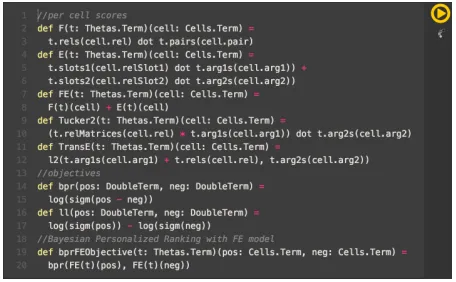
Figure 2: Implementation of various matrix and ten-sor factorization models in WOLFE.
2.1 Declarative Modeling Language
Existing PPLs primarily focus on a single represen-tation for the probabilistic models, and either do not support, or provide only inefficient implementations for other kinds of machine learning models. Thus a practitioner either has to write her own customized implementation of the models she is trying to explore, or decide apriori on the family of models she will be restricted to; both undesirable options. Instead, we introduce a probabilistic programming language that is universal in its expression of models, yet allows for efficient implementations of these models.
The design of the WOLFE language is inspired by the observation that most machine learning algo-rithms can be formulated in terms of scalar functions (such as distributions and objectives/losses), search spaces (such as the universe of possible labels) and a small set of mathematical operations such as maxi-mization, summation and expectations that operate on these functions and spaces. Using this insight, a program in WOLFEconsists of a declarative descrip-tion of the machine learning algorithm in terms of implementations of these scalar functions, definitions of the search spaces, and the use of appropriate opera-tors on these. For example, named-entity recognition tagging using conditional random fields consists of a scalar function that defines the modelscoreusing a dot product between the parameters and the sum
of node and edge features, while inference using this model involves finding the label sequence that has
themaximummodel score over all label sequences.
[image:2.612.309.537.60.201.2]ma-chine learning models. For instance, there exist a variety of matrix and tensor factorization methods for knowledge base population that have a succinct, uni-fied mathematical formulation (Nickel et al., 2015). In WOLFEthese models can be easily implemented with a few lines of code. See Figure 2 for examples of a Tucker2 decomposition, TransE (Bordes et al., 2013), and Riedel et al. (2013)’s feature model (F), entity model (E), and combination of the two (FE), either based on a log likelihood or Bayesian Person-alized Ranking (Rendle et al., 2009) objective.
2.2 Interpreter, and Efficient Implementations
In WOLFE users write models using a domain-specific-language that supports a wide range of math-ematical expressions. The WOLFEinterpreterthen evaluates these expressions. This is non-trivial as expressions usually contain operators such as the
argmaxfunctions which are, in general, intractable
to compute. For efficient evaluation of WOLFE pro-grams our interpretercompilesWOLFEexpressions into representations that enable efficient computa-tion in many cases. For example, for terms that in-volve maximization over continuous search spaces WOLFE generates a computation tree that supports efficient forward and back-propagation for automatic differentiation. Likewise, when maximizing over dis-crete search spaces, WOLFEconstructsfactor graphs that support efficient message passing algorithm such as Max-Product or Dual Decomposition. Crucially, due to the compositional nature of WOLFE, discrete and continuous optimization problems can be nested to support a rich class of structured prediction ob-jectives. In such cases the interpreter constructs nested computational structures, such as a factor graph within a back-propagation graph.
2.3 Visual and Interactive IDE
In this demonstration, we present an integrated de-veloping, debugging and visualization toolkit for ma-chine learning for NLP. The IDE is based on the read-eval-print loop (REPL) to allow quick iterations of writing and debugging, and consists of the following elements: (1) Editor (read): Users define the model and inference in the declarative, math-like language described in Section 2.1 using a syntax highlighted code editor. (2) Build Automation (eval): The use of the interpreter as described in the previous section
to provide efficient code that is executed. (3) De-bugging/Visualization (print): Our tool presents the underlying factor graph as an interactive UI element that supports clicking, drag and drop, hover, etc. to explore the structure and the factors of the model. We visualize the results of inference in a graphical manner that adapts to the type of the result (bar charts for simple distributions, shaded maps for matrix-like objects, circles/arrows for NLP data types, etc.). For further fine-grained debugging, we can also surface intermediate results from inference, for example, vi-sualizing the messages in belief propagation for each edge in the factor graph.
3 Demo Outline
The overall objective of the demo is for users to de-sign, debug, and modify a machine learning model for an NLP application, starting from scratch. The demo takes the user through all the steps of loading data, creating an initial model, observing the out-put errors, modifying the model accordingly, and rerunning to see the errors fixed: the complete set of steps often involved in real-life application of ML for NLP. We provide pre-built functions for the menial tasks, such as data loading and feature computation functions, leaving the more interesting aspects of model design to the user. Further, we include an “open-ended” option for interested users to develop arbitrary models. Based on their interest or area of ex-pertise, the user has an option of investigating any (or all) of the following applications: (1) sequence tag-ging using CRFs, (2) relational learning using MLNs, (3) matrix factorization for relation extraction, and (4) dependency parsing (for advanced users). Each of these are similar in the overall “script”, differing in the data, models, and inference algorithms used; we describe the steps of the demo using the CRF example. All of the demo applications are available online athttp://wolfe.ml/demos/nlp.
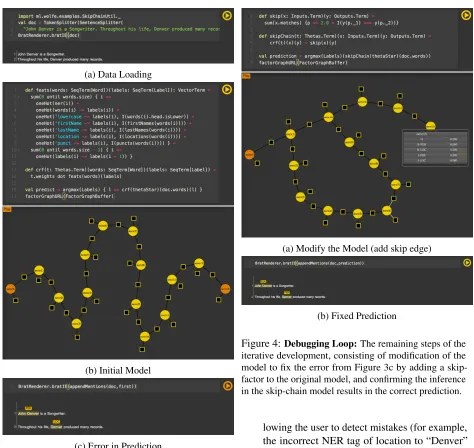
1. The first step of the demo allows the user to read as input a standard dataset of the task, and visualize instances in an easy-to-read manner. In Figure 3a for example, we show two sentences read for the purpose of sequence tagging.
(a) Data Loading
(b) Initial Model
(c) Error in Prediction
Figure 3: Model Creation and Evaluation: An exam-ple instance of the demo showing thecreationsteps, in-cluding the loading and visualization of the sentences, designing and presentation of a linear chain CRF, and Viterbi decoding for the sentences.
the purpose of debugging the model definition. The initial model for sequence tagging is a sim-ple linear chain, defined and visualized for a sentence in Figure 3b.
3. The user writes the declarative definition of in-ference, and makes predictions of the input data. The predictions are appropriately visualized,
al-(a) Modify the Model (add skip edge)
[image:4.612.69.543.54.502.2](b) Fixed Prediction
Figure 4: Debugging Loop:The remaining steps of the iterative development, consisting of modification of the model to fix the error from Figure 3c by adding a skip-factor to the original model, and confirming the inference in the skip-chain model results in the correct prediction.
lowing the user to detect mistakes (for example, the incorrect NER tag of location to “Denver” in Figure 3c).
4. The user then modifies the model (adding a skip-factor in Figure 4a) that will likely correct the mistake. The modified model is then visualized to confirm it is correct. (Optionally, the user can, at any point, visualize the execution of the in-ference to confirm the modifications as well, for example Figure 4a shows the state of messages in belief propagation.)
4 Conclusions
This demo describes WOLFE, a language, interpreter, and an IDE for easy, iterative development of com-plex machine learning models for NLP applications. The language allows concise definition of the mod-els and inference by using universal, mathematical syntax. The interpreter performs program analysis on the user code to automatically generate efficient low-level code. The easy-to-use IDE allows the user to iteratively write and execute such programs, but most importantly supports intuitive visualizations of structured data, models, and inference to enable users to understand and debug their code. The demo thus allows a user to design, debug, evaluate, and modify complex machine learning models for a variety of NLP applications.
Acknowledgments
We would like to thank Larysa Visengeriyeva, Jan Noessner, and Vivek Srikumar for contributions to early versions of WOLFE. This work was supported in part by Microsoft Research through its PhD Schol-arship Programme, an Allen Distinguished Investiga-tor Award, a Marie Curie Career Integration Grant, and in part by the TerraSwarm Research Center, one of six centers supported by the STARnet phase of the Focus Center Research Program (FCRP) a Semicon-ductor Research Corporation program sponsored by MARCO and DARPA.
References
Antoine Bordes, Nicolas Usunier, Alberto Garcia-Duran, Jason Weston, and Oksana Yakhnenko. 2013. Trans-lating embeddings for modeling multi-relational data. InAdvances in Neural Information Processing Systems, pages 2787–2795.
Noah D. Goodman, Vikash K. Mansinghka, Daniel Roy, Keith Bonawitz, and Joshua B. Tenenbaum. 2008. Church: a language for generative models. In Un-certainty in Artificial Intelligence (UAI).
Aria Haghighi and Dan Klein. 2010. Coreference reso-lution in a modular, entity-centered model. InNorth American Chapter of the Association for Computational Linguistics - Human Language Technologies (NAACL HLT), pages 385–393.
Andrew McCallum, Karl Schultz, and Sameer Singh. 2009. FACTORIE: Probabilistic programming via
im-peratively defined factor graphs. InNeural Information Processing Systems (NIPS).
Maximilian Nickel, Kevin Murphy, Volker Tresp, and Evgeniy Gabrilovich. 2015. A review of relational machine learning for knowledge graphs: From multi-relational link prediction to automated knowledge graph construction.arXiv preprint arXiv:1503.00759. Hoifung Poon and Pedro Domingos. 2007. Joint inference in information extraction. InProceedings of the 22nd AAAI Conference on Artificial Intelligence (AAAI ’07), pages 913–918.
Steffen Rendle, Christoph Freudenthaler, Zeno Gantner, and Lars Schmidt-Thieme. 2009. BPR: Bayesian per-sonalized ranking from implicit feedback. In Uncer-tainty in Artificial Intelligence (UAI).
Matthew Richardson and Pedro Domingos. 2006. Markov logic networks.Machine Learning, 62(1-2):107–136. Sebastian Riedel, Limin Yao, Benjamin M. Marlin, and
Andrew McCallum. 2013. Relation extraction with ma-trix factorization and universal schemas. InJoint Hu-man Language Technology Conference/Annual Meeting of the North American Chapter of the Association for Computational Linguistics (HLT-NAACL ’13), June. Sebastian Riedel, Sameer Singh, Vivek Srikumar, Tim
Rocktaschel, Larysa Visengeriyeva, and Jan Noessner. 2014. Wolfe: Strength reduction and approximate pro-gramming for probabilistic propro-gramming. In Interna-tional Workshop on Statistical RelaInterna-tional AI (StarAI). Richard Socher, Alex Perelygin, Jean Y Wu, Jason
Chuang, Christopher D Manning, Andrew Y Ng, and Christopher Potts Potts. 2013. Recursive deep models for semantic compositionality over a sentiment tree-bank. InEmpirical Methods in Natural Language Pro-cessing (EMNLP).