Author(s): Colm Clancy, Conor Daly, Rónán Darcy, Emily Gleeson, Alan Hally, Eoin
Whelan
This article is provided by the author(s) and Met Éireann in accordance with publisher
policies. Please cite the published version.
Citation:
Clancy C., Daly, C., Darcy, R., Gleeson, E., Hally, A., Whelan, E. Ireland: Met
Éireann Updates. ALADIN-HIRLAM Newsletter 12: 67-75, 2019.
Met Éireann Updates
Colm Clancy, Conor Daly, Rónán Darcy, Emily Gleeson, Alan Hally, Eoin Whelan
1
Introduction
Significant upgrades were made to the operational NWP suite at Met Éireann during 2018. Cycle 37h1.1 of HARMONIE-AROME had been in use since 2013. On the 1stof May 2018, Cycle 40h1 was made operational. This upgrade is detailed in Section 2. On the 15th of October, the new short-range high-resolution Irish Re-gional Ensemble Prediction System (IREPS) was implemented. Details are given in Section 3. ASCAT wind observations were added to the operational data assimilation. This is described in Section 4, while in Section 5 we discuss some of the new post-processing systems in use.
A new initiative in 2018 was the introduction of regular meetings between the model developers and the op-erational forecasters for the purposes of discussion and feedback on the performance of the HARMONIE-AROME model. This has proved successful and beneficial, and is discussed in more detail in Section 6.
Finally, an update on the Met Éireann Reanalysis project, MÉRA, is provided in Section 7.
2
Upgrade to Cycle 40
The AROME configuration of the shared ALADIN-HIRLAM NWP system, hereafter HARMONIE-AROME, is the primary model used at Met Éireann for operational short-range forecasting and additionally as a research tool. Work on upgrading from cycle 37h1.1 to 40h1 began in 2017 and the new cycle was made operational for the 1200 UTC forecast on the 1stof May 2018. The major changes with the upgrade include the use of an enlarged domain (see Figure 1) and the introduction of 3D-Var data assimilation with 3-hour cycling. The background error covariances (structure functions) were estimated using downscaled IFS EDA forecasts and only conventional observations are assimilated. Table 1 outlines the changes in the new Met Éireann operational suite.
Table 1: HARMONIE-AROME operational configurations
Previous 37h1.1 New 40h1.1
Horizontal domain 540×500, 2.5 km grid 1000×900, 2.5 km grid
Vertical levels 65 levels, 12 m up to 10 hPa 65 levels, 12 m up to 10 hPa
Timestep 60 s 75 s
Observations SYNOP SYNOP, SHIP, AIREP, BUOY & TEMP
Cut-off 45 min 45 min
Data assimilation Surface OI analysis Surface OI & 3D-Var
Forecast 54 hour forecasts at 54 hour forecasts at
0000, 0600, 1200, 1800 UTC 0000, 0600, 1200, 1800 UTC;
Boundaries IFS IFS
Figure 1: Previous operational (red) and new enlarged domain orange).
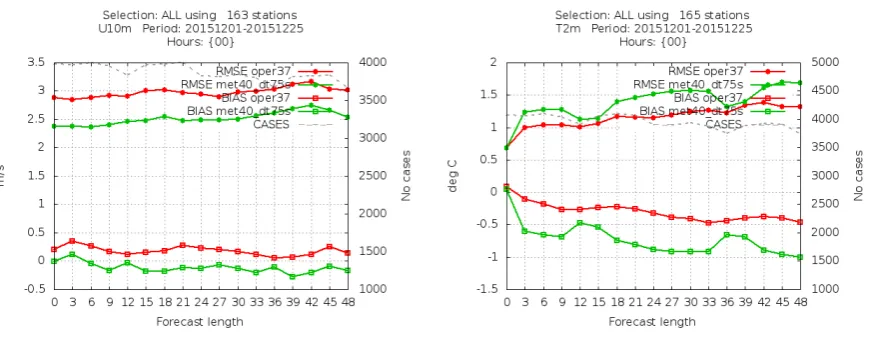
cold bias was noted in the 2 m temperatures (right), particularly during the night.
Figure 2: Point verification for December 2015 forecasts during the initial test phase of cycle 40h1.1, compar-ing the operational cycle 37h1.1 (oper37, red) and cycle 40h1.1 with default settcompar-ings (met40_dt75, green) for 10 m wind-speed (left) and 2 m temperature (right).
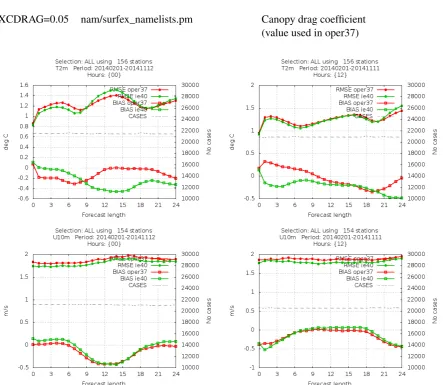
Extensive testing was carried out in an attempt to improve the performance of the near-surface temperature forecasts. Eventually we found that the cold bias could be reduced by switching off the HARATU turbulence scheme and adjusting the temperature increment (ZTINER) in the surface analysis. Unfortunately, this then led to a degradation in 10 m wind forecasts. Further changes related to surface drag were needed in order to compensate. The changes made to create our ‘optimal’ pre-operational configuration are described in Table 2. Full details and results from the testing may be found in the Technical Note of Clancy et al., 2018.
Month-long tests on the new domain with 3D-Var data assimilation were then carried out. Five months in 2014 were chosen: Febrary, April, June, September and November. Verification scores for the five months combined are shown in Figure 3. In addition to long-term statistics such as these, a number of case studies were examined. Again, full details are available in the Clancy et al., 2018. In general, the testing showed neutral to slightly better results from the cycle 40 configuration.
3
Operational Implementation of IREPS
[image:3.595.77.512.288.458.2]Table 2: Changes made to default cycle 40h1.1 for pre-operational testing
Change Affected file Description
HARATU=no sms/config_exp.h Turbulence scheme, i.e.
use default instead of HARATU
ZTINER=2.0 src/surfex/ASSIM/oi_cacsts.F90 Temperature increment in surface analysis
ZH←ZLAI/4 src/surfex/SURFEX/z0v_from_lai.F90 Increased drag from grassland by increasing
for grassland height ZH (default is ZLAI/6)
[image:4.595.71.515.209.594.2]XCDRAG=0.05 nam/surfex_namelists.pm Canopy drag coefficient (value used in oper37)
Figure 3: Point verification of 0000 UTC (left) and 1200 UTC (right) forecasts for all month-long tests com-bined, comparing the operational cycle 37h1.1 (oper37, red) and the new cycle 40 configuration (ie40, green). Parameters shown are 2 m temperature (top row) and 10 m wind-speed (bottom row).
on the MetCoOp setup of the HARMONIE-AROME-EPS branch of cycle 40h1.1. See Section 2 for details, and in particular Table 2 for local changes from the default configuration.
tuned using a coefficient or scaling factor, with the size of the coefficient dependent on the age of the forecasts with respect to the initialisation time. More details can be found in Ebisuzaki and Kalnay, 1991. Perturbations are also applied to a number of surface parameters including sea surface temperature, the temperatures of the top two soil layers, surface moisture, vegetation fraction, leaf area index, soil thermal coefficient, roughness length over land, fluxes over the sea, albedo and snow depth. The perturbation strategy follows the method outlined in Bouttier et al., 2015.
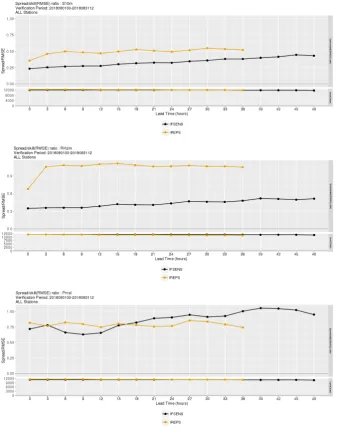
[image:5.595.131.469.236.669.2]Objective verification of IREPS versus the IFS ensemble (IFSENS) demonstrates the increased skill in the high-resolution limited-area-model EPS (IREPS) compared to the coarser high-resolution global EPS. Examples of this can be seen in Figure 4. The spread/skill ratios for 10 m wind speed and 2 m relative humidity are significantly improved. IFSENS continues to have an advantage in terms of MSLP for forecast lengths greater than 18 hours, but this is not an unexpected result as global EPSs generally capture larger-scale structures more accurately.
Figure 4: Spread-skill ratios for August 2018 for IREPS (orange) and IFSENS (black) for 10 m wind speed, 2 m relative humidity and Mean-Sea-Level-Pressure (MSLP).
2018.
4
Assimilation of ASCAT winds
[image:6.595.86.508.218.365.2]The assimilation of ASCAT wind observations from the Metop-A and Metop-B satellites was evaluated for the Irish domain. Typical data coverage plots for ASCAT observations are shown in Figure 5. A three-week period in April 2018 was used to validate the usefulness of these observations. No changes were made to the default settings relating to the assimilation of these observations.
Figure 5: ASCAT data coverage for 1200 UTC April 2nd 2018 (left) and 0000 UTC April 3rd right. The operational HARMONIE-AROME domain is shown in dark grey.
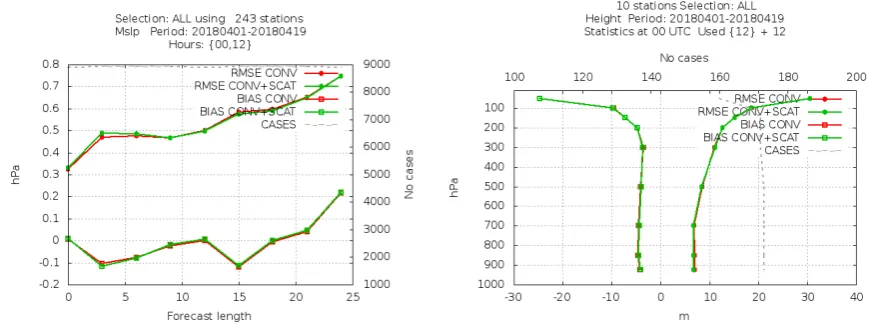
Forecasts produced (April 1st- April 19th) at 0000 UTC and 1200 UTC each day were verified against SYNOP and TEMP observations. Verification scores (mean bias and RMSE) for the period indicated a neutral im-pact on forecast quality when averaged over the test period. Figure 6 shows average scores for forecasts of MSLP compared with SYNOP observations and forecasts of geopotential compared with 1200 UTC TEMP observations.
Figure 6: Verification scores comparing conventional only (CONV, red) and conventioal plus ASCAT (CONV+SCAT, green) experiments. MSLP forecasts from both experiment (left) are verified against SYNOP (no SHIP) observations. Forecasts of geopotential (right) are verified against TEMP (land only) observations.
[image:6.595.76.516.495.657.2]of different observation types (SYNOP including SHIP, AIREP, BUOY, TEMP and SCATT) is measured using the MTEN norm. Assuming forecasts produced by the control with all observations assimilated, MTEN values provide a measure of the negative impact of the denial of each observation type. For 1200 UTC (Figure 7 left) MTEN values suggest that ASCAT observations are as important as AIREP observations. For 0000 UTC, with fewer ASCAT (and AIREP) observations, forecasts are less sensitive to the denial of these observations. The assimilation of ASCAT observations was implemented operationally with the introduction of IREPS.
Figure 7: MTEN for forecasts based on data denial experiments for 20180402 1200 UTC (left) and 20180403 0000 UTC (right). SYNOP (red) indicates SYNOP observations have not been assimilated, AIREP (blue) and so on.
5
Postprocessing
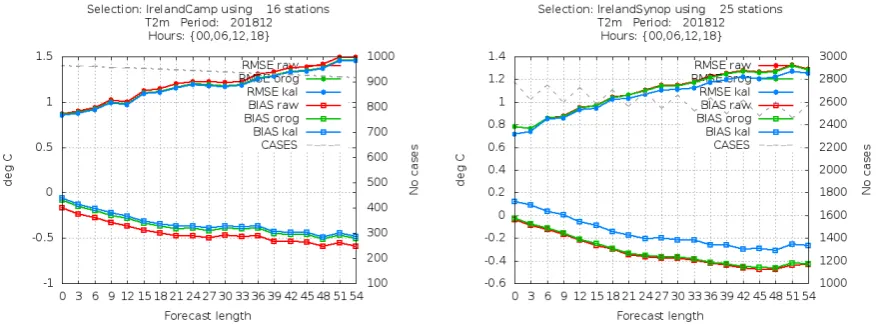
[image:7.595.73.515.539.703.2]Postprocessing of 2 m air temperature is done by downscaling the HARMONIE-AROME data to a 500 m grid with orographic correction from HARMONIE-AROME orography to a 60 m DEM over the island of Ireland. Further adjustment is then done by use of a Kalman filter on observed temperatures followed by kriging with a 30 km influence radius. These data are made available for verification with some measure of success seen. Figure 8 shows the effect of Kalman filtering on points which contributed to the adjustment (right) and the effect of orographic correction on points which did not contribute to the Kalman filter (left).
Figure 8: Point verification of orographic correction (left) and Kalman filtering (right). Parameter shown is 2 m temperature. Raw forecast is shown in red, orographic correction in green and Kalman filter in blue.
Postprocessed data is used to drive a point forecast system accessible athttps://www.met.ie.
6
NWP developer/user Working Group at Met Éireann.
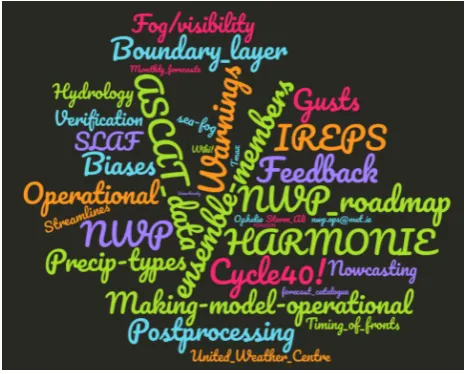
[image:8.595.181.414.240.427.2]In March 2018 we held a workshop to exchange knowledge and enhance communication between users and developers of NWP at Met Éireann. Since then we have held monthly meetings which involve discussions on successful and unsuccessful HARMONIE-AROME forecasts, known issues in the model, model evaluation and verification, what is required to make a model operational, physical parametrizations, the IREPS ensemble and many other topics. Feedback from NWP users (i.e. forecasters at Met Éireann) has been very positive and overall the meetings have vastly improved the flow of information and feedback between the two groups.
Figure 9: Some of the topics discussed at the NWP user/developer monthly meetings at Met Éireann!
7
MÉRA - Met Éireann Reanalysis
The production of the Met Éireann regional reanalysis (MÉRA, Whelan et al., 2018) is still ongoing. We currently have output spanning 1981 to February 2018. MÉRA production will cease later in 2019 when ERA5 supercedes ERA-Interim and ECMWF stop the production of ERA-Interim.
A successful workshop for users and stakeholders of the MÉRA dataset was held in May 2018 (https:
//www.met.ie/science/events/mera-workshop) and consisted of 15 talks on topics ranging from
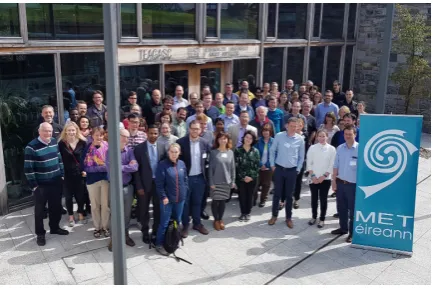
wind/solar energy to potato and tomato blight to air quality monitoring. The workshop attracted speakers from Canada, the UK and the Netherlands. Extended abstracts have been published in Gleeson and Whelan, 2018. A second workshop will be held on May 2nd2019.
Figure 10: First MÉRA Workshop held in May 2018.
8
Summary and Outlook
The past year has seen many operational NWP developments that have put Met Éireann in a better position to provide the best short-range forecasts of high impact weather for the Ireland. The use of 3D-Var and the as-similation of non-conventional observations coupled with the implementation of a high resolution EPS would not have been possible without the scientific and technical developments undertaken by HIRLAM-C, ALADIN and Météo France. Met Éireann’s operational NWP capabilities will be enhanced further with future collab-oration and cooperation. In 2018 Met Éireann signed a memorandum of understanding, along with 9 other European countries, regarding joining forces for operational weather forecasting. The new collaboration is known as United Weather Centres (UWC). Ireland will initially join Denmark, Iceland and the Netherlands to form UWC-West in 2022 and will merge with UWC-East (MetCoOp, Estonia, Latvia and Lithuania) in 2027. Further information on UWC is available in the following article by Dick Blaauboer and Jørn Kristiansen: https://www.emetsoc.org/uwc-short-range-weather-forecasts/.
A minor suite upgrade is planned in spring 2019. There will be an update to IREPS to introduce initial condition perturbations using the PertAna approach. This approach involves adding perturbations to the analysis of each ensemble member. The assimilation of AMSU-A, MHS and IASI radiance observations will be enabled. Tests have also been carried out with a quadratic spectral grid. No significant reduction in accuracy has been found, and so it is planned to implement this for the benefit of computational efficiency.
The assimilation of Mode-S aircraft derived observations retrieved from locally installed receivers and GNSS observations produced by E-GVAP will also be evaluated in the coming year. Nowcasting activities in Met Éireann have started with the recruitment of a dedicated Nowcasting scientist. Nowcasting techniques and the use of crowd-source observations will be investigated. The operational implementation of CY43 is planned for later in 2019. Following the decision by ECMWF Council to make the SAPP (Scalable Acquisition and Pre-Processing) system available by means of an Optional Programme, Met Éireann plan to make the system operational during 2019.
The coming year will bring many exciting challenges for the Irish NWP team!
9
References
Bouttier, F., L. Raynaud, O. Nuissier, and B. Ménétrier, 2015: Sensitivity of the AROME ensemble to initial and surface perturbations during HyMeX. Quart. J. Roy. Meteor. Soc., 142, 390-403, doi:https://doi.org/10.1002/qj.2622
technical-notes
Ebisuzaki, W., and E. Kalnay, 1991: Ensemble experiments with a new lagged average forecasting scheme. WMO Research Activities in Atmospheric and Oceanic Modeling Rep. 15, 308 pp
Emily Gleeson, Eoin Whelan [editors], Julian Aherne, Hazel Cathcart, Laura Cooke, Joao Correia, Joan de Lacy, Frédéric Dias, Eadaoin Doddy, Jason Flanagan, Graham Florence, Sarah Gallagher, Edward Graham, Seánie Griffin, Jelena Janjic, Chris Kidd, Eoin Lettice, Frank McDermott, Owen Naughton, Paul Nolan, Conor Sweeney, Christopher Werner, Kayla Wilkins, ‘MÉRA Workshop Proceedings’, Met Éireann, 2018-10-09
Nielsen, K.P.; Gleeson, E. Using Shortwave Radiation to Evaluate the HARMONIE-AROME Weather Model. Atmosphere 2018, 9, 163.
Storto, A. and Randriamampianina, R., 2010: The relative impact of meteorological observations in the Nor-wegian regional model as determined using an energy norm-based approach. Atmosph. Sci. Lett., 11: 51-58. doi:10.1002/asl.257