A Method to Generate a Machine-Labeled Data for Biomedical
Named Entity Recognition with Various Sub-Domains
Juae Ki
𝐦
𝟏, Sunjae Kwo
n
1, Youngjoong Ko
2, and Jungyun Seo
1Computer Science, Sogang University, Sinsu-dong 1, Mapo-gu, Seoul, Korea
1Computer Engineering, Dong-A University, 840 Hadan 2-dong, Saha-gu, Busan, Korea
2{juaekim, soon91jae , seojy}@sogang.ac.kr
1,
[email protected]
2Abstract
Biomedical Named Entity (NE) recognition is a core technique for various works in the biomedical domain. In previous studies, us-ing machine learnus-ing algorithm shows better performance than dictionary-based and rule based approaches because there are too many terminological variations of biomedical NEs and new biomedical NEs are constantly gen-erated. To achieve the high performance with a machine-learning algorithm, good-quality corpora are required. However, it is difficult to obtain the good-quality corpora because annotating a biomedical corpus for machine-learning is extremely time-consuming and costly. In addition, most previous corpora are insufficient for high-level tasks because they cannot cover various domains. Therefore, we propose a method for generating a large amount of machine-labeled data that covers various domains. To generate a large amount of machine-labeled data, firstly we generate an initial machine-labeled data by using a chunker and MetaMap. The chunker is de-veloped to extract only biomedical NEs with manually annotated data. MetaMap is used to annotate the category of biomedical NE. Then we apply the self-training approach to bootstrap the performance of initial machine-labeled data. In our experiments, the biomed-ical NE recognition system that is trained with our proposed machine-labeled data achieves much high performance. As a result, our system outperforms biomedical NE recognition system that using MetaMap only with 26.03%p improvements on F1-score.
1
Introduction
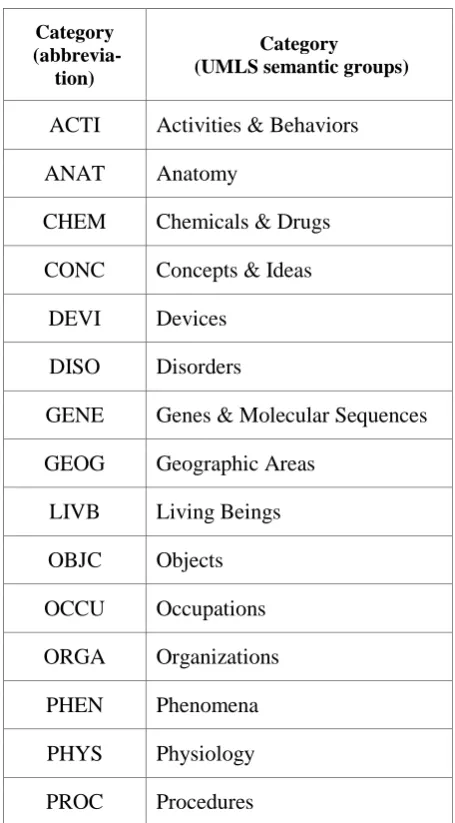
Table 1: UNLS semantic groups
egories were limited to specific sub-domains of biomedicine in each corpus. For example, the bi-omedical NE recognition system that trained with GENIA corpus (Kim et al., 2003), only cover the gene and protein subdomain.
Therefore, we propose a method for creating the automatically labeled corpus that covers vari-ous domains. The biomedical NE recognition sys-tem that is trained with our proposed machine-labeled corpus can extract biomedical NEs in var-ious domains.
We utilize the open source biomedical NE recognition tool, MetaMap (Aronson, 2001) to provide various biomedical information as catego-ries. MetaMap extracts biomedical NEs from raw texts and matches them into semantic types of UMLS. Unified Medical Language System (UMLS) (Lindberg et al., 1993) is a thesaurus that
provides the biomedical NEs and their semantic categories as an annotation. UMLS includes an amount of concept categories and a semantic net-work likes UMLS semantic type. Similar UMLS semantic types are grouped into UMLS semantic group. In this paper, we regard the annotation of biomedical NEs as UMLS semantic group. Table 1 shows UMLS semantic groups. UMLS semantic groups cover not only gene and protein but vari-ous sub-domains such as anatomy, procedure, and medical device. Biomedical NEs and their seman-tic types from MetaMap are usefully used in bio-medical QA systems and biobio-medical topic model-ing systems that require similarity of biomedical terms. MetaMap is a useful tool to analyze the bi-omedical text, however, there are several limita-tions (Zhang and Elhadad., 2013) because UMLS covers the huge knowledge and there are a lot of newly generated biomedical NEs in a real world. First, MetaMap extracts not only biomedical NEs but also common entities or even verbs that are not biomedical NEs clearly. Second, MetaMap does not resolve the ambiguity of UMLS semantic group types without context. That is, one entity can have several annotations. This limitation is ‘ambiguity problem’ in this paper. Finally, if some biomedical NE is not recorded in UMLS thesau-rus, MetaMap cannot assign UMLS semantic group. We named this limitation ‘out–of– vocabulary problem’. Thus, we present how to develop an effective biomedical NE recognition system by applying the advantages and overcom-ing the limitations of MetaMap.
We had been devised NE recognition system find the similarity of biomedical NEs in a query and biomedical NEs in candidate answer in bio-medical QA system based on information retrieval (Lee et al., 2016). This QA system is entered for 2016 BioASQ challenge (Tsatsaronis et al., 2012).
2
Proposed Method
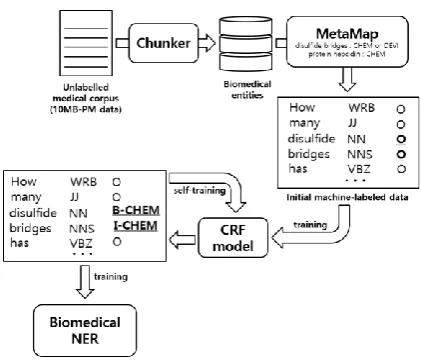
To overcome limitations of MetaMap, we propose a method to automatically construct a biomedical NE recognition data using a small amount of la-beled data, a large amount of unlala-beled data and MetaMap. Firstly, we develop a chunker learned by a small amount of biomedical training data an-notated by the people. This chunker is used to generate the labeled training data for the self-training approach. The chunking results of unla-beled biomedical corpus become the inputs of MetaMap. Then the outputs of MetaMap, UMLS
Category (abbrevia-tion)
Category
(UMLS semantic groups)
ACTI Activities & Behaviors ANAT Anatomy
CHEM Chemicals & Drugs
CONC Concepts & Ideas DEVI Devices
DISO Disorders
GENE Genes & Molecular Sequences GEOG Geographic Areas
LIVB Living Beings
OBJC Objects OCCU Occupations ORGA Organizations
PHEN Phenomena
Figure 1: Overview of proposed method
semantic types, become match the UMLS seman-tic groups are used to make an initial machine-labeled data. We develop a biomedical NE recog-nition system with initial machine-labeled data and conditional random fields (CRF) classifier. The initial machine-labeled data has a form of semantic role labelling with an IOB2 format. This classifier is an initial model for self-training. Our proposed self-training process is described in Sec-tion 2.2. During self-training, this process is re-peated, and then overcome the ambiguity problem and out–of–vocabulary problem.
Figure 1 shows the example of overcoming the ambiguity problem. In initial machine-labeled da-ta, ‘disulfide bridges’ denoted by underline has a ‘O’ tag, but after the self-training process the enti-ty, disulfide bridges, has a ‘CHEM’ tag.
2.1
Initial Machine-Labeled Data
In this section, we present the method for generat-ing the initial machine-labeled data for self-training. We propose a semi-supervised approach using MetaMap, a small amount of labeled train-ing data and a large amount of unlabeled data to generate a large amount of machine-labeled train-ing data. The unlabeled data is randomly selected titles and abstracts from the PubMed biomedical articles. In this paper, we call the unlabeled data as a 10MB-PM data.
In order to generate training data, we first de-velop a chunker to overcome the problem that MetaMap extract several entities even if they are not biomedical NEs. The chunker is developed with a small amount of labeled data. The NE can-didates of the 10MB-PM data are chunked by the
chunker and then only the NE chunks are exploit-ed as the input of MetaMap to label biomexploit-edical NEs.
We now explain how to create a large amount of initial machine-labeled data with the analysis results of MetaMap. NE chunks from the chunker are used as the input of MetaMap and then Met-aMap analyses their semantic types. We mapped 133 UMLS semantic types to 15 UMLS semantic groups depanding on semilarity. The semantic groups are regarded as annotation of biomedical NEs. If MetaMap outputs only one semantic group type for a biomedical NE chunk, we assume that this semantic group type is a correct annota-tion of the NE chunk. In this case, each word of the NE chunk is labeled by B or I tag with UMLS group as annotation. For example, there is a NE chunk ‘protein hepcidin’ from 10MB-PM data. The output of MetaMap as semantic group type of ‘protein hepcidin’ is ‘CHEM’. To generate auto-matically labeled data, we tag the ‘B-CHEM’ to ‘protein’ and ‘I-CHEM’ to ‘hepcidin’. However, in some cases, MetaMap outputs several semantic groups or no group type for an input NE chunk. In these cases, the NE chunks are not considered as a biomedical NEs and their words are initially la-beled by O tags. We try to recover them in order to generate a robust machine-labeled data through the self-training.
2.2
Self-training
The self-training approach is one of the semi-supervised learning. In Self-training, a classifier is trained with the manually annotated data. Then the unlabeled data is input the classifier. All or part of a result of the classifier is used as a train-ing data.
con-ducted until the performance of the classifier is converged. In each repeated step, new labeled bi-omedical NEs are added in the training data.
In case of biomedical NE chunk that has the ambiguity problem or out-of-vocabulary problem, we cannot make a decision to the categories of that NE chunks. Thus we annotate the O tag to that NE chunk. In other words, entities that have ambiguity UMLS semantic group or no UMLS semantic group cannot exist in automatically la-beled data. However, their categories are recov-ered appropriate tag by proposed self-training. It is the main reason that the proposed NE recogni-tion system showed high recall scores in our ex-periments.
For example, the word, ‘drisapersen,’ is bio-medical NE of the drugs but this entity is not rec-orded in the UMLS thesaurus. After executing our self-training procedure, the word ‘drisapersen’ and its semantic group type, ‘CHEM,’ are analyzed as a correct biomedical NE; ‘CHEM’ is a chemical category as a semantic group type that includes drugs, protein, steroid, vitamin, and others.
3
Experiments
3.1
Experimental Settings
We constructed a manually annotated dataset that consists of 1,249 biomedical question/answer pairs from BioASQ 2015 and 2016. A half of the annotated data was used as a training data and the other data was used as a test data. The test dataset is composed of 624 question/answer pairs and 1,492 biomedical NEs. In test data, there are 1,492 biomedical NEs. The 10MB-PM data is organized by 7,629 PubMed articles that are arbitrary select-ed. To evaluate the quality of machine-labeled da-ta, we evaluated biomedical NE recognition sys-tems that are trained with the machine-labeled da-ta of each self-training iteration with precision, re-call, and f1-score.
3.2
Experimental Result and Evaluation
‘MetaMap’ in the first row is a model that is used MetaMap as biomedical NE recognition system. We input the raw text into MetaMap, and then evaluated the performance. An ‘Initial model’ is the model that is trained with initial machine-labeled data. The initial machine-machine-labeled data is generated by applying chunker and MetaMap. A ‘Second-iteration model’ in the third row means
self-training model with initial model. Row 4-6 are result of models that each iteration of self-training.
In Table 2, the initial model shows much-improved performance. The performance of Met-aMap is much lower than the initial model. In par-ticular, the precision score of MetaMap is much worse than recall score because it outputs com-mon nouns and verbs as biomedical NEs. On the other hand, the chunker used in initial model is trained to extract only biomedical NEs with a small amount of manually annotated data. That is why the precision score of initial model is more improved than MetaMap.
To recover NE entities with ambiguity and out-of-vocabulary, the self-training procedure is de-veloped in our biomedical NE recognition system. The performance changes of self-training accord-ing to the number of iteration times are shown in row 2 to row 6 in Table 2. The best performance was obtained in the third iteration. The perfor-mance of third ST model and fourth ST model is a lower than second ST model. That is conducting the too much self-training makes some decrease of performance because noises can be generated by recovering the wrong biomedical NEs. With the self-training method, we can increase the F1-score from 68.04% to 69.91%.
Model Precision Recall F1-score
MetaMap 34.98% 58.8% 43.88%
Initial model 83.01% 57.64% 68.04%
Second iteration model 79.93% 60.32% 68.75%
Third iteration model 79.91% 62.13% 69.91%
Fourth iteration model 77.85% 59.58% 67.50%
Fifth iteration model 71.88% 49.87% 58.88%
Table 2: The performance changes according to our proposed method
4
Conclusion and Future Work
the cost to generate a data for the biomedical NE recognition systems can be reduced. Since Met-aMap as an open toolkit is used, developers can build up the biomedical NE recognition systems without expert’s help in biomedical domains.
As a future work, we plan to apply deep neural network techniques to construct the biomedical NE recognition systems.
Acknowledgement
This research was supported by the MISP(Ministry of Science, ICT & Future Plan-ning), Korea, under the National Program for Ex-cellence in SW)(2015-0-00910) supervised by the IITP(Institute for Information & communications Technology Promotion)
References
Alan R. Aronson. "Effective mapping of biomedical text to the UMLS Metathesaurus: the MetaMap program." Proceedings of the AMIA Symposium. American Medical Informatics Association, 2001. Jin-Dong Kim, Tomoko Ohta, Yuka Tateisi, and
Jun’ichi Tsujii. "GENIA corpus—a semantically annotated corpus for bio-textmining." Bioinformat-ics, 19(1), 2003, i180-i182.
Hyeon-gu Lee, Minkyoung Kim, Harksoo Kim, Juae Kim, Sunjae Kwon, Jungyun Seo, Jungkyu Cho, and Yi-reun Kim. "KSAnswer: Question-answering System of Kangwon National University and Sogang University in the 2016 BioASQ Chal-lenge." ACL 2016, 2016, pp.45-49.
Lishuang Li, Liuke Jin, Zhenchao Jiang, Dingxin Song, and Degen Huang. "Biomedical named enti-ty recognition based on extended recurrent neural networks." Bioinformatics and Biomedicine (BIBM), 2015 IEEE International Conference on. IEEE, 2015.
Lishuang Li, Liuke Jin, Yuxin Jiang, and Degen Huang. "Recognizing Biomedical Named Entities Based on the Sentence Vector/Twin Word Embed-dings Conditioned Bidirectional LSTM." China National Conference on Chinese Computational Linguistics. Springer International Publishing, 2016.
Donald A. Lindberg, Betsy L. Humphreys, and Alexa T. McCray. "The Unified Medical Language Sys-tem." IMIA Yearbook, 1993, pp.281-291.
Leaman Robert, Chih-Hsuan Wei, and Zhiyong Lu. "tmChem: a high performance approach for
chemi-cal named entity recognition and normalization." Journal of cheminformatics, 7(1), 2015.
George Tsatsaronis Michael Schroeder, Georgios Paliouras Yannis Almirantis, Ion Androutsopoulos, Eric Gaussier, Patrick Gallinari Thierry Artieres, Michael R. Alvers Matthias Zschunke, and Axel-Cyrille Ngonga Ngomo. "BioASQ: A Challenge on Large-Scale Biomedical Semantic Indexing and Question Answering." AAAI fall symposium: In-formation retrieval and knowledge discovery in bi-omedical text, 2012.
Zhiqiang Zeng, Hua Shi, Yun Wu, and Zhiling Hong. "Survey of natural language processing techniques in bioinformatics." Comp Math Methods Med 2015, article 674296.