THE ECONOMIC AND SOCIAL RESEARCH INSTITUTE
COUNCIL
DONAL NEVIN, President of the Institute. JOSEPH F. HAP, FORD, Chairman of the Council.
DAVID BEGG, General Secretary, Irish Congress of Trade Unions.
G.T. PAUL CONLON, Chairman, ESRI Fund-Raising Committee 1995-2000. TOM CONSIDINE, Secretaly General, Department of Finance.
DONAL de BUITLEIR, General Manager, Office of the Chief Executive, AIB Group plc. CONNELL FANNING, Professor, Department of Economics, University College, Cork. MARY FINAN, Managing Director, Wilson Hartnell Public Relations Limited.
MAUREEN GAFFNEY, Chairperson, The National Economic and Social Forum. DONAL GARVEY, Director General, Central Statistics Office.
PATRICK GEARY, Professol, Department of Economics, National University of Ireland, Maynooth.
BRIAN GEOGHEGAN, Director of Economic Affairs, Research and Information, IBEC. PAUL HARAN, Secretary General, Department of Enterprise, Trade and Employment. JOHN HURLEY, Governor, Central Bank of Ireland.
JOHN HYNES, Secretary General, Department of Social and Family Affairs. MICHAEL KELLY, SecretalT General, Department of Health and Children. ALAN MATTHEWS, Ptvfessol, Department of Economics, Trinity College Dublin. MICHAEL J. MEAGHER,former Directol, Bank of Ireland.
STEPHEN MENNELL, Professol, Department of Sociology, University College Dublin. TOMAS F. 6 COFAIGH, President of the Institute, 1987-1995.
MARIE O’CONNOR, Partnel, PricewaterhouseCoopers.
WILLIAM ROCHE, Professol , The Michael Smurfit Graduate School of Business, University College Dublin.
ROELOF SCHIERBEEK, Chairman, Northern Ireland Economic Research Centre. NOEL SHEEHY, Professor, Department of Psychology, Queen’s University of Belfast. EDMOND SULLIVAN, Second Secretary General, Department of Finance-PSMD. T.K. WHITAKER, President of the Institute 1971-1987.
BRENDAN J. WHELAN, Director of the Institute.
PADRAIC A. WHITE, Chairman, Northside Partnership Limited.
MEDIUM-TERM
REVIEW
2003-2010
ADELE BERGIN
JOE CULLEN DAVID DUF~
JOHN FITZ GERAID
IDE KFARNEY
DANIEL MCCOY
JULY 2003 NUMBER 9
Copies of this paper may be obtained from The Economic and Social Research Institute (Limited Company No. 18269). Registered Office." 4 Burlington Road, Dublin 4.
www.esri.ie
Authors
MEDIUM-TERM
REVIEW
2003-2010
ADELE BERGIN
JOE CULLEN DAVID DUFFY
JOHN FITZ GERALD
IDE KFARNEY
DANIEL MCCOY
© THE ECONOMIC AND SOCIAL RESEARCH INSTITUTE DUBLIN, 2003
A CKNO WLEDGEMENTS
Work on this year’s Medium-Term Review has been a lengthy process, which involved many experts both from within and outside of The Economic and Social Research Institute. In preparing the Review for publication the authors have drawn heavily on the expertise of the Director and staff of the ESRI.
Over the last six months, the authors have been in contact with several leading institutions and expel~s from various fields of the economy. Such meetings, as always, proved to be more than useful. In particular we would like to thank the Depal, ment of Finance, Teagasc, Forffts, the CIF, the CSO, the ESB, IBEC, EIRGRID, John Beggs, Oliver Mangan, and Jim Power.
Once again the National Institute of Economic and Social Research, London, proved to be invaluable in offering advice and in allowing us access to their global econometric model, NiGEM which enabled us to formulate the External Environn~ent section of this year’s Review, as well as allowing us to carry out various shocks in the model.
The last word of thanks goes to Pat Hopkins, Regina Moore, MaW Cleary and Deirdre Whitaker all of the ESRI, because without their professionalism, expertise and attention to detail, publication would simply not have been possible.
CONTENTS
A CKNO 1~EDGEMENTS
SUMMARY
Chapter
1 INTRODUCTION
2 BACKGROUND ECONOMIC ENVIRONMENT AND ASSUMPTIONS
3 THE BENCHMARK FORECAST
4 SHOCKS AND SURPRISES
5 CONCLUSIONS
REFERENCES
APPENDICES
THE ESRI MEDIUM-TERM MODEL
FORECASTING RECORD OF THE MEDIUM-TEFOlJREVIEW
DATA APPENDIX
Page
IV
vii
1
9
25
70
81
9O
92
104
107
SUMMARY
Introduction In the mid-1990s, when Ireland’s period of exceptional growth began, there
were some who feared that it was a mirage and that, as the dust settled, Ireland would wake up and find that the growth in output had never happened. However, as successive years of growth built into a boom, such fears were seen to be groundless. One of the clearest manifestations of the real success of the 1990s was the rapid move from high unemployment in the first half of the decade to a period of full employment at its end.
Today, after almost two years of slow growth with rising unemployment, expectations as to future prospects are veW much reduced. The current relative gloom is deepened by the obvious difficulties facing our Euro area partners. Looking forward, there is continuing concern that the current downturn represents a definitive end to the Irish success stoW of the late 1990s. Like Icarus,’ has the Irish economy melted its wings by flying too close to the sun and is a crash-landing likely? In this Review we argue that even if Icarus has singed his wings, the prospects remain reasonably bright for a "soft landing". Provided that the world economy, and especially the European economy, finds it way back to its normal growth path by 2005, the factors that gave rise to the veW rapid growth in the last decade are not yet exhausted, and the Irish economy still has the potential to grow at 5 per cent a year for another five years to the end of the current decade. As a result, after the current period of underperformance, there could be a corresponding period of catch-up, to return the economy to full employment. Once the unused potential is exhausted, possibly around the turn Of the current decade, the Irish economy would then revert to a more sedate European and US pace, growing at around 3 per cent a year. Whether this potential is realised depends, firstly, on a recoveW in the EU economy to realise its growth potential and, secondly, on a restoration of domestic competitiveness. Because of the uncertainty that is inevitably attached to forecasting, it is very important to look at a number of different scenarios to get a feel for the range of possible outcomes. While we believe that the most likely outcome is that portrayed in the Benchmark forecast in Chapter 3, the one certainty is that reality will prove rather different.2 As a result, in Chapter 4 we look at what might go wrong and what might go right, both externally and domestically, and how alternative scenarios might change the prospects for the economy over the course of the decade.
The Benchmark forecast and the likely margin of error that attaches to it, as discussed in Chapter 4, should inform policy makers as to how best to prepare the economy for the demands of an uncertain and evolving external environment. Policy should be formed so as to be robust in the face of quite a wide range of possible outcomes. It would be dangerous to stake success on any one scenario, even on the scenario we consider to be the most likely outcome, the Benchmark forecast of Chapter 3.
In Greek mythology Icarus made a set of wings and learnt to fly. His father Daedalus tittered frequent warnings about the dangers of soaring too high towards the sun. Like many kill joys (and many fathers) he was ignored! When the sun melted the wax holding Icarus’ wings together he crashed into the sea, with fatal consequences.
2 Appendix 2 looks at the Medium-Term Reviezds track record over the last seventeen years.
VIII MEDIUM-TEIhM REVID,V 2003-2010
Background Assumptions
While some serious policy mistakes have been made domestically over the last five years, the primaw cause of today’s slowdown lies outside the count1T. The rather different problems affecting the US and the Euro area economies in the short term provide aveW unfavourable environment for an economy as open as Ireland’s.
As we saw in the last Medium-Term Review in 2001, the US economy was on an unsustainable growth path, with a rapidly rising external deficit, even before the events of September 11th. As discussed in Chapter 2, the change in the euro-dollar exchange rate that has occurred in recent months will go some way to easing this problem, but it will still leave dangerous imbalances in the US. In the case of the Euro area economy, the problems with competitiveness, inefficiency, and the deteriorating public finances have all contributed to a prolonged period of underperfomance.
The recent rapid appreciation in the euro, along with falling oil prices, has imparted a strong deflationaw impulse to the Euro area. On top of the existing problems of the Euro area economies, this will further reduce profitability and competitiveness on the wider world market. As a result, it seems unlikely that there will be a strong European recovew before 2005. However, in spite of the prevailing pessimism, we see the European economy as having the potential to grow at up to 3 per cent a year once the current difficulties are resolved. The financial imbalances present in the US economy are not present in the same way in the EU.
Domestically, a nunlber of demographic factors that made the boom of the late 1990s possible, especially the growth in the skilled labour supply, still may raise Ireland’s potential growth rate above that of its neighbours (Chapter 2). The growth in labour supply could average around 2 per cent a year to the end of the decade, with the unskilled labour supply falling and the bulk of the increase concentrated among those with a third level education.
The falling dependency rate will continue out to the end of the decade. This will ease the pressures on the public sector, while at the same time greatly enhancing the output potential of the economy. The natural increase in the population will also remain elevated relative to our EU partners because of the legacy of high birth rates in previous decades. Immigration, which has played a positive role in enhancing labour supply and the productivity of the labour force, is likely to continue out to the end of the decade.
The Benchmark Forecast
The economy has the potential to grow quite rapidly for another five years. While it is likely to be much less vibrant than in the boom years of 1994-2001, it will nonetheless be well above the dreams of our EU neighbours. This potential for quite rapid growth is due to the key demographic factors remaining favourable, and also to related factors affecting the productivity of the labour force.
SUMMARY IX
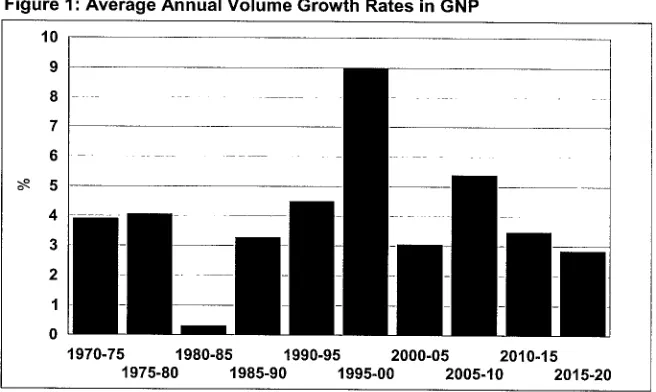
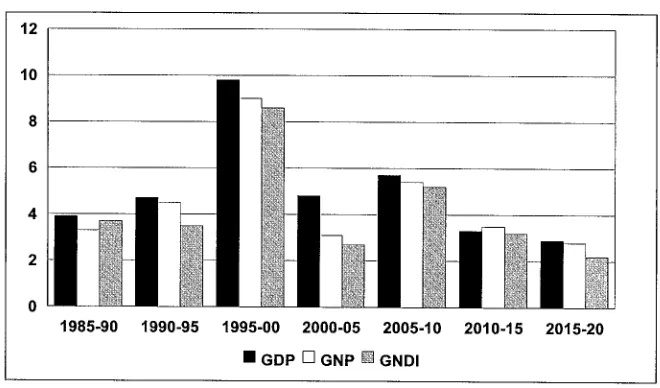
[image:10.585.187.515.407.603.2]half (Figure 1). After 2010, the growth rate will slow to around 3 per cent a year, reflecting the changed demographic circumstances.
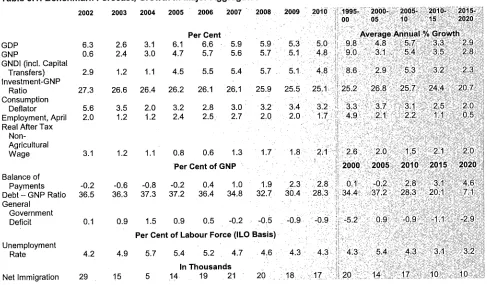
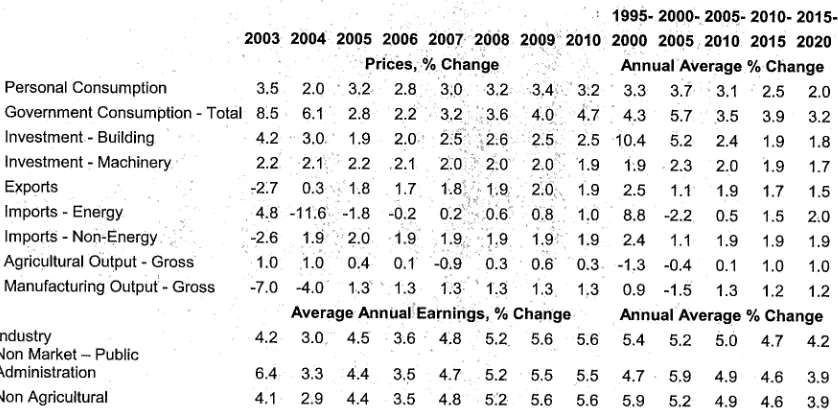
Table 1: Benchmark Forecast, Major Aggregates
Non-AgdcUi{u wage
-Balance of " ~,. Payments :’: : Debt ~ GNPRaiio General
Government
Deficit 0.1
Unemployment
Rate 4,2
Net Immigration: ~ ;
Figure 10 9 8
7
6 o~ 5 4 3 2 1 0
1 : Average Annual Volume Growth Rates in GNP
1970-75 1980-85 1990-95 2000-05 2010-15 1975-80 1985-90 1995-00 2005-10 2015-20
Whether this potential for a return to rapid growth will be realised will depend partly on the external environment, but also to a very significant extent on the competitiveness of the economy. The veW rapid inflation in
x MEDIUM-TERM REVIEW 2003-2010
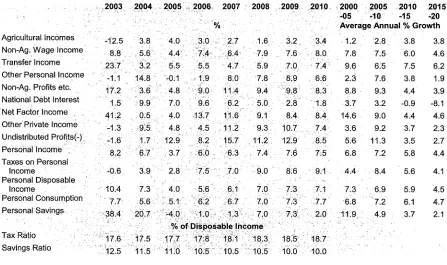
per cent next year.3 Depending on how consumer prices react, the pass through into lower inflation could be even more dramatic than we have forecast. The more rapidly that the domestic price level, including wage rates, adjusts to the changed circumstances, the lower will be the level of economic disruption from the recent exchange rate changes. In this Review, in line with past behaviour under similar circumstances, we see the rate of increase in wage rates averaging 3.5 per cent a year between 2004 and 2006. Whether this will represent a sufficiently rapid downward adjustment in inflation to restore competitiveness in the face of the exchange rate shock that has recently occurred is still open to question.
Employment growth has slowed over the last two years and the rise in unemployment has to date only been kept down by adjustments to hours worked and to the participation rate. Unemployment is likely to continue rising until the Euro area begins to recover in 2005. However, given the flexibility of the labour market, a period of more rapid growth after 2005 should restore full employment by the end of the decade.
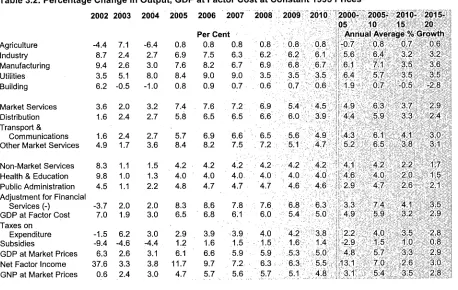
The manufacturing sector will be less of an engine for growth than in the past. While we see a return to quite rapid growth, by EU standards, for the high-technology sector between 2005 and 2010, this will be on a much more moderate scale than was experienced in the 1990s. This reflects the fact that the sector is now quite large relative to the rest of industry and the economy as a whole. In any event, with more constrained labour supply and infrastructural resources than in the 1990s, the economy could not absorb the level of foreign direct investment (FDD seen over the last decade. In addition, as jobs become higher paid, requiring higher skills, they tend to move off the production floor into offices and laboratories - the market services sector. This is the pattern in all the main world economies that enjoy a veW high standard of living. In the long run Ireland is unlikely to be an exception to this pattern.
While gradually declining in significance, manufacturing will still remain extremely important until the end of the decade. However, policy must prepare for a situation where the "baton" will pass to the market services sector from the manufacturing sector, requiring a changing approach to
economic development.
The building sector, having geared up to undertake the current huge programme of investment, faces a period of slow growth or even contraction over the coming decade. The fact that the number of dwellings built last year was roughly a third of the number built in the UK and a quarter of the
number built in Germany highlights the magnitude of the achievement to date. However, building at this rate will see the backlog of demand for housing gradually reduced.
At some stage over the coming decade, when the demand for housing has been largely met, it is likely that prices will fall to levels closer to the EU average and this will be the signal for a winding down in capacity in the sector. In the civil engineering sector it is likely that demand will continue at an elevated level well into the next decade. However, the inevitable process of adjustment to lower demand for building and construction output, which is still some way off, will prove painful for the sector.
The rapid growth Ireland has experienced, and is likely to experience out to 2010, has put serious pressures on both infrastructure and on the environment. Already Ireland exceeds its target for emissions of greenhouse gases by a wide margin and dealing with this problem over the decade will prove difficult. Tackling the infrastructural deficit, ranging from housing and energy to transport and environmental services, will also put huge pressure on national resources.
SUMMARY ~[
Alternative Scenarios
Whereas in most other countries that enjoy Ireland’s standard of living 80 per cent of resources are available for consumption, in Ireland the figure is under 75 per cent. This reflects the fact that the persistent infrastructural deficits require a veW high level of investment, cun’ently around 27 per cent of output (Table 1), whereas in countries like France or Belgium the figure is closer to 20 per cent. As a result, while Ireland is technically one of the richest countries in the world, it may not always feel that way, with such a high share of resources pre-empted for investment purposes.
The public finances remain under pressure as a result of the current slowdown. Because of the risks identified in Chapter 4, it is prudent to maintain tight control over the coming eighteen months. However, when the economy returns to growth from 2005 onwards the resources available to the State should increase significantly. Indeed, unlike the period in the first half of the decade when many of the resources available were required to fund the massive increase in infrastructural investment, more will be available to fund improved public services.
Once the current infrastructural deficit is dealt with, some time in the next decade, the public sector resources released could then be used to invest in financial assets - the pension fund. In the meantime, the level of saving by the government sector is almost double that of most of Ireland’s developed EU partners representing a significant preparation for the burdens of ageing in the period after 2025.
Given the uncertainty that surrounds any forecasting exercise it is always unwise to rely on a single projection for the future. In Chapter 4 we explore a number of different scenarios that could alter the future course of the economy over the medium term. The first two scenarios concentrate on our competitiveness on world markets while the third looks at Ireland’s vulnerability to aveW sharp external deflationaW shock arising from exchange rate changes.
Figure 2: Alternative Forecasts for GNP
120
9O
8O
7O
2004 2005 2006 2007 2008 2009 2010
Benchmark " ’ Low = ~ High
MEDIUM-TERM REVIEW 2003-2010
significantly and living standards would be 10 per cent lower than in the Benchmark by 2010 (Figure 2).
In the second scenario we consider the possibility that Ireland will be more competitive over the medium term than is assumed in the Benchmark. On average past Medium-Term Reviews have been too pessimistic about future growth prospects. In this case we consider a more optimistic scenario than the Benchmark forecast, with GNP growing at 0.7 per cent per year above the Benchmark growth rate. Because of the current congestion problems facing the economy, this probably represents an upper bound on the feasible growth rate of the economy over the medium term. This analysis highlights the haaportance of delivering the planned major increase in infrastructure. Without it the economy will not achieve its potential growth rate over the next decade.
The third scenario (not shown in the Figure) looks at the possibility that the US dollar continues to depreciate yew sharply against the euro to a value of $1.40 per euro by 2004. This scenario is also based on the worst-case outcome for the US where the Federal Reserve would react to higher inflation by raising interest rates, in spite of the negative consequences for growth. This scenario has faMy dramatic negative consequences for the Irish and EU economies over the three-year horizon considered. The vew rapid deflation which it would cause, combined with much lower world demand, would push Irish output and employment significantly lower than in the Benchmark forecast, despite lower wages and prices. The consequences for the public finances would be veW negative. Under this scenario, the rising government deficit would not be sustainable over the medium term, implying severe consequences for government spending and taxation levels.
This scenario highlights the need for prudence in the public finances today to leave adequate room to deal with such a shock, if it should occur. It also highlights the importance of a speedy and flexible response in the labour market and in the market for domestic services to the exchange rate shock that has already occurred.
Medium-Term Challenges
While some of the underperformance of the economy over the last two years has been due to inappropriate domestic policies, especially fiscal policy, the primatT factor underlying the current and prospective low growth next year is the slowdown in the world, and especially in the Euro area economies. It is not within the powers of the Irish authorities to provide more than limited insulation from these economic tribulations.
The recent exchange rate shock, and the possibility of further adjustments, poses significant short-term problems for the economy. As a result, many ill"ms face competitiveness problems today in the wider European market. If these short-term problems are to be overcome and the medium-term growth potential realised it is important that the rate of inflation in wages and prices adjust rapidly to the changed circumstances. While market forces will probably bring about the bulk of this adjustment, the Partnership process has proved especially valuable in the past in difficult times in helping all the social partners to understand the pressures facing the economy, and the difficult trade-offs facing individuals and companies. Hopefully, it will play a similar constructive role over the next two years in bringing the economy through what is likely to be a temporalT period of difficulty.
SUMMARY XIII
remains valid because the current economic difficulties are seen as essentially temporaW in nature.
The changing structure of the economy, illustrated in the Benchmark forecast, has implications for Irish development strategy. The policy pursued over the last thirty years has been veW successfffl in producing a veW significant inflow of foreign direct investment into the manufacturing sector. While a continuing inflow of such investment will remain veW important over the coming decade, the engine of growth is likely to switch more towards the market services sector, as in all the other most developed world economies. As jobs become higher paid, requiring higher skills, they tend to move off the production floor into offices and laboratories.
1. INTRODUCTION
1.1 Introduction
In the mid-1990s, when Ireland’s period of exceptional growth began, there were some who feared that it was a mirage and that, as the dust settled, we would wake up and find that the growth in output had never happened. However, as successive years of growth built into a boom, such fears were seen to be groundless. One of the clearest manifestations of the real success of the 1990s was the rapid move from high unemployment in the first half of the decade to a period of full employment at its end.
Today, after a period of almost two years of slow growth and a rise in unemployment, expectations as to future prospects are very much reduced. The relative gloom of today is exacerbated by the obvious difficulties facing our Euro area partners. Looking forward, there is continuing concern that the current downturn represents a definitive end to the Irish success stoW of the late 1990s. Like Icarus,1 has the Irish economy melted its wings by flying too close to the sun and is a crash-landing likely? In this Review we argue that even if Icarus has singed his wings, the prospects remain reasonably bright for a "soft landing". Provided that the world economy, and especially the European economy, finds its way back to its normal growth path, the Irish economy has the potential to grow more rapidly than its EU neighbours for a further period out to the end of the decade. Whether this potential is realised depends first, on the EU economy returning towards its growth potential and, second, on a restoration of domestic competitiveness.
While some policy mistakes have been made domestically over the last five years, the primary cause of today’s slowdown lies outside the countw. The rather different problems affecting the US and the Euro area economies currently provide aveW unfavourable environment for an economy as open as Ireland’s. As we said in the last Medium-Term Review in 2001 it was clear that the US economy was on an unsustainable growth path, with a rapidly rising external deficit, even before the events of September 11’h. As discussed in Chapter 2, the change in the euro-dollar exchange rate that has occurred in recent months will go some way to easing this problem, but it will still leave dangerous imbalances. In the case of the Euro area economy the problems with competitiveness, inefficiency, rigidities and the deteriorating public finances have all contributed to a prolonged period of underperformance.
Domestically, a number of demographic factors, especially the growth in the skilled labour supply that made the boom of the late 1990s possible, still have the potential to raise Ireland’s potential growth rate above that of its neighbours (see Chapter 2). Because of the unfavourable external environment and the deterioration in the competitive position of much of Irish business over the last four years, this potential is currently not being realised. This underperformance is reflected directly in a rise in
1
In Greek mythology Icarus made a set of wings and learnt to fly. His father Daedalus uttered f,’equent warnings about the dangers of soaring too high towards the sun. Like many kill joys
2 MEDIU/VI-TERM REVIEW 2003-2010
1.2 The Seeds of
Economic Success
unemployment, and indirectly in a temporalT decline in female labour force participation.
Looking beyond 2004, we anticipate a world recoveW from 2005 onwards, with the h’ish economy regaining some lost ground. The period of underachievement in the first half of the decade could be offset in the second half of the decade by a period of growth above the long-term potential of the economy. Such a time path for output would see the economy restored to full employment by the end of the decade. This is the picture portrayed in the Benchmark forecast in Chapter 3 of this Review. It shows a similar average growth rate for the decade to that in Medium-Term Review: 2001-2007 published in September 2001. The difference in this Review is that we see more of the growth occurring in the second half of the decade than in the first. We have not greatly changed our view as to the potential growth rate of the Irish economy.
For this relatively benign scenario to be realised will, of course, require the inaplementation of sensible economic policies domestically. The infrastructural deficit, that accunmlated in the latter years of its rapid growth phase, still needs to be addressed. The economy needs a period of significant adjustment to restore competitiveness, through increasing efficiency throughout the economy and through adjustment in the path of domestic costs, including labour costs, to an expected low rate of inflation. A return to rapid growth will also require a relatively early resolution of the major economic problems facing the world economy: the burgeoning US current account deficit; the Euro area economies’ fiscal problems; the EU’s structural economic problems, including labour market rigidities, and the task
of successfully integrating the ten new entrants from 2004.
Because of the uncertainty that is inevitably attached to forecasting, it is vew important to look at a number of different scenarios to get a feel for the
range of possible outcomes. While we feel that the most likely outcome is that portrayed in the Benchmark forecast in Chapter 3, the one certainty is that reality will prove rather different.2 In Chapter 4 we look at what might go wrong and what might go right, both externally and domestically, and how alternative scenarios might change the prospects for the Irish economy over the course of the decade.
The wide range of possible outcomes should inform policy makers as to how best prepare the economy for the demands of an uncertain and evolving external environment. Policy needs to be robust in the face of quite a wide range of possible outcomes. It would be dangerous to stake the success of the economy on any one scenario, even on the scenario we consider to be the nlost likely outcome, the Benchmark forecast of Chapter 3. In Chapter 5 we consider some of the implications for economic policy of the analysis contained in this Review.
One of the effects of the rapid growth of the late 1990s is that, at least for a short period, the Irish economy has become fashionable for economists to cogitate on! The result has been a wide range of publications concerning the factors underlying the rapid convergence of Irish to EU average living standards. These publications have produced fairly wide agreement on the ingredients that went to make up the success, but somewhat less agreement about how the ingredients were mixed in the recipe to produce the actual outcome.
In this Review we share the views of a strand of the literature that sees the Irish experience as a belated success, due to a range of different factors. This research in the ESRI and elsewhere (Duffy et al. (1999, 2001), 0 Grgtda
2
INTRODUCTION 3
(2002) and Honohan and Walsh (2002)) suggests that the period of exceptional growth in Ireland over the second half of the 1990s was neither an accident nor a regional boom (BanT, 2002).
Ireland began its career as an independent state with many advantages. In particular, its standard of living in 1922 was higher than that of many other
countries in Western Europe (Kennedy et al., 1988). In spite of these advantages, its ranking within Europe in terms of standard of living fell over the following forty years. In the post-war years it failed to live up to its potential, falling far behind its Northern European neighbours over a period when the rest of Europe experienced a prolonged period of rapid growth. Some of this failure must be attributed to the inappropriate policies of successive post-war governments, continuing the protectionist stance of the pre-war years ((3 Gdtda, 1994). We now know that this failure to fully participate in the post-war European recoveW was, in a sense, a self-inflicted wound. As described in the most prominent of these analyses, Honohan and Walsh (2002), the rapid growth of the last decade represented the fruits of demographic factors and some key policy initiatives that bore results in the 1990s, restoring the Irish economy to the position it should have achieved a decade or more earlier.
With this background, the story of the Irish economy for much of the 20’h centuw may be better considered as a case study in failure: the late 1990s boom is better seen as a belated catching up, consequent on the reversal of the ill-conceived policies of the immediate post-war years, rather than as an "economic miracle" (Fitz Gerald, 2000).
The strategy of economic development adopted in Ireland since 1960 has involved the opening up of the goods and the capital markets as part of the long-term process of EU integration. However, there was more to Ireland’s success than merely a liberalisation of markets. There was also active intervention by the State investing in human capital, albeit twenty years after the rest of Northern Europe, and by directly encouraging foreign direct investment. This two-pronged approach has been pursued with consistency by all governments over the last thirty-five years. There were also a series of "enabling" factors that have facilitated the success of the last decade, as well as some policy mistakes that have rendered the convergence path unnecessarily bumpy.
While Ireland still had an economic dependency ratio well above the EU level in the 1980s, it has now fallen below the EU average. This contrast, and its related effects on living standards represented by the movement in GNP per head, reflects the window of opportunity that is available to Ireland over the next twenty years. The declining dependency ratio, at a time when the ratio is rising elsewhere in the EU, has made possible a rapid rise in living standards in Ireland.
To understand more fully the productive capacity of the economy it is useful to decompose GNP per capita into a number of individual components, namely productivity, employment, participation and dependency, as follows:
GNP GNP L TOT LF N 1564
N LTOT LF N1564 N
GNPper Productivity Employment Participation Dependency
capita Rate Rate Ratio (inverse)
4 MEDIUM-TI~RM RD, qEW 2003-2010
measures the participation rate and the fourth term is the inverse of the dependency rate.
Figure 1.1 plots the growth in each of the components of GNP per capita in five-year intelwals fi’om 1970. It is clear from the chart that productivity growth has been strong throughout the past thirty years. It peaked at 3.9 per cent a year in the 1995-2000 period. Over the thirty-year period 1970 to 2000 it averaged growth of 2.7 per cent a year, well above the experience of the rest of the EU in recent years. A significant factor contributing to this growth has been the rising educational attainment of the labour force, which probably had its peak effect in the 1990s. The inflow of foreign direct investment has also made an important contribution.
Figure 1.1: Decomposition of GNP Per Capita Growth
10
8
6
4
2
0
-2
-4
70-75 75-80 80-85 85-90 90-95 95-00 00-05 05-10 10-15 15-20
GNP per Capita ~ Dependency Rate ~ Participation I~ Employment Rate Productivity
Figure 1.1 indicates that in the 1990s each of the factors, productivity, employment, participation and dependency have made net positive contributions to growth. This growth experience was driven by the coincidence of several favourable underlying factors. Strong productivity growth reflects the strength of the supply-side of the economy driven inter alia by the growth in the stock of human capital and improvements in the physical infrastructure of the economy. This in turn increased employment. The rise in participation rates, driven by increased participation of women in
the workforce, is strongly linked to the increase in investment in education as well as cultural change and improved employment prospects. At the same time underlying demographic trends (especially with declining unenaployment) have rednced the dependency ratio.
The proximate cause of the fall in GNP per capita in 1980-85 was a large increase in unemployment (a fall in the employment rate). In the second half of the 1990s increases in participation and employment made a strong positive contribution to overall growth in GNP per capita. In the case of female participation its increase added almost 1.5 per cent a year to the potential growth rate. In the current five-year period from 2000-2005 the slowdown in the world economy has affected the growth in realised productivity. The less favourable labour market situation has seen a rise in unemployment and it has slowed the increase in female participation.
I NTRODUCI’ION 5
finances and of the external position of the 1980s. While very painful at the time, once it was clear that the Irish economy had turned the corner there was a dramatic change in private sector confidence in the economy. However, this confidence on its own would not have been enough (Bradley and Whelan, 1997). The transition was greatly facilitated by the strong growth in the world economy at the time.
There has been much debate about the role of the "Partnership" process in bringing about the transformation in the economy. The National Economic and Social Council (NESC, 2003) and Blanchard (2002), attribute quite an important role to this factor. Honohan and Walsh (2002) see it instead as a facilitating factor. Fitz Gerald (1999) indicates that since the early 1980s private sector wage formation has been generally detennined by market forces. However, while the partnership process may not have greatly influenced the long-term path of wage rates, it did provide an important facilitating role as it led to greatly enhanced industrial peace; it helped produce a more coherent approach to policy making; and it implemented the trade-off between wage rates and cuts in direct taxation in the late 1980s and early 1990s which econometric models suggested was driving the wage formation process.
With the benefit of hindsight, it is useful to look back today at Ireland’s transition from a semi-independent exchange rate regime to the veW different environment of Economic and MonetaW Union (EMU). When the ESRI undertook its study of the economic implications for Ireland of EMU in 1996 (Baker, Fitz Gerald, and Honohan, 1996) the conclusion was that it would be mildly beneficial to Ireland. The small advantage was expected to result from the benefits of a significant reduction in real interest rates more than offsetting the costs of reduced flexibility. In particular, it was expected that the risk margin on interest rates relative to the German Deutschmark would fall to less than 0.25 percentage points, compared to a possible margin of one percentage point if Ireland had remained outside EMU.
The reduction in the risk margin (relative to Germany) actually took place in Ireland and the rest of the Euro area in the months immediately preceding the start of EMU. This reduction in interest rates due to the "credibility gain" from EMU was largest for countries such as Italy which had a high debt/GDP ratio (Sinn, 2001). Ireland, although having a lower risk margin than
countries such as Italy, experienced a reduction in interest rates that was, nonetheless, significant. A consequence of the fall in interest rates and the related cost of capital was a significant gain in competitiveness and a stimulus to further growth. This added fuel to the strong growth that was already under way.
However, probably more important than the immediate reduction in interest rates was the greater certainty that EMU gave about the future cost of capital. Using a model of central bank behaviour,3 Faust, Rogers and Wright (2001) have modelled what might have happened to interest rates in individual Euro area economies if EMU had not taken place. Using realistic parameters, in a model of potential output similar to that used by the EU and similar to the model that probably underlay international market expectations, their approach would suggest that interest rates in Ireland would have risen to 10 per cent or more in the late 1990s. Such exceptionally high interest rates would have resulted fl’om the fact that the method used to model potential output in the Irish economy greatly underestimated its true potential. This was reflected in the incredulity with which much financial market comment greeted the late 1990s Irish experience.
3
6 MED1UM-TEI~I REVIEW 2003-2010
The result of such a rise in interest rates would certainly have been an avoidance of the rise in inflation from 2000 onwards. However, it would also have choked off the boom well before full employment was reached and earlier than would have been necessary to avoid the inflation that actually occurred. Thus the full benefits of the boom of the 1990s might not have been achieved without membership of EMU.
There is a lesson from this experience for accession countries. Where countries’ potential growth rates are uncertain, EMU can avoid the danger that growth may be choked off prematurely through an unnecessaw rise in interest rates. The cost of this additional insulation is, of course, that interest rates will be insensitive to inflationary (or deflationary) dangers in individual economies.
Since our last Review in 2001, the Irish economy has experienced a sharp slowdown in economic output and employment growth from the highs experienced in 1999 and 2000. The persistence of high relative consumer price inflation in Ireland and a turnaround in the near decade-long decline in the rate of unemployn~ent are significant markers for the macroeconomic situation from which our Review launches. High wage settlements in recent years combined with the recent reversal in the euro exchange rates from its depreciating trajectory followed since its inception, have begun to erode cost competitiveness. The public finances have moved back into deficit as revenues have undershot, while expenditure growth has been strong over the period.
The perfomaance of the Irish economy in the last two years, however, must be viewed as a relatively soft landing given the extent of the global slowdown. This international slowdown over the last three years has been perpetuated by a series of events hitting confidence: the bursting of the speculative stock-market boom in mid 2000; the heightened geopolitical tensions after the terrorist attacks of September lld’; the wars in Afghanistan and Iraq; and the corporate accounting scandals of 2002. Given its openness to trade and its exposure to multinational investment, the Irish economy has been remarkably resilient. The uncertain environment has led to interest rates at historically low levels internationally. This has produced extremely loose monetary conditions that have resulted in strong credit growth in Ireland and continued strong house price growth, despite record house building in the last two years.
The budgetary policy pursued domestically continues to display a tendency for pro-cyclical actions but the new social partnership agreement has taken a departure from previous arrangements by not having a tax-cutting element. The wage terms in Sustaining Progress may steer expectations more in line with sustainable productivity-justified pay increases for the Irish economy. The Benchmarking awards for public sel-vice pay agreed last summer at a rate of 9 per cent on average will have a significant negative impact upon the public finances in the coming years. The on-going commitment to devote 1 per cent of GNP to the National Pension Reserve Fund and the cost to the Exchequer from its contribution to the Special Savings Ince,#ive Scheme will also be significant outlays from the public purse. These commitments are in place over the medium term, while simultaneously the State will have to finance the ambitious National Development Plan from domestic sources while still staying within the rules
of the EU Stability and Growth Pact.
INTRODUCFION 7
(Lane, 2003). Both of these trends would seem to imply that transfer pricing remains an issue within the Irish economy.
The rapid appreciation in the euro in the first half of 2003, along with falling oil prices and lower interest rates, has imparted a strong deflationaW impulse to the economy. Despite continued high growth of non-traded goods and selwices prices and higher administered prices, domestic inflation is firmly on a downward path in the short term. The spectre of deflation is a real one, if currently improbable, and requires Irish economic policy be flexible enough to respond to its possible emergence. Ireland, however, is still likely to have higher inflation compared to its main trading partners, putting continued pressure upon competitiveness over the medium term. Since Irish living standards are ultimately dependent on the economy remaining an effective export platform, re-establishing competitiveness must be a key objective in the immediate future. However, in the next decade Ireland must become competitive not as a low cost platform, but rather in high value-added activities, whether domestically or foreign owned.
1.3
Methodology
In the discussion of the Benchmark scenario in Chapter 3 we emphasise the annual average change in key variables for each five-year period, beginning with the current period of 2000 to 2005. This is because we feel that much wider margins of error attach to the forecasts for individual years than to the forecast trend growth rates. While we still present year-by-year forecasts out to 2010, this gives a misleading impression of the degree of precision that can be expected from such an exercise.
In addition to the detailed numbers for the years to 2010, we have also included some summaW measures for average growth rates for the subsequent decade. Obviously there can be even less precision about such numbers than for the current decade, but these numbers are useful in illustrating important changes that are likely to occur in the structure of the economy. In particular, in assessing the appropriate policy stance on the problem of ageing and the necessity of inDastructural investment, it is important to take such a long-term view.
As discussed in Appendix 2, our forecasting record, while better than average, is still not perfect. As a result, in preparing our forecasts we have also examined a number of scenarios reflecting the range of uncertainty that surrounds our forecast of the growth in the potential output of the Irish economy.
The forecast presented in this Review, and the analysis underlying the range of different scenarios, has been developed with the assistance of three different economic models.
In developing our forecast for the world economy and the external environment for the Irish economy we have used the NiGEM world model of the National Institute of Economic and Social Research in the United Kingdom. Using this model allows us to simulate different options on how the US economy is likely to cope with its internal imbalances and how these different options are likely to affect the rest of the world. It also allows us to examine how changes in exchange rates may affect the economic prospects for the major world economies. The benefit of such a model is that it allows "what if" experiments to see how sensitive our forecasts are to changes in different underlying assumptions. This model has proved an essential tool in preparing a consistent set of forecasts for the major world economies of relevance to Ireland.
8 MEDIUM-TERM REVIEW 2003-2010
the population. In the model individuals, as they reach the age of 20, are assigned a level of education based on current trends. This level of education has a major impact on their labour force behaviour. The model is used to project births, deaths, the population, the labour force, the number of households, and the human capital of the work force. The level of migration is input into the demographic model, having itself been determined in the macroeconomic model.
The HERMES macroeconomic model has been used for fifteen years in preparing successive Medium-Term Reviews. The latest version of HERMES has been re-estimated using data from National Income and Expenditure, 2001. Appendix i of this Review provides an outline description of the key mechanisms in that model.
2.
BACKGROUND ECONOMIC
ENVIRONMENT AND
ASSUMtWIONS
2.1 Introduction
As a small open economy, Ireland is velT much influenced by global events and by the international economic outlook. Despite membership of Economic and Monetary Union (EMU), the economy remains significantly exposed to events outside the Euro area. This exposure arises fl’om the productive structure of the economy, especially the importance of Foreign Direct Investment (FDI) fl’om the US. It is reaffirmed by the decision of the UK to remain outside EMU, which leaves much of the traditional manufacturing sector exposed to the effects of changes in the bilateral
euro-sterling exchange rate.
The first section of this chapter sets out our assumptions concerning the external environment in which the Irish economy will operate over the next seven years and seeks to draw out the implications of this environment for our economic prospects. The slowdown in world activity over the last three years has led to increased uncertainty about future growth prospects. However, if the recent realignment of the dollar against the euro proves sufficient to redress the macroeconomic imbalances in the US economy, and if global geopolitical tensions ease, then the world economy could return to trend growth by the end of 2004 and continue to grow strongly for the rest of the decade. In Section 2.2 we present mediuna-term forecasts for the three major economic blocks that impact on the Irish economy: the US, the Euro area and the UK economies. In preparing our forecasts we have utilised a number of different sources including the EU Commission, OECD and the IMF economic medium-term assessments on the world economies. We also made extensive use of the National Institute of Economic and Social Research (NIESR) Economic Review from April 2003 as the basis for our medium-term forecast for the major economies. This forecast has been modified to take account of additional information available to us Dora a range of other sources. In carrying out these modifications, and in examining the sensitivity of our forecast to alternative assumptions, we have used the NIESR Global Econometric Model (NiGEM).I
In addition to the external environment, the changing demographic situation plays a velT important role in determining the future productive capacity of the economy. In Section 2.3 we present our demographic projections for the forecast period. Demographic factors that made the boom of the late 1990s possible, especially the growth in the skilled labour supply, still have the potential to raise Ireland’s potential growth rate above that of its neighbours. The growth in labour supply could average around 2 per cent a
1
10 MED1UMoTEIhM RI~rlEW 2003-2010
year to the end of the decade, with unskilled labour supply falling and the bulk of the increase concentrated among those with a third level education.
Finally Section 2.4 presents our underlying assumptions on the public finances. This section firstly looks at the likely structure of the public sector over the next twenty years, against the backdrop of the current infi’astmctural deficit and the likely ageing of the population beyond 2025. We suggest that in the current decade there should be a lower priority for investing in financial assets, to pre-fund furore pension liabilities, as opposed to investing in infrastructure. Once the infrastructure is in place, around the middle of the next decade, the resources used to fund .it will be freed up and can be used to invest in financial assets. The latter part of this section presents a range of more detailed assumptions relating to the medium term out to 2010.
2.2
The International
Enviro~iment
USA
In recent years the US economy has been the main driver of world economic growth and that seems unlikely to change in the immediate future. One of the consequences of this has been growing imbalances in the US economy as evidenced by a large and growing Balance of Payments current account deficit. The US current account deficit widened steadily in the late 1990s rising to 4.8 per cent of ODP by 2002 (see Figure 2.1). According to IMF estimates in their World Economic Outlook, the United States is now absorbing 6 per cent of world savings.
The size of the deficit has focused attention on its sustainability, see for example, Cooper (2001), Holman (2001) or Mann (2002). The rapid growth in the size of the deficit is seen to be the result of investment encouraged by recent high US productivity growth and a consumer boom based on equity market increases. The IMF argue that excessive expectations about future profits of the ICT sectors attracted large capital inflows, which also supported the appreciation of the dollar. Traditionally, substantial reductions in a current account deficit are achieved by slower output growth, leading to lower domestic demand, or by a depreciation of the real exchange rate, making domestically produced goods more competitive. Thus, the large deficit exposes the US economy to the danger of a sharp fluctuation in the value of the dollar. This danger was discussed in some detail in the last Medium-Term Review and remains a real risk for the world economy. Indeed, Duffy and Fitz Gerald (2000) argue that the Irish economy is now more exposed to the US economy rather than to its traditional trading partner, the UK.
Figure 2,1 : The US Current Account, % of GDP ~
BACKGROUND ECONOMIC ENVIRONMENT AND ASSUMIrllONS 11
The performance of the US economy was much weaker in 2001-2002 than during the latter part of the 1990s. Real GDP growth is forecast to improve this year to 2.5 per cent (see Table 2.1), with an annual average of 3.1 per cent forecast between 2005 and 2010.
Table 2.1: Forecasts for the US Economy
~Cdnsu~me~ E
The slow growth of the economy since 2000 has resulted in a forecast increase in the unemployment rate to an annual average of 5.5 per cent this year from a low of 4 per cent in 2000. Given the expected recoveW in the US economy over the medium term this is expected to represent a peak, with the unemployment rate forecast to fall in subsequent years.
The uncertainty that has surrounded the world economy and the US economy has contributed to a rise in the personal savings ratio, that is personal saving as a percentage of disposable personal income. This had declined to 2.3 per cent in 2001 but had risen to 3.7 per cent in 2002, having been negative during the late 1990s boom. Despite strong growth in the economy and a tightening labour market, inflation did not represent a problem over the 1990s, averaging 1.9 per cent between 1995 and 2000, and remaining low since then. Given our assumption of a dollar/euro exchange rate settling of between $1.15 and $1.20 over the rest of the decade, the US economy is not expected to enter a period of deflation, although inflation levels will remain subdued. The inflation rate, as measured by the consumer expenditure deflator, is expected to average just under 2 per cent between 2000 and 2005 and to decline to an annual average of 1.8 per cent between 2005 and 2010.
Interest rates in the US are at their lowest since the 1950s. On the basis of our exchange rate assumptions, and the forecast that US economic growth recovers towards the middle of the decade, official interest rates are forecast to average 2.6 per cent between 2000 and 2005 and 5.1 per cent between 2005 and 2010. While these rates represent a substantial increase from current levels, they are still well below the rate of 6.5 per cent in December 2000.
12 MED1UM-TEi~"d REVII~W 2003-2010
THE EURO AREA
In contrast to initial expectations, the new euro currency weakened substantially against both the dollar and sterling following its launch. At its weakest levels it was worth only $0.825 US cent in October 2000 and STG£0.571 in May 2000. Since then the turnaround in the euro has been steady and in the first half of 2003 there was a strong appreciation taking it back to its launch levels of $1.175. The forecasts in this chapter are based on the assumption that this appreciation is maintained and that, over the forecast period, the dollar/euro exchange rate averages between $1.15 and $1.20.
Despite an improvement in growth performance in the latter half of the 1990s and into 2000, the immediate outlook for the Euro area is for a period of low growth next year, with a recovery in 2005. This would see growth averaging 1.4 per cent per year between 2000 and 2005. The delayed recovelT reflects the impact of a much stronger euro on the member states’ competitiveness. Thereafter, growth is expected to pick up in the second half of the decade to an annual average of 3.2 per cent. This would be somewhat above the long-term potential growth rate of the Euro area as the economy is forecast to recover some of the lost ground of the first half of the decade.
Since its inception the European Central Bank (ECB) has operated a relatively tight monetary policy, albeit at much lower interest rates than those experienced in the early 1990s after German reunification. The main ECB interest rate peaked at 4.75 per cent in October 2001 and has since fallen to 2 per cent in the light of the general economic weakness in the Euro area (Figure 2.2). Euro area interest rates are expected to be reduced still further as the strength of the euro reduces inflation substantially. Thereafter, interest rates are expected to gradually increase beyond 2004. Official Euro area interest rates are forecast to average 2.7 per cent between 2000 and 2005. The annual average for the period 2005 to 2010 is forecast to be higher at 4.2 per cent.
Figure 2.2: Short-term Interest Rates for the Euro Area
12 10 8 6 4
2 - -
--0
1991 1993 1995 1997 1999 2001 2003 2005 2007 2009
BACKGROUND ECONOMIC ENVIRONMENT AND ASSUMPTIONS13
economies such as France and Germany. The smaller peripheral economies could continue to experience price inflation.
Table 2.2: Forecasts for the Euro Area Economy
... , .2000- 2005. 2010-EuroArea 2003"2004 2005 2006 200~ 20()8 2009 2010 2005 2010 2015
¯ ¯ Annual Average % Real GDP
Growth
Inflation*
Short-term
interest rate 2.2
*Consumer Expenditure
A central concern for the Euro area is the deterioration in its public finances in recent years. Having averaged a deficit equivalent to 5.7 per cent of GDP in 1993, public finances steadily improved as economic growth recovered. Indeed, the Euro area enjoyed a small surplus of 0.2 per cent of GDP in 2000. Since then the public finances have again deteriorated and in 2003 it is estimated that the deficit in the public finances will reach 2.4 per cent of GDP. On the basis of our forecast of a recovew in world activity this represents the trough and by 2007 the Euro area public finances again move into su,’plus. On an annual average basis we are forecasting a deficit of 1.5 per cent of GDP between 2000 and 2005 and a negligible deficit of 0.1 per cent between 2005 and 2010. Of course, the average for the Euro area hides differing performances between member states. Of particular concern for the Euro area outlook are the public finances of the larger members. In the short-term both Germany and France breach the rules of the Stability and Growth Pact, effectively removing fiscal policy as an option to tackle the current poor growth performance. The role of the Stability and Growth Pact is taken up in Chapter 5.
THE UK ECONOMY
The UK economy remains an important trading partner for the Irish economy, despite its relative decline as a destination for exports. Even though the UK economy has over the past number of years had to deal with a strong currency, it has continued to perform reasonably well, albeit driven mainly by the selwices sector. It has had output growth of an annual average of 2.9 per cent between 1995 and 2000. Indeed, a concern during the late 1990s was the development of a two-speed economy as the manufacturing sector under-performed while the services sector boomed. Over the period 2000 to 2005 real GDP growth in the UK is forecast to average 2.5 per cent, with a marginal slowing to an annual average of 2.3 per cent between 2005 and 2010. Economic performance will be aided by the weakening of sterling against the euro that underpins our international forecasts.
A continuing issue facing the UK economy, and one of particular importance to h’eland, is the issue of EMU membership. This was dealt with in extensive detail by the HM TreasmT report UK Membership of the Single Currency: An Assessment of the Five Economic Tests (June 2003). The report found that the UK was not ready yet to join EMU.
u-14 MEDIUM-TEIh\I RIWIEW 2003-2010
possible medium-terna rate against the euro is STG£0.73 (see Wren-Lewis, 2003). This is somewhat lower than estimated by NIESR, who suggest a rate STG£0.69, but directly in line with an estimate by Lehman Brothers (2003). In the Benchmark forecast in this Review we have assumed that the UK does not join EMU in the foreseeable future but that sterling stabilises at a rate of £0.73 per 6 (roughly equivalent to GBP£0.93 per IR£).
Table 2.3: Forecasts for the UK Economy
2003 2004 2005 2006 2007
Real GDP
Growth 2.5 3.0
Inflation* 2.8 3.2
Unemployment 5.0 4.7 (% of labour
force) Short-term
interest rate 5.6 5.9
*Consumer Expenditure Deflator
Figure 2.3: UK Unemployment Rate, % of Labour Force
11
Q)
.o
o LL
O .o
10
I
3
1991 1994 1997 2000 2003 2006 2009 2012 2015
In common with other monetaw authorities, the Monetary Policy Committee have also cut rates in recent years in response to the world economic slowdown. Having been at 6 per cent for most of 2000, official UK interest rates were reduced steadily throughout 2002, and following the most recent cut of 0.25 percentage points in July 2003 they currently stand at 3.5 per cent.
BACKGROUND ECONOMIC ENVIRONMENT AND ASSUM1HIONS 15
The tightening of the UK labour market has not been accompanied by strong growth in manufacturing earnings, reflecting the two-speed nature of the economy. Manufacturing earnings grew by an annual average of 4.4 per cent between 1995 and 2000. This is forecast to be unchanged between 2000 and 2005, before increasing between 2005 and 2010 to an annual average of 4.7 per cent.
THE CONTEXT FOR
At present the Irish economy faces an uncertain international environment. Despite the accommodative monetaW and fiscal policy conditions in place internationally since 2001, the global economy is still sluggish. With growth in our main trading partners forecast to remain relatively muted during 2003, before strengthening somewhat in 2004, the trading environment for an exporting economy like Ireland over the short-term is poor. Growth may be assisted by further monetatT easing but with interest rates already at historically low levels, the effectiveness of further cuts is limited.
The recent appreciation in the value of the euro will dent the external contribution to growth in all countries in the Euro area and may compound many of the existing structural problems that exist inside many of these economies. Ireland, with its greater exposure to non-Euro area trade, is more likely to incur greater price competitiveness pressures. The prospects for UK membership of EMU are therefore important over the medium term to Ireland if it is to limit the effects of exchange rate misalignment in future. As mentioned in the previous section, the UK TreasmT, in its latest assessment, found that four of the five tests necessaW for an EMU membership recommendation were not met. While the government did remain quite pro-euro in principle, no time scale for adoption was indicated. Another assessment will take place in early 2004 but it is still not clear-cut whether a referendum on membership will take place before the next UK election in 2006.
In this Review we have assumed that the UK does not join EMU in the foreseeable future. The on-going detachment of the UK from the common currency will keep open the prospect of further sterling depreciation. As discussed in Chapter 4, this could have a serious negative impact on the economy in the short to medium term.
The appreciation of the currency will also add to the already considerable deflationalT trends inside the Euro area, especially Germany. Although still a remote scenario, as discussed in Chapter 4 deflation could feasibly become a real issue for the Irish economy in the event of a further major appreciation of the euro.2
The global slowdown has also reduced the levels of international flows of foreign direct investment. While this may slow FDI flows from the US in the short term, this may to some extent be counterbalanced by the effects of a return to growth in the US itself. The accession of ten new member countries into the European Union from May 2004 will increase the competition for non-EU sourced FDI flows in the medium tenn. However, for many of the relevant sectors the accession countries may not be direct competitors with Ireland in the rnarket for FDI.
Out" forecast is for world economic growth to recover from 2005 onwards. This suggests that the international context for h’eland will be difficult in the near term, but improve substantially over the remainder of the decade.
2
The worst-case scenario for Ireland would be to experience deflation when the rest of Europe
16 MEDIUM-TERM REVIEW 2003-2010
2.3 Denlographic
Assumptions
Provided the domestic productive base can remain competitive, the international backdrop for Ireland contained within this Review is broadly favourable.
The success of the Irish economy over the last decade has been built on
factors affecting the supply of labour, primarily demographic, and factors affecting the demand for labour, such as foreign direct investment and competitiveness. Demographic factors combined over the last decade to produce a major expansion of the work force - increasing supply.
These factors, which included a velT favourable demographic profile, rising female labour force participation rates, and the reversal of a tradition of emigration, accounted for around one-third of the growth in GNP per capita in the first half of the 1990s and around half of the growth between 1995 and 2000.3 As a result, the factors that will determine the potential supply of
labour over the coming decade are crucial to understand.
Following the post-Second World War baby boom, the birth rate remained uniquely high in Ireland until 1980 while it fell much earlier elsewhere in Europe (Figure 2.4). From 1980 to the mid-1990s, the birth rate declined rapidly. While there has been a limited increase in the birth rate since 1994, we expect it to stabilise at its current level for the remainder of this decade. The falling birth rate since the 1980s means that as the 1980 cohorts enter the labour supply there is, and there will continue to be, a decline in the natural increase in the labour force. This is in contrast to the effect that the high birth rates of the 1960s and 70s had on labour supply. Figure 2.5 shows a breakdown of the expected contribution to labour supply.
Figure 2.4: Birth Rate 24
22
--20 ... 18
g
~16 m
1960 1965 1970 1975 1980 1985 1990 1995 2000
The Total Fertility Rate (TFR) at 2.0 in Ireland is currently above the EU average of 1.5 and over the coming years we are expecting it to plateau at this level (Figure 2.6). However, this masks two different patterns of fertility that are emerging for women according to age. The birth rate in the 20 to 29 year age group has been declining and the birth rate for women in the 30 to
39 year age group has been increasing. We expect this pattern to continue in the short term and then to stabilise. The fact that women are having children
3
BACKGROUND ECONOMIC ENVIRONIVlENT AND ASSUMPTIONS17
[image:31.583.177.504.429.631.2]later in life has implications for female labour force participation and may help explain why Irish participation rates for 25 to 29 year-old women are already amongst the highest in the OECD area.
Figure 2.5: Decomposition of Growth in Labour Supply
Contribution to Growth
1990-95 1995-00 2000-05 2005-10 2010-15 2015-20
[] Migration [] Male Participation I-~ Female Participation [] Natural Increase
Ireland’s demographic structure is unusual in comparison to other EU countries. The high birth rate of the 1960s and 70s means there is now a large cohort of people of working age (Figure 2.7). The fall in the birth rate since the 1980s implies that young age dependency is falling. At the same time the high level of emigration in Ireland up to the 1960s means that many of the people born in Ireland who are now in their sixties and seventies emigrated, reducing the numbers in the older cohorts of the population, thereby reducing the old age dependency ratio.
Figure 2.6: Total Fertility Rate
0
1961 1966 1971 1981 1986 1991 1996 2001
18 MEDIUM-TERM REWIEW2003-2010
in the number of young adults will continue to put pressure on the housing sector.
Figure 2.7: Population Structure in 2003
0 100 200 300 400 500 600 700 800
Thousands
Another important factor driving growth in labour supply over the last decade has been the accelerated rise in the female labour force participation rate.. Cultural changes, improving labour market conditions and, most significantly, rising educational attainment have all contributed to this rise. With a tight labour market in the late 1990s, the conditions for increased participation were particularly favourable as employers sought new sources of skilled labour. The last decade has seen female participation rates for women up to the age of 45 increase, with the exception of the 15 to 24 year old age cohort. The reduction in participation rates for this latter cohort reflects increased numbers .completing their Leaving Certificate and, more recently, attending third level education. This should serve to increase participation rates in the future, as participation rates are highest for women with Leaving Certificate and third level education. This education effect accounts for approximately one-third of the rise in female participation rates over the last twenty years (Fahey, Fitz Gerald and Ma?tre, 1988) and it has contributed to over one-third of the growth in the female labour supply in the 1990s. When the effects of rising educational attainment are excluded, rising female participation contributed 0.6 percentage points to the growth in labour supply in the first half of the 1990s and 1.2 percentage points in the second half. This rises to between i per cent between 1990 and 1995 and one and a half percentage points between 1995 and 2001 if we include the effects of education (Figure 2.5).
BACKGROUND ECONOMIC ENVIRONMENT AND ASSUMI>TIONS 19
Figure 2.8: Female Labour Force Participation
percentage of cohort
9o
a
80 --:
ro
¯
t I l
N
:
-oo
t
.
~ - ~ ~- N
....
_ ~l _ ~ _ _ ~
I ~ I ~ I ~|I ¯ ¯
25-29 30-34 35-39 40-44 45-49 50-54 - 9 ¯ Ireland, 2002 [~ Ireland, 2010 ~’~ EU, 2002
60-64
Figure 2.8 shows the current female participation rates by age for Ireland and the EU and our forecasts for the rates in Ireland in 2010. Although participation rates in Ireland for women under thirty-five are comparable to the EU average, they are significantly lower for older women. In the short run there has been a small fall in female participation concentrated in the younger age groups, for the first time since 1988. We view this as interesting but temporary. This has probably been caused by economic circumstances reducing the demand for labour combined with the high cost of childcare. This reduction in participation rates has moderated the rise in unemployment. However, we assume that when the economy returns to more rapid growth there will be a further substantial rise in rates, making up for the current temporaw fall.
Looking forward, there is more limited scope for further increases in female labour force participation due to the high rates already achieved in the younger age groups. We anticipate some limited increase in participation rates among women in the 25 to 34 age cohort. It is among the older cohorts that we expect to see substantial rises in participation over the coming decade.
Migration is the final key element that directly determines changes in the labour supply. In the 1980s, high unemployment rates in Ireland, when compared to other labour markets that Irish people had access to, encouraged many people to emigrate. The bulk of those who emigrated were young and better educated than the typical emigrants of the past, leading to fears of a "brain drain". In the first half of the 1990s net migration was flat as employment prospects abroad deteriorated relative to Ireland. In the second half of the 1990s, strong economic growth and a tighter labour market encouraged inflows into the country and net immigration contributed around 0.75 percentage points to growth in the labour supply, about half of whom were foreign nationals. The majority of immigrants, Irish or foreign, over this period were highly skilled. From 2000 to 2002 there has been a significant level of immigration of unskilled labour with work permits.