Sentence Level Discourse Parsing using Syntactic and Lexical Information
Radu Soricut and Daniel Marcu
Information Sciences Institute
University of Southern California
4676 Admiralty Way, Suite 1001
Marina del Rey, CA 90292
radu, marcu
@isi.edu
Abstract
We introduce two probabilistic models that can be used to identify elementary discourse units and build sentence-level discourse parse trees. The models use syntactic and lexical features. A discourse parsing algorithm that implements these models derives discourse parse trees with an error reduction of 18.8% over a state-of-the-art decision-based discourse parser. A set of empirical evaluations shows that our dis-course parsing model is sophisticated enough to yield discourse trees at an accuracy level that matches near-human levels of performance.
1 Introduction
By exploiting information encoded in human-produced syntactic trees (Marcus et al., 1993), research on prob-abilistic models of syntax has driven the performance of syntactic parsers to about 90% accuracy (Charniak, 2000; Collins, 2000). The absence of semantic and discourse annotated corpora prevented similar developments in se-mantic/discourse parsing. Fortunately, recent annotation projects have taken significant steps towards developing semantic (Fillmore et al., 2002; Kingsbury and Palmer, 2002) and discourse (Carlson et al., 2003) annotated cor-pora. Some of these annotation efforts have already had a computational impact. For example, Gildea and Juraf-sky (2002) developed statistical models for automatically inducing semantic roles. In this paper, we describe proba-bilistic models and algorithms that exploit the discourse-annotated corpus produced by Carlson et al. (2003).
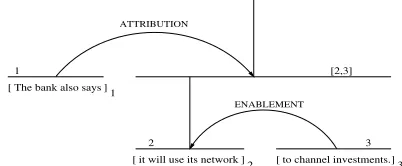
A discourse structure is a tree whose leaves correspond toelementary discourse units (edu)s, and whose internal nodes correspond to contiguous text spans (called dis-course spans). An example of a disdis-course structure is the tree given in Figure 1. Each internal node in a
dis-course tree is characterized by arhetorical relation, such
it will use its network The bank also says
1
2 3
[2,3]
ATTRIBUTION
to channel investments.
[ ]
[ ] [ ]
1
2 3
[image:1.612.324.525.257.340.2]ENABLEMENT
Figure 1: Discourse structure of a sentence.
asATTRIBUTIONandENABLEMENT. Within a rhetorical
re-lation a discourse span is also labeled as eitherNUCLEUS
orSATELLITE. The distinction between nuclei and
satel-lites comes from the empirical observation that a nucleus expresses what is more essential to the writer’s purpose than a satellite. Discourse trees can be represented graph-ically in the style shown in Figure 1. The arrows link the satellite to the nucleus of a rhetorical relation. Arrows are labeled with the name of the rhetorical relation that holds between the linked units. Horizontal lines correspond to text spans, and vertical lines identify text spans which are nuclei.
In this paper, we introduce two probabilistic models that can be used to identify elementary discourse units and build sentence-level discourse parse trees. We show how syntactic and lexical information can be exploited in the process of identifying elementary units of discourse and building sentence-level discourse trees. Our evalu-ation indicates that the discourse parsing model we pro-pose is sophisticated enough to achieve near-human lev-els of performance on the task of deriving sentence-level discourse trees, when working with human-produced syntactic trees and discourse segments.
2 The Corpus
Wall Street Journal articles from the Penn Treebank. The corpus comes conveniently partitioned into a Training set of 347 articles (6132 sentences) and a Test set of 38 ar-ticles (991 sentences). Each document in the corpus is paired with a discourse structure (tree) that was manually built in the style of Rhetorical Structure Theory (Mann and Thompson, 1988). (See (Carlson et al., 2003) for de-tails concerning the corpus and the annotation process.) Out of the 385 articles in the corpus, 53 have been inde-pendently annotated by two human annotators. We used this doubly-annotated subset to compute human agree-ment on the task of discourse structure derivation. In our experiments we used as discourse structures only the dis-course sub-trees spanning over individual sentences.
Because the discourse structures had been built on top of sentences already associated with syntactic trees from the Penn Treebank, we were able to create a composite corpus which allowed us to perform an empirically driven syntax-discourse relationship study. This composite
cor-pus was created by associating each sentence in the
dis-course corpus with its corresponding Penn Treebank
syn-tactic parse tree and its
correspond-ing sentence-level discourse tree .
Al-though human annotators were free to build their dis-course structures without enforcing the existence of well-formed discourse sub-trees for each sentence, in about 95% of the cases in the (RST-DT, 2002) corpus, there
exists a discourse sub-tree!"# associated
with each sentence . The remaining 5% of the sentences
cannot be used in our approach, as no well-formed dis-course tree can be associated with these sentences.
Therefore, our Training section consists of a set of 5809 triples of the form
$
!%& '#%(" '#()
which are used to train the parameters of the statistical models. Our Test section consists of a set of 946 triples of a similar form, which are used to evaluate the perfor-mance of our discourse parser.
The (RST-DT, 2002) corpus uses 110 different rhetori-cal relations. We found it useful to also compact these re-lations into classes, as described by Carlson et al. (2003), and operate with the resulting 18 labels as well (seen as coarser granularity rhetorical relations). Operating with different levels of granularity allows one to get deeper insight into the difficulties of assigning the appropriate rhetorical relation, if any, to two adjacent text spans.
3 The Discourse Segmenter
We break down the problem of building sentence-level
discourse trees into two sub-problems: discourse
seg-mentationanddiscourse parsing. Discourse segmenta-tion is covered by this secsegmenta-tion, while discourse parsing is covered by Section 4.
RB DT NN
ADVP NP
S
VBZ (says) SBAR (will)
S
[it will use its network] VP
VP TO
S
VB NNS VP
VP
PRP NP
MD
2 (to) (use)
NN PRP
[to channel investments.]3 VP (says)
NP(network) VB(use)
[The bank also says ]1 N
N
w p
[image:2.612.328.527.70.199.2]Nr
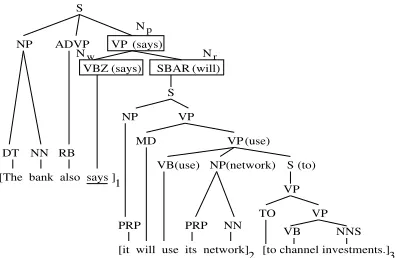
Figure 2: Discourse segmentation using lexicalized syn-tactic trees.
Discourse segmentation is the process in which a given text is broken into non-overlapping segments called
ele-mentary discourse units (edus). In the present work,
ele-mentary discourse units are taken to be clauses or
clause-like units that are unequivocally theNUCLEUSor
SATEL-LITEof a rhetorical relation that holds between two
adja-cent spans of text (see (Carlson et al., 2003) for details). Our approach to discourse segmentation breaks the
prob-lem further into two sub-probprob-lems: sentence
segmen-tation andsentence-level discourse segmentation. The problem of sentence segmentation has been studied ex-tensively, and tools such as those described by Palmer and Hearst (1997) and Ratnaparkhi (1998) can handle it well. In this section, we present a discourse segmenta-tion algorithm that deals with segmenting sentences into elementary discourse units.
3.1 The Discourse Segmentation Model
The discourse segmenter proposed here takes as input a sentence and outputs its elementary discourse unit bound-aries. Our statistical approach to sentence segmentation
uses two components: astatistical modelwhich assigns
a probability to the insertion of a discourse boundary
af-ter each word in a sentence, and asegmenter, which uses
the probabilities computed by the model for inserting dis-course boundaries. We first focus on the statistical model. A good model of discourse segmentation needs to ac-count both for local interactions at the word level and for global interactions at more abstract levels. Consider, for example, the syntactic tree in Figure 2. According to our hypothesis, the discourse boundary inserted
be-tween the wordssaysanditis best explained not by
the words alone, but by the lexicalized syntactic structure
[VP(says) [VBZ(says)* SBAR(will)]],
PP(without) VBN(passed)
VP(passed)
PP(at) VP(priced)
[image:3.612.87.285.69.114.2]VBN(priced)
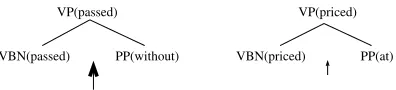
Figure 3: The same syntactic information indicates dis-course boundaries depending on the lexical heads in-volved.
Given a sentence,+.-'/-1032422-15622427-18 , we first find
the syntactic parse tree of . We used in our
exper-iments both syntactic parse trees obtained using Char-niak’s parser (2000) and syntactic parse trees from the PennTree bank. Our statistical model assigns a segment-ing probability9:; 5(<- 5 %77 for each word- 5, where; 5>=>?
boundary, no-boundary@ . Because our model is
concerned with discourse segmentation at sentence level,
we define 9:boundary<- 8 %(7A+CB , i.e., the sentence
boundary is always a discourse boundary as well. Our model uses both lexical and syntactic features for determining the probability of inserting discourse boundaries. We apply canonical lexical head projection rules (Magerman, 1995) in order to lexicalize syntactic
trees. For each word- , the upper-most node with
lex-ical head - which has a right sibling node determines
the features on the basis of which we decide whether to
insert a discourse boundary. We denote such nodeDFE ,
and the features we use are nodeDGE , its parentDIH , and
the siblings ofDJE . In the example in Figure 2, we
de-termine whether to insert a discourse boundary after the
wordsaysusing as features nodeDKHA+MLNOP!Q!R"P! and
its childrenD E +SLTVU"P!QR"P andDJWX+ZY!T\[]O_^` aa.
We use our corpus to estimate the likelihood of inserting
a discourse boundary between word- and the next word
using formula (1),
9:#;
<
-K%(7cbed
#DIHKfg24242(DhEJ*D
W
24242&
d
#D H fi24227D E DhW>2242&
(1)
where the numerator represents all the counts of the rule
D H fi2422(D E DhW324242 for which a discourse boundary has
been inserted after word- , and the denominator
repre-sents all the counts of the rule.
Because we want to account for boundaries that are motivated lexically as well, the counts used in formula (1) are defined over lexicalized rules. Without lexicalization, the syntactic context alone is too general and fails to dis-tinguish genuine cases of discourse boundaries from in-correct ones. As can be seen in Figure 3, the same syn-tactic context may indicate a discourse boundary when
the lexical headspassedandwithoutare present, but
it may not indicate a boundary when the lexical heads
pricedandatare present.
The discourse segmentation model uses the corpus pre-sented in Section 2 in order to estimate probabilities for
inserting discourse boundaries using equation (1). We also use a simple interpolation method for smoothing lex-icalized rules to accommodate data sparseness.
Once we have the segmenting probabilities given by the statistical model, a straightforward algorithm is used
to implement thesegmenter. Given a syntactic tree, the
algorithm inserts a boundary after each word- for which
9:boundary<-K%77kjml62on .
4 The Discourse Parser
In the setting presented here, the input to the discourse parser is a Discourse Segmented Lexicalized Syntactic Tree (i.e., a lexicalized syntactic parse tree in which the discourse boundaries have been identified), henceforth called a DS-LST. An example of a DS-LST in the tree in Figure 2. The output of the discourse parser is a dis-course parse tree, such as the one presented in Figure 1.
As in other statistical approaches, we identify two components that perform the discourse parsing task. The
first component is the parsing model, which assigns a
probability to every potential candidate parse tree.
For-mally, given a discourse treepq and a set of parameters
r
, the parsing model estimates the conditional probabil-ity 9:spq <
r
. The most likely parse is then given by
formula (2).
p:utwvxwy3+. z{| }~39:sp: <
r
(2)
The second component is called thediscourse parser, and
it is an algorithm for findingp: twvxwy. We first focus on the
parsing model.
A discourse parse tree can be formally represented
as a set of tuples. The discourse tree in Figure 1, for
example, can be formally written as the set of tuples
? ATTRIBUTION-SN[1,1,3]% ENABLEMENT-NS[2,2,3]@ . A
tu-ple is of the formF&%({%w , and denotes a discourse
rela-tion that holds between the discourse span that contains
edus through{ , and the discourse span that contains
edus{:B through . Each relation also signals
explic-itly the nuclearity assignment, which can be
NUCLEUS-SATELLITE(NS), SATELLITE-NUCLEUS(SN), or NUCLEUS-NUCLEUS(NN). This notation assumes that all relations
are binary relations. The assumption is justified empiri-cally: 99% of the nodes of the discourse trees in our cor-pus are binary nodes. Using only binary relations makes our discourse model easier to build and reason with.
In what follows we make use of two functions: func-tion applied to a tupleF&%7{%! yields the discourse
relation ; function applied to a tupleF&%7{%! yields
the structure&%7{%! . Given a set of adequate parameters
r
, our discourse model estimates the goodness of a
dis-course parse treep: using formula (3).
9:spq <
r
+ (
~3
9>xss4 <
r
19W!s(s4 <
r
VP (says)
< (1, VP(says))
(2, SBAR(will)) (3, S(to)) (2, VP(use))< (says)
RB [The bank also says]
DT NN ADVP NP
VBZ
1 S(says)
N SBAR (will)
[it will use its network] VP
PRP NP
2 (use) VB(use)
NN PRP
NP MD(will)
VP(will) S(will)
VP VP TO
S
VB NNS (to)
[to channel investments.]3
(to) (to)
N N
A
N
A
H = will
H = to H = says
D = { , }
H
[image:4.612.86.284.69.230.2]H
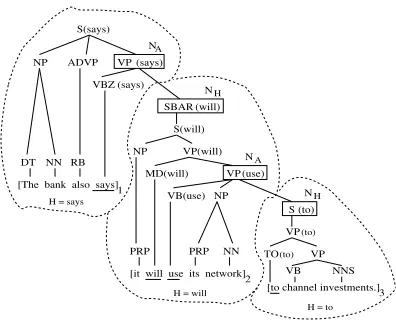
Figure 4: Dominance set extracted from a DS-LST.
For each tuple = p: , the probability9x estimates the
goodness of the structure of . We expect these
proba-bilities to prefer the hierarchical structure (1, (2, 3)) over ((1,2), 3) for the discourse tree in Figure 1. For each
tu-ple = pq , the probability 9 W estimates the goodness
of the discourse relation of . We expect these
probabili-ties to prefer the rhetorical relationATTRIBUTION-NSover
CONTRAST-NNfor the relation between spans 1 and6%(
in the discourse tree in Figure 1. The overall probability of a discourse tree is obtained multiplying the structural probabilities9>x and the relational probabilities9>W for all
the tuples in the discourse tree.
Our discourse model uses asr
the information present
in the input DS-LST. However, given such a tree >
as input, one cannot estimate probabilities such as
9:spq < >, without running into a severe sparseness
problem. To overcome this, we map the input DS-LST into a more abstract representation that contains only the salient features of the DS-LST. This mapping leads to the notion of a dominance set over a discourse segmented lexicalized syntactic tree. In what follows, we define this notion and show that it provides adequate parameteriza-tion for the discourse parsing problem.
4.1 The Dominance Set of a DS-LST
The dominance set of a DS-LST contains feature repre-sentations of a discourse segmented lexicalized syntactic tree. Each feature is a representation of the syntactic and lexical information that is found at the point where two
edus are joined together in a DS-LST. Our hypothesis is
that such “attachment” points in the structure of a DS-LST (the boxed nodes in the tree in Figure 4) carry the most indicative information with respect to the potential discourse tree we want to build. A set representation of the “attachment” points of a DS-LST is called the domi-nance set of a DS-LST.
For eachedu we identify a word- in as thehead
wordofedu and denote it . is defined as the word
with the highest occurrence as a lexical head in the
lexi-calized tree among all the words in . The node in which
occurs highest is called thehead nodeofedu and is
denotedDJ . Theeduwhich has as head node the root of
the DS-LST is called theexception edu. In our example,
the head word foredu2 isZ+m^`!aa , and its head node is
D +Y T\[]^`!aa; the head word foredu3 is+6 ,
and its head node isD +MY"s\. The exceptioneduis
edu1.
For eachedu which is not the exceptionedu, there
exists a node which is the parent of the head node of ,
and the lexical head of this node is guaranteed to belong
to a differenteduthan , call it . We call this node the
attachment nodeof and denote itDG . In our example,
the attachment node ofedu2 isDG+ LNP!QR"P , and
its lexical headsaysbelongs to edu1; the attachment
node ofedu3 isDJ¡+¢LN£OP!¤, and its lexical headuse
belongs toedu2. We write formally that twoedus and
are linked through a head nodeDG and an attachment
nodeD as s:%¥D k¦#§%(D .
The dominance set of a DS-LST is given by all the
edupairs linked through a head node and an attachment
node in the DS-LST. Each element in the dominance set
represents adominance relationshipbetween theedus
in-volved. Figure 4 shows the dominance setp for our
ex-ample DS-LST. We say thatedu2 is dominated byedu1
(shortly written:¦¨B ), andedu3 is dominated byedu2
(J¦© ).
4.2 The Discourse Model
Our discourse parsing model uses the dominance setp
of a DS-LST as the conditioning parameterr
in equa-tion (3). The discourse parsing model we propose uses
the dominance setp to compute the probability of a
dis-course parse treep: according to formula (4).
9:sp:
<
pª«+
( ~3
9
x
ss4 <¬
s
x
s%¥pª71
9W_7#4 <¬ _W #%(pA77 (4)
Different projections ofp are used to accurately estimate
the structure probabilities9>x and the relation
probabili-ties9W associated with a tuple in a discourse tree. The
projection functions¬
_x and
¬
_W ensure that, for
each tuple
=
pq , only the information inp relevant to
is to be conditioned upon. In the case of93x (the
prob-ability of the structure&%({%w ), we filter out the lexical
heads and keep only the syntactic labels; also, we filter
out all the elements ofp which do not have at least one
eduinside the span of . In our running example, for
in-stance, for'+ ENABLEMENT-NS\%¥6%( ,¬ _ x s%¥pªc+
? \%&®h¯,IJ¦SB%¥°±9K%sV%¥3G¦²#6%¥°K9K@ . The span
The bank also says 1
[ ] 1
s
s
P * P = 0.001r
Score1 = S1*S2*
The bank also says 1
[ ] 1
s
s
[2,3] it will use its network
2 3
to channel investments.
[ ]2 [ ]3
S1 = 1
r
0.47 0.88
r
S2 = P * P = 0.40r
P ( [2,2,3] | (2,SBAR)<(1,VP), (3,S)<(2,VP) ) = P ( ENABLEMENT−NS | S(to)<VP(use) ) =
P ( [1,1,3] | (2, SBAR) < (1, VP), (3, S) < (2, VP) ) = 0.37 P ( ATTRIBUTION−SN | SBAR(will) < VP(says) ) = 0.009
it will use its network
2 3
to channel investments.
[ ]2 [ ]3
ENABLEMENT ATTRIBUTION
ENABLEMENT
Figure 5: Bottom-up discourse parsing.
from it, namely the dominance relationships¡¦³B and
F¦m . To decide the appropriate structure,¬ _x keeps
them both; this is because a different dominance
relation-ship betweenedus 1 and 2, namely B¦e , would most
likely influence the structure probability of .
In the case of 9W (the probability of the relation ),
we keep both the lexical heads and the syntactic
la-bels, but filter out theeduidentifiers (clearly, the
rela-tion between two spans does not depend on the posi-tions of the spans involved); also, we filter out all the
elements of p whose dominance relationship does not
hold across the two sub-spans of . In our running
ex-ample, for,+ ENABLEMENT-NS6%¥\%¥ ,
¬
_W!s%¥pªc+ ? _ J¦´°K9:sO&@ . The two sub-spans of are 6%¥
and 6%¥ , and only the dominance relationship ¨¦µ
holds across these spans; the other dominance
relation-ship inp , ¶¦³B , does not influence the choice for the
relation label of .
The conditional probabilities involved in equation (4) are estimated from the training corpus using maximum likelihood estimation. A simple interpolation method is used for smoothing to accommodate data sparseness. The counts for the dependency sets are also smoothed using
symbolic names for the edu identifiers and accounting
only for the distance between them.
4.3 The Discourse Parser
[image:5.612.73.299.71.234.2]Ourdiscourse parser implements a classical bottom-up algorithm. The parser searches through the space of all legal discourse parse trees and uses a dynamic pro-gramming algorithm. If two constituents are derived for the same discourse span, then the constituent for which the model assigns a lower probability can be safely dis-carded.
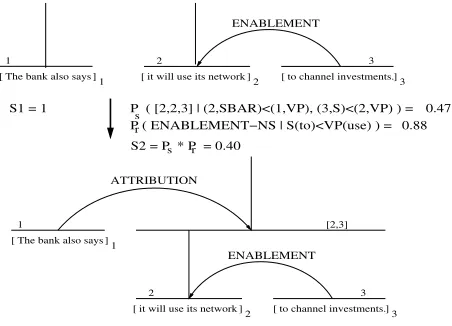
Figure 5 shows a discourse structure created in a bottom-up manner for the DS-LST in Figure 2. Tu-pleENABLEMENT-NS[2,2,3]has a score of 0.40, obtained
as the product between the structure probability 9 x of
0.47 and the relation probability 9 W of 0.88. Tuple
ATTRIBUTION-SN[1,1,3]has a score of 0.37 for the struc-ture, and a score of 0.009 for the relation. The final score for the entire discourse structure is 0.001. All probabil-ities used were estimated from our training corpus. Ac-cording to our discourse model, the discourse structure in Figure 5 is the most likely among all the legal discourse structures for our example sentence.
5 Evaluation
In this section we present the evaluations carried out for both the discourse segmentation task and the discourse parsing task. For this evaluation, we re-trained Char-niak’s parser (2000) such that the test sentences from the discourse corpus were not seen by the syntactic parser during training.
5.1 Evaluation of the Discourse Segmenter
We train our discourse segmenter on the Training sec-tion of the corpus described in Secsec-tion 2, and test it on the Test section. The training regime uses syntactic trees from the Penn Treebank. The metric we use to evalu-ate the discourse segmenter records the accuracy of the discourse segmenter with respect to its ability to insert inside-sentence discourse boundaries. That is, if a
sen-tence has 3edus, which correspond to 2 inside-sentence
discourse boundaries, we measure the ability of our al-gorithm to correctly identify these 2 boundaries. We re-port our evaluation results using recall, precision, and F-score figures. This metric is harsher than the metric pre-viously used by Marcu (2000), who assesses the perfor-mance of a discourse segmentation algorithm by
count-ing how often the algorithm makesboundaryand
no-boundarydecisions foreveryword in a sentence.
We compare the performance of our probabilistic dis-course segmenter with the performance of the decision-based segmenter proposed by (Marcu, 2000) and the per-formance of two baseline algorithms. The first
base-line (®ªBpª ) uses punctuation to determine when to
sert a boundary; because commas are often used to
in-dicate breaks inside long sentences, ®qBpª inserts
dis-course boundaries after each comma. The second
base-line (®G pª ) uses syntactic information; because long
sentences often have embedded sentences, ®G pª
in-serts discourse boundaries after each text span whose
corresponding syntactic subtree is labeledS, SBAR, or
SINV. We also compute the agreement between human
annotators on the discourse segmentation task (pª ),
Recall Precision F-score
®qBpA 28.2 37.1 32.0
®J pA 25.4 64.9 36.5
pqpª 77.1 83.3 80.1
upA1_±· 82.7 83.5 83.1 >upª1_,¸ 85.4 84.1 84.7
Xpª 98.2 98.5 98.3
Table 1: Discourse segmenter evaluation
Table 1 shows the results obtained by the algorithm
described in this paper (>upª1_h·¹) using syntactic
trees produced by Charniak’s parser (2000), in com-parison with the results obtained by the algorithm
de-scribed in (Marcu, 2000) (pqpª ), and baseline
algo-rithms ®qBpª and ®J!pª , on the same test set.
Cru-cial to the performance of the discourse segmenter is the recall figure, because we want to find as many dis-course boundaries as possible. The baseline algorithms are too simplistic to yield good results (recall figures of 28.2% and 25.4%). The algorithm presented in this pa-per gives an error reduction in missed discourse bound-aries of 24.5% (recall accuracy improvement from 77.1% to 82.7%) over (Marcu, 2000). The overall error reduc-tion is of 15.1% (improvement in F-score from 80.1% to 83.1%).
In order to asses the impact on the performance of the discourse segmenter due to incorrect syntactic parse trees, we also carry an evaluation using syntactic trees from the Penn Treebank. The results are shown in row
>upª1s'¸>. Perfect syntactic trees lead to a further
er-ror reduction of 9.5% (F-score improvement from 83.1% to 84.7%). The performance ceiling for discourse seg-mentation is given by the human annotation agreement F-score of 98.3%.
5.2 Evaluation of the Discourse Parser
We train our discourse parsing model on the Training sec-tion of the corpus described in Secsec-tion 2, and test it on the Test section. The training regime uses syntactic trees from the Penn Treebank. The performance is assessed us-ing labeled recall and labeled precision as defined by the standard Parseval metric (Black et al., 1991). As men-tioned in Section 2, we use both 18 labels and 110 la-bels for the discourse relations. The recall and precision figures are combined into an F-score figure in the usual manner.
The discourse parsing model uses syntactic trees pro-duced by Charniak’s parser (2000) and discourse seg-ments produced by the algorithm described in Section 3.
We compare the performance of our model (upª9 )
with the performance of the decision-based discourse
parsing model (pqpq9 ) proposed by (Marcu, 2000), and
®Jpq9 pqpq9 >upq9 Xpq9
Unlabeled 64.0 67.0 70.5 92.8
18 Labels 23.4 37.2 49.0 77.0
[image:6.612.317.538.70.124.2]110 Labels 20.7 35.5 45.6 71.9
Table 2: >upq9 performance compared to baseline,
state-of-the-art, and human performance
±·k· '¸k· K·¸ '¸¸
Unlabeled 70.5 73.0 92.8 96.2
18 Labels 49.0 56.4 63.8 75.5
110 Labels 45.6 52.6 59.5 70.3
Table 3: >upq9 performance with human-level
accu-racy for syntactic trees and discourse boundaries.
with the performance of a baseline algorithm (®hpq9 ).
The baseline algorithm builds right-branching discourse trees labeled with the most frequent relation encountered
in the training set (i.e.,ELABORATION-NS). We also
com-pute the agreement between human annotators on the
dis-course parsing task (Xpq9 ), using the doubly-annotated
discourse corpus mentioned in Section 2. The results are shown in Table 2. The baseline algorithm has a perfor-mance of 23.4% and 20.7% F-score, when using 18 la-bels and 110 lala-bels, respectively. Our algorithm has a performance of 49.0% and 45.6% F-score, when using 18 labels and 110 labels, respectively. These results rep-resent an error reduction of 18.8% (F-score improvement from 37.2% to 49.0%) over a state-of-the-art discourse parser (Marcu, 2000) when using 18 labels, and an error reduction of 15.7% (F-score improvement from 35.5% to 45.6%) when using 110 labels. The performance ceiling for sentence-level discourse structure derivation is given by the human annotation agreement F-score of 77.0% and 71.9%, when using 18 labels and 110 labels, respectively.
The performance gap between the results of>upq9 and
human agreement is still large, and it can be attributed to three possible causes: errors made by the syntactic parser, errors made by the discourse segmenter, and the weakness of our discourse model.
In order to quantitatively asses the impact in perfor-mance of each possible cause of error, we perform further experiments. We replace the syntactic parse trees
pro-duced by Charniak’s parser at 90% accuracy ( · ) with
the corresponding Penn Treebank syntactic parse trees
produced by human annotators (º¸ ). We also replace
the discourse boundaries produced by our discourse
seg-menter at 83% accuracy (§· ) with the discourse
bound-aries taken from (RST-DT, 2002), which are produced by
the human annotators (3¸ ).
[image:6.612.88.288.72.160.2]to an error reduction of 14.5% (F-score improvement from 49.0% to 56.4%) when using 18 labels, and an error reduction of 12.9% (F-score improvement from 45.6% to 52.6%) when using 110 labels. The results in
col-umn
·
¸ show that the impact of perfect discourse
segmentation is double the impact of perfect syntactic trees. Human-level performance on discourse segmen-tation leads to an error reduction of 29.0% (F-score im-provement from 49.0% to 63.8%) when using 18 labels, and an error reduction of 25.6% (F-score improvement from 45.6% to 59.5%) when using 110 labels. Together, perfect syntactic trees and perfect discourse segmentation lead to an error reduction of 52.0% (F-score improvement from 49.0% to 75.5%) when using 18 labels, and an error reduction of 45.5% (F-score improvement from 45.6% to 70.3%) when using 110 labels. The results in column
'¸¸ in Table 3 compare extremely favorable with the
results in columnXpq9 in Table 2. The discourse parsing
model produces unlabeled discourse structure at a per-formance level similar to human annotators (F-score of 96.2%). When using 18 labels, the distance between our discourse parsing model performance level and human annotators performance level is of absolute 1.5% (75.5% versus 77%). When using 110 labels, the distance is of absolute 1.6% (70.3% versus 71.9%). Our evaluation shows that our discourse model is sophisticated enough to match near-human levels of performance.
6 Conclusion
In this paper, we have introduced a discourse parsing model that uses syntactic and lexical features to estimate the adequacy of sentence-level discourse structures. Our model defines and exploits a set of syntactically moti-vated lexico-grammatical dominance relations that fall naturally from a syntactic representation of sentences.
The most interesting finding is that these dominance relations encode sufficient information to enable the derivation of discourse structures that are almost indis-tinguishable from those built by human annotators. Our experiments empirically show that, at the sentence level, there is an extremely strong correlation between syntax and discourse. This is even more remarkable given that the discourse corpus (RST-DT, 2002) was built with no syntactic theory in mind. The annotators used by Carlson et al. (2003) were not instructed to build discourse trees that were consistent with the syntax of the sentences. Yet, they built discourse structures at sentence level that are not only consistent with the syntactic structures of sen-tences, but also derivable from them.
Recent work on Tree Adjoining Grammar-based lexi-calized models of discourse (Forbes et al., 2001) has al-ready shown how to exploit within a single framework lexical, syntactic, and discourse cues. Various linguis-tics studies have also shown how intertwined syntax and
discourse are (Maynard, 1998). However, to our knowl-edge, this is the first paper that empirically shows that the connection between syntax and discourse can be compu-tationally exploited at high levels of accuracy on open domain, newspaper text.
Another interesting finding is that the performance of current state-of-the-art syntactic parsers (Charniak, 2000) is not a bottleneck for coming up with a good solution to the sentence-level discourse parsing problem. Little improvement comes from using manually built syntactic parse trees instead of automatically derived trees. How-ever, experiments show that there is much to be gained if better discourse segmentation algorithms are found; 83% accuracy on this task is not sufficient for building highly accurate discourse trees.
We believe that semantic/discourse segmentation is a notoriously under-researched problem. For example, Gildea and Jurafsky (2002) present a semantic parser that optimistically assumes that has access to perfect seman-tic segments. Our results suggest that more effort needs to be put on semantic/discourse-based segmentation. Im-provements in this area will have a significant impact on both semantic and discourse parsing.
References
E. Black, S. Abney, D. Flickinger, C. Gdaniec, R. Gr-ishman, P. Harrison, D. Hindle, R. Ingria, F. Jelinek, J. Klavans, M. Liberman, M. Marcus, S. Roukos, B. Santorini, and T. Strzalkowski. 1991. A proce-dure for quantitatively comparing the syntactic
cover-age of English grammars. InProceedings of Speech
and Natural Language Workshop, pages 306–311, Pa-cific Groove, CA. DARPA.
L. Carlson, D. Marcu, and M. E. Okurowski. 2003. Building a discourse-tagged corpus in the framework of Rhetorical Structure Theory. In Jan van Kuppevelt
and Ronnie Smith, editors,Current Directions in
Dis-course and Dialogue. Kluwer Academic Publishers. To appear.
Eugene Charniak. 2000. A maximum-entropy-inspired
parser. InProceedings of the NAACL 2000, pages 132–
139, Seattle, Washington, April 29 – May 3.
Michael Collins. 2000. Discriminative reranking for
nat-ural language parsing. InProceedings of ICML 2000,
Stanford University, Palo Alto, CA, June 29–July 2.
C. J. Fillmore, C. F. Baker, and S. Hiroaki. 2002. The
framenet database and software tools. InProceedings
of the LREC 2002, pages 1157–1160, LREC.
ESSLLI’2001 Workshop on Information Structure, Dis-course Structure and DisDis-course Semantics.
Daniel Gildea and Daniel Jurafsky. 2002. Automatic
la-beling of semantic role. Computational Linguistics,
28(3):245–288.
Paul Kingsbury and Martha Palmer. 2002. From
Tree-bank to PropTree-bank. InProceedings of the LREC 2002,
Las Palmas, Canary Islands, Spain, May 28-June 3. David M. Magerman. 1995. Statistical decision-tree
models for parsing. InProceedings of the ACL 1995,
pages 276–283, Cambridge, Massachusetts, June 26-30.
William C. Mann and Sandra A. Thompson. 1988. Rhetorical Structure Theory: Toward a functional
the-ory of text organization.Text, 8(3):243–281.
Daniel Marcu. 2000. The Theory and Practice of
Dis-course Parsing and Summarization. The MIT Press, Cambridge, Massachusetts.
M. Marcus, B. Santorini, and M. Marcinkiewicz. 1993. Building a large annotated corpus of English: the Penn
Treebank.Computational Linguistics, 19(2):313–330.
Senko K. Maynard. 1998. Principles of Japanese
Dis-course: A Handbook. Cambridge University Press. David D. Palmer and Marti A. Hearst. 1997. Adaptive
multilingual sentence boundary disambiguation.
Com-putational Linguistics, 23(2):241–269, June.
Adwait Ratnaparkhi. 1998. Maximum Entropy Models
for Natural Language Ambiguity Resolution. Ph.D. thesis, University of Pennsylvania.
RST-DT. 2002. RST Discourse
Tree-bank. Linguistic Data Consortium.