2014
A model for measuring student persistence through
collaborative learning
Dawn Delaine Laux
Iowa State University
Follow this and additional works at:https://lib.dr.iastate.edu/etd
Part of theDatabases and Information Systems Commons,Higher Education Administration Commons,Higher Education and Teaching Commons, and theInstructional Media Design Commons
This Dissertation is brought to you for free and open access by the Iowa State University Capstones, Theses and Dissertations at Iowa State University Digital Repository. It has been accepted for inclusion in Graduate Theses and Dissertations by an authorized administrator of Iowa State University Digital Repository. For more information, please [email protected].
Recommended Citation
Laux, Dawn Delaine, "A model for measuring student persistence through collaborative learning" (2014).Graduate Theses and Dissertations. 14175.
by
Dawn Delaine Laux
A dissertation submitted to the graduate faculty
in partial fulfillment of the requirements for the degree of
DOCTOR OF PHILOSOPHY
Major: Human Computer Interaction
Program of Study Committee: Brian Mennecke, Major Professor
Anthony Townsend Stephen Gilbert Ana-Paula Correia
James McElroy Andrew Luse
Iowa State University
Ames, Iowa
2014
TABLE OF CONTENTS
Page
LIST OF TABLES ... iv
LIST OF FIGURES ...v
ACKNOWLEDGEMENTS ... vi
ABSTRACT ... vii
CHAPTER 1. INTRODUCTION ...1
CHAPTER 2. REVIEW OF LITERATURE ...5
Usability ...5
Collaborative Learning ...7
Collaborative learning ...8
Computer-supported collaborative learning ...11
Connectedness ...17
Campus connectedness ...19
Sense of Community ...21
Learning community ...23
Commitment ...28
Turnover Intention ...31
Research Model ...32
CHAPTER 3. METHODS AND PROCEDURES ...34
Instrument Development ...34
Collaborative learning scale ...34
Campus connectedness scale ...35
Sense of community scale ...36
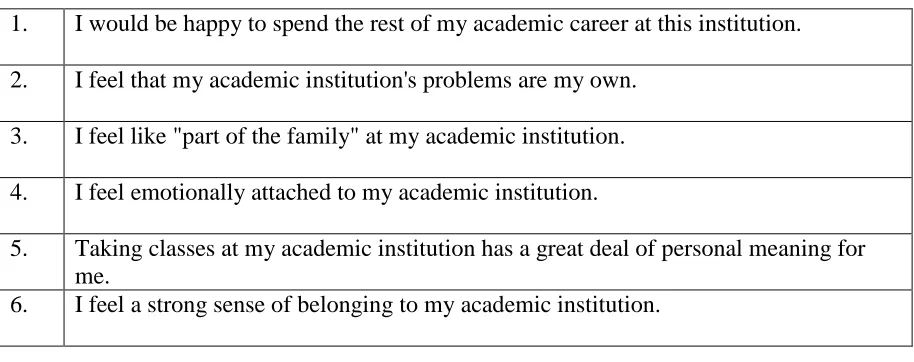
Affective organizational commitment ...38
Turnover intention ...39
System usability scale ...40
Participants ...40
Procedure ...42
CHAPTER 4. RESULTS ...44
Preliminary Data Examination ...44
Measurement Model ...45
Structural Models ...48
Combined model ...49
Group-based models ...51
CHAPTER 5. DISCUSSION AND SUMMARY ...55
Discussion ...55
Implications for practice ...63
Limitations and Future Research ...65
Conclusion ...68
LIST OF TABLES
Page
Table 1. Types of learning communities (Lenning & Ebbers, 1999; Zhao &
Kuh, 2004) ...24
Table 2. Collaborative Learning Scale ...35
Table 3. Campus Connectedness Scale ...36
Table 4. Sense of Community Scale ...37
Table 5. Affective Organizational Commitment Scale ...39
Table 6. Turnover Intention Scale...39
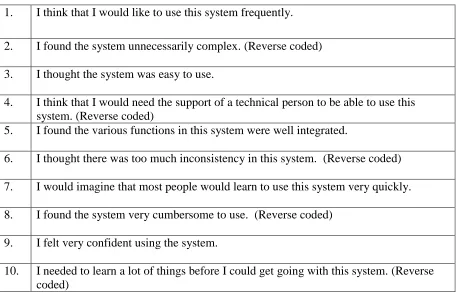
Table 7. System Usability Scale ...40
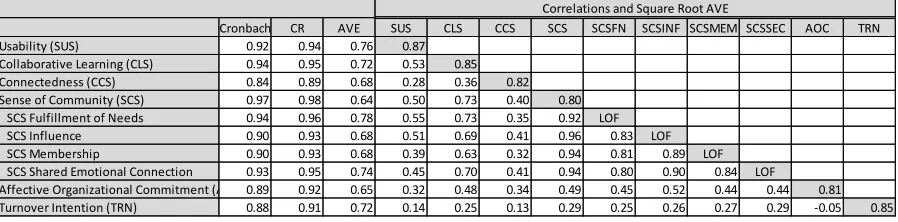
Table 8. Cronbach's alpha, composite reliability, average variance extracted, and correlations of the latent constructs, with the square root of the AVE along the diagonal (square root of the AVE not included for lower order factors) ...46
Table 9. Loadings and cross loadings of items on constructs ...47
Table 10. Hours of participant usage in the VLC. ...48
Table 11. Means and standard deviations for the entire sample, as well as the two groups separated by the amount of hours in the VLC. ...48
Table 12. Path loadings of combined structural model, including effects. ...50
Table 13. R2, f2, and q2 values for the AOC structural model ...51
Table 14. Path loadings of structural model for low VLC group, including effects. ....53
Table 15. Path loadings of structural model for high VLC group, including effects....53
Table 16. R2, f2, and q2 values for the structural model for the low VLC group. ...54
Page
Figure 1. Theoretical framework for CSCL ...12
Figure 2. Collaborative Learning Commitment Model ...33
Figure 3. Combined structural model with standardized path loadings (*p <
0.1, **p < 0.05, ***p < 0.01) ...50
Figure 4. Structural model with standardized path loadings (*p < 0.1, **p <
0.05, ***p < 0.01) for low VLC group ...52
Figure 5. Structural model with standardized path loadings (*p < 0.1, **p <
I would like to thank my committee chair, Brian Mennecke, for his support and
direction. His encouragement was always present, and I appreciate that he willingly took the
time to guide me through this journey. I would also like to thank my committee members,
Anthony Townsend, Stephen Gilbert, Ana-Paula Correia, James McElroy, and Andrew Luse,
for their guidance and support with my research.
In addition, I would also like to thank Pamela Shill and Debbie Johnson for helping
me with scheduling, deadlines, and my constant stream of emails. I would like to thank my
colleagues at Purdue for encouraging me to push forward and achieve my goal even when
some days it felt impossible.
Finally, I want to thank to my family for their support, especially my husband and
three children. My husband is my rock, and without his encouragement and belief in my
Institutions of higher education are being called upon to provide a more robust
pathway to a college degree and improve upon the advanced workforce for the needs of the
21st century. As 21st century skills call for an employee to successfully work collaboratively
in groups, an increase in technology adoption, globalization and increased competition are
among the factors that make collaboration one of the most important skills that employers
insist that individuals obtain today. An active learning environment through collaborative
learning techniques has been encouraged in higher education as a means of improving
student engagement (Freeman, Eddy, McDonough, Smith, Okoroafor, Jordt, & Wenderoth,
2014; Slavich & Zimbardo, 2012; Prince, 2004), but there is a gap in the literature when it
comes to connecting the two research areas of collaborative learning and student intention to
persist. Continued research is warranted to further understand the factors that may contribute
to improving the situation of attrition, and to suggest ways that institutions can enhance
engagement and ultimately improve student success. The purpose of this study is to create a
model that will measure the factors that significantly influence a student’s persistence in a
computer supported collaborative learning environment. Based on prior theoretical research,
the model is developed to analyze how collaborative learning is mediated by campus
connectedness and a sense of community, and subsequently how it impacts student
persistence utilizing affective organizational commitment and turnover intention measures.
A survey instrument was developed based on the factors of the research model, and was
tailored to the terminology used for communities and academia. To test the model, a cohort
of students across multiple institutions was invited to participate in a virtual learning
overall model utilizing structural equation modeling, the relationship between all factors but
one were found to be statistically significant. In further analysis, the model design was also
able to discern between two separate groups, adding to its versatility. Implications for
research in this area include an expansion of student attrition research through turnover
intention, scalability with the addition of more constructs, and ultimately a new model that
CHAPTER 1. INTRODUCTION
Institutions of higher education are being called upon to provide a more robust
pathway to a college degree and improve upon the advanced workforce for the needs of the
21st century. However, in higher education today the demographic makeup of the student
population is increasingly varied in the areas of age, enrollment status (full-time versus
part-time), and institution type (2 year or 4 year) (U.S. Department of Education, National Center
for Education Statistics, 2013). To compound the situation, there is a lower degree
attainment rate in those students that do not fit the younger, full-time student demographic
(Ross, Kena, Rathbun, Kewal Ramani, Zhang, Kristapovich, & Manning, 2012), and despite
prior research (Bean & Metzner, 1985), the trend has not improved in recent years (Snyder &
Dillow, 2012). To meet the needs of the advanced workforce, and recognizing that the
demographics of the United States are resulting in a more varied, diverse population, a
commitment to a more highly educated workforce requires a more supportive environment
for student success.
As 21st century skills call for an employee to successfully work collaboratively in
groups, an increase in technology adoption, globalization and increased competition are
among the factors that make collaboration one of the most important skills that employers
insist that individuals obtain today. The modern workplace incorporates technology usage,
predominately information technology, to support an organization in developing what has
been called the learning organization (Senge & Suzuki, 1994). Structuring the workplace in
with others to create new understanding in increasingly complicated workplace environments
is greater when utilizing a combination of multiple skillsets and knowledge domains.
As a result, successful businesses require much higher skills and knowledge than
previously required, but the path to a degree in higher education has become more
challenging because students are bearing a much higher percentage of the cost of education.
This is partially due to state governments shifting resources and support away from higher
education. A response to these challenges has included increased financial aid and fiscal
support. This type of student support does not, however, recognize the condition in which
students are enrolling into degreed programs. Time and distance are now important factors
as students seek out a degree in non-traditional settings, such as from a distance or while
working full time. Traditionally, the academic response has been to focus on programming
exclusively: better curriculum will result in higher graduation rates. But this idea is based
upon the assumption that, in part, a higher quality program attracts higher quality students.
While colleges and universities can, and should, attract the best students, institutions are
grounded in the environments they serve, to the populations they educate, and the
constituents they serve. To be sustainable, this means that the higher education environment
must encourage a sense of community and connectedness that recognizes student diversity of
thought and opinion, and of qualified merit.
In order to retain these students through graduation, Vincent Tinto (2005) makes the
following recommendations to an institution seeking to improve student persistence:
1. A commitment to success must include monetary resources and not just words.
2. A high expectation of student performance begins with the first year.
4. Utilize student feedback and assessments of the learning environment.
5. Foster student involvement both academically and socially.
6. Focus on the development of a setting that encourages learning.
These conditions are all attainable based on the characteristics of community and are not
discipline specific. With a strong community, the results will be increased involvement in
learning, promotion of social and academic involvement, and academic support for the
student’s motivation to persist (Tinto, 1997, 1998, 2003; Stefanou & Salisbury-Glennon,
2002; Zhao & Kuh, 2004).
In the mission for student persistence through active involvement, the availability of
computer supported collaborative learning brings together technology, interaction and
learning (Stahl, Koschmann, & Suthers, 2006) much like a learning community. Utilizing
online technology in the course for group work, and augmenting with a virtual learning
community, offers a vehicle for collaborative learning beyond the limited time in the
classroom. An active learning environment through collaborative learning techniques has
been encouraged in higher education as a means of improving student engagement (Freeman,
Eddy, McDonough, Smith, Okoroafor, Jordt, & Wenderoth, 2014; Slavich & Zimbardo,
2012; Prince, 2004), but there is a gap in the literature when it comes to connecting the two
areas of research. The proposed model in this study can be utilized to measure the impact of
community and connectedness found in collaborative learning activities on student intentions
to persist.
The purpose of this study is to create a model that will measure the factors that
significantly influence a student’s persistence in higher education based on feelings of
collaborative learning environment. Tinto (2005) explains that the conditions in which
institutions place their students may be designed, controlled, and modified for the goal of
greater student persistence across the academic life of the college student. Based on these
conditions of success, continued research is warranted to further understand factors that can
contribute to improving the unrelenting situation.
This paper begins with a review of literature over prior research relevant to this study.
This includes areas such as collaborative learning, community, connectedness, commitment
and turnover intention. Following this, the proposed research methods and procedures for
facilitating this study are discussed and this is followed with the analysis and results of the
CHAPTER 2. REVIEW OF LITERATURE
The purpose of this study is to research factors that can impact student persistence.
The foundations of research for this literature review are based on collaborative learning,
learning communities, sense of community, connectedness, usability and commitment.
Usability
Gerhard Fischer (2001, p.65) states “A fundamental objective of human-computer
interaction research is to make system more usable, more useful, and to provide users with
experiences fitting their specific background knowledge and objectives.” Usability is a core
concept in the study of human-computer interaction, and it is the measurement of how easy
an interface is to use (Nielsen, 1993). Nielsen defines usability into five main components:
1. Learnability – measured by how easy it is to complete basic tasks in an initial
encounter with the system.
2. Efficiency – measured by how quickly tasks can be performed
3. Memorability – After returning to the system, how easily can proficiency be retained
4. Errors – Based on the number of errors that a user makes and how the errors are
recovered
5. Satisfaction – how the system is received by the user
Usability is also measured against the context in which it is currently being used (Phang,
Kankanhalli, & Sabherwal, 2009; Brooke, 1996). In the case of this study, students utilize a
course management system to collaborate inside and outside of the classroom. The virtual
learning community also ties these students together by utilizing the same course
The System Usability Scale (SUS) developed by John Brooke (1996) is a means for
easily assessing the usability of a tool or system. The scale produces a single number that is
considered the overall usability of the item being studied. Bangor, Kortum, and Miller
(2008) evaluated Brooke’s scale by reviewing over 200 studies in the previous 10 years that
have utilized SUS in research. Based on their review, Bangor, Kortum, and Miller (2008)
identified six ways that the SUS can be effectively used when evaluating usability in a study.
First, the scale allows a practitioner to determine if the researched system is usable or not
based on a single score. The flexibility of the scale also provides an opportunity to compare
multiple user tasks within a complex system and/or revisit the same system each time a
revision is made. Additionally, alternative designs of the same system can be compared as
well as similar designs of competing systems. For example, Unal and Unal (2011) conducted
a usability study that compared two course management systems to determine which system
the students in a particular course found to be more usable. Finally, because the SUS does
not discriminate when it comes to what technology is utilized, the scale can be used to
compare multiple technology platforms.
An important factor for students when using course management systems is ease of
use. Previous studies have evaluated the usability of course and learning management
systems (Blecken, Bruggemann, & Marx, 2010; Oztekin, Kong, & Uysal, 2010; Unal &
Unal, 2011). The importance of these studies is such that if a student does not find the
system to be adequately usable, the effectiveness of the course will be diminished.
Blecken, Bruggemann, and Marx (2010) conducted a usability test on a learning
management system with ten testers, a set of tasks to perform on the system, and a
that included a standardized version of the SUS, and an overall score of 64 was reported out
of 100. According to Bangor, Kortum, and Miller (2008), a score of 64 would be above the
threshold of certain usability difficulties (under 50), but below the promising acceptability
score (above 70). Blecken, Bruggemann, and Marx (2010) also included open-ended
questions about the usability of the system in their survey which in turn were beneficial when
discussing the results of the overall SUS score.
An alternative to the SUS is UseLearn, a usability evaluation checklist developed by
Oztekin, Kong, and Uysal (2010). The UseLearn checklist is a way of integrating both
metrics quality and usability into one evaluation tool. While UseLearn measures for the
basic usability factors of efficiency, effectiveness, and satisfaction, it also measures
additional factors for a more detailed analysis that can be broken out into separate
dimensions. For example, flexibility may score high, but aesthetics may score low, so for a
practical purpose a developer would concentrate on correcting the look of the system but not
the functionality. While the study was directed toward the development of UseLearn for the
identification of usability issues in learning systems, it did not study why participants
identified particular usability issues in the system being evaluated.
Collaborative Learning
The National Research Council (2011, p. 1) refers to 21st century skills as “being able
to solve complex problems, to think critically about tasks, to effectively communicate with
people from a variety of different cultures and using a variety of different techniques, to work
in collaboration with others, to adapt to rapidly changing environments and conditions for
information on one’s own.” The expectation of the workplace is that every employee must
be able to adapt to change, use critical thinking skills and collaborate professionally (Jerald,
2009). Collaborative teams produce better work due to the diversity of interdisciplinary
ideas, and the work itself is becoming too multifarious for just one person to complete
efficiently. Just as the workplace in the 21st century depends on teamwork, higher education
is moving to active learning techniques (Freeman, Eddy, McDonough, Smith, Okoroafor,
Jordt, & Wenderoth, 2014).
While higher education is engaging in active learning techniques, such as
collaborative learning teams, for the benefit of the workplace, it is also found to improve
student persistence in college. Research in undergraduate student persistence has encouraged
this shift in instructional delivery as collaborative learning is found to play a significant role
in retention of first-year students (Freeman et al., 2014; Tinto, 1997; Tinto, 1998).
Collaborative learning
Collaborative learning is achieved when individual strengths are combined so that all
members of the group participate in the collaborative construction of knowledge (Stahl,
Koschmann, & Suthers, 2006). Collaborative learning fosters a diversity of thought and
allows for others to experience differing ideas for discussion. Each member brings an
individual perspective to the group, which can collectively add to the knowledge gained.
Individual perspectives are unique to each member based on prior experiences. An exercise
in collaborative learning allows an individual to learn how to accomplish a task with a
combined effort of shared ideas instead of dividing up the work and assimilating it for final
share experiences or knowledge through social interaction (Zhu, 2012). The focus of
learning is not limited to the knowledge of just the instructor, but rather the instructor acts as
a facilitator of the interaction among all involved parties. Members of the group control the
collaboration process with input from the instructor, and it is the responsibility of the entire
group to participate in all aspects of the process including the diffusion of conflicts,
contribution of ideas, and the achievement of learning goals (Dewiyanti, Brand-Gruwel,
Jochems, & Broers, 2007).
There is a long history of research pertaining to the benefits of collaborative work in
the traditional educational settings as well as distance education. One simple benefit is the
realization, transfer, and convergence of knowledge among participants in a collaborative
learning team. Some of the widely cited advantages of collaborative learning include the
encouragement of active and constructive learning, an improved processing of information,
critical thinking, and reasoned learning (Bernard, Rojo de Rubalcava, St. Pierre, 2000;
Brown & Palincsar, 1989).
The premise of active learning is to involve students in the learning process through
engaging activities and foster an environment that encourages students to communicate ideas
rather than passively acquire knowledge from an instructor in a lecture driven atmosphere
(Freeman, et al., 2014; Slavich & Zimbardo, 2012; Prince, 2004). Freeman et al. (2014)
analyzed student performance in courses that delivered material in a traditional lecture
environment versus an active learning environment. While it was found that students were
1.5 times more likely to fail in the lecture driven environment than those in the active
learning environment, it was noted in the article that the current trend is moving away from
focus on what they call “second-generation research” pertaining to types of active learning,
consequences of active learning, and what active learning techniques are more beneficial.
Slavich and Zimbardo (2012) contend that collaborative learning is a method for teaching the
principles of active learning, and that these approaches have theoretical similarities.
Additionally, collaborative techniques of learning have been influenced by the educational
concept of constructivism, where an individual gains knowledge more effectively when there
is a realization of how new information may conflict with his/her experiential understanding
of a concept (Slavich & Zimbardo, 2012) as well as the theory of social constructivism which
is based on the idea that an individual can enhance his or her own construction of knowledge
by negotiating meanings with other individuals (Bernard, Rojo de Rubalcava, St. Pierre,
2000; So & Brush, 2008; Zhu, 2012). The connection occurs in the method. The active
learning occurs in the group collaboration activity, which is engaging rather than passive.
With each task, the members of the group should be able to develop ideas, compare
individual perspectives, and understand multiple viewpoints of an argument, and articulate
their observations to the group (Karagiorgi & Symeou, 2005).
Nelson (1994) presents a structured approach to fostering critical thinking via
collaboration learning methods that involves preparation, cognitive structuring, and role
structuring. First, an instructor should select a topic that the majority of students can relate to
or efficiently acquire knowledge about the topic. Second, apply cognitive structuring to the
topic by invoking a task that requires deeper thought beyond a cursory discussion. Finally,
the role-structuring process is meant to get all members of the group to participate with
interest. Nelson’s (1994) approach gives the students enough material at the beginning of the
knowledge. Then, he gives the students a task that relies on the input from everyone in the
group to think critically on the topic. The final part of the process requires that all students
participate in order to complete the task without hindering progress. Nelson (1994) notes
that convincing students to embrace a different viewpoint on a topic can be challenging and
sometimes sensitive due to upbringing or past experiences, so a structured approach to
collaborative learning and critical thinking is essential for participation and engagement.
Computer-supported collaborative learning
Computer-supported collaborative learning (CSCL) emerged as a research field in the
1990s in response to new software innovations that were meant to bring students together to
learn (Stahl, Koschmann, & Suthers, 2006). According to a historical perspective written by
Stahl, Koschmann and Suthers (2006), the CSCL emerged from three early projects
researching the use of technology to improve learning through organized social activity with
instruction: the ENFI Project at Gallaudet University, the CSILE project at the University of
Toronto, and the Fifth Dimension Project at the University of California San Diego. The
ENFI Project enabled students and their instructor to use computers as a medium for textual
communication discussions. The CSILE (Computer Supported Intentional Learning
Environment) Project developed computing technologies to transform classrooms into
knowledge-building communities. The Fifth Dimension Project focused on computer-based
activities for the enhancement of student skills in reading and problem solving. Stahl,
Koschmann, and Suthers (2006) comment that all three of these early projects introduced
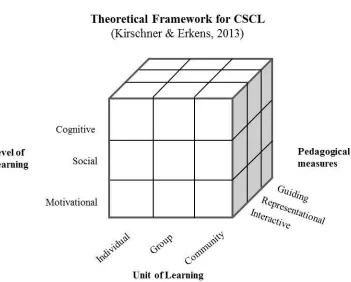
Kirschner and Erkens (2013) developed a framework for CSCL research that is
divided into three main elements: pedagogical, social and technological. This framework is
meant to provide structure for future research in the CSCL domain by identifying the varying
qualities of the environment and areas that are lacking in research and a visual representation
of the 3 x 3 x 3 cube can be found in Figure 1. The pedagogical element pertains to the
learning portion of the collaborative learning environment, and the tools used to support and
[image:21.612.144.495.303.585.2]guide the individual, team, and/or community through a set of learning goals.
Figure 1. Theoretical framework for CSCL
The level of learning element pertains to the skills that students use to work collaboratively
in a team. This element includes the communication process that students navigate when
and engaged in a task. Finally, the social aspect involves not only the student to student
interaction, but also the level of student/teacher interaction. The third element, the unit of
learning element, pertains to the technological needs of the activity depending on the makeup
of the environment. Most CSCL environments have the basic communication tools,
productivity tools and support tools for individual, group and/or community use, but how the
CSCL tools are presented and encouraged for use will determine the utilization of the
technology and effectiveness of the activity.
The developers of the multidimensional framework provide a structure to CSCL
research, and the identified factors can be constructed in multiple combinations. For
example, a study could focus on just one cube of factors, one complete slice, or a
combination of multiple cubes. The framework also helps to identify gaps in CSCL research.
Kirschner and Erkens (2013) conclude with recommendations on future research based on
gaps in the 3 x 3 x 3 cube. They suggest that more research is needed concerning the social
aspects of CSCL, which is consequently addressed in a separate article with an additional
research framework specific to sociability, social space, and social presence (Kreijns,
Kirschner, & Vermeulen, 2013). Kreijns, Kirschner, and Vermeulen (2013) note that social
space is a network of relationships among group members, and a strong social space that is
based on a solid group structure. Notably, the authors include sense of community and
feelings of belonging as two important elements of a solid group structure.
When it comes to distance learning, CSCL can help to overcome the feeling of
isolation that can occur when students feel disconnected from their fellow classmates and
instructor with the proper tasks, such as requiring activities with a large amount of
(2007) contend that CSCL environments with both educational functionality and social
functionality fulfill the learning needs of the students. It allows for a complete learning
experience, called a sociable CSCL environment. Such an environment can reduce feelings
of isolation and reduce attrition as students develop a sense of community through
interchanges of information and a commitment to participate in the community (Rovai,
2001). Abedin, Daneshgar, and D’Ambra (2011) studied the difference between on-task and
non-task social interactions with a focus on the factors that affect non-task sociability of
CSCL environments. On-task social interactions include group learning and instructional
activities whereas non-task social interactions include exchanges that are not directly related
to learning. It was concluded that the students who can alter their communicative behaviors
to adapt to a course CSCL environment will enjoy the educational experience more and will
participate more with a greater sense of community, but the effect of the sense of community
on student intention is not addressed.
Beyond the social aspect of CSCL, this research domain also investigates how
collaborative learning, when supported by technology, can enhance how students work in
groups interactively, and how technology can facilitate shared knowledge among the
members of a group (Wang, 2009; Dewiyanti, Brand-Gruwel, Jochems, & Broers, 2007).
Wang (2009) conducts a research study on three aspects of CSCL: individual accountability,
positive interdependence, and the quality of the collaborative learning process. While
collaborative learning involves working as a group to collectively complete a task, each
individual is expected to participate, and is accountable for his or her share. The presence of
individual accountability encourages ownership of the learning task, and special attention to
strategies can help to foster this atmosphere of learning (Wang, 2009; Brandon &
Hollingshead, 1999). While each member is expected to provide individual effort, members
of a team work as a collective unit and depend on each other for the success of the project
(Brandon & Hollingshead, 1999). One person cannot do it all on his or her own. The level
of a group’s sense of community can affect the positive interdependence among the team
members. Wang (2009) also suggests that both individual accountability and positive
interdependence require coordination if a collaborative learning environment is to be
successful. Guidance and organization from external support can keep the learning task on
track.
The use of CSCL technologies also makes online collaborative learning more
effective if implemented with the needs of the student in mind based on the task at hand.
Collaborative techniques of online learning have been influenced by the theory of social
constructivism which is based on the idea that an individual can enhance his or her own
construction of knowledge by negotiating meanings with other individuals (Bernard, Rojo de
Rubalcava, St. Pierre, 2000; So & Brush, 2008; Zhu, 2012). Bernard, Rojo de Rubalcava,
and St. Pierre (2000) suggest some design considerations for collaborative online learning:
proper assessment of student needs, communication of expectations, create a positive social
environment, set collaborative small group projects, promote the sharing of information, and
determine what level of technology is available to participants as well as the technology
readiness of the participants. Brandon and Hollingshead (1999) remind readers that the role
that CSCL plays in a course is based on an instructor’s setup and design of the course, not
Prior research pertaining specifically to CSCL environments are varied, but generally
interested in the satisfaction of the CSCL environment as it pertains to the collaborative task
of the learner (Dewiyanti, Brand-Gruwel, Jochems, & Broers, 2007). Zhu (2012) researched
online collaborative learning by analyzing student satisfaction, performance and knowledge
construction from a cross-cultural perspective. Students from a Flemish university and a
Chinese university were divided up into collaborative groups for a CSCL task. Flemish
students liked working at their own pace, but found that working on the tasks online was too
time-consuming. Chinese students liked that they could work with others on assignments,
but they were dissatisfied with the level of interaction between the students and instructor.
Both sets of students did agree that the collaborative learning process assisted with
understanding the learning content. Zhu (2012) contends that regardless of cultural
backgrounds, student perceived satisfaction and performance are important factors to analyze
before implementing a collaborative learning environment. Additionally, an assessment of
individual differences ahead of a CSCL task is useful for mitigating any issues before they
arise.
There is also discussion on how to appropriately measure CSCL environments
(Vatrapu, Suthers, & Medina, 2008; Gress, Fior, Hadwin, & Winne, 2010; Summers,
Beretvas, Svinicki, & Gorin, 2005; Wang, 2009). Wang (2009) studied the importance of an
instructor supported collaborative learning environment that fosters group collaboration. The
research study involved four classes participating in projects in pairs of students with a focus
on friendship and meaningful learning tasks to promote individual accountability and
positive interdependence. Varying strategies were applied and analyzed for effectiveness.
making the learning tasks meaningful, it resulted in the groups taking ownership for the task.
Alternatively, coordinating and monitoring the learning process was a challenge for CSCL as
some groups chose not to work collectively in the CSCL environment. Wang (2009)
concluded that an effective CSCL environment requires varying communication tools that
appeal to more members of the groups and are easy to use as a text only communication
medium may be lacking.
Cho, Gay, Davidson, and Ingraffea (2007) investigated the relationship between
communication styles, social networks, and learning performance utilizing a CSCL
community. They found that communication styles and pre-existing friendships significantly
affected the way learners developed social networks for the purposed of collaborative
learning, but also acknowledged that more research is warranted in the areas of social
structures, learner behaviors and the collaborative learning activities.
Based on review of the literature, the following hypothesis can be anticipated:
H1:The perceived usability of a CSCL system will influence collaborative learning involvement.
Connectedness
In research pertaining to the measurement of belonging, Lee and Robbins (1995)
propose that the notion of belongingness is composed of three main constructs –
companionship, affiliation and connectedness. While companionship is the act of bonding
with another human being and affiliation is the establishment of peer relations of similar
values, connectedness is a feeling of relatedness and identification of differences. Townsend
connectedness to identify a common definition of the construct as well as an appraisal of the
many dimensions of connectedness. Townsend and McWhirter (2005) selected a definition
by Hagerty, Lynch-Sauer, Patusky, and Bouwsema (1993, p. 293) who defined the
occurrence of connectedness as “when a person is actively involved with another person,
object, group, or environment, and that involvement promotes a sense of comfort, well-being,
and anxiety-reduction.”
Within the construct of connectedness, Lee and Robbins (1995, 1998, 2000) define
social connectedness as “an aspect of the self that reflects subjective awareness of
interpersonal closeness with the social world in toto.” Positive social connectedness is
described by Lee and Robbins (1995) as a feeling of confidence and comfort, without threat
to one’s self-esteem, within a larger social setting than just the familiar confines of family or
friends. Alternatively, if a positive level of connectedness is not achieved, Lee and Robbins
(1995) postulate that an individual will disconnect from other people and become isolated
due to the frustration felt when attempts to be understood fail. In a study to measure
belongingness among undergraduate students, Lee and Robbins (1995) developed two
self-reporting scales, the Social Connectedness Scale and the Social Assurance Scale. Lee,
Draper, and Lee (2001) later revised the Social Connectedness Scale to correct for
psychometric limitations as the scale originally contained only negatively worded items
which may potentially result in a response bias. The scale also lacked the ability to capture
an individual’s perception of a sense of closeness with others as well as maintaining and
seeking connections (Lee, Draper, & Lee, 2001). Lee, Draper, and Lee (2001) contend that
the revisions still maintain the scale’s original theoretical foundation for an “independent
Campus connectedness
As stated earlier, Tinto (2005) stresses the responsibility of an institution to develop
an environment of success if improved student persistence is to be obtained. The conditions
of success include institutional level student support, commitment to both academic and
social involvement, and programs for navigating the college environment. These conditions
are beyond a collaborative learning group, beyond the confines of the classroom, but rather,
they reside at a broader campus level of association. In a college collaborative learning
environment, if a student feels that he or she is not able to overcome a lack of connection
with the group, that student may become distant and not participate effectively in the group
activity. This situation may ultimately lead a student to attrition from the university due to a
low sense of connectedness on a campus level.
Campus connectedness is the study of social connectedness in the context of a college
environment (Lee, Keough, & Sexton, 2002). In a study of the social connectedness in
college women and men, Lee, Keough, and Sexton (2002) modified the original Social
Connectedness Scale (Lee & Robbins, 1995) to study one’s self reported degree of
interpersonal closeness and the difficulty in maintaining said sense of closeness. The study
found that women who experience low connectedness report a negative campus climate and
higher level of stress. The college men did not experience the same relationship, as their
negative view of climate did not result in significant greater stress as it would be perceived as
a loss of power. Lee, Keough, and Sexton (2002) conclude that their findings will assist
university staff in how to improve perceptions of campus climate in relation to an
Freeman, Anderman, and Jensen (2007) conducted a study to examine the association
between the sense of belonging in a single class and belonging at the university level using
two variables, faculty-student interaction and sense of social acceptance, that are meant to
cultivate a sense of belonging. The results of the hypothesis that the sense of belonging in a
single class contributes to an overall sense of belonging at the university level was not
supported. Freeman, Anderman, and Jensen (2007) suggest that a student’s sense of social
acceptance by peers and instructors might be the most importance factor in an overall sense
of belonging, but they concur that more research is needed in the area of university-level
belonging.
Pym, Goodman, and Patsika (2011) focused on how social connectedness can impact
a student’s transition to higher education. The study utilized a modified version of the
campus connectedness scale developed by Lee and Robbins (2000), qualitative data collected
from various mediums over a six year period, and student GPA as an academic performance
identifier. While Pym, Goodman, and Patsika (2011) identified a strong sense of connect
among peers, the relationship between connectedness and academic performance was not as
strong as expected. It was suggested that a student’s GPA may not have been an adequate
measure of academic performance due to the length of the study and the diversity of courses.
Summers, et al. (2005) evaluated collaborative learning methods based on feelings of
campus connectedness, academic classroom community, and effective group processing. An
important task of this study was to develop a survey that would quantitatively capture
outcomes of instructional methods for the development of learning communities. Summers,
connectedness based on their research findings, and consequently, call for further study on
the subject.
After an examination of prior research and the call for more research by Freeman,
Anderman, and Jensen (2007) on university-level belonging, the following hypothesis will be
analyzed pertaining to connectedness:
H2: Students with greater involvement in collaborative learning will have a greater sense of campus connectedness.
Sense of Community
McMillan and Chavis (1986, page 9) define the theory of a sense of community as “a
feeling that members have of belonging, a feeling that members matter to one another and to
the group, and a shared faith that members’ needs will be met through their commitment to
be together.” Based on this definition, they expound on the theory with four elements:
membership, influence, integration, and shared emotional connection. The element of
membership pertains to the boundaries of belonging to the group. One may or may not
belong to the group, and if there is acceptance, a personal investment is made. Influence
occurs on two levels. A member of the group may be attracted to participation if there is an
opportunity to influence others. On the other hand, the community will seek to influence
conformity among members. The third element is integration (also referred to as
reinforcement (McMillan & Chavis, 1986). Members will ultimately participate when it
serves their needs. Finally, the element of shared emotional connection is based on the bond
A commonly used scale for measuring sense of community was developed by Chavis,
Hogge, McMillan, and Wandersman (1986) called the Sense of Community Index (SCI).
Recently, Chavis, Lee and Acosta (2008) developed a new instrument called the SCI2 as a
better representation of the original four-dimensions found in the sense of community theory
by McMillan and Chavis, and to address the criticisms found in the original index (Abfalter,
Zaglia, & Mueller, 2012). According to the researchers of the SCI2, the SCI experienced
inconsistent reliability among the subscales, the structure of the scale only allowed for
limited variance, and it was not easily adaptable across other environments. Unlike the
original SCI, the revised scale has shown greater reliability and validity across different
cultures, and is able to cover all of the attributes found in the original theory.
Abfalter, Zaglia, and Mueller (2012) utilized the SCI2 to better understand the
dynamics of virtual communities and to improve the measurement of a sense of virtual
community (SOVC). A comparison of the original SCI to measure a virtual community was
performed against the revised SCI2. The results found that the revised scale had a better
measurement result than the original, but only by a marginal amount. In order to use the
SCI2 in a virtual environment study, the researchers recommend that certain items be
eliminated based on the structure of the virtual community. For example, if the community
is large, it would be difficult for a member of the community to state that he/she recognizes
everyone in the community. Instead, a participant may be a member of a smaller subgroup
inside the larger virtual community, so addressing subgroups may be more helpful in the
research and refinement of SOVC measurements (Abfalter, Zaglia, & Mueller, 2012).
In addition to the topic of online communities, Brown (2001) describes three stages in
feel as if they are part of a community based on the result of a community based on the result
of an exchange of ideas. Finally, after a length of time in which personal communication
occurs, a feeling of fellowship is solidified. This explanation of community corresponds
with the social presence construct (Garrison & Arbaugh, 2007). Social presence includes
open communication, group cohesion and affective expression, as described in the
community of inquire framework (Garrison, Anderson, & Archer, 2000). Previous research
sometimes uses these two terms interchangeably, but Rovai (2001, 2002) explains that social
presence is just one variable among many that impact a sense of community, specifically an
online community. These factors are not related to the type of medium that is utilized to
develop the online community because prior research has noted that the medium
characteristics are not as important as the types of activities and experiences the students are
engaged (So & Brush, 2008).
Learning community
The term “learning community” is used to describe a variety of programs, not only in
academia but also in the professional realm. A learning community is generally defined as a
group of people with shared interests who come together for the purpose of learning (Cross,
1998). Another simple description of a learning community consists of a group of students
taking two or more classes together (Tinto, 1997). This ensures that the students spend a
significant amount of time together on common activities in and out of the classroom (Zhao
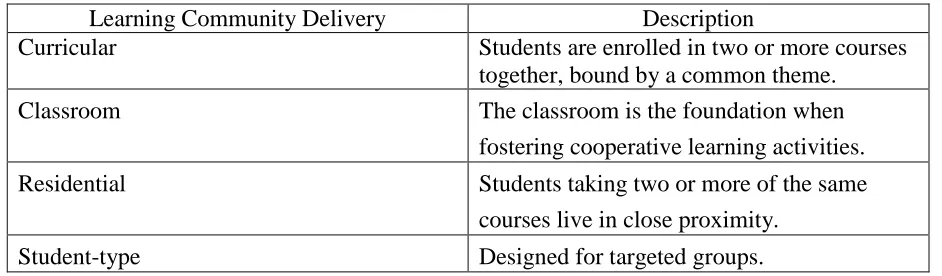
& Kuh, 2004; Brower & Dettinger, 1998). Table 1 identifies the broad learning community
Table 1. Types of learning communities (Lenning & Ebbers, 1999; Zhao & Kuh, 2004).
Learning Community Delivery Description
Curricular Students are enrolled in two or more courses
together, bound by a common theme.
Classroom The classroom is the foundation when
fostering cooperative learning activities.
Residential Students taking two or more of the same
courses live in close proximity.
Student-type Designed for targeted groups.
Each delivery method may be facilitated independently or in combination. The curricular
focuses on the common subject matter that all participants in the learning community will
learn about. The benefit to this method is that the students may be in a face to face setting or
an online setting since it is driven by the curriculum. The classroom method allows for
activities to be administered during designated classroom time when students are expected to
be in attendance. The residential method utilizes a common living area such as a residence
hall. These students have the advantage of not only being in class together, but also the
opportunity to collaborate and socialize while living in close quarters. The student-type
method focuses on the common bond between the students. This could be a particular
student organization such as Women in Technology. When it comes to combining these
delivery methods, a learning community made up of a particular student type may also live in
the same residence hall. Similarly, students taking similar courses in different locations may
participation in an online learning community. Regardless of the chosen method, students
participating in a learning community are found to possess higher levels of achievement,
learning, and success (Taylor, Moore, MacGregor, & Lindblad, 2004; Tinto, 2003; Tinto &
There are direct and indirect benefits when it comes to learning community
participation. Much effort has gone into the direct benefits of learning community research.
As an intervention, prior research has analyzed direct benefits to improve student retention
and graduation to meet the wider demographic needs and quality assurance needs of higher
education. These direct benefits include student retention, higher grades, and ultimately
improved graduation rate, to name a few. However, an emerging, and important trend has
focused on the indirect benefits of learning communities. Where direct benefits are more
program and discipline specific, how learning communities may be applied more generally
are required. The recent research on the indirect benefits of learning community includes
participation, and how participation is a product of student engagement, regardless of
pedagogy.
The indirect benefits of learning community warrant deeper investigation. The
broader impacts that are a result of the indirect benefits of a learning community require
wider identification to meet these higher educational goals, beyond specific disciplines. The
indirect benefits will inform the wider, non-specific goals that are programmatic and may be
implemented, regardless of specific academic units. Student focused research engages in
indirect learning community benefits. For example, student engagement is described by Kuh
(2003) as the level of time and energy a college student spends on learning. Further, when
reviewing the common characteristics of a learning community, prior research has suggested
a positive relationship with this form of engagement. Zhao and Kuh (2004) studied
engagement as a mediator, and found that participating in a learning community was related
more to student engagement than learning outcomes, and that student engagement was more
community include the collaboration of peers in active learning experiences, sharing of
knowledge, and academic and social engagement (Brower & Dettinger, 1998; Tinto &
Russo, 1994; Zhao & Kuh, 2004).
Building upon prior work, this research study has developed a model that is
cognizant of a learning community foundation. There are some characteristics that most
learning communities share. One common characteristic is the encouragement of learning
among students. Learning community participation has been found to be positively related to
time spent on academics (Inkelas, Daver, Vogt, & Leonard, 2007; Zhao & Kuh, 2004) and
higher-order thinking (Inkelas & Weisman, 2003; Pike, 1999; Zhao & Kuh, 2004). Another
important characteristic that has been found to be positive is the interaction among students
and faculty (Ancar, Freeman & Field, 2006; Tinto, 2006; Tinto, Russo, & Kadel-Taras, 1994;
Inkelas et al., 2007; Inkelas & Weisman, 2003; Pike, 1999; Pike, Schroeder, & Berry, 1997;
Zhao & Kuh, 2004). The interaction between faculty and student is a strong predictor of
student success in the classroom.
The characteristic of social integration allows for the sharing of knowledge and the
involvement of students both socially and intellectually (Tinto, 2003). This is also an
indirect benefit as suggested by prior research in peer collaboration activities (Inkelas et al.,
2007; Inkelas & Weisman, 2003; Zhao & Kuh, 2004). As with faculty and student
interaction, the social aspect of the learning community is important to improved student
persistence. Students that get to know their peers on a personal level allows for improved
collaboration efforts.
There is added complexity when it comes to social interaction due to the fact that not
becoming more varied, the path to higher education is responding in increasing trends. The
traditional college student path is becoming part of a broader higher educational route.
Students are increasingly attending college and the university and increasing their travel to
and from classes without taking advantage of the traditional campus resources available to
the residential college student. The commuter student may only learn and interact with peers
and faculty when in the classroom (Tinto 1997, 2003; Tinto, Russo & Kadel-Taras, 1996).
Tinto and Russo (1994) studied the effects of learning community activities facilitated on a
commuter campus. The learning community experience served to bridge academia and
social life rather than force a non-residential student to choose just one. Furthermore, the
learning community experience resulted in a higher level of student persistence than a
traditional commuter environment.
A common institutional goal is to promote student success, particularly during the
first year, but institutional commitment wanes and can be found lacking. The impact of
reduced student focus after the initial introduction to higher education results in a limited
impact of the learning community (Tinto, 2005). Tinto argues that the conditions in which
institutions place their students may be designed, controlled and modified for the goal of
greater student persistence across the academic life of the college student. This is
accomplished with six conditions of success: commitment, expectations, support, feedback,
involvement, and learning. Tinto (2005) justifies these conditions with the following
recommendations to an institution wanting to improve student persistence:
1. A commitment to success must include monetary resources and not just words.
2. A high expectation of student performance begins with the first year.
4. Utilize student feedback and assessments of the learning environment.
5. Foster student involvement both academically and socially.
6. Focus on the development of a setting that encourages learning.
These conditions are all attainable with the characteristics of a learning community and are
not discipline specific. They actively involve students in learning, promote social and
academic involvement, and offer academic support for the motivation to persist, however
indirectly (Tinto, 1997, 1998, 2003; Stefanou & Salisbury-Glennon, 2002; Zhao & Kuh,
2004).
Based on research pertaining to sense of community, two additional hypotheses are
proposed:
H3: Students with greater involvement in collaborative learning will have a greater sense of community.
H4: Students with a greater sense of community will have a greater sense of campus connectedness.
Commitment
Meyer and Allen (1991) identify three general themes when researching commitment,
specifically organizational commitment. First, commitment can be described as affective
where an individual has an emotional attachment to an organization. The more that the
individual connects with the organization, a stronger commitment is experienced. In other
research studies, the perceived cost of leaving an organization is weighed by an individual.
The greater the cost, the less likely the individual will leave. The third approach is based on
these themes, Allen and Meyer (1990) developed a three-component model to analyze
affective, continuance and normative commitment levels.
Allen and Meyer (1990) explain that the three components are linked together in such
a way that the model decreases turnover rates, but each has individual roles to play in the act
of commitment toward an organization. Individuals who stay in an organization because
they want to stay experience a level of affective commitment. Those who stay because they
need to stay experience a level of continuance commitment, and normative commitment is
when individuals stay because they feel obligated to the organization.
In one particular component of commitment, Meyer and Allen (1991) explain that the
antecedents of affective commitment fall into three categories – demographics, structure and
work experiences. These categories are meant to explain why individuals would want to stay
at an organization. The first category pertains to personal characteristics, which include
demographics and personalities. In the case of students, this may include normal
demographic information such as gender, race and age. As for personality, it pertains to the
desire to succeed, academic honesty and ethics, and desire for belonging. Another category
is described as organizational structure which is a relationship between commitment and the
preference of how an organization operates. In the case of a student, it may be how the
classes are offered, the length of each semester, and the plan of study. In the case of work
experiences, Meyer and Allen (1991) point out that a larger number of studies have been
performed on the link between affective commitment and work experience. As for students,
work experience in this situation may include course work and study experience in prior
Few research studies have explored the use of organizational commitment to measure
student retention. Meyer, Allen, and Smith (1993) performed a research study utilizing the
three-component commitment model (Meyer & Allen, 1991). There were two samples of
participants, one being nursing students. The students were surveyed on the satisfaction of
the program and the level of commitment to continue. The study found that satisfaction with
the nursing program correlated with affective commitment early on in the program, but lost
its significance later in the program.
In another research study, Larkin, Brasel and Pines (2013) conducted a study in
organizational commitment across domains to investigate student retention factors. The
purpose was to investigate how organizational commitment and embeddedness are related to
an intention to persist. Based on the results of the study, the authors suggested that their
findings could be utilized as a case study in how to take an interdisciplinary approach to
retention. As hypothesized, an individual’s level of commitment predicted graduation.
McNally and Irving (2010) also sought to extend organizational commitment research
into the study of student behavior. A portion of their study utilized prior research in
workplace commitment to analyze the effects of affective, normative, and continuance
commitment on a student’s commitment to his/her university. The results of the study
supported prior research that affective commitment leads to lower turnover intention.
McNally and Irving (2010) suggest that future research could identify antecedents of
Based on a review of affective organizational research, two hypotheses are added to
research model:
H5: Campus connectedness will positively influence affective organizational commitment.
H6: Sense of community will positively influence affective organizational commitment.
Turnover intention
Just as Tinto’s work is committed to student persistence, John Bean (1980) dedicated
his research efforts to the issue of student attrition. Bean (1980) proposed an alternative
approach to the research of student attrition. He notes the prior work of Price (1977) in
employee turnover in work organizations as the foundational basis of his research model.
Bean’s (1980, p. 157) definition of student attrition is “the cessation of individual student
membership in an institution of higher education.” Just as employees may be unhappy or
dissatisfied with their place of employment, students may have similar reasons for leaving
their chosen institution of higher education. The model of student attrition involved a
selection of organizational determinants that related to two intervening variables, satisfaction
and institutional commitment, before reaching the dependent variable measuring dropout
intention. While Bean’s study was unable to explain a large percentage of the variance, he
encourages the identification of missing determinants with further research to improve the
model of student attrition and identify the unexplained variance.
In a subsequent study, Bean and Metzner (1985) proposed a model for researching
attrition among the non-traditional student population. To achieve a better understanding of
background demographics, academic environment, environmental factors, and psychological
outcomes. The variables are based on the obstacles that non-traditional students face when
attempting to persist through a higher education degree. Instead of utilizing an institutional
commitment measurement, intent to leave was suggested as a more appropriate predictor of
student dropout. While the model proposed was not tested in the article, the intent is to
encourage more research in this domain.
Meyer, Allen, and Smith (1993) and Kelloway, Gottlieb, and Barham (1999) utilized
similar intention to leave scales that included four items. The measures of turnover included
items about how likely an individual is going to leave his or her current profession, and the
level of effort that has gone into this decision. In the Meyer, Allen, and Smith (1993) study,
the participants where nursing students. The study of Kelloway, Gottlieb, and Barham
(1999) included employees that may or may not be experiencing work-family conflict. In
both studies, the level of commitment determined the level of turnover regardless of the
domain.
The final hypothesis of this research model is based on a review of turnover intention:
H7: Affective organizational commitment will positively influence turnover intention
Research Model
The following research model is offered to frame the discussion by outlining the
factors that are significant for student persistence. Continued research is warranted to further
understand the factors that may contribute to improving the situation of attrition, and to
suggest ways that institutions can enhance engagement and ultimately improve student
collaborative learning influences campus connectedness and a sense of community, and
subsequently how it impacts student persistence.
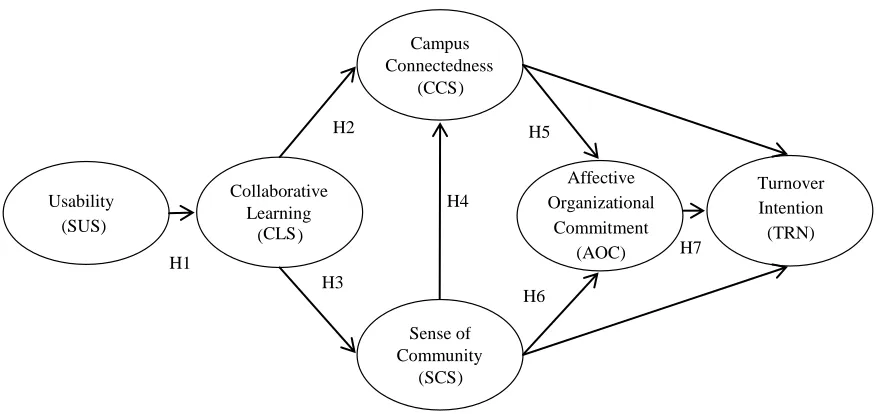
The model found in Figure 2 presents each theoretical construct and how each one
[image:42.612.92.533.224.431.2]contributes to student persistence.
Figure 2. Collaborative Learning Commitment Model
Campus Connectedness
(CCS)
Sense of Community
(SCS) Collaborative
Learning (CLS)
Affective Organizational
Commitment (AOC) H2
H3
H4
H5
H6 Usability
(SUS)
Turnover Intention
(TRN)
H1
1
CHAPTER 3. METHODS AND PROCEDURES
The following section details the process in which the research model has progressed
into a survey instrument. Prior to data collection, the consent form and survey instrument
were approved by the Institutional Review Board (IRB) on the use of human subjects for data
collection purposes. Upon approval from the IRB, the responses were collected via a
voluntary online survey via Qualtrics, and subsequently analyzed. The participants were
allowed to opt out at any time as stated in the consent form. In addition to the collected
survey data, participation data were gathered based on voluntary involvement in a virtual
learning community.
Instrument Development
The survey instrument was developed based on the factors of the research model, and
was tailored to the terminology used for communities and academia. Most questions used a 5
point Likert-type scale with the following possible responses: strongly disagree, disagree,
neutral, agree, and strongly agree. Each segment of the survey instrument is broken down
and further detailed in the sections below.
Collaborative learning scale
The collaborative learning environment may affect a sense of belonging felt by a
student. In order to measure this perception, So and Brush (2008) adapted a 10 item scale
based on prior research in online collaborative learning (Driver, 2002; Kitchen &
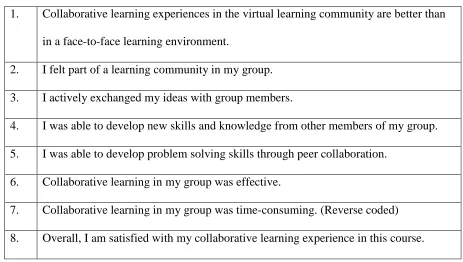
factor analysis, two items were removed for improved refinement. Of the 8 items in the
scale, only one item is negatively worded in Table 2. Analyzing student perceptions of
online collaborative learning with peers across institutions provides feedback for future
[image:44.612.80.543.218.480.2]course design.
Table 2. Collaborative Learning Scale
1. Collaborative learning experiences in the virtual learning community are better than
in a face-to-face learning environment.
2. I felt part of a learning community in my group.
3. I actively exchanged my ideas with group members.
4. I was able to develop new skills and knowledge from other members of my group.
5. I was able to develop problem solving skills through peer collaboration.
6. Collaborative learning in my group was effective.
7. Collaborative learning in my group was time-consuming. (Reverse coded)
8. Overall, I am satisfied with my collaborative learning experience in this course.
Campus connectedness scale
Summers, et al. (2005) adapted a scale to measure social connectedness to peers on
campus. The scale was administered in pre and post surveys, and adequately validated in the
study. For the purpose of this research study, the participants are commuter students from
multiple institutions. Assessing students’ sense of belonging to their campus at the beginning
of their first year can then be reassessed at the end of the semester for comparison. The
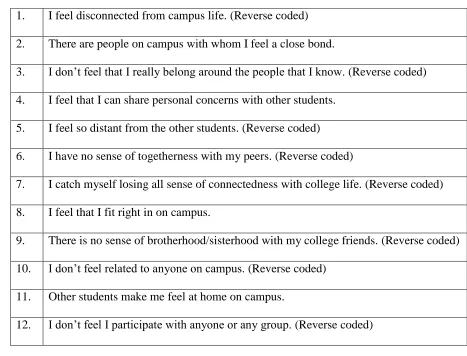
to encourage community. The scale in Table 3 consists of 12 items, 8 of which are
[image:45.612.74.541.161.517.2]negatively worded.
Table 3. Campus Connectedness Scale
1. I feel disconnected from campus life. (Reverse coded)
2. There are people on campus with whom I feel a close bond.
3. I don’t feel that I really belong around the people that I know. (Reverse coded)
4. I feel that I can share personal concerns with other students.
5. I feel so distant from the other students. (Reverse coded)
6. I have no sense of togetherness with my peers. (Reverse coded)
7. I catch myself losing all sense of connectedness with college life. (Reverse coded)
8. I feel that I fit right in on campus.
9. There is no sense of brotherhood/sisterhood with my college friends. (Reverse coded)
10. I don’t feel related to anyone on campus. (Reverse coded)
11. Other students make me feel at home on campus.
12. I don’t feel I participate with anyone or any group. (Reverse coded)
Summers, et al. (2005) speculate that classroom community and campus
connectedness are related in that one’s feelings of classroom community influences campus
connectedness.
Sense of community scale
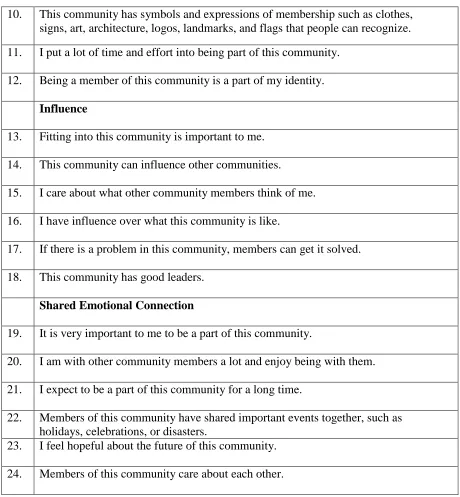
A commonly used scale for measuring sense of community was developed by Chavis,
Hogge, McMillan and Wandersman (1986) called the Sense of Community Index (SCI).