The creation of an active learning context for a Chinese class
1. Introduction
This paper presents how the implementation of coteaching promotes an active learning environment in a beginners’ Chinese classroom. Research has examined ways in which students are encouraged to take active participation in learning (Stern 1997; Mabrouk 2007; Clarke 2008). As Mabrouk (2007, p.2) states, active learning ‘generally refers to those teaching techniques that actively engage students in the classroom’. According to her, active learning allows students to work either independently or in small groups, in small and large classes, at all levels. As to be reviewed in 2.1, coteaching covers a range of learning contexts. However, existing research has not extensively focused on a learning context in which students learn Chinese by participating in student-led coteaching in turn. The current study attempts to address this gap by attesting the possibility for students to drive their own learning in this specific learning context. The authors aim to explore the impact of the implementation of coteaching on students’ learning process in terms of the following research questions: 1) Can coteaching encourage students to take responsibility for their own learning and the learning of others? 2) Can coteaching help students to learn the subject knowledge?
2. Literature review
Central to this study is the impact of the implementation of coteaching on students’ language learning experience. Coteaching is conducted to encourage students to take active participation in their learning process by acting as coteachers in groups. Their involvement in teaching demonstrates how they work cooperatively within coteaching groups and foster a mutual relationship with the peer learners they teach. Learner autonomy is associated with the implementation of coteaching. Its key components relevant to this study are learner responsibility and interdependence. Both coteaching and learner autonomy are underpinned by the Zone of Proximal Development (ZPD) (Vygotsky 1978) whereby the process of preparing to coteach generates a linguistic distance between coteachers and peer learners, allowing peer teachers to play a guiding role in their peers’ learning.
2.1. Coteaching
coteaching. According to Gallo-Fox (2010), it helps coteachers to come to an agreement about how they would conduct their coteaching practices in the classroom.
Research suggests that coteaching benefits both coteachers and learners. From coteachers’ perspectives, coteaching increases their subject knowledge and develops their teaching skills (Roth and Tobin 2005), encourages them to reflect on teaching (Murphy and Scantlebury 2010), enables them to share ideas and learn from each other (Tobin and Roth 2006) and develops mutual trust among coteachers over time (Honigsfeld and Dove 2010). Villa, Thousand and Nevin (2008) point out the benefits of coteaching for learners. They argue that coteaching enables learners to experience coteachers’ cooperative skills and may imitate them. Learners also enhance their subject knowledge when coteachers present knowledge and skills through different approaches.
Within this study and within the literature, coteaching led by students at the whole class level is operationalised in teaching groups. Students take turns, as a group, to teach the whole class. The rationale for this is to ensure that students cooperate with each other and support each other in the role of coteacher or peer learner. The studies by Assinder (1991) and Carpenter (1996) include the key features of coteaching within the context of language learning for European languages. Assinder (1991) involves 12 students in her project and concludes that coteaching experience helps students to have a more accurate and in-depth understanding of subject knowledge, increases their motivation and confidence and facilitates them taking greater responsibility for their own learning. Similarly, Carpenter (1996) in her case study of 60 students discovers that the intervention encourages students to take greater responsibility for their learning. She also points out that coteaching generates a strong group dynamic in the class. These studies reveal the benefits of coteaching in classroom settings and provide practical implications for the current study.
2.2. Learner autonomy
Research suggests that learner autonomy is developed in a setting where learners are interdependent with others (Boud 1988; Kohonen 1992; Broady and Kenning 1996; Smith and Ushioda 2009). Little (2001) explains that learners are social beings and their independence is always balanced by dependence. Their essential learning condition is one of interdependence. Learners are interdependent not only with their peers but also with the classroom teacher (Dickinson 1987; Marshall 1996). In terms of the teacher’s role, the teacher must take on the role of facilitator (Scharle and Szabo 2000), help learners to specify clear objectives and, select and use appropriate materials (Dickinson 1987), provide learners opportunities to reflect on their learning process (Broady and Kenning 1996), get learners to accept responsibility for their learning (Little 2003) and ensure a healthy and safe learning environment in which learners gain the ability to become self-directed human beings capable of producing their own knowledge (Kincheloe 2008).
2.3. The Zone of Proximal Development (ZPD)
The ZPD symbolises individuals’ learning journeys. As Vygotsky (1978: 86) defines, the ZPD is ‘the distance between the actual developmental level as determined by independent solving and the level of potential development as determined through problem-solving under adult guidance or in collaboration with more capable peers’. The definition shows that individuals are in process of maturation within the ZPD. The focus of the ZPD is the very process during which individuals’ development is generated. For Vygotsky, individuals’ developmental process is able to operate only when they are interacting with others and guided by others. Cole (1985: 155) argues that individuals’ development is a structure of joint activity in any context where they ‘exercise differential responsibility by virtue of differential expertise’. Others who are more capable play essential roles in helping individuals to progress. Such guidance is commonly regarded as mediation in literature. As Poehner and Lantolf (2010: 316) emphasise, mediation is a matter of offering assistance and it has to be appropriate. According to them, assistance should aim at helping ‘to move the individual toward independent, agentive performance and to be able to transfer what is appropriated in a given circumstance to future situations’.
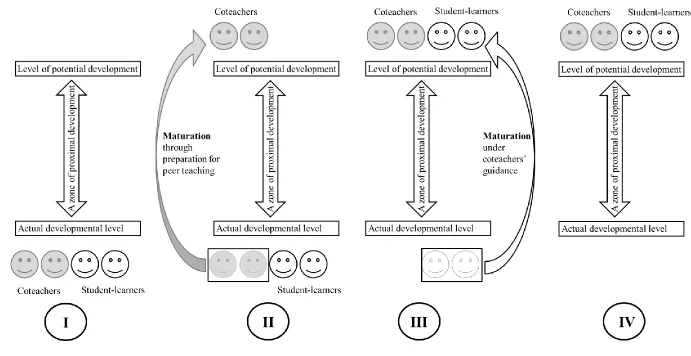
teachers’ level of Chinese. Coteachers’ teaching activities are the mediation through which peer learners improve their language level. Stage IV shows that all students, including both coteachers and peer learners, are at the same level of Chinese again after a coteaching session. These four stages together illustrate the continuous process of the implementation of coteaching in the current study.
3. Methodology
The approach taken is of a qualitative case-study to explore how students arranged themselves and their learning settings in the current coteaching context as part of a beginners’ Chinese course. The course in question took place at a School of Education in an Irish university for two hours per week for five weeks in 2011. Each lesson consisted of two sessions: 20% of students’ coteaching with the classroom teacher’s facilitation and 80% of the classroom teacher’s teaching. Sixteen adult students were divided into 5 coteaching groups of 3 or 4. All the groups conducted coteaching in the form of peer revision. Individual groups had to meet outside of the classroom in order to discuss their teaching content and teaching activities. The classroom teacher met each of the coteaching groups one day before their coteaching session to answer questions and ensure the quality of their teaching. The classroom teacher taught new content after each of the coteaching sessions. Towards the end of the course, students were expected to be able to: 1) Hold short conversations and, ask and answer simple questions; 2) Comprehend some sentence-length utterances in situations where the context aids understanding; 3) Recognise 12 to 15 Chinese characters and read simple conversations with help of Pinyin, or the phonetics of Mandarin Chinese; 4) Write 10 to 12 Chinese characters and simple conversations with help of Pinyin. All students were required to complete weekly language reflection journals and final group reports which recorded their learning experiences as both peer learners and coteachers. A total number of 64 weekly journals and 7 group reports were submitted in English. Both the journals and reports provided the data for this study. A thematic analysis was carried out to code and categorise all the data
4. Data presentation
A great amount of feedback was relevant to answering the research questions which were raised in section 3. Two major themes were derived from the feedback. The group solidarity was represented at two levels: the solidarity as the whole class and the solidary as the coteaching group. Students’ language learning included both peer learners’ learning and coteachers’ learning. Both the group solidarity and the language learning were explored to underpin the impact of coteaching on students’ learning.
4.1. Group solidarity
very well!’ (Nora: week 2)1. Peer learners were aware that they and coteachers belonged to the same class. As a result, they wanted coteachers to perform well and tried their best to help coteachers to deliver successful coteaching sessions by taking proactive participation in coteaching sessions. ‘To a huge extent, there was a sense of camaraderie in the [co]teaching scenario, as fellow student[s] one wished them to do well, supported them and the class as a whole, made an extra effort to listen/participate in their activities’ (Group 5). Peer learners’ proactive participation in coteaching sessions was also associated with their appreciation for coteachers’ hard work. They understood that coteachers had put a lot of effort into their preparation for coteaching. ‘We wanted to be “good students” for our fellow classmates who were teaching us. Since they had made the effort to come up with a plan for the lesson and made worksheets etc.’ (Group 4).
According to coteachers’ feedback, the positive relationship among coteachers within coteaching groups played important roles in helping them to conduct coteaching sessions and achieve teaching objectives. As they pointed out, the preparation for coteaching made them aware that they were all part of the coteaching groups and responsible to contribute to the group tasks. They worked together on their teaching plans and shared workload with each other in order to deliver successful coteaching sessions. ‘The fact that we were teaching in groups, we felt that we had a duty to the other three in our [co]teaching team to be well prepared. We had to know our topics very well in order to teach them, so it motivated us to work harder’ (Group 1).
These two levels of the group solidarity were complementary to each other and together helped students to participate in coteaching or being cotaught, and, at the same time, benefit from their involvement as both coteachers and peer learners. As students indicated, when they had opportunities to act as both coteachers and peer learners, they were unified as a team and created the wholeness of the class. The class was glued together and a team spirit was fostered. ‘We noticed that [coteaching] increased the sense of solidarity between learners and this was found to be motivating by everyone in the [class]’ (Group 2).
4.2. Language learning
As set out in section 3, students were required to achieve a certain level of Chinese as language learners. They pointed out in their reflective journals and final group reports that coteaching helped them to reinforce their knowledge of the Chinese language. The two factors which helped peer learners to increase their level of the Chinese language were coteachers’ teaching and peer learners’ own intention to study hard. Coteachers’ level of Chinese increased through their preparation of coteaching content. Despite the positive feedback, certain elements also had negative impact on the learning of both peer learners and coteachers.
Coteachers’ various teaching techniques helped peer learners to understand Chinese from different angles and in refreshing ways. According to peer learners, the variety of teaching techniques encouraged them to learn. ‘All the sessions were well-prepared and very varied in
their content and in the approaches of all the teachers. It was interesting to see all of the different personalities and techniques and learn in a different way from each person’ (Group 1). The fact that both coteachers and peer learners were classmates allowed coteachers to understand their peers’ needs easily. In this sense, coteachers were able to create the suitable teaching content, enjoyable class activities and positive classroom atmosphere.
‘For the most part the activities chosen by the coteachers were practical and
well-focussed. As these exercises were designed by fellow learners, they seemed to suit
our needs well in that they anticipated our difficulties and the likely gaps in our
knowledge. Peer-led sessions also contained an element of novelty and fun’
(Group 2).
According to coteachers’ feedback, their participation for coteaching enhanced their knowledge level of the Chinese language. When they were aware that their contribution to coteaching would benefit their peers, they felt encouraged to learn. ‘Revising content for a specific purpose – in this case having to clearly articulate it for others – is a much more effective way of assimilating content than silently looking through notes without really feeling under pressure to properly use the content’ (Mona: week 3). Coteachers put a lot of effort into studying individual words, phrases and pronunciation outside of the classroom. As they recalled, these efforts helped them to master their teaching content. ‘Having us independently source the meaning of target vocabulary was motivating and was certainly engaging… The amount of time required to engage in this task helped us to retain the vocabulary afterwards’ (Group 2).
Despite coteachers’ capability to conduct coteaching, a few factors hindered peer learners’ learning. They consisted of coteachers’ teaching pace, teaching content and pronunciation competence. Some coteachers’ teaching went too fast for peer learners to follow. ‘I felt this week that the class moved too fast and we covered too many new things and didn't get to practise each of the new things enough’ (Kate: week 2). Occasionally coteachers introduced too much content in their teaching. ‘I found that having too much information in the one lesson hindered my learning as well as being very tired’ (Mathew: week 2). Coteachers’ pronunciation was also a hindrance to peer learners’ mastering correct sounds of words. ‘Pronunciation varied hugely from [co]teacher to [co]teacher and this hindered the learning of the tones, which are crucial to the Chinese language’ (Group 5). One negative impact aspect was that coteaching sessions distracted a few coteachers from participating in the main section of the Chinese class. Their minds were switched off for a while. ‘I found that my concentration for this lesson was focused mainly on the first part of the lesson when we were teaching. For the rest of the lesson I was not as focused or concentrated’ (Barry: week 2).
5. Discussion
maturation were supported by the theory of the ZPD. During the process of creating the ZPD, the development of coteachers’ learner autonomy was evident.
5.1. The zone of proximal development (ZPD)
Coteachers’ maturation was referred to as the second stage of generating a ZPD in figure 1. It consisted of their independent learning, their coteaching group mates’ help and the teacher’s guidance. In this study, students were all beginners of Chinese and they were at a similar level of Chinese right after each Chinese lesson. In order to conduct coteaching, coteachers had to share ideas (Tobin and Roth 2006; Murphy and Scantlebury 2010) in order to ensure their individual accountability by enhancing their own knowledge of Chinese (Murphy and Scantlebury 2010). In the preparation for coteaching, they all worked with each other in groups of three or four in order to accomplish the unified teaching objectives (Gallo-Fox 2010). The process of preparation also responded to some of the key elements of Villa, Thousand and Nevin (2008), such as face-to-face interaction and positive interdependence. As stated in section 4.1, coteachers considered peer learners as their friends and wanted to help them to learn. This factor encouraged coteachers to master their own materials before teaching. Coteachers’ responsibility applied to both the whole Chinese class where they were teachers and the coteaching groups where they were in cooperation with their fellow coteachers. This showed that group solidarity was created by the implementation of coteaching and had positive impact on coteachers’ learning (Roth and Tobin 2005). However, the data, derived from the short course, did not explicitly demonstrate if coteachers developed their interpersonal skills and how they monitored their coteaching progress. Honigsfeld and Dove’s (2010) mutual trust among coteachers was not highlighted either.
All students were at a similar linguistic level right after each lesson (Level 1). As illustrated in figure 1, when coteachers generated a ZPD, they were a step ahead of peer learners in terms of linguistic competence. When peer learners generated a ZPD right after coteaching sessions, they improved their linguistic level (Level 2) as coteachers had done during stage II in figure 1. However, Level 1 and Level 2 were different. Level 1 was all students’ linguistic competence before their generation of a ZPD in figure 1. Level 2 was developed out of Level 1. The development from Level 1 to Level 2 demonstrated the distance by which the Chinese class as a whole progressed during each of the coteaching sessions. The progression of the whole class represented the collective maturation which was generated though the cooperation among all students acting in different roles in each of the coteaching sessions (Wells 2000; Fani and Ghaemi 2011). As a result, the coteaching context generated three types of maturation: the maturation of coteachers, the maturation of peer learners and the maturation of the whole class. The maturation of coteachers was the foundation for the maturation of peer learners. And the combination of these two types of maturation created the possibility for the maturation of the class as whole.
5.2. Learner autonomy as coteachers
As stated in section 2.2, autonomous learners need opportunities to take responsibility. As pointed out in section 4.2, in line with Carpenter (1996), these opportunities were created for both coteachers and peer learners in the current coteaching setting. Coteachers’ feedback comments were associated with the word ‘responsibility’ when they were aware of their roles as coteachers. Not only did they get themselves prepared in order to be able to help peer learners to enhance their knowledge of Chinese but they also contributed to the preparation for coteaching sessions (Dam 1995). As examined in section 2.2, taking responsibility for learning was a key component of learner autonomy. Coteachers’ autonomous actions were related to both their control over the learning process and their active involvement in learning. They understood that they needed to share the workload among themselves. As stated in section 4.1, coteachers took the responsibility for their peers’ learning by presenting good coteaching content. The fact that coteachers worked together and managed to teach their peers underpinned that they were self-regulated learners (Little 2003). This also proved that learners as coteachers were able to take responsibility for learning. Like coteachers, peer teachers also demonstrated that they were determined to take responsibility for the learning of others when they wanted to support coteachers’ teaching. However, compared with coteachers, peer learners did not provide a strong indication that they took initiatives to master the learning content.
activities during the coteaching sessions. This mutual relationship between coteachers and peer learners within a class cohort as well as among coteachers within a coteaching group emphasised the social aspect of learning and created an interdependent learning context which was an essential component of developing learner autonomy, as stated in section 2.2. As stated in section 3, the teacher met individual coteaching groups before their teaching sessions and provided coteachers necessary facilitation and support during their preparation for coteaching. The teacher’s involvement confirmed the necessity of coteachers’ interdependence with the classroom teacher (Dickinson 1987; Marshal 1996; Broady and Kenning 1996; Scharle and Szabo 2000).
6. Conclusion
This study explored the impact of the implementation of coteaching on students’ learning in a beginners’ Chinese classroom. The ZPD underpinned the whole process of the implementation of coteaching. It included three types of maturation: coteachers’ maturation, peer learners’ maturation and the collective maturation of the whole class. The first two types of maturation were complimentary to each other and together formed the third type of maturation. The current coteaching approach allowed coteachers to help each other within coteaching groups and conduct interdependent learning which mediated themselves to learn. Coteachers’ design of various teaching techniques and teaching content mediated peer learners to learn. As a result, the coteaching approach mediated the whole Chinese class to learn. The results of this study also illustrated that this approach proved to be beneficial for students to learn Chinese. The development of learner autonomy was represented by the process during which students took responsibility for their own learning as well as the learning of others. Coteaching provided students opportunities to take such responsibility. The findings also suggested that students’ learning happened in a setting where they were interdependent with each other as well as with the classroom teacher.
This study was contextualised in this specific Chinese classroom. Students’ learning process was analysed through their reflective journals and final group reports. As a broad concept, active learning embraces a variety of teaching methods and techniques. This paper did not attempt to prioritise this coteaching approach or make any assumptions regarding readers’ teaching theories. However, the authors did hope that this research project may provide readers of similar or different academic backgrounds an overview of such a teaching practice and offer them an opportunity to compare this approach with the ways they teach.
References
Assinder, W. 1991. Peer teaching, peer learning: one model. ELT Journal, 45(3), pp.218–229.
Benson, P. 2001. Teaching and researching autonomy in language learning. Harlow, England: Longman.
Broady, E. and Kenning, M.M. 1996. Learner autonomy: an introduction to the issues IN:
Broady, E. and Kenning M.M. (eds.) Promoting learner autonomy in university language teaching. London: Middlesex University Printing Services, pp.10–21.
Carpenter, C. 1996. Peer-teaching: a new approach to advanced level language learning IN: Broady, E. and Kenning, M.M. (eds.) Promoting learner autonomy in university language teaching. London: Middlesex University Printing Services, pp.23–38.
Clarke, S. 2008. Active learning through formative assessment. London: Hodder Education.
Cole, M. 1985. The zone of proximal development: where culture and cognition create each other IN: Wertsch, J.V. (ed.) Culture, communication, and cognition: Vygotskian perspectives. Cambridge, England: Cambridge University Press, pp.146–161.
Dam, L. 1995. Learner autonomy 3: from theory to classroom practice. Dublin: Authentik.
Dickinson, L. 1987. Self-instruction in language learning. Cambridge, UK: Cambridge University Press.
Fani, T. and Ghaemi, F. 2011. Implications of Vygotsky’s zone of proximal development (ZPD) in teacher education: ZPTD and self-scaffolding. Procedia – Social and Behavioral Sciences, 29, pp.1549 – 1554.
Gallo-Fox, J. 2010. Risk-taking as practice in a coteaching professional learning community
IN: Murphy C. and Scantlebury, K. (eds.) Coteaching in international contexts: research and practice. London: Springer, pp.105–124.
Holec, H. 1981. Autonomy in foreign language learning. Oxford: Pergamon.
Honigsfeld, A. and Dove, M.G. 2010. Collaboration and co-teaching: strategies for English learners. Thousand Oaks, CA: Corwin Press.
Jennings, C. M. and Di, X. 1996. Collaborative learning and thinking: the Vygotskian approach IN: Dixon-Krauss, L. (ed.) Vygotsky in the classroom: mediated literary instruction and assessment. White Plains, NY: Longman Publishers, pp. 77-91.
Kincheloe, J. 2008. Critical pedagogy primer. New York: Peter Lang.
Kohonen, V. 1992. Experiential language learning: second language learning as cooperative learner education IN: Nunan, D. (ed.) Cooperative language learning and teaching.
Cambridge, UK: Cambridge University Press, pp.14–39.
Little, D. 1991. Learner autonomy 1: definitions, issues and problems. Dublin: Authentik.
Little, D. 2003. Learner autonomy in the foreign language classroom: taking account of all the roles and agencies involved in secondary education IN: Little, D., Ridley, J. and Ushioda, E. (eds.) Learner autonomy in the foreign language classroom: teacher, learner and assessment. Dublin: Authentik, pp.3–5.
Mabrouk, P.A. 2007. Introduction IN: Mabrouk, P.A. (ed.) Active learning: models from the analytical sciences. Washington, DC: American Chemical Society, pp.1–13.
Marshall, K. 1996. The rewards and pitfalls of autonomy: a Bangor experience IN: Broady, E. and Kenning, M.M. (eds.) Promoting learner autonomy in university language teaching. London: Middlesex University Printing Services, pp.39–60.
Murphy, C. and Scantlebury, K. 2010. Introduction to coteaching IN: Murphy, C. and Scantlebury, K. (eds.) Coteaching in international contexts: research and practice. London: Springer. pp. 1–7.
Poehner, M.E. and Lantolf, J.P. 2010. Vygotsky's teaching-assessment dialectic and L2 education: the case for dynamic assessment. Mind, Culture, and Activity, 17, pp. 312-330.
Roth, W. and Tobin, K. 2005. Coteaching: from praxis to theory IN: Roth, W. and Tobin, K. (eds.) Teaching together, learning together). New York: Peter Lang, pp.5–26.
Scharle, A. and Szabo, A. 2000. Learner Autonomy: a guide to developing learner responsibility. Cambridge, UK: Cambridge University Press.
Smith, R. and Ushioda, E. 2009. Autonomy: under whose control? IN: Pemberton, R., Toogood, S. and Barfield, A. (eds.) Maintaining control: autonomy and language learning. Hong Kong: Hong Kong University Press, pp.241–254.
Stern, D. 1997. Active learning for students and teachers: reports from eight countries. Frankfurt: Peter Lang.
Tobin, K. and Roth, W.M. 2006. Teaching to learn: a view from the field. Rotterdam: Sense Publishers.
Villa, R.A., Thousand, J.S. and Nevin, A.I. 2008. A guide to co-teaching: practical tips for facilitating student learning. 2nd ed. Thousand Oaks, CA: Corwin Press.
Vygotsky, L.S. 1978. Mind in society. Cambridge, Mass: Harvard University Press.
Ann Devitt (Corresponding author)
Email: [email protected]
Ann Devitt, PhD, is an Assistant Professor at the School of Education in Trinity College Dublin. Her research interests include second language teaching and learning, in particular Computer Aided Language Learning, language in education and the discourse of the classroom and textbooks, threshold concepts for teacher education and applying computational linguistic and corpus methodologies in educational research.
Weiming Liu
Email: [email protected]