Capital Formation, Saving and Economic
Progress
By T K WHITAKER, M SO (EOON ) (Read before the Society on 25th May, 1956)
Introduction
In this paper I assemble some facts and considerations legardmg the relation of capital formation and saving to the raising of real incomes m Ireland In other words, my concern is with national development and with some of the means necessary to attain it in our particular circumstances The views expressed are purely personal I have biought the salient statistics into the text and put most of the tabular matter in. an appendix
Comparative advances in real incomes
Qnr\pp>rr± hflc! been expressed nbout the CGm^strctti^slv slo™ r^sc in
real income per head in Ireland over the past thirty years The varying degree to which economies were damaged during the war makes it difficult to interpret comparisons which stretch back to-pre-war times I t will suffice to take 1949 as a starting point, for three reasons First, it is accepted that by then the countries with which we have most contact and in which developments have most influence on our economic and social conceptions had recovered from the effects of the war Second, it was about that time that we began particularly to look to a greatly enlarged State capital programme as a means of economic progress Third, it is recent experience and trends which are of most relevance to an examination of current problems
In attempting to compare economic progress here and m other countries since 1949, one must rely on statistics which, though not gaii&fai/tuij', die the utjbt dvdildbie, namely, indices of gross national product The term " gross national product " expresses the value of the nation's output of goods and services, before any deduction is made for depreciation of capital assets Just as personal income can be either consumed or saved so gross national product can be applied either to consumption (private and public) or to " gioss capital formation " If the " gross " element could be eliminated, that is, if proper allowance could be made for maintaining existing capital, it would be possible to estimate net national product accurately , and on the basis of figures of net national product, converted into stable money terms, one could assess the real advance from year to year m a community's income and wealth As things are, one must rely for comparative purposes on gross statistics, remembering, how-ever, that " gross national product " and " gross capital formation " figures exaggerate, to an indefinable but substantial degiee, the tiue position as regards real additions to income and capital
upwaid trend in output and real incomes is weaker heie than in Britain and othei 0 E E C countnes Taking 1949 as starting point, our gross national product had risen 7 6% bv 1954, as compared with 14 6% for Bntain and 29 3% for O E E C countnes generally (Table 1 of the Appendix) On a per capita basis the differences are nan owed— for Iieland the mciease being 7 7% while the British and O E E C figures are Ieduced to 13 0% and 24 3% respectively Our showing is thus improved by emigration, which has kept the population almost stable in contrast with the increases lecorded in Britain and Europe generally The slow late of increase m real income here as compared with Butam is the more disappointing because of the statistical assessment that our average real income is only one-half that of Britain and, incidentally, about one-fifth that of the United States
Effects of emigration
While emigration may be viewed as a means by which both those who emigrate and those who remain at home can obtain a gi eater improvement m living standaids per head than the increase in our national product warrants, it must be recognised, on the other hand, that a static or declining population has itself a restrictive effect on the growth of the national product It makes development more difficult, giving an inflexible organisation and leading to reluctance to invest With a stable population it is not usual to find a dynamic and expanding business activity New investments are more risky and less profitable than m an economy that is growing quickly
Effects and risks of slow rate of advance
The failure of production here to rise as fast as in othei countries is an unsettling economic and social influence, the more disturbing because, at least since the war, there is here, as elsewhere, a general expectation of year by year improvement of living standards irres-pective of the trend m production In our case, it is Britain more ^han any other country which sets the standard of our expectations in such matters as wage and salary levels and the pattern both of private consumption and of collective services (health, housing, education and social services generally) Moreovei, the level of piosperity there not only affects our export trade and, therefore, our agncultural and industrial incomes, but also largely determines the rate of emigration because of its effect on the availability of employ-ment m Biitam on attractive terms
for long In the ordinary course, increases m money incomes which are not linked to increased output, become neutralised, in whole or in part, by higher prices and higher taxation This shearmg-off o± nominal purchasing power is part of the inevitable process of reducing monetary demand to equality with the current physical output of goods and services
If under the influence of external developments or of the natural desire lor better conditions, a movement develops towards higher standards, e g , of income, private consumption or social services and amenities, there is always the risk that it may outrun the rate of increase m national production If this occurs, the first and most obvious effect will be a widening of the trade deficit, which means the consumption of foreign reserves and investments built up out of past savings There will also be a tendency for prices to rise It is, of course, part of the necessary stimulus to enterprise, investment and increased production that the home demand for consumer goods and services should be buoyant, but there is a point of excess at which the con-sequences, psychologically and in the credit field, of heavy and persistent balance of payments deficits are seriously prejudicial to economic progress
Failure to keep pace with our neighbours m the rate of increase m real output of goods and services besides putting a strain on the economy m the way just described has also the effect of stimulating emigration, one of the potent causes of which is the attraction of better living standards elsewhere Trie lndustiidi jjiugiess made over the past twenty years or so and the enlargement in recent years of the State capital programme have been substantial but m terms of employment they have not quite balanced the release of labour from agriculture , they have not resulted in a net increase in overall employ-ment In other words, the natural increase in the population, resulting from the excess of births over deaths, is still being siphoned off by emigration There must, m these circumstances, be very great doubt whether any immediate and practicable intensification of industrialisa-tion or capital development generally can do more than absorb a fraction of the natural increase in the population, which is of the order of 25,000 per annum But even if additional jobs could be created year by year at this rate it would not necessarily mean an end to dnigrafir»n e^en to such emigration as is due solely to economic
causes There would be only a limited curb on emigration unless tne •jobs created—and all other jobs, too—were such as to yield as good a life as could be obtained by emigrating A high rate of economic development and competitive efficiency m production are indispensable conditions of even a partial solution of the emigration pioblem Acceptability of the standard of living
many of the emigrants themselves, would accept this depression of current hvmg standards as a condition of full employment at home Anothei way of putting this is that, ]f emigration ceased altogether, our population would rise at the rate of l\% per annum, assuming fertility remained unchanged The rate of increase m real output here over the years 1949-54 was not quite 1J% per annum So there would never be any improvement in the present standard of living, if emigration ceased and our recent rate of increase in output were not raised In the United States, on the other hand, real output has been increasing so much faster than population that over 40 years the standard of living has doubled In Butain, if the population does not rise much, the recent rate of increase m leal output may double the standard of living m 25 years These comparisons point to the like-lihood of emigration continuing on a large scale unless our rate of increase in output can be greatly accelerated It would, indeed, need to be almost trebled if we were to keep all our people at home and double our present living standards m 25 years If we do not keep pace with other countries m material progress, who can confidently predict that emigration will not continue virtually unabated ?
Increased output the pn?nary need
The mere giving of employment, to the neglect of the productive element in it, can obviously afford no lasting easement of the emigra-tion pioblem On the contrary, insufficiently productive employment necessitates a redistribution of real income in favour of those who are not adequately supporting themselves by output for which there is an economic demand This redistribution may take place in ways not immediately recognisable, e g , through higher taxation to finance the net debt charges on public works or through higher prices or inferior quality of protected products Whatever form it takes, it represents a lowering of real incomes for many in the community and so tends to aggravate the unsettling influence of unfavourable com-parisons with conditions elsewhere
Increased capitalisation not the only means
If we want a rising standaid of hvmg we must do what is necessaiy to achieve a rising volume of output, and if we aie not content with the present rate of increase m output we must do what is necessary and possible to accelerate it It would, however, be a mistake to think that a faster rate of increase in output is a matter merely of stepping up the volume of home investment (" domestic capital formation ") tt is true that theie is a close relationship between output per head and the amount of capital per head but there are other conditions of economic progress no less important than increased capitalisation The first of these is the development of a better appreciation of the dependence of material pi ogress on individual output Others are a raising of the general level of education, health and skill, the loosening of restrictive practices, whether of employers or employees, the practical encouragement of initiative and enterprise, the adoption of improved methods, techniques and principles of organisation and management both m agriculture and industry, and a greater readiness to apply scientific advances Attention to matters such as these may yield even greater incieases in production than direct capitalisation m the form of new plant and machinery though this does not, of course, imply that increased capitalisation may not in due course be requned It is essential for sustained and balanced progress that an increase in productive capital should be supported not only by advances in education and technical training but also by the provision of basic utilities and amenities, including power supplies, good. Jiousmg and transport services Harmonious development calls also for suitable fiscal and monetary policies designed to increase the supply of savings and the incentive to invest in productive enterprises
Capital formation in relation to national product
a mere 10%—by comparison with the average for 0 E E C countries m that year, which was 15% The corollary to this low level of gross capital foimation was that the propoition of income consumed lathei than saved was higher than m most other European countries For the years since 1949 the position is shown in Table 2 of the Appendix, from which it will be seen that the Irish proportion is still below the European average Foi 1954 the Tush percentage of 12 9 is, m fact, lowei than the percentage for Bntain, Belgium, the Netherlands, Italy, Geimany, France, Denmark, Norway and Sweden and compares with an average of 18 4% for Western Europe generally
An allocation of 12 9% of national production to gjoss capital formation is altogether insufficient if we desire to provide a rising standard of living for a growing population The experience of other countries suggests that an increase in real national income by a certain amount lequires an increase in the volume of net capital formation by about three times that amount If the natural growth in oui population weie letamed within the country and we wished to double our living standards in 25 yeais, we would need to allocate to net rather than gross capital formation 13% or more of the national product This would require not only a marked increase m savings but also a greater concentration of capital formation on dnectly productive purposes
Indices of gross capital formation, including and excluding stocks, for Ireland, Britain and 0 E E 0 courtnes generally since 1949 are given in Tables 3 and 4 of the Appendix Table 3 shows more clearly than peicentages the deficiencv m our allocation of resources to domestic capital formation because it allows for the relatively slow growth m our national product "We make a better showing in. Table 4, which refers to fixed capital only, and, therefore, excludes stocks It should be emphasised that the " gross capital formation " covered by the tables relates only to the domestic scene , no allowance is made for changes in external capital Many countries have little or no net external capital and when measuring additions to national capital may safely confine their attention to domestic capital formation In our case, however, changes m the external capital position must be taken into account as well as estimates of domestic capital for-mation if a true picture is to be obtained of the trend m national capital This point, which is further developed later, is quite indepen-dent of the ments of repatriating external capital It is a truism that if domestic capital formation is accompanied by an equivalent reduction m external capital there is no net addition to national capital The tables must, therefore, be lead m the knowledge that m every year covered theie was a deficit m the lush balance of pay-ments and a corresponding net reduction in external capital resources
application of the income saved will increase the ability to consume at some future time This expectation can itself be realised only if the income saved is used for productive investment in the sense of building up capital assets which will enlarge the flow of income in the future The dilemma of poorer countries is that there is less income left over for saving and capital formation after the essentials of life are met They are also exposed to the attraction of the higher consumption standards of richer neighbours The noimal means of escape from this dilemma—or "take off" mechanism as ]t has been called—is the raising of agricultural productivity through education and lesearch, improved methods, drainage, fertilisation, mechanisation, etc In close association with the generation of additional productive power and savings m this way, manufactuung industry can be developed and public utilities and services expanded
It is not withm the scope of this paper to discuss m any detail how production might be raised in agncultuie, industry or other spheres Some reference to recent trends and future potentialities is, however, necessary if oui position is to be understood
Agriculture
Comparisons with other countries m regaid to agricultuial develop-ment must be subject to many qualifications because of differences m soil, climate, market and other conditions but the progress here m recent years, though still relatively slow, at least establishes the possibility of further and, perhaps, more idpid advance Excluding turf, the gross volume of agricultural output rose by 11 3% over the period 1949-54, I e , at an aveiage rate of almost 2% pei annum The corresponding average rate for O E E C countries generally was almost 5% per annum The relatively low net output per acre here as compared with countries in which agnculture is highly developed is also a pointer to the scope for further improvement An improvement would yield increased incomes and enlarge both the fund of savings for capital development and the consumei demand to stimulate such development
Subject to these qualifications, the means which are already being adopted or are m contemplation may reasonably be expected to result in a faster rate of increase m agricultural output in the futuie Doubtless other means could also be employed , and there may be a case for testing, on co-operative punciples, some at least of the methods of capitalisation, organisation and management which prevail m industry
Industry
The second main source of increase m real national product is industry In our base year 1949 the level of industrial output was low here even by comparison with countries which suffered war damage The increase in net industrial output over the five years 1949 to 1954 was 28% as compared with 40% for O E E C countries generally Our increase is based m pait on State-financed building activity and the consequential stimulation of production of building materials, furniture, etc , to meet arrears of demand , this type of production ma) not be as firmly based as the production of goods for which there is likely to be a continuing and growing demand m the home and export markets It has also to be remembered that the recent increase m output m some industries is based on the import of materials (for conversion into consumer goods) for which we have to pay by drawing down external capital, here again there must be some doubt whether the increase is firmly based Output per head m a number of Irish industries is below British standards Distmctiveness has, in some cases, proved capable of overcoming cost disadvantages m the export market but it would obviously be safer to rely on com-petitiveness Prolonged protection, sheltering high domestic costs or mfenoi quality, blocks both the incentive and the capacity to expand production for export markets Modification of protection, improve-ments in industrial organisation, and a closer gearing of pay to productivity are necessary supplements to the positive efforts which are being made—not without success—to improve the range, quality and design of Irish products and promote exports
supply two-thirds of the output of manufacturing industry and provide also two-thirds of the employment
An mdustnal expansion based mainly on agricultural raw materials has to many seemed the most sensible form of development in our circumstances, as being more natural, more secure and of greater assistance to our balance of payments There has, m fact, been considerable development of this kind in recent years, particularly m the processing and canning of beef, ham and vegetables It is to be hoped that it will be maintained In general, however, progress in building secondary industries on an agricultural foundation depends on competitive efficiency in the production of the basic agricultural materials
Rigid control of industrial profits, except where high protection made it a necessary safeguard, would be inconsistent with the desire for maximum mdustnal development Even where protection is necessary to reserve a market (because of traditional consumer preferences or large-scale advertising of foreign products) but the industry is otherwise competitive, it would be unwise to control profits to such a degi ee as to discourage expansion of output or impi ovements m technique It is well to remember that in many countries undis-tributed profits are now the greatest source of savings, personal savings having dwindled under the impact of inflation and other influences to a small proportion of total savings
Other forms of production
Apart fiom the raising of pioduction m agriculture and industry, some scope may exist for furthei development of certain services such as tourism In transport we are not obviously backwaid and, indeed, as regards services generally, including administration and distribution, we appear to have reached an adequate stage of development It is, at any late, the basically productive activities which stand m greatest need of expansion
Dilemma of poorer countries
Less developed countries, being at the disadvantage of staitmg from a lower standard of living, find it much more difficult to bet 9side PVPTI the same fraction of income for capital building as the moie highly developed countries Yet, unless they maKe moie idpid strides m other means of raising output, it is precisely these countries which must set aside a relatively gi eater fraction if they are ever to catch up m living standards We find countries like Federal Germany and the Netherlands in recent years devoting much higher proportions of their national product to capital formation than, say, the United States or Britain and their people stinting themselves and living uncomfortably for a time m order to build up productive capacity A poorer country which continues to save and allocate to productive capital purposes a smaller proportion of income than relatively rich countries like the United States or Butam must fall progressively further back in the race for matenal betterment
Constituents of capital formation
gross domestic capital formation It is only by analysis of the total that a distinction can be made between capital formation yielding a flow of goods and capital formation providing the services and amenities associated with an already high level of production and consumption " Social " capital formation can contribute indirectly to increased production by improving the health, education and efficiency of workers and their families but even this indirect contribution will not be secure unless it is founded on an adequate amount of " economic " invest-ment While it is, of course, necessary that there should be a building up of capital m the form of houses, hospitals, schools, roads, etc , in association with the accumulation of capital m agriculture, industry and commerce, it is just as necessaiy to ensure that there is a proper balance between the two types of investment This balance will naturally vary as between richer and poorer countries It is to be expected that poorer communities wishing to make rapid matenal progress would apply their limited savings predominantly to laising output m agriculture and industry, thus laying the foundations for a lasting mciease in employment and the standard of living
Preponderance of housing
In most European countries these basic productive activities have been receiving a higher pioportion of the available capital than in Ireland Heie for many years dwellings have been the greatest single claimant on capital resources Table 8 of the Appendix shows that ovei the six yeais 1949-54 dwellings alone formed as high a pro-portion of gioss domestic capital formation as agriculture, mining, manufacturing and other construction combined In Britain, Germany, and Belgium housing had to take a lower place m the early post-war years than the rehabilitation of industry and trade and it is only in the past few years that special efforts have been made to overtake arrears Within the past year decisions have again been taken in Britain to slow down new building The pioportion of gross fixed capital formation represented by dwellings (24% on average for 1949-53, 19% for 1954) is, in fact, higher m this country than in countries which, like Ireland, suffered virtually no war-time destruc-tion, eg , Denmark with 17 9% and Norway with 17 1% for 1954 (see Table 5 of the Appendix) In connexion with these differences in policy it has to be recognised that it is less difficult to make pro-vision for housing out of a vastly expanded national product and, on the other hand, that it is easier to rebuild industrial capacity than to create it If, however, more savings weie made and were devoted to raising basic production, housing and other services could be paid for by a higher proportion of the population out of their improved real incomes and would, therefore, entail less call on the existing real incomes of the community at large
Real increase in capital-building is small
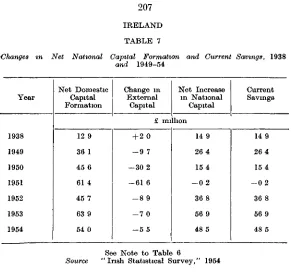
only 50% because of the fall in the value of money since 1938 Further allowance must be made (I) for proper maintenance and replacement of existing capital and (n) for depletion of external capital in assessing the true accumulation of real national capital Even from the figures given in Table 7 of the Appendix, where the Central Statistics Office depreciation allowance is treated as adequate, lb will be clear that the net annual addition m recent years to real national capital is veiy much less than 50% above the^ 1938 level A level of 10% to 15% above 1938 might be closer to the tiuth
High proportion of State-financed capital expenditure
Another point worthy of note is that State-financed capital expen-diture is now a much greater proportion of the total than in 1938 It was only about one-seventh of the 1938 figure whereas m recent years it has been one-half or more of the total The growth m the relative importance of State-firanced capital outlay obviously necessitates careful consideration of the character of that outlay and the form it gives to domestic capital formation as a whole Tables 9 and 10 make it clear that the present pattern of our domestic capital activity is shaped by the State capital programme
Over the eight years 1947/48 to 1954/55, State-financed capital outlay amounted to £202 million, of which £82 million represented expenditure on housing and hospitals If capital works financed by thp Hospitals Trust Board from its investments and by local authoiities from non-State borrowings were included, the prepondeidiioe uf housing and hospitals would be even greater Moreover, the rapid growth of State-financed investment in post-war years—from £8 million m 1947/48 to an average of £33 million over the three years 1952/53 to 1954/55—has been marked by a great expansion in works of mainly social benefit rather than of a directly productive nature Much of the benefit of power development is absorbed directly in the domestic use of electricity and turf, rather than used to expand industrial and agricultural production, and thus the basic capacity of the community to afford amenities It is also true that some of the State investment under other " economic " as distinct from " social " headings is not immediately or adequately productive of increases in real incomes and, further, that the totals include an element of leplace-uient of eXiStxixg capital as di^t met from new capital formation proper When so much of our limited national savings is being channelled into housing and other building, it is a disappointment to find that the value obtained for it is impaired by a fall in labour productivity m building as compared with pre-war
Financing of State Capital Needs
the requirements of the State Capital Programme (which up to 1954/55, inclusive, covered the Electricity Supply Boaid), theie is added the capital needed by Dublin and Cork Corporations and by Coras Iompair Eireann, a total is reached which is higher than even aggregate personal savings will cover The position m recent }^ears may be summarised as follows
1952/53 to 1954/55
(annual average) 1955/56 £ million £ million (1) Net borrowing by the
State (including Elec-tricity Supply Board) Dublin and Cork Cor-porations and Coras
(2)
Iompair Eireann Amount obtained fiom public (including ex terns)
Excess of (1) over (2)
36
26 10
41
27 14 (3)
It is to be noted that total personal savings averaged about £30 million for the four years 1952-55 In effect, since the exhaustion of Marshall Aid Counterpart, the excess of public capital requirements over available savings has had to be met by realisations of sterling securities both by the commercial banking system and by the State itself The potentialities of this method of finance have been much Ieduced and a marked upsurge in personal saving is needed if public capital outlay is to continue at the desired rate
Productivity of public capital outlay
Comment must be made not only on the relation of public capital requirements to the supply of savings available but also on the productivity of public capital outlay It is clear that the State capital programme at present contains a large proportion of works which do not yield an adequate direct return The effect of the growth in non-productive and inadequately productive assets appeals m a comparison between the interest and sinking fund charges on the State debt and the receipts from State assets The net annual increase in the charge against taxation because of the State capital programme is roughly £2 million at the present level of interest rates Any buoyancy which the revenue displays—foi whatever reason—is pre-empted to this extent
The need for savings
com-mumty must actually forego to a greater extent than heretofore the opportunity of consuming if it wishes to make moie resources available foi capital formation Present sacrifice is unavoidable I am leaving out of account deliberately the possibility of external borrowing (a) because it is limited, (b) because the teims might be oneious, and (c) because, m any event, such borrowing would have to be repaid eithei from future savings or by realisation of external assets Refei-ence will be made later to the extent to which our accessible sterling assets ha^ve alreadj^ been used or committed in suppoit of domestic capital formation The future potentialities in this direction are limited in 1 elation to the scale of our capital requirements In any case, realisation of external capital does not of itself add to national capital It entails merely a geographical redistribution of existing national capital and the guiding principle should be to achieve this redistribution in such a way as to maintain or improve the total pioduct, not to use up past accumulations to sustain a present standard of consumption exceeding our real production
The question of forced savings
Our external resources were acquned under the compulsion of war-time shortage of imports and we neither hope nor wish for a recuirence of that form of forced saving Saving enforced by taxation yielding a budget surplus is a recognised means of cuibmg inflation but if it xS too se^er^ or too prolonged it may defeat its own puipose by leading to dissaving m other ways and to inadequate piuviSion for private capital replacements and extensions A deliberate policy of inflation, which is another way of seeming forced savings, would require a virtually closed economy to be fully effective and would, of course, be socially inequitable In our circumstances, any substantial addition to the volume of money, not matched by increased production, must result initially in a heavier draw on external capital as well as m higher domestic prices, the second effect becoming the more serious according as the first required to be controlled to protect the exchange value of the currency
The Keynesian " Multiplier "
Leaving forced savings aside, theie are some who discern in Keynebidii doctrxnc the possibility of achieving higher levels of employment and income without any prior sacrifice ol consumption standards It is argued that an expansion in capital expenditure, financed otherwise than from current savings, would lift the levels of income and employment and thus geneiate the savings necessaiy to support the higher capital outlay To discuss this idea fully would involve too great a digression but some consideration must be given to its applicability to oui circumstances before we go on to the pros-pects of an increase in voluntary savings as ordinarily understood
by a lesser amount than income when income is rising and he assumed that the propensity to consume (which, of course, is the inverse of the propensity to save) was relatively fixed in a given community over a short period of time Accordingly, his theory was that, in the short run, income and employment are, in effect, determined by the level of investment, by which he meant capital formation at home Indeed, given the proportions of new income which are consumed and saved, it is possible, according to Keynesian theory, to tell how much income and employment will increase as a result of any given increase in investment Assuming that resources are not fully employed at the start, an increase m investment will cause a multiple increase in income and employment, the " multiplier " being related to the marginal propensity to consume What this means is that if, in a closed system, four-fifths (say) of any mciease in income is consumed (and one-fifth saved), the effect of a sustained increase in investment will be to generate consumption-spending within the country which will ultimately raise the national income by five times the primary increase m investment At the heart of the theory is the recognition that saving and investment are done by different people and at any moment may not necessarily be equal Inequality between them however, produces changes m incomes and employment which tend to bring them back into equilibrium If savings exceed investment this equilibrium is attained at the expense of incomes and employment, hence the efficacy in such circumstances of an mciease in investment in raising incomes and employment to a higher level
There are, however, impoitant qualifications to this theory and to the principle of the " multiplier "
(a) It has been well said that " the multiplier is not a quasi-magical device for expanding employment through the economic counterpart of internal combustion It gives a laborious increase m income, won only after many successive injections The successive injections necessarily amount to many times the so-called multiplier effect, and they must be kept up indefinitely (from some source) if the increase in income is to become permanent " {b) The " multiplier " might work m a country completely
(c) The theory does not promise full employment at any level ol incomes, a point of particular relevance to a country in which the availability of higher real incomes elsewhere operates, through emigration, to eliminate " idle resources " at home Rates of pay which are out of line with the international value of the products of home labour at the existing rate of exchange may be a serious obstacle to the attainment of full employment This is only a specific way of saying that the new investment must at least be productive at the existing levels of prices and costs if it is to be relied upon for a sustained increase m real incomes and employment Otherwise the initial increase m activity will become bogged down m rising costs and taxation at home and in external payments difficulties , and emigration will remain the principal means of access to employment yielding the desired level of real income
(d) In any case, the facts of recent Irish experience are not
m accord with the basic assumption on which the theory rests, viz , that consumption increases by a lesser amount than income when income is using In three out of the seven years 1948-54 (and doubtless aLo m 1955) the increase in national consumption exceeded the increase in rL9+iorml mpome This erratic experience is associated with the prevalence of mflationaiy conditions since the war, conditions the opposite of those in which Keynesian theory was first formulated
(e) I t is also well to stress that full employment cannot be made
to order Experience suggests that it is a matter even in highly developed countries of good luck as well as good management For a country like ours it depends at least as much on how things are going m the outside world— and more especially on the level of prosperity m Britain— as on the efforts we ourselves may make to increase our prosperity This is not to say, of course, that we cannot take effective measures to raise real incomes and employ-ment or that wrong policies here could not be positively harmful
on a greatei volume of current savings, and on the use ol savings to the greatest possible degree for pi©ductive purposes
Irregularity and Insufficiency of current savings
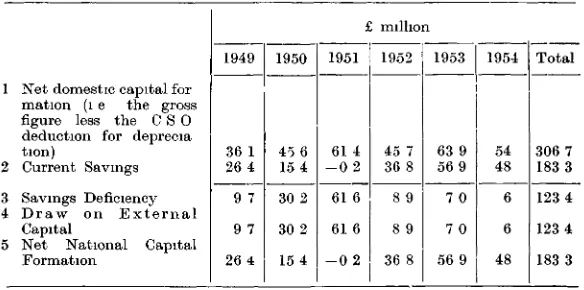
It is apparent that current savings are not sufficient even to support the present relatively low rate of net domestic capital formation The deficiency over the six years 1949-54 amounted to £123 million, which had to be supplied by drawing on external capital resources, with a corresponding reduction in net savmgb and m net national capital formation
[image:16.502.146.438.205.350.2]1 Net domestic capital for mat ion (I e the gross figure less the C S 0 deduction for deprecia tion)
2 Current Savings 3 Savings Deficiency 4 D r a w on E x t e r n a l
Capital
5 Net National Capital Formation
1949
36 1 26 4 9 7 9 7 26 4
1950
45 6 15 4 30 2 30 2 15 4
i
1951
61 4 - 0 2
61 6 61 6 - 0 2
* million 1952
45 7 36 8 8 9 8 9 36 8
1953
63 9 56 9 7 0 7 0 56 9
1954
54 48 6 6 48
Total
306 7 183 3 123 4 123 4 183 3
The figures of " draw on external capital " express the net effect of outward and inward movements of capital and theiefore allow both for Irish investment m, e g , British securities, and for British invest-ment m, e g , our National Loans Contrary to the belief held in some quarters, there has been no net reduction m the availability of capital for lush enterprises as a result of private investment in extern stocks and shares because the sales of such stocks and shares have exceeded the purchases , thus, over the period 1949-54 the net realisation of extern stocks and shares was £17 2 million, as shown in the Balance of Pavments Statements
Savings position
Savings by public and private companies Savings by public authonties
Personal savings
Gross Current Savings Corrected for stock appreciation Deduct External Dissaving
Net Savings
£ million 1952
12 0 l 6 25 0 38 6 36 8 8 9 27 9
1953 14 4 - 3 8 43 2 53 8 56 9 7 0 49 9
1954 16 - 5
37 48 48 5 5 42 5
Although the estimates of personal savings are lesiduals, the estimates of net savings as a whole tally reasonably well with rough approximations arrived at directly, e g
£ million
Net increase m Savings Bank deposits and Saving Certificates
authorities
Increase in Irish deposits of the commercial banks Increase in deposits with building societies and net
saving through insurance companies
1952 6 17 6 3
32
1953 6 20 17 6
49
1954 5 13 20 5
43
The categories of positive savings included above do not puiport to be exhaustive or completely exclusive and the attributed figures are subject to some leservations
Conditions of increase in saving
productive investment of present savings, 1 e , their application to purposes which will generate a lasting and progressive increase m real income The non-productive use of savings entails not only present loss but also foifeiture of the future return^ which sound investment would yield Genuinely productive enterprises can affoid to offer attractive yields to investors ard thus stimulate savings
Next to productive use of savings as a condition of national progress, is reasonable stability m money values Nothing can be more destruc-tive of savings and consequently of the will to save than monetary depreciation Indeed, m Britain, where there is an extensively organised and publicised national savings movement, rising prices and the lesultmg fall m the value of money negatived for some years all efforts to secure additional small savings It is, theiefore, a necessary condition of a substantial increase in savings not only that real incomes (including profits) will have increased but also that confidence m the value of money will not be seriously upset It is possible that a slight upward tendency in the price level over a long period would not be harmful but certainly a marked annual increase in prices, besides causing social injustice m many ways, must m time undermine the propensity to save While monetary depreciation is a deterrent to saving, it should at the same time be remembered that the greatest corrective of monetary depreciation is the addition to the supply of goods and services which productive investment of savings will ensure
Mode of application of savings
Capital for industry and commerce
The requirements of public authorities being in excess ol the total personal savings available, internal financing (from undistributed profits and reserves) is the only source of capital on which industry and commerce can safely rely This emphasises the desirability of curbing the growth of taxation and of a more liberal attitude towards piofit making , m this way, the conditions for economic development of national resources by private enterprise would be made less difficult Few will invest their money m schemes which may or may not succeed if they get only 7% or so in the event of success and nothing in the case of failure, while at the same time they can get a safe 5% on Government oi Government-guaranteed stock The need for a change is all the more apparent when one considers the inadequacy of the piesent rate of investment m manufacturing industry Table 8 of the Appendix shows that this investment amounts to only £10 million a year, gioss Deducting from this figure an appropriate allowance foi depreciation and for replacement of existing capital, it is certain that the new capital going into manufacturing industry is not more than £7 milhon-£8 million a yeai, and may be even less The dis appointing rate of industrial development is also revealed by the fact (lecoided by the Central Bank in its 1955 Report) that, of the total n\.w capital raised over the calendar years 1950-54 by issues of market-ahk securities, industry and commerce accounted for only £8 9 million out of £112 9 miiliuii It may not be pndmhle to point to particular developments which did not come to fruition because of the restrictive effects of public capital outlay on its present scale but it cannot be doubted that these effects will become the more significant the longer public authorities continue to absorb all the available personal savings and force up the level of taxation It is hard to counter the argument that) at least some personal savings should be left for private enterprise to work on
Inevitability of present sacrifice
develop the economy fully but also to accept leadily the sacrifices and hard work which this would involve " (para 480 of Majority Report)
Conclusions
The principal conclusions of this paper are
(1) To avoid losing ground in the improvement of real incomes by comparison with other countries, particularly Britain, and, indeed, to maintain present consumption standards without drawing on capital, our national product needs to be enlarged and a greatei proportion of it devoted to capital formation Failure to keep pace with advances in Britain is a stimulus to emigration
(2) The raising of output m agriculture and industry should have a higher priority m the allocation of savings The utmost use should be made of means of raising output which are sparing of capital so as to make savings go as far as possible and thus relieve the immediate sacrifice m consumption
(3) The building up of national capital and consequently the improvement of national living standards depend (a) on the most productive use of savings and {b) on an increase in current savings To the extent that our limited supply of savings is applied to objects othei than a permanent increase in production, a diag is imposed on material progress and the oppoitumties for self sustaining employ-ment are restricted
(4) Saving and production should be encouiaged and excessive consumption discouiaged As saving is largely a function of income this means primaiily that capital development of a productive character should be stimulated There should be a libeial attitude towards profits to encourage their expansion and use for productive purposes Assistance to agriculture and industry should be directed specifically towards the development of productive capacity
APPENDIX
TABLE 1
Index of Gross National Product at Constant Prices ] 949-54
Year
1949 1950 1951 1Q52 1953 1954
Ireland
100 100 3 101 4 104 6 107 2 107 6
Britain
100 103 8 106 4 105 3 109 6 114 6
All O E E C Countries
TABLE 2
Gross Domestic Capital Formation as a Percentage of Gross National Product at Constant Prices, 1949-54
Year
1949 1950 1951 1952 1953 1954
Ireland
0/
/o
14 7 15 3 16 3 12 4 16 2 12 9
Britain
0/
/o
13 0 113 16 2 12 8 1 4 3 14 9
All 0 E E C Countries
0/
/o
17 7 17 6 19 2 17 3 17 6 18 4
TABLE 3
Index of Gross Domestic Capital Formation at Constant Prices, 1949-54
YP f lr
1949 1950 1951 1952 1953 1954
Ireland LOO 111 5 119 8 94 2 125 5 100 3
Britain 100
90 0 132 9 103 6 120 3 131 4
All O E E C Countries
100 107 2 123 9 114 3 122 3 134 3
TABLE 4
Index of Gross Domestic Fixed Capital Formation at Constant Prices, 1949-54
Year 1949 1950 1951 1952 1953 1954
Ireland 100 114 5 117 0 121 0 129 0 130 0
Britain
100 103 7 101 5 101 5 114 0 119 7
All O E E C Countries
NOTE The above tables and Table 5 have been compiled on the basis of O E E C definitions and are therefore presumed to be comparable The mam difference between the official Irish estimates and those based on O E E C definitions is that the latter take account of the value of changes in the number of livestock on farms
Methods of measuring depreciation vary widely as between the different countries In Ireland the wear and tear allowances of the Revenue Commissioners for income tax purposes are taken as depreciation of existing industrial capital in agriculture the cost of machinery purchased is taken as depreciation , no allowance is made for deprecia-tion of land or buildings
Sources " O E E C Statistical Bulletin," January, 1956, and " Seventh Annual Report o f O E E C "
TABLE 5
Percentage Distribution of Gross Domestic Fixed Capital Formation in various-Countries in 1954
Sector
Agriculture etc Mining etc Manufacturing
and Construc-tion
Electricity Gas and Water Works Transport and
Communica tions Dwellings Other
TOTAL
Ireland Britain
9 5 1 4
IS 5
12 2
16 2 18 9 28 3
100
3 8 3 5
25 9
12 5
11 4 26 5 16 4
100
[image:22.503.154.443.283.525.2]Denmark Norway Sweden
Percentage
8 7
N A
4 8
21 9 17 9 46 7*
100
9 7
18 5 L
J
6 0
31 6 17 1 17 1
100
5 7 20 8 I
J
9 7
24 8 23 9 15 1
100
Germany (Federal Republic)
8 2
5 7
23 8
9 1
10 8 28 5 13 9
100
Italy
14 0 2 1
22 9
6 2
1 60 2 33 15 5
100
* Includos manufacturing and construction
Country
Ireland Britain Denmark Norway Sweden
Germany (Federal Republic) Italy
Agriculture, etc
0/
/o
30 7 4 8 19 3 13 9 N A
10 9 24 6
Manufacturing Industries
0/
/o
25 8* 37 6 18 9 29 9 N A
48 3* 29 9 * Includes mining and electricity, gas and water works
See Note to Tables 1 to 4
Source Returns furnished to O E E C by member countries for seventh annual report
IRELAND TABLE 6
Domestic Capital Formation, 1938 and 1949-54
Year
10?« 1949 1950 1951 1952 1953 1954
GROSS Including Changes m Stocks
17 1 45 1 56 8 73 6 58 7 77 9 69 0
Fixed Capital
Only
£
17 1 46 6 53 3 60 7 69 1 74 3
74
Depreciation
million 4 2
9 0
112 12 2 13 0 14 0
15
Net Domestic Fixed Capital
Formation
12 9 37 6 42 1 48 5 56 1 60 3
59
Index of Volume of Gross Fixed
Capital Formation
1938 = 100
100 117 134 137 142 151 152
IRELAND
TABLE 7
Changes in Net National Capital Formation and Current Savings, 1938 and 1949-54 Year 1938 1949 1950 1951 1952 1953 1954 Net Domestic Capital Formation 12 9 36 1 45 6 61 4 45 7 63 9 54 0 Change in External Capital Net Increase in National Capital £ million
+ 2 0
- 9 7 - 3 0 2 - 6 1 6 - 8 9 - 7 0 - 5 5
14 9 26 4 15 4 - 0 2 36 8 56 9 48 5 Current Savings 14 9 26 4 15 4 - 0 2
36 8 56 9 48 5 See Note to Table 6
Source " Irish Statistical Survey," 1954
IRELAND TABLE 8
Constituents of Gross Domestic Fixed Capital Formation, 1949-54
£ million Year 1949 1950 1951 1952 1953 1954 TOIAL (6 year<) Agri culture, etc 3 1 3 3 5 2 5 2 6 7 7 30 5 Mining, etc 1 1 1 0 1 2 0 8 1 0 1 6 1 Manu factunng and Con struction 5 6 7 4 8 2 9 0 10 0 10 50 2 Electricity, Gas and Water Works 5 2 6 2 7 4 7 6 7 8 9 43 2 Transport and Communi cations 7 2 7 5 7 9 9 8 12 4 12 56 8 Dwellings 12 0 13 9 15 5 15 8 14 3 14 85 5 Public Adrmni stration 1 1 1 3 2 3 3 1 2 2 2 12 0 Other Services 11 3 12 7 13 0 17 8 19 9 19 93 7 Total 46 6 53 3 60 7 69 1 74 3 74 878 0
IRELAND TABLE 9
Constituents of State Capital Programme, 1947/48-1954/55 £ million Category Housing Sanitary Services Hospitals "Electricity Development Turf Development Agri( ultural Development Afforestation
Fisheries
Schools and Other State Buildings Telephones Transport Industrial Credit Mianrai Teo Tourism Insurance University Buildings Wireless Broadcasting Min Fhe"ir Teo Ceimici Teo
Alrr no + P Tnrl cfr <=c
National Development Fund (Expenditure) TOTAL 1947/48 0 91 0 19 0 12 3 00 0 88 0 08
0 2 0
0 03 0 28 0 34 1 66 — 0 03 0 10 0 11 — — — — — — 7 93 1948/49 3 20 0 44 0 08 4 00 0 80 0 41 0 21 0 03 0 43
1 2 3
1 61 — 0 02 0 01 — — — — — — — 12 47 1949/50 8 98 0 72 0 05 4 00 1 08 2 21 0 25 0 09 0 60
1 2 5
5 07 — 0 04 — — — — — — — — 24 34 1950/51 11 06 0 69 0 09 4 60
1 0 4
3 13 0 43 0 08 0 71 1 80 0 77 0 19 0 02 — — — — — — — — 24 61 1951/52 12 67 0 63 0 14 8 80 1 27 3 91 0 76 0 10 0 95 2 60 0 89 — 0 01 — — — — — — — — 32 73 1952/53 11 91 0 88 0 40 8 60 1 19 4 13 0 58 0 16 0 98 1 95 0 97 0 50 0 02 — — — — — — — — 32 27 1953/54 9 85 1 31 3 27 7 10 0 70 3 87 0 65 0 11 1 23 1 05 3 77 0 25 — — — 0 20 0 05 0 01 — — 1 17 34 59 1954/o5 10 49 1 12 2 38 5 60 1 44 4 25 0 70 0 09 2 02 1 40 1 38 — — — — — — 0 02 0 10 o ni 1 86 32 86 Total 09 07 5 98 6 53 45 70 8 40 21 99 3 78 0 69 7 20 11 62 16 12 0 94 0 14 0 11 0 11 0 20 0 05 0 03 0 10 n 01 3 03 201 80 IRELAND TABLE 10
Summary of Constituents of State Capital Programme, 1947/48-1954/55
£ million
Category Housing and Sanitary Ser
vices Hospitals Power Development Agricultural Fishery and
Forestry Development Industrial and Mining
Development Schools and other Con
struction Communications Other
TOTAL
1947/48
1 1 U
0 12 3 88 0 31 0 03 0 28 2 00 0 21 7 93 1948/49 6 t>4 0 08 4 80 0 65 0 02 0 43 2 84 0 01 12 47 1949/50 y /u 0 05 5 08 2 55 0 04 0 60 6 32 -24 34 1950/51 11 /O 0 09 5 64 3 64 0 21 0 71 2 57 24 61 1951/52 in 60 0 14 10 07 4 77 0 01 0 95 3 49 -32 73 1952/53 i2 ?y 0 40 9 79 4 87 0 52 0 98 2 92 -32 27 1953/54 11 10 3 27 7 80 4 63 0 26
1 4 3
6 04 -34 59 1954/55 11 01 2 38 7 04 5 04 0 IS 2 02 4 18 0 46 32 86 Total to uo 6 53 54 10 26 46
1 2 2
DISCUSSION
Proposing a vote of thanks, Mr Ley don said that Mr Whitaker's paper turned a spotlight on an aspect of the national economy where it is very badly needed He agreed whole-heartedly with Mr Whitaker's views and the summary of his principal conclusions, though he would like to enter a caveat on one minor point
He agreed about the necessity for a maximum degree of efficiency in agriculture and industry He agreed also that there should be a more liberal attitude to the problem of profits and price control The most convenient and satisfactory method of exercising price and profit control in the case of protected industries is through tariff adjustment A libeial approach is all the more necessary by reason of the importance of corporate savings which can be used for industrial expansion for productive purposes
The importance of saving is not open to argument Suggestions have recently been made m certain quarters that the commercial banks could solve our present difficulties, and it had been proposed that the Government should exercise moie control over the banks, or that the Government should itself establish a State bank or buy a commercial bank He thought that people putting forward sugges-tions of this kind should explain what the objective is and make it clear how they thmk the objective can be achieved Bank credit within the State had increased by £31 5 millions in the year ended 31st December, 1955 During the same year current and deposit accounts had fallen by £13 millions Deposit accounts are the bankers' raw material and the bank must be prepared to pay the depositoi his money if he wants it Borrowing short and lending long was quite unsound and had, m fact, led to the downfall of thousands of American banks during the Great Depression In his view these suggestions provide no remedy for our present ills
A continuance of recent trends will use up our remaining external assets in a relatively short time During 1955 the net external assets of the commercial banks fell by £35 5 millions to £85 5 millions and the Central Bank has pointed out that of the external assets of the banks only slightly more than half would be available to meet drafts on banking resources
The repatriation of external assets in so far as the proceeds are applied for worth-while productive purposes at home merely represents a geographical redistribution of our national capital but the applica-tion of external assets to finance imports of consumpapplica-tion goods is merely using up our national capital It is a sobering thought that the realisation of £35 5 millions of our external assets m 1955 to finance the purchase of consumption goods involves a reduction of perhaps £1^ millions per annum for ever in the standard of living of the com-munity This was not a statistical computation, but he thought the argument was unassailable
The gravity of the position is emphasised by the fact that there has been no appreciable increase m our external assets in peacetime and what we now hold is only a part of the fortuitous accretion due to two world wars The Central Bank has pointed out that the net external assets of the commercial banks had been reduced to a level which is barely sufficient to sustain their existing liabilities withm the State