Analysis of Corporate Bond Yield Spread Based
on the Volatility Clustering Effect
Jiemin Huang
1,2, Jiaoju Ge
3, Yixiang Tian
2Abstract: - Weekly transaction data from 2016 to 2017 in Shenzhen and Shanghai Exchange platforms are collected for analyzing the volatility clustering effect of corporate bond yield spread. The volatility cluster characteristics of corporate bond yields are analyzed with cointegration by Autoregressive Conditional Heteroskedasticity models. Results show that ten-year period corporate bonds yield fluctuates most heavily. Corporate bond yields are proved to have volatility clusters and asymmetric characteristics. Thus, investors could choose different corporate bonds with different yield volatilities to maximize their returns.
Key-Words:- Corporate bond, yield spread, volatility cluster, asymmetric character
I.INTRODUCTION
T
here are many papers on volatility cluster character of corporate bond yield. Güntay (2010) found the significant relationship between corporate bond spreads and forecasting dispersion using panel data [1]. Miller (1977) proposed that bond prices mainly reflected optimistic investors’ view because of the constraints of short-term investment behavior, and higher forecasting dispersion of analyst had a greater impact on credit spreads of listed companies [2]. Nielsen(2010) presented the liquidity of corporate bonds before and after the financial crisis using illiquidity method [3]. His empirical results show that bond illiquidity increases significantly in a financial crisis but bond spread increases continuously and slowly. When the most important guarantor is seriously affected by a financialManuscript received on 30 November, 2018; I am grateful for research support from the Guangdong Philosophy and Social Science Planning Project (grant No.GD18JRZ04); 2018 scientific research project of general universities in Guangdong province (grant No. 2018GWTSCX073); the Guangdong Social Science Foundation of China (grant No. 2017WT034); the Research on Party Building in Colleges and Universities in Guangdong Province (grant No.2018GZ046); Shenzhen Philosophy and Social Science Planning Project (grant No.SZ2018C013); Shenzhen Education Science Planning Project (grant No.ybfz17026).
1associate professor, School of Finance and Economics, Shenzhen
Institute of Information Technology, Shenzhen, P.R. China, E-Mails: [email protected];2School of Economics and Management,
University of Electronic Science and Technology of China, Chengdu, P.R. China, E-Mails: [email protected], [email protected];
3associate professor, school of economics and management, Harbin
Institute of Technology, Shenzhen, E-Mails: [email protected];
Jiemin Huang is with the School of Economics and Management, University of Electronic Science and Technology of China, Chengdu, 611731, P.R. China; E-Mails: [email protected].
crisis, bonds liquidity will become even worse. Bonds issued by financial institutions will also stop flowing during financial crises. Bewley(2004) found stock volatility had significant effect on bond spread using the implied volatility of option market and equity market index with the consideration of conditional heteroskedasticity. The associated results indicate that the option market with implied volatility characteristics has no significant effect on bond spread, but the equity market index with conditional heteroskedasticity has significant and stable effect on bond spread. In addition, bond spread has a decreasing trend with the increase in heteroskedasticity volatility [4]. Campbell(2010) presented a regression model of both equity idiosyncratic volatility and equity yields, and suggested that equity volatility had an effect on corporate bond yields with the analysis of a panel data set [5]. The results show that equity idiosyncratic volatility has a strong relationship with borrowing costs of corporate bonds, and equity volatility explains changes of corporate bonds short-term return and long-term increasing trends of bonds returns.
Gemmill(2011) found that corporate bond spreads were mostly caused by default losses and the contribution of systemic factors was lower when downside risks were taken into account[6]. The associated results show that corporate bond spread exhibits a strong correlation with idiosyncratic risks, which implies that bond spreads correlate with idiosyncratic volatility and risk value of corporate bonds. Price spread of corporate bonds increases with the increase of bond idiosyncratic risk value because bond idiosyncratic risks have left-skewness distribution trends. Elton (2001) examined risk premium of corporate bonds using both time series and cross-sectional data, then suggested that bond default risk was composed of lower bond spreads and tax and systemic risk was composed of higher corporate bonds spreads [7]. Huang (2002) found that credit spreads accounted for a smaller part of short-run corporate bonds and a large part of junk bonds due to the launch of credit risk in corporate bond spreads using a structural model with default factor, [8]. Tang (2010) studied the interaction of market risk and default risk in credit spread of corporate bonds by the newest structural model [9]. He found that when GDP increased, average credit spread decreased, but GDP growth volatility and equity market jump risk increased when we estimated using swap spread of credit default. He proved that the default risk was the main part of credit spread. Based on Fama-French model, Gebhardt (2005) found that when duration is controlled, credit ratings, maturity and bond cross-section
IAENG International Journal of Applied Mathematics, 49:4, IJAM_49_4_28
yields had strong correlations with default probability. When default risk and duration are controlled, bond maturity has a correlation with bond yields [10]. Huang (2013) reviewed foreign studies on corporate bond spread [19]. Wang and Huang (2017) also analyzed corporate bond yield characteristics in Chinese bond market [20-24].
Merton (1974) analyzed corporate debt and suggested that risky corporate bond holders could be taken as the owners of riskless bonds who had issued put options to firm’s equity holders [25]. If volatility increases, the value of the put options increases which is beneficial for equity holders. The volatilities, associated with both option value and corporate debt, are the total firm volatility including both idiosyncratic volatility and systematic or market-wide volatility. This is important because idiosyncratic volatility moves very differently from that of market-wide volatility. In particular, Campbell et al. (2001) pointed out that idiosyncratic volatility had trended upwards since the mid-1970s, while market-wide volatility had undergone temporary fluctuations but had no upwards trend [26]. Their results suggest that increasing idiosyncratic volatility could depress corporate bond prices, and also support corporate equity prices during the past few decades, particularly during the late 1990s. The mechanism for creating volatility clusters may be a memory, nonlinear couples between the price and agent parameters or the herding effect. The latter may be achieved by an interaction as in statistical mechanics or explicitly in the dynamics.
Mixed GARCH-Jump modeling method has emerged as a powerful tool to describe the dynamics of asset returns for discrete-time data. Duan et al.(2005, 2006) and Maheu and McCurdy (2004) proposed time-variation jump component of the mixed GARCH-Jump model [27,28,29]. In particular, Duan et al. (2005, 2006) developed a constant intensity NGARCH-Jump model that allowed for time-variation through a common GARCH multiplier in the “diffusion” and the jump component. At the limit, their discrete time model can converge to the continuous-time jump-diffusion processes with jumps in stochastic volatilities. In addition, the NGARCH-Jump model provides a better fit for the time-series of S&P 500 index returns compared to normal NGARCH model. Maheu and McCurdy (2004) developed a mixed GARCH-Jump model that allowed separate time-variation and clustering in the jump intensity, but did not accommodate for volatility feedback in the jump component. When applying to individual stocks and indices in the US, their model outperforms the GARCH-Jump model with constant intensity and independent and identically distributed
(i.i.d.)jump component. However, the question is which jumping structure fits the asset return dynamics best under an asymmetric GARCH specification. Is it volatility feedback in the jump component, autoregressive jump intensity, or a combination of both? Should volatility feedback in the jump component be generated through a common GARCH multiplier or a separated measure of volatility in the jump intensity function?
Harvey (1995) and Bekaert and Harvey (2002) argued that returns in emerging market had higher volatility, fatter tails and greater predictability. In contrast to the mature markets, Bekaert and Harvey (1997) found that volatilities in emerging markets were primarily determined by local information variables [30]. Aggarwal et al. (1999) found that the volatilities in emerging markets exhibited large and sudden shifts [31]. These jump-like volatility changes in emerging markets are primarily associated with important local events. In addition, most returns in emerging market show positive skewness but show negative skewness in developed markets.
One existing explanation on asymmetric volatility is based on the “volatility feedback effect”. When the agents face a price change more than expected, they revise their estimated variances upward, which indicates an increase in uncertainty. This requires a greater risk premium and a lower price, ceteris paribus. When the price increases more than expected, its rise will be muted. When the price decreases more than expected, its decline will be intensified. Campbell and Hilscher (2018) also showed the volatility clusters existed because of the clusters for exogenously specified dividend process [32]. However, Schaefer (2017) presented that there was a weak link between macroeconomic fundamentals and volatility [33]. The shock on fundamentals, like a dividend, would not be related to the volatility puzzles. Thus, the paper could not
be successfully explained both volatility puzzles
simultaneously.
Mahanti (2017) gave an endogenous explanation on asymmetric volatility and volatility clustering [34]. A preference-based equilibrium asset pricing model is proposed where the origin of the volatility clustering is investor time-varying and autocorrelated sensitivity to the market news. They argue that volatility is persistent because the sensitivity is autocorrelated and volatility tends to be asymmetric due to the volatility feedback effect.
As a summary, many factors affect corporate bond yields and these factors change the corporate bond yield volatility cluster character. However, in this paper, we mainly study the volatility cluster character of corporate bond yield in Shenzhen transaction market and Shanghai transaction market.
II.DATA DESCRIPTION
Corporate bond transaction data have been available for SHANGHAI and SHENZHEN stock exchange markets since the year of 2007 and 2008, respectively. Between the year 2007 and 2010, both stock exchange markets only had several bonds with different maturities. There were only 25 corporate bonds in 2006 which matched the conditions and 54 in 2017. Thus, the sample size is relatively small. In consideration of data continuity, comprehensiveness and representativeness, corporate bond transaction data from December 31st 2016 to December 31st 2017 were chosen in this study. Corporate bonds that do not have treasury bonds to compare with and corporate bonds whose maturity
IAENG International Journal of Applied Mathematics, 49:4, IJAM_49_4_28
is less than one year are eliminated for the reason that these data would be more sensitive to interest rate.
Finally, data of 54 corporate bonds are used in this study. However corporate bonds transaction is not as frequent as stock, maybe the transaction data on some date is not available. Then if we chose daily transaction data, the data is not continuous. But if chose monthly transaction data, the data would not be enough. At last, according to the literatures, in order to get continuous and enough data, we chose weekly transaction data from December 31st 2016 to December 31st 2017.
Data are collected from Wind database and the bonds have simple interest with fixed rate. According to Duffee (1998), bonds can be divided into three categories which are short term bonds with 2 to 7 years maturity [11], median bonds with 7 to 10 years maturity, and long term bonds with maturity more than 10 years. In our study, most of the bonds are short and median term bonds. Sample in this study are also divided into AAA, AA+ and AA according to their ratings. The sample contains six different industries including Manufacturing industry, Power industry, Building industry, Mining and Quarrying industry, Transportation industry, Real Estate and Service industry.
III.DESCRIPTIVE STATISTICS
In TABLE1, variable descriptive statistics are shown. Y3 represents the yields of three-year period corporate bond, Y5 indicates the yields of five-year period corporate bond, and Y7 is the yields of seven-year period corporate bond.
TABLE 1DESCRIPTIVE STATISTICS OF CORPORATE BONDS WITH MATURITY OF 3,5,7,10 YEARS
Y3 Y5 Y7 Y10
Average 5.6770 5.6002 5.9235 4.2039
Median 5.4073 5.3654 5.8246 4.6498
Maximum 6.8343 6.8095 6.7431 5.4585 Minimum 4.8176 4.6129 5.1935 1.4359
St. 0.6288 0.6597 0.4707 1.0274
Skewness 0.6356 0.5766 0.3702 -1.4807 Kurtosis 2.0264 1.9052 1.9173 4.1198
JB 5.4480* 5.3730* 3.6559 21.3013***
P 0.0656 0.0681 0.1607 0.000024
* denotes statistical variables are significant on the 10% confidence level, *** denotes statistical variables are significant on the 1% confidence level.
For the yields of three-year period corporate bonds, the average value of is 5.6770, the median value is 5.4073, the maximum value is 6.8343, minimum value is 4.8176, and the standard deviation is 0.6288. It doesn’t obey normal distribution at the 10% level of significance.
For the yields of five-year period corporate bonds, the average value is 5.6002, the median value is 5.3654, the maximum value is 6.8095, the minimum value is 4.6129, and the standard deviation is 0.6597. It doesn’t obey normal distribution at the 10% level of significance.
For the yields of seven-year period corporate bonds, the average value is 5.9235, the median value is 5.8246, the
maximum value is 6.7431, the minimum value is 5.1935, and the standard deviation is 0.4707. The test result suggests it obeys normal distribution.
For the yields of ten-year period corporate bonds, the average value is 4.2039, the median value is 4.6498, the maximum value is 5.4585, the minimum value is 1.4359 and the standard deviation is 1.0274. It doesn’t obey normal distribution at the 1% level of significance.
For all above four time series, we found that the ten-yield period corporate bonds fluctuate most heavily.
IV.CORPORATE BOND YIELD CHARACTERISTIC ANALYSIS BASED ON CONDITIONAL HETEROSKEDASTICITY
This paper analyzes volatility cluster of corporate bond yields and checks whether they have asymmetric characteristics by using following models.
A. ARCH model
Engle(1982) presented the Autoregressive conditional Heteroskedasticity model (ARCH), and Bollerslev(1986) extended the model to the Generalized Autoregression Conditional Heteroskedasticity (GARCH) model[12,13].
Building the ARCH model as bellow:
yt=r0+r1x1t+…+rkxkt+ut (1) Et-1(yt)=r0+r1x1t+r2x2t+…+rkxkt (2) var(yt|Yt-1)=Et-1(yt-r0-r1x1t-…-rkxkt)2=Et-1ut2 (3)
ut2obeys AR(1) process:
ut2=a0+a1ut-12 +εt (4)
In equation (4), εt is white-noise process, and it satisfies that
E(εt)=0 (5)
E(εt,εs)={∅ 2, t=s
0, t≠s (6)
So, the conditional distribution of disturbance term ut is, ut~N[0,(a0+a1ut-12 )] (7)
ARCH(p) could be presented as below:
var(ut)=σt2=a0+a1ut-12 +a2ut-22 +…+aput-p2 (8) 1-a1z-a2z2-…-a
pzp=0 (9)
If ai(i=1,2,…,p) were all negative, equation (9) is equal to a1+a2+…+ap<1
var(ut)=σ2=a0 (10)
B. GARCH model
Building a model as below:
yt=xt'×γ+ut, t=1,2,…, T (11) σt2=ω+αut-12 +βσt-12 (12)
In the equation (11), xt=(x1t,x2t,…,xkt)' is the explaining variable vector, and γ=(r1,r2,…,rk)' is the coefficient vector.
lt=-12ln(2π)-12lnσt2-12(yt-xt'γ)2/σt2 (13)
IAENG International Journal of Applied Mathematics, 49:4, IJAM_49_4_28
In equation (14) σt2=ω+α(y
t-1-xt-1' γ)2+βσt-12 (14)
σ2t=(1-β)ω +α∑∞j=1βj-1ut-j2 (15)
ut2=ω+(α+β)ut-12 +vt-βvt-1 (16)
σt2=ω+αut-12 +βσt-12 +δzt (17)
zt=|xt| The high level GARCH model could have any number of ARCH items and GARCH items, and it can be written as GARCH(q,p) model. Its conditional variance could be expressed as: σt2=ω+∑qj=1βjσt-j2+∑pi=1αiut-i2=α0+α(L)ut2+β(L)σt2(18) σt2=θ0+θ(L)ut2 (19)
σt2=ω+αut-12 +βσt-12 (20)
C. Unsymmetrical GARCH model and TGARCH model Engle and Ng(1993) firstly presented the unsymmetrical GARCH or the TGARCH model for corporate bond market[14]. Investors react to favorable news less strongly than to bad news. Zakoian(1990) and Glosten (1993) first proposed the model as below[21,22]: σt2=ω+α×ut-12 +γ×ut-12 dt-1+β×σt-12 (21)
where dt-1is dummy variable, when ut-1<0, dt-1=1or else dt-1=0. Only if γ≠0. σt2=ω+∑j=1q βjσt-j2+∑i=1p αiu2t-i+∑rk=1rku2t-kdt-k (22)
D. EGARCH model Nelson(1991) originally proposed the model as below[17]: ln(σt2)=ω+β ln(σt-12 )+α|uσt-1 t-1-√ 2 π|+γ ut-1 σt-1 (23)
ln(σt2)=ω+∑βjln(σt-j2)+∑αi| ut-i σt-i-E( ut-i σt-i)| p i=1 q j=1 +∑ rkuσt-k t-k r k=1 (24)
ln(σt2)=ω+β ln(σt-12 )+α|uσt-1 t-1|+γ ut-1 σt-1 (25)
E. PGARCH model Ding et al.(1993) expanded the GARCH model to PGARCH model. The conditional variance equation is as below[26]: σtδ=ω+∑qj=1βjσt-jδ +∑ αi(|ut-i|-γiut-i) δ p i=1 (26)
where δ>0,when i=1,2, … , r, then |ri|≤1,when i>r , then ri=0, r≤p F. Asymmetrical information impulse curve In the conditional variance equation of EGARCH model ln(σt2)=ω+β ln(σt-12 )+α|uσt-1 t-1|+γ ut-1 σt-1 (27)
Supposing residual ut obeys normal distribution. If set f(ut-1 σt-1)=α| ut-1 σt-1|+γ ut-1 σt-1 (28)
zt= ut⁄σt,then f(zt)=α|zt-1|+γzt-1 (29)
It links correction of conditional volatility and impulse information ut-1. When ut-1>0, then ∂z∂f t-1=α+γ, when ut-1<0, ∂f ∂zt-1=α+γ, f(zt) contains asymmetric effect. In this paper, we choose GARCH model to analyze the volatility cluster characteristics of corporate bond yield because it could reflect the data character perfectly. TGARCH model is also chosen to analyze the asymmetric character of corporate bond yields. V.ANALYSIS ON VOLATILITY CLUSTER OF CORPORATE BOND YIELDS In FIG. 1, corporate bond yields curve is presented. The vertical axis is the average value of corporate bond yield, and horizontal axis is the time frame of week. It shows that the highest value of average corporate bond yield is nearly 7.5, which is the value in the 40th week of 2016. Then, it falls to 5.8 in the 45th week of 2016. But soon, it rises up to 6.5. After the 60th week, it quickly falls and reaches the lowest value of 5.0 in the 79th week. Although it rises later, the corporate bond average value is always less than 6.0. Overall, the weekly average yield of corporate bond fluctuates heavily after big fluctuations, and fluctuates softly after small fluctuations. FIG.1CORPORATE BOND AVERAGE YIELDS In this paper we built a random walk model of corporate bond yield as below yieldt=C0+C1yieldt-1+εt (30)
TABLE2 shows estimated results of the random walk model of corporate bond average yields. In the table the F value is significant at the 1% level of significance, and it means the model is statistically significant. The fact of R2=0.9418 means that the equation fits the real value well.
4.5 5.0 5.5 6.0 6.5 7.0 7.5
10 20 30 40 50 60 70 80 90 100
YIELD
IAENG International Journal of Applied Mathematics, 49:4, IJAM_49_4_28
But the constant term isn’t significant, and the coefficient of explaining variable YIELD (-1) is close to 1. The results indicate that yield series follow a random walk process without drafting term, or the corporate bond yield follows a random walk process with the average value of zero.
TABLE 2RANDOM EFFECT TEST RESULTS
variables coefficients Std. t Prob. C 0.1483 0.1399 1.0603 0.2916 yield(-1) 0.9737*** 0.0243 40.0102 0.0000 R2 0.9418 Log
likelihood
45.1118
AIC -0.8537 SC -0.8019 F 1600.812*** Prob 0.0000
*** denotes statistical variables are significant at the 1% level of significance.
yieldt=0.9737yieldt-1+εt (31)
standard error =(0.0243)
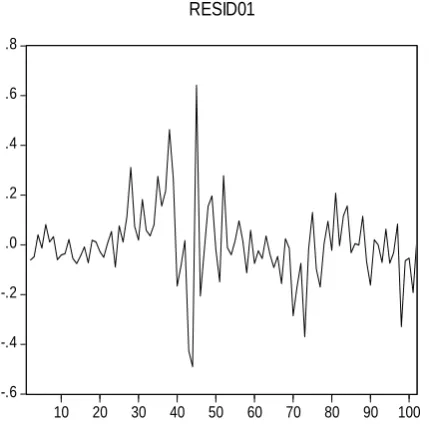
Log likelihood=45.1118, AIC=-0.8537, SC= -0.8019. In FIG. 2, the residual sequences are shown. The vertical axis is the residual and the horizontal axis is the time period of the week. The residuals of regression equation reflect volatility cluster. Large fluctuations continue for a while and so do the small fluctuations. In this figure, the fluctuations are large in the 43th, 44th and the 45th week. In the 72th week, there’s a small fluctuation, and a small fluctuation follows behind it thereafter.
FIG.2RESIDUAL SEQUENCES
FIG.3SQUARED RESIDUAL CORRELATION DIAGRAM
FIG. 3 is the squared residual correlation diagram. We could find some parts of autocorrelation function of squared residuals exceed the 95% confidence interval. Statistically it is different from zero. In addition, the Q value is significant and the corresponding probability is less than 0.01. So the squared residuals of equation (31) show autocorrelations. This implies an ARCH effect.
A. ARCH model and GARCH model analysis
First of all, a conditional variance equation is set up to fit GARCH (1,1) model as below.
σt2=α0+α1εt-12 +β1σt-12 (32)
To ensure that the conditional variance is nonnegative, it is usually required statistic parameters should be nonnegative such as α0>0,α1>0 and β1>0 . When
coefficient statistics α̂1+β̂1<1, the conditional variance of
yield would converge to unconditional variance α0
1-α1-β1.
In TABLE 3, it’s the GARCH(1,1) model test results of equation (32). In the conditional equation, the estimated value of parameter C is 4.23E-05, but it is not significant. The coefficient of RESID(-1)2 is 0.3265 which is significant at the 5% level of significance. The coefficient of GARCH(-1) is 0.6613, and it is significant also at the 1% level of significance. All parameters are positive so they meet the nonnegative parameter requirements for the
-.6 -.4 -.2 .0 .2 .4 .6 .8
10 20 30 40 50 60 70 80 90 100
RESID01
IAENG International Journal of Applied Mathematics, 49:4, IJAM_49_4_28
[image:5.595.308.528.77.407.2] [image:5.595.60.282.151.230.2] [image:5.595.64.279.412.627.2]GARCH model. The sum of coefficients for ARCH and GARCH are: α̂1+β̂1=0.3265+0.6613<1 which follows the GARCH restriction and the variance is convergent at σ2= α̂0
1-α̂1-β̂1. It means the historical impulse would insist for a
while and it could be expected in the future.
TABLE 3 GARCH(1,1) MODEL TEST RESULTS
variables coefficients Std. Z Prob. C 4.23E-05 3.20E-05 1.3213 0.1864
RESID(-1)^2
0.3265** 0.1630 2.0032 0.0452
GARCH(-1)
0.6613*** 0.1269 5.2098 0.0000
R-squared 0.9439 Log likelihood
241.7816
AIC -4.7085 SC -4.6050
** denotes statistical variables are significant at the 5% level of significance, *** denotes statistical variables are significant at the 1% level of significance.
B. TARCH model analysis
TARCH model is also a GJR model, and it is joined with an additional item which explains possible existing asymmetric information.
σt2=α0+α1εt-12 +β1σt-12 +γεt-12 It-1 (33)
It-1 is dummy variable, and It-1={1
,εt-1<0
0,εt-1>0
From equation (33) we could find εt-1>0 and εt-1<0 affecting σt2 which the influencing results are α1εt-12 and (α1+γ)εt-12 . For conditional variance, the nonnegative
requirements are α0≥0,α1≥0,β1≥0 and α1+γ≥1. If γ=0, there is no asymmetric effect. If γ > 0, there is asymmetric effect.
TABLE 4TARCH MODEL TEST RESULTS
variables coefficients Std. Z Prob. C 4.23E-05
3.23E-05
1.3132 0.189
RESID(-1)2 0.3092* 0.1742 1.7749 0.076
RESID(-1)2 *(RESID(-1)<0)
0.0349 0.1880 0.1858 0.853
GARCH(-1) 0.6628*** 0.1269 5.2248 0.000 R-squared 0.9439 Log
likeli-hood
241.798
AIC -4.6890 SC -4.5596
* denotes statistical variables are significant on the 10% confidence level, *** denotes statistical variables are significant on the 1% confidence level.
In TABLE4, the TARCH model test results of equation (33) are shown. Results indicate that the coefficient of
RESID(-1)2*(RESID(-1)<0) is 0.0349 which isn’t
significant. We could infer there is no asymmetric effect. Bewley(2004) presented similar results using the data from another country.
The above analysis suggests that there is volatility cluster character for corporate bond yield. When it is affected by other factors, the yield fluctuation would insist
for a while.
VI.CONCLUSION
This paper tests volatility cluster character of corporate bond yield spread by using Heteroscedasticity models including ARCH, GARCH and GRANGER. The 3-year, 5-year and 7-5-year corporate bonds have similar yields. However, the 10-year corporate bond yield fluctuates most heavily. As corporate bond terms increase, uncertainty increases, and corporate bond yield volatility will also increases. These results comply with expected financial theory. In addition, average corporate bond yield fluctuates heavily during sample periods. For weekly average yield, the large volatility followed by larger volatility, and small volatility followed by smaller volatility. Corporate bond yield is asymmetric and has volatility cluster character.
According to the results, investors could choose different corporate bonds based on our analysis. Risk seeking investors could choose corporate bonds that have larger volatility and risk aversion investors could choose corporate bonds that have smaller volatility.
REFERENCE
[1] L. Güntay, D. Hackbarth, “Corporate bond credit spreads and forecast dispersion,” Journal of Banking & Finance, pp. 2328-2345,2010. [2] E. Miller, “Risk, uncertainty, and divergence of opinion,” Journal of
Finance, pp. 1151-1168, 1977.
[3] J. Dick-Nielsen, P. Feldhutter, D.Lando, “Corporate bond liquidity before and after the onset of the subprime crisis,” Journal of Financial Economics, pp. 471-492, 2010.
[4] R. Bewley, D. Rees, P. Berg, “The impact of stock market volatility on corporate bond credit spreads,” Mathematics and Computers in Simulation, pp. 363-372, 2004.
[5] J. Y. Campbell, G. B. Taksler, “Equity Volatility and Corporate Bond Yields,” Journal of Finance, pp. 2321-2349, 2003.
[6] G. Gemmill, A. Keswani, “Downside risk and the size of credit spreads,” Journal of Banking & Finance, pp. 2021-2036, 2011. [7] E. J. Elton, M. J. Gruber, D. Agrawal, C. Mann, “Explaining the Rate
Spread on Corporate Bonds,” Journal of Finance, pp. 247-277, 2001. [8] J. Huang, M. Huang, “How much of the Corporate-Treasury yield
spread is due to credit risk,” Working paper, 2002.
[9] Y. Tang, H. Yan, “Market conditions, default risk and credit spreads,” Journal of Banking & Finance, pp.743-753, 2010.
[10] W. R. Gebhardt, S. Hvidkjaer, “The cross-section of expected corporate bond returns: Betas or characteristics,” Journal of Financial Economics, pp. 85-114, 2005.
[11] R. G. Duffee, “The Relation Between Treasury Yields and Corporate Bond Yield Spreads,” Journal of finance, pp. 2225-2241, 1998. [12] F. Engle, “Autoregressive Conditional Heteroskedasticity with
Estimates of the Variance of U. K. Inflation,” Econometrica, pp. 987-1008, 1982.
[13] T. Bollerslev, “Generalized Autoregressive Conditional Heteroskedasticity,” Journal of Econometrics, pp. 307-327, 1986. [14] R. F. Engle, “Measuring and Testing the Impact of News on
Volatility,” Journal of Finance, pp.1022-1082, 1993.
[15] J. M. Zakoian, “Threshold HeteroskedasticModels,” Journal of Economic Dynamics and Control, pp. 931-944, 1994.
[16] L. R. Glosten, D. Jagannathan, “On the Relation between the Expected Value and the Volatility of the Norminal Excess Return on Stocks,” Journal of Finance, pp. 1779-1801, 1993.
[17] D. B.Nelson, “Conditional Heterosdasticity in Asset Returns: A New Approach,” Econometrica, pp. 347-370, 1991.
IAENG International Journal of Applied Mathematics, 49:4, IJAM_49_4_28
[18] C. W. J. Granger, R. f. Engle, “A long Memory Property of Stock Market Returns and a New Model,” Journal of Empirical Finance, pp. 83-106, 1993.
[19] J. HUANG, “Review on foreign study of corporate bond spread,” Advanced Materials Research, pp.2258-2261, 2013.
[20] S.Wang, “Idiosyncratic volatility has an impact on corporate bond spreads: Empirical evidence from Chinese bond markets,” WSEAS Transactions on Systems, pp. 280-289, 2017.
[21] J. Huang, “Empirical analyzing on affecting factors of corporate bond spread,” Journal of Dalian Maritime University (JCR Social Sciences Edition), pp.5-8, 2017.
[22] J. Huang, “The term structure model of corporate bond yields,” WSEAS Transactions on Systems, pp.2224-2678, 2017.
[23] J. Huang, “Empirical analysis of liquidity risk premium based on bond age,” WSEAS Transactions on Business and Economics, pp.2224-2899, 2017.
[24] J. Huang, “The influence of Fama-French factors in equity and bond markets on corporate bond spread,” WSEAS Transactions on Business and Economics, pp. 2224-2899, 2017.
[25] C. Merton, “On the pricing of corporate debt: The risk structure of interest rates,” Journal of Finance, pp. 449-470, 1974.
[26] C. Dufresne, Pierre, Goldstein, “Do credit spreads reflect stationary leverage ratios,” Journal of Finance, pp.1929-1957, 2001.
[27] J. Duan, P. Ritchken, Z. Sun, “Jump starting GARCH: Pricing and hedging options with jumps in returns and volatilities,” Working Paper, University of Toronto and Case Western Reserve University, 2005.
[28] J. Duan, P. Ritchken, Z. Sun, “Approximating GARCH-jump models, jump-diffusion processes, and option pricing,” Mathematical Finance, pp. 21–52, 2006.
[29] J.M. Maheu, T.H. McCurdy, “News arrival, jump dynamics, and volatility components for individual stock returns,” Journal of Finance, pp. 755–793, 2004.
[30] C.R. Harvey, “Predictable risk and returns in emerging markets,” Review of Financial Studies, pp. 773–816, 1995.
[31] R. Aggarwal, C. Inclan,, R. Leal, “Volatility in emerging stock markets,” Journal of Financial and Quantitative Analysis, pp. 33-55, 1999.
[32] J. Campbell, J. Hilscher, J. Szilagyi, “In search of distress risk,” Journal of Finance, pp. 2899-2939, 2018.
[33] S. Schaefer, I. Strebulaev, “Structural models of credit risk are useful: evidence from hedge ratios on corporate bonds,” Journal of Financial Economics, pp. 1-19, 2018.
[34] S. Mahanti, A. Nashikkar, “Latent liquidity: a new measure of liquidity, with an application to corporate bonds,” Journal of Financial Economics, pp. 272-298, 2008.
[35] M. Hirofumi, S. Norio, “Proposal of Fast and Secure Clustering Methods for IoT,” Lecture Notes in Engineering and Computer Science: Proceedings of The International Multi Conference of Engineers and Computer Scientists, pp. 1-6, 2019, 13-15 March, Hong Kong.
[36] T. Bambang, N. Siti, “Route Optimization of Non-holonomic Leader-follower Control Using Dynamic Particle Swarm Optimization,” IAENG International Journal of Computer Science, vol.46, no.1, pp. 1-11, 2019.
[37] H. K. Mohamed, G. Zahia, B. Zizette, “A Two-Step Methodology for Dynamic Construction of a Protein Ontology,” IAENG International Journal of Computer Science, vol.46, no.1, pp. 25-37, 2019. [38] J. Huang, “Analysis of Macroeconomic Factors Affecting the
Corporate Bond Yield Spread,” Engineering Letters, vol.27, no.1, pp.120-130,2019.
[39] V. Alexander, “The Distribution of the Absolute Maximum of the Discontinuous Stationary Random Process with Rai leigh and Gaussian Components,” Engineering Letters, vol.27, no.1, pp. 53-65, 2019.
[40] V. Anchukov, “Stability and Control of Movement of the Truck with Automatic Differential Locking System,” Engineering Letters, vol.27, no.1, pp. 131-139,2019.