Antecedent Selection Techniques for High-Recall Coreference Resolution
Yannick Versley
SFB 441 / Seminar f¨ur Sprachwissenschaft Universit¨at T¨ubingen
Abstract
We investigate methods to improve the re-call in coreference resolution by also trying to resolve those definite descriptions where no earlier mention of the referent shares the same lexical head (coreferent bridging). The problem, which is notably harder than iden-tifying coreference relations among men-tions which have the same lexical head, has been tackled with several rather different ap-proaches, and we attempt to provide a mean-ingful classification along with a quantita-tive comparison. Based on the different mer-its of the methods, we discuss possibilities to improve them and show how they can be ef-fectively combined.
1 Introduction
Coreference resolution, the task of grouping men-tions in a text that refer to the same referent in the real world, has been shown to be beneficial for a number of higher-level tasks such as information ex-traction (McCarthy and Lehnert, 1995), question an-swering (Morton, 2000) and summarisation (Stein-berger et al., 2005).
While the resolution of pronominal anaphora and tracking of named entities is possible with good accuracy, the resolution of definite NPs (having a common noun as their head) is usually limited to the cases that Vieira and Poesio (2000) call direct coreference, where both coreferent mentions have the same head. The other cases, called coreferent bridging by Vieira and Poesio1, are notably harder because the number of potential candidates is much
1
Because bridging (in the sense of Clark, 1975, or Asher and
larger when it is no longer possible to rely on surface similarity.
To overcome the limit of recall that is encoun-tered when only relying on surface features, newer systems for coreference resolutions (Daum´e III and Marcu, 2005; Ponzetto and Strube, 2006; Versley, 2006; Ng, 2007, inter alia) use lexical semantic in-formation as an indication for semantic compati-bility in the absence of head equality. Most cur-rent systems integrate the identification of discourse-new definites (i.e., cases like “the sun” or “the man
that Ben met yesterday”, which are definite, but
not anaphoric) with the antecedent selection proper, which implies that the gain obtained for new features is dependent on the feature’s usefulness both in find-ing semantically related mentions and for the use in detecting discourse-new definites.
One goal of this paper is to provide a better under-standing of these information sources by comparing proposed (and partly new) approaches for resolv-ing coreferent bridgresolv-ing by separately considerresolv-ing the task of antecedent selection (i.e., presupposing that discourse-new markables have been identified beforehand). Although state of the art methods for modular discourse-new detection (Uryupina, 2003; Poesio et al., 2005) do not achieve near-perfect accu-racy for discourse-new detection, the results we give for antecedent selection represent an upper bound on recall and precision for the full coreference task, and we think that this upper bound will be useful for
Lascarides, 1998) is a much broader concept, the term ‘corefer-ent bridging’ is pot‘corefer-entially confusing, as many cases are exam-ples of perfectly well-behaved anaphoric definite noun phrases. Because we want to emphasise the important difference to the more easily resolved cases of same-head coreference, we will stick with ‘coreferent bridging’ as the only term that has been established for this in the literature.
the design of features in both systems using a mod-ular approach, such as (Poesio et al., 2005), where the decision on discourse-newness is taken before-hand, and those that integrate discourse-new classifi-cation with the actual resolution of coreferent bridg-ing cases. In contrast to earlier investigations (Mark-ert and Nissim, 2005; Garera and Yarowsky, 2006), we provide a more extensive overview on features and also discuss properties that influence their com-binability.
Several approaches have been proposed for the treatment of coreferent bridging. Poesio et al. (1997) use WordNet, looking for a synonymy or hypernymy relation (additionally, for coordinate sisters in Word-Net). The system of Cardie and Wagstaff (1999) uses the node distance in WordNet (with an upper limit of 4) as one component in the distance measure that guides their clustering algorithm. Harabagiu et al. (2001) use paths through Wordnet, using not only synonym and is-a relations, but also parts, mor-phological derivations, gloss texts and polysemy, which are weighted with a measure based on the re-lation types and number of path elements. Other ap-proaches use large corpora to get an indication for bridging relations: Poesio et al. (1998) use a general word association metric based on common terms oc-curing in a fixed-width window, Gasperin and Vieira (2004) use syntactic contexts of words in a large cor-pus to induce a semantic similarity measure (similar to the one introduced by Lin, 1998), and then use lists of the n nouns that are (globally) most sim-ilar to a given noun. Markert and Nissim (2005) mine the World Wide Web for shallow patterns like “China and other countries”, indicating an is-a rela-tionship. Finally, Garera and Yarowsky (2006) pro-pose an association-based approach using nouns that occur in a 2-sentence window before a definite de-scription that has no same-head antecedent.
1.1 Lexical vs. Referential Relations
One important property of these information sources is the kind of lexical relations that they detect. The lexical relations that we expect in coreferent bridg-ing cases are:
• instance: The antecedent is an instance of the concept denoted by the anaphor
Corsica . . . the island
• synonymy: The antecedent and the anaphor are synonyms
the automobile . . . the car
• hyperonymy: The anaphor is a strict generali-sation of the antecedent
the murderer . . . the man
• near-synonymy: The anaphor and antecedent are semantically related but not synonyms in the strict sense
the CD . . . the album
Of course, not all cases of coreferent bridging realise such a lexical relation, as sometimes the anaphor takes up information introduced elsewhere than in the lexical noun phrase head (Peter was found dead in his flat . . . the deceased), or the coreference rela-tion is forced by the discourse structure, without the items being lexically related.
As an illustrating example, in
(1) John walked towards [1 the house].
(2) a. [1 The building] was illuminated. b. [1 The manor] was guarded by dogs. c. [2 The door] was open.
Typical cases of coreference include cases like 1,2a (hypernym) or 1,2b (compatible but non-synonymous term). The discourse in 1,2c is an example of associative bridging between the NP
“the door” and its antecedent to “the house”; it
is inferred that the door must be part of the house mentioned earlier (since doors are typically part of a house), which is not compatible with coreferent bridging, but is also ranked highly by association measures.
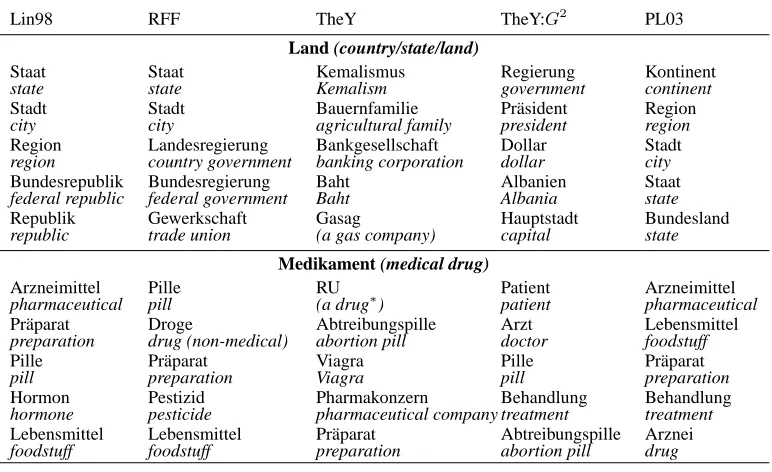
bridg-Lin98 RFF TheY TheY:G2 PL03
Land (country/state/land)
Staat Staat Kemalismus Regierung Kontinent
state state Kemalism government continent
Stadt Stadt Bauernfamilie Pr¨asident Region
city city agricultural family president region
Region Landesregierung Bankgesellschaft Dollar Stadt
region country government banking corporation dollar city
Bundesrepublik Bundesregierung Baht Albanien Staat
federal republic federal government Baht Albania state
Republik Gewerkschaft Gasag Hauptstadt Bundesland
republic trade union (a gas company) capital state
Medikament (medical drug)
Arzneimittel Pille RU Patient Arzneimittel
pharmaceutical pill (a drug∗) patient pharmaceutical
Pr¨aparat Droge Abtreibungspille Arzt Lebensmittel
preparation drug (non-medical) abortion pill doctor foodstuff
Pille Pr¨aparat Viagra Pille Pr¨aparat
pill preparation Viagra pill preparation
Hormon Pestizid Pharmakonzern Behandlung Behandlung
hormone pesticide pharmaceutical company treatment treatment
Lebensmittel Lebensmittel Pr¨aparat Abtreibungspille Arznei
foodstuff foodstuff preparation abortion pill drug
highest ranked words, with very rare words removed
∗
: RU 486, an abortifacient drug
Lin98: Lin’s distributional similarity measure (Lin, 1998)
RFF: Geffet and Dagan’s Relative Feature Focus measure (Geffet and Dagan, 2004) TheY: association measure introduced by Garera and Yarowsky (2006)
TheY:G2: similar method using a log-likelihood-based statistic (see Dunning 1993) this statistic has a preference for higher-frequency terms
[image:3.612.113.499.56.292.2]PL03: semantic space association measure proposed by Pad´o and Lapata (2003)
Table 1: Similarity and association measures: most similar items
ing like 1a,b; the result of this can be seen in ta-ble (2): while the similarity measures (Lin98, RFF) list substitutable terms (which behave like synonyms in many contexts), the association measures (Garera and Yarowsky’s TheY measure, Pad´o and Lapata’s association measure) also find non-compatible asso-ciations such as country–capital or drug–treatment, which is why they are commonly called
relation-free. For the purpose of coreference resolution,
how-ever we do not want to resolve “the door” to the an-tecedent “the house” as the two descriptions do not corefer, and it may be useful to filter out non-similar associations.
1.2 Information Sources
Different resources may be differently suited for the recognition of the various relations. Gener-ally, it would be expected that using a wordnet is the best solution if we are interested in an isa-like relation between two words. On the other
hand, wordnets usually have limited coverage both in terms of lexical items and in terms of relations encoded (as their construction is necessarily labor-intensive), and – as Markert and Nissim remark – they do not (and arguably should not) contain context-dependent relations that do not hold gener-ally but only in some rather specific context, for ex-ample steel being anaphorically described as a
com-modity in a financial text. Context-dependent
rela-tions, Markert and Nissim argue, can be found using shallow patterns (for example, steel and other
com-modities), since a use in such a context would mean
the search of the World Wide Web, which somewhat alleviates the sparse data problem.
While some near-synonyms can be found by look-ing at the distance in a wordnet, they may be far apart from each other because of ontological mod-eling decisions, or lexical items not covered by the wordnet. Similarity and association measures can provide greater coverage for these near-synonym re-lations.
The measures both of Lin (1998) and of Pad´o and Lapata (2003, 2007) are distributional methods; for each word, they create a distribution of the contexts they occur in, and similarity between two words is calculated as the similarity of these distributions.2 The difference in these two methods is the repre-sentation of the contexts. While Lin uses contexts that are expected to determine semantic preferences (like being in the direct object position of one verb), Pad´o and Lapata only use the co-occuring words, weighted by syntax-based distance. For example, in
(3) Petersubj→ likesdobj← ice-cream.
Lin’s approach would yield↑subj:likeforPeter
and↑dobj:likeforice-cream, while Pad´o and Lapata’s approach would yield the contexts like
(with a weight of 1.0) and ice-cream (with a weight of 0.5) forPeter. As a consequence, Pad´o and Lapata’s measure is more robust against data sparseness but also finds related non-similar terms (which are ultimately unwanted for coreference res-olution). Pad´o and Lapata show their dependency-based measure to perform better in a word sense disambiguation task than the measure of Lund et al. (1995), on which Poesio et al. (1998) based their ex-periments and which is based on the surface distance of words.
We also reimplemented the approach of Gar-era and Yarowsky (2006), who extract potential anaphor-antecedent pairs from unlabeled texts and rank these potentially related pairs by the mutual in-formation statistic. As an example, in a text like
(4) Peter likes ice-cream. The boy devours tons of it.
2
Both measures use a weighted Jaccard metric on mutual information vectors to calculate the similarity. See Weeds and Weir (2005) for an overview of other measures.
we would extract the pairshboy,(person)iand hboy,ice-creami, in the hope that the former pair occurs comparatively more often and gets a higher mutual information value.
2 Experiments on Antecedent Selection
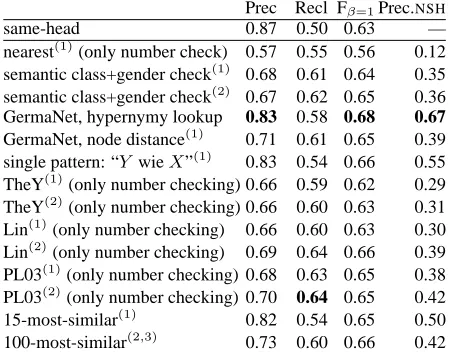
In a setting similar to Markert and Nissim (2005), we evaluate the precision (proportion of correct cases in the resolved cases) and recall (correct cases to all cases) for the resolution of discourse-old def-inite noun phrases. Before trying to resolve coref-erent bridging cases, we look for compatible an-tecedent candidates with the same lexical head and resolve to the nearest such candidate if there is one.
For our experiments, we used the first 125 articles of the coreferentially annotated T¨uBa-D/Z corpus of written newspaper text (Hinrichs et al., 2005), to-talling 2239 sentences with 633 discourse-old defi-nite descriptions, and the latest release of GermaNet (Kunze and Lemnitzer, 2002), which is the German-language part of EuroWordNet.
Unlike Markert and Nissim, we did not limit the evaluation to discourse-old noun phrases where an antecedent is in the 4 preceding sentences, but also included cases where the antecedent is further away. As a real coreference resolution system would have to either resolve them correctly or leave them unre-solved, we feel that this is less unrealistic and thus preferable even when it gives less optimistic evalu-ation results. Because overall precision is a mixture of the precision of the same-head resolver and the precision of the resolution for coreferent bridging, which is lower than that for same-head cases, we forcibly get less precision if we resolve more coref-erent bridging cases. As it is always possible to im-prove overall precision by resolving fewer cases of coreferent bridging, we separately mention the pre-cision for coreferent bridging cases alone (i.e., num-ber of correct coreferent bridging cases by all re-solved coreferent bridging cases), which we deem more informative.
Prec Recl Fβ=1Prec.NSH
same-head 0.87 0.50 0.63 —
nearest(1)(only number check) 0.57 0.55 0.56 0.12 semantic class+gender check(1) 0.68 0.61 0.64 0.35 semantic class+gender check(2) 0.67 0.62 0.65 0.36 GermaNet, hypernymy lookup 0.83 0.58 0.68 0.67
GermaNet, node distance(1) 0.71 0.61 0.65 0.39 single pattern: “Y wieX”(1) 0.83 0.54 0.66 0.55 TheY(1)(only number checking) 0.66 0.59 0.62 0.29 TheY(2)(only number checking) 0.66 0.60 0.63 0.31 Lin(1)(only number checking) 0.66 0.60 0.63 0.30 Lin(2)(only number checking) 0.69 0.64 0.66 0.39 PL03(1)(only number checking) 0.68 0.63 0.65 0.38 PL03(2)(only number checking) 0.70 0.64 0.65 0.42
15-most-similar(1) 0.82 0.54 0.65 0.50
100-most-similar(2,3) 0.73 0.60 0.66 0.42
Prec.NSH: precision for coreferent bridging cases (1)
: consider candidates in the 4 preceding sentences (2): consider candidates in the 16 preceding sentences
(3)
[image:5.612.72.297.61.237.2]: also try candidates such that the anaphor is in the antecedent’s similarity list
Table 2: Baseline results
and Nissim’s approach, which is presented in (Ver-sley, 2007). For the methods based on similarity and association measures, we implemented a simple ranking by the respective similarity or relatedness value. Additionally, we included an approach due to Gasperin and Vieira (2004), who tackle the problem of similarity by using lists of most similar words to a certain word, based on a similarity measure closely related to Lin’s. They allow resolution if either (i) the candidate is among the words most similar to the anaphor, (ii) the anaphor is among the words most similar to the candidate, (iii) the similarity lists of anaphor and candidate share a common item. We tried out several variations in the length of the simi-lar words list (Gasperin and Vieira used 15, we also tried lists with 25, 50 and 100 items). The third pos-sibility that Gasperin and Vieira mention (a common item in the similarity lists of both anaphor and an-tecedent) resolves some correct cases, but leads to a much larger number of false positives, which is why we did not include it in our evaluation.
To induce the similarity and association measures presented earlier, we used texts from the German newspaper die tageszeitung, comprising about 11M sentences. For the extraction of anaphor-antecedent candidates, we used a chunked version of the cor-pus (M¨uller and Ule, 2002). The identification of
grammatical relations, was carried out on a subset of all sentences (those with length≤ 30), with an unlexicalised PCFG parser and subsequent extrac-tion of dependency relaextrac-tions (Versley, 2005). For the last approach, where dependency relations were needed but labeling accuracy was not as important, we used a deterministic shift-reduce parser that Foth and Menzel (2006) used as input source in hybrid dependency parsing.3
For all three approaches, we lemmatised the words by using a combination of SMOR (Schmid et al., 2004), a derivational finite-state morphology for German, and lexical information derived from the lexicon of a German dependency parser (Foth and Menzel, 2006). We mitigated the problem of vo-cabulary growth in the lexicon, due to German syn-thetic compounds, by using a frequency-sensitive unsupervised compound splitting technique, and (for semantic similarity) normalised common person and location names to ‘(person)’ and ‘(location)’, re-spectively.
Same-head resolution (including a check for modifier compatibility) allows to correctly resolve 49.8% of all cases, with a precision of 86.5%. The most simple approach for coreferent bridging, just resolving coreferent bridging cases to the near-est possible antecedent (only checking for number agreement), yields very poor precision (12% for the coreferent bridging cases), and as a result, the re-call gain is very limited. If we use semantic classes (based on both GermaNet and a simple classification for named entities) to constrain the candidates and then use the nearest number- and gender-compatible antecedent4, we get a much better precision (35% for coreferent bridging cases), and a much better recall of 61.1%. Hyponymy lookup in GermaNet, without a limit on sentence distance, achieves a call of 57.5% (with a precision of 67% for the re-solved coreferent bridging cases), whereas using the best single pattern (Y wieX, which corresponds to
3
Arguably, it would have been more convenient to use a sin-gle parser for all three approaches, but differing tradeoffs be-tween speed on one hand and accuracy for relevant information and/or fitness of representation on the other hand made the re-spective parser or chunker a compelling choice.
4
the EnglishYs such asX), with a distance limit of 4 sentences5, on the Web only improves the recall to 54.3% (with a lower precision of 55% for coref-erent bridging cases). This is in contrast to the re-sults of Markert and Nissim, who found that Web pattern search performs better than wordnet lookup; see (Versley, 2007) for a discussion. Ranking all candidates that are within a distance of 4 hyper-/hyponymy edges in GermaNet by their edge dis-tance, we get a relatively good recall of 60.5%, but the precision (for the coreferent bridging cases) is only at 39%, which is quite poor in comparison.
The results for Garera and Yarowsky’s TheY al-gorithm are quite disconcerting – recall and the pre-cision on coreferent bridging cases are lower than the respective baseline using (wordnet-based) se-mantic class information or Pad´o and Lapata’s asso-ciation measure. The technique based on Lin’s simi-larity measure does outperform the baseline, but still suffers from bad precision, along with Pad´o and La-pata’s association measure. In other words, the simi-larity and association measures seem to be too noisy to be used directly for ranking antecedents. The ap-proach of Gasperin and Vieira performs compara-bly to the approach using Web-based pattern search (although the precision is poorer than for the best-performing pattern for German, “X wie Y” – X such asY, it is comparable to that of other patterns).
2.1 Improving Distributional Similarity?
While it would be na¨ıve to think that the methods purely based on statistical similarity measures could reach the accuracy that can be achieved with a hand-constructed lexicalised ontology, it would of course be nice if we could improve the quality of the se-mantic similarity measure used in ranking and the most-similar-word lists.
Geffet and Dagan (2004) propose an approach to improve the quality of the feature vectors used in distributional similarity measures: instead of weighting features using the mutual information value between the word and the feature, they pro-pose to use a measure they call Relative Feature
Fo-cus: the sum of the similarities to the (globally) most
5
There is a degradation in precision for the pattern-based approach, but not for the GermaNet-based approach, which is why we do not use a distance limit for the GermaNet-based ap-proach.
similar words that share this feature.
By replacing mutual information values with RFF values in Lin’s association measure, Geffet and Da-gan were able to significantly improve the propor-tion of substitutable words in the list of the most sim-ilar words. In our experiments, however, using the RFF-based similarity measure did not improve the similarity-list-based resolution or the simple rank-ing, to the contrary, both recall and precision are less than for the Weighted Jaccard measure that we used originally.6
We attribute this to two factors: Firstly, Geffet and Dagan’s evaluation emphasises the precision in terms of types, whereas the use in resolving coref-erent bridging does not punish unrelated rare words being ranked high – since these are rare, the like-lihood that they occur together, changing a reso-lution decision, is quite low, whereas rare related words that are ranked high can allow a correct res-olution. Secondly, Geffet and Dagan focus on high-frequency words, which makes sense in the context of ontology learning, but the applicability for tasks like coreference resolution (directly or in the ap-proach of Gasperin and Vieira) also depends on a sensible treatment of lower-frequency words.
Using the framework of Weeds et al. (2004), we found that the bias of lower frequency words for preferring high-frequency neighbours was higher for RFF (0.58 against 0.35 for Lin’s measure). Weeds and Weir (2005) discuss the influence of bias to-wards high- or low-frequency items for different tasks (correlation with WordNet-derived neighbour sets and pseudoword disambiguation), and it would not be surprising if the different high-frequency bias were leading to different results.
2.2 Combining Information Sources
The information sources that we presented earlier and the corpus-based methods based on similarity or association measures draw from different kinds of evidence and thus should be rather complementary. To put it another way, it should be possible to get the best from all methods, achieving the recall of the high-recall methods (like using semantic class
in-6
15-most-similar(2,3)
100-most-similar(2,3)
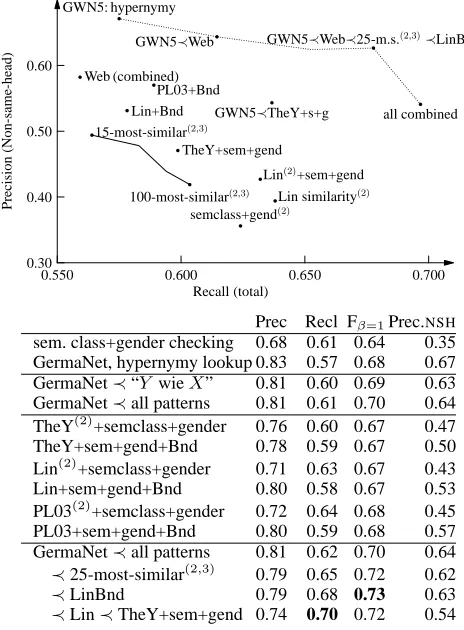
GWN5: hypernymy
Web (combined)
semclass+gend(2)
Lin similarity(2)
Lin(2)+sem+gend
TheY+sem+gend Lin+Bnd
PL03+Bnd GWN5≺Web
GWN5≺TheY+s+g
GWN5≺Web≺25-m.s.(2,3)≺LinBnd
all combined
Recall (total)
P
re
ci
si
o
n
(N
o
n
-s
am
e-h
ea
d
)
0.550 0.600 0.650 0.700
0.30 0.40 0.50 0.60
Prec Recl Fβ=1Prec.NSH
sem. class+gender checking 0.68 0.61 0.64 0.35 GermaNet, hypernymy lookup 0.83 0.57 0.68 0.67
GermaNet≺“Y wieX” 0.81 0.60 0.69 0.63
GermaNet≺all patterns 0.81 0.61 0.70 0.64 TheY(2)+semclass+gender 0.76 0.60 0.67 0.47
TheY+sem+gend+Bnd 0.78 0.59 0.67 0.50
Lin(2)+semclass+gender 0.71 0.63 0.67 0.43
Lin+sem+gend+Bnd 0.80 0.58 0.67 0.53
PL03(2)+semclass+gender 0.72 0.64 0.68 0.45
PL03+sem+gend+Bnd 0.80 0.59 0.68 0.57
GermaNet≺all patterns 0.81 0.62 0.70 0.64
≺25-most-similar(2,3) 0.79 0.65 0.72 0.62
≺LinBnd 0.79 0.68 0.73 0.63
≺Lin≺TheY+sem+gend 0.74 0.70 0.72 0.54
(2)
: consider candidates in the 16 preceding sentences (3)
[image:7.612.65.297.61.376.2]: also try candidates such that the anaphor is in the antecedent’s similarity list
Table 3: Combination-based approaches
formation, or similarity and association measures), with a precision closer to the most precise method using GermaNet. In the case of web-based patterns, Versley (2007) combines several pattern searches on the web and uses the combined positive and nega-tive evidence to compute a composite score – with a suitably chosen cutoff, it outperforms all single pat-terns both in terms of precision and recall. First re-solving via hyponymy in GermaNet and then using the pattern-combination approach outperforms the semantic class-based baseline in terms of recall and is reasonably close to the GermaNet-based approach in terms of precision (i.e., much better than the ap-proach based only on the semantic class).
As a first step to improve the precision of the corpus-based approaches, we added filtering based on automatically assigned semantic classes (per-sons, organisations, events, other countable objects,
and everything else). Very surprisingly, Garera and Yarowsky’s TheY approach, despite starting out at a lower precision (31%, against 39% for Lin and 42% for PL03), profits much more from the semantic fil-ter and reaches the best precision (47%), whereas Lin’s semantic similarity measure profits the least.
Since limiting the distance to the 4 previous sen-tences had quite a devastating effect for the approach based on Lin’s similarity measure (which achieves 39% precision when all the candidates are avail-able and 30% precision if it choses the most se-mantically similar out of the candidates that are in the last 4 sentences), we also wanted to try and ap-ply the distance-based filtering after finding seman-tically related candidates.
The approach we tried was as follows: we rank all candidates using the similarity function, and keep only the 3 rated candidates. From these 3 top-rated candidates, we keep only those within the last 4 sentences. Without filtering by semantic class, this improves the precision to 41% (from 30% for iting the distance beforehand, or 39% without lim-iting the distance). Adding filtering based on se-mantic classes to this (only keeping those from the 3 top-rated candidates which have a compatible se-mantic class and are within the last 4 sentences), we get a much better precision of 53%, with a recall that can still be seen as good (57.8%). In compari-son with the similarity-list-based approach, we get a much better precision than we would get for meth-ods with comparable recall (the version with the 100 most similar items has 44% precision, the version with 50 most similar items and matching both ways has 46% precision).
Applying this distance-bounding method to Gar-era and Yarowsky’s association measure still leads to an improvement over the case with only seman-tic and gender checking, but the improvement (from 47% to 50%) is not as large as with the semantic similarity measure or Pad´o and Lapata’s association measure (from 45% to 57%).
approach of Gasperin and Vieira 2004). This re-sults in visibly improved recall (from 62% to 68%), while the precision for coreferent bridging cases does not suffer much. Adding resolution based on Lin’s semantic similarity measure and Garera and Yarowsky’s TheY value leads to a further improve-ment in recall to 69.7%, but also leads to a larger loss in precision.
3 Conclusion
In this paper, we compared several approaches to re-solve cases of coreferent bridging in open-domain newspaper text. While none of the information sources can match the precision of the hypernymy information encoded in GermaNet, or that of using a combination of high-precision patterns with the World Wide Web as a very large corpus, it is possi-ble to achieve a considerapossi-ble improvement in terms of recall without sacrificing too much precision by combining these methods.
Very interestingly, the distributional methods based on intra-sentence relations (Lin, 1998; Pad´o and Lapata, 2003) outperformed Garera and Yarowsky’s (2006) association measure when used for ranking, which may due to sparse data problems or simply too much noise for the latter. For the asso-ciation measures, the fact that they are relation-free also means that they can profit from added semantic filtering.
The novel distance-bounded semantic similarity method (where we use the most similar words in the previous discourse together with a semantic class-based filter and a distance limit) comes near the pre-cision of using surface patterns, and offers better ac-curacy than Gasperin and Vieira’s method of using the globally most similar words.
By combining existing higher-precision informa-tion sources such as hypernym search in GermaNet and the Web-based approach presented in (Vers-ley, 2007) together with similarity- and association-based resolution, it is possible to get a large im-provement in recall even compared to the combined GermaNet+Web approach or an approach combin-ing GermaNet with a semantically filtered version of Garera and Yarowsky’s TheY approach.
In independent research, Goecke et al. (2006) combined the original LSA-based method of Lund
et al. (1995) with wordnet relations and pattern search on a fixed-size corpus.7 However, they eval-uate only on a small subset of discourse-old definite descriptions (those where a wordnet-compatible se-mantic relation was identified and which were rea-sonably close to their antecedent), and they did not distinguish coreferent from associative bridging an-tecedents. Although the different evaluation method disallows a meaningful comparison, we think that the more evolved information sources we use (Pad´o and Lapata’s association measure instead of Lund et al’s, combined pattern search on the World Wide Web instead of search for patterns in a fixed-size corpus), as well as the additional information based on semantic similarity, lead to superior results when evaluated in a comparable task.
3.1 Ongoing and Future Work
Both the distributional similarity statistics and the association measure can profit from more training data, something which is bound by availability of similar text (Gasperin et al., 2004 point out that us-ing texts from a different genre strongly limits the usefulness of the learned semantic similarity mea-sure), and by processing costs (which are more se-rious for distributional similarity measures than for non-grammar-related association measures, as the former necessitate parsed input).
Based on existing results for named entity coref-erence, a hypothetical coreference resolver combin-ing our information sources with a perfect detec-tor for discourse-new mentions would be able to achieve a precision of 88% and a recall of 83% con-sidering all full noun phrases (i.e., including names, but not pronouns). This is both much higher than state-of-the art results for the same data set (Versley, 2006, gets 62% precision and 70% recall), but such accuracy may be very difficult to achieve in prac-tice, as perfect (or even near-perfect) discourse-new detection does not seem to achievable in the near fu-ture. Preliminary experiments show that the inte-gration of pattern-based information leads to an in-crease in recall of 0.6% for the whole system (or 46% more coreferent bridging cases), but the inte-gration of distributional similarity (loosely based on the approach by Gasperin and Vieira) does not lead
7
to a noticeable improvement over GermaNet alone; in isolation, the distributional similarity information did improve the recall, albeit less than information from GermaNet did.
The fact that only a small fraction of the achiev-able recall gain is currently attained seems to sug-gest that better identification of discourse-old men-tions could potentially lead to larger improvements. It also seems that firstly, it makes more sense to com-bine information sources that cover different rela-tions (e.g. GermaNet for hypernymy and synonymy and the pattern-based approach for instance rela-tions) than those that yield independent evidence for the same relation(s), as GermaNet and the Gasperin and Vieira approach do for (near-)synonymy; and secondly, that good precision is especially important in the context of integrating antecedent selection and discourse-new identification, which means that the finer view that we get using antecedent selection ex-periments (compared to direct use in a coreference resolver) is indeed helpful.
Acknowledgements I am very grateful to Sabine Schulte im Walde, Piklu Gupta and Sandra K¨ubler for useful criticism of an earlier version, and to Simone Ponzetto and Michael Strube for feedback on a talk related to this paper. The research re-ported in this paper was supre-ported by the Deutsche Forschungsgemeinschaft (DFG) as part of Collab-orative Research Centre (Sonderforschungsbereich) 441 “Linguistic Data Structures”.
References
Asher, N. and Lascarides, A. (1998). Bridging.
Jour-nal of Semantics, 15(1):83–113.
Cardie, C. and Wagstaff, K. (1999). Noun phrase coreference as clustering. In Proceedings of the
Joint Conference on Empirical Methods in Natu-ral Language Processing and Very Large Corpora (EMNLP/VLC 1999), pages 82–89.
Clark, H. H. (1975). Bridging. In Schank, R. C. and Nash-Webber, B. L., editors, Proceedings of the
1975 workshop on Theoretical issues in natural language processing, pages 169–174, Cambridge,
MA. Association for Computing Machinery. Daum´e III, H. and Marcu, D. (2005). A
large-scale exploration of effective global features for
a joint entity detection and tracking model. In
HLT/EMNLP’05, pages 97–104.
Dunning, T. (1993). Accurate methods for the statis-tics of surprise and coincidence. Computational
Linguistics, 19(1):61–74.
Foth, K. and Menzel, W. (2006). Hybrid pars-ing: Using probabilistic models as predictors for a symbolic parser. In ACL 2006.
Garera, N. and Yarowsky, D. (2006). Resolving and generating definite anaphora by modeling hyper-nymy using unlabeled corpora. In CoNLL 2006. Gasperin, C., Salmon-Alt, S., and Vieira, R. (2004).
How useful are similarity word lists for indirect anaphora resolution? In Proc. DAARC 2004. Gasperin, C. and Vieira, R. (2004). Using word
similarity lists for resolving indirect anaphora. In
ACL’04 workshop on reference resolution and its applications.
Geffet, M. and Dagan, I. (2004). Feature vector quality and distributional similarity. In CoLing
2004.
Goecke, D., St¨uhrenberg, M., and Wandmacher, T. (2006). Extraction and representation of seman-tic relations for resolving definite descriptions. In
Workshop on Ontologies in Text Technology (OTT 2006). extended abstract.
Harabagiu, S., Bunescu, R., and Maiorano, S. (2001). Text and knowledge mining for corefer-ence resolution. In Proceedings of the 2nd
Meet-ing of the North American Chapter of the Associa-tion of ComputaAssocia-tional Linguistics (NAACL-2001).
Hinrichs, E., K¨ubler, S., and Naumann, K. (2005). A unified representation for morphological, syntac-tic, semantic and referential annotations. In ACL
Workshop on Frontiers in Corpus Annotation II: Pie in the Sky, Ann Arbor.
Kunze, C. and Lemnitzer, L. (2002). Germanet – representation, visualization, application. In
Pro-ceedings of LREC 2002.
Lin, D. (1998). Automatic retrieval and clustering of similar words. In Proc. CoLing/ACL 1998. Lund, K., Atchley, R. A., and Burgess, C.
(1995). Semantic and associative priming in high-dimensional semantic space. In Proc. of the 17th
Markert, K. and Nissim, M. (2005). Comparing knowledge sources for nominal anaphora resolu-tion. Computational Linguistics, 31(3):367–402. McCarthy, J. F. and Lehnert, W. G. (1995). Using
decision trees for coreference resolution. In IJCAI
1995, pages 1050–1055.
Morton, T. S. (2000). Coreference for NLP applica-tions. In ACL-2000.
M¨uller, F. H. and Ule, T. (2002). Annotating topo-logical fields and chunks – and revising POS tags at the same time. In Proceedings of the Nineteenth
International Conference on Computational Lin-guistics (COLING 2002).
Ng, V. (2007). Shallow semantics for coreference resolution. In IJCAI 2007, pages 1689–1694. Pad´o, S. and Lapata, M. (2003). Constructing
se-mantic space models from parsed corpora. In
Pro-ceedings of ACL 2003.
Pad´o, S. and Lapata, M. (2007). Dependency-based construction of semantic space models.
Compu-tational Linguistics, to appear.
Poesio, M., Alexandrov-Kabadjov, M., Vieira, R., Goulart, R., and Uryupina, O. (2005). Does discourse-new detection help definite description resolution? In Proceedings of the 6th
Inter-national Workshop on Computational Semantics (IWCS-6).
Poesio, M., Schulte im Walde, S., and Brew, C. (1998). Lexical clustering and definite descrip-tion interpretadescrip-tion. In AAAI Spring Symposium
on Learning for Discourse.
Poesio, M., Vieira, R., and Teufel, S. (1997). Re-solving bridging descriptions in unrestricted text. In ACL-97 Workshop on Operational Factors in
Practical, Robust, Anaphora Resolution For Un-restricted Texts.
Ponzetto, S. P. and Strube, M. (2006). Exploiting semantic role labeling, wordnet and wikipedia for coreference resolution. In HLT-NAACL 2006. Schmid, H., Fitschen, A., and Heid, U. (2004).
SMOR: A german computational morphology covering derivation, composition and inflection. In Proceedings of LREC 2004.
Steinberger, J., Kabadjov, M., Poesio, M., and Sanchez-Graillet, O. (2005). Improving LSA-based summarization with anaphora resolution. In Proceedings of Human Language Technology
Conference and Conference on Empirical Meth-ods in Natural Language Processing, pages 1–8.
Uryupina, O. (2003). High-precision identification of discourse new and unique noun phrases. In
Proceedings of the ACL Student Workshop.
Versley, Y. (2005). Parser evaluation across text types. In Proceedings of the Fourth Workshop on
Treebanks and Linguistic Theories (TLT 2005).
Versley, Y. (2006). A constraint-based approach to noun phrase coreference resolution in German newspaper text. In Konferenz zur Verarbeitung
Nat¨urlicher Sprache (KONVENS 2006).
Versley, Y. (2007). Using the Web to resolve coreferent bridging in German newspaper text. In Proceedings of GLDV-Fr¨uhjahrstagung 2007, T¨ubingen. Narr.
Vieira, R. and Poesio, M. (2000). An empirically based system for processing definite descriptions.
Computational Linguistics, 26(4):539–593.
Weeds, J. and Weir, D. (2005). Co-occurrence re-trieval: A flexible framework for lexical distri-butional similarity. Computational Linguistics,
31(4):439–475.