Thesis by Richard Lewis Cohen
In Partial FUl'f'iUmenl".
or
the Hequirements For the Degree of!)Jetor of Philosophy
CaUfornia InsUtute of Technology Pasadena, California
Mnny people have contributed to tIle progre8sof these
-experiments. In particular, the author would like to thank: Dr. Rudolf ~8s1>auer, wilo orig1na.lly suggested the experiments reported on and vho bas Binee continually advanced the theoretical and experimental investigations. I would like to thank him particularly for nuch invaluable counsel and for instilling in the author W'l increased awarenes8 of the need for
-precision in experimental
work.
Drs. Ulrich Hauser and Felix Boe~ for many stbmllat1ng d,iscussiolUl and SlJ.ggestions in the early sta..~. of the experiment.
Herbert 1';. Henr1kson~ "''hosc ingenul ty and skill in the design of experimental equip:Jent has enormously aided the progress
-John M. Poindexter and Frank T. Sni vel:y, for invaluable help with the experimental 1IOrk.
Vernon Stevens, !>bUy E. COhen, Richard T. Brockmeier,
-J. David Ilowman and M!1rshall Greer, far hel.p vi th the measurements
-and
data analysis.
Dr. Sten Samson,
:tor
JIIlch helpful 1nf01"lll8tion on the-chem1stl";'! of thulium and erbium.
Thia research "... supported in pert by the Atcaic
Abstract
~ssbauer
Effect in Tml69
The recoil· f'ree resonance absorption phenomel¥JD haa been
used t,o atudy the
8.4
key g - . ray which is emitted in the deca,y(;f the first excited state of
Tml69
which ia pOpllated by the betadecay of
~69
.
inth sources and absorbers in various che1ll1calforms, hyperfine structures which are strongly temperature dependent
have been obtained. These have been studied with the &1111 of producing
& source' emitting an unsplit line. The obaerved absorption patterns are explained on the basis of & quadrupole interaction resulting from the interaction of the nuclear quadrupole Jlll)ment of the exc1 ted state
of
~69
with the electric field ·gradient produced by the surroundingelectrons and the crystal field. ATguments are gi "en to show that
Table of COntents
I. Introduction
II. Theory
A. Elementary Theor.r 01' the f.fJs8ba.uer Effect
-B. If.yperfine Structure and Energy Shifts in NUclear Transitions
-
-I. The Q,ta.drupole Interaction
2. Cry_tal Fields and Perturbations 01'
the
4f Electronic Shell in Rare Eatth Ions3. In1'1uence
ot
Belexation Phenomena.4~ The Effective ~pole Interaction
5.
The E1"1'ecti ve Magnetic Interaction6.
The Nuclear Q.tedrupole }'bllent ofrr.}-69
In.
Experimental Procedures A. Experimental Equipaent1. VelocIty Spectrometer
-2. Proportional Counters
3.
Electronics4:
Source Oven and Cryoeta.tB. Pr8paration of SOurces and Abeorbers
1. SOurce PrePQr&t1on
2. Absorber Preparation
Page
1
4
6
7
10
17
20
26
29
31
32
35
39
Page
rv.
?eaults41
A
.
..
Measurements at Room Temperature1. Oxide Source and Absorber
46
2. Metal SOUrce and Abaorber
52
3.
Metal Source and Oxide Absorber 544.
Studies of Other Absorbing Materials56
B
.
Measurements Above and Below3rxP
K59
-V
.
DiscussionA.
The Magnitude and Temperature Dependenceof the Uyperfine Structure
65
B.
Size of the Reeonance };.'ttect68
C.
Line H1dths69
--VI. 8uJJma.ry
73
-1
-I. Introduction
The discovery by R. L. If)ssbauer (1) of the phenomenon
of recoil-free gemma ~ resonance emission and absorption has aade possible varlous studles in nuclear
and
80lid state physicsand
ex~perimental tests of the theories of relati vi ty. Jobst of these ex -periments have been performed using the isotope
Fe5'T,
while relatively little has been done using other transitions, particularly those in
-the rare earth nuclci.
The unfilled 4f shell in the rare earths is the source of soma physical properties which distinguish the rare earth series f'rom
most other element8. ~tis8bauer 8cattering expertments are
particu-larly useful in studying the nuclear hyperfine splltting resultlng f'rom the interaction of the nuclear IIIOIIIente with internal fields produced by the atomic electrons.
There are several transitions In nuclei Of rare earth
atoms that can be used for recoil-tree resonance absorption
experi-ment8
(2,
3,
4).
In the present work, the 8~4 key g . . . traneitlon inTIfil69
vu8e1ected~
Thi8 particular transition, the character -istics of which are Pl"esented in fig. 1 .. has the advantages that the recoll-f'ree fioaction is large e~en at very high t.emperatures (s_ :fig.2) because of the low energy of the transition, tt..t the half life of
..
-
2
-473
1
69
.
.
379
6SER9
.
4D
.
j36
42%
316
bKEV
58%
340
KEV
...
+A-~....,.,-712-""-... +.5/
2
-+--+-...
3/2
.-.01....01.... _ _ 1
12
y
B
169
3
2
D
[image:7.552.24.543.37.722.2]7
0
• •
FIGURE
1:
DECAY SCHEME OF
THULIUM
1
6
9
SHOWING
8
.4
KEV
TRANSITION
STUD
IE
D
I
N
PRESENT EXPERIMENTS
A
DD
ITI
ONAL
INFORMAT ION~NA
TIlftAL
THULlU~1
I
S
100% THULlUM169
.
GROUND STA
TE
NUC
LEA
R MOMEN
T:
-
0
.21
NM
B
.4-KEV T
RANS
ITI
O
N
IS
M1~E2
I
N
TER
N
AL C
ONVERS
I
ON
COEFFICIENT
M
SHELL
6
9
M
,
O
SHELL 37
w
>-
CJ w o IJ..I
,CIi
-
.-..
~-2
:
0,8
RECOIL-FREE
FRACTION
A
S
A
FUNCTIO
N
OF
I ~MPER A TUREFOR
T
HE
8
.
4
KEV
TR
A
NSI
TIO
N
IN
THULIUM
0
9
,
\
\"
,
,
,
,
--m(IDE
90
"
"-
"
,
,
"-:
240
K
"-
---METAL
90
:
160
K
250
500
750
TH4PERATURE
(K
)
"
"
"
"
"
"
II. Theory
A. Elementary Theory
ot
the ~s8bauer EffectThe beels o.f all recoil-free" ~-ray resonance experiments
1s the discovery by lotissbauer that when
an
.tom
18 bound in • crystal1ts mlcleus can make transitioDs 1n which the f'ull energy of the
trans-1t1on is g1ven to the em1.tted g. . - ray aDd practicaUy DO recoil
energy 1$ given to the em! tUng or abeorbing 8ystem. There are two
basic parts to the analys1e of the effect -- the part due to nuclear
physics. vh1ch shows the or1gin and form of the resonance, and the
part due to eo11d state physics, vhloh shows how the recoil-free
transitions occur.
The cross section
for
gaIIIII&-ray resonance absorption lsgiven by the Brelt-Wigner formula,
where
Eo
is the difference between the ground. and excited-stateenergles, E 18 the energy of the incldent
gamma
ray 1n the system ofthe absorbing nuoleus,
r:::
~
is the total width of the level be1ng,
T
exoited, Vho8e mean Ufe 18
7: ,
Ie and Ig are the excited and groundstate spins, and
OCT
is the total internal conversion ooefficient forthe transition.
*
'!he name 1s sClllleVhat misleading. I t .hould be noted that it isnot thl! recoil which 1a eliminated, but the energy 10 •• due to
5
If only
recoil
-
free
transitions are
being
considered,
this
c:ross~sect1on JIIl8t be IIIlltipl1ed by the recoil-free fraction f~ 1.
Approximating the real vibration spectrum
ot
the crystal by the Debyespectrum, we obtain
for
the l"ecoll-:free fraction (1)8,!r
)
_
(_ 6R
[_
.
1
.
(L)\2[
Td.t]
.
~E8YE
-eJXf
keif
+
e'4-
et"-/(2)
whel"e R::F-o 2/.2Nt!2 18 the recoil energy
tor
a freely recoiling atom of
-Jll&8S 14, and k 111
the
Eoltamanneonstent.
This tOl'lll1la gives therecoil-:free .fraction for emission or absorption o-t. p - .
r-.ve
:t:rom a nucleusin
a crystal with Debye temperaturee,
¥ben the crystal. is at-6-B. IT.y-per .f'lne Structure and T':nerg,y Shifts in
Nuclear TransiHons
In general, there are various effects which split and shift
the line emi.tted from a r,tissbauer 30uree. In the prescnt exper1ments,
the laree natural -line width of the transition beIng studied prevents
the observation of two of the possible effects. Theee are the second
order DoJ)l)ler shift due to thermal vibrations of the atom about its
equilibrium lattice position
(
5
)
and an i8011eric shift(6)
which 18 .an electric interaction due to the interaction of the nuclear charge
distribution with the electron charge distribution inside the nuclear
core, which can be made different for source and absorber.
The effects which are significant in the present study are
the interaction between the nuclear quadrupole moment and the electric
field gradient at the nucleus, . and the magnetiC dipole interaction
between the nuclear magnetic moment and the magnetic field &.t the
nuclear sites produced by the atomic electrons. These two effects
are considered separately in the follOWing sections.
The interaction of the nucleus with macroscopic externally
applied fields is not large enough to be observable with the presently
-
7-1. The QIadrupole Interaction
The quadrupole -interaction energy i8 a re8ult of the
inter-action of the nuclear quadrupole moment with the electric ~ield
gr&dient at the nucleus. The interaetion Ha11lltoniancan be written
in the
form
H
:::)=~
'
Qi •
(VEX
j(2),
where~
1a the nuclear~ .i 0-2. Z.
1-quadrupole tensor with component.
Q~:= 2;(~
r
-I)
(3I: -
I (I
+1)
! I _
eQ
-16
"
Qz-
1[(2[-1)
(I"iI~ +ItI~)
(3)
,
±2
eG..~
2
°
2
:=Qlf2.I-O
I
t.
where I:t and.Is are to be treated &8, operator" on the nuclear spin
wave tun<:t1on
I
II"'>
vh1ch has spin I and spin projection Illy along anarbi trarlly chosen II axis. I±and I z are de tined by
(
,l~
I!
I
I,
m)
=
Ix
r
i
ly} II) m> :::
[(I:;:
1'n)(I"!:
m+!)J
II,
-m
:!/>
Ii/I,m>= in/lIm>.
18 a
form
of the electric field gradient tensor with components- I
U
- T
~e-a ! I
I
(VE)z
=
-{6
(UXl-
::t
L U
Ye )
(4)
(v~):7._
24
(U
XX~
Uty
±
2
i
D.;<y)
1.
vi th U the potential at the nuclear site and
U
=
d
U .
.8.
We are COIIPletely free in the choice of coordinate axes.
Without the application
ot
external fields, the system that is lDOstcon'Jfmient for calculation is that in which the Pl"incipe.l axes of
the gradient tensor serve as the coordinate axes in which to write
the nuclear wave function. In this syst~ which we will call the (x',
y',
a') system, the gradient COIIIpOnentsUx'y'
::
Uy'.'::
Ux'l' :
O. In addition,we
will conform to the conventionot
having the at axis along the strongest componento
t
the gradient tensor. We furtherintroduce th,e parameters
1l
:
(
try
,
y' - Ux ' x') /Us'.'
andeq :: U.
'It' •
'Yl.
and eq then cOIIIPletely describe the gradient teneor inthe (x',
y',
It') sY8tem when Laplace's equation holds:We will nov proceed to calculate the quadrupole spl1 tting of
the
nal69
nuclear energy leveb in the (x', y', at) system. Sincethe ground state haG I : .~, there will be 1» CI'*'lrupole spUtting.
The matrix elements tor the quadrupole perturbation of the I : 3/2
excited state (e~4 key) can be calculated using equations
3
and4:
<IlmlJ-i~/I,m>
=
<I)m/tQ~-(VE);j
Il)m)=A(3m
2-I(It-f))
-2
<
I,m
I /-jal
l
m')=-
(I,
ml
L..
Q~
•
(vE);jII,m')
=
11f(I}+
1!-
>
-
9
-The reaul. ting perturbation _tr1x 1&
1n '..
3/3.lI2.
-
Y2.
-
'Yz.
1b,
3/Z 3A
0
-{j'1.A
0
0
,
-3A
°
..fa
'Y[A
-~
,f3
flA
0
-3A
0
.
-jz
0
,fiy[A
°
3A
.An exact solution of the secular equation of this _trix
yields the energy eigen\~Ue8
YZ
E'!;3/2.
=
3A
(1+
't~3)
l.
Y2.
E
f
Y2.
==-3A
(/-I-
"l73)
the eigenfUnction8 of which
are
I
11,'!3h.)=A!3hI
I
,!3h.>+
B~Y2.IIJ
!'i)
AN])(ba)
II) :
VzI=
C
tYJ.
II
J~
'l'2)
+
D!"~/2.
II,!
3/2.)
( {,
p)
(the wave functions are identifIed by the
I
z .value they U8UJ118 ~. ~:.O)Thus vi thout performing the actual diagonallsation of the gradient tensor, we have shown that under a pure qua.1rupole
inter-action the I : 3/2 excited state ill 8pl1 t into twO levels regardless of the complexity of the
gradient
tensor.The field gradlent at the nuclear 81tes coaes ~ the surrounding lons and from distortions of the electronlc 8hella pro. duced by .the field of these ions. The tirat step 1tl evaluating the
field gradient, theretore, will be to look at the structure of' the crystal and the electronic states of the rare earth ions in the
-10
-2.
Cl'ystal Fields and Perturbatione of the4t
Electronic Shell in Rare Earth IonsThe rare earth series of elements is distinguished by the
fact
that
the 4f electronic shell is partially fUled. Theelectronic ~onf1guratlon fOr all these elements
ean
be written(7)
ls22s22p63s23p63dl04e24p64dl04rnSs25p65dO-16s2.
In compounds orsolutions, three electrons go -off (the two 68 electrons, the 5d
electron, .it any, and a
4t
electron if there is DO 54 electron), leaving a3+
ion Yith a partially filled 4f shell shielded by thesurrounding closed shells of 58 and
5p
electrons. The magnetic properties of the 3~ ion are determined essentIally by the 4r electrons, since all tlle other electrons are in closed ehells.The free ion can usually be described accurately using L-S coupling of the 4f electrons; this gives a free ion ground state with
...
J :-
L+ 8..
whlch is 2J+
1 fold degenerate. Ifve
place the ionin
the electric field generated by the surrounding ions in a crystal,
we
find that the shielding of the4f
electrone by 11 total of eight 5s a.~5p
electrons makes theeffect
or the crystal fieldweek
in com-parison Yith the L-S coupling. so that J reaalne a gpodquantua
number and perturbation methods can be used to evaluate the electron config· uration of' the ion in the crystal electric 1'ie14. Thi. i. in -.rked contrast to the iron transition element., vhere the perturbIng e1'fect of the crystal tield 1a strong In comparison with the L-S coupling and J Is DO longer a good. quantum nWllber.
-11-crystal field symmetry~*
The
crystal field aplitsthe
energy levels ofthe
tree ion ground state by less than0~1
ev(,..,].2000
K) for~(8~
vhUe the spacing bet-wen levelsot
different J 1sot
the order of afev ev
("'30
,
0000
K)
(8).
The:ref'Ore, in calculating the effect of the crystal field perturbation on the free ionground
state, in first
-order the existence of excited atatea can be neglected.
:Because of the weak coupling ( .... 10.
5
ev) between the elec-tronic statea and nuclear momenta, the_hyperftne interaction can be neglected In calculating the electronic vave fUnctions.We shall proceed to calculate
the form
of the 4f electronic wave functions :reaul ting t:rom the perturbation of the free ion energy levels by the crystal :field.Since in first order the cr'Jstal electric field eplita the
ground state of the free ion into a manifold of electronic states of the same J, 1 t ia convenient to expand the potential in te1"!ll8 of spherical harmonica,
This expansion hol48 inside a volume that baa
no
1'ree charge, aDd 18 ,restricted to reati vely few terms because of the a;y1llllletry of' the Cr"Jstal field. Table I contains the only value. of' the expansion pe.rametere n and -V which ocour inequat10n
7
tor .eoa-ot
theeoII.-pounds studied in the present experi.ent.
*
InTJD3+ ,
which has an even number of' electrons, there is DO.12,
-Table I
Signifioant Oonstant.s in t.he Expansion or the Crystal FIeld
tor
Various U!ttiee Symmetries
HeXagonal close packed
structure
IPoint symmetry D3h
n
v
-2 0
3
±3
4
0S
±3
6
0,±
6
Body-centered
cubic
structurel
Point
symmetry
02n
1
2
3
4
5
6
v
-o
0,
±
2
0,
±
2 0,±
2,±
4
0,
±
2,
±
4
0,
±
2,±
4,
±
6
Body-centered
c
u
bic structure.
Point synnetry
031n
-24
6
v
-o
[image:17.560.27.529.110.723.2]-13
-The -.trix elements of the potentl&.l operator
ot
equation 7taken 1n the manitold of eigenstate. having the same J are given by
V-m
m':
<Yi.m
I
V(f)/
Y{m.)=(~7nIL
Any
Y:r"YIJ'ffml
(3)
,
~vThe wave functions
r;,
=
.,.,..,r
c(i.m'If
Im
(9)
for the different crJatal symmetries fol;1.ov :t'roIIl the solutions of the
seeular determinant of equation 8~
_
Results for the ground stateo!Tm3+
are
presented in Table II.As can be seen from equations
8
and9,
the aetual nllJllericalvalues of the coeff1cients dim 1n Table II depend on the -values of
Any
which characterize the crystal field and on the expectation',-'alues of r1l~
We are concerned here only vtth some baaic characteristics
of' the hyperflne interaction, which can be obtained without a numerical
evaluation of the Ci1m~ This numerical e'laluation is di:rt1cult in
Table IIa Seoul a r Determinant and W ave FunctioOll tor the
Ground
Stateot
Tlu3
+
(Configuration3H6)
Point SY1l1lletry D)h Secular D eterminant,
6
0-6
3
-3
4
_2-4
2 S -1-5
1
m
•
III6
v66
V60
V6-6
, 0v06
Voo V0..6-6
V-66
V-60
V-6-6
)v33
V
3-3
·3
V. 3 )V
.3-3
4
V44
·
V4-2 .2 V. 24 v-2-2·4
v.4-4 V.42
2 V2-h
v22 . SV~S
V!>-1.1
V. 1S V.1-1-s
V.!>-S V.$1 .1
V1-5 VnTable IIa (cont t d) Wave Functions LeYel Number DegeneracY' Wave Functtone (Arbttra!Z)
1
1
0(16
(16
6
+
It
6
)
+()(.10
1
6
0
21
0:
26
(16
6
+
16
./)+
CXw~
°
3
1
0:
36
(Y/
+
16./)
+CX)oy
6
o
4
1
(Y/
+
It)
/
V2
S
1
(1/
-
16-3
)
/
~
•
~6
2
01.
64
1 6
4
+CX6-2
Table lIb Secular Determinant and Wa ve Functions
tor
thearound
Stateot
Ta
3
+
(Configuration38
6
)
P ointSymmetr.r
02 Secular Det8!'11d.nant,
6
4
2
0-2
-4
-6
5
3
1 -1-3
-S
•
•
iii6
v66
V
64
V 62
v60
0 0 0,
4
v M
v 4h
v
42
v
40v4-2
0
02
V26
V
24
V 22
V20
V
2
_ 2
V
2
-4
0
0V06
V04
V 02
Voo
V0..
2
V0..
4
-V0-6
-2
0V
V
V
V
,
,
•
-24
-22
-20
-2_2
-2-4
-2-6
....
vt-4
0 0V
-42
'-40
v
-4-2
V
-4-4
'-It-6
III I
-6
0 0 0 V-60
'..6-2'..6-4'-6-6
S
v~'S3
v51
's..l
0
03
V 3S
'33
'n
'3-1
'3-3
0 1 V 15 -'1)V
11
Level Numbe r ( Arb i trary )
1
2.3
4
5
6
7
139
10
11
12
13
Degeneracy
-
..
Table In) (c:ont ' d) 'i'/ u v e fu..l1C t :i .OM \"la
ve Funct io na
CX
1
6
Y
6
6
+
CX
1L
Y6
U
+
CX
12
Y 6
2
.
~
CX
l0Y60
4o
O(
l
_
2
Y 6
-2
+
C(
l_h
Y 6
-4
+
CX
l
-6
'1
6
-6
()(
-;i'l6
6
'
l-CX
24
7
6
4
+
()(
22
Y
6'2
+
0(
20
1
6°
-1-0(
'2
_
'2
16
2
·~
0(
2
_
4I';}.!
+
CX
2
-6r:
0<.
')6Y.6
6';'
CX
3
!;X6
4
+0( 32
Y
6'2
+
0{
30"1.:
+
0(
3-2
r'6
2
+
0(
3-h'!64
+
()(
3-6rt
CX
h6
"i6
6
+
CX
1
,l;r
6
h
4o
()(
42Y62
40
CX
40
1
6°
-!r
CX
1-,
.
2'16
2
+
0(
1,_416
4
+()(
h
-6r:r:
ct..
r;6
yt
+
O(
Sh"I
6
4
+
CX
S
2
Y
6'2
+
CX
~OY.
60
':-()(
S
_
'2
Y6
2
+
CX
5-I.l6
4
+
CX
S
-6rt
•
()(
66h
6 ....CX
6h
"i6
4
+
()(
62
Y6 2 ....CX
60 Y6 0v
()( 6 _ 2 Y'62
+
CX
6-4
Y6
4
+
CX
6
-6"l6
6
f
6 '4
'2
0 ' , 24
_o J,()(
76
Y6
+ ()(74'1"6
+
CX
n
Y6
+ 0( 70 Y6
+
CX
7
_
216
+
()(
7-416
+
CX
7
_
t
l
6-CX
SSY/
+
CX
63
Y
/
+
CX
ol
yl+
CX
S_1161
+
CX
s
_
3
16
3
'l-CX
S
_r:;'!6S
CX
9
f/
6
S
+
CX
93
Y
6
3
+CX.
91
yl
4o
CX
9
_
1
16
1
v
0(
9
_3
I6
3
+
Table lIe . Secular Determinant and Wave Functions tor the Ground State or 'l'lR
3
+
(Configuration39
6
)
PointSymetr,y
C
31
Secular
Determinant
•
6
3
0
-3
-6
$
2 -1-4
-5
-2
14
III.-•
6
V66
V63
v60
00
,
3
v)6
v33
V)O
'3-3
0
0
V06
V03
'00'0-3
'0-6
-3
0
'_33
'_30
'-3-3
V.3-6
-6
0 0V
-60
'-6-3
V
..&.6
.
5
'SS
'52
V
5
-1
0
2'25
'22
'2_1
V 2
_
4
-1
V
-15
'-12
'-1.-1
V
-1.-4
-4
0V
V
V
-42
-4-1
-4-4
-S
v.S-5
V
-S-2
V -561
0
-2
V
.
V
V
V
-2-5
-2-2
-21
-24
1
V 1
_
5
V1.-2
'11
v
14
4
0
v4-2
v
41
'zm
,
Table
IIC
(cont'd)
Wave
Functione
Level
lumber
DegeneracyWave
functions
{Arbltra!,l>1
ex1.6
1 6
6
+(){13
1
/
+(){lo1
6
0+CX).,.)1
6
-3
+CX
l
-6
1
6-6
2
CX
6
CX
3
°
-3
-6
26
1
6
+
23
1
6
+0(20
1
6
+0(2_3
1
6
+CX
2
-6
1
6
3
ex
6
ex
.3
ex
°
ex
-3
ex
.
-6
.
36
1
6
+
33
1
6
+
30
1
6
+
3-3
Y 6
+
3-6
1
6
4
ex
6
ex
3
ex
°
ex
-3
ex
-6
b6
1
6
+
ZU1
6
+
40
1
6
+
4-3
1
6
+
4-6
1
6
S
CX
6
3
01.
°
ex
-3
CX
-6
56
1
6
+
()(r;3
Y
6
+
'50
1
6
+
S-"l6
+
r;..6
1
6
I ~
6
2
CX
6
,1/
+CX
62
1
6
2+0(6-1
1
6-1
+CX6-h
I
6-4
a I
CX6-S
1
6-S
+()(.6-2
1
6-2
+CX
61
Y
/
+0(61l6
4
7
2
ex
Sex
2
-1
-h
7
r;16.
+
72
1
6
+CX7_
11
6
+ex
7-J
l6
CX7_S16
-$
+
(X,7-216
-2
+
CX
n
1
6
1
+
CX7h164
8
2
ex
$
()(
2
-1
CX
-4
8,16
+
82
Y 6
+
ex
S-
11 6
+
.
8-4
1
6
C:J..
8
_ S
y 6
-S
+
CX
S-
21
6-2
+CX
-17
-3.
Influence of Relaxation FhenomenaIn principle, each of the differept electronic states
"Ii
produces a different electric field gradient, lthich we will call
--
...
(v
E
)l,
and a different magnetic field,Hil
end therefore a different hyperfine 8plitting. " This would leed to a large number of nuclearlevels in the nuclear excited
and
ground states, vb1cb would produce ,.an exceedingly complicated. ~ spectrum. }i)wver, the I!Ipin~latt1cerelaxation perfonns an averaging proceS8 vhich considerably simplifies
-the Hau.Us.
When
rare
earth
ionsare
boundin
cryst6l8, there18 a
strong interaction betvetm the J of the 4f electrons end the lattice~
Because the orb! tal angular "IiICaent1.lll! is not quenched, "the electron
spln.lattice relaxation times are very sbort( substant1ally lea. than
10-10 8
(9)
at l"OOIIl temperature), 1Il1ch shorter than in the cue of the
-iron transition elements.
'!'hi,
time is shorter than both the l1fet11leof the nuclear state
(""'lO~8
8)
and the nucleu preceaa10n period(-10-
9
s). The nucleus does not 1"ollov the rapid reorientations of-
....
the el~tronic spins because of the veak coupling between I and J, and therefore experience8 average values of
vi"
andii
resulting from an."
average over the electronic states. This JllMn8 that ,.. can restrict
the a~~raging procedure to the electronic states only.
Assuming that
the
averaging proceat over the electroniostates takes place 1n times very much emaller than the nuclear llfet~
(10 )
~)I
'VE
=
L.
~(-£i~T)
L
- \
H
=
(J/J
where exp(-Et / kT) is the Bolta-.nn .pop.1l.atlon factor for the
electronic otate with energy
Ei
.odT
1s the 1attice temperature.
FREE IO
N
-1.9-SP
LI
T
B
Y
CRYSTAL
FIELD
I
N
T
O t1
A
N
Y
LE
V
ELS
-NU
CLEAR
Q
U
ADR
UPO
LE
SPLITT I
NG
A
VERAGING
PROCESS
RESUL
T
S
I
N
2 LE
V
ELS
I
N
I:
3/2
EXC
I
TED STATE
3
H
6 C'O
N
FIG-
f..-tJ+-J--<====)
UR
ATIO
N
..
r
,
._---ELECTRO
N
SPIN
-LA
TT
ICE
R
E.lAXAT I
ON
~1AKESTRAN
SITI
ONS
A
MONG
T
H
ESE LEVELS
\
A
V
ERAGI
NG
O
F
QU
AD
RUPOL
E
SPLIT
T
I
NG
I
N
EXCITED
STATE
NO N
UCLEAR
QUADRUPOLE
SPLITTI
NG
(1= 1/2)
UN
S
PL
IT
GROUND
STATE
'- - - -
QUADRUPOLE
SPL I TT I
NG
I
N
NU
CLEAR
G
ROUND
STATE
FI
GU
RE
3
:
ILL
USTR
ATIO
N
OF THE AVERAGI
NG
OF T
H
E
QUAD
RU
POLE
S
P
LIT
T
I
NG
BY
THE
SPIN-LATTICE
-
20-1.. The
ENectl
ve ~pole InteractionThe
electric field gradient at the nucleus
o~an ion in an
10nlc crystal results
~ ~principal
eourcest
a. the direct field gradient
V~'due
tothe
surrounding
ions-b. the
dl8tortlon
of the tilledelectronic
shelleby
the fieldot
the lIUr.l"OUl'ldingions
c.
the distortion o~ -partially tilled shellsby
the fieldof
the surrounding ions~
resulting 1n
V E"d.
the dbtort1on
ot
thef'illed
ahellsby
the f'1eld reau! ting
homthe
psrt1allyfilled shells, resulting in V"E'" ."
These
eomponenta vill be analysed in the above order.a.
In iOM o~ therare
earth aeries,as
vUl~.
be shown, VE itt relatively SJIIall aDd can be neglected.
b. 'l'heaeeond effect 18 ealled "anUahield
-1n~~ since
the net .trect
of thedistortions of
the eloeedahelle
i .V
.. ,
to increase the
:f
ield
gradient Ereau!ting
from thedirect
crystalf
1eld.
Theantlahieldln
g
erteet caDbe considered in
eIther of two-complementary ways.
The
1'1rst
viewpointaasua.
that the field due to thenuclear
a quad:rupole JlX)lbent. in them which 1. -
If
t t . .
the nuclear quadrupole1IDlIent: 'l'he quadrupole 1IIOIDent of the atom
18
then(1
.
~) tIM. thenuclear quadrupole DIOIIent (if the induced ~t 18 in the
.ame
direc-tion as the nuclear moment). If' the atom 1& placed. ~ a perturbing
field gradIent and the enet'gr ep11111ns betVII!MtD the nuclear orientations
is measured, the direction. of the induced qtUIIdrupole IIlIMUt ohuges
Vith the nuclear orientation, and the total quadrupole interaction is
then g1"en by
1lQ
:
(~tom)
•
vi'
:
(1 -b')~uclear'
VE'
where
VE'
1& thegradient tensor of
the crystal field.The second viewpoint 18 that it an atoe is placed in en
In-hoIIOgeneous electl"1c field, thia field will distort the filled
elec-tronic shell., and this distortion
produces a gradient
atthe nucleus
which au.glleDts or decreases the gradient
rro.
the extermil.ly applIedfield.
All baa been shown by Sternhe1mer (10) J theee two 'lrievpointa
are equivalent in
firstorder, 1.e., as long . .
the t!e:fOl"lll&tionof
the electronic shella 18 1I!IIIill, vh1ch is ~ the cue:
Using the first of theae analyses, V'b.1oh b .moe general.1y
uae:t'Ul and easier to deal Yith then t.h4t second; Stemhet.r (10) baa
ealculated the etae of' thil'leffect 1"or ve:rioua closed ahell ion.:
W-ean malte an •• t t . t e o:f
<!
1W' the c1.oeed sheUa of tbetpe3+
lon bystartinz with Sternbe1mer's value Of ~= -143
±
1~tor
the CB~ lon,¥bieh has the . . . .
closed
shells as theTtt3+
ion~
'!'be existingcal-culations reveal a rough variation of' '( with 1/71- for a gtveQ cheU;
tlUlll
tor
CfJ+ (z :; 55): We will use¥:::
~lC1O
in tul'tbel" ealeulations.I
vI
I
' ;\f " .. fSince
a»
,
we can neglectV
l!; in ccmpIII.rieon with 0V
E •e. !!.be distortion or the pvt1&ll.y tilled 4f'
shell by the crystal tield 18 the _in source
ot
the eleetric neld grad1ent, and will 'be analysed In tome detail. All eachor
the differ-ent 1tt' electronic states produces & diN'erent 1'1e14 gradient at thenucleus,
we
.hall aepa.!'ately calculate the field gradient. ( VE)l
1'ar.each of' the cii rf'erent electronic substate.8 characterised by
'f
t ,
thegeneral w.ve function obtained earlier for the 4f' el.etron8~
We evaluate the gnd.lent
toollOr (
VE)i
&8 tollovaiAs8U.lll1ng that all the
4r
electronic charge i .out.ide
the 8~id ofnucl.e&l" shape,
rL
(r)
=/
p~r/)d
r'=
2e!
}t'(fl)
~(t)df'
'f
'r-
F'I
I; -
r/_,
where
.~ (~)
iI!I the potential in the neighborhood of' the nucleus fraIIlthe 4f' eleet:ron8 and
-:t
is the'1&l"1able over vb1eh Yeintegre.te theelectronle
eha.rge~
Expanilhg11 -
y
1r
1ln "phedeal 'Ila.l'1IDnlea~
dIfferentiating under the integral 8ign,
we
obtain the Cartee!u-23
-¢Xy::
2e(-iV7f
(Yz~
,(-2)<r3)
¢x~=
2e
<
-I-lf
(y~
+
'h-')
>
<
r-
3
)
,e)Yr=2e(-i-fff(YzI-
Ya-')
<
r-
3
) .
From
thb
we
obtain that in the cu. of' theD:3h
.~tl':Y('" page14)
~
xy :1>Y'I
::
1> ...
:
0:
'1hle-.me
that the prinoipal axea of' thefle14 gradient tensor lie along the eoordlnate eyartem \1MIl to expreaa
the Cry8tal field; this 1$
not
true f'O!' theC1!
Uld "31sywDetriea:
d~
(V
'E)"',
the part of the field gJ:'tIdientresulting
f'rom ~he distortion ofthe
olosed shell. bythe
field ofthAt
4r
electron., 1& very dU'tleul.t to ealeu.latelir'ee1aely:
In principle,it
could be caleulated byperturblng the cloaed ehell wave :f'uncttOl'l8vith the potent.1al due
to
the4t
electron., but theextenaive overlapor the
4
r
wave functions nth the closed ahel! wave1\mcticma (vb1chare thela8elve8 not well known ft)r the rare earth eeriee) ak •• the
in-tegrals very difficult. However,
we
can give _ 4U&!itatlvearguments
to
justU'y
the assumption thatVE"'«
vi"
,
i.e.,
that thefIeld gredi.nt produced indil'e<:tly by the
4t
electllClU through the. polarisation
of-
.
the cloaed .hella 18 con81derably-Uer
than thed1rect1'1eld gredient hom the !i.f' electJ"OGa: . It oan be .hown (U)
the.t
<
r-
3)tor
·
the outer eheU. withJ..:If
0* 1a aona1derably .... Uer.
*
Sstates are not
per~ f,nf1rat order by
the4t e1.eetl"Oba,
than
(r-
3) for the 41' electron.: Since the gradient at the nuelearsites 18 proportional to the angUlar integrals
<
Yz"tn)
(vhleh~
01'the eame order of magnitude for all the shells) and propoTtlonal. to
<
r
-3> ....
f t ~" .I
V
E 1e ...uer thful Vl!i even tmdv .t~ de!'or-.t101lsof the filled shells and viU be neglected. hereafter.'
Thu8, it ba8 been .bO¥n
that
the-.101"
ooatrl'Wt10n.to
thefle14 gradient at the nucleus CCJa t'l'OIl the ~try of. the ~1' eleetron
shell and the ant1ehle141ng of'
the
eryetal neld:, 110that
~ . ~fT ' V - '
V E:: VE
+
0V
E
t .
(12)
Aa
explained on~
11,
when the apia~lattlce
relaxationt:lme
'
1.
short, lie cannot obMrve the fie].4,gN41ente(v'E)i
for each.. - - : ." - _. ' ~
eleetnmle sub.tate butratheir ObMJ"Ve an averase fte14 gN41ettt
VE
Which reault8 hom the M:tf'eJ'ent electronic etatetl wigbte4 acoording
. to their Boltlllann t'aetor .• (~~ 10): '.!he
totalett-.etlve
field .g:ra41ent i8 then
- -
vi
:
v
"E
tJ+
b"V
i' .
(13)
~V0' ·"'E· 18 not intluenced by the .averaging proces ••
~VF:
18e.eenti~l.y
1n4e}Ien4erlt o't the~ture,
eo that-
-&I'lY
teaperat\ll'e vV1attonof. VE 00IDIt8 only:tnIrIDV
'E"
~ ''!betempe".----:.
. .·. ture dependence of' thef'1elcl ~1ent V E is tho . . tol1ove, At wry
. low tecrperatures (kT<<:
El),
only the loweteleetJ'GDleetate
ia. . -:r; ..A.R
-JOp1lated, and V E 1. V E1
-ro.
the love.t eleot:nlllll0 ..tate.
At in·tenDed1ate temperatures (ItT ~
Et
),
au
tlw electronio state. are---:i'; . . .
-JIOpllate4 and. ' V E 18 gi van by the avenge frClllquatlon 10. At high
~25·
popllated, which .ena that there rill be DO pref'ened orlentat1orl of
~~.
J. 'lll1. re8Ultis in a net eharge dietr1butico of apher1eal. syIIBIeUy
wb1ch produces
a cere
fieldgradient at
the nucleus. TheQUadrupole
interaction produced by the 41" electron. rill therefore approach ,el"O
-at high temperatUJ"es. !bvevel', by D!t&D8 o£ the ant1ahielding effect,
the
4r
electrons atUl eontdbute a 88*ll f1e1d. gra41ent which can becalculated by tre.ating the 4fshell ... a charge dlatribution Of
spherical 8;y111l1etl"'J, like the closed ahelle.
Thue, at big,.1 temperatures, the ~in1ng et'f'eotive 1'1e14
-26-5.
The Effective Magnetic InteractionThe magnetic byperrine interaction is given by
...
~Hat
::;
ffn .
H (14)....
vhere
jUn
is the nuclear magnetic moment end H is the magnetic rield at the nucleus. In the absence of an external MgDetlc field, thefield at the nucleus results from the spin and orbital angular momenta
of the atomic electrons in partially filled shells, in our caee the
4t
shells.Under the assumption of pure
L-S
coupling, ecpation14
canbe revritten
(11)
(15)
where the constant K contains such things as radial 1ntegrala,
elec-tronic charge, and g-factors.
-
-If' the coupling between I and J is usu.d negligible (see
page
17),
the only significant term in equation15
is KI.,Tz, 110 that(16)
Aa in the case of the quadrupole interaction, '1M first
evaluate
(lIm
)f'or each of the ditf'erent electronic states. It 18necessary to treat the degenerate and non~degenerate states separately. For the non-degenerate eleotronic levels, lie can show that
the magnetic interaction 1s aero in each .tate. The non-degenerate
electronic vave fUnctions are real except
tor
a trivial phase factor . because the crystal field Hamiltonian (eq. 7), which does not containmagnetic interactions, 18 invariant under t1JDe reversal. Thus the
-21
-(J
z ) : 0 for states of this torra; thus the magnetic hyperfine inter -action vanishes for the non-degenerate electronic levela.If the electronic states are degenerate, the situation i8 more complex. It we cona1der a doubly degenerate state nth wave
fUnctions
If
A and'f
B' the general wave functions for the degenerate .level are given by'f,
=
Q. I1ft.
+
h,
'fs
'
Yl
Cl
z
Y;;
+-
b
2Y&
1
QZ/2+-1
bz.t-=-,
ct:-a.2
+-
b~b2..
=0 •
At higher temperatures,
we
mat consider the tact that the electron spin-lattice relaxation is so fast that all the electronic. states are poJUlated during the time of the nuclear deee,y and so we JllUat average
ove~
the);X)pUlation~
Since 'f'1 and'fa
are degenerate, the Boltumm :factor Yill be the same 1'01" each, and the average ag~netic field at the nucleus ~ this degenerate level le
l.<~jJl./f,)+ ~<'Iz/J~/'iz>=
=
I
[/4,!'"{
'fA
I
J~IYA)
+-/b./1.<
tslJaJ
ts>
+
1~2./2.(t
JJ~
J~)
+l
b
z./
z
(,t8/Jl-1
ta~
.:: f[(lo}
I
tjCl.,J'<'IA
I
Jz.1 'fA)
+
(jb./2.
~
/p,/2.)
<
tal
J~
I
'fa>]
=
~[
('f.q
1Jl:/~)
+-
(V'B/J~I
'f8)] •
Since the 8ubmatrices of the-cryatal field perturbation (aee
-28--'In
then
fa
=
L
(1-
rn
)j
-ltl
with
flLm/::
ICl
m
I
~
(DO
~
appee:rs 1nboth
~
and'fB)
.
Then
'1.
<
t
Url
~)
=-l
,."/<Xmlm
.
<
'fBIJ
r
I
~) ~ ~ 1~_ml2.
(-m)
so that
aM
thus nO doublet state gives any hyperf'ine interaction i f the elec-.
-10
tronic spin-lattice relaxation t1ml!l is short compared to '"
10
seeonds.
Since only the degenerate state. contribute to the magnetic
interaction, the averaging by the spin-lattice re1axatlonproce •• 1 •
. leS8, critical with respect to the re1.&xation t1llle than that 01' the
-
29-6.
The Nucle&l'~pole
Ibmeot ofrna1
69
}bclel in the range A. : 150 - 190 are ~ly vell described
by the unified lIIIOdel of Bohr, Jobttelaon, aDd BUs80ll (12,
13).
Inthis
model,
an odd A nucleu.~. coa8t4ered a s . core containingall
the nucleons but the last (odd)
nueleon,
vldch then lIIOVee in the field. .
of the core. Tba core 18 defonaed into an axially 8~trlc ellipsoid.
Blcleer .tates can be aade 1"rom COIIIblnatlons of rotational states o-f
the core and intrinsic states of the last nucleon, Vith the angular momenta of the core and the odd particle eoabining to give I, the net
nuclear spin.
The predictions of the above lIIIOdel ( . .
13)
lire in good. agreement vith the spectrum of
rrrJ.69
studied expe:ro1Jlenta1ly by lloehllet al
(14).
TheI
:
!
groundstate of
er.l69
1s
the
lowest
state of ..1/2, 3/2, 5/2, 1/2,
9/2rotattonal
baDd, and the8:4
kev
(I : 3/2)
excited state studied in the present expert.ent eorreepom. to the
second state of that band. SollIe ucited states eorrespondlng to
intrinsic exe1tations of the odd proton are alao Observed 1n thedeclliY scheme
of
TJztl69
(fig.l)~
'!'be unified lIIOdel allova us to aka eetblates of the nualear
JIIOIIIent8~ We can calculate the qualdrupole
-..mt 1"or
the 8:4
,lutv·state by aaeum1ng that the a1nglA particle contribution vill be small
in comparison to that t'rom the detoxmed. core~ Tben the NU.1IOn lIIIOde1
(13)
gives-30
-where K " ~ is the projection of I on the axie of sysetry of' the core,
~ i~
tbe detol"llBtionof
the core, and Z and.Ro
are
the charge and themean radius of tbe nucleus. Using (13)
~
:
0.28
&Ddilo:l.4xlO-13;./3 eJI,we find Q : 2.1
x
10-24crtf?~
We will use thie value Of Q in evaluatingthe quadrupole interaction.
Since no magnetic byperfine interaction ls observed, the
-31~
III. Experimental
Procedures
The technique used in measuring the hypert"1ne structure was
to measure the transmiseion of gamma rays froa the source through a
thin foil or resonantly absorbing aterial. Using the linear Doppler
effect, the absorption lines are moved relative to the emission Unes
by moving the absorber toward and away from the souree. When, at a
certain speed, an absorption line coincides nth an emission line,
an
.
~32
-A. Exper1lllental Equipaent
1. VelocIty Spectrometer
The velocity spectrometer vhich provided the ao'~nt of the absorber consisted of a precision ground ea vhich converted
-rotary motion to linear to-and-fro motion. The dIfferent velocities
required vere obtained by changing the angular velocity of' the c_
vtth a gearbox~ The velocity range covered vas O.066am/s to 10~O am/s in a total of
69
steps. Th1a type of' velocIty drive har; the ed'fantageao
f
being
accurate, simple, andreliable.
The mechanical arrangement used is shoWn in f1g. 4. The Calli
vas made of hardened stMl, bearIng against nat hardened steel fol
-lovers.
The
ampl1tude of the stroke vas1.9 em,
1.7 emof
wh1chrepresented the region of constant velocity. To reduoe vibrations,
the motors and gearboxes vere JIIOWlted on ,a seperate ebas81. 1'l"CIIII the
cam mechani8'lll.
The following tests have been perfol1Ded to cheek on the
accturacy 8lId constancy Of the velocity apectl'Olleterc
a. Stroboseopleal;ly observing the rotation
of the motor shaft, no dependence of the
.,tor
'a~ on the load vasdetected.
b. A static check of' gear and cam linearity
vas made by measuring the carriage dIsplacement as a f'unction of motor
-ahatt rotation, usIng a dial Ind1cator. '!'hie indicated that the
-33-c. To cheek the proper behavior of the ·
velocity spectrometer at high speeds, a velocity tranadueer vaa used.
This measurement showed no variation greater than :t O~l em/s at
velocities up to 2 emf. and no variations greater than :!: 0~25 ca/s
at velocities up to
10
em/.~These checks shoved that any inaccuracies in the cam drive
d1d not influence the experimental results.
Photoelectric gates restricted the
meaeurement
to thoseregions of the motion vhere the speed vas constant. A l1ght beam
focused on a photomultiplier vaa interrupted by a sector attached to
the cam. The photqDa1ltlpl1er output vaa used to gate the sa&lera.
Two separate photoelectric gates vere used to enable positive
aDd
negative velocities to be studied separately. '!tie gate. operated
alternately, each gate
va. open
34i·of the time, and closed theABSORBER
~
FIGURE
4;
CAM
DRIVE
MECHANISM
USED
IN
VELOCITY
SPECTROMETER
SOURCE
~1
C~1
-35-2. Pl'O'portional Counters
Beeause ·ot the extremely low energy of the transi Uon being
studied
(8.4
kev), p!."OP)rttODal counters vere used to detect the gu:aar~s. The . . vere bullt using en aluminum tube
(40
ell long and 10 emtnside diameter)
tor
the cathode, and a stainles8 steel wire(0.06 _
diameter) tor the anode (see i'ig. 5)~ 'l!le enda of' the aluminum
cylinder yere sealed: off rl th Pryrex end plates Vhtch &leo auPJlC):l'1;ed
the anode rlr.~ . The counter vas filledrlth a mixture of' _ argon ~
l~ methane to a pres8Ul'e of just under one atmosphere~ The counter
rlndOY vas a 1 lEI thick (200
mg/~)
beryllium dise4
emindlameter~
Counters vere assembled: using an epoxy ree1n 1'01" rastening the end
plates and the ylndov, and then evacuated to a pressure of 10- 5 _
be1'ore filling. Arter f'illIng, the anode wire vas electrically heated:
to 1mprove the resolution. Thereeolutton attained Y&8 about 171> at
6
key, Vhlch 1s close to the theoretical l1lD1t~ Unrortunately, thisresolution vas
not
good enough to resolve the 8~4 key gamma-ray Unehom the thulium and erbiua L X·ray COIIPlex present . . a strong
back-ground.~ The spectrum abovn in fig.
6
re8U1ts froID the composition ofthe e~4 kev gIUJIIIl& ray end the L X-ray COIIIplex~
Dle to the very high counting rates obtained (ae high as
Txl03
counts/second in the channel, and·a total counting rate twicethat), .0.& precautions vere necessary to prevent tnstability in the
gas amplification and avoid rapi4 decomposition of the counttDg ~.
The counters vere run at a relat1vely low ga8 amplIfication ot about
fERYLLI
UM
WI
NDOW
I,
""EPOXY
\
ALUM
I
t-lUM
CATHO
DE
STEEL
A
NODE
\"lIRE
,
~
~
PYREX
E
ND
PLATES
~
FIGURE
5:
CR
O
SS
SECTIO
N
VIE
W
OF
PROPORTIONAL
COU
N
TERS
USED
I W 0"
...I UJ
z
z
<z: ::I: u a! I.LJ Q.. III I- Z ::::> 0 u4,00
0
t-. ,
3,000
2,000
1,000
•
•
.-
0-•
•
••
••
•
••
•
• o ·••
•
•
•
•
•
•
•
•
•
•
•
•
•
o
1
II
...I•
•
I
> I.LJ ~ .:t • 00I
I
1
q(~
" ...1...1 ...I•
•
o •• •••••••••• •• ••
••••••••
•
••
•••••
10
20
30
40
50
60
7
0
CHANNEL
NUMB
ER
FIGURE
6:
PULSE
HEIGHT
SPECTRUM
OF
OUT
PUT
FROM
PROPORTIONAL
COUNTER
SHOWING
THE
CO
MP
LEX
SHA
PE
RESULTING
FROM
THE
X·RAY
BA
CKGROUND.
THE
POSIT
I
ONS
CORRESPO
ND
I
NG
TO
THE
ENERGIES
OF
THE
STRONG
ERBIUM
L
X·RAYS
HAVE
BE
EN
I
ND
ICATED
•
.
·
counta before the HIIIOlut1orl deteriorated serioualy. At this point,
heating the anode Y1re generally reatored the original re801ution;
thia process could be repeated several times before it vas neeeatNLl"Y
3.
Electronics
A block
diagram
orthe
electron1c equipment used 1s shown
-1n f1g. 7.
The signal 1'l'OIIIIthe countere vu ted 1Dto a cathode follower
preampl1tie
r
tollowed b
y
adelay
.
line-c11pped
pulse -.plitt.r and
--differential discr1m:lnatol". The v1n4ov of' the -differential
dbcrim-inator vas
set
appreciably widerthaD
the actual width of' theline
-being measured to min1m:lse counting rate drift: due to ga1n changes.
'l'he pulses f'roIII the d1:fterential dbcr1ll1nator were counted
by 8. tranaistoriaed mult1-channel scaler with autoaat1c
The scalera were controlled by the photoelectric gates. The 81gnal
:t'roIIl a 10 kc quarts-crystal-controlled oacl1lato%r vua1Jmltaneously
gated end CQUllted to
detena1ne
the actual JDeUU1'ingt t . .
The measuring technique employed w.a to alternate runs of'
about 10 minutes with the absorber IIIOving at 12
<:m/_
(a standardbingvelocity high enough to el1m1nate resonance absorption) v1th runs of
-the s.., length at the meuuring velocity v. 'Ibe "E1'tect- &8. plotted
in the figures vas def'ined as
(Count
rate at
12
m'
-
count
rateat v)
CCiWi£
ra at
12
Ci/s
.
•The equip.ent vu autoat1cally controlled by 8. dev10e which
alternated atandardising erId 1IIeUuring runs and printed out the
scaler.
-41-4.
source
Oven and CryostatThe source temperature vas varied.
rrc.
about6tfJ
Kto
'l2.«P
K during the present exper1ments~ The temperatures below3«P
K were attained by the use of a s1Jlrple cryostat with 4l-y ice or
-liquid nl trogen as a refrigerant. BerylllUJ1 Y1ndova vere used to
tranaml t the g&mII8. rays. Temperatures below the boiling point of
nitrogen
(7.,0
K) were attained by pumping on the 'nitrogen; in thbrange the temperature vas controlled by a pressure activated switch
that measured. the vapor pressure of the nitrogen and actuated &
solenoid valve in the pumping line.
The source heater used 18 shown in fig. 8~ It had the
advantage of baving the heating element isolated. from the source, 80
tllat the atmosphere on each could be controlled separately
to
minimisechemical reactIons. By using both b11'1lar and ordinary winding of the
Kanthal heating coil, it vas shown that the magnetic field due to'the
heating current, a lII&Xilllllll of 50 gauss, had no influence on the pattern
of source lines. The oven temperature "... controlled
to
a fw d.egrees-
42
-.. \r/ATER COOLED \BERYLLIUM
BRASS SHELL WI NDO\,J·
~ ~
";::-•
Ali03
•
•
BO T..
•
•
•
•
•
•
•
•
•
•
•
•
•
SOURCE ~•
•
•
•
.
.
.
...
_
.
.
.
..
-_
...
.
•
•
•
•
•
•
•
•
•
•
•
:
!o:
!oI"
, STAiltJLESS
I
.
....,
STEEL ALUNDUM' CORE
KANTHAL "~ IRE
....
....
,
1
.1
)
1
B. Preparation of Sources and Absorbers
1. Source Preparation
Sources were produced by irradiating natural erbium metal
and
oxide for
threeveeu 1n a
flux of5xlol4
N/es?/s 10 the*terllUs Testing Reactor
at
Idaho Falla, Idabo. '!'be specificact1vIty obtained
vas
usuallyon
the orderot 10
C/g~Sources
Ofabout 20
me.
were used, result.1og in a counting rateot about
3,000(gamma rays plus L X-raya)/secOnd 1n the channel,
attertbeattenua
-tiOD by windows and the absorber photoab8orption. The strong internal
c
on
ve
rsion
of the 6.4 keytransition
requiredrelatively high
source
-activity to get useful. gaIIIID& counting rates.
Since ·the experiment
is
primarily a study of the interactionof
the nuclear quadrupolemoment
viththe
electricfIeld
gradientdepending on the crystal
lattice symmetr1es, the ettects
ot the
radiat10n damage to the lattice from the reactor irrad1ation had to
-be taken lnto account. To eliminate these ettect., the oxide aoIU'ces
were chemically proce88ed
atter
lrradiation. They vera dissolved 1nacid,
precipltated as erbIum oxalate, and :then heated 1n oxYgen toform the oxide. Metal sources were
mad.e1ther
by vacuum evaporationat
a pressure
ot 10. 5
l1li1 Hgor
better,or
1'l'OII lmd1ated metal filIngs with no post.irradiation treatment •. This procedure vas justifIedbecause the types o.f radiation ~ caused by theral DeUtron irradiation and subsequent gaIIIII& radiation
YOUl:d
be expected to be
-44.
sources
were
usually mounted on beryllium discs about 1 _thick and
4
em in diameter. Powder sources (_tal and oxide) had tobe apread very uniformly to minimise the effeeta
of
self.absorption; they vere held in place vitha
coating of paraffinor
by clamping vitha beryllium cover disc. Berylliua vas particularly useful tor source
holders because the low Z all<Ned the transmise10n of the 8;4 key with
only small attenuation and gave little bremstrahlung in stopping the electrons resulting
from
the beta decay.sources of III1xed (Tm-Y)2~ were made by dissolving the
-
45
-2. Absorber Preparation
The resonance absorption cross section
vas
approxlMtely7xlO-19
cmf!/atom (8ee eq.1).
Taking into account11ne
broadeningeffects ani photoe.bsorption, the s s t useful absorber thickness vas in
the
range
of 2-5 mg/crJ!: Itvas
possibleto
makeuniform
layer.ot
thulium oxide and garnet in this thickness range by allOWing a
8uspen-don
ot
the powdered compound inan
organic solventto
settle onto aberyllium disc. The same· di8C then served as the suPlJOJ't tor the
ebsorber, since i t
was
rigid and transparentto
the gaaarays.
Thepowder vas covered vi th a thin layer
ot
paramn for mechanical
-stability and protection against atmospheric bua1dity.
The
eo&tingmade no noticeable difference in the observed a~rptlonspectJ'\DI.
Metal absorbers were made by evapOrating thulium _tal fl'cm
a tantalum or tungsten filament
onto a
beryllium backing disc. It V88necessary to etch tho beryllium slightly to make the thulium layer
adhere. P.t'eeeures from 10-5 to 10-7 l1li vere . . lntained during the
evaporatIon, and a shutter Y&8 used
to
prevent depodtion during theoutgassing procedure and the first part of the evaporation. Since the
evaporation was done by 8ubl1JD1ng the thul1W1 f'rGa the 110114 stat.,
contamination by the boat aterial vas not a problem. There V88 a
noticeable improvement in the !Sharpness
ot
the absorption Un.s when thepreS8Ul'e during evaporation vas loweredtroa
10-5 _ Kg to 10-6,but further improvement to 10-
7
a4e no ob.ervabled1f't.renc.~
Attempts to anneal the metal absorbers
to
imprOve theot
the absorpt1on apeetrum,probably due to d1ff\1eionot
the berylliWll
-backing into the thul1Wl1.
Absorbers of thul1Wl1 d1ftuaed 1nto copper (.11111lar to those
used by oter
(3»
were made by vacuWll evaporat1on of thu.l.1Wl1 onto a clean copper tOil, heating the combination for prelim1nary annealing vi thout breaking the vacuum, and then annealing in a pure hydrogen atlllOsphere for 12 houl's at96d'
C. This IiIIOUnt Of heating vas POt sufficient to distribute the -thulium through the copper with perfect unif'ol'Jlli ty, but at least some bad d1t1'uaed eOlllpletely through the
~47-IV. Results
The ground. state of Erl69 produced by neutron ir:radiation decays to the
8~4
key state in Tm169:
Thus the source consiat. of r.e.dioe.cti ve thuliilm ions in a surrounding of erbium ions. The local surrounding of the thulium ion8 in eouree and. abeorber 18 theref'ore different.This dIfference can be neglected in interpreting the
results of the present exper1lDent because of tbe chemical e1m1larity
-of these two element.. No experillental evidence vas found. tor &
different byperfine structure in source and absorber under equivalent
A. Mea8uremel'lts
at
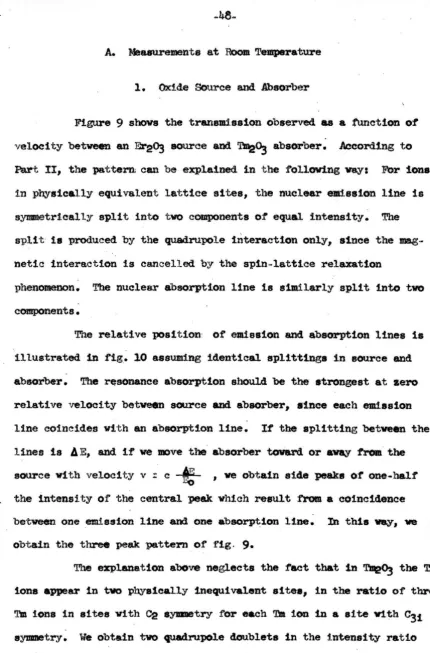
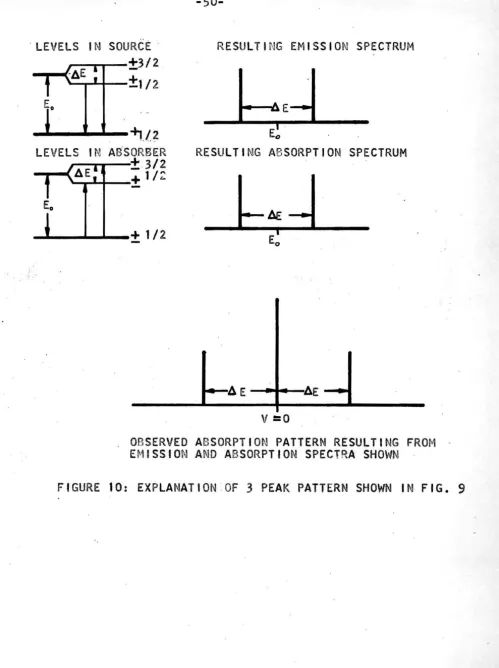
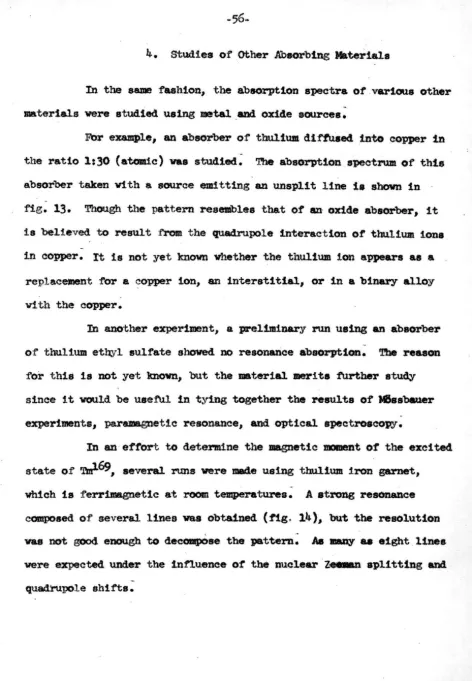
Room Telllperature