
Single- and Multi-Carrier CDMA
Multi-User Detection, Space-Time Spreading,
Synchronisation and Standards
by
L. Hanzo, L-L. Yang, E-L. Kuan and K. Yen
Title Page - for Wiley to do
Copyright Page - for Wiley to do
About the Authors
Lajos Hanzo received his degree in electronics in 1976 and his doc-torate in 1983. During his career in telecommunications he has held various research and academic posts in Hungary, Germany and the UK. Since 1986 he has been with the Department of Electronics and Com-puter Science, University of Southampton, UK, where he holds the chair in telecommunications. He has co-authored 10 books on mobile radio communications, published about 400 research papers, organised and chaired conference sessions, presented overview lectures and has been awarded a number of distinctions. Currently he heads an academic re-search team, working on a range of rere-search projects in the field of wireless multimedia com-munications sponsored by industry, the Engineering and Physical Sciences Research Council (EPSRC) UK, the European IST Programme and the Mobile Virtual Centre of Excellence (VCE), UK. He is an enthusiastic supporter of industrial and academic liaison and he of-fers a range of industrial courses. He is also an IEEE Distinguished Lecturer. For further information on research in progress and associated publications please refer to http://www-mobile.ecs.soton.ac.uk
Lie-Liang Yang
Other Wiley and IEEE Press
Books on Related Topics
1
R. Steele, L. Hanzo (Ed): Mobile Radio Communications: Second and Third Gener-ation Cellular and WATM Systems, John Wiley-IEEE Press, 2nd edition, 1999, ISBN 07 273-1406-8, p 1064
L. Hanzo, W. Webb, and T. Keller, Single- and Multi-Carrier Quadrature Amplitude Modulation: Principles and Applications for Personal Communications, WLANs and Broadcasting. IEEE Press, 2000.
L. Hanzo, F.C.A. Somerville, J.P. Woodard: Voice Compression and Communications: Principles and Applications for Fixed and Wireless Channels; IEEE Press-John Wiley, 2001, p 642
L. Hanzo, P. Cherriman, J. Streit: Wireless Video Communications: Second to Third Generation and Beyond, IEEE Press, 2001, p 1093
L. Hanzo, T.H. Liew, B.L. Yeap: Turbo Coding, Turbo Equalisation and Space-Time Coding, John Wiley - IEEE Press, 2002, p 751
J.S. Blogh, L. Hanzo: Third-Generation Systems and Intelligent Wireless Networking: Smart Antennas and Adaptive Modulation, John Wiley - IEEE Press, 2002, p408 L. Hanzo, C.H. Wong, M.S. Yee: Adaptive wireless transceivers: Coded, TurboEqualised and SpaceTime Coded TDMA, CDMA and OFDM systems, John Wiley -IEEE Press, 2002, p 737
L. Hanzo, M. M¨unster, T. Keller, B-J. Choi: OFDM and MC-CDMA for for Broadband Multi-user Communications, WLANs and Broadcasting, John Wiley - IEEE Press, 2003
1For detailed contents please refer to http://www-mobile.ecs.soton.ac.uk)
Contents
About the Authors v
Other Wiley and IEEE Press Books on Related Topics viii
Acknowledgments 1
1 Prologue - Intelligent Broadband Wireless Transceivers 3
1.1 Motivation of the Book . . . 3
1.2 Organisation and Novel Contributions of the Book . . . 4
1.3 Introduction to Flexible Transceivers . . . 13
1.4 FH/MC DS-CDMA . . . 14
1.5 Characteristics of the FH/MC DS-CDMA Systems . . . 16
1.6 Adaptive Rate Transmission . . . 20
1.6.1 Why Adaptive Rate Transmission? . . . 20
1.6.2 What Is Adaptive Rate Transmission? . . . 21
1.6.3 Adaptive Rate Transmission in FH/MC DS-CDMA System . . . 24
1.7 Software Defined Radio Assisted FH/MC DS-CDMA . . . 24
1.8 Chapter Summary and Conclusions . . . 28
I
Multi-User Detection for Adaptive Single-Carrier CDMA
29
2 CDMA Overview 35 2.1 Introduction to Code Division Multiple Access . . . 352.2 DS-CDMA transmission model . . . 39
2.3 DS-CDMA transmitter . . . 39
2.4 DS-CDMA receiver . . . 39
2.4.1 Recovery of the information signal . . . 40
2.4.2 Recovery of the information signal in multiple access interference . . 42
2.5 Frequency-domain representation . . . 44
2.6 Spreading sequences . . . 46
2.6.1 Correlation of sequences . . . 46
xii CONTENTS
2.6.2 m-sequences . . . . 48
2.6.3 Gold sequences . . . 48
2.6.4 Kasami sequences . . . 51
2.7 DS-CDMA system performance . . . 52
2.7.1 Theoretical BER performance of asynchronous BPSK/DS-CDMA over Gaussian channels . . . 54
2.7.2 Theoretical BER performance of bit-synchronous BPSK/DS-CDMA systems over Gaussian channels . . . 58
2.8 Simulation results and discussion . . . 61
2.8.1 Estimation of . . . 63
2.8.2 Simulated DS-CDMA BER performance over Gaussian channels for synchronous users . . . 64
2.8.3 Simulated DS-CDMA BER performance versus the number of users over Gaussian channels . . . 66
2.8.4 Simulated DS-CDMA BER performance versus spreading code length over Gaussian channels . . . 66
2.8.5 Simulated DS-CDMA BER performance for spreading code sets hav-ing different cross-correlation values over Gaussian channels . . . 67
2.9 Discussion . . . 68
2.10 Multiuser detection . . . 70
2.10.1 Survey of multiuser receivers . . . 72
2.11 Chapter Summary and Conclusions . . . 79
List of Symbols in Part I 34 3 Joint Detection of CDMA Signals 81 3.1 Basic equalizer theory . . . 81
3.1.1 Zero-forcing equalizer . . . 83
3.1.2 Minimum mean square error equalizer . . . 85
3.1.3 Decision feedback equalizers . . . 87
3.1.4 Equalizer modifications for joint detection . . . 88
3.2 System model . . . 89
3.3 Joint detection techniques . . . 98
3.3.1 Whitening filter . . . 98
3.3.2 Matched filter . . . 99
3.3.3 Whitening matched filter . . . 100
3.3.4 Zero Forcing Block Linear Equalizer . . . 102
3.3.5 Minimum Mean Square Error Block Linear Equalizer . . . 104
3.3.6 Zero Forcing Block Decision Feedback Equalizer . . . 108
3.3.7 Minimum Mean Square Error Block Decision Feedback Equalizer . . 111
3.4 Complexity calculations . . . 113
3.4.1 Whitening matched filter . . . 114
3.4.2 Zero Forcing Block Linear Equalizer . . . 115
3.4.3 Minimum Mean Square Error Block Linear Equalizer . . . 118
3.4.4 Zero Forcing Block Decision Feedback Equalizer . . . 119
CONTENTS xiii
3.5 Advantages and disadvantages of joint detection receivers . . . 123
3.6 Experimental work on joint detection receivers . . . 123
3.6.1 Experimental conditions . . . 123
3.6.2 Comparison of joint detection receivers in different channels . . . 125
3.6.3 Effect of multipath diversity . . . 128
3.6.4 Effect of increasing the number of users, . . . 129
3.6.5 Joint detection and channel coding . . . 130
3.6.6 Effect of channel estimation errors . . . 131
3.7 Chapter Summary and Conclusions . . . 135
4 Adaptive-Rate Joint Detection Aided CDMA 137 4.1 Introduction . . . 137
4.2 Adaptive Quadrature Amplitude Modulation . . . 140
4.3 Joint detection assisted AQAM based CDMA . . . 144
4.3.1 System model . . . 146
4.3.2 Output SINR for the joint detection receiver . . . 147
4.3.3 Output SINR of the MMSE-BDFE . . . 151
4.3.4 Numerical analysis of the JD-CDMA system performance . . . 155
4.3.5 Simulation parameters . . . 156
4.3.6 Performance of a two-user, twin-mode AQAM/JD-CDMA system . . 157
4.3.7 Performance comparisons of a twin-mode AQAM/JD-CDMA system for various number of users . . . 161
4.3.8 Performance of a two-user, triple-mode AQAM/JD-CDMA system . 162 4.3.9 Performance comparisons of a triple-mode AQAM/JD-CDMA sys-tem for various number of users . . . 164
4.3.10 Performance of a five-mode AQAM/JD-CDMA system . . . 166
4.3.11 Effect of imperfect SINR estimation on AQAM performance . . . 170
4.3.12 Discussion . . . 176
4.4 Variable Spreading Factor based adaptive-rate CDMA . . . 178
4.4.1 System model . . . 180
4.4.2 Simulation results . . . 182
4.5 Comparison of AQAM/JD-CDMA and VSF/JD-CDMA . . . 184
4.6 Combining AQAM and VSF with JD-CDMA . . . 187
4.7 Chapter Summary and Conclusions . . . 189
5 Adaptive-Rate Interference Cancellation Assisted CDMA 191 5.1 Successive interference cancellation . . . 191
5.1.1 Complexity calculations . . . 193
5.1.2 BER performance of SIC-CDMA . . . 194
5.1.3 Adaptive-rate SIC-CDMA . . . 198
5.1.4 AQAM/SIC-CDMA . . . 200
5.1.5 VSF/SIC-CDMA . . . 206
5.2 Parallel interference cancellation . . . 208
5.2.1 Complexity calculations . . . 209
5.2.2 BER performance of PIC-CDMA . . . 211
xiv CONTENTS
5.2.4 AQAM/PIC-CDMA . . . 214
5.3 Comparison of JD, SIC and PIC CDMA receivers for AQAM transmission . . 216
5.4 Comparison of JD, SIC and PIC CDMA receivers for VSF transmission . . . 221
5.5 Chapter Summary and Conclusions . . . 223
6 Blind Per-Survivor Processing Aided CDMA 225 6.1 Blind PSP for bit-synchronous CDMA data detection and multipath CIR es-timation . . . 227
6.2 Tree-search algorithm for data sequence detection . . . 228
6.3 Metric calculation . . . 229
6.4 Adaptive Recursive Least Squares multipath CIR estimator . . . 231
6.5 Blind PSP receiver performance . . . 236
6.6 PSP with turbo coding . . . 240
6.7 Chapter Summary and Conclusions . . . 243
7 Space-Time Spreading Aided Single-Carrier Wideband CDMA 247 7.1 Motivation . . . 247
7.2 System Model . . . 249
7.2.1 Transmitted Signal . . . 249
7.2.2 Channel Model . . . 252
7.2.3 Receiver Model . . . 254
7.3 Detection of Space-Time Spreading W-CDMA Signals . . . 254
7.4 BER Performance . . . 257
7.4.1 BER Analysis . . . 257
7.4.2 Numerical Results and Discussions . . . 259
7.5 Adaptive Space-time Spreading . . . 262
7.6 Chapter Summary and Conclusions . . . 268
II
Genetic Algorithm Assisted Multiuser Detection
271
8 Overview of Genetic Algorithms Invoked for Multiuser Detection 277 8.1 An Introduction to Genetic Algorithms . . . 2788.2 Genetic Algorithms at Work . . . 282
8.3 Why do GA work? . . . 285
8.3.1 Optimisation from a Human’s Perspective . . . 286
8.3.2 Optimisation from a GA’s Perspective . . . 287
8.3.2.1 Effects of Selection on the Schemata . . . 288
8.3.2.2 Effects of Crossover on the Schemata . . . 289
8.3.2.3 Effects of Mutation on the Schemata . . . 290
8.4 Elements of Genetic Algorithms . . . 291
8.4.1 Representation . . . 291
8.4.1.1 Binary Encoding . . . 291
8.4.1.2 Gray Encoding . . . 291
8.4.2 Selection . . . 292
8.4.2.1 Fitness-proportionate Selection . . . 293
CONTENTS xv
8.4.2.3 Linear Ranking Selection . . . 294
8.4.2.4 Tournament Selection . . . 294
8.4.2.5 Incest Prevention . . . 294
8.4.3 Crossover . . . 295
8.4.3.1 Single-point Crossover . . . 295
8.4.3.2 Double-point Crossover . . . 295
8.4.3.3 Uniform Crossover . . . 296
8.4.4 Mutation . . . 296
8.4.4.1 Mutation of binary decision variables . . . 297
8.4.4.2 Mutation of real-valued decision variables . . . 297
8.4.5 Elitism . . . 297
8.4.6 Termination Criterion . . . 298
8.5 Survey of Genetic Algorithm-Assisted CDMA Multiuser Detection . . . 298
8.6 Chapter Summary and Conclusions . . . 301
List of Symbols in Part II 302 9 GA-Assisted Multiuser Detection for Synchronous CDMA 303 9.1 Introduction . . . 303
9.2 Synchronous CDMA System Model . . . 304
9.3 Discrete-Time Synchronous CDMA Model . . . 307
9.4 Optimum Multiuser Detector for Synchronous CDMA Systems . . . 308
9.5 Experimental Results . . . 310
9.5.1 Effects of the Population Size . . . 311
9.5.2 Effects of the Probability of Mutation . . . 313
9.5.3 Effects of the Choice of Crossover Operation . . . 314
9.5.4 Effects of Incest Prevention and Elitism . . . 316
9.5.5 Effects of the Choice of Selection Schemes . . . 317
9.5.6 Effects of a Biased Generated Population . . . 320
9.6 Simulation Results . . . 325
9.6.1 AWGN Channel . . . 325
9.6.2 Single-path Rayleigh Fading Channel . . . 327
9.7 Chapter Summary and Conclusions . . . 331
10 Joint GA-Assisted Channel Estimation and Symbol Detection 335 10.1 Introduction . . . 335
10.2 System Model . . . 336
10.3 Joint GA-assisted Multiuser Channel Estimation and Symbol Detection . . . 339
10.3.1 Initialisation . . . 340
10.3.2 Effects of the Mating Pool Size . . . 341
10.3.3 Effects of the Mutation Size . . . 344
10.4 Simulation Results . . . 348
xvi CONTENTS
11 GA-Assisted, Antenna Diversity Aided Multiuser Detection 357
11.1 Introduction . . . 357
11.2 System Model . . . 358
11.3 GA-Assisted Diversity-Aided Multiuser Detection . . . 360
11.3.1 Direct Approach . . . 362
11.3.2 Pareto Optimality Approach . . . 362
11.4 Simulation Results . . . 363
11.5 Chapter Summary and Conclusions . . . 367
12 GA-Assisted Multiuser Detection for Asynchronous CDMA 371 12.1 Introduction . . . 371
12.2 Asynchronous CDMA System Model . . . 373
12.3 GA-Assisted Multiuser Detection in Asynchronous CDMA Systems . . . 378
12.3.1 Matched Filter-Assisted EEB Estimation . . . 380
12.3.2 GA-Assisted EEB Estimation . . . 381
12.3.3 Complexity Issues . . . 382
12.4 Simulation Results . . . 382
12.4.1 Effects of the Mating Pool Size . . . 383
12.5 Chapter Summary and Conclusions . . . 388
III
M-ary Single-Carrier CDMA
393
13 Non-Coherent -ary Orthogonal Modulation in CDMA 395 13.1 Background . . . 39513.2 Introduction to -ary Orthogonal Modulation . . . 396
13.3 Fundamentals of -ary CDMA . . . 400
13.4 System Model . . . 400
13.4.1 The Transmitter Model . . . 400
13.4.2 Channel Model . . . 402
13.4.3 The Receiver Model . . . 402
13.5 Performance Analysis . . . 407
13.5.1 Noise analysis . . . 408
13.5.2 Self-interference analysis . . . 408
13.5.3 MAI analysis . . . 409
13.5.4 Decision Statistic and Error Probability . . . 409
13.6 Bandwidth Efficiency in -ary modulated CDMA . . . 413
13.7 Numerical Simulation Results . . . 413
13.7.1 Summary of Performance Results . . . 419
13.8 Chapter Summary and Conclusions . . . 420
14 RS Coded Non-coherent -ary Orthogonal Modulation in CDMA 421 14.1 Motivation . . . 421
14.2 System Description and Channel Model . . . 423
14.2.1 The Transmitted Signals . . . 423
14.2.2 The Channel Model . . . 424
CONTENTS xvii
14.3.1 Equal Gain Combining . . . 427
14.3.2 Selection Combining . . . 429
14.4 Average Error Probability without FEC . . . 430
14.4.1 Equal Gain Combining . . . 431
14.4.2 Selection Combining . . . 431
14.5 Performance using RS forward error-correction codes . . . 431
14.5.1 Error-Correction-Only Decoding . . . 432
14.5.2 Errors-and-Erasures Decoding . . . 432
14.6 Numerical Results . . . 437
14.7 Chapter Summary and Conclusions . . . 441
15 Residue Number System Arithmetic Invoked for M-ary CDMA 447 15.1 Introduction . . . 447
15.2 Residue Number System Transform and Its Inverse . . . 448
15.3 Redundant Residue Number System . . . 453
15.4 Error-Detection and Error-Correction in RRNS . . . 455
15.5 Chapter Summary and Conclusions . . . 464
16 Redundant Residue Number System Coded M-ary DS-CDMA 467 16.1 State of the Art . . . 467
16.2 Performance in AWGN channels . . . 469
16.2.1 Communication Model . . . 469
16.2.2 Performance of Coherent Receiver . . . 472
16.2.2.1 Receiver Model . . . 472
16.2.2.2 Coherent RNS-CDMA System’s Probability of Error . . . 472
16.2.2.3 Numerical Results and Analysis . . . 477
16.2.3 Performance of Noncoherent Receiver . . . 479
16.2.3.1 Receiver Model . . . 479
16.2.3.2 The Noncoherent Receiver’s Probability of Error . . . 479
16.2.3.3 Numerical Results . . . 483
16.3 Performance in Multipath Fading channels . . . 485
16.3.1 Multipath Slow-Fading Channel Model . . . 486
16.3.2 Performance of the Coherent RNS-Based CDMA Receiver Using Maximum Ratio Combining . . . 487
16.3.2.1 Receiver Model . . . 487
16.3.2.2 Decision Statistics . . . 490
16.3.2.3 Upper-Bound of the Average Probability of Error . . . 492
16.3.2.4 Numerical Results . . . 493
16.3.3 Performance of Noncoherent RNS-Based DS-CDMA Receiver Us-ing Equal Gain CombinUs-ing and Selection CombinUs-ing . . . 495
16.3.3.1 Receiver Model . . . 497
16.3.3.2 Decision Statistics . . . 500
16.3.3.3 Average Probability of Error . . . 504
16.3.3.4 Numerical Results . . . 506
16.4 Performance of RRNS Coded Systems . . . 508
xviii CONTENTS
16.4.2 Ratio Statistic Test . . . 509
16.4.2.1 Probability Density Function of the Ratio Using EGC . . . 511
16.4.2.2 Probability Density Function of the Ratio Using SC . . . . 514
16.4.3 Decoding Error Probability . . . 519
16.4.3.1 ‘Error-Correction-Only’ Decoding . . . 520
16.4.3.2 ‘Error-Dropping-Only’ Decoding . . . 521
16.4.3.3 ‘Error-Dropping-and-Correction’ Decoding . . . 523
16.4.4 Numerical Results . . . 525
16.5 Performance of Concatenated RS-RRNS Coded Systems . . . 528
16.5.1 Concatenated RS-RRNS codes . . . 528
16.5.2 Decoding Error Probability of RS-RRNS codes . . . 531
16.5.3 Numerical Results . . . 533
16.6 Chapter Summary and Conclusions . . . 536
IV
Multi-Carrier CDMA
539
17 Overview of Multicarrier CDMA 541 17.1 Introduction . . . 54117.2 Overview of Multicarrier CDMA Systems . . . 542
17.2.1 Frequency-Domain Spreading Assisted Multicarrier CDMA Scheme . 543 17.2.2 Orthogonal Multicarrier DS-CDMA scheme – Type I . . . 546
17.2.3 Orthogonal Multicarrier DS-CDMA Scheme – Type II . . . 550
17.2.4 Multitone DS-CDMA Scheme . . . 553
17.2.5 Adaptive Frequency-Hopping Assisted multicarrier DS-CDMA scheme556 17.2.6 Adaptive Subchannel Allocation Assisted Multicarrier DS-CDMA . . 558
17.2.7 Slow Frequency-Hopping Multicarrier DS-CDMA . . . 561
17.2.8 Summary . . . 564
17.3 Channel Model . . . 564
17.4 Performance of MC-CDMA System . . . 565
17.4.1 System Description . . . 565
17.4.1.1 The Transmitter . . . 565
17.4.1.2 Receiver . . . 568
17.4.2 Performance Analysis . . . 571
17.4.2.1 Noise and Interference Analysis . . . 571
17.4.2.2 Decision Statistics and Error Probability . . . 573
17.5 Performance of Overlapping Multicarrier DS-CDMA Systems . . . 577
17.5.1 Preliminaries . . . 577
17.5.2 System Description . . . 579
17.5.2.1 Transmitted Signal . . . 579
17.5.2.2 Receiver Model . . . 581
17.5.3 Interference Analysis . . . 584
17.5.4 Performance Analysis . . . 588
17.6 Performance of Multicarrier DS-CDMA-I Systems . . . 593
17.6.1 Decision Variable Statistics . . . 593
CONTENTS xix
17.7 Performance of AMC DS-CDMA Systems . . . 597
17.8 Performance of SFH/MC DS-CDMA Systems . . . 604
17.8.1 System Description . . . 605
17.8.1.1 The Transmitted Signal . . . 605
17.8.1.2 Channel Description . . . 605
17.8.1.3 Receiver Model . . . 606
17.8.2 Performance of SFH/MC DS-CDMA Using Hard-Detection . . . 608
17.8.2.1 Probability of Error . . . 608
17.8.2.2 Numerical Results . . . 610
17.8.3 Blind Joint Detection of the SFH/MC DS-CDMA Signals . . . 613
17.8.3.1 Maximum Likelihood Detection . . . 614
17.8.3.2 Approach I . . . 616
17.8.3.3 Approach II . . . 616
17.8.4 Performance of SFH/MC DS-CDMA Using Soft-Detection . . . 617
17.8.4.1 Approach I . . . 619
17.8.4.2 Approach II . . . 621
17.8.4.3 Numerical Results . . . 622
17.9 Chapter Summary and Conclusions . . . 625
18 Space-Time Spreading Assisted Broadband Multicarrier DS-CDMA 627 18.1 Motivation and Outline . . . 627
18.2 Comparison of CDMA, MC-CDMA and MC DS-CDMA . . . 629
18.2.1 Motivation . . . 629
18.2.2 Introduction . . . 629
18.2.3 Overview of CDMA Schemes Using No Frequency-Hopping . . . 630
18.2.3.1 SC DS-CDMA . . . 630
18.2.3.2 MC-CDMA . . . 631
18.2.3.3 MC DS-CDMA . . . 632
18.2.3.4 Flexibility Comparison . . . 633
18.2.4 Broadband Wireless Communications Based on CDMA . . . 634
18.2.4.1 Deficiencies of Broadband SC DS-CDMA and Broadband MC-CDMA . . . 634
18.2.4.2 Using Broadband MC DS-CDMA for Supporting Ubiqui-tous Wireless Communications . . . 637
18.2.5 Transmit Diversity Assisted MC DS-CDMA Based on STS . . . 639
18.2.6 Capacity Improvement Based on TF-domain Spreading . . . 642
18.2.7 Conclusions . . . 645
18.3 Space-Time Spreading Assisted Multicarrier DS-CDMA . . . 647
18.3.1 Introduction . . . 647
18.3.2 System Description . . . 649
18.3.2.1 Transmitter Model . . . 649
18.3.2.2 Channel Model and System Parameter Design . . . 654
18.3.2.3 Receiver Model . . . 656
18.3.3 Bit Error Rate Analysis . . . 657
18.3.4 Capacity Extension Using Time-Frequency-Domain Spreading . . . . 660
xx CONTENTS
18.3.4.2 Signal Detection . . . 663
18.3.4.3 BER Performance . . . 666
18.3.5 Conclusions . . . 668
18.4 Performance of Generalized MC-CDMA over Nakagami- Channels . . . . 669
18.4.1 Motivation . . . 669
18.4.2 Introduction . . . 670
18.4.3 Generalized Multicarrier DS-CDMA Systems . . . 672
18.4.3.1 Transmitted Signal . . . 672
18.4.3.2 Channel Model . . . 674
18.4.3.3 Receiver Model . . . 676
18.4.4 Decision Variable Statistics . . . 677
18.4.5 Performance Analysis . . . 682
18.4.6 Numerical Results . . . 685
18.4.7 Conclusions . . . 690
18.5 Chapter Summary and Conclusions . . . 692
19 Initial Synchronization of DS-CDMA and MC-CDMA Systems 695 19.1 Introduction . . . 695
19.2 System Model . . . 697
19.2.1 The Transmitted Signal . . . 697
19.2.2 The Channel model and The Received Signal . . . 697
19.3 Acquisition Procedure Description . . . 699
19.3.1 Serial Search Acquisition Scheme . . . 702
19.3.2 Parallel Acquisition Scheme . . . 703
19.4 Asymptotic Mean Acquisition Time . . . 704
19.4.1 Mean Acquisition Time of Serial Acquisition . . . 704
19.4.2 Parallel Acquisition Scheme . . . 707
19.5 Detection Performance over AWGN Channels . . . 709
19.5.1 Statistics of the Decision Variables . . . 710
19.5.2 Probabilities of False-Alarm and Overall Missing for the Serial Search Acquisition Scheme . . . 714
19.5.3 Overall Detection, Missing and False-Alarm Probabilities of The Par-allel Acquisition Scheme . . . 717
19.6 Detection Performance over Multipath Fading Channels . . . 722
19.6.1 Statistics of Decision Variables . . . 722
19.6.2 Probabilities of Overall Missing and False-Alarm for the Serial Ac-quisition Scheme . . . 727
19.6.3 Probabilities of Overall Successful Detection, Overall Missing and Overall False-Alarm for the Parallel Search Based Acquisition Scheme 731 19.7 Serial Search Using Multicell Joint Detection . . . 735
19.7.1 Joint Two-Cell Detection Model . . . 736
19.7.2 Detection Performance over AWGN Channels . . . 739
19.7.3 Detection Performance over Dispersive Multipath Rayleigh Fading Channels . . . 747
CONTENTS xxi
19.7.3.2 Probabilities of Overall Missing and False-Alarm for Joint
Two-Cell Detection . . . 749
19.8 Code-Acquisition in Multi-Carrier DS-CDMA System . . . 757
19.8.1 System Model . . . 758
19.8.1.1 The transmitter . . . 758
19.8.1.2 Code-Acquisition Description . . . 760
19.8.2 Decision Variable Statistics . . . 762
19.8.2.1 Equal Gain Combining . . . 764
19.8.2.2 Selection Combining . . . 764
19.8.3 Probability of Detection, Missing and False-Alarm . . . 765
19.8.3.1 Equal Gain Combining . . . 765
19.8.3.2 Selection Combining . . . 766
V
Standards and Networking
773
20 Third-Generation CDMA Systems 775 20.1 Introduction . . . 77520.2 Third-Generation Systems . . . 776
20.2.1 Introduction . . . 776
20.2.2 UMTS Terrestrial Radio Access (UTRA) . . . 777
20.2.2.1 Characteristics of UTRA . . . 778
20.2.2.2 Transport Channels . . . 781
20.2.2.3 Physical Channels . . . 782
20.2.2.3.1 Dedicated Physical Channels . . . 783
20.2.2.3.2 Common Physical Channels . . . 784
20.2.2.3.2.1 Common Physical Channels of the FDD Mode . . . 784
20.2.2.3.2.2 Common Physical Channels of the TDD Mode . . . 788
20.2.2.4 Service Multiplexing and Channel Coding in UTRA . . . . 790
20.2.2.4.1 CRC Attachment . . . 791
20.2.2.4.2 Transport Block Concatenation . . . 791
20.2.2.4.3 Channel-Coding . . . 794
20.2.2.4.4 Radio Frame Padding . . . 794
20.2.2.4.5 First Interleaving . . . 794
20.2.2.4.6 Radio Frame Segmentation . . . 794
20.2.2.4.7 Rate Matching . . . 794
20.2.2.4.8 Discontinuous Transmission Indication . . . 795
20.2.2.4.9 Transport Channel Multiplexing . . . 795
20.2.2.4.10 Physical Channel Segmentation . . . 795
20.2.2.4.11 Second Interleaving . . . 795
20.2.2.4.12 Physical Channel Mapping . . . 795
xxii CONTENTS
20.2.2.4.14 Mapping of a 4.1 Kbps Data Service to the DL DPDCH in FDD Mode . . . 797 20.2.2.4.15 Mapping Several Multirate Services to the UL
Dedicated Physical Channels in TDD Mode . . . 798 20.2.2.5 Variable-Rate and Multicode Transmission in UTRA . . . 798 20.2.2.6 Spreading and Modulation . . . 801 20.2.2.6.1 Orthogonal Variable Spreading Factor Codes . . . 802 20.2.2.6.2 Uplink Scrambling Codes . . . 805 20.2.2.6.3 Downlink Scrambling Codes . . . 805 20.2.2.6.4 Uplink Spreading and Modulation . . . 805 20.2.2.6.5 Downlink Spreading and Modulation . . . 807 20.2.2.7 Random Access . . . 808
20.2.2.7.1 Mobile-Initiated Physical Random Access
Procedures . . . 808 20.2.2.7.2 Common Packet Channel Access Procedures . . . 809 20.2.2.8 Power Control . . . 809 20.2.2.8.1 Closed-Loop Power Control in UTRA . . . 809 20.2.2.8.2 Open-Loop Power Control in TDD Mode . . . . 810 20.2.2.9 Cell Identification . . . 810 20.2.2.9.1 Cell Identification in the FDD Mode . . . 810 20.2.2.9.2 Cell Identification in the TDD Mode . . . 813 20.2.2.10 Handover . . . 814 20.2.2.10.1 Intra-Frequency Handover or Soft Handover . . . 814 20.2.2.10.2 Inter-Frequency Handover or Hard Handover . . 815 20.2.2.11 Intercell Time Synchronisation in the UTRA TDD Mode . 816 20.2.3 The cdma2000 Terrestrial Radio Access . . . 816 20.2.3.1 Characteristics of cdma2000 . . . 818 20.2.3.2 Physical Channels in cdma2000 . . . 819 20.2.3.3 Service Multiplexing and Channel Coding . . . 821 20.2.3.4 Spreading and Modulation . . . 822 20.2.3.4.1 Downlink Spreading and Modulation . . . 822 20.2.3.4.2 Uplink Spreading and Modulation . . . 823 20.2.3.5 Random Access . . . 823 20.2.3.6 Handover . . . 827 20.2.4 Performance-Enhancement Features . . . 828 20.2.4.1 Downlink Transmit Diversity Techniques . . . 828
CONTENTS xxiii
21 Adaptive Rate DS-CDMA Networks Using VSFs 839
21.1 Motivation . . . 839 21.2 Introduction . . . 840 21.3 System Overview . . . 841 21.4 Adaptive Transmission Scheme . . . 845 21.5 Throughput and BER Analysis . . . 847 21.6 Numerical Results and Discussions . . . 852 21.7 Chapter Summary and Conclusions . . . 856
22 Book Summary and Conclusions 859
22.1 Part I . . . 859 22.2 Part II . . . 869 22.3 Part III . . . 871 22.4 Part IV . . . 873 22.5 Part V . . . 874
A Appendix of Chapter 13 875
A.1 Derivation of Equations 13.26 and 13.27 . . . 875 A.1.1 In-phase channel . . . 875 A.1.2 Quadrature channel . . . 877 A.2 Derivation of Equation 13.42 . . . 877
B Appendix of Chapter 14 881
C Appendix of Chapter 19 883
D Appendix of Chapter 16 885
D.1 Probability Density Function of the -th Maximum . . . 885 D.2 Decision PDFs under the hypotheses of and . . . 886 D.2.1 PDFs under the hypothesis . . . 887 D.2.2 PDFs under the hypothesis
. . . 888
Glossary 891
Acknowledgments
We are indebted to our many colleagues who have enhanced our understanding of the subject, in particular to Prof. Emeritus Raymond Steele. These colleagues and valued friends, too nu-merous to be mentioned, have influenced our views concerning various aspects of wireless multimedia communications. We thank them for the enlightenment gained from our collab-orations on various projects, papers and books. We are grateful to Steve Braithwaite, Jan Brecht, Jon Blogh, Marco Breiling, Marco del Buono, Sheng Chen, Peter Cherriman, Stan-ley Chia, Byoung Jo Choi, Joseph Cheung, Sheyam Lal Dhomeja, Dirk Didascalou, Lim Dongmin, Stephan Ernst, Peter Fortune, Eddie Green, David Greenwood, Hee Thong How, Thomas Keller, Ee Lin Kuan, W. H. Lam, C. C. Lee, Xiao Lin, Chee Siong Lee, Tong-Hooi Liew, Matthias M¨unster, Vincent Roger-Marchart, Jason Ng, Michael Ng, M. A. Nofal, Jeff Reeve, Redwan Salami, Clare Somerville, Rob Stedman, David Stewart, J¨urgen Streit, Jeff Torrance, Spyros Vlahoyiannatos, William Webb, Stephan Weiss, John Williams, Jason Woodard, Choong Hin Wong, Henry Wong, James Wong, Lie-Liang Yang, Bee-Leong Yeap, Mong-Suan Yee, Kai Yen, Andy Yuen, and many others with whom we enjoyed an associa-tion.
We also acknowledge our valuable associations with the Virtual Centre of Excellence (VCE) in Mobile Communications, in particular with its chief executive, Dr Walter Tuttlebee, and other leading members of the VCE, namely Dr Keith Baughan, Prof. Hamid Aghvami, Prof. Ed Candy, Prof. John Dunlop, Prof. Barry Evans, Prof. Peter Grant, Dr Mike Barnard, Prof. Joseph McGeehan, Prof. Steve McLaughlin and many other valued colleagues. Our sincere thanks are also due to the EPSRC, UK for supporting our research. We would also like to thank Dr Joao Da Silva, Dr Jorge Pereira, Dr Bartholome Arroyo, Dr Bernard Barani, Dr Demosthenes Ikonomou, Dr Fabrizio Sestini and other valued colleagues from the Com-mission of the European Communities, Brussels, Belgium.
We feel particularly indebted to Denise Harvey for her skilful assistance in correcting the final manuscript in LaTeX. Without the kind support of Mark Hammond, Sarah Hinton, Z¨oe Pinnock and their colleagues at the Wiley editorial office in Chichester, UK this monograph would never have reached the readers. Finally, our sincere gratitude is due to the numerous authors listed in the Author Index — as well as to those whose work was not cited owing to space limitations — for their contributions to the state of the art, without whom this book would not have materialised.
Lajos Hanzo, Lie-Liang Yang, Ee-Lin Kuan and Kai Yen Department of Electronics and Computer Science University of Southampton
Chapter
1
Prologue - Introduction to
Intelligent Broadband Wireless
Transceivers
1.1
Motivation of the Book
Against the back-cloth of the explosive expansion of the Internet and the continued dramatic increase in demand for high-speed multimedia wireless services, there is an urging demand for flexible, bandwidth-efficient transceivers. Multi-standards operation is also an important requirement for the future generations of wireless systems. In this introductory chapter we present a versatile broadband multiple access scheme, combining frequency-hopping (FH) with multicarrier DS-CDMA (FH/MC DS-CDMA). The proposed FH/MC DS-CDMA sys-tem framework is capable of meeting the requirements of future mobile wireless syssys-tems, by supporting the existing 2nd- and 3rd- generation systems, while also introducing more ad-vanced techniques facilitated by the employment of Software Defined Radios (SDR) [1–3]. and with the aid of efficient adaptive base-band algorithms [4,5]. This generic system design framework will be used throughout the monograph as the unifying backbone of the var-ious intelligent algorithms and systems proposed. No doubt that the concrete solutions proposed constitute only a miniscule fraction of the set of potential solutions to wire-less communications problems. Our hope is however that the book will be motivational, inspiring further research and leading to more advanced wireless system solutions.
The design of attractive wireless transceivers hinges on a range of contradictory factors, which are summarised in Figure 1.1. The essence of this illustration is that of contrasting the conflicting design factors of wireless systems from different perspectives. For example, given a certain wireless channel, it is always feasible to design a transmission scheme capable of further increasing the achievable transmission integrity at the cost of invoking ’smarter’ and hence more sophisticated signal processing. Alternatively, the transmission integrity may be increased even without increasing the system’s complexity, provided that for example the
4 CHAPTER 1. PROLOGUE - INTELLIGENT BROADBAND WIRELESS TRANSCEIVERS
turbo channel coding/interleaving delay can be further extended. Naturally, this is only pos-sible in the context of delay-insensitive, ie. non-interactive data communications, but not in delay-sensitive interactive speech or video systems. It is also realistic to increase the system’s integrity by invoking a more robust but lower throughput modulation scheme, as it will be demonstrated throughout this monograph, again often with the added benefit of reducing the system’s complexity. Naturally, diverse system solutions accrue when optimising different features of the system.
By contrast, it is always possible to increase the achievable effective throughput of the system, if the system’s target integrity may be relaxed, which facilitates the employment of an increased throughput, but more error-sensitive transmission scheme. As another design al-ternative to emplying more robust modulation schemes when requiring a reduced target BER, the channel coding rate may be reduced, in order to increase the transmission integrity at the cost of sacrifycing the effective throughput of the system. as well as increasing the system’s complexity. When the fading channel’s characteristics and the associated bit error statistics change, different transceiver modes may have to be activated. Furthermore, the channel’s impulse response and the associated dispersion varies, as the receiver roams in different en-vironments. The subject of this monograph is that of providing powerful solutions to these problems, with particular emphasis on various CDMA transcivers, which have found favour in all the recent third-generation wireless systems.
Our intention with the book is multi-fold:
1) First, we would like to pay tribute to all researchers, colleagues and valued friends who contributed to the field. Hence this book is dedicated to them, since without their quest for better CDMA transceiver solutions this monograph could not have been conceived. They are too numerous to name here, hence they appear in the author index of the book.
2) Since at the time of writing no joint treatment of the subjects covered by this book exists, it is timely to compile the most recent advances in the field. Hence it is our hope that the conception of this monograph on the topic will present an adequate portrayal of the community’s recent research efforts and spur this innovation process by stimulating further research in the wireless communications research community.
1.2
Organisation and Novel Contributions of the Book
The book is constituted by four parts and the grade of challenge as well as the amount of knowledge assumed is gradually increasing towards the end of the book. Below, we present the outline and rationale of the monograph:
Part I provides a detailed discourse on multiuser detection, aiming for furnishing a de-tailed historical perspective on the topic. Our discussions are embedded in the generic system design framework to be outlined at a later stage in this introductory chapter.
1.2. ORGANISATION AND NOVEL CONTRIBUTIONS OF THE BOOK 5
Implementational complexity Channel
characteristics
Effective throughput bandwidth
System Bit errorrate
Coding gain scheme
Modulation Coding/
Coding rate
Coding/interleaving delay
Figure 1.1: Factors affecting the design of wireless transceivers c
John Wiley and IEEE Press, 2002, Hanzo, Liew, Yeap [5]
is investigated and its performance in synchronous Gaussian channels is analyzed. The effects of various spreading sequences on the bit error rate (BER) performance are also considered. Finally, a literature survey of multiuser receivers is discussed and the various receivers are loosely classified.
Chapter 3: Joint detection (JD) receivers, which constitute a class of multiuser re-ceivers are introduced. These multiuser rere-ceivers are derived from the well-known single-user equalizers, which are used to equalize signals that have been distorted by inter-symbol interference (ISI) due to multipath channels. The adoption of these single-user equalizers is supported by the fact that the ISI inflicted by a -path dispersive channel is similar to the multiuser interference due to users. As a preliminary in-troduction to joint detection, a brief overview of single-user equalization is presented. This is followed by the portrayal of the theoretical basis of four joint detection re-ceivers, namely the zero-forcing block linear equalizer (ZF-BLE), the minimum mean square error block linear equalizer (MMSE-BLE), zero-forcing block decision back equalizer (ZF-BDFE) and the minimum mean square error block decision feed-back equalizer (MMSE-BDFE). The implementational complexity of these receivers is estimated and a simple method of reducing the complexity is presented. Finally, the effects of multipath diversity, channel coding and channel estimation errors on the BER performances of the JD receivers are presented and discussed.
6 CHAPTER 1. PROLOGUE - INTELLIGENT BROADBAND WIRELESS TRANSCEIVERS
the CDMA codes used, while keeping the chip rate constant. The performance of the proposed AQAM JD-CDMA and VSF JD-CDMA schemes is evaluated and discussed in relation to fixed-rate schemes. A numerical method for obtaining the BER of the JD receiver is presented, which employs the SINR at the receiver output and the associated semi-analytical performance is compared to the simulation results presented. Finally, a performance comparison between the two different adaptive-rate methods is carried out and a combined AQAM-VSF scheme is investigated.
Chapter 5: Another class of multiuser receivers is considered, namely the family of interference cancellation (IC) receivers. These IC receivers are often divided into three categories, namely successive interference cancellation (SIC), parallel interfer-ence cancellation (PIC) and hybrid IC, which is a combination of the former two. Here, the SIC and PIC receivers are analyzed in terms of their BER performance and com-plexity. The performance of these receivers in adaptive-rate CDMA schemes is also investigated and again, the SINR at the output of each receiver is derived and used as the switching criterion in the adaptive schemes. Finally, performance comparisons between the IC and JD receivers are carried out.
Chapter 6: A joint data detector and channel impulse response (CIR) estimator is proposed in this chapter, namely the blind Per-Survivor Processing (PSP) receiver. This receiver performs joint data detection and CIR estimation at the receiver, without the aid of training sequences. The blind PSP receiver is proposed for the bit-synchronous, multipath, multiuser scenario, where a reduced complexity tree-search-based algorithm is employed for data detection and CIR estimation is performed by adaptive Recursive Least Squares (RLS) estimators. The performance of this receiver is investigated for static, slowly-fading and fast-fading multipath channels. The PSP-CDMA receiver is also combined with error correction techniques, namely turbo convolutional coding, in order to improve the performance of the system. The performance of the turbo-coded, PSP-CDMA receiver is analyzed for various fading scenarios and the performance for various turbo-coded schemes are compared.
Chapter 7: In this chapter we investigate the performance of single-carrier Wideband CDMA (W-CDMA) schemes. Furthermore, we employ space-time spreading (STS) based transmit diversity, when encountering multipath Nakagami- fading channels, multiuser interference and background noise. Our analysis and the results will demon-strate that the diversity gains achieved by STS and those owing to multipath diver-sity accruing as a benefit of the channel’s frequency-selectivity are independent. Fur-thermore, we will show that both the STS based transmit diversity and the multipath-induced receiver diversity achieved with the aid of the channel’s frequency-selectivity appear to have the same order of importance and hence offer similar potential perfor-mance benefits.
1.2. ORGANISATION AND NOVEL CONTRIBUTIONS OF THE BOOK 7
chapter that in this case the intelligent system framework proposed at a later stage in this Prologue is expected to configure itself for attaining a higher transmit diversity gain.
More specifically, based on the time-varying characteristics of the wireless communi-cation channels, in this chapter an adaptive STS based transmission scheme is proposed and investigated, which adapts the mode of operation of its STS scheme and its corre-sponding data rate according to the near-instantaneous frequency-selectivity informa-tion fed back from the mobile receiver to the base stainforma-tion’s transmitter. Our numerical results show that this adaptive STS scheme is capable of efficiently exploiting the di-versity potential provided by the channel’s frequency-selectivity, hence significantly improving the effective throughput of W-CDMA systems.
To elaborate a little further, since W-CDMA signals are subjected to frequency-selective fading, the number of resolvable paths at the receiver may vary over a wide range depending on the transmission environment encountered. It is shown that if the channel’s grade of frequency-selectivity is sufficiently high, there is no need to em-ploy transmit diversity. Therefore in this chapter an adaptive STS based transmission scheme is proposed for improving the throughput of W-CDMA systems. Specifically, when the number of resolvable paths is low and hence the resultant BER is higher than the required BER, then a low throughput STS-assisted transmitter mode is acti-vated, which exhibits a high transmit diversity gain. By contrast, when the number of resolvable paths is high and hence the resultant BER is lower than the required BER, then a higher throughput STS-assisted transmitter mode is activated, which has a lower transmit diversity gain. Our numerical results will demonstrate that this adap-tive STS-based transmission scheme is capable of significantly improving the effecadap-tive throughput of W-CDMA systems. Specifically, the studied W-CDMA system’s bitrate can be increased by a factor of three at the modest cost of requiring an extra 0.4dB or 1.2dB transmitted power in the context of the investigated urban or suburban areas, respectively.
Chapter 8: Part II of the book commences with Chapter 8, which investigates the potential of genetic algorithm assisted MUD. In this chapter we continue our discourse by assuming that the reader is familiar with the basic CDMA principles. We commence our discourse by giving an overview of GAs, since the concepts of GAs are not widely known in the mobile communications community. We will present the basic functions of a GA in optimising an objective function, with the aid of a flowchart as well as an example. An insight into why a GA constitutes an efficient function optimiser is also given in the context of the schemata and the schema theorem [6]. Some of the more advanced GA processes are also highlighted here, in order to improve the efficiency of our search for the optimum solution. Finally, a survey of the GA-based CDMA mutiuser detection schemes found in the current literature is conducted.
multi-8 CHAPTER 1. PROLOGUE - INTELLIGENT BROADBAND WIRELESS TRANSCEIVERS
path interference and the asynchronism amongst the users. We will first define the ob-jective function for our optimisation by deriving the correlation metric for the optimum multiuser detector. As mentioned above, the complexity of the optimum multiuser de-tector is exponential to the number of users and hence it is impractical to implement. Hence we will apply GAs in optimising the correlation metric, while achieving a reduc-tion in the associated complexity. Through a series of experiments, we will attempt to find the particular GA configuration that is capable of offering a near-optimum bit er-ror probability (BEP) performance at a reduced computational complexity, compared to that of the optimum multiuser detector. Upon determining the GA configuration that we will be adopting for our GA-assisted multiuser detection scheme, we will then inves-tigate its BEP performance in an AWGN channel as well as in a single-path Rayleigh fading channel.
Chapter 10: In Chapter 9 we have assumed that the Channel Impulse Response (CIR) coefficients are perfectly known by the receiver, which allowed us to detect the users’ transmitted bits coherently. In practice, these coefficients must be estimated either blindly or with the aid of pilot symbols. By exploiting the capabilities of the GAs in dealing with both binary and floating point variables, we proposed a joint GA-assisted multiuser channel estimation and symbol detection technique in this chapter. Unlike in traditional systems, where the CIR estimation and symbol detection are usually per-formed by separate but inter-linked algorithms, such as the Kalman filter used for channel estimation [7] and the decorrelator for symbol detection [8], our proposed technique is capable of performing both the channel estimation and symbol detection concurrently using the same GAs. The achievable MSE of the estimated CIR coef-ficients as well as the BEP performance of our proposed joint GA-assisted multiuser CIR estimator and symbol detector are then evaluated using computer simulations.
Chapter 11: In order to obtain a BEP performance improvement, in this chapter we evaluated the performance of the GA-assisted multiuser detector in conjunction with antenna diversity. More specifically, we investigated the BEP performance of the GA-assisted multiuser detector using two different diversity selection strategies. According to the first strategy, the so-called mating pool is created by selecting the -bit GA individuals based on the combined figure of merits of the diversity antennas. On the other hand, we can exploit the population-based optimisation approach of the GAs and invoke the so-called Pareto optimality [9], in order to aid our search. According to this strategy, the mating pool is comprised of all non-dominated individuals. The BEP performance of the antenna diversity aided GA-assisted multiuser detector based on these two stragtegies is evaluated and compared for various fading scenarios.
1.2. ORGANISATION AND NOVEL CONTRIBUTIONS OF THE BOOK 9
finite observation window. In our proposed technique, we can reduce the effects of the edge bits by attempting to estimate the tentative decisions concerning these edge bits, while at the same time detecting the desired bits using the same GA. The BEP per-formance of our proposed scheme is then compared with that of a similar GA-assisted multiuser detector, where the edge bits are estimated using the conventional single-user matched filter.
Chapter 13: The topic of Part III of the book is the investigation of M-ary CDMA schemes, which is introduced in Chapter 13 in the context of non-coherent detection. In general the transmission of known pilot signals is required for providing a coherent reference in support of coherent demodulation in a fading environment [10]. However, in the uplink, an independent pilot signal/symbol would have to be transmitted by each user for coherently demodulating each signal. This clearly reduces the efficiency of the system. Thus a more practical approach is to use non-coherent detection on the uplink, which does not require a pilot signal for estimating the phase reference [10]. This is the case in the IS-95 CDMA system [11].
Chapter 14: This chapter investigates the achievable performance of a RS coded DS-CDMA system, when -ary orthogonal signaling is employed in conjunction with a Ratio Statistic Test (RTT) based erasure insertion scheme, when communi-cating over multipath Rayleigh-fading channels. Two different diversity combining schemes [12], [13] - namely equal-gain combining (EGC) and selection combining (SC) - are considered and their performance is evaluated in the context of the pro-posed RTT based erasure insertion scheme. We derive the probability density function (PDF) of the ratio defined in the RTT conditioned on both the correct detection hy-pothesis () and erroneous detection hypothesis (
) of the received -ary signals over multipath Rayleigh fading channels. These PDFs are then used for computing the symbol erasure probability and the random symbol error probability after erasure insertion, and finally to compute the codeword decoding error probability. These an-alytical results allow us to quantify the performance of the system considered using a numerical approach. Furthermore, with the aid of these analytical results, we gain an insight into the basic characteristics of Viterbi’s RTT, and determine the optimum decision threshold for practical systems, since the formulae obtained can be evaluated numerically.
Chapter 15: A deficiency of the previously introduced -ary CDMA systems is that the number of correlators required at the receiver for detecting the -ary symbols is increasing exponentially with the number of bits transmitted. In this chapter a classic number representation system, namely the so-called Residue Number System (RNS) is introduced with the intention of invoking it in the next chapter in the design of novel error correction coded -ary CDMA system.
10 CHAPTER 1. PROLOGUE - INTELLIGENT BROADBAND WIRELESS TRANSCEIVERS
readily seen in this context that each individual -ary symbol is mapped to a higher number of residue digits. Hence, this mapping operation can be interpreted as breaking up the -ary symbols into number of -ary symbols, where is the number of moduli in the RNS, where , ! " represents the moduli of the RNS. In a somewhat simplistic, but conceptually feasible manner one could argue then that for the transmission of the number of reduced-size -ary symbols we now need only #
!$%
'&( correlators at the receiver, which is essentially the motivation of this chapter. Hence, in this chapter, we focus our attention on studying the perfor-mance of RNS- and Redundant RNS (RRNS) based parallel direct sequence CDMA (DS-CDMA) systems in the context of -ary orthogonal modulation, when commu-nicating over both Additive White Gaussian Noise (AWGN) channels and multipath fading channels.
Chapter 17: The subject of Part IV of the book is multicarrier CDMA, which is intro-duced and classified in Chapter 17. It will be shown that there are a number of trade-offs associated with the design and employment of the various multicarrier CDMA scheme proposed in the literature. The BER performance of the various schemes is also characterised, when communicating over frequency selective Rayleigh fading chan-nels. The chapter is concluded with various novel system design proposals invoking frequency hopping for improving the system’s achievable performance.
Chapter 18: Following the philosophy of the generic communications system frame-work proposed in the Prologue of Chapter 1, in Chapter 7 an adaptive STS-aided W-CDMA system was proposed, which was capable of adapting the mode of operation of its STS scheme and its corresponding data rate according to the near-instantaneous frequency-selectivity information fed back from the mobile receiver to the base sta-tion’s transmitter. The numerical results of Chapter 7 showed that this adaptive STS scheme is capable of efficiently exploiting the diversity potential provided by the chan-nel’s frequency-selectivity, hence significantly improving the effective throughput of W-CDMA systems.
In this chapter our discussions evolve further by initially considering the advantages and disadvantages of single-carrier CDMA, MC-CDMA and MC-DS-CDMA in Sec-tion 18.2, whith particular attenSec-tion devoted to communicating in diverse propagaSec-tion environments exhibiting a time-variant amount of dispersion. More specifically, the benefits and deficiencies of these three systems are analyzed, when aiming for support-ing ubiquitous communications over a variety of propagtion channels encountered in indoor, open rural, suburban and urban environments. We will demonstrate that, when communicating in such diverse environments, both SC DS-CDMA and MC-CDMA exhibit certain limitations that are hard to circumvent. By contrast, when appropriately selecting the system parameters and using transmit diversity, MC DS-CDMA becomes capable of adapting to such diverse propagation environments at a reasonable detection complexity.
1.2. ORGANISATION AND NOVEL CONTRIBUTIONS OF THE BOOK 11
fading channels. We consider a range of design issues as well as the achievable Bit Er-ror Rate (BER) performance for the down-link (base-to-mobile communications), by assuming synchronous transmission of the user signals. We also consider the attain-able capacity extension of broadband MC DS-CDMA with the advent of using Time-Frequency-domain (TF-domain) spreading. Furthermore, the detection issues of broad-band MC DS-CDMA using TF-domain spreading are investigated. Our study shows that by appropriately selecting the system parameters, STS assisted broadband MC DS-CDMA is capable of supporting ubiquitous communications over various commu-nication environments including indoor, open rural, suburban and urban areas without BER performance degradation. Furthermore, we demonstrate that STS based trans-mit diversity schemes can be designed according to the required diversity gain, while maintaining a near-constant BER in various communication environments, as long as frequency-selective Rayleigh fading channels are encountered.
Finally, in the spirit of the generic communications system framework proposed in the Prologue of Chapter 1, in Section 4 a class of generalized MC DS-CDMA schemes is defined and its performance is considered, when communicating over multipath Nakagami- fading channels. In the generalized MC DS-CDMA schemes consid-ered the spacing between two adjacent subcarriers is a variable, allowing us to gain insight into the effects of the spacing on the BER performance of MC DS-CDMA systems. This generalized MC DS-CDMA scheme includes the subclasses of multi-tone DS-CDMA and orthogonal MC DS-CDMA as special cases. A unified analytical framework is utilized, which determines the exact average BER of the generalized MC DS-CDMA system transmitting over generalized multipath Nakagami- fading chan-nels. The optimum spacing of the MC DS-CDMA system required for achieving the minimum BER is investigated and the BER performance of the system having opti-mum spacing is evaluated. The resultant BER is compared with that of both multitone DS-CDMA and orthogonal MC DS-CDMA.
Chapter 19: Accurate and fast synchronization plays a cardinal role in the efficient utilization of any spread-spectrum system. Typically, the first step in the process of synchronization between the received spread pseudo noise (PN) code (sequence) and the locally generated despread code (sequence) is code acquisition [14–16], which is also referred to as initial synchronization. More explicitly, initial synchronization is constituted by a process of successive decisions, wherein the ultimate goal is to bring the two codes into coarse time alignment, namely within one code-chip interval. Once initial code acquisition has been accomplished, usually a code tracking loop [14] is em-ployed for achieving fine alignment of the two codes and for maintaining their align-ment during the whole data transmission process. The aim of this chapter, however, is to focus on the task of initial synchronization in the context of direct-sequence code division multiple-access (DS-CDMA) systems.
acqui-12 CHAPTER 1. PROLOGUE - INTELLIGENT BROADBAND WIRELESS TRANSCEIVERS
sition [15, 22, 28, 30, 39, 44] and parallel search acquisition [19, 20, 23–25, 31, 46, 49] techniques. In serial search based initial code synchronization all potentially possible code phases are searched serially, until synchronization is achieved. More explicitly, in serial search based code acquisition each reference phase is evaluated by attempt-ing to despread the received signal. If the estimated code phase is correct, successful despreading will take place, which can be detected. If the code phase is incorrect, the received signal will not be successfully despread, and the local reference code replica will be shifted to a new tentative phase for evaluation. By contrast, in parallel search based code acquisition potentially all of the possible code phases are tested simultane-ously. In this chapter both serial and parallel search based acquisition schemes will be investigated.
It is well known that the near-far interference inflicted upon low-power signals by high-power interfering signals my substantially degrade the system’s performance. In the context of DS-CDMA the above-discussed serial and parallel search based code tim-ing acquisition are as interference-limited and as vulnerable to the near-far problem, as conventional matched-filter based single-user detection. Recently, a range of tim-ing acquisition algorithms havtim-ing a high near-far resistance in multiuser environments have also been proposed [17, 18, 21, 37, 54–56]. These timing-acquisition algorithms can be classified as maximum-likelihood synchronization scheme [21, 55], minimum-mean-square-error (MMSE) timing estimation arrangements [17, 37, 54], per-survivor processing (PSP) based blind acquisition techniques [18] and MUltiple Signal Classi-fication Algorithm (MUSIC) based timing estimation scheme [54–56]. In this chapter both serial and parallel search based initial synchronization schemes are considered in the context of both single- and multi-carrier CDMA systems.
Chapter 20: In this chapter we present an overview of the various third-generation terrestrial radio transmission standards recently proposed by ETSI, ARIB, and TIA.
Chapter 21: In this chapter adaptive rate transmissions are investigated in the con-text of DS-CDMA systems using variable spreading factors (VSF). In the recently established family of adaptive rate transmission schemes [4] the transmission rate is typically adapted in response to the perceived near-instantaneous channel quality. The perceived channel quality is influenced by numerous factors, such as the variation of the number of users supported, which imposes a time-variant MUI load or the fading-induced channel quality fluctuation of the user considered. In Chapter 4 the impact of both of these channel quality factors was considered in the context of multiuser detection aided adaptive modulation as well as variable spreading factor assisted trans-missions. It was found that the system performed best, when both the spreading factors and the modulation modes were controlled in a near-instantaneous fashion.
1.3. INTRODUCTION TO FLEXIBLE TRANSCEIVERS 13
power, without imposing extra interference upon other users and without increasing the BER.
1.3
Introduction to Flexible Transceivers
There is a range of activities in various parts of the global concerning the standardization, research and development of the third-generation (3G) mobile systems [57] known as the Universal Mobile Telecommunications System (UMTS) in Europe, which was termed as the IMT-2000 system by the International Telecommunications Union (ITU) [58, 59]. This is mainly due to the explosive growth of the Internet and the continued dramatic increase in de-mand for all types of advanced multimedia wireless services including voice and data. How-ever, all the advanced services such as bit-hungry high-resolution multimedia ones, which demands data rate significantly higher than 2Mb/s, are unlikely to be supported by the 3G systems [60–64]. Consequently, the concept of “beyond 3G” has been created in the context of techniques such as broadband access, software defined radio and high-flexible terminals.
In contrast to the 3G systems, the beyond 3G mobile wireless communication systems are expected to employ at least the following three (but without any reason to limit them) typical characteristics. The first is the mobile broadband wireless systems, which implies that the fu-ture generation mobile wireless systems must be able to handle a wide range of information bit rates with transmission capability “beyond UMTS” up to more than 100 Mb/s as well as various types of real-time and non-real-time service classes with different traffic characteris-tics and quality of service guarantees [60]. The objective is that the mobile users are able to access to the range of broadband services available for fixed users of the integrated broadband communication network (IBCN). For an outdoor, cellular scenario, Mobile Broadband Sys-tems (MBS), a concept born in the RACE program, are under consideration, targeting data rates upto 155 Mb/s. The second characteristic is the multi-standards connectable systems, which implies that the beyond 3G mobile terminals are capable of connecting the wireless network with no limitation from the existing wireless communication standards [1, 2, 65–68], which are developed primarily regional rather than worldwide and cause problems with global roaming. The third but not the last typical characteristics is the high-flexible mobile wireless systems, which are not only reflected by the multimode and multiband operation as well as global roaming, but also lies in the high-flexible air-interface capable of achieving the highest spectrum efficiency under the difficult constraints of moving users, dynamic traffic load vari-ations, and highly sensitive wireless links. Therefore, the future generation mobile wireless systems in the long term might belong the adaptive (or even the intelligent) broadband mobile wireless systems based on the software defined radio (SDR) [1, 2].
14 CHAPTER 1. PROLOGUE - INTELLIGENT BROADBAND WIRELESS TRANSCEIVERS
...
[image:38.595.100.468.139.359.2]... ...
... ...
... ...
. . .
PSfrag replacements
Serial .
data Serial/ parallel converter and grouping
Side information
Constant-weight code book
/10243576
Carrier selection
Frequency synthesizer Constellation
Constellation
Constellation
mapping mapping mapping
89:0;6
8=<0;6
8>@?
<
0;6 A!B
ADC
A!EF?C G
G
G
Transmitted signal Spreading Multicarrier modulation
H
B
HIC
HEF?C
J<0;6 J=K=0;6
J:>L0;6
1
1
2
2 3
2
5
Figure 1.2: Transmitter diagram of the frequency-hopping multicarrier DS-CDMA system using adap-tive transmission.
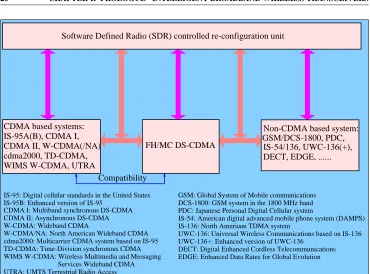
DS-CDMA systems. The standardization worldwide in the field of wireless communications shows that various mobile communication standards will continue to exist even in the future. This causes problems not only with international roaming, but also with multiple standards operation within the same geographical area. Hence, it is important to develop transceivers that will operate with several standards and in several frequency bands on a common hard-ware platform. SDR are evolving as flexible all-purpose radios and giving rise to the possi-bility of implementing these kinds of multi-standard, multimode and multiband transceivers. Therefore, in the final part of this chapter, the concept of SDR assisted broadband FH/MC DS-CDMA system is presented and the re-configurable parameters in terms of this system and those associated with connection with the other wireless systems are described.
1.4
FH/MC DS-CDMA
1.4. FH/MC DS-CDMA 15
...
...
...
PSfrag replacements
Rake Rake
Rake combiner 1
combiner 2
combiner U
Decision unit
Frequency-hoppingU information V1W
V7X
V1Y
Z\[
Z]
Z\^4_F]
Channel states (to transmitter)
received signal
`
`
`
Carrier demodulation
Output data Parallel/ serial converter
Frequency synthesizer Carrier selection
aW=bcd aX:bcd
aYIbcd
1 2 3 e
Figure 1.3: Receiver block diagram of the frequency-hopping multicarrier DS-CDMA system using conventional RAKE receiver.
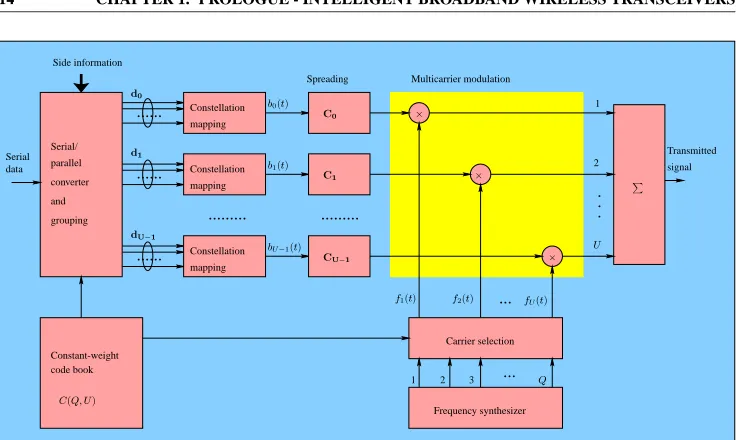
synthesizer. Furthermore, in the transmitter ‘side-information’ reflecting the channel’s in-stantaneous quality might be employed, in order to control its transmission and coding mode, so that the required target throughput and transmission integrity requirements are met.
As shown in Fig. 1.2, the original bit stream having a bit duration off
is first serial-to-parallel (S-P) converted. Then, these parallel bit streams are grouped and mapped to the potentially time-variant modulation constellations of the active subcarriers. Let us assume that the number of bits transmitted by a FH/MC DS-CDMA symbol is , and let us denote the symbol duration of the FH/MC DS-CDMA signal byfhg . Then, if the system is designed for achieving a high processing gain and for mitigating the inter-symbol-interference (ISI) in a constant-rate transmission scheme, the symbol duration can be extended to a multiple of the bit duration, i.e., f
g
i'f
. By contrast, if the design aims to support multiple transmission rates or channel-quality matched variable information rates, then a constant bit duration off
jfhg can be employed. Both multirate and variable rate transmissions can be implemented by employing a different number of subcarriers associated with different modulation constellations as well as different spreading gains. As seen in Fig. 1.2, after the constellation mapping stage, each branch is DS spread using the assigned PN sequence, and then this spread signal is carrier modulated using one of the active subcarrier frequencies derived from the constant-weight code C(Nk! ). Finally, all active branch signals are multiplexed, in order to form the transmitted signal.
16 CHAPTER 1. PROLOGUE - INTELLIGENT BROADBAND WIRELESS TRANSCEIVERS
to the transmitter side, where only out of N subcarriers are transmitted by a user, at the receiver different detector structures might be implemented based on the availability [72] or lack [78] of the FH pattern information. During the FH pattern acquisition stage, which usually happens at the beginning of transmission or during hand-over, tentatively allN sub-carriers can be demodulated. The transmitted information can be detected and the FH patterns can be acquired simultaneously by using blind joint detection algorithms exploiting the char-acteristics of the constant-weight codes [70, 71]. If however, the receiver has the explicit knowledge of the FH patterns, then only subcarriers have to be demodulated. However, if Fast Fourier Transform (FFT) techniques are employed for demodulation - as often is the case in multicarrier CDMA [79] or OFDM [80] systems, then allN subcarriers might be de-modulated, where the inactive subcarriers only output noise. In the decision unit of Fig.1.3, these noise-output-only branches can be eliminated by exploiting the knowledge of the FH patterns [72, 78]. Hence, the decision unit only outputs the information transmitted by the ac-tive subcarriers. Finally, the decision unit’s output information is parallel-to-serial converted to form the output data.
At the receiver, the channel states associated with all the subchannels might be estimated or predicted using pilot signals [75, 77]. This channel state information can be utilized for coherent demodulation. It can also be fed back to the transmitter as highly protected side-information, in order to invoke a range of adaptive transmission schemes including power control and adaptive-rate transmission.
1.5
Characteristics of the FH/MC DS-CDMA Systems
In the proposed FH/MC DS-CDMA system the entire bandwidth of future broadband systems can be divided into a number of sub-bands and each sub-band can be assigned a subcarrier. According to the prevalent service requirements, the set of legitimate subcarriers can be dis-tributed in line with the users’ instantaneous information rate requirements. FH techniques are employed for each user, in order to evenly occupy the whole system bandwidth available and to efficiently utilize the available frequency resources. In this respect FH/MC DS-CDMA systems exhibit compatibility with the existing 2nd- and 3rd-generation CDMA systems and hence constitute a highly flexible air interface.
1.5. CHARACTERISTICS OF THE FH/MC DS-CDMA SYSTEMS 17
...
Frequency
5MHz
1.25MHz (IS-95)
(W-CDMA)
Figure 1.4: Spectrum of FH/MC DS-CDMA signal using subchannel bandwidth of 1.25 MHz and/or 5 MHz.
of subcarriers of the advocated broadband wireless FH/MC DS-CDMA system may be sig-nificantly lower. This potentially mitigates the crest-factor problem. Additionally, with the aid of FH, the peak-to-average power fluctuation of the FH/MC DS-CDMA system might be further decreased. In other words, the FH/MC DS-CDMA system is capable of combin-ing the best features of scombin-ingle-carrier DS-CDMA and OFDM systems, while avoidcombin-ing many of their individual shortcomings. Finally, in comparison to the FH/MC DS-CDMA system, both broadband single-carrier DS-CDMA systems and broadband OFDM systems are less amenable to interworking with the existing 2nd- and 3rd-generation wireless communication systems. Let us now characterize some of the features of the proposed system in more depth.
Compatibility – The broadband FH/MC DS-CDMA system can be rolled out over the bands of the 2nd- and 3rd-generation mobile wireless systems and/or in the band licensed for future broadband wireless communication systems. In FH/MC DS-CDMA systems the sub-bands associated with different subcarriers are not required to be of equal bandwidth. Hence exist-ing 2nd- and 3rd-generation CDMA systems can be supported usexist-ing one or more subcarriers. For example, Fig. 1.4 shows the spectrum of a frequency hopping, orthogonal multicarrier DS-CDMA signal using a subchannel bandwidth of 1.25 MHz, which constitutes the band-width of a DS-CDMA signal in the IS-95 standard [58]. In Fig. 1.4 we also show that seven subchannels, each having a bandwidth of 1.25 MHz can be replaced by one subchannel with a bandwidth of 5 MHz (lnmpoqrsutwv4s MHz). Hence, the narrow-band IS-95 CDMA system can be supported by a single subcarrier, while the UMTS and IMT-2000 W-CDMA systems might be supported using seven subchannels’ bandwidth amalgamated into one W-CDMA channel. Moreover, with the aid of SDRs, FH/MC DS-CDMA is also capable of embracing other existing standards, such as the Time-Division Multiple-Access (TDMA) based Global System of Mobile communications known as GSM [81].
18 CHAPTER 1. PROLOGUE - INTELLIGENT BROADBAND WIRELESS TRANSCEIVERS
context of random FH [72], the subcarriers associated with each transmission of a user are determined by the set of pre-assigned FH patterns constituting a group of constant-weight codewords [78]. The active subc
![Figure 2.6: Cross-correlation values between two pairs of Gold sequences versus]as specified inEquation 2.35](https://thumb-us.123doks.com/thumbv2/123dok_us/1010188.615794/72.595.213.390.180.318/figure-cross-correlation-values-sequences-versus-specied-inequation.webp)
![Figure 2.20: Normalized channel impulse response for the COST 207 [110] seven-path Bad Urbanchannel.](https://thumb-us.123doks.com/thumbv2/123dok_us/1010188.615794/93.595.198.352.175.294/figure-normalized-channel-impulse-response-cost-seven-urbanchannel.webp)
