Abstract—This study examined the effects of personality traits (extraversion, agreeableness, conscientiousness, emotional stability and openness to experience) and safety climate on risk perception among construction workers. The sample consisted of 107 employees from Hong Kong construction companies. Structural equation modeling was used to test the effects of personality traits and safety climate on risk perception. The results showed that risk perception of construction workers was negatively influenced by extraversion and openness to experience, but was positively affected by agreeableness and conscientiousness. In addition, safety climate of work organization had positive influence on risk perception of construction workers. These findings offered both theoretical and practical implications for broadening our understanding of risk perception and improving risk perception of construction workers.
Index Terms—personality, risk perception, safety climate
I. INTRODUCTION
ROM 2007 to 2016, a concerted effort has been made by various stakeholders of occupational safety to steadily reduce the numbers and rates of injuries across all Hong Kong industrial sectors [1]. However, construction industry still is the most dangerous compared to other industries and the largest numbers of fatalities and accidents have been observed in the construction industry over the past decade. Industrial accidents can be attributable to a combination of various contributing factors, traditionally categorized into two domains: unsafe conditions and unsafe behaviors [2]. Avoidance of accidents and injuries can be achieved by eliminating either unsafe behaviors or conditions [3]. Over the last two decades the construction industry has focused mainly on eliminating unsafe conditions by means of providing protective clothing and tools, and developing safety managerial systems [4], which successfully led to a reduction of accident rates. Nonetheless, with the rapid growth of the construction industry, an increase in the number of accidents was observed in the construction industry in the past five years. Although eliminating unsafe acts is essential, it is also
Manuscript received November 2, 2017; revised November 21, 2017. Ken S.S. MAN is with the Department of Systems Engineering and Engineering Management, City University of Hong Kong, Kowloon Tong, Hong Kong (Email: [email protected]).
Alan H.S. CHAN is with the Department of Systems Engineering and Engineering Management, City University of Hong Kong, Kowloon Tong, Hong Kong (Tel: (852) 2788 8439; Fax: (852) 2788 8423; Email: [email protected]).
important to remove unsafe behaviors, which account for 80% of accidents [5].
Risk perception refers to the subjective judgment of individuals about particular risks [6] and was found to cause people to take protective action and reflect their risk behavior [7]. Risk perception has been widely recognized as an important factor influencing safety-and-health related behaviors across diverse research areas such as public health [8], transportation safety [9] and construction safety [10]. Unsafe behaviors of construction workers and the probability of accidents and health injuries have been found to be significantly affected by risk perception [11,12]. Therefore, more research effort should be made to understand factors affecting risk perception of construction workers.
Personality traits are defined as dimensions of individual differences in tendency to show consistent patterns of thoughts, feelings and behavior by McCrae and Costa Jr [13]. A Big Five factor structure has been widely evidenced in diverse data sets of personality traits studies [14,15]. The first factor is extraversion characterized by sociability, dynamism, and energy [16] and related to the need for motivation [17]. It can be expressed as a need for sensation and excitement, including social ability and dominance. The second factor is agreeableness, assessing the interpersonal orientation of people [18]. The third factor is conscientiousness, referring to the extent to which people are persistent, hard-working, motivated in pursuing and accomplishing goals [18] and showing a desire for achievements under regulations and control . The fourth factor is called emotional stability which is the degree to which people have frequent and intense negative affect [19]. The last factor is openness to experience showing that someone is curious and tends to look for novel ideas and new experience [18].
Safety climate is defined by Zohar as the shared perceptions of employees on the relative importance of safety conduct in their occupational behavior [20]. In other words, the true priority of a work organization for the safety of workers can be reflected by safety climate of that organization [21]. It has long been a reliable factor for the prediction of safety performance of workers (such as occupational injuries and accident rates) and in the promotion of safe work environments and injury-reducing behavior [22-24]. Generally, a positive safety climate of a work organization is assumed to increase the safety knowledge of workers, thereby leading to their more
Influence of Personality and Safety Climate on
Risk Perception of Hong Kong Construction
Workers
Ken S.S. MAN and Alan H.S. CHAN
frequent safety behaviors.
Although a recent study [25] was conducted to investigate whether and how the personality traits of construction project managers affect their risk perception, no current studies on the effects of personality traits of construction workers and safety climate on risk perception have been reported so far. Thus, this study aims to investigate the possible influence of personality traits of construction workers and safety climate of work organisation on the risk perception of construction workers.
II. HYPOTHESES DEVELOPMENT
A. Big Five Personality and Risk Perception
A previous study [26] found that extraverted people and those with a low level of emotional stability tend to do risky behaviors which harms their health. Extraversion and openness to experience was found to be the motivational force for risk-taking behaviors [27]. In addition, the more agreeable people are, the more empathy and sympathy to others they show and the undesirable and riskier they perceived threats as [25]. A study conducted by Vollrath et al. [28] provided evidence that people who are more agreeable are less likely to take health related risks. Individuals with a higher level of conscientiousness are more likely not to take part in risky health behavior [28]. Also, conscientiousness was found to be negatively associated with risk-taking behaviors [29]. In general, when people hold a higher level of risk perception, they are more likely not to take a risk. Therefore, we postulated the following hypotheses.
H1.1: Extraversion exerts a negative influence on risk perception among construction workers.
H1.2: Agreeableness exerts a positive influence on risk perception among construction workers.
H1.3: Conscientiousness exerts a positive influence on risk perception among construction workers.
H1.4: Emotional stability exerts a positive influence on risk perception among construction workers.
H1.5: Openness to experience exerts a negative influence on risk perception among construction workers.
B. Safety Climate and Risk Perception
In the context of work safety, risk perception of workers was found to be associated with organizational safety climate [30]. In addition, safety climate is an important predictor for risk-taking behaviors among workers [31]. We thus hypothesized that safety climate positively affects risk perception of construction workers.
H2: Safety climate exerts a positive influence on risk perception among construction workers.
III. METHOD
A. Participant
A total of 107 registered general construction workers participated in this survey. Their demographic information is summarized in Table I. There were 96 male participants (89.7%) and 11 female participants (10.3%). In terms of
age, majority of them (86.9%) were of ages between 21 and 50. More than one-third respondents (34.5%) had lower secondary or primary school education level, while others held higher secondary school or above education level. About half of respondents (50.4%) had at least 9 years of work experience in construction industry. For more details, please refer to Table I.
B. Research Model
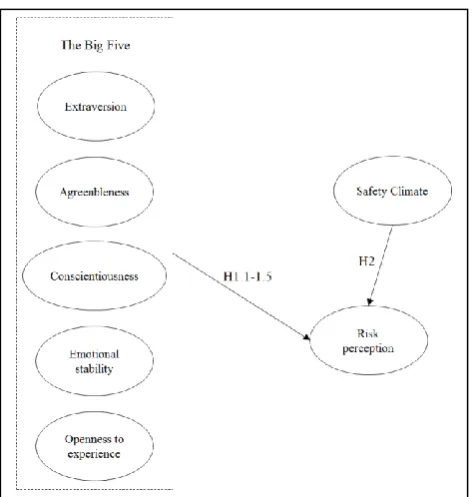
According to the above theoretical knowledge and hypotheses development, a research model (shown as Fig. 1) was proposed for examining the relationship between safety climate and risk perception and the relationship between personality traits and risk perception among Hong Kong construction workers.
C. Measurement
The questionnaire used in this study consisted of 25 items. The Ten Item Personality Inventory (TIPI) was used to measure personality traits (i.e. extraversion, agreeableness, conscientiousness, emotional stability, and openness to experience) with a seven-point Likert type response format, ranging from 1 (totally disagree) to 7 (totally agree) [32]. Six items from a safety climate measure developed by Dedobbeleer and Béland [33] were used to measure safety climate with a seven-point Likert type response format, ranging from 1 (totally disagree) to 7 (totally agree). Nine items were developed to measure risk perception of the construction workers with an 11-point phrase completion scale ranging from 0 (totally disagree) to 10 (totally agree). Respondents were asked to rate the probability of negative outcomes due to exposure to risky situations in general, and the probability for self, and the extent to which they worry about the negative outcomes [11]. According to the Labour Department [34], three levels of consequences of industrial accidents were used, namely
TABLEI
DEMOGRAPHIC PROFILE OF RESPONDENTS (N=107)
Items Description Number of Participants
Percentage (%)
Age group Below 21 2 1.9
21 – 30 38 35.5
31 – 40 32 29.9
41 – 50 23 21.5
51 – 60 12 11.2
Gender Male 96 89.7
Female 11 10.3
Education level
Primary school 13 12.1
Lower secondary 24 22.4 Higher secondary 45 42.0 Diploma or above 25 23.4 Work
experience in construction industry (Number of years)
< 3 years 23 21.5
3 years - < 6 years 19 17.8 6 years - < 9 years 11 10.3 9 years - < 12 years 10 9.3 12 years - < 15 years 5 4.7 15 years - < 18 years 6 5.6 18 years or above 33 30.8 Type of
current construction project
Building sites 45 42.1
Civil engineering sites
31 29.0
Maintenance 31 29.0
Injury experience
Yes 62 57.9
(a) incapacity for a period not exceeding 3 days; (b) incapacity for a period exceeding 3 days; and (c) death. The detailed item contents are shown in Appendix.
Fig. 1. The proposed research model for construction workers risk perception
IV. RESULT
A. Measurement Model
A confirmatory factor analysis (CFA) for assessing the measurement model representing the relationships between measured variables and theoretical constructs was employed with the use of SPSS 21.0 and AMOS 21.0. It was done to confirm the validity of the theoretical measurement model. There were seven constructs in the present measurement model. Convergent validity was verified by composite reliability (CR > 0.7), average variance extracted (AVE > 0.5), and standardized factor loadings (FL > 0.5) [35]. It was found that three items of safety climate (shown in Appendix) had significant cross loadings, thereby excluding them from this study. In other words, three items for measuring safety climate were retained for data analysis. Table II shows the results of the CFA. The CR of each latent factor ranged from 0.868 to 0.961. All items loaded significantly on their corresponding factors ranging from 0.775 to 0.983 with no significant cross loadings, and the AVE ranged from 0.687 to 0.910. The results provided evidence of the acceptable convergent validity of each construct. Discriminant validity refers the extent to which the measure is indeed different and not simply a reflection of a few other variables [36]. The square root of AVE for each construct was compared with each inter-construct correlation coefficient [37]. The results shown in Table III indicated acceptable discriminant validity because all inter-construct correlations were less than the square root of AVE for each construct. The measurement model fit was examined using four goodness-of-fit indices, namely, Chi-Square test, comparative fit index (CFI, > 0.9), root mean square error of approximation (RMSEA, < 0.08), and
standardized root mean residual (SRMR, < 0.1) [38]. According to the results, the values of Chi-Square, CFI, RMSEA, and SRMR were 353.871 (p = 0.000) with 193 degrees of freedom, 0.925, 0.089, and 0.564, respectively; these values indicated moderate model fit to data. Therefore, structural equation modeling analysis can be conducted. Also, Cronbach’s alpha was employed for measuring the internal consistency reliability of each subscale for each factor [39]. The values of Cronbach’s alpha for extraversion, agreeableness, conscientiousness, emotional stability, openness to experience, safety climate, and risk perception were 0.952, 0.921, 0.906, 0.918, 0.939, 0.886 and 0.960, respectively, indicating all measures were acceptable (> 0.7).
B. Structural Model
Structural equation modeling was conducted with AMOS 21.0 to analyze the effect relationships among the various constructs. The structural model fit was examined using four goodness-of-fit indices, namely, Chi-Square test, comparative fit index (CFI, > 0.9), root mean square error of approximation (RMSEA, < 0.08), and standardized root mean residual (SRMR, < 0.1) [38]. According to the results, the values of Chi-Square, CFI, RMSEA, and SRMR were 364.736 (p=0.000) with 200 degrees of freedom, 0.923, 0.088 and 0.941 respectively, showing a moderately acceptable model fit to data.
The results of hypotheses testing in Table IV indicated that agreeableness, conscientiousness and safety climate positively affected risk perception while extraversion and openness to experience negatively affected risk perception, supporting H1.1, H1.2, H1.3, H1.5 and H2. Moreover, emotional stability was found to not affect risk perception, not supporting H1.4. With these results, the structure of the proposed research model for construction workers risk perception is shown in Fig. 2.
TABLEII
CONFIRMATORY FACTOR ANALYSIS RESULTS
Construct Item Factor Loading
CR AVE Cronbach Alpha Extraversion (E) E1 0.924 0.953 0.910 0.952
E2 0.983
Agreeableness (A) A1 0.947 0.923 0.857 0.921 A2 0.904
Conscientiousness (C)
C1 0.900 0.905 0.827 0.906 C2 0.919
Emotional Stability (ES)
ES1 0.925 0.908 0.849 0.918 ES2 0.918
Openness to Experiences (OE)
OE1 0.924 0.939 0.886 0.939 OE2 0.958
Safety Climate (SC)
SC1 0.846 0.868 0.687 0.866 SC2 0.815
SC3 0.825 Risk Perception
(RP)
RP1 0.899 0.961 0.736 0.960 RP2 0.908
V. DISCUSSION
The aim of this study was to examine the effects of personality traits and safety climate on construction workers risk perception.
A. Influence of Personality Traits on Risk Perception The findings suggested that construction workers who have higher levels of extraversion and openness to experience tend to perceived less risk, while those score high in agreeableness and conscientiousness are more likely to perceived more risk. These results provided an explanation for the findings of Nicholson et al. [27] that extraversion and openness to experience have positive influence on risk taking while agreeableness and conscientiousness have negative influence on risk taking. The reason for their findings may be that people who have higher levels of extraversion and openness to experience hold a lower level of risk perception leading to their more
risk-taking behaviors. Similarly, people who score high in agreeableness and conscientiousness hold a higher level of risk perception contributing to their less risk-taking behaviors. In addition, this study failed to verify the positive effect of emotional stability on risk perception among construction workers. However, the positive correlation between emotional stability and risk perception was significant, indicating that construction workers who have a high level of emotional stability tend to have a high level of risk perception. Although a study of Wang et al. [25] found that extraversion, agreeableness, conscientiousness, emotional stability, and openness to experience of construction project managers have no significant effects on their risk perception, the signs of influence of personality traits on risk perception are consistent in both this current study and the study of Wang et al. [25]. In other words, both studies found standardized path coefficients for the path from extraversion to risk perception and the path from openness to experience to risk perception were negative. In addition, standardized path coefficients for the path from agreeableness to risk perception, the path from conscientiousness to risk perception, and the path from emotional stability to risk perception were found to be positive in both studies. The consistency of these findings in both studies further confirmed the way in which personality traits affect risk perception. The insignificance of the direct effects of personality traits on risk perception among construction project managers may be due to the mediating effect of their risk propensity. In future research, risk
TABLEIV
RESULTS OF HYPOTHESES TESTING
Hypotheses
Standardized Path Coefficient
Standard Error
Critical Ratio
P
Value
Results
H1.1 -0.370 0.062 -5.690 0.000 Supported
H1.2 0.197 0.067 2.811 0.005 Supported
H1.3 0.500 0.076 6.671 0.000 Supported
H1.4 0.125 0.070 1.939 0.053 Not Supported H1.5 -0.391 0.068 -5.954 0.000 Supported
H2 0.411 0.094 6.002 0.000 Supported
Fig. 2. The proposed research model for construction workers risk perception with results of hypotheses testing (dotted-line indicates non-significance).
TABLEIII
RESULTS OF DISCRIMINANT VALIDITY
E A C ES OE SC RP
E 0.954
A -0.192 0.926
C -0.025 0.135 0.909
ES -0.004 0.046 0.307** 0.921
OE 0.125 0.070 0.288** 0.215* 0.941
SC -0.072 0.241* 0.195 0.127 0.237* 0.829
RP -0.472*** 0.417*** 0.483*** 0.246* -0.168 0.496*** 0.858 Bolded section: square root of AVE; non-shaded section: inter-construct correlations; *: p<0.05; **: p< 0.01; ***: p<0.00
propensity of construction workers should be taken into account to examine the existence of the mediating effect of constriction workers risk propensity in the relationship between personality traits and risk perception.
B. Safety Climate and Risk Perception
The finding of this study also confirmed that safety climate of work organization positively influences risk perception of construction workers. In essence, the better the safety climate of construction companies, the higher risk perception the construction workers hold. The importance of safety climate is emphasized in this study because of its positive influence on risk perception of construction workers.
C. Implications for Theory and Practice
Both theoretical and practical contributions can be delivered from the findings of this study. Theoretically, the effects of personality traits and safety climate on risk perception among construction workers were examined, thus adding new knowledge to the literature of risk perception for construction industry. Moreover, there are some practical implications for construction industry. First, a better understanding of how the personality traits of construction workers influence their risk perception can facilitate developing more effective safety interventions and training programs. It does not mean that safety interventions and training programs aim to change the personality traits of construction workers. Rather, the design of appropriate safety interventions and training programs should take the personality traits of construction workers into account. For
example, customized or personalized safety training can be designed for increasing risk perception of construction workers who are extroverted and open to experience. Second, safety promotion activities such as regular safety meeting and safety talks should be organized to improve the safety climate of work organization so that an increase in risk perception of construction workers can be achieved, leading to their less risk-taking behaviors.
D. Study Limitations
Despite the usefulness of this study, it is of paramount importance to recognize its limitations. First, there is difficulty in reaching universal generalizations from this study, because all data were collected in the Hong Kong construction industry. Therefore, more research effort is needed to conduct this study in other countries to generalize our findings. Second, the collected data were cross-sectional in nature, thus more longitudinal/experimental empirical research is required to validate the findings of this study.
VI. CONCLUSION
In summary, this study successfully examined the effects of personality traits and safety climate on construction workers risk perception, which (1) broadens our understanding of risk perception; (2) emphasizes importance of safety climate in construction safety. According to these results, two relevant recommendations for improving risk perception of construction workers have been made.
APPENDIX Constructs Items Measures
Extraversion (E) E1 I see myself as extraverted and enthusiastic. E2 I see myself as reserved and quiet. Agreeableness
(A)
A1 I see myself as critical and quarrelsome. A2 I see myself assympathetic and warm. Conscientiousness
(C)
C1 I see myself as dependable and self-disciplined. C2 I see myself asdisorganized and careless. Emotional stability ES1 I see myself as anxious and easily upset.
ES2 I see myself as calm and emotionally stable. Openness to
experience (OE)
OE1 I see myself as open to new experiences and complex. OE2 I see myself as conventional and uncreative. Safety climate
(SC)
SC1 My company management think safety measure is very important. SC2 I can obtain suitable personal protective equipment at work place. SC3 Safety meeting is organized regularly.
SC4* Management of my company believes safety is more importance than production. SC5* The foreman takes care of safety in my workplace.
SC6* I am trained in safety knowledge. Risk perception
(RP)
RP1 I think in general the probability of workers getting incapacity for a period not exceeding three days due to a construction industry accident is very high.
RP2 I think in general the probability of workers getting incapacity for a period exceeding three days due to a construction industry accident is very high.
RP3 I think in general the probability of workers losing their life due to a construction industry accident is very high.
RP4 I think I am very likely to get incapacity for a period not exceeding 3 days due to a construction industry accident.
RP5 I think I am very likely to get incapacity for a period exceeding 3 days due to a construction industry accident.
RP6 I think I am very likely to lose my life due to a construction industry accident.
RP7 I very worry about getting incapacity for a period not exceeding three days due to a construction industry accident.
RP8 I very worry about getting incapacity for a period exceeding three days due to a construction industry accident.
ACKNOWLEDGMENT
The data collection of this study was fully conducted by Ms. Leung Suet Yi.
REFERENCES
[1] Labour Department, "Occupational Safety and Health Statistics
Bulletin," 2017. Available
:http://www.labour.gov.hk/eng/osh/pdf/Bulletin2016.pdf
[2] M. Shin, H. Lee, M. Park, M. Moon and S. Han, "A system dynamics approach for modeling construction workers’ safety attitudes and behaviors," Accident Analysis & Prevention, vol. 68, pp. 95-105, 2014.
[3] C. Chi, T. Chang and H. Ting, "Accident patterns and prevention measures for fatal occupational falls in the construction industry,"
Applied ergonomics, vol. 36, no. 4, pp. 391-400, 2005.
[4] Development Bureau, "Annual Report on Accident Statistics and Analysis for Public Works Contracts for 2013," 2013. Available: http://www.devb.gov.hk/filemanager/en/content_32/2013_Annual_Re port_20130630.pdf
[5] M. Fleming and R. Lardner, Strategies to promote safe behaviour as part of a health and safety management system, HSE Books, 2002. [6] P. Slovic, "Perception of risk," Science (New York, N.Y.), vol. 236, no.
4799, pp. 280-285, 1987.
[7] N. T. Brewer, N. D. Weinstein, C. L. Cuite and J. E. Herrington, "Risk perceptions and their relation to risk behavior," Annals of Behavioral Medicine, vol. 27, no. 2, pp. 125-130, 2004.
[8] L. Belcher, M. R. Sternberg, R. J. Wolitski, P. Halkitis, C. Hoff and Study Team, S.U.M.S., "Condom use and perceived risk of HIV transmission among sexually active HIV-positive men who have sex with men," AIDS Education & Prevention, vol. 17, no. 1, pp. 79-89, 2005.
[9] Ö. Şimşekoğlu, T. Nordfjærn, M. F. Zavareh, A.M. Hezaveh, A.R. Mamdoohi and T. Rundmo, "Risk perceptions, fatalism and driver behaviors in Turkey and Iran," Safety Science, vol. 59, pp. 187-192, 2013.
[10] J. Bohm and D. Harris, "Risk perception and risk-taking behavior of construction site dumper drivers," International Journal of Occupational Safety and Ergonomics, vol. 16, no. 1, pp. 55-67, 2010. [11] T. Rundmo, "Safety climate, attitudes and risk perception in Norsk
Hydro," Safety Science, vol. 34, no. 1, pp. 47-59, 2000.
[12] D. Oswald, F. Sherratt and S. Smith, "Exploring factors affecting unsafe behaviours in construction," presented at the Arcom Conference, UK, pp. 335-344, 2013.
[13] R. R. McCrae and P. T. Costa Jr, Personality in adulthood: Emerging lives, enduring dispositions, New York: Guilford, 1990.
[14] G. Stoll, S. Rieger, O. Lüdtke, B. Nagengast, U. Trautwein and B. W. Roberts, "Vocational interests assessed at the end of high school predict life outcomes assessed 10 years later over and above IQ and Big Five personality traits," Journal of personality and social psychology, vol. 113, no. 1, pp. 167-184, 2017.
[15] C. Randler, M. Schredl and A. S. Göritz, "Chronotype, Sleep Behavior, and the Big Five Personality Factors," SAGE Open, vol 7, no. 3, pp. 2158244017728321, 2017.
[16] S. Le Vigouroux, C. Scola, M. E. Raes, M. Mikolajczak and I. Roskam, "The big five personality traits and parental burnout: Protective and risk factors," Personality and Individual differences, vol. 119, pp. 216-219, 2017.
[17] M. Lauriola and I. P. Levin, "Personality traits and risky decision-making in a controlled experimental task: an exploratory study,"
Personality and Individual differences, vol. 31, no. 2, pp. 215-226, 2001.
[18] H. Zhao and S. E. Seibert, "The big five personality dimensions and entrepreneurial status: a meta-analytical review," Journal of Applied Psychology, vol. 91, no. 2, pp. 259-271, 2006.
[19] J. F. Finch, L. E. Baranik, Y. Liu and S. G. West, "Physical health, positive and negative affect, and personality: A longitudinal analysis,"
Journal of research in Personality, vol. 46, no. 5, pp. 537-545, 2012. [20] D. Zohar, "Safety climate in industrial organizations: theoretical and
applied implications," Journal of applied psychology, vol. 65, no. 1, pp. 96-102, 1980.
[21] Z. Dov, "Safety climate and beyond: A multi-level multi-climate framework," Safety Science, vol 46, no. 3, pp. 376-387, 2008. [22] M. D. Cooper and R. A. Phillips, "Exploratory analysis of the safety
climate and safety behavior relationship," Journal of Safety Research, vol. 35, no. 5, pp. 497-512, 2004.
[23] A. Neal and M. A. Griffin, "A study of the lagged relationships among safety climate, safety motivation, safety behavior, and accidents at the individual and group levels," Journal of applied psychology, vol. 91, no. 4, pp. 946-953, 2006.
[24] Y. H. Huang, J. Lee, A. C. McFadden, L. A. Murphy, M. M. Robertson, J. H. Cheung, et al., "Beyond safety outcomes: An investigation of the impact of safety climate on job satisfaction, employee engagement and turnover using social exchange theory as the theoretical framework," Applied ergonomics, vol. 55, pp. 248-257, 2016.
[25] C. M. Wang, B. B. Xu, S. J. Zhang and Y. Q. Chen, "Influence of personality and risk propensity on risk perception of Chinese construction project managers," International Journal of Project Management, vol. 34, no. 7, pp. 1294-1304, 2016.
[26] M. Vollrath and S. Torgersen, "Who takes health risks? A probe into eight personality types," Personality and Individual differences, vol. 32, no. 7, pp. 1185-1197, 2002.
[27] N. Nicholson, E. Soane, M. Fenton‐O'Creevy and P. Willman, "Personality and domain‐specific risk taking," Journal of risk research, vol. 8, no. 2, pp. 157-176, 2005.
[28] M. Vollrath, D. Knoch and L. Cassano, "Personality, risky health behaviour, and perceived susceptibility to health risks," European Journal of Personality, vol. 13, no. 1, pp. 39-50, 1999.
[29] P. A. Kowert and M. G. Hermann, "Who takes risks? Daring and caution in foreign policy making," Journal of conflict Resolution, vol. 41, no. 5, pp. 611-637, 1997.
[30] T. Rundmo, "Associations between risk perception and safety," Safety Science, vol. 24, no. 3, pp. 197-209, 1996.
[31] J. Bosak, W. J. Coetsee and S. J. Cullinane, "Safety climate dimensions as predictors for risk behavior," Accident Analysis & Prevention, vol. 55, pp. 256-264, 2013.
[32] S. D. Gosling, P. J. Rentfrow and W. B. Swann, "A very brief measure of the Big-Five personality domains," Journal of research in Personality, vol. 37, no. 6, pp. 504-528, 2003.
[33] N. Dedobbeleer and F. Béland, “A safety climate measure for construction sites,” Journal of safety research, vol. 22, no. 2, pp.97-103, 1991.
[34] Labour Department, "A Concise Guide to the Employees’ Compensation Ordinance," 2017. Available: http://www.labour.gov.hk/eng/public/ecd/pco360.pdf
[35] J. F. Hair, W. C. Black, B. J. Babin, R. E. Anderson and R. L. Tatham,
Multivariate data analysis, vol. 5, no. 3, Upper Saddle River, NJ: Prentice hall, 1998.
[36] G. A. Churchill Jr, “A paradigm for developing better measures of marketing constructs,” Journal of Marketing Research, vol. 16, pp. 64-73, 1979.
[37] C. Fornell and D. F. Larcker, “Evaluating structural equation models with unobservable variables and measurement error,” Journal of Marketing Research, vol. 18, pp. 39-50, 1981.
[38] R. B. Kline, Principles and practice of structural equation modeling, 4th ed., New York: Guilford Press, 2015.