Abstract— Currently, there are many attacks and
exploitation to Android smartphones by the attackers all over the world. These attacks are based on profit and caused loss of money and productivity to the victim. This exploitation can be done via camera, SMS, call, audio, image or location exploitation by attacking the system call, permission or API inside the Android smartphone. Therefore, this paper presents 32 mobile malware classification based on system call and permission to detect camera exploitation for Android smartphone. The experiment was conducted in a controlled lab environment, by applying reverse engineering with 5560 training dataset from Drebin, where both static and dynamic analyses were used to identify and extract the permission and system call from the mobile applications (apps). These 32 classification have been evaluated with 500 mobile apps from Google Play Store and 19 mobile apps matched with the classification. This new classification can be used as the database and input for the development of new mobile malware detection model for camera exploitation.
Index Terms— Android, camera exploitation, mobile malware, permission, system call.
I. INTRODUCTION
ndroid is an operating system that acts as platform between user and his smartphone. Due to its technology, it has been widely used by many users all over the world. Unfortunately, many users out there have lack of security awareness about malicious mobile application and mobile malware implication and how to detect it. Mobile malware is defined as malicious software that attacks smartphone systems without user’s consent. There are so many techniques have been used by the cyber-criminals to attack Android smartphone. In early year 2017, the cybercriminals have used social chat mobile app known as WhatsApp to access personal data on the phone including banking credentials and pin codes [1]. This can be done by
Manuscript received July 17, 2017; revised Aug 8, 2017. This work was funded by Ministry of Higher Education (Malaysia), FRGS grant: [USIM/FRGS/FST/32/50114].
Madihah Mohd Saudi is a senior IAENG member and works as an associate professor with the Information Security and Assurance (ISA) programme, Faculty of Science and Technology (FST), Universiti Sains
Islam Malaysia (USIM), 71800 Nilai, Malaysia. (E-mail:
Luqman Hakim Zahari graduated from Information Security and Assurance (ISA) programme, Faculty of Science & Technology (FST), Universiti Sains Islam Malaysia (USIM), 71800 Nilai, Malaysia.
Farida Ridzuan, Nurlida Basir, Sakinah Ali Pitchay, N.F.Nabila are senior lecturer with the Information Security and Assurance (ISA) programme, Faculty of Science and Technology (FST), Universiti Sains Islam Malaysia (USIM), 71800 Nilai, Malaysia.
sending embedded file with virus in word, excel or PDF file as the attachment in WhatsApp message. Even worst, the cybercriminals use social engineering technique to convince the victim to open the file attachment by including name of trusted and major organizations in their country in the message. While on April 2017, Eset security researcher, Lukas Stefanko has revealed his finding on an app named as Flashlight LED Widget [2]. This app has Trojan.Android/Charger.B embedded in it. It works as a normal flashlight but the truth is, it has much other hidden functionality once it is executed. It has command and control (C&C) capability where it will able to control victim’s smartphone remotely. It is known as Trojan.Android/Charger.B, where it can display fake screen that mimics exactly like a legitimate app. Even worst, it can also lock the infected smartphone and bypass two-factor authentication by intercepting SMS and display fake notification. This app was uploaded to Google Play on March 30, 2017 and up to 5,000 users have downloaded it. It has been taken out from the Google Play on April 10, 2017. This Trojan has evolved from Android/Charger Trojan, which was first discovered on January 2017 [3]. In contrast with Android/Charger, where it has the capability to lock the smartphone and ask as for ransom, the Trojan.Android/Charger.B is more sophisticated type of banking malware.
There are lots of mobile malwares out there ready to attack end user’s smartphone. Yet other examples are Trojan-Ransom.AndroidOS.Pletor.d and Trojan-Banker.AndroidOS.Gugi. As for Trojan-Banker.AndroidOS.Gugi, this Trojan is able to bypass Android’s permission by integrating social engineering to trick end user. No hard-core coding or vulnerability exploitation is needed to infect the victim. For the past few years, cybercriminals trends have changed. In earlier year, it is more for fun and recognition. Currently, the mobile malwares exploit the Android smartphone to gain super-user right or also known as root exploitation with the aim to steal money and confidential information from the victim. It spreads via Google Play store or third party untrusted source, mimics legitimate apps, turns as mobile banking malware and using advanced threat persistent to defeat security features in Android smartphone [4]. Hence, a good solution is needed to overcome all these issues and threats.
Therefore based on the mobile malwares threats, issues and challenges, this paper objective is to develop a new mobile malware classification for camera exploitation of Android smartphone based on system call and permission. This new classification is useful as a database and input to
A New Mobile Malware Classification for
Camera Exploitation based on System Call and
Permission
Madihah Mohd Saudi, Luqman Hakim Zahari, Farida Ridzuan, Nurlida Basir, Sakinah Ali Pitchay, N.F. Nabila
detect mobile malware that exploits camera for cybercriminal activities. There are 32 classification have been developed and these have been tested by using 500 mobile apps that have been chosen randomly from Google play store. Surprisingly there are 3.8% of the mobile apps matched with the proposed classification.
This paper is organized as follows. Section 2 presents related work on mobile malware detection techniques for camera exploitation. Section 3 describes the methodology used in this paper. Section 4 presents the experimental result and Section 5 concludes this paper and discusses the future work.
II. RELATEDWORK
There are few works done related with mobile malware and camera exploitation. Based on work done by Zhou and Jiang, camera permission is ranked as the 12th most requested in mobile apps and ranked as top 20 in malware [5]. While Wu et al. discussed about the attacks that are based on the use of phone camera [6]. They proposed a detection scheme by integrating computer vision technique where it is based on activity pattern. A very promising solution but it would be a better detection mechanism if other features such as permission and system call are taken into consideration. While Pore and Bartere, presented a review on camera-based attacks for android smartphones [7]. Xu et al. presented a Trojan that is able to exploit video camera in Android smartphones by integrating computer vision technique and remote-controlled and real-time monitoring attacks [8]. Their work mechanism is similar as done by [6]. As for Maggi et al., they implemented shoulder surfing technique to steal whatever written by the victim in his smartphone by using camera [9].
While Raguram et al. [10], applied the same concept as work done by [8]. Both of these works have challenges on how to place the camera near the victim without noticing it. As for Kundu et al., they proposed energy attacks to Android phone and camera is one of the elements that can be used [11]. It is based on hardware feature and a good reference and input to build a camera exploitation detection mechanism based on the model proposed. As for Kynigos et al., they developed a malware that exploits camera in Android smartphone without being detected by digital forensics software [12]. The images were captured and then being transferred to secondary cloud location without user’s consent and knowledge. It is a good empirical analysis and same like work done by [11], it is very useful as a reference and input to build a camera exploitation detection mechanism. Furthermore, a comprehensive review by Wolfe on the vulnerabilities and countermeasures for smartphones has been discussed [13]. Same like [13], Deshpande and Dharmadhikari, made a comprehensive review on camera attacks and defenses mechanism for Android smartphone from year 2008 to 2015[14]. As for Chouhan et al., they activated the camera and captured the cybercriminal image once the Android smartphone was stolen [15]. This technique is very useful as the detection and response mechanism for a stolen phone.
All of above discussed existing works have their own strengths and challenges. Therefore, to overcome these challenges this paper has developed mobile malware classification based on the combination of system call and
permission, which is yet not being discussed thoroughly in any of previous works.
III. METHODOLOGY
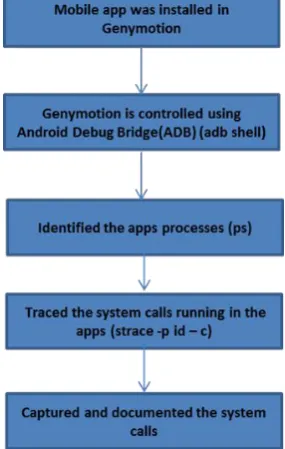
The overall processes involved in this research are summarized and displayed in Fig. 1. These processes are very time-consuming and need great analytical skill to extract the system call and the permission. The system call and permission were extracted by applying reverse engineering technique and the controlled lab architecture for this experiment as displayed in Fig. 2. It is called as controlled lab architecture, as no outgoing network connection is allowed from this lab. More than 80% software installed and used in this lab are based on open source and free. In this research, hybrid analysis which consists of both static and dynamic analyses was applied. Static analysis is a process where the source code of the mobile app being decompiled and reverse engineered without executing it. In contrast with dynamic analysis, the mobile app is executed and the behavior and payload are being monitored. There are few existing works that used static analysis such as by [16, 17] and dynamic analysis such by [18, 19, 20] as their method for malware analysis. Hybrid analysis is seen as comprehensive way of doing the analysis for our research. The permissions from the mobile apps were extracted and reverse engineered by using the static analysis (refer Fig. 3), while the system calls extraction by using dynamic analysis (refer Fig. 4). Total of 5560 Drebin dataset were used as the training dataset and 500 random anonymous mobile apps from different categories were selected for testing.
Fig. 2. Mobile Malware Lab Architecture.
Once the system calls and permissions were extracted, the frequency or also known as the percentage of occurrence being applied (refer Fig. 1). Total number for each permission and system call was being calculated.
[image:3.595.104.246.280.464.2]
Fig.3. Static Analysis Work Flow.
Fig.4. Dynamic Analysis Work Flow.
Then covering algorithm is used to generate system call and permission classification for each app. The covering algorithm generates rule by concentrating on a specific class and maximizing the probability of the desired classification. It is based on if-then rule. This is summarized as the following:
• The classification rule,
R = <P, C> (1) consists of:
P: precondition a series of tests that be valuated as true or false.
C: conclusion the class or the classes that apply to instances covered by rule R.
• Step1: Generate R on training dataset.
• Step 2: Remove the training data covered by R • Step 3: Repeat the process step1 and step 2.
In each stage, covering approach identifies rule that cover some of the training dataset. The classification of the system call and permission were developed based on this method. As for the evaluation, it was carried out by testing the proposed classification with the real mobile apps from the Google Play store. 500 random mobile apps were downloaded to the emulator platform and analyzed by using the static and dynamic analyses. Permission and system call for each of app was captured and tabulated. The results were then being analyzed and compared with the new proposed classification. The percentage of similarity was taken as the result of the experiment.
IV. RESULTSANDDISCUSSION
[image:3.595.105.248.509.734.2]TABLE I.
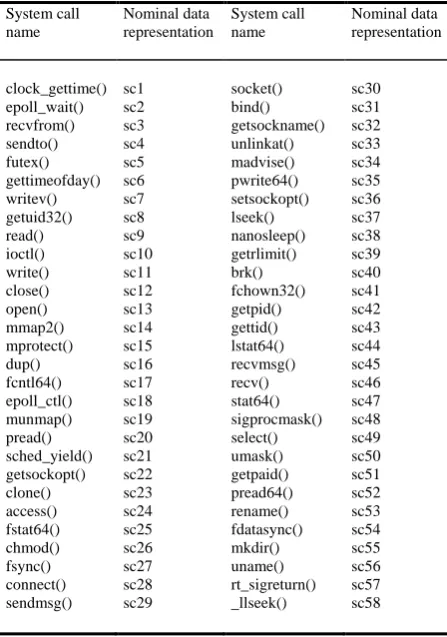
DATA REPRESENTATION FOR THE EXTRACTED SYSTEM CALLS. System call name Nominal data representation System call name Nominal data representation clock_gettime() epoll_wait() recvfrom() sendto() futex() gettimeofday() writev() getuid32() read() ioctl() write() close() open() mmap2() mprotect() dup() fcntl64() epoll_ctl() munmap() pread() sched_yield() getsockopt() clone() access() fstat64() chmod() fsync() connect() sendmsg() sc1 sc2 sc3 sc4 sc5 sc6 sc7 sc8 sc9 sc10 sc11 sc12 sc13 sc14 sc15 sc16 sc17 sc18 sc19 sc20 sc21 sc22 sc23 sc24 sc25 sc26 sc27 sc28 sc29 socket() bind() getsockname() unlinkat() madvise() pwrite64() setsockopt() lseek() nanosleep() getrlimit() brk() fchown32() getpid() gettid() lstat64() recvmsg() recv() stat64() sigprocmask() select() umask() getpaid() pread64() rename() fdatasync() mkdir() uname() rt_sigreturn() _llseek() sc30 sc31 sc32 sc33 sc34 sc35 sc36 sc37 sc38 sc39 sc40 sc41 sc42 sc43 sc44 sc45 sc46 sc47 sc48 sc49 sc50 sc51 sc52 sc53 sc54 sc55 sc56 sc57 sc58 TABLE II.
DATA REPRESENTATION FOR THE EXTRACTED PERMISSIONS.
Permission name Nominal
data represent ation
Permission name Nominal
data represent ation Access_Course_Location Access_Fine_Location Acess_Location_Extra_Co mmands Access_Network_State Access_Wifi_State Battery_Stat Bluetooth Bluetooth_Admin Call_Phone Camera Change_Network_State Change_Wifi_Multicast_S tate Change_Wifi_State Clear_App_Cache Control_Location_Updates Delete_Packages Disable_Keyguard Expand_Status_Bar Get_Accounts Get_Tasks pm1 pm2 pm3 pm4 pm5 pm6 pm7 pm8 pm9 pm10 pm11 pm12 pm13 pm14 pm15 pm16 pm17 pm18 pm19 pm20 Install_Packages Install_Shortcut Internet Kill_Background_Proc ess Modify_Audio_Setting Read_Calendar Read_Call_Log Read_Contact Read_External_Storag e Read_Logs Read_Phone_State Read_Settings Read_Sms Receive_Boot_Comple te Receive_Mms Receive_Sms Record_Audio Restart_Packages Write_External_Storag e Write_Settings pm21 pm22 pm23 pm24 pm25 pm26 pm27 pm28 pm29 pm30 pm31 pm32 pm33 pm34 pm35 pm36 pm37 pm38 pm39 pm40
TABLE III. DATA REPRESENTATION FOR THE DEVELOPED CLASSIFICATION.
Mobile malware classification content Nominal
data representat ion pm10+pm19+pm29+pm31+pm39+sc2+sc9+sc10+sc24+sc26 pm10+pm19+pm29+pm31+pm39+sc2+sc9+sc10+sc24+sc26+sc7 pm10+pm19+pm29+pm31+pm39+sc2+sc9+sc10+sc24+sc26+sc7 +sc28 pm10+pm19+pm29+pm31+pm39+sc2+sc9+sc10+sc24+sc26+sc7 +sc28+sc30 pm10+pm19+pm29+pm31+pm39+sc2+sc9+sc10+sc24+sc26+sc7 +sc28+sc30+sc31 pm10+pm19+pm29+pm31+pm39+sc2+sc9+sc10+sc24+sc26+sc7 +sc28+sc30+sc31+sc46 pm10+pm19+pm29+pm31+pm39+sc2+sc9+sc10+sc24+sc26+sc7 +sc28+sc30+sc46 pm10+pm19+pm29+pm31+pm39+sc2+sc9+sc10+sc24+sc26+sc7 +sc28+sc31 pm10+pm19+pm29+pm31+pm39+sc2+sc9+sc10+sc24+sc26+sc7 +sc28+sc31+sc46 pm10+pm19+pm29+pm31+pm39+sc2+sc9+sc10+sc24+sc26+sc7 +sc28+sc46 pm10+pm19+pm29+pm31+pm39+sc2+sc9+sc10+sc24+sc26+sc7 +sc30 pm10+pm19+pm29+pm31+pm39+sc2+sc9+sc10+sc24+sc26+sc7 +sc30+sc31 pm10+pm19+pm29+pm31+pm39+sc2+sc9+sc10+sc24+sc26+sc7 +sc30+sc31+sc46 pm10+pm19+pm29+pm31+pm39+sc2+sc9+sc10+sc24+sc26+sc7 +sc30+sc46 pm10+pm19+pm29+pm31+pm39+sc2+sc9+sc10+sc24+sc26+sc7 +sc31 pm10+pm19+pm29+pm31+pm39+sc2+sc9+sc10+sc24+sc26+sc7 +sc31+sc46 pm10+pm19+pm29+pm31+pm39+sc2+sc9+sc10+sc24+sc26+sc7 +sc46 pm10+pm19+pm29+pm31+pm39+sc2+sc9+sc10+sc24+sc26+sc2 8 pm10+pm19+pm29+pm31+pm39+sc2+sc9+sc10+sc24+sc26+sc2 8+sc30 pm10+pm19+pm29+pm31+pm39+sc2+sc9+sc10+sc24+sc26+sc2 8+sc30+sc31 pm10+pm19+pm29+pm31+pm39+sc2+sc9+sc10+sc24+sc26+sc2 8+sc30+sc31+sc46 pm10+pm19+pm29+pm31+pm39+sc2+sc9+sc10+sc24+sc26+sc2 8+sc30+sc46 pm10+pm19+pm29+pm31+pm39+sc2+sc9+sc10+sc24+sc26+sc2 8+sc31 pm10+pm19+pm29+pm31+pm39+sc2+sc9+sc10+sc24+sc26+sc2 8+sc31+sc46 pm10+pm19+pm29+pm31+pm39+sc2+sc9+sc10+sc24+sc26+sc2 8+sc46 pm10+pm19+pm29+pm31+pm39+sc2+sc9+sc10+sc24+sc26+sc3 0 pm10+pm19+pm29+pm31+pm39+sc2+sc9+sc10+sc24+sc26+sc3 0+sc31 pm10+pm19+pm29+pm31+pm39+sc2+sc9+sc10+sc24+sc26+sc3 0+sc31+sc46 pm10+pm19+pm29+pm31+pm39+sc2+sc9+sc10+sc24+sc26+sc3 0+sc46 pm10+pm19+pm29+pm31+pm39+sc2+sc9+sc10+sc24+sc26+sc3 1 pm10+pm19+pm29+pm31+pm39+sc2+sc9+sc10+sc24+sc26+sc3 1+sc46 pm10+pm19+pm29+pm31+pm39+sc2+sc9+sc10+sc24+sc26+sc4 6 CLASS1 CLASS2 CLASS3 CLASS4 CLASS5 CLASS6 CLASS7 CLASS8 CLASS9 CLASS10 CLASS11 CLASS12 CLASS13 CLASS14 CLASS15 CLASS16 CLASS17 CLASS18 CLASS19 CLASS20 CLASS21 CLASS22 CLASS23 CLASS24 CLASS25 CLASS26 CLASS27 CLASS28 CLASS29 CLASS30 CLASS31 CLASS32
[image:4.595.44.304.457.745.2]most related with camera exploitation have been identified which are sc2, sc9, sc10, sc24 and sc 26. Based on our analysis, apart from these 5 most related system call, there are another 5 system calls though the percentage of occurrence were very low in the testing dataset. But still they are important to complement and to make the camera exploitation successful. The system calls are sc7, sc28, sc30, sc31and sc46. All the representation can be referred in Table I. For the new classification proposed as displayed in Table III, the combination of above 15 attributes have been used as the basis.
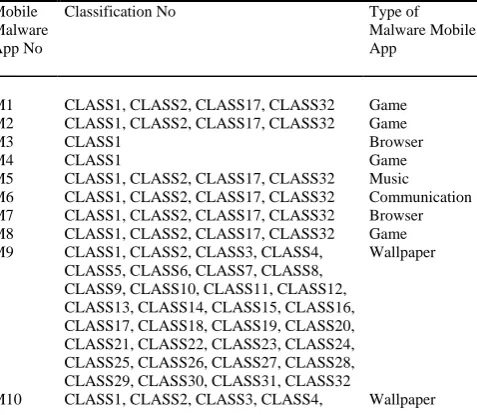
[image:5.595.53.286.345.533.2]Then, these 32 possible classification for camera exploitation have been tested with 500 mobile apps that are randomly picked from different categories in the Google play store. The results showed that 105 of the mobile apps matched with our 32 classification. The results can be referred in Table IV. Though 105 apps matched, still we rerun the evaluation on real time to consolidate and to make sure only genuine apps that exploit the camera with malicious intention were being selected. As a result, only 19 genuine apps have been identified that are capable to exploit camera for malicious purposes. This can be referred in Table V.
TABLE IV. EVALUATION RESULT.
Classification Percentage Classification Percentage
[image:5.595.51.290.582.789.2]CLASS1 CLASS2 CLASS3 CLASS4 CLASS5 CLASS6 CLASS7 CLASS8 CLASS9 CLASS10 CLASS11 CLASS12 CLASS13 CLASS14 CLASS15 CLASS16 3.00% 2.80% 0.40% 0.40% 0.20% 0.20% 0.40% 0.20% 0.20% 0.40% 0.60% 0.20% 0.20% 0.60% 0.20% 0.20% CLASS17 CLASS18 CLASS19 CLASS20 CLASS21 CLASS22 CLASS23 CLASS24 CLASS25 CLASS26 CLASS27 CLASS28 CLASS29 CLASS30 CLASS31 CLASS32 2.80% 0.40% 0.40% 0.20% 0.20% 0.40% 0.20% 0.20% 0.40% 0.60% 0.20% 0.20% 0.60% 0.20% 0.20% 2.80%
TABLE V. 19 APPS WITH CAMERA EXPLOIT FEATURES.
Mobile Malware App No
Classification No Type of
Malware Mobile App M1 M2 M3 M4 M5 M6 M7 M8 M9 M10
CLASS1, CLASS2, CLASS17, CLASS32 CLASS1, CLASS2, CLASS17, CLASS32 CLASS1
CLASS1
CLASS1, CLASS2, CLASS17, CLASS32 CLASS1, CLASS2, CLASS17, CLASS32 CLASS1, CLASS2, CLASS17, CLASS32 CLASS1, CLASS2, CLASS17, CLASS32 CLASS1, CLASS2, CLASS3, CLASS4, CLASS5, CLASS6, CLASS7, CLASS8, CLASS9, CLASS10, CLASS11, CLASS12, CLASS13, CLASS14, CLASS15, CLASS16, CLASS17, CLASS18, CLASS19, CLASS20, CLASS21, CLASS22, CLASS23, CLASS24, CLASS25, CLASS26, CLASS27, CLASS28, CLASS29, CLASS30, CLASS31, CLASS32 CLASS1, CLASS2, CLASS3, CLASS4,
Game Game Browser Game Music Communication Browser Game Wallpaper Wallpaper M11 M12 M13 M14 M15 M16 M17 M18 M19
CLASS9, CLASS10, CLASS11, CLASS14, CLASS17, CLASS18, CLASS19, CLASS22, CLASS25, CLASS26, CLASS29, CLASS32 CLASS1, CLASS2, CLASS11, CLASS14, CLASS17, CLASS26, CLASS29, CLASS32 CLASS1, CLASS2, CLASS17, CLASS32 CLASS1, CLASS2, CLASS17, CLASS32 CLASS1, CLASS2, CLASS17, CLASS32 CLASS1, CLASS2, CLASS17, CLASS32 CLASS1
CLASS1, CLASS2, CLASS17, CLASS32 CLASS1 CLASS1 Game Game Antivirus Communication Travel Communication Game Monitoring Tool Graphic
Based on the experimental results conducted, it can be concluded that cybercriminal can exploit system calls and permissions for camera functionality in Android smartphone without the owner’s consent. Therefore, a good solution to detect the malicious intention is needed to overcome such challenge. Furthermore, based on the current trend where social engineering technique has been integrated in the malicious mobile apps by the cybercriminal, therefore user should be educated on how to detect, respond and prevent from malicious mobile app infection.
IV. CONCLUSION
In this paper 32 new classification to detect mobile malware attacks via camera exploitation based on system calls and permissions have been presented. Cybercriminal can easily exploit system calls and permissions for camera functionality without users knowing it at their Android smartphones. Furthermore, based on the evaluation result it can be concluded that users have to be very careful in installing any third party apps. Apart from the technology and technical aspect that have been discussed in this paper, human factor which involves social engineering technique should not be ignored. Therefore for future work, a good solution that combines technical aspect and human aspect must be taken into account. Furthermore, automatic detection of malicious system calls and permissions is recommended to ease the malware detection job. Lastly, the finding in this paper can be used as guidance and input for the formation of mobile malware detection for camera exploitation.
ACKNOWLEDGMENT
The authors would like to express their gratitude to Ministry of Higher Education (MOHE), Malaysia and Universiti Sains Islam Malaysia (USIM) for the support and facilities provided.
REFERENCES
[1] Smith,C., Hackers have a new way to steal your banking login using
WhatsApp. BGR Media, LLC, http://bgr.com/2017/01/02/android-malware-whatsapp-threat/, last accessed 2017/8/8.
[2] Stefanko, L., Turn the light on and give me your passwords!. Eset, https://www.welivesecurity.com/2017/04/19/turn-light-give-passwords/, last accessed 2017/8/8.
[3] Koriat,O. and Polkovnichenko, A., Charger Malware Calls and
Raises the Risk on Google Play. Check Point Software Technologies Ltd, http://blog.checkpoint.com/2017/01/24/charger-malware/, last accessed 2017/8/8.
[4] Kaspersky Lab, Mobile Malware Evolution 2016,
https://securelist.com/files/2017/02/Mobile_report_2016.pdf, last
[5] Y. Zhou and X. Jiang, Dissecting Android Malware: Characterization and Evolution, IEEE Symp. Security and Privacy 2012, 2012, pp. 95–109.
[6] L. Wu, X. Du and X. Fu, Security threats to mobile multimedia
applications: Camera-based attacks on mobile phones, in IEEE Communications Magazine, vol. 52, no. 3, pp. 80-87, March 2014.
[7] Bartere,M. and Pore,M.A, Preventions and Features of Camera
Based Attacks on Smart Phones.International Journal of Emerging Trends & Technology in Computer Science, Vol.4, No4, 2015,pp. 9-12.
[8] Xu,N., Zhang,F., Luo,Y., Jia,Y., Jia,W., Xuan,D. and Teng,J. ,
Stealthy Video Capturer: A New Video Based Spyware in 3g Smartphones, Proc. 2nd ACM Conf. Wireless Network Security, 2009, pp. 69–78.
[9] F. Maggi, Gasparini,S., Boracchi,G., A Fast Eavesdropping Attack
against Touchscreens, 7th Int’l. Conf.Info. Assurance and Security, 2011, pp. 320–25.
[10] R. Raguram,M.W.,Andrew, Goswami,D., Monrose, F. and
Frahm,J.M., Ispy: Automatic Reconstruction of Typed Input from Compromising Reflections, Proc. 18th ACM Conf. Computer and Commun. Security, 2011, pp. 527–36.
[11] Kundu, A., Lin, Z. and Hammond, J., 2017. Energy Attacks on
Mobile Devices. arXiv preprint arXiv:1704.04464.
[12] Kynigos, C., Glisson, W.B., Andel, T. and McDonald, T., 2016,
January. Utilizing the Cloud to Store Hijacked Camera Images. In System Sciences (HICSS), 2016 49th Hawaii International Conference on (pp. 5497-5506). IEEE.
[13] Henry B Wolfe, The Insecurity of Mobile Phones, Proceedings of
Informing Science & In-formation Technology Education
Conference, 2010, 119-131.
[14] Deshpande, S. and Dharmadhikari, S.C., 2016. Analysis on Camera
Attacks and their De-fenses on Android Smartphones. European Journal of Advances in Engineering and Tech-nology, 3(3), pp.26-29.
[15] Chouhan, J. , Singh, N. , Modi, P. , Jani, K. and Joshi, B. (2016) Camera and Voice Control Based Location Services and Information Security on Android. Journal of Information Security, 7, 195-205. [16] D. Geneiatakis, I. N. Fovino, I. Kounelis, and P. Stirparo, A
Permission verification ap-proach for android mobile applications, Comput. Secur., vol. 49, pp. 192–205, 2015.
[17] D. Arp, M. Spreitzenbarth, H. Malte, H. Gascon, and K. Rieck, Drebin: Effective and Ex-plainable Detection of Android Malware in Your Pocket, Symp. Netw. Distrib. Syst. Secur., no. February, pp. 23–26, 2014
[18] M. Dimjasevic, Atzeni,S., Ugrina,I. and Rakamaric,Z., Android Malware Detection Based on System Calls, Uucs, vol. 11, no. 1, pp. 209–216, 2015.
[19] Y. D. Lin, Y. C. Lai, C. H. Chen, and H. C. Tsai, Identifying android malicious repackaged applications by thread-grained system call sequences, Comput. Secur., vol. 39, pp. 340–350, 2013.