WD16
MICROCOMPUTER
(Using MCP 3-Chip Microprocessor Set)
PROGRAMMER'S REFERENCE MANUAL
WESTERN!If DIGITAL
WD1600 MICROCOMPUTER
(Using MCP 3-Chip Microprocessor Set)
PROGRAMMER'S REFERENCE MANUAL
4 OCTOBER 1976
I ~
TABLE OF CONTENTS
CHAPTER ONE - GENERAL Abbreviations
Processor Status Word Registers
CHAPTER TWO - INTRODUCTION Addressing Modes Stack Operations Interrupt Lines Priori ty Mask
External Status Register Power Up Options
Halt Options
User Bootstrap Routine System Error Traps Reserved Core Locations
CHAPTER THREE - OP CODES Format 1 Op Codes Format 2 Op Codes Format 3 Op Codes Format 4 Op Codes Format 5 Op Codes Format 6 Op Codes Format 7 Op Codes Format 8 Op Codes Format 9 Op Codes Format lOOp Codes Format 11 Op Codes
APPENDIX A - Numeric Op Code Table APPENDIX B - Assembler Notes
APPENDIX C - Programming Notes
APPENDIX D - Microm State Code Functions APPENDIX E - Op Code Timings
PAGE 1.1
2.1
3.1
CHAPTER 1 - GENERAL
The WD16~~ microcomputer is a 16 bit machine with both word and byte addressing, an automatic push down hardware sta.ck, vectored interrupt handling, eight 16 bit registers, and PC relative addressing. A byte is defined as 8 bits, and a word is defined as 2 bytes. A memory address increment of one is an increment of 1 byte. An address increment of two is an increment of 1 word. Word addresses always start on even bytes. For any memory location the even byte is the least significant byte. Bit ~ is defined as the LSB of a memory location.
(MSB) 15 8 7 ~ (LSB)
I
High Byte Low Byte]
~---.--' ... ""--.(
Byte Address Byte Address
~ (ODD) X (EVEN) )
--....r
Word Address X (EVEN)
Unless otherwise stated, word addressing is implied. All addresses and op codes are done in hex unless otherwise stated. All hex numbers are enclosed within double quotes.
LEGEND OF ABBREVIATIONS
REG Register
SRC Source Address
(SRC) = Contents of Source Address
DST Destination Address
(DST) Contents of Destination Address
(SRC) B = Contents of Source Byte Address
(DST) B = Contents of Destination Byte Address
x
=
Ones Complement of X-x
=
Twos Complement of XA
=
Logical And'V
=
Logical OrSL
=
Exclusiveor
@
=
Indirect{-
=
Pusht
=
Pop+
=
Destination Direction+
=
Addition-
=
Subtraction*
=
Multiplication/
=
Division=
Double Precision Chain LinkPROCESSOR STATUS WORD
A 16 bit Processor Status (PS)
15 8 7
IExt. Status Reg.
I
ALUWord exists. The format is as follows:
4 3 2 1
f4
IN I
z
I
VI
ci
Where bits 8-15 are the contents of the external status register (see chapter 2), bits 4-7 are the status of the microprocessor ALU flags, and bits ~ -3 are the status of the condition indicators at the time the PS is formed. The ALU flags are of no use or concern to the progranuner. They are stored along with the condition indicators automatically as a func-tion 'of the micro-op. The four condition flags are updated during the exe-cution of most op codes, and are used by the branch instructions to test for valid branch conditions. The exact status of each indicator is de-fined along with the descriptions of individual op codes in chapter 3. In general, however, ~e indicators are set by the following conditions:
N = set if the MSB of the result is set. set if the result is zero.
Z
=
V= set if arithmetic overflow (underflow) occurs during addition (subtractic Set to exclusive -or of Nand C indicators otherwise.
C= set if carry (borrow) occurs during addition (subtraction). Also set to last bit shifted out during a shift operation.
REGISTERS
There are 8 registers in the WD1600. All are 16 bits long. Six can be hsed as either accumulators or index registers, one is the
stack pointer (SP), and one is the program counter (PC). The registers are numbered ~ - R7 with R6
=
SP and R7= pc.
The register set is usually referred to in the following manner: ~ - RS, SP, PC.CHAPTER TWO - INTROQUCTION
ADDRESSING MODES
In general there are 8 addressing modes for both source and destination addressing. Not all op codes accept all 8 modes (see chapter 3). Those that do use the following format: 3 bits for the index register (R~ - RS, SP, PC) and 3 bits for the mode. The mode bits are the upper 3 bits of the 6 bit set. The modes are
de-fined below. The numbers in parenthesis refer to notes that follow the definitions.
MODE ~ 1 2 3 4 5 6 7
NAME SYMBOLIC
Direct Register Indirect Register Auto-increment Auto-increment deferred Auto-decrement Auto-decrement deferred
Indexed register
Indexed register deferred REG @REG (REG) + @(REG)+ - (REG) @- (REG) X(REG) @X(REG) DESCRIPTION
REG is or contains operand. REG contains address of operand. REG contains address of operand. REG is post-incremented (1). REG contains address of add-ress of operand. REG is post-incremen ted by 2.
REG is predecremented (1). REG then contains address of operand. REG is predecremented by 2. REG then contains address of address of operand.
Contents of REG plus X is address of operand (2).
Contents of REG plus X is address of address of operand (2).
NOTE 1: For word operations the increment/decrement is 2. For byte
operations the increment/decrement is 1 unless the index register is SP or PC. In this case the increment/decrement is always 2.
NOTE 2: The contents of REG remain unchanged.
MODE
2
3
6
7
When using PC as the index register the assembler accepts the following 4 formats in place of the formats mentioned above for ease of programming.
NAME Immediate Absolute Relative SYMBOLIC #N @#N A
Relative deferred @A
DESCRIPTION
Operand N follows op code. Address of operand is N and i t follows the op code in memory. PC relative offset to address A, which contains operand, follows op code.
PC relative offset to address A, which contains address of operand,
follows the op code.
The 8 modes are referred to as Source Mode ~ to Source Mode 7 (S~ -SM7) and Destination Mode ~ to Destination Mode 7 (DMSI -DM7). In Chapter 3 these modes are referred to in general terms during op code def-initions as "SRC" and "DST".
STACK OPERATIONS
Although automatic stack operations are provided for, no specific area of memory is set aside for the stack. The user must assign an area of memory by loading the stack pointer with the top address of the designated stack area. Stack operations are push-down pop-up operations with predecrements and post-increments of SP. Stack operations may also be executed explicitly by using SP as an index register with op codes that allow SM~ - SM7 and/or OM~ - OM7 addressing.
When pushing the PS the word is formed just prior to the push. When popping the PS the condition indicators and interrupt enable flag are set to the status of the appropiate bits in the popped PS. Other than that the popped PS goes nowhere. Unless otherwise stated popping the PS from the stack performs the above mentioned operations and only the above mentioned operations.
When pushing the PC onto the stack PC will be set to the address of the op code that follows the op code that caused the push. There are cases where some op code formats can alter this rule. They gen-erally involve advanced programming techniques. A few are mentioned in appendix C. In particular, system errors that are caused by pro-gramming errors and not real time error conditions will push a PC that points to the op code that follows the op code that caused the error. The stored PC must be decremented by two to get the address of the offending op code.
INTERRUPT LINES
There are 4 interrupt lines available to the system. They are labeled I~ - 13. These lines are assigned functions as follows:
I~ = Vectored interrupt line II = Nonvectored interrupt line 12 = Enable/disable for I~ and II.
I3
=
Halt switchThe priority among the lines is as follows:
13, Il~I2, I~~I2.
Note that 13 is always enabled. Note also that the nonvectored inter-rupt has priority over the vectored interinter-rupt. The system is currently set up so that power fail and a real time clock can be assigned to II, and up to 16 devices assigned to I~.* The two interrupts operate as follows: A) Nonvectored Interrupt (II)
PS and PC are pushed onto the stack. 12 is disabled. The external status register is tested for a power fail. If power fail is true PC is fetched from location "14". If power fail is false PC is fetched from location "2A", and a microm state code is transmitted to clear the line clock (see appendix 0).
B) Vectored Interrupt (I~)
*
PS and PC are pushed onto the stack. 12 is disabled. An Interrupt Acknowledge is executed, and the device code of the interrupting de-vice is read in and stripped to bits 1- 4. PC is fetched from location NOTE: AI though onlX ~ 4 bj. t device code ia cUJ;'l;ently used, a minor microm
"28" and the device code is added to it. The ccntents of this inter-mediate location are read in and added to PC to form the final address. Each intermediate location is a table entry that contains the PC rela-tive offset from the start of the device handler routine to itself. The absolute address of the start of the table is in location "28".
PRIORITY MASK
Associated with the interrupts is a priority interrupt mask. This is a 16 bit mask where each bit position represents a priority level. Each priority level can be assigned to one or more devices. A one in any bit position can represent an interrupt enable or disable for its associ-ated devices as the hardware dictates. The SAVS, RSTS, and MSKO op codes each alter the mask. When the mask is altered i t is written into location
II 2E" for storage. While the mask is on the bus a microm state code is transmitted (see appendix D) to signal the I/O devices that a new mask is being transmitted. Each device can then look at its assigned mask bit while the memory write to location 12E" is taking place. Whether or not
the mask feature is actually used by the I/O devices in no way alters the operations of the op codes mentioned above.
EXTERNAL STATUS REGISTER
As a part of the hardware external to the CPU the External Status Register supplies the CPU, upon demand, with information about the status of certain hardware areas. This register is gated onto the bus when its associated microm state code is present (see appendix D). The format of the register is as follows:
Bit 7 = Power Fail Status
Bit 6 = Bus Error (Time Out) Status Bit 5 Parity Error Status
Bit 4 I2 Interrupt Line Status Bit 3 = Halt Option Jumper #2 Bit 2 = Halt Option Jumper #1 Bit 1 = Power Up Option Jumper #2 Bit ~ = Power Up Option Jumper #1
Bits 8-15 are don't care. Bits 5-7 are real time error conditions that also generate a system reset (see next section). Bit 4 is the interrupt enable status. The jumpers can be logic units, switches, or hard wired
jumpers as the user wishes. The various options associated with the 4 jumpers are discussed later.
POWER UP OPTIONS
A system reset indicate one of 4 conditions: power fail, bus error, parity error, or power up. There are 2 levels of power fail possible in this system (see appendix C): minor and major. Only a major power fail generates a system reset. Both types set bit 7 in the External Status Register. The following steps are performed after a system reset.
AI) Trace and wait flags are reset if on. A2) The external Status Register is fetched.
A3) The Line-clock-clear state code is transmitted. A4) 12 is reset.
A5) If power fail bit is set go to Dl. A6) If bus error bit is set go to Cl. A7) If parity error bit is set go to BI. AS) Go to D2 otherwise.
BI) Push PS and PC onto stack.
B2) Fetch PC from location "12"and begin execution.
Cl) Push PS and PC onto stack.
C2) Fetch PC from location "IS" and begin execution.
Dl) Wait until power fail status = ~. D2) Send a' system-reset microm state code. D3) Wait 300 cycles.
D4) Execute power up option 1,2,3 or 4 per jumpers.
For a proper initial power up either bit 7 must be set or bits 5-7 must be reset when the system reset line is released.
The 4 power up options are as follows:
JUMPERS
l~ 11
OPERATION
Execute user bootstrap routine.
Pick up ~-R5, SP, PC, and PS from memory locations ~-"l~".
Execute selected halt option. Fetch PC from location "16".
HMT OPTIONS
When the halt switch (I3) is set during program execution one of 4 halt options is selected. 'the halt op code* and power up option #2 also select the halt option specified. The options are as follows:
JUMPERS
l~
11
O:PERATION
Execute user bootstrap routine.
Save R~-R5,SP,PC and PS in memory locations ~-"l~". Wait until 13 = ~, then restore R~ R5,SP,PC and PS from memory locations ~-"l~".
Lock up processor (requires a system reset to clear) Fetch new PC from location "16".
*NOTE: Conditional. See Chapter 3.
USER BOOTSTRAP ROUTINE
wnen the user bootstrap routine is selected as an option the system creates the starting address by placing address "C~~~" in pC and then replacing bits S-13 with the contents of the 6 bit External Address Register. This register is gated in with a microm status code (see appendix D).
It allows the user 64 different starting addresses in the range "C~~~" to "FF~~".
SYSTEM ERROR TRAPS
With the exception of the major power fail error that is a function of a system reset, all error conditions perform a common routine as outlined below. A non-vectored interrupt and some op codes also use this routine. The numbers in parenthesis refer to notes that follow the table.
1) PS is pushed onto the stack 2) PC is pushed onto the stack
3) PC is fetched from location X where "X" is from the following table
(1)(2)(3) 12" for bus error PC
(1) (2) (3) 14" for nonvectored interrupt power fail PC
(I) (2) (3) 18" for parity error PC
(1) (2) (3) lA" for reserved op code error PC
(1) (2) (3) lC" for illegal op code format error PC (1) (2) (3) lE" for XCT error PC
(1) (2) 2~" for XCT trace PC
(1) (2) (3) 2A" for nonvectored interrupt PC (1) (2) 2C" for BPT PC
NOTE 1: NOTE 2:
wait flag reset if on trace flag reset if on
NOTE 3: interrupt enable (I2) reset if on
The meaning of the wait and trace flags is discussed in chapter 3. Note that the nonvectored interrupt power fail PC is a minor power fail condition, not a major one. See appendix C for full detail on how to include both major and minor power fail conditions in the hardware.
RESERVED CORE LOCATIONS
The following is a complete list of memory locations that are re-served for specific system functions or options. Byte addresses are given.
LOCATIONS
~ - "II" "12" - "13" "14 - "15" "16" - "17"
"18" - "19"
"lA" -"lB" "lC"
-
"lD" "IE"-
''IF'' "213"-
"21" "22"-
"23" "24"-
"25" "26"-
"27" "28"- "29" "2A"-
"2B""2C"
-
"2D" "2E" - 2F" "3lJ" - "3F"RESERVED FUNCTION
R~ - RS, SP, PC and PS for power up/halt options bus error PC
nonvectored interrupt power fail PC power up/halt option power restore PC pari ty error PC
reserved op code PC
illegal op code format PC XCT error PC
XCT trace PC
SVCA ~able address SVCB PC
SVCC PC
vectored interrupt (I~) table address nonvectored interrupt (II) PC
BPT PC
I/O priority interrupt mask
CHAPTER 3 - OP CODES
This chapter is divided into a number of sections, each repre-senting one class of op codes. At the beginning of each section there is a detailed description of the format for that class. A list of op codes and their base numeric values, less arguments, is also included. A detailed description of each op code in the class then follows.
FORMAT 1 OP CODES
Single word - no arguments
15 12 11 8 7 4 3
o
L
I
OPCThere are 16 op codes in this class representing op codes "~fJfJfJ" to "~~~F". Each is a one word op code with no arguments with the exception of the SAVS op code which is a two word op code. Word two of the SAVS
op code is the I/O priority interrupt mask. The op codes and their mnemoni~s are:
BASE OP CODE
~~~~
~Illll
1l1l1l2
~llfJ3 ~~1l4 ~~~5 ll~fJ6 1l~1l7 ~~fJ8 ~~~9 fJll~A ~~~B ~~~C ~~~D ~~~E
f6f6IlF
NOP
FORMAT: FUNCTION:
INDICATORS :
RESET
FORMAT: FUNCTION:
INDICATORS :
MNEMONIC
NOP RESET lEN IDS HALT XCT BPT WFI
RSVC
RRTT SAVE SAVS REST RRTN
RSTS RTT
NO OPERATION
NOP
No operations are performed Unchanged
I/O RESET
RESET
An I/O reset pulse is transmitted Unchanged
lEN
FORMAT: FUNCTION:
INDICATORS:
IDS
FORMAT: FUNCTION:
INDICATORS:
INTERRUPT ENABLE
lEN
The interrupt enable (I2) flag is set. Allows one more instruction ~o execute before inter-rupts are recognized.
Unchanged
INTERRUPT DISABLE
IDS
The interrupt enable (12) flag is reset. This instruction can honor interrupts, but
the 12 bit in the PS that is stored on the stack is reset if an interrupt occurs.*
Unchanged
*NOTE: On some machines 12 will be set or reset during the lEN or IDS. If so the change will be valid immediately, not one op code later.
HALT
FORMAT: FUNCTION:
INDICATORS :
XCT
FORMAT: OPERATION:
FUNCTION:
HALT
HALT
Tests the status of the Power Fail bit in the external status register. If the bit is set it is assumed that the HALT occured in a power fail routine, and the following operations occur: 1) The interrupt enable (12) flag is reset
2) The CPU waits until the Power Fail bit is rese"
3) PC is fetched from location "16", and program execution begins at this new location
If the power fail bit is reset then the CPU waits until the halt switch (13) is set. At that time the selected halt option (see chapter 2) is execub The interrupt enable flag is also reset.
Unchanged
EXECUTE SINGLE INSTRUCTION
XCT
PC + @SP, SP t
PS +- @SP, SP t
Trace flag set, execute op code +SP, @SP + PS
+SP, @SP + PC Trace flag reset
PC + (loc "2~") if no error PC + (loc "lE") if error
PC and PS are popped from the stack, but 12 is no t
pushed onto the stack, and PC is fetched from location "lE" instead. 12 is also reset.
INDICATORS: Depends upon executed op code
BPT FORMAT: OPERATION: FUNCTION: INDICATORS : WFI FORMAT: FUNCTION: INDICATORS : SAVE FORMAT: OPERATION: FUNCTION: INDICATORS : SAVS FORMAT: OPERATION: FORMAT: INDICATORS : REST FORMAT: OPERATION:
BREAKPOINT TRAP
BPT
~ SP, @SP +PS ,.: SP, @SP +PC
PC +. (loc "2C")
PS and PC are pushed onto the stack. PC is fetched from location "2C"
Unchanged
WAIT FOR INTERRUPT
WFI
The CPU loops internally without accessing
the data bus until an interrupt occur~. Program execution continues with the op code that follows the WFI after the interrupt has been serviced. The interrupt enable flag is also set.
Unchanged
SAVE REGISTERS
SAVE
-} SP, @SP+ R5 ~ SP, @SPof- R4 ~ SP, @SP+ R3 ~ SP, @SP+ R2
~ SP, @SP+ RI -} SP, @SP+
Rf6
Registers R5 Unchanged.
SAVE STATUS
SAVS MASK
SAVE
to ~ are pushed onto the stack.
'"+SP, @SP + (loc "2E")
(loc "2E") +0 (loc "2E ") V mask
MsKO lEN
Registers R5 to
Rf6
and the priority mask in location "2E" are pushed onto the stack. The old and new masks are ORED together and placed in location "2E".A mask out state code (see appendix D) is transmitted and the interrupt enable (I2) flag is set.
Unchanged
RESTORE REGISTERS
REST
~ -+-·@SP, SP
+
Rl +- @SP, SP1-R2 +- @SP, SP t
R3 +- @SP, SP of R4 +- @SP, SP t RS+ @SP, SP t
FUNCTION: Registers
R?
to ~ are popped from the stack, INDICATORS: UnchangedRTT
FORMAT: OPERATION:
FUNCTION: INDICATORS :
RRTN
FORMAT: OPERATION:
FUNCTION:
INDICATORS :
~TT
FORMAT: OPERATION:
FUNCTION:
INDICATORS :
RSTS
FORMAT: OPERATION:
FUNCTION:
INDICATORS :
RSVC
FORMAT: OPERATION:
RETURN FROM TRAP
RTT
PC +@SP, SP t PS +-@SP, SP t
PC and PS are popped from stack N
=
Set per PS bit 3Z
=
Set per PS bit 2 V=
Set per PS bit 1C
=
Set per PS bit ~RESTORE AND RETURN FROM SUBROUTINE
RRTN
REST
PC
+- @SP, sPtRegisters R~ to R5 and PC are popped from the stack
Unchanged
RESTORE AND RETURN FROM TRAP
RRTT
REST RTT
Registers ~ to R5~ PC and PS are popped from the stack.
Set per PS bits ~ - 3
RESTORE STATUS
RSTS
(LOC 12E") +- @SP, SP t MSKO
REST RTT
The priority mask is popped from the stack and restored to locaton "2E". A MASK OUT state code
(See Appendix D) is transmitted. Registers ~
to !OJ PC and PS are popped from the stack. Set per PS bits ~ - 3
RETURN FROM SUPERVISOR CALL (B or C)
RSVC REST
FUNCTION:
INDICATORS :
Registers ~ to RS, PC and PS are popped from the stack with the saved SP bypassed.
Set per PS bits ~ - 3
FORMAT 2 OP CODES
SINGLE WORD - 3 BIT REGISTER ARGUMENT
15 12 11 8 7 3 2
o
OPC REG
There are 4 op codes in this class representing op codes "f6f6lfl" to "f6f12F". Each is a one word op code with a single 3 - bit register argument. The op codes and their mnemonics are:
BASE OP CODE
f6!ilf6 f6f1l8 flf62f6 f6f628 IAK FORMAT: FUNCTION: INDICATORS : RTN FORMAT: OPERATION: FUNCTION: INDICATORS : MSKO FORMAT: OPERATION: FUNCTION: INDICATORS : PRTN FORMAT: OPERATION: MNEMONIC IAK RTN MSKO PRTN
INTERRUPT ACKNOWLEDGE
IAK REG
An interrupt acknowledge (READ and lACK) is executed, and the 16 bit code that is returned is placed in· REG unmodified. Used with the nnnvectored interrupt when the user does not wish to use the vectored format. Unchanged
RETURN FROM SUBROUTINE
RTN
PC;: +
REG· +
REG REG @SP,Sp. t
The' . linkage register is placed in PC and the saved linkage register is popped from the stack. The register used must be the same one that was used for the subroutine call.
Unchanged
MASK OUT
MSKO REG
(LOC "2E" ) + REG MSKO
The contents of REG are written into location "2E" and a MASK OUT state code (see appendix D) is transmitted.
Unchanged
POP STACK AND RETURN
PRTN TMP+ SP +
FUNCTION:
INDICATORS :
Twice the value of the top word on
the stack is added to SP, and a standard RTN call is then executed.
Unchanged
· . .
FORMAT 1 OP CODES
SINGLE WORD - 4 BIT NUMERIC ARGUMENT
fI
,
fI
8I
7 OPC 4I
3~I
~15 12 11
There is only one op code in this class representing op codes
"flfl3f1" to "flfl3F". It is a one word op code with a 4-bit numeric argument.
BASE OP CODE
LCC
FORMAT: FUNCTION:
INDICATORS :
MNEMONIC
LCC
LOAD CONDITION CODES
LCC ARG
The 4 indicators are loaded from bits fI-3 of the op code as specified.
FORMAT 4 OP CODES
SINGLE WORD - 6 BIT NUMERIC ARGUMENT
15 12 11 8 7 6 5
I
OPCI
ARGThere are 3 op codes in this class representing op codes
"f6f64[1" to "f6f1FF". All 3 are supervisor calls. All 3 are one word op codes with a 6-bit numeric argument.
BASE OP CODE
SVCA
FORMAT: OPERATION:
FUNCTION:
INDICATORS :
SVCB SVCC
FORMAT:
OPERATION:
FUNCTION:
MNEMONIC
SVCA SVCB SVCC
SUPERVISOR CALL "A"
SVCA ARG
~SP I @SP of- }\S:i -I- SP I@SP+ PC
PC -+ (LOC "22") + (ARG *2) PC +PC + @PC
PS and PC are pushed onto the stack. The contents of location "22" plus twice the value
of the argument (which is always positive) is placed in PC to get the table address. The contents
of the table address is added to PC to get the final destination address. Each table entry is the relative offset from the start of the desired
routine to itself. Unchanged
SUPERVISOR CALL "B" SUPERVISOR CALL
"c"
SVCB ARG
SVCC ARG
TMPA + SP +SP I @SP+
~SP, @SP+ TMPB +SP
'+
SP, @SP + SAVERl + TMPB R5 + ARG*2
PS PC
TMPA
PC... (LOC "24") if SVCB PC +' (LOC "26") if SVCC
PS and PC are pushed onto the stack. The value of SP at the start of op code execution is the pushed followed by registers R5 to~. 'The address of the saved PC is placed in Rl, and twice the value of the 6-bit positive argument is placed in R5.
INDICATORS :
PC is loaded from location ,. 24" for SVCB or "26" for SVCC. Unchanged.
FORMAT 5 OP CODES
SINGLE WORD - 8 BIT SIGNED NUMERIC ARGUMENT
15 8 7 ~
OPC
I
DISPLACEMENT c= ,There are 15 op codes in this class representing op codes
"~l~~" to "~7FF" and "8~~W' to "87FF". All are branches with a signed 8 bit displacement that represents the word offset from PC
(which points to the op code that follows) to the desired branch location. The op codes consist on one unconditional branch, 8
signed conditional branches, and 6 unsigned conditional branches. No op code in this class modifies any of the indicator flags. Max-imum branch range is +.128, -127 words from the branch op code.
BASE OP CODE
)i11)i1)i1 )i12)i1)i1
)i13~)i1 )i14~~
)i15)i1)i1 )i16)i1)i1
)i17)i1~ 8~~)i1 81~~ 82~0 83~~ 84)i1~ 850~ 86~)i1 87~~
BR
FORMAT: OPERATION: FUNCTION:
BNE
FORMAT: OPERATION:
MNEMONIC
BR BNE BEQ BGE BLT BGT BLE BPL BMI BHI BLOS BVC BVS
BCC, BHIS BCS, BLO
BRANCH UNCONDITIONALLY
BR DEST
PC + PC+ (DISP *2)
Twice the value of the signed displacement is added to PC.
SIGNED BRANCHES
BRANCH IF NOT EQUAL TO ZERO
BNE DEST
IF Z = ¢, PC + PC + (DISP *2)
~, ____________________ ~B~RA~N~C~H~I~F~E~Q~U~A~L~TO~~Z~E~RO~ ______________ ___
FORMAT: BEQ DEST
OPERATION: IF Z
=
1, PC + PC + (DISP *2)BGE B~~CH IF GREATER THAN OR EQUAL TO ZERO
FORMAT: BGE DEST
BLT
FORMAT: OPERATION:
BGT
FORMAT: OPERATION:
BLE
FORMAT: OPERATION:
BPL
FORMAT: OPERATION:
BMI
FORMAT: OPERATION:
BHI
FORMAT: OPERATION:
BLOS
FORMAT: OPERATION:
BVC
FORMAT: OPERATION:
BVS
·FORMAT: OPERATION:
BCC
BHIS
FORMAT:
OPERATION:
BRANCH IF LESS THAN ZERO
BLT DEST
IF N~V
=
1, PC + PC + (DISP *2)BRANCH IF GREATER THAN ZERO
BGT DEST
IF Z v(~) = ~, PC + PC + (DISP *2)
BRANCH IF LESS THAN OR EQUAL TO ZERO
BLE DEST
IF ZV (WV)
=
1, PC ... PC + (DISP *2)BRANCH IF PLUS
BPL DEST
IF N = ~, PC + PC + (DISP *2)
BRANCH IF MINUS
BMI DEST
IF N = 1, PC + PC + (DISP *2)
UNSIGNED BRANCHES
BRANCH IF HIGHER
BHI DEST
IF CVZ =
¢,
PC + PC + (DISP *2)BRANCH IF LOWER OR SAME
BLOS DEST
IF CVZ
=
1, PC + PC + (DISP *2)BRANCH IF OVERFLOW CLEAR
BVC DEST
IF V
=
¢,
PC + PC + (DISP *2)BRANCH IF OVERFLOW SET
BVS DEST
IF V
=
1"PC + PC + (DISP *2)BRANCH IF CARRY CLEAR
BRANCH IF HIGijER OR SAME
BeC DEST BHIS DEST
IF C
=
¢,
PC + PC + (DISP *2)BCS BLO
FORMAT:
OPERATION:
BRANCH IF CARRY SET BRANCH IF LOWER
BCS DEST BLO DEST
IF C
=
1, PC~ PC + (DISP *2)FORMAT 6 OP CODES
S.iNGLE WORD - SINGLE OPS - SPLIT FIELD - DMf6 ONLY
15 9 8 6 5 4 3
o
I
OPC BASEI
REGI
OPCI
COUNTThere are 12 op codes in this class representing op codes "f68~~" to "f69FF", "88~f6" to " 89FF" , and "8E~fIS" to "8FFF". There are 4 immedi-ate mode op codes with a register as a destination, 4 multiple count single register shifts, and 4 multiple count double register shifts. In all op codes the actual count (or number in the case of the immedi-ates) is the value of bits f6 - 3 plus one. Count is always a positive number in the range 1 - "l~", but it is stored in the op code as ~ -"F". All of these op codes are one word op codes with the op codes them-selves split between bits 9-15 and 4-5.
In the case of the double shifts the 32 bit number (REQtl) (REG) is the operand. If REG
=
PC then (REG+l)=
R!2S.BASE OP CODE
~8f1S(IS ~81flS flS82f1S flS83f1S 88f1SfIS 881flS 882f1S 883f1S 8Ef6f1S 8ElflS 8E2f1S 8E3f1S
ADD I
FORMAT; OPERATION: FUNCTION: INDICATORS : SUBI FORMAT: OPERATION: FUNCTION: MNEMONIC ADDI SUBI BICI MOVI SSRR SSLR SSRA SSLA SDRR SDLR SDRA SDLA
ADD IMMEDIATE
ADDI NUMBER, REG REG +- REG + COUNT + 1
The stored number plus one is added to the destination register.
N
=
Set if bit 15 o~ the result is set Z=
Set if the result=
(ISV = Set if arithmetic overflow occurs; i.e. set if both operands were positive and the sign of the result is negative
C
=
Set if a carry was generated from bit 15 of the resultSUBTRACT IMMEDIATE
SUBI NUMBER, REG REG +. REG - (COUNT +1)
The stored number plus one is subtracted from the destination register.
INDICATORS :
BICI
FORMAT: OPERATION: FUNCTION:
INDICATORS :
MOVI
FORMAT: OPERATION: FUNCTION:
INDICATORS :
SSRR
FORMAT: FUNCTION:
INDICATORS :
SSLR
FORMAT: FUNCTION:
INDICATORS :
N ~ Set if bit l5 Qf ~e ~eault is set Z
=
Set if the result=
~V = Set if arithmetic underflow occurs; i.e. set if the operands were of opposite signs and the sign of the result is positive
C = Set if a borrow was generate from bit 15 of the result
BIT CLEAR IMMEDIATE
BICI NUMBER, REG
REG +. REG l!.(COUNT + 1)
The stored number plus one is one's complemented and ANDED to the d~stination register
N
=
Set if bit 15 of the result is set Z Set if the result= ¢
V
=
Reset C=
UnchangedMOVE IMMEDIATE
MOVI NUMBER I REG
REG +-COUNT + 1
The stored number plus one is placed in the destination register
N Reset
Z = Reset
V Reset
C
=
UnchangedSHIFT SINGLE RIGHT ROTATE
SSRR REG, COUNT
A l7-bit right rotate is done stored count+l times on REG:C-Flag. The C-Flag is shifted into bit 15 of REG, and the C-Flag gets the last bit shifted out of REG bit
¢.
N = Set if bit 7 of REG is set Z = Set if REG = ¢
V = Set to exclusive or of Nand C flags C = Set to the value of the last bit shifted out of REG bit ¢
SHIFT SINGLE LEFT ROUTINE
SSLR REG, COUNT
A 17-bit left rotate is done stored count+l times on C-Flag: REG. The C-Flag is shifted into bit ¢ of REG and the C-Flag gets the last bit shifted out of REG bit 15.
N
=
Set if bit 15 of REG is set Z = Set if REG=
~V
=
Set to exclusive or of N and C flags C=
Set to the value of the last bit shiftedout of REG bit 15.
SSRA FORMAT: FUNCTION: INDICATORS : SSLA FORMAT: FUNCTION: INDICATORS: SDRR FORMAT: FUNCTION: INDICATORS: SDLR FORMAT: FUNCTION: INDICATORS :
SHIFT SINGLE RlGliT ARITHMETIC
SSRA REG, COUNT
A l7-bit right arithmetic shift is done stored count+l times on REG: C-Flag. Bit 15 of REG is replicated. The C-Flag gets the last bit shifted out of REG bit~. Bits shifted out of the C-Flag are lost.
N = Set if bit 7 of REG is set Z = Set if REG = ~
V = Set to exclusive or of Nand C flags C = Set to the value of the last bit shifted
out of REG bit ~
SHIFT SINGLE LEFT ARITHMETIC
SSLA REG, COUNT
A l7-bit left arithmetic shift is done stored count+l . times on C-Flag:R;EG. Zeros are shifted into REG bit~, and the C-FLAG gets the last bit shifted out of REG bit 15. Bits shifted out of the C-Flag are
lost-N = Set if REG bit 15 is set Z =
V =
C =
Set if Set to Set to out of
REG
=
~exclusive or of N and C flags the value of the last bit shifted REG bit 15
SHIFT DOUBLE RIGHT ROTATE
SDRR REG, COUNT
REG+l:REG:C-Flag is rotate right stored count+l times. The C-Flag is shifted into REG+l bit 15, REG+l bit
¢
is shifted intoREG bit 15, and REG bit ¢ is shifted into the C-Fla N = Set if bit 7 of REG is set
Z
=
Set if REG=
~V
=
Set to exclusive or of N and C flags C=
Set to the value of the last bit shiftedout of REG bit ~
SHIFT DOUBLE LEFT ROTATE
SDLR REG, COUNT
A 33 bit left rotate is done stored count+l times on C-Flag:REG+l:REG. The C-Flag is shifted into REG bit ~, REG bit 15 is shifted into REG+l bit~, and REG+l bit 15 is shifted into the C-Flag
N
=
Set if REG+l bit 15 is set Z = Set if REG+l = ~V
=
Set to exclusive or of N and C flags C=
Set to the value of the last bit shiftedSDRA
FORMAT: FUNCTION:
INDICATORS:
SDLA
FORMAT: FUNCTION:
INDICATORS:
SHIFT OOUBLE RIGHT ARITHMETIC
SDRA REG, COUNT
A right arithmetic shift is done stored count+l times on REG+l:REG:C-Flag.
Bit 15 of REG+l is replicated. Bit ~ of REG+l . is shifted to bit 15 of REG. Bit
~ of REG is shifted to the C-Flag. Bits shifted out of the C-Flag are lost. N = Set if bit 7 of REG is set
Z
=
Set if REG=
~V
=
Set to exclusive or of Nand C flags C = Set to the value of the last bitshifted out of REG bit ~
SHIFT DOUBLE LEFT ARITHMETIC
SDLA REG, COUNT
A left arithmetic shift is done stored count+l times on C-Flag:REG+l:REG.
Zeros are shifted into REG bit ~, REG bit 15 is shifted to REG+l bit~. REG+l bit 15 is shifted to the C-Flag. Bits shifted out of the C-Flag are lost. N
=
Set if REG+l bit 15 is set Z=
Set if REG+l=
~V Set to exclusive or of N and C flags C Set to the value of the las~ bit shifted
out of REG+l bit 15
FORMAT 7 OP CODES
SINGLE OPS - ONE OR TWO WORDS - DM~ TO DM7
15 6 5 3 2
o
OPC
I
MODE REGI
There are 32 op codes in this class representing op codes "~A~~" to "~DFF" and "SA~~" to nSDFF". All addressing modes from ~ to 7 are available with all registers available as index regis-ters (see chapter two). A one word op code is generated fbr ad-dressing modes ~ to 5. A two word op code is generated for addres-sing modes 6 and 7 with the offset value in word two. For DM6 and DM7 with PC as the index register PC is added to the offset from word two af€er the offset is fetched from memory. The offset is there-fore relative to a PC that points to the op code that follows (i.e. current op code + 4). Codes "SA~~" to "SCC~" are BYTE ops.
BASE OP CODE
~A~~ ~A4~ ~AS~ ~AC~ ~B~~ ~B4~ ~BS{t ~BC~ ~C~~ ~C4~ ~CS~ ~CC~ ~D~~ ~D4~ ~DS~ ~DC~ ROR FORMAT: FUNCTION: INDICATORS: ROL FORMAT: FUNCTION:
MNEMONIC BASE OP CODE MNEMONIC
ROR 8A~~ RORB
ROL SA4~ ROLB
TST SAS~ TSTB
ASL SAC~ ASLB
SET SB~~ SETB
CLR SB4~ CLRB
ASR SBS~ ASRB
SWAB 8BC~ SWAD
COM SC~~ COMB
NEG 8C4~ NEGB
INC SCS~ INCB
DEC 8CC~ DECB
IW2 8D~~ LSTS
SXT SD4~ SSTS
TCALL 8DS~ ADC
TJMP SDC~ SBC
WORD OPS
ROTATE RIGHT
ROR DST
A I-bit right rotate is done on (DST):C-Flag The C-Flag is shifted into (DST) bit 15, and (DST) bit ~ is shifted into the C-flag.
N
=
Set if bit 7 of (DST) is set Z=
Set if (DST)=
~V = Set to exclusive or of N and C flags
C
=
Set to the value of the bit shifted out of (DST)ROTATE LEFT
ROL DST
A I-bit left rotate is done on C-Flag: (DST). The
INDICATORS : TST FORMAT: OPERATION: FUNCTION: INOICATORS: ASL FORMAT: FUNCTION: INDICATORS : SET FOP.MAT: OPERATION: FUNCTION: INOIcATORS : CLR FORMAT: OPERATION: FUNCTION: INDICATORS : ASR FORMAT: FUNCTION:
C-Flag i~ shifted into (OST) bit ~, and (OST) bit 15 is shifted intQ the C-Flag.
N
=
Set if bit 15 of (OST) is set Z=
Set if (OST)=
~V
=
Set to exclusive or of N and C flagsC = Set to the value of the bit shifted out of (OST)
TEST WORD
TST OST
(OST) l!. (OST)
The indicators ?re set to reflect the destination operand status.
N
=
Set if (OST) bit 15 is setZ
=
Set if (OST)=
~ V=
ResetC
=
Unchang~dARITHMETIC SHIFT LEFT
ASL OST
A I-bit left arithmetic shift is done on (DST). A zero is shifted into (OST) bit ~, and (OST) bit 15 is shifted into the C-Flag.
N - Set if (DST) bit 15 is set Z
=
Set if (OST)=
~V = Set to exclusive or of N and C flags
C
=
Set to the value of the bit shifted out of (OST)SET TO ONES
SET OST
(OST) +' "FFFF"
The destination operand is set to all ones N = Set
Z
=
ResetV = Reset C
=
UnchangedCLEAR TO ZEROS
CLR OST
(OST) +- ~
The destination operand is cleared to all zeros N
=
ResetZ = Set V = Reset
C
=
Unchanged if OMgJ. Reset if OMI-0M7.ARITHMETIC SHIFT RIGHT
ASR OST
A I-bit right arithmetic shift is done on (OST). Bit 15 of (OST) is replicated. Bi t ~ of (OST) is shifted.
into the C-Flag.
INDICATORS : SWAB FORMAT: OPERATION: FUNCTION: INOICATORS : COM FORMAT: OPERATION FUNCTION: INDICATORS.: NEG FORMAT: OPERATION: FUNCT<ION: INOiICATORS: INC FORMAT: OPERATION: FUNCTION: INOICATORS : OEC FORMAT: OPERATION: FUNCTION: INDICATORS :
N
=
Set if (OST) bit 7 is setZ
=
Set if (OST)=
~V
=
Set to exclusive or of N and C flagsC
=
Set to the value of the bit shifted out of (OST)SWAP BYTES
SWAB OST
COST) 15-8
t
(OST) 7-~The upper and lower bytes of (OST) are exbanged. N - Set if (OST) bit 7 is set
Z
=
Set if (OST) lower byte = ~ V=
ResetC = Unchanged
COMPLEMENT
COM OST
COST) -+- COST)
The destination operand is one's complemented. N = Set if (OST) bit 15 is set
Z = Set if (OST)
=
~ V = ResetC = Set
NEGATE
NEG OST
(OST) -+- - (OST)
The destination operand is two's complemented. N
=
Set if (OST) bit 15 is setZ
=
Set if COST)=
~ V=
Set if (OST)=
"8~~~". C=
Reset if (OST)=
~INCREMENT
INC OST
COST) -+- (OST) + 1
The destination operand is incremented by one. N
=
Set if COST) bit 15 is setZ
=
Set if (OST)=
~ V=
Set if (OST)=
"8~~~"C
=
Set if a carry is generated from (OST) bit 15OECREMENT
OEC OST
(OST) -+- (OST) - 1
The destination operand is decremented by one, N = Set if (OST) bit 15 is set
Z = Set if (OST) = ~ V
=
Set if (OST)=
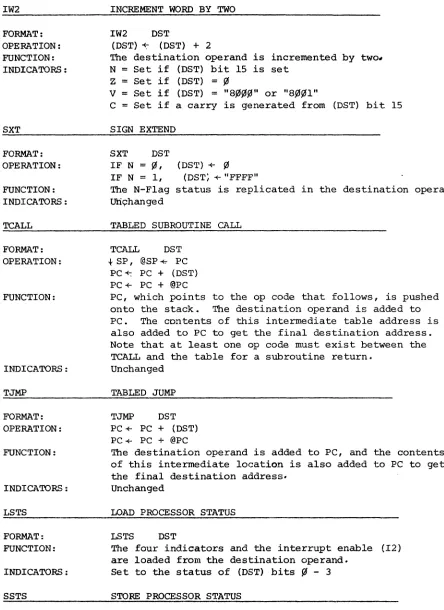
17FFF"IW2 FORMAT: OPERATION: FUNCTION: INDICATORS : SXT FORMAT: OPERATION: FUNCTION: INDICATORS : TCALL FORMAT: OPERATION: FUNCTION: INDICATORS : TJMP FORMAT: OPERATION: FUNCTION: INDICATORS : LSTS FORMAT: FUNCTION: INDICATORS : SSTS FORMAT: FUNCTION: INDICATORS :
INCREMENT WORD BY TWO
IW2 DST
(DST) -+- (DST) + 2
The destination operand is incremented by two .. N = Set if (OST) bit 15 is set
Z = Set if (DST) = [4
V= Set if (DST)
=
"8[4[4[4" or "8[4[41"C = Set if a carry is generated from (DST) bit 15
SIGN EXTEND
SXT DST
IF N = [4, (DST) -+- [4 IF N = 1, (DST; -+- "FFFF"
The N-Flag status is replicated in the destination operand Utic;::hanged
TABLED SUBROUTINE CALL
TCALL DST
4.-SP, @SP +. PC PC +: PC + (DST) PC -+- PC + @PC
PC, which points to the op code that follows, is pushed onto the stack. The destination operand is added to PC. The contents of this intermediate table address is also added to PC to get the final destination address. Note that at least one op code must exist between the TCALL and the table for a subroutine return.
Unchanged
TABLED JUMP
TJMP DST
PC -+- PC + (OST) PC-+- PC + @PC
The destination operand is added to PC, and the contents of this intermediate location is also added to PC to get the final destination
address-unchanged
LOAD PROCESSOR STATUS
LSTS DST
The four indicators and the interrupt enable (I2) are loaded from the destination operand.
Set to the status of (DST) bits [4 - 3
STORE PROCESSOR STATUS
SSTS DST
The processor status word is formed and stored in (DST). Unchanged
[image:36.611.118.562.68.678.2]ADC
FORMAT: OPERATIQN; FUNCTION: INDICATORS :
SBC
FORMAT: OPERATION: FUNCTION: INotICATORS :
ADO CARRY
ADC OST
(PST)
*"
lOST) + C -flagThe carry flag is added to the destination operand N= Set if (OST) bit 15 is set
Z = Set if (OST) = ~
V = Set to exclusive or of N and C flags
C == Set if a carry is generated from COST) bit 15
SUBTRACT CARRY
SBC OST
COST) 0(- (OST) - C-Flag
The Carry flag is subtracted from the destination operand N = Set if (OST) bit 15 is set
Z = Set if (OST) = ~
V
=
Set to exclusive or of N and C flagsC == Set if a borrow is generated from COST) bit 15
BYTE OPS
For OM~ addressing only the lower byte of the destination register is affected by a byte op code. For DM1-DM7 addressing only the speci~ fied meIOOry byte is affected by a byte op. For even memory addresses the lower byte is altered, and for ddd meIOOry addresses the upper byte is altered.
RORB
FORMAT: FUNCTION:
INDICATORS :
ROLB
FORMAT: FUNCTION:
INDICATORS:
TSTB
JroRMAT: OPERATION:
ROTATE RIGHT BYTE
RORB DST
A l-bit right rotate is done on (OST)B:C-Flag. Bit ~ of (OST)B is shifted into the C-Flag, and the C-Flag is shifted into (OST)B bit 7.
N = Set if (DST)B bit 7 is set Z = Set if (DST)B = ~
V = Set to exclusive or of N and C flags
C = Set to the value of the bit shifted out of (OST) Bbit ~
ROTATE LEFT BYTE
ROLB DST
A l-bit left rotate is done on C-flag : (DST)B· Bit 7 of (DST)B is shifted into the C-flag, and the C-flag is shifted into (DST)B bit ~
N = Set if (DST)B bit 7 is set Z = Set if (OST)B = ~
V == Set to exclusive or of N and C flags
C = Set to the value of the bit shifted out of (OST)B bit 7
TEST BYTE
TSTB OST
FUNCTION: INDICATORS : ASLB FORMAT: FUNCTION: INDICATORS:
The destination operand status sets the indicators. N = Set if (DST)B bit 7 is set
Z
=
Set if (DST)B=
~ V = ResetC Unchanged
ARITHMETIC SHIFT LEFT BYTE
ASLB DST
A I-bit left arithmetic shift is done on C-Flag:(DST)B A zero is shifted into (DST)B bit ~, and (DST)B bit 7 is shifted into the C-flag.
N
=
set if (DST)B bit 7 is set Z=
Set if (DST) B=
~V
=
Set to exclusive or of Nand C flagsC = Set to the value of the bit shifted out of (DST)B bit 7
SETB SET BYTE TO ONES
---FORMAT: OPERATION: FUNCTION: INDICATORS : CLRB FORMAT: OPERATION: FUNCTION: INDICATORS : ASRB FORMAT: FUNCTION: INDICATORS : SWAD FORMAT: FUNCTION: INDICATORS :SETB DST
(DST) B + "FF"
The destination byte operand is set to all ones N = Set
Z = Reset
V Reset
C = Unchanged
CLEAR BYTE TO ZEROS
CLRB DST
(DST) B +' $3
The destination byte operand is cleared to all zeros. N = Reset
Z
=
Set V = Reset C = ResetARITHMETIC SHIFT RIGHT BYTE
ASRB DST
A I-bit right arithmetic shift is done on (DST)B: C-flag. Bit 7 of (DST)B is replicated. Bit $3 of
(DST)B is shifted into the C-flag. N
=
Set if (DST)B bit 7 is set Z = Set if (DST)B = ~V = Set to exclusive or of Nand C flags
C
=
Set to the value of the bit shifted out of (DST)B bit ~SWAP DIGITS
SWAD DST
The two hex digits in the destination byte operand are exchanged with each otherl
N
=
Set if (DST)B bit 7 is set Z : Set if (DST)S = ~V
=
Set if (DST)B bit 7 is set C=
ResetCOMB
FORMAT: OPERATION: FUNCTION: INDICATORS :
NEGB
FORMAT: OPERATION: FUNCTION: INDICATORS:
INCB
FORMAT: OPERATION: FUNCTION: INDICATORS :
DECB
FORMAT: OPERATION: FUNCTION: INDICATORS:
COMPLEMENT BYTE
COMB DST
(DST) B +- (OST) B
The destination byte operand is one's complemented N = Set if (DST)B bit 7 is set
Z
=
Set if (DST)B=
~V
=
Reset C=
SetNEGATE BYTE
NEGB DST
(DST) B + - (DST) B
The destination byte operand is two's complemented N
=
Set if (DST)B bit 7 is setZ
=
Set if (DST)B=
~ V = Set if (DST) B = "81'5151"C = Reset if (DST)B
=
51INCREMENT BYTE
INCB DST
(DST) B + (DST) B + 1
The destination byte operand is incremented by one N
=
Set if (DST)B is setZ
=
Set if (DST)B=
51V = Set if (DST)B = "8161616"
C = Set if a carry is geperated from (DST)B bit 7
DECREMENT BYTE
DECB DST
(DST) B + (DST) B - 1
The destination byte operand is decremented by one N = Set if (DST)B bit 7 is set
Z
=
Set if (DST)B=
51V - Set if (DST)B
=
"7FFF"FORMAT 8 OP CODES*
DOUBLE OPS - SINGLE WORD - S~ AND D~ ONLY
15 6 5 3 2 ~
OPC
I
S REGI
D REGI
There are 8 op codes in this class representing op codes "~E~~" to "~FFF". Only addressing mode ~ is allowed for both the source and destination. All are one word op codes, and all are block move instructions. The last 4 can be used as pseudo DMA ops in some hardware configurations. In all cases the source register contains the address of the first word or byte of memory to be moved, and the destination register contains the address of the first word or byte of memo17Y to receive the data being moved. The number of words or bytes being moved is contained in R~. The count ranges from 1-65536
(~
=
65536) words or bytes. The count in ~ is an unsigned positive integer. None of the indicators are altered by these op codes.Each of these o~ codes is interruptable at the end of each word or byte transfer. If no interrupt requests are active the trans-fers continue. PC is not incremented to the next op code until the opcode is completed. This allows for complete interruptability as long as register integrity is maintained during the interrupt.
BASE OP CODE
fJE~~
fOE4fO ~E8~ ~EC~ ~F~~
fOF4fO roF8~ ~FC~
* NOTE: These
MBWU
FORMAT: FUNCTION:
MBWD
FORMAT: FUNCTION:
MNEMONIC
MBWU MBWD MBBU MBBD MBWA MBBA MABW MABB
op codes are all in the third microm.
MOVE BLOCK OF WORDS UP
MBWU SRC, DST
The word string beginning with the word addressed by the source register is moved to successively increasing word addresses as specified by the des-tination register. The source and destination reg-isters are each incremented by two after each word is transferred. R~ is decremented by one after each transfer, and transfers continue until ~
=
~.MOVE BLOCK OF WORDS DOWN
MBWD SRC, DST
The word string beginning with the word addressed by the source register is moved to successively
INDICATORS : MBBU FORMAT: FUNCTION: INDICATORS: MBBD FORMAT: FUNCTION: INDICATORS: MBWA FORMAT: FUNCTION: INDICATORS : MBBA FORMAT: FUNCTION: INDICATORS : MABW FORMAT: FUNCTION: INDICATORS : MABB FORMAT: FUNCTION: INDICATORS :
decreasing word addresses as specified by the des-tination register. The source and desdes-tination reg-isters are each decremented by two after each word is transferred. ~ is decremented by one after each transfer, and transfers continue until ~
=
~. UnchangedMOVE BLOCK OF BYTES UP
MBBU SRC, DST
The byte string beginning with the byte addressed by the source register is moved to successively increas-ing byte addresses as specified by the destination. register. The source and destination registers are each incremented by one after each byte is transfer-red. ~ is decremented by one after each transfer, and transfers continue until ~ = ~.
Unchanged.
MOVE BLOCK OF BYTES DOWN
MBBD SRC, DST
The byte string beginning with the byte addressed by the source register is moved to successively decreas-ing byte addresses as specified by the destination register. The source register, destination register, and R$, are each decremented by one after each byte is transferred. Transfers continue until R~ = ~.
Unchanged
MOVE BLOCK OF WORDS TO ADDRESS
MBWA SRC, DST
Same as MBWU except that the destination register is never incremented.
Unchanged
MOVE BLOCK OF BYTES TO ADDRESS
MBBA SRC, DST
Same as MBBU except that the destination register is never incremented.
Unchanged
MOVE ADDRESS TO BLOCK OF WORDS
MABW SRC, DST
Same as MBWU except that the source register is never incremented.
Unchanged
MOVE ADDRESS TO BLOCK OF BYTES
MABB SRC, DST
Same as MBBU except that the source register is never incremented.
Unchanged
('
FORMAT 9 OP CODES
DOUBLE OPS - ONE OR TWO WORDS - SM9$, DMf6 to DM7
OPC
I
S REGI
D MODE2
@
D REG
I
15 9 8 6 5 3
There are 8 op codes in this class representing op codes
"7[4[4[4" to "7FFF". Source mode f6 addressing only is allowed, but des-tination modes [4 - 7 are allowed for all op codes except 3: JSR and LEA with DM9$ will cause an illegal instruction format trap (see chap-ter 2), and SOB is a special format unique to itself. It is includ-ed here only because its destination field is 6 bits long. SOB is a branch instruction. Its 6 bit destination field is a positive word offset from PC, which points to the op code that follows,
backwards to the desired address. Forward branching is not allowed. SOB is always a one word op code, and it is used for fast loop con-trol. All other op 00des are one wo~d long for DM9$ to DM5 addressing and two words long for DM6 or DM7 addressing. The rules for PC rel-ative addressing with DM6 or DM7 are the same as they are for the format 7 op codes. Preliminary decoding of all these op codes ex-cept SOB presets the indicator flags as follows: N
=
1, Z=
[4, V = f6, C = 1.BASE OP CODE
7f4f4[4 72f4f4
74[4[4 76f6f4 78[4[4 7A[4f4 7Cf4[4 7E[4f4
JSR
FORMAT: OPERATION:
FUNCTION:
INDICATORS :
LEA
FORMAT: OPERATION:
MNEMONIC
JSR LEA ASH SOB XCH ASHC MUL DIV
JUMP TO SUBROUTINE
JSR REG, DST
+
SP I @SP + REGREG +PC PC +DST
The linkage register is pushed onto the stack; PC, which points to the op code that follows, is placed in the linkage re~ister; and the destination add-ress is placed in PC. DMf4 is illegal. The assem-bler recognizes the format "CALL DST" as, being equivalent to "JSR PC, DST".
Preset
LOAD EFFECTIVE ADDRESS
LEA REG, DST REG + DST
FUNCTION:
INDICATORS :
XCH
FORMAT: OPERATION: FUNCTION:
INDICATORS :
SOB
FORMAT:
OPERATION:
FUNCTION:
INDICATORS :
ASH
FORMAT: FUNCTION:
INDICATORS:
ASHC
FORMAT:
FUNCTION:
INDICATORS :
The destination address is placed into the source register. DM(6 is illegal. The assembler recognizes
the format "JMP DST" as being equivalent to "LEA PC,DST" •
Preset
EXCHANGE
XCH REG, DST
REG ~(DST)
The source register and destination contents are exchanged with each other.
Preset
SUBTRACT ONE AND BRANCH (IF"
iJ)
SOB REG, DST REG+ REG - 1
IF REG F ~, PC +. PC - (OFFSET *2)
The source register is decremented by one. If the result is not zero then twice the value of the des-tination offset is subtracted from PC.
Unchanged
ARITHMETIC SHIFT
ASH REG, DST
The source register is shifted arithmetically with the number of bits and direction specified by the destination operand. If (DST)
=
iJ
no shifting occurs. If (DST)=
-X then REG is shifted right arithmetically X bits as in an SSRA. If (DST) = +X then REG is shifted left arithmetically X bits as in an SSLA. Only an 8 bit destination operand is used. Thus, DST is a byte address. For DM~ only the lower byte of the destin-ation register is used.Preset if (DST) =
iJ.
Otherwise: N=
Set if REG bit 15 is set Z=
Set if REG=
iJ
V
=
Set to exclusive or of N and C flagsC = Set to the value of the last bit shifted out of REG
ARITHMETIC SHIFT COMBINED
ASHC REG, DST
Exactly the same as ASH except that the shift is done on REG+l:IU3G. All other comments apply.
Preset if (DST) =~. Otherwise. N
=
Set if REG+l bit 15 is set Z=
Set if REG+l: REG=
iJ
V - Beset
C
=
Set to the value of the last bit shifted outMOL
FORMAT: OPERATION: FUNCTION:
INDICATORS :
DIV
FORMAT: OPERATION:
FUNCTION:
INDICATORS :
MULTIPLY
MOL REG, DST
REG+l :REG + REG
*
(DST)An unsigned multiply is performed on the source register and the destination operand. The unsigned 32 bit result is placed in REG+l:REG.
N = Set if REG+l bit 15 is set Z
=
Set if REG+l:REG=
~V = Reset
C = Indeterminate
DIVIDE
DIV REG, DST
REG + [REG+ 1: REG/ (DST) ] REG+ 1 + REMAINDER
An unsigned divide is performed on the 32 bit source op'~rand REG+l:REG and the destination operand. The unsigned result is placed in REG, and the unsigned remainder is placed in REG+l.No divide occurs and the V-flag is set if REG+l is greater than or equal to (DST) since the result will not fit into 16 bits. If the divisor is zero both the V and C flags are set.
If no division error:
N
=
Set if REG bit 15 is set Z=
Set if REG=
~V = Reset
C = Indeterminate If division error: N = Reset
Z = Reset V = Set
C = set if (DST) ~
FORMAT lOOP CODES
OOUBLE OPS - ONE TO THREE WORDS - S~ TO SM?, DM~ TO DM7.
I
OPC15 12 11 9 8 6 5 3 2
i
I
S MODEI
S REGI
D MODEI
D REG There are 12 op codes in this class representing op codes "l~~~" to "6FFF" and "9~~~" to "EFFF". Nine of the op codes are word ops. Three are byte ops'. Full source and destination mode addressing with any register is allowed. A one word op code is generated forS~-SMS and D~-DM5 addressing. A two word op code is generated for either SM6-SM7 or DM6-DM7 addressing, but not both. For both SM6-SM7 and DMc-DM7 addressing a three word op code is generated. For a two word op code with word #1 at location X: X + 2 contains the source or destination offset and PC
=
X + 4 if PC is the register that applies to the offset in location X + 2. For a three word op code with word #1 at location X: X + 2 contains the source offset and X + 4 contains the destination offset. If the source register is PC then PC = X + 4 when added to the offset to compute the source address. If the destin-ation register is PC then PC=
X + 6 when added to the offset to compute the destination address.BASE OP CODE
l~~~ 2~~f6
3f6f6f6
4f6f6f6 5f6f6~ 6f6~~ 9f6f6~ A~~~
Bf6f6f6
cf6f6~ Df6~~ E~~~
ADD
FORMAT: OPERATION: FUNCTION:
INDICATORS :
MNEMONIC
ADD SUB AND BIC BIS XOR CMP BIT MOV CMPB MOVB BISB
WORD OPS
ADD
ADD SRC, DST (DST) + (SRC) + (DST)
The source and destination operands are added to-gether, and the sum is placed in the destination. N = Set if (DST) bit 15 is set
Z
=
Set if (DST)=
f6V = Set if both operands were of the same sign and the result was of the opposite sign
C
=
Set if a carry is generated from bit 15 of the resultSUB FORMAT: OPERATION: FUNCTION: INDICATORS : AND FORMAT: OPERATION: FUNCTION: INDICATORS: BIC FORMAT: OPERATION: FUNCTION: INDICATORS : BIS FORMAT: OPERATION: FUNCTION: INDICATORS: XOR FORMAT: OPERATION: FUNCTION: SUBTRACT
SUB SRC, DST (DST) +" (DST) - (SRC)
The two's complement of the source operand is added to the destination operand, and the sum is placed in the destination.
N = Set if (DST) bit 15 is set Z
=
Set if (OST)=
~V
=
Set if operands were of different signs and the sign of the result is the same as the sign of tht:: source operandC = Set if a borrow is generated from bit 15 of the result
AND
AND SRC, DST
(D;::;T) ~+-(SRC) fl (DST)
The source and destination operanda ~re logically ANDED tOgether, and the .r:esul t is :.placed ih the destination.
N = Set if '(loST) bit 15 is set Z = Set if (DST)
=
~V
=
Reset C = UnchangedBIT CLEAR
BIC SRC, DST (DST) + (SRC) fl (DST)
The one's complement of the source operand is log-ically ANDEO with the destination operand, and the result is placed in the destination.
N
=
Set if (DST) bit 15 is set Z = Set if (DST)=
~V
=
Reset C = UnchangedBIT SET
BIS SRC, DST (DST) + (SRC) V (DST)
The source and destination operands are logically ORED, and the result is placed in the destination. N
=
Set if (DST) bit 15 is setZ
=
Set if (DST)=
~ V=
ResetC
=
UnchangedEXCLUSIVE OR
XOR SRC, DST (DST) + -(SRC) !1- (OST)
The source and destination operands are logically
INDICATORS :
CMP
~RMAT: OPERATION: . FUNCTION:
INDICATORS :
BIT
FORMAT: OPERATION: FUNCTION:
INDICATORS :
MOV
FORMAT: OPERATION: FUNCTION:
INDICATORS :
N
=
Set if (DST) bit 15 is set Z=
Set if (DST)=
~V = Reset C
=
UnchangedCOMPARE
CMP SRC, DST (SRC) - (DST)
The destination operand is subtracted from the source operand, and the result sets the indicators. Neither operand is altered.
N
=
Set if result bit 15 is set Z=
Set if result=
~V
=
Set if operands were of opposite sign and the sign of the result is the same as the sign of (DST) C=
Set if a borrow is generated from bit 15 of the resultBIT TEST
BIT SRC, DST (SRC)
A
(DST)The source and destination operands are logically ANDED, and the result sets the indicators. Neither operand is altered.
N = Set if result bit 15 is set Z
=
Set if result=
~V
=
Reset C = unchangedMOVE
MOV SRC, DST (DST)
+
(SRC)The destination operand is replaced with the source operand.
N
=
Set if (DST) bit 15 is setZ
=
Set if (DST)"=
~V
=
Reset C=
UnchangedBYTE OPS
For S~ addressing only the lower byte of the source register is used as an operand. For SM1-SM7 addressing only the addressed memory byte is used as an operand. For D~ addressing only the lower byte of the destination register is used as an operand with one exception: MOVB will e~tenQ the sign through bit 15. For DMI-DM7 addressing only the addressed memory byte is used as an operand.
CMPB COMPARE BYTE
FORMAT: CMPB SRC, DST
OPERATION: (SRC)B - (DST)B
FUNCTION:
INDICATORS :
MOVB
FORMAT:
OPERATION: FUNCTION:
INDICATORS :
BISB
FORMAT:
OPERATION: FUNCTION:
INDICATORS :
The destination operand is subtracted from the source operand, and the result sets the indicat-ors • Neither operand is altered.
N
=
Set if result bit 7 is set Z=
Set if result=
~V = Set if operands were of different signs and the sign of the result is the same as the sign of (DST)B.
C
=
Set if a borrow is generated from result bit 7MOVE BYTE
MOVB SRC, DST
(DST) B -+- (SRC) B
The destination operand is replaced with the source operand. If DM~ the sign bit (bit 7) is replicat-ed through bit 15.
N = Set if (DST)B bit 7 is set Z Set if (DST)B
=
~V = Reset C = Unchanged
BIT SET BYTE
BISB SRC, DST
(DST) B
'*" .
(SRC) B V (DST) BThe source and destination operands are logically ORED, and the result is placed in the destination. N = Set if (DST)B bit 7 is set
Z
=
Set if (DST)B=
~ V=
ResetC = Unchanged
When using auto increments or decrements in either the source or destination (or both) fields the user must remember the following rule: All increments or decrements in the source are fully completed before any destination decoding begins even if the same index regis-ter is used in both the source and destination. The two fields are totally independent.
FORMAT 11 OP CODES
DOUBLE OPS - ONE WORD - FLOATING POINT.
12 11 8 7 6
I
II
4 3 2
1111 OPC SRC
I
II
DSTThere are 16 OP Codes in this class representing OP Codes "Ff6f6f6" to "FFFF". Only five are currently defined. They re