• No results found

Vol. 8, Issue 3, March 2018 Impact Factor 5.132 ISSN: (

N/A
N/A
Protected

Academic year: 2020

Share "Vol. 8, Issue 3, March 2018 Impact Factor 5.132 ISSN: ("

Copied!
8
0
0

Loading.... (view fulltext now)

Full text

(1)

NURSING INTERVENTION FOR PATIENTS UNDER CORONARY ARTERY BYPASS GRAFT SURGERY AND ITS IMPACT: AN ANALYSIS

Vikas Kumar Gautam

1

, Dr. Mridula Saikia Khanikor

2

Department of Nursing

1,2

Shri Venkateshwara University, Gajraula (Uttar Pradesh)

Abstract

This research exploresthe nursing intervention for patients under coronary artery bypass graft surgery. As we know that the Coronary artery bypass graft (CABG) surgeries are among the most generally performed significant operations. CABG surgery is instructed for chosen gatherings concerning patients with critical narrowing and blockages of the heart arteries (coronary artery disease). CABG surgery makes new routes around narrowed and blocked arteries, permitting adequate blood stream to convey oxygen and supplements to the heart muscle. Coronary artery disease (CAD) happens when atherosclerotic plaque (solidifying of the arteries) develops in the mass of the arteries that supply the heart. This plaque is essent ially made of cholesterol. Plaque collection can be quickened by smoking, hypertension, raised cholesterol, and diabetes. Patients are likewise at higher hazard for plaque development on the off chance that they are more established (more prominent than 45 years for men and 55 years for women), or in the event that they have a positive family ancestry for early heart artery disease. And the Nurses assume an essential job in dealing with the patients experiencing CABG surgery. Nurses need to give satisfactory consideration on postoperative results, for example, anxiety, fatigue, pain among patients experiencing CABG surgery and likewise mindful that if these results are not overseen legitimately with fitting nursing interventions may aggravate the recuperation procedure and result in low quality of life.

1. OVERVIEW

CVDs are the main source of death worldwide: more amazing year due to CVD than some other illness conditions. An expected death rate of 17.5 million happened from CVDs in 2012, an expected 7.4 million deaths from CHD and 6.7 million deaths came about because of the stroke.

Center and low-income nations had the rate of higher CVD deaths throughout the most recent

thirty years. The Registrar General of India showed that CAD caused 17 percent of aggregate

deaths somewhere in the range of 2001 and 2003, which rose to 23 percent of aggregate deaths

somewhere in the range of 2010 and 2013. In India, look into researchers have expressed

expanding rate of coronary heart illness in the course of the most recent six decades, under 1

percent to 4 - 6 percent in rustic populaces and from 1 percent to 9 - 10 percent in urban

populaces (Gupta et al., 2016). National Commission on Macroeconomics and Health detailed

(2)

that by 2015 sixty-two million individuals in India will be analyzed to have CAD, with 23 million of these individuals beneath the age of 40 years[1].

It has been evaluated that by the following 15 years CVD will increment in India and it has been determined that India will have over half of CVD all inclusive. Fundamentally the patients with CAD are treated with restorative administration that incorporates heart healthy lifestyle changes, prescriptions, percutaneous coronary interventions and cardiovascular recovery. Patients are treated with Coronary Artery Bypass Graft (CABG) surgery when these medications are not adequate to reestablish coronary blood supply and if there is an extreme square in coronary arteries. CABG surgery is performed to expand quality of life and decline heart related death among the patients with CAD[2].

Significant changes in routine lifestyle incite anxiety in the people, and one of the progressions is experiencing CABG surgery. Hospitalization, independent of any restorative condition, is natural to cause anxiety in the patients conceded for careful treatment. If not perceived supported anxiety fabricates pressure which may thus aggravate the patients and their prognosis. Despite constructive advantages, it is extremely unsavory for any individual to experience a noteworthy surgery. The pressure turns out to be more and serious when surgery is performed on the heart, an indispensable organ of human body. The CABG surgery makes physical, mental, and social versatile difficulties previously and even after the surgery[3].

Extreme pain, anxiety, stresses and sleep unsettling influences are generally looked by the patients after a noteworthy cardiovascular surgery. These components may bargain the treatment and quality of life of patients experiencing real heart surgery. Experiencing major cardiovascular surgery is an exceedingly distressing background for the patients and will result in expanded level of anxiety. Fear and anxiety are the central points that unequivocally impact the patient's capacity to endure with pain or inconvenience. Pain can delay the quantity of days remain in the healing facility postoperatively and furthermore influence patient's satisfaction level.

Anxiety

Anxiety is an abstract upsetting background of the patients that bothers them physically, inwardly, and mentally. Anxiety contrarily impacts the recuperation of the patients who experience heart surgery. Anxiety amid hospitalization is normal and expected to some degree however it might turn into a vital clinical concern that can essentially aggravate the patients' health if not treated. Nearness of anxiety in patients following a noteworthy heart surgery can back off their recuperation and increment the occurrence of morbidity and mortality. Amid this stage, the patient is compromised with attention to her or his mortality and may have the concern in regard to the impact of heart surgery on work, life, and association with others.

Fatigue

Fatigue is usually a tenacious and real issue in numerous patients after cardiovascular surgery.

Notwithstanding the numerous positive advantages coming about because of coronary

revascularization, fewer ideal results are experienced by a few patients. The nearness of

(3)

postoperative fatigue among patients following CABG surgery can have an unfavorable outcome on their recuperation procedure and quality of life. Postoperative fatigue and related states of essential depletion may aggravate the physical capacity and quality of life of the patients who had heart surgery.

Self-Efficacy

Self-efficacy is known as person's capacities and trust in completing the fundamental and suitable health practices to accomplish an expected objective. Self-efficacy is person's capacity to defeat some explicit circumstances and impressive factor to keeping up healthy practices. It has a huge job in the individual focused consideration and significantly propels the health among the patients who experienced heart attack. Preoperative education enhances self-efficacy after CABG surgery and great self-efficacy is an essential idea in managing distressing circumstances and pressures coming about because of the CAD. Self-efficacy additionally assumes a huge mental job in reducing negative impacts caused by the CABG surgery.

2. NURSING CARE OF THE PATIENT UNDERGOING CORONARY ARTERY BYPASS GRAFTING

Preoperative preparation of patients and noteworthy others is an entrenched convention in many institutions. Research has demonstrated that instruction of the patient preceding surgery helps with recuperation, expands patient happiness, and diminishes postoperative complications.

Suitable planning of preoperative preparation is useful for the patient's information maintenance.

Since looming open heart surgery is nervousness inciting to most patients, it is basic for the medical caretaker to evaluate the patient for individual adapting needs and give the information in a convenient way to limit however much uneasiness as could be expected. It has been recommended that state nervousness levels are lower 5 to 14 days preceding CABG surgery, which makes this a perfect time for teaching[4].

A high uneasiness level isn't helpful for the maintenance of information. Advantages of preoperative instructing might be amplified when information is presented during the period when the patient has the most minimal tension. Numerous patients are conceded upon the arrival of surgery. Carrying them into the emergency clinic for preadmission testing a few days before surgery and finishing the preoperative educating during this time might be powerful. A few patients need explicit insights regarding the perioperative experience, while others appear to require just the consolation that a proficient and sympathetic caregiver will give the required perioperative care.

The talented professional medical attendant individualizes preoperative guidance to meet the

particular needs of that patient. Information when leading preoperative instructing with a patient

planned for CABG surgery may incorporate sights and sounds that will be experienced, obtrusive

lines that will be embedded, foreseen sensations from preoperative meds, and foreseen length of

the operation. During the preoperative showing session, the medical attendant ought to likewise

give information identified with postoperative expectations[5].

(4)

3. NURSING INTERVENTION FOR PATIENTS UNDER CORONARY ARTERY BYPASS GRAFT SURGERY: AN ANALYSIS

Above figure1 descriptive The Global Burden of Disease Study and the WHO revealed that Coronary Heart Disease (CHD) has turned out to be one of the imperative reasons for inability balanced life, 69 respondents are agree, 61 respondents are strongly agree, 39 respondents are disagree, and 31 Respondents are Strongly disagree.

Figure 1: The Global Burden of Disease Study and the WHO revealed that Coronary Heart Disease (CHD) has turned out to be one of the imperative reasons for inability balanced life and developing patterns in periods of life lost in India

Above figure2 descriptive The Comprehensive Nursing Intervention Program (CNIP) on anxiety, fatigue, self-efficacy and quality of life among the patients experiencing CABG surgery, 72 respondents are agree, 63 respondents are strongly agree, 38 respondents are disagree, and 27 Respondents are Strongly disagree.

Figure 2: Comprehensive Nursing Intervention Program (CNIP) on anxiety, fatigue, self- efficacy and quality of life among the patients experiencing CABG surgery

Above figure3 descriptive The education of the patient prior to surgery assists with recovery,

increases patient contentment, and decreases postoperative complications, 71 respondents are

agree, 64 respondents are strongly agree, 34 respondents are disagree, and 31 Respondents are

Strongly disagree.

(5)

Figure 3: The education of the patient prior to surgery assists with recovery, increases patient contentment, and decreases postoperative complications

Above figure4 descriptive the Preoperative teaching may be maximized when information is presented during the period when the patient has the lowest anxiety, 69 respondents are agree, 62 respondents are strongly agree, 38 respondents are disagree, and 31 Respondents are Strongly disagree.

Figure 4: Preoperative teaching may be maximized when information is presented during the period when the patient has the lowest anxiety

Above figure5 descriptive Pulmonary care is an important part of the postoperative care of the patient after CABG surgery, 73 respondents are agree, 64 respondents are strongly agree, 33 respondents are disagree, and 30 Respondents are Strongly disagree.

Figure 5: Pulmonary care is an important part of the postoperative care of the patient after

CABG surgery

(6)

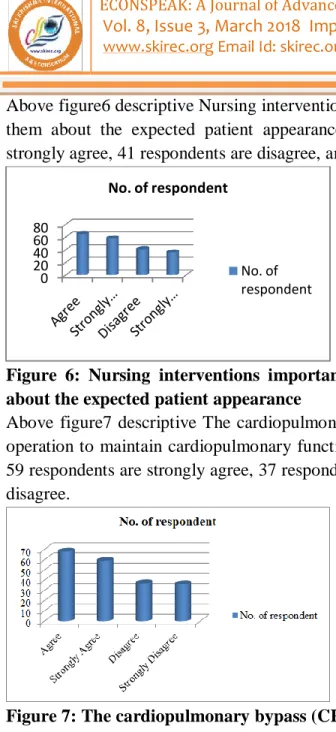
Above figure6 descriptive Nursing interventions important for significant others include teaching them about the expected patient appearance, 65 respondents are agree, 58 respondents are strongly agree, 41 respondents are disagree, and 36 Respondents are Strongly disagree.

Figure 6: Nursing interventions important for significant others include teaching them about the expected patient appearance

Above figure7 descriptive The cardiopulmonary bypass (CPB) machine can be used during the operation to maintain cardiopulmonary function and tissue perfusion, 68 respondents are agree, 59 respondents are strongly agree, 37 respondents are disagree, and 36 Respondents are Strongly disagree.

Figure 7: The cardiopulmonary bypass (CPB) machine can be used during the operation to maintain cardiopulmonary function and tissue perfusion

4. CONCLUSION

World Health Organization (WHO) announced that cardiovascular diseases (CVD) were one of the most significant reasons for death all around, bringing about more than 17.3 million passing every year; by 2030 the figure is foreseen to increase to more than 23.6 million. Thirty-one percent of all passing all around were expected to CVD, with 80% of those passing happened in the low and center salary countries in 2013. CVD is causing more number of passing than some other diseases all through the world. CVD has turned into a fundamental health problem in a few creating countries, and CVD is the most well-known reason for grimness and mortality worldwide. Coronary artery disease (CAD) is the most well-known among all CVD and CAD have expected widespread extents worldwide. All-inclusive, CAD has turned into the most driving reason for passing and inabilities in creating countries. The Global Burden of Disease

20 0 40 60 80

No. of respondent

No. of

respondent

(7)

Study and the WHO revealed that Coronary Heart Disease (CHD) has turned out to be one of the significant reasons for incapacity balanced life and developing patterns in times of life lost in India.

Conversely, the quantity of passing because of CAD is instantly declining in the created countries. This increase is driven by industrialization, urbanization, and related lifestyle changes and is called epidemiological progress. CVDs are the main source of death worldwide: more amazing year due to CVD than some other disease conditions. An expected death pace of 17.5 million happened from CVDs in 2012, an expected 7.4 million passing from CHD and 6.7 million passing came about because of the stroke. Enter and low-salary countries had the incidence of higher CVD passing in the course of the most recent thirty years.

The nursing care of patients after CABG surgery has reacted to the advancement of cardiac surgery techniques as more patients have the operation without the utilization of CPB. Nursing backing is fundamental to finish the successful change, in any establishment, from on-pump to off-pump surgery. Since just a couple of cardiac surgery focuses are performing off-pump surgery, the writing is fragmented intending to the one of a kind nursing point of view. Regions of worry for nurses incorporate, however, are not restrictive to the instruction of patients and staff, perioperative instrumentation, postoperative recovery, and release arranging.

The accompanying exchange is experiential and recounted, in light of the fact that these are not completely tended to in the nursing writing. Nurse instructors, administrators, and propelled practice nurses associated with the beginning times of starting an off-bypass program are most appropriate to foresee potential changes in patients' care. Staff instruction is the establishment of a successful, generally speaking, changes to the off-bypass strategy. The acknowledgment of this surgical approach will be the inspirational power behind adjustment to the change in the surgical way of thinking.

This adjustment can best be cultivated by means of little staff instruction projects and incorporation of off-bypass surgery ideas into preparing programs for basic care nurses. Nurses assume key jobs in correspondence with and training of patients and patients' families about this unpredictable procedure, for instance, giving preoperative advising to patients and getting patients' assent for the procedure. Previously and keeping in mind that giving educated assent, patients need to comprehend and have the option to separate their surgery from the different surgical techniques accessible.

We have examined that the patients are progressively getting to be conscious of off-pump and

negligibly intrusive, direct CABG medical procedures. An ever-increasing number of patients

pose direct inquiries identified with these techniques since they have assembled information

from the Internet or through network organizing. Specialists must have the knowledge to

characterize each surgical strategy and depict the advantages and risks. Patients needing valve fix

or substitution must comprehend that cardiopulmonary bypass is as yet required for this

operation.

(8)

Due to the various kinds of entry points utilized, patients must comprehend the expected system and know, for instance, that in the event that vessels can't be pictured when a thoracotomy approach is utilized, at that point a median sternotomy cut might be made. Additionally, regardless of whether a median sternotomy approach is utilized at first, some coronary branches may not be sufficiently envisioned or balanced out.

REFERENCES

[1]. Fanning MF. Reducing postoperative pulmonary complications in cardiac surgery patients with the use of the best evidence. J Nurs Care Q. 2004;19:95-99.

[2]. Shoup A. Nursing management intraoperative care. In: Lewis SM, Heitkemper MM, Dirksen SR, eds. Medical-Surgical Nursing Assessment and Management of Clinical Problems. St. Louis, Mo: Mosby; 2004:377-392

[3]. Deglin JH, Vallerand AH. Davis's Drug Guide for Nurses. 8th ed. Philadelphia, Pa: FA Davis; 2003:857-860.

[4]. Kjaergaard S, Rees SE, Gronlund J, et al. Hypoxemia after cardiac surgery: clinical application of a model of pulmonary gas exchange. Eur J Anaesthesiol. 2004;21:296-301 [5]. Naughton C, Reilly N, Powroznyk A, et al. Factors determining the duration of tracheal

intubation in cardiac surgery: a single-centre sequential patient audit. Eur J Anesthesiol.

2003;20:225-231.

Figure

Figure  3:  The  education  of  the  patient  prior  to  surgery  assists  with  recovery,  increases  patient contentment, and decreases postoperative complications
Figure  6:  Nursing  interventions  important  for  significant  others  include  teaching  them  about the expected patient appearance

References

Related documents

Then it studies if these approaches are influenced by the existence of buying firm and bank relationship (as measured by availability and need for bank loan, terms of bank loan,

arthropod crown group and extant outgroups such as Onychophora or even lower stem group arthropods such as Cambrian lobopodians and anomalocaridids (Fig. 3 ), and illuminates

In the source-based approach a value added export is assigned to the gross trade flow, in which it leaves the producing country for the very first time, whereas it is labeled as

 If students know that the primary response “sulphur dioxide” is untrue, they tend to pick option D because sulphur dioxide does not appear in options A and D and more than one

Results: Girls with insecure attachment styles (avoidant and ambivalent) in comparison with girls with secure attachment were more concerned about their

2016 2015 American thyroid association management guidelines for adult patients with thyroid nodules and differentiated thyroid cancer: the American thyroid association

describe our relationship with our clothes just in terms of “possession” or to see clothes simply as a set of tools to enhance our social status or amplify our ego, while

Inference: From Table 8, it is inferred that among the level of agreement with the statements that concerns with the interpersonal relationship with the Students and their