Reordering Grammar Induction
Miloˇs Stanojevi´c ILLC
University of Amsterdam
Khalil Sima’an ILLC
University of Amsterdam
Abstract
We present a novel approach for unsu-pervised induction of a Reordering Gram-mar using a modified form of permuta-tion trees (Zhang and Gildea, 2007), which we apply to preordering in phrase-based machine translation. Unlike previous ap-proaches, we induce in one step both the hierarchical structure and the transduction function over it from word-aligned parallel corpora. Furthermore, our model (1) han-dles non-ITG reordering patterns (up to 5-ary branching), (2) is learned from all derivations by treating not only labeling but also bracketing as latent variable, (3) is entirely unlexicalized at the level of re-ordering rules, and (4) requires no linguis-tic annotation.
Our model is evaluated both for accuracy in predicting target order, and for its im-pact on translation quality. We report sig-nificant performance gains over phrase re-ordering, and over two known preordering baselines for English-Japanese.
1 Introduction
Preordering (Collins et al., 2005) aims at permut-ing the words of a source sentences into a new order´s, hopefully close to a plausible target word order. Preordering is often used to bridge long dis-tance reorderings (e.g., in Japanese- or German-English), before applying phrase-based models (Koehn et al., 2007). Preordering is often bro-ken down into two steps: finding a suitable tree structure, and then finding a transduction function over it. A common approach is to use monolin-gual syntactic trees and focus on finding a trans-duction function of the sibling subtrees under the nodes (Lerner and Petrov, 2013; Xia and Mccord, 2004). The (direct correspondence) assumption
underlying this approach is that permuting the sib-lings of nodes in a source syntactic tree can pro-duce a plausible target order. An alternative ap-proach creates reordering rules manually and then learns the right structure for applying these rules (Katz-Brown et al., 2011). Others attempt learn-ing the transduction structure and the transduction function in two separate, consecutive steps (DeN-ero and Uszkoreit, 2011). Here we address the challenge of learning both the trees and the trans-duction functions jointly, in one fell swoop, from word-aligned parallel corpora.
Learning both trees and transductions jointly raises two questions. How to obtain suitable trees for the source sentence and how to learn a distri-bution over random variables specifically aimed at reordering in a hierarchical model? In this work we solve both challenges by using the fac-torizations of permutations into Permutation Trees (PETs) (Zhang and Gildea, 2007). As we ex-plain next, PETs can be crucial for exposing the hierarchical reordering patterns found in word-alignments.
We obtain permutations in the training data by segmenting every word-aligned source-target pair intominimal phrase pairs; the resulting alignment between minimal phrases is written as a permuta-tion (1:1 and onto) on the source side. Every per-mutation can be factorized into a forestof PETs (over the source sentences) which we use as a la-tent treebankfor training a Probabilistic Context-Free Grammar (PCFG) tailor made for preorder-ing as we explain next.
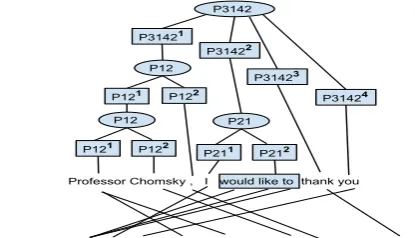
Figure 1 shows two alternative PETs for the same permutation over minimal phrases. The nodes have labels (likeP3142) which stand for lo-cal permutations (lo-called prime permutation) over the child nodes; for example, the root labelP3142
stands for prime permutation h3,1,4,2i, which says that the first child of the root becomes3rdon
the target side, the second becomes1st, the third
becomes 4th and the fourth becomes 2nd. The
prime permutations are non-factorizable permuta-tions likeh1,2i,h2,1iandh2,4,1,3i.
We think PETs are suitable for learning pre-ordering for two reasons. Firstly, PETs specify ex-actlythe phrase pairs defined by the permutation. Secondly, every permutation is factorizable into prime permutations only (Albert and Atkinson, 2005). Therefore, PETs exposemaximal sharing between different permutations in terms of both phrases and their reordering. We expect this to be advantageous for learning hierarchical reordering. For learning preordering, we first extract an ini-tialPCFG from the latent treebank of PETs over the source sentences only. We initialize the non-terminal set of this PCFG to the prime permuta-tionsdecorating the PET nodes. Subsequently we split these coarse labels in the same way as latent variable splitting is learned for treebank parsing (Matsuzaki et al., 2005; Prescher, 2005; Petrov et al., 2006; Saluja et al., 2014). Unlike treebank parsing, however, our training treebank is latent because it consists of a whole forest of PETs per training instance (s).
Learning the splits on a latent treebank of PETs results in a Reordering PCFG which we use to parse input source sentences into split-decorated trees, i.e., the labels are the splits of prime permu-tations. After parsings, we map the splits back on their initial prime permutations, and then retrieve a reordered version´sofs. In this sense, our latent splits arededicated to reordering.
We face two technical difficulties alien to work on latent PCFGs in treebank parsing. Firstly, as mentioned above, permutations may factorize into more than one PET (a forest) leading to a latent training treebank.1 And secondly, after we parse
a source string s, we are interested in´s, the per-muted version ofs, not in the best derivation/PET. Exact computation is a known NP-Complete prob-lem (Sima’an, 2002). We solve this by a new Minimum-Bayes Risk decoding approach using Kendall reordering score as loss function, which is an efficient measure over permutations (Birch and Osborne, 2011; Isozaki et al., 2010a).
In summary, this paper contributes:
• A novel latent hierarchical source reordering model working over all derivations of PETs
1All PETs for the same permutation share the same set of prime permutations but differ only in bracketing structure (Zhang and Gildea, 2007).
• A label splitting approach based on PCFGs over minimal phrases as terminals, learned from an ambiguous treebank, where the label splits start out from prime permutations.
• A fast Minimum Bayes Risk decoding over Kendallτ reordering score for selecting´s. We report results for extensive experiments on English-Japanese showing that our Reordering PCFG gives substantial improvements when used as preordering for phrase-based models, outper-forming two existing baselines for this task.
2 PETs and the Hidden Treebank
We aim at learning a PCFG which we will use for parsing source sentencessinto synchronous trees, from which we can obtain a reordered source ver-sion´s. Since PCFGs are non-synchronous gram-mars, we will use the nonterminal labels to encode reordering transductions, i.e., this PCFG is implic-itly an SCFG. We can do this becausesand´sare over the same alphabet.
Here, we have access only to a word-aligned parallel corpus, not a treebank. The following steps summarize our approach for acquiring a la-tent treebank and how it is used for learning a Re-ordering PCFG:
1. Obtain a permutation over minimal phrases from every word-alignment.
2. Obtain a latent treebank of PETs by factoriz-ing the permutations.
3. Extract a PCFG from the PETs with initial nonterminals taken from the PETs.
4. Learn to split the initial nonterminals and es-timate rule probabilities.
These steps are detailed in the next section, but we will start out with an intuitive exposition of PETs, the latent treebank and the Reordering Grammar.
Figure 1 shows examples of how PETs look like – see (Zhang and Gildea, 2007) for algorith-mic details. Here we label the nodes with nonter-minals which stand forprime permutations from the operators on the PETs. For example, non-terminals P12, P21 and P3142 correspond re-spectively to reordering transducersh1,2i, h2,1i
andh3,1,4,2i. A prime permutation on a source node µ is a transduction dictating how the chil-dren of µ are reordered at the target side, e.g.,
P12
Professor Chomsky , I would like to thank you
Ebenso möchte Ich Ihnen , Herr Professor Chomsky , herzlich danken P3142
P12
P21
(a) Canonical PET
P12
Professor Chomsky , I would like to thank you
Ebenso möchte Ich Ihnen , Herr Professor Chomsky , herzlich danken P3142
P12
P21
[image:3.595.83.516.67.171.2](b) Alternative PET Figure 1: Possible Permutation Trees (PETs) for one sentence pair
in PETs (P12andP21). ITGs recognize only the binarizable permutations, which is a major restric-tion when used on the data: there are many non-binarizable permutations in actual data (Welling-ton et al., 2006). In contrast, our PETs are ob-tained by factorizing permutations obob-tained from the data, i.e., they exactly fit the range of prime permutations in the parallel corpus. In practice we limit them to maximum arity 5.
We can extract PCFG rules from the PETs, e.g.,
P21 → P12 P2413. However, these rules are decorated with too coarse labels. A similar prob-lem was encountered in non-lexicalized monolin-gual parsing, and one solution was to lexicalize the productions (Collins, 2003) usinghead words. But linguistic heads do not make sense for PETs, so we opt for the alternative approach (Matsuzaki et al., 2005), which splits the nonterminals and softly percolates the splits through the trees gradu-ally fitting them to the training data. Splitting has a shadow side, however, because it leads to com-binatorial explosion in grammar size.
Suppose for example nodeP21could split into
P211 andP212 and similarly P2413 splits into
P24131and24132. This means that ruleP21 → P12P2413will form eight new rules:
P211 →P121P24131 P211→P121 P24132 P211 →P122P24131 P211→P122 P24132 P212 →P121P24131 P212→P121 P24132 P212 →P122P24131 P212→P122 P24132
Should we want to split each nonterminal into
30 subcategories, then an n-ary rule will split into30n+1new rules, which is prohibitively large.
Here we use the “unary trick” as in Figure 2. The superscript on the nonterminals denotes the child position from left to right. For example P212 1
means that this node is a second child, and the
mother nonterminal label isP211. For the running
example rule, this gives the following rules:
P211 →P2111P2121 P212→P2112 P2122 P211
1→P121 P2121→P24131 P211
1→P122 P2121→P24132 P211
2→P121 P2122→P24131 P211
2→P122 P2122→P24132
The unary trick leads to substantial reduction in grammar size, e.g., for arity 5 rules and 30 splits we could have had306 = 729000000split-rules,
but with the unary trick we only have30+302∗5 = 4530 split rules. The unary trick was used in early lexicalized parsing work (Carroll and Rooth, 1998).2 This split PCFG constitutes a latent
PCFGbecause the splits cannot be read of a tree-bank. It must be learned from the latent treebank of PETs, as described next.
P12
Professor Chomsky , I would like to thank you
Ebenso möchte Ich Ihnen , Herr Professor Chomsky , herzlich danken P3142
P12 P21
P121 P122 P121 P122
P211 P212 P31421
P31422
P31423
[image:3.595.307.515.505.624.2]P31424
Figure 2: Permutation Tree with unary trick
3 Details of Latent Reordering PCFG Obtaining permutations Given a source sen-tence s and its alignment a to a target sentence
tin the training corpus, we segmenths,a,tiinto a sequence ofminimal phrases sm (maximal
se-quence) such that the reordering between these minimal phrases constitutes a permutation πm.
We do not extract non-contiguous or non-minimal phrases because reordering them often involves complicated transductions which could hamper the performance of our learning algorithm.3
Unaligned words Next we describe the use of the factorization of permutations into PET forests for training a PCFG model. But first we need to extend the PETs to allow for unaligned words. An unaligned word is joined with a neighboring phrase to the left or the right, depending on the source language properties (e.g., whether the lan-guage is head-initial or -final (Chomsky, 1970)). Our experiments use English as source language (head-initial), so the unaligned words are joined to phrases to their right. This modifies a PET by adding a new binary branching nodeµ (dominat-ing the unaligned word and the phrase it is joined to) which is labeled with a dedicated nonterminal:
P01 if the unaligned word joins to the right and
P10if it joins to the left.
3.1 Probability model
We decompose the permutation πm into a forest
of permutation treesP EF(πm)inO(n3),
follow-ing algorithms in (Zhang et al., 2008; Zhang and Gildea, 2007) with trivial modifications. Each PET ∆ ∈ P EF(πm) is a different bracketing
(differing in binary branching structure only). We consider the bracketing hidden in the latent tree-bank, and apply unsupervised learning to induce a distribution over possible bracketings. Our prob-ability model starts from the joint probprob-ability of a sequence of minimal phrases sm and a
permuta-tion πm over it. This demands summing over all
PETs ∆ in the forest P EF(πm), and for every
PET also over all its label splits, which are given by the grammar derivationsd:
P(sm, πm) =
X
∆∈P EF(πm)
X
d∈∆
P(d,sm) (1)
The probability of a derivationd is a product of probabilities of all the rulesrthat build it:
P(sm, πm) =
X
∆∈P EF(πm)
X
d∈∆ Y
r∈d
P(r) (2)
3Which differs from (Quirk and Menezes, 2006).
As usual, the parameters of this model are the PCFG rule probabilities which are estimated from the latent treebank using EM as explained next.
3.2 Learning Splits on Latent Treebank For training the latent PCFG over the latent tree-bank, we resort to EM (Dempster et al., 1977) which estimates PCFG rule probabilities to max-imize the likelihood of the parallel corpus in-stances. Computing expectations for EM is done efficiently using Inside-Outside (Lari and Young, 1990). As in other state splitting models (Matsuzaki et al., 2005), after splitting the non-terminals, we distribute the probability uniformly over the new rules, and we add to each new rule some random noise to break the symmetry. We split the non-terminals only once as in (Matsuzaki et al., 2005) (unlike (Petrov et al., 2006)). For es-timating the distribution for unknown words we replace all words that appear ≤ 3 times with the “UNKNOWN” token.
3.3 Inference
We use CKY+ (Chappelier and Rajman, 1998) to parse a source sentence s into a forest using the learned split PCFG. Unfortunately, computing the most-likely permutation (or alternatively´s) as in
argmax
π∈Π
X
∆∈P EF(π)
X
d∈∆
P(d, πm)
from a lattice of permutations Π using a PCFG is NP-complete (Sima’an, 2002). Existing tech-niques, like variational decoding or Minimum-Bayes Risk (MBR), used for minimizing loss over trees as in (Petrov and Klein, 2007), are not di-rectly applicable here. Hence, we opt for mini-mizing the risk of making an error under a loss function over permutations using the MBR deci-sion rule (Kumar and Byrne, 2004):
ˆ
π= argmin
π X
πr
Loss(π, πr)P(πr) (3)
using their inside probabilities. An empirical dis-tribution over permutations P(π) is given by the relative frequency ofπ in the sample.
With large samples it is hard to efficiently com-pute expected Kendall τ loss for each sampled hypothesis. For sentence of length k and sam-ple of sizenthe complexity of a naive algorithm is O(n2k2). Computing Kendall τ alone takes O(k2). We use the fact that Kendall τ
decom-poses as a linear function over all skip-bigramsb
that could be built for any permutation of lengthk:
Kendall(π, πr) = X
b
1−δ(π, b)
k(k−1) 2
δ(πr, b) (4)
Hereδreturns1if permutationπcontains the skip bigramb, otherwise it returns0. With this decom-position we can use the method from (DeNero et al., 2009) to efficiently compute the MBR hypoth-esis. Combining Equations 3 and 4 we get:
ˆ
π= argmin π
X
πr
X
b
1−δ(π, b) k(k−1)
2
δ(πr, b)P(πr) (5)
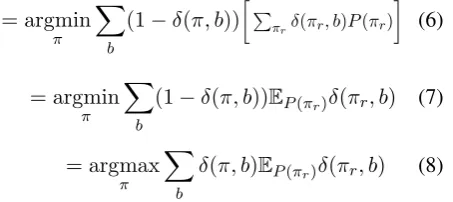
We can move the summation inside and reformu-late the expected Kendall τ loss as expectation over the skip-bigrams of the permutation.
= argmin
π X
b
(1−δ(π, b))Pπrδ(πr, b)P(πr)
(6)
= argmin
π X
b
(1−δ(π, b))EP(πr)δ(πr, b) (7)
= argmax
π X
b
δ(π, b)EP(πr)δ(πr, b) (8)
This means we need to pass through the sampled list only twice: (1) to compute expectations over skip bigrams and (2) to compute expected loss of each sampled permutation. The time complexity isO(nk2)which is quite fast in practice.
4 Experiments
We conduct experiments with three baselines:
• Baseline A: No preordering.
• Baseline B: Rule based preordering (Isozaki et al., 2010b), which first obtains an HPSG parse tree using Enju parser4 and after that
swaps the children by moving the syntactic head to the final position to account for differ-ent head oridiffer-entation in English and Japanese.
4http://www.nactem.ac.uk/enju/
• Baseline C: LADER (Neubig et al., 2012): latent variable preordering that is based on ITG and large-margin training with latent variables. We used LADER in standard set-tings without any linguistic features (POS tags or syntactic trees).
And we test four variants of our model:
• RGleft- only canonical left branching PET
• RGright- only canonical right branching PET
• RGITG-forest- all PETs that are binary (ITG)
• RGPET-forest- all PETs.
We test these models on English-Japanese NTCIR-8 Patent Translation (PATMT) Task. For tuning we use all NTCIR-7 dev sets and for test-ing the test set from NTCIR-9 from both direc-tions. All used data was tokenized (English with Moses tokenizer and Japanese with KyTea5) and
filtered for sentences between 4 and 50 words. A subset of this data is used for training the Reorder-ing Grammar, obtained by filterReorder-ing out sentences that have prime permutations of arity>5, and for the ITG version arity>2. Baseline C was trained on 600 sentences because training is prohibitively slow. Table 1 shows the sizes of data used.
[image:5.595.68.295.433.534.2]corpus #sents #words #wordssource target train RGPET 786k 21M – train RGITG 783k 21M – train LADER 600 15k – train translation 950k 25M 30M tune translation 2k 55K 66K test translation 3k 78K 93K Table 1: Data stats
The Reordering Grammar was trained for 10 it-erations of EM ontrain RGdata. We use 30 splits for binary non-terminals and 3 for non-binary. Training on this dataset takes 2 days and parsing tuning and testing set without any pruning takes 11 and 18 hours respectively.
4.1 Intrinsic evaluation
We test how well our model predicts gold reorder-ings before translation by training the alignment model using MGIZA++ 6 on the training corpus
and using it to align the test corpus. Gold re-orderings for the test corpus are obtained by sort-ing words by their average target position and (unaligned words follow their right neighboring
5http://www.phontron.com/kytea/
word). We use Kendall τ score for evaluation (note the difference with Section 3.3 where we de-fined it as a loss function).
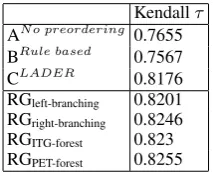
Table 2 shows that our models outperform all baselines on this task. The only strange result here is that rule-based preordering obtains a lower score than no preordering, which might be an ar-tifact of the Enju parser changing the tokenization of its input, so the Kendallτ of this system might not really reflect the real quality of the preorder-ing. All other systems use the same tokenization.
Kendallτ ANo preordering 0.7655
BRule based 0.7567
CLADER 0.8176
[image:6.595.128.235.235.323.2]RGleft-branching 0.8201 RGright-branching 0.8246 RGITG-forest 0.823 RGPET-forest 0.8255
Table 2: Reordering prediction
4.2 Extrinsic evaluation in MT
The reordered output of all the mentioned base-lines and versions of our model are translated with phrase-based MT system (Koehn et al., 2007) (dis-tortion limit set to 6 with distance based reordering model) that is trained ongold preorderingof the training data7´s−t. The only exception is
Base-line A which is trained on originals−t.
We use a 5-gram language model trained with KenLM8, tune 3 times with kb-mira (Cherry and
Foster, 2012) to account for tuner instability and evaluated using Multeval 9 for statistical
signifi-cance on 3 metrics: BLEU (Papineni et al., 2002), METEOR (Denkowski and Lavie, 2014) and TER (Snover et al., 2006). We additionally report RIBES score (Isozaki et al., 2010a) that concen-trates on word order more than other metrics.
Single or all PETs? In Table 3 we see that using all PETs during training makes a big im-pact on performance. Only the all PETsvariants
7Earlier work on preordering applies the preordering model to the training data to obtain a parallel corpus of guessed´s−tpairs, which are the word re-aligned and then used for training the back-end MT system (Khalilov and Sima’an, 2011). We skip this, we take the risk of mismatch between the preordering and the back-end system, but this simplifies training and saves a good amount of training time.
8http://kheafield.com/code/kenlm/ 9https://github.com/jhclark/multeval
System BLEU↑ METEOR↑ TER↓ RIBES↑
ANo preord. 27.8 48.9 59.2 68.29
BRule based 29.6 48.7 59.2 71.12
CLADER 31.1 50.5 56.0 74.29
RGleft 31.2AB 50.5AB 56.3ABC 74.45
RGright 31.4AB 50.5AB 56.3ABC 75.29
RGITG-forest 31.6ABC 50.8ABC 55.7ABC 75.29 RGPET-forest 32.0ABC 51.0ABC 55.7ABC 75.62
Table 3: Comparison of different preordering models. Superscripts A, B and C signify if the sys-tem is significantly better (p < 0.05) than the re-spective baseline or significantly worse (in which case it is a subscript). Significance tests were not computed for RIBES. Score is bold if the system is significantly better than all the baselines.
(RGITG-forestand RGPET-forest) significantly
outper-form all baselines. If we are to choose a single PET per training instance, then learning RG from only left-branching PETs (the one usually cho-sen in other work, e.g. (Saluja et al., 2014)) per-forms slightly worse than the right-branching PET. This is possibly because English is mostly right-branching. So even though both PETs describe the same reordering, RGrightcaptures reordering over
English input better than RGleft.
All PETs or binary only? RGPET-forestperforms significantly better than RGITG-forest (p < 0.05). Non-ITG reordering operators are predicted rarely (in only 99 sentences of the test set), but they make a difference, because these operators often appear high in the predicted PET. Furthermore, having these operators during training might allow for better fit to the data.
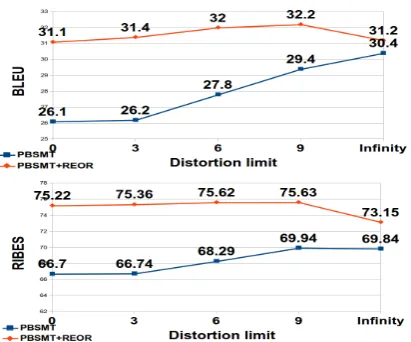
How much reordering is resolved by the Reordering Grammar? Obviously, completely factorizing out the reordering from the transla-tion process is impossible because reordering de-pends to a certain degree on target lexical choice. To quantify the contribution of Reordering Gram-mar, we tested decoding with different distortion limit values in the SMT system. We compare the phrase-based (PB) system with distance based cost function for reordering (Koehn et al., 2007) with and without preordering.
Figure 3 shows that Reordering Grammar gives substantial performance improvements at all distortion limits (both BLEU and RIBES). RGPET-forestis less sensitive to changes in decoder
perfor-Figure 3: Distortion effect on BLEU and RIBES
mance of RGPET-forest varies only by 1.1 BLEU
points while standard PBSMT by 4.3 BLEU points. Some local reordering in the decoder seems to help RGPET-forest but large distortion
limits seem to degrade the preordering choice. This shows also that the improved performance of RGPET-forest is not only a result of efficiently
ex-ploring the full space of permutations, but also a result of improved scoring of permutations.
System BLEU↑METEOR↑TER↓RIBES↑
DP BMSD 29.6 50.1 58.0 68.97
EHiero 32.6 52.1 54.5 74.12
RGPET-forest+MSD32.4D 51.3DE 55.3DE 75.72
Table 4: Comparison to MSD and Hiero
Does the improvement remain for a decoder with MSD reordering model? We compare the RGPET-forest preordered model against a decoder
that uses the strong MSD model (Tillmann, 2004; Koehn et al., 2007). Table 4 shows that using Reordering Grammar as front-end to MSD re-ordering (full Moses) improves performance by 2.8 BLEU points. The improvement is confirmed by METEOR, TER and RIBES. Our preordering model and MSD are complementary – the Re-ordering Grammar captures long distance ing, while MSD possibly does better local reorder-ings, especially reorderings conditioned on the lexical part of translation units.
Interestingly, the MSD model (BLEU 29.6) improves over distance-based reordering (BLEU 27.8) by (BLEU 1.8), whereas the difference be-tween these systems as back-ends to Reordering Grammar (respectively BLEU 32.4 and 32.0) is
far smaller (0.4 BLEU). This suggests that a ma-jor share of reorderings can be handled well by preordering without conditioning on target lexical choice. Furthermore, this shows that RGPET-forest
preordering is not very sensitive to the decoder’s reordering model.
Comparison to a Hierarchical model (Hiero). Hierarchical preordering is not intended for a hi-erarchical model as Hiero (Chiang, 2005). Yet, here we compare our preordering system (PB MSD+RG) to Hiero for completeness, while we should keep in mind that Hiero’s reordering model has access to much richer training data. We will discuss these differences shortly.
Table 4 shows that the difference in BLEU is not statistically significant, but there is more dif-ference in METEOR and TER. RIBES, which concentrates more on reordering, prefers Reorder-ing Grammar over Hiero. It is somewhat sur-prising that a preordering model combined with a phrase-based model succeeds to rival Hiero’s per-formance on English-Japanese. Especially when looking at the differences between the two:
1. Reordering Grammar uses only minimal phrases, while Hiero uses composite (longer) phrases which encapsulate internal reorder-ings, but also non-contiguous phrases. 2. Hiero conditions its reordering on the lexical
target side, whereas the Reordering Grammar does not (by definition).
3. Hiero uses a range of features, e.g., a lan-guage model, while Reordering Grammar is a mere generative PCFG.
The advantages of Hiero can be brought to bear upon Reordering Grammar by reformulating it as a discriminative model.
Which structure is learned? Figure 4 shows an example PET output showing how our model learns: (1) that the article “the” has no equiva-lent in Japanese, (2) that verbs go after their ob-ject, (3) to use postpositions instead of preposi-tions, and (4) to correctly group certain syntactic units, e.g. NPs and VPs.
5 Related work
[image:7.595.76.282.61.232.2]P12
P12
. P21
P21
P12
P21
DC
P12
c u r r e n t i flowing
P21
t h r o u g h
P12
P01 P12
the feeding conductor 3 produces
P12
magnetic P12
[image:8.595.75.528.63.205.2]field b1
Figure 4: Example parse of English sentence that predicts reordering for English-Japanese
al (2012) trains a latent non-probabilistic discrim-inative model for preordering as an ITG-like gram-mar limited to binarizable permutations. Tromble and Eisner (2009) use ITG but do not train the grammar. They only use it to constrain the lo-cal search. DeNero and Uszkoreit (2011) present two separate consecutive steps for unsupervised induction of hierarchical structure (ITG) and the induction of a reordering function over it. In con-trast, here we learn both the structure and the re-ordering function simultaneously. Furthermore, at test time, our inference with MBR over a mea-sure of permutation (Kendall) allows exploiting both structure and reordering weights for infer-ence, whereas test-time inference in (DeNero and Uszkoreit, 2011) is also a two step process – the parser forwards to the next stage the best parse.
Dyer and Resnik (2010) treat reordering as a la-tent variable and try to sum over all derivations that lead not only to the same reordering but also to the same translation. In their work they consider all permutations allowed by a given syntactic tree. Saers et al (2012) induce synchronous gram-mar for translation by splitting the non-terminals, but unlike our approach they split generic non-terminals and not operators. Their most expres-sive grammar covers only binarizable permuta-tions. The decoder that uses this model does not try to sum over many derivations that have the same yield. They do not make independence as-sumption like our “unary trick” which is proba-bly the reason they do not split more than 8 times. They do not compare their results to any other SMT system and test on a very small dataset.
Saluja et al (2014) attempts inducing a refined Hiero grammar (latent synchronous CFG) from Normalized Decomposition Trees (NDT) (Zhang et al., 2008). While there are similarities with
the present work, there are major differences. On the similarity side, NDTs are decomposing align-ments in ways similar to PETs, and both Saluja’s and our models refine the labels on the nodes of these decompositions. However, there are major differences between the two:
• Our model is completely monolingual and unlexicalized (does not condition its reorder-ing on the translation) in contrast with the La-tent SCFG used in (Saluja et al., 2014),
• Our Latent PCFG label splits are defined as refinements of prime permutations, i.e., specifically designed for learning reordering, whereas (Saluja et al., 2014) aims at learn-ing label splittlearn-ing that helps predictlearn-ing NDTs from source sentences,
• Our model exploitsall PETs and all deriva-tions, both during training (latent treebank) and during inferences. In (Saluja et al., 2014) only left branching NDT derivations are used for learning the model.
6 Conclusion
We present a generative Reordering PCFG model learned from latent treebanks over PETs obtained by factorizing permutations over minimal phrase pairs. Our Reordering PCFG handles non-ITG reordering patterns (up to 5-ary branching) and it works with all PETs that factorize a permuta-tion (rather than a single PET). To the best of our knowledge this is the first time both extensions are shown to improve performance. The empiri-cal results on English-Japanese show that (1) when used for preordering, the Reordering PCFG helps particularly with relieving the phrase-based model from long range reorderings, (2) combined with a state-of-the-art phrase model, Reordering PCFG shows performance not too different from Hiero, supporting the common wisdom of factorizing long range reordering outside the decoder, (3) Re-ordering PCFG generates derivations that seem to coincide well with linguistically-motivated re-ordering patterns for English-Japanese. There are various direction we would like to explore, the most obvious of which are integrating the learned reordering with other feature functions in a dis-criminative setting, and extending the model to deal with non-contiguous minimal phrases.
Acknowledgments
This work is supported by STW grant nr. 12271 and NWO VICI grant nr. 277-89-002. We thank Wilker Aziz for comments on earlier version of the paper and discussions about MBR and sampling.
References
Michael H. Albert and Mike D. Atkinson. 2005. Sim-ple Permutations and Pattern Restricted Permuta-tions. Discrete Mathematics, 300(1-3):1–15.
Alexandra Birch and Miles Osborne. 2011. Reorder-ing Metrics for MT. InProceedings of the Associ-ation for ComputAssoci-ational Linguistics, Portland, Ore-gon, USA. Association for Computational Linguis-tics.
Glenn Carroll and Mats Rooth. 1998. Valence Induc-tion with a Head-Lexicalized PCFG. InIn Proceed-ings of Third Conference on Empirical Methods in Natural Language Processing.
Jean-C´edric Chappelier and Martin Rajman. 1998. A Generalized CYK Algorithm for Parsing Stochastic CFG. InProceedings of the First Workshop on Tab-ulation in Parsing and Deduction, pages 133–137.
Colin Cherry and George Foster. 2012. Batch Tun-ing Strategies for Statistical Machine Translation. In Proceedings of the 2012 Conference of the North American Chapter of the Association for Computa-tional Linguistics: Human Language Technologies, NAACL HLT ’12, pages 427–436.
David Chiang. 2005. A Hierarchical Phrase-Based Model for Statistical Machine Translation. In Pro-ceedings of the 43rd Annual Meeting of the Associa-tion for ComputaAssocia-tional Linguistics (ACL’05), pages 263–270, Ann Arbor, Michigan, June.
Noam Chomsky. 1970. Remarks on Nominalization. In Roderick A. Jacobs and Peter S. Rosenbaum, ed-itors, Readings in English Transformational Gram-mar, pages 184–221. Ginn, Boston.
Michael Collins, Philipp Koehn, and Ivona Kuˇcerov´a. 2005. Clause Restructuring for Statistical Machine Translation. In Proceedings of the 43rd Annual Meeting on Association for Computational Linguis-tics, ACL ’05, pages 531–540.
Michael Collins. 2003. Head-Driven Statistical Mod-els for Natural Language Parsing. Comput. Lin-guist., 29(4):589–637, December.
A. P. Dempster, N. M. Laird, and D. B. Rubin. 1977. Maximum Likelihood from Incomplete Data via the EM Algorithm. JOURNAL OF THE ROYAL STA-TISTICAL SOCIETY, SERIES B, 39(1):1–38. John DeNero and Jakob Uszkoreit. 2011. Inducing
Sentence Structure from Parallel Corpora for Re-ordering. InProceedings of the Conference on Em-pirical Methods in Natural Language Processing, EMNLP ’11, pages 193–203.
John DeNero, David Chiang, and Kevin Knight. 2009. Fast Consensus Decoding over Translation Forests. In Proceedings of the Joint Conference of the 47th Annual Meeting of the ACL and the 4th International Joint Conference on Natural Language Processing of the AFNLP: Volume 2 - Volume 2, ACL ’09, pages 567–575.
Michael Denkowski and Alon Lavie. 2014. Meteor Universal: Language Specific Translation Evalua-tion for Any Target Language. InProceedings of the EACL 2014 Workshop on Statistical Machine Trans-lation.
Chris Dyer and Philip Resnik. 2010. Context-free Re-ordering, Finite-state Translation. In Human Lan-guage Technologies: The 2010 Annual Conference of the North American Chapter of the Association for Computational Linguistics, HLT ’10, pages 858– 866.
Hideki Isozaki, Katsuhito Sudoh, Hajime Tsukada, and Kevin Duh. 2010b. Head Finalization: A Sim-ple Reordering Rule for SOV Languages. In Pro-ceedings of the Joint Fifth Workshop on Statistical Machine Translation and MetricsMATR, WMT ’10, pages 244–251.
Jason Katz-Brown, Slav Petrov, Ryan McDon-ald, Franz Och, David Talbot, Hiroshi Ichikawa, Masakazu Seno, and Hideto Kazawa. 2011. Train-ing a Parser for Machine Translation ReorderTrain-ing. In Proceedings of the 2011 Conference on Empiri-cal Methods in Natural Language Processing, pages 183–192, Edinburgh, Scotland, UK., July. Associa-tion for ComputaAssocia-tional Linguistics.
Maxim Khalilov and Khalil Sima’an. 2011. Context-Sensitive Syntactic Source-Reordering by Statistical Transduction. InIJCNLP, pages 38–46.
Philipp Koehn, Hieu Hoang, Alexandra Birch, Chris Callison-Burch, Marcello Federico, Nicola Bertoldi, Brooke Cowan, Wade Shen, Christine Moran, Richard Zens, Chris Dyer, Ondˇrej Bojar, Alexandra Constantin, and Evan Herbst. 2007. Moses: Open Source Toolkit for Statistical Machine Translation. In Proceedings of the 45th Annual Meeting of the ACL on Interactive Poster and Demonstration Ses-sions, ACL ’07, pages 177–180.
Shankar Kumar and William Byrne. 2004. Mini-mum Bayes-Risk Decoding for Statistical Machine Translation. InProceedings of the Joint Conference on Human Language Technologies and the Annual Meeting of the North American Chapter of the Asso-ciation of Computational Linguistics (HLT-NAACL). K. Lari and S. J. Young. 1990. The Estimation of Stochastic Context-Free Grammars using the Inside-Outside Algorithm. Computer Speech and Lan-guage, 4:35–56.
Uri Lerner and Slav Petrov. 2013. Source-Side Clas-sifier Preordering for Machine Translation. In Pro-ceedings of the 2013 Conference on Empirical Meth-ods in Natural Language Processing, pages 513– 523. Association for Computational Linguistics. Gideon Maillette de Buy Wenniger and Khalil Sima’an.
2014. Bilingual Markov Reordering Labels for Hi-erarchical SMT. InProceedings of SSST-8, Eighth Workshop on Syntax, Semantics and Structure in Statistical Translation, pages 138–147, Doha, Qatar, October.
Takuya Matsuzaki, Yusuke Miyao, and Jun’ichi Tsujii. 2005. Probabilistic CFG with Latent Annotations. In Proceedings of the 43rd Annual Meeting on As-sociation for Computational Linguistics, ACL ’05, pages 75–82.
Graham Neubig, Taro Watanabe, and Shinsuke Mori. 2012. Inducing a Discriminative Parser to Optimize Machine Translation Reordering. InConference on Empirical Methods in Natural Language Processing
and Natural Language Learning (EMNLP-CoNLL), pages 843–853, Jeju, Korea, July.
Kishore Papineni, Salim Roukos, Todd Ward, and Wei-Jing Zhu. 2002. BLEU: A Method for Automatic Evaluation of Machine Translation. InProceedings of the 40th Annual Meeting on Association for Com-putational Linguistics, ACL ’02, pages 311–318. Slav Petrov and Dan Klein. 2007. Improved Inference
for Unlexicalized Parsing. In Human Language Technologies 2007: The Conference of the North American Chapter of the Association for Computa-tional Linguistics; Proceedings of the Main Confer-ence, pages 404–411, Rochester, New York, April. Slav Petrov, Leon Barrett, Romain Thibaux, and Dan
Klein. 2006. Learning Accurate, Compact, and Interpretable Tree Annotation. In Proceedings of the 21st International Conference on Computational Linguistics and 44th Annual Meeting of the Associa-tion for ComputaAssocia-tional Linguistics, pages 433–440, Sydney, Australia, July. Association for Computa-tional Linguistics.
Detlef Prescher. 2005. Inducing Head-Driven PCFGs with Latent Heads: Refining a Tree-Bank Grammar for Parsing. InIn ECML05.
Chris Quirk and Arul Menezes. 2006. Do we need phrases? Challenging the conventional wisdom in Statistical Machine Translation. In Proceedings of HLT-NAACL 2006. ACL/SIGPARSE, May.
Markus Saers, Karteek Addanki, and Dekai Wu. 2012. From Finite-State to Inversion Transductions: To-ward Unsupervised Bilingual Grammar Induction. InCOLING 2012, 24th International Conference on Computational Linguistics, Proceedings of the Con-ference: Technical Papers, 8-15 December 2012, Mumbai, India, pages 2325–2340.
A. Saluja, C. Dyer, and S. B. Cohen. 2014. Latent-Variable Synchronous CFGs for Hierarchical Trans-lation.Proceedings of EMNLP.
Khalil Sima’an. 2002. Computational Complex-ity of Probabilistic Disambiguation. Grammars, 5(2):125–151.
Matthew Snover, Bonnie Dorr, Richard Schwartz, Lin-nea Micciulla, and John Makhoul. 2006. A study of translation edit rate with targeted human annota-tion. InIn Proceedings of Association for Machine Translation in the Americas, pages 223–231. Christoph Tillmann. 2004. A Unigram Orientation
Model for Statistical Machine Translation. In Pro-ceedings of HLT-NAACL 2004: Short Papers, HLT-NAACL-Short ’04, pages 101–104.
Benjamin Wellington, Sonjia Waxmonsky, and I. Dan Melamed. 2006. Empirical lower bounds on the complexity of translational equivalence. InIn Pro-ceedings of ACL 2006, pages 977–984.
Dekai Wu. 1997. Stochastic Inversion Transduction Grammars and Bilingual Parsing of Parallel Cor-pora. Comput. Linguist., 23(3):377–403, Septem-ber.
Fei Xia and Michael Mccord. 2004. Improving a Statistical MT System with Automatically Learned Rewrite Patterns. In Proceedings of Coling 2004, pages 508–514, Geneva, Switzerland, August. COL-ING.
Hao Zhang and Daniel Gildea. 2007. Factorization of Synchronous Context-Free Grammars in Linear Time. InNAACL Workshop on Syntax and Structure in Statistical Translation (SSST), pages 25–32. Hao Zhang, Daniel Gildea, and David Chiang.