SECURE TWO-PARTY PROTOCOL FOR SOLVING YAO’S
MILLIONAIRES’ PROBLEM IN BITCOIN
by Joshua Holmes
Athesis
submittedinpartialfulfillment oftherequirementsforthedegreeof MasterofScienceinComputerScience
BoiseStateUniversity
Joshua Holmes
DEFENSECOMMITTEEANDFINALREADINGAPPROVALS
ofthethesissubmittedby JoshuaHolmes
ThesisTitle: Variance:
SecureTwo-PartyProtocolforSolvingYao’sMillionaires’ProbleminBitcoin DateofFinalOralExamination: 19October2017
ThefollowingindividualsreadanddiscussedthethesissubmittedbystudentJoshuaHolmes, andtheyevaluatedthepresentationandresponsetoquestionsduringthefinaloral exami-nation. Theyfoundthatthestudentpassedthefinaloralexamination.
Gaby Dagher, Ph.D. Chair, Supervisory Committee
Dianxiang Xu, Ph.D. Member, Supervisory Committee
Marion Scheepers, Ph.D. Member, Supervisory Committee
Also, I would like to thank my family and friends for the constant support and motiva-tion.
Secure multiparty protocols are useful tools for parties wishing to jointly compute a functionwhilekeepingtheirinputdatasecret.Themillionaires’problemisthefirstsecure two-partycomputationproblem,wherethegoalistosecurelycomparetwoprivatenumbers withoutatrustedthird-party. Therehavebeenseveralsolutionsto theproblem,including Yao’s protocol [Yao, 1982] and Mix and Match [Jakobsson and Juels, 2000]. However, Yao’s Protocol is not secure in the malicious model and Mix and Match unnecessarily releasestheoreticallybreakableencryptionsofinformationaboutthedatathatisnotneeded forthecomparison. Inaddition, neitherprotocolhasanyverificationofthevalidityofthe inputs before theyare used. In this thesis, we introduce Variance, a privacy-preserving two-partyprotocolforsolvingtheYao’smillionaires’probleminaBitcoinsetting,inwhich each party controlsseveral Bitcoin accounts (public Bitcoinaddresses) and theywant to findoutwhoownsmorebitcoinswithoutrevealing(1)howmanyaccountstheyownand thebalanceofeachaccount,(2)theaddressesassociatedwiththeiraccounts,and(3)their total wealth of bitcoins while assuring the other party that they are not claiming more bitcointhan theypossess. We utilizecommitments, encryptions, zero knowledge proofs, andhomomorphismsasthemajorcomputationaltoolstoprovideasolutiontotheproblem, andsubsequentlyprovethatthesolutionissecureagainstactiveadversariesinthemalicious model.
Abstract . . . vi
List of Tables . . . x
List of Figures . . . xi
LIST OF ABBREVIATIONS . . . xii
LIST OF SYMBOLS . . . xiii
1 Introduction . . . 1
1.1 Motivation . . . 1
1.2 Challenges & Concerns . . . 2
1.3 Limitations . . . 3
1.4 Thesis Statement . . . 4
1.5 Organization of the Thesis . . . 5
2 Literature Review . . . 6
2.1 Bitcoin . . . 6
2.2 Secure Multiparty Computation (MPC) . . . 7
2.3 Zero Knowledge Proofs (ZKPs) . . . 8
3 Background and Building Blocks . . . 10
3.3 Pedersen Commitments [21] . . . 11
3.4 Zero Knowledge Proofs [12] . . . 11
3.4.1 Schnorr’s Protocol (Protocol 3.1) . . . 12
3.4.2 Zero Knowledge OR (Protocol 3.2) . . . 14
3.4.3 Zero Knowledge AND (Protocol 3.3) . . . 14
3.4.4 Protocol 3.4: Bit Verification . . . 15
3.4.5 Proof of Equal Discrete Logs (PEDL) [13] (Protocol 3.5) . . . 15
3.5 Mix and Match Table . . . 16
3.5.1 Plaintext Equality Test [15] . . . 16
4 Variance Protocol . . . 22
4.1 Solution Overview . . . 22
4.2 ZK-OR Proof of Assets . . . 22
4.3 Conversion to Bits . . . 25
4.4 Zero Knowledge Comparison Protocol . . . 27
5 Security Analysis . . . 30
5.1 Zero Knowledge Proofs . . . 30
5.1.1 Schnorr’s Protocol . . . 31
5.1.2 Equal Discrete Log Proof . . . 32
5.1.3 Zero Knowledge AND . . . 33
5.1.4 Zero Knowledge OR . . . 35
5.2 Security Definition . . . 37
5.3 Security Proofs . . . 38
5.4 Potential Security Threat & Solutions . . . 50
6 Experimental Evaluation and Performance Analysis . . . 51
6.1 The Setting . . . 51
6.1.1 Proof of Assets . . . 52
6.1.2 Bit Conversion and Comparison . . . 56
7 Conclusion . . . 57
7.1 Summary . . . 57
7.2 Looking Ahead . . . 58
7.2.1 Proof of Assets . . . 58
7.2.2 Zero Knowledge Comparison . . . 59
Bibliography . . . 60
4.1 Conceptual Model. . . 27 4.2 Actual Model . . . 28
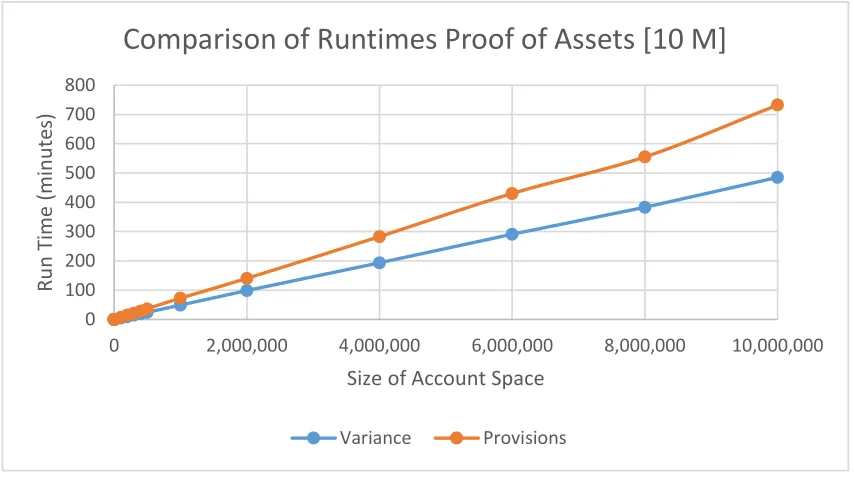
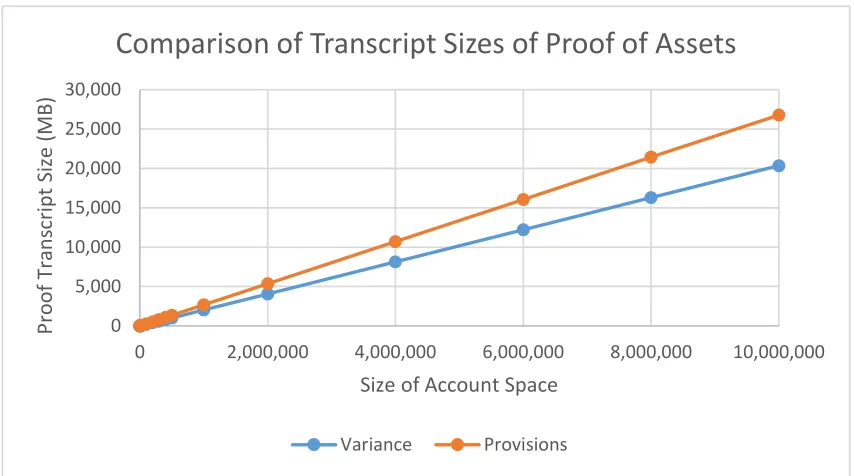
6.1 Comparison of runtimes of proofs of assets up to 500,000 accounts. . . 54 6.2 Comparison of runtimes of proofs of assets up to 10,000,000 accounts. . . 54 6.3 Comparison of transcripts sizes of proofs of assets up to 10,000,000 accounts. 55
ZKP– Zero Knowledge Proof
MPC– Secure Multi-Party Computations
EC– Elliptic Curve
ECDLP– Elliptic Curve Discrete Log Problem
TTP– Trusted Third Party
JmK An EC Exponential Elgamal encryption ofm((g
m·yr, gr)).
Cm An EC Pedersen Commitment hidingm(gm·hα).
C(m,α) An EC Pedersen Commitment hidingmwith a keyα(gm·hα). g A generator point of the EC group.
h A second generator point of the EC group. y The distributed EC Elgamal Public Key.
Chapter 1
INTRODUCTION
1.1
Motivation
Secure multiparty computation is an essential and expanding field in cryptography [10]. The ability to run useful computations while maintaining privacy of data opens up oppor-tunities to compute on private and distributed data. Most of the work in secure multiparty computation is focused on encryption schemes. While encryption is usually sufficient, it can eventually be decrypted, especially as technology improves or if the hard problems are solved. To accommodate permanently relevant private data, a secure multiparty protocol should adapt perfectly-hiding techniques to perfectly hide as much data as possible.
In Yao’s Millionaires’ Problem [25], two parties want to compare their wealth without revealing how much money they have. Since its conception, it has been one of the ele-mentary problems of secure computation, used to demonstrate how more generic secure computational systems can be applied. Yao proposed a two-party protocol [25], utilizing garbled logic gates to simulate a circuit. The main limitation of Yao’s protocol is that the construction of the circuit can not be verified, which makes the protocol only secure in the semi-honest model.
to compare two bits or numbers with a plaintext equality test to find a matching row and retrieve the output. It then uses averifiable mix network[16] to randomize the table so the rows are not traceable so that one party can not infer associations between the values in the different columns.
In this thesis, we introduce a solution to the Millionaires’ problem in the context of Bitcoin [20]. In the Bitcoin cryptocurrency system, an account is presented as a public address associated with a balance and users hold the associated private keys to their ac-counts. To determine who owns more bitcoins, it is not sufficient to simply compare two numbers. Owners of bitcoin usually store their holdings in multiple accounts. Due to the nature of Bitcoin, any protocol involving a user’s accounts is required to preserve privacy. This adds an extra layer of complexity to the comparison, as not only do the total assets need to be secure, but the specific owned accounts and the number of accounts must also be kept secret. Due to the nature of the Bitcoin’s blockchain, any information associating accounts with owners can be used to determine private information about the owner in the future, such as their current active accounts. Varianceis a commitment-based protocol employing zero knowledge proofs to run bit comparisons to solve the Millionaires’ Problem in the context of Bitcoin.1
1.2
Challenges & Concerns
There are several challenges associated with creating a protocol that solves the Million-aires’ Problem for Bitcoin. Since it is common for Bitcoin holders to keep their assets in multiple accounts, these accounts have to be added for any real comparison to take place. Any protocol which manages this sum would have to be privacy-preserving, which means
the total sum, the amounts in the accounts, and the public keys for the owned accounts must be kept secret. The last requirement is calledunlinkablity[5][4], meaning a party can not be linked to their accounts and vice versa. However, even if another party can not figure out the accounts through the protocol but can figure out the sums, they may be able to piece together which accounts the party holds, though this is a hard problem.
Due to the sensitivity of some of the data, a commitment based scheme using per-fectly hiding commitments would be preferable. Specifically, the owned accounts should be impossible, or at least extremely difficult, to determine. Due to the nature Bitcoin’s blockchain, if an adversary manages to associate an account with a party, then they may be able to figure out other accounts associated with the party, even perhaps being able to track owned accounts in the future [22]. It would be best to have as much data about the sum as possible be perfectly hidden, so the protocol is not as dependant on the discrete log problem. Even obscuring small details of the sum may the prevent discovery of claimed accounts.
As the Bitcoin protocol is designed to be secure malicious users, any solution to this problem should also be secure in the malicious model.
1.3
Limitations
A limitation ofVariancecan only solve the Millionaires’ Problem if the goal of each party is to show that they have the most wealth. Accounts can easily be omitted by either party to artificially reduce their apparent net worth, which could be used to avoid appearing to have more bitcoins. This protocol can only work if the goal of each party is to prove they have more Bitcoin with no ulterior motivations.
keys to make a party appear to have more bitcoins than they actually have. There is no known solution to this problem because either party could be colluding with account holders outside the protocol.
Varianceis also limited to accepting key schemes to which a Zero Knowledge Proof of Knowledge of the secret is known. For example, to include accounts for which the secret is only hidden behind a pay-to-pub-hash or pay-to-script-hash, a Zero Knowledge Proof of Knowledge of the private key of the preimage of the hash is required. Even with this proof, Provisions’s proof of assets could not include these accounts [5]. This is a major issue in the context of the Millionaires’ Problem, as wealthy Bitcoin holders tend to keep many of their assets (bitcoins) in non-spending accounts, where bitcoins is put in to an account and not spent. In these cases, only the public address (the hash) is known. However, since one of the common applications of solutions to the Millionaires’ Problem is to run auctions, this solution still has many applications while without supporting non-spending accounts. This problem can be solved if a Zero Knowledge Proof of Knowledge of the private key associated with the public address, meaning the private key to the preimage of the hash, can be created, but any such proof would likely be significantly less efficient than the proof of knowledge for a discrete log public key.
1.4
Thesis Statement
The objective of this thesis is to answer the following question:How can two non-trusting individuals determine in a privacy-preserving manner who owns more bitcoins?
protocol for determining whose total assets of bitcoins is higher such that:
1. No account from the public Bitcoin blockchain can be linked back to either party.
2. Neither party can determine the other’s total Bitcoin assets or number of accounts.
3. The protocol is portable across multiple cryptosystems.
1.5
Organization of the Thesis
The rest of the thesis is organized as follows:
1. Chapter 2 discusses the related literature over the past years in the fields related to Bitcoin, Zero Knowledge Proofs, and Secure Multi-Party Computation.
2. Chapter 3 discusses the building blocks and preliminaries needed for this proposal.
3. Chapter 4 discusses our protocol and methodology for secure and privacy-preserving comparison of Bitcoin assets.
4. Chapter 5 is an analysis of the security of the protocol.
5. Chapter 6 discusses the computational complexity of the protocol, as well as evalua-tion of experiments.
Chapter 2
LITERATURE REVIEW
2.1
Bitcoin
technically effective, but they do not meet the our goals because they reveal the accounts held and how much money is in each account. Recall that our goal is to determine who has more bitcoin without revealing the amount each party holds nor any information as to the accounts.
Provisions [5] has the most applicable Proof of Assets, which manages to keep the accounts and the amount of bitcoin secret. It utilizes a series of commitments that are verified and combined in such a way that only the balance of an owned account can be added to the total sum commitment. This fulfills our goals of not revealing the owned accounts or the total sum. However, according to the paper, it would take over 20GB and an excessive amount of time to execute their proof over the entire blockchain. This makes it applicable to the daily or periodic Proof of Solvency that exchanges may be expected to execute, which is the purpose for which it was designed, but it may not be sufficiently efficient for situations that call upon solutions to the Millionaire’s Problem. Their specific methodology also stops them from using non-spending accounts and requires that the commitment and key systems use the same cryptographic setting (key schemes can not be mixed), which is less than optimal. We attempt to improve on their conceptual method by making it portable (allows multiple cryptographic settings), more efficient, modular, and more intuitive.
2.2
Secure Multiparty Computation (MPC)
Jakobson and Juels [15], because they can simulate any function using logic circuits, though it may take an inordinately large amount of time.
There has been a significant amount of work in secure multiparty computations [1] [13] [9]. There are several important uses for MPCs. One important purpose is to facilitate cloud computing without having to forgo privacy [19]. Another use is privacy preserving database queries and data mining. [18][24]. To accommodate these schemes, MPC schemes are being designed to be scalable. Though a Yao garbled circuit can execute any executable function securely, it would be extremely inefficient to execute an entire program by running expensive computations on every single basic binary operation. More efficient methods have been designed, though they are still not very efficient for heavy computation on the cloud, both in communication and computation. However, most or all of these schemes rely on public key encryptions and the ability to decrypt in some form or changing the data through homomorphism, which is incompatible with a commitment-based scheme. If the owner of the commitment does not know how the commitment was altered, they no longer have the knowledge required to open the commitment.
2.3
Zero Knowledge Proofs (ZKPs)
called knowledge complexity. They also proposed a the first zero knowledge proof. Later Oded Goldreich, Silvio Micali, and Avi Wigderson [11] proved that all problems in NP have associated zero knowledge proofs.
ZKP’s are often designed as Sigma protocols. A sigma protocol is a 3 step interactive protocol. Sigma protocols were created by Schnorr [23] to accomidate Schnorr’s Protocol as part of his Signature Protocol. Since then, they have become the mainstay of Zero Knowledge Proof design, as they are relatively simple to prove security with simulators [6]. ZKP’s can easily be made non-interactive through the Fiat-Shamir heuristic [7].
Chapter 3
BACKGROUND AND BUILDING BLOCKS
3.1
Public Parameters
We define two generatorsg andhsuch that no party knows the discrete log betweeng and h. g andhare points on an elliptic curve, e.g. secp256k1[2]). It should be noted that if the cofactor of the curve is 1, then every point but the primitive point INFis a generator. There is also a distributed Elgamal private keyy, where all members of the protocol hold a part of the key. Though we work with with Bitcoin public and private keys, we do not perform any ECDSA signatures. Though we use elliptic curves, we employ the standard notations for integer groupsy=gxrather than the standard elliptic curve notationY =xG (g·hinstead ofG+H).
3.2
Elliptical Curve Exponential Elgamal Cryptosystem [17]
of exponential elgamal in general is to properly decrypt to a specific message, the discrete log has to be solved or the resulting point has to be recognized. This is not an issue for a small message set.
3.3
Pedersen Commitments [21]
Pedersen Commitments are a perfectly hiding computationally binding commitment scheme based on any system with an associated hard Discrete Log Problem. Commitments will be written as C(m) = gmhα, where no party knows the discrete log between g and hWhen referring to Pedersen commitments, or any other perfectly hiding commitment scheme, a commitment is described as hiding a value. This is not exactly true, as a commitment could hide any value, but finding a second such pairing ofm0andα0 is at least as hard as solving ECDLP. So, when we say the commitment hides a valuem, we mean that the owner knows the valuesm andα that create that form commitment. In this thesis, we generally use the elliptic curvesecp256k1. We refer tomas the message andαas the ephemeral key, asα strongly resembles the ephemeral key from Elgamal.
3.4
Zero Knowledge Proofs [12]
(2−t) of successful deceit. Schnorr’s Protocol (Protocol 3.1) is the standard basic example of a Sigma Protocol.
The Zero Knowledge Proofs presented here are presented slightly differently from most other works. When proving a Zero Knowledge Proof is truly Zero Knowledge, one of the requirements is Special Soundness, which uses a simulator. In general, a simulator is used to show that a protocol reveals no information by showing that valid transcripts can be created only using the Verifier’s knowledge. In the context of Sigma Protocols, a simulator simulates the actions of the Prover, designated Prover*, and uses pre-knowledge of the Verifier’s challenge to forge anaand az. Usually, simulators are only used when proving the protocol is sound. However, due to the heavy use of Zero Knowledge OR (Protocol 3.2), which utilizes simulators, the simulator will be presented with the protocol. By default, when we refer to the protocol, we are referring to the main protocol, not the simulator. Due to the length of some of the compound ZKPs we design, we will construct compound ZKPs using a function call style notation (e.g.AND(Schnorr(y1,x1), Schnorr(y2,x2))).
3.4.1 Schnorr’s Protocol (Protocol 3.1)
This is the most common example of a zero knowledge protocol. The statement being proved is “I know the discrete log ofgx”. If both parties havegxand the Prover knowsx, it allows the Prover to prove that he knowsx. Many zero knowledge proofs are heavily based on this basic protocol. We call this protocol usingSchnorr(y,x).
Commitment Value Proof (CVP) Protocol
commitment is equal to a value if certain conditions are met and something else of not. This proof is simple for a homomorphic commitment scheme. We are specifically using Pedersen commitments, so this protocol is simple. The function call notation of this proof is CVP(C(m,α), m, α)), wherem is the message and α is the ephemeral key. To execute, runSchnorr(C(m,α)·g−m,α)
Schnorr’s Protocol [23]
Input: Public: The exponentialy:=gx Private
(Prover):
x, the discrete log ofy
Output: Public: Verification that the Prover knowsx.
1. The Prover generates a random numberrand calculatesa:=gr 2. The Prover sendsato the Verifier.
3. The Verifier generates a random challengecand sends it to the Prover. 4. The Prover computesz:=r+c·x.
5. The Prover sendszto the Verifier. 6. The Verifier accepts ifgz =yc·a.
Schnorr’s Protocol’s Simulator
1. The Prover* uses the Verifier’s random number generator to generate the Verifier’s challengec.
2. The Prover* randomly generates the responsez.
3. The Prover* calculatesa=gz·y−c.
4. Run the protocol from protocol step 2, skipping step 4, instead using the generatedz.
3.4.2 Zero Knowledge OR (Protocol 3.2)
This is an essential for efficiently proving compound statements. The statement being proved is “At least one of these statements is true.” It does not reveal which of the statements is true. Zero Knowledge OR is essential if we wish our protocol to be modular. The main conceptual point about this OR protocol is that it allows all but one of the challenges to be predetermined by the Prover the others to be based on input from the Verifier without revealing which is which, allowing the Prover to use the Honest Verifier Simulator to create an acceptable transcript using the protocol’s associated simulator σi. It should be noted that the initial communications a and responses z is not necessarily one value if the associated protocol calls for more than one initial communication and response. Using Zero Knowledge Or encourages a modular design, so if the protocol needs to be applied in another setting, the larger protocol can still be used as long as the component protocols can be designed for the new setting. The strength of Zero Knowledge Or is when there are a only few possible cases, as it can link them together without adding too many exponentiations. Simulators tend to take more exponentiations than true proofs. The function call notation for OR is as follows: OR((π1, condition1),...(πn, conditionn)) for each ZKPπi in the OR. The condition is the requirement for running the true proof instead of the simulator. Zero Knowledge OR appears in Hazay and Lindell’s book [13], but their proof exists for two proofs that are the same relation. Our proof is a generalization of their proof that covers many differing component protocols.
3.4.3 Zero Knowledge AND (Protocol 3.3)
in conjunction with Zero Knowledge OR to generate a statement like “Either (S1ANDS2) ORS3”. The statement associated with Zero Knowledge AND would be of the form “All of these statements are true.” This necessary for the modular design to function, as many cases require multiple facts to be true. The function call notation isAND(π1, π2, ..., πn).
3.4.4 Protocol 3.4: Bit Verification
One essential Zero Knowledge Proof is the Bit Verification Proof, a proof that a com-mitment hides a bit (Cb = gb ·hγ). This is essential because the protocol uses bit-wise comparisons. This will use Zero Knowledge OR, with the statement “This commitment hides a 0 OR this commitment hides a 1.” Its function call notation is BV(Cb, b, γ), which is calls the following construction:OR((CVP(Cb,0, γ),b= 0),(CVP(Cb,1, γ),b= 1))
3.4.5 Proof of Equal Discrete Logs (PEDL) [13] (Protocol 3.5)
As the name suggests, this is a proof where, given two basesgandhand two valuesy1 =gx andy2 =hx, a Prover can prove knowledge of anxthat fulfills this relation. It is important to note that the simulator can still simulate a successful response when the discrete logs are not equal. The statement being proven is “The discrete log ofy1 baseg andy2 basehare equal and I know what it is.” The function call notation isPEDL(y1, y2, x).
Proving Encryption is a Rerandomization (PER)
The main purpose for the Proof of Equal Discrete Logs protocol in this thesis is to prove proper rerandomization of an Elgamal Encryption. If a Prover takes an encryption e0 = (gm ·yα1, gα1) and rerandomizes it using α
is PER(e0, e1, α2), where α2 is the randomization factor, which calls PEDL as follows: PEDL(e2(m)·e1−1(m), e2(k)·e1−1(k), α2)
3.5
Mix and Match Table
A Mix and Match table is an encrypted logic table. An equality test, like PET, is used to determine which of the rows matches the inputs to retrieve outputs. Often, these tables are used to simulate circuits. Between each use of a Mix and Match table, the table needs to be shuffled and rerandomized using a Verifiable Mix Network.
3.5.1 Plaintext Equality Test [15]
This test can use any cryptoscheme that is homomorphic and can have a distributed key, like Elgamal. For Elgamal, if you have two cyphertexts Jm1K and Jm2K, then all parties
take Jm1K · Jm2K
−1
= Jm1−m2K. All parties then exponentiate their version with a
previously committed random value, then they are multiplied together. Then, the parties jointly decrypt. If the encrypted value is a 1, then they are equal. If not, then it is a random number and they are unequal.
1. Each party computesJm1−m2K=Jm1K·Jm2K
−1 .
2. Each party commits a random valueri and published the commitment.
3. Each party calculatesJ(m1−m2)riK= (Jm1−m2K)
ri .
4. Each party exchanges theirJ(m1−m2)riKto the other parties.
6. The encryptions from each party multiplies all the encryptions together: Qn
i=1J(m1−m2)
ri
K= r
(m1−m2)
Pn i=1ri
z
=J(m1−m2)
r
K
Zero Knowledge OR Protocol
Input: Public: A list of statementsSwith each statementSi’s associated
zero knowledge protocolπi, the associated simulatorσi, as
well as the inputs for each of the protocols. Private
(Prover):
The information to genuinely prove at least one of the two statementsSi.
Output: Public: Verification that at least one of the statements is true.
1. For each j such that the Prover will not attempt to prove Sj: The Prover usesσj to pregenerate the initial messageaj, the sub-challengecj, and the responsezj.
2. For eachisuch that the Prover will to proveSi: The Prover usesπito calculate the initial messageai.
3. The Prover sends all the initial communications to the Verifier.
4. The Verifier randomly generates a challengecand sends it to the Prover.
5. Take the XOR of all the simulated sub-challenges with the challengecand call itct. 6. For all but the last true proofs: Generate a random challengeciand calculatect=ct⊕ci 7. For the last of the true proof: Setci =ct
8. For each iwhere Si is a true proof, the Prover uses eachci with the associatedπi to calculatezi.
9. The Prover sends the list of responses and sub-challenges to the Verifier. 10. The Verifier accepts if all of the following are true:
(a) The XOR of all the sub-challenges is equal toc
(b) For each protocolπi: (ai, ci, zi) is a valid transcript for πi, given the protocol’s public inputs.
Zero Knowledge OR Simulator
1. The Prover* pregenerates the Verifier’s challengec
2. The Prover* runs protocol step 1 for each protocolπiexcept the last one, useσito generate the
ai,ci,zi.
3. The Prover* calculates the last sub-challengeci as cXORed with all the other sub-challenges
and uses the simulatorσito generateziand calculateai.
4. The Prover* and Verifier run the protocol from protocol step 3, skipping any step with true proofs.
Zero Knowledge AND Protocol
Input: Public: The list of statements, and for each statement Si, the
associated protocolsπiand the protocols inputs.
Private (Prover):
The information to prove each statementSi.
Output: Public: Verification that both statements are true.
1. For each statementSi, the Prover usesπito calculate the initial communicationsai. 2. The Prover sends the list of initial communications to the Verifier.
3. The Verifier randomly generates a challengecand sends it to the Prover. 4. For each statementSi, the Prover usescwithπito calculate a responsezi. 5. The Prover sends the list of responses to the Verifier.
6. The Verifier accepts if, for each statementSi, the transcript(ai, c, zi)is a valid transcript forπi
Zero Knowledge AND Simulator
1. The Prover* uses the Verifier’s random number generator to generate his challengec
2. For each statementSi, the Prover* uses the protocols’ associated simulatorsσito generateziand
calculatesai.
3. The Prover* and Verifier execute the protocol starting at protocol step 2, skipping step 4, instead using the list of generated responses.
Bit Verification Protocol
Input: Public: A commitmentCb =gbhγ
Private (Prover):
Knowledge ofbandγ
Output: Public: Verification that the commitmentCb hides either zero or
one.
1. The Prover and Verifier will prove the statement “Cb hides 0 OR Cb hides 1” by executing
Protocol 3.2 to perform a Zero Knowledge OR on the following two Zero Knowledge Protocols:
• CVP (Protocol 3.4.1) to proveCbhides0.
• CVP (Protocol 3.4.1) to proveCbhides1.
Bit Verification Simulator
1. The Prover* and Verifier run protocol step 1 except with Zero Knowledge Or’s Simulator instead of Zero Knowledge Or Protocol.
Proof of Equal Discrete Logs
Input: Public: The exponentialsy1 :=gxandy2 :=hx Private
(Prover):
x, the discrete log ofy1basegandy2baseh. Output: Public: Verification that the Prover knows x and that it is
the discrete log of bothy1 andy2 in their respective bases.
1. The Prover generates a random numberrand calculatesa1 :=granda2 :=hr 2. The Prover sendsa1anda2 to the Verifier.
3. The Verifier generates a random challengecand sends it to the Prover. 4. The Prover computesz:=r+c·x.
5. The Prover sendszto the Verifier.
6. The Verifier accepts ifgz =y1c·a1andhz=y2c·a2.
Proof of Equal Discrete Logs Simulator
1. The Prover* uses the Verifier’s random number generator to generate the Verifier’s challengec.
2. The Prover* randomly generates the responsez.
3. The Prover* calculatesa1:=gz·y1−canda2:=hz·y2−c
4. Run the protocol from step 2, skipping step 4, instead using the generatedz.
Chapter 4
VARIANCE PROTOCOL
4.1
Solution Overview
Our solution to this problem is a three step scheme based on perfectly hiding commitments.
1. ZK-OR Proof of Assets: First, a Prover has to make a verified commitment of a sum of their accounts. To accomplish this, we create commitments related to each account in the blockchain or anonymity set. They are individually verified and added up to the sum of the owned accounts.
2. Bit Conversion: Once the commitment of the assets is complete, then it needs to be converted to commitments of bits so that a bitwise comparison can be accomplished. The Prover will create a series of bit commitments and prove that when put together that they are equal two the sum of assets commitment.
3. Zero Knowledge Comparison: We employ Mix and Match to select a table to which each party proves their data is consistent.
4.2
ZK-OR Proof of Assets
own-ZK-OR Proof of Assets Protocol
Input: Public: Generator g, Distributed Public Key h, The list of accountsL, where each account is a pair(yi, Bi). Private
(Prover):
A set of owned private keysxi∈Zqsuch thatgxi = yifor accounti.
Output: Public: A verified commitment of the sum of the Prover’s claimed accountsCsum
1. For each account(yi, Bi)in list of accountsL:
(a) If the prover owns the account, owning the account meaning he has knowledge of xi, and wishes to claim it then the Prover creates a commitmentCBiˆ := gBihγi. Else, the Prover creates a commitmentCBiˆ :=g0hγi
(b) The Verifier requires the Prover to prove the following statement: “Either the commitment CBiˆ hides Bi AND the Prover knows the secret key xi OR the commitment CBiˆ hides 0.” To accomplish this, the Prover and Verifier execute Protocol 3.2 to perform Zero Knowledge OR on the following two Zero Knowledge Protocols, creating the Account Verification Proof:
• The statement “The commitment CBiˆ hidesBi AND the Prover knows the secret key xi” is proven by using Protocol 3.3 to perform Zero Knowledge AND on the following two protocols:
– CVP (Protocol 3.4.1) to proveCBiˆ hidesBi.
– Schnorr’s Protocol (Protocol 3.1) to prove that the Prover knows the private keyxiassociated withyi. (Can be substituted for the appropriate key proof when applicable).
• CVP (Protocol 3.4.1) to proveCBiˆ hides0.
2. Now, the Verifier has a list of |L|length of commitments of Biˆ, each of which either holds a 0 or the balance of accounti, and it has been verified that if it holds the balance, then the Prover knows the private key.
Using the additive homomorphism of Pedersen Commitments:
Csum:=
n Y
i=1
CBiˆ = n Y
i=1
gBiˆ hγi =gPni=1Biˆ hΓ, whereΓ :=
n X
i=1
γi. (4.1)
ership of the account and then homomorphically add them together to get a sum. Our protocol has the advantage of greater flexibility and efficiency compared to Provisions’s Proof of Assets.
To verify the individual accounts, this thesis applies Protocol 3.2 (OR) and Protocol 3.3 (AND) to prove the statement to be true: “(Either the amount hidden in this commitment is equal to the balance of the account AND I know the secret key for the account) OR the amount hidden in this commitment is equal to 0.” To accomplish this, we specifically construct the Zero Knowledge Proof using Pedersen Commitments and Elgamal keys, so the Zero Knowledge Proof will prove the following statement:
“(Either I know the ephemeral key γi for the Pedersen Commitment Cˆbi, assuming ˆbi = bi (Assuming Cˆ
bi) = g
bihγi) AND I know the private key xi for the public key yi = gxi) OR I know the ephemeral key γi for the commitment Cˆbi, assuming ˆbi = 0 (AssumingCˆbi =g0hγi)”. We call the following proof Account Verification Proof.
OR((AND(Schnorr(yi, xi), CVP(Cˆbi, bi, γi)),xis known), (CVP(Cˆbi,0, γi)),xis not known))
The commitments and the key can be based on different schemes as long as zero knowledge proofs can be created to prove the individual statements. For example, the public key can be RSA if you have a zero knowledge proof of knowledge of an RSA public key. The public key can also use a different curve and generators than the commitments. InVariance, we specifically work with a discrete log based public keys and Pedersen commitments. To accomplish this, we shall make the statement to prove more specific: “Either the amount hidden in this commitment is equal to the balance of the account (Protocol 3.4.1) AND I know the discrete log of the public key (Protocol 3.1) OR the amount hidden in this commitment is equal to 0 (Protocol 3.4.1).”
with a commitment of the sum of the other party’s claimed accounts:
Csum =
Y
owned
CBi = n Y
i=1
CBiˆ (4.2)
Each party also knows their ephemeral key for theirCsum.
Γ :=
n X
i=1
γi (4.3)
The two parties will execute this protocol in an interweaved manner, meaning each of the parties perform each step as both Prover and Verifier before continuing to the next step.
4.3
Conversion to Bits
To compare the sums, the two parties need to convert their sums in to a binary represen-tation. Each party commits each individual bit in the bitwise representation of their sum. Normally, we would have to prove that each commitment hides a bit, but that fact is a side effect of Protocol Then, we raise each commitment by2j, wherej is the bit position. This shifts the bit to the appropriate bit position. The Verifier then uses the homomorphic addition property of Pedersen Commitments by multiplying these shifted bit commitments together. This product equals theCsum from the previous section. This is accomplished in
Protocol 4.2. The two parties will execute this protocol in an interweaved manner, meaning each of the parties perform each step as both Prover and Verifier before continuing to the next step.
Bit Conversion Protocol
Input: Public: Generatorg, Distributed Public Keyh, commitment of the sumCsum
Private (Prover):
The number hidden inCsum, including a bitwise rep-resentation, where theith bit isbi and sum is equal toPni=0bi·2i.
Output: Public: A verified bitwise representation of the sum.
1. The parties agree on a number of bitsnwith which to represent their numbers, creating an implicit upper bound of2n−1.
2. The Prover will create a Pedersen commitment for each bit except the least significant bit.
(a) Generate a random ephemeral keyηi (b) Generate commitmentC(bi) =gbihηi
3. The Prover will create a Pedersen commitment for the least significant bit. (a) LetΓbe the ephemeral key, or random number, from the commitmentCsum
(b) Calculate numberη0= Γ− Pn−1
i=1 2i·ηiso thatΓ = Pn−1
i=0 2i·ηi (c) Generate commitmentCb0 =gb0hη0
4. Prover sends commitments to Verifier.
5. The Prover and Verifier confirm that the each commitment is a bit by executing the Bit Verification Protocol (Protocol 3.4).
6. The Verifier uses the additive homomorphism of Pedersen Commitments and accepts if Qn−1
i=0 (Cbi)2 i
=Csum, assuming the Bit Verification Protocol’s succeed.
Protocol 4.2: Bit Conversion
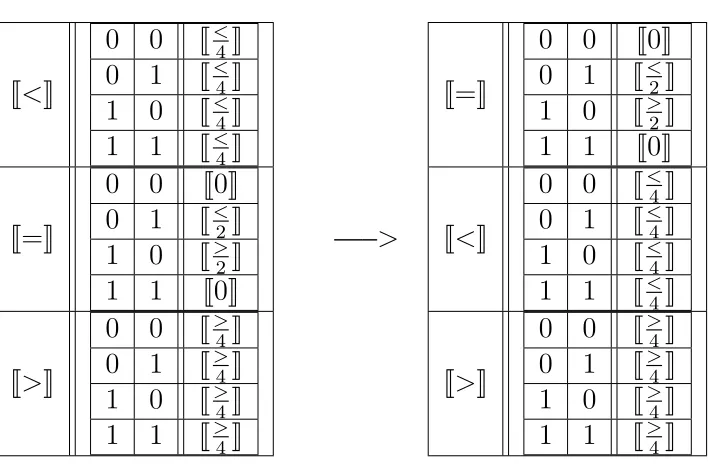
Table 4.1: Conceptual Model.
J
<
K
0
0
J
<4K
0
1
J
<4K
1
0
J
<4K
1
1
J
<4K
J
=
K
0
0
J
0
K
0
1
J
<2K
1
0
J
>2K
1
1
J
0
K
J
>
K
0
0
J
>4K
0
1
J
>4K
1
0
J
>4K
1
1
J
>4K
—–>
J
=
K
0
0
J
0
K
0
1
J
<2K
1
0
J
>2K
1
1
J
0
K
J
<
K
0
0
J
<4K
0
1
J
<4K
1
0
J
<4K
1
1
J
<4K
J
>
K
0
0
J
>4K
0
1
J
>4K
1
0
J
>4K
1
1
J
>4K
4.4
Zero Knowledge Comparison Protocol
To perform the comparison, we will execute the Zero Knowledge Comparison Protocol: We also accomplish this with Zero Knowledge Proofs and homomorphism as the computational tools.
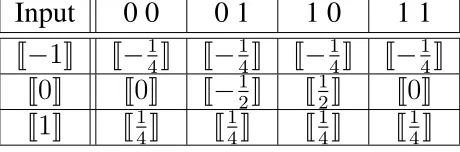
To accomplish this, we use a feature that is common in Elliptical Curve groups, includ-ingsecp256k1, the order of the group is prime. That means that in exponential elgamal on this curve, you can encrypt fractions with denominators less than or equal to the order. This means if we let “less than”= −1, “equal” = 0, and “greater than”= 1, we can construct the two tables illustrated in Table 4.1. The first column of the inner tables correspond with the bit of party 1 and second column similarly corresponds with party 2. We call the table associated with0 the Equals table, the table associated with−1the Less Than table, and the table associated with1the Greater Than table.
is illustrated in Table 4.2.
Table 4.2: Actual Model
Input
0 0
0 1
1 0
1 1
J
−1
K
J
−
1
4
K
J
−
1
4
K
J
−
1
4
K
J
−
1 4
K
J
0
K
J
0
K
J
−
1
2
K
J
1
2
K
J
0
K
J
1
K
J
1
4
K
J
1
4
K
J
1
4
K
J
1 4
K
Since the feedback (current state of the comparison) at the first bit is equal, there is no reason to shuffle the table before the first comparison, which will save a little time. The selected row begins as the Equals table or J0K. After the first bit of the comparison, the feedback is calculated homomorphically based on each party’s bit and the selected table.
For each commitment in the list of commitments, starting with most significant:
1. Take the table from the selected row.
2. Each party creates 2 encryptions based the rows of the selected table.
• For each row in the selected table, if the bit on the party’s column is equal to the bit from their bit commitment, rerandomize the resulting encryption.
3. Each party sends the rerandomized encryptions to the other party.
4. Prove that the encryptions are valid using the Bit Table Verification Proof (equa-tion 4.4):
5. Multiply all the encryptions (P1’s andP2’s) together to homomorphically obtain the feedback.
6. Shuffle the table using the method from Mix and Match.
7. Use PET to determine which row from the shuffled outer table corresponds with the feedback. The row that the feedback matches with is the new selected row.
Bit Table Verification Proof
The Zero Knowledge Proof for each possibility will be structurally the same. The general ZKP for the party’s encryption corresponding to the bit commitmentCbi hiding a specific bitbis as follows:
p1(x1, x2, i, b) =AND(CVP(Cbi, b, ηi), PER(rowx1, e0, α1), PER(rowx2, e1, α2) )
We compose two instances of p1 with Zero Knowledge OR to create the Bit Table Verification Proof (BTVP) to prove that one of the two possible cases is true (b = 0 OR b= 1):
BTVP(x1, x2, y1, y2, i) = OR((p1(x1, x2, i,0),bi = 0), (p1(y1, y2, i,1),bi = 1)) (4.4)
After the comparison protocol has been successfully concluded, the two parties take the resulting feedback and run a verified distributed decrypt on the feedback. If the result is −1, P2 has the larger amount of bitcoins. If the result is 0, they have equal bitcoins. Otherwise,P1 has more bitcoins. The protocol then concludes.
Chapter 5
SECURITY ANALYSIS
5.1
Zero Knowledge Proofs
We begin our proof ofVariance’s security with proofs that the sigma protocols are zero knowledge protocols, as it is a prerequisite to the majority of the requirements of security.
To prove that a sigma protocol is an Honest Verifier Zero Knowledge Proof (HVZKP), the protocol must satisfy the following three properties [13]:
1. Completeness: Does a honest Prover with proper inputs pass every time? If proper inputs result in the Verifier accepting, it is complete. Completeness is usually simple, simply following the steps of the protocol assuming both parties are honest.
2. Special Soundness:Is the secret present? Given one initial communication and two challenges, can the secret be extracted? The extractor (Verifier*) takes the role of the Verifier and has the ability to rewind the Prover while maintaining knowledge of the Prover’s previous communication, thus allowing the Verifier* to send the second challenge and get second response. The Verifier* then can extract the information from the transcripts. If a protocol is specially sound, then the probability of a Prover successfully cheating is2−t, wheretis the number of bits in the challenge.
can create a proof transcript that is impossible to distinguish from a proper transcript? The simulator (Prover*) takes over the role of the Prover and knows the challenge beforehand. If the Prover* can create a valid transcript using only the inputs of the Verifier, then the protocol reveals nothing to an honest Verifier.
Once a Sigma Protocol is proven to be a Honest Verifier Zero Knowledge Proof, it can be converted to a malicious Zero Knowledge Proof by either using a perfectly hiding commitment of the challenge before the initial communication [13], or by using the Fiat-Shamir random oracle heuristic [7] to eliminate the Verifier’s input by making the protocol non-interactive.
We will only provecompletenessandspecial soundnessin this section for each of the sigma protocols, as we have already provenHonest Verifier Zero Knowledgeby providing the honest simulators with the protocols in Chapter 3.
5.1.1 Schnorr’s Protocol
The proof for Schnorr’s protocol is relatively simple, so we will begin with it to demonstrate the structure of the proof.
Completeness:
To prove completeness, we will assume an honest Prover. If the Prover knowsxsuch that y=gx:
1. The Prover randomly generatesrand calculatesgrand sends it to the Verifier.
2. The Verifier sends a randomt-bit challengecto the Prover.
Schnorr’s Protocol Extractor
1. The Prover and Verifier* run Protocol 3.1 from the beginning to end, resulting in the transcript (a, c1, z1)
2. The Verifier* rewinds the Prover to Step 3 of the protocol and sends a second challenge c2.
3. The protocol resumes to completion, resulting in the transcript (a, c2, z2) 4. If both transcripts are valid, the Verifier* calculates z1−z2
c1−c2 =
(r+c1·x)−(r+c2·x)
c1−c2 =
c1·x−c2·x
c1−c2 =
(c1−c2)·x
c1−c2 =x; otherwise, the extractor fails.
Protocol 5.1: Schnorr’s Protocol Extractor
4. The Prover sendsz to the Verifier.
5. The Verifier calculates gz and a·yc. Because the Prover is honest, gz = gr+cx =
gr·gxc =a·yc. Sincegz =a·yc, the Verifier accepts.
Special Soundness:
To prove that the protocol is specially sound, we provide the extractor, Protocol 5.1. Since the extractor can extract the secretx, the protocol is specially sound.
5.1.2 Equal Discrete Log Proof
Completeness
To prove completeness, we will assume an honest Prover. If the Prover knowsxsuch that yg =gx andyh =hx:
1. The Prover randomly generatesrand calculatesag =grandah =hrand sends it to the Verifier.
2. The Verifier sends a challengecto the Prover.
3. The Prover usesxto calculatez =r+c·x
4. The Prover sendsz to the Verifier.
5. The Verifier calculatesgz, which is equal togr+cx =gr·(gx)c=a·ygc.
6. The Verifier calculateshz, which is equal tohr+cx=hr·(hx)c=a·yhc.
Sincegz =a·ygcandhz =a·yhc, the Verifier accepts.
Special Soundness
To prove that EDLP is specially sound, we provide an extractor (Protocol 5.2). Since the extractor can extract the secretx, the protocol is specially sound.
5.1.3 Zero Knowledge AND
Equal Discrete Log Proof Protocol Extractor
1. The Prover and Verifier* run Protocol 3.5 from the beginning to end, resulting in the transcript ((ag, ah), c1, z1)
2. The Verifier* rewinds the Prover to Step 3 of the protocol and sends a second challenge c2.
3. The protocol resumes to completion, resulting in a second transcript ((ag, ah), c2, z2) 4. If both transcripts are valid, the Verifier* calculates z1−z2
c1−c2 =
(r+c1·x)−(r+c2·x)
c1−c2 =
c1·x−c2·x
c1−c2 =
(c1−c2)·x
c1−c2 =x; otherwise, the extractor fails.
Protocol 5.2: Equal Discrete Log Proof Protocol Extractor
Completeness
The Prover starts with all the inputs required to properly execute all component protocols.
1. The Prover runs each component protocol’s initial communication step to acquire a list of initial communications.
2. The Prover sends the list of initial communications to the Verifier.
3. The Verifier sends a challengecto the Prover.
4. The Prover uses the component protocols to calculate a list of responses.
5. The Prover sends the list of responses to the Verifier.
Zero Knowledge AND Extractor
1. Run Protocol 3.3 to completion, getting the Verifier*’s first challenge (c1) as well as a list of transcripts (T1)
2. The Verifier* rewinds the Prover to Step 3 of the protocol and sends a second challenge c2.
3. The protocol resumes to completion, resulting in a second list of transcripts (T2). 4. If any of the transcripts are invalid with their respective protocol, the extractor aborts and
fails.
5. For each component protocolπi, select the associated transcriptsT1(i)andT2(i). The Verifier* uses the protocolπi’s extractor with the transcripts T1(i) andT2(i) to obtain the secret associated withπi.
Protocol 5.3: Zero Knowledge AND Extractor
Special Soundness
We assume that each component protocol is specially sound and has an extractor. Zero Knowledge AND’s extractor is provided as Protocol 5.3 to prove that this composition is specially sound.
5.1.4 Zero Knowledge OR
Completeness
The Prover starts with the inputs to properly prove at least one of the component protocols.
1. The Prover splits the list of protocols in to two sub-lists: protocols to be run properly (P) and protocols to be simulated (S). The Prover simulates if he does not have the proper inputs.
2. For each protocolπj in the listS, the Prover generates a sub-challengecj. The Prover then use the associated simulator σj to randomly generate the responseszj and the calculate the initial communicationaj.
3. For each protocol πi in the list P, they run the protocol πi to calculate the initial communication.
4. The Prover sends the list of initial communications to the Verifier.
5. The Verifier sends a challengecto the Prover.
6. The Prover XORs each sub-challengecj together, then XORs that number with the Verifier’s challengec, which will be called the total sub-challenge(ct).
7. For all but one of the protocols πi in P, the Prover randomly generates a sub-challengeciand XORs that challenge in toct, creating a newct.
8. For the remaining protocolπiinP, setciequal to the resultingct.
9. For each protocol πi in P, use the protocol πi to calculate the response with the associated sub-challengeci.
11. The Verifier takes the XOR of all of the sub-challenges, and sees that the result is equal toc.
12. The Verifier goes through each protocolπi:
(a) If the Prover used the protocol’s simulatorσi, then the Verifier will accept, as the simulator is assumed to be valid.
(b) If the Prover used the proper protocol, then the Verifier will accept, as the protocol is complete and the Prover used proper inputs.
Therefore, Zero Knowledge OR is complete.
Special Soundness
We assume that each component protocol is specially sound and has an extractor. Each tran-script from the component protocols contains the initial communication, the sub-challenge, and the response (ai,ci,zi) from that protocol. The extractor is provided as Protocol 5.4. Since the extractor extracts the used secrets, Zero Knowledge OR is specially sound.
5.2
Security Definition
In the following, we define the security goals ofVariance:
Definition 1. A privacy-preserving bitcoin asset comparison protocol is a protocol that fulfills the following criteria:
1. Correctness. IfP1 andP2are honest, then the comparison is always accurate.
2. Privacy. A dishonest party (or an eavesdropper) cannot learn any information about
Zero Knowledge OR Extractor
1. Run Protocol 3.2 to completion, getting the Verifier*’s first challenge (c1) as well as a list of transcripts (T1).
2. The Verifier* rewinds the Prover to Step 4 of the protocol and the Verifier* sends a second challengec2.
3. The protocol resumes to completion, resulting in a second list of transcripts (T2). 4. The Verifier* verifies both lists of transcripts are valid, as well as the sub-challenges. If
any of the transcripts are invalid, the extractor fails and aborts.
5. For each component protocolπi, select the corresponding transcriptsT1(i)andT2(i). If the sub-challenges fromT1(i)andT2(i) are not equal, then the Verifier* will runπi’s extractor, using the transcriptsT1(i)andT2(i)to extract the Prover’s secret associated with the protocol.
Protocol 5.4: Zero Knowledge OR Extractor
3. Ownership. Each party is assured that the other is cannot include any bitcoins
that they do not own in the concealed sum such that the probability of a dishonest
party successfully cheating in the construction of the concealed sum is extremely low
(<2−30).
4. Sound Comparison. Assuming the concealed sum is accurate, the probability of a
dishonest party successfully cheating in the comparison is extremely low (<2−30).
5.3
Security Proofs
We will now prove the following theorem:
To prove this theorem, we will prove that each of the statements in Definition 1 applies toVariance. We will also provide a supplementary proof of security as provided by Hazay and Lindell [14] called Proof by Simulation, which is also a proof of the security definition.
5.3.1 Basic Component Proofs
Lemma 1. Varianceis correct.
Proof: This proof relies on the three different phases of the protocol all being correct:
ZK-OR Proof of Assets
If the commitments are designed according to the protocol, then the homomorphisms allow the Proof of Assets produce the appropriate sum. Also, the Account Verification Proof is a Zero Knowledge Protocol, thus it is also complete. Each party will accept the other party’s proofs, allowing the protocol continue to the next step with the appropriate committed sums.
Bit Conversion
If the bit commitments are designed according to the protocol, then the product of the shifted bit commitmentsQni=0−1Cbi2
i
is equal to the original sum commitment, thus the bit commitments are accepted if they are proven to be bits. This is the case becausePni=0−1ηi·
2i = Γ. Since the commitments hide a bitwise representation of the sumS,Pn−1 i=0 bi·2
i =
S, thusQni=0−1Cbi2 i
= Qni=0−1(gbi·hηi)2i = gPn−1
i=0 bi·2i ·h
Pn−1
i=0 ηi·2i = gS ·hΓ = Csum. The
Zero Knowledge Comparison
First, the Mix and Match protocol, including PET, is complete, as proven by Jakobsson and Juels [15]. Next, the parties rerandomize the correct encryptions based on their current bit and the logic of the table. Recall that the encryptions are additive elgamal and homomor-phically add the messages when multiplied. We will now the feedback will be correct in every case.
• On the Equals(J0K)table:
1. P1’s bit is 0, P2’s bit is 0, J0K· q
−1 2
y
·J0K·q1 2
y
= J0K. The bits are equal, so the feedback should match the Equals table. This is the result of the homomor-phism.
2. P1’s bit is 0,P2’s bit is 1,J0K·q
−1 2 y ·q −1 2 y
·J0K =J−1K. P1’s bit is less than P2’s, so the feedback should match the Less Than table. This is the result of the
homomorphism.
3. P1’s bit is 1, P2’s bit is 0,
q1
2
y
·J0K·J0K·q1 2
y
= J1K. P1’s bit is greater than P2’s bit, so the feedback should match the Greater Than table. This is the result
of the homomorphism. 4. P1’s bit is 1, P2’s bit is 1,
q1
2
y
·J0K·q−1 2
y
·J0K = J0K. The bits are equal, so the feedback should match the Equals table. This is the result of the homomor-phism.
• On the Less Than (J−1K)table, if any group of 4 encryptions, which are allq−1 4
y
• On the Greater Than(J1K)table, if any group of 4 encryptions, which are allq14yare rerandomized and homomorphically added, the result will beJ1K, which leads back to the Greater Than table after the shuffle, as intended.
Also, BTVP is a Zero Knowledge Proof, so it is complete, so the parties will accept the other’s proofs. They then run a distributed decrypt on the last feedback, which returns the
relation betweenP1andP2. Therefore,Varianceis correct.
Lemma 2. Variancemaintains privacy.
Proof: This claim contains two parts. Proof that the accounts are private and proof that
the sum is private.
Proof of Private Accounts
ZK-OR Proof of Assets is the only part of the protocol which handles the individual accounts. As long as the sum is not released by any of the other steps, those steps are not relevant to this proof.
Proof of Private Sum
ZK-OR Proof of Assets does not reveal the accounts, so the only other component is the homomorphic addition of the commitments, which is also perfectly-hiding.
The Bit Conversion protocol is based on perfectly hiding commitments and homomor-phic operations. There exists message-key pairs for a bit in the sum for bitwise commitment to hide a 1 or a 0, thus there is no way to differentiate between them. This leaves the Bit Verification Proof, which is a Zero Knowledge Proof, thus it is Zero Knowledge and has a simulator. Therefore, the Bit Conversion protocol is privacy-preserving.
This leaves the Comparison Protocol. The shuffle and PET is privacy-preserving un-der the ECDLP, as proven by Jakobsson and Juels in their paper [15]. This leaves the encryptions and the proof. The encryptions are semantically secure, so their contents are protected by ECDLP. BTVP is a Zero Knowledge Proof, and thus is Zero Knowledge has a simulator. However, many of the bits lose their perfect-hiding during this phase. If ECDLP gets solved, all bits up to and including the first different bit from the most significant bit can be revealed, as the parties’ encryptions become trivial to open and can be matched to the owner’ bit on the equals table. All of the less significant bits remain perfectly-hidden, as the less than and greater than tables both have identical encryptions on all the rows, thus the decryptions reveal nothing about the claimed bits. Therefore, the more significant bits of the sum up to and including the first differing bit are kept private under ECDLP, while the remaining less significant bits remain perfectly hidden, thus are private.
Therefore the sum and the accounts are private, therefore Variance maintains
Argument for Strong Account Privacy
We designed the protocol in such a way some of the sum remains perfectly hidden after the comparison, specifically from the most significant bits up to and including the first differing bit. In the event that ECDLP becomes solved, we would like to explore what can be kept secret. Though ECDLP being broken means the bulk of the information about the sum is revealed, the lack of information about the less significant bits actually makes deducing the accounts much harder. This is because every account commitment has two possible message-key combinations: (balance and key1) and (0 and key2). If the entire sum were to be revealed, that means that the adversary knows the sum and can easily figure out the associated key using the sum andCsum. That means that, if there are 10 million accounts,
there is a linear system of equations with 20 million variables that is tractable and has a polynomial runtime (O(n3)), so the accounts would be revealed. Since the sum is not fully revealed, this attack on the accounts are much harder, if not impossible, in most cases.
Lemma 3. Varianceensures ownership.
Proof: ZK-OR Proof of Assets uses homomorphisms, which do not make it easier
to cheat on the sum commitments. The Account Verification Proof is a Zero Knowledge Proof, so it is specially sound, so it protects against cheating with a probability of success-fully cheating at2−tfor each account, wheretis the number of bits in the challenge. Since we use perfectly-hiding commitments, they are only computationally binding. This means that they are bound by ECDLP. As long as the discrete log is not solved, the commitment is bound. Therefore, each party’s sum is bound to only use accounts to which that party holds the key with a very high probability by ECDLP.
Therefore,Varianceensures ownership.
Proof: This proof consists of two parts: Bit Conversion and ZK Comparison.
Bit Conversion uses homomorphisms, which do not reveal anything the original com-mitments have not already revealed. The Bit Verification proof is a Zero Knowledge Proof, thus it is specially sound (meaning the probability of cheating on any bit is2−t, wheretis the number of challenge bits). The last thing is to prove that the bitwise construction itself is sound. Recall that the homomorphism we use is Qni C(bi,ηi)2
i
. This operation bitshifts the message. If one of the bits is invalid, then the ephemeral key on the least significant bit does not result in equality, as the message is different and requires a total ephemeral key that is different fromΓ. Since this key is not known, the cheating party has no way to prove with probability greater than2−tthat the final bit in the number is a bit because they do not know the appropriate ephemeral key unless they have broken the discrete log. Therefore, the Bit Conversion is sound under ECDLP.
Mix and Max is sound, as is PET. BTVP is a Zero Knowledge Proof and thus is specially sound, thus successfully cheating on the rerandomization is extremely improbable, 2−t. The homomorphisms on the encryptions are perfectly binding, as encryptions are perfectly binding. The bit commitment is bound with ECDLP.
Variance’s comparison is sound under ECDLP.
5.3.2 Proof by Simulation
Simulator Proof: To ensure privacy, we first present simulator protocols for each of the
their commitments and encryptions are simply random numbers, and thus will be called “pseudo.”
Ideal Model
First, we describe the actions of thetrusted third party(TTP) in the Ideal Model.
1. Each party gives the TTP their list of private account keys.
2. The TTP finds each of the associated public keys and creates a sum for each party.
3. The TTP returns the relation betweenP1’s sum andP2’s sum.
ZK-Proof of Assets Simulator
Public Inputs: The set of accounts, where each account is a pair (public key, balance) Public Outputs:A’s total sum commitment,S’s total sum pseudo commitment,A’s list of account commitments,S’s list of account pseudo commitments.
Extracted Data: A’s list of used private keys and the message-key pairs for all ofA’s commitments.
The Simulator is as follows:
1. For each account in the set of accounts:
(a) S generates a random group element as its account pseudo commitment and sends it toA.
(b) Sreceives a group element fromA(A’s account commitment)
• S, acting as the Prover, runs the Account Verification Proof’s simulator withA. IfAaccepts, continue.
• S, acting as the Verifier, runs the Account Verification Proof’s extractor withA. If the extractor succeeds, the values γi,ˆbi, andxiˆ. Ifxiˆ 6= 0, then ˆ
xi =xi, andxi is recorded as one ofA’s used private keys.
• If the extractor fails, S sends abort to the TTP and sends the failed chal-lenge toA.
2. Shomomorphically addsA’s account commitments to obtainA’s sum commitment. S also sumsA’sˆbi values to obtain the claimed assets and sumsγi values to obtain
Γi.
3. Shomomorphically adds their account pseudo commitments to obtainS’s sum pseudo commitment. IfAaccepts the homomorphic combination, thenScontinues. Else,S aborts.
Bit Conversion Simulator
Public Inputs: A’s commitment,S’s pseudo commitment, and the number of agreed bitsn Public Outputs: A’s list of verified bit commitments andS’s list of verified bit pseudo commitments.
Extracted Data: The contents of all ofA’s commitments, including the bits, the original hidden amount, and all of the random keys.
The Simulator is as follows:
2. S sends the list ofngroup elements (bit pseudo commitments) toA.
3. S attempts to receiven group elements fromA. If he sends anything other than n group elements,S aborts.
4. For each indexifrom 0 ton−1:
(a) Run Bit Verification Proofs. These proofs can be run in either order.
• S, acting as the Prover, runs the Bit Verification simulator withA onS’s ith bit pseudo commitment. IfArejects the simulation,Saborts.
• S, acting as the Verifier, runs the Bit Verification extractor withAon their ith bit commitment to extractA’sith bit key pair for their bit commitment. If the extractor fails, S sends the failed challenge and aborts.
5. S homomorphically combinesA’s bit commitments as prescribed in the protocol. If the product is equal toA’s total commitment,StellsAto continue.
6. Shomomorphically combines its own bit commitments as prescribed by the protocol. IfAdoes not tellS to continue,S aborts.
Zero Knowledge Comparison
Public Inputs: A’s bit commitments andS’s bit pseudo commitments, as well as the initial unshuffled tables, as well asSandA’s public keys.
Public Outputs: The result of the comparison.
Optional Simulator Data (from calling a simulator): The result of the comparison m andA’s private keyx.
The Simulator is as follows:
1. Build the initial table (unshuffled). Select the “Equals” table
2. For each bitistarting from most significant:
(a) Srandomly generates two pairs of group elements and sends them toA. (b) S attempts to receive two pairs of group elements. If any other data is sent,S
aborts. Else,S continues.
(c) Run Bit Table Verification Proof: The order of the proofs is irrelevant.
• S, acting as the Prover, uses BTVP’s simulator withA using S’s ith bit commitment, the two random pairs, and the selected table as inputs. If A accepts,S continues. Else,S aborts.
• S, acting as the Verifier, uses BTVP’s extractor withA, using theA’sith bit commitment, theA’s group element pairs, and the selected table as inputs. If successful, S extracts the bits and the rerandomization exponents and continues. Else,S aborts.
(d) Homomorphically combine all four pairs as exponential Elgamal encryptions, called feedback.
(e) Run Mix and Match’s Verifiable Mix Network’s simulator to replace the exist-ing tables with random group elements and ensureAshuffles properly.
(f) Simulate PET with the feedback to select a single random row. The table in that row is the new selected table.
4. Take the last feedback(R1, R2), whereR1is the ephemeral public key.
5. S simulates a distributed decryption such that the result is m. S also extracts A’s private key. If the simulation is successful,Scontinues.
Variance Simulator
Public Inputs: List of accounts, as well asS andA’s public keys. Public Outputs: The result of the comparison.
Extracted Data: A’s private key, claimed accounts, total assets, and all random keys from the commitments.
The Simulator is as follows:
1. S runs the Proof of Assets simulator with A, using the list of accounts. If the simulation is successful, S extracts the list of A’s used private account keys. The simulator outputsA’s sum commitment andS’s sum pseudo commitment as public information.
2. S uses the TTP withA’s used private account keys to determine the proper compar-ison result.
3. S runs the Bit Conversion Simulator with A, using A’s sum commitment and S’s sum pseudo commitment. The simulator outputsA’s list of bit commitments andS’s list of bit pseudo commitments.
4. S runs the Zero Knowledge Comparison Simulator with A, using A’s list of bit commitments andS’s list of bit pseudo commitments.