Proceedings of the 2019 Conference on Empirical Methods in Natural Language Processing 3560
A Multi-Pairwise Extension of Procrustes Analysis for Multilingual Word
Translation
Hagai Taitelbaum Faculty of Engineering Bar-Ilan University, Israel
Gal Chechik
The Gonda Brain Research Center Bar-Ilan University, NVIDIA
Jacob Goldberger Faculty of Engineering Bar-Ilan University, Israel
Abstract
In this paper we present a novel approach to si-multaneously representing multiple languages in a common space. Procrustes Analysis (PA) is commonly used to find the optimal orthog-onal word mapping in the bilingual case. The proposedMulti Pairwise Procrustes Analysis (MPPA) is a natural extension of the PA algo-rithm to multilingual word mapping. Unlike previous PA extensions that require ak-way dictionary, this approach requires only pair-wise bilingual dictionaries that are much easier to construct in either a supervised or an unsu-pervised way. The improved performance of the MPPA algorithm is demonstrated on two standard multilingual tasks.
1 Introduction
Continuous word embeddings have been proved effective in numerous NLP applications. In cross-language tasks, these vector-space representations have recently emerged as a tool to transfer knowl-edge from one language to another. Specifically, several studies have suggested forming cross-lingual embeddings by learning a linear mapping from a source-language embedding space to a target-language one and demonstrated the bene-fits of this approach for word translation (Mikolov et al.,2013;Klementiev et al.,2012). Xing et al.
(2015) showed that imposing orthogonality con-straints on the linear mapping between spaces can alleviate overfitting. Building on these concepts, several studies have aimed to improve these bilin-gual word embeddings using bilinbilin-gual word dic-tionaries that are created in either a supervised or an unsupervised manner (Artetxe et al., 2017a). Bilingual word embedding were found to be use-ful in a number of monolingual and cross-lingual NLP tasks (Vulic and Moens,2015;Tsai and Roth,
2016).
Bilingual embedding can be extended to a mul-tilingual setup by jointly learning mappings from each monolingual word embedding to a shared vector space. Modeling multiple languages jointly has been shown to improve modeling accuracy on bilingual tasks because it can utilize knowledge learned from the other languages (Ammar et al.,
2016;Duong et al.,2017;Taitelbaum et al.,2019). Extending the bilingual setup to a multilingual setting poses new challenges. For bilingual em-bedding, the word-mapping problem has a closed-form solution known as Orthogonal Procrustes Analysis (PA), which can be computed using sin-gular value decomposition (Schnemann, 1966). However, there is no similar closed-form solution for the multi-language case. The standard exten-sion of PA to multi-set alignment is Generalized Procrustes Analysis (GPA) (Gower, 1975) which is an iterative greedy algorithm. GPA was recently used to jointly transform multiple languages into a shared vector space (Kementchedjhieva et al.,
2018). However, GPA assumes that a multi-way word correspondence is available, which is often not the case. Building a multi-way dictionary is a challenging task in itself.
In this study, we propose a novel efficient ap-proach for mapping multiple languages simulta-neously into a shared vector space, while en-forcing orthogonality constraints. This approach,
Multi Pairwise Procrustes Analysis (MPPA) can be viewed as a multilingual extension of the Pro-crustes Analysis. Unlike GPA-based approaches, MPPA does not require a multi-way dictionary, but only bilingual dictionaries which are much easier to obtain even in an unsupervised man-ner. We evaluated MPPA on two standard mul-tilingual tasks and report better results than GPA based methods and competitive results with gradi-ent based methods.
easy-to-use algorithm for solving the extension of the Orthogonal Procrustes problem to the multilin-gual case. Our project code will be publicly avail-able.
2 A Multi-Pairwise Extension of Procrustes Analysis
We first briefly review Procrustes Analysis (PA), a procedure to find the best orthogonal map-ping between two languages. We then describe our approach, Multi-Pairwise Procrustes Analy-sis(MPPA), which extends PA to the multilingual case.
Assume we are givend-dimensional word em-bedding data from two languages along with a dictionary consisting of pairs of corresponding words.Mikolov et al.(2013) showed that there is a strong linear correlation between the vector spaces of two languages and that learning a complex non-linear neural mapping does not yield better results than with a linear mapping.Xing et al.(2015) fur-ther showed that enforcing the linear mappings to be orthogonal matrices reduces overfitting and im-proves performance. We can learn the orthogonal mappingTby minimizing the following cost func-tion:
S(T) =
n
X
t=1
kT xt−ytk2, (1)
wherextandytare embeddings pf corresponding
words from the two languages and n is the dic-tionary size. Schnemann (1966) proved that the solution to Eq. (1), obtained as the result of a Pro-crustes Analysis algorithm, isT = U V>, where
UΣV>
is the singular value decomposition (SVD) of thed×dmatrixM = P
tytx
>
t. This method
has been used in many recent cross-lingual studies (Xing et al., 2015;Artetxe et al.,2016, 2017a,b,
2018a,b; Hamilton et al., 2016; Conneau et al.,
2017;Ruder et al.,2018).
Assume we are givend-dimensional word em-bedding data fromklanguages and that each pair of languages is provided with a dictionary com-posed of pairs of corresponding words from the two languages. We could learn a mapping for each language pair independently as a solution to Eq. (1). However, this approach does not benefit from the multilingual setup. Another approach would be to choose one of the languages as a “pivot” and learn a mapping from each language to the pivot separately. A typical choice for the pivot, used in publicly available aligned vectors, is English
(Conneau et al., 2017;Joulin et al., 2018). This strategy, however, does not guarantee that the indi-rect word translation between language pairs will have high quality. Alternatively, we can enforce a transitivity constraint by mapping all the embed-ding spaces to a shared vector space. Our goal in the multilingual case is thus to find the orthogonal matrices T1, ..., Tk such that pairs of
correspond-ing words from different languages are mapped into close vectors in the shared space. Formally, we want to minimize the following mean-square error score:
S(T1, ..., Tk) =
X
i<j
nij
X
t=1
kTixij,t−Tjxji,tk2 (2)
where (xij,t, xji,t) is a pair of corresponding
words in the iandj languages, respectively and
nij is the dictionary size. We use this notation to
emphasize that the vocabularies of the same lan-guage in different dictionaries are not necessarily the same.
When more than two languages are involved there is no closed-form solution to the global min-imum of (2). We propose an efficient algorithm for minimizing it. The basic step is optimizing the score (2) with respect to the mappingTiwhile
keeping all other mappings fixed. Viewing the ob-jective score (2) as a function ofTiwe obtain:
S(Ti) =
X
j6=i
nij
X
t=1
kTixij,t−yj,tk2+const. (3)
whereyj,t = Tjxji,t is the representation ofxji,t
in the common space. This is exactly the Or-thogonal Procrustes problem (1) of finding a map-ping from languageiinto the common space. The optimal orthogonal matrixTi is thus obtained by
Ti =U V>s.t.UΣV>is the SVD of the matrix:
Mi =
X
j6=i
X
t
Tjxji,tx
>
ij,t. (4)
OnceTiis updated we move to the next language
in a circular manner. At each step in the iter-ative algorithm, the score (2) is monotonically decreased until it converges to a local minimum point. Hence, we can stop the optimization proce-dure once there is no significant improvement in the objective score (2).
we can compute cross correlationd×dmatrix for each pair of languagesi, jin a preprocessing step:
Cij =C>
ji=
X
t
xji,tx>
ij,t. (5)
Substituting (5) in (4) we obtain that
Mi =
X
j6=i
TjCij. (6)
Therefore, updating the mapping Ti can be done
in a very efficient way without going over all the bilingual dictionaries of thei-th language.
Algorithm 1Multi Pairwise Procrustes Analysis
Required:A set of lexical of word pairs between
each pair of languages.
Task:Find a set of orthogonal mappingsT1, .., Tk,
to a common space.
Compute cross-correlation matrices:
Cij =C>
ji=
X
t
xji,tx>
ij,t 1≤i < j≤k
Initialization: T1 =I,
fori= 2, ..., kdo UΣV>= SVD(P
j<iTjCij)
Ti ←U V>
end
Algorithm:
whilenot convergeddo
fori= 1, ..., kdo UΣV>= SVD(P
j6=iTjCij)
Ti←U V>
end end
The proposed Multi Pairwise Procrustes Anal-ysis (MPPA) word mapping training procedure is depicted in Algorithm box 1. The algorithm de-scription also contains an initialization procedure that can help avoid getting stuck at local optima. The idea of the initialization is aligning each new language i to the current common space which was built with languagesj < i.
MPPA requires only pairwise bilingual dictio-naries. It is applicable even if we only have dic-tionaries for a subset of all the language pairs such that each language under consideration is repre-sented in at least one bilingual dictionary. Con-sider a graph whose vertices are the languages and an edge indicates the existence of a dictionary be-tween two languages. It can easily be seen that
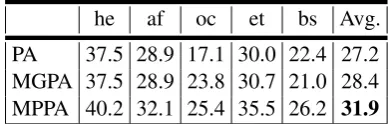
he af oc et bs Avg.
[image:3.595.318.514.64.126.2]PA 37.5 28.9 17.1 30.0 22.4 27.2 MGPA 37.5 28.9 23.8 30.7 21.0 28.4 MPPA 40.2 32.1 25.4 35.5 26.2 31.9
Table 1: p@1 for low resource languages: Hebrew, Afrikaans, Occitan, Estonian, and Bosnian, trained with multilingual algorithms over triplets.
if the graph is loop-free (as in the case where we only have dictionaries for a pivot language) the op-timization of (2) is decoupled and each bilingual mapping can be learned separately. The task be-come really multi-lingual once the graph is loopy, where mapping transitivity implies that there is more than a single path between the source and target languages. We note in passing that we can consider the word representation in the common space as a latent variable and the mapping matrices as unknown parameters. The MPPA algorithm can be thus viewed as an instance of the EM algorithm (Dempster et al.,1977). Further discussion regard-ing the connection between MPPA algorithm and the EM algorithm can be found in (Goldberger,
1999).
3 Related work
The standard extension of PA to multi-set align-ment is Generalized Procrustes Analysis (GPA) (Gower, 1975). Kementchedjhieva et al. (2018) recently proposed the Multi-support GPA (MGPA) algorithm for multilingual word translation which is based on the GPA. Their algorithm requires a k-way dictionary in the form of (xit) where
(x1t, ..., xkt) are representations of words that
alterna-en-de en-fr en-es en-it en-pt de-en de-fr de-es de-it de-pt fr-en fr-de fr-es fr-it fr-pt PA 73.5 81.1 81.4 77.3 79.9 72.4 73.3 67.7 69.5 59.1 82.4 69.5 82.6 83.2 78.1 MAT+MPPA 74.5 82.7 82.2 78.5 81.3 72.9 75.2 68.0 70.1 61.1 82.2 69.0 83.6 83.1 78.7 MAT+MPSR 74.8 82.4 82.5 78.8 81.5 72.9 76.7 69.6 72.0 63.2 81.8 71.2 83.9 83.5 79.3 UMH 75.1 82.7 82.5 78.9 82.0 75.5 73.5 67.2 68.7 59.0 83.1 69.8 82.7 82.5 77.5
es-en es-de es-fr es-it es-pt it-en it-de it-fr it-es it-pt pt-en pt-de pt-fr pt-es pt-it Avg.
PA 82.9 68.3 85.8 83.5 87.3 76.9 67.5 87.1 87.3 81.0 80.3 63.7 84.3 91.5 81.1 78.0 MAT+MPPA 83.5 66.5 85.9 83.7 86.8 77.7 67.1 87.7 87.5 81.2 80.2 63.7 84.6 92.2 82.6 78.5 MAT+MPSR 83.7 69.0 86.9 84.5 87.8 77.4 69.5 88.1 88.2 82.3 79.9 65.7 86.3 92.7 82.6 79.3 UMH 85.3 68.7 85.1 83.3 86.3 79.9 67.5 86.7 87.0 80.4 82.1 64.4 83.6 91.7 81.1 78.5
Table 2: Multilingual word translation results for English, German, French, Spanish, Italian and Portuguese. The reported numbers are precision@1 in percentage.
tive to the GPA optimization procedure.
Another line of research applies stochastic gradient-based optimization methods to minimize the mean-square error score (2) jointly with re-finement of the bilingual dictionaries. The gradi-ent is approximated by sampling word pairs from the bilingual dictionaries.Chen and Cardie(2018) proposed theMultilingual Pseudo Supervised Re-finement (MPSR) for this minimization task that uses simple gradient methods in order to mini-mize (2). For unsupervised setupChen and Cardie
(2018) used an adversarial initialization step, Mul-tilingual Adversarial Training(MAT).Alaux et al.
(2019) presented, Unsupervised Multilingual Hy-peralignment(UMH), a similar algorithm that ex-tends the bilingual methods proposed by Grave et al.(2018);Alvarez-Melis and Jaakkola (2018), to multilingual setup.
A main difference between UMH (Alaux et al.,
2019) and MAT+MPSR (Chen and Cardie,2018) is how they treat orthogonality. The first is a stochastic gradient optimization followed by a projection on the set of orthogonal matrices. In the second method orthogonality is a regulariza-tion term that is optimized by gradient methods. The matrices are encouraged to be orthogonal by an orthogonalization update (Cisse et al., 2017) that yields matrices that are close to orthogonal but are not necessarily exactly orthogonal. In contrast to gradient based methods, our approach avoids word sampling and hyper-parameters that need to be tuned.
4 Experiments
Datasets and embeddings We used the MUSE
benchmark (Conneau et al., 2017)1, which con-sist of bilingual dictionaries of 5000 unique source
1https://github.com/facebookresearch/MUSE
word for training and 1500 for testing. The fast-Text embeddings (Bojanowski et al.,2017) trained on Wikipedia data, are available online2. Vectors were normalized to unit length and then zero cen-tered (Artetxe et al.,2016).
Compared methods We compared MPPA
to MGPA (Kementchedjhieva et al., 2018), MAT+MPSR (Chen and Cardie,2018) and UMH (Alaux et al.,2019). We used the task and results reported in the corresponding paper (UMH results are from the appendix). All methods ran several refinement epochs (Artetxe et al., 2017a), where after each refinement iteration dictionaries were re-build, as described in Conneau et al. (2017). Model selection was done by the best validation criterion suggested inConneau et al. (2017) and extended in Chen and Cardie (2018). All these methods retrieve word translation using the Cross-domain Similarity Local Scaling(CSLS) criterion (Lample et al.,2018).
Results The first experiment was conducted
over language triplets (Kementchedjhieva et al.,
2018). The goal is to translate from English to a low resource language (like Bosnian) us-ing a high resource language (like Russian). As inKementchedjhieva et al.(2018), 10 refinement epochs were used, and initial dictionaries for each language pair were generated by pairs of words with identical string matching.
Table1depicts precision@1 for the triplets task. MPPA outperformed MGPA and both outperform PA. Note that MGPA needs a multi-way dictio-nary constructed from the bilingual dictionaries. In contrast, MPPA uses directly the raw data (the bilingual dictionaries).
The second experiment involved multilingual word translation in six European languages: En-glish, German, French, Spanish, Italian and
tuguese (Lample et al., 2018). We compared MPPA to MAT+MPSR (Chen and Cardie,2018). MAT+MPSR is an unsupervised method, so for a fair comparison we replaced the MPSR algo-rithm with our MPPA algoalgo-rithm, thus obtain-ing MAT+MPPA. We ran 5 refinement epochs, after the MAT step, as the default option in MAT+MPSR source code3. MPPA training phase is 10 times faster than MPSR equivalent phase, which also have hyper-parameters that needed to be tuned. UMH (Alaux et al.,2019), was also eval-uated on this benchmark.
Table 2 shows precision@1 results. MPPA was comparable to UMH and MPSR performed slightly better. Note that the MPSR mapping matrices were not exactly orthogonal. They in-deed achieved smaller mean-square error (2) on the training data than our solution, which was re-stricted to be orthogonal. This suggests that the orthogonality constraint, especially in the multi-lingual case where it is combined with transitivity constraints, can be too restrictive.
5 Conclusion
This paper presents a general approach to map word embeddings into a common space that can be viewed as an extension of PA to the multi-lingual case. The proposed algorithm efficiently avoids the need to go over the whole dictionary at each iteration. The optimization is done by enforc-ing both transitivity and orthogonal constraints. A possible future research direction would involve finding efficient optimization methods where the orthogonality constraint could be slightly relaxed.
References
Jean Alaux, Edouard Grave, Marco Cuturi, and Ar-mand Joulin. 2019. Unsupervised hyperalignment for multilingual word embeddings. InInternational Conference on Learning Representations.
David Alvarez-Melis and Tommi S Jaakkola. 2018. Gromov-wasserstein alignment of word embedding spaces.arXiv preprint arXiv:1809.00013.
Waleed Ammar, George Mulcaire, Yulia Tsvetkov, Guillaume Lample, Chris Dyer, and Noah A Smith. 2016. Massively multilingual word embeddings. arXiv preprint arXiv:1602.01925.
Mikel Artetxe, Gorka Labaka, and Eneko Agirre. 2016. Learning principled bilingual mappings of word em-beddings while preserving monolingual invariance.
3https://github.com/ccsasuke/umwe
In Proceedings of the 2016 Conference on Empiri-cal Methods in Natural Language Processing, pages 2289–2294.
Mikel Artetxe, Gorka Labaka, and Eneko Agirre. 2017a. Learning bilingual word embeddings with (almost) no bilingual data. InAnnual Meeting of the Association for Computational Linguistics, pages 451–462. Association for Computational Linguis-tics.
Mikel Artetxe, Gorka Labaka, and Eneko Agirre. 2018a. Generalizing and improving bilingual word embedding mappings with a multi-step framework of linear transformations. In Proceedings of the Thirty-Second AAAI Conference on Artificial Intel-ligence (AAAI-18).
Mikel Artetxe, Gorka Labaka, and Eneko Agirre. 2018b. A robust self-learning method for fully un-supervised cross-lingual mappings of word embed-dings. arXiv preprint arXiv:1805.06297.
Mikel Artetxe, Gorka Labaka, Eneko Agirre, and Kyunghyun Cho. 2017b. Unsupervised neural ma-chine translation. arXiv preprint arXiv:1710.11041.
Piotr Bojanowski, Edouard Grave, Armand Joulin, and Tomas Mikolov. 2017. Enriching word vectors with subword information. Transactions of the Associa-tion for ComputaAssocia-tional Linguistics, 5:135–146.
Xilun Chen and Claire Cardie. 2018. Unsupervised multilingual word embeddings. In Conference on Empirical Methods in Natural Language Process-ing.
Moustapha Cisse, Piotr Bojanowski, Edouard Grave, Yann Dauphin, and Nicolas Usunier. 2017. Parse-val networks: Improving robustness to adversarial examples. InProceedings of the 34th International Conference on Machine Learning-Volume 70, pages 854–863. JMLR. org.
Alexis Conneau, Guillaume Lample, Marc’Aurelio Ranzato, Ludovic Denoyer, and Herv´e J´egou. 2017. Word translation without parallel data. arXiv preprint arXiv:1710.04087.
A. P. Dempster, N. M. Laird, and D. B. Rubin. 1977. Maximum likelihood from incomplete data via the EM algorithm. Journal of the Royal Statistical So-ciety, Series B (Methodological), 39:1–38.
Long Duong, Hiroshi Kanayama, Tengfei Ma, Steven Bird, and Trevor Coh. 2017. Multilingual training of crosslingual word embeddings. In The Confer-ence of the European Chapter of the Association for Computational Linguistics.
Jacob Goldberger. 1999. Registration of multiple point sets using the EM algorithm. InIEEE International Conference on Computer Vision.
Edouard Grave, Armand Joulin, and Quentin Berthet. 2018. Unsupervised alignment of embeddings with wasserstein procrustes.CoRR, abs/1805.11222.
William L Hamilton, Jure Leskovec, and Dan Juraf-sky. 2016. Diachronic word embeddings reveal sta-tistical laws of semantic change. arXiv preprint arXiv:1605.09096.
Armand Joulin, Piotr Bojanowski, Tomas Mikolov, Herve Jegou, , and Edouard Grave. 2018. Loss in translation: Learning bilingual word mapping with a retrieval criterion. InEmpirical Methods in Natu-ral Language Processing (EMNLP).
Yova Kementchedjhieva, Sebastian Ruder, Ryan Cot-terell, and Anders Søgaard. 2018. Generalizing pro-crustes analysis for better bilingual dictionary induc-tion. InCONLL.
Alexandre Klementiev, Ivan Titov, and Binod Bhat-tarai. 2012. Inducing crosslingual distributed repre-sentations of words. InCOLING, pages 1459–1474.
Guillaume Lample, Alexis Conneau, Marc-Aurelio Ranzato, Ludovic Denoyer, and Herv Jgou. 2018. Word translation without parallel data. In Interna-tional Conference on Learning Representation.
Tomas Mikolov, Quoc V Le, and Ilya Sutskever. 2013. Exploiting similarities among languages for ma-chine translation. arXiv preprint arXiv:1309.4168.
Sebastian Ruder, Ryan Cotterell, Yova Kementched-jhieva, and Anders Søgaard. 2018. A discrimina-tive latent-variable model for bilingual lexicon in-duction.arXiv preprint arXiv:1808.09334.
Peter Schnemann. 1966. A generalized solution of the orthogonal procrustes problem. Psychometrika, 31(1):1–10.
Hagai Taitelbaum, Gal Chechik, and Jacob Goldberger. 2019. Multilingual word translation using auxiliary languages. InConference on Empirical Methods in Natural Language Processing.
Chen-Tse Tsai and Dan Roth. 2016. Cross-lingual wik-ification using multilingual embeddings. In NAACL-HLT.
Ivan Vulic and Marie-Francine Moens. 2015. Mono-lingual and cross-Mono-lingual information retrieval mod-els based on (bilingual) word embedding. InACM SIGIR Conference on Research and Development in Information Retrieval, page 363372.