Collapsed Variational Bayesian Inference for PCFGs
Pengyu Wang
Department of Computer Science University of Oxford
Oxford, OX1 3QD, United Kingdom
Phil Blunsom
Department of Computer Science University of Oxford
Oxford, OX1 3QD, United Kingdom
Abstract
This paper presents a collapsed variational Bayesian inference algorithm for PCFGs that has the advantages of two dominant Bayesian training algorithms for PCFGs, namely variational Bayesian inference and Markov chain Monte Carlo. In three kinds of experiments, we illustrate that our al-gorithm achieves close performance to the Hastings sampling algorithm while using an order of magnitude less training time; and outperforms the standard variational Bayesian inference and the EM algorithms with similar training time.
1 Introduction
Probabilistic context-free grammars (PCFGs) are commonly used in parsing and grammar induction systems (Johnson, 1998; Collins, 1999; Klein and Manning, 2003; Matsuzaki et al., 2005). The tra-ditional method for estimating the parameters of PCFGs from terminal strings is the inside-outside (IO) algorithm (Baker, 1979). As a special in-stance of the Expectation-Maximization (EM) al-gorithm (Dempster et al., 1977), based on the prin-ciple of maximum-likelihood estimation (MLE), the standard IO algorithm learns relatively uni-form probability distributions for grammars, while the true distributions can be highly skewed (John-son et al., 2007). In order to encourage sparse grammars and avoid overfitting, recent research for training PCFGs has drifted away from MLE in favor of Bayesian inference algorithms that make either deterministic or stochastic approximations (Kurihara and Sato, 2006; Johnson et al., 2006; Johnson et al., 2007).
Variational Bayesian inference (VB) (Kurihara and Sato, 2006) for PCFGs extends EM and places no constraints when updating parameters in the M step. By minimising the divergence between the
true posterior and an approximate one in which the strong dependencies between the parameters and latent variables are broken, this determinis-tic algorithm efficiently converges to an inaccu-rate and only locally optimal solution like EM. Alternatively, Johnson et al. (2007) proposed two Markov Chain Monte Carlo algorithms for PCFGs that can reach the true posterior after convergence. However, it is often difficult to diagnose a sam-pler’s convergence, and mixing is notoriously slow for distributions with tightly coupled hidden vari-ables such as PCFGs, especially when the data sets are large. Therefore, there remains a challenge for more efficient, but also accurate and deterministic inference algorithms for PCFGs.
In this paper, we present a collapsed variational Bayesian inference (CVB) algorithm for PCFGs. It has the same computational complexity as the standard variational Bayesian inference, but offers almost the same performance as the stochastic al-gorithms due to its weak assumptions. The idea of operating VB in the collapsed space was proposed by Teh et al. (2007) and Sung et al. (2008), and it was successfully applied to “bag-of-words” mod-els such as latent Dirichlet allocation (LDA) (Teh et al., 2007) and mixture of Gaussian (Sung et al., 2008), where the latent variables are conditionally independent given the parameters. By combining the CVB idea and the dynamic programming tech-niques used in structurally dependent models, we deliver a both efficient and accurate algorithm for training PCFGs and other structured natural lan-guage models.
The rest of the paper is structured as follows. We begin with the Bayesian models of PCFGs, and relate the existing training algorithms. Sec-tion 3 introduces collapsed variaSec-tional Bayesian inference for “bag-of-words” models (defined in Section 3.1). We discuss the difficulty in apply-ing such inference to structured models, followed by an approximate CVB algorithm for PCFGs.
An alternative approach is also included in brief. In Section 4, we validate our CVB algorithm in three simple experiments. They are inferring a sparse grammar that describes the morphology of the Sotho language (Johnson et al., 2007), unsu-pervised dependency parsing (Klein and Manning, 2004) and supervised parsing with latent annota-tions (Matsuzaki et al., 2005). Section 5 concludes with future work.
2 Approximate inference for PCFGs
2.1 Definitions
A PCFG is a tuple (T, N, S, R, θ), where T, N,
R and θ are the finite sets of terminals,
non-terminals, rules and parameters respectively, and
S ∈ N is the start symbol. We adopt a similar notation to Johnson et al. (2007), and assume that the context free grammarG = (T, N, S, R) is in
Chomsky normal form and the empty string /∈T. Hence, each rule r ∈ R takes either the form A → BC orA → w, where A, B, C ∈ N and w∈T. LetθA→β be the probability of derivation ruleA → β, whereβranges over(N ×N)∪T.
In the Bayesian setting, we place Dirichlet priors with hyperparametersαA={αA→β}on eachθA
={θA→β}.
Given a corpus of sentencesw = (w1, ..., wn) and the corresponding hidden parse trees t = (t1, ..., tn), the joint probability distribution of pa-rameters and variables is1:
P(w,t, θ|α) =P(θ|α)
n
Y
i=1
PG(wi, ti|θ)
= Y
A∈N
PD(θA|αA)
Y
r∈R
θfr(t)
r
(1)
PD(θA|αA) =
1 B(αA)
Y
r∈RA
θαr−1
r
B(αA) =
Q
r∈RAΓ(αr)
Γ(Pr∈RAαr)
wherefr(t) is the frequency of product ruler in all the parse trees t, and RA is the set of rules with left-hand sideA. For a Dirichlet distribution PD(θA|αA),B(αA)is the normalization constant that can be written in terms of the gamma function
Γ(i.e. the generalised factorial function).
1Strictly speaking, for each(w, t)pair, if a hidden treet is arbitrary, we need to include two delta functions, namely δ(w=yield(t))andδ(G⇒?t). We assume that both delta
functions are true, otherwise the probability of such pair is 0.
2.2 Variational Bayesian inference
The standard inside-outside algorithm for PCFGs belongs to the general EM class, which is further a subclass of VB (Beal, 2003). VB maximises the negative free energy−F(Q(t, θ)), a lower bound
of the log marginal likelihood of the observation
logP(w|α). This is equivalent to minimising the
Kullback-Leibler divergence.
logP(w|α)≥ −F(Q(t, θ))
=EQ(t,θ)[logP(w,t, θ|α)]−EQ(t,θ)[logQ(t, θ)]
Q(t, θ)is an approximate posterior, where the
pa-rameters and hidden variables are assumed to be independent. Thus, it is factorised:
Q(t, θ)≈Q(t)Q(θ) (2)
This strong independence assumption allows for the separate updates ofQ(t)andQ(θ)iteratively,
optimising the negative free energy−F(Q(z, θ)).
For the traditional IO algorithm using maximum likelihood estimation,Q(θ) is further assumed to be degenerate, i.e.Q(θ) =δ(θ=θ?).
E step:Q(t)∝exp(EQ(θ)[logP(w,t, θ)])
M step:θ? = argmax
θ
P(w,t, θ)
In the E step, we updateQ(t). For each treet,
Q(t)∝PG(w, t|θ?)
= Y
r∈R
(θ?r)fr(t) (3)
The distribution over parse treeQ(t)is intractable
to compute as its normalization requires summing over all possible parse trees producingw. We use dynamic programming to compute inside and out-side probabilities recursively with the aim of accu-mulating the expected counts.
E[fA→BC(t)|w]∝
X
0≤i<j<k≤|w|
POUT(A, i, k)×
θA→BCPIN(B, i, j)PIN(C, j, k)
E[fA→w(t)|w]∝
X
0≤i≤|w|
POUT(A, i)×
θA→wiδ(wi =w)
wherePIN(A, i, k)is the inside probability of
ob-servationwi,k = wi, ..., wk givenAis the root of the subtree, andPOUT(A, i, k)is the probability of
In the M step, we find the optimalθ? based on the MLE principle:
θ?A→β = P E[fA→β(t)|w]
A→β0∈RAE[fA→β0(t)|w]
E[fA→β(t)|w] = n
X
i=1
E[fA→β(ti)|wi]
VB inference is the generalisation of EM in the sense that it allows arbitrary parametric forms of
Q(θ). Thus, the update equation in the M step is:
Q(θ)∝exp(EQ(t)[logP(w,t, θ|α)])
By the conjugacy property, the new Q(θ) is still
in Dirichlet distribution form except with updated hyperparameters as shown by Kurihara and Sato (2006). Instead, Beal (2003) suggested an equiva-lent mean parametersθ˜. Based on implementation
of the EM algorithm, we only need a minor modi-fication in the M step.
˜ θA→β =
m(E[fA→β(t)|w]+αA→β)
m(PA→β0∈RA(E[fA→β0(t)|w]+αA→β0))
m(x) = exp(Ψ(x))
whereΨ(x) =∂Γ(x)∂x is the digamma function.
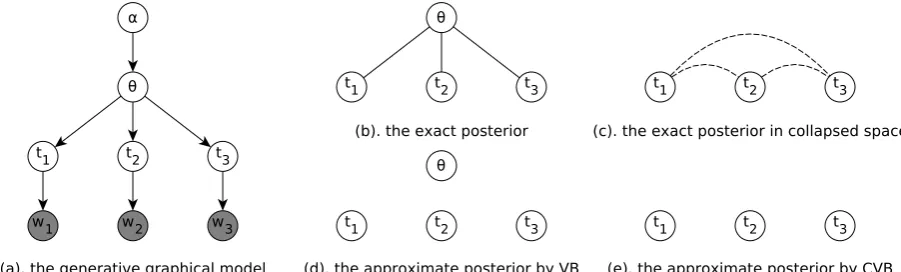
From the joint distribution in (1) proportional to the true posterior, we notice that the parame-ters and hidden variables are intimately coupled. Fluctuations in the parameters can induce changes in the hidden variables and vice-versa. Hence, the independence assumption in (2) and Figure 1(d) seems too strong, leading to inaccurate local max-imums, although it allows for efficient and deter-ministic updates in EM and VB. The dependencies between parameters and hidden variables are kept intact for the remaining algorithms in this paper.
2.3 Markov Chain Monte Carlo
The standard Gibbs sampler for PCFGs iteratively samples the parameters θ and all the parse trees
t. Its mixing can be slowed by again the strong dependencies between the parameters and hidden variables. Instead of reparsing all the hidden trees tfor each sample ofθ, collapsed Gibbs sampling
(CGS) improves upon Gibbs sampling in terms of convergence speed by integrating out the param-eters, and sampling directly fromP(t|w, α) in a
component-wise manner. Thus, it also deals with the dependencies exactly.
By using the conjugacy property, we can easily compute the marginal distribution ofwandt:
P(w,t|α) = Z
θ
PG(w,t|θ)PD(θ|α)dθ
= Y
A∈N
B(fA(t) +αA)
B(αA) (4)
where we define fA(t) to be a vector of rule fre-quencies int indexed byA → β ∈ RA. Hence,
the conditional distribution for a parse treetigiven all others is:
P(ti|wi,w¬i,t¬i, α)∝P(wi, ti|w¬i,t¬i, α)
= Y
A∈N
B(fA(t) +αA)
B(fA(t¬i) +αA) (5)
wherew¬i andt¬i denote all other sentences and trees. It is noticeable that sampling a parse tree from the above conditional distribution is difficult. The frequencies fA(t) effectively mean that the production probabilities are dependent on the cur-rent parse treeti. That is rule parameters can be
updated on the fly inside a parse tree, which pro-hibits efficient dynamic programming tricks.
In order to solve this problem, Johnson et al. (2007) proposed a Hastings sampler that specified an alternative rule probabilities θH of a proposal
distributionP(ti|wi, θH), where
θHA→β = fA→β(t¬
i) +α A→β
P
A→β0∈RA(fA→β0(t
¬i) +α A→β0)
The rule probabilitiesθHare based on the statistics
collected from all other parse trees, and they are fixed for the conditional distribution of the current parse tree. Therefore, by using a variant of inside algorithm (Goodman, 1998), one can efficiently sample a parse tree, which will be either accepted or rejected based on the Metropolis choice.
Figure 1: Graphical representations of the PCFG withn= 3trees (a), and the (approximate) posteriors for Gibbs sampling (b), collapsed Gibbs sampling (c), variational Bayesian inference (d), and collapsed variational Bayesian inference (e). We use dashed lines to depict the weak dependencies.
3 Collapsed variational Bayesian inference
3.1 For bag-of-words models
Leveraging the insight that a sampling algorithm in collapsed space mixes faster than the standard one, Teh et al. (2007) proposed a similar argument that a VB inference algorithm in collapsed space is more effective than the standard one. Following the success in LDA (Teh et al., 2007), a number of research results have been accumulated around ap-plying CVB to a variety of “bag-of-words” mod-els (Sung et al., 2008; Sato et al., 2012; Wang and Blei, 2012).
Formally, we define a model to be independent and identically distributed (i.i.d.) (or informally “bag-of-words”) if its hidden variables are condi-tionally independent given the parameters. LDA, IBM word alignment model 1 and 2, and various finite mixture models are typical examples.
For an i.i.d. model, integrating out parameters induces dependencies that spread over many hid-den variables, and thus the depenhid-dency between any two variables is very weak. This provides an ideal setting to apply the mean field method (i.e. fully factorized VB), as its underlying assumption is that any variable depends on only the summary statistics collected from other variables called the field, and any particular variable’s impact on the field is very small. Hence, the mean field assump-tion is better satisfied in collapsed space with very weak dependencies than in joint space with strong dependencies. As a result, we expect that VB in collapsed space can achieve more accurate results than the standard VB, and the results would be
very close to the true posterior.
Even in collapsed space, CVB remains a deter-ministic algorithm that updates the posterior dis-tributions over the hidden variables just like VB and EM. Therefore, we expect CVB to be compu-tationally efficient as well.
3.2 For structured NLP models
We notice that the basic condition for applying the CVB algorithm to a specific model is for the model to be i.i.d., such that the hidden variables are only weakly dependent in collapsed space, providing an ideal condition to operate VB. However, the i.i.d. condition is certainly not true for structured NLP models such as hidden Markov models (HMMs) and PCFGs. Given the shape of a parse tree, a hidden variable is strongly dependent on its par-ent, siblings and children, and weakly dependent on the rest. Even worse, to infer a grammar from terminal strings, we don’t even have access to the shape of parse trees, let alone analyzing the depen-dencies of hidden variables inside trees.
as-Q(ti)∝
Y
A∈N
Q
A→β∈RAexp(EQ(t¬i)[log(
QfA→β(ti)−1
j=0 (fA→β(t¬i) +αA→β+j))])
Q(P
A→β0fA→β0(ti))−1
j=0 exp(EQ(t¬i)[log(PA→β0∈R
A(fA→β(t
¬i) +α
A→β0+j))])
Figure 2: The exact mean field update in collapsed space for the parse treeti.
Q(ti)∝
Y
r=A→β∈R
E
Q(t¬i)[fA→β(t¬i)] +αA→β
P
A→β0(EQ(t¬i)[fA→β0(t¬i)] +αA→β0)
fr(ti)
Figure 3: The approximate mean field update in collapsed space for the parse treeti.
sumptions made by each algorithm in Figure 1(b-e) before presenting the CVB algorithm formally.
The CVB algorithm for the PCFG model keeps the dependencies between the parameters and the hidden parse trees in an exact fashion:
Q(t, θ) =Q(t)Q(θ|t)
We factoriseQ(t) by breaking only the weak
de-pendencies between parse trees, while keeping the inside dependencies intact, as we don’t make fur-ther assumptions aboutQ(t)for eacht.
Q(t)≈
n
Y
i=1
Q(ti)
By the above factorisations, we compute the neg-ative variational free energy −F(Q(t)Q(θ|t)) as
follows:
− F(Q(t)Q(θ|t))
=EQ(t)Q(θ|t)[logP(w,t, θ|α)−logQ(t)Q(θ|t)]
=EQ(t)[EQ(θ|t)[logP(w,t, θ|α)
Q(θ|t) ]−logQ(t)]
Maximizing −F(Q(t)Q(θ|t)) requires to update Q(θ|t) andQ(t) in turn. In particular, Q(θ|t) is
set equal to the true posteriorP(θ|w,t, α):
− F(Q(t)P(θ|w,t))
=EQ(t)[EP(θ|w,t,α)[logP(w,t, θ|α)
P(θ|w,t, α)]−logQ(t)] =EQ(t)[logP(w,t|α)−logQ(t)]
Finally, we update the approximate posterior for each parse tree tby using the mean field method
in the collapsed space:
Q(ti)∝exp(EQ(t¬i)[logP(wi, ti|w¬i,t¬i, α)])
(6)
The inner termP(wi, ti|w¬i,t¬i, α) in the above equation is just the unnormalized collapsed Gibbs sampling in (5). Plugging in (5), and expanding terms such asB(αA)andΓ(x), we obtain an exact computation ofQ(ti)in Figure 2.
The exact computation is both intractable and expensive. The intractability comes from the sim-ilar problem as in the collapsed Gibbs sampling that we are unable to calculate the normalisation termPtiQ(ti). Hence, we follow Johnson et al. (2007) to approximate it by using only the statis-tics from other sentences, namelyθHand ignoring
the local contribution.
P(wi, ti|w¬i,t¬i, α)≈
Y
A→β∈R
θAH→βfA→β(ti)
(7)
We discuss the accuracy of (7) in Section 3.3. For those expensive computations of the expected log counts in Figure 2, Teh et al. (2007) and Sung et al. (2008) suggested the use of a linear Gaussian approximation based on the law of large numbers.
EQ(t¬i)[log(fA→β(t¬i) +αA→β)]
≈log(EQ(t¬i)[fA→β(t¬i)] +αA→β) (8)
Substituting (7) into (6), and employing the linear approximation, we derive an approximate CVB al-gorithm as shown in Figure 3. In addition, its form is much more simplified and interpretable com-pared with the exact computation in Figure 2.
The surprising similarity between the approxi-mate CVB update in Figure 3 and E step update in (3) indicates that the dynamic programming used in both EM and VB can take over from now. To run inside-outside recursion, the EM algorithm employs the parameters θ? based on maximum
the mean parameters θ˜; and our CVB algorithm
employs the parametersθCVB computed from the
expected counts of all other sentences.
The implementation can be easily achieved by modifying code of the EM algorithm. We keep track of the expected counts at global level, sub-tract the local mean counts for ti before update, run the inside-outside recursion using θCVB, and
finally add the updated distribution back into the global counts. Therefore, we only need to replace the parameters with the expected counts, and make update after each sentence; the core of the inside-outside implementation remains the same.
Our CVB algorithm bears some similarities to the online EM algorithm with maximum a pos-terior (MAP) updates (Neal and Hinton, 1998; Liang and Klein, 2009), but they differ in several ways. The online EM algorithm updates each tree
tibased on the statistics of all the trees, optimising the same objective function p(w|θ) as the batch
EM algorithm. MAP estimation searches for the optimal posteriorp(w|θ)p(θ). On the other hand,
our CVB algorithm optimises the data likelihood
p(w). The smoothing effects for the MAP
estima-tion (αA→β −1) prevent the use of sparse priors, whereas the CVB algorithm (αA→β) overcomes such difficulty by parameter integration.
3.3 Discussion
Breaking the weak dependencies between hidden variables and employing the linear approximation have been argued to be accurate (Teh et al., 2007; Sung et al., 2008; Sato and Nakagawa, 2012), and they are the standard procedures in applying the CVB algorithms to i.i.d. models.
In our CVB algorithm for PCFGs, we introduce an extra approximation in (7), which we argue is accurate. Theoretically, the inaccuracy only oc-curs when there are repeated rules in a parse tree as shown in Figure 2, so the same rule seen later uses a slightly different probability. Even if the inac-curacy indeed occurs, in our described scenario of many sentences, the local contribution from a sin-gle sentence is small compared with the statistics from all other sentences. Empirically, we replicate the experiment of Setho language by Johnson et al. (2007) in Section 4.1, and we find that the sampled trees based onθHnever get rejected, illustrating an
acceptance rate close to100%, and meaning that θH is a very accurate Metropolis proposal. Since
[image:6.595.370.460.69.137.2]all the assumptions made by the CVB algorithm
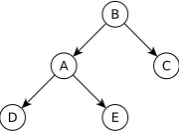
Figure 4: A fragment of a tree structure
are reasonable and weak, we expect its results to be close to true posteriors.
3.4 An alternative approach
We briefly sketch an alternative CVB algorithm at the variable level for completeness.
For a structured NLP model with its shape to be fixed such as the PCFG with latent annotations (PCFG-LA) (Matsuzaki et al., 2005) (See defini-tion in Secdefini-tion 4.3), we can simply ignore all the dependencies between the hidden variables in the collapsed space, despite whether they are strong (for adjacent nodes) or weak (for others). Al-though it seems that we have made unreasonable assumptions, it is not transparent which is worse comparing with the assumptions in the standard VB. Following this assumption, we can derive a CVB algorithm similar to the corresponding local sampling algorithm that samples one hidden vari-able at a time. For example, the approximate pos-terior over the subtype of the nodeAin the above
tree fragment in Figure 4 is updated follows:
q(A=a)
∝E[fB→aC(t¬
A)] +α
E[fB(t¬A)] +|RB|α ·
E[fa→DE(t¬A)] +α
E[fa(t¬A)] +|Ra|α where we useAto denote the node position, and ato denote its hidden subtype. q(A = a) means the probability of node Abeing in subtypea. In
addition, we need to take into account the distribu-tions over its adjacent variables. In our case,Ais strongly dependent on nodesB, C, D, E, and only
weakly dependent on other variables (not shown in the above tree fragment) via global counts, e.g.:
E[fB→aC(t¬A)]
=X
b
X
c
q(B =b)q(C =c)E[fb→ac(t¬A)]
4 Experiments
We conduct three simple experiments to validate our CVB algorithm for PCFGs. In Section 4.1, we illustrate the significantly reduced training time of our CVB algorithm compared to the related Hastings algorithm; whereas in later two sections, we demonstrate the increased performance of our CVB algorithm compared to the corresponding VB and EM algorithms.
4.1 Inferring sparse grammars
Firstly, we conduct the same experiment of in-ferring sparse grammars describing the morphol-ogy of the Sotho language as in Johnson et al. (2007). We use the same corpus of unsegmented Sotho verb types from CHILDES (MacWhinney and Snow, 1985), and define the same initial CFG productions by allowing each non-terminal to emit any substrings in the corpus as terminals plus five predefined morphological rules at the top level.
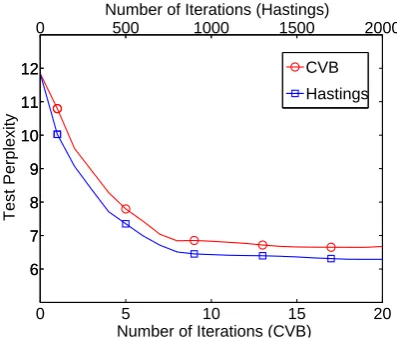
We randomly withhold 10% of the verb types from the corpus for testing, and use the rest 90% for training. Both algorithms are evaluated by their per word perplexity on the test data set with prior set to 10−5 as suggested by Johnson et al.
(2007). We run 5 times with random starts, and report the averaged results in Figure 5. The Hast-ings algorithm2 takes roughly 1,000 iterations to
converge, while our CVB algorithm reaches the convergence even before 10 iterations, consuming only a fraction of training time (CVB: 1.5 minutes; Hastings: 20 minutes). As well as little difference margin in final perplexities shown in Figure 5, we also evaluated segmentation quality measured by the F1 scores, and again the difference is trivial (CVB: 29.8%, Hastings: 31.3%).
4.2 Dependency model with valence
As a second empirical validation of our CVB in-ference algorithm, we apply it to unsupervised grammar induction with the popular Dependency Model with Valence (DMV) (Klein and Manning, 2004). Although the original maximum likelihood formulation of this model has long since been sur-passed by more advanced models, all of the state-of-the-art approaches to unsupervised dependency parsing still have DMV at their core (Headden III et al., 2009; Blunsom and Cohn, 2010; Spitkovsky et al., 2012). As such we believe demonstrating
2Annealing is not used in order to facilitate the perplexity calculation in the test set.
0 5 10 15 20
6 7 8 9 10 11 12
Number of Iterations (CVB)
Test Perplexity
CVB
Hastings
0 500 1000 1500 2000
6 7 8 9 10 11 12
[image:7.595.306.505.64.233.2]Number of Iterations (Hastings)
Figure 5: Perplexities averaged over 5 runs on the extracted corpus of Sotho verbs.
improved inference on this core model will enable future improvements to more complex models.
We evaluate a Dirichlet-Multinomial formula-tion of DMV in the standard fashion by train-ing on sections 2-21 and testtrain-ing on section 23 of the Penn. Wall Street Journal treebank (Marcus et al., 1993). We initialise our models using the original harmonic initialiser (Klein and Manning, 2004). Figure 6 displays the directed accuracy re-sults for DMV model trained with CVB and VB with Dirichlet αparameters of either 1 or 0.1, as
well as the previously reported MLE result. In both cases we see superior results for CVB infer-ence, providing evidence that CVB may be a bet-ter choice of inference algorithm for Bayesian for-mulations of generative grammar induction mod-els such as DMV.
4.3 PCFG with latent annotations
The vanilla PCFGs estimated by simply taking the empirical rule frequencies off treebanks are not ac-curate models to capture the syntactic structures in most natural languages as demonstrated by Char-niak (1997) and Klein and Manning (2003). Our third experiment is to apply the CVB algorithm to the PCFGs with latent annotations (PCFGs-LA) (Matsuzaki et al., 2005), where each non-terminal symbol is augmented with hidden vari-ables (or subtypes). Given a parsed corpus, train-ing a PCFG-LA yields a finer grammar with the automatically induced features represented by the subtypes. For example, an augmented binary rule takes the form A[a] → B[b]C[c], where a, b, c ∈ [1, H]are the hidden subtypes, andHdenotes the
1.0 0.1 0.45
0.46 0.47 0.48 0.49
Bayesian Priors
F1 Scores
EM
VB
[image:8.595.308.507.67.230.2]CVB
Figure 6: DMV trained by EM, VB and CVB. F1 scores on section 23, WSJ.
Objective Precision Recall F1 Exact EM 75.84 72.92 74.35 11.13 VB 76.98 73.32 75.11 11.49 CVB 78.85 76.98 77.90 12.56
Table 1: PCFG-LA (2 subtypes) trained by EM, VB and CVB. Precision, Recall, F1 scores, Exact match scores on section 23, WSJ.
We follow the same experiment set-up as DMV, and report the results on the section 23, using the best grammar tested on the development set (sec-tion 22) from 5 random runs for each algorithm. We adopt Petrov et al. (2006)’s methods to process the data: right binarising and replacing infrequent words with the generic unknown word marker for English, and to initialise: adding 1% randomness to the parametersθ0 to start the EM training. We calculate the expected counts from(G, θ0)to ini-tialise our VB and CVB algorithms.
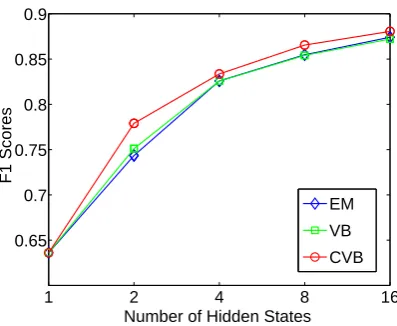
In Table 1, when each non-terminal is split into 2 hidden subtypes, we show that our CVB algo-rithm outperforms the EM and VB algoalgo-rithms in terms of all the evaluation objectives. We also investigate the hidden state space with higher di-mensions (4,8,16subtypes), and find our CVB
al-gorithm retains the advantages over the other two, whereas the VB algorithm fails to surpass the EM algorithm as reported in Figure 7.
5 Conclusion and future work
In this paper we have presented a collapsed vari-ational Bayesian inference algorithm for PCFGs. We make use of the common scenario where the data consists of multiple short sentences, such that
1 2 4 8 16
0.65 0.7 0.75 0.8 0.85 0.9
Number of Hidden States
F1 Scores
[image:8.595.73.278.68.234.2]EM VB CVB
Figure 7: PCFG-LA (2,4,8,16 subtypes) trained by EM, VB and CVB. F1 scores on section 23, WSJ.
we can ignore the local dependencies induced by collapsing the parameters. The assumptions in our CVB algorithm are reasonable for a range of pars-ing applications and justified in three tasks by the empirical observations: it produces more accurate results than standard VB, and close results to sam-pling with significantly less training time.
While not state-of-the-art, the models we have demonstrated our CVB algorithm on underlie a number of high performance grammar induction and parsing systems (Cohen and Smith, 2009; Blunsom and Cohn, 2010; Petrov and Klein, 2007; Liang et al., 2007). Therefore, our work naturally extends to employing our CVB algorithm in more advanced models such as hierarchical splitting and merging system used in Berkeley parser (Petrov and Klein, 2007), and generalising our CVB al-gorithm to the non-parametric models such as tree substitution grammars (Blunsom and Cohn, 2010) and infinite PCFGs (Liang et al., 2007).
We have also sketched an alternative CVB al-gorithm which makes a harsher independence as-sumption for the latent variables but then requires no approximation of the variational posterior by performing inference individually for each parse node. This model breaks some strong dependen-cies within parse trees, but if we expect the pos-terior to be highly skewed by using a sparse prior, the product of constituent marginals may well be a good approximation. We leave further exploration of this algorithm for future work.
Acknowledgments
References
James K. Baker. 1979. Trainable grammars for speech recognition. The Journal of the Acoustical Society of America, 65(S1):S132.
Matthew Beal. 2003. Variational Algorithms for Ap-proximate Bayesian Inference. Ph.D. thesis, The Gatsby Computational Neuroscience Unit, Univer-sity College London.
Phil Blunsom and Trevor Cohn. 2010. Unsupervised induction of tree substitution grammars for depen-dency parsing. In Proceedings of the 2010 Con-ference on Empirical Methods in Natural Language Processing, pages 1204–1213, Cambridge, MA, Oc-tober. Association for Computational Linguistics. Eugene Charniak. 1997. Statistical parsing with
a context-free grammar and word statistics. In Proceedings of the fourteenth national conference on artificial intelligence and ninth conference on Innovative applications of artificial intelligence, AAAI’97/IAAI’97, pages 598–603. AAAI Press. Shay B. Cohen and Noah A. Smith. 2009. Shared
logistic normal distributions for soft parameter ty-ing in unsupervised grammar induction. InNAACL ’09: Proceedings of Human Language Technolo-gies: The 2009 Annual Conference of the North American Chapter of the Association for Compu-tational Linguistics, pages 74–82, Morristown, NJ, USA. Association for Computational Linguistics. Michael Collins. 1999. Head-Driven Statistical
Mod-els for Natural Language Parsing. Ph.D. thesis, University of Pennsylvania.
A. P. Dempster, N. M. Laird, and D. B. Rubin. 1977. Maximum likelihood from incomplete data via the EM algorithm. Journal of the Royal Statistics Soci-ety, Series B, 39(1):1–38.
Joshua T. Goodman. 1998. Parsing inside-out. Ph.D. thesis, Cambridge, MA, USA. Adviser-Stuart Shieber.
William P. Headden III, Mark Johnson, and David Mc-Closky. 2009. Improving unsupervised depen-dency parsing with richer contexts and smoothing. In Proceedings of Human Language Technologies: The 2009 Annual Conference of the North American Chapter of the Association for Computational Lin-guistics, pages 101–109, Boulder, Colorado, June. Mark Johnson, Thomas L. Griffiths, and Sharon
Gold-water. 2006. Adaptor grammars: A framework for specifying compositional nonparametric bayesian models. InNIPS.
Mark Johnson, Thomas Griffiths, and Sharon Gold-water. 2007. Bayesian inference for PCFGs via Markov chain Monte Carlo. InProc. of the 7th Inter-national Conference on Human Language Technol-ogy Research and 8th Annual Meeting of the NAACL (HLT-NAACL 2007), pages 139–146, Rochester, New York, April.
Mark Johnson. 1998. PCFG models of linguis-tic tree representations. Computational Linguistics, 24:613–632.
Dan Klein and Christopher D. Manning. 2003. Ac-curate unlexicalized parsing. InProceedings of the 41st Annual Meeting on Association for Computa-tional Linguistics - Volume 1, ACL ’03, pages 423– 430, Stroudsburg, PA, USA. Association for Com-putational Linguistics.
Dan Klein and Christopher D. Manning. 2004. Corpus-based induction of syntactic structure: mod-els of dependency and constituency. In ACL ’04: Proceedings of the 42nd Annual Meeting on Associ-ation for ComputAssoci-ational Linguistics, page 478.
Kenichi Kurihara and Taisuke Sato. 2006. Variational bayesian grammar induction for natural language. In Proceedings of the 8th international conference on Grammatical Inference: algorithms and appli-cations, ICGI’06, pages 84–96, Berlin, Heidelberg. Springer-Verlag.
Percy Liang and Dan Klein. 2009. Online EM for un-supervised models. InProceedings HLT/NAACL.
Percy Liang, Slav Petrov, Michael Jordan, and Dan Klein. 2007. The infinite PCFG using hierarchi-cal Dirichlet processes. InProc. of the 2007 Con-ference on Empirical Methods in Natural Language Processing (EMNLP-2007), pages 688–697, Prague, Czech Republic.
Brian MacWhinney and Catherine Snow. 1985. The child language data exchange system. Child Lan-guage.
Mitchell P. Marcus, Mary Ann Marcinkiewicz, and Beatrice Santorini. 1993. Building a large anno-tated corpus of English: the Penn treebank. Compu-tational Linguistics, 19(2):313–330.
Takuya Matsuzaki, Yusuke Miyao, and Jun’ichi Tsu-jii. 2005. Probabilistic cfg with latent annotations. In Proceedings of the 43rd Annual Meeting on As-sociation for Computational Linguistics, ACL ’05, pages 75–82, Stroudsburg, PA, USA. Association for Computational Linguistics.
Radford Neal and Geoffrey E. Hinton. 1998. A view of the em algorithm that justifies incremental, sparse, and other variants. InLearning in Graphical Mod-els, pages 355–368. Kluwer Academic Publishers. Slav Petrov and Dan Klein. 2007. Improved
infer-ence for unlexicalized parsing. InHuman Language Technologies 2007: The Conference of the North American Chapter of the Association for Computa-tional Linguistics; Proceedings of the Main Confer-ence.
Linguistics and the 44th annual meeting of the As-sociation for Computational Linguistics, ACL-44, pages 433–440, Stroudsburg, PA, USA. Association for Computational Linguistics.
Issei Sato and Hiroshi Nakagawa. 2012. Rethinking collapsed variational bayes inference for LDA. In Proceedings of the 29th International Conference on Machine Learning.
Issei Sato, Kenichi Kurihara, and Hiroshi Nakagawa. 2012. Practical collapsed variational bayes infer-ence for hierarchical dirichlet process. In Proceed-ings of the 18th ACM SIGKDD international con-ference on Knowledge discovery and data mining, KDD ’12, pages 105–113, New York, NY, USA. ACM.
Valentin I. Spitkovsky, Hiyan Alshawi, and Daniel Ju-rafsky. 2012. Three dependency-and-boundary models for grammar induction. In Proceedings of the 2012 Conference on Empirical Methods in ural Language Processing and Computational Nat-ural Language Learning (EMNLP-CoNLL 2012).
Jaemo Sung, Zoubin Ghahramani, and Sung-Yang Bang. 2008. Latent-space variational Bayes. IEEE Trans. Pattern Anal. Mach. Intell., 30(12), Decem-ber.
Yee Whye Teh, David Newman, and Max Welling. 2007. A collapsed variational Bayesian inference algorithm for latent Dirichlet allocation. InIn Ad-vances in Neural Information Processing Systems, volume 19.