3744
Multi-Level Memory for Task Oriented Dialogs
Revanth Reddy1∗, Danish Contractor2, Dinesh Raghu2, Sachindra Joshi2
1Indian Institute of Technology, Madras 2IBM Research AI, New Delhi
{dcontrac,diraghu1,jsachind}@in.ibm.com
Abstract
Recent end-to-end task oriented dialog sys-tems use memory architectures to incorporate external knowledge in their dialogs. Current work makes simplifying assumptions about the structure of the knowledge base (such as the use of triples to represent knowledge) and combines dialog utterances (context), as well as, knowledge base (KB) results, as part of the same memory. This causes an explosion in the memory size, and makes reasoning over mem-ory, harder. In addition, such a memory de-sign forces hierarchical properties of the data to be fit into a triple structure of memory. This requires the memory reader to learn how to infer relationships across otherwise connected attributes.
In this paper we relax the strong assumptions made by existing architectures and use sep-arate memories for modeling dialog context and KB results. Instead of using triples to store KB results, we introduce a novel multi-level memory architecture consisting of cells for each query and their corresponding re-sults. The multi-level memory first addresses queries, followed by results and finally each key-value pair within a result. We conduct de-tailed experiments on three publicly available task oriented dialog data sets and we find that our method conclusively outperforms current state-of-the-art models. We report a 15-25% increase in both entity F1 and BLEU scores.
1 Introduction
Task oriented dialog systems are designed to com-plete a user specified goal, or service an infor-mation request using natural language exchanges. Unlike open domain end-to-end neural dialog models, task oriented systems rely on external knowledge sources, outside of the current conver-sation context, to return a response (Henderson
∗
Work done during internship at IBM Research AI
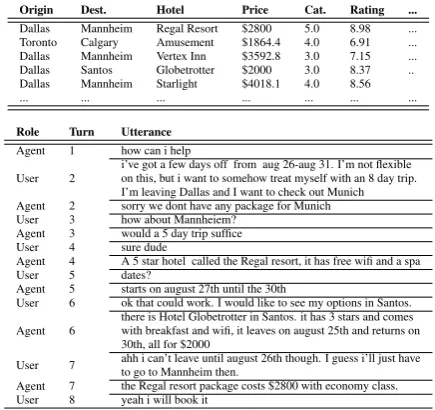
et al.,2014a;Su et al.,2016;Bordes and Weston, 2017a; Eric and Manning, 2017; El Asri et al., 2017). For instance, in the example shown in Ta-ble1, a dialog agent giving tour package recom-mendations needs to be able to first query an exter-nal knowledge source to determine packages that meet a user’s requirement, and then respond ac-cordingly.
Origin Dest. Hotel Price Cat. Rating ...
Dallas Mannheim Regal Resort $2800 5.0 8.98 ...
Toronto Calgary Amusement $1864.4 4.0 6.91 ...
Dallas Mannheim Vertex Inn $3592.8 3.0 7.15 ...
Dallas Santos Globetrotter $2000 3.0 8.37 ..
Dallas Mannheim Starlight $4018.1 4.0 8.56
... ... ... ... ... ... ...
Role Turn Utterance
Agent 1 how can i help
User 2
i’ve got a few days off from aug 26-aug 31. I’m not flexible on this, but i want to somehow treat myself with an 8 day trip. I’m leaving Dallas and I want to check out Munich Agent 2 sorry we dont have any package for Munich
User 3 how about Mannheiem?
Agent 3 would a 5 day trip suffice
User 4 sure dude
Agent 4 A 5 star hotel called the Regal resort, it has free wifi and a spa
User 5 dates?
Agent 5 starts on august 27th until the 30th
User 6 ok that could work. I would like to see my options in Santos.
Agent 6
there is Hotel Globetrotter in Santos. it has 3 stars and comes with breakfast and wifi, it leaves on august 25th and returns on 30th, all for $2000
User 7 ahh i can’t leave until august 26th though. I guess i’ll just have to go to Mannheim then.
Agent 7 the Regal resort package costs $2800 with economy class.
[image:1.595.307.525.342.547.2]User 8 yeah i will book it
Table 1: A goal oriented dialog based on the Frames dataset (El Asri et al., 2017) along with an external knowledge source with each row containing a tour package.
Existing memory based architectures for task oriented dialog suffer from multiple limitations. First, the creation of a shared memory for copy-ing values from dialog context, as well as the knowledge base (KB) results, forces the use of a common memory reader for two different types of data. This makes the task of reasoning over mem-ory, harder – not only does the memory reader need to determine the right entries from a large memory (since each word from context also occu-pies a memory cell), it also needs to learn to dis-tinguish between the two forms of data (context words and KB results) stored in the same memory.
Subject Relation Object Subject Relation Object
Vertex Inn Price $3592.8 Vertex Inn Category 3.0
Regal Resort Price $2800 Regal Resort Rating 8.98 Regal Resort Category 5.0 Starlight Price $4018.1
Starlight Rating 8.56 Starlight Category 4.0
[image:2.595.70.291.262.307.2]... ... ... ... ... ...
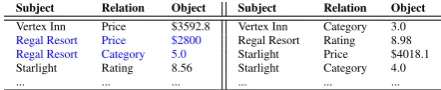
Table 2: Results from Dallas to Mannheim stored in the form of triples.
Second, all current neural memory architectures store results, returned by a knowledge source, in the form of triples (eg. subject −relation − object). This modeling choice makes it hard for the memory reader to infer relationships across otherwise connected attributes. For instance, con-sider the example triple store in Table2showing results for a query executed for packages between “Dallas” and “Mannheim”. If the user asks the di-alog agent to check the price of stay at a 5 star hotel, the memory reader needs to infer that the correct answer is $2800 by learning that the price, category and hotel need to be linked inorder to re-turn an answer (shown inblue).
Lastly, current models treat conversations as a sequential process, involving the use of KB sults from only the most recent information re-quest/query. In contrast, in real world dialogs such as the one shown in Table1, the agent may have to refer to results (to Mannheim) from a previously executed query (see Turn 7). Thus, at each turn, the system has to memorize all the information ex-changed during the dialog, and infer the package being referred to, by the user. In order to support such dialogs, the memory needs to store results of all queries executed during the course of the di-alog. The problem of inferring over such results (which may be from multiple queries) is exacer-bated when memory is represented in the form of triples.
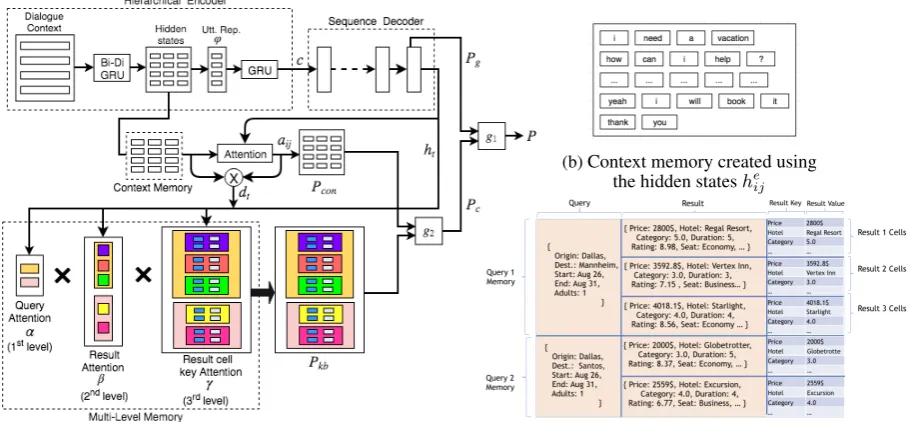
In this paper, we present our novel multi-level memory architecture that overcomes the limita-tions of existing methods: (i) We separate the memory used to store tokens from the input con-text and the results from the knowledge base. Thus, we learn different memory readers for con-text words as well for knowledge base entities (ii) Instead of using a subj − rel − obj store, we develop a novel multi-level memory architec-ture which encodes the natural hierarchy exhib-ited in knowledge base results by storing queries and their corresponding results and values at each level. We first attend on the queries, followed by the results in each query to identify the result be-ing referred to, by the user. We then attend on the individual entries in the result to determine which value to copy in the response. Figure 1c shows our multi-level memory storing the results from queries executed as part of the dialog in Table1. Our paper makes the following contributions: 1. We propose the use of separate memories for copying values from context and KB results. Thus, the model learns separate memory readers for each type of data.
2. Our novel multi-level memory for KB results, models the queries, results and their values in their natural hierarchy. As our experiments show, the separation of memory as well as our multi-level memory architecture, both, contribute to signifi-cant performance improvements.
3. We present detailed experiments demonstrat-ing the benefit of our memory architecture along with model ablation studies. Our experiments on three publicly available datasets (CamRest676 (Su et al.,2016),InCar assistant(Eric and Man-ning, 2017), Maluuba Frames (El Asri et al., 2017)) show a substantial improvement of 15-25 % in both entity F1 scores, and BLEU scores as compared to existing state of the art architectures. To the best of our knowledge, we are the first to attempt end-to-end modeling of task oriented di-alogs with non-sequential references as well as multiple queries, as seen in the Maluuba Frames dataset. A human evaluation on model outputs also shows our model is preferred by users over existing systems such as KVRet (Eric and Man-ning,2017) and Mem2Seq (Madotto et al.,2018).
2 Related work
open-domain dialogs. While they can be used for learning task oriented dialogs, they are not well suited to interface with a structured KB. To bet-ter adapt them to handle task oriented dialogs: 1) (Bordes and Weston, 2017b) proposed a memory network based architecture to better encode KB tuples and perform inferencing over them and 2) (Madotto et al., 2018) incorporated copy mecha-nism to enable copying of words from the past ut-terances and words from KB while generating re-sponses. All successful end-to-end task oriented dialog networks (Eric and Manning,2017;Bordes and Weston, 2017b; Madotto et al., 2018) make assumptions while designing the architecture: 1) KB results are assumed to be a triple store, 2) KB triples and past utterances are forced to be repre-sented in a shared memory to enable copying over them. Both these assumptions make the task of inferencing much harder. Any two fields linked directly in the KB tuple are now linked indirectly by the subject of the triples. Further, placing the KB results and the past utterances in same mem-ory forces the architecture to encode them using a single strategy. In contrast, our work uses two different memories for past utterances and KB re-sults. The decoder is equipped with the ability to copy from both memories, while generating the re-sponse. The KB results are represented using a multi-level memory which better reflects the natu-ral hierarchy encoded by sets of queries and their corresponding result sets.
Memory architectures have also been found to be helpful in other tasks such as question answer-ing. Work such as (Xu et al., 2016) defines a hi-erarchical memory architecture consisting of sen-tence level memory followed by word memory for a QA task while (Chandar et al., 2016) defines a memory structure that speeds up loading and infer-encing over large knowledge bases. Recent work by (Chen et al.,2018) uses a variational memory block along with a hierarchical encoder to improve diversity of open domain dialog responses.
3 Multi-Level Memory Network
In this section, we describe our end-to-end model for task oriented dialogues. Our model1 (Figure 1a) consists of: (i) a hierarchical encoder which encodes the current input context consisting of the user and agent utterances (ii) a multi-level memory that maintains the queries and knowledge base
re-1
Code is available atMulti-Level Memory
sults seen so far in the course of the dialogue, and (iii) copy augmented sequence decoder that uses separate context and multi-level memory. The queries and their corresponding results are main-tained in a multi-level memory. The decoder uses a gating mechanism for memory selection while generating a response.
3.1 Encoder
Our model uses a standard hierarchical encoder as proposed by (Sordoni et al., 2015). The en-coder takes a sequence of utterances as input. For thetth turn, the dialogue context can be rep-resented as (c1, c2, ...c2t−1), which consists of
t user utterances and t − 1 system utterances. Each utterance ci is further a sequence of words
(wi1, wi2, ...wim). We first embed each word wij using a word embedding function φemb that
maps each word to a fixed-dimensional vector. We then generate utterance representations,ϕ(ci)
using a single layer bi-directional GRU. heij de-notes the hidden state of word wij in the bi-directional GRU. The input representation c is generated by passing each utterance representation
ϕ(ci)through another single layer GRU.
3.2 Multi-level Memory
(a)Architecture of our model with multi-level memory attention
(b)Context memory created using the hidden statesheij
[image:4.595.74.531.68.279.2](c) Expanded view of the multi-level KB memory corresponding to example in Table1
Figure 1: Model architecture (a) along with schematic representation of context memory (b) and multi-level KB memory (c)
3.2.1 Memory Representation
Letq1, q2, ...qk be the queries fired to the knowl-edge base till the current state of the dialogue. Every query qi is a set of key-value pairs
{kqi
a : vqai,1 < a < nqi}, corresponding to the query’s slot and argument wherenqiis the number of slots in query qi. For example, after the user
utterance at Turn 3 in Table 1, the query fired by the system on the knowledge base would be
{’origin’:’Dallas’,’destination’:’Manheim’,’Start’: ’Aug 26’, ’end’: ’Aug 31’, ’Adults’:1}. The ex-ecution of a query on an external knowledge base, returns a set of results. Let rij be the jth
result of queryqi. Each resultrij is also a set of
slot-value pairs{krij
a :varij,1 < a < nrij}where
nrij is the number of attributes in result rij. A visualization of the memory with queries and their corresponding results can be seen in Figure1c.
The first level of memory contains the query representations. Each query qi is represented by
qiv = Bag of words over the word embeddings of values (vqi
a) in qi. The second level of memory
contains the result representations. Representation of each resultrij is given byrijv = Bag of words
over the word embeddings of values (vraij) inrij.
The third level of memory contains the result cells which have the key-value pairs (krij
a :varij) of the
results. The values (vrij
a ) which are to be copied
into the system response are thus present in the
fi-nal level of memory . We now describe how we apply attention over the context and multi-level memory.
3.3 Decoder
The model generates the agent response word-by-word; a word at time steptis either generated from the decode vocabulary or is a value copied from one of the two memories (knowledge base or con-text memory). A soft gateg1 controls whether a value is generated from vocabulary or copied from memory. Another gateg2determines which of the two memories is used to copy values.
3.3.1 Generating words:
Let the hidden state of the decoder at timetbeht.
ht=GRU(φemb(yt−1), ht−1) (1)
The hidden state ht is used to apply atten-tion over the input context memory. Attention is applied over the hidden states of the input bi-directional (BiDi) GRU encoder using the “ con-cat” scheme as given in (Luong et al.,2015). The attention for the jth word in the ith utterance is given by:
aij = exp(w
T
1tanh(W2tanh(W3[ht, heij])))
P
ijexp(w1Ttanh(W2tanh(W3[ht, heij])))
The attention scoresaij are combined to create an
attended context representationdt,
dt=
X
i,j
ai,jheij (3)
and similar to (Luong et al., 2015), the decoder word-generation distribution is given by :
Pg(yt) =sof tmax(W1[ht, dt] +b1) (4) 3.3.2 Copying words from context memory: The input context memory is represented using the hidden statesheij of the input Bi-Di GRU encoder. Similar to (Gulcehre et al., 2016), the attention scores aij, are used as the probability scores to
form the copy distributionPcon(yt)over the input
context memory.
Pcon(yt=w) =
X
ij:wij=w
aij (5)
3.3.3 Copying entries from KB memory: The context representationdt, along with the
hid-den state of decoderht, is used to attend over the
multi-level memory. The first level attention, α.,
is applied over the queriesq..
αi = exp(w
T
2tanh(W4[dt, ht, qvi]))
P
iexp(wT2tanh(W4[dt, ht, qvi]))
(6)
The second level attention,βi., is the attention over the resultsri.of queryqi.
βij =
exp(wT3tanh(W5[dt, ht, rvij]))
P
jexp(w3Ttanh(W5[dt, ht, rijv]))
(7)
The product of first level attention and second level attention is the attention over results of all the queries in the multi-level memory. The weighted sum of the first level attention, second level tention and result representations gives us the at-tended memory representation,mt.
mt=X
i
X
j
αiβijrvij (8)
Each result is further composed of multiple re-sult cells. On the last level of memory, which con-tains the result cells, we apply key-value attention similar to (Eric and Manning,2017). The key of the result cell is the word embedding of the slot,
krij
a , in the result. The attention scores,γij., for the
keys represent the attention over the result cells of each resultrij.
γijl=
exp(w4Ttanh(W6[dt, ht, φemb(k
rij
l )]))
P
lexp(wT4tanh(W6[dt, ht, φemb(k rij
l )]))
(9) The product of first level attention αi, second
level attention βij and third level attention γijl
gives the final attention score of the valuevrij
l in
the KB memory. These final attention scores when combined (Eq. 10), form the copy distribution,
Pkb(yt), over the values in KB memory.
Pkb(yt=w) =
X
ijl:vrijl =w
αiβijγijl (10)
3.3.4 Decoding
Similar to (Gulcehre et al.,2016), we combine the generate and copy distributions - we use gateg2 (Eq.11) to obtain the copy distributionPc(yt)(Eq.
12) by combiningPkb(yt)andPcon(yt).
g2=sigmoid(W7[ht, dt, mt] +b2) (11)
Pc(yt) =g2Pkb(yt) + (1−g2)Pcon(yt) (12) Finally, we use gate g1 to obtain the final out-put distributionP(yt), by combining generate dis-tribution Pg(yt) and copy distribution Pc(yt) as shown below:
g1=sigmoid(W8[ht, dt, mt] +b3) (13)
P(yt) =g1Pg(yt) + (1−g1)Pc(yt) (14) We train our model by minimizing the cross en-tropy loss−PT
t=1log(P(yt)). 4 Experiments
4.1 Datasets
We present our experiments using three real world publicly available multi-turn task oriented dia-logue datasets: the InCar assistant (Eric and Man-ning, 2017), CamRest (Su et al., 2016) and the Maluuba Frames dataset (El Asri et al.,2017). All three datasets contain human-human task oriented dialogues which were collected in a Wizard-of-Oz (Wen et al.,2017) setting.
(i) InCar assistant dataset consists of 3031
(ii)CamRest dataset, consists of676 human-to-human dialogues set in the restaurant reservation domain. There are three queryable slots (food, price range, area) that users can specify. This dataset has currently been used for evaluating slot-tracking systems. Recent work by (Lei et al., 2018) uses an end-to-end network without a KB and substitutes slot values with placeholders bear-ing the slot names in agent responses. However, we formatted the data to evaluate end-to-end sys-tems by adding API call generation from the slot values so that restaurant suggestion task can pro-ceed from the KB results.
(iii)Maluuba Frames dataset, consists of 1369
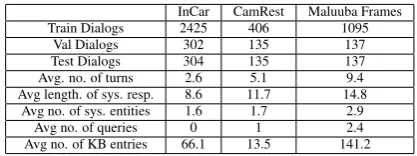
dialogues developed to study the role of memory in task oriented dialogue systems. The dataset is set in the domain of booking travel packages which involves flights and hotels. In contrast to the previous two datasets, this dataset contains di-alogs that require the agent to remember all infor-mation presented previously as well as support re-sults from multiple queries to the knowledge base. A user’s preferences may change as the dialogue proceeds, and can also refer to previously pre-sented queries (non-sequential dialog). Thus, to store multiple queries, we require 3levels in our multi-level memory as compared to2levels in the other datasets, since they don’t have more than one query. We do not use the dialogue frame annota-tions and use only the raw text of the dialogues. We map ground-truth queries to API calls that are also required to be generated by the model. Recent work has used this dataset only for frame tracking (Schulz et al., 2017) and dialogue act prediction (Peng et al.,2017;Tang et al.,2018). To the best of our knowledge we are the first to attempt the end-to-end dialog task using this dataset. Table3 summarizes the statistics of the datasets.
InCar CamRest Maluuba Frames Train Dialogs 2425 406 1095
Val Dialogs 302 135 137
Test Dialogs 304 135 137
Avg. no. of turns 2.6 5.1 9.4 Avg length. of sys. resp. 8.6 11.7 14.8
Avg no. of sys. entities 1.6 1.7 2.9
Avg no. of queries 0 1 2.4
[image:6.595.76.285.582.660.2]Avg no. of KB entries 66.1 13.5 141.2
Table 3: Statistics for3different datasets.
4.2 KB API Call Generation
In this section, we briefly describe how the knowl-edge base queries are generated as API calls as part of the model response. The InCar assistant
dataset has a fixed KB for each dialogue whereas the CamRest and Maluuba datasets require queries to be fired on a global KB. Queries in CamRest dataset can have 3 slots namely cuisine, area and pricerange, whereas those in Maluuba can have 8 slots, which are destination, origin, start date, end date, budget, duration, number of adults and chil-dren. Any query that is to be fired on the KB is expected to be generated by the model as an API call, by considering a fixed ordering of slots in the generated response. For eg., in CamRest dataset, ApiCall(area=south, pricerange=cheap) would be generated by the model asapi call dontcare south cheap, with dontcaremeaning that the user does not have any preference for cuisine and, south, cheap being the user constraints for area and pricerange respectively. Therefore, the task of API call generation typically involves copying relevant entities that are present in dialog context.
4.3 Training
Our model is trained end-to-end using Adam op-timizer (Kingma and Ba, 2014) with a learning rate of 2.5e−4. The batch-size is sampled from [8,16]. We use pre-trained Glove vectors (Pen-nington et al., 2014) with an embedding size of 200. The GRU hidden sizes are sampled from [128, 256]. We tuned the hyper-parameters with grid search over the validation set and selected the model which gives best entity F1.
4.4 Evaluation Metrics
4.4.1 BLEU
We use the commonly used BLEU metric (Pap-ineni et al.,2002) to study the performance of our systems as it has been found to have strong corre-lation (Sharma et al.,2017) with human judgments in task-oriented dialogs.
4.4.2 Entity F1
To explicitly study the behaviour of different memory architectures, we use the entity F1 to measure how effectively values from the knowl-edge base are used in the dialog. To compute the entity F1, we micro-average the precision and recall over the entire set of system responses to compute the micro F12. For the InCar Assistant dataset, we compute a per-domain entity F1 as well as the aggregated entity F1. Since our model does not have slot-tracking by design, we evaluate
2
InCar CamRest Maluuba Frames
Model BLEU F1 Calendar
F1
Weather F1
Navigate
F1 BLEU F1 BLEU F1
[image:7.595.101.496.61.132.2]Attn seq2seq (Luong et al.,2015) 11.3 28.2 36.9 35.7 10.1 7.7 25.3 3.7 16.2 Ptr-UNK (Gulcehre et al.,2016) 5.4 20.4 22.1 24.6 14.6 5.1 40.3 5.6 25.8 KVRet (Eric and Manning,2017) 13.2 48.0 62.9 47.0 41.3 13.0 36.5 10.7 31.7 Mem2Seq (Madotto et al.,2018) 11.8 40.9 61.6 39.6 21.7 14.0 52.4 7.5 28.5 Multi-level Memory Model (MM) 17.1 55.1 68.3 53.3 44.5 15.9 61.4 12.4 39.7
Table 4: Comparison of our model with baselines
on entity F1 instead of the slot-tracking accuracy as in (Henderson et al.,2014b;Wen et al.,2017)
4.5 Baselines
We experiment with the following baseline models for comparing the performance of our Multi-Level Memory architecture:
Attn seq2seq3(Luong et al.,2015): A model with simple attention over the input context at each time step during decoding.
Ptr-UNK3 (Gulcehre et al., 2016): The model
augments a sequence-to-sequence architecture with attention-based copy mechanism over the en-coder context.
KVRet (Eric and Manning, 2017): The model uses key value knowledge base in which the KB is represented as triples in the form ofsubject− relation−object. This model does not support copying words from context. The sum of word embeddings of subject, relation is used as the key of the correspondingobject.
Mem2Seq3 (Madotto et al., 2018): The model uses a memory networks based approach for at-tending over dialog history and KB triples. During decoding, at each time step, the hidden state of the decoder is used to perform multiple hops over a single memory which contains both dialog history and the KB triples to get the pointer distribution used for generating the response.
4.6 Results
Table 4 shows the performance of our model against our baselines. We find that our multi- level memory architecture comprehensively beats all existing models, thereby establishing new state-of-the- art benchmarks on all three datasets. Our model outperforms each baseline on both BLEU and entity F1 metrics.
InCar: On this dataset, we show entity F1 scores for each of the scheduling, weather and navigation domains. Our model has the highest F1 scores across all the domains. It can be seen that our
3
We use the implementation provided by (Madotto et al.,
2018) at https://github.com/HLTCHKUST/Mem2Seq
model strongly outperforms Mem2Seq on each domain. A detailed study reveals that the use of triples cannot handle cases when a user queries withnon-subject entries or in cases when the re-sponse requires inferencing over multiple entries. In contrast, our model is able to handle such cases since we use a compound representation of entire result (bag of words over values) while attending on that result.
CamRest: Our model achieves the highest BLEU and entity F1 scores on this dataset. From Table4, we see that simpler baselines like Ptr-UNK show competitive performance on this dataset because, as shown in Table 3, CamRest dataset has rela-tively fewer KB entries. Thus, a simple mecha-nism for copying from context results in good en-tity F1 scores.
InCar CamRest Maluuba
Ctxt. KB Ctxt. KB Ctxt. KB
Mem2Seq 66.2 25.3 63.7 36.5 17.7 8.9 Multi-level Mem. 81.6 37.5 70.1 53.4 27.2 14.6
Table 5: Percentage (%) of category-wise (context vs KB) ground truth entities correctly captured in gener-ated response. Abbreviation Ctxt denotes context.
Maluuba Frames: The Maluuba Frames dataset was introduced for the frame tracking task. Here, a dialog frame is a structured representation of the current dialog state. Instead of explicitly modeling the dialog frames, we use the context representa-tiondtto directly attend on the Multi-level mem-ory. As Table3shows, this dataset contains sig-nificantly longer contexts as well as larger number of entities, as compared to the other two datasets. In addition, unlike other datasets, it also contains non-linear dialog flows where a user may refer to previously executed queries and results. The com-plexity of this dataset is reflected in the relatively lower BLEU and F1 scores as compared to other datasets.
4.7 Analysis
4.7.1 Entity source-wise performance
[image:7.595.310.525.403.438.2]multi-InCar CamRest Maluuba Frames
Model BLEU F1 Calendar
F1
Weather F1
Navigate
F1 BLEU F1 BLEU F1
[image:8.595.86.514.62.115.2]Unified Context and KB memory (Mem2Seq) 11.8 40.9 61.6 39.6 21.7 14.0 52.4 7.5 28.5 Separate Context and KB Memory 14.3 44.2 56.9 54.1 24.0 14.3 55.0 12.1 36.5 +Replace KB Triples with Multi-level memory 17.1 55.1 68.3 53.3 44.5 15.9 61.4 12.4 39.7
Table 6: Model ablation study : Effect of (i) separate memory and (ii) multi-level memory design.
level memory for KB, Table5shows the percent-age of ground-truth entities, according to their cat-egory, which were also present in the generated re-sponse. For example, on the InCar dataset, out of the930entities in ground-truth response that were to be copied from the KB, our model was able to copy37.5%of them into the generated response. From Table5, it can be seen that our model is able to correctly copy a significantly larger number of entities from both, KB and context, as compared to the recent Mem2Seq model in all datasets.
4.7.2 Model ablation study
We report results from ablation studies on all three datasets. Table 6 shows the incremental benefit obtained from individual components used in our model. We investigate the gains made by (i) Using separate memory for context and KB triples (ii) Replacing KB triples with a Multi-level memory. We use the recent Mem2Seq model for compari-son with a unified context and KB memory model. As can be seen from Table6, the separation of context memory and KB memory leads to a signif-icant improvement in BLEU and F1 scores on all datasets. This validates our hypothesis that stor-ing context words and KB results in a sstor-ingle mem-ory confuses the memmem-ory reader. The use of a multi-level memory instead of triples leads to fur-ther gains. This suggests, better organization of KB result memory by keeping the natural hierar-chy intact is beneficial.
4.7.3 Error Analysis
We analyzed the errors made by our dialog model on 100 dialog samples in test set of Maluuba Frames. We observed that the errors can be di-vided into five major classes: (i) Model outputs wrong KB result entry due to incorrect atten-tion (27%), (ii) Model returns package details in-stead of asking for more information from the user (16%), (iii) Model incorrectly captures user in-tent (13%), (iv) Model makes an error due to non-sequential nature of dialog (22%). In such errors, our model either generates an API call for a result already present in memory, or our model asks for a query-slot value that was already provided by the
user, (v) Data specific characteristics such as in-sufficient samples for certain classes of utterances (eg: more than one package returned) or return-ing different, but meanreturn-ingful package attributes as compared to ground-truth data, contribute to 22% of the errors.
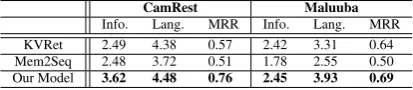
CamRest Maluuba
Info. Lang. MRR Info. Lang. MRR KVRet 2.49 4.38 0.57 2.42 3.31 0.64 Mem2Seq 2.48 3.72 0.51 1.78 2.55 0.50 Our Model 3.62 4.48 0.76 2.45 3.93 0.69
Table 7: Informational accuracy and language quality scores using a human study.
4.8 Human Evaluation
We also conducted a blind user study that com-pared outputs from our model, Mem2Seq and KVRet systems. We used 96 randomly selected examples from each test split of Maluuba and CamRest datasets resulting in a total of 192 ex-amples. Our study was split across 8 users who were provided with results fetched from the KB, current dialog context, gold response and the out-puts of each of the models. Model outout-puts were shuffled in each example and users were asked to score each output between 1 (lowest) to 5 (highest) in terms of its accuracy of information in response and the quality of language. The results of this study are presented in Table7. We also report the MRR (mean-reciprocal rank) for model preference along with other scores.
[image:8.595.313.520.239.284.2]Role Turn Utterance
Agent 1 hello ! how can i help you today ?
User 2 i just need to dream a bit. i have 4500 dollars but no vacation days. i’m wondering what a hypothetical trip to Manas would be like Agent 2 i can help with that, where are you departing from
User 3 i’m in Tijuana, not departing any time soon unfortunately though
... ... ...
Agent 5 [API CALL manas tijuana 29/8 16/9 4500 ...]
... ... ...
User 7 that’s fine, what about pittsburgh
Agent 7 [API CALL pittsburgh tijuana ... 4500 ...]
... ... ...
Agent 8 that i do have! would you be satisfied with a 3.5 star hotel ?
User 9 as of now i’m satisfied with a tent and a backpack . what are the hotel details?
Agent 9 the hotel is situated near a park, comes with free parking, wifi and breakfast ! does this sound good
User 10 sounds quite nice, what about the guest rating ?
Gold the guest rating is impressive :8.86 Mem2Seq this is the only available with the same
KVRet it’s a 2.5 star hotel near a park, museum and airport.it has a guest rating of 8.22
[image:9.595.70.292.63.250.2]Our Model the onyx isle hotel has a8.86guest rating and offers free parking, breakfast and wifi.
Table 8: Comparing the responses generated by various models on an example in test set of Maluuba Frames.
4.9 Attention Visualization
Analyzing the attention weights is a useful way to understand how the model is inferencing over the memory to copy entities from it. Table 8 shows an example of a dialog from the Maluuba Frames dataset and the outputs generated by dif-ferent models. Here, the user first wants to know about packages to ‘Manas’ and then requests for trips to ‘Pittsburgh’. Later, the user becomes inter-ested in the 3.5 star hotel in Pittsburgh which was suggested by the agent and wants to know its guest rating. It can be seen from Table8that our model outputs the correct guest rating (8.86) of the hotel. Mem2Seq fails to understand the context and gen-erates an irrelevant response. KVRet gengen-erates a readable response but points to the guest rating of a different hotel.
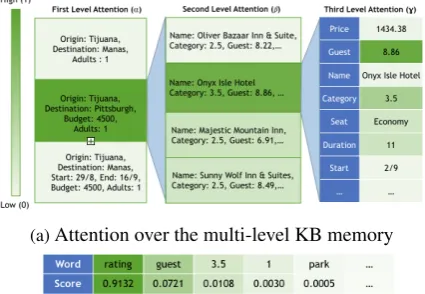
(a)Attention over the multi-level KB memory
[image:9.595.75.288.552.699.2](b)Decreasing order of attention scores over words in dialogue context
Figure 2: Visualization of attention over memory while generating the word ‘8.86’ for the example in Table8.
The attention over the memory while generating the word ‘8.86’ for this example is shown in Fig 2. Fig2ashows that the query with destination as ‘Pittsburgh’ gets the highest attention and among the results of this query, the package with the 3.5 star rated hotel gets highest attention. Within this result, the model gives highest score to the result cell with guest rating as the key. To further under-stand why the correct result hotel gets higher at-tention, Fig2bshows the attention scores over the words in context memory. The context represen-tationdtcaptures the important words (3.5, guest, rating) in context which are in-turn used to apply attention over the multi-level memory.
Lastly, studying the values of the gatesg1(prob. of generating from vocabulary) andg2 (prob. of copying from KB), we found that gate g1 had a probability value of 0.08 thereby driving the model to copy from memory instead of generating from output vocabulary and gateg2, with a proba-bility value of0.99, was responsible for selecting KB memory over context memory.
5 Conclusion
References
Antoine Bordes and Jason Weston. 2017a. Learn-ing end-to-end goal-oriented dialog. ICLR, abs/1605.07683.
Antoine Bordes and Jason Weston. 2017b. Learning end-to-end goal-oriented dialog. In International Conference on Learning Representations.
Sarath Chandar, Sungjin Ahn, Hugo Larochelle, Pas-cal Vincent, Gerald Tesauro, and Yoshua Bengio. 2016. Hierarchical memory networks. CoRR, abs/1605.07427.
Hongshen Chen, Zhaochun Ren, Jiliang Tang, Yi-hong Eric Zhao, and Dawei Yin. 2018. Hierarchi-cal variational memory network for dialogue gener-ation. InProceedings of the 2018 World Wide Web Conference, WWW ’18, pages 1653–1662, Repub-lic and Canton of Geneva, Switzerland. International World Wide Web Conferences Steering Committee.
Layla El Asri, Hannes Schulz, Shikhar Sharma, Jeremie Zumer, Justin Harris, Emery Fine, Rahul Mehrotra, and Kaheer Suleman. 2017. Frames: A corpus for adding memory to goal-oriented dialogue systems.CoRR, abs/1704.00057.
Mihail Eric and Christopher D Manning. 2017. Key-value retrieval networks for task-oriented dialogue. arXiv preprint arXiv:1705.05414.
Caglar Gulcehre, Sungjin Ahn, Ramesh Nallap-ati, Bowen Zhou, and Yoshua Bengio. 2016. Pointing the unknown words. arXiv preprint arXiv:1603.08148.
Matthew Henderson, Blaise Thomson, and Jason D Williams. 2014a. The second dialog state tracking challenge. InProceedings of the 15th Annual Meet-ing of the Special Interest Group on Discourse and Dialogue (SIGDIAL), pages 263–272.
Matthew Henderson, Blaise Thomson, and Jason D Williams. 2014b. The second dialog state tracking challenge. InProceedings of the 15th Annual Meet-ing of the Special Interest Group on Discourse and Dialogue (SIGDIAL), pages 263–272.
Diederik P Kingma and Jimmy Ba. 2014. Adam: A method for stochastic optimization. arXiv preprint arXiv:1412.6980.
Wenqiang Lei, Xisen Jin, Min-Yen Kan, Zhaochun Ren, Xiangnan He, and Dawei Yin. 2018. Sequic-ity: Simplifying task-oriented dialogue systems with single sequence-to-sequence architectures. In Pro-ceedings of the 56th Annual Meeting of the Associa-tion for ComputaAssocia-tional Linguistics (Volume 1: Long Papers), volume 1, pages 1437–1447.
Minh-Thang Luong, Hieu Pham, and Christopher D Manning. 2015. Effective approaches to attention-based neural machine translation. arXiv preprint arXiv:1508.04025.
Andrea Madotto, Chien-Sheng Wu, and Pascale Fung. 2018. Mem2seq: Effectively incorporating knowl-edge bases into end-to-end task-oriented dialog sys-tems. arXiv preprint arXiv:1804.08217.
Kishore Papineni, Salim Roukos, Todd Ward, and Wei-Jing Zhu. 2002. Bleu: a method for automatic eval-uation of machine translation. In Proceedings of the 40th annual meeting on association for compu-tational linguistics, pages 311–318. Association for Computational Linguistics.
Baolin Peng, Xiujun Li, Lihong Li, Jianfeng Gao, Asli Celikyilmaz, Sungjin Lee, and Kam-Fai Wong. 2017. Composite task-completion dialogue policy learning via hierarchical deep reinforcement learn-ing.arXiv preprint arXiv:1704.03084.
Jeffrey Pennington, Richard Socher, and Christopher Manning. 2014. Glove: Global vectors for word representation. InProceedings of the 2014 confer-ence on empirical methods in natural language pro-cessing (EMNLP), pages 1532–1543.
Hannes Schulz, Jeremie Zumer, Layla El Asri, and Shikhar Sharma. 2017. A frame tracking model for memory-enhanced dialogue systems.arXiv preprint arXiv:1706.01690.
Iulian Vlad Serban, Alessandro Sordoni, Yoshua Ben-gio, Aaron C Courville, and Joelle Pineau. 2016. Building end-to-end dialogue systems using gener-ative hierarchical neural network models. InAAAI, volume 16, pages 3776–3784.
Iulian Vlad Serban, Alessandro Sordoni, Ryan Lowe, Laurent Charlin, Joelle Pineau, Aaron C Courville, and Yoshua Bengio. 2017. A hierarchical latent variable encoder-decoder model for generating di-alogues. InAAAI, pages 3295–3301.
Shikhar Sharma, Layla El Asri, Hannes Schulz, and Jeremie Zumer. 2017. Relevance of unsuper-vised metrics in task-oriented dialogue for evalu-ating natural language generation. arXiv preprint arXiv:1706.09799.
Alessandro Sordoni, Yoshua Bengio, Hossein Vahabi, Christina Lioma, Jakob Grue Simonsen, and Jian-Yun Nie. 2015. A hierarchical recurrent encoder-decoder for generative context-aware query sugges-tion. InProceedings of the 24th ACM International on Conference on Information and Knowledge Man-agement, pages 553–562. ACM.
Jian Su, Xavier Carreras, and Kevin Duh, editors. 2016. Proceedings of the 2016 Conference on Empirical Methods in Natural Language Processing, EMNLP 2016, Austin, Texas, USA, November 1-4, 2016. The Association for Computational Linguistics.
Oriol Vinyals and Quoc Le. 2015. A neural conver-sational model. InProceedings of the International Conference on Machine Learning.
Tsung-Hsien Wen, David Vandyke, Nikola Mrkˇsi´c, Milica Gasic, Lina M. Rojas Barahona, Pei-Hao Su, Stefan Ultes, and Steve Young. 2017. A network-based end-to-end trainable task-oriented dialogue system. InProceedings of the 15th Conference of the European Chapter of the Association for Compu-tational Linguistics: Volume 1, Long Papers, pages 438–449. Association for Computational Linguis-tics.