Technology (IJRASET)
Autonomous Tracking of Vehicle Taillights for
Avoiding Accidents in Toll Road
M.Yuvaraju1, G. Manjula Devi2 #
Department of EEE, Department of EEE
Abstract-The pasture of statistical morphology contributes a spacious variety of operators to image trade out, all based in the region of the alternative simple precise concepts from rest theory. The operators are mainly valuable for the breakdown of double images and universal usages embrace circumference detection, noise deduction, image enrichment and image segmentation. The PWM is detecting the vehicles signal then an ultrasonic sensor can be used to sense the taillights. UART can be used for transmitting and receiving these signals to the Arduino system. The system is low-power and processes scenes entirely an embedded systems. In contrast to most existing work that addresses whichever daytime or nighttime exposure, the presented system provides the aptitude to track vehicle taillights and distinguish aware signals in spite of of illumination environment. The mobile visualization system has been weathered in authentic traffic scenes and the results obtained exhibit the routine and the trivial personality of the algorithm.
Keywords- Arduino, Pulse Width Modulation, Ultrasonic sensor, UART, Vehicle Taillights detection.
I. INTRODUCTION
In traffic roads, government takes extra hard work in installing cameras for decision the different data like amount of vehicles transient through the road, amount of pedestrians walking beside the road, etc [2]. There are amount of projects successively right through the world for interchange monitoring scheme. More or less all projects successively focus on daytime interchange monitoring [15]. It is a night time interchange monitoring scheme, which concentrates on the night time interchange which essentially concentrates on the reflections approaching from the road surfaces since previous projects didn’t give a lot of significance [19].
Detecting and recognizing vehicles are an essential talented investigate area for able transport systems. Earlier swot on this topic have discussed traffic inspection, driver assistance systems and autonomous vehicle assistance and road traffic in sequence systems [16]. To more efficiently obtain traffic in sequence as moving vehicles, techniques based on outline differencing have been practical to differentiate stirring vehicles from frozen backdrop scenes based on change recognition or other statistical models [12]. These methods can be professionally functional to daytime transfer scenes with stationary and unmoved lighting conditions. However, spatial–sequential difference features are no longer dependable when vehicles stop or move slowly in crammed traffic areas, and vehicles may be falsely detected as background regions and missed [11]. Contour-based methods can present superior computational effectiveness in detecting and tracking vehicles. Yet, their exposure efficiency depends significantly on the suitable initialization of the outline models applied to the vehicles.
Technology (IJRASET)
substance, into which the image should be segmented, can be mechanically resolute. amongst the bright objects all are not the rear lamps of the vehicle. According to vehicle instruction act the rear lamp have to be equal. By using normalized cross correlation symmetric rear-lamp is detected[5].
Tracking of objects can be made in a variety of traditions like employing expanse based tracking, Outline based tracking, attribute based tracking, model based tracking etc., By dynamically extracting the center in sequence i.e. employing intermittent surroundings working out, expanse based tracking can be through for stirring objects. In contour based object tracking, objects were tracked through contour boundaries and dynamically updating the aim contours by extracting the shapes of the substance which are computational proficient. AdaBoost (Adaptive Boosting) algorithm which is an adaptive algorithm planned by Freund & Schapire , is an iterative algorithm [1]. By using the Adaboost cascade classifier of rear close-up image sample training, we can find the rectangle area containing the object in the image, and the areas will be returned as a sequence of rectangular box [6]. Due to the illumination circumstance deviation, the recognition effect is reduced in case of within a channel, because the classifiers missed every vehicles in the channel [10].
II. RELATED WORKS
The vehicle detection and tracking with automatically. An important aspect of conflict averting and driver support systems, when
independent vehicles, is the tracking of vehicle taillights and the recognition of alert signals [1]. To present the invent and functioning of a robust and computationally trivial algorithm for a real-time vision system, proficient of detecting and tracking vehicle taillights, recognizing frequent alert signals by means of a vehicle-mounted embedded smart camera, and including the cars temporary on together sides of the vehicle [14]. Presently, there are daytime vehicle detection algorithms and night time algorithms that detect lights using color thresholds but these algorithms cannot operate during both daytime and night time [9]. Due to the nature of these algorithms, a method designed for detecting vehicles during the daytime does not work during night time and vice versa. In this project the proposed method eliminates false-positive regions later on, allowing us to employ soft color thresholds and avoid missing taillight regions [8]. There are limited to the number of vehicles passing through the specific detection regions and are difficult to apply for vehicle classification, vehicle speed detection, and vehicle motion analysis. To more efficiently obtain traffic information from moving vehicles, techniques based on frame differencing have been applied to differentiate moving vehicles from motionless background scenes based on change detection or other statistical models [15]. The testing videos from highway were classified into different scenarios. ‘Normal’ condition stands for bright condition with clear scenes. ‘Through tunnel’ stands for a video sequence with several tunnels. ‘Under overpass’ and ‘Sunset, forward shadow’ represent different shadow appearance on the ground [10].
III. SYSTEM ARCHITECTURE
A. Ultrasonic Sensor
Ultrasonic sensor detects the remoteness of the adjoining object in front of the sensor. This sensor worked by sending out a explode of ultrasound and listening for the echo when it bounces of an object. It pings the obstacles with ultrasound. The board sends a short pulse trigger detection, and listens for pulse on identical pin by means of the pulseln ( ) meaning.
B. PWM
It stands for Pulse Width Modulation. Arduino microcontroller used to that powerful PWM technique to controlling analog circuits to its digital outputs. Digital control only turns on or turns off in the binary format, and this pattern generated a square wave signal. The various model of Arduino circuit boards have various number of PWM digital output.
C. UART
It means Universal asynchronous receiver/transmitter is used or serial communication. It can be act as an conciliator between the parallel and serial interfaces. The UART having the serial wires are transmitter and receiver. UART must generate the data envelope in the transmitter side. At the receiver end the sampling rate of UART will be based on expected baud rate, pick out the sync bit and to get the data alone. Further sophisticated UARTs could chuck received data into a buffer; it will be stay until the microcontroller gets it. Buffered data’s are usually release on first-in-first-out (FIFO).
D. H-Bridge
Technology (IJRASET)
controlling the motor from the Arduino. Motors are moved to forwards or backwards and the speed is strong-minded by the duty cycle. This speed control is called pulse width modulation. It can be controlling the electronic pulse.
E. Arduino Microcontroller
[image:4.612.200.432.284.473.2]It is Developed because other micro-controllers were quite expensive. EM-18 RFID reader is one of the commonly used RFID reader to read 125KHz tags. It can be directly interfaced with microcontrollers using UART and with PC using an RS232 converter. Arduino is a common term its can be intended and manufactures computer open-source hardware, open-source software and microcontroller. Arduino is a low cost device and it can be interact with sensors and actuators. Arduino microcontroller needs an exterior programmer for pre-programming with a boot loader which simplifies uploading of program to the on chip flash memory. The Arduino Uno is a microcontroller panel base on the ATmega328. It have 14 digital input/output pins, 6 analog inputs, a 16 MHz clay resonator, a USB link, a control jack, an ICSP title, and a rearrange button. Basically attach it to a processor with a USB rope or control it with a AC-to-DC adapter or sequence to get in progress. "Uno" means single in Italian and is named to spot the future free of Arduino. The Arduino Uno can be motorized through the USB link or with an peripheral control provide. The control supply is preferred mechanically. The Arduino Uno has a amount of services for communicate with a processor, a further Arduino, or additional microcontrollers. Block Diagram of Vehicle Taillights Detection is shown in fig. 1.
Fig. 1 Block diagram of vehicle tracking
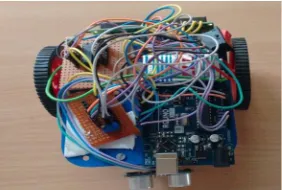
The Prototype is designed using the key components and the Arduino controller as it is shown in the fig. 2.
Fig. 2 Prototype of Vehicle Taillights Detection
IV. RESULT AND DISCUSSION
A. Results of Vehicle Tracking and Detection
[image:4.612.237.378.520.615.2]Technology (IJRASET)
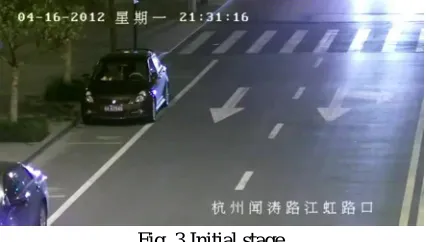
[image:5.612.201.414.130.251.2]microcontroller of an ultrasonic sensor [1]. AdaBoost classifier, our system is more reliable under various lighting conditions. When the vehicle is tracking and detecting using image segmentation. Taillight detects whether the vehicle is turn/break is applied at a particular time, that time the taillight is capture. It can be used both daytime and night time of the traffic signal. Initial stage of the image is shown in fig. 3.
Fig. 3 Initial stage
[image:5.612.201.414.283.432.2]Second stage of the image is shown in fig. 4.
Fig. 4 Second stage
Detected image is shown in fig. 5.
Fig. 5 Detected image
Vehicle tracks another vehicles passed on the road and it status detected via embedded camera, these in order were especially practical at the night time to keep away from the accident.
B. Results of Taillight Detected
Technology (IJRASET)
the speed of the particular vehicle. This is shown in fig. 6.Fig. 6 Taillights Distance
When the taillight is detected using the ultrasonic sensor, the particular vehicle will be stopped automatically. And the taillight will be displayed using LCD unit. This is shown in fig. 7.
Fig. 7 Taillight Detected
V. CONCLUSION
Coding accessible in MATLAB based on morphological algorithm able of vehicle detecting and tracking taillights, detecting alert signals (turns and brakes) in existing system. The resulting output provided daytime and night time . After the middling luminance for the first frame is considered and suitable hardware are selected, the algorithm detects prospective taillight pairs to be tracked. This step is routine, requiring no user input. The output of this paper is d taillight detected is displayed using the Arduino Uno controller. When the taillight detects means it will slow down. If the ultrasonic sensor is used for taillight detection it will stopped automatically. Distance also displaye It will be avoiding road accidents and saving peoples.
VI. ACKNOWLEDGEMENT
This research and material reported in this document are supported by the Anna university regional campus Coimbatore.
REFERENCES
[1] Akhan Almagambetov,Senem Velipasalar, Mauricio Casares, “Robust and computationally Lightweight Autonomous Tracking of Vehicle Taillights and Signal Detection by Embedded Smart Camera,” in Proc. IEEE Trans, July 2015.
[2] National Safety Council, Injury Facts, 2011 ed. NSC, Itasca, IL, USA, Feb. 2011.
[3] Z. Sun, G. Bebis, and R. Miller, “On-road vehicle detection: A review,” IEEE Trans. Pattern Anal. Mach. Intell., vol. 28, no. 5, pp. 694–711, May 2006. [4] S. J. Park, T. Y. Kim, S. M. Kang, and K. H. Koo, “A novel signal processing technique for vehicle detection radar,” in Proc. IEEE Int. Symp. MTT-S, vol. 1,
pp. 607–610, 2003.
[5] R. O’Malley, E. Jones, and M. Glavin, “Rear-lamp vehicle detection and tracking in low-exposure color video for night conditions,” IEEE Trans. Intell. Transp. Syst., vol. 11, no. 2, pp. 453–462, Jun. 2010.
[6] Q. Ming and K.-H. Jo, “Vehicle detection using tail light segmentation,” in Proc. Int. IFOST Forum, vol. 2, pp. 729–732,2011.
[7] R.Sukthankar, “RACCOON: A real-time autonomous car chaser operating optimally at night,” in Proc. IEEE IV Symp., pp. 37–42,1993. [8] Cabani, G. Toulminet, and A. Bensrhair, “Color-based detection of vehicle lights,” in Proc. IEEE IV Symp., pp. 278–283,2005.
[9] K. She, G. Bebis, H. Gu, and R. Miller, “Vehicle tracking using on-line fusion of color and shape features,” in Proc. IEEE Int. Conf. Intell. Transp. Syst., pp. 731–736,2004.
[image:6.612.211.400.280.398.2]Technology (IJRASET)
[11] X. Li and X. Guo, “Vision-based method for forward vehicle detection and tracking,” in Proc. Int. Conf. MAEE, pp. 128–131, Jul. 2013.
[12] D.-Y. Chen, Y.-J. Peng, L.-C. Chen, and J.-W. Hsieh, “Nighttime turn signal detection by scatter modeling and reflectance-based direction recognition,” IEEE Sensors J., vol. 14, no. 7, pp. 2317–2326, July 2014.
[13] M. Casares, A. Almagambetov, and S. Velipasalar, “A robust algorithm for the detection of vehicle turn signals and brake lights,” in Proc. IEEE Int. Conf. AVSS, pp. 386–391, Sep. 2012.
[14] A. Almagambetov, M. Casares, and S. Velipasalar, “Autonomous tracking of vehicle rear lights and detection of brakes and turn signals,” in Proc. IEEE Symp. CISDA, pp. 1–7, Jul. 2012.
[15] Y.-L. Chen, B.-F. Wu, H.-Y. Huang, and C.-J. Fan, “A real-time vision system for nighttime vehicle detection and traffic surveillance,” IEEE Trans. Ind. Electron., vol. 58, no. 5, pp. 2030–2044, May 2011.
[16] H.-Y. Cheng, P.-Y. Liu, and Y.-J. Lai, “Vehicle tracking in daytime and nighttime traffic surveillance videos,” in Proc. Int. Conf. Educ. Technol. Comput., vol. 5, pp. V5-122–V5-125, 2010.
[17] K. Robert, “Night-time traffic surveillance: A robust framework for multivehicle detection, classification and tracking,” in Proc. IEEE Int. Conf. AVSS,pp. 1–6, 2009.
[18] Y.-L. Chen and C.-Y. Chiang, “Embedded on-road nighttime vehicle detection and tracking system for driver assistance,” in Prof. IEEE Conf. SMC, pp. 1555– 1562,2010.
[19] R. Ogura and G. Ohashi, “Vehicles detection based on extremas in nighttime driving scene,” in Proc. IEEE Global Conf. GCCE, pp. 679–682,2012.