"I’HI’- ECONOMIC AND SOCIAL RESEARCH
INSTITUTF-MARITAL DESERTION
IN DUBLIN
An Exploratory Study
KATHLEEN O’HIGGINS
MARITAL DESERTION IN DUBLIN An Exploratory Study
Copks of this paper may b¢ obtained from Tht Economic and Social Research Institute. 4, (Limi~d Compa~ No. fR:~69). Rttisterd O~ce: Burllngton Road. Dublln 4
MARITAL DESERTION
IN DUBLIN
An Exploratory Study
KATHLEEN O’HIGGINS
~)THE ECONOMIC AND SOCIAL RESEARCH
INSTITUTE, DUBLIN, t974.
CONTENTS
Introduction
SECTION 1
Methodology and Field Techniques
"Fhe Interview
SECTION II
Before Marriage
SECTION III
During Marriage
SECTION IV After Desertion
SECTION V
Marriage Breakdown and the Law ill Ireland
Divorce
Future Research
SECTION VI
Conclusions
APPENDIX A--Tables 2-19
APPENDIX B--Questionnaire and Letter.
Page
I
i1
t8
5°
96
123
127
i28
131
141
Addendum
A cknowledgemenls
Introduction
Tire study which [bllows is an attempt to examine a social problem, that of marital desertion, never prcviously considered in Ireland in this particular way. It has as its objectives (i) the study of the marital breakdown situation which led some men to choose this solution, and (it) thc aetiology of breakdown. The difficuhies in fidly achicvlng these objectives were many and we would agree with the lawyer,
Eekelaar, that "... examination of sociological material does not provide evidence of causes of marital breakdown. Sociolo-gists and psychiatrists can do no more than provide informadon aleut the kinds of factors which arc commonly associated with separation and divorce.’’l This study is of an exploratory nature. It is not based oh a representadve sample of dcserted wives simply because no sampling frame was available. No register or record exists of all desertions in Ireland. A minimum number--namely, those on a mean’s tested statutory benefit from the Department of Social Welfare, can be given for thc country as a whole, and that is in the region of 2,9oo. From the 1971 Census of Population the number of married men in the country was 514,927 and the number of married women was 523,o75--a difference of 8,148. This figure sccms surprisingly small when it is considered that it has to take account of husbands temporarily absent from the country. As it is derived from the difference between two large totals (approximately half-a-million each) one must be statistically distrustful of the difference between two large magnitudes. Still SOlnC interest attaches to the differences in pr.evious Census years--~966--i years--~966--i,~54; 1961--14,6e5; 195~--15,286; 1946--26,386. It wyears--~966--ill he seen that the difference was much greater in previous years so that the present small total may be associated with the decline
in emlgratlom Not all deserting husbands leave tile country, of course, but from the evidence ofsoeial workers and the deserted wives themselves it seems that a great many do. In trying to find some idea of the magnitnde of the problem of desertion then, this Census figure 0f8,14.8 nltlSt be taken into consideration. In all l~rohal)ility tile number of deserted wives is somewhere between three and eight thousand.
The problem oflhe lack of a sampling frame will be discussed more fidly in the scclion on methodology and field techniques.
The lentatlvc nature or this report must always be borne in
mind byline reader aud no definitive solution to the problem is propom~ded. None of the conclusions can be taken ~s applying to the population of descried wives in gcncral in Dublin. They arc true Ibr those forty deserted wives interviewed. Nevertheless, this is the first step into the area of the study of marital break-down in Ireland. It is aimed at (i) encouraging forther study, (ii) pointing out the difficulties of research in this area, and (ill) emphaslslng the existence of a serious social problem.
Desertion is osually a male phenomenon. This might be explained by the stronger ties between mothers and their children Hmn between fathers anti their children; and indeed in Ireland the traditional molher/chdd attachment is well-known anti the subject of much discussion.~ In other countries, too, males are more likely to desert than females. Women also deserl, however, and in our initial discussions on the subject with colleagues and social workers it would appear that in Ireland desertion by women is on the incre~e. There are few statistics available on this, perhaps because deserted husbands have less need of applying to statutory bodies for help. George and Wildlng3 found in their study of motherless families in Britain that a desire for independence w~ the motivation of the majority oflhe women who left their husbands, and not because
~See A. J. Hum ~hrey~: JV’tw Dubllntrs London: Roulledge and Kegan Paul, 1966 and C:. Arenxberg and S. K tuba : lram ~ and Cornnmnity m Irtland, Harvard University Pre~s, s94o.
=V. George and P. Wildlng: h4otht~lts$ Families, London: Itoulledge and Kegan Paul. 197~.
of say, cruelty ~H" adultery, l:~ut deserlion remains a typically inale I)henonlenon ;nld it w;Is for this iIe~SOll t]l~tt ollr stndy was confined to dcser’led wiw;s. The reneging by the husband on his obligations to support his wife and children is the kernel ~f n typical case of desertion. This might even involve the husband remairfing ia fl~c home while relhsing to support his family, or leaving wid~out expl:umtion or support Ibr a few months at a lime. l-[owcvcr, in the case of the respondents in this study, all but c, ne o1" the htlsl~arlds had h:ft [br sofne considerablc time and scenle(I unlikely to return.
Descrll.n in h’cland difl’crs It"ore desertion in otller countries in one very imporlant aspect. I)ivorce is not permitted by the Irish Conslitulion, so desertion cannot be used as a ground for divnrce---a descried wife remains a deserted wife. Up Io early 1973 there was one exception to this as far as the SLate was concerned. Where a WOlnzln WaS deserted hy her husband and divorced by him in another country, she was not eligible Ibr the benefit received by a desertd wife, and was~ in the eyes of the law and of the Department of Social Wcll’~rc, no longer married. Although the then Minisler Ibr Labour and Social Welfare, Mr Brennan, in November 197t said that this matter was under discussion, the Department of Social Welfare, Deserted Wife’s Allowance Section, confirmed by telephone on
’3 October 197"2 tbat there had been no change in this ruling.4 There are, apparently, legal principles involved and tile Department, it is appreciated, must work within the law. As it would not be possible for the husband to obtain a dissolution of his marriage in finis country, what exactly then are tile legal principles involved? Our courts will rccognise a fi:weign divorce dccrcc if tile parties to the nmrriagc are domiciled in that Foreign country. In these nmtters, a court bases its jurisdiction on domicile. Domicile is a lawyer’s concept, and, basically means where a person has Ills permanellt home. If the parties are not domiciled, but naerely resident, in the foreign country, the divorce is not reeognised, l-lowcver, a married
woman takes her husband’s domicile just as she takes his name. (She h~ a domicile of dependency.) She cannot, at law, have a domicile of her own. If tile husband deserts to England, the law presumes that both parties are living there, whereas in fact she has been deserted and is still living in Dublin. On this legal basis, a deserted wife might have lost her allowance. Domicile "legally" distorts the real position. It is inaccurate for the law to say that the wiG~" is living with her husband in England, yet, legally this is the correct positio~. This whole legal exercise is hascd on fiction. The Attorney General ruled in April 1973, however, lhal divorce per se does not mean that a woman is disqualified fi’om rcceivlng a deserted wife’s allowance.
"l’o speak of desertion we must first have a marriage. In Ireland marriage was traditionally unclcrpinned by a whole series of social and economic considerations, for example, procrcation, labour, home provision, inheritance, neighbour-hood and wider kin relationships. Thomas, in his study of Catholic couples in the Chicago Archdiocese in z949, (and it seems relevant to Irish Catholics of that time also) observes----"Among Catholic couples at least, many factors leading to unhappiness and dissatisl2Lction have little relationship to the complete breakdown of marriage. This is to say many areas of conflict and tension are never thought of in terms of separation or divorce. Although... the margin of tolerance may shift, the average couple, apparently, accepts a considerable amount of frustration as a necessary concomitant of the marriage state.’’s Marriage was held to be instituted by God and so a sacred and holy institution. However, this traditional idea of marriage no longer applies to anything like the same extent----especially in urban society, owing to economic, industrial and philosophic change. Even in the ecclesiastical sense, the notion of psycholo-gical consummation of marriage is being debated and some churchmen hold its presence as being as important and necessary in a marriage as physical consummation. The emphasis is
*John I, Thomas: "Catholic Family Disorgani~tlon", in E. W. Burge~ and I)..l. Ik~guc ((Is.). Contrlbutlcms to Urban Sociolo~.y, Chicago : University of Chicago Press. 196.t, p. 54o.
placed ~m marriage :is a personM relationship bctwccn people--romantic love and persotlal fidfilment being the important components. Such a relationship without social underpinning may be unstable and if it does not work out there are no supports for it, as the Iradilional setting provided. This results in more. frequent breakdown, since divorce is not allowed in h’eland the only possible legal step is separation if the situation becomes intolerable. This does not conlL:r the freedom to remarry if desired. Desertion is one means of separation. The marriage is ended socially, if not legally, by desertion. It does not conl~:r the right of remarriage eitl?er; but because the deserter usually goes to an area where he is unknown, remarriage is easier though legally I)igamons. Desire to remarry may not necessarily be a factor in breakdowns, but among those who descrt in Ireland, it may be more likely to be so since divorce is not permitted, and a numbcr of our subjects were deserted tbr this purpose.
Kephart and Monahan examined desertion and divorce as related to religious background in Philadelphia. From statistics compiled frolrt records of thc I~hiladclphia Municipal Court, they found that "in white desertion and nero-support cases which came to court, the Catholic group, with reference to their propor6on, is over-represented by nearly forty per cent.’’6 Ireland (Republic of) having a mainly Catholic population, is probably more desertion prone than other eonnlrles if Kephart and Monahan’s findings can he related to all Catholic popula-tions. On the other hand, if a legal (a rnensa et toro) or mutual separation (agreement by both parties withont a court appear-ance) is obtained, the conditions of support and visils to children will bc legally laid down. The~e may not necessarily be adhcrcd to permanently hut at least an effort is made to make the best compromise at the time. Equally, desertion may be a flight from an intolerable situation, but again becausc a desertcr will usually go to an area where he is unknown it is more likely that he wishes to remarry.
*William M. Kephart and Thomas P. Mouahau: "Divorce and Desertion by Religious and Mixed Religious Groups", American ffuurnal of Seclology, March,
Marriage bclng a dyuamlc rclationship is subject to strcsscs like any h~ml;:m institution; dcscrtion is a solution takcn by some to solvc the problems they hnvc encountered by reason of cmcring this relationship--problems they fccl they cannot handlc and from which they must cscapc. They choose to cnd thcir rclntlonship, sometimes tcmporarily, somctimcs without consciously doing so and somcdmcs dclibcratcly, unablc to find any od~cr way, or sccing this way as the easiest. Dominion, a psychi~trisl and marriagc guidance counscllor, rcferring to the dmc prior Io a separation, whcthcr for divorce or dcscrtion, writcs: "lu fl~e prescnce of so mnch fruslration and suffering tile iuevitabtc depression that aceompanics them may reach such proportions that dcspcrale action follows.’’7
Desertions are not confined to the income groups dependent on stat~ltory benefits. Studies on II~e occupational distribution of deserlion have shown (notably Kephart’s study of the occnpalion;d levels of deserters in Philadelphia)g that rates are highest among unskilled and semi-skilled occupations. From our own investlgalions, supported by interviews of middle-class women and by information from intermediaries about requests for cooperation made o possible respondents, it was shown that in Dublin a nnmber of desertions occur in middle and upper income groups. Becnnse of the dimdulty of contacting the women, who are not registered with any agency and, if traceable at all, are only so through friends or colleagues, there is no way of measuring the over-all desertion rate. Estimates will always remain very crude.
The first evidence of the intention of the Government in Ireland to make special provision for the deserted wife is to be found in the Third Programme for Economic and Social Exl~nnsion, 1969-72, laid by the Government before each house
inlroduclhm in October ~97o of a special pcnsiou Ibr tilt: dcscrtcd wifc in ccrl;lin circunlslanccs~ payable by Ihc Dcpart-mere of Social Welfare. I)~zscrtcd wlvcs had previously been dcah widl by du: llomc .,\ssistancc Sccdon of tile old Hcahh Authority system, "... wives, including Ihosc wilh r;mdlics, who arc unsupl}ortcd bee:lure Iht:h" husl~;lllds h;w~: I~:fl Ihclll o1" are in prison, [orm ;i stll)Sl;inli;ll group whose only .gOlll’i:tt Of omcinl assistmwc is Home Assistance" wrotc 6 Ciml~’ich: prior Io the iml)lcmcntalion of Ibis new schcnlc.I°
Of Ihosc in rcccil}l of Ihc I)cscrtcd Wife’s AIIowat~cc no scparalc slalislics fi3r Dublin arc avnilnblc since tl*¢: 1)cparlmcnt of Soci;d Wcllhrc keeps records only Ibr Ihc COtllltl’y ;|s it whole. Sincc ils inccplion Illc I)¢:l)arhncnl is rccciving apl)licalh)ns daily as more women discovcr IIi;1! (hcy arc cmitlcd to Ihis allowance. Thcrc is a mcal~s Icsl which rcslricIs thc allownncc to Ihosc with an incomc nol cxcccding ~’t9’t p.a. This is a graduated allowance Iml lilt first .L’4. ol’nll earnings is igtlored. Aficr that the alllO|lll[ rcci:ivcd varies from £6.15 per wcck for il V¢Olllall with £4 per wcck or h:ss Io 651) pcr wcck fi)r a "tVOlllall carning £9.5° per wcck.* Allowances for children1 :~rc, of course, additional to tills pcnsiou. Iu the cases of those wives cntith:d io
dfis statutory bcnc[it, Ihc OCl~artmcnt of Social Wclf;u’c look the cxtrcmcly hq:lphd stop Ot’l)roviding n i~lmsioH book, cashid)lc at a post olticc, instcad oflhc Homc Aisistancc olflcc. This w;~s a great inlprovcmcnt al~d was apprcclaled by most of II~c th:scrtcd wives to whom wc spoke. AllclldilllCt: itl ;ill OI[ICC IO collect Home Assis/ancc was a strain on Ihcsc womcll since their situation was made public by Ihcir having Io lake ;i place in a qucuc and Jlavc their business discussed openly wilh tile Homc Assistance Olllccr. Thc lattcr havc no private oMccs but work in a room which is waiting-room cure olllcc. Ofhm the attitude of these assistancc officers was nol vcry hclpftd but somc of the rcspondcnts praiscd Ihcir parlictdar assislal~cc officer for his courtesy and undcrstat~ding, ahhough Ihc I,s. (~ Cinn~ide: A I~wfor the poor. I)ublln: hlstilute of I’t,lflic A,h,dnlsl,’a6o,i. J97a, p.
embarassing circumstances in which the payment was made remained. The present arrangement is satisfactory because of its almost complete privacy. A pension book is provided and the pension can be collected from a post office on each Thurs-day. A few respondents mentioned that since the pension book had a particular eolour and collection day was Thursday, other people who might be in the post office could guess the situation. These women, however, were unable to suggest an alternative or better means of payment.
The Department of Social Welfare also set out the conditions which must be satisfied before a woman can be regarded as deserted wife. They are as follows:
(a) her husband must have of his own volition left her and must not have lived with her for a continuous period of not less than six months prior to the date of her claim for an allowance.
(b) she must have made and must continue to make reasonable efforts, within the means available to her, to trace her husband and to effect a reconciliation with him or to compel him, by legal process or otherwise to contribute to the support of her children.
(c) her hnsband must not have resumed living with her and must have wilfully refused or neglected to contribute to the support of her and her children, and
(d) she must be resident in the State at the date of the claim and must also have resided in the State for any period of two years.
The Department qualificd its beneficiaries further by the following criteria, which must be met by applicants, defining "deserted wives" in |his context. An applicant must:
(a) for the purpose of the scheme bc regarded as having been deserted by her hnsband.
(b) be under 7° yem’s ,fl" agc.
(c) if she is less than 4° years of age, have at h:asl one qualified child residing with her, and
(d) satisfy a mcans test.
We, ourselves, ill seeking a definition for tile study, I’~h this definilion unsatisfactory because it made no provision for a woman who had been deserted and then divorced by her husband in another Slale. Again, because of the means test a number of women who were olherwise qualified were excluded. Nor were we alone in our dissatisfaction. Leslie comments as follows: "There is not even any clear definition of what desertion is. The [United States] Bureau of the Census uses the term, i.e. marital separalions, and defines these as including couples with legal separalions, those living apart with intentions of ohtalning a divorce and other persons permanently or temporarily eslranged fi’om fhcir spouse because of marital discord.’’ll This conglomeration is too comprehensive for the purpose of our present study; that of tIle Department of Social Welfare is too restricted. We, there-fore, defined a deserted wlfc, quite simply, as a woman not living with her husband and not adequately supported by him --thus including cases where tile woman was not receiving tile Deserted Wife’s Allowance. l)ivorced women were also included and separated women who were not supported by their husbands. We thought it desirable also to include con-structive desertion. Eekclaar describes this: "it is not only the spouse who leaves home who may be in desertion. It" hc had been forced to leave as a rcsuh of a misconduct of the other, then the one who remains behind will be the deserter. The latter is said to be in ’consmmtive’ desertion.’’l-" This type of desertion is not reeognised in Ireland by the Deparlment of
riG. I~1i¢: The Family in Social Context. New York, OxfoHI University Press,
1967, pp. 6o~13-’~Op. tit., p. H5.
Social Welfare and a woman who is forced to leave her husband clue to his cruelty or non-maintenance cannot claim a Deserted Wife’s allowance. This is, on the financial support side, a more difficult situation for the wlfc than the husband. The conrts do, however, rccognlse "constructive desertion" and i£ a wile applies for a maintenance order the may be granted one on this ground. As constructive desertion it a ground for divorce in Britain and elsewhere, one can only speculate on the number of deserting husbands from Ireland who may have used this as justification in seeking their own divorce. Equally, of course, one can speculate on the number of cases where the husband may truly have been driven to desert.
SECTION I
Methodology and Field Techniques
THE nature of the process ofdeserdon makes its opcrationdifficult to shady. ])eserters do not register anywhcre and
hotb the tlcscrtcr and deserted arc very likely to wish to rcmain anonymous. Consequently, when first considering a study of deserted wives, Ihc problem of contact was the one that was immediately obvious. Wc consulted the Census as being a possible source of respondents but only A4arried, Widowed or
Single categories of women are mcntioned. There is no
break-down of the Married classification so that source was closed. Flow does one find a small group, not specifically catered for in any official rcgistcr?
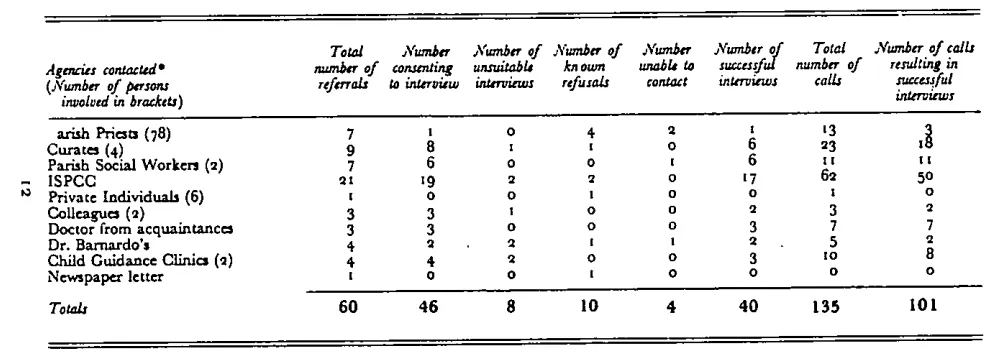
At a very early stage it became evident tlmt the ideal of the social researcher, namely, a random sample, was impossible to achieve. Table I givcs dctails of One agcncics contacted and the results of the contacts. This Table demonstrates the difficulties encountered by thc author in her efforts to find respondents. The number of parish priests contacted (78) and the number of referrals resulting from the contacts (7) is a case in point. The latc Archbishop of Dublin, Dr McQ.uaid, was asked Ibr his cooperation here but replied that he could not see the purpose of sucb a stutly. Ahhough there were somc vcry courteous and
helpful replies, even where no referrals were possible, tim nnajority of the parish priests did not reply at all. A number of rude refusals, alleging that the investigator was trying to break the trust existing between priest and parislfioner, were received. This was in reply to our-letter which requested an initial discussion on the area of study and possible means of
con-tacting respondents.*
Table t : DIta~ of calls mad4 to reJpondents.
Totol
Number A’~abtr of Number of Nmnbcr Numbtr of Total Hum&r of calls Agmcies con~tod* ~ of con.~ing unmitabl* kn own unabl* to
suu,~sful
number of re~in8 in (Number of persons referrals to interviLw inurvitws refusalJ ontazt inta-aiew~ call~ succeJ4[al
involved in brackcto )
~itws
Priests (78) 7 t o ~. 2 z t3
Curates (4) 9 8 x ~ o 6 23 z
Parish Social Worker,l (2) 7 6 o o t 6 z t t t
- ISPCC 2t 19 2 2 o t7 62 5o
Private [ndividuah (6) t o o t o o z o
CoUcagucs (2) 3 3 I o o 2 3 2
Doctor from acquaintances 3 3 o o o 3 7 7
Dr. Barnazdo’s 4 ~ ~ t ~ ~ 5 2
CAtld Guidance CAinlcs (~) 4 4 "z o o 3 zo 8
Newspap~" letter t o o t o o o o
To~lz 60 46 8 10 4 40 135 101
Some of the other agcncles mcntloned at the foot of the table, although by no means opposed to the investigation, after discussion felt that the very particular person-to-person relation-ship established between the client and, for instance, tile Samaritan might be destroyed if the client suspected that her personal affairs might form part of a general survey.
All possible avenues of contact having been exhausted a total of 60 names had been received. Tile majority interviewed fell into tile group dependent on statutory benefits--receiving either a deserted wife’s allowance or home assistance. Wise criteria applied for interviewing were contact and consent (once tile respondents fell within tile definition limits).
wondered how hc knew of their situation. As a result, not of six names obtained from this source, only one produced a successful interview. Among tills particular group reactions like, "I am all right, l havc my parents. Men are all alike," were not un-common; and one lady became upset and abusive, exclaiming Ihat no onc had hodlered to help her twenty-three years ago when she nccdcd it and she was not going to co-operate now. Others reslslcd all attempts to make an appointment for an intcrvlcw rcplying to all suggestions that, if the interviewer was in Ihe area, she was "to drop in". No amount of explana-tion could overcome this reluctance.
The occd for absolute confidcnliality, again at the inter-viewing stage, caused some problems. It was this same pre-occupation with the prcservation of confidentiality that led to the dcclslon to undcrtake all the field work myself rather than employ others. The main prohlem created in the field was that I could not idenlify myself or state my business except to the rcspondcnt herself. This seemecl to result in many more call-backs than would normally be necessary in a field survey, an avcragc of 3’38 per interview, as compared with, for instance, ~.63 in Social Status and Inter-generational Social Mobility in
Dublin.J ~
Coming to the interviews themselves and to the data collected, as Dominion remarks "Research on marriage presents a major challenge because of the multiplicity of sociological and psychological faclors involved,’’14 and in this study of marital breakdown wlfich led to desertion, a main difficulty was the necessity of interviewing only one of the partners. "The shifting sands of subjectivity prevent any firm reliance being placed in individual accounts of marriage conflicts";~5 and in most of the cases encountered there was no atlcmpt on the wife’s part to seek an explanation for the breakdown in any terms other than that the husband was to
ZaB. Hutchinson: Social Status and Inter-generational Social MobillO, in Dublin. Dublin: The. F, conomi¢ and Social Research lmti~ut¢, 1969, Paper No. 48.
~*Op. tit.. p. 148.
ILl). Mat~len, Mothtr: Alone, I~andon: Allr.n I~ne. The Penguin Pre~, 1969, p. n5,
blame. Nor did IIi1: m:Lj-rhy of the wives inlerviewcd ;dtelllpt to
assesswhctherthcy themselves (though the "innocent" pro’lies)
lind I:ailed to meet evcn the minimum expcetalions of Ihe husbnnd. The few exccplions who had thought about the mattcr calnc Io Ihc rcalisation Ihat they wcrc in some way to blame as well as Ihclr hushands, thotugh, even of Ihesc, not all rccogniscd the posslhillty that thcy might have provoked the desertion. I’[ow much Ihe general lack of admission of guilt ’,,,’as a face-saving devlcc for thc investigator’s benefit, on" a reaction Io an ego-damaging experience, is impossible to say: "Individ-uals with problems use various stralagcms to protect their
t;gos.TM
Like Marsdcn we Ibtmd the relationship bclwcet’l :.t cottple’s bchaviotur in marriage breakdown was "... ttnt2sually dilficuh Io explore. Principally, Iherc is the problem of getting reliable information about the actual bchaviour. Several studlcs have clearly dcmonstratcd that couples do not agree about the
ilaltlrc al~d causes o1" thch" disagrcenlctlls.’’17 How inuch Inorc
incomplete is a n(xcssarily one-sided view cvcn though tempered sometimes hy time :lnntl thought. In colllempl:ttlng this view wc mHSt remember what Slater and Woodsidc concluded after interviewing both husband and wife, that "no judgements, whatever the apparent facls, can be made on marital conflicts until 190111 sides h;tvc been heard.’’~8 While Hfis may be true, cspeciMly in ihc light of our own experience of the obvious subjectivity of respondents’ interpretations of events of the past, the very nalurc of a sltl¢ly of desertion, a solution chosen by some to marital conflict, implies that one of Ihe partners will not be available for questioning.
However, in the majority of eases, the respondents seemed to welcome the opportunily of telling "th,:ir story" and attitudes towards the husband had become hardened. In a few cases the reticence of tile respondents presented some dillicuhy. Heimleu"
noH. T. Chrlstensen (cd.): Handbook of~4arHagt and the I’~lmi~. Chic;*go: Rand McNally & Comp;my, 196,~, pp. 295/6.
"Op. cir.. p. 68.
J°E. Slater & M. Woodside: Patttrns of Marriagt, London: Casscll, u951.
rcmarks "There arc some cxpcricnccs in life that cannot bc expressed fully in words. The deeper the human emotion, the
more difficult it is to find expression for it.’’’° One particular contact, referred to earlier, dissolved into tears each time we spoke to her even about being interviewed, so it was decided not to pursue this any fi,rthcr. Others agreed to co-operate but did not elucidate on the information they gave.
The problem ofsubjectivity cannot be solved using interview techniques alone. In preparing the questionnaire, questions asked were inevitably affected by this. Informalion which could he obtained without too many attitude or opinion questions was preferred. Because of the small number of respondents and the use of only one interviewer a less formal type of intervlewing---opcn-cnded questions and discussions of points fi}r clarity could be nscd.
There was a great variety in the length of time taken for the interviews. The shortest interview was forty-five minutes and Ihe longest was five hours. Rc6ecnce, the presence or children or a parent, or other unavoidable inhibiting factors were responsihle for the shorter inter,,iews while a great desire to talk to someone seemed to account for the very long ones. With the exception of three, all the interviews took place in the home "¢)f the respondent. One interviewtook place in a meeting hall, and the other two in the researcher’s office.
"In the interview and questionnaire approach, heavy reliance is placed on the subject’s verbal report for information about the stimuli or experiences to which he is exposed and for knowledge of his behaviour; usually the investigator has not observed the events disenssed.’’~° This may be regarded as another drawback since some of die respondents had never thought about the kind of things on the questionnaire--the whys and wherefores. A problem arose occ~ionally of con-veying the meaning of questions. Since the majority of the
"E. Hcimler: ~ltntal IIl~.ts andSocial Work. London: Pelican Book,, 1967, p. r7.
inC. Sellitz, et. aL: Researfh Methods in Social Rtlal~nJ, London: Methuen & Co. Ltd., 1965, p. ~36.
respondents came fi’on~ Ihc lower socio-economic group, with tile minimum educali.nal level achieved, it is underslandablc that this situation could nrlse and here Ihe interviewer was careful to standar(lise cxplnnalions. Few o1" the wom(:n had opinions or suggestions For improving their situalion--probal)ly they had new:r becn asked wlmt they would like to sec hal~pcn. Aldlough Ihe general run of pcople were willing Io talk, Ihere was some retieicnce, for instance, on the questions ;ll)oul sex but none of tile q,,estions seemed to give off’once or cause any itlortJinale amount or emb:H’rassment. If the hllerviewer saw a rather fidgety respondent, she explained the reason for asking the question which IlSll;llly cased the situation, ahhough in most instances did not bring ally further inlbrmation. For the most I)arl, the respondcnls seemed Io enjoy answeritlg Ihe questions.
It is not known how m:uly wometl were aeltmlly approached on our behalf by the various agcncies and refused; but those who agreed wcrc cerlah]ly co-operative and (although inarticulate in some cases and very articulate ii-i others) wen: very positive in their reactions to the study. We canl~ol say why some women agreed and others did llot. It cotdd have been how the ildlial appro,gch was made and by whom. Where social workers fi’om Ihe ISPCIC, Dr Barnardo’s, social service ccntres, thc doctor, and o.e o[’lhe priesls had made the initial approach it was :t grcat dcal easier to carry out tl~: interviews. Preparation I)y someone the women (u’ttsled seemed to have positively inlltJermcd Ihcir rcaclions.
A copy of thc printed qucslionnaire is included itn Al>pendix B. Questions were sclceted on Ihc basis of Ihctors which arc usually associated with prediction oF brcakdown, i.e. age of marriage, accommodatiotl, drink, sex, nun’dJer of children, employment patterns.
Tile questionnaire was dividcd into three parts:
(l) Before Marriage: dealing with origin, age, social status,
place in family, cducation, interests, influence of parents, courtship pattern, savings and some questions which
made an effort ~o assess attitudes towards marriage of hoth parties.
During ll’farriage: was concerned with age at marrlagc,
religion, accommodation, rent, nnmber of children, whether money, sex, drink or gambling were considered problems, wife’s opinion of what went wrong, husband’s employment patlern, ability to discuss prohlems, violence.
(3)
After Desertion: included questions of the number ofyears marrlcd before desertion, present source of income, whereabouts of children, court or clinic attendance, support (financial or otherwise) from kin, present accommodation, opportunities [’or recreation, clrcum-stances of desertion, general views on what they would like to see done.
|rcHzr attempts at contact were made in the case o[.those who " had previously agreed to take part. Those contacted by the interviewer withont an intermediary, and who refused, were quite definite in their refilsal and it was felt that no useful purpose could hc served by fi~rther attempts to make them change their minds.
Because of the difficulty of finding respondents, pilot inter-views were not carried ont. The questionnaire therefore ",’,’as not modified in any way and the format decided upon whhout testing was used throughout the survey.
One woman whose husband had returned to her was vt~ry anxious to be interviewed for some reason, and she was inter-viewed first. This was usefnl, for though the information could
not be included, it was an indication of how questions sounded in the actual interview setting.
The Interview
The particular type of interview used was a questionnaire with a number of pro-coded questions and a number of
ended ones where tim !’CSl)ondent could talk if she wishud, and Was encouraged to do so. As I~ll" as possible wc tried to nlakc |lie
hlterview a conversath)tb feeling this would bc more flexlblc anti enable the respondclfl to nlore easily descrilm complex situations. This Ilexibilily in the interview led on Olle or Its,() occnsions Io cxhausti~g imerviews of as much as five hours duration, as some of the ’,,.,omelm became so interested in Iclllng their story to SOlm:one cmtsidc their circle, that it was very difficult to guide the interview, h was fch, however, that a strltcturcd imcrview would not bc useful in this sort of study,
so ils IIItlch fl’(:cdoln of exl)rcssioJl as possibh: was allowed, with
rcl’crencc to tit<: qucstion]nairc information Ilowing in. Scvcral have yielded a grcal deal more
Olfly to kccp the essential interviews would probal)ly information had pressure of time not made Ihcsc impossible. Direct observation its a tech-ifique naturally was not possible except perhaps in that part of the enquiry COltccrncd with the deserted wife’s std~sequetlt pattern of daily life, but this type of investigation was found lime-consuming anti diflh:ult to arrange. Not" was it likely to have produced a great dcal of exlra inlbrmatlon relevant to the proposed limits of the study.
So the interviewing lechniqttes was mainly flexible and tmstructurcd, becoming directive in Ibrm when the need arose, as, Jbr example, when demographic inlbrmatiou was sought. The respondent was cneouragcd in the interview to talk about the inarital relationship. As memioned al)ovc, there was an m~eveness of response here as some women wl:l’e more articulate or even more williltg to talk than others. It was necessary, in sonic c~lses, t() exercise eonlrol to keep the
hirer-view on the topic, ahhough the establishment of rapport, particularly at the beginning of tile interview, involved a general discussion about the weather, or the children, or the informant’s accommodatioi~. Each interview commcnccd with I;actual information, in order to give Ihe inlbrmant a chance to start off without strain IJelbre tackling the more personal and open-ended questions which came later, ahhough experience showed that this was necessary only for the reliccnt, who were
in the minority. The others had to be directed to the factual questions while they gave quite a lot of the information included in the open-ended questions before being asked.
It is difficult to check conslstcncy in one interview. An initial call was made to introduce the interviewer and the study; and an appointment w~ made with the respondent to call later at a convenient time. Because of the personal nature of the topic and the variety of reactions to it, it became clear that we were correct in assuming that more control could be exercised in directing tile discussion, more evenness and cohesiveness attained, when only one interviewer was involvcd. Standardisa-tion of qucsStandardisa-tioning also was more easily achieved and many respondents felt reassured. Some respondents asked directly if many people were involved in the study; others asked about confidentiality and they were reassured on this. If the first call made to establish rapport was succcssfifl, the study was explained to the rcsponden’t as an effort to enquire into their circumstances, the causes of the marital breakdown, and to ask for their suggestions as to how they could be helped. They were informcd that the interview would take up to two hours. In the actual interview the respondents were often more worried about delaying the interviewer than in spending their own time, which from our point of view.was very satisfactory. Those who had already been contacted by agencies were much more amenable, as was to be expected. The study had been well explained to the respondents, and they had some idea of its content.
SECTION II
Before Marriage .
TJI~: nunabcr o1" women interviewed in tiffs study was [brty.On each qnestiolmaire respondents were asked where possible fi~l- information oil their busl)ands. Thus we bave some information on their husbands as well as themselves.
The queslionnaire, being divkled into the three parts already described, commenced with data on tile respondent and her husband before their marriage. The lirst eleven questions were of a demographic nature, based on the hypotheses that origins, occupations and education might well be thc factors important in tbe study of marital breakdown, and that in tile cases of occupations and edncation, the lowest in each category might be associated with a higbcr incidence of separation and divorce.2~
Demographic Data
Origins
In examining tile origins of our subjects and their husbands, we found that of the forty couples, in thirty-five cases both parties were urban born and twenty-eight of them (or slightly more than two-thirds) were both Dublin born. In about one case in twenty both were rural born; and among the remainder (about one case in twelw=) the wife was urban, the husband rural. The subjects were all living ira the Dublin city area; some had cbangcd their accommodation after the desertion took place but, even allowing for this, there was a wide spread of
"See: M. Ko,narovsky: Blue Collar Alartqage. New York: I~.andom House,
196~, PP- 344151617 and K. G. Hilhnan: Marital Instability and its Relation to
Education, Income and Occupation : An Anal)’sis baJcd on Selected Stndies ~ 31arrlage and.
areas across tile city with no predominance of subjects from what might usually be regarded as traditional Dublin areas, for example, Sommerhill or the Liberties. Of the thirty-eight women born in an urban area nearly all were born in Dublin; the exceplions being one woman who was born in another country lint came to Dublin at fourteen years old, and another who was born in a large Irish town, but came to Dublin after marriage. There were thirty-five urban born husbands, twenty-nine of whom were Dnbliners (a somewhat smaller proportion); three were born in large Irish towns, and three came from other countries. Of the five rural-born men, two came from other countries and three were natives of Ireland. The vast majority of our subjects and their husbands were therefore of urban origin. Studies of marital breakdown and divorce (notably in the US and France),2= suggest that persons from rural backgrounds are slower to divorce than those from urban areas. It may lye that the mainly urban origin of our respondents and their husbands was a contributing factor to
the breakdown.
At least one-third of the Dublin City and County Borough adtdt population is not Dublin born,23 hut more than two-thirds of the couples in our study were both born in Dublin and all but two of tl~e women were Dublin born. It is possible to speculate on thc reasons for this predominance of Dubliners. It may be accounted for by the fact that, as most of the sample came from the lowcr socio-economic level, they would bc more likely to be Dublin born, since Hutchinson’s study found that those born outside Dublin and coming in, appear to be better off than their Dublin born colleagues. It may lye, moreover, that rural-born women are less likely to contact welfare agencies, either through ignorance of their existence, or from pride, although wc have no evidence supporting this speculation.
ttSee: E. Gaulcrry: "Los Dissolutions d’Unions en France, gtudie~ a partie
¯ ii|~t
des minute~ de jugeme . p@ulation, juin 1971, pp. ]5314" H. Carter & A. Iqaterls: "Trends in Divorce and Family Disruption". J. Ross Eshleman (ed.),
Perspecti~* in J~farrlage and the Family, Boston t969, pp. 7~4/5 and G. Leslie, op. cir.,
p. 59~.
There were two ill|l:l’-r;ici;l[ marriages ill tile gl’olll~. ]ll o11(2
or these d~c 1~ar,’i:~.~,: (judgi.g From d~c s,dJji:o’s comme,~,s)
seclns |o Jlavc bCell ClllCri:d illlO with a rcbcllious altiltldc, alld a desire to bc dill’trent, :it least on IIic part of the wilk:. The huslmlitl ill tilts case was an African studying i,, l)ul~lir,. A marriage such as Ihis carrh:s a greater risk of breakdown, partly because of Ihc hostility of Irish society to tilter-racial In:u’ri:lgcs in general, which imposes on the couple m~u’c adjuslments than in marriages widlout this difl’crcncc. Racial cliJFi:ri:nccs in a CnUl’llc may ntl<:aii very clissimilar llackgroiilids, involving religious and cultural differences. This is iiOl ncccsSal’ily trite OP all cuhul-~:s alid societies biit would apply in Ireland. liccauso of Ihose dill’erotic:s, a grcaler cll~Jrl is required I¥onl each member of Ihe pair if Ihcy are to build a good inarriago. On this conccl)t o1" "holIIOgalily" Ihc pioneer rcsoarcJi o1" JJiirl~ess aild Oollrc]l hi the US~’4 aiid laler Ihe work of Goodc anti Ziniliicrnlalin, also in lhe US,25 hal established Ihat ililcr-racial liiarrlagcs arl: Icss Iikcl7 to StlCCCt:d whell social di~ercnccs nloall dissimilar I)ackground since Ihc Inert alike Ihe spcnises arc in background, cducalion, and rcligion, ihc less Ihl: probal)ilh7 Ihai Ihc nlarrlagc will elid ill divorce.
The oilier inter-raclal i+lial’l’iage lit Ollr gl’Olll) look place ill England where, ahhough the Ilorriis :ire sonlewliat similar such a marriage is a lliuch nlOl’C conlll’iOll occtlrrCllCe. There did not seem to Jlave heen any mollie of rebellion in Ihis marriage.
Social Status
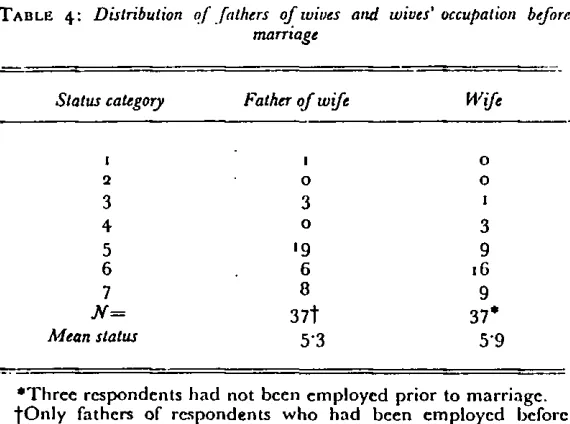
Ocographical origin was quali[ied by occul)alioli and education levels. Information was obtained fi’Olll the subject about her husband’s occupation prior to and dlli’il]g marriage; her own occupation before marriage; her father’s and her rather-in-law’s occupations. Using the Hall-Jones scale, we
liE. %V. Ilurg~ and L. Collrell: Predlctlng Suzcess or Falhtre in 31artlage. New York: Prenllce Hall lnlernallonal, 1939.
~W. J. C, oc~ie: After Di~rce. New York: "l’ll~ Free Pr~. 1956 and C. Zh,~mer-mann: The PYL~Rt CHs;,. Chicago: Henry Regnery, 1956.
translated this informallon into terms ol" social status, as follows:
Status Cate.t~ory
I. ihighest)
2.
3.
4"
5.
6.
7-Occupation Groups
Professionally qualified and high administra-tive.
Manngerial and executive.
[tlspectional, snpervisory and other high-grade non-manual.
[uspcctional, supervisory and r~thcr lower-grach: non-manual.
.Skilled manual and rouline grades and
non-nl++l+n i i a I.
Semi-skilled nlanua[. Unskilled m:mual.
lendcncy, were it true’, might well bc o1" particulm" illlel’(’sl tO an explanatory Ihe~)l’), ~d" deserllon; and our belief Ihat desertion may be associated with more general soci;d I]lilure is reinforced by other dala clnerging frfln] ollr stttd),, h might lie noted here that in the During A.larriage section, it w~s I~uild th:H the Imsbavtd’s status by occupation had dropped fi’mH a mean~ off"4 to 5-6, :l small dill;<:r,Silcc, lint COllSistent wilh lilt KI’IH:Ial tendency toward soelal f:filtlrc wc have noted.
Hlllchinson fOllnfl lit his Stlldy Ihat "lhl+’r(: :il~pi:ars :i t~.lidenc), for Oil: likelihood of tlpward niobilil), Io 17e illVl’rsely rl:lalcd Io pal(:rmil slatiis, Ihe lower a inilll’S inh~wilcd slallis Ih(: inorc likely lie is Io hart: iiifiv(.’(l Io a Ilight:r one">7il ~lll(I also Ihlil sl.’lttlS has a tcndcnlc), It) rise wilh incrcasing age. The r(:vci’se seelllS Io be Irlle of Ihq: husl):lnds of ollr rcspolldcliis. The), appear to bc in a grollp with downward mol)iliiy Oll all COlllllS. Oesertloii has I)een re~ardcd ;is "lhe poor mall’S divorce" although even the statislleai-studics done ill Ihe O,S Ctllliailled no data on the occuF, alion or ecollomic level of the httsban~d. It was nlot until 1952 thai Kepharl, makingal~occllpalioiial almlysis of all the deserllon :ilid llou-support cases for the year 195o from the Philadelphia Courl Records, found little i’vidence to support a vlew of desertion as "the pOOl" illan’s dlvol"l:(;".~7 Slightly more than 4o per cclit of the white deserlions were derived From the upper half of lilt occupational ladder, and the supposed predominance of deserlions at Ilie lower end ~1" the occupationlal scale failed to cmcr~c. Had wl: had siiilil:lr records available Io us of all desertions it is possible ihat we could have arrived ;it the same rcsilh. I:,ven allowilLif lilt Ihis and for the downward Ircilds iHdlcated, the llicalm we arrived at were still in Ihe stallls group 5. AIIhou~h Kepharl does imt use the HalI-Jollcs scale alld lit: has not givetl Ihc source of his occupation classificatloll, it is probably saft~ to assume Ilmt his "skilled" and "scmi-skillcd" lot ilistancc, fall into more or less the same categories as in Ihc H,’lll-Jones scale. The Iindillgs fi)l" otlr sample are thai Ihe res]}olldenls wcrtt not pariieuh~rly
llll. A. Ihllchillstln. rip. cir. i~W. Kephart, op. cir.
among file "poor", even Hmugh the majority of our subjects were introduced by welfare agencies. In examining the status origin of our couples, we found that the percentage of the same status origin was no more than 30.05 per cent, which is not signifieanlly different statlslically from the figure of 37.5 per cent in HulchinsmCs Dublin sample,m
Education
I. (In.’,’s~)
2.
3.
"1"
5-6. (highesl)
Our scale here was a six point system: No standard
Primary Certificate
Atlended Vocational School Intermediate Certificate
Leaving Certificate Atlendcd University.
We fomld the means to he 2’2 for the wife and 2.3 for the ImslJand, a mean level slightly above primary certificate education. Comparing the educational levels of the couples, we discovered that about half had similar education to each other. Hutchinson had similar findings in his sample of 1,867 mar-riages in Dublin.~9 On the breakdown here, however, Hutchinson found that (i) only sllghtly’more than one-third of men who failed to complete the primary course married women of similar attainments and (ii) three-quarters who received no education beyond the primary level married women with a similar education level. In (i) three-quarters and in (ii) seven out of eight eases in our sample the same result occurred. And if we take the number of couples with the same standard or just one point difference, roughly three-quarters show the same or similar education standard. This would seem to indicate that the husbands of our subjects were less likely to marry up educationally. Diferences in educational attainment as well as low educatlmml levels have been correlated with marital
"-roll. Ilutchinson: Saclal Stat~ts in D,~blln : 34arringt. 3~obility and First Ernplo3trnent, 1973 I)uhtin: The F,¢onomlc and S;~t:ial Research Inslltutc, Paper No. 157, p. 19.
-’tB. Hutchinson, op. c#.
breakdown, althou.Kh I].mPass arid Sweet3° assert that only extreme differences hI ed.cation are associated with fiighcr instability of tnarriage. MOst of our subjects and their Imsbamls did have a low educalionni ]eve], lint there were IIo aPl~reciahle dill"erences in tile levels hi" education of the spouses.
Oil Ihe education factor then, as with the occupation I]lclor, the trend seemed Ibr the illell o[" our ~roLiI) |o marry down educationally. This downward IrellCI al~pearing again rein-forces the belief that desertion may bc a~sociated with a more general social failure.
Siblings
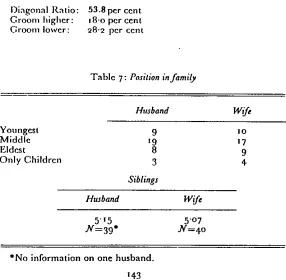
Whilc parents have the grcatcst influence on children’s personalities, siblings change the structure of the [hmily and Ihch" interaction with each other may catJse chnnges in per-s~mality. For instance, Getzels and ~’Valsh fbund that first horns adhcred more rigidly to societal norms and ideas than did other children in the family.~l ~,’Iarsdcn suggcsls that thc cldcst child ill a large family may often have to bear the greater strain and may marry in haste at an early age.3~- We were interested to know if birth order had any relevance to the breakdown of the marriage.
One would expect, by definition, that aliowi,g fi~r sampfing error, eldest children would equ:d youngest children in total numbers. Table 7 shows that [br our study this is the case and there is no efifl’erence in thc proportions comparing men and women. Psychological difrcrences then, on the basis of birth order, are hardly relevant here as far as we can see. Table 7 also shows a higher number oF middle children, which is consistent with the Iov,,er-class origin of tile grolll), who lend Io conic fronl larger families (Tablc 7) and therefore have inore cJlatlC(: ()f I)eing a middle child.
Z°Larry L. Burnpass and .lanles A. Sweet: "l)ifl~:t’clttlals in M:trhal htst:dfilh)’: 197o". ,4rn*rkan S~/o/ieal Rto~L,, t972, Vol. :17 (December): 7S4-7G6.
Jtj. W. Cetz¢ls & J. J. Walsh: "The Mcthcd of Paired Direct Projective Qtttmlonnalre:s in the study of nllitUde ~truclure nnd soclallznl~On". P,~.~holoj~ical M.~mpA~, 7~:4~4 0958).
~SD. iarsden: op. dl.
Accommodation of the I’arent.r of the Couples
We conlhluc lu consider sameness and difference in the background of our couples before marriage and now come to pn reals" nccommodalion. We used the following scale : (i) Own house, (2) I~-e,ltcd house, (including house acquired through a profession or hllsiness firm hut excluding Corporation house) (3) Corporatioll or Council house, artisan’s dwelling and ex-serviceman’s house, (4) Rented flat (excluding Corporation) (5) C,~rpornliml [lal, h,e:lgh Trllsl flat, (6) Tenement room.
Slighlly less Ihan half the couples came from similar type acc()lnm~(l;l~h~ll..~llsl f)’,,er one quarter of the husbands’ parents’ :~ccommod:~tio~ was superior. There seemed to be very llttle indicalfim of mlylhlng here that might have affected the m,lrri:lge, except in the cruses where the husband married down it tony have been indicalin.~ the COlltinualion of the downward trcml prcvio~sly nnled.
Length of Courtship
We disct,s~ed wilh our subjects the length of time they had been going out with their husbands before marriage. The length of acquaintance or courtship is relevant in that if it is short it might indicate that a hasty or ill-thought-out decision to marry was taken. If it were a long courtship, then one would expect the couple to have a better understanding of each other prior to marriage and therefore Io be less likely to break up afterwards. Our hypt~thesis here was that our couples would have a short courtship prior to marriage since their marriages ended in thc particular manner they did.
Thomas, in his study of marital breakdown among Chicago C.athollcs, found that one out of five of]fis couples acquainted for six nlonths or less before marriage, broke up within the first year of marriage,n’~ Since this is almost double the percentage of thosc in his study who were acquainted for longer periods, a~ld tl~c latter represented a relatively uniform pattern, he
sSJohn I,. Thomas: "Catholic Family l)isorganlsatlon". E. W. Burgt:~, D. J. I~ol~ue: {c<ls) Contrib:ttlan~ I,~ I,’,ban ,Yocinlogl’. Chicago: University of Chicago Prcx-~.
concluded that an :~cquaintancc of less than six months is predictive of marital discord. Thonlas does not say whether his couples were desertion cases or not. Goode also demonstrated in his study of425 divorced women in Detroit in 1948 that short acquaintance lends to lead to HIISIICCCSS[tl[ marriage.TM An earlier study by Locke found that 55 per cent of divorcees had bet:n cllgaqcd live inonlJls or Jess.:is Period of engagcmcnt is 11OI, ho’,vcvt;r, a very reliable indicator of length of acquaint-alice.
In hvo sludics, one hy Burgess and Cottrel136 anti the other by Tcrman:’’~ the vast majority of the couples were acquainted for more than one year hclbre marriage. These were studies of
middh:-class Americans, who could be regarded as having i"casomdJly stable marriages. We have no figures on an Irish or Dublin length of acquaintance prior to marriage. In Ireland, however, there is a tradition o1" long courtships
since
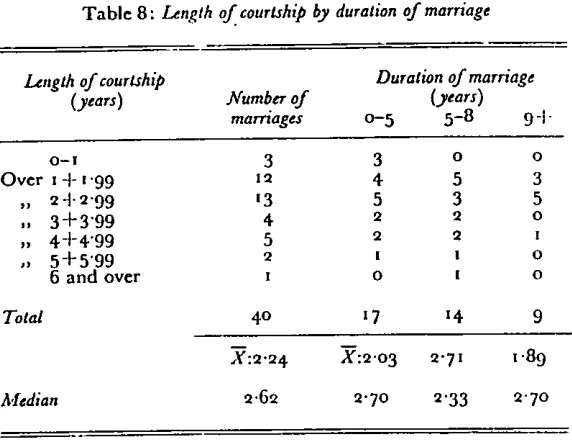
the Famine times. Generally the idea was to delay marriage fur economic reasons. This may well be still truc in rural areas of the counlry but the evidence is of people marrying younger in h-eland.~From the data presented on Table 9 we learn that three of our couples were "going together" for Icss than onc year (two for six months; one for eight months). Slightly less than one-third said they had beer* going togcther For one year and roughly the same number said two years. The remaimler had courtships o[" three years or more. The shortcst period of acquaintance was six months and the longest eight years. The mean length of courtship was 2.2 years.
One couple had bccn acquainted for four years whcn the girl
~’w. J. Goodc: After Divorct. New York: The Frec Press, z956.
sq-t. J. Locke: Predicting Adiustment in tWarriage: A Comparison era divorced and a
happily marriedgvoup. New York: I:loll, Rinehart and Winston, 1951.
~lE. W. Iturg~ and I.. I). C¢~ltrell: Predi~tlng Success or Failure in Afarriage, New York: Prentice Hall lnternatlntml, 1939, p. 406.
~H.. M. Terman: Pskvhological Factors in Marital Happiness. New York: IVIcGraw-Hill Book Gompany, 1938, p. 197.
became pregnant. Tile husband married her under duress bnt they never lived together. He went back to his parents, she to hers and they barely greet each other on the street now. He has never supported either her or the child who is now twenty years old. It is possible that in this case the man was not considering marriage whilst the girl was. He was ten years her senior and started taking her out when she was sixteen. He has not since made any effort to have the marriage annulled. Before he was informed that she was pregnant, this man had told the subject he did not want to see her again. The preg-nancy then forced a marriage on him.
In our study some couples were "going together" for longer than the marriage lasted, for example: five year eourtship~ two year marriage. We see from Table 9 that all of the mar-riages after a courtship of less than one year broke up within five years and three-quarters of those acquainted for one year ended in the first eight years. It does not follow, however, that the longer the acquaintance the more durable the marriage since those acquainted for three years hroke up within the first eight years of marriage and four out of five of those with a five year courtship did the same. There is no significant difference in the means or medians here.
Overall then our hypothesis that our subjects would have short courtships has not been proved. It is not the length of the courtship apparently in the eases ofour subjects that is import-ant but the degree of friendship attained in the time. None of these courtships either long or short produced stable mar-riages. It is possible too that in those courtships which were of short duration the couple might have decided not to marry had
they given themselves more time to consider the matter. And this may well be a reason why the marriages ended the way they did in those particular cases, bearing in mind that no one reason in ilselfis likely to be responsible for the desertion.
Employment
Hcre we will consider employment in the context of the
Before Marriage section. We will deal with Employment as a
factor ill marital In’cakdowa in the During ~’larriage section. Tile question "W:~s your husband in constant employment before marriage?" was asked. A four point scale was used for tile replies: (i) Constantly employed ; (2) Casually employed ; (3) Mostly employed; and (4) Unemployed all the time.
Three-quarters of the subjects said their husbands had becn in constant employment before marriage.
Of the remainder, some gave sympathetic explanations--one husband ,,was .’L painter and at the time there was insufficient work available; another was a student hnd the third found it difficult to get employment when the licensed premises in which he was a barman closed down. In the other cases the wives said their husbands could get work but got tired of jobs they had and changed them or else they would not work at all. Some went back and forth to England to work. The inter-racial marriage which had taken place in England was in this group of casually employed men.
If we look at the ages of these men and their ages at marriage, we find that the period about which we are talking, before their marriages, is mainly in the ’fFtics. Rates ofunenlployment and emigration were very high then.39 Only a quarter of our subjects, however, report that their husbands were unemployed before marriage and in the cases where they do, a large proportion say the men could have obtained and did have many jobs but would not keep them. It may be that in retro-spect tile maiority of tile wives saw the men as working be[bre marriage and not afterwards, or in cases ofcasual or unemploy-ment were bitter about their Imsbands’ work record. They saw it as one of flitting irresponsibly from job to job and not as instability of employment.
Almost a quarter of the men went to England to find work and their girl friends joined them there to get married. This gronp were all married in the late 195os, a time of very high unemployment and emigration rates.
~tSee: Central Statlsti~ Office: Trends in Emplo.,emtnt and UtwmploymLnt, Dublin; The Stationery Olfice for years 195o~o.
Behaviour and Attitudes
We will now discuss generally the behaviour and attitudes of our couples before marriage. Here we have a one-sided explanation of tile breakdown. Presumably, however, what our respondents said was true for them--as what the husband would say would he trne for him. In this part of the question-nalre, the subject was encouraged to speak freely if she felt so inclined. The lines of demarcation here between the before and after marriage sections are very blurred as it is understandable that the subjects found dilticulty in separating these periods, or seeing them as being distinct from each other at this stage.
[nteresls
These questions were included to see if there was anything remarkable about the recreational pursuits of our couples, whether their interests were mutual or conflicting and could have contributed to the eventual breakdown. Interests can be divisive in that if a couple’s interests conflict they may try to change each other and force their tastes on the partner. On the other hand, different interests can add to a marriage and be a source of deligl~t Io both, bringing a variety to the interaction between the parties. We ,asked specifically about membership of clubs, interest in sport, dancing and film-going. There was then a general question about any other interests. These questions did not yield any great variety of answering. Films and dancing, in that order, were the two most popular interests. Slightly more wives than husbands belonged to clubs, sports, social or voluntary organisations. It was noted that as one went up the occupational scale the subjects tended to mention more interests but it is not unusual to find that llfe is filler and there are more facilities for recreation in middle and higher classes. Better education enables people to engage in a wider number of activities, i.e. reading, theatre, music. A higher income level enables them to engage in a wider variety of sporting activities
where payment is required, for example, tennis, badminton, squash and so on. The data neither revealed any clash of
I1| sonle cases there ’~;is iliti(lla}ily but this qneSlioii r~:vralcd ItO eonNicl that the: wives were n’~.,ai’c o1".
Parental h~uences attd Bacbground
People arc trnined in Ihcir homes in a partlcul;ir w:g,,. They tend to adopt the cusl~zns and behaviour of their own family or institution whcre they :~re reared. They learn a parlicular philosophy oflil~ which gives dclinition to their approach to Ihe problems of life. We qttestioHed our subjects on their parents ancl homes ;~tld oil Iheir htlsbands’ backgrotmds to assess whether or not there were I~,tcturs present which would have all’cctcd the marital relali.nship, for cxamph: poor parenl/ chihl relationship which might have been responsible Ibr inability to form a worlhwhile adult relationship.
The somcwllat tradiliollal vicwl)oint, eHdorsing the allrihtltes of a complete family cllvirolm~ent as being essential lbr the proper development of tl~t: child, has bcen challenged by a number of investigators who stress that the presence of botl~ parents does not automatically guarantee a I:,ctter child-rearing sittLation.4° Nyc, for example, found that the acliustmcnl of adolescents from broken homes to tl~eir general environment was more successful than that of children fi’om unhappy unbroken homes and ]%’larsden found that Ihe most vivid instances of social problems in his survey involved childhood with a brutal father or step-father, or with an over-demanding mother.4~ On tile other haHd, homes which arc brokcn Ihro~Jgh death, desertion or other separations appear to have ;n~ advcrse efl’cct on individuals, and a closc rclatiol~ship has bccn Ibund between the broken home, psychiatric illness and personality disorders. Greer, Gnnn and Koller have Ibund signilicant correlations betwcen stJicidnl bchaviollr laler ill llfc :Hid parental Joss in childhood.~2 Landis and Landis tell Hs Ih;i.t
’IScc: S. Glucck and I:~. C;hle~:k: IJ.rattellin~ .7ut’tnile Delinquent)’: London: 195o. Oxford University Pre~.s and J. T. I.;~ndls: ’"l’hc traum:l ofchildr,rlt ~*.hose p:lrcnls divorce", Marriage and Family Lhffng. V(}I. ~. ~9C,6.
’lOp. tit.
"iS. Greet, J. C. Gunn, K. 1%1. Noller: British ~l~¢dical~aurnal. ~gfiG. p. ~. ~:]52
;laid .~. Grccr, .|. (’.. (’;unn: Briti.~h ~ledital ffoutnal. 196G, p. "z. 1355.
"Research studies have shown a combination of background factors to bc related to marriage failure. Among people whose marriages end in divorce, there are more who: are from trnhappy or divorced homes, had no close relationship with parents . . .,,4s These two factors then--broken or unhappy homes--arc associated with marital hreakdown. The actual presence of hoth parents alone is not a guarantee of the forma-tion of well-adjusted children.. It seems also necessary that there be a good inter-parental relationship and a good parent or substitute parent/child relationship.
Turning In oHr own findings, we must emphaslse again the exploratory nature of the study and that we cannot make any definite comparisons with the above studies. However, only two of our subjects wcrc not reared at home with their natural parents. In the cases of their husbands, almost one-third came from homes which were broken, either by death or separation, or wcrc illegitimate or had one or other step-parent. Some of
Ihc wives in Ihese cases remarked that their husbands’ fathers had deserted and they (the husbands) felt they could do the same. Also a few subjects said they had felt sorry for their husbands, their childhood had bcen so deprived, and they wished to compensate. Others reported their husbands’ homes as being unhappy, with conflict between the parents.
Only two respondents mentioned their own parents in an unflattering way--one woman said she was afraid of her father and felt she had married to get away from him. She married a man whose mother had left her husband and children when they were young. Here was a case of some element of disturb-ance on both sidcs.
A quarter of the couples had neither member living at home at the time of marriage, but the reasons were mainly ones of emigration--six couples went abroad to work and marry, and
fi~ur rcspondents met their husbands and married them while away from Ireland. There did not appear to be overt
disagree-s~l- T. l,andis and M. C. I~andis: Building a S~c~sful 3~arrlage: New Jm~ey, Prenllcc IlaU Inlernatlonal Inc. 1948, p. I"11.
nlelllS between paretl{s ;rod childrel] Oil the respondents’ si(.J(:
anyway.
A comparison o1" our subjects and their husbands with the earlier stndles shows little consistency on the wlvcs’ side in that
fi:w report any dimcnhics in the parental home. On the wlvcs’ evidence of the husbands’ backgromlds, however, there would appear to be confirlnatiotl in a nmnbcr or cases or disturbcd home backgrounds, whlcl~ would be consistent whh marriage Ihilure mentioned in the earlier studies.
Ahhough we have no comparative figures, it seems to us rather significant that for ,a large nmnbcr ofour couples, one or other of them did not havc a home ill the nuclear family sense:.
When we consider first that the vast majority of our sample were Dubliuers, a high rate of temporary emigration is indi-cated in the group. One would except that Dubliners, being in more familiar surroundings than those from rural areas, would know Illcir potential better and not have Io move to such a large extent. Such geographical mobility indicates a restlessness and a need for change of landscape and a lack of stability. Evidence of background disturbance would seem to be more clearly indicated for the husbands and the inability on their part tosustain a personal relationship tostem from their disturbed backgrounds. The subjects came fi’otn more stable backgrounds.
We asked whether or not the wives were plcased to leave home to try to confirm whether or not there had been tension in the parental home. Our idea also was that if there had beeu a large family the respondent might have wished to marry to escape from crowdcd conditions and drudgery. Since our respondents were mostly from the lower soclo-eeollomic group, this might have been likely. We could find no evidence, however, that this was the case as fi’om the replies there seemed
no rcmarkal:,le desire on the part or the girls to rush from home into marriage, with the exception of the ease ah’eady mentioned of the subject who said she had married to gct away from home.
Parental Approval of the Marriage
The question of parental al)proval was raised. I~’arems might
have 13ten aisle to see warning signals in tile relationship of the conple. I:’qnally, the opposition of Hie parents to the marriage might lead to in-law conflict later.
The snhject of parental approval and its effect on the subse-qHent marriage has long been debated. The indications are that marriages approved orand planned in public have a better chance ofslwcess dlan any other kind. Popenoe found in a study of 738 elnpements that 46 per cent were caused by parental opposition and n smaller percentage of these marriages turned oHI happily Ihan those with parental approval.~
DisapprovM of the marriages in this study was expressed more by II~ mod~crs of the girls, although in some cases the fiUher was also said to disapprove. About half the subjects said either one ~r hath parents disapproved. Some of the parents’ ohjec¢inus were more int.itive than real, the re~ons not being very valid, for i~stance, "Not good enough for her"; "Just didn’t lake tl:, him"; "Because he was from Artane school, he would never be. any good." Other parents who disapproved had more well-fiHinded objections, such as that the boy’s parents had hccn separated, he appeared irresponsible to them and Hn~y felt he w,,dd find it difficult to "settle down." Another sol of parents disapproved because t!~ey regarded the pros-pectivc husband’s drinking as excessive. Here, however, when their daughter became pregnant, the parents insisted that she marry, while disapproving of die marriage. The glrl did not want Io marry but was pressurised by her own parents to do so. Although none of Ihe marriages in our study followed elopements caused by parental opposition, there was an element of disapproval present which subsequent events seemed to have j~sdficcl. The trend for our subjects seems to follow Pop~-.ne’s Ih~dlng" that parental disapproval is a factor present in a number of broken marriages, bearing in mind the exploratory ual~rc of this study, where distinct comparisons
eannol he lllad~.
In Ihe marriages we sludlcd, a mlmber were disapproved of
~lpaul Popem~e:.1forlorn i~farriage. New York: The Macmillan Company, 19.19. pp. a~/7.
Courtship Pattern a.d Communicatio.
The Icnglh o1" ccmrlship :md ils iml)lications Imve ah’eatly hcen discussed. We t,ow turn to the courtship to discover the level of mutual or complementary interests which would give itdbrmatil~n al)out lhe. degree of communication between the couj~h: IJt:Jbl’,.! marriage. Tlnis s(:elllcd Io us illlpOrl~lllt SillCC ability t~ CO[l~mtlllic:HC belbre :ind rifler m:wri:lge is a good indicalor of the slabilily ofa relalionshil).
l.andis and Landis stress the innportaucc of pre-marital comm,nieatio. ;[ll([ 11t" cstalJlishinlg the habit of talking things over during the czlgngcment. The understandinng ol’each olher’s views and li:elings :ire, they s:q,,, csscntial in a sHccl,ssful mar-niage?n Kumarovsky, commellting on sell2disclosure or com-m.ufic:ltlon o1" Ihe sllbjeels ill Jl(:r study on Ihl: marriages of blue-collar ,.vorkcrs inl the US, Ibund thai the level ofeducntion, was very
important--We had expected the level of etlHcatioH to make a difl’er-ence in Ihe tidiness of self disclosure, but the extent of Ihe difl~zrent:e is surl)n’ising. The high school gn’aduatcs, bolh In;lie and felll:lle, SJlglre their experiences in marn’iagc Imnch more fully thall do Iht: h:ss-cducaled personls." I~.omarovsky also wrih:s about I1~: concern with Ihc mengret~css o1" marital communication of manysludentsof tlnc stubjeel, who sometimes imply that if only the Iloodgatcs were to open it