Proceedings of the 9th Workshop on Computational Approaches to Subjectivity, Sentiment and Social Media Analysis, pages 31–42 31
IEST: WASSA-2018 Implicit Emotions Shared Task
Roman Klinger1, Orph´ee De Clercq2, Saif M. Mohammad3, and Alexandra Balahur4
1 Institut f¨ur Maschinelle Sprachverarbeitung, Universit¨at Stuttgart, Germany
2LT3, Language and Translation Technology Team, Ghent University, Belgium
3 National Research Council Canada, Ottawa, Ontario, Canada
4 Text and Data Mining Unit, European Commission Joint Research Centre, Ispra, Italy
Abstract
Past shared tasks on emotions use data with both overt expressions of emotions (I am so happy to see you!) as well as subtle expres-sions where the emotions have to be inferred, for instance from event descriptions. Further, most datasets do not focus on the cause or the stimulus of the emotion. Here, for the first time, we propose a shared task where systems have to predict the emotions in a large auto-matically labeled dataset of tweets without ac-cess to words denoting emotions. Based on this intention, we call this the Implicit Emotion Shared Task (IEST) because the systems have to infer the emotion mostly from the context. Every tweet has an occurrence of an explicit emotion word that is masked. The tweets are collected in a manner such that they are likely to include a description of the cause of the emotion – the stimulus. Altogether, 30 teams submitted results which range from macro F1
scores of 21 % to 71 %. The baseline (Max-Ent bag of words and bigrams) obtains an F1
score of 60 % which was available to the partic-ipants during the development phase. A study with human annotators suggests that automatic methods outperform human predictions, pos-sibly by honing into subtle textual clues not used by humans. Corpora, resources, and re-sults are available at the shared task website at
http://implicitemotions.wassa2018.com.
1 Introduction
The definition of emotion has long been debated. The main subjects of discussion are the origin of the emotion (physiological or cognitive), the com-ponents it has (cognition, feeling, behaviour) and
the manner in which it can be measured (categori-cally or with continuous dimensions). The Implicit Emotion Shared Task (IEST) is based onScherer
(2005), who considers emotion as “an episode of interrelated, synchronized changes in the states of all or most of the five organismic subsystems (in-formation processing, support, executive, action, monitor) in response to the evaluation of an exter-nal or interexter-nal stimulus event as relevant to major concerns of the organism”.
This definition suggests that emotion is triggered by the interpretation of a stimulus event (i. e., a sit-uation) according to its meaning, the criteria of relevance to the personal goals, needs, values and the capacity to react. As such, while most situations will trigger the same emotional reaction in most people, there are situations that may trigger differ-ent affective responses in differdiffer-ent people. This is explained more in detail by the psychological the-ories of emotion known as the “appraisal thethe-ories” (Scherer,2005).
Emotion recognition from text is a research area in natural language processing (NLP) concerned with the classification of words, phrases, or doc-uments into predefined emotion categories or di-mensions. Most research focuses ondiscrete emo-tion recogniemo-tion, which assigns categorical emo-tion labels (Ekman, 1992; Plutchik, 2001), e. g., Anger,Anticipation,Disgust,Fear,Joy,Sadness, SurpriseandTrust.1 Previous research developed statistical, dictionary, and rule-based models for
several domains, including fairy tales (Alm et al.,
2005), blogs (Aman and Szpakowicz,2007) and microblogs (Dodds et al.,2011). Presumably, most models built on such datasets rely on emotion words (or their representations) whenever acces-sible and are therefore not forced to learn associ-ations for more subtle descriptions. Such models might fail to predict the correct emotion when such overt words are not accessible. Consider the in-stance “when my child was born” from the ISEAR corpus, a resource in which people have been asked to report on events when they felt a specific prede-fined emotion. This example does not contain any emotion word itself, though one might argue that the words “child” and “born” have a positive prior connotation.
Balahur et al.(2012b) showed that the inference of affect from text often results from the interpreta-tion of the situainterpreta-tion presented therein. Therefore, specific approaches have to be designed to under-stand the emotion that is generally triggered by situ-ations. Such approaches require common sense and world knowledge (Liu et al.,2003;Cambria et al.,
2009). Gathering world knowledge to support NLP is challenging, although different resources have been built to this aim –e. g., Cyc2and ConceptNet (Liu and Singh,2004).
On a different research branch, the field of dis-tant supervision and weak supervision addresses the challenge that manually annotating data is te-dious and expensive. Distant supervision tackles this by making use of structured resources to au-tomatically label data (Mintz et al.,2009;Riedel et al.,2010;Mohammad,2012). This approach has been adapted in emotion analysis by using informa-tion assigned by authors to their own text, with the use of hashtags and emoticons (Wang et al.,2012).
With theImplicit Emotion Shared Task (IEST), we aim at combining these two research branches: On the one hand, we use distant supervision to compile a corpus of substantial size. On the other hand, we limit the corpus to those texts which are likely to contain descriptions of the cause of the emotion – thestimulus. Due to the ease of access and the variability and data richness on Twitter, we opt for compiling a corpus of microposts, from which we sample tweets that contain an emotion word followed by ‘that’, ‘when’, or ‘because’. We then mask the emotion word and ask systems to predict the emotion category associated with that
2http://www.cyc.com
word.3 The emotion category can be one of six classes:anger,disgust,fear,joy,sadness, and sur-prise. Examples from the data are:
(1) “It’s [#TARGETWORD#] when you feel like you are invisible to others.”
(2) “My step mom got so [#TARGET-WORD#] when she came home from work and saw that the boys didn’t come to Austin with me.”
In Example 1, the inference is that feeling invisible typically makes us sad. In Example 2, the context is presumably that a person (mom) expected some-thing else than what was expected. This in isolation might cause anger or sadness, however, since “the boys are home” the mother is likely happy. Note that such examples can be used as source of com-monsense or world knowledge to detect emotions from contexts where the emotion is not explicitly implied.
The shared task was conducted between 15 March 2018 (publication of train and trial data) and the evaluation phase, which ran from 2 to 9 July. Submissions were managed on CodaLab4. The best performing systems are all ensembles of deep learning approaches. Several systems make use of external additional resources such as pre-trained word vectors, affect lexicons, and language models fine-tuned to the task.
The rest of the paper is organized as follows: we first review related work (Section 2). Section 3
introduces the shared task, the data used, and the setup. The results are presented in Section4, in-cluding the official results and a discussion of dif-ferent submissions. The automatic system’s pre-dictions are then compared to human performance in Section5, where we report on a crowdsourcing study with the data used for the shared task. We conclude in Section6.
2 Related Work
Related work is found in different directions of research on emotion detection in NLP: resource creation and emotion classification, as well as mod-eling the emotion itself.
Modeling the emotion computationally has been approached from the perspective of humans needs
3
This gives the shared task a mixed flavor of both text classification and word prediction, in the spirit of distributional semantics.
and desires with the goal of simulating human re-actions.Dyer(1987) presents three models which take into account characters, arguments, emotion experiencers, and events. These aspects are mod-eled with first order logic in a procedural manner. Similarly,Subasic and Huettner(2001) use fuzzy logic for such modeling in order to consider grad-ual differences. A similar approach is followed by the OCC model (Ortony et al.,1990), for which
Udochukwu and He(2015) show how to connect it to text in a rule-based manner for implicit emotion detection. Despite of this early work on holistic computational models of emotions, NLP focused mostly on a more coarse-grained level.
One of the first corpora annotated for emotions is that byAlm et al.(2005) who analyze sentences from fairy tales.Strapparava and Mihalcea(2007) annotate news headlines with emotions and valence,
Mohammad et al.(2015) annotate tweets on elec-tions, andSchuff et al.(2017) tweets of a stance dataset (Mohammad et al.,2017). The SemEval-2018 Task 1: Affect in Tweets (Mohammad et al.,
2018) includes several subtasks on inferring the af-fectual state of a person from their tweet: emotion intensity regression, emotion intensity ordinal clas-sification, valence (sentiment) regression, valence ordinal classification, and multi-label emotion clas-sification. In all of these prior shared tasks and datasets, no distinction is made between implicit or explicit mentions of the emotions. We refer the reader toBostan and Klinger(2018) for a more de-tailed overview of emotion classification datasets.
Few authors specifically analyze which phrase triggers the perception of an emotion. Aman and Szpakowicz(2007) focus on the annotation on doc-ument level but also mark emotion indicators. Mo-hammad et al. (2014) annotate electoral tweets for semantic roles such as emotion and stimulus (from FrameNet). Ghazi et al. (2015) annotate a subset of Aman and Szpakowicz (2007) with causes (inspired by the FrameNet structure).Kim and Klinger(2018) andNeviarouskaya and Aono
(2013) similarly annotate emotion holders, targets, and causes as well as the trigger words.
One of the oldest resources nowadays used for emotion recognition is the ISEAR set (Scherer,
1997) which consists of self-reports of emotional events. As the task of participants in a psycho-logical study was not to express an emotion but to report on an event in which they experienced a given emotion, this resource can be considered
similar to our goal of focusing on implicit emotion expressions.
With the aim to extend the coverage of ISEAR,
Balahur et al. (2011, 2012a) build EmotiNet, a knowledge base to store situations and the affective reactions they have the potential to trigger. They show how the knowledge stored can be expanded using lexical and semantic similarity, as well as through the use of Web-extracted knowledge ( Bal-ahur et al.,2013). The patterns used to populate the database are of the type “I feel [emotion] when [situation]”, which was also a starting point for our task.
Finally, several approaches take into consider-ation distant supervision (Mohammad and Kir-itchenko,2015;Abdul-Mageed and Ungar,2017;
De Choudhury et al.,2012;Liu et al.,2017,i. a.). This is motivated by the high availability of user-generated text and by the challenge that manual annotation is typically tedious or expensive. This contrasts with the current data demand of machine learning, and especially, deep learning approaches.
With our work in IEST, we combine the goal of the development of models which are able to recog-nize emotions from implicit descriptions without having access to explicit emotion words, with the paradigm of distant supervision.
3 Shared Task
3.1 Data
The aim of the Implicit Emotion Shared Task is to force models to infer emotions from the context of emotion words without having access to them. Specifically, the aim is that models infer the emotion through the causes mentioned in the text. Thus, we build the corpus of Twitter posts by polling the Twitter API5 for the expression
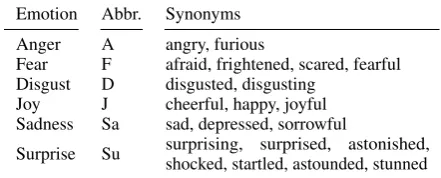
‘EMOTION-WORD (that|because|when)’, whereEMOTION-WORDcontains a synonym for one out of six emotions.6The synonyms are shown in Table 1. The requirement of tweets to have either ‘that’, ‘because’, or ‘when’ immediately after the emotion word means that the tweet likely describes the cause of the emotion.
The initially retrieved large dataset has a distribu-tion of 25 %surprise, 23 %sadness, 18 %joy, 16 % fear, 10 %anger, 8 %disgust. We discard tweets
5
https://developer.twitter.com/en/docs.html
Emotion Abbr. Synonyms
Anger A angry, furious
Fear F afraid, frightened, scared, fearful Disgust D disgusted, disgusting
Joy J cheerful, happy, joyful Sadness Sa sad, depressed, sorrowful
[image:4.595.307.529.63.159.2]Surprise Su surprising, surprised, astonished, shocked, startled, astounded, stunned
Table 1: Emotion synonyms used when polling Twitter.
Emotion Train Trial Test
Anger 25562 1600 4794 Disgust 25558 1597 4794 Fear 25575 1598 4791
Joy 27958 1736 5246
Sadness 23165 1460 4340 Surprise 25565 1600 4792
Sum 153383 9591 28757
Table 2: Distribution of IEST data.
with more than one emotion word, as well as exact duplicates, and mask usernames and URLs. From this set, we randomly sample 80 % of the tweets to form the training set (153,600 instances), 5 % as trial set (9,600 instances), and 15 % as test set (28,800 instances). We perform stratified sampling to obtain a balanced dataset. While the shared task took place, two errors in the data preprocessing were discovered by participants (the use of the word unhappy as synonym for sadness, which lead to in-consistent preprocessing in the context of negated expressions, and the occurrence of instances with-out emotion words). To keep the change of the data at a minimum, the erroneous instances were only removed, which leads to a distribution of the data as shown in Table2.
3.2 Task Setup
The shared task was announced through a dedi-cated website (http://implicitemotions.wassa2018. com/) and computational-linguistics-specific mail-ing lists. The organizers published an evalua-tion script which calculates precision, recall, and F1measure for each emotion class as well as micro and macro average. Due to the nearly balanced dataset, the chosen official metric for ranking sub-mitted systems is the macro-F1 measure.
In addition to the data, the participants were provided a list of resources they might want to use7 (and they were allowed to use any other resources they have access to or create
them-7http://implicitemotions.wassa2018.com/resources/
Predicted Labels
A D F J Sa Su
Gold
Labels
A 2431 476 496 390 410 426
D 426 2991 245 213 397 522
F 430 249 3016 327 251 518
J 378 169 290 3698 366 345
Sa 450 455 313 458 2335 329
[image:4.595.70.291.64.153.2]Su 411 508 454 310 279 2930
Table 3: Confusion Matrix on Test Data for Baseline.
Predicted Labels
A D F J Sa Su
Gold
Labels
A 3182 313 293 224 329 453
D 407 3344 134 102 336 471
F 403 129 3490 196 190 383
J 297 67 161 4284 220 217
Sa 443 340 171 240 2947 199
Su 411 367 293 209 176 3336
Table 4: Confusion Matrix on Test Data of Best Sub-mitted System
selves). We also provided access to a baseline system.8 This baseline is a maximum entropy classifier with L2 regularization. Strings which match[#a-zA-Z0-9_=]+|[ˆ ]form tokens. As preprocessing, all symbols which are not al-phanumeric or contain the # sign are removed. Based on that, unigrams and bigrams form the Boolean features as a set of words for the classifier.
4 Results
4.1 Baseline
The intention of the baseline implementation was to provide participants with an intuition of the dif-ficulty of the task. It reaches 59.88 % macro F1 on the test data, which is very similar to the trial data result (60.1 % F1). The confusion matrix for the baseline is presented in Table3; the confusion matrix for the best submitted system is shown in Table4.
4.2 Submission Results
Table5shows the main results of the shared task. We received submissions through CodaLab from thirty participants. Twenty-six teams responded to a post-competition survey providing additional information regarding team members (56 people in total) and the systems that were developed. For the remaining analyses and the ranking, we only report on these twenty-six teams.
id Team F1 Rank B
1 Amobee 71.45 (1) 3
2 IIIDYT 71.05 (2) 3
3 NTUA-SLP 70.29 (3) 4
4 UBC-NLP 69.28 (4) 6
5 Sentylic 69.20 (5) 7
6 HUMIR 68.64 (6) 8
7 nlp 68.48 (7) 9
8 DataSEARCH 68.04 (8) 10
9 YNU1510 67.63 (9) 11
10 EmotiKLUE 67.13 (10) 11
11 wojtek.pierre 66.15 (11) 15
12 hgsgnlp 65.80 (12) 15
13 UWB 65.70 (13) 15
14 NL-FIIT 65.52 (14) 15
15 TubOslo 64.63 (15) 17
16 YNU Lab 64.10 (16) 17
17 Braint 62.61 (17) 19
18 EmoNLP 62.11 (18) 19
19 RW 60.97 (19) 20
20 Baseline 59.88 21
21 USI-IR 58.37 (20) 22
22 THU NGN 58.01 (21) 23
23 SINAI 57.94 (22) 24
24 UTFPR 56.92 (23) 26
25 CNHZ2017 56.40 27
26 lyb3b 55.87 27
27 Adobe Research 53.08 (24) 28
28 Anonymous 50.38 29
29 dinel 49.99 (25) 30
30 CHANDA 41.89 (26) 31
31 NLP LDW 21.03
Table 5: Official results of IEST 2018. Participants who did not report on the system details did not get assigned a rank and are reported in gray. Column B provides the first row in the results table to which the re-spective row is significantly different (confidence level 0.99), tested with bootstrap resampling.
The table shows results from 31 systems, includ-ing the baseline results which have been made avail-able to participants during the shared task started. From all submissions, 19 submissions scored above the baseline. The best scoring system is from teamAmobee, followed byIIDYT andNTUA-SLP. The first two results are not significantly differ-ent, as tested with theWilcoxon(1945) sign test (p <0.01) and with bootstrap resampling (confi-dence level 0.99).
Table10in the Appendix shows a breakdown of the results by emotion class. Though the data was nearly balanced, joy is mostly predicted with highest performance, followed by fear and disgust. The prediction of surprise and anger shows a lower performance.
Note that the macro F1evaluation took into ac-count all classes which were either predicted or in the gold data. Two teams submitted results which
Rank Keras Tensorflo
w
P
andas
SciKitLearn NL
TK
GloV
e
Gensim PyT
orch
F
astT
ext
SpaCy Weka ELMo LibLinear Theano
1 X X X X
2 X X
3 X X X
4 X X X X X X X
5 X X X X X
6 X X X X X
7 X X X X X X
8 X X X X X X X X
9 X X X X X X X X
10 X X
11 X X X X X X
12 X X X X X
13 X X X X X X
14 X X X X X
15 X
16 X X X X X
17 X X
18 X X X X
19 X X
20 X X X X X
21 X X X X X
22 X X X X X
23 X X
24 X X X X X X
25 X X X
26 X
16 14 14 13 13 11 11 5 5 3 3 3 1 1
Table 6: Overview of tools employed by different teams (sorted by popularity from left to right).
contain labels not present in the gold data, which reduced the macro-F1 dramatically. With an evalu-ation only taking into account 6 labels, id 22 would be on rank 9 and id 28 would be on rank 10.
4.3 Review of Methods
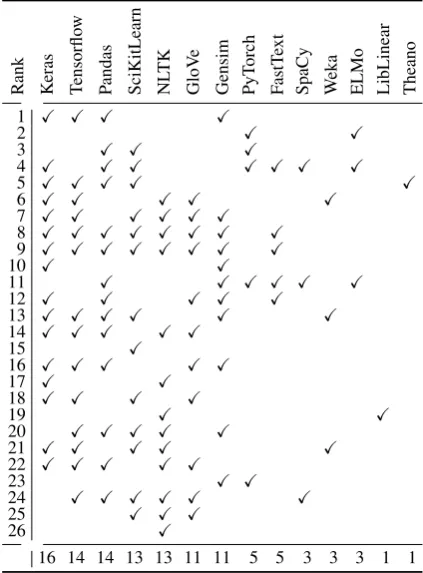
Table6shows that many participants use high-level libraries like Keras or NLTK. Tensorflow is only of medium popularity and Theano is only used by one participant. Table7shows a summary of machine learning methods used by the teams, as reported by themselves. Nearly every team uses embeddings and neural networks; many teams use an ensemble of architectures. Several teams use language models showing a current trend in NLP to fine-tune those to specific tasks (Howard and Ruder,
2018). Presumably, those are specifically helpful in our task due to its word-prediction aspect.
[image:5.595.82.284.61.405.2] [image:5.595.310.522.63.350.2] [image:5.595.82.283.68.406.2]Rank Embeddings LSTM/RNN/GR
U
Ensemble CNN/Capsules Attention Linear
Classifier
T
ransfer
Learning
Language
model
MLP Autoencoder Random
F
orrest
k-Means Bagging LD
A
1 X X X X X X X
2 X X X X
3 X X X X X X
4 X X X X X X
5 X X X X
6 X X X X X X
7 X X X X
8 X X X
9 X X X X X
10 X X X
11 X X X
12 X X X X
13 X X
14 X X X
15 X
16 X X X
17 X X X X
18 X X X X
19 X
20 X X
21 X X X X X
22 X X 23 X X
24 X X X X
25 X X X
26
[image:6.595.85.278.62.375.2]23 20 12 9 7 5 5 3 2 1 1 1 1 1
Table 7: Overview of methods employed by different teams (sorted by popularity from left to right).
4.4 Top 3 Submissions
In the following, we briefly summarize the ap-proaches used by the top three teams: Amobee, IIIDYT, and NTUA-SLP. For more information on these approaches and those of the other teams, we refer the reader to the individual system description papers. The three best performing systems are all ensemble approaches. However, they make use of different underlying machine learning architectures and rely on different kinds of information.
4.4.1 Amobee
The top-ranking system, Amobee, is an ensemble approach of several models (Rozental et al.,2018). First, the team trains a Twitter-specific language model based on the transformer decoder architec-ture using 5B tweets as training data. This model is used to find the probabilities of potential miss-ing words, conditional upon the missmiss-ing word de-scribing one of the six emotions. Next, the team applies transfer learning from the trained models they developed for SemEval 2018 Task 1: Affect in Tweets (Rozental and Fleischer,2018). Finally, they directly train on the data provided in the shared task while incorporating outputs from DeepMoji
Rank Words Le
xicons
Characters Emoji Unlabeled
Corpora
Emotion
Emb
.
Sentence/Document SemEv
al
1 X X X X X X
2 X X X
3 X X X X
4 X X
5 X
6 X X X
7 X
8 X X X
9 X
10 X X X
11 X X X
12 X X X X
13 X X
14 X X X
15 X X
16 X
17 X X
18 X X X X X X
19 X
20 X X X
21 X X X
22 X X
23 X X
24 X X X X
25 X 26 X
26 9 8 7 6 4 4 3
Table 8: Overview of information sources employed by different teams (sorted by popularity from left to right).
(Felbo et al., 2017) and “Universal Sentence En-coder” (Cer et al.,2018) as features.
4.4.2 IIIDYT
The second-ranking system, IIIDYT (Balazs et al.,
2018), preprocesses the dataset by tokenizing the sentences (including emojis), and normalizing the USERNAME, NEWLINE, URL and TRIGGER-WORD indicators. Then, it feeds word-level rep-resentations returned by a pretrained ELMo layer into a Bi-LSTM with 1 layer of 2048 hidden units for each direction. The Bi-LSTM output word rep-resentations are max-pooled to generate sentence-level representations, followed by a single hidden layer of 512 units and output size of 6. The team trains six models with different random initializa-tions, obtains the probability distributions for each example, and then averages these to obtain the final label prediction.
4.4.3 NTUA-SLP
The NTUA-SLP system (Chronopoulou et al.,
[image:6.595.327.503.63.381.2]model using a large Twitter corpus. Then, these pretrained embeddings are fed to a neural classi-fier with 2 layers, each consisting of 400 bi-LSTM units with attention. For the second model, they use transfer learning of a pretrained classifier on a 3-class sentiment classification task (Semeval17 Task4A) and then apply fine-tuning to the IEST dataset. Finally, for the third model the team uses transfer learning of a pretrained language model, according toHoward and Ruder(2018). They first train 3 language models on 3 different Twitter cor-pora (2M, 3M, 5M) and then they fine-tune them to the IEST dataset with gradual unfreezing.
4.5 Error Analysis
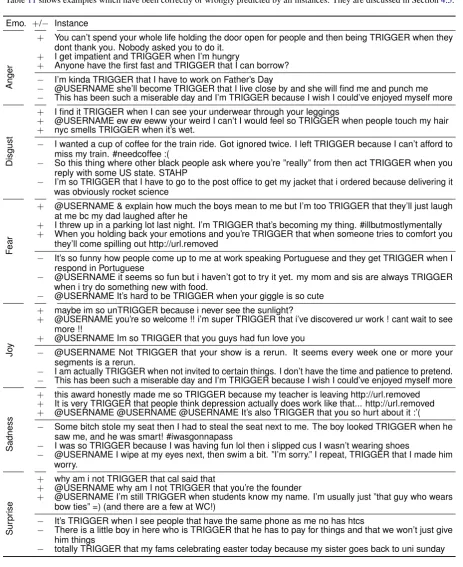
Table11in the Appendix shows a subsample of instances which are predicted correctly by all teams (marked as+, including the baseline system and those who did not report on system details) and that were not predicted correctly by any team (marked as−), separated by correct emotion label.
For the positive examples which are correctly predicted by all teams, specific patterns reoccur. Foranger, the author of the first example encour-ages the reader not to be afraid – a prompt which might be less likely for other emotions. For several emotions, single words or phrases are presumably associated with such emotions,e. g., “hungry” with anger, “underwear”, “sweat”, “ewww” with dis-gust, “leaving”, “depression” for sadness, “why am i not” for surprise.
Several examples which are all correctly pre-dicted by all teams forjoyinclude the syllable “un” preceding the triggerword – a pattern more frequent for this emotion than for others. Another pattern is the phrase “fast and furious” (with furious for anger) which should be considered a mistake in the sampling procedure, as it refers to a movie instead of an emotion expression.
Negative examples appear to be reasonable when the emotion is given but may also be valid with other labels than the gold. For disgust, respec-tive emotion synonyms are often used as a strong expression actually referring to other negative emo-tions. Especially forsadness, the negative exam-ples include comparably long event descriptions.
5 Comparison to Human Performance
An interesting research question is how accurately native speakers of a language can predict the emo-tion class when the emoemo-tion word is removed from
Predicted Labels
A D F J Sa Su
Gold
Labels
A 349 40 34 55 95 43
D 195 92 30 84 157 69
F 94 20 265 92 120 42
J 39 6 22 398 36 13
Sa 88 37 23 89 401 46
[image:7.595.321.512.63.159.2]Su 123 25 29 132 53 183
Table 9: Confusion Matrix Sample Annotated by Hu-mans in Crowdsourcing
a tweet. Thus we conducted a crowdsourced study asking humans to perform the same task as pro-posed for automatic systems in this shared task.
We sampled 900 instances from the IEST data: 50 tweets for each of the six emotions in 18 pair-wise combinations with ‘because’, ‘that’, and ‘when’. The tweets and annotation questionnaires were uploaded on a crowdsourcing platform, Figure Eight (earlier called CrowdFlower).9 The question-naire asked for the best guess for the emotion (Q1) as well as any other emotion that they think might apply (Q2).
About 5 % of the tweets were annotated inter-nally beforehand for Q1 (by one of the authors of this paper). These tweets are referred to as gold tweets. The gold tweets were interspersed with other tweets. If a crowd-worker got a gold tweet question wrong, they were immediately notified of the error. If the worker’s accuracy on the gold tweet questions fell below 70 %, they were refused further annotation, and all of their annotations were discarded. This served as a mechanism to avoid malicious annotations.
Each tweet is annotated by at least three people. A total of 3,619 human judgments of emotion asso-ciated with the trigger word were obtained. Each judgment included the best guess for the emotion (response to Q1) as well as any other emotion that they think might apply (response to Q2). The an-swer to Q1 corresponds to the shared task setting. However, automatic systems were not given the option of providing additional emotions that might apply (Q2).
The macro F1for predicting the emotion is 45 % (Q1, micro F1of 0.47). Observe that human perfor-mance is lower than what automatic systems reach in the shared task. The correct emotion was present in the top two guessed emotions in 57 % of the cases. Perhaps, the automatic systems are honing
in to some subtle systematic regularities in hope that particular emotion words are used (for exam-ple, the function words in the immediate neighbor-hood of the target word). It should also be noted, however, that the data used for human annotations was only a subsample of the IEST data.
An analysis of subsets of Tweets containing the wordsbecause,that, andwhenafter the emotion word shows that Tweets with “that” are more dif-ficult (41 % accuracy) than with “when” (49 %) and “because” (51 %). This relationship between performance and query string is not observed in the baseline system – here, accuracy on the test data (on the data used for human evaluation) for the “that” subset is 61 % (60 %), for “when” 62 % (53 %), and for “because” 55 % (50 %) – there-fore, the automatic system is most challenged by “because”, while humans are more challenged by “that”. Please note that this comparison on the test data is somewhat unfair since for the human anal-ysis, the data was sampled in a stratified manner, but not for the automatic prediction. The test data contains 5635 “because” tweets, 13649 with “that” and 9474 with “when”.
There are differences in the difficulty of the task for different emotions: The accuracy (F1) by emo-tion is 57 % (46 %) for anger, 15 % (21 %) for dis-gust, 42 % (51 %) for fear, 77 % (58 %) for joy, 59 % (52 %) for sadness and 34 % (39 %) for sur-prise. The confusion matrix is depicted in Table9. Disgust is often confused with anger, followed by fear being confused with sadness. Surprise is often confused with anger and joy.
6 Conclusions & Future Work
With this paper and the Implicit Emotion Shared Task, we presented the first dataset and joint effort to focus on causal descriptions to infer emotions that are triggered by specific life situations on a large scale. A substantial number of participating systems presented the current state of the art in text classification in general and transferred it to the task of emotion classification.
Based on the experiences during the organiza-tion and preparaorganiza-tion of this shared task, we plan the following steps for a potential second iteration. The dataset was now constructed via distant super-vision, which might be a cause for inconsistencies in the dataset. We plan to use crowdsourcing as applied for the estimation of human performance to improve preprocessing of the data. In addition,
as one participant noted, the emotion words which were used to retrieve the data were removed, but, in a subset of the data, other emotion words were retained.
The next step, which we suggest to the partici-pants and future researchers is introspection of the models – carefully analyse them to prove that the models actually learn to infer emotions from subtle descriptions of situations, instead of purely associ-ating emotion words with emotion labels. Similarly, an open research question is how models developed on the IEST data perform on other data sets.Bostan and Klinger(2018) showed that transferring mod-els from one corpus to another in emotion analysis leads to drops in performance. Therefore, an inter-esting option is to use transfer learning from estab-lished corpora (which do not distinguish explicit and implicit emotion statements) to the IEST data and compare the models to those directly trained on the IEST and vice versa.
Finally, another line of future research is the application of the knowledge inferred to other tasks, such as argument mining and sentiment analysis.
Acknowledgments
This work has been partially supported by the German Research Council (DFG), project SEAT (Structured Multi-Domain Emotion Analysis from Text, KL 2869/1-1). We thank Evgeny Kim, Laura Bostan, Jeremy Barnes, and Veronique Hoste for fruitful discussions.
References
Muhammad Abdul-Mageed and Lyle Ungar. 2017. Emonet: Fine-grained emotion detection with gated recurrent neural networks. In Proceedings of the 55th Annual Meeting of the Association for Compu-tational Linguistics (Volume 1: Long Papers), pages 718–728, Vancouver, Canada. Association for Com-putational Linguistics.
Cecilia Ovesdotter Alm, Dan Roth, and Richard Sproat. 2005. Emotions from text: Machine learning for text-based emotion prediction. In Proceed-ings of Human Language Technology Conference and Conference on Empirical Methods in Natural Language Processing, pages 579–586, Vancouver, British Columbia, Canada. Association for Compu-tational Linguistics.
Alexandra Balahur, Jesus Hermida, and Andres Mon-toyo. 2012a. Building and exploiting emotinet, a knowledge base for emotion detection based on the appraisal theory model. IEEE Transactions on Af-fective Computing, 3:88–101.
Alexandra Balahur, Jes´us M. Hermida, Andr´es Mon-toyo, and Rafael Mu˜noz. 2011. EmotiNet: A knowl-edge base for emotion detection in text built on the appraisal theories. InNatural Language Processing and Information Systems, pages 27–39, Berlin, Hei-delberg. Springer Berlin HeiHei-delberg.
Alexandra Balahur, Jes´us M. Hermida, and Hristo Tanev. 2013. Detecting implicit emotion expres-sions from text using ontological resources and lex-ical learning. InNew Trends of Research in Ontolo-gies and Lexical Resources: Ideas, Projects, Sys-tems, pages 235–255, Berlin, Heidelberg. Springer Berlin Heidelberg.
Alexandra Balahur, Jess Hermida, and Andrs Montoyo. 2012b. Detecting implicit expressions of emotion in text: A comparative analysis. Decision Support Systems, 53(4):742753.
Jorge A. Balazs, Edison Marrese-Taylor, and Yutaka Matsuo. 2018. IIIDYT at IEST 2018: Implicit Emo-tion ClassificaEmo-tion with Deep Contextualized Word Representations. In Proceedings of the 9th Work-shop on Computational Approaches to Subjectivity, Sentiment and Social Media Analysis, Brussels, Bel-gium. Association for Computational Linguistics.
Laura Ana Maria Bostan and Roman Klinger. 2018. A survey on annotated data sets for emotion classifi-cation in text. In Proceedings of COLING 2018, the 27th International Conference on Computational Linguistics, Santa Fe, USA.
Erik Cambria, Amir Hussain, Catherine Havasi, and Chris Eckl. 2009. Affectivespace: Blending com-mon sense and affective knowledge to perform emotive reasoning. In WOMSA09: 1st Work-shop on Opinion Mining and Sentiment Analysis. WOMSA’09: 1st Workshop on Opinion Mining and Sentiment Analysis, pages 32–41, Seville, Spain.
Daniel Cer, Yinfei Yang, Sheng-yi Kong, Nan Hua, Nicole Limtiaco, Rhomni St. John, Noah Con-stant, Mario Guajardo-Cespedes, Steve Yuan, Chris Tar, Yun-Hsuan Sung, Brian Strope, and Ray Kurzweil. 2018. Universal sentence encoder. CoRR, abs/1803.11175.
Alexandra Chronopoulou, Aikaterini Margatina, Chris-tos Baziotis, and Alexandros Potamianos. 2018. NTUA-SLP at IEST 2018: Ensemble of neural trans-fer methods for implicit emotion classification. In Proceedings of the 9th Workshop on Computational Approaches to Subjectivity, Sentiment and Social Media Analysis, Brussels, Belgium. Association for Computational Linguistics.
Munmun De Choudhury, Scott Counts, and Michael Gamon. 2012. Not all moods are created equal! ex-ploring human emotional states in social media. In Sixth international AAAI conference on weblogs and social media, pages 66–73.
Peter S. Dodds, Kameron D. Harris, Isabel M. Kloumann, Catherine A. Bliss, and Christopher M. Danforth. 2011. Temporal patterns of happiness and information in a global social network: Hedonomet-rics and twitter.PloS one, 6(12).
Michael G. Dyer. 1987. Emotions and their computa-tions: Three computer models. Cognition and Emo-tion, 1(3):323–347.
Paul Ekman. 1992. An argument for basic emotions. Cognition & emotion, 6(3-4):169–200.
Bjarke Felbo, Alan Mislove, Anders Søgaard, Iyad Rahwan, and Sune Lehmann. 2017. Using millions of emoji occurrences to learn any-domain represen-tations for detecting sentiment, emotion and sarcasm. In Proceedings of the 2017 Conference on Empiri-cal Methods in Natural Language Processing, pages 1615–1625, Copenhagen, Denmark. Association for Computational Linguistics.
Diman Ghazi, Diana Inkpen, and Stan Szpakowicz. 2015. Detecting emotion stimuli in emotion-bearing sentences. In Computational Linguistics and In-telligent Text Processing, pages 152–165, Cham. Springer International Publishing.
Jeremy Howard and Sebastian Ruder. 2018. Universal language model fine-tuning for text classification. In Proceedings of the 56th Annual Meeting of the As-sociation for Computational Linguistics (Volume 1: Long Papers), pages 328–339, Melbourne, Australia. Association for Computational Linguistics.
Evgeny Kim and Roman Klinger. 2018. Who feels what and why? annotation of a literature corpus with semantic roles of emotions. In Proceedings of COLING 2018, the 27th International Conference on Computational Linguistics, Santa Fe, USA.
Hugo Liu, Henry Lieberman, and Ted Selker. 2003. A model of textual affect sensing using real-world knowledge. InProceedings of the 8th International Conference on Intelligent User Interfaces, IUI ’03, pages 125–132, New York, NY, USA. ACM.
Hugo Liu and Push Singh. 2004. Conceptnet – a practi-cal commonsense reasoning tool-kit. BT Technology Journal, 22(4):211–226.
Mike Mintz, Steven Bills, Rion Snow, and Dan Juraf-sky. 2009. Distant supervision for relation extrac-tion without labeled data. InConference of the As-sociation for Computational Linguistics and the In-ternational Joint Conference on Natural Language Processing of the Asian Federation of Natural Lan-guage Processing.
Saif Mohammad. 2012. #emotional tweets. In*SEM 2012: The First Joint Conference on Lexical and Computational Semantics – Volume 1: Proceedings of the main conference and the shared task, and Vol-ume 2: Proceedings of the Sixth International Work-shop on Semantic Evaluation (SemEval 2012), pages 246–255, Montr´eal, Canada. Association for Com-putational Linguistics.
Saif M. Mohammad and Felipe Bravo-Marquez. 2017. WASSA-2017 shared task on emotion intensity. In Proceedings of the Workshop on Computational Ap-proaches to Subjectivity, Sentiment and Social Me-dia Analysis (WASSA), Copenhagen, Denmark.
Saif M. Mohammad, Felipe Bravo-Marquez, Mo-hammad Salameh, and Svetlana Kiritchenko. 2018. Semeval-2018 Task 1: Affect in tweets. In Proceed-ings of International Workshop on Semantic Evalua-tion (SemEval-2018), New Orleans, LA, USA.
Saif M. Mohammad and Svetlana Kiritchenko. 2015. Using hashtags to capture fine emotion cate-gories from tweets. Computational Intelligence, 31(2):301–326.
Saif M. Mohammad, Parinaz Sobhani, and Svetlana Kiritchenko. 2017. Stance and sentiment in tweets. ACM Trans. Internet Technol., 17(3):26:1–26:23.
Saif M. Mohammad, Xiaodan Zhu, Svetlana Kir-itchenko, and Joel Martin. 2015. Sentiment, emo-tion, purpose, and style in electoral tweets. Informa-tion Processing & Management, 51(4):480–499.
Saif M. Mohammad, Xiaodan Zhu, and Joel Martin. 2014. Semantic role labeling of emotions in tweets. In Proceedings of the 5th Workshop on Computa-tional Approaches to Subjectivity, Sentiment and So-cial Media Analysis, pages 32–41, Baltimore, Mary-land. Association for Computational Linguistics.
Alena Neviarouskaya and Masaki Aono. 2013. Extract-ing causes of emotions from text. InProceedings of the Sixth International Joint Conference on Natural Language Processing, pages 932–936.
Andrew Ortony, Gerald L. Clore, and Allan Collins. 1990. The cognitive structure of emotions. Cam-bridge University Press.
Robert Plutchik. 2001. The nature of emotions hu-man emotions have deep evolutionary roots, a fact that may explain their complexity and provide tools for clinical practice. American Scientist, 89(4):344– 350.
Sebastian Riedel, Limin Yao, and Andrew McCallum. 2010. Modeling Relations and Their Mentions with-out Labeled Text. In Proceedings of the Euro-pean Conference on Machine Learning and Prin-ciples and Practice in Knowledge Discovery from Databases.
Alon Rozental and Daniel Fleischer. 2018. Amobee at semeval-2018 task 1: GRU neural network with a CNN attention mechanism for sentiment classifica-tion. CoRR, abs/1804.04380.
Alon Rozental, Daniel Fleischer, and Zohar Kelrich. 2018. Amobee at IEST 2018: Transfer Learning from Language Models. InProceedings of the 9th Workshop on Computational Approaches to Subjec-tivity, Sentiment and Social Media Analysis, Brus-sels, Belgium. Association for Computational Lin-guistics.
Klaus R Scherer. 1997. Profiles of emotion-antecedent appraisal: Testing theoretical predictions across cul-tures.Cognition & Emotion, 11(2):113–150.
Klaus. R. Scherer. 2005. What are emotions? and how can they be measured? Social Science Information, 44(4):695–729.
Hendrik Schuff, Jeremy Barnes, Julian Mohme, Sebas-tian Pad´o, and Roman Klinger. 2017. Annotation, modelling and analysis of fine-grained emotions on a stance and sentiment detection corpus. In Pro-ceedings of the 8th Workshop on Computational Ap-proaches to Subjectivity, Sentiment and Social Me-dia Analysis, Copenhagen, Denmark. Workshop at Conference on Empirical Methods in Natural Lan-guage Processing, Association for Computational Linguistics.
Carlo Strapparava and Rada Mihalcea. 2007. Semeval-2007 task 14: Affective text. InProceedings of the Fourth International Workshop on Semantic Evalua-tions (SemEval-2007), pages 70–74, Prague, Czech Republic. Association for Computational Linguis-tics.
Pero Subasic and Alison Huettner. 2001. Affect analy-sis of text using fuzzy semantic typing. IEEE Trans-actions on Fuzzy Systems, 9(4):483–496.
Orizu Udochukwu and Yulan He. 2015. A rule-based approach to implicit emotion detection in text. In Natural Language Processing and Information Sys-tems, pages 197–203, Cham. Springer International Publishing.
Wenbo Wang, Lu Chen, Krishnaprasad Thirunarayan, and Amit P. Sheth. 2012. Harnessing twitter ”big data” for automatic emotion identification. In So-cialCom/PASSAT, pages 587–592. IEEE.
A Results by emotion class
Table10shows breakdown of the results by emotion class.
Joy Sadness Disgust Anger Surprise Fear
Team P R F1 P R F1 P R F1 P R F1 P R F1 P R F1
Amobee 82 82 82 70 68 69 73 70 72 62 66 64 66 70 68 77 73 75
IIIDYT 79 81 80 71 67 69 70 71 71 66 63 64 66 71 68 76 74 75
NTUA-SLP 81 77 79 71 66 69 72 70 71 63 64 63 62 71 67 75 73 74
UBC-NLP 79 79 79 67 67 67 69 68 69 62 63 62 65 67 66 73 73 73
Sentylic 80 77 79 68 66 67 69 69 69 63 61 62 63 69 66 73 73 73
HUMIR 77 78 78 70 64 66 70 68 69 61 63 62 61 69 65 74 70 72
nlp 77 78 78 68 62 65 70 67 69 62 63 62 62 68 65 72 72 72
DataSEARCH 77 77 77 66 64 65 69 68 68 61 62 62 64 65 65 72 71 71
YNU1510 78 75 76 64 64 64 68 68 68 60 63 62 64 65 64 73 71 72
EmotiKLUE 77 78 77 69 59 64 67 67 67 60 61 60 60 68 64 72 69 71
wojtek.pierre 77 75 76 67 61 64 66 68 67 57 60 58 62 63 62 69 70 69
hgsgnlp 75 75 75 66 59 62 67 66 67 59 59 59 59 67 63 69 69 69
UWB 74 77 75 61 68 64 74 59 65 57 63 60 66 56 61 65 73 69
NL-FIIT 76 74 75 62 64 63 69 63 66 61 57 59 58 65 61 68 70 69
TubOslo 82 67 74 62 63 62 62 68 65 59 56 58 57 66 62 68 66 67
YNU Lab 74 74 74 66 56 61 63 67 65 55 61 58 63 56 60 66 70 68
Braint 77 70 73 61 60 60 60 68 64 56 55 55 60 57 59 63 66 65
EmoNLP 73 72 73 62 57 60 63 62 63 55 56 56 56 61 58 64 64 64
RW 71 72 72 60 57 59 62 63 62 55 52 53 56 60 58 62 63 63
Baseline 69 71 70 58 54 56 62 62 62 54 51 52 55 59 57 63 63 63
USI-IR 71 69 70 58 51 54 59 59 59 49 58 53 57 50 53 59 62 61
THU NGN 77 78 77 69 63 66 68 68 68 60 63 62 61 66 64 71 68 70
SINAI 68 68 68 52 52 52 59 60 59 52 51 52 56 55 55 61 61 61
UTFPR 64 53 58 54 60 57 59 58 58 50 53 52 51 62 56 66 56 61
CNHZ2017 65 70 67 58 47 52 58 59 59 51 48 50 49 58 53 58 57 58
lyb3b 72 64 68 58 46 52 55 62 58 46 53 50 47 50 49 60 58 59
AdobeResearch 62 65 63 52 52 52 52 51 52 48 45 46 49 52 50 56 54 55
Anonymous 76 77 76 64 67 65 70 64 67 62 59 60 59 69 64 74 68 71
dinel 61 61 61 52 37 43 52 49 50 44 50 47 44 54 48 51 50 50
CHANDA 46 64 54 39 36 38 54 42 47 38 37 37 51 20 29 39 58 46
NLP LDW 33 38 36 18 12 14 20 31 25 22 26 24 18 7 10 18 17 18
Table 10: Results by emotion class. Note that this table is limited to the six emotion labels of interest in the data set. However, other labels predicted than these six were taken into account for calculation of the final macro F1score. Therefore, the macro F1calculated from this table is different from the results in Table5in two cases
[image:11.595.76.530.122.484.2]B Examples
Table11shows examples which have been correctly or wrongly predicted by all instances. They are discussed in Section4.5.
Emo. +/− Instance
Anger
+ You can’t spend your whole life holding the door open for people and then being TRIGGER when they dont thank you. Nobody asked you to do it.
+ I get impatient and TRIGGER when I’m hungry
+ Anyone have the first fast and TRIGGER that I can borrow? − I’m kinda TRIGGER that I have to work on Father’s Day
− @USERNAME she’ll become TRIGGER that I live close by and she will find me and punch me − This has been such a miserable day and I’m TRIGGER because I wish I could’ve enjoyed myself more
Disgust
+ I find it TRIGGER when I can see your underwear through your leggings
+ @USERNAME ew ew eeww your weird I can’t I would feel so TRIGGER when people touch my hair
+ nyc smells TRIGGER when it’s wet.
− I wanted a cup of coffee for the train ride. Got ignored twice. I left TRIGGER because I can’t afford to miss my train. #needcoffee :(
− So this thing where other black people ask where you’re ”really” from then act TRIGGER when you reply with some US state. STAHP
− I’m so TRIGGER that I have to go to the post office to get my jacket that i ordered because delivering it was obviously rocket science
F
ear
+ @USERNAME & explain how much the boys mean to me but I’m too TRIGGER that they’ll just laugh at me bc my dad laughed after he
+ I threw up in a parking lot last night. I’m TRIGGER that’s becoming my thing. #illbutmostlymentally
+ When you holding back your emotions and you’re TRIGGER that when someone tries to comfort you they’ll come spilling out http://url.removed
− It’s so funny how people come up to me at work speaking Portuguese and they get TRIGGER when I respond in Portuguese
− @USERNAME it seems so fun but i haven’t got to try it yet. my mom and sis are always TRIGGER when i try do something new with food.
− @USERNAME It’s hard to be TRIGGER when your giggle is so cute
Jo
y
+ maybe im so unTRIGGER because i never see the sunlight?
+ @USERNAME you’re so welcome !! i’m super TRIGGER that i’ve discovered ur work ! cant wait to see more !!
+ @USERNAME Im so TRIGGER that you guys had fun love you
− @USERNAME Not TRIGGER that your show is a rerun. It seems every week one or more your segments is a rerun.
− I am actually TRIGGER when not invited to certain things. I don’t have the time and patience to pretend. − This has been such a miserable day and I’m TRIGGER because I wish I could’ve enjoyed myself more
Sadness
+ this award honestly made me so TRIGGER because my teacher is leaving http://url.removed
+ It is very TRIGGER that people think depression actually does work like that... http://url.removed
+ @USERNAME @USERNAME @USERNAME It’s also TRIGGER that you so hurt about it :’(
− Some bitch stole my seat then I had to steal the seat next to me. The boy looked TRIGGER when he saw me, and he was smart! #iwasgonnapass
− I was so TRIGGER because I was having fun lol then i slipped cus I wasn’t wearing shoes
− @USERNAME I wipe at my eyes next, then swim a bit. ”I’m sorry.” I repeat, TRIGGER that I made him worry.
Sur
pr
ise
+ why am i not TRIGGER that cal said that
+ @USERNAME why am I not TRIGGER that you’re the founder
+ @USERNAME I’m still TRIGGER when students know my name. I’m usually just ”that guy who wears bow ties” =) (and there are a few at WC!)
− It’s TRIGGER when I see people that have the same phone as me no has htcs
− There is a little boy in here who is TRIGGER that he has to pay for things and that we won’t just give him things
− totally TRIGGER that my fams celebrating easter today because my sister goes back to uni sunday
[image:12.595.69.533.87.655.2]