Learning Language Representations for Typology Prediction
Chaitanya Malaviya and Graham Neubig and Patrick Littell
Language Technologies Institute Carnegie Mellon University
{cmalaviy,gneubig,pwl}@cs.cmu.edu
Abstract
One central mystery of neural NLP is what neural models “know” about their subject matter. When a neural machine transla-tion system learns to translate from one language to another, does it learn the syn-tax or semantics of the languages? Can this knowledge be extracted from the sys-tem to fill holes in human scientific knowl-edge? Existing typological databases con-tain relatively full feature specifications for only a few hundred languages. Ex-ploiting the existence of parallel texts in more than a thousand languages, we build a massive many-to-one neural machine translation (NMT) system from 1017 lan-guages into English, and use this to pre-dict information missing from typological databases. Experiments show that the pro-posed method is able to infer not only syn-tactic, but also phonological and phonetic inventory features, and improves over a baseline that has access to information about the languages’ geographic and phy-logenetic neighbors.1
1 Introduction
Linguistic typology is the classification of human languages according to syntactic, phonological, and other classes of features, and the investiga-tion of the relainvestiga-tionships and correlainvestiga-tions between these classes/features. This study has been a sci-entific pursuit in its own right since the 19th cen-tury (Greenberg, 1963; Comrie, 1989; Nichols, 1992), but recently typology has borne practical fruit within various subfields of NLP, particularly on problems involving lower-resource languages.
[image:1.595.305.534.225.316.2]1Code and learned vectors are available at http:// github.com/chaitanyamalaviya/lang-reps
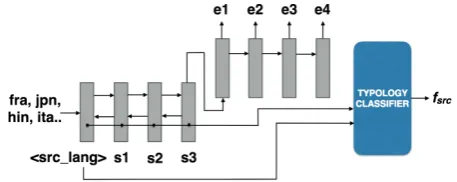
Figure 1: Learning representations from mul-tilingual neural MT for typology classification. (Model MTBOTH)
Typological information from sources like the World Atlas of Language Structures (WALS) (Dryer and Haspelmath, 2013), has proven use-ful in many NLP tasks (O’Horan et al., 2016), such as multilingual dependency parsing (Ammar et al., 2016), generative parsing in low-resource settings (Naseem et al., 2012; T¨ackstr¨om et al., 2013), phonological language modeling and loan-word prediction (Tsvetkov et al., 2016), POS-tagging (Zhang et al., 2012), and machine trans-lation (Daiber et al., 2016).
However, the needs of NLP tasks differ in many ways from the needs of scientific typology, and ty-pological databases are often only sparsely pop-ulated, by necessity or by design.2 In NLP, on
the other hand, what is important is having a rela-tively full set of features for the particular group of languages you are working on. This mis-match of needs has motivated various proposals to reconstruct missing entries, in WALS and other databases, from known entries (Daum´e III and Campbell, 2007; Daum´e III, 2009; Coke et al., 2016; Littell et al., 2017).
In this study, we examine whether we can
2For example, each chapter of WALS aims to provide a statistically balanced set of languages over language families and geographical areas, and so many languages are left out in order to maintain balance.
tackle the problem of inferring linguistic typol-ogy from parallel corpora, specifically by training a massively multi-lingual neural machine trans-lation (NMT) system and using the learned rep-resentations to infer typological features for each language. This is motivated both by prior work in linguistics (Bugarski, 1991; Garc´ıa, 2002) demon-strating strong links between translation studies and tools for contrastive linguistic analysis, work in inferring typology from bilingual data ( ¨Ostling, 2015) and English as Second Language texts (Berzak et al., 2014), as well as work in NLP (Shi et al., 2016; Kuncoro et al., 2017; Belinkov et al., 2017) showing that syntactic knowledge can be extracted from neural nets on the word-by-word or sentence-by-sentence level. This work presents a more holistic analysis of whether we can dis-cover what neural networks learn about the lin-guistic concepts of an entire language by aggre-gating their representations over a large number of the sentences in the language.
We examine several methods for discovering feature vectors for typology prediction, including those learning a language vector specifying the language while training multilingual neural lan-guage models ( ¨Ostling and Tiedemann, 2017) or neural machine translation (Johnson et al., 2016) systems. We further propose a novel method for aggregating the values of the latent state of the en-coder neural network to a single vector represent-ing the entire language. We calculate these feature vectors using an NMT model trained on 1017 lan-guages, and use them for typlogy prediction both on their own and in composite with feature vectors from previous work based on the genetic and geo-graphic distance between languages (Littell et al., 2017). Results show that the extracted representa-tions do in fact allow us to learn about the typol-ogy of languages, with particular gains for syn-tactic features like word order and the presence of case markers.
2 Dataset and Experimental Setup
Typology Database: To perform our analysis, we use the URIEL language typology database (Littell et al., 2017), which is a collection of bi-nary features extracted from multiple typological, phylogenetic, and geographical databases such as WALS (World Atlas of Language Structures) (Collins and Kayne, 2011), PHOIBLE (Moran et al., 2014), Ethnologue (Lewis et al., 2015), and
Glottolog (Hammarstr¨om et al., 2015). These fea-tures are divided into separate classes regarding syntax (e.g. whether a language has prepositions or postpositions), phonology (e.g. whether a lan-guage has complex syllabic onset clusters), and phonetic inventory (e.g. whether a language has interdental fricatives). There are 103 syntactical features, 28 phonology features and 158 phonetic inventory features in the database.
Baseline Feature Vectors: Several previous methods take advantage of typological implica-ture, the fact that some typological traits corre-late strongly with others, to use known features of a language to help infer other unknown fea-tures of the language (Daum´e III and Campbell, 2007; Takamura et al., 2016; Coke et al., 2016). As an alternative that does not necessarily require pre-existing knowledge of the typological features in the language at hand, Littell et al. (2017) have proposed a method for inferring typological fea-tures directly from the language’sknearest neigh-bors (k-NN) according to geodesic distance (dis-tance on the Earth’s surface) and genetic dis(dis-tance (distance according to a phylogenetic family tree). In our experiments, our baseline uses this method by taking the 3-NN for each language according to normalized geodesic+genetic distance, and cal-culating an average feature vector of these three neighbors.
Typology Prediction: To perform prediction, we trained a logistic regression classifier3 with
the baselinek-NN feature vectors described above and the proposed NMT feature vectors described in the next section. We train individual classi-fiers for predicting each typological feature in a class (syntax etc). We performed 10-fold cross-validation over the URIEL database, where we train on 9/10 of the languages to predict 1/10 of the languages for 10 folds over the data.
3 Learning Representations for Typology Prediction
In this section we describe three methods for learning representations for typology prediction with multilingual neural models.
LM Language Vector Several methods have been proposed to learn multilingual language
models (LMs) that utilize vector representations of languages (Tsvetkov et al., 2016; ¨Ostling and Tiedemann, 2017). Specifically, these models train a recurrent neural network LM (RNNLM; Mikolov et al. (2010)) using long short-term mem-ory (LSTM; Hochreiter and Schmidhuber (1997)) with an additional vector representing the current language as an input. The expectation is that this vector will be able to capture the features of the language and improve LM accuracy. ¨Ostling and Tiedemann (2017) noted that, intriguingly, ag-glomerative clustering of these language vectors results in something that looks roughly like a phy-logenetic tree, but stopped short of performing ty-pological inference. We train this vector by ap-pending a special token representing the source language (e.g. “hfrai” for French) to the begin-ning of the source sentence, as shown in Fig. 1, then using the word representation learned for this token as a representation of the language. We will call this first set of feature vectors LMVEC, and
examine their utility for typology prediction.
NMT Language Vector In our second set of feature vectors, MTVEC, we similarly use a
lan-guage embedding vector, but instead learn a multi-lingual neural MT model trained to translate from many languages to English, in a similar fashion to Johnson et al. (2016); Ha et al. (2016). In contrast to LMVEC, we hypothesize that the alignments to
an identical sentence in English, the model will have a stronger signal allowing it to more accu-rately learn vectors that reflect the syntactic, pho-netic, or semantic consistencies of various lan-guages. This has been demonstrated to some ex-tent in previous work that has used specifically en-gineered alignment-based models (Lewis and Xia, 2008; ¨Ostling, 2015; Coke et al., 2016), and we examine whether these results apply to neural net-work feature extractors and expand beyond word order and syntax to other types of typology as well.
NMT Encoder Mean Cell States Finally, we propose a new vector representation of a language (MTCELL) that has not been investigated in
pre-vious work: the average hidden cell state of the encoder LSTM for all sentences in the language. Inspired by previous work that has noted that the hidden cells of LSTMs can automatically capture salient and interpretable information such as syn-tax (Karpathy et al., 2015; Shi et al., 2016) or
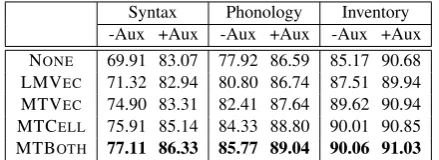
Syntax Phonology Inventory -Aux +Aux -Aux +Aux -Aux +Aux NONE 69.91 83.07 77.92 86.59 85.17 90.68 LMVEC 71.32 82.94 80.80 86.74 87.51 89.94 MTVEC 74.90 83.31 82.41 87.64 89.62 90.94 MTCELL 75.91 85.14 84.33 88.80 90.01 90.85
[image:3.595.307.527.62.142.2]MTBOTH 77.11 86.33 85.77 89.04 90.06 91.03
Table 1: Accuracy of syntactic, phonological, and inventory features using LM language vec-tors (LMVEC), MT language vectors (MTVEC),
MT encoder cell averages (MTCELL) or both
MT feature vectors (MTBOTH). Aux indicates
auxiliary information of geodesic/genetic nearest neighbors; “NONE -Aux” is the majority class
chance rate, while “NONE+Aux” is a 3-NN
clas-sification.
sentiment (Radford et al., 2017), we expect that the cell states will represent features that may be linked to the typology of the language. To cre-ate vectors for each language using LSTM hidden states, we obtain the mean of cell states (cin the standard LSTM equations) for all time steps of all sentences in each language.4
4 Experiments
4.1 Multilingual Data and Training Regimen To train a multilingual neural machine translation system, we used a corpus of Bible translations that was obtained by scraping a massive online Bible database atbible.com.5 This corpus contains
data for 1017 languages. After preprocessing the corpus, we obtained a training set of 20.6 million sentences over all languages.
The implementation of both the LM and NMT models described in §3 was done in the DyNet toolkit (Neubig et al., 2017). In order to ob-tain a manageable shared vocabulary for all lan-guages, we divided the data into subwords us-ing joint byte-pair encodus-ing of all languages (Sen-nrich et al., 2016) with 32K merge operations. We
4We also tried using the mean of final hidden cell states of the encoder LSTM, but the mean cell state over all words in the sentence gave improved performance. Additionally, we tried using the hidden statesh, but we found that these had significantly less information and lesser variance, due to being modulated by the output gate at each time step.
used LSTM cells in a single recurrent layer with 512-dimensional hidden state and input embed-ding size. The Adam optimizer was used with a learning rate of 0.001 and a dropout of 0.5 was en-forced during training.
4.2 Results and Discussion
The results of the experiments can be found in Tab. 1. First, focusing on the “-Aux” results, we can see that all feature vectors obtained by the neural models improve over the chance rate, demonstrating that indeed it is possible to extract information about linguistic typology from un-supervised neural models. Comparing LMVEC
to MTVEC, we can see a convincing
improve-ment of 2-3% across the board, indicating that the use of bilingual information does indeed pro-vide a stronger signal, allowing the network to extract more salient features. Next, we can see that MTCELLfurther outperforms MTVEC,
indi-cating that the proposed method of investigating the hidden cell dynamics is more effective than using a statically learned language vector. Fi-nally, combining both feature vectors as MTBOTH
leads to further improvements. To measure statis-tical significance of the results, we performed a paired bootstrap test to measure the gain between NONE+AUXand MTBOTH+AUXand found that
the gains for syntax and inventory were significant (p=0.05), but phonology was not, perhaps because the number of phonological features was fewer than the other classes (only 28).
When further using the geodesic/genetic dis-tance neighbor feature vectors, we can see that these trends largely hold although gains are much smaller, indicating that the proposed method is still useful in the case where we have a-priori knowledge about the environment in which the language exists. It should be noted, however, that the gains of LMVECevaporate, indicating that
ac-cess to aligned data may be essential when infer-ring the typology of a new language. We also noted that the accuracies of certain features de-creased from NONE-AUXto MTBOTH-AUX,
par-ticularly gender markers, case suffix and negative affix, but these decreases were to a lesser extent in magnitude than the improvements.
Interestingly, and in contrast to previous meth-ods for inferring typology from raw text, which have been specifically designed for inducing word order or other syntactic features (Lewis and Xia,
Feature NONE MT Gain
[image:4.595.308.525.60.196.2]S NUMERAL AFTER NOUN 37.40 81.26 43.86 S NUMERAL BEFORE NOUN 46.49 83.22 36.73 S POSSESSOR AFTER NOUN 42.05 75.60 33.55 S OBJECT BEFORE VERB 50.97 80.89 29.92 S ADPOSITION AFTER NOUN 52.41 79.10 26.69 P UVULAR CONTINUANTS 77.57 97.37 19.80 P LATERALS 67.30 86.48 19.18 P LATERAL L 64.05 78.16 14.10 P LABIAL VELARS 82.16 95.93 13.76 P VELAR NASAL INITIAL 72.14 85.82 13.68 I VELAR NASAL 39.89 62.08 22.20 I ALVEOLAR LATERAL APPROXIMANT 60.92 79.32 18.40 I ALVEOLAR NASAL 81.49 92.98 11.48 I VOICED LABIODENTAL FRICATIVE 65.75 77.10 11.36 I VOICELESS PALATAL FRICATIVE 82.41 93.66 11.25
Table 2: Top 5 improvements from “NONE-Aux”
to “MTBOTH-Aux” in the syntax (“S ”),
phonol-ogy (“P ”), and inventory (“I ”) classes.
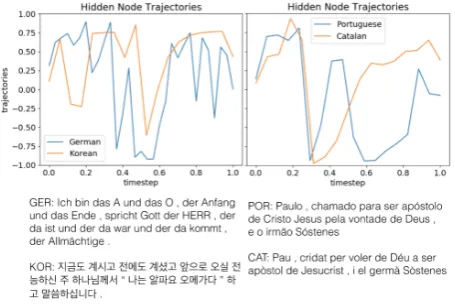
Figure 2: Cell trajectories for sentences in lan-guages where S OBJ BEFORE VERB is either active or inactive.
[image:4.595.307.535.265.418.2]find-ing regional clusters through syntax, and seefind-ing an improvement in regionally-distinctive phonol-ogy/inventory features as a side effect.
Finally, given that MTCELL uses the feature
vectors of the latent cell state to predict typology, it is of interest to observe how these latent cells behave for typologically different languages. In Fig. 2 we examine the node that contributed most to the prediction of “S OBJ BEFORE VERB” (the node with maximum weight in the classi-fier) for German and Korean, where the feature is active, and Portuguese and Catalan, where the feature is inactive. We can see that the node trajectories closely track each other (particularly at the beginning of the sentence) for Portuguese and Catalan, and in general the languages where objects precede verbs have higher average val-ues, which would be expressed by our mean cell state features. The similar trends for lan-guages that share the value for a typological fea-ture (S OBJ BEFORE VERB) indicate that infor-mation stored in the selected hidden node is con-sistent across languages with similar structures.
5 Conclusion and Future Work
Through this study, we have shown that neural models can learn a range of linguistic concepts, and may be used to impute missing features in ty-pological databases. In particular, we have demon-strated the utility of learning representations with parallel text, and results hinted at the importance of modeling the dynamics of the representation as models process sentences. We hope that this study will encourage additional use of typological fea-tures in downstream NLP tasks, and inspire fur-ther techniques for missing knowledge prediction in under-documented languages.
Acknowledgments
We thank Lori Levin and David Mortensen for their useful comments and also thank the review-ers for their feedback about this work.
References
Waleed Ammar, George Mulcaire, Miguel Ballesteros, Chris Dyer, and Noah Smith. 2016. Many lan-guages, one parser. Transactions of the Association for Computational Linguistics, 4:431–444.
Gregory D.S. Anderson. 2013. The velar nasal. In Matthew S. Dryer and Martin Haspelmath, editors,
The World Atlas of Language Structures Online. Max Planck Institute for Evolutionary Anthropol-ogy, Leipzig.
Yonatan Belinkov, Nadir Durrani, Fahim Dalvi, Hassan Sajjad, and James Glass. 2017. What do neural ma-chine translation models learn about morphology? In Proceedings of the 55th Annual Meeting of the Association for Computational Linguistics.
Yevgeni Berzak, Roi Reichart, and Boris Katz. 2014. Reconstructing native language typology from for-eign language usage. In Eighteenth Confer-ence on Computational Natural Language Learning (CoNLL).
Ranko Bugarski. 1991. Contrastive analysis of termi-nology and the termitermi-nology of contrastive analysis. Languages in Contact und Contrast. Essays in Con-tact Linguistics/Edited by Vladimir Ivir and Damir Kalogjera.–Berlin, pages 73–82.
Reed Coke, Ben King, and Dragomir Radev. 2016. Classifying syntactic regularities for hundreds of languages. arXiv preprint arXiv:1603.08016.
Chris Collins and Richard Kayne. 2011. Syntactic Structures of the World’s Languages. New York University, New York.
Bernard Comrie. 1989. Language Universals and Lin-guistic Typology: Syntax and Morphology. Black-well, Oxford.
Joachim Daiber, Miloˇs Stanojevi´c, and Khalil Sima’an. 2016. Universal reordering via linguistic typology. In Proceedings of COLING 2016, the 26th Inter-national Conference on Computational Linguistics: Technical Papers, pages 3167–3176, Osaka, Japan. The COLING 2016 Organizing Committee.
Hal Daum´e III. 2009. Non-parametric Bayesian areal linguistics. In Proceedings of Human Language Technologies: The 2009 Annual Conference of the North American Chapter of the Association for Computational Linguistics, pages 593–601, Boul-der, Colorado. Association for Computational Lin-guistics.
Hal Daum´e III and Lyle Campbell. 2007. A Bayesian model for discovering typological implications. In Proceedings of the 45th Annual Meeting of the Asso-ciation for Computational Linguistics, pages 65–72, Prague, Czech Republic. Association for Computa-tional Linguistics.
Matthew S. Dryer and Martin Haspelmath, editors. 2013. WALS Online. Max Planck Institute for Evo-lutionary Anthropology, Leipzig.
Joseph Greenberg. 1963. Some universals of grammar with particular reference to the order of meaningful elements. In Joseph Greenberg, editor, Universals of Language, pages 110–113. MIT Press, London.
Thanh-Le Ha, Jan Niehues, and Alexander Waibel. 2016. Toward multilingual neural machine trans-lation with universal encoder and decoder. arXiv preprint arXiv:1611.04798.
Harald Hammarstr¨om, Robert Forkel, Martin Haspel-math, and Sebastian Bank. 2015. Glottolog 2.6. Max Planck Institute for the Science of Human His-tory, Jena.
Sepp Hochreiter and J¨urgen Schmidhuber. 1997. Long short-term memory. Neural computation, 9(8):1735–1780.
Melvin Johnson, Mike Schuster, Quoc V Le, Maxim Krikun, Yonghui Wu, Zhifeng Chen, Nikhil Thorat, Fernanda Vi´egas, Martin Wattenberg, Greg Corrado, et al. 2016. Google’s multilingual neural machine translation system: Enabling zero-shot translation. arXiv preprint arXiv:1611.04558.
Andrej Karpathy, Justin Johnson, and Li Fei-Fei. 2015. Visualizing and understanding recurrent networks. arXiv preprint arXiv:1506.02078.
Adhiguna Kuncoro, Miguel Ballesteros, Lingpeng Kong, Chris Dyer, Graham Neubig, and Noah A. Smith. 2017. What do recurrent neural network grammars learn about syntax? In Proceedings of the 15th Conference of the European Chapter of the Association for Computational Linguistics: Volume 1, Long Papers, pages 1249–1258, Valencia, Spain. Association for Computational Linguistics.
M. Paul Lewis, Gary F. Simons, and Charles D. Fennig. 2015. Ethnologue: Languages of the World, Eigh-teenth edition. SIL International, Dallas, Texas.
William D Lewis and Fei Xia. 2008. Automati-cally identifying computationally relevant typolog-ical features. InProceedings of the Third Interna-tional Joint Conference on Natural Language Pro-cessing, Volume II, pages 685–690.
Patrick Littell, David R. Mortensen, Ke Lin, Kather-ine Kairis, Carlisle Turner, and Lori Levin. 2017. Uriel and lang2vec: Representing languages as ty-pological, geographical, and phylogenetic vectors. InProceedings of the 15th Conference of the Euro-pean Chapter of the Association for Computational Linguistics: Volume 2, Short Papers, pages 8–14, Valencia, Spain. Association for Computational Lin-guistics.
Ian Maddieson. 2013a. Lateral consonants. In Matthew S. Dryer and Martin Haspelmath, editors, The World Atlas of Language Structures Online. Max Planck Institute for Evolutionary Anthropol-ogy, Leipzig.
Ian Maddieson. 2013b. Uvular consonants. In Matthew S. Dryer and Martin Haspelmath, editors, The World Atlas of Language Structures Online. Max Planck Institute for Evolutionary Anthropol-ogy, Leipzig.
Tomas Mikolov, Martin Karafi´at, Lukas Burget, Jan Cernock`y, and Sanjeev Khudanpur. 2010. Recur-rent neural network based language model. In Inter-speech, volume 2, page 3.
Steven Moran, Daniel McCloy, and Richard Wright. 2014. PHOIBLE Online. Max Planck Institute for Evolutionary Anthropology, Leipzig.
Tahira Naseem, Regina Barzilay, and Amir Globerson. 2012. Selective sharing for multilingual dependency parsing. InProceedings of the 50th Annual Meet-ing of the Association for Computational LMeet-inguis- Linguis-tics: Long Papers-Volume 1, pages 629–637. Asso-ciation for Computational Linguistics.
Graham Neubig, Chris Dyer, Yoav Goldberg, Austin Matthews, Waleed Ammar, Antonios Anastasopou-los, Miguel Ballesteros, David Chiang, Daniel Clothiaux, Trevor Cohn, et al. 2017. Dynet: The dynamic neural network toolkit. arXiv preprint arXiv:1701.03980.
Joanna Nichols. 1992. Linguistic Diversity in Space and Time. University of Chicago Press, Chicago.
Helen O’Horan, Yevgeni Berzak, Ivan Vulic, Roi Re-ichart, and Anna Korhonen. 2016. Survey on the use of typological information in natural language processing. In Proceedings of COLING 2016, the 26th International Conference on Computational Linguistics: Technical Papers, pages 1297–1308, Osaka, Japan. The COLING 2016 Organizing Com-mittee.
Robert ¨Ostling. 2015. Word order typology through multilingual word alignment. In The 53rd Annual Meeting of the Association for Computational Lin-guistics and the 7th International Joint Conference on Natural Language Processing, pages 205–211. Robert ¨Ostling and J¨org Tiedemann. 2017. Continuous
multilinguality with language vectors. In Proceed-ings of the 15th Conference of the European Chap-ter of the Association for Computational Linguistics: Volume 2, Short Papers, pages 644–649, Valencia, Spain. Association for Computational Linguistics. Alec Radford, Rafal Jozefowicz, and Ilya Sutskever.
2017. Learning to generate reviews and discovering sentiment. arXiv preprint arXiv:1704.01444. Rico Sennrich, Barry Haddow, and Alexandra Birch.
Xing Shi, Inkit Padhi, and Kevin Knight. 2016. Does string-based neural MT learn source syntax? In Pro-ceedings of the 2016 Conference on Empirical Meth-ods in Natural Language Processing, pages 1526– 1534, Austin, Texas. Association for Computational Linguistics.
Oscar T¨ackstr¨om, Ryan McDonald, and Joakim Nivre. 2013. Target language adaptation of discrimina-tive transfer parsers. In Proceedings of the 2013 Conference of the North American Chapter of the Association for Computational Linguistics: Human Language Technologies, pages 1061–1071, Atlanta, Georgia. Association for Computational Linguistics. Hiroya Takamura, Ryo Nagata, and Yoshifumi Kawasaki. 2016. Discriminative analysis of lin-guistic features for typological study. In Pro-ceedings of the Tenth International Conference on Language Resources and Evaluation (LREC 2016), Paris, France. European Language Resources Asso-ciation (ELRA).
Yulia Tsvetkov, Sunayana Sitaram, Manaal Faruqui, Guillaume Lample, Patrick Littell, David Mortensen, Alan W Black, Lori Levin, and Chris Dyer. 2016. Polyglot neural language models: A case study in cross-lingual phonetic representation learning. InProceedings of the 2016 Conference of the North American Chapter of the Association for Computational Linguistics: Human Language Technologies, pages 1357–1366, San Diego, California. Association for Computational Linguistics.