Visual Denotations for Recognizing Textual Entailment
Dan Han1[email protected] Pascual Mart´ınez-G´omez
1
Koji Mineshima2
1Artificial Intelligence Research Center, AIST 2Ochanomizu University
Tokyo, Japan
Abstract
In the logic approach to Recognizing Textual Entailment, identifying phrase-to-phrase semantic relations is still an un-solved problem. Resources such as the Paraphrase Database offer limited cover-age despite their large size whereas unsu-pervised distributional models of meaning often fail to recognize phrasal entailments. We propose to map phrases to their visual denotations and compare their meaning in terms of their images. We show that our approach is effective in the task of Recog-nizing Textual Entailment when combined with specific linguistic and logic features.
1 Introduction and Related Work
Recognizing Textual Entailment (RTE) is a chal-lenging task that was described as the best way of testing an NLP system’s semantic capacity (Cooper et al., 1994). In this task, given a text T and a hypothesis H, the objective is to recognize whether T implies H (yes), whether T contradicts H (no) or otherwise (unk). For example, given:
(T) Some men walk in the tall and green grass. (H) Some people walk in the field.
the system needs to recognize that T implies H (yes). Although humans can easily solve these problems, machines face great difficulties (Dagan et al.,2013). RTE has been approached from dif-ferent perspectives, ranging from purely statistical systems (Lai and Hockenmaier,2014;Zhao et al., 2014) to purely logical (Bos et al.,2004; Abzian-idze, 2015; Mineshima et al., 2015) and hybrid systems (Beltagy et al.,2013).
We evaluate our idea on top of a logic system since they generally offer a high precision and in-terpretability, which is useful to our purposes. In
this approach, there are two main challenges. The first challenge is to model the logical semantic composition of sentences guided by the syntax and logical words (e.g. most, not, some, every). The second challenge is to introduce lexical knowledge that describes the relationship between words or phrases (e.g. men→ people,tall and green grass →field).
Whereas the relationship men → people can be found in high precision ontological resources such as WordNet (Miller,1995), phrasal relations such astall and green grass→fieldare not avail-able in databases such as the Paraphrase Database (PPDB) (Ganitkevitch et al., 2013) despite their large size. Moreover, although unsupervised dis-tributional similarity models have an infinite do-main (given a compositional function on words), they often fail to identify entailments (e.g. guitar has a high similarity topiano but they do not en-tail each other). To address these issues, Roller et al. (2014) investigated supervised methods to identify word-to-word hypernym relations given word vectors whereas Beltagy et al. (2016) pro-posed a mechanism to extract phrase pairs from T and H and train a classifier to identify para-phrases in unseen T-H problems. Our approach is largely inspired by their work and our intention is to increase the performance of these phrase and sentence level entailment classifiers using multi-modal features.
Our assumption is that the same concept ex-pressed using different phrase forms is mapped to similar visual representationssince humans tend to ground the meaning of phrases into the same visual denotation. In a similar line,Kiela and Bot-tou (2014) proposed a simple yet effective con-catenation of pre-trained distributed word repre-sentations and visual features, whereas Izadinia et al.(2015) suggests a tighter parametric integra-tion using a set of hand annotated phrasal
ment relations; however, their work was limited to recognizing word or phrase relations, ignoring the additional challenges that come in RTE which we show is critical. Young et al.(2014) and Lai and Hockenmaier(2014) did tackle sentence-level RTE using visual denotations. However, their ap-proach is only applicable to those RTE problems whose words or phrases appear in the FLICKR30K corpus, which is a considerable limitation. Lai and Hockenmaier (2017) extended the approach to also recognize unseen phrasal semantic rela-tions using a neural network augmented with con-ditional probabilities estimated from visual deno-tations. Instead, our approach is much simpler and similarly effective.
Our contribution is a method to judge phrase-to-phrase semantic relations using an asymmetric similarity scoring function between their sets of visual denotations. We identify the conditions in which this function contributes to sentence-level RTE and show empirically its benefit. Our ap-proach is simpler than previous methods and it does not require annotated phrase relations. More-over, this approach is not limited to specific cor-pora or evaluation datasets and it is potentially lan-guage independent.
2 Methodology
We formulate our framework in terms of a classi-fier gθ : T × H → {yes,no,unk} that outputs an entailment judgment for any textT ∈ T and hypothesis H ∈ H. There are three key issues in designing an effective classifier that uses visual denotations: i) to discern when it is appropriate to use visual denotations to recognize phrasal entail-ments, ii) to extract candidate phrase pairs and iii) to map those phrases into visual denotations1 and measure their semantic similarity in terms of their associated images.
Textual and Logic Features The first issue is to understand the linguistic and logic limitations of visual denotations in recognizing phrasal entail-ments. From our observations, the linguistic phe-nomena that make visual denotations ineffective are word-to-word verb relations (e.g.laughingand crying) since their associated images may depict different actions with similar entities (e.g. pictures of a baby crying are similar to those of a baby laughing); antonym relations between any word 1We approximate the visual denotations of a phrase by obtaining the images associated to that phrase.
in a phrase pair (e.g. similar images for big car andsmall vehicle); and words that denote people of different gender (e.g.boyversuslady,man ver-suswoman) as they often display high visual sim-ilarity compared to other entities. The logic phe-nomena we identified signal sentences with small differences in critical words, phrases or structures, as in the presence of negations (e.g. images ofno catstill display cats), passive-active constructions and subject-object case mismatches (e.g. images ofboy eats appleandapple eats boyare similar) between T and H.
These logic phenomena can be easily detected from logic formulas with the aid of the variable unification during the theorem proving process. For instance, using event semantics (Davidson, 1967; Parsons, 1990), an active sentence a boy eats an appleand its corresponding passive sen-tencean apple is eaten by a boycan be composi-tionally mapped to the same logical formula, i.e., ∃e∃x∃y(boy(x)∧apple(y)∧eat(e)∧(subj(e) = x) ∧(obj(e) = y)), while a boy eats an apple andan apple eats a boy are mapped to different formulas. When trying to prove the formula cor-responding to H from the formula corcor-responding to T, one needs to unify the variables contained in these formulas, so that the non-logical predicates such asboy,appleandeatin T and H are aligned by taking into account logical signals.
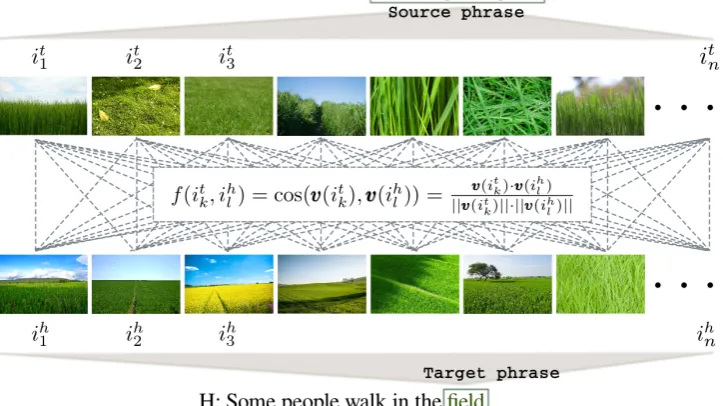
Figure 1: Phrase-image mappings for the phrase pairtall and green grassandfieldin one RTE problem.
Visual Features At this stage it remains to mea-sure the semantic relation between the candidate phrase pairs (extracted with the tree mapping algo-rithm described above) using their visual denota-tions (see Figure1for a schematic diagram2). For this purpose, we select the phrase pairs(t, h)with highest and lowestsimilarity score. We define the similarity score as the average cosine similarity between thebestimage correspondences. That is:
score(t, h) = |I1 h|
X
ih l∈Ih
max it
k∈Itf(i
t
k, ihl) (1)
whereIt = {it1, . . . , itn}are thenimages
associ-ated with phrasetfrom T andIh = {ih1, . . . , ihn}
are the n images for phrase h from H, for 1 ≤
l, k≤n. Note the asymmetry in Eq.1which cap-tures semantic subsumptions (a picture ofriveris among the pictures ofbody of water). The func-tion f returns the cosine similarity between two images:
f(it
k, ihl) = cos(vvv(itk),vvv(ihl)) = vvv(i t k)·vvv(ihl)
||vvv(it
k)|| · ||vvv(ihl)||
(2) wherev(i)is the vector representation of an im-agei. We obtain these vector representations con-catenating the activations of the first 7 layers of GoogLeNet (Szegedy et al.,2015) as it is common practice (Kiela and Bottou,2014).
Given the phrases with the highest and lowest 2 Due to copyright, images in this paper are a subset of Google Image Search results for which we have a publishing license. Nevertheless, they are faithful representatives.
similarity score,3 we extract four features from each pair. The first feature is the similarity score itself. The other three features capture statistics of the relationship f(It×Ih) between the two sets of visual denotationsItandIh. This relationship f(It×Ih) is defined as the the matrix of image
cosine similarities:
f(It×Ih) =
f(it
1, ih1) f(it1, i2h) · · · f(it1, ihn) f(it
2, ih1) f(it2, i2h) · · · f(it2, ihn)
... ... ... ...
f(it
n, ih1) f(itn, i2h) · · · f(itn, ihn)
(3)
Specifically, these three features are:
• maxf(It×Ih)returns the cosine similarity
between the two most similar images. This feature is robust against polysemic phrases (at least one image associated topupilis simi-lar to at least one image associated tostudent) and hypernymy.
• averagef(It×Ih) returns the average
simi-larity across all image pairs and aims to mea-sure the visual denotation overlap between both phrases in the pair.
• minf(It×Ih)returns the similarity between
the two most different images and gives a no-tion of how different the meanings of the two phrases can be.
All features above are concatenated into a fea-ture vector which is paired with the T-H entailment gold label to train the classifier.
3 Experiments
Our system is independent from the logic back-end but we use ccg2lambda(Mart´ınez-G´omez et al.,2016)4for its high precision and capabilities to solve word-to-word divergences using WordNet and VerbOcean (Chklovski and Pantel,2004).
We evaluate our system on the SemEval-2014 version of the SICK dataset (Marelli et al.,2014) with train/trial/test splits of4,500/500/4,927 T-H pairs and a yes/no/unk label distribution of
.29/.15/.56. We chose SICK for its relatively limited vocabulary (2,409words) and short sen-tences. The average T and H sentence length was 10.6 where 3.6 to 3.8 words appeared in T and not in H or vice versa. We used scipy’s Random Forests (Breiman,2001) as our entailment classi-fier with500trees and feature value standardiza-tion, trained and evaluated on those T-H pairs for which ccg2lambda outputs unknown (around 71%of the problems).
Using the tree mapping algorithm,5we obtained an average of 9.8 phrase pairs per T-H problem. We obtainedn= 30images for every phrase using Google Image Search API which we consider as our visual denotations. The images and their vec-tor representations were obtained between Sept. 2016 and Feb. 2017 using the image miner and the feature extractor ofKiela(2016).6
Our main baseline is ccg2lambda when us-ing only WordNet and VerbOcean to account for word-to-word lexical divergences.ccg2lambda
is augmented with a classifier c that uses either text and logic features t or image features from 10,20, or30images (10i,20ior30i). On the training data (Table1),ccg2lambdaobtains an accuracy of82.89%. Using our classifier with all features, we carried out10runs of a10-fold cross-validation on the training data and we obtained an accuracy (standard deviation) of 84.14(0.06), 84.30(0.14) and84.28 (0.11) when using10,20 and30images, respectively. Thus, no significant differences in accuracy were observed for differ-ent numbers of images. When using only text and logic features (c-t), the accuracy dropped
4https://github.com/mynlp/ccg2lambda
5https://github.com/pasmargo/t2t-qa
6https://github.com/douwekiela/mmfeat
System Accuracy Std.
ccg2lambda 82.89 −
ccg2lambda,c-t-10i 84.14 0.06
ccg2lambda,c-t-20i 84.30 0.14
ccg2lambda,c-t-30i 84.28 0.11
ccg2lambda,c-t 76.60 0.03
ccg2lambda,c-20i 82.85 0.08 Table 1: Results (accuracy and standard devia-tion) of the classifiercin a cross-validation on the training split of SICK dataset using text and logic featurestfor10i,20iand30iimages.
System Prec. Rec. Acc.
ccg2lambda+ images 90.24 71.08 84.29 ccg2lambda, only text 96.95 62.65 83.13
L&H, text + images − − 82.70
L&H, only text − − 81.50
Illinois-LH, 2014 81.56 81.87 84.57
Yin & Sch¨utze, 2017 − − 87.10
[image:4.595.308.525.61.157.2]Baseline (majority) − − 56.69
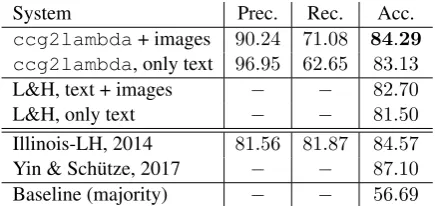
Table 2: Results on the test split of SICK dataset using precision, recall and accuracy. The system “ccg2lambda + images” uses text and logics features and20images per phrase:c-t-20i.
to76.60 (0.03); when using only image features (c-20i), the accuracy dropped to82.85%. These results show that using visual denotations to rec-ognize phrasal entailments contributes to improve-ments in accuracy and that the interaction with text and logic features produces further gains.
On the test data, we obtained1.1%higher accu-racy (84.29versus83.13) over theccg2lambda
baseline with a standard deviation of0.07%over 10 runs (see Table 2) when using the setting
c-t-20i. As a comparison, Lai and Hocken-maier (2017) obtain a similar accuracy increase when using visual denotations (1.2%) with a sub-stantially more complex approach that requires training on the SNLI dataset (Bowman et al., 2015), a much larger corpus.
[image:4.595.309.527.246.349.2]Figure 2: True positive, ID: 4012; gold:yes.
Figure 3: False positive, ID: 1215; gold:unk.
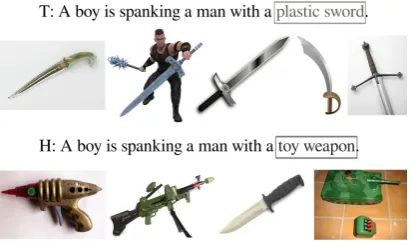
Figure 4: False negative, ID: 1318; gold:yes.
4 Error analysis
We had an average of126true positives (gold la-bel yes, system label yes) and 81 false positives (gold label unk, system label yes) in our cross-validation over the training data. Figure2 shows an example of a true positive where the tree map-ping algorithm extracted the phrase pairkangaroo that is littleandbaby kangaroo. The image sim-ilarity features showed a high score causing the classifier to correctly produce the judgment yes. Figure3shows a false positive where the extracted phrase pair was marsh and river and for which the image similarity is unfortunately high. These cases are common when comparing people (boy andman) or scenery (such as beachand desert).
Figure 4 shows a false negative (gold label yes, system labelunk) where the candidate phrase pair was plastic sword andtoy weapon. In this case, there was only one image with a plastic sword within the images associated totoy weaponwhich may have caused the cosine similarities to be low.
5 Discussion and Conclusion
In this paper we have evaluated our method on the SICK dataset which was originally created from image captions. For that reason, the proportion of concepts with good visual denotations might be higher than in typically occurring RTE problems. Our future work is to assess the applicability of our approach into other RTE problems such as the RTE challenges, SNLI (Bowman et al.,2015) and MultiNLI (Williams et al.,2017) datasets and fur-ther investigate what syntactic or semantic units can be best represented using visual denotations.
Another issue is the use of a commercial im-age search API as a black box to retrieve imim-ages. These search engines may include heuristics that map similar phrases or keywords into the same canonical form and that are difficult to control ex-perimentally. However, we believe that our ap-proach is still valid for a variety of image search mechanisms and it is generally useful to resolve lexical ambiguity at a high coverage.
We identified the conditions in which visual de-notations are effective for sentence-level RTE and devised a simple scoring function to assess phrasal semantic subsumption, which may serve as the ba-sis for more elaborated strategies. Our system is independent on the semantic parser but the en-tailment recognition mechanism requires a theo-rem prover that displays theo-remaining sub-goals. The system and instructions are available athttps: //github.com/mynlp/ccg2lambda
Acknowledgments
[image:5.595.78.283.233.353.2] [image:5.595.79.285.384.509.2]References
Lasha Abzianidze. 2015. A tableau prover for natural logic and language. InProceedings of the 2015 Con-ference on Empirical Methods in Natural Language Processing, pages 2492–2502, Lisbon, Portugal. As-sociation for Computational Linguistics.
Islam Beltagy, Cuong Chau, Gemma Boleda, Dan Garrette, Katrin Erk, and Raymond Mooney. 2013. Montague meets markov: Deep semantics with probabilistic logical form. In Second Joint Con-ference on Lexical and Computational Semantics (*SEM), Volume 1: Proceedings of the Main Con-ference and the Shared Task: Semantic Textual Sim-ilarity, pages 11–21, Atlanta, Georgia, USA. Asso-ciation for Computational Linguistics.
Islam Beltagy, Stephen Roller, Pengxiang Cheng, Ka-trin Erk, and Raymond J. Mooney. 2016. Repre-senting meaning with a combination of logical and distributional models. Computational Linguistics, 42(4):763–808.
Johan Bos, Stephen Clark, Mark Steedman, James R Curran, and Julia Hockenmaier. 2004. Wide-coverage semantic representations from a CCG parser. InProceedings of the 20th international con-ference on Computational Linguistics, pages 104– 111. Association for Computational Linguistics. Samuel R. Bowman, Gabor Angeli, Christopher Potts,
and Christopher D. Manning. 2015. A large anno-tated corpus for learning natural language inference. In Proceedings of the 2015 Conference on Empiri-cal Methods in Natural Language Processing, pages 632–642, Lisbon, Portugal. Association for Compu-tational Linguistics.
Leo Breiman. 2001. Random forests. Machine learn-ing, 45(1):5–32.
Timothy Chklovski and Patrick Pantel. 2004. VerbO-cean: Mining the web for fine-grained semantic verb relations. In Proceedings of EMNLP 2004, pages 33–40, Barcelona, Spain. Association for Computa-tional Linguistics.
Robin Cooper, Richard Crouch, Jan van Eijck, Chris Fox, Josef van Genabith, Jan Jaspers, Hans Kamp, Manfred Pinkal, Massimo Poesio, Stephen Pulman, et al. 1994. FraCaS–a framework for computational semantics.Deliverable, D6.
Ido Dagan, Dan Roth, Mark Sammons, and Fabio Mas-simo Zanzotto. 2013. Recognizing textual entail-ment: Models and applications, volume 6. Morgan & Claypool Publishers.
Donald Davidson. 1967. The logical form of action sentences. In Nicholas Rescher, editor,The Logic of Decision and Action. University of Pittsburgh Press. Juri Ganitkevitch, Benjamin Van Durme, and Chris Callison-Burch. 2013. PPDB: The paraphrase database. InProceedings of the 2013 Conference of
the North American Chapter of the Association for Computational Linguistics: Human Language Tech-nologies, pages 758–764, Atlanta, Georgia. Associ-ation for ComputAssoci-ational Linguistics.
Hamid Izadinia, Fereshteh Sadeghi, Santosh K. Div-vala, Hannaneh Hajishirzi, Yejin Choi, and Ali Farhadi. 2015. Segment-phrase table for semantic segmentation, visual entailment and paraphrasing. InThe IEEE International Conference on Computer Vision (ICCV).
Douwe Kiela. 2016. Mmfeat: A toolkit for extracting multi-modal features. InProceedings of ACL-2016 System Demonstrations, pages 55–60, Berlin, Ger-many. Association for Computational Linguistics.
Douwe Kiela and L´eon Bottou. 2014. Learning image embeddings using convolutional neural networks for improved multi-modal semantics. In Proceedings of the 2014 Conference on Empirical Methods in Natural Language Processing (EMNLP), pages 36– 45, Doha, Qatar. Association for Computational Lin-guistics.
Alice Lai and Julia Hockenmaier. 2014. Illinois-LH: A denotational and distributional approach to seman-tics. InProceedings of the 8th International Work-shop on Semantic Evaluation (SemEval 2014), pages 329–334, Dublin, Ireland. Association for Computa-tional Linguistics and Dublin City University.
Alice Lai and Julia Hockenmaier. 2017. Learning to predict denotational probabilities for modeling en-tailment. InProceedings of the 15th Conference of the European Chapter of the Association for Compu-tational Linguistics: Volume 1, Long Papers, pages 721–730, Valencia, Spain. Association for Compu-tational Linguistics.
Marco Marelli, Stefano Menini, Marco Baroni, Luisa Bentivogli, Raffaella Bernardi, and Roberto Zam-parelli. 2014. A SICK cure for the evaluation of compositional distributional semantic models. In
Proceedings of LREC2014, pages 216–223.
Pascual Mart´ınez-G´omez, Koji Mineshima, Yusuke Miyao, and Daisuke Bekki. 2016. ccg2lambda: A compositional semantics system. In Proceedings of ACL-2016 System Demonstrations, pages 85– 90, Berlin, Germany. Association for Computational Linguistics.
Pascual Mart´ınez-G´omez and Yusuke Miyao. 2016. Rule extraction for tree-to-tree transducers by cost minimization. InProceedings of the 2016 Confer-ence on Empirical Methods in Natural Language Processing, pages 12–22, Austin, Texas. Associa-tion for ComputaAssocia-tional Linguistics.
Koji Mineshima, Pascual Mart´ınez-G´omez, Yusuke Miyao, and Daisuke Bekki. 2015. Higher-order log-ical inference with compositional semantics. In Pro-ceedings of the 2015 Conference on Empirical Meth-ods in Natural Language Processing, pages 2055– 2061, Lisbon, Portugal. Association for Computa-tional Linguistics.
Terence Parsons. 1990.Events in the Semantics of En-glish: A Study in Subatomic Semantics. The MIT Press.
Stephen Roller, Katrin Erk, and Gemma Boleda. 2014. Inclusive yet selective: Supervised distributional hy-pernymy detection. In Proceedings of COLING 2014, the 25th International Conference on Compu-tational Linguistics: Technical Papers, pages 1025– 1036, Dublin, Ireland. Dublin City University and Association for Computational Linguistics.
Christian Szegedy, Wei Liu, Yangqing Jia, Pierre Sermanet, Scott Reed, Dragomir Anguelov, Du-mitru Erhan, Vincent Vanhoucke, and Andrew Ra-binovich. 2015. Going deeper with convolutions. In
The IEEE Conference on Computer Vision and Pat-tern Recognition (CVPR).
Adina Williams, Nikita Nangia, and Samuel R. Bow-man. 2017. A broad-coverage challenge corpus for sentence understanding through inference. CoRR, abs/1704.05426.
Wenpeng Yin and Hinrich Sch¨utze. 2017. Task-specific attentive pooling of phrase alignments con-tributes to sentence matching. InProceedings of the 15th Conference of the European Chapter of the As-sociation for Computational Linguistics: Volume 1, Long Papers, pages 699–709, Valencia, Spain. As-sociation for Computational Linguistics.
Peter Young, Alice Lai, Micah Hodosh, and Julia Hockenmaier. 2014. From image descriptions to visual denotations: New similarity metrics for se-mantic inference over event descriptions. Transac-tions of the Association for Computational Linguis-tics, 2:67–78.