Proceedings of E A C L '99
Word Sense Disambiguation in U n t a g g e d Text based on Term
Weight Learning
F u m i y o F u k u m o t o a n d Y o s h i m i S u z u k i t
D e p a r t m e n t o f C o m p u t e r S c i e n c e a n d M e d i a E n g i n e e r i n g , Y a m a n a s h i U n i v e r s i t y
4 - 3 - 1 1 T a k e d a , K o f u 4 0 0 - 8 5 1 1 J a p a n
{[email protected], [email protected] }.yamanashi.ac.jp
A b s t r a c t
This paper describes unsupervised learn- ing algorithm for disambiguating verbal word senses using term weight learning. In our method, collocations which char- acterise every sense are extracted using similarity-based estimation. For the re- sults, term weight learning is performed. Parameters of term weighting are then estimated so as to maximise the colloca- tions which characterise every sense and minimise the other collocations. The re- suits of experiment demonstrate the ef- fectiveness of the method.
1 I n t r o d u c t i o n
One of the major approaches to disambiguate word senses is supervised learning (Gale et al., 1992), (Yarowsky, 1992), (Bruce and Janyce, 1994), (Miller et al., 1994), (Niwa and Nitta, 1994), (Luk, 1995), (Ng and Lee, 1996), (Wilks and Stevenson, 1998). However, a major obstacle impedes the acquisition of lexical knowledge from corpora, i.e. the difficulties of manually sense- tagging a training corpus, since this limits the ap- plicability of m a n y approaches to domains where this hard to acquire knowledge is already avail- able.
This paper describes unsupervised learning al- gorithm for disambiguating verbal word senses us- ing term weight learning. In our approach, an overlapping clustering algorithm based on Mutual information-based (Mu) term weight learning be- tween a verb and a noun is applied to a set of verbs. It is preferable that Mu is not low (Mu(x,y) _> 3) for a reliable statistical analysis (Church et al., 1991). However, this suffers from the problem of d a t a sparseness, i.e. the co-occurrences which are used to represent every distinct senses does not appear in the test data. To attack this prob- lem, for a low Mu value, we distinguish between
unobserved co-occurrences t h a t are likely to oc- cur in a new corpus and those that are not, by using similarity-based estimation between two co- occurrences of words. For the results, t e r m weight learning is performed. P a r a m e t e r s of t e r m weight- ing are then estimated so as to maximise the col- locations which characterise every sense and min- imise the other collocations.
In the following sections, we first define a pol- ysemy from the viewpoint of clustering, then de- scribe how to extract collocations using similarity- based estimation. Next, we present a clustering method and a method for verbal word sense dis- ambiguation using the result of clustering. Fi- nally, we report on an experiment in order to show the effect of the method.
2 P o l y s e m y i n C o n t e x t
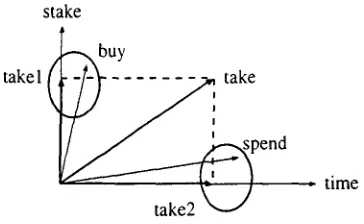
Most previous corpus-based WSD algorithms are based on the fact that semantically similar words a p p e a r in a similar context. Semantically sim- ilar verbs, for example, co-occur with the same nouns. The following sentences from the Wall Street Journal show polysemous usages of take.
(sl) Coke has typically taken a minority stake in such ventures.
( s l ' ) G u b e r and pepers tried to buy a stake in m g m in 1988.
(s2) T h a t process of sorting out specifies is likely to take time.
(s2') We spent a lot of time and money in building our group of stations.
Proceedings of EACL '99
and the synonymy of take with them disappears•
stake
AL>buy
takel ~ - o ~ take
pend
time
Figure 1: The decomposition of the verb take
In order to capture the synonymy of take with the two verbs correctly, one has to decompose the vector assigned to take into two component vec- tors, t a k e l and take2, each of which corresponds to one of the two distinct usages of take (in Figure 1). (we call them hypothetical verbs in the follow- ing). The decomposition of a vector into a set of its component vectors requires a proper decom- position of the context in which the word occurs. Furthermore, in a general situation, a polysemous verb co-occurs with a large group of nouns and one has to divide the group of nouns into a set of subgroups, each of which correctly characterises the context for a specific sense of the polysemous word. Therefore, the algorithm has to be able to determine when the context of a word should be divided and how.
The approach proposed in this paper explic- itly introduces new entities, i.e. hypothetical verbs when an entity is judged polysemous and asso- ciates them with contexts which are sub-contexts of the context of the original entity• Our algorithm has two basic operations, splitting and lumping• Splitting means to divide a polysemous verb into two hypothetical verbs and lumping means to com- bine two hypothetical verbs to make one verb out of them (Fukumoto and Tsujii, 1994).
3 E x t r a c t i o n o f C o l l o c a t i o n s
Given a set of verbs, vl, v 2 , - - . , v,~, the algorithm produces a set of semantic clusters, which are or- dered in the ascending order of their semantic de- viation values• Semantic deviation is a measure of the deviation of the set in an n-dimensional Euclidean space, where n is the number of nouns which co-occur with the verbs•
In our algorithm, if vi is non-polysemous, it be- longs to at least one of the resultant semantic clus- ters. If it is polysemous, the algorithm splits it into several hypothetical verbs and each of them belongs to at least one of the clusters• Table 1
summarises the sample result from the set {close, open, end}.
Table 1: Distinct senses of the verb ' c l o s e '
Vi n Mu(vi ,n)
c l o s e l (open)
c l o s e 2 (end)
account banking acquisition book bottle
announcement connection conversation period practice
2.116 2.026 1.072 4.427 3.650
1.692 2.745 4.890 1.876 2.564
In Table 1, subsets ' o p e n ' and ' e n d ' correspond to the distinct senses o f ' c l o s e ' . Mu(vi,n) is the value of mutual information between a verb and a noun. If a polysemous verb is followed by a noun which belongs to a set of the nouns, the meaning of the verb within the sentence can be determined ac- cordingly, because a set of the nouns characterises one of the possible senses of the verb.
The basic assumption of our approach is t h a t a polysemous verb could not be recognised cor- rectly if collocations which represent every dis- tinct senses of a polysemous verb were not weighted correctly. In particular, for a low Mu value, we have to distinguish between those unob- served co-occurrences that are likely to occur in a new corpus and those that are not. We extracted these collocations which represent every distinct senses of a polysemous verb using similarity-based estimation. Let (wv, nq) and (w~i , nq) be two dif- ferent co-occurrence pairs. We say that wv and nq are semantically related if w~i and nq are se- mantically related and (wp, nq) and (w~i , nq) are semantically similar (Dagan et al., 1993). Us- ing the estimation, collocations are extracted and term weight learning is performed. Parameters of term weighting are then estimated so as to maximise the collocations which characterise ev- ery sense and minimise the other collocations.
[image:2.596.93.275.84.196.2] [image:2.596.324.499.118.284.2]Proceedings of EACL '99
b e g i n
(a) f o r all nq E N_Sett - N_Set3 such that Mu(wp,nq) < 3 t
Extract wpi (1 < i < s) such that Mu(w~i, nq) > 3. Here, s is the number of verbs which co-occur with nq
f o r all w;i
i f w~i exists such that Sim(wp,w'pi ) > 0
(a-l) t h e n parameters of Mu of(wp,nq) and (v,rtq) are set to a (1 < a ) (a-2) else parameters of Mu of (wp,nq) and (V,nq) are set to ~ (0 < / 3 < 1)
e n d _ i f e n d _ f o r e n d _ f o r
(b) f o r all n, E g_Set3 such that Mu(wp,rt,) >_ 3 and M u ( w t , n , ) > 3
t
Extract wp~ (1 < i < t) such that Mu(w~, ~ ) > 3. Here, t is the number of verbs which co-occur with n,
f o r all w~i
i f w;, exists such that Sirn(wp,w'pl ) > 0 and Sirn(wt,w;i ) > 0
t h e n parameters of Mu of (v,n.), (wp,n.) and ( w l , n . ) are set to/3 (0 < /3 < 1) e n d _ i f
e n d _ f o r e n d _ f o r e n d
Figure 2: Extraction of collocations
is shown in Figure 2 t
In Figure 2, (a-l) is the procedure to extract collocations which were not weighted correctly and (a-2) and (b) are the procedures to extract other words which were not weighted correctly. Sim(vi, v~) in Figure 2 is the similarity value o f v l and v~ which is measured by the inner product of their normalised vectors, and is shown in formula (1).
v i × ~)~
vi = ( v ~ : , . . - , v ~ )
(1)
{ Mu(vi,nj) ifMu(vi,nj) >_ 3
vii = 0 otherwise (2)
In formula (1), k is the number of nouns which co-occur with vi. vii is the Mu value between vl and nj.
We recall that wp and nq are semantically re- lated if w~i and nq are semantically related and (wv,n q) and (w'pi,nq) are semantically similar. (a) ' and nq are se- in Figure 2, we represent wpi
mantically related when Mu(w~i,nq) >__ 3. Also, (wv,nq) and (w'pi,nq) are semantically similar if t For wt, we can replace wp with wt, nq 6 N_Sett - N_Sets with nq E N_Set, - N.Sets, and Sim(wp, w'pl) > 0 with Sirn(wt, w'pi) > O.
Sim(wp, w~i ) > 0. In ( a ) o f Figure 2, for example, when (wp,nq) is judged to be a collocation which represents every distinct senses, we set Mu values of (wp,nq) and (v,nq) to a x Mu(wp,nq) and a x Mu(v,r%), 1 < a. On the other hand, when nq is judged not to be a collocation which represents every distinct senses, we set Mu values of these co-occurrence pairs to fl x Mu(wp,nq) and /3 x Mu(v,nq), 0 < j3 < 1 2
4 C l u s t e r i n g a S e t o f V e r b s
Given a set of verbs, VG = {vl, -- -, vm}, the algo- rithm produces a set of semantic clusters, which are sorted in ascending order of their semantic de- viation. The deviation value of VG, D e v ( V G ) is shown in formula (3).
D e v ( V G )
1 E ( v o
~)2
1 9 1 ( ~ * m + 7 ) ~=: j__:
(3)
/3 and 7 are ob-
tained by least square estimation 3 . vii is the
1 m
Mu value between v{ and n i. ~ = ~ - ~ i = l v i j In the experiment, we set increment value of a and decrease value of/3 to 0.001.
[image:3.596.71.519.58.316.2]Proceedings of E A C L '99
is the j-th value of the centre of gravity. [ 0 [ =
1 n m 2
~ i ~ j = l ( ~ i
vii)
is the length of the centre of gravity. In formula (3), a set with a smaller value is consideredsemantically less deviant.
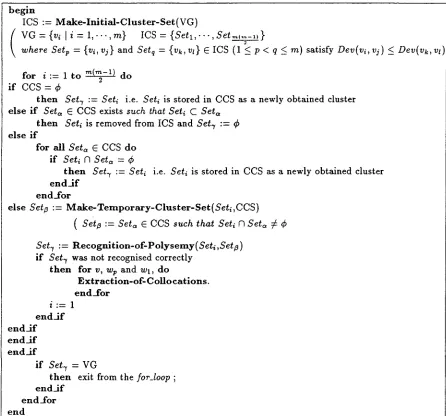
Figure 3 shows the flow of the clustering algo- rithm. As shown in ' ( ' in Figure 3, the func- tion M a k e - I n l t i a l - C l u s t e r - S e t applies to VG and produces all possible pairs of verbs with their semantic deviation values. The result is a list of pairs called the ICS (Initial Cluster Set). The CCS (Created Cluster Set) shows the clus- ters which have been created so far. The func- tion M a k e - T e m p o r a r y - C l u s t e r - S e t retrieves the clusters from the CCS which contain one of the verbs of
Seti.
The results(Set~3) are
passed to the function R e e o g n i t i o n - o f - P o l y s e m y , which determines whether or not a verb is polysemous. Let v be an element included in bothSeti
andSet 3.
To determine whether v has two senseswp,
wherewp
is an element ofSeti,
and wl, where wl is an element ofSet3,
we make two clusters, as shown in (4) and their merged cluster, as shown in (5).{vl, wp}, {v=, wl,---,
(4)
{v,
wp,---,
(5)
Here, v and wp are verbs and wl, • • -, w,~ are verbs or hypothetical verbs, wl, "-', wp, -.-, w,~ in (5) satisfy
Dev(v, wi) < Dev(v,wj)
(1 < i _< j < n). vl and v2 in (4) are new hypothetical verbs which correspond to two distinct senses of v.If v is a polysemy, but is not recognised cor- rectly, then E x t r a c t i o n - o f - C o l l o c a t i o n s shown in Figure 2 is applied. In E x t r a c t i o n - o f - C o l l o c a t i o n s , for (4) and (5), a and /3 are es- timated so as to satisfy (6) and (7).
D,v(,.,,,~,,)_< O~v(,,~,,,-.-,~,,,,.-,,=n)
(6)
Dev(v2,w,,...,w,~) < Oev(v,w,,...,wp,..,,w,~)
(7)
The whole process is repeated until the newly ob- tained cluster,
Setx,
contains all the verbs in the input or the ICS is exhausted.5 W o r d S e n s e D i s a m b i g u a t i o n
We used the result of our clustering analysis, which consists of pairs of collocations of a distinct sense of a polysemous verb and a noun.
Let v has senses vl, v2, "--, v,~. The sense of a polysemous verb v is vi (1 < i < m) if
t ~ -
Ej
Mu(vi,ni)
is largest amongEj
Mu(vl,nj),
• .. and
Et~ Mu(v,~,nj).
Here, t is the number of nouns which co-occur with v within the five-word distance.6 E x p e r i m e n t
This section describes an experiment conducted to evaluate the performance of our method.
6.1 D a t a
The data we have used is 1989
Wall Street Jour-
nal
(WSJ) in A C L / D C I C D - R O M which consists of 2,878,688 occurrences of part-of-speech tagged words (Brill, 1992). The inflected forms of the same nouns and verbs are treated as single units. For example, ' b o o k ' and ' b o o k s ' are treated as sin- gle units. We obtained 5,940,193 word pairs in a window size of 5 words, 2,743,974 different word pairs. From these, we selected collocations of a verb and a noun.As a test data, we used 40 sets of verbs. We selected at most four senses for each verb, the best sense, from among the set of the Collins dictionary and thesaurus (McLeod, 1987), is determined by a h u m a n judge.
6 . 2 R e s u l t s
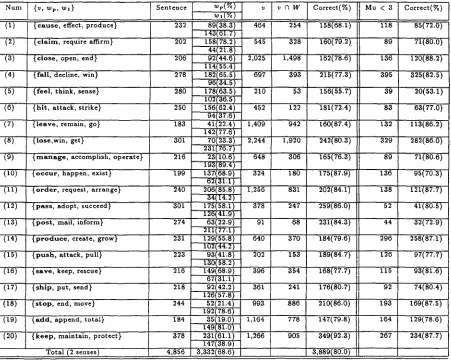
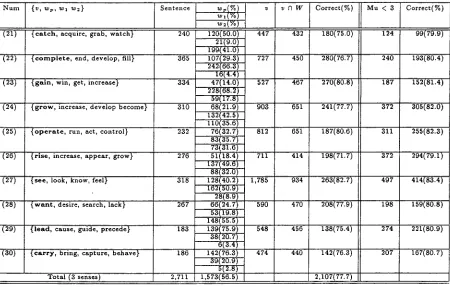
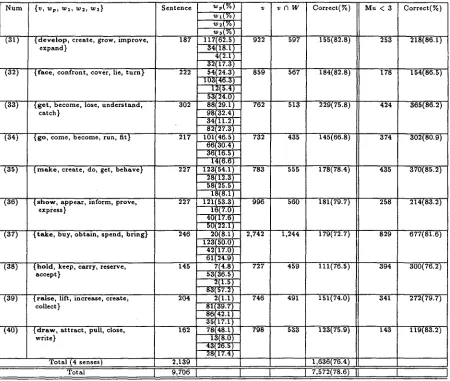
The results of the experiment are shown in Table 2, Table 3 and Table 4.
In Table 2, 3 and 4, every polysemous verb has two, three and four senses, respectively. Column 1 in Table 2, 3 and 4 shows the test data. The verb v is a polysemous verb and the remains show these senses. For example, ' c a u s e ' of (1) in Table 2 has two senses, 'effect' and 'produce'. 'Sentence' shows the number of sentences of occurrences of a polysemous verb, and column 4 shows their dis- tributions. ' v ' shows the number of polysemous verbs in the data. W in Table 2 shows the num- ber of nouns which co-occur with wp and wl. v n W shows the number of nouns which co-occur with both v and W. In a similar way, W in Table 3 and 4 shows the number of nouns which co-occur with wp ~ w2 and wp ~ w3, respectively. 'Correct' shows the performance of our method. 'Total' in the b o t t o m of Table 4 shows the performance of 40 sets of verbs.
Proceedings of E A C L '99
b e g i n
ICS := M a k e - I n i t i a l - C l u s t e r - S e t ( V G )
v o = {v~ l i = 1 , . . . , m} I t s = { s a l , - - - ,
Set.,,,,;-,, }
where Setp = {vi, vj} and Setq = {vk,vt} E ICS (1 ~ p < q < m) satisfy Dev(vi, vj) < Dev(vk,vt
for i : = 1 t o ~ d o
i f CCS = ¢
t h e n Set 7 := Set~ i.e. Seti is stored in CCS as a newly obtained cluster e l s e i f Set a E CCS exists such that SeQ C Seth
t h e n Seti is removed from ICS and Set 7 := ¢ else i f
f o r all Seth E CCS d o i f Setl fq Set,, = ¢
t h e n Set 7 := Seti i.e. Seti is stored in CCS as a newly obtained cluster e n d _ i f
e n d _ f o r
else Setz := M a k e - T e m p o r a r y - C l u s t e r - S e t ( Set~,CCS) ( Set~ := Seth E CCS such that Seti M Seta ~£ ¢ Set 7 := R e c o g n l t i o n - o f - P o l y s e m y ( Seti,Set~ )
i f Set 7 was not recognised correctly t h e n f o r v, wp and wl, d o
E x t r a c t l o n - o f - C oUo c a t i o n s .
e n d . . f o r i : = 1
e n d _ i f end_.if e n d _ i f e n d _ i f
i f Set 7 = VG
t h e n exit from the for_loop ; e n d _ i f
end_.for
e n d
Figure 3: Flow of the algorithm
Mu < 3 shows the number of nouns which satisfy Mu(wp,n) < 3 or Mu(wt,n) <3. 'Correct' shows the total number of collocations which could be estimated correctly. Table 2 ~ 4 show that the frequency of v is proportional to that of v M W. As a result, the larger the number of v M W is, the higher the percentage of correctness of collo- cations is.
7 R e l a t e d W o r k
Unsupervised learning approaches, i.e. to de- termine the class membership of each object to be classified in a sample without using sense- tagged training examples of correct classifications, is considered to have an advantage over supervised learning algorithms, as it does not require costly
hand-tagged training data.
[image:5.596.70.516.61.477.2]Proceedings of E A C L '99
Table 2: T h e result of disambiguation experiment(two senses)
(6)
[ _ _
122
"-~cause~ e~'ect ~
•
require a-~"-Telose, open,
~
rrect(~"-'(fall, decline, win} ] 278
"-~feel, think, sense T T 280
{hit, attack, strike} I 250 {leave, remain, go} [ 183
gcty
t
~Olaccomplish, operate'}-- 216
--{occur, happen, ~
--{order, request, a r r a n g e - ' ~ " ~ 240
"-~ass, adopt, ~
274
-'~roduce, create, g r o ' ~ ~ " - - " " 2 ~
--~ush, attack, pull~
-~s~ve,
223
"-{ship, put, send}
{stop, end, move} {add, append, total}
{keep, maintain, protect}
Total
215(77.3
181(72.4 160(87.4
349(92.3)
~ - ~ Correct(%)]
83(77.0) 113(86.2)
I
169(87.5) J
Yarowsky used an unsupervised learning pro- cedure to perform noun W S D (Yarowsky, 1995). This algorithm requires a small number of training examples to serve as a seed. T h e result shows t h a t the average percentage attained was 96.1% for 12 nouns when the training d a t a was a 460 million word corpus, although Yarowsky uses only nouns and does not discuss distinguishing more than two senses of a word.
A more recent unsupervised approach is de- scribed in (Pedersen and Bruce, 1997). T h e y presented three unsupervised learning algorithms t h a t distinguish the sense of an ambiguous word in untagged text, i.e. M c Q u i t t y ' s similarity analysis, Ward's minimum-variance m e t h o d and the EM al- gorithm. These algorithms assign each instance of an ambiguous word to a known sense definition based solely on the values of automatically iden- tifiable features in text. Their methods are per- haps the most similar to our present work. T h e y
reported t h a t disambiguating nouns is more suc- cessful rather t h a n adjectives or verbs and the best result of verbs was M c Q u i t t y ' s m e t h o d (71.8%), although they only tested 13 ambiguous words (of these, there are only 4 verbs). Furthermore, each has at most three senses. In future, we will compare our m e t h o d with their m e t h o d s using the d a t a we used in our experiment.
8
C o n c l u s i o n
[image:6.596.76.527.98.459.2]Proceedings of E A C L '99
Nunl
(21)
(22)
(23)
(24)
(2s)
(26)
(27)
(28)
(29)
(30)
Table 3: The result of disambiguation experiment(three senses)
{catch, acquire, grab, watch}
{complete, end, develop, fill} {gain, win, get, increase} {grow, increase, develop become}
{operate, run, act, control}
{rise, increase, appear, grow}
{see, look, know, feel}
{want, desire, search, lack}
{lead, cause, guide, precede}
{carry, bring, capture, behave}
Total (3 senses)
Sentence w__w__w__w__w__w__~ v v N HI Correct(%) Mu < 3 Correct(%) 240 120(50.0) 447 432 180(75.0) 124 99(79.9)
21(9.0)
199(41.0)
365 107(29.3) 727 450 280(76.7) 240 193(80.4) 242(66.3)
16(4.4)
334 47(14.0) 527 467 270(80.8) 187 152(81.4)
228(68.2) 59(17.8)
310 68(21.9) 903 651 241(77.7) 372 305(82.0)
132(42.5) 11o(35.6)
232 76(32.7) 812 651 187(80.6) 311 255(82.3)
83(35.7)
73(31.6)
276 51(18.4) 711 414 198(71.7) 372 294(79.1) 137(49.6)
88(32.0)
318 128(40.2) 1,785 934 263(82.7) 497 414(83.4) 162(50.9)
28(8.9~
267 66(24.7) 590 470 208(77.9) 198 159(80.8)
53t19.8) 148(55.5)
183 139(75.9) 548 456 138(75.4) 274 221(80.9) 38(20.7)
6(3.4)
186 142(76.3) 474 440 142(76.3) 207 167(80.7) 39(20.9)
5(2.8)
2,711 1,573(56.5) 2,107(77.7)
method to not only a verb but also a noun and an adjective sense disambiguation to evaluate our method.
A c k n o w l e d g m e n t s
T h e authors would like to thank the reviewers for their valuable comments. This work was sup- ported by the Grant-in-aid for the J a p a n Society for the Promotion of Science(JSPS).
R e f e r e n c e s
E. Brill. 1992. A simple rule-based part of speech tagger. In Proc. of the 3rd Conference on Ap- plied Natural Language Processing, pages 152- 155.
R. Bruce and W. Janyce. 1994. Word-sense dis- ambiguation using decomposable models. In Proc. of the 32nd Annual Meeting, pages 139- 145.
K. W. Church, W. Gale, P. Hanks, and D. Hindte. 1991. Using statistics in lexical analysis. In Lezical acquisition: Ezploiting on-line resources to build a lezicon, pages 115-164. (Zernik Uri (ed.)), London, Lawrence Erlbaum Associates.
I. Dagan, P. Fernando, and L. Lilian. 1993. Con- textual word similarity and estimation from sparse data. In Proc. of the 31th Annual Meet- ing of the ACL, pages 164-171.
F. Fukumoto and J. Tsujii. 1994. Automatic recognition of verbal polysemy. In Proc. of the 15th COLING, Kyoto, Japan, pages 762-768. W. K. Gale, K. W. Church, and D. Yarowsky.
1992. A method for disambiguating word senses in a large corpus. In Computers and the Hu- manities, volume 26, pages 415-439.
A. K. Luk. 1995. Statistical sense disambiguation with relatively small corpora using dictionary definitions. In Proc. of the 335t Annual Meeting of ACL, pages 181-188.
W. T. McLeod. 1987. The new collins dictionary and thesaurus in one volume. London, Harper- Collins Publishers.
G. Miller, C. Martin, L. Shari, L. Claudia, and R. G. Thomas. 1994. Using a semantic concor- dance for sense identification. In Proc. of the ARPA Workshop on Human Language Technol- ogy, pages 240-243.
[image:7.596.77.527.97.384.2]Proceedings of EACL '99
Table 4: The result of disambiguation experiment(four senses)
Num {v, wp, wl, w~, wa}
(31) {develop, create, grow, improve, 187 expand}
(32) {face, confront, cover, lie, turn} 222
(33) {get, become, lose, understand, 302 catch}
(34) {go, come, become, run, fit}
(35) {make, create, do, get, behave} 227
(36) {show, appear, inform, prove, 227 expi'ess}
(37) {take, buy, obtain, spend, bring} 246
Sentence wp(%) v v N W Correct(%) M u < 3 Correct(%)
w~(%)
117(62.5) 922 597 155(82.8) 253 218(86.1)
34118.1 )
412.1)
32(17.3)
54(24.3) 859 567 184(82.8) 178 154(86.5)
103(46.3)
12(s.4)
53(24.0}
88(29.1) 762 513 229(75.8) 424 365(86.2)
98(~2.4) 34(11.21
82(27.3)
217 101(46.5) 732 435 145(66.8) 374 302(80.9) 66(30.4)
36(16.5) 14(6.6)
123(54.1) 783 555 178(78.4) 435 370(85.2)
28(12.3) 58(25.5)
18(8.1)
121(53.3) 996 560 181(79.7) 258 214(83.2) 16(7.0)
40(17.6)
50(22.1)
20(8.1) 2,742 1,244 i79(72.7) 829 677(81.6)
123(5o.o) 42(17.o}
6i(24.9)
7(4.81 727 459 111(76.5) 394 300(76.2)
53(36.5) 2(1.5)
83(57.2)
2(1.1) 746 491 151(74.0) 341 272(79.7) 81(39.7}
8614~.1 }
35(17.1)
78(48.1) 798 533 123(75.9) 143 119(83.2)
13(8.o)
43(26.5)
~8(17.4)
(as)
(39)
(40)
{hold, keep, carry, reserve, 145 accept }
{raise, lift, increase, create, 204 Collect}
{draw, attract, pull, close, 162 write}
Total (4 senses) I Tot al
2,139 11636(76.4)
[ 9,706[ [ [ 7,572(75.6) II I I
sense: An examplar-based approach. In Proc. of the 34th Annual Meeting of ACL, pages 40- 47.
Y. Niwa and Y. Nitta. 1994. Co-occurrence vec- tors from corpora vs. distance vectors from dic- tionaries. In Proc. of 15th COLING, Kyoto, Japan, pages 304-309.
T. Pedersen and R. Bruce. 1997. Distinguishing word senses in untagged text. In Proc. of the 2nd Conference on Empirical Methods in Natu- ral Language Processing, pages 197-207.
H. Schutze. 1992. Dimensions of meaning. In Proc. of Supercomputing, pages 787-796. Y. Wilks and M. Stevenson. 1998. Word sense dis-
ambiguation using optimised combinations of knowledge sources. In Proe. of the COLING- ACL'98, pages 1398-1402.
D. Yarowsky. 1992. Word sense disambiguation using statistical models of roget's categories trained on large corpora. In Proc. of the l$th
COLING, pages 454--460.
D. Yarowsky. 1995. Unsupervised word sense dis- ambiguation rivaling supervised methods. In Proc. of the 33rd Annual Meeting of the ACL, pages 189-196.
[image:8.596.74.524.87.468.2]