Dries Hauptfleisch
Facilities management: an analysis
of evolving educational needs in a
developing profession
Peer reviewed Abstract
Internationally the development of property, being part of the creation of fixed investment and wealth, is taking place unabated. The absence of a universally acknowledged profession, designated to manage and optimise the utilisation of the ever compounding fixed investments in the products of the collective built environment (buildings, engineering structures and infrastructure), is observed. In practice it manifests itself in the attempts, by various professions and others, to cast themselves into the role of facilities managers. The problem at hand is to extract, from the present practice of facilities management, a knowledge profile and secondly to contextualise the results in terms of other applicable managerial concepts. The main objective is to structure a tertiary education programme. There are reasons to believe that facilities management is in the process of becoming a driving force, not only in the scientific management and optimisation of fixed assets, but as an initiator of development in the built environment. A literature study was undertaken to make an overview analysis and a limited statistical sample was made regarding the views of practising del-egates attending continuing education short training courses in facilities man-agement. The outcomes indicate some consistent omissions in the literature, while the views of practitioners contribute to form an overview.
Keywords: Facilities management, knowledge profile, managerial concepts, built environment
Abstrak
Internasionaal vind eiendomsontwikkeling, as voertuig vir die skep van vaste-investering en welvaart, onverpoosd plaas. Die afwesigheid van ’n universele erkende professie, aangewese om die groeiende vaste-investering produkte van die kollektiewe bou-omgewing (geboue, ingenieurstrukture en infrastruk-tuur) te bestuur en te optimiseer, is opvallend. In praktyk word dit gemanifesteer deurdat verskeie professies en andere, hulself in die rol van fasiliteitbestuur-ders bevind. Die probleem ter sake is om uit huidige fasiliteitbestuurpraktyke ’n kennisprofiel saam te stel en tweedens, die resultate daarvan binne kon-teks van ander toepaslike bestuurskonsepte te plaas. Die hoof oogmerk is om struktuur te verleen aan ’n tersiêre onderwysprogram. Daar is rede om te glo dat fasiliteitbestuur in die proses is om ’n dryfveer te word, nie net ten aansien van die wetenskaplike bestuur van, en optimisering van vaste-investering nie, maar as inisieerder van ontwikkeling in die bou-omgewing. ’n Literatuurstudie
is onderneem om oorkoepelende waarnemings in dié verband te maak en ’n beperkte statistiese opname is gemaak aangaande die sienswyses van prak-tisyns tydens deelname aan voortgesette onderwys kortkursusse in fasiliteitbes-tuur. Die uitkoms van voorgaande dui op konsekwente onderbeklemtoning van sekere aspekte in die literatuur, terwyl die sienswyses van praktisyns ’n bydrae lewer om ’n oorsigtelike beeld daar te stel.
Sleutelwoorde: Fasiliteitbestuur, kennisprofiel, bestuurskonsepte, bou-omgewing
1.
Introduction
Investment in properties, as fixed assets, is growing continuously internationally. These property development activities are served by a multitude of highly skilled professionals such as engineers, archi-tects, quantity surveyors, construction managers, project managers, town planners, land surveyors and others. The absence of a univer-sally acknowledged profession of the same standing, designated to manage and optimise the utilisation of the ever compounding fixed investments in the products of the collective built environment (buildings, engineering structures and infrastructure), is remarkable. This situation may be explained by the fact that, in the present day accepted vocabulary, facilities management as a managerial concept developed in the United States of America only during the 1970’s, when a Facilities Management Institute was founded and the first known formal symposium was held in Washington DC in 1989 (Binder, 1989). Though these events started approximately 30 years ago, the development and spread were slow, and in comparison with the other built environment professions, it is still in its infancy. However, although perhaps lacking some of the prestige associated with other professions, there are reasons to believe that facilities management is one of the fastest growing ’new professions’ in the built environment. Furthermore, it is becoming evident that facilities management is in the process of becoming a driving force, not only of scientific management and optimisation of fixed assets, but as an initiator of development in the built environment.
2.
Methodology
educational needs in a developing profession
Figure 1: Facilities Management in context of Asset Management • STRUCTURE OF PORTFOLIO
• STRATEGIC VISION/CREATIVITY/PLANNING • GEOGRAPHICS/DEMOGRAPHICS • LIFE CYCLE
• FINANCE • ETC
• OWNER/TENANT RELATIONS • TENANT/CHURN MANAGEMENT • POST OCCUPANCY EVALUATION • ENVIRONMENTAL (SHEQ) • SPACE PLANNING • FM STRATEGY/TACTICS • ETC
• MAINTENANCE (PLANNED)/REPAIRS/RESTORE/UPGRADE • CLEANING/HYGIENE
• ETC
ASSET MANAGEMENT
BUILDINGS/ INFRASTRUCTURE/ CONSTRUCTION (MAINLY FIXED ASSETS)
PROPERTY DEVELOPMENT
PROPERTY MANAGEMENT
FACILITIES MANAGEMENT
MAINTENANCE MANAGEMENT
INVESTMENT STRATEGY
RENT COLLECTION
• HUMAN RESOURCES • SYSTEMS
[image:3.421.80.357.61.489.2]of overall asset management, within an enterprise that holds built environment assets. This diagramme was tested for general correct-ness by subjecting it to 6 different groups of facility management practitioners taking part in continuing education short courses over a period of four years.
From the above it is clear that the research done was not hypoth-esis testing. The intention was to establish current thinking regarding facilities management, thus contributing towards the development of academic programmes, pre-empting the needs of industry, result-ing in a structured knowledge profile.
3.
Validation of literature
educational needs in a developing profession
4.
Under-emphasised knowledge areas
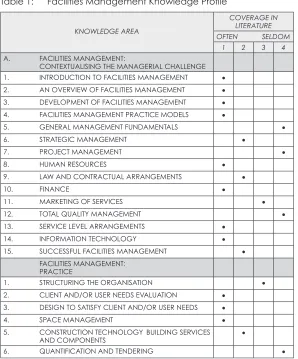
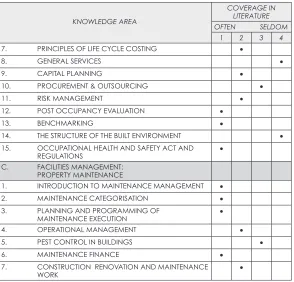
[image:5.421.71.369.181.540.2]The knowledge areas that are perceived as important for practic-ing facilities management and the relevant emphasis of each in the surveyed literature are reflected in Table 1. This analysis is not sub-stantiated by quantitative and triangulated research procedures, but has value as an attempt to observe general tendencies to under-emphasise perceived important knowledge areas, required in a validated knowledge profile for the development and practice of facilities management.
Table 1: Facilities Management Knowledge Profile
KNOWLEDGE AREA
COVERAGE IN LITERATURE OFTEN SELDOM
1 2 3 4
A. FACILITIES MANAGEMENT:
CONTEXTUALISING THE MANAGERIAL CHALLENGE
1. INTRODUCTION TO FACILITIES MANAGEMENT •
2. AN OVERVIEW OF FACILITIES MANAGEMENT •
3. DEVELOPMENT OF FACILITIES MANAGEMENT •
4. FACILITIES MANAGEMENT PRACTICE MODELS •
5. GENERAL MANAGEMENT FUNDAMENTALS •
6. STRATEGIC MANAGEMENT •
7. PROJECT MANAGEMENT •
8. HUMAN RESOURCES •
9. LAW AND CONTRACTUAL ARRANGEMENTS •
10. FINANCE •
11. MARKETING OF SERVICES •
12. TOTAL QUALITY MANAGEMENT •
13. SERVICE LEVEL ARRANGEMENTS •
14. INFORMATION TECHNOLOGY •
15. SUCCESSFUL FACILITIES MANAGEMENT •
FACILITIES MANAGEMENT: PRACTICE
1. STRUCTURING THE ORGANISATION •
2. CLIENT AND/OR USER NEEDS EVALUATION •
3. DESIGN TO SATISFY CLIENT AND/OR USER NEEDS •
4. SPACE MANAGEMENT •
5. CONSTRUCTION TECHNOLOGY BUILDING SERVICES
AND COMPONENTS •
KNOWLEDGE AREA
COVERAGE IN LITERATURE OFTEN SELDOM
1 2 3 4
7. PRINCIPLES OF LIFE CYCLE COSTING •
8. GENERAL SERVICES •
9. CAPITAL PLANNING •
10. PROCUREMENT & OUTSOURCING •
11. RISK MANAGEMENT •
12. POST OCCUPANCY EVALUATION •
13. BENCHMARKING •
14. THE STRUCTURE OF THE BUILT ENVIRONMENT •
15. OCCUPATIONAL HEALTH AND SAFETY ACT AND
REGULATIONS •
C. FACILITIES MANAGEMENT:
PROPERTY MAINTENANCE
1. INTRODUCTION TO MAINTENANCE MANAGEMENT •
2. MAINTENANCE CATEGORISATION •
3. PLANNING AND PROGRAMMING OF
MAINTENANCE EXECUTION •
4. OPERATIONAL MANAGEMENT •
5. PEST CONTROL IN BUILDINGS •
6. MAINTENANCE FINANCE •
7. CONSTRUCTION RENOVATION AND MAINTENANCE
WORK •
[image:6.421.59.353.55.337.2]5.
Analysis of continuing education short courses
evaluation
educational needs in a developing profession Table 2: Recommendations for Programme Content Weighting
KNOWLEDGE AREAS ACTUAL LECTURE
% RECOMMENDED LECTURE %
Management (assets property
facility general) 35 34.1
Client care 6 7.1
Finance 15 13.9
Legal 18 17 2
Quality 13 12.9
Maintenance 13 14 8
Total 100 100
From the results reflected in Table 2 it is concluded that the respond-ents that have attended continuing education short courses, are satisfied that the course content is on target.
6.
Conclusions
It may be concluded that the knowledge gained from offering con-tinuing education short courses, expanded with the analysis of a lit-erature survey and non-quantified observations of academia and practice, a first attempt in structuring a knowledge profile of facili-ties management renders useful information. Being a “new” disci-pline makes it a moving target that requires continuous evaluation and development, particularly regarding the structuring of a tertiary education programme.
The next step to be taken is the structuring of a three year educa-tional programme on Naeduca-tional Qualification Framework (NQF) Level 6, in order to satisfy the perceived needs of industry. The proposed contents of this programme are to be subjected to quantified evalu-ation by prospective students as well as by organised industry. Once the educational programme has been introduced, continuous evaluation processes will be implemented to further develop evolv-ing educational needs, to be reflected in a facilities management knowledge profile.
References
Barret, P. & Baldry, D. 2006. Facilities management: Towards best practice. 2ed. Oxford: Blackwell Science.
Best, R., Langston, C. & de Valence, G. 2003. Workplace strategies and facilities management. Oxford: Butterworth Heinemann. Binder, S. 1989. Corporate facility planning. An inside view for design-ers and managdesign-ers. New York: McGraw-Hill Book Co.
Cloete, C. (ed.) 2001a. Principles of property maintenance. Sand-ton: The South African Property Education Trust.
Cloete, C. (ed.) 2001b. Risk management in property. Sandton: The South African Property Education Trust.
Cloete, C. (ed.) 2002a. Management of commercial and industrial properties. Sandton: The South African Property Education Trust. Cloete, C. (ed.) 2002b. Introduction to facilities management. Sand-ton: The South African Property Education Trust.
Collins, J.C. & Porras, J.I. 2000. Built to last. London: Random House Business Books.
Cornwell, P.B. 1973. Pest Control in Buildings. London: Hutchinson Benham Ltd.
Cotts, G.C. & Rondeau, E.P. 2004. The facility manager’s guide to finance and budgeting. New York: American Management Association.
Crocker, A. 1990. Building failures: Recovering the cost. Oxford: BSP Professional Books.
De Vries, M.K. 2001. The leadership mystique. London: Prentice Hall. Gross, J.M. 2002. Fundamentals of preventive maintenance. New York: American Management Association.
Grulke, W. & Silber, G. 2001. Lessons in radical innovation. Johannes-burg: @One Communications.
Friday, S. & Cotts, D.G. 1995 Quality facility management: A market-ing and customer service approach. New York: John Wiley & Sons, Inc.
Hauptfleisch, A.C. (ed.) 1999. Building practice, Volume 1&2. Sand-ton: The South African Property Education Trust.
Hauptfleisch, A.C. & Sigle, H.M. 2007. Structure of the built environ-ment in South Africa. 4th ed. Pretoria: CONQS.
educational needs in a developing profession Means, R.S. 1996. Cost planning and estimating for facilities mainte-nance. Kingston: R S Means Company, Inc.
Owen, D.D. 1993. Facilities planning and relocation. Kingston: R S Means Company, Inc.
Pearce, J.A. & Robinson, R.B. 2000. Strategic management: Formula-tion, implementaFormula-tion, and control. 7th ed. Singapore: McGraw-Hill. Project Management Institute, Inc. 2004. A guide to the project management body of knowledge. 3rd ed. Pennsylvania: Project
Management Institute, Inc.
Robinson, R.R. (ed.). 1999. Issues in security management: Thinking critically about security. Oxford: Butterworth Heinemann.
Rondeau, P.R., Brown, R.K. & Lapides, P.D. 2006. Facility manage-ment. 2nd ed. Hoboken: John Wiley & Sons, Inc.
Seely, I.H. 1987. Building maintenance. 2nd ed. London: Macmillan Education Ltd.