R e t r i e v i n g Collocations From Korean Text
Seonho Kim, Zooil Yang, Mansuk Song
{pobi, zooil, mssong}@december.yonsei.ac.kr Dept. of C o m p u t e r Science,
Yonsei University, Seoul, Korea
Jung-Ho
A h nj u n g h o @ m a t h . y o n s e i . a c . k r Dept. of M a t h e m a t i c s , Yonsei University, Seoul, K o r e a
A b s t r a c t
This paper describes a statistical methodology ibr automatically retrieving collocations from POS tagged Korean text using interrupted bi- grams. The free order of Korean makes it hard to identify collocations. We devised four statis- tics, 'frequency', 'randomness', 'condensation', and 'correlation' .to account for the more flexible word order properties of Korean collocations. We extracted meaningful bigrams using an eval- uation ihnction a n d extended the bigrams to n-gram collocations by generating equivalence sets, a-covers. We view a modeling problem for n-gram collocations as that for clustering of co- hesive words.
1 I n t r o d u c t i o n
There have been many theoretical and applied works related to collocations. A rapidly grow- ing awfilability of copora has attracted interests m statistical methods for automatically extract- mg ¢:o]loeations from textual corpora. However, it is not easy to )dentify the central tendencies of collocation distribution and the borderlines of criteria are often fuzzy because the expres- sions can be of arbitrary lengths in a large va- riety of forms. Getting reliable collocation pat- terns is particularly difficult in Korean which allows arguments to scamble so freely. This paper presents a statistical method using 'in- terrupted bigrams' for automatically retrieving ~:ollocations and idiomatic expressions from Ko- rean text. We suggest several statistics to ac- count for the more flexible word order.
If the distribution of a random sample is un- known, we often try to make inferences about its properties described by suitably defined mea- sures. For the properties of arbitrary collocation distribution, four measure statistics: ' h i g h fre- q u e n c y ' , ' c o n d e n s a t i o n ' , ' r a n d o m n e s s ' , and
' c o r r e l a t i o n ' were devised.
Given a morpheme, our system begins by re- trieving the frequency distributions of all bi- grams within window and then meaningful bi- grams are extracted. We produce a-covers to extend them into n-gram collocations 1
According to the definition of Kjellmer and Cowie, a fossilized phrase is a sequence, where the occurrence of one word almost predicts the rest of the phrase and one word predicts a very limited number of words in a semi-fossilized phrase (Kjellmer, 1995) (Cowie, 1981). How- ever, in both fossilized and semi-fossilized types there is a high degree of cohesion among the members of the phrases (Kjellmer, 1995). We consider the cohesions as a-covers that are ob- tained by applying a fuzzy compatibility rela- tion, which satisfies symmetry and reflexivity, to meaningful bigrams. Namely, n-gram collo- cations could be interpreted as equivalent sets of the meaningful bigrams through partitioning. Here, a-covers mean the clustered sets of the meaningful bigrams.
2 R e l a t e d W o r k s
In determining properties of collocations, most of corpus-based approaches accepted that the words of a collocation have a particular statisti- cal distribution(Cruse, 1986). Although previ- ous approaches have shown good results in re- trieving collocations and many properties have been identified, they depend heavily on the fre- quency factor.
(Choueka et al., 1983) proposed an algorithm for retrieving only uninterrupted collocations, 2
IBigrams and n-grams can be either adjacent mor- phemes or separated morphems by an arbitrary number of other words.
sin(:e ,:hey assumed that a collocation is a se- ,lu¢'n(:e of adjacent words that frequently ap- l:,(~ar t~)gether. (Church and Hanks, 1989) de- lhw:(I ;t collocation as a pair of correlated words :m(i ,,se(t m u t u a l information to evaluate such ],~xi(:a,1 (:orrelations of word pairs of length two. T h e y retrieved interrupted word pairs, as well as , m i n t e r r u p t e d word pairs. (Haruno et al., 1996) ,:onstructed collocations by combining adjacent n-grams with high value of m u t u a l information. (Brei(lt, 1993)'s s t u d y was motivated by the fact than m u t u a l information could not give realistic figures to low fl'equencies and used t-score for a significance test for V-N combinations.
Martin noted that a span of 5 words on left nnd right sides captures 95% of significant collo- (:ations in English (Martin, 1983). Based on this assumption, (Smadja, 1993) stored all bigrams of words along with their relative position, p (-5 < p _~ 5). He evaluated the lexical strength of a word pair using ' Z - s c o r e ' and the variance of its t)osil;ion distribution using ' . s p r e a d ' . He defined ~,. (:()]location as an arbitary, domain dependent, recurrent, and cohesive lexical cluster.
(Nagao and Mori, 1994) developed an algo- r i t h m tbr calculating adjacent n-grams to an ar- 1)itrary large n u m b e r of n. However, it was hard to find an efficient n and a lot of fragments were obtained. In Korean, statistics based on adja- cent n-grams is not sufficient to capture various types of collocations. (Shimohata et al., 1997) employed entropy value to filter out fragments of the adjacent n-gram model. T h e y evaluated disorderness with the distribution of adjacent words preceding and following a string. The strings with a high value of entropy were ac- (:epted as collocations. This disorderness is ef- fi(:ient to eliminate fragments but can not han- (lle i n t e r r u p t e d collocations. In general, previ- ous ;studies on collocations have dealt with re- stricted types and d e p e n d on filtering measures in a lexically point of view.
3 I n p u t F o r m a t
In this section, we discuss an input form rele- vant to Korean language structure and linguis- tic contents which would work well on an effi-
m f i n t e r r u p t e d c o l l o c a t i o n is a s e q u e n c e of words• To ~tvoid c o n f u s i o n of t e r m s , we call a s e q u e n c e of two words as ~ ' a ( l j a c e n t b i g r a m ' a n d a s e q u e n c e of n w o r d s as a • a d ? a c c n t n - g r a m ~.
cient statistics. Korean is one of agglutinative languages as well as a propositional language. An elementary node being called as ' e o j e o l ' is generally composed of a content word and func- tion words. Namely, a word in English corre- sponds to a couple of morphemes in Korean.
A key feature of Korean is t h a t h m c t i o n words, such as propositions, endings, copula, auxiliary verbs, and particles, are highly devel- oped as independent morphemes, while t h e y are represented as word order or inflections in En- glish. Functional morphemes d e t e r m i n e gram- matical relations, tense, modal, and aspect. In Korean, there are lots of multiple function words in a rigid forms. T h e y can be viewed as collocations. For this reason, our system is designed at the morphological level. A set of twelve part of speech tags, { N, J, V, P, D, E, T, O, C, A, S, X } 3 was considered.
A n o t h e r feature is a free word order. Since the words of a collocation appear in text with the flexible ways, sufficient samples are required to compute accurate probabilities. We allow po- sitional information to vary by using an inter- r u p t e d bigram model.
The basic input can be represented in (1). An object k means a pair of m o r p h e m e s (mi,mk) and mk corresponds to one of all possible mor- phemes, being able to co-occur with mi. A vari- able j indicates the j - t h position. Xij denotes the frequency of mk t h a t occurs at the j - t h po- sition before mi.
Xi1 X12 X21 X2~
X i = . .
Xnl Xn2
Given a predicate
Xll° /
X210
XnlO
(1)
m o r p h e m e as a base mor- pheme, the range of window is from -1 to -10. This distance constraint is for the characteris- tic of SOV language. If a bigram includes an adverb morpheme, a larger window, from -20 to 10 is used because the components often appear widely separated from each other on text. In other cases, we considered the range from -5 to +5. This distant constraints are for an efficient statistics.
An input d a t a is transformed to a p r o p e r t y matrix, T(Xi) as (2) t h a t is a two dimensional
Cn~,m,)
(o}~1,o~ol) (drink,much) (3}~l,t--t ~ = ) (drink,too) (Ot h l,gt) (~nk,~lcan) (3t,~l,OH °J) (drink, everyday) (fl[hl,~OI) (drink,boil) (OtJ, l,~) (drink,,iot) (Ot~,l,@~l) (drink,t.bgether) ( 0 ~ 1 , ~ ==~) (drink, a tittle) ( O H , ~ ) (drink,take) ( O t A I , _ ~ ) (drink, a little)
syntactic
relation VD VD VJ VD W VD VD VD W VD
preferring position
1 2 4 3 2 1 3 1 2 3
Figure 1: meaningful b i g r a m s of ~[z](drink) by X t r a c t
~rr~:~y of k object.s, k = 1,2,...,n, on four vari-
~t,|)les, V Frequency ~ VCondensation , V Randomness ,
~md V c o r r e l a t i o n.
½F ½c ½R ½cR
T ( X i ) = '. . . .
~ F ~ c ~ R ~ c R
(2)
~]~) continue explanations, we begin by men- tioning the 'Xtrgct' tool by Smadja (Smadja, 1993). Our i n p u t form was designed in a simi- lar m a n n e r with 'Xtract'. Smadja assumed that the components of a collocation should appear together in a relatively rigid way because of syn- tactic constraint. Namely, a bigram pair (mi,
'rnk),
where mk Occurs at one(or several) spe- (:ific position a r o u n d mi, would be a meaningful bigrams for collocations. T h e rigid word order is related with the variance of frequency distri-bution of (mi, ink). 'Xtract' extracted the pairs
whose variances are over a threshold and pulled out the interesting positions of t h e m by stan- dar(lizz~tion of the frequency distributions. Un- fbrtunately, the approach for English has sev- eral limitations to work 4 on Korean structure ibr the following 'reasons:
1. For free order languages such as Korean, words are widely distributed in text, so that positional variance affects the over- tiltering of Useful bigrams. Figure 1 shows that there is no pair which contains ran- domly distributed morphems such as func- tion words or nouns. This indicates that very few pairs were p r o d u c e d when 'Xtract' is applied to Korean.
4~We p o r t e d S m a d j a ' s X t r a c t t o o l i n t o a K o r e a n v e r - sion.
2. Suppose t h a t a meaning bigram, (mi, mk) prefers a position pj. Then, the n u m b e r of concordances for condition probability
P(mi, rnklpj)
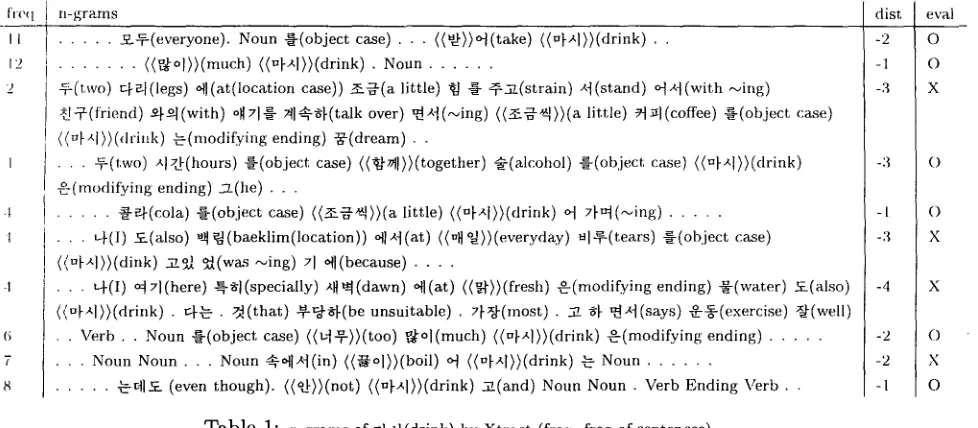
would be small, specially in a free order language. As shown in Table 1, the model p r o d u c e d a lot of long meaning- less n-grams when compiling into n-grams. The precision value of Korean version of Xtract was estimated to be 40.4%.3. The eliminated bigrams by the previous stage can appear again in n-gram colloca-
tions. W h e n compiling, the model only
keeps the words occupying the position with a probability greater t h a n a given threshold from the concordances of (mi,
ink, pj).
As one might imagine, the firststage could be useless.
As stated above, in Korean, the effect of po- sition on collocations needs to be t r e a t e d in some complex ways. Korean collocations can be divided into four types: 'idiom' 5, 'seman- tic collocation' 6, 'syntactic collocation' 7 and 'morphological collocation' s. Idioms and mor- phological collocations appear on text in a rigid way and word order but others do in the flex- ible ways. From a consideration of these more flexible collocations, we adopt an i n t e r r u p t e d bi- gram model and suggest several statistics t h a t consist with characteristics of Korean.
4
A l g o r i t h m
This section describes how properties are repre- sented as numerical values and how meaningful objects are retrieved. In the first stage, we ex- tract meaningful interrupted bigrams based on four properties. Next, the meaningful bigrams are extended into n-gram collocations using a a-compatibility relation.
It empirically showed that a Weibull distribu- tion (3) provides a close approximation of fre- quency distribution of bigrams.
F(x)=l-~ -"*~ o<x<~ ~ h ~ ~>0,~>0 (3)
5 I d i o m s h a v e n o a m b i g u o u s m e a n i n g b u t r e q u i r e s r i g i d p a t t e r n s t o p r e s e r v e t h e i d i o m a t i c m e a n i n g .
6 T h e r e p l a c e m e n t of s o m e c o m p o n e n t s b y o t h e r w o r d s is m o r e free t h a n i d i o m s .
~ T h e c o m b i n a t i o n of w o r d s is a f f e c t e d b y s e l e c t i o n M r e s t r i c t i o n s of p r e d i c a t e , n o u n , or a d v e r b .
[image:3.612.61.278.79.351.2]I'r('(l
II
12
'2
n - g r a m s
. . . _7_@(everyone). N o u n - ~ - ( o b j e e t c a s e ) . . . ((u,d-))o--I(take)(@l-z,l))(drink) . .
. . . ( ( , ~ o ] ) ) ( m u c h ) (@l-z]))(drink) . N o u n . . .
-7-(two) ct-N(legs) ~ ] ( a t ( l o c a t i o n c a s e ) ) ~ ( a little) ~ ~ ~ ( s t r a i n ) x-l(stand) o-lx-I(with ~ i n g )
~ ( f ' r i e n d ) N ' N ( w i t h ) °1t 71 .~- ~].~-¢l-(talk over) ~ x-I ( ~ i n g ) ( ( ~ - - I ) ) ( a little) ~1 ~l (coffee) ~ ( o b j e c t case)
( ( - I - x l ) ) ( d r i n k ) ~ ( m o d i f y i n g e n d i n g ) ~ ( d r e a m ) . .
• . . @ ( t w o ) z]~l-(hours) ~ ( o b j e c t case) ( ( ~ N l ) ) ( t o g e t h e r ) ~ ( a l c o h o l ) . ~ ( o b j e c t case) ( ( n l - x l ) ) ( d r i n k )
~ - ( m o d i ( y i n g e n d i n g ) .2.(he) . . .
. . . N-el-(cola) ~ ( o b j e c t case) ( ( ~ ' N " N ) ) ( a little) ( ( - I - z l ) ) ( d r i n k ) o-I 71-~l(~ing) . . .
. . . . I-(I) ~ ( a l s o ) " - t l N ( b a e k l i m ( l o c a t i o n ) ) ~lx-I(at) ( ( , l t ~ ) ) ( e v e r y d a y ) ~ l ~ ( t e a r s ) ~ ( o b j e c t case)
( @ P x l ) ) ( d i n k ) ~ , I ~ ( w a s ~ i n g ) 71 ~ l ( b e e a u s e ) . . . .
• . . L+(I) ~ 7 ] ( h e r e ) -U-el(specially) z l l ~ ( d a w n ) oJ](at) ((-N-})(fresh) - ~ - ( m o d i f y i n g e n d i n g ) -~-(water) Y_(also)
( ( u [ - q ) ) ( d r i n k ) . Oc-~- . ~ ( t h a t ) -~--~[-(be u n s u i t a b l e ) . 7~-×J-(most) . ~ N- ~ z ] ( s a y s ) ~r---~-(exercise) ~-(well)
• . V e r b . . N o u n .~-(object case) ((uJ-~-))(too) ~.~]:o](much) ((-~-z]))(drink) -G-(modifying e n d i n g ) . . .
• . . N o u n N o u n . . . N o u n ~-otix](in) ( ( - ~ o ] ) ) ( b o i l ) ~ ( @ ] - z i ) ) ( d r i n k ) .~ N o u n . . .
. . . -~-~1-7-. (even t h o u g h ) . ( ( ~ ) ) ( n o t ) ( @ } , q ) ) ( d r i n k ) ,.~_(and) N o u n N o u n . V e r b E n d i n g V e r b . .
Table 1: n - g r a m s of =l-zl(drink) by X t r a c t (freq: freq of s e n t e n c e s )
dist eval
-2 O
-1 O
-3 X
-3 O
-I O
-3 X
-4 X
-2 O
-2 X
-1 O
Thus, there are a lot of pairs with low frequency
which interrupt to get reliable statistic. We
clinfinated such pairs using median m that is a. value such t h a t
P{X > m} >
1/2 to a fre- quency distribution F. If median is less t h a n 3, we took the value 3 as a median.Any q u a n t i t y that depends on not any un- known p a r a m e t e r s of p o p u l a t i o n distribution b u t only the sample is called a statistic. We regarded four statistics relating to properties of (:ollocations as variables. Before the further ex- plauation, consider
Sm~,
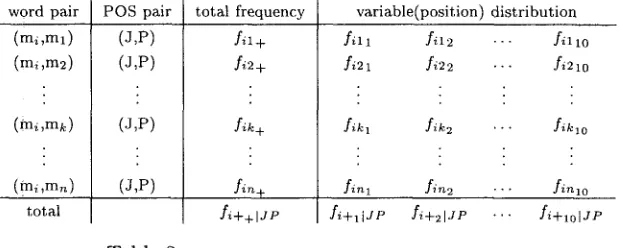
a sample space of mi as Table 2 whose cardinality]Sm~l
is n. Let one ob- .iect be (mi, mk) and its frequency distribution be./}k,,.rik2,''"
,fiklOand,::k+ be ~pl°_l
like.
Suppose that P O S ( m i ) is J and POS(mk) "s¢p'.
4.1 P r o p e r t i e s
The properties which we considered are primar- ily concerned with the frequency and positional
infbrmations of word pairs. As we have em-
phasized, the correlation between position and (:ollocation is very complicated in Korean.
According to Breidt, MI or T-score thresh- olds work satisfactory as a filter for extraction of collocations, b u t filtered out at least half of the actual collocations (Breidt, 1993). Gener- ally, a s s u m e d properties could not fully account tbr collocations. Therefore, in order to reduce a h)ss of infbrmation, the combination of observed vaxiables would be b e t t e r than filtering. We de- lined tbur variables for properties of collocations
1. Vi:
2. ~ :
as follows.
According to Benson's definition, a colloca- tion is a recurrent word c o m b i n a t i o n (Ben- son et al., 1986). We agree with this view that a word pair of high frequency would be served as a collocation. V f statistic of an object (mi, ink), is represented as (4). Here, standardization d e m a n d s attention. The mean and s t a n d a r d deviation are cal- culated in the ' J P ' set which the o b j e c t be- longs to.
Vf
=fik+--fijp
f f i j p ' n
E l fil+
A++JJP
= %' = n , (4)
a i j P = 1=1 ( f d f , j p )
Intuitively, two words that prefer spe- cific positions must be related with each other. We seeked to r e c a p t u r e the idea
with the flexibility of word order. For
this, the concept of convergence on each
position was employed. In a free or-
der language, a meaningful pair can oc- cur in text either with two distance or
three distance. Let's consider two in-
p u t vectors x, (0,1,0,0,0,1,0,0,1,0) and y,
(0,0,0,1,1,1,0,0,0,0). T h e y have the same
[image:4.612.86.575.74.288.2]:t. 14.:
word pair (miami) (mi,m2)
(mi,mk)
(m~ ,m,~) total
POS pair (J,P) (J,P)
(a,P)
(J,P)
total frequency variable(position) distribution
kl+ All k~2
k2+ k=l k:2
fik+ Akl fik2
fin+ finl fin2
f~++lJp
under a J P relation
• . . f i l l O • • • fi210
:
•.. fik~o :
• . . finlo fi+ltaP fi+MdP "'" fi+lolJP
Table 2: all combinations of mi
(1/2,1,1/2) was devised for convergence on each position. The calculation of conden- sation value rnikv at p-th position is:
'lH, ikp
4fiki+afika+fika
p = 1f ikv { 1 "q'- ~ f ikp-l- f ikp41
= - 2 p = 2...9
fia 8
~ 3 f i k 9 + 4 f i k 1 o: 4' p = 1 0
The mik,, is c, o m p u t e d by neighborhoods that are locdted in the border of the l)-th position. The may_ALe_ is likely "'3 *~ kk+
to represent :the condensation of (mi, ink) b u t it is; still deficient. Intuitively,
(0,1,1,1,0,3,2,0,0,0) would be less con-
densed t h a n (0,0,3,0,0,3,2,0,0,0). There-
fi)re, n' was designed for a penalty factor.
Irtikp
~. = max (5)
p=1,2 ... lo ~ n ' f i a +
',,' is the number of m, such that fikm 7 ~ 0
ti)r 0 <_ m <_ 10, and it is a reverse propor- tion to the condensation. Square root was used tbr preventing the excessive influence p
o f ' / t .
We were motivated by the idea that if a pair is r a n d o m l y distributed in terms of posi- tion. then it Would not be meaningful. Es- pecially in tim case of flmction words, they are likely to be randomly distributed over a given m o r p h e m e b u t distributions of mean- in.gful pairs are not random, as shown in Figure 3. A typical m e t h o d for the check of randomness is to measure how far the given distribution is away from a uniform dis- tribution. In (6),
fik
m e a n s the expected number of (mi, ink) at each position on the a,ssumption that the pair randomly occurs4. Vat :
at the position. ]fikv-Tikl 71k can be viewed
as an error rate at each position p based on the assumption. The big difference be- tween the expected n u m b e r and the actual observed frequency means t h a t the distri-
bution is not random. One might think
that this concept is the same with one of variance. However, note the denominator. This calculation is s o m e w h a t b e t t e r than variance which depends on frequency.
= ~ ( fikp -- fik )2
v , . (6)
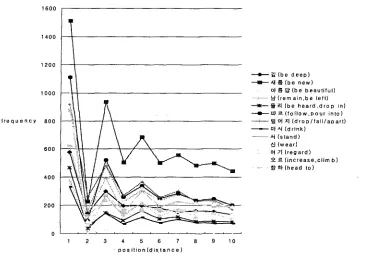
To become a meaningful bigram, a pair should be syntactically valid. We viewed that if the frequency distribution of a pair keeps the overall frequency distribution of the P O S relation set which the pair be- longs to, then the pair would be syntac- tically valid. To verify this idea, we de- pict the overall frequency distributions in some P O S relations in Figure 2. It shows the frequency distributions of pairs which are composed of postposition and predicate morpheme. It is quite interesting that all objects have the similar form of frequency
distribution. T h e y have sharp peaks at
the first and third position. Clearly, this illustrates that a postposition has a high probability of appearing at the first and third position before a predicate. We can conclude from this that pairs keeping the overall frequency structure would be syn- tactically valid. We used correlation coetti- cient for the structural similarity. In the case of a pair rnik, the correlation value between
(.fikl, f i k 2 , ' " , .fiklo)
and (./i+LI.lP- [image:5.612.134.445.77.201.2]1 4 0 0
f r e q u e n c y 8 0 0 1 2 0 0
1 0 0 0
6 0 0
4 0 0
2 0 0 1 6 0 0
• ~ ( b e d e e p )
- - ~ - - . - ~ ,~. (b e n e w ) o}-~. ~ ; ( b e b e a u t i f u l ) .... : ... ~ ( r e r n a i n , b e left)
• ~ . - - - ~ - e - I ( b e h e a r d , d r o D i n ) - - - - e - - - ¢,t~- ~ ( f o l i e w , D o u r into)
[image:6.612.136.502.78.337.2] [image:6.612.354.510.381.443.2]- ~ . . . - ~ ~ o( x I ( d r o l ~ / f a l l / a o a r t ) - o)AI ( d r i n k )
... X-f (s t a n d ) ( w e a r )
• O~ 71 ( r e g a r d )
N ( i n c r e a s e , c l i m b ) • - F=t t ) ( h e a d to)
1 2 3 4 5 6 7 8 9 1 0
• p o s i t i o n d i s t a n c e )
Figure 2: F r e q u e n c y d i s t r i b u t i o n s o f p a i r s w i t h ' J P ' o r ' V P ' P O S r e l a t i o n
a n d y be two vectors whose components
are m e a n corrected, xi - ~ for x, Yi - Y for
y. T h e correlation between two variables is straightforward, if x a n d y is standardized t h r o u g h dividing each of their elements by the s t a n d a r d deviations, ax and ay, respec-
tively. Let x* be x/ax and y* be y/ay, t h e n
the correlation between x and y, VeT can be
represented as follows.
Xt = (fikl, f i k 2 , ' ' ' , fiklo)
Y' = (fi+llJP, fi+2WJP,"', fi+~olJP) (7)
x J y *
gcr = 10
The ranks of bigrams by four measures is sum- marized in Figure 3. It tells t h a t each of the measures comes up with our expectation.
4.2 E v a l u a t i o n F u n c t i o n
in this section, we analyze the correlations of fbur measures we defined a n d explain how to make an evaluation function for extracting meaningful bigrams. Table 3 shows the values of correlations which exist in the given mea-
sures: V/, V~, Ve, VeT. This explains t h a t the de-
fined measures have r e d u n d a n t parts. We can say t h a t if a measure has the high values of
V~ ½ ½ Vet
V/ ½ vT ½,.
1.0
- 0 . 4 9 5 1.0
- 0 . 2 0 3 0 . 5 0 6 1.0 0 . 2 5 2 - 0 . 2 7 8 - 0 . 0 0 2 1.0
Table 3: correlations between factors
correlations between others, t h e n it has a re- d u n d a n t part to be eliminated. Since we d o n ' t know w h a t factors are effective in d e t e r m i n i n g useful bigram, the concept of weights is more reliable t h a n filtering. We c o n s t r u c t e d an eval- uation function, which reflects the correlations between the measures.
First of all, we s t a n d a r d i z e d four measures. S t a n d a r d i z a t i o n gives an effect on a d j u s t m e n t of value range according to its variability. T h e degree of relationship between m e a s u r e l a n d
measure2 can be obtained by
Cmeasurel,measure2
which is {corr(measurel, measure2)} +, w h e r e
x + = x if x > 0, x + = 0 otherwise. T h e evalu- ation function is concerned with the degrees of relationships of measures.
f ( V f , Vr, Vc, Vcr) = Vf ÷ ¢ r V r +CoVe + ¢crVcr
i
Cb,. : (1 - C v . , v f ) ( 1 - a C v A 2 ' v )(1 - a C v s v ° r )
¢ . . . . (1 - C v ¢ , v r ) ( 1 - a - ~ ) ( 1 - a - - ~ )
(/'or := (1 -- Cv~.~,vf)(1 - a v S " v ~ )(1 -- a ' ~ V ~ ~'v~ ) w h e r e a = 2 2
(9)
Here, the cor/stant a ( ~ 0.845) is for a com- pensation coefficient. The minimum value of Cr,
¢c and ¢c~ is 1/3 respectively, where
Cv:,v~ =
Cvj.,v~, = Cvf,v~
= 0 and all correlations of~., i,~:, and Vcr = 1. On the contray, the max- lmum value of ¢~, ¢¢, and ¢cr is 1 respectively, where
Cv:,v, = Cvf,v~ = cv:,v~
= 0 and all cor- relations ofVr, Vc, Vcr
= 0. In other words, as the coefficients ¢~, ¢~, and ¢c~ get closer to 1, the correlations b e t w e e n measures reduce.As shown in (8) and (9), we agree that
Vf
is a. primaryl factor of collocations. Each coeffi- cient ¢ indicates how much the p r o p e r t y is re- flected in evaluation. For example, in the case of Cr, a - ~ z~ is a portion which is related with the p r o p e r t y of condensation within random- ness. Therefbre,i 1 - a - - ~ corresponds to the remainder, when subtracting this portion from randomness.The threshold for evaluation was set by test- ing. W h e n the value for threshold was 0.5, good results were obtained b u t in noun morphems, a high value over 0.9 was required. The pairs are selected as meaningful bigrams whose val- ues of the evaluation function are greater than the threshold.
4.3 : E x t e n d i n g t o n - g r a m s
The selected meaningful bigrams from the pre- vious step are e x t e n d e d into n-gram colloca- tions. At the final step, the longest ones among all (~-~:overs are Obtained as n-gram collocations by eliminating substrings. Here, n-gram collo- ~:ations mean interrupted collocations as well as n-character strings.
We regarded Cohesive clusters of the mean- ingful bigrams as n-gram collocations on the as- s u m p t i o n that m e m b e r s in a collocation have a high degree of cohesion (Kjellmer, 1995). To find cohesive chisters, a fuzzy compatibility re- la.tion R is appl!ed. R on X x X, where X i s the set of all meaningful bigrams which contain
;,, l)~se m o r p h e m e
mi,
means a cohesive relationa.nd partitions of' set X obtained by R corre- spond to n-gram collocations. To say shortly, our p r o b l e m h a s s h i f t e d to clustering of a set X. A reason to employ the concept of fuzzy is that
equivalence sets defined by the relation may be more desirable.
A fuzzy compatability relation
R ( X , X )
is rep- resented as a matrix by a m e m b e r s h i p function. The membership function of a fuzzy set A E X is denoted by #A : X ~ [0, 1] and maps ele- ments of a given set X into real numbers in [0,1]. These two membership functions #A were used to define the cohesive relation as follows.p ( x ) = I * n y l . : . , ~ _ ] * n y l I*1 ' ~ " J : - lyl
D ( p ( x ) [ I p ( y ) ) = p(x)(log pry) - log p~x)) if p ( x ) _ ( p ( y )
~ A ( X ' Y ) ~ O ( p ( y ) [ I p ( x ) ) : p(y)(log p~x) - log p~y)) i f p ( y ) ( _ p ( x )
(10)
, , 2 J * n y l ( 1 1 )
/ZA I,x,Y)= T ~ T
Let Ixl and lYl be the frequency of concor- dances which contains the bigram pairs x and y,
respectively.
IxAyl
means how often two pairs xand y co-occur in the same concordances under the distance constraint. (10) is relative entropy measure and (11) is dice coefficient. This mea- sures are concerned with a lexical relation for cohesive degrees.
To get equivalence sets, it is very i m p o r t a n t to identify properties of the relation R we de- fined. A relation which is reflexive, symmet- ric and transitive is called as an equivalence
relation or similarity relation. In our case,
the fuzzy cohesive relation, R is certainly re- flexive and symmetric. If
R(x, z) > ma, xyEy
min[R(x, y), R(y,
z)] is satisfied for all (x, z) eX 2, then R is transitive. Generally, transitive
closure is used for checking transitivity. The
transitive closure of a relation is defined as the smallest fuzzy relation which is transitive and has the fewest possible m e m b e r s with contain- ing the relation itself.
Given a relation
S(X,X),
its max-min transi-tive closure
ST(X, X)
can be calculated by the following algorithm consisted of three steps:1. S I = S U (S o S) , o is a max-min compo- sition operator.
2. If S' # S, make S = S ' and go to Step 1. 3. Stop:
S ' =
S T .hmg to multiple (:lasses by R. This proves that the relation R is valid to explain collocations.
A iuzzy binary relation R(X,X) which is re-
th~xive and symmetric is called as a fuzzy com- pa.til)i[ity relation and is usually referred to as ~,. (lunsi-e(tuivalence relation. W h e n R is a fuzzy compa, tibility relation, compatibility classes are ,l(,.fined in terms of a specified membership de- gre,'. (~. An a - c o m p a t i b i l i t y class is a subset A of X. s,mh that it(x, y) > a for all x, y E A and the tnmily consisting of the compatibility classes is called as an a-cover of X to R in terms of a spe- cifi,: m e m b e r s h i p degree a. An a-cover forms partitions of X and an element of X could be- long to multiple a - c o m p a t i b i l i t y classes. Here, we a.ccepted a-covers at 0.20 a-level in dice and (}.3{} in relative entropy.
One might argue why we did n o t directly ap- ply a]] bigrams to this stage with skipping the previous stage. We hope to deal with the com- t)arision in a later paper.
5 E v a l u a t i o n
We performed experiments for evaluation on 328,859 sentences(8.5 million-morphemes) from Yonsei balanced copora. 250 morphemes were selected for a test, such that frequency >_ 150.
The morphemes have 8,064 pairs and 773 were
e x t r a c t e d as meaningful bigrams. In the sec- ond stage, 3,490 disjoint a - c o m p a t i b i l i t y classes corresponding to lexicMly cohesive clusters were genera,ted. 698 longest n-gram collocations out of the a - c o m p a t i b i l i t y classes were extracted by eliminating the fragments that can b e s u b s u m e d in longer classes.
The precision of extracted meaningful bigram was 86.3% and 92% in the case of n-gram collo- cations. We could take either o~-covers and the hmgest n-grams as n-gram collocations accord- ing to applications.
Since unfortunately, there is no existing d a t a b a s e of collocations for evaluation, it is not easy to c o m p u t e precision values and recall val- ues as well. We c o m p u t e d the precision values
by hand. As a different approach to Korean
collocations, (Lee et al., 1996) extracted inter- r u p t e d bigrams using several filtering conditions and at least the 90% of the results were adja- cent bigrams of length 1. By this comparison, we may conclude that our approach is more flex- ible to deal with Korean word order.
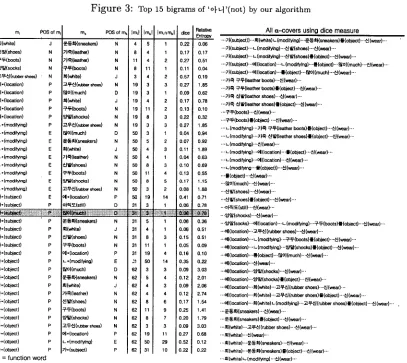
Figure 3 9 displays the changes of rank ac- cording to measures we considered. It shows that in contrast to other models, the proper- ties have been effective in retrieving colloca- tions which contain pairs of m o r p h e m e s with relatively low frequency. Since the ranks of bi- grams in four measures came up with our expec- tation, if we could make more a d e q u a t e evalua- tion function, the precision would be improved. Table 4 shows some obtained meaningful bi- grams of 'o}.>] (not)'. There are a great deal of expressions relating negative sentences in Ko- rean. The components of t h e m occurs separated in various ways. W h e n evaluating meaningflfl bigrams, the coetticients for tile evaluation flmc- tion are as follows: Cr ~ 0.432, ¢(: v 0.490, ¢cr ~ 0.371 in the case of ' o l - q ( n o t ) ' . This means that the influence of three other mea- sures is 1.284 times more than that of frequency measure in ' J P ' P O S relation.
We will illustrate all steps with a word, ' ~ ' ( w e a r ) . The results of the first stage, mean- ingful bigrams of '4_! '(wear) m are shown in Fig- ure 4. In the second stage, we calculated mem- bership grades of inputs using dice measure and relative entropy measure. As Figure 4 shows, dice measure looks unsatisfactory in such cases as the pair ' ( ~ ( o b j e c t case), ~ o } (much))'. Al- though the common frequency, 3 is a relatively high in the aspect of the word with lower fre- quency, ' N o l ' ( m u c h ) , the value of dice is low. Thus, we also tested relative entropy based on the probability of low frequency. T w o measures produce similar results if all values in the level set of R is considered instead of a specific value of o~, b u t entropy measure produces more good results.
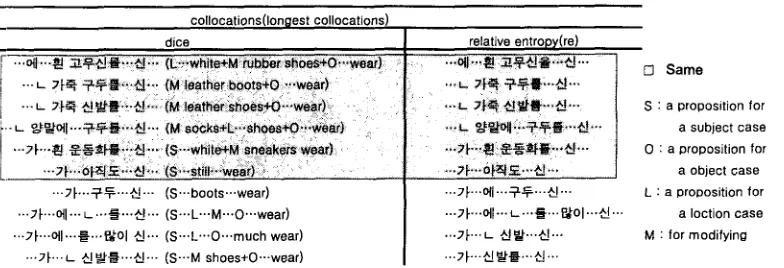
Figure 4 and 5 show all o~-compatibility classes and the longest n-gram collocations of ' ~ ' ( w e a r ) . T h r o u g h our m e t h o d , various kind of collocations were extracted. In Figure 4, the order of components of a oe is by concordances.
6 C o n c l u s i o n
In this paper, we implemented measures which reflect the four properties of collocation respec-
9The meanings of pairs are not described in detail because the pairs including function words are hard to translate into English.
!
m k mr relation poa-
post- not oo~mo.
:: ~ o ~ : : Iof:~.t
olf ~t oF q J p
t .oF i.~ JP JOFLf JP . ~ =oFq J p !o~ L-I J p oll !O~M JP o~1 ~ ~ Io~-t.-I J p
~ V l l l l d I ~ l m
F r e q u e n c y d i s t r i b u t i o n
22 20 17 26 40 48 17 15 6 4 2 7 0 0 0 0 0 0 0 0 0 53 0 0 0 0 0 0 0 0 1 11 0 0 1 0 0 0 0 1 0 29
0 2 1 4 5 2 4 4 0 82 1 1 0 0 0 1 0 2 0 27 6 4 3 6 4 9 1 16 2 60 24 31 34 35 38 46 24 48 10 13 0 0 0 0 I 7 1 0 0 0 23 24 25 27 24 55 17 13 1 0 19 30 23 30 15 19 19 58 1 1 1 0 1 0 1 3 0 0 0 0
0 0 2 0 1 3 1 0 0 0
6 7 11 13 5 25 3 3 0 0
1 0 0 6 1 2 1 1 0 0 frec l e n t
freq s t d
6 3 8 4.1 53 - 0 12 - 0 31 - 0 104 0 . 2 32 - 0 111 0 . 3 3 0 3 1.7
9 - 0
2 0 9 1 215 1
6 - 1
7 - 1
73 - 0
1 2 - 0
r a n d l m n
ran i s t d
3 6 . 3 0 . 4 9 0 . 0 2 . 5 7 4 . 7 1 . 9 7 7 . 7 2.1 5 2 . 9 1.1 6 1 . 9 1.4 2 2 . 9 - 0 1 . 6 - 1 5 3 . 0 1.1
4 . 9 - 1 5.1 - 1 2 3 . 3 - 0 2 0 . 6 - 0
9 , 6 - 1
2 0 . 6 - 0
. ~ I h ~
B m l | l l m l m
~ l l | l l a l ~ l l l l
O l l l l ~ I I ~ 1 1 1
I~I~I~ ~llrll~ll~l~ I I I I ~ I I I I ~ I ~ I ~ I~1 I1~1 ~lllBml~ nenmNI ~ 1 1 ~ 1 ~ nenmil 1 1 1 ~ 1 ~
O ~ 1 llitai'aa B~ III Bill ~ I I I ~ I E n m l t l l ~ l l ~
e v a l u l
e v a l
4 . 8 3 . 3 1 . 9 1 . 8 1 . 3 1.2 0 . 6 0 . 6 0 . 5 0.1 0 . 0
- 0 . 6
- 0 . 7
- 0 . 7
- 0 . 8
Figure 3: Top 15 bigrams of ' o ~ ' ( n o t ) by our algorithm
mi POSot
• J(white) J
~ ~(shoes) N ~-'~-(l~:~ots) N
°=m~socks) N
~-.~-~'J(rub~u shoes) • N o11- (location) P oll * (location) P 0~1- (location) P ~ * (location) P
~*(Iocation) P L *(modifying} p
L *(modifying) E L *(modif~Rg} E L ,(modifying) E ~ * (modifying) E L~ *(modlfy~ng) E L *(modifying) E L * (mod~fyirlg) E
L *(modifying) E ~*(subiec~) E > ~*(subject) P
) |*(subiect) P ~ F*(su~ect) P
)~(su~ect) P
2 Hsubject} P 2}*(sul~ect) P • m* (object) P
t-(object) P
~ " (object) P
t-(object) P
~*(objecl) P
•*(object) P
~-" (object) P -~- (object) P ~ " (ObJ~:':t) P
•*(object) P
~*(obj~ct] P
~ - - ( o b l ~ t ) P • = f u n c t i o n w o r d
m~ POS of m= Relative
Y ~-~l-I{sneakets) N 4 5 1 0.22 0.06
2IS(leather) N 8 4 1 0.t7 0.17
2 P~(leat her} N 11 4 2 0.27 0.51
-T~boots) N 8 11 1 0.11 0.04
~(whlte) J 3 4 2 0.57 0.19
-.~--~J~ ( mbl0er s PK.~s ) N 19 3 3 0.27 1.85
.~O~(much) O 19 3 1 0.09 0.62
-!:1 (Y, hit e) J 19 4 2 0.17 0.78
-r~(boots) N 19 11 2 0.13 0.10
°o~shocks) N 19 8 3 0.22. 0.32
.~-'~,-J~ (Veer shoes) N 19 3 3 0.27 1.85
~Ol(much) D 50 3 1 0.04 0.94
-~J,-I(sneaker s) N 50 5 2 0.07 0.92
~(white) J 50 4 3 0.11 1.89
7 t-~(leather) N 50 4 1 0.04 0.63
AJ~shoes) N 50 8 3 0.10 0.69
~ - t-(boots) N 50 11 4 0.13 0.55
°~shoc~.s) N 50 8 5 0.17 1.15
.~.-~--'-'~ ( PJbber shoes) N 50 3 2 0.08 1.88 HI * (location) P 50 19 14 0.41 0.71 oF~_.~-(stfll) D 31 3 1 0.06 0.78
¢-Jo~l-I{sneakers) N 0.36
tl:l (vA'~it e) J 0.51
~il~shoes) N 0.51
:~.(~oots) N 0.09
~-(Iocati~) P 0.10
L *(modifying) E 0.22
P~ol(much) D 3.03
~-~i~sneakers) N 2.01
~(white) J 2.06
7 P.~.,(leather) N 2.74
~U~(shoes] N 1.54
::F~(boots) N 1.41
°ol~(shacks) N 1.79
~-.~-.~ (rubber shoes) N 3.03
Hl*(Iocation) P 0.68
L *(modifying) E 0,12
~Hsubiect) P 0.22
All c¢--covers using dice measure
" " ; I.(subject ) )-..:ltl (whit e) L (m odiNng) ....~-~ll.t(sneakers)-i.( object ) ...~ (wear) ... • ..7 ~subject)... L (modifyirlg)..- ,~.J ~r(sl~S)-..~_J (wear)..-
.-.2 ~sublect)... L (modifying)"-N u~(shoesl-II(object ) --.~ (wear).-.
~ g s u b j e c t ) . ` ~ ( ~ c a t i ~ n ) ~ ( m o d ~ f y ~ n g ) ~ . ~ ` 1 ( ~ b j e c t ) ~ B j ~ ( m u c h ) ` ` ~ ( w e = ) ~ . ...2~(subject)...oll(Iocation)...ll(object)...~Ol(rnuch)...~(wear)...
• .-2~-.~ ~-~-(leather boots)..-~(wear)... • .-2~-~ -.7-.~,.0eather boots) J(object)...~ (wear)..- • .o~-~, ~ ~t~'(Ioather shoes).--~(wear)--. -..2}-~ ~J W(k3ather shoes)J.(object)..-~(wear)... ...~(boots)..-~(wear)...
-..-.?-~-(boots)t}Cobject) ...~(wear)-..
"'" L (modifying),..2 }-~ -7" '~(feather boots)t(object)..-~ (wear)..- ... ~ (modifying).-o ~ ~ L~,j(leat her shoes)I(obJect)...~(wear)... • .. L.. (modifying)"-~ (wear)...
• .- L (rnodifying)...ol (Iocation)..-J(object)...N (wear)..- ... L (modifying)-..ol (Iocation)..-~(wear).-.
... L. (modiNng..-~(object))...~ (wear)... "'i(object)"-~(wear)",
. . . ~ O F ( m u c h ) . . . ~ ( w e a r ) . . .
• ..~ ~(shoes)-..~ (wear)... ...~ ~(shoes) J(object).-.~ (wear)..- -- o I-~.L~_ (sNI)-..~ (wear)-.. • ..oj~:(shccks)...~J (wead ...
• ..°~(socks)...~(Iocation)--. L (modifying).-.-~-~-(boots)t~(object)...~ (wear)... • ..ol (location) ...~-~,~.AJ (rul0ber shoes)..-~ (wear)-..
...ol (location) ... L (modl lying ) ...-.~-~(boots)i(object ) ...~ (wear) .-. • .-oll(Iccation)... L-(modlfytng).-.°~(shocks)J(object),..~(wear).-. ...ol (Iocatlon)...§(object)..-P~Ol(much)...~ (wear)...
• ..N (Iocation)-..~ (wear)..-
• . . N ( I o c a t i o n ) . . . O ~ ( s h o c k s ) . . . ~ ( w e a r ) .,.
-..N (Ioc~tion)--.~'gt(shocks)tl(object).--N (wear)... • -.N(Iocation)...~(white)..-~-~.,J(rubber shoes)..-~(wear).-.
• ..c~(Iocation)...~(white)....~.P~-C~(rubber shoes).i(object)...~ (wear)...
. . . o ~ ( I o c a t i o n ) . . - ~ ( w h i t e ) L ( m o d i f y i n g ) . . . ~ - ~ . . ~ ( r u b b e r shoes)tl(object)...~(wear)..- • ..-~-.~t4(sneakers).-~ (wear)...
• .. -~-¢l{sneakem)-B (object) .-.~J (wear) ..- - .M (whit e) .-.~-~--~ (rubber shces)...~ (wear)... -..~ (vANte)-.-~(wear).--
.-.~(v,/nite)...~-~-tzl<sneakers)...~(wear)...
[image:9.612.123.488.65.205.2]---~ (whir e) .. -~-.~-~J-( sneaker s)iJ.(object ) ..-~ (wear)..- .-.~ (white) L- (rnodiNng)...~ (wear) --.
Figure 4: Meaningful bigrams and all c~-compatibility classes of '~'(wear)
tively and the evaluation function which appro- priately combines the measures. Our approach was primarily focused on the subtle relation- shit)s between word positions and collocations in a, free order language.
We extracted meaningful bigrams using an ew~luation flmction and extended them into
n-grams by producing a-compatibility classes. The usefulness of our algorithm were illustrated by examples and tables.
[image:9.612.102.509.215.578.2](Adverb,'o~Q') (Postposition,'o~') (Noun, 'o~q')
( ~ ] ~ , otq)(not only) (~-x], o]-q)(not only)
(~t--~-~1, o~q)(simply ~ not) (~e-~Q, o]-q)(but ~ not) ( ~ , olM)(never)
(~V~I, °l'q)(not necessarily)
(~, o~q)(too) (~ol, obq)(not also) (~b, obq)(not) (2E, o ~ )(not) (~-, o]-w] )(not) (~, o]-q)(not also)
( ~ - - , o]M)(not because) (:~, o~q)(not ~ that) (~x~], o]-q)(not important) (~, ol-q)(not intend to) (°1t71, o]-q)(not ~ that) (oil-r, o~q)(not the reason)
Table 4: Examples of bigrams for negation expressions
collocations(Ionsest collocations)
dice
""Y b"':F~-'"~"" ( S . . . b o o t s . . . w e a r ) ...Yb..o~l ..- ~-...-~... ,~ ..- ( S . . . L . . . M . . . O . . . w e a r ) • . . ~ b . . O l l . - . ~ . . . ~ o l ~ . . . ( S . . . L . . . O . . . m u c h wear)
-..2t... ~- ~ ~ ~ - . . . ~ . . - (S-..M shoes+O.--wear)
relative
• ..~t--..oll-..-'7-@"-~ " " • ..71-...otl-.. c . . . . , ~ . . . ,Nol . . . ~ ... • ..~F..L ~ ~t...~...
...~t---~.l ~ ' - l . " ~ ...
K] S a m e
S : a proposition for
a subject case
0 : a proposition for a object case
L : a p r o p o s i t i o n f o r
a Ioction case
M : for m o d i f y i n g
Figure 5: the longest n-gram collocations of '~'(wear)
pound nouns, and idioms and it could be ap- plicable to other free order languages.
With the development of recognition of phrases, the input format and related distance between morphemes, the algorithm can be used effectively. Also linguistic contents for statisti- cal constraints should be reflected in the system. We have plans to check how this algorithm will work in English and to align bilingual col- locations for machine translation.
R e f e r e n c e s
Benson, M., Benson, E., Ilson. R. 1986 The
BBI Combinatory Dictionary of English: A
Guide to Word Combinations. John Ben-
jamins, Amsterdam and Philadelphia. Breidt, E. 1993 Extraction of V-N collocations
fiom text corpora: A feasibility study for
German. In the 1st ACL-Workshop on Very
La.~ye Corpora.
Choueka, Y., Klein, T., and Neuwitz, E. 1983. Automatic retrieval of frequent idiomatic and collocationM expressions in a large corpus. In
Journal .for Literary and Linguistic Comput-
ing, 4:34-38.
Clmrch, K., and Hanks, P. 1989. Word as- sociation norms, mutual information, and
lexicography. In Computational Linguistics,
16(1):22-29.
Cowie, A. P. 1981. The treatment of colloca- tions and idioms in learner's dictionaries. In
Applied Linguistics, 2(3):223-235.
Cruse, D. P. 1986 Lexical Semantics. Cam-
bridge University Press.
Haruno, M., Ikehara, S., and Yamazaki. T. 1996 Learning bilingual collocations by word-level
sorting. In Proceedings of the 16th COLING,
525-530.
Ikehara, S., Shirai, S., and Uchino, H. 1996 A Statistical Method for Extracting Uninter-
rupted and Interrupted Collocations. In Pro-
ceedings of the 16th COLING, 574-579.
Kjellmer, G. 1995 A mint of phrases: Corpus
Linguistics, 111-127. Longman.
Klir, J. G., and Yuan, B. 1995 Fuzzy Sets
And Fuzzy Logic: Theory And Applications.
Prentice-Hall.
Martin, W., and Sterkenburg, V. P. 1983 Lexi-
cography: principles and practice
Nagao, M., and Mori, S. 1994. A new method of n-gram statistics tbr large number of n and automatic extraction of words and phrases
from large text data of Japanese. In Proceed-
ings of the 15th COLING, 611-615.
[image:10.612.145.487.76.165.2] [image:10.612.103.495.192.326.2]I I
And Statistics For Engineers And Scientists
John Wiley ~ Sons
Shimohata, S., Sugio, T., and Nagata, J. 1997. Retrieving collocations by co-occurrences and
word order coristraints. In the 35th Annual
Meeting qf ACL, 476-481.
Sm~Ldja, F. 1993. Retrieving collocations from
text: Xtract. In Computational Linguistics,
19(1):143-177.
Sm~tdja, F., MaKeown, K., and Hatzivas- silogtou, V. 1996. Translating collocations tbr bilingual lexicons: A statistical approach.
In Computational Linguistics, 22 (1): 1-38.
Lee, KongJoo, Kim, Jaehoon Kim, Kim,
Gih:hang. 1995. Extracting Collocations
fronl Tagged Corpus in Korean. In Proceed-
ings of Korean Information Sience Society,
 by Xtract](https://thumb-us.123doks.com/thumbv2/123dok_us/1381434.672160/3.612.61.278.79.351/figure-meaningful-bigrams-z-drink-xtract.webp)