Accurate Function Parsing
Paola Merlo Department of Linguistics
University of Geneva 1204 Geneva
Switzerland
Gabriele Musillo
Depts of Linguistics and Computer Science University of Geneva
1204 Geneva Switzerland
Abstract
In this paper, we extend an existing parser to produce richer output annotated with function labels. We obtain state-of-the-art results both in function labelling and in parsing, by automatically relabelling the Penn Treebank trees. In particular, we ob-tain the best published results on seman-tic function labels. This suggests that cur-rent statistical parsing methods are suffi-ciently general to produce accurate shal-low semantic annotation.
1 Introduction
With recent advances in speech recognition, parsing, and information extraction, some domain-specific interactive systems are now of practical use for tasks such as question-answering, flight booking, or restaurant reservation (Stallard, 2000). One of the challenges ahead lies in moving from hand-crafted programs of limited scope to robust systems inde-pendent of a given domain. While this ambitious goal will remain in the future for some time to come, recent efforts to develop language processing sys-tems producing richer semantic outputs will likely be the cornerstone of many successful developments in natural language understanding.
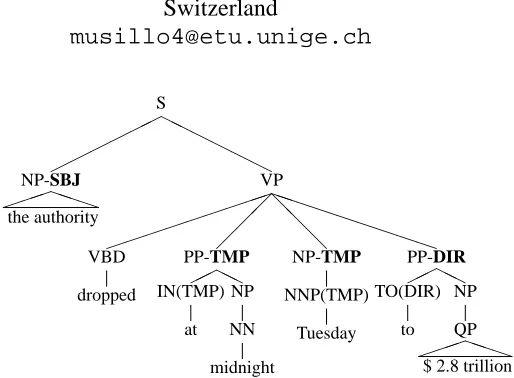
In this paper, we present a parser that outputs la-bels indicating the syntactic or semantic function of a constituent in the tree, such asNP-SBJorPP-TMP
shown in bold face in the tree in Figure 1. These labels indicate that the NP is the subject of the sen-tence and that the PP conveys temporal information. (Labels in parentheses will be explained later in the paper.) Output annotated with such informative la-bels underlies all domain-independent question
an-S
H H H H H H
NP-SBJ
PPP
the authority
VP
@ @ @
P P P P P P P P P
VBD
dropped
PP-TMP
HH
IN(TMP)
at NP
NN
midnight
NP-TMP
NNP(TMP)
Tuesday
PP-DIR
HH
TO(DIR)
to NP
QP
PPP
[image:1.612.306.563.150.339.2]$ 2.8 trillion
Figure 1: A sample syntactic structure with function labels.
swering (Jijkoun et al., 2004) or shallow semantic interpretation systems (Collins and Miller, 1998; Ge and Mooney, 2005). We test the hypothesis that a current statistical parser can output such richer in-formation without any degradation of the parser’s accuracy on the original parsing task. Briefly, our method consists in augmenting a state-of-the-art sta-tistical parser (Henderson, 2003), whose architec-ture and properties make it particularly adaptive to new tasks. We achieve state-of-the-art results both for parsing and function labelling.
Statistical parsers trained on the Penn Treebank (PTB) (Marcus et al., 1993) produce trees annotated with bare phrase structure labels (Collins, 1999; Charniak, 2000). The trees of the Penn Treebank, however, are also decorated with function labels. Figure 1 shows the simplified tree representation with function labels for a sample sentence from the Penn Treebank corpus (section 00) The Gov-ernment’s borrowing authority dropped at midnight Tuesday to 2.8 trillion from 2.87 trillion. Table 1 illustrates the complete list of function labels in the Penn Treebank. Unlike phrase structure labels,
Syntactic Labels Semantic Labels
DTV dative ADV adverbial
LGS logical subject BNF benefactive
PRD predicate DIR direction
PUT compl of put EXT extent
SBJ surface subject LOC locative
VOC vocative MNR manner
Miscellaneous Labels NOM nominal
CLF it-cleft PRP purpose or reason
HLN headline TMP temporal
TTL title Topic Labels
[image:2.612.83.304.54.177.2]CLR closely related TPC topicalized
Table 1: Complete set of function labels in the Penn Treebank.
tion labels are context-dependent and encode a shal-low level of phrasal and lexical semantics, as ob-served first in (Blaheta and Charniak, 2000).1 To a large extent, they overlap with semantic role labels as defined in PropBank (Palmer et al., 2005).
Current statistical parsers do not use this richer information because performance of the parser usu-ally decreases considerably, since a more complex task is being solved. (Klein and Manning, 2003), for instance report a reduction in parsing accuracy of an unlexicalised PCFG from 77.8% to 72.9% if using function labels in training. (Blaheta, 2004) also reports a decrease in performance when at-tempting to integrate his function labelling system with a full parser. Conversely, researchers interested in producing richer semantic outputs have concen-trated on two-stage systems, where the semantic la-belling task is performed on the output of a parser, in a pipeline architecture divided in several stages (Gildea and Jurafsky, 2002). See also the common task of (CoNLL, 2004 2005; Senseval, 2004).
Our approach maintains state-of-the-art results in parsing, while also reaching state-of-the-art results in function labelling, by suitably extending a Sim-ple Synchrony Network (SSN) parser (Henderson, 2003) into a single integrated system. This is an interesting result, as a task combining function la-belling and parsing is more complex than simple parsing. While the function of a constituent and its structural position are often correlated, they
some-1(Blaheta and Charniak, 2000) talk of function tags. We will
instead use the term function label, to indicate function identi-fiers, as they can decorate any node in the tree. We keep the word tag to indicate only those labels that decorate preterminal nodes in a tree – part-of-speech tags– as is standard use.
times diverge. For example, some nominal temporal modifiers occupy an object position without being objects, like Tuesday in the tree above. Moreover, given current limited availability of annotated tree banks, this more complex task will have to be solved with the same overall amount of data, aggravating the difficulty of estimating the model’s parameters due to sparse data.
2 Method
Successfully addressing function parsing requires accurate parsing models and training data. Under-standing the causes and the relevance of the ob-served results requires appropriate evaluation mea-sures. In this section, we describe the methodology that will be used to assess our main hypothesis.
2.1 The Basic Parsing Architecture
Our main hypothesis says that function labels can be successfully and automatically recovered while parsing, without affecting negatively the perfor-mance of the parser. It is possible that attempting to solve the function labelling and the parsing prob-lem at the same time would require modifying ex-isting parsing models, since their underlying inde-pendence assumptions might no longer hold. More-over, many more parameters are to be estimated. It is therefore important to choose a statistical parser that can model our augmented labelling problem. We use a family of statistical parsers, the Simple Synchrony Network (SSN) parsers (Henderson, 2003), which crucially do not make any explicit independence as-sumptions, and learn to smooth across rare feature combinations. They are therefore likely to adapt without much modification to the current problem. This architecture has shown state-of-the-art perfor-mance and is very adaptive to properties of the in-put.
by a Predictive LR pushdown automaton (Nederhof, 1994), which implements a form of left-corner pars-ing strategy.2
The probability of a phrase-structure tree is equated to the probability of a finite (but unbounded) sequence of derivation moves. To bound the number of parameters, standard history-based models par-tition the set of prefixes of well-formed sequences of transitions into equivalence classes. While such a partition makes the problem of searching for the most probable parse polynomial, it introduces hard independence assumptions: a derivation move only depends on the equivalence class to which its history belongs. SSN parsers, on the other hand, do not state any explicit independence assumptions: they induce a finite history representation of an unbounded se-quence of moves, so that the representation of a movei−1is included in the inputs to the represen-tion of the next movei, as explained in more detail in (Henderson, 2003). SSN parsers only impose soft inductive biases to capture relevant properties of the derivation, thereby exhibiting adaptivity to the in-put. The art of designing SSN parsers consists in selecting and introducing such biases. To this end, it is sufficient to specify features that extract some in-formation relevant to the next derivation move from previous ones, or some set of nodes that are struc-turally local to the node on top of the stack. These features and these nodes are input to the compu-tation of a hidden history represencompu-tation of the se-quence of previous derivation moves. Given the hid-den representation of a derivation, a log-linear distri-bution over possible next moves is computed. Thus, the setDof structurally local nodes and the setf of predefined features determine the inductive bias of an SSN system. Unless stated otherwise, for each of the experiments reported here, the set D that is input to the computation of the history representa-tion of the derivarepresenta-tion movesd1, . . . , di−1 includes the following nodes: topi, the node on top of the
pushdown stack before theith move; the left-corner ancestor oftopi; the leftmost child oftopi; and the
most recent child of topi, if any. The set of
fea-turesf includes the last move in the derivation, the label or tag oftopi, the tag-word pair of the most
re-2The derivation moves include: projecting a constituent with
a specified label, attaching one constituent to another, and shift-ing a tag-word pair onto the pushdown stack.
cently shifted word, the leftmost tag-word pair that
topi dominates.
2.2 The Set of Function Labels
The bracketting guidelines for the Penn Treebank II list 20 function labels, shown in Table 1 (Bies et al., 1995). Based on their description in the Penn Tree-bank guidelines, we partition the set of function la-bels into four classes, as indicated in the table. Fol-lowing (Blaheta and Charniak, 2000), we refer to the first class as syntactic function labels, and to the sec-ond class as semantic function labels. In the rest of the paper, we will ignore the other two classes, for they do not intersect with PropBank labels, and they do not form natural classes. Like previous work (Blaheta and Charniak, 2000), we complete the sets of syntactic and semantic labels by labelling con-stituents that do not bear any function label with a
NULLlabel.3
2.3 Evaluation
To evaluate the performance of our function pars-ing experiments, we will use several measures. First of all, we apply the standard Parseval measures of labelled recall and precision to a parser whose train-ing data contains the Penn Treebank function labels, to assess how well we solve the standard phrase structure parsing problem. We call these figures FLABEL-less figures in the tables below and we will call the task the (simple) parsing task in the rest of the paper. Second, we measure the accuracy of this parser with an extension of the Parseval measures of labelled precision and recall applied to the set of complex labels —the phrase structure non-terminals augmented with function labels— to evaluate how well the parser solves this complex parsing prob-lem. These are the FLABEL figures in the tables be-low. We call this task the function parsing task. Fi-nally, we also assess function labelling performance on its own. Note that the maximal precision or recall score of function labelling is strictly smaller than one-hundred percent if the precision or the recall of
3Strictly speaking, this label corresponds to two
ASSIGNEDLABELS
ADV BNF DIR EXT LOC MNR NOM PRP TMP SEM-NULL SUM
ADV 143 0 0 0 0 0 0 1 3 11 158
BNF 0 0 0 0 0 0 0 0 0 1 1
DIR 0 0 39 0 3 4 0 0 1 51 98
EXT 0 0 0 37 0 0 0 0 0 17 54
ACTUAL LOC 0 0 1 0 345 3 0 0 15 148 512
LABELS MNR 0 0 0 0 3 35 0 0 16 40 94
NOM 2 0 0 0 0 0 88 0 0 4 94
PRP 0 0 0 0 0 0 0 54 1 33 88
TMP 18 0 1 0 24 11 0 1 479 105 639
SEM-NULL 12 0 13 5 81 28 12 24 97 20292 20564
[image:4.612.132.499.53.189.2]SUM 175 0 54 42 456 81 100 80 612 20702 22302
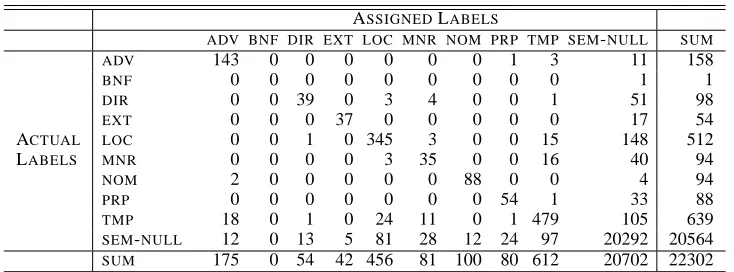
Table 2: Confusion matrix for simple baseline model, tested on the validation set (section 24 of PTB).
the parser is less than one-hundred percent. Follow-ing (Blaheta and Charniak, 2000), incorrectly parsed constituents will be ignored (roughly 11% of the to-tal) in the evaluation of the precision and recall of the function labels, but not in the evaluation of the parser. Of the correctly parsed constituents, some bear function labels, but the overwhelming majority do not bear any label, or rather, in our notation, they bear aNULLlabel. To avoid calculating excessively optimistic scores, constituents bearing theNULL la-bel are not taken into consideration for computing overall recall and precision figures. NULL-labelled constituents are only needed to calculate the preci-sion and recall of other function labels. (In other words,NULL-labelled constituents never contribute to the numerators of our calculations.) For exam-ple, consider the confusion matrix M in Table 2, which reports scores for the semantic labels recov-ered by the baseline model described below.
Preci-sion is computed as
P
i∈{ADV···TMP}M[i,i]
P
j∈{ADV···TMP}M[SUM,j]
.
Re-call is computed analogously. Notice thatM[n, n], that is the[SEM-NULL,SEM-NULL]cell in the matrix, is never taken into account.
3 Learning Function Labels
In order to assess the complexity of the task of pre-dicting function labels while parsing, we run first the SSN on the function parsing task, without modifica-tions to the parser. The confusion matrix for seman-tic function labels of this simple baseline model is illustrated in Table 2.
It is apparent that the baseline model’s largest cause of error is confusion between the labels and
theNULLlabel. These misclassfications affect recall
in particular. Consider, for example, theMNR label, where 40 out of 94 occurrences are not given a func-tion label. We add two augmentafunc-tions to the parser to alleviate this problem.
The simple baseline parser treatsNULLlabels like other labels, and it does not distinguish subtypes of
NULL labels. Our first augmentation of the parser is designed to discriminate among constituents with these NULL labels. We hypothesize that the label
NULL(ie. SYN-NULL andSEM-NULL) is a mixture of types, which will be more accurately learnt sepa-rately. If the labelNULLis learnt more precisely, the recall of the other labels will increase. The NULL
label in the training set was automatically split into the mutually exclusive labelsCLR,OBJandOTHER. Constituents were assigned the OBJlabel according
to the conditions stated in (Collins, 1999).4
Another striking property of the simple baseline function parser is that the SSN tends to projectNULL
labels more than any other label. Since SSNs de-cide the label of a non-terminal at projection, this behaviour indicates that the parser does not have enough information at this point in the parse to project the correct function label. We hypothesize that finer-grained labelling will improve parsing per-formance. This observation is consistent with results reported in (Klein and Manning, 2003), who showed that part-of-speech tags occurring in the Treebank are not fine-grained enough to discriminate between
4Roughly, an
preterminals. For example, the tag TO labels both the preposition to and the infinitival marker. Extend-ing (Klein and MannExtend-ing, 2003)’s technique to func-tion labelling, we split some part-of-speech tags into tags marked with semantic function labels. More precisely, we concentrate on the function labelsDIR,
LOC, MNR,PRP orTMP, which appear to cause the most trouble to the parser, as illustrated in Table 2.
The label attached to a non-terminal was propa-gated down to the pre-terminal tag of its head. The labels in parentheses in Figure 1 illustrate the effect of this lowering of the labels. The goal of this tag-splitting is to indicate more clearly to the parser what kind of label to project on reading a word-tag pair in the input. To this end, re-labelling is applied only if the non-terminal dominates the pre-terminal imme-diately. This constraint guarantees that only those non-terminals that are actual projections of the pre-terminal are affected by this tag-splitting method. Linguistically, we are trying to capture the notion of maximal projection.5 This augmented model has a total of 188 non-terminals to represent labels of constituents, instead of the 33 of the original SSN parser. As a result of lowering the five function la-bels, 83 new part-of-speech tags were introduced to partition the original tagset of the Treebank. There are 819 tag-word pairs in this model, while the orig-inal SSN parser has a vocabulary size of 508 tag-word pairs. These augmented tags as well as the 155 new non-terminals are included in the setf of features input to parsing decisions as described in section 2.1.
SSN parsers do not tag their input sentences. To provide the augmented model with tagged input sen-tences, we trained an SVM tagger whose features and parameters are described in detail in (Gimenez and Marquez, 2004). Trained on section 2-21, the tagger reaches a performance of 95.8% on the test set (section 23) of the PTB using our new tag set.
4 Experiments
In this section, we report the results of the exper-iments testing hypotheses concerning our function parser. All SSN function parsers were trained on
5This condition was relaxed in a few cases to
capture constructs such as coordinated PPs (e.g.
[PP-LOC[PP[INat]. . .][CCand][PP[INin]. . .]. . .] or infini-tival clauses (e.g.[S-PRP[VP[TOto][VP[VB. . .]. . .]. . .]).
FLABEL FLABEL-less
F R P F R P
Validation Set
Base 83.4 82.8 83.9 87.7 87.1 88.2 Aug 84.6 84.0 85.2 88.1 87.5 88.7
Test Set
Aug 86.1 85.8 86.5 88.9 88.6 89.3
[image:5.612.326.546.55.168.2]H03 88.6 88.3 88.9
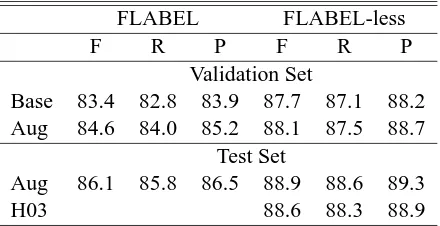
Table 3: Percentage F-measure (F), recall (R), and precision (P) of the SSN baseline (Base) and aug-mented (Aug) parsers. H03 indicates the model il-lustrated in (Henderson, 2003).
sections 2-21 from the Penn Treebank, validated on section 24, and tested on section 23. All models are trained on parse trees whose labels include function labels. Both results taking function labels into ac-count (FLABEL) and results not taking them into account (FLABEL-less) are reported. All our mod-els, as well as the parser described in (Henderson, 2003), are run only once. 6 These results are re-ported in Table 3.
Our hypothesis states that we can perform func-tion labelling and parsing at the same time, without loss in parsing performance. For this to be an inter-esting statement, we need to show that function la-belling is not a straightforward extension of simple parsing. If simple parsing could be easily applied to function parsing, we should not have a degradation of an SSN parser model evaluated on the complex labels, compared to the same SSN parser evaluated only on phrase structure labels. As the results on the validation set indicate, our baseline model with function labels (FLABEL) is indeed lower than the performance of the parser when function labels are not taken into account (FLABEL-less), indicating that the function parsing task is more difficult than the simple parsing task.
Since the function parsing problem is more dif-ficult than simple parsing, it is then interesting to observe that performance of the augmented parser increases significantly (FLABEL column) (p < .001) without losing accuracy on the parsing task
6This explains the little difference in performance between
(FLABEL-less column), compared to the initial parsing performance (as indicated by the perfor-mance of H03). Notice that, numerically, we do in fact a little better than H03, but this difference is not significant.7
Beside confirming that learning function labels does not increase parsing errors, we can also confirm that the nature of the errors remains the same. A sep-arate comparison of labelled and unlabelled scores of our complex function parser indicates that unla-belled results are roughly 1% better than launla-belled re-sults (F measure 89.8% on the validation set). The original SSN parser exhibits the same differential. This shows that, like other simple parsers, the func-tion parser makes mostly node attachment mistakes rather than labelling mistakes.
A separate experiment only discriminatingNULL
labels indicates that this modification is indeed use-ful, but not as much as introducing new tags, on which we concentrate to explain the results. There is converging evidence indicating that the improve-ment in performance is due to having introduced new tag-word pairs, and not simply new words. First of all, of the 311 new tag-word pairs only 122 in-troduce truly new words. The remaining pairs are constituted by words that were already in the orig-inal vocabulary and have been retagged, or by tags associated to unknown words.
Second, this interpretation of the results is con-firmed by comparing different ways of enlarging the vocabulary size input to the SSN. (Henderson, 2003) tested the effect of larger input vocabulary on SSN performance by changing the frequency cut-off that selects the input tag-word pairs. A frequency cut-off of 200 yields a vocabulary of 508 pairs, while a cut-off of 20 yields 4242 pairs, 3734 of which com-prise new words. This difference in input size does not give rise to an appreciable difference in perfor-mance. On the contrary, we observe that introduc-ing 122 new words and 83 new tags improves results considerably. This leads us to conclude that the per-formance of the augmented model is not simply due to a larger vocabulary.
We think that our tag-word pairs are effective be-cause they are selected by a linguistically
meaning-7Significance was measured with the randomized
signifi-cance test described in (Yeh, 2000).
Syntactic Labels Semantic Labels
F R P F R P
Validation Set
Base 95.3 93.9 96.7 73.1 70.2 76.3 Aug 95.7 95.0 96.5 80.1 77.0 83.5
Test Set
[image:6.612.322.555.55.196.2]Aug 96.4 95.3 97.4 86.3 82.4 90.5 BC00 95.7 95.8 95.5 79.0 77.6 80.4 B04 FT 95.9 95.3 96.4 83.4 80.3 86.7 B04 KP 98.7 98.4 99.0 78.0 73.2 83.5
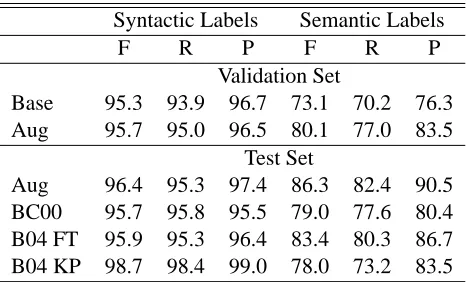
Table 4: Percentage F-measure (F), recall (R), and precision (P) function labelling, separated for syn-tactic and semantic labels, for our models and Bla-heta and Charniak’s (BC00) and BlaBla-heta’s models (B04 FT, B04 KP). The feature trees (FT) and ker-nel perceptrons (KP) are optimised separately for the two different sets of labels.
ful criterion and are more informative exemplars for the parser. Instead, simply decreasing the frequency cut-off adds mostly types of words for which the parser already possesses enough evidence (in gen-eral, nouns). Our method of lowering function la-bels acts as a finer-grained classification that parti-tions different kinds of complements based on their lexical semantic characteristics, yielding classes that are relevant to constituent structure. For instance, it is well known that lexical semantic properties of arguments of verbs are related to the verb’s argu-ment structure, and consequently to the parse tree that the verb occurs in. Partitioning a verb’s comple-ments into function classes could influence attach-ment decisions beneficially. We also think that the parser we use is particularly able to take advantage of these subclasses. One of the main properties of SSN parsers is that they do not need large vocabu-laries, because the SSN is good at generalising item-specific properties into an internal hidden represen-tation of word classes.
Baseline Augmented
P R P R
ADV 81.7 90.5 87.9 81.0
DIR 72.2 39.8 77.0 48.5
EXT 88.1 68.5 86.8 63.5
LOC 75.7 67.4 78.9 74.6
MNR 43.2 37.2 74.0 55.7
NOM 88.0 93.6 88.7 93.1
PRP 67.5 61.4 74.4 65.9
[image:7.612.114.275.53.194.2]TMP 78.3 75.0 89.6 83.7
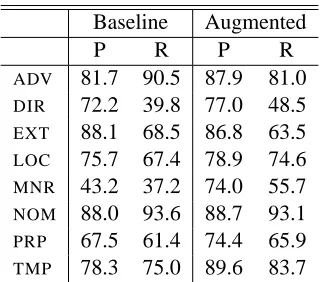
Table 5: Percentage F-measure (F), recall (R), and precision (P) function labelling, separated for indi-vidual semantic labels, for validation set.
recovered. Clearly, our parsing results would be un-interesting if our recall on function labels were very low. In that case, we would have failed to learn the function parsing task, and that would trivially yield a good performance on the simple parsing task. Ta-ble 4 reports the aggregated numbers for the base-line and the augmented model, while Table 5 re-ports separate figures for each semantic function la-bel. These tables show that we also perform well on the labelling task alone. 8 Comparison to other
researchers (last three lines of Table 4) shows that we achieve state-of-the-art results with a single inte-grated model that is jointly optimised for all the dif-ferent types of function labels and for parsing, while previous attempts are optimised separately for the two different sets of labels. In particular, our method performs better on semantic labels.
5 Related Work
As far as we are aware, there is no directly compa-rable work, as nobody has so far attempted to fully merge function labelling or semantic role labelling into parsing. We will therefore discuss separately those pieces of work that have made limited use of function labels for parsing (Klein and Manning, 2003), and those that have concentrated on recover-ing function labels as a separate task (Blaheta and Charniak, 2000; Blaheta, 2004). We cannot discuss here the large recent literature on semantic role la-belling for reasons of space, apart from work that
8See also (Musillo and Merlo, 2005) for more detail and
comparisons on the labelling task.
also recovers function labels (Jijkoun and de Rijke, 2004) and work that trains a parser on Propbank la-bels as the first stage of a semantic role labelling pipeline (Yi and Palmer, 2005).
(Klein and Manning, 2003) and, to a much more limited extent, (Collins, 1999) are the only re-searchers we are aware of who used function labels for parsing. In both cases, the aim was actually to improve parser performance, consequently only few carefully chosen labels were used. (Klein and Manning, 2003) suggest the technique of tag split-ting for the constituent bearing the labelTMP. They
also speculate that locative labels could be fruitfully percolated down the tree onto the preterminals. Re-sults in Table 5 indicate more precisely that lower-ing locative labels does indeed brlower-ing about some im-provement, but not as much as the MNR and TMP
labels.
6 Conclusions
In this paper we have presented a technique to ex-tend an existing parser to produce richer output, an-notated with function labels. We show that both state-of-the-art results in function labelling and in parsing can be achieved. Application of these re-sults are many-fold, such as information extraction or question answering where shallow semantic an-notation is necessary. The technique illustrated in this paper is of wide applicability to all other se-mantic annotation schemes available today, such as Propbank and Framenet, and can be easily extended. Work to extend this technique to Propbank annota-tion is underway. Since funcannota-tion labels describe de-pendence relations between the predicative head and its complements, whether they be arguments or ad-juncts, this paper suggests that a left-corner parser and its probabilistic model, which are defined en-tirely on configurational criteria, can be used to pro-duce a dependency output. Consequences of this ob-servation will be explored in future work.
Acknowledgments
We thank the Swiss National Science Foundation for its support of this research under grant number 105286. We thank James Henderson for allowing us to use his parser and for numerous helfpul discus-sions.
References
Ann Bies, M. Ferguson, K.Katz, and Robert MacIntyre. 1995. Bracketing guidelines for Treebank II style. Technical re-port, University of Pennsylvania.
Don Blaheta and Eugene Charniak. 2000. Assigning function tags to parsed text. In Procs of NAACL’00, pages 234–240, Seattle, Washington.
Don Blaheta. 2004. Function Tagging. Ph.D. thesis, Depart-ment of Computer Science, Brown University.
Eugene Charniak. 2000. A maximum-entropy-inspired parser. In Procs of NAACL’00, pages 132–139, Seattle, Washington.
Michael Collins and Scott Miller. 1998. Semantic tagging us-ing a probabilistic context-free grammar. In Procs of the Sixth Workshop on Very Large Corpora, pages 38–48, Mon-treal, CA.
Michael Collins. 1999. Head-Driven Statistical Models for Natural Language Parsing. Ph.D. thesis, Department of Computer Science, University of Pennsylvania.
CoNLL. 2004, 2005. Conference on computational natural lan-guage learning (conll-2004/05).
Ruifang Ge and Raymond J. Mooney. 2005. A statistical se-mantic parser that integrates syntax and sese-mantics. In Procs of CONLL-05, Ann Arbor, Michigan.
Daniel Gildea and Daniel Jurafsky. 2002. Automatic labeling of semantic roles. Computational Linguistics, 28(3):245– 288.
Jesus Gimenez and Lluis Marquez. 2004. Svmtool: A general POS tagger generator based on Support Vector Machines. In Procs of LREC’04, Lisbon, Portugal.
Jamie Henderson. 2003. Inducing history representations for broad-coverage statistical parsing. In Procs of NAACL-HLT’03, pages 103–110, Edmonton, Canada.
Valentin Jijkoun and Maarten de Rijke. 2004. Enriching the output of a parser using memory-based learning. In Procs of ACL’04, pages 311–318, Barcelona,Spain.
Valentin Jijkoun, Maarten de Rijke, and Jori Mur. 2004. In-formation extraction for question answering: Improving re-call through syntactic patterns. In Procs of COLING-2004, Geneva, Switzerland.
Dan Klein and Christopher D. Manning. 2003. Accurate unlex-icalized parsing. In Procs of ACL’03, pages 423–430, Sap-poro, Japan.
Mitch Marcus, Beatrice Santorini, and M.A. Marcinkiewicz. 1993. Building a large annotated corpus of English: the Penn Treebank. Computational Linguistics, 19:313–330.
Gabriele Musillo and Paola Merlo. 2005. Assigning function labels to unparsed text. In Procs of RANLP’05, Korovets, Bulgaria.
Mark Jan Nederhof. 1994. Linguistic Parsing and Program Transformations. Ph.D. thesis, Department of Computer Science, University of Nijmegen.
Martha Palmer, Daniel Gildea, and Paul Kingsbury. 2005. The Proposition Bank: An annotated corpus of semantic roles. Computational Linguistics, 31:71–105.
Senseval. 2004. Third international workshop on the evalua-tion of systems for the semantic analysis of text (acl 2004). http://www.senseval.org/senseval3.
David Stallard. 2000. Talk’n’travel: A conversational system for air travel planning. In Procs of ANLP’00, pages 68–75, Seattle, Washington.
Alexander Yeh. 2000. More accurate tests for the statistical significance of the result differences. In Procs of COLING 2000, pages 947–953, Saarbrucken, Germany.