A&A 561, A129 (2014)
DOI:10.1051/0004-6361/201321789 c
ESO 2014
Astronomy
&
Astrophysics
The effects of spatial resolution on integral field spectrograph
surveys at different redshifts
−
The CALIFA perspective
D. Mast
1,2, F. F. Rosales-Ortega
3,4, S. F. Sánchez
2,1, J. M. Vílchez
2, J. Iglesias-Paramo
2,1, C. J. Walcher
5,
B. Husemann
5, I. Márquez
2, R. A. Marino
6, R. C. Kennicutt
7, A. Monreal-Ibero
2,5, L. Galbany
8,
A. de Lorenzo-Cáceres
9, J. Mendez-Abreu
10,11, C. Kehrig
2, A. del Olmo
2, M. Relaño
12, L. Wisotzki
5,
E. Mármol-Queraltó
10,11, S. Bekeraitè
5, P. Papaderos
13, V. Wild
9, J. A. L. Aguerri
10,11, J. Falcón-Barroso
10,11,
D. J. Bomans
14,15, B. Ziegler
16, B. García-Lorenzo
10,11, J. Bland-Hawthorn
17,
Á. R. López-Sánchez
18,19, and G. van de Ven
20(Affiliations can be found after the references) Received 29 April 2013/Accepted 15 November 2013
ABSTRACT
Context.Over the past decade, 3D optical spectroscopy has become the preferred tool for understanding the properties of galaxies and is now increasingly used to carry out galaxy surveys. Low redshift surveys include SAURON, DiskMass, ATLAS3D, PINGS, and VENGA. At redshifts above 0.7, surveys such as MASSIV, SINS, GLACE, and IMAGES have targeted the most luminous galaxies to study mainly their kinematic prop-erties. The on-going CALIFA survey (z∼0.02) is the first of a series of upcoming integral field spectroscopy (IFS) surveys with large samples representative of the entire population of galaxies. Others include SAMI and MaNGA at lower redshift and the upcoming KMOS surveys at higher redshift. Given the importance of spatial scales in IFS surveys, the study of the effects of spatial resolution on the recovered parameters becomes important.
Aims.We explore the capability of the CALIFA survey and a hypothetical higher redshift survey to reproduce the properties of a sample of objects observed with better spatial resolution at lower redshift.
Methods.Using a sample of PINGS galaxies, we simulated observations at different redshifts. We then studied the behaviour of different parame-ters as the spatial resolution degrades with increasing redshift.
Results.We show that at the CALIFA resolution, we are able to measure and map common observables in a galaxy study: the number and distri-bution of H
ii
regions (Hα flux structure), the gas metallicity (using the O3N2 method), the gas ionization properties (through the [Nii
]/Hαand [Oiii
]/Hβline ratios), and the age of the underlying stellar population (using the D4000index). This supports the aim of the survey to characterise the observable properties of galaxies in the Local Universe. Our analysis of simulated IFS data cubes at higher redshifts highlights the importance of the projected spatial scale per spaxel as the most important figure of merit in the design of an integral field survey.Key words.techniques: spectroscopic – galaxies: abundances – stars: formation – galaxies: ISM – galaxies: stellar content
1. Introduction
The Calar Alto Legacy Integral Field Area Survey (CALIFA, 0.005 < z < 0.03;Sánchez et al. 2012a) aims to characterise spectroscopically the galaxy population in the Local Universe, and on completion will be the largest and most comprehensive wide-field integral field spectrograph (IFS) survey carried out to date. With its statistically significant sample of∼600 galaxies, CALIFA will form the bridge between large single aperture sur-veys and detailed studies of individual galaxies.
Other surveys in the Local Universe using the power of integral-field spectrophotometers for a detailed study of nearby galaxies include the SAURON (Spectroscopic Areal Unit for Research on Optical Nebulae) project (de Zeeuw et al. 2002) and its extension ATLAS3D (z <0.01;Cappellari et al. 2011), VENGA (VIRUS-P Exploration of Nearby Galaxies, Blanc et al. 2010), the DiskMass Survey (Bershady et al. 2010), and the PPAK IFS Nearby Galaxies Survey, PINGS (z ∼ 0.002; Rosales-Ortega et al. 2010, hereafter RO10). Upcoming sur-veys are SAMI (Sydney Australian Astronomical Observatory Multi-object Integral Field Spectrograph, Croom et al. 2012) and MaNGA1 (Mapping Nearby Galaxies at APO, z ∼ 0.05).
1 http://www.sdss3.org/future/manga.php
At high redshift there is the SINS (Spectroscopic Imaging survey in the Near-infrared with SINFONI) survey (z ∼ 2; Förster Schreiber 2009), the MASSIV (Mass Assembly Survey with SINFONI in VVDS) survey (z ∼ 1;Vergani et al. 2012), the GLACE (GaLAxy Cluster Evolution) survey (z ∼ 0.6; Sánchez-Portal et al. 2011), and the IMAGES (MAss Galaxy Evolution Sequence;z∼1;Ravikumar et al. 2007).
In order to map the properties of local galaxies, a compro-mise must be made between the observing time invested on each object and the number of objects of the sample. The mosaick-ing approach designed for the PINGS survey, which mapped the H
ii
regions over the whole extension of the galaxies and explored the 2D metallicity structure of discs, involved more than 30 pointings and three years of observation. In contrast, the SAURON project opted for single pointings of the central part of early-type galaxies and bulges of spirals.The CALIFA survey was designed with the aim of obtaining a balance between a detailed study of each galaxy and a statis-tically significant sample to fully characterise the optical prop-erties of galaxies in the Local Universe. With this in mind, the sample was selected to have optical sizes that fit within the field of view (FoV) of the PPak instrument (PMAS – Potsdam Multi-Aperture Spectrophotometer – fiber pack, Roth et al. 2005; Verheijen et al. 2004; Kelz et al. 2006; Kelz & Roth 2006),
Fig. 1.Digital Sky SurveyR-band images of the five galaxies selected from PINGS for this study (adapted from RO10). The IFS mosaicking is indicated by the superposition of the hexagonal PPak FoVs. Images are 10×10 arcmin2. North is up, east is to the left.
allowing us to map their physical properties over their whole op-tical extent in just one pointing. In this context, one of the aims of the present paper is to determine the capability of CALIFA to measure the main properties of the observed galaxies despite resolution limitations.
Looking ahead to the next decade when new proposed sur-veys will explore the intermediate and high redshift regime, in this paper we also study how the information loss due to spa-tial resolution degradation will affect an hypothetical IFS survey at higher redshift. Taking advantage of the superb spatial sam-pling of a subsample of PINGS galaxies (z ∼ 0.0009−0.0023, ≈0.04 kpc/arcsec), we create two simulations: simulationZ1 rep-resents CALIFA atz ∼ 0.02, and simulationZ2 represents an hypothetical survey atz∼0.05, or other redshift ranges depend-ing on the instrument. In what follows, we refer to the PINGS redshift regime at an averagez ∼ 0.002 as Z0. We will anal-yse the behaviour of some common observables used in galaxy studies as the spatial resolution degrades with increasing red-shift. Because of the low spectral resolution of PINGS data, we are unable to study the effect of spatial resolution on kinematics because the simulated cubes would not be representative of the higher spectral resolution CALIFA data.
Previous studies of this issue includeViironen et al.(2012) with a detailed study of UGC 9837 (z ∼ 0.008863) repeating the analysis with simulated versions of the galaxy at higher red-shifts (z ≈ 1−2).Kronberger et al.(2007) model disc galaxies using N-body/hydrodynamic simulations to investigate distor-tions in the velocity fields at different redshifts fromz = 0 to
z=1.Giavalisco et al.(1996) simulateHubbleSpace Telescope (HST) images at cosmological distances using images from the Ultraviolet Imaging Telescope (UIT), or the more recent work
ofBarden et al.(2008) where they simulate galaxies at redshifts 0.1 < z < 1.1 using images from the SDSS in the u, g,r,i, andzfilter bands as input. Most of these studies have focussed on the degradation of images with redshift. Examples of studies fo-cussing on spectral effects areLaw et al.(2006) who mapped the velocity fields of high-redshift galaxies, andYuan et al.(2013) who utilised the [N
ii
]/Hα ratio to investigate how an inferred metallicity gradient is altered by the loss of angular resolution.The structure of this paper is as follows. In Sect.2we present the sample. Section3summarises the observations and data re-duction while Sect.4explains how we simulate the different red-shift regimes. The analysis of both gaseous and stellar compo-nents of the sample is presented in Sect.5. In Sect.6we review the main results of this work.
Throughout this paper, we assume a standardΛCDM cos-mology consistent with WMAP results (Bennett et al. 2003) with
Ωm=0.3,ΩA=0.7 andH0=70h70km−1s−1.
2. Sample
The PINGS survey is a project designed to construct 2D spec-troscopic mosaics of a representative sample of 17 nearby spi-ral galaxies, using PMAS in the PPak mode at the Centro Astronómico Hispano Alemán (CAHA) at Calar Alto, Spain. PINGS is one of the most detailed and largest IFS surveys of individual galaxies at low redshift (z∼ 0.001). The data cover most of the optical extent of the galaxies, down toR25(the radius
of the galaxy at the isophotal level of 25 mag/arcsec2inB-band),
Table 1.PINGS subsample.
Object Type Dist. [Mpc] Size [arcmin2]a z NGC 628 SA(s)c 9.3 10.5×9.5 0.00219 NGC 1058 SA(rs)c 10.6 3.0×2.8 0.001728 NGC 1637 SAB(rs)c 12.0 4.0×3.2 0.00239 NGC 3184 SAB(rs)cd 11.1 7.4×6.9 0.001975 NGC 5474 SA(s)cd 6.8 4.8×4.3 0.000911
Notes.(a)Size of the galaxy down to R25(de Vaucouleurs et al. 1992).
size (see Table1for details of each galaxy). The NGC 628 mo-saic subtends 34 arcmin2 and was constructed from 34 diff er-ent pointings, the NGC 1058 mosaic subtends 3.0×2.8 arcmin2
and was constructed from 7 different fields, the NGC 1637 mo-saic was built from one central pointing and a concentric ring of 6 pointings covering a total area of 4.0 ×3.2 arcmin2, the
NGC 3184 mosaic covers an area of 7.4×6.9 arcmin2and was constructed from 16 IFS pointings, and finally the NGC 5474 mosaic covers an area of 4.8×4.3 arcmin2and was built from of one central pointing and a concentric ring of 6 pointings.
3. Observations and data reduction
The observations were carried out at the 3.5 m telescope of the Calar Alto observatory with the PMAS in the PPak mode. The PPak unit features a central hexagonal bundle with 331 densely packed optical fibres to sample an astronomical object with a resolution of 2.7/fibre, over an area of 74×65 arcsec2,
with a filling factor of 65 % (<100% due to gaps in-between the fibres). The sky background is sampled by 36 additional fi-bres distributed in 6 mini-bundles of 6 fifi-bres each, which en-circle the central hexagon at a distance of∼90. All galaxies were observed using the same telescope and instrument set-up. The V300 grating was used, covering a wavelength range of 3700–7100 Å with a resolution of ∼10 Å FWHM, corre-sponding to∼600 km s−1. The final product of the data
reduc-tion is a set of row-staked-spectra (RSS), a 2D FITS image where theX andY axes contain the spectral and spatial infor-mation respectively, regardless of their position in the sky. An additional file links the different spatial elements to position on the sky. Row-staked-spectra present a discontinuous sampling of the sky, so we performed an interpolation to obtain a regularly sampled 3D cube (datacube). Not all PINGS datacubes have the same final sampling. NGC 1637, NGC 1058, NGC 3184 and NGC 5474 have 1/spaxel sampling, while NGC 628 has a sam-pling of 2/spaxel. For more details on the observing strategy, data reduction (similar to that used for the CALIFA data) and sample selection of the PINGS survey, see RO10.
4. Methodology
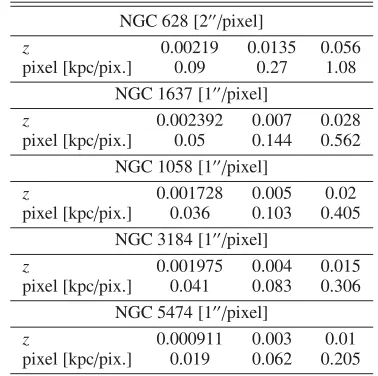
[image:3.595.40.288.99.171.2]The aim of this work is to study how the loss of spatial reso-lution due to redshift affects the derivation of physical param-eters obtained from IFS observations at different redshifts. We study three different spatial scales: (i)Z0 is at the original res-olution of the PINGS data set, i.e. sampling of∼0.045 kpc/, or 80–100 spatial elements across the optical extent; (ii)Z1 is at the typical spatial resolution and sampling of a CALIFA galaxy of diameter∼60, with 25–30 spatial elements out to∼2–3 ef-fective radii (Re); (iii) Z2 corresponds to a galaxy sampled
Table 2.Spatial sampling atZ0,Z1 andZ2.
NGC 628 [2/pixel]
z 0.00219 0.0135 0.056
pixel [kpc/pix.] 0.09 0.27 1.08 NGC 1637 [1/pixel]
z 0.002392 0.007 0.028
pixel [kpc/pix.] 0.05 0.144 0.562 NGC 1058 [1/pixel]
z 0.001728 0.005 0.02
pixel [kpc/pix.] 0.036 0.103 0.405 NGC 3184 [1/pixel]
z 0.001975 0.004 0.015
pixel [kpc/pix.] 0.041 0.083 0.306 NGC 5474 [1/pixel]
z 0.000911 0.003 0.01
pixel [kpc/pix.] 0.019 0.062 0.205
at 1 kpc/ or ∼7–10 spatial elements out to ∼2–3 Re i.e. a
z ∼ 0.05 galaxy and instrument with∼1spatial elements. We should note that the key parameter is the number of spatial ele-ments across the extent of the galaxy, the fiducial redshift of the galaxy will depend on the precise survey design. We then per-formed the same analysis on the three sets of galaxies (i.e. the original PINGS galaxies and both simulated sets) focusing on a set of commonly measured observables. In this way, we can quantify the extent to which we can recover observables of in-terest, and thus achieve the aim of characterising the properties of galaxies in the Local Universe, in both CALIFA and a hypo-thetical higher redshift IFS survey.
We decided to focus this study only on resolution effects, and in particular on spatial resolution degradation due to redshift. We have not considered either surface brightness dimming or increase in noise, i.e. we take for granted that the exposure time is sufficient to reach a similar depth in all cases. Also, we have not taken into account the effects of PSF, since, so far, the ability to spatially resolve a feature in an IFS dataset is more strongly affected by the sampling than by PSF size.
4.1. Simulations
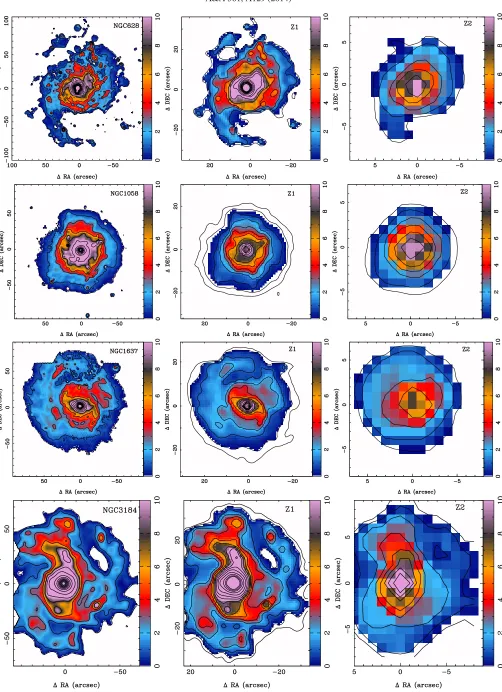
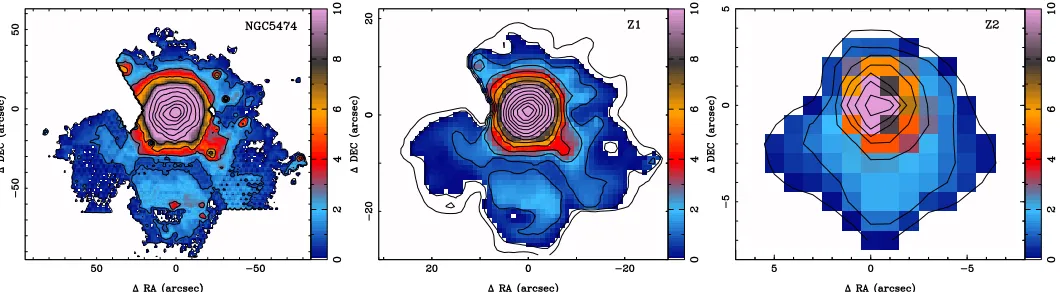
Fig. 2.continued.
V-band images of the original and simulated galaxies. The im-ages are constructed by convolving a JohnsonV-band filter with the datacubes.
5. Analysis
The aim of this paper is to understand how observed properties of H
ii
regions, in particular radial trends and spatial distribution, are affected by spatial resolution degradation. A complete analy-sis of the behaviour of derived properties and impact on physical conclusions will be the subject of forthcoming papers.We performed a set of standard analyses of increasing com-plexity: (i) reconstruction of broad-band images from the IFS datacubes; (ii) creation of emission line flux maps; (iii) measure-ment of more complex spectroscopic properties, such as line ra-tios, chemical abundance tracers, and ionisation indicators, fol-lowing the procedures described inSánchez et al.(2012a,b).
To analyse the information contained in the cubes, we used FIT3D to separate the underlying stellar continuum from the emission lines in each spectrum, following the process described in detail inSánchez et al. (2011) and RO10. FIT3D routines fit the underlying stellar population combining linearly a set of stellar templates within a multi-SSP model. A simple SSP template grid was adopted, consisting of three ages (0.09, 1.00 and 17.78 Gyr) and two metallicities (Z∼0.0004 and 0.03). The SSP templates were taken from the MILES project (Vazdekis et al. 2010). The metallicities and ages cover the wide ranges possible within the MILES library. The oldest stellar popula-tion was selected to reproduce the reddest possible underlying stellar population, mostly due to higher metallicities than the one considered in our simplified model, although it is clearly older than the accepted cosmological age of the Universe. Our youngest stellar population is the 2nd youngest in the MILES library for which both metallicities are available. No apprecia-ble difference was found between using this or the youngest SSP (∼80 Myr). Finally, we selected an average age stellar popula-tion, of∼1 Gyr, required to reproduce the intermediate-to-blue stellar populations, and to produce more reliable corrections of the underlying stellar absorption.
We study commonly used indicators of gaseous and stellar properties. In the case of the gas emission, these are the Hαflux, the [O
iii
]λ5007/Hβvs. [Nii
]λ6583/HαBPT diagnostic diagram (Baldwin et al. 1981;Veilleux & Osterbrock 1987), and the ra-dial oxygen abundance gradient derived from the widely-used O3N2 strong-line indicator (Pettini & Pagel 2004;Marino et al. 2013). For the stellar component we decided to show the 4000 Å break D4000(i.e. the break strength at 4000 Å defined as the ratioof the average flux densities in the narrow bands 4000–4100 Å and 3850–3950 Å, Balogh et al. 1999) as it is the most com-monly used proxy for mean stellar age.
All radial profiles are plotted in units ofR25obtained from
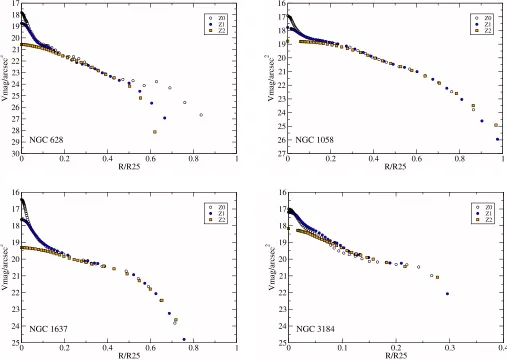
the RC3 catalogue (de Vaucouleurs et al. 1992) and scaled to each redshift regime. Surface brightness profiles for each galaxy (Fig.3) were constructed using the IRAF2taskellipseand then
scaled in they-axis to make them coincide atRmax/2 (maximum
measured radius divided by 2), in order to analyse the profile dif-ferences between galaxies. For the ellipse fitting we usedV-band images extracted from the datacubes as explained before.
All the above analyses (fitting and subtracting the underly-ing stellar continuum and fittunderly-ing of the emission lines) were per-formed independently on each datacube, i.e both the original and simulated ones.
5.1. Morphology
From Fig. 2 we can see that at the representative redshift of CALIFA (Z1, middle panel) we are able to qualitatively repro-duce most morphological features. In all cases we can trace the spiral arms, rings and bulge extension seen in the origi-nal images. Finer detail such as individual regions or spots, are smeared out on theZ1 case, so qualitatively we can see that the analysis of the distribution of some features along the arms or small regions will be limited by the resolution effect.
In theZ2 regime (Fig.2, right panel), the situation is totally different. Except in the case of NGC 628, where, as a grand-design galaxy, the spiral arms are very well defined and still traceable to high redshift, in all other galaxies the identification of spiral signatures is hampered. Individual regions are not eas-ily detected and the separation between the bulge and the disc becomes subtle. The latter effect can also be appreciated from the surface brightness profiles in Fig.3. In all cases, the primary effect of spatial resolution loss is that the profiles become flat-ter in the centre. In theZ1 case the central component, though smoothed, can be detected as an excess of light above the inward extrapolation of the disc. That is not the case for theZ2 profiles where the inner regions are shallow and a single component fit to the data seems to be the best option, although a slight disc/bulge differentiation could be seen in the radial plots.
0 0.2 0.4 0.6 0.8 1 R/R25
17 18 19 20 21 22 23 24 25 26 27 28 29 30
Vmag/arcsec
2
Z0 Z1 Z2
NGC 628
0 0.2 0.4 0.6 0.8 1
R/R25 16
17
18
19
20
21
22
23
24
25
26
27
Vmag/arcsec
2
Z0 Z1 Z2
NGC 1058
0 0.2 0.4 0.6 0.8 1
R/R25 16
17
18
19
20
21
22
23
24
25
Vmag/arcsec
2
Z0 Z1 Z2
NGC 1637
0 0.1 0.2 0.3 0.4
R/R25 16
17
18
19
20
21
22
23
24
25
Vmag/arcsec
2
Z0 Z1 Z2
[image:6.595.42.549.84.445.2]NGC 3184
Fig. 3.Surface brightness profiles of the original PINGS galaxies and the simulated ones, constructed fitting ellipses toV-band images extracted from the datacubes. The profiles were scaled in they-axis to make them coincide atRmax/2 (maximum measured radius divided by 2).
5.2. Ionized gas component
5.2.1. H
ii
region distributionTo extract the Hαintensity maps for all the cubes (see Figs.4 and5) we co-add the flux intensity within a square-shaped sim-ulated filter centred at the wavelength of Hα(6563 Å) shifted to the observed frame considering the redshift of the object, with a width of 60 Å. The adjacent continuum for each pixel was estimated averaging the flux intensity within two bands on both sides of the centre, separated 100 Å from it and with a width of 60 Å. This continuum intensity is then subtracted from the Hαintensity to derive a continuum-subtracted emis-sion line map. It is worth noting that this Hαintensity map is contaminated with the adjacent [N II] emission lines, and it is not corrected for Balmer absorption of the underlying stellar population.
Figure4show the resulting maps from the original and de-graded datacubes. TheZ1 maps show the same distribution of H
ii
regions tracing the spiral arms as in theZ0 case. Because of the coarse resolution, the Hii
regions found in theZ1 case are complexes of several PINGS regions but without a severe alter-ation of Hαflux local maxima position. On the contrary, as can be expected from the global morphology noted in the previous section, the Hα2D distribution in theZ2 simulation, presents a strong difference as many Hii
complexes are averaged into onesingle Hαaggregation. Again, no traceable spiral arms are visi-ble for theZ2 regime, and even in the NGC 628 case, in which the spiral structure is perfectly traced by the H
ii
complexes atZ0 andZ1, theZ2 galaxy presents a morphology that at a first sight it is not easily associated with a spiral structure. In any case, it is worth noting that the morphological analysis presented here is meant to show the effects of resolution in the morphology, in the understanding that any spectroscopic survey will have an imag-ing follow up to derive the morphology with better resolution and that kind of work will not be done from the line maps (al-though this might not be the case for all high-redshift studies, since some of them relies only in the IFS data).NGC628
200 100 0 −100 −200 ΔRA (arcsec)
−200 −100 0 100 200
Δ
Dec (arcsec)
NGC628 @ z1
20 0 −20
ΔRA (arcsec) −40
−20 0 20 40
Δ
Dec (arcsec)
NGC628 @ z2
5 0 −5
ΔRA (arcsec) −10
−5 0 5 10
Δ
[image:8.595.53.550.61.389.2]Dec (arcsec)
Fig. 5.H
ii
regions detection showing the application of the HIIexplorer
software to NGC 628. The panels display the segmentation maps generated by the software.Left: originalZ0 galaxies.Middle:Z1 galaxies.Right:Z2 galaxies. North is up, east is to the left. These segmentation maps are later used for the extraction of the Hii
region spectra.describing the pixels associated to each H
ii
region map that should be used for the extraction of the spectra. Each region will have a single spectrum generated by co-adding all the spec-tra indicated by the segmentation map. In Fig.5we can see, as an example, the case of NGC 628 in the three redshift regimes. The number of Hii
regions detected in each regime immedi-ately indicates the effect of resolution degradation, i.e. as we go to higher redshift we are considering as one region the contribu-tion from all Hii
regions smaller than the resolution element. Even in the Z0 case, the real physical size of an Hii
region is below the spatial resolution: in all cases, when we refer to Hii
regions we are in fact considering Hii
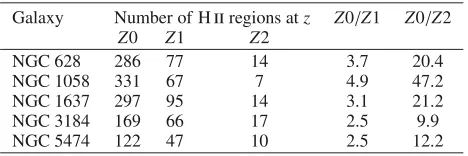
complexes or ag-gregates. Table3 shows the number of detected regions, with good enough signal-to-noise ratio (S/N) to perform the analy-sis, following the criteria fromSánchez et al.(2012b), for all the galaxies in the present study. For example, from 331 re-gions detected in NGC 1058, theZ2 regime identifies only 7. For the Z1 case, the average factor of under-detection is ∼3, and the difference betweenZ1 and theZ2 regime∼5. Also, as the resolution becomes coarser, the difficulty in delimiting the Hii
regions implies that we are combining both diffuse gas and Hii
region emission. It is important to mention that this is always the case if one is considering spaxel-to-spaxel analysis instead of individual or aggregations of Hii
regions. The latter is required to minimize the effect of contamination due to diffuse gas. If Hii
regions cannot be segregated, it is not guaranteed that the dominant ionized emission is due to photoionization from young massive stars and therefore, analysis as the abundance deriva-tions are not reliable. This is probably the case for theZ2 case where, due to the low number of pixels, it is difficult to identifyTable 3.Number of H
ii
regions detected for each galaxy.Galaxy Number of H
ii
regions atz Z0/Z1 Z0/Z2Z0 Z1 Z2
NGC 628 286 77 14 3.7 20.4
NGC 1058 331 67 7 4.9 47.2
NGC 1637 297 95 14 3.1 21.2
NGC 3184 169 66 17 2.5 9.9
NGC 5474 122 47 10 2.5 12.2
peaky/isolated structures as required by the HII
explorer
. As will be shown later for the abundance determination, although for theZ2 case the conditions are not easily fulfilled, the com-parison between the spaxel-spaxel and the HIIexplorer
analy-sis indicates that the former has a greater misinterpreting possi-bility, even considering a S/N threshold. As already mentioned inSánchez et al.(2012b), the spatial sampling and resolution of the data presented in this work is not optimal for the derivation of additive properties of individual Hii
regions. Therefore these data are not optimal for the study of the Hαluminosity function or the characteristic optical extension of Hii
regions, to men-tion just a couple of quantities. Although in every analysis of this kind one has to bear in mind that the measurements could correspond to an Hii
region complex. [image:8.595.316.550.474.552.2]Table 4.Distribution of number of regions corresponding to different regimes.
Galaxy Z0 inZ1 Z0 inZ2 Z1 inZ2 NGC 628 3±1 20±5 4±1 NGC 1058 3±2 19±9 5±2 NGC 1637 2±1 14±5 4±1 NGC 3184 1±1 4±3 2±1 NGC 5474 2±1 8±4 3±1
distinguishing disc, arms, and bulge, but, in any case, it will de-pend on the morphology of the studied galaxy.
To explore further the H
ii
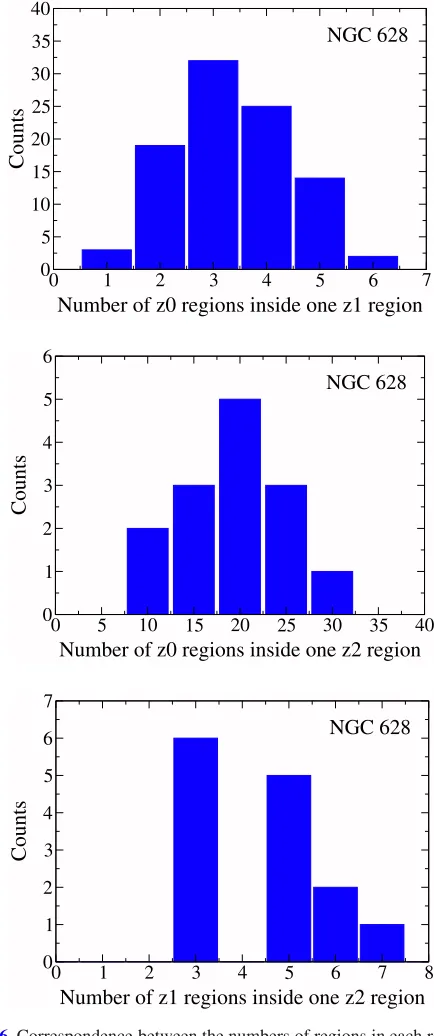
region limits mentioned above, we identified all the regions from the higher resolution datacube that are detected as an individual region at lower resolution. In this way we can analyse the real source (or sources) of a par-ticular measurement, and study how it is affected by the spatial binning. Figure6 shows an example for NGC 628. The upper panel of this figure displays a histogram of the number ofZ0 re-gions inside aZ1 one. This distribution indicates that, on aver-age, eachZ1 detected Hii
region is built of 3 smallerZ0 regions. For the higher redshift case, each individual region is, in reality, an agglomerate of around 15 to 25Z0 regions, while it is built by the contribution of∼4Z1 regions. Table4summarises the distri-bution of the number of regions in terms of median and standard deviation for all the sample.5.2.2. Diagnostic diagrams
We can use the [O
iii
]λ5007/Hβratio, together with [Nii
]λ6583/ Hα, to construct the classical BPT diagram for all the galaxies, as shown in Fig.7. These plots allow us to see how the spatial information loss is affecting our understanding and character-isation of the ioncharacter-isation sources at higher redshift. It is clear that when the idea is to separate, for example, AGN activity from star-formation, one has to consider the degree of contami-nation due to the area subtended by the spectroscopic aperture. In the present study, where we are dealing with Hii
regions, we have the opportunity to map the way that this resolution degra-dation alters the position of each individual region on the BPT diagram. We have also plotted theKewley et al.(2001) demar-cation curve, often invoked to distinguish between star-forming regions (Fig.7, below the red line), and other sources of ionisa-tion, such as AGN/shocks/post-AGB stars (above the line) and theKauffmann et al.(2003) one to indicate the so-called com-posite zone. In the plots, empty circles correspond to theZ0 case, while full blue circles and orange squares correspond toZ1 andZ2 respectively. We also plot symbol size proportional to the galactocentric distance, i.e. the larger the symbol, the farther from the galaxy centre.
This distribution of regions in the BTP diagram is expected since star-formation is the dominant ionising source in all the selected galaxies. As described inKewley & Ellison(2008) the objects lying in the composite region do not require an addi-tional ionising sourceper se, in the case of a strong nitrogen enrichment. Other ionisation sources, like shocks, AGB star and AGN photoionization, mixed with pure star-formation, can also populate this region. Thus, the intermediate region only indicates that their nature is uncertain, not that the ionising source is def-initely different than star-formation. However, for the particular scope of this article, we have preferred a conservative approach and do not consider them in any further discussion.
0 1 2 3 4 5 6 7
Number of z0 regions inside one z1 region
0 5 10 15 20 25 30 35 40
Counts
NGC 628
0 5 10 15 20 25 30 35 40
Number of z0 regions inside one z2 region
0 1 2 3 4 5 6
Counts
NGC 628
0 1 2 3 4 5 6 7 8
Number of z1 regions inside one z2 region
0 1 2 3 4 5 6 7
Counts
[image:9.595.74.257.111.176.2]NGC 628
Fig. 6.Correspondence between the numbers of regions in each regime for NGC 628, i.e. the number of regions lying inside an individual region of each other redshift case.Upper panel: correspondence be-tweenZ0 andZ1.Middle panel: correspondence betweenZ0 andZ2. Lower panel: correspondence betweenZ1 andZ2.
-1.2 -1 -0.8 -0.6 -0.4 -0.2 0 0.2
log([NII]λ6583/Ηα)
-2 -1.5 -1 -0.5 0 0.5 1
log([OIII]
λ5007/Ηβ)
Z0 Z1 Z2
NGC 628
-1 -0.8 -0.6 -0.4 -0.2 0 0.2
log([NII]λ6583/Ηα)
-2 -1.5 -1 -0.5 0 0.5 1
log([OIII]
λ5007/Ηβ)
Z0 Z1 Z2
NGC 1058
-1.2 -1 -0.8 -0.6 -0.4 -0.2 0 0.2
log([NII]λ6583/Ηα)
-2 -1.5 -1 -0.5 0 0.5 1
log([OIII]
λ5007/Ηβ)
Z0 Z1 Z2
NGC 1637
-1.2 -1 -0.8 -0.6 -0.4 -0.2 0 0.2
log([NII]λ6583/Ηα)
-2 -1.5 -1 -0.5 0 0.5 1
log([OIII]
λ5007/Ηβ)
Z0 Z1 Z2
NGC 3184
-1.2 -1 -0.8 -0.6 -0.4 -0.2 0 0.2
log([NII]λ6583/Ηα)
-2 -1.5 -1 -0.5 0 0.5 1
log([OIII]
λ5007/Ηβ)
[image:10.595.74.522.69.583.2]Z0 Z1 Z2
NGC 5474
Fig. 7.Classical BPT emission-line diagnostic diagrams (Baldwin et al. 1981;Veilleux & Osterbrock 1987) with the demarcation curves ofKewley et al.(2001) (upper curve, red) andKauffmann et al.(2003) (lower curve, green) for each galaxy. Empty circles correspond toZ0, blue circles toZ1, and orange squares toZ2. Symbol sizes are proportional to galactocentric distance, i.e. the larger symbols are, the farther from the centre.
the other redshift regimes. The underlying reason of the shrink-ing in the occupied parameter space with increasshrink-ingZ could be because the ratios are luminosity-weighted. If two regions haveR1 = a1/b1 andR2 = a2/b2, then the combined ratio
R=(a1+a2)/b=R1×(b1/b)+R2×(b2/b), whereb=b1+b2. In the case whereb1 b2(b1 b2), thenR∼R1(R2). When
b1 ∼ b2, thenR ∼ 0.5×(R1+R2). Ris always betweenR1 andR2. Therefore, summing multiple H
ii
regions and measur-ing line ratios mean takmeasur-ing a luminosity-weighted mean of the ratios.In all the Z1 simulated galaxies the approximate shape of the two-branches structure, visible in the originalZ0 galaxies is
acceptably discerned. Thus, we suggest thatZ1 can recover the global trend of H
ii
regions in the BPT diagram whileZ2 only reflects the denser part of the distribution in the lower redshift case.5.2.3. Line ratios and abundances
-1.2 -1 -0.8 -0.6 -0.4 -0.2 0 0.2
log([NII]
λ6583/Ηα)
-2 -1.5 -1 -0.5 0 0.5 1
log([OIII]
λ5007/Ηβ)
Z0 Z1 Z2
[image:11.595.41.290.69.259.2]NGC 628
Fig. 8.Same as Fig.7but for oneZ2 region and its corresponding Z0 andZ1 region content. Empty circles correspond toZ0, blue circles to Z1, and orange squares toZ2.
Fig. 9.Top: radial distribution of [O
iii
]/Hβfor NGC 1058.Bottom: ra-dial distribution of the [Nii
]/Hα ratio for the same galaxy. Empty cir-cles correspond toZ0, blue circles toZ1, and orange squares toZ2.emission lines), is basically not affected by the effects of ex-tinction (the involved line-ratios are very close in wavelength),
and implies a simple linear conversion, reason for which this indicator is very popular for high redshift studies3Fig.9shows
the radial distributions of the ratios [N
ii
]/Hαand [Oiii
]/Hβ. We can see that the [Oiii
]/Hβ radial gradient becomes flatter with redshift. This will have a clear effect on the abundance deter-mination. As an example, Fig.10shows the radial abundances for regions in two of the galaxies (NGC 1058 and NGC 1637) with fitted gradients for comparison purposes, corresponding the empty circles toZ0, the blue circles toZ1, and the orange squares toZ2 (see Fig.A.1for the remaining objects).We note that the oxygen abundance is not an additive but a relative property, and it exhibits a ubiquitous radial gradient (e.g. Sánchez et al. 2012b). Therefore, neither the average nor a value at a fixed aperture are characteristic of the full distribution (e.g. Tremonti et al. 2004;Rosales-Ortega et al. 2012). Even more, it is still not clear that the average of the values derived at different radii is representative of a single value derived using an aperture that encircles all the previous ones.
In all the galaxies we see a radial abundance gradient de-creasing outwards, with NGC 628 and NGC 1058 being the more evident cases. This effect is expected as late-type galax-ies are known to have a composition gradient related to their star formation history (SFH). The capability of any survey of being able to measure this gradient is essential if one of its goals is to characterise the properties of galactic discs.
All galaxies show a nearly flat distribution in the innermost parts, until r ∼ 0.2R25. From this point, the abundance
mea-surements start to exhibit higher values, reaching maxima at
r∼0.4R25in 3 of the cases (r ∼0.2R25for NGC 1058). After
this, the slope of the radial abundance distribution changes its sign, and decreases with increasing galactocentric radius. In all cases,Z1 reproduces notably the Z0 trend with slightly lower abundances. The same radial gradients are visible, with the only difference being the absence of the peak at r ∼ 0.2R25 (in the
case of NGC 1058) andr ∼0.4R25 (for NGC 628). For all the
galaxies,Z2 fails to reproduce the slope behaviour, as anticipated with the [O
iii
]/Hβline ratio, showing a nearly flatter distribution (on average) like in NGC 1058 and NGC 1637 (see Fig.10). [image:11.595.41.289.324.690.2]0 0.2 0.4 0.6 0.8 1
R/R25
8 8.2 8.4 8.6 8.8 9 9.2 9.4
12+log(O/H)
NGC 1058
0 0.2 0.4 0.6 0.8 1
R/R25
8 8.2 8.4 8.6 8.8 9 9.2 9.4
12+log(O/H)
[image:12.595.42.561.65.440.2]NGC 1637
Fig. 10.Radial abundance gradients derived using the relation O3N2 fromPettini & Pagel(2004) for two of the galaxies. In eachleft panelthe three redshift regimes are over-plotted, the empty circles correspond toZ0, the blue circles toZ1, and the orange squares toZ2. The three points in the bottom left corner show the average error bars. In theright panelswe can see a linear regression fitting to each regime.
0 0.2 0.4 0.6 0.8 1
R/R25
8 8.2 8.4 8.6 8.8 9 9.2 9.4
12+log(O/H)
NGC 1058
Fig. 11.Radial abundance gradient of NGC 1058 for the three red-shift regimes. Colour coded is each differentZ2 region with its cor-respondingZ0 andZ1 components (same colour). Small circles cor-respond toZ0, medium sized toZ1 and the bigger ones to Z2.Plus signs represent the abundance determined summing the flux of all the Z0 regions inside the correspondingZ2 region, while crosses are the determination from the total flux ofZ1 regions (also the ones inside theZ2 region).
crosses are the determination from the total flux of theZ1 re-gions inside thatZ2 region.
[image:12.595.40.293.512.691.2]Fig. 12.Comparison between the same analysis as Fig.10and a spaxel-spaxel determination above a S/N threshold (green) for NGC 1058.
This effect is also present in other abundance indicators, likeR23, and less affected by others like [N
ii
]/Hα. Evidently, the effect of the spatial resolution degradation on theZ2 regime in-hibits any possibility of measuring convincing radial abundance gradients at that redshift.Yuan et al. (2013) find similar results studying the [N
ii
]/Hαratio. They show that seeing-limited observations pro-duce significantly flatter gradients than higher angular resolu-tion observaresolu-tions. They find a critical angular resoluresolu-tion FWHM range (<0.02), which depends on the intrinsic gradient of the galaxy, beyond which the measured metallicity is significantly more flattened than the intrinsic metallicity.Another effect that may be playing an important role on the radial abundance gradients and the BPT diagrams, is that when we go to higher redshift, the coarse resolution causes us to add more diffuse gaseous component to the H
ii
aggregates, with potentially different dominating ionising sources than in the Hii
complexes. The difference between the plus sign, the cross and the bigger circles of Fig.11would account for the different amount of diffuse medium considered on each region. The ef-fect of this contamination is very clear if we study cases where we can resolve the diffuse medium at tens-of-parsec scale like in M33 or NGC 5253 (e.g.Voges & Walterbos 2006;Relaño et al. 2010;Monreal-Ibero et al. 2010a,2011). In all the mentioned cases, as we move away from the Hii
region, with the maximum local Hαflux, as this flux decreases, the ratio [Nii
]/Hαincreases while [Oiii
]/Hβ decreases. This will cause the abundance deter-mination based on the O3N2 method to increase. If in a con-sidered galaxy the Hii
region spatial density is low, the contri-bution of the diffuse component to the line ratios could become very important and even the dominant source of line fluxes, i.e. as could be the case in the outer points of the radial abundance distribution plotted in Fig.10. In any case, an estimation of the contribution of the diffuse component is not trivial and depends on the different galaxy components considered (arm, inter-arm, bulge, nucleus, etc.).Figure12 shows the comparison between the same analy-sis as Fig.10and an spaxel-spaxel determination above a S/N threshold. The low abundance inner pixels may alter the gra-dient determination. Although a deep analysis of the merging H
ii
complexes and the contribution from diffuse ionized gas (DIG) is beyond the scope of this paper, it is worth noting thatthey are key points in this kind of studies, and any interpreta-tion should consider them. Although the DIG contribuinterpreta-tion to the integrated flux in some lines has been quantified in large val-ues (e.g. about 30%–50% of ionized gas, as traced by Hα, in galaxies is found outside of H
ii
regions,Thilker et al. 2002; Oey et al. 2007;Haffner et al. 2009;Monreal-Ibero et al. 2010b; Alonso-Herrero et al. 2010), its final contribution to dust cor-rected luminosity is much lower (e.g. 5%–30%,Crocker et al. 2013;Sánchez et al. 2013). The line ratio of the DIG may differ from that of the star-forming regions, being in general located in the LINER-like region of the BTP diagram (Singh et al. 2013; Papaderos et al. 2013), reflecting ionizing conditions that depend on the morphology of the galaxies (e.g. post-AGBs for most of the earlier-type galaxies,Papaderos et al. 2013). Therefore, the inclusion of larger fraction of DIG emission as the resolution is degraded have a clear effect in the line ratios, although it is the not the only effect to take into account.When the spatial resolution is good enough to resolve the more luminous H
ii
regions, it is still possible to use techniques of crowded field spectroscopy (Fabrika et al. 2005;Blanc et al. 2009;Kamann et al. 2013). These techniques are extensions to IFS of the well-known PSF-photometric techniques (DAOPhot), and they rely on the basis that the considered regions are basi-cally unresolved at the spatial resolution of the data. Therefore, it is possible to perform a multi-Gaussian 2D fitting, wavelength by wavelength, to model each of the individual HII-regions, and a 2D polinomial function to take into account the continuum. This procedure will effectively decouple the diffuse from the re-solved emission. However, for doing so it is required to distin-guish between both components, and, as we argue along this ar-ticle, this is not feasible with the spatial resolution of theZ2 data. We have still not implemented this procedure in HIIexplorer, but we will have to add that capability to perform more detailed anal-ysis in the future.It is clear that the effects in the line ratios and the correspond-ing derivation of the abundance gradients are complex, and in-volve many different components that are difficult to disentangle. However, the final result may produce a change in this gradient induced by the degradation of the resolution.
With all the considerations made above, the parameters stud-ied for the gaseous phase show that, contrary to the naive pic-ture, the effect of the resolution degradation is not as intuitive as it would be if we were considering simple additive quantities. Some effects detected in abundance gradients or BPT diagrams at high redshift could be due to spatial information loss.
5.3. Stellar component
As we explained in Sect. 5, we used FIT3D for separating the gaseous spectra from the underlying stellar population. In the previous sections we showed the analysis for the gaseous phase, and in what follows we are going to deal with the stellar component.
Spectral indices are widely used for the characterisation of stellar population in galaxies (Trager et al. 2000;Gallazzi et al. 2005). It is beyond the scope of this paper to analyse which method is most suitable for the detail study of stellar population. In the present study we chose the D4000 index to analyse how
their derived properties vary in the different redshift regimes. D4000 is a good tracer of stellar age, besides being
Fig. 13.Isophotal fit performed toV-band images extracted from the NGC 628 datacubes. Flux scale is in arbitrary units. For clarity, only some isophotes (black lines) are depicted on the plots. This fitting is later used as segmentation maps for the spectral extraction, i.e the extraction will be performed adding all the spectra between two isophotes separated by a given flux step. North is up, east is to the left.Left:Z0,centre:Z1, right: Z2.
The chosen approach was to generate segmentation maps doing an isophotal fitting to theV-band images extracted from the datacubes. The basic idea of any binning for the analysis of data is to increase the S/N as much as possible while min-imising the degradation of the spatial information. The most widely adopted binning procedure for the analysis of IFS data is the one described byCappellari & Copin(2003). This tech-nique performs a binning of the data intended to increase the S/N of the low-surface brightness areas, considering spatial vicinity. However, it does not take into account the morphology (rela-tive intensity) between adjacent pixels, which is understandable since it was mostly adopted for the analysis of early-type galax-ies (SAURON/ATLAS3D data). For the analysis of galaxies rich in structure (like the ones included in the current study), we con-sider that a more representative binning should take into account the relative intensity of adjacent pixels.
A similar effect is shown in the standard procedures to de-rive isophotal distribution of properties (e.g. surface-brightness profiles as the one described in Sect.5.1). They well describe the azimuthal distribution of properties for early type galaxies, but they do not work as well for late type galaxies.
Therefore, we propose a more simple method to derive isophotal information similar to the one introduced byPapaderos et al.(2002). Instead of assuming a certain shape for the isophote at a certain radii, we just slice the intensity maps on bins of equal intensity, within a certain percentage. Starting from the peak emission of a galaxy, and selecting the range of adjacent pixels to be aggregated within a selected percentage of flux with respect to the peak emission, and iterating until reaching a certain surface brightness, it is possible to bin the data in isophotal areas with-out any assumption on their shape. Once segregated the galaxy in isophotal areas, it is possible to extract the corresponding co-added spectra, and analyse them. For a given isophotal bin, the distance considered is the distance from the galaxy centre to the average distance to each isophote. This technique provides az-imuthal distributions of properties that describe better the actual shape of the galaxies.
If in addition to this simple criteria, a maximum distance be-tween adjacent pixels is considered, then we will end-up with a 2D binning technique that preserves the actual shape of the galaxies. The details of the technique and its comparison with other methods will be described elsewhere.
In Fig. 13 we can see an example for this segmenta-tion method for NGC 628. As described in detail in Sánchez et al.(2007), FIT3D measures the stellar indices from the ex-tracted stellar spectra, normalised to the standard Lick/IDS resolution.
Figure14displays the radial distribution of the D4000index
for all of the sample. Being sensitive to stellar age, this index is higher in the presence of an older stellar population.
For all the galaxies, theZ0 radial behaviour of the D4000
in-dex (open circles) is totally reproduced by theZ1 regime (blue circles). Only the innermost regions, when a sharp structure is present, it is slightly smeared out in theZ1 case. The higher red-shift regime (orange squares) follows the radial trend when the distribution is smooth, as is the case of NGC 1058.Z2 is unable to reproduce the innermost structures presented in NGC 628, NGC 3184 and NGC 1637.
All these indices are luminosity weighted. Summing two spaxels means performing a luminosity-weighted average of their D4000 break strength, so the observed behaviour is more
intuitive than the one for the more complex emission line ra-tios. Unlike the gaseous phase where we have the information in clumps, the stellar component contains the information in a smooth, less clumpy way. In the cases where the radial D4000
dis-tribution is flatter, the spatial resolution loss has a small effect at higher redshifts. This behaviour allows the higher redshift regime to follow the radial trend without much scatter, although loosing any fine detail present in the distribution.
We conducted similar test with other stellar indices as Hδ index, i.e. the equivalent width of the Balmer line Hδ, and the [MgFe] index ([MgFe]= Mgb(0.72 Fe5270+0.28 Fe5335)). As
a result of our low spectral resolution we are not able to confirm if complex indices based on absorption lines (as [MgFe]) are traceable to higher redshift, but we can conclude that simple ones like Hδor D4000are.
6. Summary and conclusions
0 0.2 0.4 0.6 0.8 1 R/R25
0.6 0.8 1 1.2 1.4 1.6 1.8 2
D4000
Z0 Z1 Z2
NGC 628
0 0.2 0.4 0.6 0.8 1
R/R25 0.6
0.8 1 1.2 1.4 1.6 1.8 2
D4000
Z0 Z1 Z2
NGC 3184
0 0.2 0.4 0.6
R/R25 0.6
0.8 1 1.2 1.4 1.6 1.8 2
D4000
[image:15.595.54.543.67.601.2]Z0 Z1 Z2
NGC 5474
Fig. 14.Radial distribution of the D4000index defined as the ratio of the flux in the red continuum to that in the blue continuum. Black empty circles correspond toZ0 regime, blue circles toZ1, and orange squares toZ2. The error bars are similar to the symbol sizes.
in noise. One associated with the ongoing CALIFA survey (Z1) and the other with an hypothetical higher redshift survey (Z2). We then performed the same analysis to theZ0 galaxies and their simulated versions. We studied the behaviour of the radial abun-dance (through the O3N2 method), BPT diagrams, and one spec-tral index D4000, in addition to the Hαemission and the
morphol-ogy. Our main conclusions regarding each measured quantity, can be summarised as follows:
– Morphology:Z1 is able to reproduce all morphological
sig-natures visible at lower redshift. Despite the detail loss
(implying that several individual regions or hot spots are not detected as such), spiral arms, rings and bulge extensions can be traced perfectly. For the Z2 regime the identifica-tion of spiral signatures is complicated, and only possible if the structure is a strong morphological feature on a global scale in the galaxy. Several of the higher redshift examples shown in this paper present disturbed morphology that pre-vents from doing a reliable morphological classification.
– H
ii
regions detection: the implemented method of Hii
andZ2 ∼1/5 of the number of regions detected at theZ1 redshift (hence, ∼1/15 ofZ0). This illustrates what is the underestimation of the number of H
ii
regions due the loss of spatial resolution.– Diagnostic diagrams: the BPT diagrams showed that the
ef-fect of spatial resolution degradation on this diagrams is to collapse the measured values into the denser regions ofZ0 plots.Z1 is able to reproduce with acceptable accu-racy the shape of the Z0 BPT. For the Z2 situation, only the most populated regions of the lower redshift regime are mapped. Despite the displacement observed, the main ion-ization mechanism of the observed galaxy at the putative higher redshift is mostly due to thermal ionization from hot massive young stars.
– Radial abundance: The O3N2 method (commonly used at
high redshift to derive gas metallicity) was applied to our sample. It showed that the flat inner part of the abundance distribution presented in the Z0 galaxies is observable in theZ1 case and, although with smoothed values, inZ2.Z1 andZ2 are able to reproduce the maximum value displayed around (0.2−0.4)R25in theZ0 galaxies. The gradient slopes
inZ0 are slightly smoothed in Z1 but still present. In the higher redshift case global trends are traceable. We note that the degradation and contamination of H
ii
complexes at higher redshift may induce spurious radial trends.– Spectral indices: for the analysed index D4000, global
tenden-cies are correctly traced on both simulated cases, andZ1 is also capable, at some level, of reproducing fine structure of theZ0 distributions.
As a global conclusion, we showed that the information loss will depend on the level of detail contained in the analysed feature. In this sense, if the studied galaxy has a smooth profile, early-type, with smooth behaviour in their properties, that behaviour will still be visible at higher redshift. But any sharp structure will be lost. Our analysis allows us to conclude that CALIFA will be able to analyse to an acceptable scale, and with a good level of detail, all desired magnitudes, in its aim of characterising the Local Universe. For the hypothetical higher redshift sur-vey, the perspectives are difficult but promising, since global trends, averaged values, and, in some cases, local structures, are acceptably mapped and correctly interpreted in the considered framework.
It is worth noting that the important figure of merit is the ratio between the spaxel size and the typical scale-length at a certain redshift. As examples of hypotheticalZ2 surveys, we can con-sider SAMI (1.6/fibre) or MaNGA (3/fibre). In this regard, the conclusions obtained for theZ2 simulation are also applicable to other redshift ranges depending on the instrument. For exam-ple, if we are studying galaxies with∼0.25 kpc/spaxel, we have shown that most of the common observables are perfectly traced, while this is not the case with a scale of 1∼kpc/spaxel.
As real examples, we can consider the Gemini Multi-Object Spectrographs (GMOS;Allington-Smith et al. 2002). With 25× 35 spaxels and a 0.2/spaxel scale our results showed that atz∼0.05 it is still possible to derive radial gradients, when-ever the right depth and spatial coverage are granted. The same conclusion can be applied to VIMOS (VIsible MultiObject Spectrograph,Le Fèvre et al. 2003) in the Medium Resolution mode (a 13 ×13 FoV with 0.33/spaxel). But, as we have already shown, atz ∼0.4, for example, none of these instru-ments is capable of measuring properly any of the observ-ables studied. Another positive example could be SINFONI (Spectrograph for INtegral Field Observations in the Near
Infrared, Eisenhauer et al. 2003) in its 8 × 8 FoV with a 0.125×0.125 spaxel, or even with the 3×3 mode, pro-vided that the Adaptive Optics Facility is used,z ∼ 0.1 can be reached with considerable success. In the usual redshift ranges that SINFONI has been used (z ∼ 1), we have shown that no convincing metallicity radial gradients can be obtained with the data.
Acknowledgements. We would like to thank the anonymous referee for his/her useful comments that have significantly improved the first submitted version of this paper. Based on observations collected at the Centro Astronómico Hispano-Alemán (CAHA) at Calar Alto, operated jointly by the Max-Planck Institut für Astronomie and the Instituto de Astrofísica de Andalucía (CSIC). D.M. and A.M.-I. are supported by the Spanish Research Council within the pro-gramme JAE-Doc, Junta para la Ampliación de Estudios, co-funded by the FSE. F.F.R.O. acknowledges financial support from the Mexican National Council for Science and Technology (CONACYT) under the programme Estancias Posdoctorales y Sabáticas al Extranjero para la Consolidación de Grupos de Investigación, 2010-2012. I.M. acknowledges financial support from the Spanish MINECO grant AYA 2010-15169, and from Junta de Andalucía TIC114 and Proyecto de Excelencia P08-TIC-03531; J.F.-B. from the Ramón y Cajal Program, grants AYA2010-21322-C03-02 and AIB-2010-DE-00227 from the Spanish Ministry of Economy and Competitiveness (MINECO), as well as from the FP7 Marie Curie Actions of the European Commission, via the Initial Training Network DAGAL under REA grant agreement n ˛a 289313. C.J.W. ac-knowledges support through the Marie Curie Career Integration Grant 303912. E.M.Q. and J.F.-B. acknowledge support from the Spanish Programa Nacional de Astronomía y Astrofísica under grant AYA2010-21322-C03-02. This work has been partially funded by the Spanish PNAYA, project AYA2010-21887 of the Spanish MINECO. R.A. Marino was also funded by the Spanish Programme of International Campus of Excellence Moncloa (CEI).
Appendix A: Radial abundance determination for the remaining objects
In Sect.5.2.3, for presentation purposes, we showed only two objects. In Fig.A.1 the radial abundance gradients for the re-maining galaxies are shown.
Appendix B: Annular binning
One binning scheme widely used in different surveys and metal-licity studies is the annular binning extraction, method which is often used to derive metallicity gradients, specially in low S/N high-zdata (e.g., Jones et al. 2010;Queyrel et al. 2012; Swinbank et al. 2012;Yuan et al. 2013). FigureB.1shows the radial abundance gradients for all the sample, using this binning method. Annuli are one pixel wide for all the redshift regimes. The black line overplotted on the graph represents the abun-dance determination of Sect.5.2.3for theZ0 regime using the HII
explorer
. As this method wipe out any azimuthal varia-tion and add together the Hii
region and the diffuse emission (that in general do no have the same ionizing conditions as the starforming-regions) for a given annulus on all the three regimes, the result is not surprising. Radial distributions have low disper-sion compared with the ones in Sect.5.2.3and small scale vari-ations are smeared out as resolution gets coarse.0 0.1 0.2 0.3 0.4 0.5 0.6 0.7 0.8
R/R25
8 8.2 8.4 8.6 8.8 9 9.2 9.4
12+log(O/H)
NGC 628
0 0.1 0.2 0.3 0.4 0.5 0.6 0.7 0.8
R/R25
8 8.2 8.4 8.6 8.8 9 9.2 9.4
12+log(O/H)
NGC 628
Z0 Z1
Z2
0 0.1 0.2 0.3 0.4
R/R25
8 8.2 8.4 8.6 8.8 9 9.2 9.4
12+log(O/H)
NGC 3184
0 0.1 0.2 0.3 0.4
R/R25
8 8.2 8.4 8.6 8.8 9 9.2 9.4
12+log(O/H)
NGC 3184
Z0
Z1
Z2
0 0.2 0.4 0.6
R/R25
8 8.2 8.4 8.6 8.8 9 9.2 9.4
12+log(O/H)
NGC 5474
0 0.2 0.4 0.6
R/R25
8 8.2 8.4 8.6 8.8 9 9.2 9.4
12+log(O/H)
NGC 5474
Z0
Z1
[image:17.595.38.559.66.659.2]Z2
0 0.2 0.4 0.6 0.8 R/R25
8 8.2 8.4 8.6 8.8 9 9.2 9.4 9.6
12+log(O/H)
NGC 628
Z0HII
0 0.2 0.4 0.6 0.8 1
R/R25 8
8.2 8.4 8.6 8.8 9 9.2 9.4 9.6
12+log(O/H)
NGC 1058
Z0HII
0 0.2 0.4 0.6 0.8 1
R/R25 8
8.2 8.4 8.6 8.8 9 9.2 9.4
12+log(O/H)
NGC 1637
Z0
HII
0 0.1 0.2 0.3 0.4
R/R25 8
8.2 8.4 8.6 8.8 9 9.2 9.4 9.6
12+log(O/H)
NGC 3184
Z0HII
0 0.2 0.4 0.6 0.8
R/R25 8
8.2 8.4 8.6 8.8 9 9.2 9.4
12+log(O/H)
NGC 5474
[image:18.595.48.549.66.595.2]Z0HII
Fig. B.1.Radial abundance gradients for all the sample, using the annular binning scheme for the spectral extraction. On each redshift regime annuli are one pixel wide (on its corresponding scale). In each panel the three redshift regimes are over-plotted, the empty circles correspond toZ0, the blue circles toZ1, and the orange squares toZ2 as usual. The black line indicates theZ0 abundance gradient determined in Sect.5.2.3.
References
Allington-Smith, J., Murray, G., Content, R., et al. 2002, PASP, 114, 892 Alonso-Herrero, A., García-Marín, M., Rodríguez Zaurín, J., et al. 2010, A&A,
522, A7
Baldwin, J. A., Phillips, M. M., & Terlevich, R. 1981, PASP, 93, 5
Balogh, M. L., Morris, S. L., Yee, H. K. C., Carlberg, R. G., & Ellingson, E. 1999, ApJ, 527, 54
Barden, M., Jahnke, K., & Häumlußler, B. 2008, ApJS, 175, 105 Bennett, C. L., Halpern, M., Hinshaw, G., et al. 2003, ApJS, 148, 1
Bershady, M. A., Verheijen, M. A. W., Swaters, R. A., et al. 2010, ApJ, 716, 198 Blanc, G. A., Heiderman, A., Gebhardt, K., Evans, N. J., II, & Adams, J. 2009,
ApJ, 704, 842
Blanc, G. A., Gebhardt, K., Heiderman, A., et al. 2010, New Horizons in Astronomy: Frank N. Bash Symposium 2009, ASP Conf. Ser., 432, 180 Caon, N., Capaccioli, M., D’Onofrio, M., & Longo, G. 1994, A&A, 286, L39 Cappellari, M., & Copin, Y. 2003, MNRAS, 342, 345
Cappellari, M., Emsellem, E., Krajnovi´c, D., et al. 2011, MNRAS, 413, 813 Cardelli, J. A., Clayton, G. C., & Mathis, J. S. 1989, ApJ, 345, 245
Casoli, F., Combes, F., Dupraz, C., Gerin, M., & Boulanger, F. 1986, A&A, 169, 281
Crocker, A. F., Calzetti, D., Thilker, D. A., et al. 2013, ApJ, 762, 79
Croom, S. M., Lawrence, J. S., Bland-Hawthorn, J., et al. 2012, MNRAS, 421, 872
de Zeeuw, P. T., Bureau, M., Emsellem, E., et al. 2002, MNRAS, 329, 513 Dutil, Y., & Roy, J.-R. 1999, ApJ, 516, 62
Eisenhauer, F., Abuter, R., Bickert, K., et al. 2003, Proc. SPIE, 4841, 1548 Fabrika, S., Sholukhova, O., Becker, T., et al. 2005, A&A, 437, 217
Förster Schreiber, N. M. 2009, in Proc. Unveiling the Mass Extracting and Interpreting Galaxy Masses, id.44
Gallazzi, A., Charlot, S., Brinchmann, J., White, S. D. M., & Tremonti, C. A. 2005, MNRAS, 362, 41
García-Benito, R., Pérez, E., Díaz, Á. I., Maíz Apellániz, J., & Cerviño, M. 2011, AJ, 141, 126
Garnett, D. R., & Shields, G. A. 1987, ApJ, 317, 82
Garnett, D. R., Shields, G. A., Skillman, E. D., Sagan, S. P., & Dufour, R. J. 1997, ApJ, 489, 63
Genzel, R., Lutz, D., Sturm, E., et al. 1998, ApJ, 498, 579
Giavalisco, M., Livio, M., Bohlin, R. C., Macchetto, F. D., & Stecher, T. P. 1996, AJ, 112, 369
González Delgado, R. M., & Pérez, E. 1997, ApJS, 108, 199 Graham, A. W., Driver, S. P., Petrosian, V., et al. 2005, AJ, 130, 1535
Graham, A. W., Merritt, D., Moore, B., Diemand, J., & Terzi´c, B. 2006, AJ, 132, 2711
Haffner, L. M., Dettmar, R.-J., Beckman, J. E., et al. 2009, Rev. Mod. Phys., 81, 969
Hendry, M. A., Smartt, S. J., Maund, J. R., et al. 2005, MNRAS, 359, 906 Jones, T., Ellis, R., Jullo, E., & Richard, J. 2010, ApJ, 725, L176 Kamann, S., Wisotzki, L., & Roth, M. M. 2013, A&A, 549, A71
Kauffmann, G., Heckman, T. M., Tremonti, C., et al. 2003, MNRAS, 346, 1055 Kelz, A., & Roth, M. M. 2006, New Astron. Rev., 50, 355
Kelz, A., Verheijen, M. A. W., Roth, M. M., et al. 2006, PASP, 118, 129 Kennicutt, R. C., Jr. 1998, ARA&A, 36, 189
Kennicutt, R. C., Jr., & Garnett, D. R. 1996, ApJ, 456, 504 Kewley, L. J., & Ellison, S. L. 2008, ApJ, 681, 1183
Kewley, L. J., Dopita, M. A., Sutherland, R. S., Heisler, C. A., & Trevena, J. 2001, ApJ, 556, 121
Kewley, L. J., Groves, B., Kauffmann, G., & Heckman, T. 2006, MNRAS, 372, 961
Kormendy, J. 1977, ApJ, 218, 333
Kronberger, T., Kapferer, W., Schindler, S., & Ziegler, B. L. 2007, A&A, 473, 761
Law, D. R., Steidel, C. C., & Erb, D. K. 2006, AJ, 131, 70
Le Fèvre, O., Saisse, M., Mancini, D., et al. 2003, Proc. SPIE, 4841, 1670 López, L. A., Krumholz, M. R., Bolatto, A. D., Prochaska, J. X., &
Ramirez-Ruiz, E. 2011, ApJ, 731, 91
Marino, R. A., Rosales-Ortega, F. F., Sánchez, S. F., et al. 2013, A&A, 559, A114 Mármol-Queraltó, E., Sánchez, S. F., Marino, R. A., et al. 2011, A&A, 534, A8 Monreal-Ibero, A., Vílchez, J. M., Walsh, J. R., & Muñoz-Tuñón, C. 2010a,
A&A, 517, A27
Monreal-Ibero, A., Arribas, S., Colina, L., et al. 2010b, A&A, 517, A28 Monreal-Ibero, A., Relaño, M., Kehrig, C., et al. 2011, MNRAS, 413, 2242 Moustakas, J., Kennicutt, R. C., Jr., Tremonti, C. A., et al. 2010, ApJS, 190, 233 Oey, M. S., Parker, J. S., Mikles, V. J., & Zhang, X. 2003, AJ, 126, 2317 Oey, M. S., Meurer, G. R., Yelda, S., et al. 2007, ApJ, 661, 801 Papaderos, P., Izotov, Y. I., Thuan, T. X., et al. 2002, A&A, 393, 461 Papaderos, P., Gomes, J. M., Vílchez, J. M., et al. 2013, A&A, 555, L1 Pettini, M., & Pagel, B. E. J. 2004, MNRAS, 348, L59
Pilyugin, L. S., Vílchez, J. M., & Contini, T. 2004, A&A, 425, 849 Queyrel, J., Contini, T., Kissler-Patig, M., et al. 2012, A&A, 539, A93 Ravikumar, C. D., Puech, M., Flores, H., et al. 2007, A&A, 465, 1099 Relaño, M., Monreal-Ibero, A., Vílchez, J. M., & Kennicutt, R. C. 2010,
MNRAS, 402, 1635
Rodríguez Zaurín, J., Tadhunter, C. N., & González Delgado, R. M. 2008, MNRAS, 384, 875
Rosales-Ortega, F. F., Kennicutt, R. C., Sánchez, S. F., et al. 2010, MNRAS, 405, 735
Rosales-Ortega, F. F., Díaz, A. I., Kennicutt, R. C., & Sánchez, S. F. 2011, MNRAS, 415, 2439
Rosales-Ortega, F. F., Sánchez, S. F., Iglesias-Páramo, J., et al. 2012, ApJ, 756, L31
Rosolowsky, E., & Simon, J. D. 2008, ApJ, 675, 1213 Roth, M. M., Kelz, A., Fechner, T., et al. 2005, PASP, 117, 620 Sánchez, S. F. 2004, Astron. Nachr., 325, 167
Sánchez, S. F. 2006, Astron. Nachr., 327, 850
Sánchez, S. F., Cardiel, N., Verheijen, M. A. W., Pedraz, S., & Covone, G. 2007, MNRAS, 376, 125
Sánchez, S. F., Rosales-Ortega, F. F., Kennicutt, R. C., et al. 2011, MNRAS, 410, 313
Sánchez, S. F., Kennicutt, R. C., Gil de Paz, A., et al. 2012a, A&A, 538, A8 Sánchez, S. F., Rosales-Ortega, F. F., Marino, R. A., et al. 2012b, A&A, 546, A2 Sánchez, S. F., Rosales-Ortega, F. F., Jungwiert, B., et al. 2013, A&A, 554, A58
Sánchez-Portal, M., Cepa, J., Pintos-Castro, I., et al. 2011, in Highlights of Spanish Astrophysics VI, eds. M. R. Zapatero Osorio, J. Gorgas, J. Maíz Apellániz, J. R. Pardo, & A. Gil de Paz, Proc. IX Scientific Meeting of the EAS, 353
Schawinski, K., Thomas, D., Sarzi, M., et al. 2007, MNRAS, 382, 1415 Shaver, P. A., McGee, R. X., Newton, L. M., Danks, A. C., & Pottasch, S. R.
1983, MNRAS, 204, 53
Singh, R., van de Ven, G., Jahnke, K., et al. 2013, A&A, 558, A43 Swinbank, M., Sobral, D., Smail, I., et al. 2012, MNRAS, submitted
[arXiv:1209.1395]
Taylor, M. B. 2005, Astronomical Data Analysis Software and Systems XIV, eds. P. Shopbell, M. Britton, & R. Ebert, ASP Conf. Ser., 347, 29
Thilker, D. A., Walterbos, R. A. M., Braun, R., & Hoopes, C. G. 2002, AJ, 124, 3118
Trager, S. C., Faber, S. M., Worthey, G., & González, J. J. 2000, AJ, 120, 165 Tremonti, C. A., Heckman, T. M., Kauffmann, G., et al. 2004, ApJ, 613, 898 van Zee, L., Salzer, J. J., Haynes, M. P., O’Donoghue, A. A., & Balonek, T. J.
1998, AJ, 116, 2805
Vazdekis, A., Sánchez-Blázquez, P., Falcón-Barroso, J., et al. 2010, MNRAS, 404, 1639
Veilleux, S., & Osterbrock, D. E. 1987, ApJS, 63, 295
Vergani, D., Epinat, B., Contini, T., et al. 2012, A&A, 546, A118
Verheijen, M. A. W., Bershady, M. A., Andersen, D. R., et al. 2004, Astron. Nachr., 325, 151
Viironen, K., Sánchez, S. F., Marmol-Queraltó, E., et al. 2012, A&A, 538, A144 Vila-Costas, M. B., & Edmunds, M. G. 1992, MNRAS, 259, 121
Voges, E. S., & Walterbos, R. A. M. 2006, ApJ, 644, L29 Webster, B. L., & Smith, M. G. 1983, MNRAS, 204, 743 Yuan, T.-T., Kewley, L. J., & Rich, J. 2013, ApJ, 767, 106
Zaritsky, D., Kennicutt, R. C., Jr., & Huchra, J. P. 1994, ApJ, 420, 87
1 Centro Astronómico Hispano-Alemán, Calar Alto, (CSIC-MPG),
C/Jesús Durbán Remón 2-2, 04004 Almería, Spain e-mail:[email protected]
2 Instituto de Astrofísica de Andalucía (CSIC), Glorieta de la Astronomía s/n, 18008 Granada, Spain
3 Instituto Nacional de Astrofísica, Óptica y Electrónica, Luis E. Erro 1, 72840 Tonantzintla, Puebla, Mexico
4 Departamento de Física Teórica, Universidad Autónoma de Madrid, 28049 Madrid, Spain.
5 Leibniz Institute for Astrophysics Potsdam, an der Sternwarte 16, 14482 Potsdam, Germany
6 CEI Campus Moncloa, UCM-UPM, Departamento de Astrofísica y CC. de la Atmósfera, Facultad de CC. Físicas, Universidad Complutense de Madrid, Avda. Complutense s/n, 28040 Madrid, Spain
7 Institute of Astronomy, University of Cambridge, Madingley Road, Cambridge CB3 0HA, UK
8 CENTRA Centro Multidisciplinar de Astrofísica, Instituto Superior Técnico, Av. Rovisco Pais 1, 1049-001 Lisbon, Portugal
9 School of Physics and Astronomy, University of St Andrews, North Haugh, St Andrews KY16 9SS, UK
10 Instituto de Astrofísica de Canarias (IAC), Glorieta de la Astronomía S/N, 38206 La Laguna, S/C de Tenerife, Spain 11 Depto. Astrofísica, Universidad de La Laguna (ULL), 38206 La
Laguna, Tenerife, Spain
12 Dep. Física Teórica y del Cosmos, Campus de Fuentenueva, Universidad de Granada, 18071 Granada, Spain
13 Centro de Astrofísica and Faculdade de Ciências, Universidade do Porto, rua das Estrelas, 4150-762 Porto, Portugal
14 Astronomisches Institut, Ruhr-Universität Bochum, Universitätsstr. 150, 44801 Bochum, Germany
15 RUB Research Department Plasmas with Complex Interactions, 44801 Bochum, Germany
16 University of Vienna, Türkenschanzstrasse 17, 1180 Vienna, Austria 17 Sydney Institute for Astronomy, School of Physics A28, University
of Sydney, Sydney 2006 NSW, Australia
18 Australian Astronomical Observatory, PO Box 915, North Ryde NSW 1670, Australia
19 30 Department of Physics and Astronomy, Macquarie University, North Ryde NSW 2109, Australia