Abstract 1
We investigated whether chimpanzees can use self-experience to infer what another 2
sees in two studies. Subjects first gained self-experience with the visual properties of 3
an object (either opaque or see-through). In a subsequent test phase, a human 4
experimenter interacted with the object and we tested whether chimpanzees 5
understood that the experimenter experienced the object as opaque or as see-through. 6
Crucially, in the test phase, the object seemed opaque to the subject in all cases (while 7
the experimenter could see through the one that they had experienced as see-through 8
before), such that she had to use her previous self-experience with the object to 9
correctly infer whether the experimenter could or could not see when looking at the 10
object. Chimpanzees did not attribute their previous self-experience with the object to 11
the experimenter in a gaze-following task (experiment 1); however, they did so 12
successfully in a competitive context (experiment 2). We conclude that chimpanzees 13
successfully used their self-experience to infer what the competitor sees. We discuss 14
our results in relation to the well-known ‘goggles experiment’ and address alternative 15
explanations. 16
17
Keywords: Chimpanzee, experience projection, perspective taking, social cognition, 18
The goggles experiment: Can chimpanzees use self-experience to infer what a 20
competitor can see? 21
22
Mentalising, or possessing a “Theory of Mind”, refers to the ability to ascribe 23
unobservable mental states to oneself and others (Premack & Woodruff 1978). 24
Whether this ability is uniquely human or shared with non-human primates is still 25
highly controversial. Advocates of great apes’ mentalising capabilities can by now list 26
an abundance of studies that support their view (for reviews, see Andrews 2005; Call 27
2007; Call & Tomasello 2008; Whiten 2013). In contrast, skeptics are still not 28
convinced and explain positive results by nonmentalistic processes, such as 29
associative learning or inferences based on nonmentalistic categories (Heyes 1998; 30
Penn & Povinelli 2007; Povinelli & Vonk 2004). Some theorists doubt that 31
distinguishing reasoning about another’s mind from responding to behavioural cues 32
alone will ever be possible, as inferences about another’s mental state are inevitably 33
based on their behaviour (Lurz 2009; Purdy & Domjan 1998; Shettleworth 2010). 34
Heyes (1998) proposed one way to distinguish mentalising skills from 35
nonmentalistic processes. The design was later refined by Povinelli and Vonk (2003, 36
2004) and became known as the “goggles experiment”. In this theoretical study, 37
primate subjects first gain experience with two pairs of mirrored goggles in a training 38
phase. From the outside, both goggles differ only in their rim colour. However, when 39
wearing them, subjects experience one as opaque and the other as transparent. In the 40
subsequent test phase, two experimenters wear the goggles such that one can see, 41
while the other cannot. The subject is now allowed to beg for food from one of the 42
experimenters. If primates are able to mentalise, they should use their own mental 43
experimenter who wears the see-through goggles. Crucially, subjects never observe 45
others interacting with the goggles, such that effects from observational learning can 46
be excluded. 47
Although well-known and perhaps the clearest way of demonstrating 48
mentalism in a nonverbal animal, there have since been little attempts to implement 49
the study. Penn and Povinelli report negative results for chimpanzees in a study in 50
which they used (instead of goggles) buckets with opaque or see-through visors 51
(Vonk & Povinelli 2011). In contrast, Meltzoff and Brooks (2008) conducted a study 52
with 18-month-old infants that resembled the goggles experiment. They provided two 53
groups of children different experience with the view-obstructing properties of 54
blindfolds. Both blindfold types looked opaque from the outside, but through the 55
“trick-blindfolds” one could see when close to one’s eyes, whereas the others were 56
opaque and one could not see through them, even when close to one’s eyes. After this 57
experience phase, the infants’ understanding of the other’s sight was tested in a gaze-58
following task. A blindfolded experimenter sat opposite the child and looked to a 59
target object to her left or right. The authors found that children who had experienced 60
the opaque blindfolds followed the experimenter’s gaze less than those who had 61
experienced the trick blindfolds. Infants thus used their self-experience to infer what a 62
blindfolded experimenter could see. 63
Like infants, chimpanzees follow conspecifics’ and humans’ gaze (e.g., 64
Tomasello, Call & Hare 1998; Tomasello, Hare & Agnetta 1999). We thus decided to 65
test chimpanzees’ mentalising abilities in an experiment similar to the infant study. 66
Instead of blindfolds, we used “face masks” that could be held in front of the eyes of 67
the subject (experience phase) or the experimenter (test phase). One mask was 68
through when close to the eyes. In the test, a masked experimenter looked to a target 70
object to her left or right, and we measured the subject’s gaze-following response. We 71
hypothesised that if chimpanzees were able to use their own experience to infer what 72
the other can see, they would follow the experimenter’s gaze less if they had 73
experienced the opaque mask compared to the trick mask. 74
In a second study, we used a competitive paradigm to test the same question – 75
can chimpanzees use their self-experience to infer what the experimenter sees? 76
Previous research has shown that chimpanzees are more skilful in competitive 77
compared to cooperative contexts (Hare & Tomasello 2004). We thus hypothesised 78
that it might be easier for chimpanzees to predict the other’s perspective in this 79
paradigm. 80
81
EXPERIMENT 1 82
Methods 83
Subjects 84
Subjects were 25 chimpanzees (Pan troglodytes; 11 males, 14 females) living 85
at the Ngamba Island Chimpanzee Sanctuary in Lake Victoria, Uganda (mean age 86
15.5±3.2 years, range 8-22 years) (www.ngambaisland.org). All apes came to the 87
sanctuary as orphans as a result of the illegal bushmeat trade, were raised by humans 88
together with peers, and at the time of testing lived in social groups. All of them had 89
experience with experimental testing due to previous research at the sanctuary. 90
Subjects were fed according to their regular diet and were never food or water 91
deprived. 92
93
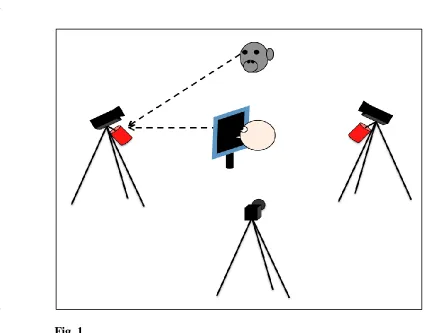
The subject was tested individually inside the holding facility. The 95
experimenter sat opposite the subject, at a distance of about 60 cm. There was a 96
rectangular black board on the floor (50x100 cm) between the experimenter and the 97
subject (Fig. 1). Three cameras recorded the session. One was placed behind the 98
experimenter and recorded her movements to keep track of the experimental 99
conditions; the other two cameras were to the left and right of the experimenter, 135 100
cm away from the subject, on a height of 150 cm, and provided a close-up of the 101
subject’s face and upper body to keep track of her looking behaviour. Two identical, 102
colourful plastic toys (25 cm high x15 cm wide) hung right underneath the cameras as 103
potential gaze targets.
104
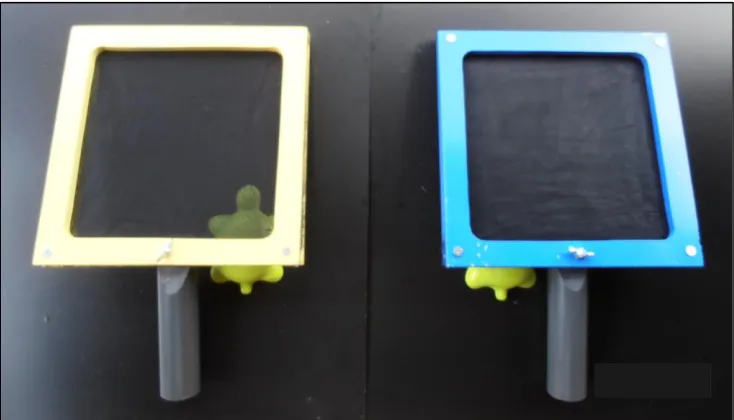
We used four types of “face masks”, each shaped like a hand mirror (Fig. 2). 105
A mask consisted of a yellow or blue frame (26 x 26 cm) on a handle bar (15 cm long, 106
4 cm diameter) and an opaque or fly screen inner layer (21x21cm), resulting in the 107
four different mask types opaque-yellow, opaque-blue, yellow and screen-108
blue. One could see through the fly screen when looking straight through, but not if 109
looking from the side. The opaque and the screen layers looked the same when placed 110
on a black surface (see Fig. 2). To maximise the similarity between both inner layer 111
types, we added a layer of fly screen on top of the opaque layer, so that the surface 112
structure was the same for both mask types. In the experience phase, we used 113
colourful small toys (7x11 cm) and pieces of fruit to draw the animal’s attention to the 114
mask. We did so by first showing the animal the object (toy or fruit) and subsequently 115
positioning the mask between the subject’s eyes and the object, such that she would 116
look at the mask. 117
120
Procedure and Design 121
Each subject received two conditions in separate sessions on two consecutive 122
days. We modeled our procedure as closely as possible to the infant study by Meltzoff 123
and Brooks (2008). Each daily test session was split into two phases: 124
Experience Phase. Subjects could gain experience with the properties of one 125
mask type for eight minutes; on the next day, she would experience the other mask 126
type. The experimenter sat down in front of the subject and placed pieces of fruit or 127
colourful toys on the black board between them. When the subject fixated the object, 128
the experimenter interposed the mask between the object and the subject’s eyes, such 129
that the subject could learn about the mask’s properties (opaque/transparent, 130
depending on condition). Subjects did not avoid looking at the mask and generally 131
maintained their gaze direction after the mask was interposed, resulting in them 132
looking at the mask. Multiple object exemplars in multiple spatial locations on the 133
board were used to demonstrate that the screen mask did not block vision, and that the 134
opaque one did. At the beginning of the experience phase, the experimenter held the 135
mask close to the object, approximately 40 cm from the subject’s eyes. In the course 136
of the eight minutes, she decreased the distance between the mask and the subject’s 137
eyes up to a distance of about 10 cm. Even when the mask was close to the 138
chimpanzees’ eyes, they sat still and maintained their general gaze direction, thus not 139
showing signs of an avoidance reaction to the mask. 140
Test Phase. After the experience phase, we tested the chimpanzee’s 141
understanding of the effect of the experienced mask type on the experimenter’s sight 142
in a gaze-following task. First, the experimenter started an electronic device that gave 143
trial, the experimenter approached first the right, then the left camera and examined 145
the plastic toys to draw the subject’s attention to them. She then sat down opposite the 146
chimpanzee and fed her, with the mask lying on the black board in front of her. After 147
about one minute, she picked up the mask, held it close to her face, turned her masked 148
face (and head) 90 degrees towards the left or right camera (according to a predefined 149
scheme, never to the same side more than twice in a row, and left and right side 150
counterbalanced), and remained with her face aligned with the camera for 7 seconds. 151
Next, she laid down the mask and fed one to three more pieces of food to the subject 152
before the next trial started. Crucially, in the test phase, the opaque inner layer was 153
always inserted in the mask, such that in both conditions the mask really was opaque 154
(and the experimenter was just starring at the inside of the mask, but her gaze 155
direction aligned with the camera). We administered 8 test trials per session, with a 3-156
minute repetition of the experience phase after the first 4 trials to remind the subjects 157
of the mask properties. 158
Each subject received each of the two conditions in separate sessions on two 159
consecutive days. Twelve of the subjects started with the opaque condition, the other 160
13 started with the screen condition. In each of the two condition groups, half of the 161
subjects started with a yellow frame, the other half with a blue frame. In their 162
following session, they received the other condition with the other colour. The 163
resulting four groups were counterbalanced for age and sex. 164
165
Coding and Analysis 166
We used the recorded data from all 3 cameras for the analysis. First, we 167
determined the relevant looking time intervals (the 7 seconds in which the 168
on the experimenter’s head. We then analysed the recordings of the left and right 170
camera separately for all looks to the camera within the 7 seconds per trial in which 171
the experimenter looked towards the camera. Looks were coded as “camera look” 172
when the chimpanzee lined up his or her eyes with a camera for at least 0.33 s (8 173
video frames). We differentiated the camera looks depending on whether the subject 174
looked at the same camera as the experimenter (“correct look”), or at the other one 175
(“incorrect look”). As subjects rarely looked to the cameras more than once within a 176
7-s trial, we coded presence or absence of at least one correct/incorrect look per trial 177
and analysed the proportion of trials with correct and incorrect looking for each 178
individual. In trials in which the subject’s eyes were not aligned with the camera (or 179
in which subjects only glanced at the camera for less than 0.33 seconds), no correct or 180
incorrect looks were coded. 181
For a better comparison to Meltzoff and Brooks’ (2008) between-subjects 182
study with infants (who received only 4 trials each), we additionally analysed only the 183
first 4 trials of each subject’s first session (resulting in a between-subject analysis of 184
our originally within-subject data). Following Meltzoff and Brooks (2008), we scored 185
the subject's first target look for each trial as either a correct look (+1) or an incorrect 186
look (−1). If infants did not look at either target during the 7-s trial, they received a 187
score of 0. We then calculated a looking score for each subject as the sum of correct 188
looks, incorrect looks, and nonlooks (as it is routinely done in gaze-following studies 189
with children, e.g., Butler, Caron & Brooks 2000; Dunphy-Lelii & Wellman 2004). 190
Thus, the possible range for the looking scores across the first four trials varied from 191
−4 to + 4. 192
An independent observer coded a randomly selected 20% of the sessions. He 193
rho and was good for both the number of correct (rho = 0.78, P < 0.01) and incorrect 195
looks (rho = 0.89, P < 0.01). 196
197
Results 198
The different experiences with the visual properties of the mask 199
(opaque/transparent) did not affect the chimpanzees’ gaze-following behaviour 200
towards the experimenter wearing that mask (repeated-measures ANOVA with 201
condition, order and sex as between-subject factors: F1, 21 = 0.012, P = 0.913, η2 =
202
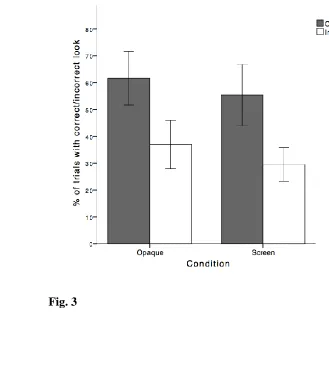
0.001). In both conditions, chimpanzees looked at the correct camera in about 60% of 203
the trials, whereas they looked at the incorrect camera in about 33% of the trials (Fig. 204
3). 205
We used a one-way ANOVA to assess the chimpanzees’ looking scores in 206
their first 4 trials. Chimpanzees’ looking scores did not differ between the opaque and 207
the screen condition, F1, 23 = 1.03; P = 0.32, although on average they looked less
208
often to the target in the opaque condition (M = 1.00, 95% CI [-0.05, 2.05]) compared 209
to the screen condition (M = 1.69, 95% CI [0.63, 2.75]). Overall, chimpanzees’ 210
looking scores were higher than infants’ looking scores in both conditions (Infants: 211
opaque condition: M = 0.12±1.15; screen condition: M = 1.04±1.37; Meltzoff & 212
Brooks 2008). 213
214 215
Discussion 216
In this study, we adapted a study recently conducted with 18-month-old 217
infants (Meltzoff & Brooks 2008) to chimpanzees to test their mentalising abilities. 218
an experimenter who was wearing a mask depending on whether they had 220
experienced that the mask was opaque or transparent. We conclude that there is no 221
evidence that chimpanzees in this study used their own visual experience to infer what 222
another can see. In contrast, 18-month old infants followed the gaze of a blindfolded 223
experimenter more when they had experienced that one could see through the 224
blindfolds, compared to having experienced that they were opaque (Meltzoff & 225
Brooks 2008). 226
This difference in the results of chimpanzees and infants could be due to a 227
methodological difference - we used masks instead of blindfolds. However, as the 228
masks covered the whole face instead of just the eyes, this should have made the 229
manipulation more obvious, not less. 230
Gaze following could also have a different ecological significance for 231
chimpanzees and children. Following another’s gaze in the rainforest as quickly as 232
possible might be a highly adaptive response with little energetic costs. The behaviour 233
might be more automatic and quick in chimpanzees than in humans, which could 234
render it unsuitable to capture higher cognitive processes like the computation of 235
another’s perspective. In our study, the subjects’ costs to follow the experimenter’s 236
gaze were particularly low as they did not have to switch position to see the gaze 237
target. This is reflected by the relatively high rates of gaze-following (about 60% of 238
trials) that chimpanzees in our study showed despite the opaque face mask in front of 239
the experimenter’s eyes. A study by Okamoto-Barth, Call & Tomasello (2007) 240
measured great apes’ gaze-following behaviour towards an experimenter who was 241
either looking through a window or at an opaque barrier (in 50 cm distance from the 242
experimenter’s face). Chimpanzees followed the experimenter’s gaze to the target 243
30%). Chimpanzees in our study hence treated the face mask more like a window than 245
an opaque barrier, but did so independent of condition. One reason for this might be 246
that our subjects face more ecological challenges (e.g., snakes, more food 247
competition) than the zoo animals in the study by Okamoto-Barth, Call & Tomasello 248
(2007), and they might thus be more sensitive to gaze. It could also be that a flat 249
barrier close to one’s face is rather rare and its effect less often experienced in 250
everyday life (and thus more likely not be taken into account) than gaze-obscuring 251
obstacles in some distance of another individuals’ eyes. Overall, our results also 252
support previous findings that chimpanzees are more sensitive to the role of head 253
movements when following gaze compared to the role of the eyes (see Tomasello, 254
Hare, Lehmann & Call 2007). 255
Several studies have shown that chimpanzees take into account the geometric 256
constellation of the looker and the object (Okamoto-Barth, Call & Tomasello 2007; 257
Tomasello et al. 1999) and that adult, but not infant chimpanzees habituate when 258
confronted with an experimenter who repeatedly looks towards nothing (Tomasello, 259
Hare & Fogleman 2001). These results suggest that there is at least some degree of 260
flexibility in chimpanzees’ gaze-following behaviour. 261
262
EXPERIMENT 2 263
In a second study, we used a competitive game to test the same question as in 264
experiment 1, since competitive contexts have been quite successful in uncovering 265
cognitive skills of chimpanzees (Hare & Tomasello 2004). Our set-up and procedure 266
was inspired by a study from Melis, Call, and Tomasello (2006). We first established 267
a competitive context by taking away food that the chimpanzee was trying to obtain 268
opposite the chimpanzee with food in boxes to her left and right side. The boxes had 270
different lid types: opaque, transparent or screen. The opaque and the transparent lids 271
did not change their visual properties between their opened and their closed position. 272
In contrast, subjects could see through the screen in its open position, but not when it 273
was closed (the experimenter could, from her perspective, see through the screen in 274
both its open and its closed position). Subjects were first familiarised with the visual 275
properties of the lids; then the lids were closed and the subject could choose to steal 276
food from one of the two boxes – opaque vs. transparent box (transparent condition) 277
or opaque vs. screen box (screen condition). In a nonsocial control, we tested 278
chimpanzees’ general preference to reach into the opaque box (compared to a 279
transparent box), independent of the presence of a human competitor. 280
Melis et al.’s procedure was basically the same, but with tunnels instead of 281
boxes, and only two different tunnel types: opaque vs. transparent. The subject could 282
then reach the food either through an opaque tunnel that hid her approaching hand, or 283
through a transparent tunnel that did not prevent the experimenter from observing the 284
reach. Subjects had a significant preference for reaching through the opaque tunnel, 285
but such preference disappeared in a nonsocial control. While our transparent 286
condition basically replicated Melis et al.’s experiment, the screen condition was the 287
key to test chimpanzees’ mentalising abilities. We hypothesised that if subjects were 288
able to use their experience with the lid properties to infer what the experimenter sees, 289
they would prefer to steal from the opaque box, in which their hand was hidden from 290
the experimenter’s view. They would not show such a preference when the human 291
competitor was absent. 292
293
Subjects 295
Subjects were 19 semi-free ranging chimpanzees (Pan troglodytes) at the 296
Ngamba Island Chimpanzee Sanctuary in Lake Victoria, Uganda 297
(www.ngambaisland.org) (9 females, 10 males; age range 8 – 17 years, M = 14.3 298
years). All but one young male (Rambo, 8 years) had participated in experiment 1 299
before. All except one male (Kisembo, 14 years) passed the criterion that ensured that 300
they understood the competitive nature of the game, such that 18 chimpanzees 301
proceeded to the test. Subjects were fed according to their regular diet and were never 302
food or water deprived. 303
304
Apparatus 305
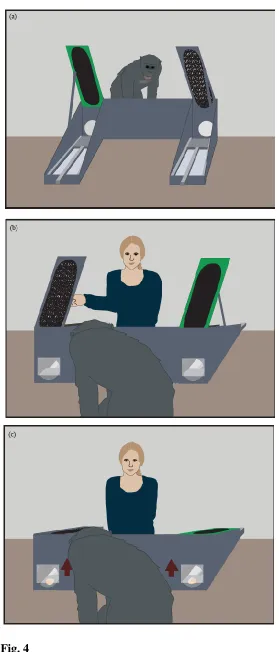
The experimenter sat opposite the subject, 50 cm from the enclosure (Fig. 4). 306
The bars between the experimenter and the subject were occluded (60 cm high, 100 307
cm wide). 308
There were two boxes to the experimenter’s left and right side (40x13 cm, 25 309
cm high on subject’s side; 65 cm apart from each other). Two sliding food trays could 310
be inserted in the boxes and moved away from or closer to the subject by a handle 311
bar. The subject could reach the food by sliding up a transparent trap door (10x8 cm) 312
at the box side facing her and then reaching through a hole into the box (6.5 cm 313
diameter). The boxes had exchangeable lids, so that they could either be transparent, 314
opaque or covered with four layers of black fly screen. To maximise the similarity in 315
surface structure between the opaque and the screen lid, we fixed a layer of fly screen 316
on the opaque lid. The lids could be brought into a stable open position (40 degrees 317
above horizontal), such that the subject would have a good view of the visual 318
lids were closed, the subjects could still see through the transparent lid, and could not 320
see through the opaque lid. However, the screen lid changed its apparent properties: 321
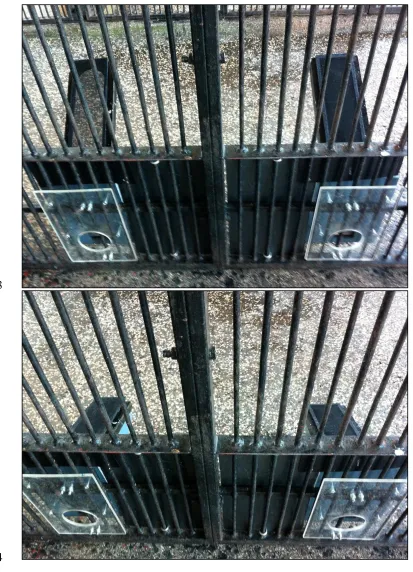
the subject could now not see through it any more (see Fig. 5, for pictures). In 322
contrast, the experimenter was still able to see through the screen from her 323
perspective. 324
Procedure and Design 325
Each subject first had to pass a criterion training and, if successful, received 326
three conditions in randomised order: the nonsocial control, the transparent and the 327
screen condition. Subjects received each condition in two consecutive sessions with 328
12 trials each, summing up to 24 trials per condition and 72 trials in total. 329
Training. To familiarise subjects with the competitive nature of the task, 330
subjects learnt that the experimenter would retrieve the food if she could see the 331
subject reaching for it. The experimenter sat opposite the subject, with the two boxes 332
to her left and right side. Both box lids were transparent and, at the beginning of each 333
session, open. To demonstrate the transparency of the lids, the experimenter showed 334
the subject 5 peanuts through each of the lids, starting on her right side and then 335
taking turns. Next, the experimenter closed the lids. The trial started with the 336
experimenter baiting the boxes, with the food out of reach of the subject. She centered 337
the subject by placing some peanuts between the boxes, 160 cm above the ground. 338
While the subject was climbing up to get the peanuts, the experimenter pushed the 339
food towards the trap doors and turned with her head and body towards one of the 340
boxes (left and right side counterbalanced within a session, with the constraint that the 341
orientation could not be the same in more than two consecutive trials), so she could 342
see the food item she was oriented towards, but not the other. When the subject 343
However, when the subject tried to grab the food item that the experimenter was 345
looking at, the experimenter pulled it back. When the subject tried to grab the other 346
piece, she was allowed to obtain it. After the subject had made a decision, both trays 347
were pulled back, and the next trial started. Each session included 12 trials. Subjects 348
had to choose the correct side in at least 10 out of 12 trials in two consecutive sessions 349
to proceed to the test. If they did not succeed within 10 sessions, they were dropped 350
from the study. 351
Test phase. Each test session started with 6 warm-up trials as in the training. 352
They served to ensure the motivation of the subject on the testing day. The subjects 353
proceeded to the actual test trials only if they chose the correct side in at least 5 out of 354
6 warm-up trials (only two subjects failed and successfully restarted their session on 355
the following day). Each test trial started with opening the lids, and demonstrating the 356
lid properties that differed between the sides (transparent/opaque/screen) to the 357
subject by showing her a peanut, moving it behind the lid and back to the center. The 358
peanut was then given to the subject. Two peanuts were presented on each side, 359
always starting with the right side and then taking turns. Then the lids were closed 360
and the trays baited. The experimenter centered the subject as in the training. While 361
the subject was climbing up to get the peanuts, the experimenter pushed the food 362
towards the trap doors. She remained with her upper body and head centered, so that 363
she could observe both boxes. When the subject tried to reach for the food underneath 364
the transparent or the screen lid, the experimenter could see her hand and pulled back 365
the food. If the subject chose the opaque side, on which her hand was hidden from the 366
experimenter’s view, she was allowed to take it. Note that the bars between the 367
chimpanzee and the experimenter were occluded up to a height of 60 cm, so that the 368
in the following way: 370
Transparent. One lid was opaque, the other transparent. 371
Screen. One lid was opaque, the other a fly screen. Subjects could learn about 372
the see-through properties of the screen while the lids were open. As soon as the lids 373
were closed, both sides looked opaque to the subject, while the experimenter could 374
still see through the screen. To help the subjects discriminate between the two closed 375
lids, on of them had a green frame (whether the green frame was attached to the 376
opaque or the screen lid was counterbalanced between subjects). 377
Control. To check for a general preference to choose the food underneath the 378
opaque lid, we administered a nonsocial control. Everything was as in the transparent 379
condition, with the only difference that the experimenter left the room after pushing 380
the food towards the subject. The subject could then choose her preferred side 381
independent of the presence of the human competitor. The experimenter returned after 382
10 seconds. If the subject was quick enough, she could get both food items. 383
We guarded against potential cueing by having the experimenter keep her 384
body centered, her hands in her lap and look down in the middle between the boxes 385
when the subject was approaching to choose. The subject could not see the 386
experimenter’s eyes, and the experimenter could not see the subject’s body when it 387
was close to the barrier. 388
389
Coding and Analysis 390
All trials were recorded by two cameras that focused on the boxes. For each 391
trial, we coded which box the subject chose first by lifting the trap door 392
(opaque/transparent/screen). An independent observer, naïve to all test parameters, 393
excellent (Cohen's kappa = 0.99, P < 0.001). We ran a logistic regression in the R 395
Statistical Computing Environment, using the glm function (with a binomial link 396
function) in the lme4 package. We included trial number and order group as 397
covariates, and we included condition as a factor. 398
399
Results 400
Subjects passed the training on average after 6 sessions (72 trials) (95% 401
Confidence Interval (CI) [5.21, 6.90], range 4-10 sessions). Only one male 402
chimpanzee (14 years old) did not reach the criterion after 10 sessions (120 trials) and 403
did not proceed to the test phase. 404
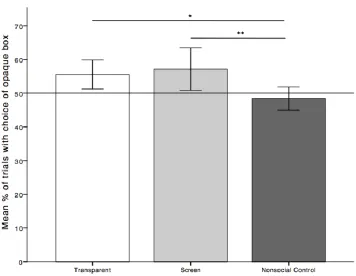
In the test, subjects selected the opaque box more frequently in the screen and 405
transparent conditions than in the control condition (Fig. 6). Our primary analysis (see 406
Table 1) included the control condition as the reference level of the Condition factor 407
(which includes three levels: control, screen, and transparent). This models how 408
behavior changes by moving from the control condition (i.e., the reference level) to 409
the screen and transparent conditions. Results show that the estimates for the screen 410
and the transparent condition were both positive, indicating that animals are more 411
likely to choose the opaque box in both of these conditions than they are likely to 412
choose the opaque box in the control condition. This difference is significant for both 413
screen and transparent conditions, as the 95% confidence intervals for these estimates 414
do not include zero, and the p-values for the for both were less than .05 (transparent-415
control: P = 0.04; screen-control: P = 0.01). To explore the difference between the 416
screen and the transparent condition, we used the same model but re-leveled the 417
Condition factor so that screen was now the reference level (see Table A1). Now, 418
likely to choose the opaque box in the transparent condition than in the screen 420
condition. The results show that there is not a substantial difference between the 421
screen and transparent conditions because the estimate for the transparent condition is 422
small, the 95% confidence interval includes zero, and the p-value is greater than 423
.05 (P= 0.63). 424
We were also interested in whether chimpanzees’ choices were different from 425
chance. We conducted one-sample t-tests and found that chimpanzees’ choice of the 426
opaque box was significantly different above chance in the transparent (t17 = 2.58, P =
427
0.020) and in the screen condition (t17 = 2.28, P = 0.036), but not in the control (t17 =
428
0.940, P = 0.36). 429
When looking at individual performances, six (out of 18) subjects performed 430
(non-significantly) above chance (50% choice of opaque box) in both the transparent 431
and the screen condition, four subjects performed above chance in the transparent, but 432
not in the screen condition, and four subjects performed above chance in the screen, 433
but not in the transparent condition. 434
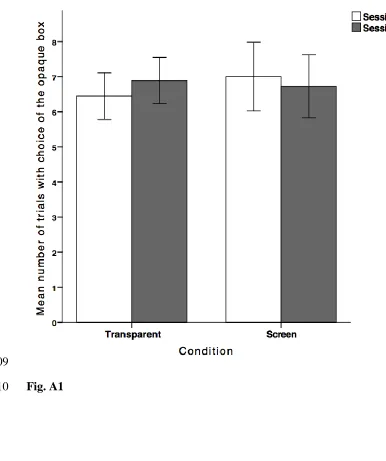
To assess learning over the course of testing, we compared each subject’s 435
performance in the first and second session of the transparent and the screen condition 436
to each other (Fig. A1), and in the first and last trial in these conditions (in the control, 437
both lid types were rewarded, so there was no learning opportunity). We did not 438
observe a change in subject’s choices of the opaque box between first and second 439
session (paired-samples t-tests; transparent: t17 = -1.25, P = 0.23; screen: t17 = 0.59, P
440
= 0.56) or between first and last trial within condition (related-samples McNemar 441
Test; transparent: P = 0.77; screen: P = 1.0). As the choice of the opaque box was 442
rewarded in the experimental conditions, we were interested in possible carry-over 443
compare the effect of zero, one or two preceding experimental conditions on the 445
number of choices of the opaque box in the control. Without any previous experience, 446
subjects’ choice was close to chance with M = 52.0% (95% CI [45.5, 58.7]), and this 447
did not change significantly in control conditions after one or two preceding 448
experimental conditions; F(2, 15) = 1.18, P = 0.33 (control second: M = 46.5% (95% 449
CI [37.2, 55.9]); control last: M = 46.5% (95% CI [40.1, 53.0]). 450
451
Discussion 452
In this study, chimpanzees were allowed to steal food from an experimenter if 453
the experimenter could not see the stealing attempt. We found that chimpanzees 454
preferred to steal food from an opaque box when choosing either between an opaque 455
and a transparent box (transparent condition) or between an opaque box and a box 456
with a screen lid, that looked opaque from their, but not from the experimenter’s 457
perspective, but that they had experienced to be see-through earlier from a different 458
perspective (screen condition). Interestingly, subjects performed above chance in both 459
conditions, but not better in the (seemingly easier) transparent condition. In contrast, 460
chimpanzees did not show a preference for the opaque box when choosing between 461
opaque and transparent in a nonsocial control in which the experimenter was not 462
present at the time of stealing. 463
These results demonstrate that chimpanzees were able to use their own 464
experience with the visual properties of the lids to later infer in which box their 465
approaching hand would be hidden from the experimenter. Crucially, in the moment 466
of choice in the screen condition, both box lids appeared opaque from their 467
perspective (and both had a screen surface), but they had experienced earlier that one 468
The results of our study confirm previous results by Melis et al. (2006) and 470
extend them in important ways. First, we confirmed that chimpanzees conceal visual 471
information by preferring the obscured approach route to the food over the exposed 472
route when a human competitor is present. Notably, this preference was small both in 473
our study (choice rate of opaque box: M = 56%) and in Melis et al.’s study (M = 474
57%), probably because our task is “at the limit of what chimpanzees are capable of” 475
(Melis et al. 2006, p. 157). Chimpanzees did not maintain the same high level of 476
performance in the test compared to the end of the training (at least 83% correct); this 477
was probably due to the higher cognitive challenge in the test, in which subjects could 478
not rely on the experimenter’s body orientation, but had to use their own experience 479
with the visual properties of the lids, compared to the training (in which they could 480
rely solely on the salient cue of the experimenter’s body orientation), resulting in an 481
additional memory problem. On top of that, subjects did not get training with the 482
exact test situation (while they received an average of 6 sessions of experience with 483
the requirements in the training). However, together with previous results (Hare, Call 484
& Tomasello 2006; Okamoto-Barth et al. 2007; Tomasello et al. 1999) these studies 485
consistently support the view that chimpanzees know what others can and cannot see 486
in various situations, and that they can use this knowledge strategically in competitive 487
or food begging contexts (see also Bräuer, Call & Tomasello 2005, 2007; Bulloch, 488
Boysen & Furlong 2008; Hostetter, Cantero & Hopkins 2001; Hostetter, Russell, 489
Freeman & Hopkins 2007; Tempelmann, Kaminski & Liebal 2011). 490
Second, our study adds to previous studies by confronting subjects with a 491
situation in which they can only successfully compete if they project their self-492
experience with an object to the human competitor to predict what the other can see. 493
success do not apply here: behaviour reading or learned behavioural rules (e.g., Heyes 495
1998; Penn & Povinelli 2007). We would like to address three prominent concerns. 496
1. Subjects could have merely reacted to behavioural cues of the experimenter, e.g., 497
her body orientation or her gaze. 498
We can exclude this explanation as in the test, the experimenter’s body was 499
oriented to the center between the boxes and her gaze direction was not visible to the 500
subject as she looked down towards the box lids. 501
2. Subjects could have learnt about the effect of the lid properties on the 502
experimenter’s vision by observing her interacting with the lids. 503
The experimenter treated all lid types in the same way. In addition, the lids were 504
positioned such that the chimpanzee could never see the experimenter’s eyes through 505
the transparent lid or the screen. However, the lid types were differentially rewarded – 506
while subjects were allowed to steal from the box with the opaque lid, the 507
experimenter retrieved the food from underneath the transparent or screen lid during a 508
stealing attempt. Therefore, subjects could potentially learn to choose the opaque box 509
in the course of the 24 trials of each experimental condition. However, we found no 510
evidence of improvement over time. Subjects did not choose the opaque box more 511
often in control conditions that were preceded by one or two experimental conditions, 512
compared to naïve subjects’ choice behaviour in control conditions. Within 513
conditions, we did not observe increased success rates in the second compared to the 514
first session or in the first compared to the last trial. Thus, although subjects could 515
have used e.g., the coloured frames as a learning cue, they did not improve over trials. 516
3. Subjects could have formed rules from observing other individuals in their natural 517
environment and infer the experimenter’s behaviour from these rules. 518
2000; Hare, Call & Tomasello 2001) subdominant chimpanzees reliably avoided food 520
that a dominant competitor could see or had seen in the past when competing with 521
him about two food items. While most other explanations could be excluded, one 522
potential lower-level explanation remained: In their every-day environment, subjects 523
could have learnt rules about the contingencies of the eyes of a competitor and 524
contested food, e.g., by imagining a line of sight between the competitor’s eyes and 525
the food (“evil eyes hypothesis”, see Povinelli & Vonk 2004). For this objection to 526
apply to our study, chimpanzees would need to have experienced others looking 527
through screens and then act as if they could see; it is unlikely that the subjects in our 528
study were ever exposed to such experiences as they live in a natural forest during the 529
day and have no previous experience with experiments involving screens or others 530
interacting with them. Moreover, in our study at the time of choice, the 531
experimenter’s line of sight seemed obstructed by the box lids from the subject’s 532
perspective for both the opaque and the screen lid. Only by projecting their 533
experience of being able to see through the screen in the training phase, subjects could 534
successfully avoid being caught stealing (see also Kaminski, Call & Tomasello 2008; 535
Schmelz, Call & Tomasello 2011). 536
However, we are aware of one additional alternative explanation for our 537
results. Following up the evil eye hypothesis, one could object that chimpanzees 538
imagined a line of sight between the experimenter’s eyes and the food, and imagined 539
the screen in the right position such that it would not block this line. Similarly, the 540
subjects could have learnt about the “psychological affordances” of the masks, such 541
as “able to be seen through” and “unable to be seen through”, instead of projecting 542
their visual experience to the competitor (see Meltzoff & Brooks 2008). The subject 543
from the competitor’s view. This explanation might require them to imagine the 545
screen from the experimenter’s perspective (as from their perspective, it is “unable to 546
be seen through” at the moment of choice), thus forming a mental representation of an 547
object that differs from their own. This skill, also known as level 2 perspective taking 548
sensu Flavell and colleagues (Flavell, Everett, Croft & Flavell 1981; Masangkay, 549
McCluskey, McIntyre, Sims-Knight, Vaughn & Flavell 1974) correlates highly with 550
classic mentalising skills such as false belief understanding and active deception in 551
children (even when controlling for age and language development (Bigelow & 552
Dugas 2009, Farrant, Fletcher & Maybery 2006). This suggests similar underlying 553
mechanisms, in particular the ability to envision perspectives that counter one’s own. 554
But even if subjects do not imagine the screen from the experimenter’s 555
perspective, the task at least requires them to learn about the psychological 556
affordances of the lids by learning how it affects themselves and applying it to others 557
(see Meltzoff & Brooks 2008). 558
559
GENERAL DISCUSSION 560
We ran two studies that tested chimpanzees’ ability to project their visual 561
experience with an object to a human to predict what she can see. While they failed to 562
do so in a non-competitive gaze-following task (experiment 1), they were successful 563
in a competitive context (experiment 2). In experiment 1, subjects first gained 564
experience with an opaque or transparent (but opaque-looking) face mask. Then we 565
measured their gaze-following behaviour towards a masked experimenter. 566
Chimpanzees did not take into account the different visual properties of the mask 567
while following the experimenter’s gaze. In contrast, Meltzoff and Brooks (2008) 568
blindfolded experimenter more when they had experienced the blindfolds as see-570
through rather than as opaque. 571
In experiment 2, we tested the same question in a competitive paradigm. 572
Subjects could steal food from an experimenter by reaching into one of two boxes. If 573
the experimenter saw the stealing attempt, she retrieved the food. In the key 574
condition, both box lids seemed opaque from the subject’s perspective; however, they 575
had experienced that from a different point of view, one of the lids (the screen) was 576
see-through, while the other really was opaque. Chimpanzees preferred to reach for 577
the food under the truly opaque lid, in which their approach was hidden from the 578
experimenter, and avoided the screen lid through which the experimenter could see. 579
In a nonsocial control condition, they did not show such a preference. 580
We argue that this study fulfils the requirements that skeptics propose to 581
validly test mentalising skills in nonhuman primates (the ‘goggles experiment’, e.g., 582
Heyes 1998; Shettleworth 2010). First, the cue on which the inference to the mental 583
state was made was arbitrary – in the test situation, chimpanzees could discriminate 584
between the box lids only by the frame colour or their location. Second, subjects did 585
not have exposure to (human or non-human) others behaving in association with that 586
cue, excluding the possibility of associative learning or “learnt behavioural rules” 587
(and we did not find any learning effect over trials). And third, although both box lids 588
looked opaque in the moment of choice, chimpanzees discriminated between their 589
visual properties based on their previous self-experience, and used this knowledge 590
appropriately to anticipate what the human competitor would be able to see. Note, 591
however, that not all researchers accept the goggles experiment as a valid test of 592
mental state attribution (e.g., Csibra 1998; Lurz 2009; Perner 2010). Their key point is 593
“seeing” as a mental state themselves, or whether they reason about “seeing” (even 595
their own experience of it) non-mentalistically – for instance, by experiencing seeing 596
as having an unobstructed line of sight on an object. Thus, even if we find that 597
chimpanzees project their own experience to others, some authors argue that this does 598
not necessarily indicate that they project mental states to others. As Csibra (1998) 599
puts it: 600
“Seeing is a mental concept if, and only if, it refers to an epistemic relation 601
between a mind and an object/event that is established in a particular (visual) way; 602
but it is not a mental concept when it refers only to the physical relations that may or 603
may not give rise to the epistemic relation. Accordingly, demonstrating that animals 604
can understand such a physical relation and can use it as a discriminatory cue to 605
predict the usability of people’s behaviour is not sufficient evidence for applying 606
mental concepts. What is needed in addition is to demonstrate that the animals 607
conceive the result of seeing as a representational rather than a dispositional state.” 608
(Csibra, 1998; p. 118) 609
But if chimpanzees are able to project their self-experience to others (in 610
whichever form), why did they not show differential gaze-following towards a 611
masked experimenter, depending on whether they experienced the mask as opaque or 612
transparent before (experiment 1) - in particular, as 18-month-old infants successfully 613
do so (Meltzoff & Brooks 2008)? Several factors might account for this discrepancy. 614
First, chimpanzees often show clearer outcomes in competitive situations, possibly 615
due to their highly competitive environment in hierarchically organised groups (Hare 616
& Tomasello 2004). In contrast, in the human world cooperation is a key feature for 617
successful adaptation, and human infants have a natural tendency to cooperate from 618
18-month old human infants succeeded in Meltzoff and Brooks’ (2008) study, while 620
chimpanzees failed in our highly similar study. 621
Second, whereas the gaze following required in experiment 1 is a quick and 622
rather automatic response (although adult chimpanzees have demonstrated some 623
flexibility in gaze following, e.g., they take into account the presence of barriers 624
(Okamoto-Barth et al. 2007), and stop following the gaze of someone who repeatedly 625
looks towards nothing (Tomasello et al. 2001), in experiment 2 chimpanzees had 626
unlimited time to think about which box to choose. Although in humans, 627
sociocognitive processes such as perspective taking have been proven to be fast and 628
sometimes even involuntary (e.g., Samson, Apperly, Braithwaite, Andrews & Bodley 629
Scott 2010; Surtees & Apperly 2012), these processes might be computed slower in 630
great apes, and thus be captured better with more explicit behavioural measures. 631
Third, while subjects could use only the frame colour as a cue to the visual 632
properties of the mask in experiment 1, they could use frame colour and/or location of 633
the lid (left/right of the experimenter) as a cue in the second study. Obviously, the 634
location of the rewarded lid varied randomly between the trials; however, in the 635
experience phase of each trial, they could not only learn about the frame colour, but 636
also about the location of the (truly) opaque lid. Several studies demonstrate that 637
chimpanzees have difficulties with quickly associating arbitrary cues such as colour 638
with the presence of food (e.g., Call 2006; Jarvik 1953, 1956), which might account 639
for their indiscriminate gaze-following behaviour in experiment 1. Other studies show 640
that chimpanzees prefer location to colour as a cue to find food (e.g., Haun, Call, 641
Janzen & Levinson 2006; Tinklepaugh 1932; but see also Kanngiesser & Call 2010, 642
for contradicting results). The additional informative spatial feature might thus have 643
After dozens of positive findings that show that chimpanzees understand what 645
others see or hear (Bräuer et al. 2007; Hare et al. 2000; Melis et al. 2006), prefer 646
(Schmelz, Call & Tomasello 2013), know (Hare et al. 2001; Kaminski et al. 2008), 647
attend to (MacLean & Hare 2012), intend (Behne, Carpenter, Call & Tomasello 2005; 648
Buttelmann, Carpenter, Call & Tomasello 2007; Call, Hare, Carpenter & Tomasello 649
2004; Call & Tomasello 1998; Warneken & Tomasello 2006), and infer (Schmelz et 650
al. 2011), this study provides additional evidence that chimpanzees possess 651
mentalising capacities revealed by a different and powerful method. Because subjects 652
used their self-experience to infer what the competitor saw, the current results might 653
fit best with Meltzoff”s “Like Me” framework (2007). 654
Overall, we thus agree with Whiten’s recent evaluation of the state of the art 655
of the field (Whiten 2013): “Humans are not alone in computing how others see the 656
world”. As the methodology of the current study is based on suggestions of skeptics 657
in the field, it would seem to constitute especially powerful additional evidence for 658
this proposal. 659
660
Acknowledgement 661
We thank the Wolfgang Koehler Primate Research Center animal caretakers for their 662
help in collecting the data. We also thank L. Ajarova and the trustees and staff of 663
Ngamba Island Chimpanzee Sanctuary, Uganda, for their enthusiasm, help and 664
support. We appreciate permission from the Ugandan National Council for Science 665
and Technology and the Uganda Wildlife Authority, for allowing us to conduct our 666
research in their country. We are also grateful to Raik Pieszek for technical support, 667
Benjamin Schmid and Maleen Thiele for reliability coding, and Maren Schumann for 668
of this project, and two anonymous reviewers for their helpful comments on the 670
References 672
Andrews K (2005) Chimpanzee theory of mind: Looking in all the wrong places. Mind 673
& Language 20(5):521-536. doi:10.1111/j.0268-1064.2005.00298.x 674
Behne T, Carpenter M, Call J, Tomasello M (2005) Unwilling versus unable: Infants’ 675
understanding of intentional action. Developmental Psychology 41(2):328-337. 676
doi:10.1037/0012-1649.41.2.328 677
Bigelow AE, Dugas K (2009) Relations among preschool children's understanding of 678
visual perspective taking false belief and lying. Journal of Cognition and 679
Development 9(4):411-433. doi:10.1080/15248370802678299 680
Bräuer J, Call J, Tomasello M (2005) All great ape species follow gaze to distant 681
locations and around barriers. Journal of Comparative Psychology 119(2):145-682
154. doi:10.1037/0735-7036.119.2.145 683
Bräuer J, Call J, Tomasello M (2007) Chimpanzees really know what others can see in 684
a competitive situation. Animal Cognition 10(4):439-448. doi:10.1007/s10071-685
007-0088-1 686
Bulloch MJ, Boysen ST, Furlong EE (2008) Visual attention and its relation to 687
knowledge states in chimpanzees Pan troglodytes. Animal Behaviour 688
76(4):1147-1155. doi:10.1016/j.anbehav.2008.01.033 689
Butler SC, Caron AJ, Brooks R (2000) Infant Understanding of the Referential Nature 690
of Looking. Journal of Cognition and Development 1(4):359-377. doi: 691
10.1207/S15327647JCD0104_01 692
Buttelmann D, Carpenter M, Call J, Tomasello M (2007) Enculturated chimpanzees 693
7687.2007.00630.x 695
Call J (2006) Descartes’ two errors: Reason and reflection in the great apes. In Hurley 696
SL & Nudds M (eds) Rational Animals? Oxford University Press, Oxford UK, 697
pp 219-34. doi:10.1093/acprof:oso/9780198528272.003.0010 698
Call J (2007) Past and present challenges in theory of mind research in nonhuman 699
primates. Progress in Brain Research 164(2700):341-353. doi:10.1016/S0079-700
6123(07)64019-9 701
Call J, Tomasello M (1998) Distinguishing intentional from accidental actions in 702
orangutans (Pongo pygmaeus) chimpanzees (Pan troglodytes) and human 703
children (Homo sapiens) Journal of Comparative Psychology 112(2):192-206. 704
doi:10.1037/0735-7036.112.2.192 705
Call J, Tomasello M (2008) Does the chimpanzee have a theory of mind? 30 years 706
later. Trends in Cognitive Sciences 12(5):187-192. 707
doi:10.1016/j.tics.2008.02.010 708
Call J, Hare B, Carpenter M, Tomasello M (2004) 'Unwilling' versus 'unable': 709
Chimpanzees' understanding of human intentional action. Developmental 710
Science 7(4):488-498. doi:10.1111/j.1467-7687.2004.00368.x 711
Csibra, G (1998). Seeing is not believing. Behavioral and Brain Sciences 21(01): 117-712
118. doi: 10.1017/S0140525X98250709 713
Dunphy-Lelii S, Wellman HM (2004) Infants' Understanding of Occlusion of Others' 714
Line-of-Sight: Implications for an Emerging Theory of Mind. European 715
Journal of Developmental Psychology 1(1):49-66. doi: 716
Farrant BM, Fletcher J, Maybery MT (2006) Specific language impairment theory of 718
mind and visual perspective taking: evidence for simulation theory and the 719
developmental role of language. Child Development 77(6):1842-1853. 720
doi:10.1111/j.1467-8624.2006.00977.x 721
Flavell JH, Everett BA. Croft K, Flavell ER (1981) Young children's knowledge about 722
visual perception: Further evidence for the Level 1 Level 2 distinction. 723
Developmental Psychology 17(1):99-103. doi:10.1037/0012-1649.17.1.99 724
Hare B, Tomasello M (2004) Chimpanzees are more skilful in competitive than in 725
cooperative cognitive tasks. Animal Behaviour 68(3):571-581. 726
doi:10.1016/j.anbehav.2003.11.011 727
Hare B, Call J, Tomasello M (2001) Do chimpanzees know what conspecifics know? 728
Animal Behaviour 61(1):139-151. doi:10.1006/anbe.2000.1518 729
Hare B, Call J, Tomasello M (2006) Chimpanzees deceive a human competitor by 730
hiding. Cognition 101(3):495-514. doi:10.1016/j.cognition.2005.01.011 731
Hare B, Call J, Agnetta B, Tomasello M (2000) Chimpanzees know what conspecifics 732
do and do not see. Animal Behaviour 59(4):771-785. 733
doi:10.1006/anbe.1999.1377 734
Haun D, Call J, Janzen G, Levinson SC (2006) Evolutionary psychology of spatial 735
representations in the hominidae. Current Biology 16(17):1736-1740. 736
doi:10.1016/j.cub.2006.07.049 737
Heyes CM (1998) Theory of mind in nonhuman primates. Behavioral and Brain 738
Sciences 21(1):101-114. doi:10.1017/S0140525X98000703 739
communication by chimpanzees (Pan troglodytes) in response to the attentional 741
status of a human (Homo sapiens) Journal of Comparative Psychology 742
115(4):337-343. doi:10.1037//0735-7036.115.4.337 743
Hostetter AB, Russell JL, Freeman H, Hopkins WD (2007) Now you see me now you 744
don't: Evidence that chimpanzees understand the role of the eyes in attention. 745
Animal Cognition 10(1):55-62. doi:10.1007/s10071-006-0031-x 746
Jarvik ME (1953) Discrimination of colored food and food signs by primates. Journal 747
of Comparative and Physiological Psychology 46(5):390-392. 748
doi:10.1037/h0054308 749
Jarvik ME (1956) Simple color discrimination in chimpanzees: effect of varying 750
contiguity between cue and incentive. Journal of Comparative and 751
Physiological Psychology 49(5):492-495. doi:10.1037/h0045644 752
Kaminski J, Call J, Tomasello M (2008) Chimpanzees know what others know but not 753
what they believe. Cognition 109(2):224-234. 754
doi:10.1016/j.cognition.2008.08.010 755
Kanngiesser P, Call J (2010) Bonobos chimpanzees gorillas and orangutans use feature 756
and spatial cues in two spatial memory tasks. Animal Cognition 13(3):419-430. 757
doi:10.1007/s10071-009-0291-3 758
Lurz RW (2009) If chimpanzees are mindreaders could behavioral science tell? Toward 759
a solution of the logical problem. Philosophical Psychology 22(3):305 – 328. 760
doi:10.1080/09515080902970673 761
MacLean EL, Hare B (2012) Bonobos and chimpanzees infer the target of another’s 762
Masangkay ZS, McCluskey KA, McIntyre CW, Sims-Knight J, Vaughn BE, Flavell JH 764
(1974) The early development of inferences about the visual percepts of others. 765
Child Development 45(2):357-366. doi:10.2307/1127956 766
Melis AP, Call J, Tomasello M (2006) Chimpanzees (Pan troglodytes) conceal visual 767
and auditory information from others. Journal of Comparative Psychology 768
120(2):154-162. doi:10.1037/0735-7036.120.2.154 769
Meltzoff AN (2007) 'Like Me': A foundation for social cognition. Developmental 770
Science 10(1):126-134. doi:10.1111/j.1467-7687.2007.00574.x 771
Meltzoff AN, Brooks R (2008) Self-experience as a mechanism for learning about 772
others: A training study in social cognition. Developmental Psychology 773
44(5):1257-1265. doi:10.1037/a0012888 774
Okamoto-Barth S, Call J, Tomasello M (2007) Great Apes' Understanding of Other 775
Individuals' Line of Sight. Psychological Science 18(5):462-468. doi: 776
10.1111/j.1467-9280.2007.01922.x 777
Penn DC, Povinelli DJ (2007) On the lack of evidence that non-human animals possess 778
anything remotely resembling a 'Theory of Mind'. Philosophical Transactions 779
of the Royal Society of London B: Biological Sciences 362(1480):731-744. 780
doi:10.1098/rstb.2006.2023 781
Perner J (2010) Who took the cog out of cognitive science? In: Frensch PA, Schwarzer 782
R (eds) Cognition and neuropsychology: International perspectives on 783
psychological science 1. Psychology Press, Hove UK, pp 241-261 784
Povinelli DJ, Vonk J (2003). Chimpanzee minds: suspiciously human? Trends in 785
Povinelli DJ, Vonk J (2004) We don't need a microscope to explore the chimpanzee's 787
mind. Mind & Language 19(1):1-28. doi: 10.1111/j.1468-0017.2004.00244.x 788
Premack D, Woodruff G (1978) Does the chimpanzee have a theory of mind? 789
Behavioral and Brain Sciences 1(4):515-526. 790
doi:10.1017/S0140525X00076512 791
Purdy JE, Domjan M (1998) Tactics in theory of mind research. Behavioral and Brain 792
Sciences 21(1):129-130. doi:10.1017/S0140525X98390706 793
Samson D, Apperly IA, Braithwaite JJ, Andrews BJ, Bodley Scott SE (2010) Seeing it 794
their way: Evidence for rapid and involuntary computation of what other people 795
see. Journal of Experimental Psychology: Human Perception and Performance 796
36(5):1255-1266. doi:10.1037/a0018729 797
Schmelz M, Call J, Tomasello M (2011) Chimpanzees know that others make 798
inferences. Proceedings of the National Academy of Sciences 108(7):3077-799
3079. doi:10.1073/pnas.1000469108 800
Schmelz M, Call J, Tomasello M (2013) Chimpanzees predict that a competitor's 801
preference will match their own. Biology Letters 802
9(1):doi:10.1098/Rsbl.2012.0829 803
Shettleworth SJ (2010) Clever animals and killjoy explanations in comparative 804
psychology. Trends in Cognitive Sciences 14(11):477-481. 805
doi:10.1016/J.Tics.2010.07.002 806
Surtees ADR, Apperly IA (2012) Egocentrism and automatic perspective taking in 807
children and adults. Child Develpment 83(2):452-460. doi:10.1111/j.1467-808
Tempelmann S, Kaminski J, Liebal K (2011) Focus on the essential: all great apes 810
know when others are being attentive. Animal Cognition 14(3):433-439. 811
doi:10.1007/s10071-011-0378-5 812
Tinklepaugh OL (1932) The multiple delayed reaction with chimpanzees and monkeys. 813
Journal of Comparative Psychology 13(2) 207. doi:10.1037/h0072368 814
Tomasello M (2009) Why we cooperate: MIT Press, Cambridge MA 815
Tomasello M, Call J, Hare B (1998) Five primate species follow the visual gaze of 816
conspecifics. Animal Behaviour 55(4):1063-1069. doi:10.1006/anbe.1997.0636 817
Tomasello M, Hare B, Agnetta B (1999) Chimpanzees Pan troglodytes follow gaze 818
direction geometrically. Animal Behaviour 58(4):769-777. 819
doi:10.1006/anbe.1999.1192 820
Tomasello, M., Hare, B., Lehmann, H., & Call, J. (2007). Reliance on head versus eyes 821
in the gaze following of great apes and human infants: the cooperative eye 822
hypothesis. Journal of Human Evolution, 52(3), 314-320. 823
Tomasello M, Hare B, Fogleman T (2001) The Ontogeny of Gaze Following in 824
Chimpanzees Pan troglodytes and Rhesus Macaques Macaca mulatta. Animal 825
Behaviour 61(2):335-343. doi: 10.1006/anbe.2000.1598 826
Vonk J, Povinelli DJ (2011) Social and physical reasoning in human-reared 827
chimpanzees: preliminary studies. In: Eilan N, Lerman H, Roessler J (eds) 828
Perception, Causation, and Objectivity. Issues in Philosophy and Psychology. 829
Oxford University Press, Oxford UK, pp 342-352 830
Warneken F, Tomasello M (2006) Altruistic helping in human infants and young 831
Whiten A (2013) Humans are not alone in computing how others see the world. Animal 833
Behaviour 86(2):213-221. doi:10.1016/J.Anbehav.2013.04.021 834
APPENDIX 836
TABLES 837
[image:37.595.77.511.247.419.2]838
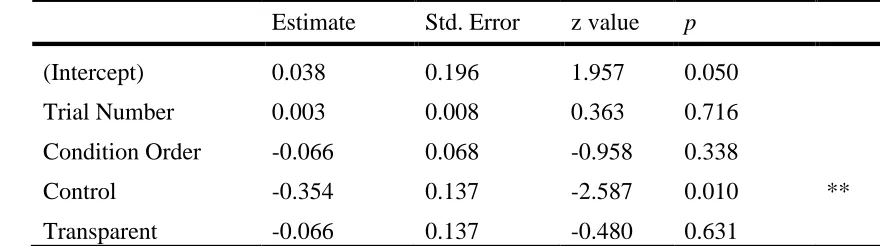
Table 1 Results of the General Linear Model determining whether trial number, 839
condition order or condition influences chimpanzees’ choices of the opaque box 840
Estimate Std. Error z value P
(Intercept) 0.030 0.195 0.152 0.880
Trial Number 0.003 0.008 0.363 0.716
Condition Order -0.066 0.068 -0.958 0.338
Screen 0.354 0.137 2.587 0.010 **
Transparent 0.288 0.137 2.110 0.035 *
Significance codes: ‘**’ 0.01, ‘*’ 0.05
[image:37.595.69.509.582.705.2]841 842 843
Table A1 Results of the General Linear Model determining whether trial number, 844
condition order or condition influences chimpanzees’ choices of the opaque box, with 845
the screen condition as the reference level 846
Estimate Std. Error z value p
(Intercept) 0.038 0.196 1.957 0.050
Trial Number 0.003 0.008 0.363 0.716
Condition Order -0.066 0.068 -0.958 0.338
Control -0.354 0.137 -2.587 0.010 **
Transparent -0.066 0.137 -0.480 0.631
Significance codes: ‘**’ 0.01
FIGURE CAPTIONS 848
849
Fig. 1 Set-up of experiment 1. In the test phase, the chimpanzee was sitting opposite 850
the experimenter who was wearing a face mask and orienting towards a 851
colorful object underneath the camera that recorded the subject’s gaze-852
following behaviour. 853
Fig. 2 Pictures of the face masks for experiment 1 as an example of the chimpanzees’ 854
experience in the training phase. On the left, the colorful toy on the black 855
board is visible through the screen mask, whereas on the right, the toy is 856
hidden behind the opaque mask. 857
Fig. 3 Mean percentages of trials with at least one correct (grey bars) or one incorrect 858
look (white bars) in the opaque and screen conditions. Error bars refer to 95% 859
CI. 860
Fig. 4 Set-up of experiment 2. (a) Apparatus with open lids from the experimenter’s 861
perspective. (b) Training phase. The chimpanzee can see the peanuts through 862
the screen lid on his left side, but not through the opaque lid on his right side. 863
(c) Test phase. Both lids are closed and now appear opaque to the subject, 864
whereas the experimenter can still see through the screen. The chimp can now 865
decide to lift and reach through one of the trap doors to steal a banana piece. 866
Note that the space between the chimpanzee and the experimenter was 867
occluded up to a height of 60 cm (lower breast height of the experimenter; not 868
depicted in the picture) such that the experimenter could not see which side 869
the chimpanzee chose until observing the subject’s hand in one of the boxes. 870
Fig. 5 Pictures of the box lids in the screen condition in their open (above) and their 871
closed position (below) from the subjects’ perspective. The screen lid is on the 872
Fig. 6 Mean percentages of trials with the choice of the opaque box across the three 874
conditions. In the transparent condition, one lid was opaque, the other 875
transparent. In the screen condition, one lid was a screen, the other opaque. 876
The control was like the transparent condition, but without the experimenter’s 877
presence at the time of choice. Error bars indicate 95% CI, ‘*’ indicates P < 878
0.05, ‘**’ indicates P < 0.01. 879
Fig. A1 Comparison of the chimpanzees’ choices of the opaque box in the first (white 880
bars) and second session (grey bars) of the transparent and the screen 881
FIGURES 883
884 885
886
Fig. 1 887
[image:40.595.72.498.105.438.2]889
890
Fig. 2 891
[image:41.595.128.495.119.329.2]893
[image:42.595.78.407.126.506.2]894
Fig. 3 895
899
[image:43.595.126.405.84.736.2]900
Fig. 4 901
903
[image:44.595.70.483.88.660.2]904
Fig. 5 905
907
909