This is a post-peer-review, pre-copyedit version of an article published in Computers in Human Behavior. The final authenticated version is available online at:
https://doi.org/10.1016/j.chb.2013.04.014
All figures and tables referred to in the text can be found at the end of the article.
Please cite this article as:
Zottmann, J. M., Stegmann, K., Strijbos, J.-W., Vogel, F., Wecker, C., & Fischer, F. (2013). Computer-supported collaborative learning with digital video cases in teacher education: The impact of teaching experience on knowledge convergence. Computers in Human Behaviour, 29(5), 2100-2108. doi: 10.1016/j.chb.2013.04.014
This manuscript version is made available under a Creative Commons Attribution-NonCommercial-NoDerivatives 4.0 International License.
Computer-supported collaborative learning with digital video cases in teacher education: The impact of teaching experience on knowledge convergence
Jan M. Zottmann1*, Karsten Stegmann1, Jan-Willem Strijbos1, Freydis Vogel1, Christof Wecker1 and Frank Fischer1
Author Note
1 Department of Psychology, LMU Munich, Germany
*Correspondence concerning the article should be addressed to Jan Zottmann, LMU Munich, Leopoldstraße 13, D-80802 Munich, Germany
Abstract: Case-based learning is ascribed high potential with respect to the education of pre-service teachers as well as the further education of experienced in-pre-service teachers, as it can provide opportunities for the application of professional knowledge to authentic classroom situations. In addition to the application and acquisition of knowledge, the aspect of
knowledge convergence (i.e., increasing similarity of collaborative learners with respect to their knowledge) should be taken into account when homogeneous benefits are desired for all participants of a case-based training. A field study with 29 pre-service teachers and 24 in-service teachers from adult education was conducted to examine effects of different levels of teaching experience on knowledge application, knowledge acquisition, and knowledge convergence in a computer-supported collaborative case-based learning environment. An innovative approach to measuring knowledge convergence was introduced, using the
positions of annotations (i.e., flags placed on the timeline of the case video) made by learners during their case analyses as an indicator of their shared focus of attention. This measure was found to positively correlate with the application and acquisition of professional knowledge. Teaching experience affected both processes and outcomes of case-based learning, suggesting different means of instructional support for pre-service and in-service teachers.
1. Introduction
In the ongoing discussion about the professionalisation of teachers and teacher
education, analytical skills are regarded as a central prerequisite for professional performance and as an inseparable part of their ability to understand and analyse classroom situations (Nittel, 1998). A certain level of knowledge about concepts, principles, and theories is mandatory for professional analyses of classroom interactions, but professional teachers obviously need more than that. Of particular importance, teachers must be able to apply abstract knowledge to concrete phenomena (see Mostert, 2007; Schrader, Hohmann, & Hartz, 2010). Against this backdrop, a key problem within teacher education is the theory-to-practice gap that novice teachers (henceforth referred to as pre-service teachers) encounter regularly. When confronted with a real classroom setting and exposed to its full complexity, pre-service teachers face enormous difficulties to draw upon the professional knowledge they acquired during teacher education (e.g., Korthagen & Kessels, 1999; Koury et al., 2009). Experienced teachers (henceforth referred to as in-service teachers) may experience similar problems – albeit for different reasons. They might have difficulty in applying research-based knowledge, such as when parts of their knowledge have remained inert over the years (Renkl, Mandl, & Gruber, 1996) or when their professional education has been “washed out” in the process of adapting to the reality of the school environment (see Ruohotie-Lyhty & Kaikkonen, 2009). Methods of case-based learning have repeatedly been proposed for implementation in teacher education because learning with cases and problems is ascribed high potential for promoting analytical and problem-solving skills as well as for overcoming inert knowledge (e.g., Levin, 1999; Merseth, 1996). Case-based learning has been recommended for the
teachers interact and influence each other during collaborative phases of case-based trainings. Therefore, this empirical study investigates the impact of teaching experience in computer-supported collaborative learning with digital video cases within the scope of a field study with pre-service and in-service teachers.
2. Research background
2.1 Case-based learning in pre-service and in-service teacher education
In a comprehensive overview on cases and case methods in teacher education, Merseth (1996) noted that case materials have a long history in the educational field (also see Doyle, 1990). They play a major role in the fields of law, medical, and business schools. However, a common definition of what constitutes a case does not exist. A case can be any “chunk of reality” and may be given at differing levels of “immediacy”: Some authors emphasise this aspect and regard only actual situations as cases. Others would also consider simulations to be capable of presenting cases. Cases may also be represented by means of text, pictures, videos, and the like. Hence, realism and authenticity appear to be essential varying features of cases. Cases may be used as exemplars for the demonstration of theoretical principles, as stimulants for fostering personal reflection, or as opportunities to practice analysis (Merseth, 1996; see Shulman, 1992). Case-based learning approaches aim in general to foster the application of knowledge for problem-solving (Zumbach, Haider, & Mandl, 2008). Approaches of case-based learning are claimed to foster critical thinking, reflection, and decision making, as well as analytical and problem-solving skills (e.g., Levin, 1999; Merseth, 1996; Mostert, 2007).
propose possible solutions (Derry & Hmelo-Silver, 2005). As there is no consensus about the exact definition of “case” or “case-based learning” (see Koehler, 2002; Moreno & Valdez, 2007) and in the light of the fact that multiple perspectives on PBL exist in parallel (Ochoa & Robinson, 2005), the relationship of PBL and case-based learning requires further
clarification. PBL may be regarded as a specific subset of case-based learning. Most variants of PBL prominently feature the use of cases (e.g., Cognition and Technology Group at Vanderbilt, 1992; Hmelo-Silver, 2004). In principle, however, a case might also be used as a vehicle for demonstrating or studying exemplary practice or specific solutions if they are presented as part of the case instead of having learners engage in problem-solving. Hence, there can be instances of case-based learning that are not instances of PBL (see Merseth, 1996). Yet, many instances of case-based learning involve problem-solving on part of the learners and thus also fulfil the definition of case based learning, and vice versa. Therefore, the empirical studies conducted in the area of PBL should not be easily dismissed by researchers interested in case based learning because of the different terminology.
authentic problems in the domain of teacher education is unsatisfactory (see Hopperdietzel, Eberle, Kiel, Kahlert, Haag, & Steinherr, 2008).
Case-based learning is considered a particularly promising approach when it comes to the professional development of teachers because it offers opportunities for learners to apply their knowledge to authentic classroom situations. Applying professional knowledge to case information to better understand a pedagogical situation at hand is considered a central component of the analytical competency of teachers (Zottmann, Goeze, Frank, Zentner, Fischer, & Schrader, 2012). Cases appear to be ideal for the exploration of the
multidimensional nature of what students and teachers do in the classroom (Levin, 1999; Mostert, 2007). Thus, complex and authentic cases are expected to help narrow the
aforementioned gap between knowledge from teacher education courses and actual classroom practice. This is especially true for pre-service teachers when they have to respond
immediately to a situation at hand and do not have the time to carefully weigh educational principles (Derry, Hmelo-Silver, Nagarajan, Chernobilsky, & Beitzel, 2006; Hewitt, Pedretti, Bencze, Vaillancourt, & Yoon, 2003; Korthagen & Kessels, 1999). As a consequence, individual learning prerequisites such as prior knowledge – including teaching experience (i.e., pre-service versus in-service teachers) – are important factors that need to be taken into account when implementing cases.
Several authors have proposed that the professional development of teachers can best be fostered with situations in which they can work with cases collaboratively, such as within the scope of case discussions (Levin, 1999; Schrader, Hohmann, & Hartz, 2010). The aspect of social interaction during case discussions has been described as the “source of changes” (Levin, 1999, p. 143) in teachers’ thinking. To this end, the concept of knowledge
2.2 Knowledge convergence in collaborative case-based learning
With respect to collaborative case-based learning in teacher education and trainings for adult educators, two central issues arise: (1) Whether members of a learning group benefit from collaboration to a similar or the same extent (see Weinberger, Stegmann, & Fischer, 2007) and (2) whether group members really share a common appraisal of which situations are important from the perspective of knowledge after their interaction. The concept of knowledge convergence from Computer-Supported Collaborative Learning (CSCL) deals with these issues. Knowledge convergence is “the process by which two or more people share mutual understanding through social interaction” (Jeong & Chi, 2007, p. 287). In other words, social interaction that takes place during collaboration is assumed to lead to a higher “degree of similarity” (Strijbos, 2011, p. 62) of the collaborative learners with respect to cognitive representations.
learning and explains how collaborative case-based learning can be fostered with a computer-supported learning environment.
2.3 Computer-supported collaborative learning with digital video cases
The use of digital video technology is valued in various theories of learning and instruction that assume that structuring learning around digital content, presented in a non-linear and multi-perspectival way, enables learners to acquire open and flexible knowledge structures and helps them to overcome the problem of inert knowledge (e.g., Spiro, Collins, & Ramchandran, 2007). Studies argue that hypermedia environments that incorporate digital video cases represent powerful instructional tools for multiple educational settings, including teacher training (e.g., Koury et al., 2009). Moreno and colleagues found video cases to be more beneficial than text-based case narratives when examining the effects of different case presentation formats on the motivation of learners, their perceptions of learning, and the ability to transfer their educational knowledge to novel situations (e.g. Moreno & Ortegano-Layne, 2008; Moreno & Valdez, 2007). Digital media also allow for a more authentic representation of classroom cases (Putnam & Borko, 2000). However, pre-service teachers with little classroom interaction experience might particularly be overwhelmed and
subsequently confused by the number of detail presented in an authentic and highly complex video case (e.g., Sherin, 2004; Mostert, 2007).
as learning prerequisites remains open. This aspect was therefore explicitly included in the research questions for the present study.
3. Research questions
In this study, annotations made by the participants during individual case analyses in a computer-supported learning environment served as reference points for subsequent
collaborative case discussions and as visible indicators for a shared focus of attention of the learners. The following research questions were investigated:
(RQ1) To what extent does teaching experience affect learning processes regarding the application of knowledge, the annotation behaviour, and the shared focus of attention in computer-supported collaborative case-based learning?
(RQ2) To what extent does teaching experience affect learning outcomes regarding the acquisition of knowledge, the annotation behaviour, and the shared focus of attention in computer-supported collaborative case-based learning?
(RQ3) To what extent are the application and acquisition of knowledge and the shared focus of attention related?
We hypothesised that both the outcomes and processes of case-based learning would be affected by different levels of teaching experience, although prior research does not suggest a clear direction of the effect. We further hypothesised that there would be positive correlations among knowledge application, knowledge acquisition, and the learners’ shared focus of attention.
4. Method
4.1 Participants
study, not all of the participants attended all training days (resulting in varying degrees of freedom for the analyses reported in section 5). Furthermore, 9 in-service teachers dropped out of the course. This observation is in line with average dropout rates in German adult education (Nuissl, 2010). Because the knowledge convergence of learners dropping out of courses is hardly practically relevant and we were interested in knowledge convergence during genuine participation in entire courses, we excluded these participants from all analyses. Hence, our findings pertain to the knowledge convergence among pre- and in-service teachers who complete courses involving computer-supported collaborative case-based learning. The completion rates may differ between these two groups, but the feature of course completion is held constant across them.
The sample included in the analysis comprised 29 pre-service and 15 in-service teachers. These groups did not differ significantly with respect to the distribution of gender,
2(1) = 0.09, p = .767. However, pre-service teachers were significantly younger than the
in-service teachers, t(17.06) = -10.74, p < .001, d = 6,90. The pre-service and in-service teacher
groups also differed significantly regarding the distribution of mother tongue, 2(1) = 7.28, p
= .007. The in-service teacher group contained fewer native German speakers than the group of pre-service teachers. The following subsections describe both groups in more detail.
4.1.1 Pre-service teachers
4.1.2 In-service teachers
The group of in-service teachers (n = 24) initially consisted of 20 female and 4 male foreign language teachers from German adult education centres. As mentioned previously, there was a considerable drop-out in the in-service teacher group, and only 15 of the 24 participants completed the training. The professional background of these in-service teachers differed considerably and their teaching experience in adult education ranged from 2 to 35 years (M = 14.00; SD = 9.75). They were between 32 and 61 years of age (M = 47.07; SD = 8.02). Of the 15 in-service teachers, 9 were native speakers of German, 6 were native speakers of English. The in-service teachers who dropped out of the training were excluded from all analyses. Findings of the study are thus restricted to in-service teachers who actively participated in learning activities.
4.2 Curriculum and learning material
The field of foreign-language learning (English as a second language) was chosen as the domain of study, because this domain features well-developed subject-specific educational principles serving as a basis for teacher-competency criteria (Kelly, Grenfell, Allan, Kriza, & McEvoy, 2004), as well as operationalised levels of learner-competency, which proved helpful when selecting the case material. Participants in both conditions participated in the same training.
4.2.1 Digital video cases
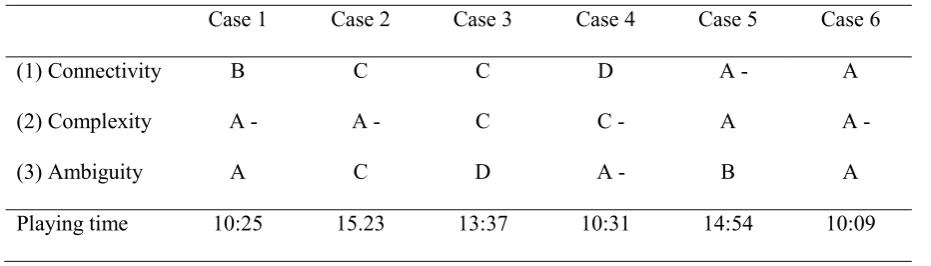
A = “excellent” to D = “sufficient” to the selected cases with respect to three characteristics with the concept of analytical competency in mind (see Schrader, Hohmann, & Hartz, 2010; Zottmann, Goeze, Frank, Zentner, Fischer, & Schrader, 2012): Connectivity, complexity and ambiguity.
Connectivity refers to the requirement that learners can connect the case to various models and theories. The more theoretical concepts related to teaching foreign languages or teaching in general that could be applied to the case, the better the grade that should be given by the experts.
Complexity refers to the suitability of the case for learners with high as well as low analytical skills. Learners with different levels of teaching experience should be able to find access to the case. Thus, the situations shown to them should be neither too obvious for experienced teachers nor too obscure for novices.
Ambiguity refers to the amount of possible distractors included in the cases that may hinder a goal-oriented, theory-driven analysis. For example, the course teacher in one of the cases (case 3) was not a native English speaker and spoke with a heavy accent. The experts suggested that the attention of learners working with that case could easily shift to this aspect of the case, which was not really relevant for a theory-driven analysis.
The experts were asked to agree on how the cases should be rated and compared along the three aforementioned characteristics. Table 1 illustrates the final ratings by the experts after group discussion. These expert ratings enabled us to determine in which order the cases would be presented to the learners during the training and which cases were most similar and thus suitable for pre- and post-test purposes.
4.2.2 Learning materials
The experts also helped to identify which theories might be applicable to the selected cases. We then summarised these theories and sent relevant reading materials to all
participants for preparation prior to the training. These reading materials included approaches related to teaching foreign languages, such as the audio-lingual method or focus on form (versus focus on meaning). In addition, theoretical concepts included in the reading materials were related to teaching in general, for example the cognitive apprenticeship approach (Collins, 2006) and the choreographies of teaching (Oser & Baeriswyl, 2001). We requested that the learners apply these approaches to the cases throughout the training.
4.2.3 Computer-Supported Learning Environment
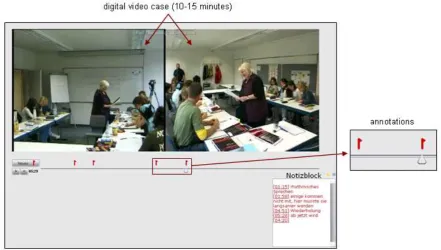
The cases were implemented as digital videos in a computer-supported learning environment. Each video case consisted of two videos of the same situation filmed from different camera angles (one angle focussing on the learners, the other on the teacher), which were played synchronously on the same screen. The learning environment offered the
commonly known video-player functions (e.g., stop, start, rewind, forward). In addition, learners could jump to any part of the video by clicking on the timeline below the video window, and learners could annotate the case videos by placing little flags above the timeline (see Figure 1). Participants also could remove the flags as well as take notes in a text box on the lower right side of the screen during each individual learning phase. The learning
environment allowed a display of the annotations and notes of all group members on one screen during the collaborative phases (i.e., discussion of the training cases in small groups), assigning different colours to the individual learning partners.
Insert Figure 1 about here ************************
4.3 Procedure
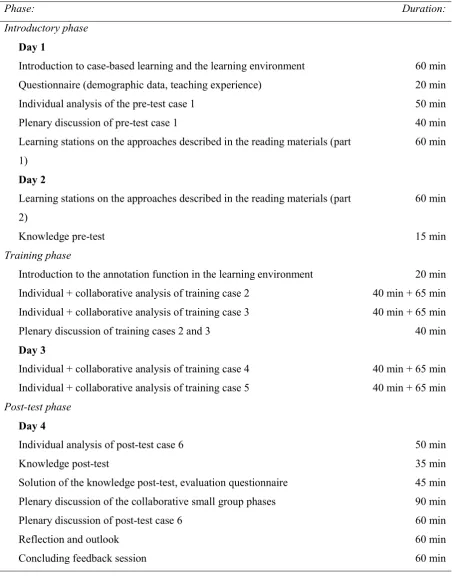
The study, implemented in the context of a 4-day teacher training event, included individual and collaborative phases of case-based learning. Table 2 provides an overview of the training phases and the specific activities that were conducted on each day. The training was moderated by a full-time professional trainer for pre-service school teachers.
Day one started with an introductory phase in which the participants learned about the general approach of learning with cases as well as the computer-supported learning
environment. Next, we asked the participants to complete a short questionnaire covering demographic data. Then the learners viewed the first case analysis, the pre-test case (case 1), in a plenary format (participants were asked to remain silent), followed by 50 minutes of individual analysis in the learning environment. The annotation feature was available at this point and could be used by the learners, but its purpose would not be explained to them until the second day. After this individual phase, participants received the opportunity to exchange their views on the pre-test case in a plenary session. The first training day ended with a phase that was supposed to re-activate the professional knowledge of the participants. For that purpose, we prepared learning stations on the theoretical concepts from the reading materials. Participants spent about an hour with the learning stations at the end of the first day.
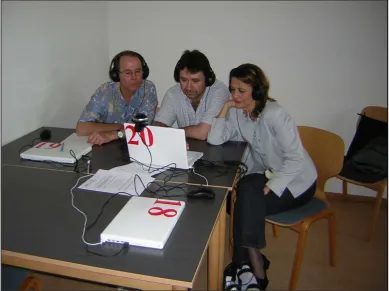
groups of three on the backdrop of their individual analyses for 65 minutes (see Figure 2). For each collaborative phase, the composition of the groups changed. At the end of the second day, a plenary exchange took place with respect to the first two training cases (cases 2 and 3). On the third day, participants worked on two additional training cases (case 4 and 5).
************************ Insert Figure 2 about here ************************
The fourth and final day started with the post-test case viewed in the plenary, and then the learners analysed it individually. There was no subsequent collaborative phase for the post-test case, but the individual phase was directly followed by a knowledge post-test. Next, we asked the participants to complete an evaluation questionnaire that included items
assessing a variety of control variables (e.g., how the participants had perceived working on the cases). We also provided the learners with the solutions for the knowledge post-test. We then conducted a plenary discussion of the collaborative small group phases in which open questions from the previous training days could also be addressed. The subsequent plenary discussion of the post-test case (case 6) included a sample solution proposed by the trainer. We then provided the participants the opportunity to reflect upon their experiences when working with the cases. The training concluded with a feedback session.
************************ Insert Table 2 about here ************************
4.4 Measures
The shared focus of attention (i.e., the degree of similarity among the learners with respect to which scenes they identified as central) was measured by using the positions of annotations made during the individual learning phases. For each pair of learners within a group, we determined an indicator for the overall proximity of these annotations between the two learners.
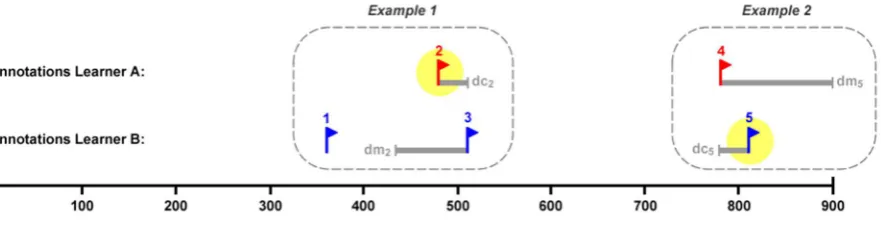
This indicator was determined as follows: First, for each annotation of each learner the closest annotation of the other learner was identified as its reference point. The distance to the closest annotation is referred to as dc. Next, the maximum possible distance from its reference point, referred to as dm, was determined for each annotation. The maximum possible distance is provided by the distance of the midpoint between the two closest annotations of the other learner from the reference point (or between the reference point and the beginning or the end of the video if no annotations of the other learner were placed in between). The indicator for a shared focus of attention consists of the average ratio of the actual distance of an annotation from its reference point to its maximum possible distance across all annotations of the pair (the number of all annotations is k), then subtracting this value from 1. Displayed as a formula, the value for the shared focus of attention between two learners would be
.
************************ Insert Figure 3 about here ************************
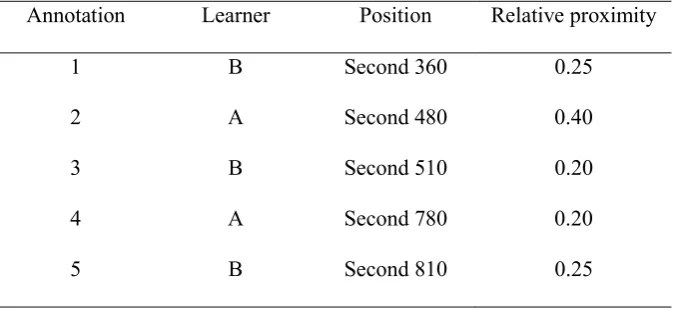
example 1 is annotation 2 by learner A. The distance to the closest annotation by learner B (annotation 3) is dc2 = 30 seconds. With annotation 1 by learner B being the second closest annotation, the maximum possible distance is the mid-point between annotation 1 and annotation 3, which is dm2 = 75 seconds. This leads to a relative proximity value of 0.40 for annotation 2. The starting point for example 2 is annotation 5 by learner B. Here, the distance to the closest annotation by learner A (annotation 4) is dc5 = 30 seconds as well. However, as learner A did not place any other annotations before the end of the case, the maximum
distance is that between the reference point and the end of the video at second 900, dm5 = 120, leading to a relative proximity value of 0.25 for annotation 5. The overall value for the shared focus of attention of learners A and B for the fictitious case video would be 1 – (1.30 / 5) = 0.74.
************************ Insert Table 3 about here ************************
For every case, an individual value for the shared focus of annotation was calculated for each learner. Initially, each learner in an experimental condition was compared to all other learners from that condition, leading to ngroup –1 shared focus values per learner. The mean of these ngroup –1 values was then used as the individual shared focus value for a learner. When a learner did not make any annotations at all during the case analysis, no shared focus value could be calculated. The shared focus of attention was measured at the beginning (pre-test, case 1), during the learning process (mean value of cases 2, 3, 4 and 5, Cronbach’s α = .673), and at the end of the training (post-test, case 6).
the similarity of the annotations of two learners on 16 examples of annotated cases that varied in the number of annotations, the ratio of the number of annotations between the learners, and the length of the video. These examples of annotated cases were represented simply as a timeline with the annotations of learner A placed above and the annotations of learner B placed below the timeline. The experts were asked to rate the degree of similarity of the two learners in each case. The ratings for each case were averaged across experts and correlated with the values of the indicator determined on the basis of the algorithm described above. The association between these two series of values was high (r = .83), signifying the validity of this approach to the measurement of shared focus of attention.
4.4.2 Annotation behaviour
Annotation behaviour of the learners was measured by counting the annotations (i.e., the number of flags) made by each learner for the pre-test case, all of the training cases (mean), and the post-test case.
4.4.3 Knowledge
The knowledge of the study participants (i.e., their knowledge regarding the teaching approaches described in the reading materials) was assessed in various phases of the training. Prior to working with the training cases, we conducted a knowledge pre-test with 38
structured items (Cronbach’s α = .86) that referred to the declarative knowledge of the participants.
The statements made by learners during the collaborative small group discussion were first segmented into units of analysis. A previously developed coding scheme for the
assessment of analytical competency, which included the dimension “ability to apply knowledge to case information” (see Zottmann et al., 2012), was adapted for the video analysis. The statements made by the learners were then categorised according to whether they were made against the backdrop of knowledge related to the reading materials or based on personal experience or common sense. A statement was categorised as knowledge when it referred to the approach of cognitive apprenticeship that had been included in the reading materials (see section 4.3.2); for example, “The teacher in the video shows the students how she constructs a relative clause, which can be seen as the first phase of cognitive
apprenticeship”. Examples of statements that we categorised as common sense, personal classroom experience, or normative references were, “When writing on the blackboard, the teacher in the video does what teachers usually do in a classroom” or “These students cannot understand the teacher’s remarks, because they are too lazy”. We trained three coders to categorise the discussions until a satisfactory interrater reliability was achieved (Fleiss’ = .69). Once a satisfactory reliability was achieved, we divided the discussions equally among the three coders, who then coded individually.
We measured the acquisition of knowledge after completion of the post-test case by means of a knowledge post-test with 35 structured items (Cronbach’s α = .77). This test was similar, but not identical, to the knowledge pre-test because it also included items that required learners to apply approaches from the reading materials to the post-test case.
5. Results
5.1 Preliminary analyses
of the study). Pre-service teachers (M = 32.41; SD = 3.38) scored higher than the in-service teachers in the knowledge pre-test (M = 29.13; SD = 6.10). Although this difference was not significant, t(18.55) = 1.93, p = .069, d = 0.76, the medium to large effect size indicates that the conditions may not be regarded as equal with respect to declarative prior knowledge.
The annotation behaviour of the pre-service teachers (M = 13.46; SD = 7.58) and the in-service teachers (M = 15.90; SD = 9.04) during the pre-test case did not differ significantly, t(36) = -.830, p = .412, d = 0.29.
In the pre-test case, the shared focus of attention of the pre-service teachers was not significantly different (M = .587; SD = .038) from the shared focus of the in-service teachers (M = .583; SD = .016), t(34.88) = .463, p = .647, d = 0.13.
5.2 Effects on learning processes (RQ1)
Regarding the application of knowledge, analyses of the small group discussions revealed that pre-service teachers (M = 9.65; SD = 8.55) applied descriptively more
knowledge during the discussions than did the in-service teachers (M = 5.40; SD = 6.31), t(42) = 1.70, p = .096, d = 0.55, although this difference was not significant at the 5% level.
With respect to the annotation behaviour of the learners during the collaboration, no significant difference was found between pre-service teachers (M = 16.60; SD = 7.53) and in-service teachers (M = 15.67; SD = 7.41), t(41) = 0.384, p = .703, d = 0.13.
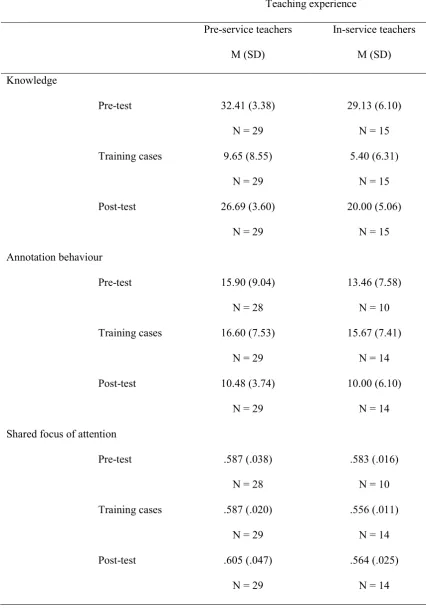
Regarding the shared focus of attention in the process, an ANCOVA (with the score in the knowledge pre-test as covariate) revealed a significant difference between the pre-service teachers (M = .587, SD = .020) and the in-service teachers (M = .556, SD = .011), F(1,40) =
4.71, p = .036, partial 2 = .11.
To control for the initial difference between pre-service and in-service teachers
regarding knowledge, we computed ANCOVAs that included the knowledge pre-test score as a covariate.
The pre-service teachers (M = 26.69; SD = 3.60) scored significantly higher in the knowledge post-test than in-service teachers (M = 20.00; SD = 5.06), F(1,41) = 19.87, p <
.001, partial 2 = .33.
There was no significant difference between pre-service teachers (M = 10.48; SD = 3.74) and in-service teachers (M = 10.00; SD = 6.10) with respect to the annotation behaviour
during the individual analysis of the post-test case, F(1,40) = .001, p = .972, partial 2 < .001.
Teaching experience, however, had a significant effect of medium size on the shared focus of attention in the post-test case, F(1,40) = 6.05, p = .018, partial 2 = .13. The shared
focus of the pre-service teachers (M = .605; SD = .047) was higher than that of the in-service teachers (M = .564; SD = .025).
************************ Insert Table 4 about here ************************
5.4 Relations between learning processes and learning outcomes (RQ3)
We calculated partial correlations with the score in the knowledge pre-test as a control variable. Knowledge application during the collaboration correlated with knowledge
6. Discussion
The present study investigated the impact of teaching experience on learning processes and outcomes regarding the application of knowledge, the annotation behaviour, and the shared focus of attention in computer-supported collaborative case-based learning. In
addition, we investigated the relations between the application and acquisition of knowledge and the shared focus of attention.
As expected, teaching experience had a strong influence on processes and outcomes of case-based learning. The in-service teachers showed less declarative knowledge at the
beginning than the pre-service teachers. Training with the video cases did not decrease the knowledge gap between in-service and pre-service teachers. Controlling for prior knowledge by means of an ANCOVA showed that pre-service teachers benefitted more than the in-service teachers from the training with video cases. Results further revealed a substantial positive relation between the application of knowledge and knowledge acquisition. The differential effect of the training on pre-service and in-service teachers can therefore be explained by the difficulties in-service teachers seemingly faced when applying knowledge to the video cases during the collaborative phases of small group discussions, as well as in the knowledge acquisition test conducted at the end of the training. Even though the difference between pre-service teachers and in-service teachers regarding the application of knowledge to the cases did not become significant at the 5% level, the medium effect size indicates that in-service teachers’ lower degree of knowledge application may be one explanation for their lower degree of knowledge acquisition.
knowledge and previous teaching experience, so the collaborative discussions of the cases may have had a stronger impact on this group than on the pre-service teachers. The mutual exchange might have increased the number of perspectives as to which concepts (beyond knowledge in the reading materials) might be applied to the video cases.
At the end of the training, the pre-service teachers had still a higher shared focus of attention in comparison to the in-service teachers. The cases selected for the pre-test and post-test were highly comparable with respect to playing time as well as their connectivity,
complexity, and ambiguity (see section 4.3.1), so we can argue that the in-service teachers in fact became more divergent over the course of the training.
The professional knowledge of the in-service teachers may have remained inert (see Renkl, Mandl, & Gruber, 2006) or may have been forgotten due to infrequent use over the years, preventing the in-service teachers from benefitting from learning with the video cases to the same extent experienced by the pre-service teachers. Also, a “bias against applying empirical research or theory” (Mostert, 2007, p. 437) often exists among in-service teachers when confronted with classroom cases. Considering the different backgrounds of the in-service teachers, however, it is possible that they never had much knowledge about the
approaches described in the reading materials in the first place. Handing out reading materials prior to the training was perhaps not sufficient to help these in-service teachers to activate this knowledge. Research on simulation-based inquiry learning indicates that providing
knowledge shows positive effects only if offered on demand, that is, during simulation-based or case-based learning, not before (de Jong & van Joolingen, 1998).
teachers who initially participated in the training are included in the analyses, the results from the tests of significance remain the same).
In general, the drop-out rate may be a highly relevant issue for instructors and teacher trainers who are planning to utilise cases. It is possible that the observed lack of knowledge may have made the training a frustrating experience for some of the in-service teachers when they could trust neither their own judgments nor those of their peers regarding the cases (see Mostert, 2007). Moreover, in spite of societal or institutional demands, adults may choose not to participate in further education training, given individual and subjective cost-benefit
analyses (Bolder & Hendrich, 2000). Time and place constraints are major factors influencing drop-out in adult education in this regard. However, the drop-out rate might also be connected to the relevance of case-based training as perceived by in-service teachers (see Park & Choi, 2009).
Limitations beyond the ones already discussed include the focus on declarative knowledge and the ability of teachers to apply it to classroom cases, even though this is regarded as a crucial component of the professional skills of teachers. The results should not be interpreted as that the participating in-service teachers were “poor teachers”; after all, their performance in the classroom was not measured. Future studies should investigate the impact of case-based trainings on subsequent changes in actual teaching practices.
Further research is needed to investigate how in-service teachers could best be
supported in (re-)activating and applying knowledge to cases. For example, knowledge could be made available for long-time practitioners on demand (i.e., just in time) within a computer-supported case-based learning environment. Pre-service teachers, in contrast, may benefit more from instructional support that guides their attention during the analysis of complex and ambiguous cases and helps them focus on the relevant scenes within the case.
Methodologically, the shared focus of attention was successfully measured through the learners’ annotations of the cases (i.e., whether they identified similar scenes in the video case). Although the shared focus measure was positively connected with the application and acquisition of knowledge, future studies may investigate this in conjunction with learners’ annotations and an expert solution. Because this is a predominantly content-free measure, it could also be applied in other domains in which digital video technologies are frequently used for learning (e.g., in medical education; see Luengo, Aboulafia, Blavier, Shorten, Vadcard, & Zottmann, 2009). Whereas current natural language processing (NLP) technologies allow fully automated diagnostics of multiple dimensions of the quality of case analyses (see Mu et al., 2012), the measure for shared focus of attention could be directly derived from the annotation behaviour. Taken together, these advances may allow adaptive support of computer-supported collaborative case-based learning in the future.
References
Albanese, M. A., & Mitchell, S. (1993). Problem-based learning: A review of literature on its outcomes and implementation issues. Academic Medicine, 68(1), 52-81.
Bolder, A., & Hendrich, W. (2000). Fremde Bildungswelten. Alternative Strategien lebenslangen Lernens [Different training worlds. Alternative strategies of lifelong learning]. Opladen, Germany: Leske + Budrich.
Chi, M. T. H. (1997). Quantifying qualitative analyses of verbal data: A practical guide. Journal of the Learning Sciences, 6(3), 271-315.
Choi, I., & Lee, K. (2009). Designing and implementing a case-based learning environment for enhancing ill-structured problem-solving: Classroom management problems for prospective teachers. Educational Technology Research and Development, 57, 99-129. Clark, H. H., & Brennan, S. E. (1991). Grounding in communication. In L. B. Resnick, J.
Levine & S. D. Teasley (Eds.), Perspectives on socially shared cognition (pp. 127-149). Washington: American Psychologist Association.
Cognition and Technology Group at Vanderbilt (1992). The Jasper series as an example of anchored instruction: Theory, program, description, and assessment data. Educational Psychologist, 27(3), 291-315.
Collins, A. (2006). Cognitive apprenticeship. In R. K. Sawyer (Ed.), The Cambridge handbook of the learning sciences (pp. 47-60). New York: Cambridge University Press.
de Jong, T., & van Joolingen, W. (1998). Scientific discovery learning with computer
simulations of conceptual domains. Review of Educational Research, 68(2), 179-201. Derry, S., & Hmelo-Silver, C. (2005). Reconceptualizing teacher education: Supporting case-based instructional problem solving on the world wide web. In L. M. PytlikZillig, M. Bodvarsson & R. Bruning (Eds.), Technology-based education: Bringing researchers and practitioners together (pp. 21-38). Greenwich, CT: Information Age Publishing. Derry, S. J., Hmelo-Silver, C. E., Nagarajan, A., Chernobilsky, E., & Beitzel, B. D. (2006).
Dochy, F., Segers, M., Van den Bossche, P., & Gijbels, D. (2003). Effects of problem-based learning: A meta-analysis. Learning and Instruction, 13(5), 533-568.
Doyle, W. (1990). Case methods in the education of teachers. Teacher Education Quarterly, 17(1), 7-16.
Fischer, F., Kollar, I., Weinberger, A., Stegmann, K., Wecker, C., & Zottmann, J. (2013). Collaboration scripts in computer supported collaborative learning. In C. Hmelo-Silver, C. Chinn, C. Chan & A. O'Donnell (Eds.). International handbook of collaborative learning (pp. 403-419). New York: Taylor & Francis.
Fischer, F., & Mandl, H. (2005). Knowledge convergence in computer-supported collaborative learning: The role of external representation tools. Journal of the Learning Sciences, 14(3), 405-441.
Fitzgerald, G., Koury, K., Mitchem, K., Hollingshead, C., Miller, K., Park, M. K., & Tsai, H. (2009). Implementing case-based instruction in higher education through technology: what works best? Journal of Technology and Teacher Education, 17(1), 31-63. Fu, X., Schaefer, J. C., Marchionini, G., & Mu, X. (2006). Video annotation in a learning
environment. Proceedings of the Annual Meeting of the American Society for Information Science & Technology, 43(1), 1-22.
Hewitt, J., Pedretti, E., Bencze, L., Vaillancourt, B. D., & Yoon, S. (2003). New applications for multimedia cases: Promoting reflective practice in preservice teacher education. Journal of Technology and Teacher Education, 11(4), 483-500.
Hmelo-Silver, C. (2004). Problem-based learning: What and how do students learn? Educational Psychology Review, 16(3), 235-266.
Hopperdietzel, H., Eberle, T., Kiel, E., Kahlert, J., Haag, L., & Steinherr, E. (2008).
Fallbasiertes Arbeiten in der Lehrerbildung [Working with cases in teacher education]. Journal für Lehrerinnen- und Lehrerbildung, 4, 30-36.
Jeong, H., & Chi, M. T. H. (2007). Knowledge convergence and collaborative learning. Instructional Science, 35(4), 287-315.
Kelly, M., & Grenfell, M., Allan, R., Kriza, C., & McEvoy, W. (2004). European profile for language teacher education: A frame of reference. Southhampton: University of Southhampton & European Commission Directorate General for Education and Culture.
Koehler, M. J. (2002). Designing case-based hypermedia for developing understanding of children’s mathematical reasoning. Cognition & Instruction, 20(2), 151-195.
Korthagen, F., & Kessels, J. (1999). Linking theory and practice: Changing the pedagogy of teacher education. Educational Researcher, 28(4), 4-17.
Koury, K., Hollingsead, C., Fitzgerald, G., Miller, K., Mitchem, K., Tsai, H., & Zha, S. (2009). Case-based instruction in different delivery contexts: The impact of time in cases. Journal of Interactive Learning Research, 20(4), 445-467.
Levin, B. B. (1999). The role of discussion in case pedagogy. In M. A. Lundeberg, B. B. Levin & H. L. Harrington (Eds.), Who learns what from cases and how? The research base for teaching and learning with cases (pp. 139-157). Mahwah, NJ: Erlbaum.
Levin, B. B. (Ed.). (2001). Energizing teacher education and professional development with problem-based learning. Alexandria, VA: Assocation for Supervision and Curriculum Development.
Merseth, K. K., (1996). Cases and case methods in teacher education. In J. Sikula, T. J. Buttery & E. Guyton (Eds.), Handbook of research on teacher education (2nd ed., pp. 722-744). New York: Macmillan.
Moreno, R., & Ortegano-Layne, L. (2008). Do classroom exemplars promote the application of principles in teacher education? A comparison of videos, animations, and
narratives. Educational Technology Research and Development, 56, 449-465. Moreno, R., & Valdez, A. (2007). Immediate and delayed effects of using a classroom case
exemplar in teacher education: The role of presentation format. Journal of Educational Psychology, 99(1), 194-206.
Mostert, M. P. (2007). Challenges of case-based teaching. The Behavior Analyst Today, 8(4), 434-442.
Mu, J., Stegmann, K., Mayfield, E., Rosé, C., & Fischer, F. (2012). The ACODEA
framework: Developing segmentation and classification schemes for fully automatic analysis of online discussions. International Journal of Computer-Supported
Collaborative Learning, 7(2), 285-305.
Nittel, D. (1997). Die Interpretationswerkstatt. Über die Einsatzmöglichkeiten qualitativer Verfahren der Sozialforschung in der Fortbildung von Erwachsenenbildner/innen [The interpretation workshop: Possible applications of qualitative methods from social sciences in adult education teacher trainings]. Der Pädagogische Blick, 5, 141-150. Nuissl, E. (2010). Dropout. In R. Arnold, S. Nolda & E. Nuissl (Eds.). Wörterbuch
Erwachsenenbildung (pp. 69-70), Bad Heilbrunn, Germany: Klinkhardt.
Oser, F. K., & Baeriswyl, F. (2001). Choreographies of teaching: Bridging instruction to learning. In V. Richardson (Ed.), Handbook of research on teaching (4th ed., pp. 1031-1065). Washington: AERA.
Porath, M., & Jordan, E. (2004). Problem-based learning in teacher education: Constructing knowledge of exceptionality. Exceptionality Education Canada, 14(2), 47-63.
Putnam, R., & Borko, H. (2000). What do new views of knowledge and thinking have to say about research on teacher learning? Educational Researcher, 29(1), 4-15.
Renkl, A., Mandl, H., & Gruber, H. (1996). Inert knowledge: Analyses and remedies. Educational Psychologist,31, 115-121.
Ruohotie-Lyhty, M., & Kaikkonen, P. (2009). The difficulty of change: The impact of personal school experience and teacher education on the work of beginning language teachers. Scandinavian Journal of Educational Research, 53(3), 295-309.
Schrader, J., Hohmann, R., & Hartz, S. (Eds.). (2010). Mediengestützte Fallarbeit [Media-supported working with cases]. Bielefeld, Germany: Bertelsmann.
Sherin, M. G. (2004). New perspectives on the role of video in teacher education. In J. Brophy (Ed.), Using video in teacher education (pp. 1-27). New York, NY: Elsevier.
Shulman, J. H. (1992). Toward a pedagogy of cases. In J. H. Shulman (Ed.), Case methods in teacher education (pp. 1-30). New York, NY: Teachers College Press.
Spiro, R. J., Collins, B. P., & Ramchandran, A. (2007). Reflections on a post-Gutenberg epistemology for video use in ill-structured domains: Fostering complex learning and cognitive flexibility. In R. Goldman, R. D. Pea, B. Barron & S. Derry (Eds.), Video research in the learning sciences (pp. 93-100). Mahwah, NJ: Erlbaum.
Stegmann, K., & Fischer, F. (2011). Quantifying qualities in collaborative knowledge construction: The analysis of online discussions. In S. Puntambekar, G. Erkens & C. Hmelo-Silver (Eds.), Analyzing interactions in CSCL: Methods, approaches and issues (pp. 247-268). New York: Springer.
Weinberger, A., Stegmann, K., & Fischer, F. (2007). Knowledge convergence in collaborative learning: Concepts and assessment. Learning and Instruction, 17(4), 416-426.
Wolfe, J. (2008). Annotations and the collaborative digital library: Effects of an aligned interface on student argumentation and reading strategies. International Journal of Computer-Supported Collaborative Learning, 3, 141-164.
Zottmann, J. M., Goeze, A., Frank, C., Zentner, U., Fischer, F., & Schrader, J. (2012). Fostering the analytical competency of pre-service teachers in a computer-supported case-based learning environment: A matter of perspective? Interactive Learning Environments, 20(6), 513-532.
Zumbach, J., Haider, K., & Mandl, H. (2008). Fallbasiertes Lernen: Theoretischer Hintergrund und praktische Anwendung. In J. Zumbach & H. Mandl (Eds.),
Table 1. Expert ratings for the cases used in the study
Case 1 Case 2 Case 3 Case 4 Case 5 Case 6
(1) Connectivity B C C D A - A
(2) Complexity A - A - C C - A A -
(3) Ambiguity A C D A - B A
Table 2. Experimental procedure
Phase: Duration:
Introductory phase
Day 1
Introduction to case-based learning and the learning environment 60 min
Questionnaire (demographic data, teaching experience) 20 min
Individual analysis of the pre-test case 1 50 min
Plenary discussion of pre-test case 1 40 min
Learning stations on the approaches described in the reading materials (part 1)
60 min
Day 2
Learning stations on the approaches described in the reading materials (part 2)
60 min
Knowledge pre-test 15 min
Training phase
Introduction to the annotation function in the learning environment 20 min Individual + collaborative analysis of training case 2 40 min + 65 min Individual + collaborative analysis of training case 3 40 min + 65 min
Plenary discussion of training cases 2 and 3 40 min
Day 3
Individual + collaborative analysis of training case 4 40 min + 65 min Individual + collaborative analysis of training case 5 40 min + 65 min
Post-test phase
Day 4
Individual analysis of post-test case 6 50 min
Knowledge post-test 35 min
Solution of the knowledge post-test, evaluation questionnaire 45 min
Plenary discussion of the collaborative small group phases 90 min
Plenary discussion of post-test case 6 60 min
Reflection and outlook 60 min
Table 3. Positions of annotations of two learners for the fictitious case displayed in figure 3
Annotation Learner Position Relative proximity
1 B Second 360 0.25
2 A Second 480 0.40
3 B Second 510 0.20
4 A Second 780 0.20
Table 4. Overview of the results for knowledge and the shared focus of attention Teaching experience Pre-service teachers M (SD) In-service teachers M (SD) Knowledge
Pre-test 32.41 (3.38)
N = 29
29.13 (6.10)
N = 15
Training cases 9.65 (8.55)
N = 29
5.40 (6.31)
N = 15
Post-test 26.69 (3.60)
N = 29
20.00 (5.06)
N = 15
Annotation behaviour
Pre-test 15.90 (9.04)
N = 28
13.46 (7.58)
N = 10
Training cases 16.60 (7.53)
N = 29
15.67 (7.41)
N = 14
Post-test 10.48 (3.74)
N = 29
10.00 (6.10)
N = 14
Shared focus of attention
Pre-test .587 (.038)
N = 28
.583 (.016)
N = 10
Training cases .587 (.020)
N = 29
.556 (.011)
N = 14
Post-test .605 (.047)
N = 29
.564 (.025)