DOI 10.1007/s10801-016-0703-9
Lengths of words in transformation semigroups
generated by digraphs
P. J. Cameron1 · A. Castillo-Ramirez2 · M. Gadouleau2 · J. D. Mitchell1
Received: 2 February 2016 / Accepted: 25 July 2016
© The Author(s) 2016. This article is published with open access at Springerlink.com
Abstract Given a simple digraph Donn vertices (withn ≥ 2), there is a natural construction of a semigroup of transformationsD. For any edge(a,b)of D, let
a →bbe the idempotent of rankn−1 mappingatoband fixing all vertices other thana; then, defineDto be the semigroup generated bya →bfor all(a,b)∈E(D). Forα∈ D, let(D, α)be the minimal length of a word inE(D)expressingα. It is well known that the semigroup Singnof all transformations of rank at mostn−1 is generated by its idempotents of rankn−1. WhenD=Knis the complete undirected graph, Howie and Iwahori, independently, obtained a formula to calculate(Kn, α), for anyα∈ Kn =Singn; however, no analogous non-trivial results are known when D=Kn. In this paper, we characterise all simple digraphsDsuch that either(D, α)
is equal to Howie–Iwahori’s formula for allα∈ D, or(D, α)=n−fix(α)for all α∈ D, or(D, α)=n−rk(α)for allα∈ D. We also obtain bounds for(D, α)
when Dis an acyclic digraph or a strong tournament (the latter case corresponds to a smallest generating set of idempotents of rankn−1 of Singn). We finish the paper
with a list of conjectures and open problems.
Keywords Transformation semigroup·Simple digraph·Word length
1 Introduction
For anyn∈N,n≥2, let Singnbe the semigroup of all singular (i.e. non-invertible)
transformations on[n] := {1, . . . ,n}. It is well known (see [2]) that Singnis generated
B
A. Castillo-Ramirez [email protected]1 School of Mathematics and Statistics, University of St Andrews, St Andrews, Fife KY16 9SS, UK 2 School of Engineering and Computing Sciences, Durham University, South Road,
Fig. 1 T5
1 2 3 4 5
by its idempotents of defect 1 (i.e. the transformationsα∈ Singn such thatα2 =α and rk(α) := |Im(α)| = n−1). There are exactlyn(n−1)such idempotents, and each one of them may be written as(a →b), fora,b ∈ [n],a =b, where, for any v∈ [n],
(v)(a→b):=
b ifv=a,
v otherwise.
Motivated by this notation, we refer to these idempotents asarcs.
In this paper, we explore the natural connections between simple digraphs on[n]
and subsemigroups of Singn. For any subsetU ⊆Singn, denote byUthe semigroup generated byU. For any simple digraph Dwith vertex setV(D)= [n]and edge set
E(D), we associate the semigroup
D :=(a→b)∈Singn:(a,b)∈ E(D)
.
We say that a subsemigroup S of Singn isarc-generatedby a simple digraph Dif S= D.
For the rest of the paper, we use the term ‘digraph’ to mean ‘simple digraph’ (i.e. a digraph with no loops or multiple edges). A digraph D isundirected if its edge set is a symmetric relation onV(D), and it istransitiveif its edge set is a transitive relation onV(D). We shall always assume that Disconnected (i.e. for every pair
u, v∈V(D)there is either a path fromutov, or a path fromvtou) because otherwise
D ∼= D1×· · ·×Dk, whereD1, . . . ,Dkare the connected components ofD. We say that Disstrong(orstrongly connected) if for every pairu, v∈ V(D), there is a directed path fromutov. We say thatDis atournamentif for every pairu, v∈V(D)
we have(u, v)∈E(D)or(v,u)∈ E(D), but not both.
Many famous examples of semigroups are arc-generated. Clearly, by the discussion of the first paragraph, Singn is arc-generated by the complete undirected graph Kn. In fact, forn ≥ 3, Singn is arc-generated by Dif and only if Dcontains a strong tournament (see [3]). The semigroup of order-preserving transformations On:= {α∈
Singn:u ≤v⇒uα≤vα}is arc-generated by an undirected path Pnon[n], while
the Catalan semigroup Cn := {α ∈ Singn : v ≤ vα,u ≤ v ⇒ uα ≤ vα}is
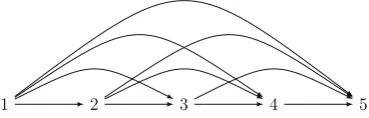
arc-generated by a directed path Pn on[n](see [9, Corollary 4.11]). The semigroup of non-decreasing transformations OIn:= {α∈Singn:v≤vα}is arc-generated by the
transitive tournamentTn on[n](Fig.1illustratesT5).
Connections between subsemigroups of Singn and digraphs have been studied
[image:2.439.203.388.59.118.2]Definition 1 For a digraph D, the closure D¯ of D is the digraph with vertex set
V(D¯) := V(D)and edge set E(D¯) := E(D)∪ {(a,b):(b,a)∈ E(D) is in a directed cycle ofD}.
Say thatDisclosedifD= ¯D. Observe thatD = ¯Dfor any digraphD. Recall that theorbitsofα∈ Singn are the connected components of the digraph on[n]with edges{(x,xα): x ∈ [n]}. In particular, an orbitofαis calledcyclic
if it is a cycle with at least two vertices. An elementx ∈ [n]is afixed point ofαif
xα=x. Denote by cycl(α)and fix(α)the number of cyclic orbits and fixed points of α, respectively. Denote by ker(α)the partition of[n]induced by thekernelofα(i.e. the equivalence relation{(x,y)∈ [n]2:xα=yα}).
We introduce some further notation. For any digraph Dandv ∈V(D), define the
in-neighbourhoodand theout-neighbourhoodofvby
N−(v):= {u∈V(D):(u, v)∈E(D)}andN+(v):= {u ∈V(D):(v,u)∈E(D)},
respectively. We extend these definitions to any subsetC ⊆V(D)by lettingN(C):=
c∈CN(c), where ∈ {+,−}. Thein-degreeandout-degreeofv are deg−(v):= |N−(v)|and deg+(v) := |N+(v)|, respectively, while thedegreeofv is deg(v):=
|N−(v)∪N+(v)|. For any two verticesu, v ∈ V(D), theD-distancefromu tov, denoted by dD(u, v), is the length of a shortest path from u tov in D, provided that such a path exists. The diameter of D is diam(D) := max{dD(u, v) : u, v ∈ V(D), dD(u, v)is defined}.
LetDbe any digraph on[n]. We are interested in the lengths of transformations of
Dviewed as words in the free monoidD∗:= {(a→b):(a,b)∈ E(D)}∗. Say that a wordω∈ D∗expresses(orevaluates to)α∈ Difα=ωφ, whereφ: D∗→ D
is the evaluation semigroup morphism. For anyα∈ D, let(D, α)be the minimum length of a word inD∗expressingα. Forr ∈ [n−1], denote
(D,r):=max{(D, α):α∈ D,rk(α)=r}, (D):=max{(D, α):α∈ D}.
The main result in the literature in the study of(D, α)was obtained by Howie and Iwahori, independently, whenD=Kn.
Theorem 1.1 [4,5] For anyα∈Singn,
(Kn, α)=n+cycl(α)−fix(α).
Therefore,(Kn,r)=n+12(r−2), for any r ∈ [n−1], and(Kn)=(Kn,n−
1)=32(n−1).
certain classC; we denote this number byCmax(n,r). In particular, whenCis the class of acyclic digraphs, we find an explicit formula forCmax(n,r). WhenCis the class of strong tournaments, we find upper and lower bounds forCmax(n,r)(and for the analogously definedCmin(n,r)). Finally, in Sect.4we provide a list of conjectures and open problems.
2 Arc-generated semigroups with short words
LetDbe a digraph on[n],n ≥3, andα∈ D. Theorem1.1implies the following three bounds:
(D, α)≥n+cycl(α)−fix(α)≥n−fix(α)≥n−rk(α). (1)
The lowest bound is always achieved for constant transformations (i.e. transforma-tions of rank 1).
Lemma 2.1 For any digraph D on[n], ifα∈ Dhas rank1, then(D, α)=n−1.
Proof It is clear that(D, α) ≥ n −1 becauseαhasn −1 non-fixed points. Let Im(α)= {v0} ⊆ [n]. Note that, for anyv ∈ [n], there is a directed path inDfromv tov0(as otherwise,α /∈ D). For anyd ≥1, let
Cd := {v∈ [n] :dD(v, v0)=d}. Clearly,[n]\{v0} =
m
d=1Cd, wherem := maxv∈[n]{dD(v, v0)}and the union is disjoint. For anyv∈Cd, letvbe a vertex inCd−1such that(v→v)∈ D. For any distinctv,u ∈Cdand any choice ofv,u∈Cd−1, the arcs(v→v)and(u →u)
commute; hence, we can decomposeαas
α= 1
d=mv∈Cd (v→v),
where the composition of arcs is done frommdown to 1.
Remark 1 Using a similar argument as in the previous proof, we may show thatD contains all constant transformations if and only ifDis strongly connected.
Inspired by the bounds given in (1), we characterise all the connected digraphsD
on[n]satisfying the following conditions:
∀α∈ D, (D, α)=n+cycl(α)−fix(α); (C1)
∀α∈ D, (D, α)=n−fix(α); (C2)
2.1 Digraphs satisfying condition (C1)
Theorem1.1says thatKnsatisfies (C1). In order to characterise all digraphs satisfy-ing (C1), we introduce the following property on a digraphD:
() If dD(v0, v2) = 2 andv0, v1, v2is a directed path in D, then N+({v1, v2}) ⊆
{v0, v1, v2}.
We shall study the strong components of digraphs satisfying property(). We state few observations that we use repeatedly in this section.
Remark 2 Suppose thatDsatisfies property(). Ifv0, v1, v2is a directed path inDand deg+(v1) >2, or deg+(v2) >2, then(v0, v2)∈ E(D). Indeed, if(v0, v2) /∈ E(D), thendD(v0, v2)=2, so, by property(),N+({v1, v2})⊆ {v0, v1, v2}; this contradicts that deg+(v1) >2, or deg+(v2) >2.
Remark 3 Suppose that Dsatisfies property(). Ifv0, v1, v2is a directed path in D and eitherv1orv2has an out-neighbour not in{v0, v1, v2}, then(v0, v1)∈E(D).
Remark 4 IfDsatisfies property(), then diam(D)≤2. Indeed, ifv0, v1, . . . , vkis
a directed path inDwithdD(v0, vk)=k≥3, thenv0, v1, v2is a directed path inD andv2has an out-neighbourv3∈ {/ v0, v1, v2}; by Remark3,(v0, v2)∈ E(D), which contradicts thatdD(v0, vk)=k.
Note that digraphs satisfying property()are a slight generalisation of transitive digraphs.
LetDbe a digraph and letC1andC2of be two strong components ofD. We say thatC1connectstoC2if(v1, v2)∈ E(D)for somev1∈C1,v2∈C2; similarly, we say thatC1fully connectstoC2 if(v1, v2) ∈ E(D)for allv1 ∈ C1,v2 ∈ C2. The strong componentC1is calledterminalif there is no strong componentC=C1ofD such thatC1connects toC.
Lemma 2.2 Let D be a closed digraph satisfying property(). Then, any strong component of D is either an undirected path P3or complete. Furthermore, P3may
only appear as a terminal strong component of D.
Proof LetCbe a strong component ofD. Since Dis closed,C must be undirected. The lemma is clear if|C| ≤3, so assume that|C| ≥4. We have two cases:
Case 1 Every vertex inC has degree at most 2. ThenCis a path or a cycle. Since
|C| ≥4 and diam(D)≤2, thenCis a cycle of length 4 or 5; however, these cycles do not satisfy property().
Case 2 There exists a vertexa ∈Cof degree 3 or more. Any two neighbours ofaare adjacent: indeed, for anyu, v∈ N(a),u,a, vis a path and deg+(a) >2, so (u, v)∈ E(D)by Remark2. Hence, the neighbourhood ofais complete and every neighbour ofahas degree 3 or more. Applying this rule recursively, we obtain that every vertex inChas degree 3 or more, and the neighbourhood of every vertex is complete. Therefore,Cis complete because diam(D)≤2.
Lemma 2.3 Let D be a closed digraph satisfying property(). Let C1 and C2 be
strong components of D, and suppose that C1connects to C2. (i) If C2is non-terminal, then C1fully connects to C2.
(ii) Let|C2| = 1. If either|C1| = 2, or the vertex in C1that connects to C2has
out-degree at least3, then C1fully connects to C2.
(iii) Let|C2| =2. If not all vertices in C1connect to the same vertex in C2, then C1
fully connects to C2.
(iv) If|C2| ≥3, then C1fully connects to C2.
Proof Recall thatC1 andC2are undirected because Dis closed. If |C1| = 1 and
|C2| = 1, clearly C1 fully connects to C2. Henceforth, we assume |C1| ≥ 2 or
|C2| ≥ 2. Let c1 ∈ C1 and c2 ∈ C2 be such that (c1,c2) ∈ E(D). As C1 is a non-terminal, Lemma2.2implies thatC1is complete.
(i) AsC2is non-terminal, there existsd ∈ D\(C1∪C2)such that(c2,d)∈E(D). Suppose that|C1| ≥2. Then, for anyc1∈C1\{c1},c1,c1,c2is a directed path in D withd ∈ N+(c2), so Remark3 implies(c1,c2) ∈ E(D). Suppose now that|C2| ≥2. Then, for anyc2∈C2\{c2},c1,c2,c2 is a directed path inDwith
d ∈ N+(c2), so again(c1,c2)∈E(D). Therefore,C1fully connects toC2. (ii) Suppose that|C1| ≥2. If|C1|>2, then deg+(c1) >2, becauseC1is complete.
Thus, for eachc1∈C1\{c1},c1,c1,c2is a directed path inDwith deg+(c1) >2, so(c1,c2)∈ E(D)by Remark2. As|C2| =1, this shows thatC1fully connects toC2.
(iii) LetC2 = {c2,c2}and let c1 ∈ C1\{c1} be such that (c1,c2) ∈ E(D). For anyb,d ∈ C1,b = c1,d = c1, bothb,c1,c2andd,c1,c2are directed paths in Dwithc2 ∈ N+(c2)andc2 ∈ N+(c2); hence,(b,c2), (d,c2) ∈ E(D)by Remark3.
(iv) Suppose that C2 = P3. Say C2 = {c2,c2,c2} with either dD(c2,c2) = 2 or dD(c2,c2) = 2. In any case, c1,c2,c2 is a directed path in D with c2 ∈
N+({c2,c2}), so (c1,c2) ∈ E(D)by Remark3; now,c1,c2,c2 is a directed path in Dwithc2∈ N+({c2,c2}), so(c1,c2)∈ E(D). Hence,c1is connected to all vertices of C2. AsC1 is complete, a similar argument shows that every
c1∈C1\{c1}connects to every vertex inC2.
Suppose now that C2 = Km for m ≥ 3. By a similar reasoning as the pre-vious paragraph, we show that(c1, v) ∈ E(D)for allv ∈ C2. Now, for any
c1 ∈ C1\{c1},v ∈ C2,c1,c1, vis a directed path in Dso(c1, v) ∈ E(D)by
Remark3.
Lemma 2.4 Let D be a closed digraph satisfying property(). Let Ci, i =1,2,3, be strong components of D, and suppose that C1connects to C2and C2connects to C3.
If C1does not connect to C3, then|C2| = |C3| =1, C3is terminal in D, and C2is
terminal in D\C3.
fromc3, so|C3| =1. Finally, Remark3applied to the pathc1,c2,c3also implies that
C3is terminal inDandC2is terminal inD\C3. The following result characterises all digraphs satisfying condition (C1).
Theorem 2.5 Let D be a connected digraph on[n]. The following are equivalent:
(i) For allα∈ D,(D, α)=n+cycl(α)−fix(α).
(ii) D is closed satisfying property().
Proof In order to simplify notation, denote
g(α):=n+cycl(α)−fix(α).
First, we show that (i) implies (ii). Suppose(D, α)=g(α)for allα∈ D. We use the one-line notation for transformations:α=(1)α (2)α . . . (k)α, wherex=(x)α
for allx >k,x∈ [n]. Clearly, ifDis not closed, there exists an arcα∈ D\D, so 1 < (D, α) = g(α)= 1. In order to prove that property()holds, let 1,2,3 be a shortest path in D. If(2→v) ∈ D, for somev ∈ [n]\{1,2,3}, thenα=3v3v ∈
D, butg(α)=2 = (D, α)= 3. If(3 → v) ∈ D, thenα=3vvv ∈ D, but
g(α)=3=(D, α)=4. Therefore,N+({2,3})⊆ {1,2,3}, and()holds.
Conversely, we show that (ii) implies (i). Letα∈ D. We remark that any cycle ofαbelongs to a strong component ofD.
Claim 2.6 Let C be a strong component of D. Then eitherαfixes all vertices of C or |(Cα)∩C|<|C|.
Proof Suppose thatα|C, the restriction ofαtoC, is non-trivial and|(Cα)∩C| = |C|. Thenα|Cis a permutation ofC. Letu ∈Cand suppose that(u →v)is the first arc movinguin a word expressingαinD∗. Ifv∈C, we haveuα=vα, which contradicts thatα|C is a permutation. Ifv ∈Cfor some other strong componentCof D, then
uα /∈Cwhich again contradicts our assumption.
Claim 2.7 Let u, v∈ [n]be such that uα=v. If dD(u, v)=2, then: 1. vis in a terminal component of D.
2. There is a path u, w, vof length2in D such thatwα =vα =v; for any other path u,x, vof length2in D, we have xα∈ {x, v}.
Proof LetC1andC2be strong components ofDsuch thatu ∈C1andv∈ C2. We analyse the four possible cases in whichdD(u, v) = 2. In the first three cases, we use the fact thatP3 ∼=O3, hence we can orderu < w < vandαis an increasing transformation of the ordered set{u, w, v}; thusuα=wα=vα=v.
Case 1 C1=C2. By Lemma2.2,C1∼=P3and it is a terminal component. Therefore,
2.holds as there is a unique path fromutov.
Case 2 C1connects toC2and|C2| =2. AsdD(u, v)=2,C1does not fully connect
C2, so, by Lemma2.3,|C2| = 1,C2is terminal,|C1| = 2, and the vertex w ∈ C1connecting to C2 = {v}has out-degree 2. Then, by property(),
Case 3 C1connects toC2and|C2| =2. AsdD(u, v)=2,C1does not fully connect
C2, so, by Lemma2.3,C2is terminal andu, w, vis the unique path of length two fromutov, wherewis the other vertex ofC2.
Case 4 C1does not connect toC2. SincedD(u, v)=2, there exist strong components
C(1), . . . ,C(k) such that C1 connects to C(i) andC(i) connects to C2, for all 1 ≤ i ≤ k. By Lemma 2.4,C(i) = {xi}, C2 = {v} is terminal and
N+(xi)= {v}for alli. Thusu,xi, vare the only paths of length two from
u tov; in particular, xiα ∈ {xi, v}for allxi. As uα = v, there must exist 1≤ j ≤ksuch thatw:=xj is mapped tov.
Now we produce a wordω∈ D∗expressingαof lengthg(α). Define
U := {u∈ D:dD(u,uα)=2}.
For everyu ∈U, letube a vertex inDsuch thatu,u,uαis a path anduα=uα. The existence ofuis guaranteed by Claim2.7. Define a wordω0∈ D∗by
ω0:= u∈U(u→u)(u→uα).
Sort the strong components ofDin topological order:C1, . . . ,Ck, i.e. fori = j,
Ci connects toCjonly if j >i. For each 1≤i ≤k, define
Si := {v∈Ci\(U∪U):vα∈Ci},
whereU:= {u:u ∈U}, and consider the transformationβi :Ci →Ci defined by
xβi =
xα ifx∈Si x otherwise.
If|Ci| ≤ 2 or Ci ∼= P3, then cycl(βi) = 0 and βi can be computed with|Ci| −
fix(βi)arcs. Otherwise,Ci is a complete undirected graph. Ifβi ∈ Sing(Ci), then
by Theorem1.1, there is a wordωi ∈ Ci∗ ⊆ D∗of length|Ci| +cycl(βi)−fix(βi)
expressingβi. Suppose now thatβiis a non-identity permutation ofCi. By Claim2.6,
αdoes not permuteCi and there existshi ∈Ci\(Ciα). Note thathi ∈Ci\Si. Define
ˆ
βi ∈Sing(Ci)by
xβˆi = ⎧ ⎪ ⎨ ⎪ ⎩
xα ifx∈Si
ai ifx=hi
x otherwise,
where ai is any vertex in Si. Thenα|Si = ˆβ|Si. Again by Theorem1.1, there is a wordωi ∈Ci∗⊆ D∗of length|Ci| +cycl(βˆi)−fix(β)ˆ = |Ci| +cycl(βi)−fix(βi)
The following word maps all the vertices in[n]\(U∪U∪Ci)that have image in
Ci:
ω
i =
(a→aα):a∈ [n]\(U∪U∪Ci),aα∈Ci.
Finally, let
ω:=ω0ωkωk. . . ω1ω1∈ D∗.
It is easy to check that ω indeed expresses α. Since ki=1fix(βi) = fix(α)+ k
i=1|Ci\Si|and k
i=1(ωi)= k
i=1|Ci\(U∪U∪Si)|, we have
(ω)=2|U| + k
i=1
((ωi)+(ωi))=n+ k
i=1
cycl(βi)−fix(α)=g(α).
2.2 Digraphs satisfying condition (C2)
The characterisation of connected digraphs satisfying condition (C2) is based on the classification of connected digraphsDsuch that cycl(α)=0, for allα∈ D.
Fork≥3, letkbe the directed cycle of lengthk. Consider the digraphsΓ1, Γ2, Γ3 andΓ4as illustrated below:
1 2 3
4
5
Γ1 Γ2
2 1
3 4 5
Γ3
1 2
3 4
Γ4
1
2 3
4 5
Lemma 2.8 Let D be a connected digraph on[n]. The following are equivalent:
(i) For allα∈ D,cycl(α)=0.
(ii) D has no subdigraph isomorphic toΓ1,Γ2,Γ3,Γ4, ork, for all k≥5.
Proof In order to prove that (i) implies (ii), we show that ifΓ is equal toΓi ork,
• IfΓ =Γ1, take
α:=(3→4)(4→5)(1→4)(4→3)(2→4)(4→1)(3→4)(4→2)
= 21555.
• IfΓ =Γ2, take
α:=(3→4)(4→5)(1→3)(3→4)(2→3)(3→1)(4→3)(3→2)
= 21555.
• IfΓ =Γ3, take
α:=(3→4)(2→3)(1→2)(3→1)=2144.
• IfΓ =Γ4, take
α=(3→4)(4→5)(2→3)(3→4)(1→2)(4→1)=21555.
• AssumeΓ =kfork≥5. Consider the following transformation of[k]:
(u⇒v):=(u→u1) . . . (ud−1→v),
whereu,u1, . . . ,ud−1, vis the unique path fromutovon the cyclek. Take
α:=(1⇒k−3)(k⇒k−4)(k−1⇒1)(k−2⇒k)
(k−3⇒k−1)(k−4⇒k−2).
Then,α =(k−1)(k−1) . . . (k−1)k1(k−2), where(k−1)appearsk−3 times, has the cyclic component(k−2,k).
Conversely, assume thatDsatisfies (ii). Ifn ≤3, it is clear that cycl(α) =0, for allα∈ D, so supposen ≥4. We first obtain some key properties about the strong components ofD¯.
Claim 2.9 Any strong component ofD is an undirected path, an undirected cycle of¯ length 3 or 4, or a claw K3,1(i.e. a bipartite undirected graph on[4] = [3] ∪ {4}).
Moreover, if a strong component of D is not an undirected path, then it is terminal.
Proof LetC be a strong component of D¯. Clearly,C is undirected and, by (ii), it cannot contain a cycle of length at least 5. IfC has a cycle of length 3 or 4, then the whole ofC must be that cycle andCis terminal (otherwise, it would containΓ3or Γ4, respectively). IfChas no cycle of length 3 and 4, thenCis a tree. It can only be a path orK3,1, for otherwise it would containΓ1orΓ2; clearly,K3,1may only appear
Suppose there isα∈ Dthat has a cyclic orbit (so cycl(α)=0). This cyclic orbit must be contained in a strong componentCofD¯, and Claim2.9implies thatC∼=Γ, whereΓ ∈ {K3,1,¯s,Pr :s ∈ {3,4},r ∈N}. IfΓ =K3,1orΓ = ¯s, thenCis a
terminal component, soαacts onCas some transformationβ ∈ Γ; however, it is easy to check that no transformation inΓhas a cyclic orbit. IfΓ =Pr, for somer, thenαacts onCas a partial transformationβofPr. SincePr =Or,βhas no cyclic
orbit.
We introduce a new property of a connected digraphD:
() For every strong componentCofD,|C| ≤2 ifCis non-terminal, and|C| ≤3 ifCis terminal.
Lemma 2.10 Let D be a closed connected digraph on[n]satisfying property(). The following are equivalent:
(i) D satisfies property().
(ii) D has no subdigraph isomorphic toΓ1,Γ2,Γ3,Γ4, ork, for some k≥5.
Proof If (i) holds, it is easy to check thatDdoes not contain any subdigraphs isomor-phic toΓ1,Γ2,Γ3,Γ4, orkfor somek≥5.
Conversely, suppose that (ii) holds. LetC be a strong component of D. IfC is non-terminal, Lemma 2.2implies thatC is complete; hence,|C| ≤ 2 as otherwise
Dwould containΓ4as a subdigraph. IfC is terminal, Lemma2.2implies thatC is complete orP3; hence,|C| ≤3 as otherwise Dwould containΓ3as a subdigraph.
Theorem 2.11 Let D be a connected digraph on[n]. The following are equivalent:
(i) For allα∈ D,(D, α)=n−fix(α).
(ii) D is closed satisfying properties()and().
Proof Clearly,Dsatisfies (i) if and only if it satisfies condition (C1) and cycl(α)=0, for allα∈ D. By Theorem2.5and Lemmas2.8and2.10,Dsatisfies (i) if and only
ifDsatisfies (ii).
2.3 Digraphs satisfying condition (C3)
The following result characterises digraphs satisfying condition (C3).
Theorem 2.12 Let D be a connected digraph on[n]. The following are equivalent:
(i) For everyα∈ D,(D, α)=n−rk(α).
(ii) Dis a band, i.e. everyα∈ Dis idempotent.
(iii) Either n=2and D∼=K2, or there exists a bipartition V1∪V2of[n]such that (i1,i2)∈E(D)only if i1∈V1, i2∈V2.
Proof Clearly (i) implies (ii): if(D, α)=n−rk(α), then rk(α)=fix(α)by inequal-ity (1), soαis idempotent.
Therefore, forn ≥ 3, if everyα ∈ Dis idempotent, then a vertex in Deither has in-degree zero or out-degree zero: this corresponds to the bipartition of[n]into V1 andV2.
We finally prove that (iii) implies (i). Letn ≥ 3 and suppose that there exists a bipartitionV1∪V2of[n]such that(i1,i2)∈ E(D)only ifi1 ∈ V1,i2 ∈ V2. Then for any α ∈ D, all elements ofV2 are fixed byα andi1α ∈ {i1} ∪ N+(i1)for anyi1 ∈ V1. In particular, any non-fixed point of αis mapped to a fixed point, so
r :=rk(α)=fix(α). LetJ := {v1, . . . , vn−r} ⊆V1be the set of non-fixed points of α; therefore
α=(v1→v1α) . . . (vn−r →vn−rα),
where each one of then−rarcs above belongs toD. The result follows by
inequal-ity (1).
3 Arc-generated semigroups with long words
Fixn ≥2. In this section, we consider digraphsDthat maximise(D,r)and(D). Forr ∈ [n−1], define
max(n,r):=max{(D,r):V(D)= [n]}, max(n):=max{(D):V(D)= [n]}.
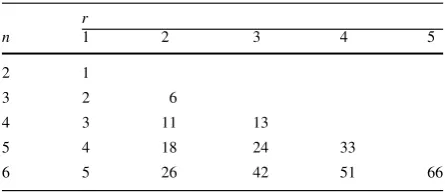
The first few values ofmax(n,r), calculated with the GAP packageSemigroups [7], are given in Table1. By Lemma2.1,max(n,1)=n−1 for alln≥2; henceforth, we shall always assume thatn≥3 andr∈ [n−1]\{1}.
In the following sections, we restrict the class of digraphs that we consider in the definition ofmax(n,r)and max(n)to two important cases: acyclic digraphs and strong tournaments.
3.1 Acyclic digraphs
[image:12.439.166.389.495.591.2]For anyn ≥ 3, let Acyclicn be the set of all acyclic digraphs on[n], and, for any r∈ [n−1], define
Table 1 First values of
max(n,r) n r1 2 3 4 5
2 1
3 2 6
4 3 11 13
5 4 18 24 33
Acyclic
max (n,r):=max
(A,r): A∈Acyclicn
, Acyclic
max (n):=max
(A): A∈Acyclicn
.
Without loss of generality, we assume that any acyclic digraphAon[n]is topologically sorted, i.e.(u, v)∈ E(A)only ifv >u.
In this section, we establish the following theorem.
Theorem 3.1 For any n≥3and r∈ [n−1]\{1},
Acyclic
max (n,r)=(
n−r)(n+r−3)
2 +1,
Acyclic
max (n)=Acyclicmax (n,2)= 1 2(n
2−3n+4).
First of all, we settle the caser =n−1, for which we have a finer result.
Lemma 3.2 Let n≥3and A∈Acyclicn. Then,(A,n−1)is equal to the length of a longest path in A. Therefore,
Acyclic
max (n,n−1)=n−1.
Proof Letv1, . . . , vl+1be a longest path inA. Thenα∈ Adefined by
vα :=
vi+1 ifv=vi, i ∈ [l],
v otherwise,
has rankn−1 and requires at leastlarcs, since it moveslvertices.
Conversely, let α ∈ Abe a transformation of rank n−1, and consider a word expressingαinA∗:
α=(u1→v1)(u2→v2) . . . (us →vs).
Since αhas rank n −1, we must havev2 = u1 and by inductionvi = ui−1 for 2≤i ≤s. AsAis acyclic,us,us−1, . . . ,u1, v1forms a path inA, sos≤l. The following lemma shows that the formula of Theorem3.1is an upper bound for Acyclic
max (n,r).
Lemma 3.3 For any n≥3and r∈ [n−1]\{1},
Acyclic
max (n,r)≤ (
n−r)(n+r−3)
2 +1.
Proof Let Abe an acyclic digraph on[n], letα ∈ Abe a transformation of rank
Claim 3.4 (A, α)≤v∈[n]ψA(v, vα).
Proof Letω = (a1 → b1) . . . (al → bl)be a shortest word expressingα in A∗, withl = (A, α). Say that the arc(ai → bi),i ≥ 2, carriesv ∈ [n]if v(a1 →
b1) . . . (ai−1→bi−1)=ai (assume thata1→b1only carriesa1). Every arc(ai →
bi)carries at least one vertex, for otherwise we could remove that arc form the word ωand obtain a shorter word still expressingα. Letv ∈ [n], and denotev0 =v and vi =v(a1 →b1) . . . (ai →bi)(and hencevl =vα). Let us remove the repetitions
in this sequence: let j0 = 0 and fori ≥ 1, ji = min{j : vj = vji−1}. Then the sequencev =vj0, vj1, . . . , vjl(v) = vαforms a path in Aof lengthl(v), and hence
l(v)≤ψ(v, vα). For eachv ∈ [n], there arel(v)arcs inωcarryingv, so the length ofωsatisfies
l ≤ n
v=1
l(v)≤
v∈[n]
ψA(v, vα).
Claim 3.5 If|L| ≥2, thenv∈[n]ψA(v, vα)≤ (n−r)(n2+r−3).
Proof As|L| ≥ 2, and Ais topologically sorted, we have{n,n−1} ⊆ L, and any α ∈ Afixes bothn −1 andn, i.e. ψA(v, vα) = 0 for v ∈ {n−1,n}. For any
v∈ [n−2], we have
ψA(v, vα)≤min{n−1, vα} −v.
Hence
v∈[n]
ψA(v, vα)=
v∈[n−2]
ψA(v, vα)
≤
v∈[n−2]
(min{n−1, vα} −v)
=
w∈[n−2]α
min{n−1, w}|wα−1|
−Tn−2,
whereTk = k(k2+1). The summation is maximised when|nα−1| =n−rand|wα−1| = 1 forn−r+1≤w≤n−2, thus yielding
v∈[n]
ψA(v, vα)≤(n−1)(n−r)+(Tn−2−Tn−r)−Tn−2
=(n−r)(n+r−3)
2 .
Proof AsAis topologically sorted,L = {n}. We use the notation from the proof of Claim3.4. We then havel(n)=0. We have three cases:
Case 1 (n−1)is fixed byα. Then,l(n−1)=0 andl(v)≤min{n−1, vα} −vfor allv∈ [n−2]. By the same reasoning as in Claim3.5, we obtain(A, α)≤
(n−r)(n+r−3)
2 .
Case 2 (n−1)α = n andvα ≤ n−1 for everyv ∈ [n−2]. Then againl(v) ≤
min{n−1, vα} −v, for allv∈ [n−2], and(A, α)≤ (n−r)(n2+r−3).
Case 3 n has at least two pre-images underα. Letω=(a1→b1) . . . (al →bl)be a shortest word expressingαinA∗, and denoteα0=id andi =(ai →bi),
αi =1. . . ifori ∈ [l]. We partitionnα−1into two partsSandT: S= {v∈nα−1:vl(v)−1=n−1}, T =nα−1\S.
For all v ∈ S, if the arc carryingv ton−1 isj, then(n−1)α−j−11 ⊆ S (vcan only collapse with other pre-images ofα). Then the arc(n−1→n)
occurs only once in the wordω(if it occurs multiple times, then remove all but the last occurrence of that arc to obtain a shorter word expressingα). If we do not count that arc, we havel(v)≤n−1−varcs carryingvifv∈S,
l(v) ≤ n−1−v arcs carryingv ifv ∈ T, andl(v) ≤ vα−vifvα =n. Again, we obtain(A, α)≤ (n−r)(2n+r−3)+1.
Lemma3.3follows by the previous claims.
The following lemma completes the proof of Theorem3.1.
Lemma 3.7 For any n≥3and r ∈ [n−1]\{1}, there exists an acyclic digraph Qn
on[n]and a transformationβr ∈ Qnof rank r such that
(Qn, βr)≥ (
n−r)(n+r−3)
2 +1.
Proof LetQnbe the acyclic digraph on[n]with edge set
E(Qn):= {(u,u+1):u∈ [n−1]} ∪ {(n−2,n)}.
For anyr ∈ [n−1]\{1}, defineβr ∈ Qnby
vβr := ⎧ ⎪ ⎪ ⎪ ⎨ ⎪ ⎪ ⎪ ⎩
n−r+v ifv∈ [r−2],
n−1 ifv∈ [n−1]\[r−2], n−v≡0 mod 2,
n ifv∈ [n−1]\[r−2], n−v≡1 mod 2,
n ifv=n.
Letβr be expressed as a word inQ∗nof minimum length as
βr =(a1→b1) . . . (al →bl),
Claim 3.8 For each i ∈ [l], the arci carries exactly one vertex.
Proof First,(a1,b1)∈ E(Qn)anda1βr =b1βr imply thata1=n−1 andb1=n. Suppose that there is an arcj, j ∈ [l], that carries two verticesu < v; take j to be
minimal index with this property. We remark thatv ≤ n−2 anduαj−1 = vαj−1 implyuβr = vβr. Thenw := u +1 satisfieswβr = uβr, sow is not carried by
j. If wαj−1 ≤ n−2, thenuαj−1 < wαj−1 < vαj−1 sinceu < w < v and the graph induced by[n−2]in Qnis the directed path Pn−2; this contradicts that
uαj−1 = vαj−1. Hence wαj−1 ≥ n −1 andvαj−1 ≥ n −1. Ifvαj−1 = n or vβr =n−1, thenj does not carryv. Thus,vαj−1=n−1 andvβr =n. Then, in
order to carryvton−1, we haves=(n−2→n−1)for at least ones∈ [l], and
j =(n−1→n). Fors∈ [j−1], replace all occurrencess =(n−2→n−1)with
s :=(n−2→n)and deletej: this yields a word inQ∗nof lengthl<lexpressing
βr, which is a contradiction.
For alli ∈ [l], denoteδ(i):=v∈[n]dQn(vαi, vβr). We then haveδ(l)=0, and by the claim,δ(i)≥δ(i−1)−1 for alli ∈ [l]. Thusl≥δ(0), where
δ(0)=
v∈[n]
dQn(v, vβr)
= r−2
v=1
(n−r)+ n−2
v=r−1
(n−1−v)+1
= (n−r)(n+r−3)
2 +1.
3.2 Strong tournaments
Letn ≥3. Recall that ifTis a strong tournament on[n], then{a→b:(a,b)∈ E(T)}
is a minimal generating set of Singn. Let Tourndenote the set of all strong tournaments
on[n]. Forr ∈ [n−1], define
Tour
max(n,r):=max{(T,r):T ∈Tourn}, Tour
max(n):=max{(T):T ∈Tourn}.
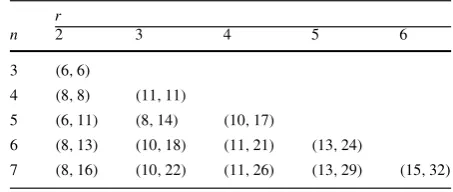
Define analogouslyTourmin(n,r)andTourmin(n). The first few values ofTourmin(n,r)and Tour
max(n,r), calculated with the GAP packageSemigroups[7] using data from [6], are given in Table2. The calculation of these values has been the inspiration for the results of this section and the conjectures of the next one.
Lemma 3.9 Let n≥3and T ∈Tourn.
1. For any partition P of[n]into r parts, there exists an idempotentα∈Singnwith
Table 2 First values of
Tour
min(n,r), Tourmax(n,r)
r
n 2 3 4 5 6
3 (6,6)
4 (8,8) (11,11)
5 (6,11) (8,14) (10,17)
6 (8,13) (10,18) (11,21) (13,24)
7 (8,16) (10,22) (11,26) (13,29) (15,32)
2. For any r -subset S of[n], there exists an idempotentα∈SingnwithIm(α)=S such that(T, α)=n−r .
Proof 1. LetP = {P1, . . . ,Pr}. For all 1≤i≤r, the digraphT[Pi]induced byPi is a tournament, so it is connected and there exists a vertexvi reachable by any
other vertex inPi: letαmap the whole ofPi tovi. Thenα, when restricted toPi,
is a constant map, which can be computed using|Pi|−1 arcs. Summing forifrom 1 tor, we obtain that(T, α)=n−r.
2. Without loss of generality, letS= [r] ⊆ [n]. For everyv∈ [n], define
s(v):=min{s∈S:dT(s, v)≥dT(s, v),∀s∈ S}.
In particular, ifv ∈ S, thens(v) = v. Moreover, ifv = v0, v1, . . . , vd =s(v)
is a shortest path fromvtos(v), withd =dT(v,s(v)), thens(vi)=s(v)for all
0≤i ≤d. For eachv ∈ [n], fix a shortest pathPvfromvtos(v), and consider the digraphDon[n]with edges
E(D):= {(a,b):(a,b)∈ E(Pv)for somev∈ [n]}.
Then,Dis acyclic and the set of vertices with out-degree zero inDis exactlyS. Let sort[n]so thatDhas reverse topological order:(a,b)∈ E(D)only ifa >b. Note thatSis fixed by this sorting. Letαbe given byvα:=s(v); hence, with the above sorting
α= r+1
v=n(v→v1).
Lemma 3.10 Let n ≥3, T ∈Tourn, andα:=(u→v)∈Singn, for(u, v) /∈ E(T). Then
(T, α)=4dT(u, v)−2.
Fig. 2 Circulant tournamentκ5
1
2
3
4
5
By the minimality of the path, for any j +1 < i, we have(vj, vi) /∈ E(T), so
(vi, vj)∈ E(T). Then, the following expressesαwith arcs inT∗:
(v0→vd)=(vd→v0)(vd−1→vd)(vd−2→vd−1)· · ·(v1→v2)(v0→v1) ((v2→v0)(v1→v2)) ((v3→v1)(v2→v3))
· · ·((vd→vd−2)(vd−1→vd))
(vd−2→vd−1)· · ·(v0→v1).
So(T, α)≤4d−2. For the lower bound, we note that any word inT∗expressing (u → v) must begin with(v → u). Then,u has to follow a walk in T towardsv; say this walk has lengthl ≥d. All the vertices on the walk must be moved away (as otherwise they would collapse withu) and have to come back to their original position (sinceαfixes them all); as the shortest cycle in a tournament has length 3, this process adds at least 3(l−1)symbols to the word. Altogether, this yields a word of length at least
1+l+3(l−1)=4l−2≥4d−2.
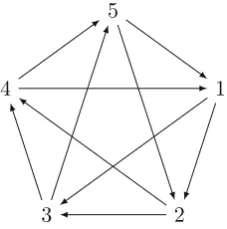
Letn =2m+1 ≥ 3 be odd, and letκn be thecirculant tournamenton[n]with
edges E(κn):= {(i, (i+ j) modn):i ∈ [n],j ∈ [m]}. Figure2illustratesκ5. In
the following theorem, we useκnto provide upper and lower bounds forTourmin(n,r) andTourmax(n,r)whennis odd.
Theorem 3.11 For any n odd, we have
n+r−2≤Tourmin(n,r)≤n+8r,
(rˆ+1)(n− ˆr)−1≤maxTour(n,r)≤6r n+n−10r.
[image:18.439.274.388.60.175.2]Proof LetT ∈Tournand 2≤r ≤n−1. We introduce the following notation:
[n]r := {u:=(u1, . . . ,ur):ui =uj,∀i,j},
(T,r):=max r
i=1
dT(ui, vi):u,v∈ [n]r
.
The result follows by the next claims.
Claim 3.12 r(diam(T)−r+1)+r −r ≤ (T,r) ≤ rdiam(T), where r =
min{r,(diam(T)+1)/2}.
Proof The upper bound is clear. For the lower bound, letu, v ∈ [n]be such that
dT(u, v) = diam(T), and letu =v0, v1, . . . , vd =v be a shortest path fromu to
v, where d = diam(T). Then,dT(vi, vj) = j −i, for all 0 ≤ i ≤ j ≤ D. If
1 ≤r ≤ (d +1)/2, consideru =(v0, . . . , vr−1)andv =(vd−r+1, . . . , vd), so
we obtain(T,r)≥r(d−r+1). Ifr≥ (d+1)/2, simply add verticesujandvj
such that(uj, vj) /∈T.
Claim 3.13 min{(T,r):T ∈Tour(n)} =(κn,r)=2r .
Proof Letu=(u1, . . . ,un)form a Hamiltonian cycle, and choosev=(un,u1, . . . ,
un−1). Then dT(ui, vi) ≥ 2 for all i. Conversely, since diam(κn) = 2, we have
(κn,r)=2r.
Claim 3.14 n−r+(T,r−1)≤(T,r)≤n+6rdiam(T)−4r .
Proof For the lower bound, considerα∈ Singnas follows. Letu=(u1, . . . ,ur−1) andv=(v1, . . . , vr−1)achieve(T,r−1), and letv /∈ {v1, . . . , vr−1}; define
xα=
vi ifx=ui,
v otherwise.
Letω = e1. . .el (whereei = (ai → bi)) be a shortest word expressingα, where
l := (T, α). Recall that an arcei carries a vertexc if ce1. . .ei−1 = ai. By the minimality ofω, every arc carries at least one vertex. Moreover, ifcanddare carried by
ei, thencα=dα; therefore, we can label every arceiofωby an elementc(ei)∈Im(α) ifeicarries vertices eventually mapping toc(ei). Denote the number of arcs labelled
casl(c), we then havel=c∈Im(α)l(c). For anyu∈V, there are at leastdT(u,uα)
arcs carryingu. Therefore,
l=
c∈Im(α)
l(c)≥ r−1
i=1
dT(ui, vi)+
a∈/u
dT(a, v)≥(T,r−1)+n−r.
For the upper bound, we can express anyα ∈ Singn of rankr in the following
(T, β) = n −r. Suppose that Im(α) = {v1, . . . , vr}and Im(β) = {u1, . . . ,ur},
whereuiβ−1=viα−1, fori ∈ [r]. Leth∈ [n]\Im(β). Define a transformationγ of [n]by
xγ = ⎧ ⎪ ⎨ ⎪ ⎩
vi ifx =ui,
v1 ifx =h,
x otherwise.
Thenα=βγ, whereγ ∈Singn, and by Theorem1.1
(Kn, γ )=n−fix(γ )+cycl(γ )≤r+r
2 = 3r
2.
By Lemma3.10, each arc associated withKnmay be expressed in at most 4diam(T)−2 arcs associated withT; therefore,
(T, γ )≤ 3r
2 (4diam(T)−2)=6rdiam(T)−3r.
Thus,
(T, α)≤(T, β)+(T, γ )≤n+6rdiam(T)−4r.
4 Conjectures and open problems
We finish the paper by proposing few conjectures and open problems.
Letπnbe the tournament on[n]with edgesE(πn):= {(i, (i+1) modn):i ∈ [n]} ∪ {(i,j): j+1<i}. Figure3illustratesπ5.
Conjecture 4.1 For every n≥3, r∈ [n−1], and T ∈Tourn, we have
(T,r)≤(πn,r)=Tourmax(n,r),
with equality if and only if T ∼=πn. Furthermore,
(πn)=Tourmax(n)=
n2+3n−6
2 ,
Fig. 3 π5
which is achieved forα:=n(n−1) . . . 2n.
Tournamentπnhas appeared in the literature before: it is shown in [8] thatπnhas
the minimum number of strong subtournaments among all strong tournaments on[n]. On the other hand, it was shown in [1] that, fornodd, the circulant tournamentκnhas
the maximal number of strong subtournaments among all strong tournaments on[n].
Conjecture 4.2 For every n≥3odd, r ∈ [n−1], and T ∈Tourn, we have
Tour
min(n,r)=(κn,r). Furthermore,
Tour
min(n,2)=n+1 and Tour
min(n,r)=n+r,
for all3≤r≤ n+21.
Conjecture 4.3 There exists c > 0 such that for every simple digraph D on[n],
(D)=O(nc).
The referee of this paper noted that the automorphism groups ofKn andKn = Singnare both isomorphic to Symnand proposed the following problems.
Problem 1 Investigate connections between the automorphism groups ofDandD. Is it possible to classify all digraphsDsuch that the automorphism group ofDand of
Dare isomorphic?
Problem 2 Generalise the ideas of this paper to oriented matroids. Is there a natural way to associate (not necessarily idempotent) transformations to each signed circuit of an oriented matroid?
In a forthcoming paper, we investigate the relationship between the graph theoretic properties ofDand the semigroup properties ofD.
Acknowledgments The second and third authors were supported by the EPSRC grant EP/K033956/1. We kindly thank the insightful comments and suggestions for open problems of the anonymous referee of this paper.
Open Access This article is distributed under the terms of the Creative Commons Attribution 4.0 Interna-tional License (http://creativecommons.org/licenses/by/4.0/), which permits unrestricted use, distribution, and reproduction in any medium, provided you give appropriate credit to the original author(s) and the source, provide a link to the Creative Commons license, and indicate if changes were made.
References
1. Beineke, L.W., Harary, F.: The maximum number of strongly connected subtournaments. Can. Math. Bull.8, 491–498 (1965)
3. Howie, J.M.: Idempotent generators in finite full transformation semigroups. Proc. R. Soc. Edinb.81A, 317–323 (1978)
4. Howie, J.M.: Products of idempotents in finite full transformation semigroups. Proc. R. Soc. Edinb. 86A, 243–254 (1980)
5. Iwahori, N.: A length formula in a semigroup of mappings. J. Fac. Sci. Univ. Tokyo Sect. 1A Math. 24, 255–260 (1977)
6. McKay, B.: Catalogue of Directed Graphs. September 2015. Retrieved fromhttps://cs.anu.edu.au/ people/Brendan.McKay/data/digraphs.html
7. Mitchell, J.D., et al.: Semigroups—GAP Package, Version 3.0. September 2015 8. Moon, J.W.: On subtournaments of a tournament. Can. Math. Bull.9, 297–301 (1966)
9. Solomon, A.: Catalan monoids, monoids of local endomorphisms, and their presentations. Semigroup Forum53, 351–368 (1996)
10. You, T., Yang, X.: A classification of the maximal idempotent-generated subsemigroups of finite singular groups. Semigroup Forum64, 236–242 (2002)
11. Yang, X., Yang, H.: Maximal regular subsemibands of Singn. Semigroup Forum72, 75–93 (2006) 12. Yang, X., Yang, H.: Isomorphisms of transformation semigroups associated with simple digraphs.