1
Reducing the stigma of mental
disorders: a base for an effective
communication plan.
A survey testing the influence of knowledge, experience and
media on stigma of mental disorders.
Bachelor assignment 2019
University of Twente
3
IndexAbstract 4
Summary 5
1. Introduction 7
1.1 Previous research 8
2. Theoretical framework 11
2.1 The stigma of mental disorders 11
2.2 Antecedents of stigma 12
2.2.1 Knowledge 12
2.2.2 Experience 13
2.2.3 Media 14
2.2.3.1 Framing 14
2.2.3.2 Kind of information 14
2.2.3.3 Kind of media 15
2.3 Demographic 16
2.3.1 Age 16
2.3.2 Proximity 16
2.3.3 Nationality 17
2.4 Models 18
3. Method 20
3.1 Data collection procedure and sampling 20
3.2 Instrument 20
3.3 Pre-Test 23
3.4 Preparation for analysis 24
3.5 Participants 25
4. Results 27
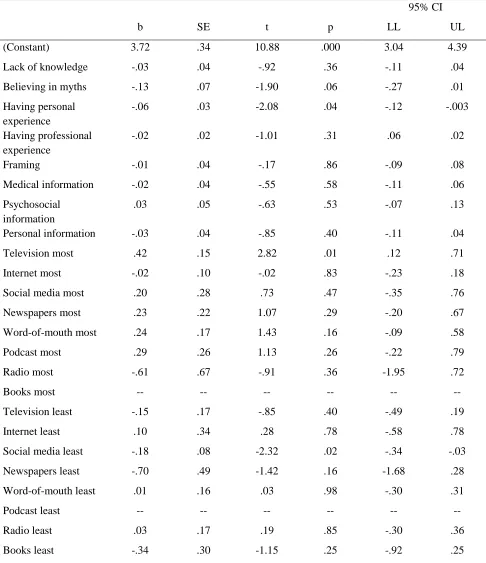
4.1 Correlations between variables 27 4.2 Multiple regression analyses 28 4.2.1 Knowledge, Experience and Media 29
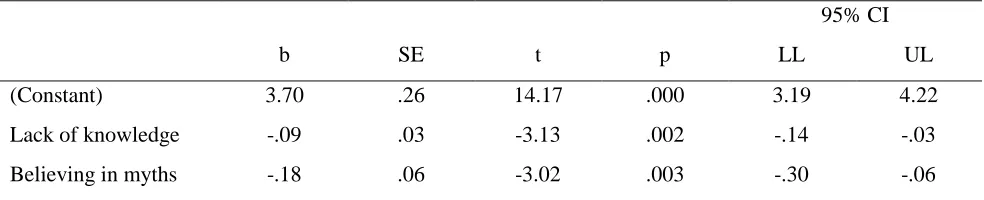
4.2.2 Knowledge 32
4.3 Moderation analyses 32
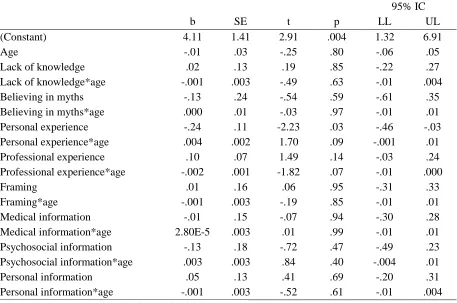
4.3.1 Age 33
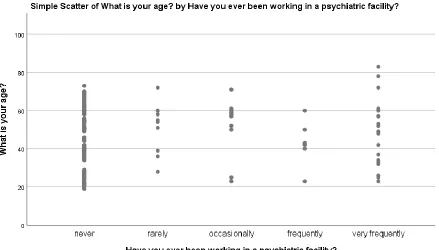
4.3.2 Proximity 34
4.3.3 Nationality 36
4.4 Overview 37
5. Discussion 41
5.1 Limitation (strengths) and further research 43
6. Recommendations 47
7. Conclusions 50
8. References 51
4
AbstractContext: From ancient times, people have always had to deal with mental disorders, but acceptance has never been met within society and a stigma was formed. Nowadays, one-fourth of the population suffer or had suffered from some form of mental illnesses. These people have to cope every day with this stigma which makes them feel like outsiders.
Aim: Research showed that most of the campaigns done to reduce the stigma have been scarcely effective due to the lack of studies which measure the factors that may reduce the stigma of mental disorders by the use of communication means. Due to this, the aim of this study was to see the effects of knowledge, experience and media on the stigma of mental disorders. Moreover, if demographic factors like age, nationality and the perceived proximity to a psychiatric facility influenced these effects.
Method: This study was conducted by means of a survey. A total of 146 people of Italian and Dutch nationality participated. The age range was from 19 to 83 and most of them lived next to a psychiatric facility. A correlation analysis, a multiple regression analysis and an analysis of variance per moderator were conducted.
Results/ Discussion: It was found that having knowledge is important to reduce stigma. Moreover, personal experience helps to reduce stigma. Lastly, the best medium to use to convey information is books and the worst media are social media and television.
Recommendations: Overall, it was advised to educate younger generations through education programs and to create an awareness campaign to also address older generations. Moreover, the government should be addressed to change the way in which society is structured towards the mentally ill. Eventually, if everyone would get informed better, a reduction of stigma might happen.
5
SummaryFrom ancient time, people have always had to deal with mental disorders. When there was not enough knowledge about how the brain works, people who showed some differences in their behaviours were cast aside. In the last centuries, discoveries have been made regarding mental illnesses, but acceptance within society has never been met and people with mental disorders have always been seen as different and due to this, a stigma was formed. Nowadays, it was counted that one-fourth of the population suffer or had suffered of some form of mental disorders. These people have to deal every day with people who discriminate them and make them feel like outsiders. This causes them to hide their own feelings and, consequently, get worst. Moreover, people who live nearby a psychiatric facility, due to the way in which society portraits mental disorders, often feel unsafe. Nonetheless, much research has been done about mental disorders and associations, supporters and researchers are trying to reduce the stigma through communication strategy. However, it was found that most of these campaigns have been rarely effective due to the lack of studies which measure the factors that may reduce the stigma of mental disorders by the use of communication means. Accordingly, research shows that, through decades, there has not been a reduce of stigma within the population.
Due to this, the aim of this study was to see if factors like the amount of knowledge people have, their experience, how media frame the mentally ill, the medium used to receive information and the kind of information influence the stigma of mental disorders and how. Moreover, if demographic factors like age, nationality and the perceived proximity to a psychiatric facility influenced the effects of the aforementioned factors on stigma of mental disorders. This study was conducted by means of a survey. A total of 146 people took part in the study, 48 were Dutch and 98 were Italian. The age of the participants went from 19 to 83 years old and most of them lived next to a psychiatric facility. After conducting the analysis of the data, it was found, that knowledge is important to reduce stigma; when people knew about the topic of mental illnesses, their stigma was lower. When people knew about mental disorders, they were also aware about the negative way media frame the mentally ill. Moreover, personal experience and personal information helps to reduce stigma, thus experiences of people who suffer or suffered from some form of mental disorders should be told to people to let them empathise with the subject and know what it means to suffer from a mental illness. Lastly, the best medium to use to convey information is books and the worst media are social media and television. However, it was seen that television is one of the main medium to spread negative feelings regarding the mentally ill and it is considered easier to use than other media. Due to this, some measures should be taken to partially change how this mean is used.
Overall, it is advised to educate people through education programs. This means, for instance, approaching the Minister of Education through lobbying and ask to implement few hours in the last years of high school to discuss about the topic of mental disorders. Moreover, it is recommended to have someone experienced to talk to the students. Many students may pass through a rough time in their adolescence, e.g. eating disorders, drug misusing, depression, and this program may also help to increase acceptance between each other and, thus, facilitate the recovery of these students. Moreover, in high school books, something about mental disorders should be said by means of stories of people who suffered from mental disorders or by explaining the life of famous people, such as poets, scientists and singers who may have had some form of mental illnesses. By doing this, students may also better understand the relevance of this topic in society.
6
afterwards, will be less biased. Every information of this campaign should be monitored and there should not be the possibility for manipulation of information. Furthermore, the hashtag #reducingstigma should always be used as an identification mark of the campaign. In cities where psychiatric facilities are present, meetings should be organised by people of trust to talk about mental disorders and the decisions which need to be taken regarding the facility. This may particularly relevant for individuals living around and working in a psychiatric facility who should be informed better about mental illnesses and should have a say in decisions which may have an influence in their life. Lastly, the government, mostly policymakers should be addressed in order to change those social structures that prevent people with mental disorders to have a life like everyone else.
7
1. IntroductionUntil two hundred years ago, there was much disregard from the public towards people who were behaving abnormally. Before that, these people were called crazy and accordingly, mental illness was a reason for punishment and isolation (Museum of Health Care, 2014). In the middle ages, someone who presented abnormal symptoms was imprisoned, used to amuse the population, tortured and at the end killed (Museum of Health Care, 2014; Small, 1964). Particularly in Christian countries, there was the belief that people who behaved differently were possessed by the evil spirit and that they were impure. This was also due to the tendency of these people to behave wrongly, violently, and against the law. However, the main reasons for people with mental illness to behave in those ways were sometimes anger towards injustice and the feeling that they were misunderstood.
This led to the rising of “mad-houses”. In this places, insane people were imprisoned and kept away from society without any consideration towards their health (Museum of Health Care, 2014). Nevertheless, around the nineteenth century, some research was conducted about mental illness and it was concluded that people who present mental disorders are curable. Therefore, the mad-houses were replaced by asylums were people who presented mental illnesses were nursed and helped out to reintegrate into society. Nonetheless, people were cured physically and by the use of unorthodox methods, such as hot and cold bath or the use of straightjackets. According to Museum of Health Care (2014), only many years later, the doctors Boris Sidis and Sigmund Freud suggested that the root of the problem was psychological and cures like hypnosis and therapy were more effective. Afterwards, the term “mental disorders” and the different mental illnesses began to be acknowledged by society. This was also due to education and the study of psychology (Museum of Health Care, 2014). Despite, being aware of the existence of people who may have mental problems does not mean acceptance. Because of the aforementioned history and the portrait that media convey of people with mental disorders, a stigma was formed.
In the last 50 years, research has been done about the stigma of mental disorders. Most of this research was conducted in Western countries (Corrigan & Watson, 2002). Furthermore, many associations, advocates and researchers have been basing their campaigns and communication strategies on these studies (Corrigan, Morris, Michaels, Rafacz, & Rüsch, 2012). Nonetheless, within previous research, there were found no studies that tried to investigate the factors influencing the stigma of mental disorders from a communication perspective. For instance, in the study of Luty, Umoh, Sessay, and Sarkhel (2007), the authors mention and try to measure the effectiveness of a method to reduce stigma, namely the use of factsheets to inform people about mental illnesses. Nevertheless, these authors consider the negative attitudes people have to base the content of these factsheets and not, for instance, the kind of information that might be the best to show to reduce negative attitudes. Additionally, most of the studies encountered have psychological background and only tried to emphasize the prominence of the stigma of mental disorders within society. Accordingly, in a recent article by Fox, Earnshaw, Taverna, and Vogt (2018) in which they review all the mental illnesses studies until now, the authors
state that there is much confusion in the literature about the stigma of mental disorders. Moreover, they refer to the complexity of the argument which causes a lack of clarity (Fox et al., 2018). Besides, it was noticed that some of these studies are older than 30 years and many discoveries have been made in the field of psychology and psychiatry during these years. Because of this, many of the questionnaires created in the past and their results may be considered outdated. Consequently, due to the lack of clear scientific literature as base, communication plans which were created to reduce stigma may have not worked as expected.
Accordingly, the ineffectiveness of these campaigns can be seen in a study of 2006 by
8
with someone who presents symptoms of schizophrenia. This study was done 10 years after another one with the same focus which was to measure people attitudes towards mental illnesses. Differences in the results were not found (Wahl, 2012). To conclude, it seems that the stigma of mental disorders remained the same throughout the decades. In addition to this, it was counted that one-fourth of the worldwide population presents symptoms that can be linked to mental illness and that one of four people had some form of mental disorders during its life (Todor, 2013). Therefore, the stigma of mental disorders may be considered a societal issue and serious measures capable of tackling this problem need to be taken.
At the end of the study from Fox and colleagues (2018), they invite researchers to use existing and new knowledge and valid and reliable questionnaires to try to reduce the stigma of mental disorders and improve the lives of people who suffer from some form of mental illnesses and their families. Furthermore, digging into the origin of the problem and analysing the main factors that influence it is important to build the right strategic plan (Fill & Turnbull, 2017). This is exactly what this study will try to do and what makes it unique. That is, identifying the factors in society that, nowadays, influence the stigma of mental disorders from a communication perspective, such as the frames built by media, the kind of information that people need and knowledge people have. Based on the results, a recommendation for a communication plan will be eventually given with the goal of changing and/or influencing the way in which these variables affect the stigma of mental disorders and with the aim of reducing this stigma.
The factors that will be investigated are the amount of knowledge that a person has, the experience that a person has with the topic mental disorders or with people who suffered from some form of mental disorders, the media they get information from and how they influence the stigma. Moreover, to understand who is the most relevant group to target and the context where the stigma of mental disorders should be reduced, the effect that age and proximity have on the aforementioned effects will be investigated. Additionally, the sample of this study is formed by Italian and Dutch participants. Due to this, the differences in the effects between these two cultures will be analysed. Therefore, the main research question will be: To what extent do knowledge, experience and media have an effect on the stigma of mental disorders and what is the role of age, proximity and nationality on this effect?
In this paper, there will be first a theoretical framework to understand what the stigma of mental disorder is and some of the factors that may influence this stigma. This theoretical framework will lead to the hypotheses of this research. Afterwards, in the method section, it will be explained how these constructs will be measured. In the results section, the analysis of the results will be described and in the discussion session, the results will be interpreted. Moreover, the limitations and strengths of the study will be described. To conclude, recommendations will be given for further research and in order to create a base for a communication plan to reduce the stigma of mental disorders.
1.1 Previous research
9
Struenin’g (Taylor & Dear, 1981) and its core was to measure the feelings that people have towards mental disorders. The CMHI scale was created by Baker and Schulberg in 1967 and it measured the attitudes that people have towards the ideology to help communities with people with mental disorders (Taylor & Dear, 1981). The Community Attitudes Toward the Mentally Ill (CAMI) was mentioned as an example because it is the most used scale within the most recent studies that indeed aims to measure the attitudes that people have towards mental illnesses. For instance, in the study by Ukpong and Abasiubong, (2010), they use the CAMI scale to measure the attitudes that people at the University of Uyo Teaching Hospital in Nigeria have towards the mentally ill.
Moreover, another scale used in the past ten years that was verified to be reliable and valid by Luty, Fekadu, Umoh, and Gallagher (2006) is the Attitudes towards Mental Illness Questionnaire (AMIQ). This questionnaire consists of open questions, close questions measured with a 5-point Likert scale and the use of vignettes (Luty et al. 2006). Vignettes, also known as scenarios, are used to let the participant empathise with a certain situation. These vignettes were also used in other studies to measure the attitudes people have towards people with schizophrenia and substance addiction (Luty et al., 2007).
According to the results of these studies, supporters all around the world have been working on reducing the stigma of mental disorders in the last 50 years. An example of one of the first campaigns is the one that took place in a little Canadian village where people were educated about mental illnesses with films and group discussions (Corrigan et al., 2012). Nowadays, there are many associations that fight against the stigma of mental disorders. In the United States, there is a group formed by people with mental disorders and family members who started the NAMI-program (Rüsch, Angermeyer, & Corrigan, 2005). This program aims at educating people about mental illnesses, supports the rights of mentally ill people, and opposes the way in which media frame mental disorders (Rüsch et al., 2005).
One of the main associations in Europe that fights for the reducing of stigma towards the mentally ill is Mental Health Europe (MHE). The mission of MHE is to ensure that the laws created for mentally ill people and their families are respected (Mental Health Europe, n.d.). Furthermore, in collaboration with policymakers this organization tries to generate friendly policies for people with mental disorders (Mental Health Europe, n.d.). Their projects also focus on the reduction of the stigma. They work with the European parliaments, and many associations around Europe are members of MHE (Mental Health Europe, n.d.). All around Europe there are different associations which try to reduce the stigma of mental disorders on a national level. In Germany, a major campaign is going on for years. This is called: “BASTA” that in English is translated as “stop” (Rüsch et al., 2005). The association organizing this campaign tries to reach society via different means: emails, school programs, social media and art exhibitions (Rüsch et al., 2005).
In the Netherlands, there are few associations that fight against the stigma of mental disorders. Stichting Ideële Reclame [Idea Advertising Foundation] (SIRE) is a Dutch association that does campaigns to solve societal problems. Subsequently, they have also been doing some campaigns related to mental illnesses. For instance, in 2013, they did a campaign to support people who have major depression, who feel like they do not belong and who suffer from burnout (SIRE, 2013). Further, they also tried to educate people about mental illnesses through radio programs and social media. Another Dutch association that focuses on the reduction of stigma is Samen Sterk Zonder Stigma, that literally means Together Strong Without Stigma. This association organizes, for example, trainings where they teach people who suffer from self-stigma how to be more open and be able to accept themselves in a better way (Samen Sterk Zonder Stigma, 2019).
10
to provide juridical services to the families of mentally ill (Unione Nazionale delle Associazioni per la Salute Mentale, n.d.). At a local level, in Pisa (Italy) there is L’Alba [The Dawn], an association that helps people who have or had mental disorders to reintegrate into society (L’Alba, n.d.). Through the use of creative workshops and space where everyone can be open and talk to each other, people try to transform what they have experienced into something positive (L’Alba, n.d.).
11
2. Theoretical frameworkIn this chapter, different theories to explain how the stigma of mental disorders is formed will be described. Moreover, some of the factors influencing stigma, chosen from a communication perspective, will be identified and analysed. Additionally, the moderators which may influence the effects on the stigma of mental disorders will be described. Eventually, according to literature, per each factor, an hypothesis will be formulated and the models of this research will be presented.
2.1 The stigma of mental disorder
The word stigma derives from the Greek word stigmata which means “a mark of shame or discredit; a stain, or an identifying mark or characteristic” (Merriam-Webster Dictionary as cited in Overton & Medina, 2008, p. 143). Therefore, when a group of people has a characteristic that makes it different, a stigma may form (Rössler, 2016). In the case of people with mental disorders, the creation of the stigma can be explained by three main theories: social identity theory, self-stigma and structural stigma (Overton & Medina, 2008). Social identity theory explains how societies categorize people by looking at how they behave and if they respect the social norms and an ideal identity (Overton & Medina, 2008). In the past, people with mental illnesses were seen as of weak character (Rüsch et al., 2005). This led to the exclusion of this group of people and to their stigmatization. In order to maintain their position in society, people who suffer from mental disorders may refuse or postpone treatment (Klin & Lemish, 2008). It was found that only 25-30% of these people seek for a cure (Klin & Lemish, 2008). In the long run, they may get sicker and, because of the lack of help, they may even attempt suicide.
Individuals who have mental disorders, and they feel marginalized because of it, create a negative judgment towards themselves: self-stigma. They believe they are incapable of leading a normal life and keep up with the expectations of others (Overton & Medina, 2008). Consequently, their self-esteem and self-efficacy decrease. Because of this, they begin feeling inferior, ashamed of themselves and insecure about their future (Overton & Medina, 2008). This can also be a reason for a person to become mentally ill and to feel the need to be hospitalised (Lamb & Weinberger, 2016). In addition to this, when a person falls in the trap of self-stigma, he or she may show some cues that are seen differently by others (Rüsch et al., 2005). Accordingly, this person also began to be negatively judged by other people.
The theory of structural stigma refers to the way in which society forms barriers towards people with mental disorders. Namely, the creation of laws which do not allow people with mental disorders to have the same rights as the people who are seen as “normal” (Overton & Medina, 2008). For instance, one-half of all states have been denying the mentally ill the possibility to raise their children, to vote for elections, and to get a driver’s licence (Johnston, as cited in Overton & Medina, 2008; Wahl, 2012). This way in which society is built does not guarantee people with mental disorders to live like everyone else. Further, laws for mental disorders emphasize the marginalization of this group, and, consequently, enhance the stigma of mental disorders. These structures in society are a big obstacle for mentally ill people when they are in the process of recovery. In a study mentioned by Wahl (2012), 1400 people who were diagnosed with mental illnesses were asked how they experience stigma. Social rejection was one of the main findings, thus that once friends discovered their sickness, they stopped calling and inviting them to hang out (Wahl, 2012). Further, participants stated that they felt isolated from their communities (Wahl, 2012). Eventually, people with mental disorders may feel unmotivated to get better and, as a result, they may get worse.
The stigma of mental disorders is formed by three factors: stereotype, prejudice, and
12
believe in or act upon them (Overton & Medina, 2008). These are called implicit stereotypes. Further, stereotypes can be seen as positive when they help people to make fast assumptions towards a person or group of people (Rüsch et al., 2005). Nonetheless, it is not fair to draw conclusions about a person because of the stereotype that belongs to her or him (Rössler, 2016). This is the case of people with mental illnesses who are often stereotyped as violent and irresponsible (Corrigan & Watson, 2002).
When individuals have negative feelings towards a whole stereotyped group, they are expressing prejudice (Kassin et al., 2017). This way of responding to stereotypes can be seen as defensive. People are scared of a particular group and, consequently, they talk about hate, disgust and danger (Overton & Medina, 2008). A sentence that people could say as referring to mentally ill could be: “they are dangerous and I’m afraid of them” (Overton & Medina, 2008, p. 144).
Taking actions according to the negative emotions, aroused by a belief that a person has towards a certain group of people, is called discrimination (Kassin et al., 2017). Therefore, it may be said that stereotypes and prejudice lead to discrimination. One of the main actions that is usually taken towards mental illnesses is avoidance (Overton & Medina, 2008). For instance, employers may not want to hire people with mental disorders because they are unreliable and they do not want to be responsible for them (Rüsch et al., 2005). The same goes for landlords who decide to not rent their house to mentally ill people because of the belief that they are not able to take care of themselves (Overton & Medina, 2008). These kinds of actions can lead to the creation of barriers between the mentally ill and the rest of society (Overton & Medina, 2008). Because of this, the distinction between “normal people” and “mentally ill people” increases, and accordingly, the stigma of mental disorders deepens.
2.2 Antecedents of Stigma
In this sub-chapter, each section will describe the factors which were found to influence the stigma of mental disorders, namely knowledge, experience, media, age, proximity and nationality. Firstly, knowledge refers to how much knowledge a person has regarding the topic of mental disorders and how it can influence the level of stigma a person has. Secondly, experience regards how the amount of experience a person has with people with some form of mental disorders and with the topic can influence stigma. Thirdly, it will be described if the way in which media portrait mental disorders, the information chosen to convey information about mental disorders and the kind of medium used to pass this information have an influence on the stigma of mental disorders, how and why. Lastly, it will be analysed how age, proximity to a psychiatric facility and nationality have an influence on the stigma.
2.2.1 Knowledge
13
towards mental illnesses. Therefore, lack of knowledge due to not being informed enough may result in an increase of stigma and people should be given correct information to be able to understand the complex topic of mental disorders.
Additionally, within society, different myths related to mental disorders are present. For instance, stalking celebrities is seen as obsessive behaviour (Stout et al. 2004). However, in reality, stalking is not one of the symptoms of Obsessive-Compulsive Disorder (OCD). Another example is the belief that mental illnesses are the results of weak or lazy characteristics and that people can just get better by working harder (MentalHealth.gov, 2017). Nevertheless, mental illnesses can be the result of many factors, such as genes, traumas and family history. Due to the fact that believing in myths may have a negative effect on stigma, it may be necessary to understand if people believe in them. To conclude, it could be relevant to see if not having a lack of knowledge and not believing in myths
decrease the stigma of mental disorders.
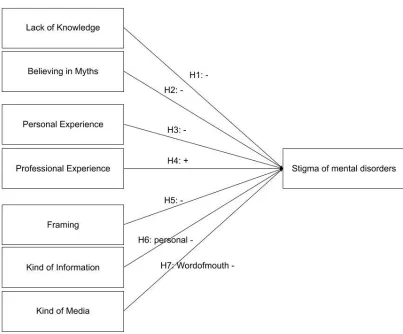
H1: The variable lack of knowledge has a negative effect on stigma of mental disorders.
H2: The variable believing in myths has a negative effect on stigma of mental disorders.
2.2.2 Experience
Having had personal experience with someone suffering from some form of mental illness may have an impact on the stigma of mental disorders a person has. Research showed that direct contact, such as face-to-face communication, is the most effective way to reduce stigma (Rössler, 2016). This is because when people have some experience with individuals with mental disorders, they get a true impression about who they are, what is their story, and how they are dealing with their problems (Rössler, 2016). Additionally, research revealed that people who know someone who was diagnosed with mental disorders have usually more positive attitudes (Walker & Read, 2002). Further, knowing a person mentally ill who was able to get better increases the positive image that people have of mental disorders (Rössler, 2016; Stout et al., 2004). This is also explained by the cultivation theory. This theory implies that repetitive exposure to the same messages can reinforce, cultivate and eventually change believes, images and norms perceptions of social reality (Stout et al., 2004). Accordingly, lack of contact with the mentally ill and the lack of real facts lead people to only have an image of mental disorders like the one portraited by society and the media (Stout et al., 2004). Therefore, in order to decrease the stigma of mental disorders, people should be more in contact with people who suffer or suffered from mental disorders.
Nonetheless, research showed that people working in the mental health sector have usually more negative attitudes toward mental illnesses. For instance, in the study of Noblett, Lawrence, and Smith (2015), the authors measured the attitudes doctors have towards mental illnesses. They concluded that participants had negative attitudes. If this fact were confirmed by other researches, it could be a big problem for mental health workers trying to cure their patients (Noblett et al., 2015). This kind of experience can be seen as professional experience since it happens in the workplace.
Due to the contradiction between personal and professional experience, it may be relevant to research if having personal experience with a person with mental disorders has a positive influence on the decreasing of stigma of mental disorders and if working in a psychiatric facility has a negative influence on the decreasing of stigma of mental disorders. Moreover, to get more insights on the subject, it will be seen if the amount of time spent dealing with the topic of mental disorders, the type of relationship, the type of profession and the years of experience of a person working in the mental health sector also influence the level of stigma of a person.
H3: The variable personal experience has a negative effect on stigma of mental disorders.
14
2.2.3 MediaNowadays, one of the main influencers on the stigma of mental disorders is media, such as television, advertising, and newspapers. This is also emphasized by the study of Corrigan and colleagues in 2001 (as cited in Overton & Medina, 2008), where it was found that 90% of the participants knew about mental illnesses because of media. Moreover, it is said that, in general, media are crowded with stereotypes and because of this, it is one of the main factors reinforcing stigma towards different groups (Rössler, 2016; Seiter, 1986). In this section, three constructs to measure media will be described, namely framing, kind of information and kind of media.
Framing
Media framing has an impact on the stigma of mental disorders. This is because media are known for framing information with a negative connotation and using terms and metaphors that cannot be thoroughly understood by everyone (Rössler, 2016). Media framing refers to the way in which media portrait something and how deeply they influence people with the message they convey (Chong & Druckman, 2007). How the media have an influence on the stigma can be explained by two communication theories: cultivation theory and social learning theory. Following cultivation theory, by looking too much at the media, people tend to believe in the social reality portraited by them (Stout et al. 2004). Consequently, they look at the world with the images, values, social norms and ideologies those media propose. This was also stressed in a study from Wahl and Lefkowits (1989) where, by using the CAMI questionnaire, they found that when people spend much time watching television, they have more negative attitudes than people who only watch television few hours a day or not at all. For instance, if individuals watch many crime films where a killer is a person who has mental disorders, they may begin believing that, actually, most of the crimes are committed by people who are mentally ill.
The social learning theory states that people learn through observation; namely, through what they hear and see (Stout et al., 2004). Indeed, watching television requires people to see and hear. People may learn from the media how to behave and, particularly, how everyone should behave in a social context (Stout et al., 2004). This means that the media also teach people how to behave with people with mental illnesses (Stout et al., 2004). This can be a problem when considering the negative framing of media towards people with mental disorders. Accordingly, most media analyses done on the topic of mental disorders show that mentally ill people are framed as dangerous, violent, potential killers, childlike and unpredictable (Angermeyer & Matschinger, 2003; Overton & Medina, 2008; Rüsch et al, 2005; Stout et al., 2004). Therefore, when people base their knowledge on the media, they have mostly negative stereotypes of mental disorders, and when in contact with the real world, they tend to feel and behave accordingly. To conclude, to get a general understanding of the influence that media have on the stigma, it will be measured if people realise that media portrait the mentally ill as dangerous, violent, potential killers, childlike and unpredictable. If they do not, it should mean that they are not aware of it and their level of stigma should be higher than the one of people who are aware of it.
H5: The variable framing has a negative effect on stigma of mental disorder.
Kind of information
15
the way in which mental illnesses are shown by the media. They are the ones who decide the kind of message they want to send to the viewers or readers. For instance, the camera shots used in films may differ between the mentally ill and not (Overton & Medina, 2008). Another example is the use of scary sounds, dark light and horror images to emphasise the presence of an “evil” character (Stout et al., 2004). Nonetheless, it is assumed that screenwriters, producers and journalists are usually more knowledgeable about mental illnesses. Research showed that they have also less negative attitudes towards people with mental disorders (Stout et al., 2004). However, when they were asked if they were willing to hire a person who was diagnosed with a mental illness, they said that they would not do that (Stout et al., 2004). Therefore, they also discriminate the mentally ill. Because of this, when they are creating the messages they want to send through the media, they tend to be subjective. Accordingly, the information given gets a negative connotation.
Three different kinds of information were found to be effective in reducing the stigma of mental disorders. Firstly, it was suggested that to convey the right information, psychiatrists or doctors should get in contact with media and give more positive, reliable and scientifically proved information - medical (Stout et al., 2004). In addition to this, experts in mental health should also understand that producers, journalists and screenwriters use dramatic effects to increase the selling of their product (Wilson, Nairn, Coverdale, & Panapa, as cited in Sout et al., 2004). Therefore, there should be a perfect balance between the real information and the emotions that the authors want to transmit. Furthermore, it was proved that giving medical information, in the forms of documentaries or articles, about mental disorders can reduce negative attitudes people have towards mentally ill people (Rössler, 2016). Secondly, Walker and Read (2002) state that talking about the influence that mental disorders have on relationships, psychosocial information, may decrease stigma. Additionally, these authors investigated which information is better to convey between medical and psychosocial. It was concluded that a combination of both is the best in order to reduce stigma (Walker & Read, 2002). Lastly, it was found that the best kind of information to convey to reduce stigma is personal, that is hearing real stories of people mentally ill getting better and succeeding in their life (Rössler, 2016). Personal information does not necessarily imply direct contact with people who suffer or suffered from mental disorders, but it can also be passed through indirect means, such as films or videotapes of stories of people who suffer or suffered from mental disorders (Corrigan et al. 2012). According to the aforementioned research, three main kinds of information were selected: psychosocial, medical and personal. It may be relevant to see which one of these kinds is the most effective to use when trying to reduce the stigma of mental disorders and if personal information is the best to use.
H6: The variable personal information has a negative effect on stigma of mental disorders over and above the variable psychosocial information and the variable medical information.
Kind of media
Over time, mental illnesses have been reported in different media. The most used are television by means of films, tv series and documentaries, popular magazines and newspapers (Stout et al., 2004). In addition to this, with the decrease of televisions in households, the internet is becoming the most important source of information, thus also about mental illnesses. However, the provenience of the information found on the web is usually uncertain, thus it could be considered unreliable (Klin & Lemish, 2008). Furthermore, another means showed in television, in the internet and newspapers that can foster negative attitudes toward the mentally ill is advertisement (Sieff, 2003). In this case, features of mental illnesses are humourized to promote products. For instance, a good cleaning product could be advertised by making fun of people with Obsessive Compulsive Disorder (OCD).
16
medium is considered face-to-face communication which allows personal cues and consequently a personal connection, whilst the leanest media are fliers and bulletins which lack images and are usually impersonal (Fill & Turnbull, 2017). Rich media decrease ambiguity and misunderstanding, but they are often more complex and time-consuming. Lean media are simple for fast communication and cost-effective. Moreover, according to the technology acceptance model (TAM), the use of certain media depends on the usefulness of the media and the perceived ease of use (Fill & Turnbull, 2017). Research shows that when people get information from others, thus via face-to-face communication, they tend to have more positive attitudes towards mental illnesses than, for example, people who get their information from websites (Rössler, 2016). However, it is still unclear which media is the most used as a source of information nowadays and the effect it has. Because of this, it may be relevant to comprehend which medium or media among the ones that are used the most nowadays, such as social media, television, the internet etc., have the most negative influence on decreasing the stigma of mental disorders and if face-to-face communication or word-of-mouth is the medium which have the most positive influence on decreasing the stigma.
H7: The variable word-of-mouth has a negative effect on stigma of mental disorder over and above the variables television, internet, social media, podcast, radio, books and newspapers.
2.3 Demographic
When trying to decrease the stigma of mental disorders within the population, it is relevant to understand the context where stigma is more dominant and the target group who present the most negative attitudes towards mental illnesses. In this study, three demographic variables will be used, namely age, proximity and nationality.
2.3.1 Age
Depending on their age, people may have more or less stigma. This was shown by the study of Wolff, Pathare, Craig, and Leff (1996), in which they measured the influence that age has on the stigma of mental disorders when situations of social control and goodwill are presented. Older people had more negative attitudes in the situation of social control. They answered they were scared and tried to avoid meeting mentally ill people (Wolff et al., 1996). Younger people, instead, were more open-minded and they were more willing to help people with mental disorders (Wolff et al., 1996). Therefore, they proved to have more positive attitudes toward the mentally ill than older people. These results were confirmed in a more recent study by Griffiths, Christensen, and Jorm (2008), where they tried to identify the predictors influencing the stigma of depression. They saw that younger people tended to have less stigma of mental disorders than older people. Because of this, it is expected that being older has a negative influence on the effects of knowledge, experience and media on the stigma of mental disorders.
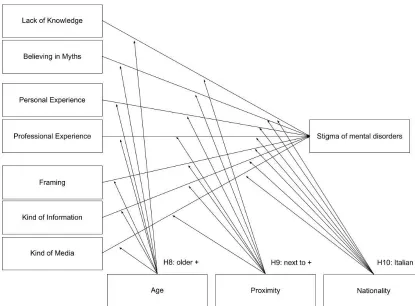
H8: Being old positively increases the effects of the independent variables on stigma of mental disorders.
2.3.2 Proximity
17
people suffering from some form of mental disorders may have more difficulty to get better in the environment where they live. Therefore, in case the stigma around psychiatric facilities is higher, means should be found to decrease it. Consequently, one of the barriers for the mentally ill to get better would be destroyed and it may be possible to facilitate their process of recovery (Wahl, 2012). Because of the negative opinions that people may have towards building psychiatric facilities around their houses and the facilities themselves, it is expected that when people perceive that they live next to a psychiatric facility, they have a higher stigma than people who live far away.
H9: Living next to a psychiatric facility positively increases the effects of the independent variables on stigma of mental disorders.
2.3.3 Nationality
Nationality may also influence the stigma of mental disorders. This may depend on the culture of the nations. By using some of Hofstede cultural dimensions, the possible differences between Italy and the Netherlands towards the stigma of mental disorders will be described. These countries were compared by using the website of Hofstede Insights (n.d., Figure 1, Appendix 1). The dimensions used are power distance index, individualism vs. collectivism, uncertainty avoidance and masculinity vs. femininity.
Firstly, power distance index refers to the degree people of a nation accept inequality of power within society (Gray, 1998). Accordingly, in a nation with high power distance index, such as Italy, people do not have a big role in the decision-making process and laws which are created to deal with mental disorders may only be applied according to what more powerful people want. According to this, in Italy, people may have higher stigma than in the Netherlands. The second dimension, individualism vs. collectivism, refers to the extent to which people are more or less part of a group (Gray, 1998). The Netherlands scores slightly higher in individualism than Italy (Hofstede Insights, n.d.). Accordingly, Dutch people often tend to rely on close ties, whilst Italian people tend to merge into in-groups (Gray, 1998). These in-groups try to protect themselves against possible threats and, consequently, Italian people may see people with mental illnesses as dangerous and marginalize them more than Dutch people. Thirdly, uncertainty avoidance is the tolerance a society has towards ambiguity (Gray, 1998). The Netherlands scores higher than Italy in this dimension (Hofstede Insights, n.d.). According to uncertainty avoidance, Italian people are usually less open to changes and they need to rely on rules and guidelines (Gray, 1998). Contrary, Dutch people are better at accepting unknown and unexpected situations and, consequently, they are more able to live their lives at ease (Gray, 1998). Therefore, in the Netherlands, people should be able to deal better with the idea of mental disorders than in Italy. Lastly, masculinity vs. femininity refers to the difference between nations which aim to individual achievement and success and nations which focus on cooperation, caring for the weak and quality of life (Gray, 1998). The Netherlands is seen as a more feminine nation. Due to this, people with mental illness should be better accepted and taken care in the Netherlands than in Italy. To conclude, it is expected that Italian people hold a more negative stigma of mental disorders than Dutch people.
H10: Being of Italian nationality positively increases the effects of the independent variables on stigma of mental disorders.
2.4 Models
18
Figure 2. Effect of Knowledge (Lack of Knowledge and Believing in Myths), Experience (Personal Experience and Professional Experience) and Media (Kind of Media, Kind of Information and Framing) on Stigma of mental disorders20
3. MethodThe method section will describe the way this study was conducted, the instrument that was used, how reliability and validity were checked, the preparation of the dataset for analysis and the sample used. As an overview, this study was conducted with Italian and Dutch people by means of a survey. To ensure validity, a factor analysis was conducted. Furthermore, Cronbach’s alpha was measured to ensure reliability. Lastly, incomplete questionnaires were deleted from the dataset and the variables were prepared for analysis.
3.1 Data collection procedure and sampling
In the middle of April, the questionnaire was ready to be used. Before sending the questionnaire, it was translated in the other two languages of the participants: Italian and Dutch. Afterwards, the three questionnaires were created by using the program Qualtrics (n.d.). People to which the questionnaire was sent were selected according to the sampling method maximum variation sampling. Therefore, it was tried to have a great variation among the participants, such as people working in a psychiatric facility or not, living next to or far from a psychiatric facility, elderly, middle age people and younger generations. The only criterion used was that participants had to be older than 18 years old. To ensure a good mix and to distribute the questionnaire people from different ages, work occupation and surroundings were contacted and it was asked to them if they could, after having filled the questionnaire, forward it to their friends, colleagues and neighbours. They were contacted via message or via mail and an online link was sent to them (Appendix 2). The message did not give further details regarding the research because this was explained to them as soon as they opened the questionnaire.
At the beginning of the questionnaire, people were given a short piece of text (Appendix 3). This included a thank you for participating, the topic of the study and the time people would have needed to fill in the questionnaire, which was 10-15 minutes. However, it was decided not to explain to participants the whole research because it may have made people uncomfortable which would have led to bias results. Accordingly, participants were also told that there were no wrong nor right answers and that this study did not aim to test them as individuals, but it aimed to get general insights on the topic mental disorders.
Additionally, people were ensured that their data were going to be kept private and that the study was approved by the ethical committee of the University of Twente. Lastly, they were given the possibility to quit the study whenever they wanted and the contact information of the researcher for possible questions. Once participants finished the questionnaire, they were thanked again for participating and a white space was given to write down their emails in case they wanted to know about the final results of this research.
The collection of data lasted for a month and, in the first three weeks, most of the answers were gathered. Eventually, 255 questionnaires were sent and 178 responses were received. Nonetheless, 32 out of the total answered questionnaires could not be counted as valid, due to incompleteness. Therefore, 146 questionnaires were counted for analysis.
3.2 Instrument
The instrument used for this research was a questionnaire. This method was chosen because it allows to gather data from a large number of people and draw reliable conclusions about the population. Moreover, sending a questionnaire generally saves time when compared to other methods, such as face-to-face interviews, which require much time to be conducted. Another reason a questionnaire was chosen is that it allows people to have their time to answer the questions and be more honest and open about their answers. This is because they are not pressured by the researchers or other people to answer.
21
lack of knowledge, believing in myths, age, nationality and proximity. Accordingly, in the next paragraphs, it will be described what the variable measured, if the items were retrieved from previous studies and the reliability and validity of some of the variables according to their significance. The variables which questions were taken from other scales or, in general, literature were stereotype,prejudice, discrimination, lack of knowledge and believing inmyths. The questions for the other items were created by using the theoretical framework as a base. Furthermore, the reliability of these variables was measured with the Cronbach’s alpha. When is higher than .60, the variables are reliable. The reliability was measured first, with the data of the two countries, Italy and the Netherlands together, and afterwards, it was measured per country. This is because the samples of the two countries may be more homogeneous if taken separately and this may lead to higher reliability. Accordingly, some of the values increased when measured per each country. Table 1 (Appendix 4) shows the reliability per each variable per each country or countries. Moreover, the validity of the variables was measured by means of factor analysis with varimax rotation and the numbers of factors were forced depending on the variable analysed. For instance, for stigma of mental disorders, 3 factors were forced. These results can be found in Table 2 (Appendix 5). Overall, for almost every questions a 5-point Likert scale was used with “1 = strongly disagree”, “2 = somewhat disagree”, “3 = Neither disagree nor agree”, “4 = somewhat agree”, “5 = strongly agree”. If an item had a different scale, it will be described later in the text.
The first 12 questions measured the level of stigma of mental disorders people had, thus the dependent variable. The sub-variables were stereotype, prejudice and discrimination. For each variable, four questions were asked. To illustrate, a question for stereotype was “I think that one of the main causes of mental disorders is a lack of will power” where “1 = strongly disagree” is having no stereotypes and “5 = strongly agree” is having stereotypes. Moreover, an example question for
discrimination was “I think that employers should not hire people with mental disorders”. Furthermore, one statement for stereotype and three statements for prejudice were formulated with a positive connotation. To illustrate, a question to measure prejudice was “I think people with mental disorders deserve our sympathy”. The questions for the variable stigma of mental disorders were taken from three questionnaires of which reliability and validity were tested beforehand. The first questionnaire is the Community Attitudes Toward the Mentally Ill scale (CAMI) (Link, Yang, Phelan, & Collins, 2004; Taylor & Dear, 1981). An example of question used for stereotype from this questionnaire is “I think that mental disorders are illnesses like any other”. For the variable prejudice, the questions were mainly retrieved from the Prejudice towards People with Mental Illnesses (PPMI) scale (Kenny, Bizumic, & Griffiths, 2018). A statement from the PPMI that was used to measure prejudice was “I am not scared of people with mental illness”. The last questionnaire used to measure stigma was the scale of Beliefs and Attitudes towards Mental Health Service Users’ Rights (BAMHS) which was used to formulate a few questions of the variable discrimination (Eiroa-Orosa & Limiñana-Bravo, 2019). For instance, the statement “I would not be comfortable if a person with a mental disorder was a teacher in a school” was from the BAMHS. Due to the fact that the validity and reliability of the aforementioned questionnaires have already been measured, it may be said that the validity and reliability of this items would also be high. Nonetheless, this was not the case. The reliability for the variable stigma was quite low, = .55 for the Netherlands and Italy together, = .61 for Italy and = .46 for the Netherlands (Appendix 4, Table 1). Because of this, by also looking at the factor analysis (Appendix 5, Table 2), it was decided to delete questions 5 and 8 of the variable prejudice to increase the reliability of this construct which resulted in higher reliability, = .68 for the Netherlands and Italy together, = .71 for Italy and = .66 for the Netherlands. Furthermore, the factor analysis presented only 7 statements for stigma with values acceptable, thus higher than .60 (Appendix 5, Table 2). Moreover, the questions of
22
The next 14 questions of the questionnaire were under the construct media. Media is measured with the variables kind of media, framing and kind of information. The sub-variables kind of media and framing had 4 questions each and the sub-variable kind of information had 6 questions, two per kind of information (medical, psychosocial and personal). For instance, a question used for kind of information
was “When people with mental disorders talk about their experiences, I think I get the best information on the subject” with “1 = strongly disagree” when it is thought that the kind of information is not a good source and “5 = strongly agree” when it is a good source. The variable kind of media was one of these variables which did not have a 5-point Likert scale. To answer the questions, participants had to rank 8 media, namely television (movies, documentaries, series TV, etc.), internet (Google, Wikipedia, Websites, etc.), social media (Blogs, Facebook, etc.), newspapers (including Magazines), word-of-mouth (Friends, Acquaintances, Professionals), podcast, radio and books from 1 the one they mostly use in general, the most suitable, the most reliable and the clearest when searching for information about mental disorders, to 8 the one they use the least in general, the least suitable, the least reliable and the least clear when searching for information about mental disorders. An example of a question for this variable is “Which media do you think is the most suitable to use to inform the public about mental disorders? Rate these media from 1 = the least suitable to 8 = the most suitable”. The reliability of the variable framing was moderately high, = .61 for both countries, = .62 for Italy and = .53 for the Netherlands (Appendix 4, Table 1). Additionally, all the sub-variables of kind of media were reliable (Appendix 4, Table 1). However, the validity of the sub-variables was not always met (Appendix 5, Table 2).
From question 27 to question 34, the construct knowledge was measured; 4 questions were for the variable lack of knowledge and 4 questions were asked for the variable believing in myths. An example of a question for lack of knowledge was “When people talk about mental disorders, I feel enough knowledgeable to participate in the conversation” where “1 = strongly disagree” means that people think they do not have knowledge about mental disorders and “5 = strongly agree” means they think they have knowledge about mental disorders. The questions for the sub-variable lack of knowledge
were retrieved from the Subjective Knowledge scale by Flynn and Goldsmith (1999). This questionnaire was created to measure the amount of knowledge a person has about fashion (Flynn & Goldsmith, 1999). Because of this, the statements used for this variable were edited and the terms regarding fashion were replaced with terms about the topic of mental disorders. For instance, the statement “I know pretty much about fashion clothing” became “I know pretty much about mental disorders”. Additionally, to create statements for the variable believing in myths, myths about mental disorders were selected from the article by Stout and colleagues (2004) and the website MentalHealth.gov (2017). For instance, one of the myths about mental illnesses is that children cannot be affected (MentalHealth.gov, 2017). Therefore, the statement “I think that children cannot experience mental disorders” was formulated. Furthermore, the construct knowledge was tested as reliable with a Cronbach’s alpha of = .74 for both countries, = .77 for Italy and = .68 for the Netherlands (Appendix 4, Table1). Moreover, the items of the variable knowledge presented values higher than .60 for the validity and the four statements for lack of knowledge and the four for believing in myths were under the same factor loading (Appendix 5, Table 2).
The questions after the construct knowledge measured the experience people had with the topic of mental disorders or with the mentally ill. The sub-variables for experience were personal experience
23
worked there between “1 = from 1 to 3months”, “2 = from 3 months to 1 year”, “3 = from 1 to 10 years”, “4 = more than 10 years”. Moreover, they were also asked their role in the psychiatric facility between “1 = nurse”, “2 = social worker”, “3 = psychiatric”, “4 = psychologist” and “5 = other”. The reliability of this construct was really low, = .36 for the Netherlands and Italy together, = .46 for Italy and = -.46 for the Netherlands (Appendix 4, Table 1). These low alphas may be explained by the fact that when people did not have personal and/or professional experience, they were skipping questions 36, 37, 39 and 40 which asked the type and quantity of personal or professional experience. Accordingly, the missing values did not allow to measure the reliability of the construct. Due to this, the reliability of only the first items which asked if participants had personal experience and professional experience was measured and it resulted, even if not reliable, in an increase of reliability for the variable experience, = .50 for the Netherlands and Italy together, = .49 for Italy and = .54 for the Netherlands (Appendix 4, Table 1). Lastly, in the factor analysis, having personal experience
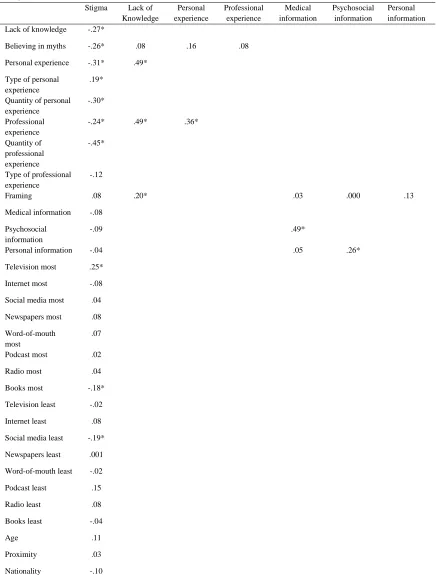
and having professional experience fell in different factors loading and the values for those questions were higher than .60 (Appendix 5, Table 2). Due to the missing values of four questions of the construct experience, those questions were not used for the multiple regression analysis and the moderation analysis. However, the correlation analysis between those questions and stigma of mental disorders was conducted to partially see the effect of quantity of personal experience, type of personal experience, quantity of professional experience and type of professional experience on stigma of mental disorders.
Finally, the last three questions asked the age of participants, the perceived proximity to a psychiatric facility and the nationality of the participants. Age was asked with an open question. Secondly, proximity measured the perceived distance of participants between their home and a psychiatric facility. The answer was a 5 Likert-point scale with “1 = very close“2 = close”, “3 = moderate”, “4 = far away”, “5 = very far away”. Lastly, with nationality, it was possible to answer “1
= Dutch”, “2 = Italian”, “3 = other”. Moreover, because the moderators had only one question, their validity and reliability was not measured.
3.3 Pre-test
Before sending the questionnaire, a pre-test was conducted. Two Dutch people, whose one was an English speaker, and an Italian person were contacted to check each version of the questionnaire respectively. They were asked to fill in the questionnaire, check for possible translation mistakes and calculate the time to fill in the questionnaire. Moreover, it was asked if the questions were understandable and if they were easy to fill in.
Only a few things came out. First, the questionnaire needed 10-15 minutes to be filled in. Second, the age question had a slider to select age and the checkers find it hard to understand how to use it. Therefore, this was changed into an open question with white space to fill in. Thirdly, the variable experience was first divided between private and professional experience. The term “private” was confusing and it was said that it should have been changed in personal. Lastly, there were some words that when translated in another language had a slightly different meaning, such as using “struttura psichiatrica” [psychiatric structure] instead of “clinica psichiatrica” [psychiatric clinic] in the Italian questionnaire.
24
3.4 Preparation for analysesBefore analysing the data, they had to be imported and prepared in SPSS, a statistic program (IBM, SPSS software, n.d.). The first step was exporting the answers from Qualtrics (Qualtrics, n.d.) and import them in SPSS. Once this was done, the responses which were half or not filled in were deleted. Afterwards, each variable was renamed according to their questions. For the variables age, proximity
and nationality there was only one question. Therefore they were named according to their variables. For instance, question 41 which asked the age of the participants was called “Age”.
Some of the questions had an opposite measuring scale when compared to most questions, namely three questions for prejudice, the questions for believing in myths, a question for stereotype and thevariable nationality. Therefore, these were re-coded. Prejudice was re-coded by changing 1 with 5, 2 with 4 and 3 stayed the same. In the end, number 1 means not having prejudices and 5 means having prejudices toward people with mental disorders. Believing in myths was re-coded in the same way, thus 1 is believing in the myth and 5 not believing in the myth. Stereotype was also re-coded by switching numbers, thus that 1 is not having stereotype and 5 is having stereotype. Lastly, nationality was re-coded into a dummy variable – variables with only 1 and 0 values – with Dutch equal to 0 and Italian equal to 1.
Once each question was re-coded, the kind of measures, values, decimals and labels were changed. For example, for question 9 of discrimination, the kind of measure is ordinal because it is a 5-point Likert scale question. The values are “1 = strongly disagree”, “2 = somewhat disagree”, “3 = neither disagree nor agree”, “4 = somewhat agree”, “5 = strongly agree” and, because of this, the decimals are 0. The label is “I would not be comfortable if a person with a mental disorder was a teacher in a school”. Additionally, the variable proximity was considered as scale and not as ordinal, even if the answer was a 5-points Likert scale. The next step required to measure the reliability of each variable and the validity of the questionnaire. This was done by measuring the Cronbach’s alpha per each variable and by conducting a factor analysis per variable. The difference of reliability and validity between countries was also measured to see if the reliability and validity were higher per country. Afterwards, questions were merged according to their variable. For instance, questions 17, 18, 19, 20 were combined into framing.
Nonetheless, the variables personal experience and professional experience had questions which required a different kind of answers. Because of this, for the analysis, it was decided to create three variables for personal experience and three variables for professional experience. Respectively, they were called “personal experience1”, “type of personal experience2”, “quantity of personal experience3”, “professional experience1”, “quantity of professional experience2” and “type of professional experience3”. Additionally, because kind of information measured the difference among three kinds of information, three variables were formed, namely “medical information”, “psychosocial information” and “personal information”.
25
Once checked if all the labels, values, decimals and measures were correct, the dataset was ready for analysis. First, the frequencies and the demographics per each variable and the correlations between variables were analysed. Later, a multiple regression per each variable or more variables was conducted. Eventually, a regression analysis of variance was conducted to check the influence of each moderator on the effects of the independent variables on the dependent variable.
3.5 Participants
26
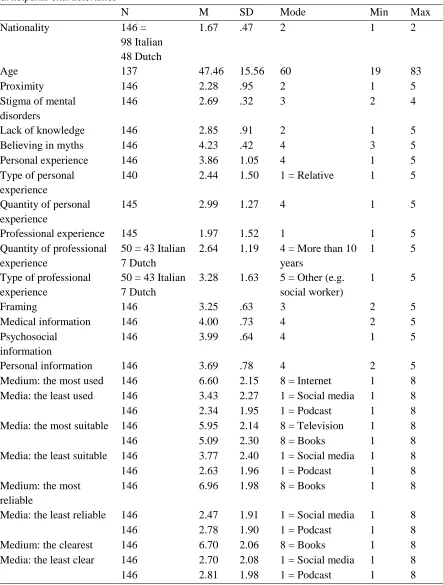
Table 3
Participants characteristics
N M SD Mode Min Max
Nationality 146 = 98 Italian 48 Dutch
1.67 .47 2 1 2
Age 137 47.46 15.56 60 19 83
Proximity 146 2.28 .95 2 1 5
Stigma of mental disorders
146 2.69 .32 3 2 4
Lack of knowledge 146 2.85 .91 2 1 5 Believing in myths 146 4.23 .42 4 3 5 Personal experience 146 3.86 1.05 4 1 5 Type of personal
experience
140 2.44 1.50 1 = Relative 1 5
Quantity of personal experience
145 2.99 1.27 4 1 5
Professional experience 145 1.97 1.52 1 1 5 Quantity of professional
experience
50 = 43 Italian 7 Dutch
2.64 1.19 4 = More than 10 years
1 5
Type of professional experience
50 = 43 Italian 7 Dutch
3.28 1.63 5 = Other (e.g. social worker)
1 5
Framing 146 3.25 .63 3 2 5
Medical information 146 4.00 .73 4 2 5 Psychosocial
information
146 3.99 .64 4 1 5
Personal information 146 3.69 .78 4 2 5 Medium: the most used 146 6.60 2.15 8 = Internet 1 8 Media: the least used 146 3.43 2.27 1 = Social media 1 8 146 2.34 1.95 1 = Podcast 1 8 Media: the most suitable 146 5.95 2.14 8 = Television 1 8 146 5.09 2.30 8 = Books 1 8 Media: the least suitable 146 3.77 2.40 1 = Social media 1 8 146 2.63 1.96 1 = Podcast 1 8 Medium: the most
reliable
146 6.96 1.98 8 = Books 1 8