go.warwick.ac.uk/lib-publications
Original citation:
Stoehr, Martin, Michelitsch, Georg S., Tully, John C., Reuter, Karsten and Maurer, Reinhard
J.. (2016) Communication : charge-population based dispersion interactions for molecules
and materials. Journal of Chemical Physics, 144 (15). 151101.
Permanent WRAP URL:
http://wrap.warwick.ac.uk/96017
Copyright and reuse:
The Warwick Research Archive Portal (WRAP) makes this work by researchers of the
University of Warwick available open access under the following conditions. Copyright ©
and all moral rights to the version of the paper presented here belong to the individual
author(s) and/or other copyright owners. To the extent reasonable and practicable the
material made available in WRAP has been checked for eligibility before being made
available.
Copies of full items can be used for personal research or study, educational, or not-for profit
purposes without prior permission or charge. Provided that the authors, title and full
bibliographic details are credited, a hyperlink and/or URL is given for the original metadata
page and the content is not changed in any way.
Publisher’s statement:
This article may be downloaded for personal use only. Any other use requires prior permission of the author and AIP Publishing.
The following article Stoehr, Martin, Michelitsch, Georg S., Tully, John C., Reuter, Karsten and Maurer, Reinhard J.. (2016) Communication : charge-population based dispersion interactions for molecules and materials. Journal of Chemical Physics, 144 (15). 151101. and may be found at https://doi.org/10.1063/1.4947214
A note on versions:
The version presented here may differ from the published version or, version of record, if
you wish to cite this item you are advised to consult the publisher’s version.
Communication: Charge-Population Based Dispersion Interactions for
1
Molecules and Materials
2
Martin Stöhr,1, 2Georg S. Michelitsch,2John C. Tully,1Karsten Reuter,2 and Reinhard J. Maurer1,a)
3
1)Department of Chemistry, Yale University, New Haven CT 06520, United States
4
2)Department Chemie, Technische Universität München, Lichtenbergstr. 4, D-85748 Garching,
5
Germany
6
(Dated: 6 December 2017)
7
We introduce a system-independent method to derive effective atomic C6 coefficients and polarizabilities in
molecules and materials purely from charge population analysis. This enables the use of dispersion-correction schemes in electronic structure calculations without recourse to electron-density partitioning schemes and expands their applicability to semi-empirical methods and tight-binding Hamiltonians. We show that the accuracy of our method isen parwith established electron-density partitioning based approaches in describing intermolecular C6coefficients as well as dispersion energies of weakly bound molecular dimers, organic crystals,
and supramolecular complexes. We showcase the utility of our approach by incorporation of the recently developed many-body dispersion (MBD) method [Tkatchenko et al., Phys. Rev. Lett. 108, 236402 (2012)] into the semi-empirical Density Functional Tight-Binding (DFTB) method and propose the latter as a viable technique to study hybrid organic-inorganic interfaces.
Keywords: dispersion interactions, many-body dispersion, density-functional tight-binding, intermolecular
8
interactions
9
Long-range correlations such as dispersion
interac-10
tions play an important role in the molecular
struc-11
ture and reaction dynamics of many materials and
12
molecules. Many computationally efficientab initio
elec-13
tronic structure approaches, such as current
approxima-14
tions to Density-Functional Theory (DFT), neglect
long-15
range dispersion interactions by construction. As a
re-16
sult of recent method development efforts, a number of
17
different dispersion-inclusive ab initio approaches have
18
been devised, such as DFT-D31 and DFT+vdW(TS)2,
19
van der Waals functionals3,4 (vdW-DF), or the recent
20
many-body dispersion method5,6(DFT+MBD). Some of
21
these methods provide an accurate electronic structure
22
description of intermolecular interactions in molecular
23
dimers1, organic crystals7–9, hybrid organic-inorganic
in-24
terfaces10,11, and supramolecular complexes9,12.
25
Notwithstanding recent advances in extending
accu-26
rate electronic structure methods to the solid state13,
27
specifically in the context of nanostructured
materi-28
als and complex interfaces a need exists for more
effi-29
cient methods with reduced scaling properties and
re-30
liable account of long-range interactions. At the cost
31
of reduced transferability such approaches allow to
ad-32
dress structural changes and chemical reactions at longer
33
length and time scales. One such class of methods
34
are semi-empirical methods and model Hamiltonians.
35
Contrary to molecular mechanics or force fields
meth-36
ods that completely eliminate the explicit description
37
of electronic structure, semi-empirical methods such as
38
the wavefunction based
Neglect-of-Diatomic-Differential-39
Overlap14 (NDDO) methods as represented by AM115
40
and PM316, or the DFT-based FIREBALL method17,18
41
and Density-Functional-based Tight Binding method19,20
42
(DFTB) retain a parametrized minimal basis
represen-43
tation of the electronic Hamiltonian. As a result they
44
provide access to electronic21, optical22, and magnetic23
45
properties of materials.
46
Often derived from mean-field methods such as
47
Hartree-Fock or semi-local DFT, these effective
meth-48
ods unfortunately suffer from the same intrinsic
ne-49
glect of long-range interactions. Just as with
semi-50
local DFT, they may thus in principle be coupled with
51
semi-empirical pairwise dispersion correction approaches
52
such as first put forward by Grimmeet al. (DFT-D)24.
53
This has e.g. been extensively done in the context of
54
DFTB25–27. In such schemes dispersion corrections are
55
incorporated by addition of the leading terms of the
dipo-56
lar expansion that captures the dynamical charge
fluctu-57
ations of atoms in molecules and materials
58
Edisp=−
∑
A<B
fdamp(RAB, RA, RB) C6AB R6
AB
, (1)
wherefdampis a damping function limiting the correction
59
to distances RAB beyond effective van-der-Waals radii
60
RA andRB, andC6AB correspond to the interatomic C6
61
dispersion coefficients. All these parameters are thereby
62
precalculated and tabulated.
63
In recent years, a number of approaches has been
64
derived that provide a more profound connection
be-65
tween DFT and dispersion interactions by deriving
dis-66
persion coefficients from coordination numbers1, the
elec-67
tron density2, the exchange-hole dipole moment28,
Wan-68
nier functions29, or by directly modelling a non-local
den-69
sity functional30. The above methods account for the
70
dependence of dispersion interactions on the real-space
71
distribution of the electron-density or the wavefunctions.
72
The corresponding numerical schemes represent
addi-73
tional steps in electronic structure simulations and, for
semi-empirical methods, may provide severe
computa-75
tional bottlenecks, notwithstanding the crude real-space
76
representation of molecular properties in a minimal basis.
77
In this work we provide a connection between a given
78
Hamiltonian in a local basis representation and
atom-79
wise dispersion coefficients. This eliminates the recourse
80
to the electron density in respace, and thereby
al-81
lows for an efficient coupling of advanced
dispersion-82
correction schemes with Density Functionals and
semi-83
empirical methods such as DFTB. Our method is based
84
on charge population analysis (CPA) and, in contrast
85
to other approaches9,25–27, does not introduce additional
86
system-dependent parametrization. It has proven
in-87
sensitive to the underlying basis set representation for
88
both tested cases of DFT and DFTB. Validation on a
89
large number of intermolecular C6 coefficients and
stan-90
dardized benchmark sets for intermolecular interactions
91
shows that our charge-population based scheme coupled
92
with DFT yields highly accurate intermolecular C6
co-93
efficients and interaction energies when compared to
ex-94
periment and high-level reference data. Our scheme is
95
thereforeen parin accuracy with the atoms-in-molecules
96
density partitioning-based vdW(TS) of Tkatchenko and
97
Scheffler for a wide range of molecular systems.
98
The DFT+vdW(TS), or in short DFT+TS, scheme2
99
represents a particularly simple and accurate method to
100
derive dispersion interactions directly from the electron
101
density. The dispersion interaction as given by eq. 1
102
is defined via effective atom-wise dispersion parameters
103
such as static atomic polarizabilities α0
A, CAA6
coeffi-104
cients, and van-der-Waals radii RA
105
C6AB= 2C AA 6 C
BB 6 α0
B
α0 A
CAA 6 +
α0 A
α0 B
CBB 6
. (2)
The effective atomic parameters for an atom in a
106
molecule that enter eq. 1 are related to accurate free atom
107
reference data31 by the change in atomic polarizability
108
due to the chemical environment in which the atom is
109
embedded. Exploiting the linear correlation of
polariz-110
ability and effective atomic volume32the parameters are
111
obtained as a function of the volume ratio between the
112
free atom (Vfree
A ) and the atom in the environment (VA)
113
C6AA
C6AA,free ≈
(
αA αfree
A
)2
≈ (
VA Vfree
A
)2
. (3)
The atomic volumes are thereby calculated using the
Hir-114
shfeld atoms-in-molecules density partitioning scheme33.
115
The favourable scaling properties of DFTB and
simi-116
lar methods stem from removal of time-consuming
com-117
ponents such as the explicit construction of the electron
118
density and the evaluation of multi-center integrals. This
119
leaves the parametrized Hamiltonian in a minimal atomic
120
orbital basis set representation. However, with no direct
121
access to the electron density, the vdw(TS) scheme can
122
not be applied. Inspired by a recent dispersion correction
123
approach for force fields based on tessellation of an
artifi-124
cial electron density34we therefore attempted to directly
[image:3.612.325.556.54.266.2]125
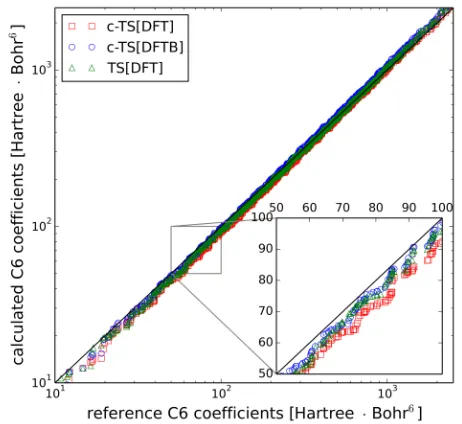
FIG. 1. Comparison of interatomic C6coefficients as obtained
by c-TS in combination with DFT-PBE (red squares) and DFTB (blue circles) against accurate reference values derived from dipole oscillator strength distributions (black line). Ad-ditionally, the corresponding values for the original TS scheme are included (green triangles). Inset: The larger systematic deviations in the region of 50–100 Ha·Bohr6 are the main
reason for the slightly increased overall MARE in c-TS[DFT] compared to TS[DFT].
reconstruct the electron density in DFTB from the
con-126
fined atomic orbitals used to parametrize the electronic
127
DFTB Hamiltonian and DFTB orbital occupations (see
128
supplemental material for details35). Unfortunately, the
129
resulting DFTB+TS dispersion coefficients suffer from
130
the poor density representation and show significant
de-131
viations from the DFT-based scheme and accurate
refer-132
ence data for a number of benchmark systems. More
im-133
portantly, the results also strongly depend on the choice
134
of confinement of the free atom basis functions employed
135
in the DFTB scheme.
136
This leaves us with the need to identify an alternative
137
relation between electronic structure and atomic
polariz-138
ability. While the static atomic polarizability is directly
139
proportional to the atomic volume, it is also indirectly
140
proportional to the chemical hardness or the degree of
141
hybridization32,36,37. One possible measure for the
de-142
gree of hybridization when using a local atomic-orbital
143
basis set|ψa⟩=
∑
ic a
i · |ϕi⟩is the atom-projected trace
144
of the density matrix38
145
hA=∑ a
fa∑ i∈A
|cai| 2
, (4)
withfa the molecular orbital occupation of state a, and
146
cai the associated wavefunction coefficient corresponding
147
to basis functionilocated at atomA. This measure thus
148
accounts for the hybridization-induced charge transfer
and effective volume change due to interaction with other
150
atoms (see supplemental material for more details35). It
151
corresponds to the on-site contribution to Mulliken
pop-152
ulations39, which is equal to the atomic chargeZ
Ain the
153
case of a free atom. We therefore propose to approximate
154
the change of polarizability of an atom in a molecule or
155
a solid as follows
156
CAA 6 C6AA,free ≈
(
αA αfree
A
)2
≈ (
hA ZA
)2
. (5)
This CPA approach yields the correct limit for free
neu-157
tral atoms and effectively accounts for bond formation
158
and coordination. Free atom values of αfree A , C
AA,free
6 ,
159
Rfree
A are correspondingly rescaled2and enter equation 2.
160
The CPA can be employed in electron-density based
dis-161
persion correction approaches such as TS and MBD and
162
the resulting schemes will henceforth be referred to with
163
the prefix c, as for instance c-TS or c-MBD.
164
We assess the accuracy of dispersion interactions
de-165
rived via CPA by calculating a set of intermolecular C6
166
coefficients of 817 complexes proposed as benchmark by
167
Meath and co-workers40,41 on the basis of
experimen-168
tally derived dipole oscillator strength distributions. Our
169
method yields intermolecularC6coefficients with a Mean
170
Absolute Relative Error (MARE) of 7.5% against
exper-171
iment when based on DFT-PBE states and 6.8% when
172
based on DFTB states, cf. Fig. 1. The MARE for the
173
original density-partitioning approach of Tkatchenko and
174
Scheffler2 is 5.4% in DFT-PBE, whereas density
parti-175
tioning on the basis of an artificially constructed DFTB
176
density yields 23.9% error. The latter clearly shows the
177
limitations of the original TS approach in combination
178
with DFTB. Further, it is noteworthy that the maximum
179
relative deviation in c-TS[DFT] is 29.6% (for Li· · ·SiH4),
180
whereas it is 42% (H2 dimer) in the original TS[DFT]
181
scheme. Principal component analysis reveals a
simi-182
lar linear correlation between calculation and reference
183
for all approaches. The inset of Fig. 1, however, shows,
184
that the higher overall relative error in c-TS[DFT]
dom-185
inantly stems from a slight systematic underestimation,
186
especially for small values of C6below 100 Ha·Bohr6.
187
With this encouraging result we proceed to
incor-188
porate our approach into different dispersion-corrected
189
DFT methods and study realistic benchmark systems.
190
We do this for the pairwise-additive TS scheme2and the
191
many-body MBD scheme5. Both depend on a given set
192
of atom-wise dispersion coefficients as a starting point.
193
In the case of TS, an energy as given in eq. 1 is
evalu-194
ated. Throughout this work, we do not adjust or
mod-195
ify the damping function parameters of Tkatchenko and
196
Scheffler2 and simply apply a damping function as
op-197
timized for the PBE functional42. In the MBD case
198
the dispersion parameters enter an interacting set of
199
atom-centered quantum harmonic oscillators, which
de-200
fine a coupled fluctuating dipole model43,44 to capture
201
the non-additive many-body vdW interactions. All DFT
202
calculations below were performed using the FHI-aims
203
S66x8(a) S22(a) X23(b) Overall
PBE 1.55 2.61 11.95 5.37
PBE+TS 0.42 0.32 3.25 1.33
PBE+c-TS 0.35 0.30 1.27 0.64
PBE+MBD 0.32 0.48 1.11 0.64
PBE+c-MBD 0.32 0.60 1.94 0.95
DFTB 2.31 3.53 12.87 6.23
DFTB+c-TS 1.20 1.55 2.86 1.87
DFTB+c-MBD 1.13 1.27 2.54 1.64
TABLE I. Mean absolute deviation (MAD) in binding en-ergies of three benchmark sets of molecular dimers and or-ganic crystals calculated with DFT-PBE and DFTB with and without dispersion correction using the original electron den-sity based schemes (TS and MBD) and using the CPA (c-TS and c-MBD). Results are given in kcal/mol with respect to(a)interaction energies as obtained by CCSD(T)/CBS and (b)experimental lattice energies.
all-electron DFT code45, with the semi-local PBE
func-204
tional42. SCC-DFTB46 calculations have been carried
205
out using the DFTB+ code47 with recent mio-1.148
pa-206
rameters. In both cases we extract the wavefunction
co-207
efficients and carry out dispersion calculations using a
208
modified version of the Atomic Simulation Environment
209
(ASE)49, which interfaces to standalone implementations
210
of the TS50 and MBD51methods.
211
212
For validation of the CPA method we employ
estab-213
lished benchmark systems of intermolecular interaction
214
energies for molecular dimers in equilibrium (S2252) and
215
along dissociation curves (S66x853), as well as the lattice
216
energies of 23 different organic crystals (X23)7,54,55, see
217
Table I. Despite a 2% larger error in intermolecular C6
co-218
efficients as compared to the original scheme (PBE+TS),
219
the CPA method combined with TS pairwise dispersion
220
(PBE+c-TS) slightly improves the description of
inter-221
action energies. The original TS scheme is known to
222
slightly overestimate polarizabilities and dispersion
inter-223
actions2,5. In contrast, for c-TS we find a slight
underes-224
timation, especially when using the semi-local DFT-PBE
225
functional, cf. the inset of Fig. 1. As we only consider
226
energy differences, final interaction energies may
bene-227
fit from error cancellation. In the case of PBE+c-MBD,
228
mean absolute deviations (MAD) are equal or minimally
229
increased compared to the original scheme. The
consider-230
ably increased absolute deviations of all methods for the
231
X23 set arise from significantly higher interaction
ener-232
gies with a mean of 20.4 kcal/mol. Especially for organic
233
crystals, many-body interactions are important,
yield-234
ing mean absolute relative errors (MARE) of 6.2% and
235
9.8% for PBE+MBD and PBE+c-MBD, respectively. In
236
this specific case the underestimation of dispersion
pa-237
rameters in the CPA scheme when based on DFT-PBE
238
states simultaneously improves the performance of c-TS
239
due to error cancellation and appears to slightly impair
240
the c-MBD scheme. Nonetheless, our approach, eq. 5,
FIG. 2. Left: MADs in binding energies (in kcal/mol) for a selected subset of S12L complexes as obtained by differ-ent dispersion corrected approaches with respect to DQMC calculations. right: Graphical depiction of the S12L subset considered in this work. H (white), C (black), N (blue), O (red).
yields overall comparable results to the original scheme
242
and therefore represents a viable alternative that
addi-243
tionally eliminates the need for electron density
parti-244
tioning.
245
Switching from DFT-PBE to the semi-empirical
246
method DFTB, MAREs are almost consistently
in-247
creased by about 10%. This is expected from the more
248
approximate electronic structure description at this level.
249
Nevertheless, accounting for vdW interactions via c-TS
250
and c-MBD drastically improves the description of
in-251
termolecular complexes and organic crystals in
compar-252
ison to plain DFTB. Overall deviations are decreased
253
from 6.2 kcal/mol (68.7% MARE) down to 1.6 kcal/mol
254
(23.2% MARE) in DFTB+c-MBD. The still sizable
255
MARE of 23.2% may be further reduced by adaptation
256
of the damping function of TS or the range-separation
257
parameter of MBD to the DFTB level of description. On
258
the other hand, the approximations made in DFTB do
259
not produce cumulative deviations as the relative error
260
decreases with increasing interaction energies from S66x8
261
to S22 and X23 (see supplemental material35). This
fur-262
ther encourages the use of dispersion-corrected DFTB
263
or other semi-empirical approaches for the description of
264
extended systems.
265
A particular benefit of our approach is the ability to
ef-266
ficiently incorporate many-body dispersion into DFT and
267
semi-empirical methods. We further exemplify this with
268
a set of five supramolecular complexes (a subset of the
269
S12L benchmark set56, see Fig. 2) for which
pairwise-270
additive approaches tend to overestimate binding
ener-271
gies, while PBE+MBD is known to perform well12,34.
272
In reference to accurate diffusion quantum Monte-Carlo
273
results12 (DQMC), our CPA method in combination
274
with PBE and MBD (PBE+c-MBD) yields an MAD of
275
1.7 kcal/mol (6.0% MARE). This is almost identical to
276
the performance of the original PBE+MBD scheme with
277
1.9 kcal/mol (8.1% MARE) for this subset. Remarkably,
278
this level of accuracy carries over to the DFTB+c-MBD
279
level with only slightly larger deviations of 2.4 kcal/mol
280
(10.2% MARE). For comparison, SCC-DFTB in
conjunc-281
tion with D3 including three-body interactions within the
282
Axilrod-Teller-Muto formalism57,58 yields 6.9 kcal/mol
283
(28.5% MARE).
284
In conclusion we presented a computationally efficient
285
and stable approach to extract atom-wise dispersion
pa-286
rameters solely from the density-matrix. On-site
Mul-287
liken charges capture the trends in hybridization and
ef-288
fective volume that renormalize free atom dispersion
co-289
efficients for an atom embedded in a molecule or
mate-290
rial. In conjunction with DFT, this approach eliminates
291
the need for density partitioning and promises a
consid-292
erably simplified definition of analytical forces59 when
293
compared to density partitioning schemes. In the case of
294
DFTB and semi-empirical methods in general it enables a
295
parameter-free connection between atomic reference data
296
and a parametrized Hamiltonian. At both levels of
the-297
ory we find accurate intermolecular C6 coefficients,
in-298
termolecular binding energies, and lattice energies for
299
a large variety of chemical systems – including organic
300
dimers in (non-)equilibrium configurations, organic
crys-301
tals, and supramolecular complexes. As shown for the
302
example of supramolecular guest-host systems, DFTB in
303
combination with many-body dispersion can yield a
re-304
liable description of stacked and intercalated complexes
305
as they appear in porous metal-organic frameworks and
306
hybrid organic-inorganic interfaces. A recent test study
307
on bisphenol A aggregates adsorbed at a Ag(111) surface
308
strongly supports this assertion60. Pending an in-depth
309
analysis of the validity of eq. 5 and its possible
limita-310
tions in the context of inorganic and metallic materials,
311
we suggest this method as an efficient route towards a
312
large-scale electronic structure description of hybrid
ma-313
terials and complex interfaces.
314
MS acknowledges financial support by the PROMOS
315
program of the DAAD during his stay at Yale
Univer-316
sity. RJM and JCT acknowledge funding from DoE
-317
Basic Energy Sciences grant no. DE-FG02-05ER15677.
318
GSM acknowledges the support of the Technische
Univer-319
sität München - Institute for Advanced Study, funded by
320
the German Excellence Initiative. The authors thank T.
321
Bereau and A. Tkatchenko for fruitful discussions and for
322
supplying detailed information about systems contained
323
in the X23 and S12L benchmark sets.
324
1S. Grimme, J. Antony, S. Ehrlich, and H. Krieg, J. Chem. Phys.
325
132, 154104 (2010).
326
2A. Tkatchenko and M. Scheffler, Phys. Rev. Lett.102, 073005
327
(2009).
328
3M. Dion, H. Rydberg, E. Schröder, D. Langreth, and
329
B. Lundqvist, Phys. Rev. Lett.92, 246401 (2004).
330
4J. Klimeš, D. Bowler, and A. Michaelides, Phys. Rev. B 83,
331
195131 (2011).
332
5A. Tkatchenko, R. DiStasio Jr., R. Car, and M. Scheffler, Phys.
333
Rev. Lett.108, 236402 (2012).
334
6A. Ambrosetti, A. Reilly, R. DiStasio Jr., and A. Tkatchenko,
335
J. Chem. Phys.140, 18 (2014).
[image:5.612.57.295.54.226.2]7A. Reilly and A. Tkatchenko, J. Phys. Chem. Lett. 4, 1028
337
(2013).
338
8A. Reilly and A. Tkatchenko, Phys. Rev. Lett. 113, 055701
339
(2014).
340
9J. Brandenburg and S. Grimme, J. Phys. Chem. Lett.5, 1785
341
(2014).
342
10G. Mercurio, R. Maurer, W. Liu, S. Hagen, F. Leyssner,
343
P. Tegeder, J. Meyer, A. Tkatchenko, S. Soubatch, K. Reuter,
344
and F. Tautz, Phys. Rev. B88, 035421 (2013).
345
11R. Maurer, V. Ruiz, and A. Tkatchenko, J. Chem. Phys.143,
346
102808 (2015).
347
12A. Ambrosetti, D. Alfè, R. DiStasio Jr., and A. Tkatchenko, J.
348
Phys. Chem. Lett.5, 849 (2014).
349
13A. Michaelides, T. Martinez, A. Alavi, G. Kresse, and F. Manby,
350
J. Chem. Phys.143, 102601 (2015).
351
14J. Pople, D. Santry, and G. Segal, J. Chem. Phys.43, S129
352
(1965).
353
15M. Dewar, E. Zoebisch, E. Healy, and J. Stewart, J. Am. Chem.
354
Soc.107, 3902 (1985).
355
16J. Stewart, J. Comput. Chem.10, 209 (1989).
356
17O. Sankey and D. Niklewski, Phys. Rev. B40, 3979 (1989).
357
18J. Lewis, K. Glaesemann, G. Voth, J. Fritsch, A. Demkov, J.
Or-358
tega, and O. Sankey, Phys. Rev. B64, 195103 (2001).
359
19D. Porezag, T. Frauenheim, T. Köhler, G. Seifert, and
360
R. Kaschner, Phys. Rev. B51, 12947 (1995).
361
20M. Elstner, D. Porezag, G. Jungnickel, J. Elsner, M. Haugk,
362
T. Frauenheim, S. Suhai, and G. Seifert, Phys. Rev. B58, 7260
363
(1998).
364
21T. Todorov, J. Phys13, 10125 (2001).
365
22T. Niehaus, S. Suhai, F. Della Sala, P. Lugli, M. Elstner,
366
G. Seifert, and T. Frauenheim, Phys. Rev. B63, 085108 (2001).
367
23C. Köhler, T. Frauenheim, B. Hourahine, G. Seifert, and
368
M. Sternberg, J. Phys. Chem. A111, 5622 (2007).
369
24S. Grimme, J. Comput. Chem.25, 1463 (2004).
370
25J. McNamara and I. Hillier, Phys. Chem. Chem. Phys.: PCCP
371
9, 2362 (2007).
372
26M. Rapacioli, F. Spiegelman, D. Talbi, T. Mineva, A. Goursot,
373
T. Heine, and G. Seifert, J. Chem. Phys.130, 244304 (2009).
374
27R. Petraglia, S. Steinmann, and C. Corminboeuf, Int. J.
Quan-375
tum Chem.115, 1265 (2015).
376
28E. Johnson and A. Becke, J. Chem. Phys.123, 024101 (2005).
377
29P. Silvestrelli, Phys. Rev. Lett.100, 053002 (2008).
378
30K. Berland, V. Cooper, K. Lee, E. Schröder, T. Thonhauser,
379
P. Hyldgaard, and B. Lundqvist, Rep. Prog. Phys.78, 066501
380
(2015).
381
31X. Chu and A. Dalgarno, J. Chem. Phys.121, 4083 (2004).
382
32T. Brinck, J. Murray, and P. Politzer, J. Chem. Phys.98, 4305
383
(1993).
384
33F. Hirshfeld, Theor. Chim. Acta.44, 129 (1977).
385
34T. Bereau and O. von Lilienfeld, J. Chem. Phys. 141, 034101
386
(2014).
387
35See supplementary material at [URL will be inserted by AIP] for
388
computational details, additional benchmark results, a summary
389
of results on atoms-in-molecules partitioning with DFTB, and an
390
archive containing benchmark structure data.
391
36K. Miller and J. Savchik, J. Am. Chem. Soc.101, 7206 (1979).
392
37K. No, K. Cho, M. Jhon, and H. Scheraga, J. Am. Chem. Soc.
393
115, 2005 (1993).
394
38E. Davidson, J. Chem. Phys.46, 3320 (1967).
395
39R. S. Mulliken, J. Chem. Phys.23, 1833 (1955).
396
40D. J. Margoliash and W. J. Meath, J. Chem. Phys. 68, 1426
397
(1978).
398
41G. Zeiss and W. Meath, Mol. Phys.33, 1155 (1977).
399
42J. Perdew, K. Burke, and M. Ernzerhof, Phys. Rev. Lett.77,
400
3865 (1996).
401
43M. Cole, D. Velegol, H.-Y. Kim, and A. Lucas, Mol. Simul.35,
402
849 (2009).
403
44A. G. Donchev, J. Chem. Phys.125, 074713 (2006).
404
45V. Blum, R. Gehrke, F. Hanke, P. Havu, V. Havu, X. Ren,
405
K. Reuter, and M. Scheffler, Comp. Phys. Comm. 180, 2175
406
(2009).
407
46P. Koskinen and V. Mäkinen, Comput. Mat. Sci.47, 237 (2009).
408
47B. Aradi, B. Hourahine, and T. Frauenheim, J. Phys. Chem. A
409
111, 5678 (2007).
410
48M. Elstner, D. Porezag, G. Jungnickel, J. Elsner, M. Haugk,
411
T. Frauenheim, S. Suhai, and G. Seifert, Physical Review B58,
412
7260 (1998).
413
49S. Bahn and K. Jacobsen, Comput. Sci. Eng.4, 56 (2002).
414
50E. McNellis, J. Meyer, and K. Reuter, Phys. Rev. B80, 205414
415
(2009).
416
51available at www.fhi-berlin.mpg.de/~tkatchen/MBD, accessed:
417
12/21/2015.
418
52P. Jurečka, J. Šponer, J. Černý, and P. Hobza, Phys. Chem.
419
Chem. Phys.8, 1985 (2006).
420
53J. R̆ezáč, K. Riley, and P. Hobza, J. Chem. Theory Comput.7,
421
2427 (2011).
422
54A. Otero-de-la Roza and E. Johnson, J. Chem. Phys.136, 174109
423
(2012).
424
55A. Reilly and A. Tkatchenko, J. Chem. Phys.139, 024705 (2013).
425
56T. Risthaus and S. Grimme, J. Chem. Theory Comput.9, 1580
426
(2013).
427
57B. Axilrod and E. Teller, J. Chem. Phys.11, 299 (1943).
428
58Y. Muto, J. Phys.-Math. Soc. Japan17, 629 (1943).
429
59M. Blood-Forsythe, T. Markovich, R. DiStasio Jr., R. Car, and
430
A. Aspuru-Guzik, Chem. Sci.7, 1712 (2016).
431
60J. Lloyd, A. Papageorgiou, S. Fischer, S. Oh, Ö. Saglam,
432
K. Diller, D. Duncan, F. Allegretti, F. Klappenberger, M. Stöhr,
433
R. Maurer, K. Reuter, J. Reichert, and J. Barth, Nano Lett.16,
434
1884 (2016).