Original citation:
Tkachenko, Nataliya, Bricker, Stephanie and Jarvis, Stephen A.. (2015) To dig or not to dig? Place and perception in subsurface housing. Proceedings of the Institution of Civil Engineers - Engineering Sustainability.
http://dx.doi.org/10.1680/jensu.15.00019 Permanent WRAP url:
http://wrap.warwick.ac.uk/75841
Copyright and reuse:
The Warwick Research Archive Portal (WRAP) makes this work of researchers of the University of Warwick available open access under the following conditions. Copyright © and all moral rights to the version of the paper presented here belong to the individual author(s) and/or other copyright owners. To the extent reasonable and practicable the material made available in WRAP has been checked for eligibility before being made available.
Copies of full items can be used for personal research or study, educational, or not-for-profit purposes without prior permission or charge. Provided that the authors, title and full bibliographic details are credited, a hyperlink and/or URL is given for the original metadata page and the content is not changed in any way.
Publisher statement:
http://www.icevirtuallibrary.com/toc/jbren/current
A note on versions:
The version presented here may differ from the published version or, version of record, if you wish to cite this item you are advised to consult the publisher’s version. Please see the ‘permanent WRAP url’ above for details on accessing the published version and note that access may require a subscription.
22 October 2015 1
2
To dig or not to dig?
3
Place and perception in subsurface housing
4
5
Nataliya Tkachenko (MSc)1,2*, Stephanie Bricker (CGeol)4, Stephen A Jarvis (PhD)1,3
6 7
1 Warwick Institute for the Science of Cities, University of Warwick, Coventry, CV4
8
7AL 9
2 Centre for Interdisciplinary Methodologies, University of Warwick, Coventry, CV4
10
7AL 11
3 Department of Computer Science, University of Warwick, Coventry, CV4 7AL
12
4 British Geological Survey, Environmental Science Centre, Nicker Hill, Keyworth,
13
Nottingham NG12 5GG 14
15
* Corresponding author: [email protected] 16
17
18
19
20
21
22
23
24
25
26
27
28
Abstract
30
Cities of the future are envisioned to be fully optimized, due to technological 31
advancements, distributed sensor networks and automation. With the proliferation 32
of new data sources, opportunities also exist for better understanding how people 33
act and make decisions, as well as discerning the conditions in which they wish to 34
live and what they expect from their surrounding environment. Following the 35
recently proposed normative strand in urban planning, this study uses distributed 36
personal underground development as a case study for extracting the values behind 37
this controversial self-‐build movement, alongside observers’ opinions obtained 38
from associated web-‐based data. 39
40
Keywords: information technology, town and city planning, tunnels and tunneling 41
42
43
44
45
46
47
48
49
50
51
52
53
54
1. Introduction
56
57
1.1 Underground development in light of normative rationality
58
59
Modern cities are facing numerous challenges. There is a growing need to 60
accommodate their increasing populations, ensuring comfortable, prosperous and 61
sustainable co-‐existence of inhabitants, whilst at the same time minimizing the 62
effects of both anthropogenic and natural stresses to safeguard population security. 63
Simultaneously, city planning methods are undergoing gradual transformations 64
under the influence of the proliferation of newly available data sources and tools, 65
which enable its processing, visualization and interpretation. Increasing data 66
volumes and diversity, commonly referred to as ‘big data’, open new avenues of 67
urban understanding, promising to make cities more livable, with precisely 68
executed functions, resulting in ‘smarter’ urban habitats. New data and new ways of 69
working with this data therefore suggest more creative planning methods, capable 70
of equally incorporating readings from distributed sensor networks and 71
interpreting various social participatory undertakings within urban fabrics 72
(Townsend, 2013). However, the search for custom-‐made ways of working, which 73
incorporate underlying values of urban populations, is still regarded as a weak 74
component within a predominantly process-‐oriented rational tradition (Flyvbjerg, 75
1998). This poses several risks, notably of ignoring constructive bottom-‐up trends 76
and of overlooking negative experiences within so-‐called technically optimal 77
shortcomings is in distributed underground development, often regarded as a 79
hobbyist niche (Garrett, 2012; Lackman, 2012) and not considered as a constitutive 80
element in wider city planning (Bridge et al., 2005). 81
Underground development in urban planning is often referred to as an 82
alternative solution where (i) there are significant space constraints/demand over 83
ground, (ii) where development is limited due to land conservation purposes or (iii) 84
where cost savings can be made, for example with regard to storage (ITA, 1990; 85
Marker, 2009; Rogers, 2009). Most often, underground space is used to fulfill major 86
city functions, including transportation and waste management, as well as 87
containing major public utilities such as mains water, natural gas, electricity 88
distribution and communications infrastructure (Yang et al., 2015); it is rarely 89
considered as a potential space for living. This may be due to the fact that modern 90
understanding of underground space lies predominantly in the context of ever-‐ 91
growing urban infrastructure, for example, the requirement for additional parking, 92
road tunnels and rapid transportation systems. Nevertheless, there is wide variety 93
of civic uses of the subsurface (Goel et al., 2012; Rogers, 2009), which also include 94
its use for residential purposes; this function most commonly comprises utilizing 95
underground space to support living (e.g., servant’s quarters) or leisure activities 96
(e.g. subterranean gyms and swimming pools). 97
Therefore, a degree of living underground is not a novel concept. Indeed, 98
subterranean living has grown increasingly popular over the last thirty years as an 99
literature (Gray, 2015; Yoneda, 2014), thousands of people in Europe and America 101
live in underground homes and countries including Japan, China and Singapore, 102
where development space is at a premium, are particularly keen to build 103
underground living spaces. 104
At this time, there are two main obstacles that deter more widespread 105
development of underground living spaces: poor adaptation of the legal framework 106
(ITA, 2000) and public perception (Gray, 2015). 107
In most countries, the legal framework is seen as the major obstacle (De Mulder 108
et al., 2012; ITA, 2000). Increasing demands for underground solutions emphasize 109
the need for better coordination of the utilization of underground space. However, a 110
large number of different authorities and overlapping legislative documents must 111
be consulted before a building permit can be obtained (Rönkä et al, 1998). At the 112
same time, the lack of clear rules, methods and standards for underground 113
construction also delay legal procedures, which are far more coherent for above-‐ 114
surface solutions (RAIB, 2014). For landowners, the right to use underground space 115
is also often restricted in some way, either through land-‐use plans or legal praxis – 116
moreover, they do not necessarily have the right to oppose activities of others under 117
the surface (ITA, 1990, 2000). 118
The primary reason for the limited uptake of underground development is public 119
perception (Garrett, 2012). There is a common prejudice against such spaces, often 120
described as lifeless, dark dungeons, providing little access to what we all enjoy: 121
people’s values in underground development was introduced by Dobinson and 123
Bowens (1997), who stated that such controversial projects were likely to generate 124
opposing opinions and that underground development is therefore “not an end in 125
itself”: Rather, it must be viewed as a means of achieving strategic objectives of the 126
entire community (Dobinson & Bowens, 1997). 127
Nevertheless, personal underground development projects are taking place in 128
several countries around the world (Gray, 2015). Predominantly captured by 129
various media sources, they are commonly positioned in the discourse of eco-‐ 130
lifestyle and organic post-‐modern architectural trends, due to the unconventional 131
lifestyle of the owners or the extraordinary design of the dwelling (e.g., Gary 132
Neville’s eco-‐house in Bolton, UK) (Pham, 2010). From a planning perspective, in 133
light of the normative rationality, individual underground development, which 134
manifests itself primarily via self-‐build projects (e.g., Chiswick and Holland Park 135
residences in London, UK) (McCloud, 2012) or crowd funding of underground 136
public spaces (e.g., New York’s Lowline Park, US) (Leaver, 2014), can be considered 137
as a valid demonstration of need to include local values into planning (Buunk & van 138
der Weide, 2015). This movement, nevertheless, has received very little attention in 139
academic literature. Its controversial nature also means that this topic is a good 140
candidate with which to demonstrate the underlying values of urban living, their 141
prioritization and modes of implementation. 142
The need for a better understanding of the underlying values involved in decision 143
specified this necessity for planning in general if it is to fulfill its social function of 145
reflexivity and arrangement (Flyvbjerg, 1998; Buunk et al, 2015). Values can take 146
different forms; they can be expressed by means of motive, incentive, desire or ideal 147
for spatial development (Bardi & Schwartz, 2003). Also, they can be approached 148
from several perspectives: first, by uncovering the reasons why the project took 149
place in the first instance (that is, ‘simple observation’) and second, by revealing the 150
reactions of others to such a development (that is, ‘observing the observer’) (Lovink, 151
2011). 152
Similar to the political and social sciences’ concepts of power and meanings, 153
values can only materialize by means of social interaction (Ardvisson, 2011; Bardi & 154
Schwartz, 2003). Linguistic methods, therefore, have been widely adopted in 155
planning research, where discourse analysis helped to provide insight into the 156
frames and storylines by which actors create their views of spatial development 157
issues (Silva, 2012). Specific phrases or sentences that are likely to characterize the 158
personal motive or ideal behind a storyline are often used to identify values in these 159
contexts. The most recent proliferation of new data sources has also opened 160
opportunities towards understanding the values of the audience, which can be 161
found encrypted, for example, behind the politics of information arrangement (e.g., 162
Google’s PageRank) (Brin & Page, 1997; Curme et al., 2014), amount of ‘likes’ and 163
‘shares’ (Bodle, 2011; Gerlitz & Helmond, 2013) or sentiments of the commenting 164
lexicon (Feldman, 2013) around a particular city planning or development project. 165
alongside more widely adopted discourse analysis techniques, in order to gain 167
insight into the controversial yet important topic of distributed personal 168
underground development. 169
170
1.2 Research aims and questions
171
172
The main purpose of this study is to understand attitudes towards individual 173
underground development as a social phenomenon of choice (e.g., aesthetics of eco-‐ 174
living, attractiveness of organic design) or necessity (e.g., noise reduction, 175
protection against weather cataclysms). Conceptual mapping of this subject aims to 176
demonstrate which locations may hold the potential for underground development 177
as an alternative or parallel planning direction, based on the degree of social 178
approval for this type of accommodation. The proposed method may serve as a 179
powerful screening tool for public perception, which may precede more immersive 180
types of engagement (e.g., forums or focus group approaches) with urban residents 181
or local authorities (Silva, 2012). 182
In order to be able to appropriately position the dilemma ‘to dig or not to dig’ in a 183
planning discourse, it was therefore important for our study to focus on two main 184
aspects: (a) urban locations, which have or currently are implementing 185
underground housing projects, and (b) perceptions, provoked by the mediated 186
representation of the underground mode of living and degree of readers’ 187
189
1.3 Methodology
190
191
Two main sets of methods – linguistic and digital – have been employed in this 192
study. Whilst the first group has already found its niche in the normative tradition of 193
urban planning discipline (Buunk & van der Weide, 2015), the full potential of the 194
second method for planning purposes is yet to be explored (Silva, 2012). When 195
reference is made to digital methods, what is most commonly assumed is the 196
automated processing of structured information, which is not necessarily a 197
complete definition of this approach. Specialists divide techniques into ‘natively 198
digital’ and ‘simply digital’, according to the nature of the data sources they are 199
capable of processing (Rogers, 2013b). The ‘simply digital’ group of methods is 200
usually applicable to datasets which have originated in the analog world (e.g., 201
interviews, reports, old photos) and have been digitized, whilst ‘natively digital’ 202
methods deal with data which is produced, stored and disseminated in the digital 203
(or cyber-‐) sphere exclusively. The main dataset used in our analysis was 204
unstructured and hybrid (both ‘natively digital’ and ‘digitized’) information 205
contained on the web. 206
The extraction of both data sources was facilitated by the construction of queries 207
for the Google web navigation engine, the results of which provided links to mixed 208
media sources (blogs, news, individual sites and social media platforms), ordered by 209
(Weltevrede & Helmond, 2012; Rogers, 2013a). The intensity of the social interest 211
and engagement around the research topic of underground development has been 212
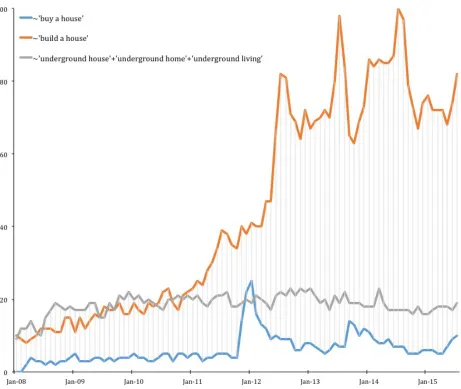
tested against two other popular search terms, evolving around the controversial 213
dilemma of self-‐building in urban settings: ~’buy a house’ and ~’build a house’ 214
(Figure 1). 215
The Google search engine was repurposed into a research tool (Rogers, 2013a) by 216
switching to the ‘no country redirect’ mode and using single queries in the English 217
language only. The query yielded around 500 web sources comprising mixed media 218
(blogs, news links to social media platforms etc.) from which, for the sake of data 219
consistency and the adaptation of digital methods for information extraction, media 220
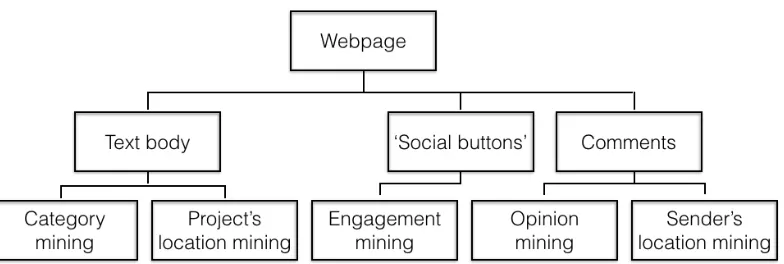
platforms (e.g., Pinterest and TripAdvisor) were filtered out from the inventory, 221
(see Figure 2). 222
The initial step in our analysis consisted of gathering information concerning 223
urban underground development projects, including their description and location 224
(city/town and country). To extract descriptive information, the SentenceRipper 225
(DMI, 2012b) research tool from the Digital Methods Initiative was used to strip the 226
text content from the list of collected URLs and incorporate these into a database 227
consisting of single sentences as elementary unit entries (Bruns, 2007). Each unit 228
was mined for keywords (DMI, 2012a) and location (DMI, 2014b) to extract 229
semantic information required for our analysis. 230
To collect data regarding social reaction to projects, the DMI (2014c) research 231
which was subsequently followed by an application of the DMI (2013), which 233
retrieved the number of ‘likes’ on Facebook as an indication of the most commonly 234
occurring web ‘fingerprint’ within the list of returned websites (Geiger, 2015). For 235
each URL entered, the script queried the Facebook Query Language (FQL) API and 236
retrieved the number of ‘likes’, ‘shares’, ‘comments’ and ‘clicks’. This information 237
was combined and used in the analysis to illustrate the degree of social engagement 238
with particular underground development projects, as described in the news media, 239
on blogs or on individual websites. 240
For opinion mining, the Discus Comment Scraper (DMI, 2014a) tool was used to 241
extract comments from the list of input URLs and to structure them into an 242
individual database. In a similar approach to the text content analysis, each 243
comment was mined for geolocation (city/town and country) and provided as input 244
for the sentiment analysis routine. We used a naïve opinion mining approach and 245
estimated comments’ sentiments by counting the number of occurrences of 246
“positive” and “negative” words (Liu, 2012). To assign a numeric score to each 247
message, we substracted the number of occurrences of negative words from the 248
number of occurrences of positive words. Larger negative scores subsequently 249
corresponded to more negative expressions of sentiment, neutral (or balanced) 250
expressions were net to zero, and very positive comments scored larger positive 251
numbers. Hu and Liu’s ‘opinion lexicon’ was used as a categorization source, 252
containing valuation for approximately 7,000 words and having been successfully 253
most useful properties of this lexicon include misspellings, morphological variants 255
and slang processing. The body of the sentiment scores has been normalized to a 256
scale 1-‐100. 257
Manual quality checks of the results of the digital tools were performed at each 258
stage of the data processing lifecycle, which was made possible by the reasonable 259
volume of collected information. 260
261
2. Visualizing personal underground developments in urban settings
262
263
We visualize the values of the development projects, both from the perspective of 264
their owners, and also from the perspective of the virtual audiences, which engaged 265
with the online projects’ demonstration. Both sets of results are aggregated at the 266
level of a projects’ country of origin and are presented in individual subsections 267
below. 268
269
2.1 Defining rationales behind underground development projects:
270
typologies
271
272
To discover the rationale behind individual underground developments we 273
primarily looked into two types of new knowledge: firstly, we aimed to understand 274
what types of individual projects of this nature existed and how self-‐builders 275
much time they spend there); second, to gain insight into the reasons and purposes 277
of why the dwellings have been constructed. Both classifications were derived from 278
the manual data observation and automated keyword extraction from the text 279
bodies of the websites. 280
281
2.1.1 Classification by the types of residence
282
283
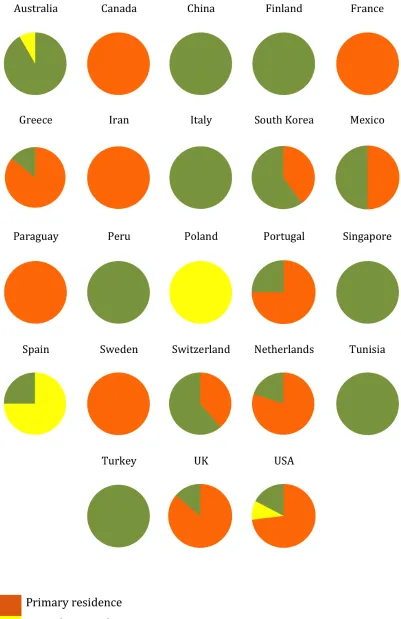
According to the data, personal underground houses are used for permanent 284
living as a main residence (the majority of the underground housing projects) or as 285
a vacation residence, often situated either in suburbs (e.g., Queens, New York, US) or 286
in coastal cities or towns (e.g., Atlantic Beach City, Florida, US) (Figure 3). The 287
results of data mining demonstrated a substantially higher proportion of projects 288
undertaken for personal development, as opposed to those aimed at contributing to 289
the development of an underground public sphere, examples of which could include 290
crowd-‐funding of underground public green spaces (e.g., Newline Underground 291
Park in New York, US) or the private conversion of abandoned mines into hotels and 292
tourist landmarks (Hobbiton Caves in Matamata town, New Zealand). 293
The reason for this may be the high costs associated with such projects (seen, for 294
example, in underground housing projects in the UK, Sweden and the Netherlands), 295
as well as interest in lower energy costs associated with the maintenance of the 296
dwelling (examples of which can be found in Iran, Paraguay and Portugal). 297
islands, where the price of land is affordable and often used for mixed residential 299
and tourist business purposes (examples in the USA, Spain, Poland and Australia). 300
The civil public sphere of underground development projects are mainly 301
concentrated in countries with rich underground development histories in ancient 302
or medieval times (e.g., Tunisia, Turkey, Peru) or those with forward-‐looking 303
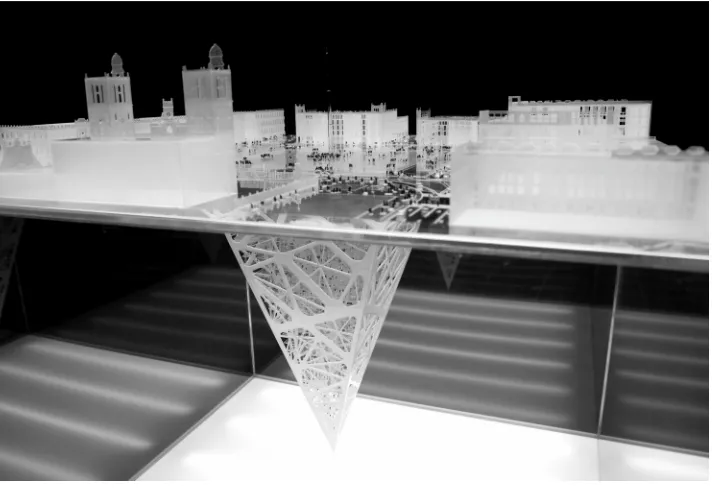
intentions for development of modern tourist infrastructure (e.g., Shimao 304
Wonderland in Shanghai, China or the Earthscraper in Mexico) (Figure 4). 305
306
2.1.2 Classification by the underlying causes for development
307
308
Keyword analysis also enabled us to gain insight into the underlying causes for 309
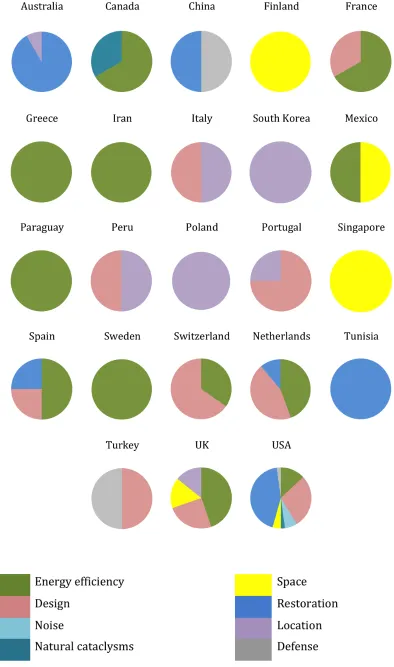
distributed urban underground development projects (Figure 5). 310
According to the data, the main underlying reason for exploring underground 311
habitat is increased or uncertain energy costs (e.g., Greece, Paraguay, Spain), or 312
personal choice, for example, eco-‐living with minimal impact on the surrounding 313
environment (e.g., Sweden, Netherlands, France, Canada). Very often, the desire for 314
eco-‐living is confirmed by combination with sustainable architecture requirements 315
(France, Switzerland, Netherlands, UK), designed in response to the specific climate 316
of the country and often with in-‐built passive low-‐energy features, including solar 317
shading (Las Vegas, US), natural ventilation (The Book House, Portugal) and lighting 318
and 50% more light than the equivalent-‐sized window because of the fact it is 320
horizontal” (Chiswick, London, UK)(McCloud, 2012). 321
Location is also one of the top reasons to consider building underground in prime 322
urban areas: ‘Holland Park is one of London’s most desirable areas: we like it 323
because it is quite villagey, even though you are in central London; it is also very 324
close to the London parks.’ (Holland Park, London, UK) (McCloud, 2012). 325
The need for space is also one of the most defining factors of the modern living 326
experience. The data analysis revealed that this need is particularly pressing for 327
capitals and mega-‐cities (e.g., Helsinki, London, Mexico, New York), where growing 328
infrastructure and restrictions to build over ground lead to consideration of 329
alternative spaces for development. 330
Many personal underground undertakings take place in already pre-‐developed 331
underground spaces. Abandoned mines and quarries, old bunkers or neglected 332
ancient caves can be successfully repurposed for living conditions (e.g., Coober Pedy 333
in Australia, Matmata in Tunisia or Zhengzhou in China). 334
Natural cataclysms (such as storms and wildfires) were highlighted primarily in 335
the countries of North America (US and Canada). Very few projects mentioned noise 336
as a reason for digging underground (e.g., town of East Hampton, New York). 337
338
2.2 Virtual engagement and sentiments of urban audiences
339
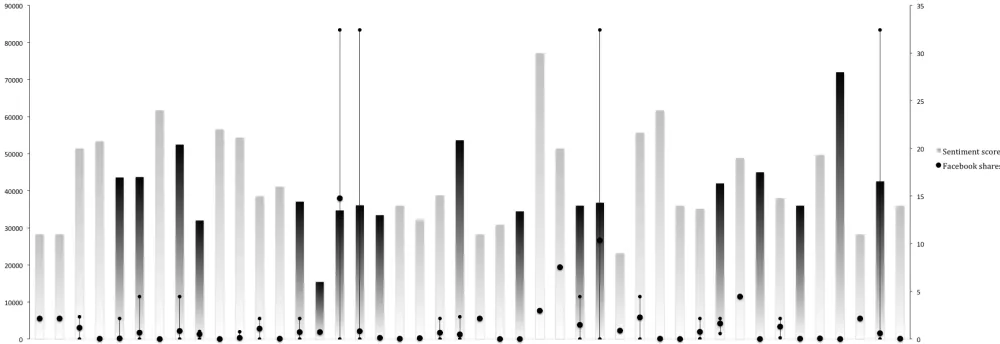
Virtual engagement and sentiment of urban audiences as quantitative and 341
qualitative traditions in opinion mining are summarized in Figure 6. For the 342
quantitative engagement, the number of Facebook ‘likes’, ‘shares’ and ‘clicks’ have 343
been summarized into a single indicator and aggregated for each country across the 344
whole inventory of comments. The relative sentiment has been averaged across 345
comments and for each country, respectively. 346
Figure 6 demonstrates that the overall sentiment towards this architectural trend 347
is positive across all countries in this study. It is also the case that no correlation 348
was identified between the engagement activity and the average sentiment score: 349
countries such as France, United Kingdom, Netherlands and the United States 350
demonstrate very high levels of social engagement, coupled with a relatively modest 351
sentiment expression, while Tunisia, Oman and Morocco have more positive 352
attitudes, but an insignificant degree of activity on social media and thus a low 353
expectation of message spread within their urban communities. This finding can, in 354
part, be explained by the differences in cultures of engagement with digital media 355
between these two groups of countries (GWI, 2015). 356
The highest sentiment scores among countries where urban underground 357
development projects took place were for Tunisia, Italy and Switzerland; however, 358
none of these countries demonstrated particularly active dissemination of the 359
information on social media. As previously discussed, this can partly be explained 360
by the culture of digital engagement; non-‐English commentary is also likely, but was 361
Scandinavian countries such as Finland and Norway demonstrate the lowest 363
positive engagement with the prospects for personal underground living. This could 364
be caused by several factors, one of which is linguistic, the manner Nordic people 365
express themselves is less emotional (Warner-‐Søderholm, 2012), but also 366
geographical, as having long dark seasons already limits citizens’ exposure to 367
natural light. 368
Manual analysis of comments has revealed arguments which can often be 369
overlooked in sentiment analysis, as well as some common misconceptions 370
concerning the underground lifestyle. For example, some personal beliefs (e.g., ‘I do 371
not think I could live down that hole’) might demonstrate deeply rooted opinions, 372
which are unlikely to change under any type of argument. Some retrospective 373
misconceptions indicate the need for better communication of the design of 374
underground homes (e.g., ‘The last thing you want is to use daylight fluorescent 375
tubes. So I specifically light things so you get great shafts of light that give you that 376
contrast between light and shadow’). It is desirable, therefore, to expand the study 377
in due course toward a more detailed analysis of the comments. We plan, therefore, 378
to collect and interpret more personal drivers behind underground development 379
initiatives as part of the self-‐build movement, which can be of cultural, educational 380
or personal origin. 381
382
383
3. Conclusion
385
386
This study provides the first web-‐analytic-‐based insight into drivers behind 387
distributed self-‐build underground projects in urban locations worldwide. 388
Exploiting the principles of information propagation within the web sphere, the 389
study provides preliminary insights into values and opinions of both developers and 390
observers in urban environments. Conceptual mapping of this subject explored 391
which locations might hold the potential for underground development as an 392
alternative/parallel planning direction, based on ongoing development in those 393
cities or degrees of social approval for this type of accommodation. We believe that 394
the proposed web-‐analytic approach is a potentially powerful screening tool for 395
canvassing public opinion on urban planning matters, which can be employed 396
before more immersive types of engagement (e.g., forums or focus groups) with 397
urban residents or local authorities are commissioned. 398
399
Acknowledgements
400
401
This research is supported in part by the EPSRC Centre for Doctoral Training in 402
Urban Science and Progress (EP/L016400/1). This project is conducted in 403
collaboration with the British Geological Survey (BGS), and the authors are grateful 404
for their support in this research. The authors thank Dr Andrew Hughes for his 405
to thank the anonymous reviewers for their constructive and encouraging 407
comments. 408
409
References
410
411
Ardvisson A (2011) General Sentiment: How Value and Affect Converge in the 412
Information Economy. The Sociological Review 59(s2): 39–59. 413
Bardi A Schwartz S (2003) Values and behaviour: strength and structure of 414
relations. Personality and Social Psychology Bulletin 29: 1207-‐1220. 415
Bodle R (2011) Regimes of Sharing. Information, Communication & Society 14
416
(3): 320–337. 417
Bridge D Hough E Kessler H (2005) The Current Role of Geological Mapping in 418
Geosciences. In: Urban Geology: Integrating Surface and Sub-‐Surface 419
Geoscientific Information for Development Needs, Springer, pp. 129-‐134. 420
Brin S Page L (1998) The Anatomy of a Large-‐Scale Hypertextual Web Search 421
Engine. Computer Networks and ISDN Systems 30(1): 107–17. 422
Bruns A (2007) Methodologies for Mapping the Political Blogosphere: An 423
Exploration Using the IssueCrawler Research Tool. First Monday 12(5). 424
Buunk W van der Weide L (2015) A value-‐oriented approach to discursive analysis 425
of urban and regional planning. In: Silva, E., Healey, P., Harris, N. and van der 426
Broeck, P. (eds). The Routledge Handbook of Planning Research Methods. 427
Curme C Preis T Stanley H Moat HS (2014) Quantifying the semantics of search 429
behaviour before stock market moves. Proceedings Of the National 430
Academy Of Sciences (USA) 111: 11600-‐11605. 431
De Mulder EFJ, Hack HRGK and van Ree CCDF (2012) Sustainable Development 432
and Management of the Shallow Subsurface. Geological Society of London, 433
Bath, UK. 434
DMI (Digital Methods Initiative)(2014a) Discus Comment Scraper Tool. 435
Amsterdam, Netherlands. See 436
https://tools.digitalmethods.net/beta/disqusScraper/ (accessed:
437
04/08/2015). 438
DMI (Digital Methods Initiative) (2013) LikeScraper Tool. Amsterdam, 439
Netherlands. See https://tools.digitalmethods.net/beta/likescraper/ 440
(accessed: 04/08/2015). 441
DMI (Digital Methods Initiative) (2014b) LocationRipper Tool. Amsterdam, 442
Netherlands. See https://tools.digitalmethods.net/beta/geoExtraction/ 443
(accessed: 04/08/2015). 444
DMI (Digital Methods Initiative) (2012a) Raw Text to Tag Cloud Engine Tool. 445
Amsterdam, Netherlands. See 446
https://tools.digitalmethods.net/beta/tagcloud/ (accessed: 04/08/2015).
447
DMI (Digital Methods Initiative) (2012b) SentenceRipper Tool. Amsterdam, 448
Netherlands. See https://tools.digitalmethods.net/beta/sentences/ 449
DMI (Digital Methods Initiative) (2014c) TrackerTracker Tool. Amsterdam, 451
Netherlands. See https://tools.digitalmethods.net/beta/trackerTracker/ 452
(accessed: 04/08/2015). 453
Dobinson K Bowen R (1997) Towards a 4-‐Dimensional City. Warren Centre, 454
Australia. 455
Feldman R (2013) Techniques and Applications for Sentiment Analysis. 456
Communications of the ACM 56(3): 82-‐89. 457
Flyvbjerg B (1998) Rationality and power: democracy in action. University of 458
Chicago Press, Chicago, US. 459
Garrett B (2012) Explore Everything: Place-‐Hacking the City, Verso, London, UK. 460
Geiger F (2015) Facebook Like Button Lands German Sites in Hot Water. The Wall 461
Street Journal Blogs. See http://blogs.wsj.com/digits/2015/05/22/facebook-‐
462
like-‐button-‐lands-‐german-‐sites-‐in-‐hot-‐water/
463
Gerlitz C Helmond A (2013) The Like Economy: Social Buttons and the Data-‐ 464
Intensive Web. New Media & Society 15(8): 1348-‐65. 465
Goel RK Singh B Zhao J (2012) Underground Infrastructures: Planning, Design, and 466
Construction. Elsevier, Oxford, UK. 467
Gray J (2015) Underground Construction. Sustainable Build. See 468
http://www.sustainablebuild.co.uk/constructionunderground.html
469
GWI Insight Report (2015) Social Media Engagement Summary: Analyzing How 470
ITA (International Tunneling Association) (1990) Legal and Administrative Issues 472
in Underground Space Use: a preliminary survey of member nations of the ITA. 473
Final report of the ITA Working Group 4. Tunneling and Underground Space 474
Technology 6(2): 191-‐210.
475
ITA (International Tunneling Association), Working Group 4 (2000) Planning and 476
mapping of underground space – an overview. Tunneling and Underground 477
Space Technology 15(3): 271-‐286. 478
Lackman J (2012) Urban eXperiment: The new French underground. WIRED, UK. 479
See http://www.wired.co.uk/magazine/archive/2012/03/features/the-‐new-‐
480
french-‐underground
481
Leaver H (2014) Building life from the bottom: are underground cities the future? 482
See http://metro.co.uk/2014/01/23/building-‐life-‐from-‐the-‐bottom-‐are-‐
483
underground-‐cities-‐the-‐future-‐4273806/
484
Liu B (2012) Sentiment Analysis and Opinion Mining. Morgan & Claypool 485
Publishers, Colorado, US. 486
Lovink G (2011) Networks without a cause: A critique of social media. Polity Press, 487
Cambridge, UK. 488
Marker BR (2009) Geology of megacities and urban areas. In: Engineering Geology 489
for Tomorrow’s Cities: Engineering Geology Special Publications 22(Culshaw 490
MG, Reeves HJ, Jefferson I and Spink TW (eds)). Geological Society of London, 491
McCloud K (2012) Grand Designs, Series 12, Episode 6. The Edwardian Artist’s 493
Studio, Channel 4, 24 October. 494
Pham D (2010) Gary Neville’s Underground Eco Home Blends Into the Earth. 495
Inhabitat. See http://inhabitat.com/gary-‐nevilles-‐zero-‐carbon-‐underground-‐
496
home/
497
RAIB (Rail Accident Investigation Branch) (2014a) RAIB report released into 498
penetration and obstruction of a tunnel between Old Street and Essex Road 499
stations, London, UK. See https://www.gov.uk/raib-‐reports/penetration-‐and-‐
500
obstruction-‐of-‐a-‐tunnel-‐between-‐old-‐street-‐and-‐essex-‐road-‐stations-‐london
501
(accessed 28/10/2015). 502
Rogers CDF (2009) Substructures, underground space and sustainable urban 503
environments. In Engineering Geology for Tomorrow’s Cities: Engineering 504
Geology Special Publications 22 (Culshaw MG, Reeves HJ, Jefferson I and Spink 505
TW (eds)). Geological Society of London, Bath, UK, pp. 177-‐188. 506
Rogers R (2013a) Search as Research: Source Distance and Cross-‐Spherical 507
Analysis. In: Rogers, R. Digital Methods. The MIT Press, pp. 95-‐125. 508
Rogers R (2013b) The End of the Virtual: Digital Methods. In: Rogers, R. Digital 509
Methods. The MIT Press, pp. 19-‐39. 510
Ronka K Ritola J Rauhala K (1998) Underground Space in Land Use Planning. 511
Tunneling and Underground Space Technology 13(1): 39-‐50. 512
Silva CN (2012) Online Research Methods in Urban and Planning Studies: Design 513
Townsend A (2014) Smart Cities. Norton & Company, New York | London, 515
pp.115-‐142 516
Warner-‐Søderholm G (2012) Norwegian Cultural Identity Within a 517
Scandinavian Context. Culture Matters, 518
http://dx.doi.org/10.1177/2158244012471350
519
Weltevrede E Helmond A (2012) Where Do Bloggers Blog? Platform Transitions 520
within the Historical Dutch Blogosphere. First Monday 17(2). 521
Yang X Chen Z Guo D (2015) Comprehensive evaluation of environmental and 522
economic benefits of China’s urban underground transportation construction 523
projects. Journal of Environmental Biology 36: 733-‐744. 524
Yoneda Y (2014) 6 Fascinating Underground Homes That Go Above and Beyond. 525
Inhabitat. See: http://inhabitat.com/6-‐fascinating-‐underground-‐homes-‐that-‐
526
go-‐above-‐and-‐beyond/ (accessed 28/03/2015).
527
528
529
530
531
532
533
534
535
List of figures
537
538
Figure 1. Relative proportion of the search terms to the total volume of queries. 539
Data source: Google Trends 540
541
542
543
544
545
546
[image:26.595.57.518.77.466.2]548
549
550
Figure 2. Workflow model 551
552
553
554
555
556
557
558
559
[image:27.595.62.454.168.300.2]561
562
[image:28.595.64.465.41.660.2]
564
Figure 4. Prototype model for Earthscraper underground development project, 565
Mexico City, Mexico (“BNKP Arquitectura – The Earthscraper model 03.jpg” by 566
ForgeMind ArchiMedia – CC : BY) 567
568
569
570
571
572
573
574
575
576
577
[image:29.595.55.411.42.286.2]579
580
[image:30.595.56.450.43.710.2]
582
Figure 6. Combined quantitative and qualitative indicators of public engagement 583
with underground development projects on the web (darker bars represent 584
[image:31.595.66.566.58.230.2]