Detection and Identification of Roman Emperors Using
Facial Recognition
Karel van Klink
University of Twente P.O. Box 217, 7500AE EnschedeThe Netherlands
[email protected]
ABSTRACT
Facial recognition is a much developed field of research, but the technique has not before been applied to recog-nizing Roman Emperors’ statues. In this research we will attempt to classify and identify statues and busts of Ro-man Emperors using existing techniques, and discuss what features of these statues cause different results compared to pictures of human faces. The results are ROC curves for all the used test scenarios, and matrices with Euclidean distances among all the faces of Roman Emperors in the dataset that was used. From this we conclude that Roman Emperors can be distinguished using existing techniques, albeit at inferior performance compared to distinguishing human faces. We also conclude that details such as a miss-ing tip of the nose or varymiss-ing levels of detail in the eyes and pupils pose a major influence on the result of the clas-sification by the existing solutions used.
Keywords
Face detection, Facial recognition, Neural network, DLIB, Facenet
1.
INTRODUCTION
For hundreds of years, the majority of Europe was part of the Roman Empire. Ruled by numerous Emperors, who were depicted in statues and busts all over the differ-ent provinces. During these times, Roman sculptors may very well have used meticulous directions for making these sculptures. With new techniques available in the fields of texture classification and facial recognition, we now have the means to (dis) confirm this theory. This research will seek to answer the questions regarding the working ods of Roman sculptors, how precise their working meth-ods were, and how similar the busts and statues of different Roman Emperors really are, from a facial recognition per-spective.
This research will continue where research on facial recog-nition for paintings and police sketches left off [11, 9, 18]. The situations presented in these papers are similar, in the sense that they all use pictures that aren’t a picture of a person, but an ’artist impression’. This is also the case for
Permission to make digital or hard copies of all or part of this work for personal or classroom use is granted without fee provided that copies are not made or distributed for profit or commercial advantage and that copies bear this notice and the full citation on the first page. To copy oth-erwise, or republish, to post on servers or to redistribute to lists, requires prior specific permission and/or a fee.
31stTwente Student Conference on ITJuly 5th, 2019, Enschede, The Netherlands.
Copyright2019, University of Twente, Faculty of Electrical Engineer-ing, Mathematics and Computer Science.
the sculptures of Roman Emperors. What makes this re-search different however, is the fact that the sculptures do not have the same texture that the sketches and paintings have.
2.
RESEARCH QUESTIONS
This paper answers the following research questions.
RQ1 Can existing facial recognition solutions be used to recognize and identify sculptures of Roman Emper-ors?
RQ1.1 What is the performance of existing solu-tions for identifying Roman Emperors, com-pared to identifying human faces.
RQ1.2 What differences between statues of Roman Emperors and pictures of human faces sig-nificantly influence the performance of the classifiers?
3.
RELATED WORK
Much research has been done on texture analysis, facial recognition, and facial expression recognition [8, 19, 10, 5]. Facial recognition in the case ofcooperative user sce-narios [7] has been readily applied in real-life situations such as - but not limited to - facial recognition systems at airports for automated border control gates [12]. It has to some extent been applied to statues in work done by Tyler et al. using a 3D morph-able model [17], to police sketches [18, 9], and to paintings made throughout history by Rosa et al. [11]. However, the work done by Rosa et al. used a proprietary solution by now Facebook-owned Face.com [15, 16] and can therefore not be replicated.
The research that has already been done was presented with a situation that is similar to this research. The stat-ues of Roman Emperors are not true pictures taken of the actual Emperors themselves, but are artistic impressions. The difference is in the way this has been done. Both the paintings and sketches in the research done by Tyler et al. [17] and Rosa et al. [11] respectively, used depictions of people that have a texture that is more true to nature. For the Roman Emperors this is not the case. This research will contribute by applying facial recognition to the sculp-tures of Roman Emperors, in order to investigate whether existing classifiers can be applied to these statues, and how these solutions can be improved upon in order to increase the accuracy of the classifiers when used on these statues.
4.
BACKGROUND
untrained. In this paper, we will focus on using trained techniques. We will make use of two different classifiers:
DLIB[6] andFacenet[13].
4.1
datasets
Roman Emperors
The dataset of Roman Emperors used in this research con-sists of 140 pictures, almost all of which are taken from a frontal perspective. The dataset contains some pictures under different lighting conditions, and with the subject not facing the camera directly. These are assumed to be only minor problems. What will be a bigger challenge however, is dealing with other situations that would not occur in a more common recognition scenario. Things like a lack of pupils or cracks covering the face are among po-tential issues for a classifier to accommodate for.
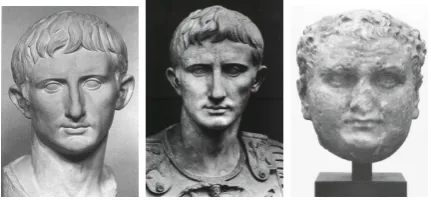
Some of the potentially problematic situations are shown in the pictures in Figure 1. From left to right we have the following pictures with their corresponding caveats. The first picture shows a (relatively) ideal situation: no cracks on the sculpture, clear lighting and no missing chunks as a result of damage done to the bust. In the second example we see a situation that should not pose a problem to most modern classifiers: low illumination. The third picture shows a face with a very rough texture, as opposed to the more smooth faces in the other pictures. This could result in mixed results depending on the classifier used, since it will have a different effect on LBP or LDP based classi-fiers. These kinds of classifiers make use of local changes in texture, thus possibly resulting in a different outcome depending on the contrast present in a picture.
[image:2.595.62.278.510.610.2]The dataset also contains statues that contain other blem-ishes, such as a missing or damaged nose, damaged eyes, or even missing a substantial part of theinner face. Given the fact that these consist for only roughly one third of the total dataset, we choose to disregard these pictures. By doing this, we will have higher performance when us-ing existus-ing classifiers, and will yield better results when improving upon these.
Figure 1. Samples from the used dataset that dis-play different encountered situations when classi-fying
Human Faces
To compare the results of the recognition of the Roman Emperors, we will use a dataset consisting of frontal pic-tures of human faces. The dataset we use is part of the FRGCv2 dataset [2]. Specifically, the Spring-2003 subset consisting of 4110 pictures of 150 different people.
Because the lighting conditions are similar for both datasets, and the fact that all pictures in both datasets are taken
from the front, we will be more likely to make a satisfac-tory comparison between the results of the datasets.
4.2
Evaluating the results
For evaluation of the results of the classifiers’ performances, we will make use of Receiver Operator Curves (ROC) and their corresponding Area Under Curve (AUC) values. “[An ROC] is a graphical representation for displaying the transition between T P R [True Positive Rate] and F P R [False Positive Rate]. T P R indicates correctly classified or total positive values and [are] plotted on the y-axis, whereasF P Rindicates incorrectly classified or total neg-ative values plotted on the x-axis” [14]. Classifiers with higher performance will have points close to T P R = 1 andF P R= 0, thus the area under that ROC (the AUC value) is close to 1. “The area under the ROC curve mea-sures the probability [. . . ] of the two images [. . . ] to be correctly identified” [4].
5.
METHOD
Existing Solutions (RQ1.1)
In order to verify and compare the performance of existing solutions on recognizing Roman Emperors, we will test on both the datasets of the Roman Emperors and the FR-CGv2 subset. On both these datasets, we use bothDLIB
[6] through a wrapper libraryface_recognition[3], and Facenet [13].
Measuring performance
To measure the performance, we first prepare the dataset of the Roman Emperors. We make a selection by hand on the pictures that are not damaged, and remove the pic-tures of Emperors that are missing a nose, or other parts of their face. This will leave us with 82 pictures of 26 emperors. After this, we remove duplicate pictures from the remainder of the dataset, resulting in 79 pictures of 26 emperors. We remove the duplicated, because these would have resulted in unrealistic results. Any classifier would be able to recognize two identical pictures. We make the selection on intact statues to be able to properly compare them using existing solutions, because the models for these networks have been trained on faces with all facial features present. The other dataset is kept as it is, and contains 4110 pictures of 150 different people.
After making the selection, we have two datasets that con-tain pictures that are not aligned. From these two sets, we create two new datasets that contain pictures that are all aligned. This is done using the dlib.frontal-_face_detectorandimutils.face_utils.FaceAligner. In the dataset of the Roman Emperors, one picture had to be manually aligned because it was not recognized by thefrontal_face_detectorwhich iskeizer (62).jpgas shown in Figure 2. The alignment is done using the algo-rithm found in Algoalgo-rithm 1.
With these four datasets, we now use the two recognizers to test their performances. From bothDLIBandFacenet
Figure 2. A statue of Emperor Commodus that could not be automatically aligned
The facial features are calculated withDLIBby using the algorithm shown in Algorithm 2 and Algorithm 3 shows the calculations done withFacenet. The computation of the ROC curve with its corresponding area under the curve is calculated as shown in Algorithm 4. On top of these graphs, we will plot the TPR and FPR rates against dif-ferent thresholds for the cases of the Roman Emperors and humans using DLIBand Facenetwith the unaligned pic-tures. These graphs will allow us to determine whether a threshold exists where the TPR is close to 1, and the FPR close to 0.
Causes of performance differences (RQ1.2)
With the computed ROC curves and AUC values, we will be able to draw a conclusion whether performance differs when using the classifiers on pictures of humans, or on statues of Roman Emperors. From this, we will perform a visual inspection on the pictures that seem to cause these discrepancies. The pictures that are to be inspected, are the ones that have been incorrectly labelled by the classi-fiers. These can be found by inspecting the matrix that is computed by both classifiers for all the distances between the vectors of facial features.In this matrix, we will look for the pictures that share a relatively low distance among each other, but do not share the same labels. From these pictures, we will perform a visual inspection on the facial features that these pictures share, and compare them to the facial features of the pic-tures they should have matched with instead. From this, we will draw a conclusion that seeks to answer research question 1.2.
6.
RESULTS
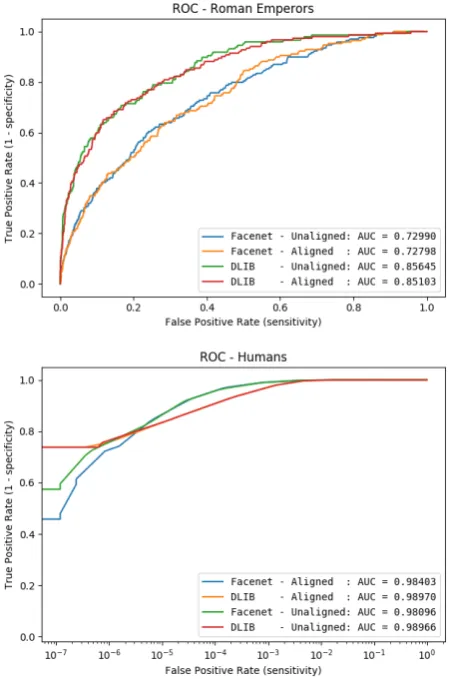
All the different ROC curves for the eight combinations possible between datasets, classifiers and aligned or un-aligned can be found in Figure 3. Each graph is titled accordingly by the classifier used, whether the pictures in the dataset were aligned or not, and what dataset was used. Note that in the titles, the dataset of human faces is calledSpring2003_controlled. Each graph also displays its corresponding area under the curve, or AUC value.
In Figure 4 we have the TPR and FPR values plotted against the threshold of the classification. From these graphs, we can see that for classifying human faces, both classifiers have a threshold value where the TPR is 1 and the FPR 0. For the classification of Roman Emperors, no such value exists. A similar graph can be found in Figure 5. Note that in this case, there is a range where the se-lection of a thresholddoes allow for classification at TPR nearly 1 and FPR nearly 0 at around 0.45 forDLIBand at around 0.9 forFacenet.
Figure 3. Various ROC curves using different methods and datasets
In the results, we also get the matrices of the distances between all the embeddings in Euclidean space. A part of one of these matrices is shown in Figure 6. In these matrices, we can spot some pictures with the same labels being incorrectly classified, because they have a relatively large distance between them. These pictures in particular are picture 58 considered a close match to pictures 1, 38, 64 and 90. Also, we have 127 relatively close to 52, and 36 close to exclusively 37. All despite the fact that these pictures are of different Emperors. The difference between pictures 37 and 138 compared to the other pictures of the same Emperor can be found in Figure 6. The complete matrix, and all the other matrices from the different test scenarios can be found in Appendix A.
6.1
Discussion
Performance of classifiers
[image:3.595.312.537.58.398.2]align-Figure 4. TPR and FPR at various thresholds when classifying Roman Emperors
Figure 5. TPR and FPR at various thresholds when classifying humans
ment on the input pictures internally when calculating the embeddings, the fact that the differences between un-aligned and un-aligned pictures are negligible is to be ex-pected.
Causes of incorrect classification
Looking at the results in the matrix, we will perform a visual inspection on the incorrectly labelled pictures that share a relatively low mutual distance between their em-beddings.
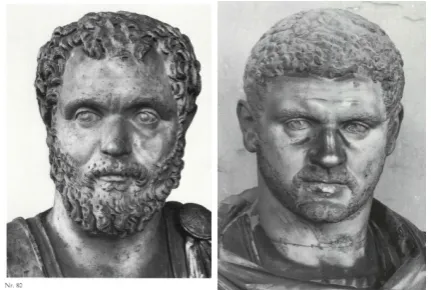
[image:4.595.58.282.55.222.2]First, we have picture 58 ranking closest to pictures 1, 38, 64 and 90. Upon inspection of these pictures, the reason for this to happen becomes obvious. In all these pictures the subjects are looking in the same direction, and both Emperors share a similar style of facial hair. Pictures 58 and 90 are shown side-by-side in Figure 7. However, pic-ture 58 is the only picpic-ture that contains Emperor Clodius Albinus. (This situation also arises with picture 131 for example, since it is the only picture of Emperor Vespasian) Therefore, the closest match never could have been a cor-rect one. Despite this fact, the mutual distances are of such proximity that they fall within the same range as for actual matches. If classified correctly, the pictures of ’single’ emperors should all have relatively large distances from the other faces in the set. This is not the case for
Figure 6. Part of the matrix of Euclidean distances between faces detected in the dataset of Roman Emperors
most of the Emperors that only have a single picture in the dataset.
Figure 7. Statues of Emperors Clodius Albinus and Caracalla. The statue of Clodius Albinus is incorrectly classified as a depiction of Caracalla
Next, there is the case of pictures 127 and 52 of Emperors Tiberius and Marcus Aurelius. Picture 127 was incorrectly classified as a depiction of Emperor Marcus Aurelius, de-spite the fact that 4 more pictures of Tiberius were in the dataset. Their distances to picture 127 were greater than the distance to picture 52. Upon inspection, we notice that picture 127 and 52 do indeed share some facial features to a certain extent. Both are shown in Figure 8. Here we can see that both faces share a similar shape, and that in both cases the pupils are missing. The statues might not contain any retinas or contrasted pupils, there are cases where the retinas are outlined which might help in classi-fication. Here, this is not the case.
[image:4.595.317.533.268.413.2] [image:4.595.57.284.275.440.2]Figure 8. Statues of Emperors Tiberius and Mar-cus Aurelius, where this statue of Tiberius is in-correctly classified as Marcus Aurelius
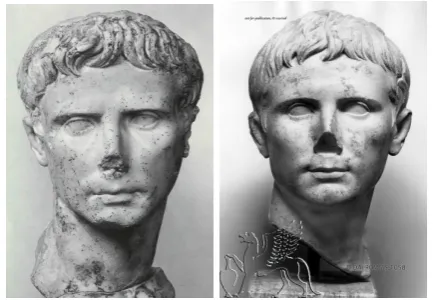
apparent why they are classified almost separately from the other statues of Emperor Augustus. Both pictures 37 and 138 are shown in Figure 9.
Figure 9. Statues of Augustus that are classified separately from the other statues of Augustus
7.
CONCLUSIONS
With the results found in the ROC curves and their corre-sponding AUC values, we can conclude that existing clas-sifiers are sufficiently able to distinguish statues of Roman Emperors. However, these results still are significantly lacking when compared to the results on human faces. This is most likely due to the fact that these classifiers have never been trained on pictures of Roman Emperors. A way to improve these results would be to have the net-works train on pictures of Roman Emperors instead of human faces.
Because of the limited size of the dataset of Roman Emper-ors, there were many cases of Emperors incorrectly clas-sified simply because of the fact that they appeared as single pictures in the set. An improvement for further work would be to construct a dataset that contains more pictures of Roman Emperors that do not contain many blemishes. As could be seen for the pictures in Figure 9, a common imperfection can cause a separation in classifica-tion. Also, classifications appear to be heavily influenced by details such as the pupils and overall details of the eyes. For human faces, this is a very valid feature to train a net-work on, but for the Emperors’ statues, these can vary
significantly per Emperor. This could be circumvented by training a network on pictures of Emperors in such a way where details in the eyes are found to be much less impor-tant, or by pre-processing the pictures in such a way that the eyes are the same for all the statues.
8.
REFERENCES
[1] K. Chengeta and S. Viriri. A survey on facial recognition based on local directional and local binary patterns. In2018 Conference on Information Communications Technology and Society (ICTAS), pages 1–6, Durban, Mar. 2018. IEEE.
[2] P. A. Flanagan. Face Recognition Grand Challenge (FRGC), Dec. 2010.
[3] A. Geitgey. The world’s simplest facial recognition api for Python and the command line:
ageitgey/face recognition, May 2019. original-date: 2017-03-03T21:52:39Z.
[4] J. A. Hanley and B. J. McNeil. The meaning and use of the area under a receiver operating characteristic (ROC) curve.Radiology, 143(1):29–36, Apr. 1982. [5] T. Jabid, M. H. Kabir, and O. Chae. Local
Directional Pattern (LDP) for face recognition. In 2010 Digest of Technical Papers International Conference on Consumer Electronics (ICCE), pages 329–330, Jan. 2010.
[6] D. E. King. Dlib-ml: A Machine Learning Toolkit. Journal of Machine Learning Research,
10:1755–1758, 2009.
[7] S. Z. Li and A. K. Jain, editors.Handbook of face recognition. Springer, London : New York, 2nd ed edition, 2011.
[8] W. Liu, S. Li, and Y. Wang. Automatic Facial Expression Recognition Based on Local Binary Patterns of Local Areas. In2009 WASE International Conference on Information
Engineering, volume 1, pages 197–200, July 2009. [9] S. Pramanik and D. Bhattacharjee. Geometric
feature based face-sketch recognition. In
International Conference on Pattern Recognition, Informatics and Medical Engineering
(PRIME-2012), pages 409–415, Mar. 2012.
[10] A. R. Rivera, J. R. Castillo, and O. O. Chae. Local Directional Number Pattern for Face Analysis: Face and Expression Recognition.IEEE Transactions on Image Processing, 22(5):1740–1752, May 2013. [11] J. d. l. Rosa and J.-L. Su ˜Aarez. A Quantitative,
Approach to Beauty. Perceived Attractiveness of Human Faces in World Painting.International Journal for Digital Art History, (1), June 2015. [12] J. Sanchez del Rio, D. Moctezuma, C. Conde,
I. Martin de Diego, and E. Cabello. Automated border control e-gates and facial recognition systems. Computers & Security, 62:49–72, Sept. 2016. [13] F. Schroff, D. Kalenichenko, and J. Philbin.
FaceNet: A Unified Embedding for Face Recognition and Clustering.2015 IEEE Conference on Computer Vision and Pattern Recognition (CVPR), pages 815–823, June 2015. arXiv: 1503.03832. [14] M. Sundaram and A. Mani. Face Recognition:
Demystification of Multifarious Aspect in Evaluation Metrics.Face Recognition - Semisupervised
Classification, Subspace Projection and Evaluation Methods, July 2016.
[image:5.595.61.278.309.459.2]Unconstrained Face Recognition.arXiv:1108.1122 [cs], Aug. 2011. arXiv: 1108.1122.
[16] A. Tsotsis. Facebook Scoops Up Face.com For $55-60m To Bolster Its Facial Recognition Tech (Updated).
[17] C. W. Tyler, W. A. P. Smith, and D. G. Stork. In search of Leonardo: computer-based facial image analysis of Renaissance artworks for identifying Leonardo as subject. InHuman Vision and Electronic Imaging XVII, volume 8291, page 82911D. International Society for Optics and Photonics, Feb. 2012.
[18] R. G. Uhl, N. d. V. Lobo, and Y. H. Kwon. Recognizing a facial image from a police sketch. In Proceedings of 1994 IEEE Workshop on Applications of Computer Vision, pages 129–137, Dec. 1994. [19] H. Zhou, R. Wang, and C. Wang. A novel extended
local-binary-pattern operator for texture analysis. Information Sciences, 178(22):4314–4325, Nov. 2008.
APPENDIX
A.
ALGORITHMS USED FOR
Algorithm 1:Aligning faces found in provided pictures
Input: f iles: list of filenames to align
Output: Images of aligned faces
detector=dlib.get_frontal_face_detector()
predictor=dlib.shape_predictor(’shape_predictor_68_landmarks.dat’)
f a=FaceAligner(predictor, desiredWidth=1024)
foreachimginf iles:
image=imutils.resize(cv2.imread(img), width=2000) # Convert image to grayscale
gray=cv2.cvtColor(image, cv2.COLOR_BGR2GRAY)
# Get coordinates of rectangle around the face in the picture
rects=detector(gray)
# Align the found face using the detected coordinates
aligned f ace=fa.align(image, gray, rects[0]) # Store the aligned face to the filesystem cv2.imwrite(path, aligned_f ace)
Algorithm 2:Calculation of facial encodings usingDLIB
Input: f iles: list of filenames with faces
Output: encodings: list of all facial encodings in the files from the input f ace encodings= []
foreachimg pathinf iles:
image=face_recognition.load_image_file(img_path)
f ace bounding boxes=face_recognition.face_locations(image)
# Get the encoding for the first (and only) face in the current image
encoding=face_recognition.face_encodings(image)[0]
# Append the encoding of the current face to the result list
f ace encodings.append(encoding)
Algorithm 3:Calculation of facial encodings usingFacenet
Input: f iles,labels: list of filenames with faces and their corresponding labels
Output: encodings: list of all facial encodings in the input files
embeddings=tf.get_default_graph().get_tensor_by_name("embeddings:0")
encodings= [] sess=tf.Session()
foreachf ileinf iles:
img=facenet.load_data(f ile)
f eed dict=images_placeholder: img
# Get embedding for current image
embed=sess.run(embeddings, feed_dict=f eeddict)
# Append current encoding to the result list
Algorithm 4:Computation of the ROC graph with the area under curve metric
Input: encodings,labels: list of facial encodings as vectors and their corresponding labels
Output: points,auc: list of points of the ROC curve and the auc value distances=sklean.metrics.pairwise.euclidean_distances(encodings)
points= []
# p is set to the amount of positives in the set # n is set to the amount of negatives in the set
max threshold=max(list(zip(*distances))[0])
threshold= 0
whilethreshold <=max threshold:
tp= 0 /* amount of true positives */
f p= 0 /* amount of false positives */
foreachi,person inenumerate(distances):
# Iterate over all the persons
foreachj,match inenumerate(person):
# Iterate over every distance relative to that person
if i==j: /* Ignore the diagonal where all distances are 0 */ continue
elif match < threshold:
if labels[i] ==labels[j]: /* Check if a match is true or not */
tp+= 1
else:
f p+= 1
tpr=tp/p f pr=f p/n
# Add the TPR and FPR to the ROC curve
points.append([f pr, tpr])
threshold+= (max_threshold / 1000)