Analyzing change in future thought with Letters from the
Future
University of Twente
Faculty of Behavioral, Management and Social Sciences
Positive Psychology and Technology
16.06.2019
Eric Haase
s1872702
Supervisor: Anneke Sools
Abstract
Background. This thesis examines the question how stable narrative futuring, the imagination of the future through stories, is over a period of four weeks. Human beings have an innate ability to imagine the future and futuring methods have shown that consciously working with the future can lead to effects such as motivation, increased well-being and guidance of the present. There are several methods with which the future can consciously be worked with and one of them is the novel technique ‘Letters from the Future’. The method invites participants to imagine a desired future and then send a letter back to the present. What is yet to understand is how these methods have the effect they have and therefore this thesis focuses on analyzing the stability of characteristics of futuring over time. Current research suggests that these characteristics are stable.
Method. Nine participants from both student and working backgrounds completed the study by writing one letter weekly for four weeks. Through qualitative analysis nine characteristics of narrative futuring were analyzed in the letters to determine the stability of futuring processes (content, emotions, audience, temporal orientation, function of the letter, role of the letter, valence, specificity and subjective time horizon).
Results. The content of letters varied greatly with wishes of improvements of the Self (e.g. being happy) and the job being predominant. The imagined future was mostly years away from the present, the function of the letter predominantly was to orient and evaluate the present. Overall the characteristics have stayed stable over the four weeks but individually changes occurred especially between week 4 and the rest of the weeks.
Discussion. Even though no efforts were made to induce a change in narrative still some of the participants had significantly changing letters. Even the stable cases presented some form of change that wasn’t apparent through the coding scheme alone and other forms of information gathering such as interviews are proposed to get a more holistic picture of futuring processes. Future studies should focus on analyzing what ‘change’ is helpful and how to foster positive,
Introduction
Letter from the future by one of the participants
Dear past me,
I am writing to you from the beautiful nature I am surrounded by, a few years from where
you are now. Waterfalls, forests, clear lakes. This is what grounds you. Nature. Slowing
down. Remember that. I am so at peace with myself and my life right now. I have taken the
chances and risks I was terrified to take, I have freed myself from what people thought I
SHOULD do and instead went with what felt right. I feel so much myself. I miss my family
and friends yes, but I know I will see them again. They adjusted to the situation, they know I
cannot be held back, if I want to be happy. I am free emotionally, spiritually and physically. I
have learned all the wonderful things that interested me, and have fun great joy and peace
with this decision. I can still integrate what I have learned, but I opened my mind to other
options because it felt right. You should acknowledge that wherever you go. You make your
own decisions, and you are free minded. Don't try to change that and be something you're
not just because you think other's will not approve. Acknowledge your true self, although it
might seem hard sometimes. Trust in yourself and your abilities, you have got an amazing
power resting within you. Let it happen, take the risks, get outside your comfort zone. Learn
to find the calm within all the chaos and learn to love the chaos itself. Breathe. Everything
will be fine, let it flow.
Lots of love, future me
Futuring and the study of the future
The present study aims at utilizing ‘Letters from the Future’ to research the stability and change
Imagining the future is an innate human capacity. Some evolutionary researchers even propose that it is a unique human ability with evolutionary importance for survival (Suddendorf & Corballis, 2007). Many psychologists have acknowledged the importance of incorporating the concept of future into models and therapies. Abraham Maslow stated that “no theory of
psychology will ever be complete which does not centrally incorporate the concept that man has his future within him, dynamically active at this present moment” (1986: 15). Futuring is, even if not explicit, part of most psychological theories: no learning theory or theory of self-actualization would be possible without having the future as a given circumstance (Sools & Mooren, 2012). One can imagine wanting to become healthier: in the present you are not as healthy as you desire, but through time you want to practice behaviors so that in the future you will be healthier. Also emotions, such as anxiety, presuppose the existence of a future: “If I
leave the house, something bad might happen.” Right now, in the present, there exists a fear that in a possible future something bad might happen.
To clearly define the capacity for futuring one could compare it to the process of remembering the past. While both futuring and remembering the past share ‘present-centeredness’, meaning that both remembering and imagining start from the present and
influence the present, the past is contained of lived-through experiences and the future of expectations of the not-lived-yet (Sools, Trilivia, & Filippas, 2017). That leads to remembered experiences being concrete, vivid and complete while imaginations being vague and incomplete. The goal of the Letters from the Future is to make imagining more concrete by “constructing a future self as if realized, with a vivid portrayal of the future self ‘as an experiencing subject’” (Sools, Trilivia, & Filippas, 2017).
To conclude, futuring is an innate capacity for human beings that can be lived consciously or unconsciously. It is distinctive to remembering the past in that it is less concrete, more vague and creative because it entails the not-yet-happened.
Possible selves
One of the theories that concerns itself with the future is the theory of possible selves. Markus and Nurius have proposed the concept of possible selves which have been defined as mental concepts of our selves in the future that have the functionality of motivating and moderating present behavior (Markus & Nurius, 1986). Erikson continued to more clearly define the concept of possible selves as “conceptions of our selves in the future, including, at least to some
their social and cultural context” (Erikson, 2007). Possible selves are therefore parts of the
human psyche and form our expectations and wishes for the future. They can be both positive and negative and are often influenced by our present self and, as presented by Erikson, the social and cultural context.
The future self needs to be experientally close to the current self to have a motivating effect (Strahan & Wilson, 2006), similar to the findings on futuring by Oettingen and Mayer (2002) who distinguish future-directed thinking into two forms that both lead to motivation. They define expectations as having an image of a future which is deemed as likely to happen and fantasies as leading to positive emotions about a desired future. In their study high levels of expectation led to motivation and success while high levels of positive fantasy and absence of negative fantasies led to low levels of motivation and success. This suggests that positive fantasies might be unproductive in attaining goals because they are too far from reality and, compared to an expectation, do not consider the likeliness of a future happening or not.
Possible selves can further be distinguished into hoped-for and feared selves that either follow a pathway for achievement or a pathway of avoidance (Barreto & Frazier, 2012) but both lead to motivation. In the hoped-for case a person is encouraged and guided towards the desired self, in the feared self it prevents behaviors and encourages counter-behaviors to lead to desired selves.
Through the research on possible selves several instruments have been created such as the ‘best possible selves’. The best possible selves technique invites participants to imagine
and then write about a future in which all desired things have happened (Meevissen, Peters, & Alberts, 2011). Doing this repeatedly was linked to increasing people’s mood, well-being and
optimism (Peters et al., 2010; King, 2001) and the conscious dealing with possible selves generally has been linked to increases in motivation (Barreto & Frazier, 2012; Wambua, Wambua, & Kigwilu, 2017; Oettingen & Mayer, 2002).
beings is made meaningful, understood and interpreted” (Crossley, 2000) through narratives
and stories.
Considering the application of the method, Sools and Mooren (2012) have suggested that using Letters from the Future could be useful in increasing resilience in human beings which is a necessary condition to anticipate social crisis and change. Furthermore, the tool has been used to investigate how greek citizens make sense of the Greek Referendum in 2015 (Sools, Triliva, Fragkiadaki, Tzanakis, & Gkinopoulos, 2018). This provided deep insight into how the citizens coped with this impactful situation and how they anticipated change. Furthermore, the researchers suggested that “Letters from the Future indeed facilitate possibility thinking in the face of uncertainty and anxiety” (Sools et al., 2018) and the use of the letters could provide political and social significance by “deploying possibility thinking as
a means towards political decision-making”.
Another study performed by Kress, Hinkle and Protivnak (2011) propose Letters from the Future to be used in school counselling as it has been shown that students are more willing to open up when they are partially engaged in something else, don’t directly talk to the counsellor or a creative intervention is proposed. Additionally, writing may reduce common problems with hearing impaired students or students from diverse cultures.
To conclude, possible selves can be regarded as key determinants in shaping meaning making and perception and therefore as an integral part of the human condition (Barreto & Frazier, 2012). The research into possible selves has shown that a) human beings have conceptions, namely possible selves, of themselves in the future, both positive and negative, that impact the present and b) experientally close, positive expectations in contrast to ‘far away’, unconcrete fantasies lead to well-being, increased mood, optimism and motivation.
Additionally, the method Letters from the Future can have a positive impact on possibility thinking and resilience. It is, however, yet to be found how these methods lead to the positive impact they have. One approach is mapping cognitive-narrative processes in form of analyzing characteristics of narrative and futuring.
Characteristics of Narrative and Futuring
to higher, more complex and less obvious characteristics such as ‘the functionality of the letter’ which is a characteristic that will be explained below.
In the study by Sools and Mooren (2012) on the relation between using Letters from the Future and resilience the “collected letters differed greatly in terms of content, structure, form, genre, audience and temporal orientation”. There seem to be little to no limits in variation
between the content of letters, ranging from an ‘Utopian manifest of the distant future’ to an ‘Ironic expression of personal achievement in the near future’. Content includes everything that
which the letter is about, topics such as the job, family or health. The content-descriptions also provide the element of temporal orientation in that it can be in a distant or near future. Concerning the audienceor receiver of the letter the letters were found to be directed at oneself, family members and friends or others such as a manifest to the whole world (Sools & Mooren, 2012).
Emotions are primary elements of narratives and often take up complex variation and expression. They are significant elements of narratives since they have the power to establish authenticity (Pence, 2004).
Furthermore, letters can fulfill various roles. The role of the letter varies greatly from individual to individual: some letters fulfill an emotional role by motivating or showing a process, others provide a behavioral role by encouraging action, next to other functions. In Sools & Mooren’s (2012) study the letters were categorized into four major dimensions: (a)
control by goal-directed behavior, (b) openness by anticipating an unknown future, (c) understanding by trying to make sense of what lies ahead and (d) intrinsic, concerned with imagining the future without a goal. Similar to these four roles, Miller (2015) claims that one should use flexible stances towards the future due to its unknown nature instead of past-driven, causal explanations, which is called flexibility. More generally, we should expand our typical closed stance towards the future (closed meaning perceiving as predictable) to an open stance towards the future (embracing the unknown), at least often times an open stance could be more helpful in achieving the desired goal than with a closed stance. This is in line with the four roles depicted, as role a) and c) reflect a closed stance and b) and d) an open stance and the two characteristics will be merged to ‘role of the letter’.
has been defined as evaluations of a person, situation or action. Orienting is defined as orienting oneself towards not-yet realized situations, feelings or actions. Expressing emotions has been defined as direct, clear expressions of emotions. Finally, engaging in dialogue is defined as explicit sentences directed at the writer as in a normal conversation. These definitions will also be applied here. There is variation in these functions and letters in general concerning valence. Valence refers to whether an optimistic or pessimistic outlook is taken upon the future. Since these two characteristics aren’t dependent on one another or too similar in concept they will be
kept split as two separate characteristics.
Sools’ (2019) examination on possible selves research has extended the list of
characteristics that individuals vary on for the concept of the subjective time horizon. Frederick Town Melges is one of the creators of the future oriented therapy and has termed the two concepts of objective and subjective time horizon. No primary sources could be found and therefore Sools and Mooren’s (2012) description of Melges ideas will be used. While the
objective time horizon is the clock-time and the time we use to measure things the subjective time-horizon represents how people experience time. This has three components: the individual’s sense of duration (long vs short) and rate (fast vs slow), temporal orientation (past,
present or future-focused) and succession (the unfolding of sequences of events). Melges used this theory to identify psychiatric disorders and to relate it to the subject’s subjective
time-horizon. For this case, subjective time-horizon will be defined on two dimensions: ‘slowing-down’ meaning that the future is perceived as far away by providing little detailed descriptions of the future and ‘speeding up’ meaning that the future is perceived as close to the present by
providing very detailed descriptions of the future.
The last characteristic is termed ‘Specificity’. Specificity entails how specific a respondent describes the future versus vague, open descriptions.
Below is the table with a list of all the characteristics described that could be found related to futuring.
Table 1
Characteristics Description
Goals, Wishes and Aspirations (Content)
Goals, wishes and aspirations that cover various domains, such as job, family or personality development.
Temporal Orientation
The outlook on the future can be towards a close future (f.e. within days) or a far-away future (i.e. a year or decades away).
Audience/ Receiver of the letter
The audience can be oneself, family and friends or other constructs such as the whole world.
Emotions Positive and negative emotions ranging from fear to excitement to happiness.
Role of letter/ Flexibility (Miller)
Four dimensions indicating the stance towards the future: (a) control by goal-directed behavior, (b) openness by anticipating an unknown future, (c) understanding by trying to make sense of what lies ahead and (d) intrinsic, concerned with imagining the future without a goal.
Functionality of letter
Five known functionalities: 1) imagining, 2) evaluating, 3) orienting, 4) expressing emotions and 5) engaging in dialogue.
Valence Optimism versus Pessimism. Narratives differ on a positive, neutral or negative outlook on the future.
Subjective time-horizon
Specificity Letters from the Future do vary on how specific the future looks. It can be either concrete through detailed descriptions of the future or abstract by describing the future globally, more open.
Expectation vs fantasy
Expectations lead to success and motivation while fantasies do not. It is assumed that expectations are deemed as highly likely to happen (which results in the effect) compared to fantasies that only lead to positive emotions about a future.
Stability and change of futuring
It is unclear yet whether these characteristics are susceptible to change or if they are stable over time even though being one important factor in determining the functionality of future thought. Factors such as Miller’s stance towards the future could benefit greatly from knowing whether
there is stability or change because then future interventions know whether and how to approach participants to motivate an open approach and depending on the stability for example how resistant participants will be. There is however some evidence about future processes’ stability from possible selves research. “Possible selves are dynamic and contextually sensitive” (Barreto & Frazier, 2012). Possible selves are also influenced by the developmental state of the individual: young people’s possible selves will be focused on career and romantic
relationships while old people focus on health issues and independence. In addition, Frazier and Hooker (2006) found that possible selves are also both stable and influenced by change over time: while (significant) experiences initiate change, “possible selves also create the sense of continuity that generates a sense of individuality and personhood” (as cited in Barreto &
Frazier, 2012).
In another study by Harding, Wyse and Morenoff (2016) they have looked at the narrative change (and stability) of prisoner reentry narratives. They have found four major characteristics that were linked to change and stability of the prisoner’s narrative: 1) the
not be fulfilled which would result in change of the narrative. It was proposed that “narratives may be resistant to change when they are reinforced by social ties and institutions, even if the individual faces structural circumstances that make realizing the narrative particularly difficult” (Harding, Wyse, & Morenoff, 2016).
No studies could be found that have considered the stability and change of the narrative characteristics described in table 1. While studies have found factors that influence narrative generally (for example in form of possible selves), the change of the individual, specific elements such as a Letter from the Future’s functionality of the letter or specificity over a period of time with multiple use of the technique haven’t been assessed. Examining this is of crucial
importance to understand why methods such as Letters from the Future or Best Possible Selves have the effects that they have. To answer this question this study will analyze how stable or dynamic these characteristics are over time.
Methods
An exploratory, web-based study was adopted that uses qualitative methods for data collection and analysis.
Participants
The study was conducted in 2019 and focused on individuals in a life-period of change. Change was defined as having an external event that lead to a change in daily life. Those ranged from graduating, moving to a new flat or getting into a relationship. Change was looked for because it gives an incentive to use methods such as the Letter from the Future and while possibly being beneficial for the participant also provides more valid data because the occurrence, so the writing of the letter, is more natural. No special writing skills were required.
Initially, four women and seven men were invited to participate in the study. In the first week nine of the eleven participants took part in the study, with two participants dropping off at the second week and one in each of the following two weeks, resulting in a sample of five participants that completed the whole study. The age (from the remaining 9 participants in week 1) ranged from 21 to 41 with a mean of 24. All participants were German. Seven of the participants were students, two were workers.
The method adopted is the Letters from the Future which was already described in the Introduction. It is more time- and cost-efficient and participants can decide themselves when to respond in their environment of choosing (Sools & Mooren, 2012). The study design is three-fold, 1) writing the letter, 2) asking questions about the letter and 3) collection of biographical information, similar to Sools and Mooren’s application of the method. The questions focused on the writing process and on things that the participants recognized themselves during the writing process that might be crucial for the analysis. At the beginning participants were asked for their informed consent and that the data will be handled for research purposes was explained.
Instructions for writing the letter were adopted from the study of Sools (2019) and can be seen in Appendix A. After reading the instructions the participants were asked to take a couple of moments, close their eyes, take a few deep breaths and let the mind take them where it goes and when vividly imagining the future moment starting to write. To ensure full incorporation of the instructions for optimal results a short summary of the instructions was provided at the text field where the letter was written:
“- don't worry about grammar or spelling, just write what comes to mind.
- imagine a desired future as if realized, discover new possibilities!
- imagine WHERE you are and WHEN your future has realized (is it an hour, a day, a month or years?)
- WHAT does this image of the future entail? did a wish come true, did you become more resourceful?
- HOW did you arrive in this future, what happened along the way?
- TO WHOM is the letter directed? what MESSAGE do you want to give to the recipient of the letter?”
Procedure
Participants were recruited through purposive sampling in combination with snowball sampling. The researcher invited students and friends that fulfilled the requirement of being in a state of change and some of them in turn invited participants they knew to also be in a state of change.
In the informed consent form participants were informed about all ethical guidelines as determined by the Ethics Committee BMS (https://www.utwente.nl/en/bms/research/ethics/) and were asked to either agree or disagree and cancel the study. Additionally, they were informed that they could terminate participation at any given moment without justification. All participants gave informed consent.
The participants received a weekly mail at the beginning of the week with the whole week to submit a letter between 1000 and 2500 symbols which resembles half to a full page.
Analysis
Development of the Coding Scheme. To develop the coding scheme, in a deductive approach the characteristics from table 1 were schemed and initial sub-codes were created with the help of the coding scheme used by Wonnink (2018) in her study on futuring processes (e.g. for ‘content; Dreams, Wishes and Aspirations’: Job, Successes, Experiences, Roles and Self)
and these were tested on the first two submitted letters for completeness. Due to the novelty of the coding no software was used for the coding and focus was on manual coding. Early on it became clear that the characteristic “Expectation vs. Fantasy” could not be included into the final coding scheme because it was not possible to make a valid assumption about whether a letter fulfilled an expectation or a fantasy. After the scheming with the first two letters an initial sub-set of codes and subcodes was present which was tested for its completeness with two other letters. When a unit of analysis did not fit into any of the categories a new sub-code was created, for example the initial amount of emotions taken by Wonnink’s study was extended by the emotion sadness. What followed is the following coding scheme where the individual elements will be explained more in-depth:
A. Dreams, Wishes and Aspirations: To assess the dreams, wishes and aspirations of participants first the presence of descriptions of those were assessed on a scale from 0 to 2, 0 representing no description at all, 1 a little description and 2 extensive descriptions of either one goal or multiple (for the following code descriptions the same explanation holds true for the 0-2 scale, otherwise it will be explained). Then the descriptions were put into the following five sub-codes Job, Successes, Experiences, Roles and Self.
the process it became clear that the last emotion was never present but rather a similar concept was, namely ‘afraid’. Additionally, later on the emotion ‘sad’ was also included
into the coding. These were then applied to the letters by looking at expressions of emotions such as explicit expressions of the respective emotion.
C. Receiver of the letter: For the receiver of the letter three dimensions were used: a) myself, b) family and friends and c) others. Those were indicated mostly at the beginning of letters by the introductory expression such as “Hey me,”.
D. Functionality of the letter: For the functionality of the letter the five functions (imagining, evaluating, orienting, expressing emotions and engaging in a dialogue) and the definitions which already have been explored in the Introduction have been used to analyze the presence of these functions in the letter. For example, an orienting-function became clear through tips and guidance through the future self.
E. Role of the letter: Similar to the analysis of the functionality of the letter here the descriptions of the four roles provided in the initial study by Sools & Mooren (2012) were read carefully and applied to the letters. Each role was assessed by its characteristics. For example an ‘openness by anticipating an unknown future’ had the
characteristic of not describing the future thoroughly or consciously withholding descriptions to ‘not spoil the future’.
F. Temporal orientation: For the analysis temporal orientation was divided into three sub-codes: 1) days to weeks, 2) years and 3) more than 10 years. This was the best suiting based on the given letters since most of them could be located in sub-code 2 and the others substantially earlier (code 1) or later (code 3). Indicators were explicit dates or expressed age differences.
G. Valence: For the analysis of valence, initially it was thought to only distinguish between optimism and pessimism but later on it became clear that often letters included a mix of both, different from topic to topic. Indicators of either were optimistic or pessimistic differences to the perceived present.
H. Specificity: For specificity a distinction was made between the two dimensions ‘specific and explained in detail’ to ‘vague and open’. For example a specific approach
was often determined by detailed descriptions including naming people or places. I. Subjective time horizon: Since subjective time horizon is very similar to specificity in
that the two dimensions ‘slowing down’ and ‘speeding up’ include the factor of little
time horizon was on the ‘feel’ of the letter, so whether the whole letter feels like its
close or far away to the participant.
Application of the coding.
Coding of all Letters Individually. Concerning the coding process of the letters the unit of analysis was both on the word and the sentence level. For some categories words were enough such as the description of emotions or the receiver of the letter. As explained above, emotions were mostly indicated through the explicit expression of the respective emotion or expressions that could be related to an emotion. For other characteristics such as the role of the letter mostly sentences and often chunks of sentences were the unit of analysis because they are complex concepts that are not explicit but need subjective interpretation. Additionally, some units of analysis did not only apply to one code but to multiple. Especially, when a unit of analysis was a sentence often multiple sub-codes of one code (e.g. functionality of the letter) or even multiple codes were present. Examples of units of analysis will be presented in the first part of the Result section.
Within-Person and Between-Person Comparison between Letters. The data was transmitted into tables with the count of codes for all weeks. That was performed both for between-person comparisons with the data of all participants for all weeks and within-person comparisons between the four letters. While for between-person comparisons numerical values, so counts of codes, were used (see table 2), within-person comparisons were based on the presence of codes as the comparative value (see table 3 and 4).
Choice of excerpts. The choice of excerpts was based on quotes that are representative for and explain the application and meaning of the codes and subcodes. Additionally, it was sought for that all letters are represented in the results description to convey coherence.
Results
Table 2
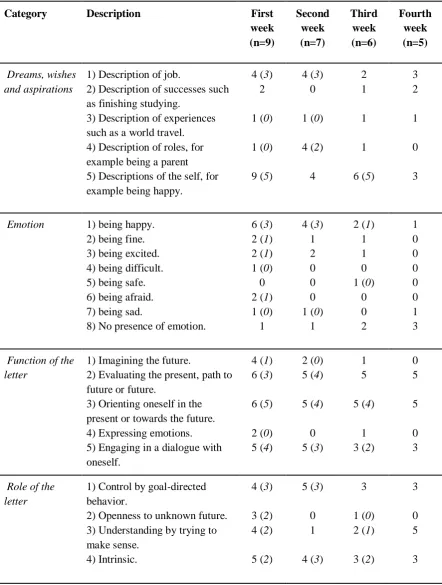
Codebook with abbreviated codes, code descriptions and frequency counts for all participants for all four weeks and frequency count changes for the five finishing participants in brackets
Category Description First
week (n=9) Second week (n=7) Third week (n=6) Fourth week (n=5) Dreams, wishes and aspirations
1) Description of job.
2) Description of successes such as finishing studying.
3) Description of experiences such as a world travel. 4) Description of roles, for example being a parent 5) Descriptions of the self, for example being happy.
4 (3) 2
1 (0)
1 (0)
9 (5)
4 (3) 0
1 (0)
4 (2) 4 2 1 1 1
6 (5)
3 2 1 0 3
Emotion 1) being happy. 2) being fine. 3) being excited. 4) being difficult. 5) being safe. 6) being afraid. 7) being sad.
8) No presence of emotion.
6 (3) 2 (1) 2 (1) 1 (0) 0 2 (1) 1 (0) 1
4 (3) 1 2 0 0 0 1 (0)
1
2 (1) 1 1 0 1 (0)
0 0 2 1 0 0 0 0 0 1 3
Function of the letter
1) Imagining the future.
2) Evaluating the present, path to future or future.
3) Orienting oneself in the present or towards the future. 4) Expressing emotions. 5) Engaging in a dialogue with oneself.
4 (1) 6 (3)
6 (5)
2 (0) 5 (4)
2 (0) 5 (4)
5 (4)
0 5 (3)
1 5
5 (4)
1 3 (2)
0 5 5 0 3
Role of the letter
1) Control by goal-directed behavior.
2) Openness to unknown future. 3) Understanding by trying to make sense.
4) Intrinsic.
4 (3)
3 (2) 4 (2)
5 (2)
5 (3)
0 1
4 (3)
3
1 (0) 2 (1)
3 (2)
Temporal orientation
1) Future described is within days or weeks.
2) Future described is within years.
3) Future described is more than 10 years away.
4) No presence of temporal orientation.
0
5 (2) 3 (2)
1
0
3 (2) 0
4 (3)
0
2
2 (1) 2 0 3 0 2
Valence 1) The future is described optimistically.
2) The future is described pessimistically.
3) The future is both seen optimistically and pessimistically.
5 (3)
0
4 (2)
6 (4)
0
1
4 (3) 0 2 1 0 4
Specificity 1) The future situation is explained concretely and with detail.
2) The future is explained with little detail and open.
3) No specificity could be determined.*
5 (2)
4 (3)
0
6 (4) 0 1 3
2 (1) 1 3 2 0 Subjective time horizon
1) The future is described with little detail and seems far away. 2) The future is described thoroughly and seems close. 3) No subjective time horizon is visible.
3 (1)
5 (3)
1
1
5 (3)
1
2 (1) 3 1 2 2 1 Receiver of letter
1) The letter is directed towards oneself.
2) The letter is directed towards a family member.
3) The letter is directed to someone else.
9 (5)
0
0
7 (5)
0
0
6 (5) 0 0 5 0 0 First impression
The drop-out rate was very high with 44% of the participants from week 1 not finishing week 4 (some still wrote letters in week 2 and 3). The average length of a letter was half a page (approximately 400 words) but with great deviations. The longest letters on average were the first and last letter up to a full page which could be due to exactly being the first and last letter: no one had previous experience in using Letters from the Future. On first sight the letters seem to be very stable and every participant demonstrated a personal style leading to being able to read a letter from week 2-4 and immediately being able to connect it to the participant without knowing who wrote it.
Week 1
To explain the coding scheme and give an overview how the participants started the first week the codes will be presented with examples of quotes.
Receiver of the letter.
All nine participants wrote the letter to themselves, indicated by a greeting to oneself: “Dear S., by now you are in your late thirties [...]” (Participant 2, week 1).
Temporal Orientation.
Most of the letters have been about a future that is years away from the present (n= 5). No participant wrote a letter that is days to weeks away from now and several have written from a decades-away future (n= 3). As asked for in the instructions it has been made explicit by either stating a year from when the letter is written or describing the future in a way that it becomes clear:
“I am surrounded by nothing but nature and the ocean, 5 years from where you are now”
(Participant 7, week 1).
For one participant no temporal orientation was visible.
Content (Dreams, Wishes and Aspirations).
For the dreams and wishes all 9 participants wished for the fulfillment or improvement of the Self. There were many different goals, such as becoming more capable:
“Through the practice of meditation and further meditation courses, I am able to deal with most situations that happen to me and can show and teach others how to do it themselves”
Or finally reaching a goal because of one’s abilities: “I am not here to tell you that everything will be easy and joyful (...) but your dedication and stubbornness will pay off eventually” (Participant 3, week 1).
Even when multiple dreams have been expressed, the fulfillment of the self has been the most important one which was indicated by the amount of words or sentences that could be linked to this wish. The second most important wish which was expressed was that of acquiring a job or improving the current job (n= 4). Usually, the description was accompanied by a thorough description of the then practiced job or what would need to happen to get to that goal. The descriptions of all participants were very similar and the style of the following excerpt is representative for most descriptions:
“In this future, I can work together with people who are just curious and want to explore more than the usual working life and see what’s in the depth of the mind. My job is continuous
learning and providing help through coaching to others on whatever they want to achieve themselves” (Participant 8, week 1).
Descriptions of successes were present two times while both descriptions of roles and experiences just once.
Emotions.
Apart from one participant all participants expressed at least one emotion up to three emotions. The most expressed emotion was that of being happy (n= 6) which can be connected to the overarching desire for fulfillment of the Self (as described in the content part). Happiness, representative for all emotions, was described either through expressions (“Wuuuhuuuu”,
participant 9, week 1) or descriptions:
“Instead of reaching for the stars and trying to change the world you have settled for a stable
and secure 9-5 office job and you are damn well satisfied about it” (participant 2, week 1). For the prevalence of the other emotions please check the table at the beginning of the section.
Specificity.
Concerning specificity, there was an even distribution of concrete (n= 5) and abstract (n= 4) decisions of the future between participants. Concrete descriptions have usually been focused on detailed description of the future and its events:
Abstract descriptions were open and ambiguous and usually also considered more abstract topics and goals than those with concrete descriptions, such as above, describing her future birthday party.
“However, things will change, that I can tell you. Most importantly, you will find ways to manage your fear” (participant 1, week 1).
Here, no concrete ways to manage the participant’s fear are given, just that there will be ways
to manage the fear. Finally, it was interesting to see that while one participant had both concrete and abstract attempts at describing the future, usually there was a clear dominance of either the concrete or abstract form.
Valence.
No participant has indicated a solely pessimistic outlook (n= 0) on the future. The participants either adopted a purely optimistic outlook (n= 5) or a mixed outlook (n= 4), with the proportions being even. The mixed outlook often seemed to stem from a desire to dream about the future, but at the same time ‘not lose the connection to reality’ and be realistic: “[...] Afterwards you spend the evening with your wife, may it be doing sports together or
lounging in front of the tv binge watching the 5th GoT-Spin off. This may all sound like far distant, unfathomable dream to you now, but it all could become reality once you figured out to accept your life and the cards you were dealt” (participant 2, week 1, italics added by author
for clarification).
On the one hand, the participant describes a future he desires quite specifically but at the same time reminds himself of the distance between the image and the current self.
Functionality of the letter.
Concerning the functionality of the letter most letters adopted multiple functions and all five functions have been present in the letters. The most adopted functions were evaluating (n= 6) and orienting (n= 6) and the least adopted function was to express emotions (n= 2). Sometimes it was tricky to assess both imagining the future (n= 4) and engaging in a dialogue with oneself (n= 5) because they are both essential elements of the letter itself and in the end letters that explicitly presented symbols of a dialogue or an imaginatory process which helps the reader ‘feel’ the described future were categorized as such.
your considerateness and presumption that you have nothing interesting to say is just a foul trick, to make it convenient for you, to not go into conflict” (translated, Participant 6, week 1). Here, the participant’s future self evaluates the present self’s considerateness and one could
also argue that it at the same time is an orientation towards other behaviors, in this case go into conflict and not being considerate the whole time.
Role of the letter.
The roles of the letter showed great, distributed variety (see Table 2). Many letters fulfilled multiple roles, often because covering multiple topics and often excerpts that reflected a role also reflected a function:
“Anyways, what I am writing this letter for is to ensure you that everything will find its place, even you and your stubborn worries about everything” (Participant 5, week 1). Here, he
introduces the role of the letter as being of an intrinsic nature (n= 5), but at the same time starts evaluating the present self or even orienting towards a future without that much worry.
A typical ‘control by goal-directed behavior’ function (n= 4) looks something like this: “You have transformed your division into a proper team, with a culture, that is known for that
even outside of its area of expertise. That you have achieved with the help of your workshops on the topics of feedback and conflict management and the implementation of ‘New Work’ working methods” (translated, Participant 6, week 1).
Openness to unknown future was present three times and understanding by trying to make sense four times.
Subjective time-horizon.
For the subjective time-horizon the participants were on both spectrums. Predominantly, participants described their future as close to the present (n= 5): “Don’t be afraid: everything
will come as you wished for. You will finish your further education already this year and there will be options to for you to use your new competences in practice” (translated, participant 5,
week 1).
Change and stability over time - week 1 to week 4
To illustrate the stability and change over time first a case of very stable characteristics will be presented, followed by a more changing case. Afterwards, the general change over the four weeks will be described.
First case: Participant 6, Markus
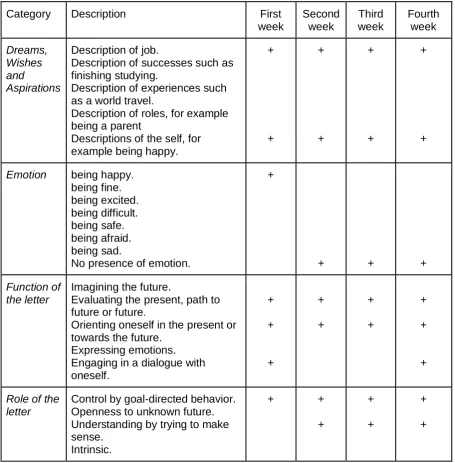
[image:22.595.75.531.290.753.2]First a table will be presented with the results from all four weeks for Markus and then the first letter is presented to gain a deeper understanding of the meaning making of Markus.
Table 3
Codebook for participant 6 and frequency counts for all four weeks.
Category Description First
week Second week Third week Fourth week Dreams, Wishes and Aspirations
Description of job.
Description of successes such as finishing studying.
Description of experiences such as a world travel.
Description of roles, for example being a parent
Descriptions of the self, for example being happy.
+ + + + + + + +
Emotion being happy. being fine. being excited. being difficult. being safe. being afraid. being sad.
No presence of emotion.
+
+ + +
Function of the letter
Imagining the future.
Evaluating the present, path to future or future.
Orienting oneself in the present or towards the future.
Expressing emotions. Engaging in a dialogue with oneself. + + + + + + + + + +
Role of the letter
Temporal orientation
Future described is within days or weeks.
Future described is within years. Future described is more than 10 years away.
No presence of temporal orientation.
+ + + +
Valence The future is described optimistically.
The future is described pessimistically.
The future is both seen
optimistically and pessimistically.
+ + + +
Specificity The future situation is explained concretely and with detail. The future is explained with little detail and open.
No specificity could be determined.
+ + + +
Subjective time horizon
The future is described with little detail and seems far away.
The future is described thoroughly and seems close.
No subjective time horizon is visible.
+ + + +
Receiver of letter
The letter is directed towards oneself.
The letter is directed towards a family member.
The letter is directed to someone else.
+ + + +
1. Letter by Participant 6 (translated from german)
Dear Markus,
All the best from 2022. You are probably asking yourself why I’m writing to you but I thought I’d send a couple of messages to myself from three years ago. You have always been a great
guy and have been unerringly faithful to your path. Your self-reflection, your motivation and
your ambition to personal development have brought you where you are today. But one thing
You have found a nice balance between Home Office and a cool working place. Modern
communication tools make it insignificant where you work but you still love the work with
people. You work with people that get excited about new topics in the work world and at the
same time have a clear pragmatism. You have made your division to a well-working team with
a culture that is known far outside of its domain. You have done that through your workshops
on the topics of feedback and conflict management and the installment of New Work working
methods. The topic mindset, there, is very dear to your heart. But in principle you all know
that today already. What has changed the most is your understanding of leadership. You
perceive leadership as detached from hierarchy and steer on many different plains, yourself,
your colleagues, project members and your boss. You don’t hold yourself back through wrong
humility but perceive every situation to get into leadership. Here your leadership-diary and
development-plan has helped you immensely, as the constant seeking for feedback. You have
understood that governance is a form of shaping and a tool for creating your own future and
present.
That, also, is nothing new to you. So what is holding you back to do this more in the year 2019
I ask you. When looking back I can say that your thoughtfulness and your assumption that you
have nothing interesting to share is just a foul trick, to be comfortable and not go into conflict.
That your viewpoints are seen as valuable by others, is something you get reflected daily. On
the other hand you love this exchange and contact.
Today, in 2022, you have found pleasure in leading, shaping and influencing. You already do
that in your workshops, now transfer that to other areas of your life. You already have all the
abilities, ultimately it’s about you becoming aware of that, where your leadership is needed or where you want to intervene shaping-ly.
By the way, I’ll write you every week now to give you further impulses in your self -development.
Until next week,
Markus has focused his attention on extensively describing his personal and professional development until 2022. He goes into great detail describing that Markus from today is missing the self-awareness that he has all the wanted qualities of building up his division or recognizing the leadership-role in himself already inside himself. He even presents an explanation of why that is, namely his wrong thoughtfulness and assumption that he has nothing interesting to say as a foul trick to stay comfortable.
In the following letters Markus, very stably, extends his personal development into great detail providing deeper insight into how to change to the desired self. In letter 2 Markus goes on to make a list of four areas providing descriptions in great detail of areas in which he has improved in 2022:
“In the following four areas you have improved tremendously:
1. You are better in Observing: You have a knife-sharp clarity in everyday life decisions and a clear focus on the observation, without judgement. (...)
2. You are better in Orienting. (...) 3. You are better in Deciding. (...)
4. You are better in testing decisions (assumptions). (...)” (translated, week 2).
In letters 3 and 4 he each selects two of the above areas and goes into even further detail specifying his personal development.
Immediately, it can be seen that the Content stays exactly the same without deviation. Concerning the expression of emotion only in the first letter a hint is given towards being happy about having the desired qualities. In the rest of the letters no emotion is present.
Markus’ letters are stable in portraying the multitude of functions i) evaluating the present and
path to future, ii) orienting oneself towards the future and iii) in letter 1 and 4 engaging in a dialogue with himself:
“Today I write you, how the impulses I’ve given you last week have impacted the future in the year 2022, the time from which I write, and which actions you have taken to get there.”
Concerning the role of the letter Markus is very controlled by goal-directed behavior and creating understanding by trying to make sense as already becomes obvious in the first letter and is done in the same style in the following letters:
For all the other characteristics Specificity, Valence, Temporal orientation, Subjective time horizon and the receiver of the letter all four letters displayed the same characteristics.
Even though Markus serves as the example with very stable characteristics it has to be mentioned that while the characteristics stay stable the letters do change. He deepens and specifies his future image and his personal development so while the characteristics stayed stable the future thought process still changed.
In conclusion, it can be said that Markus is very stable in all of the characteristics and followed a certain agenda during the four weeks.
Second case: Participant 5, Jane
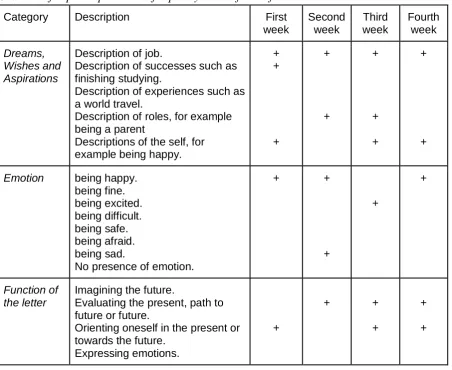
[image:26.595.74.527.394.764.2]Participant 5, named Jane, has demonstrated the most change when looking at the differences between the weeks concerning the characteristics, especially between week 1 and week 4. These differences will be looked at closely after a presentation of the codebook.
Table 4
Codebook for participant 5 and frequency counts for all four weeks.
Category Description First
week Second week Third week Fourth week Dreams, Wishes and Aspirations
Description of job.
Description of successes such as finishing studying.
Description of experiences such as a world travel.
Description of roles, for example being a parent
Descriptions of the self, for example being happy.
+ + + + + + + + + +
Emotion being happy. being fine. being excited. being difficult. being safe. being afraid. being sad.
No presence of emotion.
+ + + + + Function of the letter
Imagining the future.
Evaluating the present, path to future or future.
Orienting oneself in the present or towards the future.
Engaging in a dialogue with oneself.
+ + + +
Role of the letter
Control by goal-directed behavior. Openness to unknown future. Understanding by trying to make sense. Intrinsic. + + + + + + Temporal orientation
Future described is within days or weeks.
Future described is within years. Future described is more than 10 years away.
No presence of temporal orientation.
+ + + +
Valence The future is described optimistically.
The future is described pessimistically.
The future is both seen
optimistically and pessimistically.
+ + +
+
Specificity The future situation is explained concretely and with detail. The future is explained with little detail and open.
No specificity could be determined.*
+ + +
+
Subjective time horizon
The future is described with little detail and seems far away.
The future is described thoroughly and seems close.
No subjective time horizon is visible.
+ + +
+
Receiver of letter
The letter is directed towards oneself.
The letter is directed towards a family member.
The letter is directed to someone else.
+ + + +
1. Letter, translated
Don’t be worried: everything will come as you wished. You will finish your training already this year. And there will be a chance to put your new competences to use! Have trust in yourself, that your work will get the appreciation. Think about that no master has ever fallen from the skies. Accept that also you can do faults, because you can learn something from them.
By the way, greetings from your children. All are healthy and happy. Everyone is going their desired way, even if not always what you imagined. Nevertheless, your children stand on the ground with both their feet and have the necessary self-confidence to follow their dreams.
When I look into the mirror I see a young and still very attractive woman. I thank you for taking care of what you eat. That you do enough sports. I’m especially thankful for your daily yoga exercises that give me the mobility I have today. I feel perfectly healthy, powerful, and have enough energy to get everything done.
A small secret: we have broken through John’s resistance and by this time are proud dog-owners, but I won’t tell you the race. It is just beautiful, to have another family member!
I hug you,
Your Jane
4. Letter, translated
My lovely Jane,
That is now my last letter and we will get straight down to the nitty-gritty.
As I experience the advantage of higher age and the knowledge of the future I already know that you will be successful in everything that you have planned. And that’s not the crunchpoint, as you already know deep down. I’ve got a question for you: what is most important to you in life? Think of three things. Or the other way round: what do you fear most in life? If you have answered this question (and as far as I know you your work doesn’t stand on first or second place), then you know the following: a success or failure or fault that you do is insignificant. It’s NOT THE CIRCUMSTANCES that bring you down. So where does this fear about a career restart come from?
And another thing. Please stop putting yourself into a frame that doesn’t suit you. Don’t try to be something that you aren’t or aren’t anymore. You already jumped into the cold water frequently. Now you are older and wiser. Take care of necessary security, also financially. Expand your report assessment so that everything else would just be a bonus. You have already set the foundation. Now look that YOU get the necessary security.
You also have a loving and reliable partner who supports you in everything. HE would still be there when everything goes down south. I understand that you don’t want to go into a dependence. But then you need to take care or just learn to accept that.
worry, live…”. I believe you only get happy like that. Don’t believe that tomorrow, or in a month or a year; when you’ve done this and that; when you’ve fulfilled this goal - that you THEN can sit back and relax with a feeling of having work done. It doesn’t work like that. Because you always look for new challenges. Once you’ve finished one project, another comes.
Follow the words of the zen-master:
When I walk, I walk
When I sleep, I sleep
When I eat, I eat...
Be in the here and now because life could be over tomorrow and you haven’t yet (and with that I mean fully out of your heart) lived. I build on you to internalize my words and find a way. And don’t be afraid anymore, no matter what comes…
I love you
I believe in you
Your Jane
In the first letter Jane is very confident and optimistic in the success of the future. Her work-related dreams are coming true, her children are healthy and happy and she feels fulfilled and healthy. The whole letter has a positive aura and the communication between the future and present self seems loving as indicated by, as an example, the letter starting with “lovely Jane” and ending with “I hug you”. Concerning the characteristics, the letter fulfills a control role
by encouraging certain behaviors such as doing sports, yoga and eating healthy and the described situations are expressed concretely, in detail and the function seems to be to orient present Jane for a good future.
By the time Jane writes her fourth and last letter the style of writing has changed. Now the topic is still in part her work but the majority revolves around the Self and it seems like a conversation is going on between future and present self about their states of mind. Future Jane asks present Jane to think about questions of great importance (“I’ve got a question for you: what do you fear most in life? Or the other way round: What do you fear most in life?”) and compared to the first (and second and third) letter isn’t completely optimistic but adopts a mixed approach, a more ‘realistic’ approach: In the first letter
everything works out well and there is no need to question anything. In the fourth letter Jane starts with “I already know that you will be successful in everything you have planned” but
putting herself “into frames that don’t suit her” and encourages her to stop doing that. She also admits the fear of going into a dependence to her partner and that she hasn’t lived life
fully yet.
In all these parts it becomes obvious that present Jane isn’t perfect yet and because of
mentioning that present Jane still does need to put effort into it and needs the feedback of future Jane to eventually reach future Jane, otherwise she wouldn’t have written about it. This
can also be supported by the fact that her specificity has become lower and compared to the first letters now writes about the future with little detail and focuses more on the present. The subjective time-horizon becomes ‘further away’, indicating that there is a perceived bigger discrepancy between the present Jane and future Jane- in past letters it has seemed more close. Finally then, following out of it is that the function and role of the letter has changed since the first letter. Initially, the main function has been to orient present Jane for the future. Now, in the fourth letter, it is mainly about evaluating the present and far more engaging in a dialogue. The role is initially ‘control by goal-directed behavior’ which has switched to ‘creating understanding by making sense’ and ‘intrinsic’. Future Jane tries to explain what cognitively has to change to reach a fulfilling future and uses book titles and “words of the
zen-master” to elaborate her point.
In conclusion, it can be said that Jane’s style of writing and the characteristics have changed a lot between the first and fourth letter. There was some change in the second and third letter but substantial change came with the fourth and last letter which seemed like a break off the ‘utopian’, fully optimistic versions before. This last letter gave Jane a broadening of the scope concerning content as she stops being mainly career-focused and even questions the primary focus on work.
Overall change week 1-4
Initially, it was planned to use all the available data to have more participants to compare. But eventually the data of the five participants that wrote all four letters were chosen to give a more consistent and valid picture of the stability of the characteristics. Please refer to Table 2 and look at the scores in brackets for the frequency counts discussed here.
the most prevalent followed by descriptions of the job. Also the multiplicity of contents stays stable with the number of dreams ranging between 9 and 10 overall on five participants.
Concerning Emotions it can be seen that despite the loss of participants the number of letters with no presence of any emotions is rising from initially 1 to 3 in week 4. Otherwise, ‘being happy’ is consistently the most important emotion to the respondents.
The functions of the letters are also very stable over the four weeks. Evaluating and Orienting are the most adopted functions with slight deviations between the weeks. It has to be mentioned that these two functions often came together and some units of analysis fulfilled both functions at the same time which might explain the similarity in their amount of use.
The role of the letters are very stable between week 1 and 3. Then in week 4 suddenly all five letters have an element of ‘Understanding by trying to make sense’ from initially being
present twice per week. The rest of the roles stay stable.
Concerning temporal orientation the future is usually described ‘years away’ from the present. The amount of ‘no presence of temporal orientation’ rises from once the first week up
to three times in week 2.
When looking at the valence of the participants no letter has indicated a solely pessimistic outlook and it varied between an optimistic and mixed outlook. The first three weeks are stable in optimism being the predominant outlook while in week 4 suddenly just one letter is fully optimistic and the rest of the letters adopts a mixed approach. This is in line with the description of the case of Jane in which the most change happened in week 4.
While initially the majority had vague descriptions with little detail of the future the specificity increases in the second week and stays dominant thereafter. One participant did not provide descriptions of the future and was coded as ‘no specificity could be determined’ in
week 2 and 3.
In contrast to the results of specificity the subjective time-horizon was very stable in that three participants describe the future thoroughly and it seems close to the present while one participant describes it as if far away and one doesn’t show any subjective time horizon.
Concerning the receiver of the letter in all four weeks all respondents directed the letter to themselves.
Conclusion and discussion
In answer to the research question the futuring processes with all their characteristics are relatively stable for most participants. Even though the study started with nine participants only five finished the whole study and for those five the letters generally were stable in their characteristics (see table 2). Often one letter, mainly the last one, had a deviation from the previous three that usually were very similar. One could argue that the knowledge of writing the last letter gave a special motivation to ‘dig deeper’ into oneself or bring up an issue that wasn’t mentioned before, in a new way.
The overall stability was both expected and unexpected due to the results of previous research. As discussed in the Introduction significant experiences such as change, which was one of the participation requirements, initiate change in possible selves to adapt to the new situation (Frazier & Hooker, 2006). That would mean that the participants of this study, all experiencing change, should have processes of adaptation and if you look into the individual cases such as Jane’s you see exactly that: while there is some stability one letter resembles a
changing perspective, a new-found stance. On the other hand futuring processes have the necessary function of providing continuity to support our individuality and some stability will always have to be expected (Frazier & Hooker, 2006). In addition to that, the study by Harding, Wyse and Morenoff (2016) have shown that narratives tend to stay stable even when faced with barriers such as prison reentry. The overall change that did occur can be explained by the fact that all of the participants were in a state of change.
The expression of emotions was rather underrepresented. In the first week there is some expression of emotions. By the last week more participants didn’t include any expression of emotion than participants that did. This seems to contradict the finding that the most present dream was that of the Self in form of for example being happy. That is due to the descriptions provided of the wish usually were still very rational descriptions. This could be due to writing the letters online and in digital form. Additionally, there was little to no contact with the researcher, especially when writing the letters. That might have created a more rational approach. Besides that most of the participants knew the researcher personally and might have been biased to express emotions as the letters themselves already are personal and the inclusion of emotions could be too disclosing.
how he arrived at the future, therefore not following the instructions given beforehand and during the writing of the letter. Also the analysis of the present and past was in a rather negative fashion, trying to stop present self from repeating certain behaviors. Concerning this problem Sools, Tromp and Mooren (2015) already have expressed the following concern: “Future research should focus on why and when participants (knowingly or not) divert from the instruction and how this is related to health and well-being”. I can just emphasize the validity of this statement and that this is still relevant. Possible solutions would be to check the clarity of the instructions and how attentive participants read them and if necessary improve them. Additionally, to lower this problem a researcher should be present at the moment of writing the letter to answer questions or guide the participant into the process with tools such as a meditation for increased focus.
Further studies should take notice that some participants are not inclined to think about the future and it may lead to unpleasant feelings in the participants which leads to the common question whether futuring should be fostered and consciously worked with. Sools and Mooren (2012) have already stated that maybe not everyone is willing to optimize their ability to imagine the future along with the problem of enhancing people’s ability, that already have
excellent imaginatory abilities, leading to a form of escapism. Additionally, they claim, asking people to imagine the future already is an intervention itself in that it redirects thought towards the future and can take away the beauty of just letting the future unveil itself. That fits well with the uneasiness of one participant that couldn’t continue. The participant expressed that after the first week everything has been said and he would feel uncomfortable to continue because he lacks any more imagination and would feel insecure and unhappy about continuing. Preliminary tests that assess the readiness and desire of engaging with the future could provide a necessary protection for individuals that might be negatively impacted by engaging in effortful futuring. Other informal conversations with a few of the participants showed that the majority expressed happiness and even thankfulness for participating in the study as it had “greatly benefited” them and they planned to continue to do it on their own. Other expressions used were “great insight into myself and my future” or “really great orientation”. This relates
to the double-nature of Letters from the Future as both a research and therapeutic method. Special attention should be given to the cases of participants feeling uneasy indicating that the therapeutic dimension of Letters from the Future isn’t helpful (or really helpful but then needs to be controlled) to some individuals