by
Louai Al-Awami
A thesis submitted to the
Department of Electrical and Computer Engineering in conformity with the requirements for
the degree of Doctor of Philosophy
Queen’s University Kingston, Ontario, Canada
September 2013
Wireless Sensor Networks (WSNs) that use tiny wireless devices capable of commu-nicating, processing, and sensing promise to have applications in virtually all fields. Smart homes and smart cities are just few of the examples that WSNs can enable. Despite their potential, WSNs suffer from reliability and energy limitations.
In this study, we address the problem of designing Distributed Data Storage Sys-tems (DDSSs) for WSNs using decentralized erasure codes. A unique aspect of WSNs is that their data is inherently decentralized. This calls for a decentralized mecha-nism for encoding and decoding. We propose a distributed data storage framework to increase data survivability in WSNs. The framework utilizes Decentralized Era-sure Codes for Data Survivability (DEC-DS) which allow for determining the amount of redundancy required in both hardware and data to allow sensed data to survive failures in the network.
To address the energy limitations, we show two approaches to implement the proposed solution in an energy efficient manner. The two approaches employ Ran-dom Linear Network Coding (RLNC) to exploit coding opportunities in order to save energy and in turn prolong network life. A routing based scheme, called DEC Encode-and-Forward (DEC-EaF), applies to networks with routing capability, while the second, DEC Encode-and-Disseminate (DEC-EaD), uses a variation of random
scheme is called Decentralized Robust Soliton Storage (DRSS) and it operates in a decentralized fashion and requires no coordination between sensor nodes.
The schemes are tested through extensive simulations to evaluate their perfor-mance. We also compare the proposed schemes to similar schemes in the literature. The comparison considers energy efficiency as well as coding related aspects. Using the proposed schemes can greatly improve the reliability of WSNs especially under harsh working conditions.
To the awaited Mahdi (AS), the hope for humanity.
First and foremost, all thanks be to Allah for his endless blessings throughout my life. I would like to express my deepest gratitude to my supervisor, Dr. Hossam Hassanein, for his continuous motivation, patience, and support. I couldn’t hope for a better supervisor and a friend to make my PhD study such an exciting and inspirational journey.
I also would like to thank my examination committee for their invaluable feed-back and contributions. Special thanks go to Dr. Shahram Yousefi for his insightful comments, which have significantly contributed to my work and enriched my research experience.
To my family, for their continuous love and support. I thank my parents, who have given up so much to make this achievement possible. No words can express my gratitude to my beloved wife Alaa. Her care and love have always been the source of my ambitious aspirations.
I would like to thank the administration at KFUPM and the Saudi Arabian Cul-tural Bureau in Ottawa for their thorough support at all times. Special thanks go to the Computer Engineering Department at KFUPM for their encouragement and assistance.
My sincere thanks go to the wonderful supervisor assistant Basia Palmer whose iv
san Ahmed, Abd-Elhamid Taha, Abduladhim Ashtaiwi, Bader Al-Manthari, Ahmed Abo-Hasswa, Kashif Ali, Fadi Al-Turjman, Fariba Aalamifar, Kais Suleiman, Abdal-lah Alma’aitah, Ashraf Alfagih, Abdulrahman Abahsain, Abdulmonem Rashwan, Ed Elkouche, Sharief Oteafy, Khalid Elgazzar, Samad Razeghzadeh, Mahmoud Qutqut, Walid Ibrahim, Yaser Al Mtawa, Hatem Abo-Zeid, and Sherin Abdel-Hamid.
This accomplishment was only possible with the help and support of many people, to all I say thank you from my heart.
Al-Awami, L.; Hassanein, H., “Decentralized Robust Soliton Data Storage Sys-tem,” in preparation for journal publication.
Al-Awami, L.; Hassanein, H., “Distributed Data Storage Systems for Data Sur-vivability in Wireless Sensor Networks using Decentralized Erasure Codes,” sub-mitted for journal publication.
Al-Awami, L.; Hassanein, H., “Data Survivability for WSNs via Decentralized Erasure Codes,” 8th International Wireless Communications and Mobile Com-puting Conference (IWCMC), pp.94,99, 27-31 Aug. 2012
Al-Awami, L.; Hassanein, H., “Energy Efficient Data Survivability for WSNs via Decentralized Erasure Codes,” IEEE 37th Conference on Local Computer Networks (LCN), pp.577,584, 22-25 Oct. 2012
Abstract i
Dedication iii
Acknowledgments iv
Co-Authorship vi
Table of Contents vii
List of Tables x
List of Figures xi
List of Acronyms xi
List of Symbols xiv
Chapter 1:
Introduction . . . 1
1.1 Distributed Data Storage Systems (DDSSs) . . . 1
1.2 Characteristics of WSNs . . . 3 1.3 Motivation . . . 5 1.4 Objectives . . . 7 1.5 Contributions . . . 8 1.6 Organization of Dissertation . . . 9 Chapter 2: Literature Review . . . 12
2.1 Random Linear Codes Based Schemes . . . 13
2.2 Fountains Codes Based Schemes . . . 17
2.3 Code Independent Schemes . . . 22
2.4 Summary . . . 23 vii
3.2 Code Model . . . 28
3.3 Energy Model . . . 29
3.4 Failure/Erasure Model . . . 30
3.5 Communications and Propagation Model . . . 31
Chapter 4: Decentralized Erasure Codes Based Distributed Stor-age for Data Survivability . . . 32
4.1 Introduction . . . 32
4.2 Decentralized Erasure Codes (DEC) . . . 33
4.3 Centralized Vs. Decentralized Erasure Codes . . . 35
4.4 Decentralized Erasure Codes for Data Survivability (DEC-DS) . . . 37
4.5 Performance Evaluation . . . 43
4.6 Summary . . . 46
Chapter 5: Energy Efficient Decentralized Erasure Codes Based Distributed Storage . . . 48
5.1 Preliminaries . . . 49
5.2 DEC Encode-and-Forward (DEC-EaF) . . . 50
5.3 DEC Encode-and-Disseminate (DEC-EaD) . . . 55
5.4 Performance Evaluation . . . 58
5.5 Summary . . . 63
Chapter 6: Robust Soliton Distribution Based Distributed Storage 66 6.1 Introduction . . . 66
6.2 Related Work . . . 68
6.3 LT Codes and Robust Soliton Distribution (RSD) . . . 70
6.4 LT Codes with Feedback . . . 73
6.5 Decentralized Robust Soliton Storage (DRSS) . . . 76
6.6 Performance Evaluation . . . 81
6.7 Summary . . . 88
Chapter 7: Conclusion and Future Directions . . . 90
Bibliography . . . 94 viii
Appendix B:
Random Matrices over Finite Field . . . 111 Appendix C:
Network Coding . . . 117
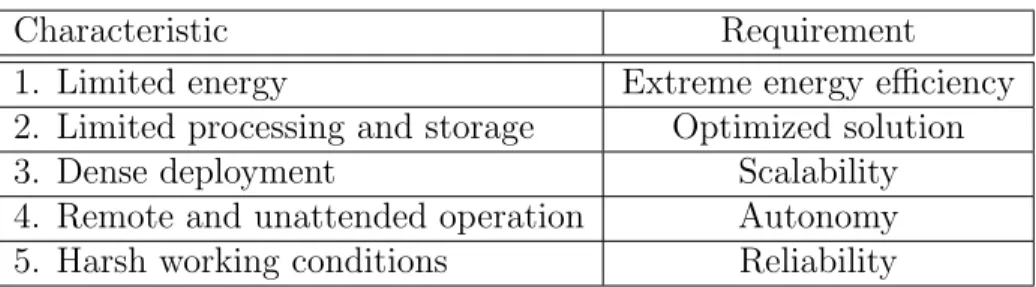
1.1 Types of Data Storage Systems. . . 3
1.2 Characteristics and Requirements of WSNs. . . 5
5.1 Power Requirements of the CC1000 Chip Running at 868M Hz. . . 61
5.2 Power Required to Implement Data Survivability Schemes. . . 62
6.1 Hellinger Distance (H) for DRSS, DF, and EDFC. . . 84
6.2 Power Required to Build RSD Storage. . . 85
6.3 Void Packets Ratio (β0) for DRSS, EDFC, and DF. . . 86
6.4 DER (Ω) for DRSS, EDFC, and DF. . . 88
B.1 Invertibility Probability vs. Finite Field (Fq). . . 114
B.2 Invertibility Probability vs. DO (β = max(0, k0−k)). . . 114
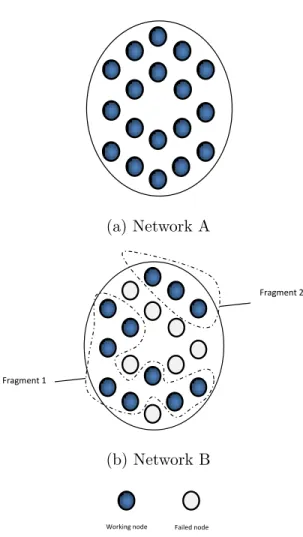
1.1 Network Survivability Vs. Data Survivability. . . 7
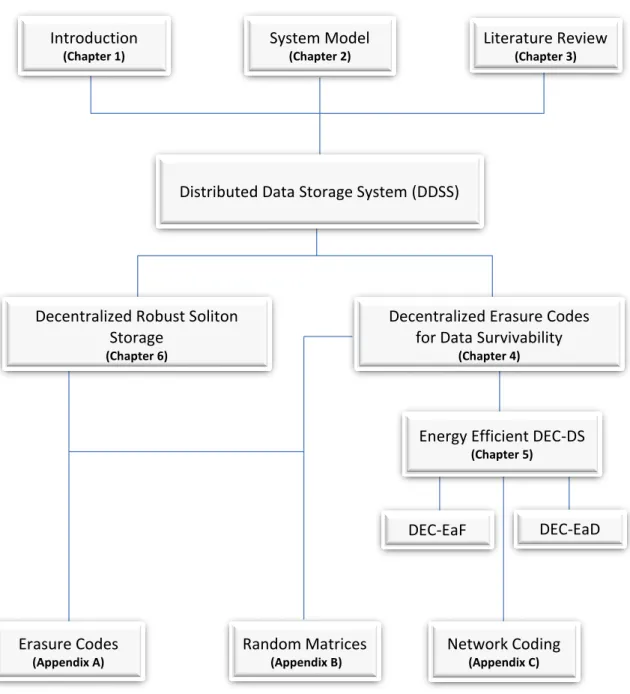
1.2 Dissertation Organization. . . 11
3.1 Generic Model of anN(4,27) Network. . . 27
4.1 Source and Storage Networks (k = 10,n = 18, and m= 4). . . 34
4.2 Centralized vs. Decentralized Erasure Codes. . . 36
4.3 GM for Centralized vs. Decentralized Erasure Codes. . . 37
4.4 Ps =f(x) =c2e−2e −x . . . 42
4.5 Probability of Successful Decoding (Ps): k = [10,50], s= 2, F2 . . . 45
4.6 Decoding Overhead (β): k = [10,50], s= 2, F2. . . 46
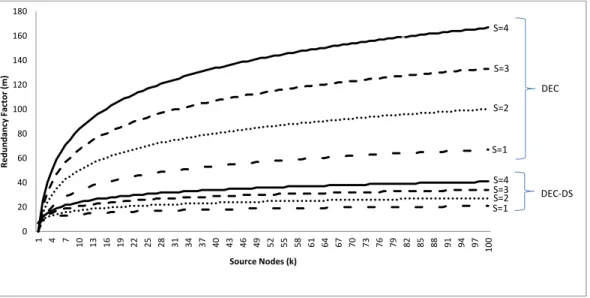
4.7 Redundancy Factor (m) Vs. Source Nodes (k) and s. . . 47
5.1 An Example of DEC-EaF:m = 7. . . 54
5.2 An Example of DEC-EaD:m = 7. . . 57
5.3 Power Requirements for DEC-DS, DEC-EaF, and DEC-EaD, for s=3. 61 5.4 Energy vs. Network Size for s= 4. . . 63
5.5 Code Degree Distribution for DEC-DS, DEC-EaF, and DEC-EaD for k= 30. . . 65
6.1 ρ(i) andτ(i) fork = 10,000, c= 0.2, and δ= 0.05. . . 74
6.2 Power Requirements for EDFC, DRSS, and DF, for s=2. . . 86
6.3 Probability of Successful Decoding (Ps): k = 100,s = 2, F2 . . . 87
6.4 Decoding Overhead (β): k = 100, s= 2, F2. . . 88
A.1 Binary Erasure Channel. . . 102
A.2 Matrix Reversibility Probability of RLC. . . 107
A.3 Failure Probability(δ) of RLC vs. Decoding Overhead (β). . . 109
B.1 Invertibility Probability (Ps) vs. pfor F2. . . 115
C.1 Routing vs. Network Coding in Wired Networks. . . 118
C.2 Routing vs. Network Coding in Wireless Networks. . . 121
ADFC Approximate Decentralized Fountain Codes. ARQ Automatic Repeat reQuest.
BP Belief Propagation.
CDF Commulative Distribution Function. CDM Cooperative Distribution Management. DDSS Distributed Data Storage System. DEC Decentralized Erasure Codes.
DEC-DS Decentralized Erasure Codes for Data Survivability. DEC-EaD DEC Encode-and-Disseminate.
DEC-EaF DEC Encode-and-Forward.
DER Divergence-Efficiency-Robustness Indicator. DF Distributed Fountain.
DO Decoding Overhead.
DRSS Decentralized Robust Soliton Storage. DTN Delay Tolerant Network.
EDFC Exact Decentralized Fountain Codes. EO Encoding Overhead.
FEC Forward Error Correction.
GM Generator Matrix.
GPS Global Positioning System.
GPSR Greedy Perimeter Stateless Routing. ISD Ideal Soliton Distribution.
LT Luby Transform. P2P Peer-to-Peer.
PLC Progressive Linear Codes. pmf probability mass function. PNC Partial Network Coding.
PRLC Priority Random Linear Codes. QoS Quality of Service.
RF Redundancy Factor.
RFID Radio-Frequency Identification. RLC Random Linear Codes.
RLNC Random Linear Network Coding. RNC Random Network Coding.
RS Reed-Solomon.
RSD Robust Soliton Distribution. SLC Stacked Linear Codes.
WSN Wireless Sensor Network.
α Encoding Overhead (EO)
β Decoding Overhead (DO)
β0 Ratio of void packets
δ Probability of failure
Fq Finite field
Ω Divergence-Efficiency-Robustness Indicator
ω Route selection gain
ωi Selected next hop
G Decoding matrix
m Current Redundancy Factor
r Average route length
Xj Vector of source symbols received by vj
Z Set of nodes not yet visited by data packet
ρ(i) Degree Probability Distribution
σ Depletion of route
θ Redundancy factor counter
Ξ Energy required to implement code
ξc Energy consumed by communicating
ξp Energy consumed by processing
ξt Energy consumed by transmitting
ξrelay Energy consumed by relaying
a Number of priority levels
c A constant of order 1
C(k, n, m) Code over a network of k source andn storage nodes with RF =m d Packet degree
E Vector of encoded symbols
ej Encoded symbol from node j
f Failure/erasure rate
G Generator Matrix (GM)
Gj Local encoding coefficient vector at node vj
gji Encoding coefficient for source symbol xi on storage nodevj
H Hellinger Distance
k Number of source nodes/packets
k0 Number of packets collected
l Number of nodes in a square level of a quad-tree
m Redundancy Factor (RF)
n Number of storage nodes
N(k, n) Network of k source and n storage nodes
pe Probability of erasure
Ps Probability of successful decoding
Rj Routes to node j
si Hop i
U The set of source nodes
ui Source node i
V Set of storage nodes
vj Storage node j
Wi Set of selected storage nodes by node ui
wij jth selected storage node by ui
X Vector of source symbols
x0 Number of void packets
xi Source symbol from node ui
Z Set of nodes visited by data packet
Introduction
Wireless Sensor Networks (WSNs) are becoming part of everyday life. They are increasingly being deployed to facilitate security, pollution monitoring, and improved health care systems. Using sensor technology allows cars, homes, and even phones, to work more efficiently. Yet, because of their inherent limitations, WSNs require means to ensure that the data they collect is preserved, especially, when used for critical applications and/or in harsh environments.
In this dissertation we present a Distributed Data Storage System (DDSS) for data survivability in WSNs. This work focuses on schemes to aid in preserving data when failures occur in the network. Using appropriate coding techniques, the proposed work achieves data survivability while addressing the specific requirements of WSNs.
1.1
Distributed Data Storage Systems (DDSSs)
Distributed Data Storage Systems (DDSSs) are an indispensable building block of today’s networks. They are used by enterprises and web service providers to store and
handle huge volumes of data. The main advantages of DDSSs are fault-tolerance and scalability. Fault-tolerance and scalability are usually achieved through replication of data over multiple nodes. Despite the simplicity of data replication, it is generally inefficient and expensive [1]. Therefore, coding based schemes offer an attractive alternative to replication.
When discussing designing storage systems, there exist two redundancy strategies to achieve reliability of data; replication and coding. Coding based solutions can achieve many advantages over replication based solutions at a slight increase in pro-cessing cost. Unlike coding, replication often requires lots of storage space on every node. In other words, to attain the same level of reliability, replication based schemes require more redundancy than coding based schemes. In fact, for the same level of redundancy, coding can achieve an order of magnitude higher reliability than repli-cation [2]. In addition, replirepli-cation based approaches also need to keep track of where different data exists, resulting in complicated data gathering protocols. Moreover, it has been shown analytically that on average the number of data blocks needed to reconstruct a complete data set from a replication based distributed storage is more than that needed when using coding based distributed storage [1]. Coding has also been shown to greatly reduce storage requirements as well as simplify data gathering mechanisms [3].
Data storage systems can also be classified based on the relative location of both their source and encoded data which can be either centralized or decentralized. We use the termcentralized to refer to the case where the data exists in the same physical location. The term decentralized, on the other hand, implies that the data exists at different physical locations. Table 1.1 shows the four possible configurations of data
Table 1.1: Types of Data Storage Systems.
Encoded Data Source Data
Centralized Decentralized
Centralized C:C C:D
Decentralized D:C D:D
storage systems. We adopt the notion “([source data]:[encoded data])” to distinguish one class from another. Also, we use “C” to stand for “centralized” while “D” to refer to “decentralized” case. For example, “C:D” refers to the class with centralized source data and decentralized encoded data. In this work, we focus on the ”D:D” case, where both the source and encoded data are decentralized, i.e. source as well as encoded data exists at multiple locations.
1.2
Characteristics of WSNs
WSNs are composed of a set of wireless devices called sensor nodes which comprise of processing, communication, storage, and sensing modules. The sensing module is referred to simply as a sensor. Sensor nodes can also be equipped with an actuator to perform certain tasks such as opening a door or turning a machine on or off. The information sensed by the sensor nodes can be either processed locally, or sent over to a more powerful sink node for processing. A sink node can exist on site, or be reached through some type of network infrastructure such as Wi-Fi, cellular, or satellite network. In Delay Tolerant Networks (DTNs), network connectivity is not available all the time. For example, consider a WSN where a sink node is not available all the time. Instead, a sink node visits the network occasionally to collect data from sensor nodes.
WSNs are autonomous. A WSN can be deployed in an ad hoc fashion. Sensor nodes may then resort to self-organizing mechanisms to discover their surroundings, recognize their topology, and decide on the role of each node. Sensor nodes can also form clusters where each cluster is managed by a designated cluster-head to better aid scalability. Cluster-head facilitates the inter-cluster communication, and may serve as a gateway to the sink node. To achieve load balancing, the role of a cluster-head may be switched occasionally among different nodes.
Despite the aforementioned potentials, WSNs pose a very intricate set of chal-lenges. The most notable of which is energy limitation that restricts all aspects of node’s operation. Generally, sensor nodes either use an on board battery or har-vest energy from their surroundings. In either case, the energy available is limited. A common approach to conserve energy is using low-duty cycling in which sensor nodes sleep for extended periods of time to reduce energy consumption. Further, sensor nodes are typically equipped with low-powered processor and communication module. Thus, multihop communication becomes a necessity in many situations. Re-search in routing in WSNs generally focuses on reducing energy consumption and load balancing. If a Global Positioning System (GPS) module is available on board, routing can take advantage of location information to improve routing performance. Alternatively, localization algorithms may be run to discover the relative position of each node.
In various applications, a WSN may be left unattended for extended periods of time under harsh working conditions which may cause nodes to fail. In such cases, self-healing algorithms are usually employed to guarantee network continuity. Another important characteristic of WSNs is that they contain a large number of sensor nodes,
Table 1.2: Characteristics and Requirements of WSNs.
Characteristic Requirement
1. Limited energy Extreme energy efficiency 2. Limited processing and storage Optimized solution
3. Dense deployment Scalability
4. Remote and unattended operation Autonomy 5. Harsh working conditions Reliability
which calls for scalable solutions. Table 1.2 summaries the characteristics of WSNs and the demands they impose on their design.s
1.3
Motivation
As aforementioned, WSNs combine a set of unique requirements. Consequently, de-veloping a DDSS for WSNs needs to tackle such requirements. To address data reliability, sensor data in WSNs needs to be maintained using some reliability mech-anism. This is especially important when a sink node is not available, such as in the case of DTNs. In this regard, we present data survivability as a design metric to quantify redundancy and its impact on data resilience against failures. We make a distinction between data survivability and network survivability. While network survivability focuses on using redundancy means to guarantee network continuity in case of nodes failure, data survivability provides means to prevent loss of data in the network in case of failure through the use of redundancy. Also, while network sur-vivability requires redundancy in hardware and software, data sursur-vivability utilizes redundancy in storage and data. To clarify, consider Figure 1.1. Assume the network shown must be unfragmented to be considered operational. Also assume that every
node can only reach its direct neighbors through single hop. From a network surviv-ability viewpoint, Network A is “surviving” while Network B is not, i.e. Network B is fragmented and hence it is considered failed. However, from a data survivability prospective, both Network A and B are “surviving”, since data can still be recovered from both networks.
Data survivability helps address the reliability of the data in a WSN apart from the reliability of the network. Since the ultimate goal behind WSNs is the data they collect, it would be favorable to focus on aspects related to data rather than the network. For example, consider a scenario where a network is deployed to monitor certain phenomenon of interest. The network is expected to last for a certain period of time, then go down because of loss of energy, or because nodes are unreliable. Now, assume each node is equipped with a Radio-Frequency Identification (RFID) tag. A data collector can visit the network at a later time to collect data using an RFID reader without requiring the nodes to be working. In such a situation, the network has done its job which is sensing. What remains of interest is the data on sensor nodes. Data survivability helps facilitate such a separation of concepts.
While addressing data survivability, we need to take into consideration the unique aspects of WSNs. The limitation in computing capabilities and resource dictate the need for simple and efficient mechanisms to handle data encoding and decoding. Also, because sensor data is decentralized, we need to use decentralized strategy to build the data storage. Due to the large number of sensor nodes in the network, any solution has to be also scalable. Finally, meeting all the above requirements has to be done in an energy efficient manner. That is why we choose Decentralized Erasure Codes (DEC) for the design of our proposed DDSS since it meets the aforementioned
(a) Network A
Fragment 1
Fragment 2
(b) Network B
Working node Failed node
Figure 1.1: Network Survivability Vs. Data Survivability.
requirements.
1.4
Objectives
DEC have been proposed for low-delay data collection. However, no work has investi-gated designing DEC for data survivability applications. We propose a new DEC-DS
tailored towards data survivability for WSNs applications. The proposed scheme op-timizes the redundancy requirements while achieving data survivability. While both coding schemes share the same coding mechanisms, i.e. encoding and decoding, the mathematical formulation used for designing the dissemination mechanism for each scheme is different.
To meet the energy requirements for WSNs, we utilize in-route coding opportu-nities using Random Linear Network Coding (RLNC) to improve both the energy required to implement the proposed codes. To realize this, we propose two mech-anisms to improve the dissemination phase of building DEC-DS. The first is called DEC Encode-and-Forward (DEC-EaF) and relies on a routing layer to choose the most energy efficient route while exploiting coding opportunities. The second, called DEC Encode-and-Disseminate (DEC-EaD), utilizes a random walk mechanism to disseminate the source data.
Finally, we consider the LT codes based DDSSs. LT codes belongs to a family of codes called Fountain codes which are attractive because of their simple encoding and decoding. We propose a new decentralized approach to implement LT codes over a WSN in a decentralized fashion. We present the mathematical bases for designing the scheme and use simulations to compare it to existing schemes in energy efficiency and robustness.
1.5
Contributions
The main contributions of this dissertation are:
1. Developing a new Distributed Data Storage System (DDSS) using Decentralized Erasure Codes (DEC-DS) tailored to achieve data survivability in WSNs.
2. Implementing two energy efficient dissemination mechanisms utilizing network coding to enhance (DEC-DS). The mechanisms proposed are independent of the redundancy required, so they can be applied virtually to any DEC.
• DEC Encode-and-Forward (DEC-EaF) which includes routing strategy to utilize coding opportunities to reduce the energy required for code estab-lishment.
• DEC Encode-and-Disseminate (DEC-EaD) which features a fully decen-tralized solution employing rotor-router random walk to disseminate source data while reducing energy requirements.
3. Developing an energy efficient LT codes based DDSS which is called Decentral-ized Robust Soliton Storage (DRSS) targeting WSNs applications.
4. Conducting an energy-oriented study of DEC to shed light on the energy con-sumption aspects of those codes.
1.6
Organization of Dissertation
This dissertation is organized as follows. In Chapter 2, we survey related literature on decentralized erasure codes and distributed storage systems. Chapter 3 discusses the system model and its components. In Chapter 4, we present the proposed decentral-ized erasure codes for data survivability applications. Chapter 5 presents an energy efficient dissemination mechanisms of the decentralized erasure codes incorporating the concept of network coding. Next, Chapter 6 discusses a proposed DDSS imple-mentation based on LT codes. Finally, conclusion and future directions are discussed
in Chapter 7. Background material on erasure codes, theory of random matrices over finite fields, and network coding is presented in Appendices A, B, and C, respec-tively. Figure 1.2 depicts a visual map of the different parts of the document and their relationships.
Erasure Codes (Appendix A) Random Matrices (Appendix B) Network Coding (Appendix C) Introduction (Chapter 1) System Model (Chapter 2) Literature Review (Chapter 3)
Distributed Data Storage System (DDSS)
Energy Efficient DEC-DS
(Chapter 5)
Decentralized Erasure Codes for Data Survivability
(Chapter 4)
DEC-EaD DEC-EaF
Decentralized Robust Soliton Storage
(Chapter 6)
Literature Review
Because of their vast range of applications, DDSSs have been extensively studied in many areas in the literature. We are mainly interested in the studies related to erasure-codes-based distributed storage systems. More specifically, our focus is on the problem of designing storage systems with the assumption that the source data is decentralized. In this chapter, we highlight the main proposals in this area.
Existing schemes can be classified into two categories: random linear codes based schemes and Fountain codes based schemes. In addition, there exists other efforts which try to address different aspects of the problem, such as buffer management, and code repair; regardless of the codes used. We refer to the latter schemes as code independent schemes.
Both categories of schemes rely on randomness to build their codes. However, Random Linear Codes (RLC) based storage schemes do not target any degree distri-bution while Fountain-codes-based schemes target some form of degree distridistri-bution used by the underlying code such as LT codes [4] or Raptor codes [5]. The degree dis-tribution plays an essential role in performance at both the encoder and the decoder.
Due to their degree distributions, Fountain codes enjoy low encoding and decoding complexities.
2.1
Random Linear Codes Based Schemes
Random Linear Codes (RLC) are an important class of codes that are constructed in a random fashion using only linear operations. Given a set of source symbols
X = {x1, x2, ..., xk}, an encoded symbols ei is constructed by XOR-ing a random
subset Wi ⊂ X as ei =w1 ⊕w2 ⊕...∀wi ∈ Wi. Decoding on the other hand can be
envisioned as solving a system of linear equations using Gaussian Elimination (GE). RLC do not feature any specific structure, but because of their random construction, they are attractive for distributed implementations. In this section we review some DDSSs that use RLC.
2.1.1
Distributed Storage in Sensor Networks Using
Decen-tralized Erasure Codes
DEC allows for an easier data collection, reduced storage requirements, and increased data survivability. DEC assumes a network N(k, n) comprised ofk source nodes and
nstorage nodes, wherek≤n. The scheme makes use of coding by allowing each of the source nodes to pre-route its data to a subset ofmstorage nodes, wherem≤n, which in turn combine all the packets they receive using bitwise XOR resulting in encoded packets of the same length as source packets. Therefore, when a data collector shows up, it recovers the original k source packets by contacting any (1 +)k storage nodes with high probability (w.h.p.), where is a very small number. DEC assumes the use
of Gaussian Elimination (GE) decoder.
More specifically, every source node picks one of the n storage nodes at random and routes its packet to it. The source node then repeats the process m times, where m = cln(k) and c = 5nk. Routing is assumed to be taken care by a separate layer in place, e.g. Greedy Perimeter Stateless Routing (GPSR) [6]. After receiving each packet, each storage node uniformly and independently chooses a coefficient at random from a finite field Fq and multiplies the received packet by an encoding
coefficient and XORs the result with the packets already stored in its memory. Note that in addition to storing the encoded packet, the node needs to store the coefficients to be used later for decoding.
In references [7], [3], and [8], Dimakis et al. introduce the idea of DEC and show that m ≥ 5nklog(k) is sufficient to guarantee that collecting any (1 +)k encoded blocks is enough to recover the original k blocks w.h.p, for some >0. The decoding is assumed to use GE requiringO(k3) orO(k2log(k)) when exploiting sparsity of the coefficient matrix.
2.1.2
Regenerating Codes
In reference [9], the problem of repairing a decentralized erasure codes based storage was addressed. The study proposes a scheme to repair the storage system in case some storage nodes fail while new nodes join the network. The scheme assumes storage nodes to have multiple encoded data blocks. As new nodes are deployed to repair the damaged network, they start to contact existing storage nodes, that in turn would generate a new encoded block using the blocks in their memory and send them to the new nodes. By communicating functions of stored data on surviving nodes, the
repair bandwidth required is reduced.
2.1.3
Random Linear Coding Based Distributed Networked
Storage
The work in reference [1] provides a mathematical analysis of the performance of RLCs compared to traditional replication and erasure coding schemes. The results show that using RLC to store a file on a distributed storage is more efficient in terms of the number of encoded blocks needed to recover the original file, and the number of storage nodes required than the other two schemes. The study considers a centralized server to do the encoding on the distributed nodes and therefore it does not include any distributed implementation.
2.1.4
Geometric Random Linear Codes
In reference [10], Geometric Random Linear Codes (G-RLS) have been proposed to facilitate both data persistence and ease of information retrieval in WSNs. The proposal assumes a network that is composed of k source nodes andnstorage nodes, which is first mapped into a quad-tree structure. A quad-tree is a tree data structure in which each inner node has exactly four children. Using quad-tree, a network is mapped into a grid where each group of nodes are placed into a single square. Then, every source nodeui disseminates its information to Θ(log(l)) storage nodes in every
square level of the tree it belongs to, where l is the number of nodes in that square, i.e. a tree level. The proposed solution assumes the presence of a routing protocol that takes care of delivering packets to the target nodes.
square they sit on in the quad-tree. When a storage node vj receives a new block xi
form node ui at levelS, it encodes it as
cjS =cjS⊕βijxi.
When a sensor r is interested in data at location q, a query is sent from r and routed to location q. The query arrives eventually to the closet sensor at location q. If this sensor happens to be at a leaf of the quad tree, the block is retrieved and is sent back tor. In case all sensors at the leaves (level L) fail, the query will reach the closest sensor at the parent level, i.e. (L−1). The sensor handling the query will try to request packets from sensor at the same level. If enough packets are found, the block is sent back. Otherwise, the sensor tries level (L−2), and so on.
2.1.5
Priority Random Linear Codes
Priority Random Linear Codes (PRLC) [11][12] have been proposed to address the issue of encoding data with different priority levels. The situation arises when data within the network is of varying importance and that less important data can be sacrificed for the sake of preserving more important data.
The work proposes two coding schemes based on RLC, called Stacked Linear Codes (SLC) and Progressive Linear Codes (PLC). SLC encodes data packets of the same priority level together while PLC encodes data packets of the priority level a with packets of priority level 1 toa. By definition, priority level i is higher thanj ifi < j. Therefore, PLC combines data packets with other data packets of the same level or higher. The work also includes a dissemination algorithm and a degree distribution generation.
2.1.6
Growth Codes
Growth codes [13] have been proposed to deal with situations where sensor networks are deployed in emergency situations where sensor nodes are vulnerable to failure and required to work in a zero-configuration fashion. The scheme allows nodes to progressively increase the degree of their encoded blocks while exchanging data blocks to increase data persistence. The sink nodes on the other hand receive the first set of blocks uncoded and use them to decode the later arriving blocks and so on. The degree used in each round is controlled by the sink node.
To illustrate the operation of Growth Codes, we consider the following scenario. Initially, all blocks are set to degree one (no coding). The sink samples nearby nodes for data packets. After collecting enough packets, the degree is increased to two since any encoded block of degree two will be likely decodable. As the sink receives more data packets, the degree of the code is increased to allow for better data persistence without compromising packet decodability.
Growth Codes clearly avoid using known erasure codes to overcome the challenge of generating the required degree distribution in a distributed manner. Another reason is that such codes are not meant to maximize the recoverability of the data.
2.2
Fountains Codes Based Schemes
Fountain-codes-based schemes try to implement the exact or an approximate degree distribution of Fountain codes [14]. In most schemes, a random walk is performed to disseminate the source packets. The advantage of using Fountain codes is the low encoding and decoding complexities. Besides, the Belief Propagation (BP) decoder
used with Fountain codes allows for partial data recovery since encoded packets have low average degrees.
The construction of “Robust Soliton Distribution”-like decentralized codes are investigated in references [15], [16],[17],[18], [19], [20],[21],[22], and [23]. In the node-centric approaches [15, 16, 17, 18, 19], the source data performs a random walk over a set of storage nodes, where at each step, the source data is encoded with the local data at the current storage node. On the other hand,packet-centric approaches [20, 21, 22, 23], allow source packets to perform a random walk while encoding from the data on each newly visited storage node, until eventually residing at the walk-terminating node1. In other words, in node-centric the source packet is not modified
by the visited nodes, while the data on the nodes is modified. In data-centric however, while the packet is modified by each visited node, the data on the storage nodes is not.
2.2.1
Distributed Fountain Codes for Networked Storage
A Fountain codes based DDSS is considered in reference [15]. The scheme relies on each storage nodevi choosing a random degreedi from a probability distributionρ(i).
Then, the storage node contacts di source nodes as follows. The storage node sends
a request to a random location. If the receiving node happens to be a source node, it replies back with its data. Otherwise, the receiving node initializes a random walk process to search for a source node nearby. When the random walk arrives at a source node, the source node sends its data back to the requesting storage node.
2.2.2
Data Persistence in Large-Scale Sensor Networks with
Decentralized Fountain Codes
Lin et al. propose a decentralized data persistence scheme based on Fountain codes for WSNs [16]. The study discusses two schemes. The first results in an exact de-gree distribution but high energy consumption. The scheme is referred to as Exact Decentralized Fountain Codes (EDFC). The second scheme, which is referred to as Approximate Decentralized Fountain Codes (ADFC), reduces energy consumption by approximating the required distribution. Both schemes target the Robust Soli-ton distribution used by LT codes [4], a well known family of Fountain codes. In addition,data dissemination is performed randomly using a Random Walk algorithm. The algorithm initially requires each storage node to choose its code degree d
randomly from the Robust Soliton Distribution (RSD). In addition, each source node calculates the number of random walks to initiate plus a probabilistic forwarding table. The forwarding table exists on each node an is used to determine the probability of selecting each of the neighbouring nodes as a next hop for the random walk. Then, the source node starts a random walk to disseminate the target data packet. When the random walk stops at a storage node, that node stores the corresponding data packet delivered by that random walk. When the dissemination process stops, each storage node selects dpackets out of the received packets and encodes them together to achieve RSD.
The dissemination process depends on two factors: the number of random walks started by each source node and the probabilistic forwarding table at each node. The forwarding table and the number of random walks depend on the value of the
redundancy coefficient xd which is generated by solving an optimization formulation
that can be performed offline. After collecting the encoded packets, the decoding at the sink node is performed using BP.
2.2.3
Decentralized Fountain Codes Based Distributed
Stor-age
The work in reference [17] introduces two decentralized algorithms to build a de-centralized erasure codes DDSS. Both algorithms are based on the idea of random walk to disseminate information. The algorithm encode packets on the fly without the need to wait for all packets to arrive at a storage node for the encoding to be executed. The second aspect is the approximation of algorithm parameters such as network size, number of data nodes, etc. The improvements target better distributed implementation rather than increased performance. The work is later developed in reference [18][19] to implement Raptor codes [5]. The algorithm includes two stage encoding in analogy to the outer code and inner code that take place in Raptor codes encoding process. Accordingly, the algorithm starts by pre-coding the k packets by first sending them tomnodes, which subsequently route them ton nodes for the final coding.
2.2.4
Raptor-Packets
A different approach is used in reference [20] and [21] to address the problem of data persistence. Similar to the work in reference [18] and [19], the solution uses random walks to implement distributed Raptor Codes. However, instead of sensor nodes encoding the packets they receive and forwarding the original packet, nodes forward
the encoded packet after encoding the received packet with their encoded version. The packets finally reside at the last storage node terminating the random walk.
2.2.5
Doped Fountain Coding for Minimum Delay Data
Col-lection
The studies in reference [24] and [23] consider the idea of Fountain codes based storage in circular networks. The main idea is in the layout of the network where relay nodes form a ring around which source and storage nodes are placed. When a source node generates a new data packet, it forwards it to the closest relay. The packet then gets forwarded over the ring to the whole network. Since storage nodes are within the transmission range of the relays, they overhear the transmissions and store the packets by encoding them together. Further, each relay node utilizes the wireless multicast property by encoding packets coming from its left and right to use single transmission to forward two packets.
The scheme targets applications where data collector is mobile and requires low delay packet collection. Hence, data packets are pushed to the edge of the network where they are collected easily. In case the received packets are not enough for the decoding process, the data collector contacts the data source for the original data packets.
2.3
Code Independent Schemes
2.3.1
Partial Network Coding
Partial Network Coding (PNC) [25][26][27] was proposed to address the problem of updating encoded data in continuous data collection application without the need for decoding. In such applications, data nodes store the sensed data in an encoded form for sometime before a data collector shows up. Since the data collector could be only interested in the most up-to-date data, there has to be a way of removing obsolete data to update encoded packets.
The main contribution of the proposal is a buffer management where every sensor node maintains multiple copies of data packets with different degrees, so when a new data is generated, some of the combined packets can be dropped while new combinations are generated using newly arriving data packets, as well as existing combined packets.
2.3.2
Resilient Coding
The work in reference [28] studies the suitability of different degree distribution to the problem of erasure codes based distributed storage. The work also proposes a buffer management scheme to reduce the energy consumption resulting from accessing the memory for the purpose of storing encoded data.
The study considers data dissemination in WSNs with mobile nodes. In this application, sensor nodes are assumed to combine packets received from other nodes with packets they have on board to generate encoded packets which are in turn sent
out to speed up the dissemination process. The work studies how quickly nodes can start decoding after receiving a certain number of information packets encoded at a certain degree. The main results are that high degree encoding tends to increase the fraction of packets recovered, however, the decoding does not start unless an enough number of packets are received. On the other hand, low degree encoding results in low fraction of different packets per node but starts the decoding process earlier.
The study also proposes a buffer management scheme called Cooperative Dis-tribution Management (CDM) to handle packets of different generations. In CDM, when a node recovers a complete generation of packet, the packets are copied from the RAM to the flash memory. Then, instead of deleting the packets belonging to the old generation, whenever a packet of the new generation arrives, two old packets of the old generation are combined to make room for the new arriving packet. Note that packets pertaining to the old generation are kept in the RAM to assist neighboring nodes, which have not yet fully recovered that generation.
2.4
Summary
The original DEC proposed in reference [7][3] is attractive for applications in WSNs due to its simplicity and decentralized operation. It is designed for low delay decoding. In other words, DEC accomplishes low decoding overhead. However, doing so comes at the cost of high encoding overhead which comes from disseminating large amount of redundancy into the network. This also results in higher energy requirements since the energy required to disseminate and encode the data is proportional to the amount of data disseminated. In addition, DEC is not optimized for data survivability. In
Chapter 4 we introduce a scheme called DS to achieve data survivability. DEC-DS achieves data survivability using low encoding overhead and consequently results in lower energy consumption than DEC.
Existing work on DEC does not take advantage of network coding to exploit coding opportunities and save energy. In Chapter 5, we present two approaches for incorporating RLNC into existing schemes. The first scheme is called DEC-EaF and uses routing mechanism to implement the required codes at a lower energy cost. The second scheme is named DEC-EaD and uses random walk utility to disseminate data while implementing in-route encodings. The choice to implement both routing and random walk based schemes comes from the fact that both approaches exist in the literature to implement similar codes. This allows us to compare each scheme with other schemes from the same class. The other advantage is that each scheme is applicable to different network setup. Namely, while DEC-EaF can be implemented in networks with existing routing service, DEC-EaD can be used in network without any routing infrastructure.
Fountain codes can accomplish low complexity encoding and decoding. Unlike RLC based storage systems, Fountain codes allow for partial retrieval of data. We presented a number of schemes that target Fountain codes in decentralized setup. In particular, the work in references [8] and [16] implements RSD based storage with decentralized source data. We propose a new scheme in Chapter 6 to implement RSD based storage at a lower cost than existing schemes.
Existing work also focus on the coding theory related aspects of the storage schemes such as encoding and decoding complexities, in addition to probability of successful decoding. There seems to be a marginal interest in energy consumption.
In this dissertation, we emphasize on the energy consumption of studied schemes, while paying attention to the coding theoretical related performance aspects.
System Model
In this chapter, we describe the different models used in this dissertation. Besides describing models and components, we also highlight different definitions and assump-tions behind each model. Unless otherwise stated, the models apply to all chapters and simulation setups.
3.1
Network Model
We consider a network with a set ofk source nodes,U ={u1, u2, ..., uk}and a set of
nstorage nodes,V ={v1, v2, ..., vn}. In addition to storage, nodes inV are assumed
to serve as multihop relays. Without loss of generality, we assume theU∩V =∅and
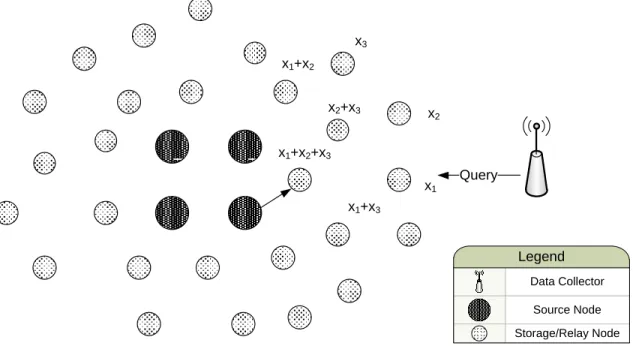
k ≤ n. We denote by N(k, n) a network with k source nodes and n storage nodes. Figure 3.1 shows an example of anN(4,27). Each source node generates a data packet
xi. Let X = {x1, x2, ..., xk} represents the set of all native packets generated by all
the k source nodes. The terms data packet, source packet, and native packet may be used exchangeably to refer to packet before encoding. The term symbol may also be
used occasionally instead of packet. After generating a data packet, each source node
ui selects a set of m storage nodes Wi = {w1, w2, ..., wm} uniformly and randomly
whereW ⊆V and sends its data packetxi to the selected nodes. We call the number
of packets (m) sent out by each source node the Redundancy Factor (RF). In this study, we assume that m is equal for all source nodes. We assume a shortest path routing algorithm is in place. During the analysis, no specific topology is assumed. However, simulations are performed on grid topology. Details on simulation setup will be discussed in the corresponding chapters.
Data Collector Source Node Storage/Relay Node Legend x1+x2+x3 x2+x3 x 2 x3 x1 x1+x3 x1+x2 Query
Figure 3.1: Generic Model of an N(4,27) Network.
After sending the source packets, each storage node vj receives a set of data
packets between 0 and k; and for each packet xi it receives, a random coefficient
gji from Fq is generated. vj then multiplies xi by gji and XORs the result with the
existing combination on its memory under the mathematics of Fq to generate a new
the length of the encoded packets ej’s is the same as that of the native packets xi’s.
Let E = {e1, e2, ..., en} be the set of all the encoded packets on all n storage nodes.
In addition to the encoded packets, all the generated random coefficients are stored on the storage nodes and forwarded when the packets are being collected by a data collector. We defineGj ={gj1, gj2, ..., gjk} to be the local encoding coefficients vector
at node vj.
Data packets generated by data nodes are assumed to be of equal size. Further-more, each storage node is assumed to have a storage capacity of a single encoded packet plus the corresponding encoding coefficients vector. This later assumption is used to model limited memory. Furthermore, during the data dissemination phase of building the code, the network is assumed to be always connected, i.e. for any two nodesi and j, a path fromi to j is always available, and vice versa.
3.2
Code Model
A code is represented as a set of three matrices G(n, k), X(k,1), and E(n,1). G
represents the Generator Matrix (GM) which stores the coding coefficients where each entry gji ∈ G represents the encoding coefficient used by storage node vj to encode
the packet received from source node ui, if any. Otherwise, gji = 0. X on the other
hand contains the set of native data packets where each entryxi represents the value
generated by node ui. Finally, E holds values representing encoded combinations
resulting from the encoding process on storage nodes, where entry ej represents the
encoded packet on storage node vj. We denote by C(k, n, m) a code over anN(k, n)
g1,1 g1,2 · · · g1,k g2,1 g2,2 · · · g2,k .. . ... . .. ... gn,1 gn,2 · · · gn,k x1 x2 .. . xk = e1 e2 .. . en G×X =E
Note that encoding can be viewed as constructing G, then multiplying GbyX to generate E. Conversely, decoding involves collecting packets (rows) to build G and
E, then solving for X.
3.3
Energy Model
The focus of this work is on energy efficient construction of decentralized erasure codes. Therefore, we use the number of operations executed during the encod-ing/decoding process to evaluate the energy needed. We use an abstract energy model as described below. However, any specific energy model can be easily incorporated.
We assume a network composed of wireless nodes powered by batteries. The en-ergy consumed by nodes can be due to either sensing (in the case of source nodes), communications (sending/receiving), or processing. The corresponding energies con-sumed are therefore represented byξs,ξc, and ξp, respectively, where ξc >> ξp. Note
thatξccan refer the energy consumed by either sending or receiving. We further define
ξt and ξr to be the energy required for sending and receiving a packet, respectively.
Accordingly, the cost of relaying a packet becomes ξrelay = ξt+ξr which
corre-sponds to one reception and one transmission. We assume that ξp accounts for the
energy cost for encoding, i.e., generating random coefficient, multiplying the received packet by the random coefficient, and XOR-ing the result with the local encoded packet, and storing the final results. The cost of routing related calculations is ne-glected since it is assumed to be equal for all schemes considered. We also do not consider the energy consumed by sensing for the same reason.
3.4
Failure/Erasure Model
The data erasures considered can be due to many reasons such as node destruction, hardware or software failures, node moving out of network range, or node disconnect-ing from network. Regardless of the cause, we model erasures by simply deletdisconnect-ing the corresponding node from the network. Node failure is modeled as a random process with n possible equally likely independent events. At each time unit ti, one and only
one random storage node is taken out of the network. In simulations, this corresponds to failure of a node. Each time a node is deleted, the survivability of the remaining portion of the code is evaluated.
An alternative failure model can be a burst failure model which can simulate failures caused by natural disasters for instance. It should be noted that we do not consider burst failure model. However, studying the impact of burst failures on the geographical distribution of sensor data is left as a future work.
3.5
Communications and Propagation Model
Nodes have a limited communication range and hence need to rely on multi-hop communication. Hence, each node is able to reach its direct single-hop neighbors. Erasures due to channel errors are not considered. We only consider erasures due to failure or the disappearance of storage nodes. Data collector is assumed to be able to reach all sensor nodes in a single hop during data collection.
Decentralized Erasure Codes
Based Distributed Storage for
Data Survivability
4.1
Introduction
Distributed Data Storage Systems (DDSSs) can achieve two main benefits; relia-bility and scalarelia-bility. Therefore, they are an indispensable building block in many applications such as data centres and Peer-to-Peer (P2P) networks. However, when adopted for WSNs applications with limited resources, designing DDSSs brings about a number of interesting challenges. Given the limited processing, storage, and energy resources on sensor nodes, coding and dissemination mechanisms used must be sim-ple and efficient. Secondly, because sensor data is decentralized over many nodes, building distributed storage is not straightforward.
Therefore, erasure codes present an attractive option for designing DDSSs for 32
WSNs applications because of their simplicity. An overview of erasure codes can be found in Appendix A. In addition, random construction makes them suitable for distributed systems such as WSNs. However, because the source data in WSNs is decentralized by nature, existing centralized solutions may not be optimized for WSNs applications.
Decentralized Erasure Codes (DEC) were proposed for such design requirements. DEC works on decentralized source data and requires no information a priori, except for network size. It also uses simple linear coding. The code provides reliability and flexibility since encoded data can be decoded using random data collection. Finally, DEC has a predictable algebraic structure allowing for quantifiable performance.
In this chapter we present an overview of DEC. We also introduce the notion of data survivability as a quantitative design requirement for data resilience in WSNs. Then, we present a modified DEC scheme called Decentralized Erasure Codes for Data Survivability (DEC-DS) that allows for the incorporation of data survivability as a network design parameter. The design of DEC-DS comprises of mathematical rela-tions to facilitate determining the amount of redundancy required and the maximum failure that can be tolerated. DEC-DS also includes means of data dissemination, encoding, collection, and decoding.
4.2
Decentralized Erasure Codes (DEC)
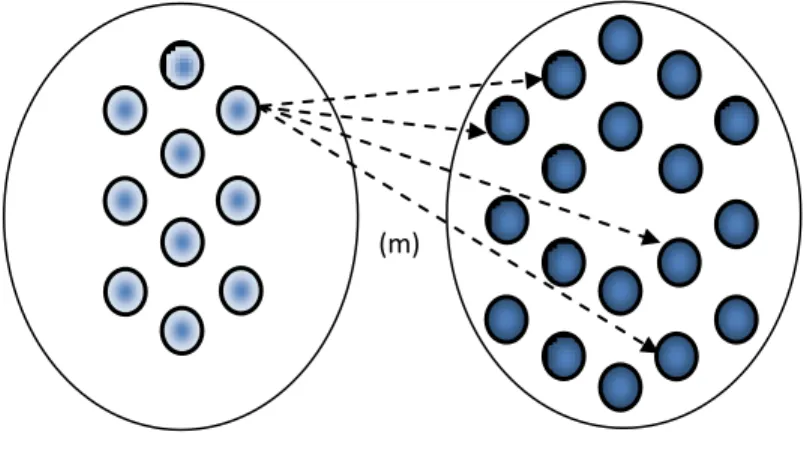
A. G. Dimakis et al. propose DEC in references [3], [8], and [7]. Refer to Figure 4.1. Given a network of k source nodes and n storage nodes, where k < n, each source node generates a singledata packet xi and forwards it to mstorage nodes that
through some routing mechanism. Upon receiving the data packets from different source nodes, each storage node generates a random coefficient gji for every packet
received which is drawn from a finite field Fq and combines the received packets as
follows
ej =gj1.x1⊕gj2.x2⊕...⊕gjk.xk
Note that every storage node will receive a different set of data packets, and that
gji 6= 0 ifxiwas included in the encoding at the current storage node, and 0 otherwise.
The storage node then stores theencoded packet ej in addition to the a k-dimensional
local encoding coefficient vector Gj ={gj1, gj2, ..., gjk}used for encoding.
To retrieve the original packets, the decoder needs to collect (1 + )k encoded packets, whereis a very small number. Then the decoder solves for X in the system of linear equations E = GX where E = {e1, e2, ..., ek0}, X = {x1, x2, ..., xk}, and
G = {G1, G2, ..., Gk0}. k ≤ k0 ≤ n denotes the number of packets collected. Figure
4.1 depicts an example of N(10,18) with m = 4.
X = Source Network (k) Y = Storage Network (n)
(m)
Even though DEC is simple and decentralized, its main emphasis is on reducing the number of packets required for successful decoding (repair bandwidth) and in turn reduce decoding delay. We refer to this number as the Decoding Overhead (DO) and it is denote by (β = max(0, k0 − k)). Unlike the original DEC, our objective is to increase data survivability against failures rather than reducing the decoding overhead (β). We argue that achieving survivability requires less Encoding Overhead (EO) or (α =k ×m) than that required to achieve low delay decoding as in DEC. The cost would however be a higher value of β. We use some important results on random matrices over finite fields as presented in Appendix B. Using those results, we know that the DO is upper bounded by 0≥β≥c where c'8 forF2.
4.3
Centralized Vs. Decentralized Erasure Codes
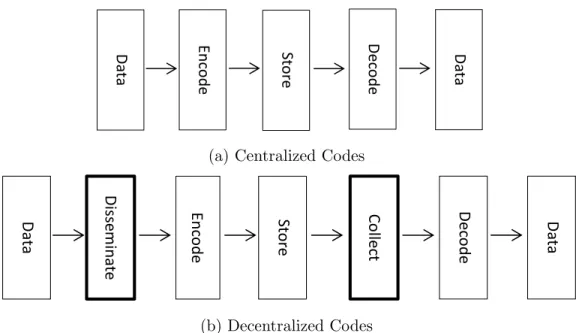
The design of erasure codes in a decentralized setup is quite different than that in a centralized one. Generally, random erasure codes for k packets works as follows. A degree distribution ρ(k) is used to generate a value 1 ≥ d ≥ k. Then, d packets are combined together using bitwise XOR. Now, consider Figure 4.2. In a central-ized code, all k native data packets are available at the encoder. Hence, the degree generated by the distribution ρ(k) can be exactly matched since d ∼ ρ(k) ≤ k. In decentralized codes however, due to the dissemination phase that precedes the en-coding as shown in Figure 4.2b, the encoder at each storage node may only have a subset of the native packets. Therefore, the required degree of ρ(k) may not be exactly matched.
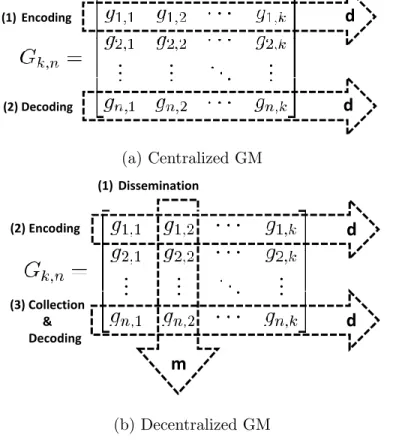
Mathematically speaking, in the centralized case (Figure 4.3a), the degree of each row of the generator matrix (G) can be produced exactly to match the degree d
D ata Enco d e D ec o d e D ata D ata D isse m in at e Enco d e Co llec t D ata D ec o d e Sto re Sto re
(a) Centralized Codes
ata d e o d e ata D ata D isse m in at e Enco d e Co llec t D ata D ec o d e re Sto re (b) Decentralized Codes
Figure 4.2: Centralized vs. Decentralized Erasure Codes.
generated by the distribution ρ(k). On the other hand, in the case of decentralized codes (Figure 4.3b), each source node chooses which storage nodes receive its data by disseminating m duplicate copies to m distinct storage nodes first. Thus, setting exactlym entries per columnto 1.
Due to the restrictions imposed by the observations made above, we need to resort to a different approach to manipulate the distribution of Gand consequently control its properties. So, instead of manipulating the degree of each row (which is not possible), we manipulate the overall distribution of the matrix. This is motivated by some interesting results on random matrices over finite fields as discussed in Appendix B.
d d d (1)Dissemination d (2) Encoding (3) Collection & Decoding m (1)Encoding (2) Decoding (a) Centralized GM
d
d
d
(1)Disseminationd
(2) Encoding (3) Collection & Decodingm
Encoding Decoding (b) Decentralized GMFigure 4.3: GM for Centralized vs. Decentralized Erasure Codes.
4.4
Decentralized Erasure Codes for Data
Surviv-ability (DEC-DS)
We now present the proposed distributed data storage scheme for data survivability. The scheme is called Decentralized Erasure Codes for Data Survivability (DEC-DS). The goal of the scheme is to increase data survivability against failures (erasures). However, the main difference between this scheme and previous schemes in the liter-ature is that it generates redundancy according to a supplied data survivability value
recovered as long as the erasure rate1 in the networkf ≤1− 1
s+1.
The scheme works in a fashion similar to the original DEC. The only difference, however, is the value of the RF (m) produced by source nodes. The aim of the original DEC is to guarantee that any (1 +)k encoded packets are enough to retrieve the original packets, for a small value. In contrast, our scheme aims at making sure that data can be recovered while there is more than (1− 1
s+1)×n packets in the network,
where n is the number of storage nodes.
In mathematical terms, DEC constructs the generator matrix G such that any (1 +)k rows are linearly independent. DEC-DS on the other hand builds G such that Gis invertible as long as there is (1− 1
s+1)×n rows. Note that the requirement
of DEC-DS can be achieved by DEC. But DEC is not optimal for such a requirement. In other words, DEC-DS can achieve data survivability at a lower cost of redundancy and energy compared to DEC.
As have been mentioned previously, when the source data is decentralized, gener-ating an erasure code according to a specific degree distribution is not trivial. One way to match the distribution of a centralized erasure codes is to send all source data to all storage nodes (i.e. m =n) and let each storage node chooses a subset of the source data according to a degree distribution ρ(k). Clearly, the communication requirements of such a solution is O(nk). The good news is that we can do better; since we have control over the degree distribution of G. In what follows, we show how we can use the results from the theory of random matrices over finite fields to implement DDSS for data survivability applications. Appendix B presents a brief background on the theory of random matrices over finite fields with some important results.
We consider a networkN(k, n), similar to that shown in Figure 4.1. Data Surviv-ability is defined as the maximum fraction of nodes to fail without compromising the probability of successful decoding of the native data. For example, s= 3 corresponds to a code that can tolerate (1− 1
s+1)×100 = 75% failure (0.75×n nodes). We are
interested in designing a storage network with a codeC(k, n, m) and survivability s. Let n be the number of storage nodes to be deployed. To achieve survivability
s, n can be determined by
n=k(s+ 1) (4.1)
Let U = {u1, u2, ..., uk} be the set of source nodes. Also, let V = {v1, v2, ..., vn}
be the set of storage nodes. In addition to storage, nodes in V are also assumed to serve as relays. Without loss of generality, we assume that U ∩V = . We also assume that a multi-hop routing mechanism is in place. Each source node ui
generates a data packet xi, selects a set of m storage nodes Wi = {w1, w2, ..., wm}
uniformly and randomly whereW ⊆V, and sendsxi to the set of selected nodes. Let
X ={x1, x2, ..., xk}represents the set of all native packets generated by the k source
nodes. The total number of packets sent out by all the source nodes, or the Encoding Overhead (EO), is denoted by(α) and can be expressed as
α=k×m (4.2)
Upon receiving a set of data blocks Xj ⊂ X, each storage node vj combines the
received blocks linearly to generate an encoded block ej as
where gji ∈F2 is a coding coefficient.
In other words, ej represents a linear combination of a sum of a random subset
of X. The number of packets dj = |Xj| used to construct an encoded packet ej is
called the packet degree of ej. Along with ej, a k-dimensional binary vector Gj =
{gj1, gj2, ..., gjk} is generated with entries as
gji = 0, if xi ∈/ Xj 1, otherwise. (4.3)
Gj is referred to as the encoding vector. Each node is assumed to have a
stor-age space for only one encoded packet and its corresponding encoding vector. This latter assumption is made to model limited memory in sensor nodes. Let G = {G1, G2, ..., Gn} be the generator matrix as seen in Figure 4.3b. When data is being
collected, a subset of storage nodes are contacted to forward their encoded packets along with the corresponding encoded vectors. The data collector then builds a local decoding matrix G⊂Gusing the received encoding vectors. It also forms anencoded data matrix E using the received encoded packets, and solves for the native data X
in the system of equations X =EG−1.
Algebraically, to achieve a data survivability s, we attempt to build G such that it is invertible with high probability even when (1− 1
s+1)×n rows are deleted. To
better explain this, we need to present Theorem 4 from Appendix B. The Theorem can also be found in reference [29].
probability of invertibility as long as
logk+h(k)
k ≥p≥1−
logk+h(k)
k (4.4)
Further h(k) can be a constant cresulting in an invertibility probability (Ps) as
Ps=c2e−2e −c
(4.5)
where c2 =π(0,2) is given by Eq. B.6. As shown in Figure 4.4, it is not difficult
to see that 0 ≤ Ps ≤ c2. Further, Ps = c2∀ x ≥ 7. The choice of a constant value
for xis important since it affects the resulting overhead. Besides, the value of such a constant can be made absolutely small. The following theorem establishes the basis for the design of the proposed DEC-DS.
Theorem 1. Let G be a k ×n random matrix over F2, and s ≥ 0. Further, let
n = (1 +s)k and m = (1 + s)(log (k) +c?1) +c?2. G is constructed by selecting m
random entries in each of then columns and setting them to 1. Now, letGbe ak×k0
matrix constructed by deleting n−k0 rows fromGchosen uniformly at random, where
k ≤k0 ≤n−k. ThenG is invertible with high probability for some constant value c?
1
and c?
2.
Proof. From Theorem 4 (Appendix B), we know that p = logk+kh(k) ≤ 1/2. For a constant h(k), p = logk+c?1
k . Furthermore, Eq. B.5 shows that on average a constant
number of extra packets is required to guarantee invertibility. Let c?
2 denote the
number of extra packets required. Now, to maintain the same invertibility probability for the square k×n matrix, we need
𝑥 = 7 𝑥 𝑓 𝑥 = 𝑐2 𝑒 − 2 𝑒 − 𝑥 Figure 4.4: Ps=f(x) = c2e−2e −x . p= log (k) +c ? 1 k but, p= m×k n×k m =np = n k(log (k) +c ? 1) +c ? 2 (4.6) = (1 +s)(log (k) +c?1) +c?2 (4.7) The values ofc?
1 andc?2 correspond to the constant in cin Eq. 4.5 and the number
of extra vectors required for decoding as in Table B.2, respectively. We have chosen
c?
values shown in Table B.2. Consequently, Eq. 4.6 becomes
m= (1 +s)(log (k) + 7) + 8 (4.8) When data collection takes place, the data collector retrieves ej’s and Gj’s to
build to matricesE andG, respectively, and decodes the native blocks asX =EG−1. The only condition required is that G must be invertible (or full rank). As shown in Figure 4.3, the properties of the resulting code depend on the properties of the resulting coefficient matrix G. Note that unlike ordinary erasure codes, the packet degree distribution cannot be controlled in DEC. Therefore, the attention is shifted to the distribution (density) of matrix G. Clearly, there is a compromise between α
and the expected β. Choosing α to be small saves energy during dissemination and encoding but results in higher β value. This is mainly because
(1 +s)(log (k) + 7) + 8 ≥m≥5(1 +s) log (k) (4.9)
So, the least density, and therefore least energy, is achieved when m = (1 +
s)(log (k) + 7) + 8. Moreover, the value of c?
2 is insignificant for large value of k. In
other words, for k >10, it is sufficient to have m = (1 +s)(log (k) + 7).
4.5
Performance Evaluation
To verify the proposed survivability scheme and to evaluate its performance, a custom simulator was built. The simulator starts by creating a network of k source nodes and a storage network of n nodes. The network topology is a grid where each node have between 1 and 8 neighbours. Based on the survivability required, the values
for n and m are calculated as previously discussed. The simulator takes as input: k,
s, and Fq. Next, the dissemination phase begins where each source node randomly
selects m distinct storage nodes and forwards the data to them. Unlike [7], we as-sume that the m random nodes chosen are all different. In the encoding phase, each storage node encodes the received packets over the finite field specified, and stores the encoded packets in addition to the corresponding encoding vector. To test the code survivability, we set f, the erasure rate, to values between 0 and 1. For each value of f, f ×n storage nodes are deleted, and decoding is applied to test if native data can still be decoded. To test decodability, storage nodes are selected randomly to build G−1. If rank(G−1) = k, decoding is successful and we record the number of packets used for decoding (β). Otherwise, decoding fails. To calculate the proba-bility of successful decoding (Ps), large number of different test cases with different
distribution of nodes are generated and tested. Procedure 4.1 illustrates the general steps of the simulation.
Algorithm 4.1 Simulation Pseudo-code
Require: k, s
n= (s+ 1)k;
m= (s+ 1)(logk+ 7) + 8;
for i= 1 to 10000do
Disseminate(n, m);
forfailure level (f) from 0 to 1 do
CollectPackets(f);
end for end for
The simulation usedk = [10,50] ands= 2. The results are based on 500 different runs with different initial choices of storage nodes by source nodes. We are interested in the probability of successful decoding (Ps) and the average number of packets
required for decoding (β). We definePs as
Ps =
Numbe
![Figure 4.5: Probability of Successful Decoding (P s ): k = [10, 50], s = 2, F 2 . Figure 4.5 shows the performance of the code in terms of the probability of suc-cessful decoding (P s )](https://thumb-us.123doks.com/thumbv2/123dok_us/988429.2629893/62.918.183.793.256.675/figure-probability-successful-decoding-figure-performance-probability-decoding.webp)
![Figure 4.6: Decoding Overhead (β): k = [10, 50], s = 2, F 2 .](https://thumb-us.123doks.com/thumbv2/123dok_us/988429.2629893/63.918.174.796.179.521/figure-decoding-overhead-β-k-s-f.webp)