An analysis of the Dutch migration policy and its efforts in receiving, detecting and sheltering potentially radicalised children from jihadist circles.
Maaike Grootjans - S1727125
Management, Society and Technology
University of Twente, Enschede
First supervisor: Dr. A.J.J. Meershoek Second supervisor: Dr. C. Matera
Date: July 3rd, 2019 Word count: 19,057
ABSTRACT
A policy and practical gap exists between child returnees from the Islamic State and the
jihadism in the asylum chain in the Netherlands. Academic research has shown that returnees
could execute terrorist attacks, spread the jihadist ideology or recruit new fighters in the
Netherlands. More increasingly, such tasks are performed by young children. This study aims
at laying down this role of children as external operatives within the context of migration.
Building on existing literature, policy documents, international legislation and interviews, it
asks: To what extent does the Dutch migration policy reckon with children coming from
(former) Islamic State-territories? In this context, child returnees are defined as human beings
below the age of 18 who return to the EU after having lived in the IS Caliphate for a longer
period of time with the aim of pursuing the jihadist ideology. Complementing the qualitative
document analysis, two interviews were conducted with practitioners. Analysis showed that the
Netherlands perceives children as victims rather than perpetrators and makes minimal efforts
in designing the migration policy and migration chain to such an extent where the potential
danger of child returnees is embedded. Further research is needed to adequately address this
TABLE OF CONTENT
ABBREVIATIONS AND ACRONYMS ... 4
TABLES AND FIGURES ... 5
INTRODUCTION ... 6
I.PROBLEM STATEMENT ... 7
II.RESEARCH QUESTIONS ... 8
III.RELEVANCE ... 8
LITERATURE ... 10
I.RELIGIOUS TERRORISM ... 10
II.FOREIGN FIGHTERS ... 10
III.GEOGRAPHIC SHIFT OF TERRORISM ... 11
II.CHILDREN IN TERRORISM ... 12
METHODOLOGY ... 15
I.DATA COLLECTION METHODS... 15
II.RESEARCH DESIGN ... 16
III.CONCEPTUALISATION ... 17
IV.OPERATIONALISATION ... 21
IV.RELIABILITY AND VALIDITY ... 22
I. INTERNATIONAL FRAMEWORK ... 24
I.MIGRATION... 24
II.CHILDREN ... 25
III.CHILDREN IN ARMED CONFLICTS ... 26
IV.FOREIGN FIGHTERS ... 27
V.RETURNING FOREIGN FIGHTERS ... 28
VI.THE INTERNATIONAL COVENANT ON CIVIL AND POLITICAL RIGHTS... 28
VII.CONCLUSION ... 29
II. DUTCH MIGRATION POLICY ... 31
I.NATIONAL APPROACH ... 31
II.DUTCH ASYLUM PROCEDURE ... 32
III.CONCLUSION ... 34
III. CHILDREN IN DUTCH MIGRATION ... 36
I.ACCOMPANIED CHILDREN ... 36
II.UNACCOMPANIED MINOR ALIENS (AMV)... 36
III.CHILDREN IN ASYLUM CENTRES ... 38
IV.CONCLUSION ... 39
IV. DUTCH RETURNEES ... 40
I.RETURNING FOREIGN FIGHTERS... 40
II.RETURNING CHILDREN ... 41
IV.CONCLUSION ... 42
V. SIGNALLING JIHADISM ... 44
II.RECOGNITION AND INTERPRETATION ... 46
III.DIFFICULTIES ... 46
III.CONCLUSION ... 47
VI. ACTING UPON JIHADISM ... 50
I.ACTION IN THE MIGRATION CHAIN ... 50
II.INCREASING IMPORTANCE OF THE FRONTLINE PROFESSIONAL ... 50
III.CONCLUSION ... 51
DISCUSSION ... 53
I.RESULTS AND INTERPRETATION ... 53
III.LIMITATIONS ... 55
IV.REITERATION OF RESULTS ... 57
IV.RECOMMENDATIONS ... 57
CONCLUSION ... 59
I.TO WHAT EXTENT DOES THE DUTCH MIGRATION POLICY RECKON WITH CHILDREN COMING FROM (FORMER)ISLAMIC STATE-TERRITORIES? ... 59
II.CONTRIBUTION ... 60
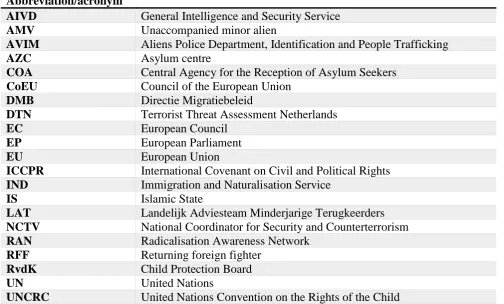
ABBREVIATIONS AND ACRONYMS
Abbreviation/acronym
AIVD General Intelligence and Security Service
AMV Unaccompanied minor alien
AVIM Aliens Police Department, Identification and People Trafficking
AZC Asylum centre
COA Central Agency for the Reception of Asylum Seekers
CoEU Council of the European Union
DMB Directie Migratiebeleid
DTN Terrorist Threat Assessment Netherlands
EC European Council
EP European Parliament
EU European Union
ICCPR International Covenant on Civil and Political Rights
IND Immigration and Naturalisation Service
IS Islamic State
LAT Landelijk Adviesteam Minderjarige Terugkeerders NCTV National Coordinator for Security and Counterterrorism
RAN Radicalisation Awareness Network
RFF Returning foreign fighter
RvdK Child Protection Board
UN United Nations
[image:5.595.70.575.105.409.2]UNCRC United Nations Convention on the Rights of the Child
TABLES AND FIGURES
TABLE 1: ABBREVIATIONS AND ACRONYMS ... 4
TABLE 2: THE ROLE OF CHILDREN IN THE ISLAMIC STATE... 13
TABLE 3: THE REGULAR ASYLUM PROCEDURE CONFORM THE ALIEN DECREE 2000. ... 34
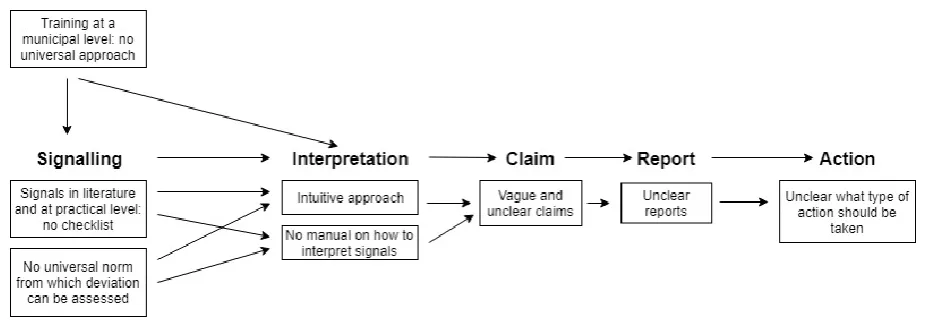
TABLE 4: SIGNALS AND INTERPRETATION OF JIHADISM. ... 49
INTRODUCTION
“Allah promises us victory, and he has promised you defeat. This battle is not going to end in Raqqa or Mosul. It is going to end in your lands. By the will of Allah, we will have victory. So
get ready, for the fighting has just begun.”1
Above-mentioned statement was made by Yusuf, a ten-year-old American boy who had travelled to join the Islamic State (IS) with his mother. The video, uploaded by IS in 2017, shows the story of the young boy against the backdrop of a destructed landscape. While Islamic chants serve as background music, the boy speaks English with Arabic dialogues mixed through his manifesto and addresses his statement directly to the American president. From this, it is easy to assume that Yusuf is different from other children his age. This becomes even more evident when the video continues with Yusuf setting a rifle from “safe” to “semi-automatic”.
If Yusuf’s story were to be true, he and his mother would be amongst the many who
have left their home-country to join IS in either Syria or Iraq. While the concept of these so-called foreign fighters is not new, it rose in global attention accompanying the rise of IS (Malet, 2013). Especially after IS proclaimed the Caliphate in the summer of 2014, the number of the foreign fighters increased, with an estimated number of 20,730 foreign fighters in February 2015 (Bakker & de Roy van Zuijdewijn, 2015, p. 2). Of this number, 200 to 250 are estimated to come from the Netherlands (Bakker & de Roy van Zuijdewijn, 2015, p. 3). A more recent study by the National Coordinator for Security and Counterterrorism (NCTV) and the General Intelligence and Security Service (AIVD) estimates that there are at least 80 to 90 children in IS-territory with a Dutch connection (NCTV & AIVD, 2017, p. 6). IS does not hesitate in recruiting children in their jihad and religiously justifies it by claiming that they are the “next generation of the Caliphate …. and can be precisely shaped according to the ideal IS-image” (Horgan, Taylor, Bloom & Winter, 2017, p. 651; NCTV & AIVD, 2017, p. 5). This next generation of the Caliphate exercises functions and operations which align those of adult fighters more increasingly (Almohammad, 2018, p. 21). The international scope that Islamic terrorism has reached in the last decades is especially worrying when combined with this increasing recruitment and employment of children. In such a post-9/11 world, the both demographic and geographic shift that terrorism has made becomes undeniably clear.
1 Zelin, A.Y. (2017). New Video Message from the Islamic State: ‘The Fertile Nation #4—Wilāyat AlRaqqah,’
JihadologyRetrieved April 15th, 2019 via:
I. Problem statement
Where many people have been moving towards the IS-regions, the recent example of British IS-bride Shamima Begun and the Dutch IS-fighter Yago Riedijk show the topicality of foreign fighters and their (new) families feeling the urge to move back to their home-country.2 While many foreign fighters wish to come home due to the fall of the Caliphate, there is still a vast majority of fighters who carry the jihadist ideology and wish to pursue this (Byman, 2015; Sunier, 2016).
Based upon their nationality, many flee to their home-country in Europe. There are, however, also returning foreign fighters (RFFs) who seek asylum in a country different from their citizenship. Through the migration flow, two problems arise that could harm Western societies. Firstly, the risk of radicalised fighters entering Europe through the migration influx is significant to the national security of a country. Secondly, there is the risk that other asylum seekers or citizens are radicalised by these returning foreign fighters. The example of “De Balie-man” showed that it is possible that people with terrorist motives or history follow the migration
flow to the European Union.3
Especially the vulnerability of children and the position they occupy with IS is becoming a problem for the migration flow and the migration procedure. On the one hand, the government is responsible to ensure safety and security within its territory and society, which would imply that measures must be taken against the threats that children pose. On the other hand, governments have a duty of care towards children, both towards children with a Dutch nationality but also regardless of their nationality in the asylum procedure.
In essence, this thesis places question marks regarding the role of minors in jihadism and the asylum procedure. How governments respond to these issues separately is carefully laid down in an international and national framework. The question that results from it is whether countries like the Netherlands comply with these rules. Secondly, it raises questions about the efforts governments make in early detection of jihadism amongst youngster who come to the Netherlands with the migration flow.
2 Van Wilgenburg, W. (2019, March 11th). Jihadist Yago Riedijk in Syrië: Laat Nederland nu goede voorbeeld
geven. AD. Retrieved on April 15th, 2019 from:
https://www.ad.nl/binnenland/jihadist-yago-riedijk-in-syrie-laat-nederland-nu-goede-voorbeeld-geven~aa0f7ef6/
3 Musch, S. (2018, October 30th). Syriër uit De Balie alsnog aangehouden op verdenking terrorisme. NRC. Retrieved on June 20th, 2019 from:
II. Research questions
II.I. Central research question
To address the above-mentioned problem the future challenge for the Dutch government lies in correctly sheltering children from jihadist circles who wish to reside in the Netherlands and adapting its migration policy to do so. This results in a practical gap between the dangers of these potentially radicalised children and how this is dealt with at a policy-level and practised at the frontline-level. The following central research question will thus be answered in this thesis:
To what extent does the Dutch migration policy reckon with children coming from (former) Islamic State-territories?
II.II. Sub-questions
To properly answer the research question, the following sub-questions will be asked:
i. How is the international and supranational legislation concerning returning foreign fighters, children and migration designed in an international framework?
ii. How are migrants currently received and sheltered in the Netherlands?
iii. What does the migration chain in the Netherlands entail of concerning children? iv. What does the legislation concerning returning foreign fighters and child returnees
comprise of in a Dutch context?
v. What efforts do the Dutch reception centres make in signalling jihadism amongst children?
III. Relevance
The topicality of this problem provides an interesting and acute gap in the academic and practical field on the phenomenon of child radicalisation, the consequences of this and government’s response. Several members of the Taskforce ‘Vreemdelingen en Migratiecriminaliteit’ have expressed the need for such a topic to be researched, considering
the current lack of information on this topic. In essence, this thesis will deliver a research that is relevant in a variety of ways.
III.I. Scientific relevance
contribute to further academic research on this topic. Additionally, considering the many regulations that exists in both an international and national context, this thesis will contribute to comprehensively present such an international framework with all the relevant laws, which also has practical value. From this, research in the field of law can continue.
III.II. Practical relevance
Given that this thesis will be written within the context of the Dutch migration policy, the Dutch government needs to be able to adequately design or adapt a policy which to a large extent prevents and/or mitigates the consequences that radicalised children pose. Currently, little is known about how institutions deal with children from jihadist circles who wish to come to the Netherlands. This thesis will, through its social, scientific and juridical framework and various empirical observations, allow for a comprehensive explanation of how children from jihadist circles are currently being sheltered. This, in turn, will be of help to the Dutch government and its institutions to correctly adapt and/or design policy.
III.III. Societal relevance
LITERATURE
This chapter will provide background information derived from academic literature on terrorism, its geographic shift towards the West and the increasing role of children in Islamist terrorism. In doing so, a context will be drafted for the continuance of this thesis.
I. Religious terrorism
9/11 attracted international attention to Islamic terrorism in a variety of scholarly fields, governmental and non-governmental institutions, and the media (Bakker, 2015; Flint & Radil, 2009, p. 150). It has, ever since, been in the news almost daily on a global scale and poses one of the most pressing security threats (Bakker, 2015, p. 23; Schmid, 2004).
While terrorism has existed throughout history, the current phenomenon of jihadi-Salafist terrorism differs greatly from other waves of terrorism associated with colonialism, communism and anarchism. Firstly, suicide attacks became a crucial means for “successful and effective” terrorism (Bakker, 2015, p. 59). Additionally, where the other waves were mostly
concentrated on intrastate activities – of course with a few exceptions – the current wave has shown its global scope through international attacks such as 9/11 and Paris in 2015 (Flint & Radil, 2009). Accompanying, religious terrorism is often characterised through the growing amount of foreign fighters (Bakker & de Roy van Zuijdewijn, 2015).
II. Foreign fighters
Specifically from 2012 to 2014, when IS proclaimed the Caliphate, a growing amount of foreign fighters occurred (Bakker & de Roy van Zuijdewijn, 2015, p. 2; Weggemans, Bakker & Grol, 2014). Nowadays, foreign fighters almost seem inextricably linked with Islamic terrorism, but the phenomenon has existed long before Al-Qaeda and IS (Malet, 2013). Transnational recruitment has been occurring even before the rise of nation-states, for example during the Spanish Civil War (Bakker & Grol, 2017; Malet, 2013, p. 22).
a victim of the Western system that disregards their norms and values, resulting in them moving to areas who follow the same norms. Here, they either become citizens of the Caliphate, or they actively engage in jihadism through conducting terrorist attacks or spreading the ideology (Cragin, 2017, p. 298).
III. Geographic shift of terrorism
While seeing so many Western nationals leaving has been a pressing security issue on many political agendas, an even more pressing issue regards the return of these foreign fighters. As IS has lost many territory and power, Western countries ought to prepare for the many returnees. Where some may have lost their strong bonds with their religion and others may not (Speckhard, Shajkovci & Yayla, 2018). Overall, the scaring thought is that individuals who fought abroad might return more battle-hardened, radicalised and experienced in exercising violent activities, as became evident through the Paris-attacks in November 2015 (Byman, 2015, p. 582; Cragin, 2017; De Roy van Zuijdewijn, 2016, p. 83).
De Roy van Zuijdewijn (2016) introduces three types of danger of RFFs: 1) a physical threat, such as exercising terrorist attacks, 2) an ideological threat, by spreading the ideology and recruiting new foreign fighters, and 3) a social threat, where national policies are adjusted and societies grow fearful of returnees. Also, RFFs pose threats to themselves as they might suffer from post-traumatic stress disorder (PTSD) and often come back to broken families which may result in violent conflicts, confusion with the child and resistance to aid from the government (De Roy van Zuijdewijn, 2016, p. 86). A recent example of the latter is the Dutch case of Maya, whose daughter Mandy radicalised, travelled to IS and now wants to return with her children.4 Maya is fearful of the dangers that Mandy might pose, but especially of her grandchildren who are potentially radicalised as well.
While many scholars and governments do accept these threats, it also raises questions about the accuracy of these issues. Byman (2015, p. 582), for example, argues that the risks of bleed out differ per country and depend on the security services and policies. Additionally, RFFs are more likely to create more enemies than to expand their organisation. On the same hand, a study by Leduc (2016) shows that RFFs do not increase the probability of a terrorist attack in the West and, consequently, do not increase the effectiveness of jihadist circles.
4 de Goede, A. (2019, June 22nd). Maya's dochter en kleinkinderen gingen naar IS-kalifaat: 'Laat ze daar, het zijn
tikkende tijdbommen'. RTL Nieuws. Retrieved on July 1st, 2019 from:
Whether the certainty of such potential threats is questionable, and politicians may only use it to put the issue on the agenda, it is important to keep the risk of occurrence in mind. Even though there is a low probability, the events are of high impact and will, inevitably, have large negative consequences and externalities on the Dutch society. It is for these reasons that governments must prepare for such dangers.
II. Children in terrorism
II.I. Child soldiers
The Islamic State is not the first and only organisation to employ children in their conflicts and such a child soldier phenomenon has been present for many centuries (Betancourt et al., 2010). Currently, especially African, South-American and some Asian countries are known for child usages in armed conflicts (Horgan, Taylor, Bloom & Winter, 2017). Western countries have, on the contrary, also been guilty of using child soldiers in the past. One example is the Hitler Jugend during the Second World War, where teens were educated and indoctrinated according to the Nazi regime (Benotman & Malik, 2016, p. 21).
From both the militant’s and the child’s perspective it is difficult to clearly define
motives for child recruitment. Observing from a militant’s perspective, there are multiple benefits to using children. A first reason is that children are easy to shape according to the ideology of the recruiting group. This could occur from the age of 7 or 8.5 Moreover, they easily follow commands and are cheaper than adults because they consume less (Benotman & Malik, 2016, p. 27; NCTV & AIVD, 2017, p. 5).
From a child’s perspective, joining a conflict might be a way to earn money for the
family (Benotman & Malik, 2016, p. 27; Horgan, Taylor, Bloom & Winter, 2017, p. 648). Also, children are often told to do so by their parents (Horgan, Taylor, Bloom & Winter, 2017, p. 648). This is important to realise, as children have a lower sense of morality than adults do and can be more easily drawn into activities they have no moral sense of. Finally, recruiting children often comes with impunity, implying that the militant group does not take into account children’s rights, protection and a community’s attitude because they do not comply with it
themselves (Almohammad, 2018, p. 6).
5 de Goede, A. (2019, June 22nd). Maya's dochter en kleinkinderen gingen naar IS-kalifaat: 'Laat ze daar, het zijn
tikkende tijdbommen'. RTL Nieuws. Retrieved on July 1st, 2019 from:
II.II. Children in IS
As has been clarified earlier, IS sees great potential in the usage of children as the “future generation” of the Caliphate. A study by the NCTV and AIVD (2017) extensively explains how
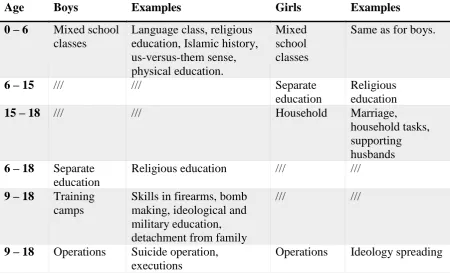
children live in IS-territory and to what education and training camps they are subjected to. The following table depicts the education and training children receive:6
Age Boys Examples Girls Examples
0 – 6 Mixed school classes
Language class, religious education, Islamic history, us-versus-them sense, physical education.
Mixed school classes
Same as for boys.
6 – 15 /// /// Separate
education
Religious education
15 – 18 /// /// Household Marriage,
household tasks, supporting husbands 6 – 18 Separate
education
Religious education /// ///
9 – 18 Training camps
Skills in firearms, bomb making, ideological and military education, detachment from family
/// ///
9 – 18 Operations Suicide operation, executions
[image:14.595.72.523.195.469.2]Operations Ideology spreading
Table 2: The role of children in the Islamic State.
II.III. Potential threats
The Dutch society is at risk of the threats that these children might pose, aligning the three types of fall-out presented earlier in this chapter. It is especially astonishing to see the physical activities that children practise within IS and this is potentially the biggest danger that they might pose to society. Continuing, the indoctrination that children receive might result in more violence and ideology-spreading in the Netherlands (NCTV & AIVD, 2017, p. 16). Consequently, their indoctrination could alienate them from society and their peers, resulting in unsupportive surroundings and a negative attitude towards them in society. This simultaneously results in a certain victimhood of the child. Within the Dutch society, children as perceived as victim more so than perpetrator. They return extremely traumatised by the living conditions and war they endured in IS-territory (NCTV & AIVD, 2017, p. 16). This inevitably
METHODOLOGY
The purpose of this research is both descriptive and exploratory and will follow qualitative methods. It will mainly serve to describe the existing regulations concerning people associated with IS or have resided in IS-territory and plan to come to the Netherlands. This thesis also follows an exploratory purpose; little is known about how Dutch institutions deal with children from jihadist circles who wish to return to the Netherlands. Qualitative methods are best suitable for these types of research because these methods are best able to illustrate the current regulations on a national, supranational and international scale as well as illustrating the perceptions of practitioners.
I. Data collection methods
I.I. Documents
A primary source of information considers publicly available documents, which are presented and analysed in Appendix A. The Netherlands, the European Union (EU) and the United Nations (UN) present large online databases of documents available to the public. Such documents include laws, policies, strategies, meetings, agreements, reports, factsheets, etcetera. Examples of such include migration laws, counterterrorism strategies, reports on children in IS, reception standards and more.
Another type of document concerns academic research reports delivered by scholarly experts in the field of terrorism, migration and children in armed conflicts. Many of these documents have been found through scholarly online libraries. Such academic reports comprise of comparisons of counterterrorism policies in European countries and analyses of jihadism in the migration chain, the RFF phenomenon, children in IS, and more. These are elaborated upon in Appendix B.
I.II. Interviews
applicability of laws and regulations which aids in answering the research question. The interviews will be semi-structured and follow guidelines and questions that are presented in Appendix D. This approach allows deviation which could be helpful for this study. The guidelines, on the other hand, prevent the interviews from going off-topic completely.
I.II.I. Case selection and sampling
In selecting respondents, it was important that respondents are involved as frontline professional in either the migration chain or the process of child returnees. Through snowball-sampling and cold-calling the researcher approached relevant institutions. Snowball-snowball-sampling is the easiest and fastest way in reaching possible respondents given the mutual contact person in between the researcher and the respondent (Babbie, 2004). Cold-calling is less effective but could result in an entrance in the relevant authority which could ultimately lead to the right respondent. The researcher made use of phone calls, e-mail, and contact via LinkedIn. Given the differences in time allocation, the researcher first engaged in cold-calling before making use of the snowball-sampling method.
The most important and relevant institutions are the Central Agency for the Reception of Asylum Seekers (COA), the Child Protection Board (RvdK), the Dutch Landelijk Adviesteam Minderjarige Terugkeerders (LAT) and the Immigration and Naturalisation Service (IND). These institutions are occupied with frontline tasks in the migration chain or in the field of child returnees. Of these institutions, the researcher aimed to speak with two employees each. Furthermore, the Migration Policy Department (DMB) has also been contacted given their primary role in drafting the migration policy. Through snowball-sampling, the researcher engaged in contact with police officers who are key figures in vice-crime, traumatised children and criminalisation in the migration chain.
Securing interviews proved to be harder than anticipated, mostly for time reasons. Appendix C extensively describes the efforts of the researcher in securing interviews with frontline officials.
II. Research design
The research design is aimed at answering all sub-questions in the order they have been presented in the Introduction before presenting the Discussion, ending with the Conclusion which answers the central research question.
comply to a variety of laws, policies, directives and regulations. Given the global scope of terrorism and migration, it is important to lay down the most important laws to which the Netherlands has to comply and include in her own policies. Chapter I will aim at depicting such an international framework upon which the rest of this study can build. Essentially, it will represent the rights and duties the Netherlands has towards refugees, the migration chain, returning foreign fighters and children in armed conflicts.
The second sub-question will be answered with the use of the Chapter I, as well as including Dutch legislation. Continuing, the third sub-question will specify upon the role of children within this migration chain in Chapter III. To amplify the existing legislation and information, an interview with an employee of the COA will be included in answering this question.
Chapter IV will answer the fourth sub-question which aims at describing the Dutch policy regarding RFFs and returning minors. This question has been included in this study because it sees how the Dutch policy fits in the rights and duties that have been laid down in Chapter I. It will also present the differences between Dutch nationals and non-Dutch individuals. Given that the unit of observation in this thesis is focused on children, this chapter will mostly be narrowed down to child returnees in the Netherlands. This information has been mostly derived from publicly accessible information, such as websites of the RvdK and letters to Dutch Parliament. The researcher aimed at securing interviews with frontline employees of the RvdK, but this was not possible due to time limits and the current events regarding child returnees. Information that was derived from the interviews with the COA and the police is included as well.
The final sub-question will be answered in Chapter V and VI. It will elaborates upon the function of the frontline worker concerning detecting jihadism and interpreting signals in the migration chain. It will do so by using research reports and interviews with the COA and the police. Chapter V will illustrate the signalling and interpretation efforts of frontline workers in AZCs. Chapter VI will elaborate on this by presenting the actions that are taken as a result of these signals.
III. Conceptualisation
III.I. Child returnees
Children serve as the unit of observation in this study. More specifically, children returning from the conflict zones of Syria and Iraq are the focus of this study which is henceforth referred to as “child returnees”. This concept comprises of two other concepts which will be elaborated
upon below: “children” and “returnees foreign fighters”.
The United Nations Convention on the Rights of the Child (UNCRC) defines a child as any human being below the age of 18.7 Given that the UNCRC has been ratified and implemented in Dutch law, this definition will be used in this study.
Returnees is a more complex concept to demarcate because it covers a broad range of groups. Essentially, returnees are individuals who return home.8 “Home” in this sense implies the country in which the individual has citizenship or a residence permit. However, the AIVD makes no difference in Dutch citizenship or other EU citizenship, given the principle of free movement within the EU (AIVD, 2017). This study will therefore not specify upon citizenship as well, following the AIVD’s practicalities. Returnees could cover people returning from a
holiday, groups who return to their home after a war, groups who return home from work-related activities, etcetera. Recently however, returnees have mostly been associated with IS returnees which are groups and individuals who return home after having lived in the IS Caliphate. This thesis will focus on this latter group of returnees.
This group can be further differentiated in approximately three categories, the “disengaged”, the “deradicalized” and the “operatives” (NCTV, 2018). Disengaged individuals
refer to people who have returned to the Netherlands without losing their jihadist and radicalised ideology, but also detach themselves from IS (NCTV, 2018). This implies that these people might still believe in a violent jihad and are willing to execute activities to stimulate this jihad but do not do so in the name of IS. Individuals or groups who have been deradicalized have coupled themselves loose of both the jihadist ideology as well as their support for IS. These people are believed not to be a threat to the safety of the Netherlands. The final group comprises of the operatives who act in the name of IS and engage in violent activities, ideology spreading or recruitment (NCTV, 2018). This group of operatives started as foreign fighters in Syria and Iraq which can be defined as “a member of an insurgency who is not a citizen of the state in which civil conflict occurs, has travelled for the purpose of becoming an armed belligerent in an intrastate conflict, and is not in the employ of a regular state military force” (Hegghammer,
7 UNCRC (1989), art. 1
8 Definition of returnee. Merriam-Webster. Retrieved June 20th, 2019 from:
2010, pp. 57-58). What is important to remember is that foreign fighters are not citizen of the country in which the conflict occurs, but may carry the same nationality. Additionally, the purpose of travel is of importance because it separates individuals or groups with the purpose of actively joining the jihad from individuals or groups with the purpose of living in the Caliphate without actively joining the jihad.
Given that this study is interested in the influence of IS on children and the effects from this, this thesis will only focus on the “operatives” from IS returnees. Combined with the
definition of a child, the researches has defined child returnees as: “any human below the age of 18 who returns to the EU after having lived in the IS Caliphate for a longer period of time with the aim of pursuing the jihadist ideology.”
III.II. Security risks
As has been stated in the problem statement, child returnees and adult returnees can pose serious security risks to a country. Given that this concept is also included in the questions for the interviews, it is worth defining this concept. Essentially, a security risks comprises of a person or a situation which poses a possible threat to the security of something. Within the context of this thesis, this would imply that child returnees could pose a possible threat to the security of a country.
As presented in the Literature, these security risks could be expressed in three types of fallout. Firstly, there is a physical threat where children could serve as external operatives and engage in violence or terrorist attacks. Secondly, children pose an ideological threat when they come to the Netherlands to spread the jihadist ideology or recruit homegrown terrorists or potential foreign fighters. Finally, there is the threat that children cause segregation or cause a change in national policy which would affect the whole Dutch society which also includes a mental health risk of PTSD to the child as well. As mentioned in the Literature, PTSD could result in a physical fallout given the return of children is paired with confusion and possible reluctance to help from the government.
This thesis makes no difference in the three types of fallout as have been presented above and includes all three when referring to security risks given the significance of it to Dutch national security.
III.III. Jihadism
Chapter V and VI which specify on jihadism in the migration chain. Additionally, the term “jihadism” plays a significant role in the interviews conducted for this study.
Given that the setting of this study is located in the Netherlands, it is most logical to use the definition of jihadism as it is exercises by the Dutch government. Additionally, it best suits the scope of this thesis because it includes the violent character of jihadism and the aim for establishing a Caliphate. The latter is especially important because the establishment of a Caliphate includes the recruitment of children which is at the core of this thesis. Therefore, jihadism is a movement with Islamic politics that, on the basis of a specific interpretation of the Salafist doctrine and on the basis of, amongst other things, the ideas of Sayyid Qutb, strives for a global reign of the Islam by means of violent extremism (jihad) and thus for the re-establishment or maintenance of the Islamic State (Caliphate).9
III.IV. Migration chain
A final concept worth to define is the migration chain of the Netherlands because it plays a significant role on this research. A concise definition used in this thesis is: the procedure in between the formal application of an individual for the right to remain in another country and the conclusion of that application. It will be further conceptualised by clarifying the procedure which includes the five tracks that the IND presents.10 The first track entails the Dublin Regulation, where the IND does not assess the application because it belongs in a different country. The second track entails immigrants who come from “safe countries” or already
receive protection from a different member state. In both these cases, the applicant is not entitled to a rest and preparation period and a medical test.11 Track three entails people who are considered “prima facie” and receive asylum, these people are assessed in a fast-track
procedure. Track four is the Regular Procedure of eight days which is the most common. There is a possibility of extending these eight days is necessary, depending on the case. The final track involves applicants from the third track who cannot be assessed because of missing identity and/or travel documents. For this thesis, the fourth track will be used. This has been chosen
9 The definition is a translation of the Dutch definition of jihadism offered by the NCTV: “Een stroming binnen
de politieke islam die op basis van een specifieke invulling van de salafistische leer en op basis van onder meer het gedachtegoed van Sayyid Qutb door middel van een gewapende strijd (jihad) streeft naar een mondiale heerschappij van de islam en daarmee naar de heroprichting dan wel instandhouding van de islamitische staat (kalifaat).” Retrieved on June 20th, from:
https://www.nctv.nl/organisatie/ct/dtn/over_dtn/definities-gebruikt-in-het-dreigingsbeeld-terrorisme-nederland.aspx
10 Dutch Council for Refugees. Short overview of the asylum procedure. Retrieved May 3rd, 2019 from:
http://www.asylumineurope.org/reports/country/netherlands/asylum-procedure/general/short-overview-asylum-procedure.
given that this thesis is detailed on migrants coming from Syria and Iraq, which are both countries which eliminate the first and second track as a possibility. The fifth track does not apply as well, given that it entails people who are on the first sight accepted, which is rarely the case with immigrants from Syria and Iraq.12 Furthermore, the procedure will be conceptualised following the conceptualisation of van Wijk and Bolhuis (2016) whose research is similar to this. They define the procedure on the basis of the relevant authorities which are the IND, COA and the Repatriation and Departure Service (DT&V) in the smaller chain, which is at the core of this thesis. Additionally, independent authorities that are relevant to this chain are the Nidos, the Aliens Police Department, Identification and People Trafficking (AVIM) and the DMB.
This thesis will only focus on aliens who apply for asylum for the reason of safety and obtaining a resident permit. Purposes such as work and study will not be included in this study, as well as people who do not apply for asylum.
IV. Operationalisation
This section will explain the measurements of the concepts that have been identified above. Jihadism and the migration chain do not need an operationalisation.
IV.I. Child returnees
Within the field of terrorism, an operationalisation of children regarding age is often presented as a ratio variable, where 0 years of age is the meaningful zero on the scale (Scherrer, Ragazzi & Walmsley, 2018, p. 68). This operationalisation is based on the different tasks that children are given in IS, as was presented in the Literature. From 0 to 9 years, children are perceived as “child”. They receive education from IS, but do not pose a physical danger to society because
they do not engage in physical training. From the age of 9 to 12, children are considered “pre-teens”. From this age on, children, especially boys, engage in physical training camps and are
physically employed by IS. The age of 12 has been set as a limit to pre-teens because of the cognitive level and maturity that often accompanies children in their development. From 12 to 18, children have reached a certain cognitive level and morality that makes them more dangerous than pre-teens. These “adolescents” pose physical danger to society, as well as ideological and mental danger due to a level of recognition of their behaviour. In this study, the researcher will disregard the age category of 0 to 9 given the lesser amount of danger these
children pose. Child returnees in this study then comprise any human being from the age of 9 to 18.
Nationality also occupies a special role in this dissertation. The AIVD does not differentiate between Dutch nationalities and other EU nationalities given the principles of freedom of movement (AIVD, 2017). Because this thesis focuses on the Netherlands, this study will follow this dichotomy of the AIVD between EU nationalities and non-EU nationalities.
IV.II. Security risks
The NCTV presents a Terrorist Threat Assessment Netherlands (DTN) consisting of five levels: minimal, limited, significant, substantial and critical.13 It essentially is presented as an ordinal variable given that there is a ranking but the distances between the levels are not equivalent. At the moment, the DTN is set at substantial since 2013.14 This means that terrorist see the
Netherlands as a target, terrorist are carrying out attacks in surrounding countries and there may be indicators that terrorist are preparing an attack on the Netherlands.15
IV. Reliability and validity
IV.I. Reliability
This study does not make use of participants, tests or questionnaires which makes it difficult to establish reliability. As will be presented in the Discussion, the topicality of the issue make it complex to ensure a consistency of results and conclusions. The topic is dynamic and ever-changing which raises questions about the ability to establish reliability in the field of terrorism. On the other hand, the politicized character of the topic of terrorism and returning foreign fighters does establish reliability to a point that the researcher is up-to-date. Additionally, a variety of Parliamentary documents throughout the years have shown no deviation in attitude towards the issues as well as national policies which strengthen reliability. The political atmosphere in this case ensures a certain stability of the current regulations which can be compared to the method of inter-rater reliability.
13 About Terrorist Threat Assessment Netherlands. Retrieved June 20th, 2019 from:
https://english.nctv.nl/organisation/counterterrorism/TerroristThreatAssessmentNetherlands/about-terrorist-threat-assessment-netherlands.aspx
14Ibid.
15 Composition of threat levels. Retrieved June 20th, 2019 from:
IV.II. Validity
I. INTERNATIONAL FRAMEWORK
The Netherlands has to comply to a variety of supra- and international legislation. The inclusion of the country in the European Union and the United Nations allows for a broad range of treaties, laws, policies, agreements and regulations that are also embedded in the Dutch laws. For this study, a framework of the most relevant and important legislation that exists in this international sphere is presented in order to correctly assess the duties of the Netherlands in the upcoming chapters. The amount of legislation extensive and does not in its entirety fall within the scope of this thesis; the motives, as well the main findings of the chosen documents are described in Appendix A.
For this analysis, the focus lies on hard law instruments. These represent legislation that is legally binding to the Netherlands. It allows a comprehensive illustration about what is considered a legal obligation in the Netherlands and what is not in order to adequately assess the Dutch practices on the discussed topics. Aside from hard law instruments, one soft law instrument has been included as well. Soft law instruments are not legally binding to a country and include agreements, practices, principles and conclusions. The soft law instrument has been chosen based upon its relevance to the topic and the Dutch involvement in drafting the document.
I. Migration
are aligned to adequately comply to both instruments. The Directive aims for a universal and common application based on solidarity and a human-worthy approach. It, for examples, clarifies upon education facilities towards applicants, residence and freedom of movement, employment, health care, etcetera. It also specifies such standards towards children or unaccompanied children. Such duties are also presented as rights in the 1951 Refugee Convention which lays down minimal rights such as education, health care, access to courts, work, documentation, etcetera.16
Essentially, the core principle of the Convention is non-refoulement which states that all people have the right to refuge if they face serious threats on account of race, religion, nationality, membership of a social group or political opinion and shall not be returned by the state where they apply for asylum. This principle can, however, be disregarded if the person has engaged in war-crimes. The latter is represented in Article 1F, which specifies that “The provisions of this Convention shall not apply to any person with respect to whom there are serious reasons for considering that: he has committed a crime against peace, a war crime, or a crime against humanity, as defined by the international instruments drawn up to make provision in respect of such crimes; he has committed a serious non-political crime outside the country of refuge prior to his admission to that country as a refugee; he has been guilty of acts contrary to the purposes and principles of the United Nations.” In Directive 2013/33 does commit to the
core principle of non-refoulement, but does not lay down duties towards Article 1F.
II. Children
The UNCRC is the most extensive and complete document on children and covers all aspects of a child’s life, as well as civil, political, economic, social and cultural rights.17 The UNCRC
was ratified and put into force by the Netherlands in 1995.
The four general principles are at the core of the UNCRC and lay down the non-discrimination of the application of the rights, the best-interest-of-the-child principles, the right to life, survival and development and the right to express views freely in articles 2, 3, 6 and 12 respectively. Article 2 and 3 mostly refer to duties towards the Netherlands in that it must apply the rights of the child without engaging in discrimination and also act in the best interest of the child. Articles 6 and 12 clarify their right to life, survival and development and the right to express their views freely. The duty that accompanies these rights is that the Netherlands must
16 1951 Refugee Convention, p.3
take care of the right to life, survival and development to a maximum extent and must respect a child’s views respectively.18
Other articles in the UNCRC are dedicated to the freedom of children as well in terms of religion and identity. Appendix A emphasises Article 8(1), Article 14 and Article 20(3) in this respect. These mostly concern the religion of the child. This would imply that children have the right to follow and express their Islamic religion freely. However, article 3 is regarded as vital towards a participating State because it presents a duty which covers all articles of the UNCRC; meaning that all States must act in the best interest of the child when complying with these laws. This could mean that one article of the UNCRC is disregarded because it may threaten the best interest of the child.
III. Children in armed conflicts
Other articles of the UNCRC that deserve attention in this thesis are related to children in conflict areas. These articles, presented in Appendix A mostly concern a prohibition against all forms of violence against children, be it intentional or not. It also stipulates rights to recovery after having experienced violence. For the Netherlands, this would imply that efforts need to be made in adequately preventing children from being hurt as well as taking measures in their recovery. Especially for the design of the RFF policy, this is of importance. Such a recovery should also include a juvenile justice system which is another duty of the participating State.
As an addition to the UNCRC and as a response to the growing child soldier phenomenon, the Optional Protocol regarding the involvement of children in armed conflicts has been implemented in 1990 and ratified in 1995 by the Netherlands. It specifically concerns children in armed conflicts, who are not allowed to join an armed conflict below the age of 18.19 Moreover, in 2007, the Paris Principles were adopted in the fight against the child soldier phenomenon and state that recruiting children for armed conflicts is a violation of their rights. Protection and reintegration of children who have forcibly been involved in armed conflict must always be sought and exercised, which is considered a duty of the participating states (de Vries, 2018, pp. 16-17).
Children also occupy a special role in the UN Security Council Resolution 2396. While this Resolution perceives children as victims to terrorism, it also highlights the various roles
18 UNCRC (1989), art. 12
19 Optional Protocol to the Convention on the Rights of the Child on the involvement
of children in armed conflict. Retrieved May 21st, 2019:
that children can have in militant groups, thereby also mentioning the risk they pose.20 Article 36 continues in stressing the importance of good rehabilitation programmes for children with inclusion of education, health care and psychological support.21 Furthermore, the Resolutions calls that Member States take effective measures in preventing risks posed by RFFs and their families, for example by cooperation with other Member States.22 Directive 2017/541 of the EP and the CoEU mentions the engagement of children in terrorism twice. This is mostly directed to an insurance of taking into account children in prosecution. Also, like many other resolutions and legislative documents, the best interest of the child trumps other principles and guidelines, and age and gender must be taken into account. The recognition of the child returnees phenomenon, the potential dangers and the measures that government may take that are presented in these hard law instruments may stimulate participating States in adequately addressing this issue in national legislation.
IV. Foreign fighters
Resolution 2178 of the UN Security Council completely focuses on the foreign fighter phenomenon and is binding upon States. It criminalizes “nationals who travel or attempt to travel to a State other than their States of residence or nationality, and other individuals who travel or attempt to travel from their territories to a State other than their States of residence or nationality, for the purpose of the perpetration, planning, or preparation of, or participation in, terrorist acts, or the providing or receiving of terrorist training.”23 Preventing foreign fighters
is a first important step in preventing their return and their threats, which is why the inclusion of this resolution is of importance. By laying down such legal obligations, it can be analysed whether the efforts of the Netherlands in preventing foreign fighting are adequate enough. The Resolution leaves a lot to the participating States in drafting such preventing measures but does offer guidelines and handles; effective border controls, controls on identity papers and travel documents, intensify information exchange, provide advance passenger information, improve international cooperation, etc.24 Furthermore, this Resolution also encourages states to prevent radicalisation and recognise threats posed by foreign fighters, including children and including their return.25
20 S/RES/2396 (2017), art. 25 and 31.
21 S/RES/2396 (2017), par. 36
22 S/RES/2396 (2017), par. 25
23 S/RES/2178 (2014), par. 6
24 S/RES/2178 (2014), par. 2, 3, 9 and 11
V. Returning foreign fighters
The 2018 Addendum to the 2015 Madrid Principles of the UN add to the phenomenon of foreign fighters by also paying attention to the RFF phenomenon, which is vital for this research. It focuses on enhanced border control, information-sharing, preventing recruitment, risk assessments, addressing the risk of prison-radicalisation, etc.26 This is similar to the handles provided by Resolution 2178, which suggest a similarity in legal obligations for both phenomena. In drafting strategies to implement these principles, Member States must take into account the best interest of the child and consider that children and women might need special focus and assistance.27 This is further specified in guiding principle 7 and 12.
The Directive 2017/541 of the EP and the CoEU criminalises returning to EU-soil with the intention of committing a terrorist offense, be it an attack, recruitment or other acts which are criminalised conform Resolution 2178.28
VI. The International Covenant on Civil and Political Rights
In 1978, the Netherlands ratified the International Covenant on Civil and Political Rights (ICCPR) which states fundamental civil and political rights. Even though this Covenant is not specified towards children, it is worth mentioning because it explains the tension between national security and fundamental human rights. More specifically, it explains how human rights are solely fundamental and are not absolute; states can make exceptions in exercising fundamental rights if it threatens national security, as is stated in article 4.29 This exception entails that if there exists “a public emergency which threatens the life of the nation and the
existence of which is officially proclaimed, the States Parties to the present Covenant may take measures derogating from their obligations under the present Covenant to the extent strictly required by the exigencies of the situation, provided that such measures are not inconsistent with their other obligations under international law and do not involve discrimination solely on the ground of race, colour, sex, language, religion or social origin.”30 In the case of the
Netherlands, it would imply that a state of emergency needs to exist in order to deviate from obliging to the fundamental rights. However, the current Dutch terrorist threat level is set at “substantial” and not critical, implying that the Netherlands have less incentive to act according
to article 4 of the Covenant.
26 S/2018/1177, p.2
27 S/2018/1177, p.2 and par. 27
28 Directive 2017/541, par. 9
29 ICCPR (1966), art. 4
VII. Conclusion
In total, an extensive body of legislation exists concerning migration, children in armed conflicts and the dynamics of terrorism. In essence, the international framework leaves of completion and interpretation to the Member States. It does provide handles and guidelines which mostly refer to effective border control, information-sharing and co-operation with other countries and region. It is notable that such measures exist in both legislation concerning migration, as well as in legislation concerned with foreign fighters and returning foreign fighters. This leaves the interpretation that migration and foreign fighting are closely connected and can be tackled with similar measures. This does not strike as surprising, given that the growth of migration towards the EU is linked to the war in Syria and Iraq and the departure of foreign fighters. This thus results in extensive measures and implications for migration and foreign fighting as have been presented in the timeline of migration developments and Resolutions 2178, 2396 and Directive 2017/541. The migration policies that have been introduced here, however, do match their rights and duties and provide an complete framework of migration regulations.
On the other hand, international institutions like the UN and the EU have failed in addressing both the issue of returning foreign fighters and children’s engagement in terrorism. The novelty of both issues results in this lack of legislation and could potentially have caused the many additional protocols, such as the 2018 Addendum to the 2015 Madrid Principles. It must be noted however that efforts have been made in including these issues in existing instruments, like Resolution 2396 and Directive 2017/541. These efforts, however, mostly criminalise travel purposes and do not specify on directly dealing with returning foreign fighters. Additionally, the extensive list of instruments concerning foreign fighters might explain this lack as well. Member States are focusing on preventing foreign fighting and spend a lot of effort and time in drafting deradicalization programmes and early-detection measures.
II. DUTCH MIGRATION POLICY
This chapter will aim at answering the sub-question: How are migrants currently received and sheltered in the Netherlands? Learning this will allow in understanding the dynamics of the asylum procedure, the current policy executed and the functions employed by authorities and applicants which could ultimately help in answering the main research question. Firstly, a short analysis of the coalition agreement and the comprehensive agenda on migration is given to put the asylum procedure and the regulations in the Dutch context. Afterwards, the current asylum procedure is explained. The choice of documents and the main findings of the analysis are presented in Appendix B.
I. National approach
In the coalition agreement, the foundation and intentions for a human-worthy and effective migration policy are laid down conform international and European treaties and regulations.31 The Dutch government prioritises international collaboration in order to achieve the points they address in the agreement. Such points entail preventing irregular migration, improving shelter in the region and improving sheltering in the Netherlands conform international treaties. It becomes evident that the government puts an emphasis on improving the region, which could ultimately prevent (irregular) migration as a whole.32 On a European scale, the coalition hopes
to achieve an asylum procedure and policy which aligns those of other EU member states and strives for effective collaboration through the Common European Asylum System.33 Such a
collaboration also includes guarding the borders of the EU via Border Security Teams.
On a national scale, the agreement intends for a flexible asylum procedure which is able to respond to the dynamic flow of migration, especially in 2015 and 2016.34 This is to be achieved via cooperation between authorities and municipalities in order to enhance admission, sheltering, integration and deportation. The coalition agreement also aims for an eight-day-procedure to improve a sped-up and effective process. The foundation and intentions that are laid down in the coalition agreement are translated into the comprehensive agenda on migration which presents six pillars combining the most important points of the coalition agreement.35
31 Vertrouwen in de toekomst: Regeerakkoord 2017-2021, ch. 4.5
32 Vertrouwen in de toekomst: Regeerakkoord 2017-2021, p.51
33Ibid, p.52-53 34Ibid, p.53
These six pillars are further allocated amongst three levels: the region, Europe and the Netherlands:
1. Preventing irregular migration, regional;
2. Improving reception and protection for refugees and displaced persons in the region,
regional;
3. Achieving a robust asylum system, based on solidarity, in the EU and the Netherlands,
Europe;
4. Combating illegal residence and stepping up returns, the Netherlands; 5. Promoting legal migration routes, regional;
6. Encouraging integration and participation, the Netherlands.
While all pillars are of importance to the design of the current asylum procedure, the third pillar is the most significant for this study. It essentially aims for a flexible and effective asylum procedure which is based upon solidarity and is similar to other member states’ procedure, as was also stated in the coalition agreement. While many of the standards of reception of migrants is laid down in Directive 2013/33 of the European Parliament and the Council, the Dutch system needs to be redesigned to meet this principles and allow for a flexible and effective system.
II. Dutch asylum procedure36
II.I. Redesigning the current system.
In accordance with EU legislation, some changes have already been adapted.37 Firstly, if repeat application is not expected to be successful, an interview will not be held with the applicant. Secondly, legal assistance will be strengthened when the Immigration and Naturalisation Service (IND) has the intention to reject an application. Finally, methods will be installed which can more effectively assess the credibility of claims made about belonging to a certain religious group or to an LGTBQ-community.
Furthermore, redesigning the system entails a joint planning system and more co-operation between authorities under one roof at the Combined Asylum Seekers’ Centres, as
well as closer co-operation between asylum centres (AZCs) and municipalities.38 Also, integration plays a meaningful role in migration as it decides where migrants will be housed and receive education and healthcare conform Directive 2013/33.
36 Asielbeleid. Retrieved May 14th, 2019 from: https://www.rijksoverheid.nl/onderwerpen/asielbeleid 37 Parliamentary document: Letter to Parliament, 10-07-2018, 2199350, p.7
Given that the authorities play a large role in redesigning the system, more attention is paid to them concerning unacceptable behaviour, which could also include jihadism. The Aliens Police, Identification, and Human Trafficking Department (AVIM) is for example tasked with a more sped up process concerning information-sharing on matters that could harm national security.39 Extra supervision is cared of, and asylum seekers who commit a criminal offence will be dealt with according to the criminal justice system of the Netherlands.40 Such criminal offences of unusual behaviour will be taken into account in the process of granting asylum by the 1F-unit of the IND.41
II.II. Institutions
In order to apply for asylum, the AVIM, the COA, the IND and the DT&V closely cooperate with each other. The AVIM and the IND are primarily tasked with the identification of the applicant. The IND’s tasks extent to assessing the application by conducting interviews and
ultimately deciding on asylum. The COA is tasked with the reception and sheltering of asylum seekers in the meantime of the application.42 When an application is denied, the DT&V is tasked
with preparing the asylum seeker to leave the Netherlands again, meanwhile the asylum seeker stays with COA.
II.II. the Regular Procedure
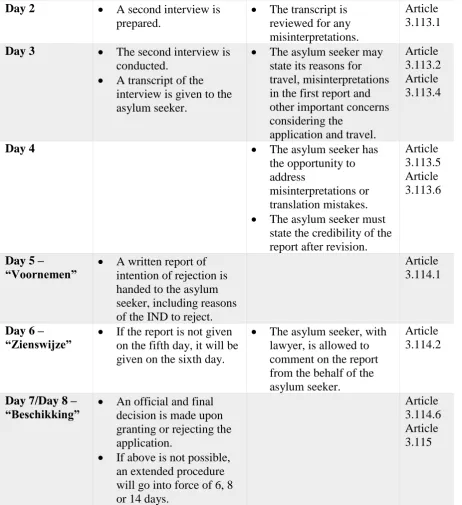
The Regular Procedure is laid down in Articles 3.112 to 3.115 of the Aliens Decree 2000 and Articles 42 of the Aliens Act (Staatssecretaris van Veiligheid en Justitie, 2016). In this procedure, a six-day-rest is given to the asylum seeker to rest from the travel and prepare for the asylum procedure.
Day Action of IND Action of the asylum seeker Article43 Day 1 • A first interview is
conducted, without including reasons of travel.
• A transcript of the interview is given to the asylum seeker.
Article 3.112
39Ibid, p.8
40Ibid, p.8
41Ibid, p.8 & Vertrouwen in de toekomst: Regeerakkoord, 2017-2021, p.53 & Interview R1 42Ibid.
Day 2 • A second interview is prepared.
• The transcript is reviewed for any misinterpretations.
Article 3.113.1
Day 3 • The second interview is conducted.
• A transcript of the interview is given to the asylum seeker.
• The asylum seeker may state its reasons for travel, misinterpretations in the first report and other important concerns considering the
application and travel.
Article 3.113.2 Article 3.113.4
Day 4 • The asylum seeker has
the opportunity to address
misinterpretations or translation mistakes. • The asylum seeker must
state the credibility of the report after revision.
Article 3.113.5 Article 3.113.6
Day 5 –
“Voornemen” • A written report of intention of rejection is handed to the asylum seeker, including reasons of the IND to reject.
Article 3.114.1
Day 6 –
“Zienswijze” • If the report is not given on the fifth day, it will be given on the sixth day.
• The asylum seeker, with lawyer, is allowed to comment on the report from the behalf of the asylum seeker.
Article 3.114.2
Day 7/Day 8 –
“Beschikking” • An official and final decision is made upon granting or rejecting the application.
• If above is not possible, an extended procedure will go into force of 6, 8 or 14 days.
[image:35.595.71.534.70.576.2]Article 3.114.6 Article 3.115
Table 3: The Regular Asylum Procedure conform the Alien Decree 2000.
III. Conclusion
in the region which could limit illegal and dangerous migration. In general, the EU migration policy also aims for solidarity, collaboration and an effective and human-worthy approach.
When narrowing this down to the Aliens Act 2000 and the Aliens Decree 2000; the 1951 Geneva Convention on the Protection of Refugees and Directive 2013/33 are represented in the national context. Articles 1F and 33 are for example represented in the two Dutch policies. Additionally, the Dutch AZCs provide aid to asylum seekers as are laid down in Directive 2013/33. These include, amongst others, education, language classes, health care, employment training and other leisure activities. Moreover, the eight-day-procedure that is elaborated upon in the Aliens Decree 2000 show the effectiveness of the Dutch approach, which is also briefly laid down in the Directive 2013/33 and matches the aim of the EU.
III. CHILDREN IN DUTCH MIGRATION
This chapter will describe the asylum procedure specified on children by answering the second sub-question: What does the migration chain in the Netherlands entail of concerning children?
It will do so by making use of an interview with a practitioner, as well as including publicly available documentation and information on this issue. Appendix B will provide a thorough analysis of the relevant documentation for this chapter.
I. Accompanied children
Most children who travel to the Netherlands are accompanied by either the parent(s) or legal guardian(s). Reading from the Aliens Decree 2000, no special procedure is put into force when children are accompanied. This implies that children are not placed in separate housing establishments and do not participate in the interviews of the IND as this is a task of the parents. Confirmed by R1, children who are accompanied with their parents or any other legal guardian are not seen as separate from their parents. Consequently, if the parents are given asylum and residency to the Netherlands the child is automatically granted asylum to.44
Special attention is, however, given to Article 3 of the UNCRC which obliges the participating State, in this case the Netherlands, to act on behalf of the best interest of the child.45 In correspondence with this article, Article 3.15.3c of the Aliens Decree 2000 states that the decision for a family member to be rejected their application to asylum in the Netherlands may be reversed if it breaches the best interest of the child. Additionally, Article 8.22 of the Aliens Decree recognises that a child will only be deported if it is in their best interest. The best interest of the child is also recognized at a practical level, where R1 explained how children may be separated from their parents in different housing establishments if it is better for the child.46 II. Unaccompanied minor aliens (AMV)
The possibility exists that a minor is unaccompanied by a parent or guard and seeks refuge in the Netherlands. The Dutch government defines an AMV as a child younger than 18, coming from outside the EU without a parent, parents or any other guard with authority over the minor.47 AMVs who need protection are granted asylum and get a guardian until their 18th
44 Interview R1
45 UNCRC (1989), art. 3
46 Interview R1
47 Unaccompanied minor aliens (AMV). Retrieved on May 25th, 2019: