Making the transition to a digitally-rich environment: A study of professional development for the online techbook
West Ada School District
By. Eian Harm, Ed.D and Lori Gash, M.Ed June 2015
Introduction
The West Ada School District (WASD) is currently in the process of transitioning its schools and
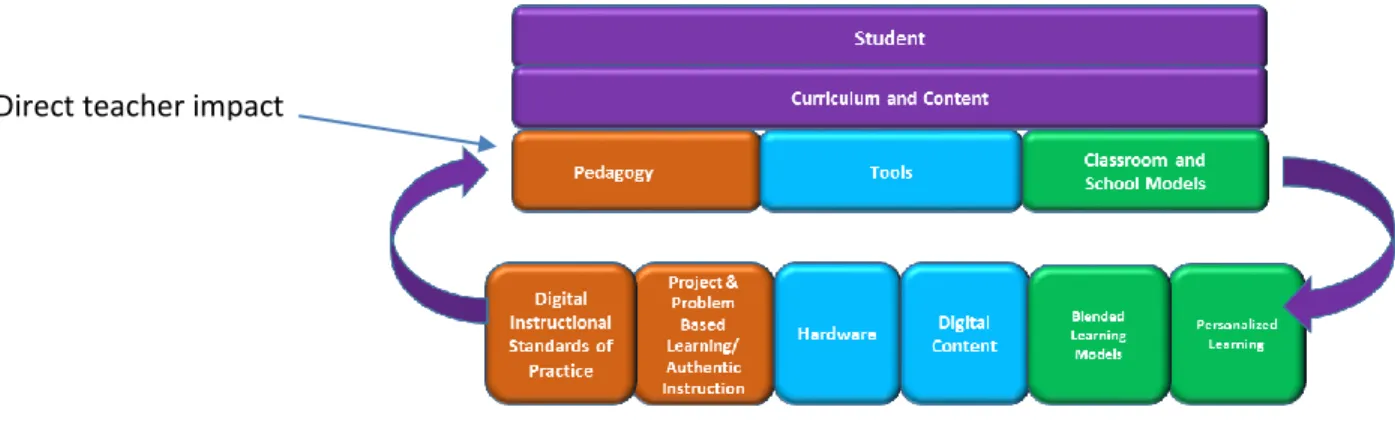
classrooms to digitally-rich environments. This is in order to better align student learning with the skills needed for success in current and future jobs. Through this transition, much data collection and research has been, and must continue to be, undertaken in order to determine the most appropriate tools for these new learning environments. Online learning materials such as Discovery Education’s “techbook” provide examples of these new tools. Though finding appropriate tools is a necessity, our ongoing research continues to indicate that it is the teacher that has the most significant impact on outcomes within our classrooms- it is their pedagogy (what they do with the tools) that makes the most significant difference in terms of outcomes.
Figure 1. West Ada School District’s Digital Integration Research Framework
These outcomes are being measured within WASD through standardized test-based, survey and observational engagement-based, and student interview and discussion-based metrics. All of these Direct teacher impact
metrics are indicating that a high-quality teacher, who is both competent and confident using these new digital learning tools is indeed the “secret sauce” for increased student learning and engagement (Wardlow & Harm, 2015). Our research during the 2014/2015 school year has, in large part, focused on the transition process of teachers to these new environments. The result of this research has led us to a more clear definition of effective professional development (PD) and the time and resources needed to successfully accomplish it. Current research indicates that teacher confidence in using these new tools is the main factor in whether they use them effectively in their classrooms and educational leaders must provide the time and resources necessary for these professionals to make this transition (Wardlow & Harm, 2015). Recent research performed by WASD in conjunction with Digital Promise- The League of Innovative Schools has shown that there is no connection between teachers’ age and their willingness to utilize digital technology within their classrooms, rather it is the amount of time spent with the
technology as a teaching tool, that leads to its effective use (Wardlow & Harm, 2015). This leads us to the notion that effective PD is the key to effective integration. This PD must, however, be designed and implemented through means which have not been typical of our training models throughout the past. PD models are developing which are more individualized based upon teacher needs and “readiness” levels, incorporate ample time for discussion in order for teachers to voice concerns and hear possible solutions, and which includes “integration” time- or more simply put, time to work to incorporate new knowledge into their practice. As teachers daily schedules are typically “full” with either teaching students, planning for the next day, grading assignments, or attending meetings, there is little to no time to slow down and THINK about new techniques. Districts must provide this time, space, and
expectation.
We strongly feel that the extra time and resources devoted to the effective transition and use of these educational tools will be a more than worthy investment by school systems and the community. We postulate, and our research is beginning to confirm, that teachers truly embracing digital tools in
effective ways will further promote the “student-centered” environments that are most sought after in developing effective problem-solvers who have the skills necessary as described through the term career and college readiness (Harm, Sexton, & Neptune, 2014).
Purpose of this study
The current techbook study during the 2014/2015 school year sought to determine the following: 1) Which aspects of teacher professional development were deemed effective/ineffective? 2) Develop expected timelines for digital transitions and training for future projects. 3) Identify areas of concern toward a smooth “digital transition” such as bandwidth and
technology-related issues
4) Identify if there are any “gaps” between student and teacher perceptions of techbook use and effectiveness.
5) Answer the question: does the use of technology help teachers do their job more efficiently and effectively as measured by a self-efficacy scale?
Through these analyses WASD hopes to continually develop and refine its PD to most positively impact students through the creation of highly relevant learning environments which focus on students
acquiring the skills necessary to be successful in career and college. WASD believes that the use of these digital tools not only enables the learning of new-age skills, but also opens students and teachers to the world outside of the classroom walls like no tools have been able to do before.
Research Question(s).
1) Which aspect(s) of teacher professional development were deemed effective/ineffective?
Timeline and amount of training. A continual question in effective PD revolves around the amount of time necessary to truly allow teachers to learn and integrate information. This current training was composed of 6 meeting days throughout the school year with some “kick off” training in the summer
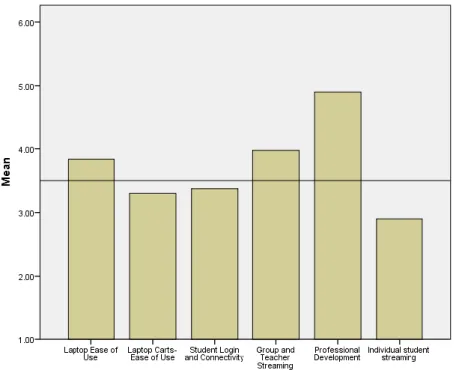
prior to the onset of school. This equated to roughly one meeting per month throughout the first two (2) years of the project. As these are new techniques and pedagogy that teachers are creating, we assume that the amount of training time will not only decrease for these particular teachers, but will decrease for future endeavors as well. We feel this way because the methods for using these tools will now be visible within the individual schools. Teachers will be observing each other in the informal setting of their own schools and classrooms. The pedagogy will not need to be recreated, just refined. Based on 20 responses to our survey, 75% of the teachers stated that the amount of training the received was “just right” while 10% wanted more training. 20% of the teachers stated that they could have used “less days” of training. With a total of 85% of the teachers indicated either an adequate number of days or wishing for more time, it becomes clear that long-term and sustained training is an essential piece of the digital transition and teachers desire it. This also matches much of the previous research on effective professional development (Elmore, 2008; Fullan, 2003; Knight, 2011). The professional development category was rated the highest on the Likert Survey sent to teachers (see figure 2 below) indicating this aspect of their experience was the most positive. As much of the initial time was spent learning the techbook tool, many of the teachers stated that this initial focus was essential and necessary throughout the first year. Comments by teachers such as “more ideas on ways to implement DE services into lessons” now indicate a desire to move from a focus on the tool itself to integration within the classroom. This matches the expected training and integration timeline where confidence in the tool must first be accomplished, followed by a collaborative training time focused on integrative digital pedagogy. This is the recommended “next step” for techbook training.
2) What aspects of the techbook did teachers like and/or find challenging?
Teachers indicated that the variety of information and the use of multi-media (reading, listening, watching videos) allowed them to reach different learners in more effective ways. Several comments
revolved around students being more engaged in their learning through the interactive aspects of the techbook.
As there were several issues associated with internet connectivity which occurred throughout the year, many comments were made regarding “streaming” capabilities. A continual focus on reducing
technology-related issues (connectivity, login, battery) must be something the district undertakes- as these are ongoing concerns. These issues can be the “last straw” for a teacher who is struggling to integrate and could possibly revert this teacher to what they already know “works”- non technology teaching styles. Other comments regarding the techbook revolved around the need for less “repetition” within the techbook applications, being unsure if students were able to utilize the techbook at home, and the necessity of teacher resources such as answer keys.
Though many teachers indicated their understanding that “online” text is the direction
education is heading, many still stated concern about removing textbooks from the classroom, as they felt these were important and necessary tools for student learning.
3) Does the use of technology help teachers do their job more efficiently and effectively as measured by a self-efficacy scale?
Teacher self-efficacy, or how well teachers feel they are able to accomplish their job, was measured through a “teacher self-efficacy and job satisfaction” scale by Klassen & Chiu (2010). This framework measure six (6) categories:
1) Job satisfaction
2) Classroom management
3) Ability to use varied instructional strategies 4) Ability to engage students
5) Workload stress
6) Classroom management
Teachers in the online techbook training group were anonymously compared to a control group of teachers throughout the district in the categories above. Results from the 1-6 Likert scale are provided below.
Table 1. Teacher job satisfaction and self-efficacy survey results.
Factor Group N Mean Std. Deviation
Job Satisfaction ** Techbook 23 5.0435 0.67
Control 30 4.6833 0.74
Classroom Management Techbook 23 5.2826 0.68
Control 30 5.3278 0.54
Instructional Strategies Techbook 23 4.8804 0.71
Control 30 5.0417 0.78
Student Engagement Techbook 23 4.5797 0.84
Control 30 4.8778 0.76
Workload Stress * Techbook 23 4.4638 0.96
Control 30 5.2056 0.70
Classroom Stress *
Techbook 23 2.9855 1.24
Control 30 3.6444 1.11
*Indicates significant difference between means at the p < 0.05 level.
Results of this survey indicate that teacher workload and classroom stress levels were rated significantly lower when compared to the control group. This is an interesting finding as it matches prior technology-integration research within WASD which has consistently indicated decreased workloadstress for those teachers utilizing digital technology. The addition of the decreased classroom stress is a new finding. It has been hypothesized that, as technology accomplishes some of tasks for the teacher (grading, spell-checking, differentiating for language and reading ability) this will manifest itself in decreased stress. Our results may be indicating just this occurrence as we have now seen this repeatedly over several previous studies. Additionally, teachers in the techbook group reported higher values for job
satisfaction (M=5.04, SD=0.67) when compared with the control group (M=4.68, SD=0.74). Though this value only approached statistical significance (p=0.07) it may be indicative of teachers feeling the positive benefits of increased student engagement. This could also be the positive result of the increased collaboration between teachers and the satisfaction of learning something new and actively innovating within their chosen profession- further analysis is needed to confirm these conclusions. In either case, these are highly positive results and indicate an effective model of professional
development- one that should be replicated in future endeavors.
Student Survey Results.
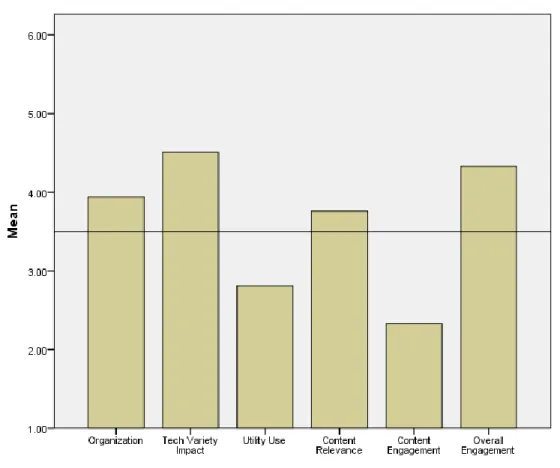
A student survey was sent to 1,462 6th and 9th grade students who were using the online techbook. A 6 point Likert scale was used to rate student opinions of questions aligned to the Effectiveness Index (EI), a tool used to measure the quality of online and digital courseware (Mashaw, 2012). WASD has used this index in several other studies throughout previous years. Survey results in figure 3 indicate that students are indeed engaged by the use of the techbook within their classrooms. This is indicated by the “overall engagement” value having a mean value of 4.33 (SD=1.46). The overall engagement value showed the highest correlations with students’ perception of both content relevance (d=.72) and the
variety learning methods, as accessed through the technology (d=.62). Since both of these measures were rated above average by students, it provides an indication that students were engaged by the techbook content as well as the use of technology to access it. Student responses to the statement “list one word that describes your experience with the Discovery Education Techbook” also indicate high levels of engagement- with the most often repeated words being “good” and “interesting” (see Wordle in figure 4). It also underscores the necessity of providing our students up-to-date and relevant
information in a variety of engaging formats. This is certainly something that digital providers must continually seek to accomplish, but they certainly are able to accomplish it more effectively than traditional textbooks made possible.
The two lowest values as rated by students were the Utility Use (M=2.81, SD=1.38) and the Content Engagement (M=2.33, SD=1.46) categories. The utility use category measured how often and how effective students felt the learning tools provided within the techbook were. Features such as the highlighter, note-taking, and speak text were rated as either not used often, or not effective when used. This could indicate either the need to reconfigure these tools or the necessity of providing additional PD in their use. The content engagement category was assessed through questions focused on how often students spoke of topics outside of the classroom with friends or family members, as well as if they looked up information on their own outside of class. Though in reality the adolescent age of our survey group makes it difficult for this value to ever be highly positive, the value was left in the analysis as a way to measure the goal of high levels of student engagement in a subject. If students are truly engaged in a topic based on their own interest, the chance that they would speak to others about the
Figure 3. Student survey results based on Effectiveness Index (EI) by Mashaw, 2012.
Figure 4. Wordle created by student responses to statement: “write one word that describes your experience with the Discovery Education Techbook”. Larger words mean they were indcated more often.
Discussion and conclusion.
West Ada School District has been actively working to identify professional development (PD) model(s) which truly change instructional practice. To accomplish this WASD has sought to acquire data throughout the digital transformation from both students, teachers, and parents alike. Through these methods it
becomes possible to measure outcomes from the “end users” of the product (student and parents), as well as the teacher to see if practice is truly changing and the digital tools are effective. Results from our study this year indicate that teachers found the current PD model to be highly effective in helping them gain confidence in using aspects of the Discovery Education techbook within their classrooms. Prior research shows that as teachers gain confidence they tend to be more apt to use the technology as a learning tool (Wardlow & Harm, 2015). This use is showing up in the student surveys which indicate high levels of engagement with the techbook as a learning tool due to both the content relevance as well as the variety of instructional materials and modes of delivery as enabled by the technology. Though students are engaged in the use of the
techbook as a classroom tool, several difficulties arose throughout the year. These difficulties were mainly due to technology-related issues such as streaming capabilities, student login and connectivity to the internet, as well as laptop battery and charging cart concerns. These are issues that certainly need to be addressed and remedied as “scale up” of these tools begins to take place. Teachers who are reluctant to embrace these new learning tools will have a tendency to revert to their prior practice when faced with the added challenges of non-functioning technology.
Though these “connectivity” issues were prevalent throughout the school year (due mainly to state-level internet concerns) both students and teachers were engaged in the learning process and use of the new tool. Students rated the content relevance and the impact of the variety created by the technology very highly positive. These factors were strongly related to overall engagement, which was also rated as high. Teachers’ job satisfaction and their ability to get their jobs done (self-efficacy) showed some differences throughout the year when compared to a control group within the district. This may indicate that teachers are experiencing
the increased engagement of their students, they are allowing the technology to create “student-centered” environments, and/or they may simply be benefitting from the increased collaboration and creativity
associated with innovating in their chosen profession. The next step is to focus on using these digital tools as a part of integrated and high-impact types of pedagogies. Examples of this can be seen in such practice as inquiry-based lessons and problem or project based learning. In any case, these are highly positive results which indicate that, when done correctly in a long term and sustained fashion, professional development can truly change practice within our schools.
Work Cited.
Elmore, R.F. (2008). School reform from the inside out: Policy, practice, and performance. Cambridge, Mass: Harvard Education Press.
Fullan, M. (2003). The Moral Imperative of School Leadership, Thousand Oaks, CA: Corwin Press; Toronto, Ontario Principals’ Council.
Harm, J.E., Sexton, B., & Neptune, T. (2013). Configuring the 21st Century Classroom.
http://www.westada.org/cms/lib8/ID01904074/Centricity/Domain/209/2013-2014%20District%20Research%20Reports/Configuring_the_21st_Century_Classroom_Year_2.pd f
Klassen, R.M. and Chiu, M.M. (2010). Effects on teachers’ self-efficacy and job satisfaction: Teacher gender, years of experience, and job stress. Journal of Educational Psychology, Vol. 102, No. 3, pp. 741-756.
Mashaw, B. (2012). A Model for Measuring Effectiveness of an Online Course. Decision Sciences Journal of Innovative Education, 10(2), pp. 189-221.
Wardlow, L. and Harm, E. (2015). Using appropriate digital tools to overcome barriers to collaborative learning in classrooms. Educational Technology. Volume 55, Number 3. May/June 2015, pp. 32-35.