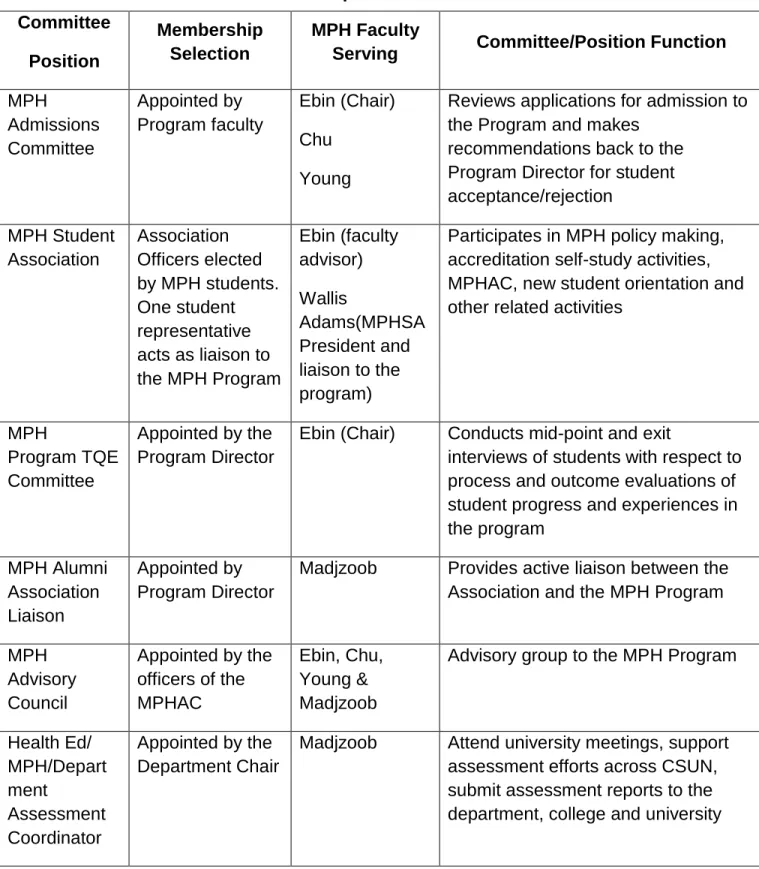
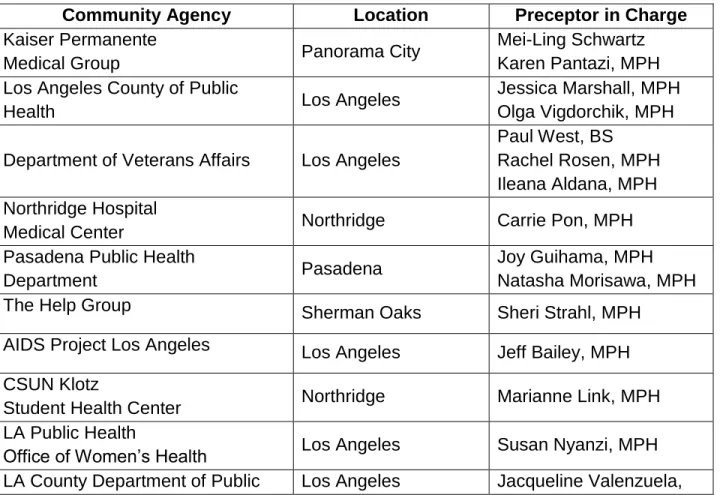
2011 CSUN MPH Program Self Study, 1
Introduction and Program Summary
The California State University, Northridge (CSUN) MPH Program in Community Health Education was one of the first established public health programs housed outside of a School of Public Health. Accredited in the early 1970s, the CSUN MPH Program prides itself in developing public health professionals ready to serve the needs of our diverse communities. Since the last accreditation in 2005, there have been changes throughout the university and within the program. Dr. Sylvia Alva was appointed Dean of the
College of Health and Human Development in 2009. Dr. Marilynn Filbeck is now the Associate Dean of the College. Dr. Robert Huff has retired from the university after serving the program for over twenty years. A new faculty search has been approved to begin in 2010 for a Fall Semester 2011 start date.
The CSUN MPH Program has adopted a new Program Mission Statement which the program believes epitomizes its focus: prepare professional community health
educators to enhance the general health and wellbeing of diverse human populations and communities. Changes were made in the goals and measureable objectives upon discussion between faculty and community members. These goals will help shape the direction of the program.
Applications to the MPH Program are increasing and program faculty are discussing resource implications for student acceptance rate changes. There has been a large increase in the number of international applicants and that has implications on resources, course content, and time to graduation. International Students attend full-time and take more courses per semester than the typical CSUN MPH graduate
student. A new applicant review system is being implemented to place more information online for easier access.
Although faculty teaching loads are high at the California State University System (4 courses per semester), the CSUN MPH faculty continue to apply for grants and conduct research. Several faculty incorporate research and community outreach within their courses. Community service is important to the university in general and the MPH specifically as all faculty continue to actively serve the CSUN community and our profession. Dr. Kathleen Young is on the Governing Council of the American Association of Health Education (AAHE). Dr. Vicki Ebin has been elected to the Educational Board of APHA and also serves on the executive board of the Council of Accredited MPH Programs (CAMP).
Since the last accreditation, the MPH Program changed the minimum required units to graduate from 41 to 42 semester units. Prior to this change the unit difference reflected the students doing a thesis versus a comprehensive examination as the culminating experience.
Finally, the CSUN MPH Program is pleased to report sponsoring several Continuing Education Events. Two of these events were administered as a web-based program, using Elluminate@. This methodology was well received by the participants and was very cost-efficient for the program. Additional Continuing Education Workshops have been proposed for the coming year and a Motivational Interviewing Workshop is tentatively scheduledforMay 2, 2011.
Future plans for the CSUN MPH Program reflect the need to address changes in the admission process, size of incoming classes, possible creation of online courses, expanded use of technology, and improvement of advisement. An ongoing need is to create a more seamless assessment process that is “hard-wired” into the MPH Program.
2011 CSUN MPH Program Self Study, 3
1.0 The Public Health Program
Following the last accreditation review (2005), the Master of Public Health (MPH) Program faculty reviewed and updated the Program’s goals and objectives in
consultation with core members of the leadership units within the Program (including the Master of Public Health Advisory Council (MPHAC), Master of Public Health Student Association (MPHSA), and Master of Public Health Alumni Association (MPHAA).
1.1 Mission:
The program shall have a clearly formulated and publicly stated mission with supporting goals and objectives. The program shall foster the development of professional public health values, concepts and ethical practice.
1.1.a A clear and concise mission statement for the program as a whole.
The mission of the Master of Public Health Program in Health Education at California State University, Northridge (CSUN) is to prepare professional community health educators to enhance the general health and wellbeing of diverse human populations and communities.
The MPH Program at CSUN believes that through public health education, practice and scholarship, the graduate student will develop multidisciplinary skills to identify and assess the needs of the communities; plan, implement and evaluate programs to address these needs; and achieve good health and quality of life in the multicultural communities they serve.
To fulfill this mission, the MPH program designs courses and activities to help students develop the designated student learning objectives and academic competencies
(described under Criterion 2). As a program we also seek to foster a rigorous and
contemporary learning environment with the following characteristics: a diverse core set of courses, health disparities, social justice, and multiple perspectives of health issues. 1.1.b and 1.1.c: Goal Statements and Corresponding Objectives
One or more goal statements for each major function by which the program intends to attain its mission, including instruction, research and service; A set of measurable objectives relating to each major function by which the program intends to attain its mission, including instruction, research and service.
Below are the goals and measurable objectives guiding the MPH Program at California State University, Northridge (CSUN). These goals and objectives are provided for students. Additionally, goals and objectives pertaining to faculty research and service are listed.
MPH Program Goals and Objectives
GOAL 1: To ensure that MPH students master public health and health education knowledge and skills.
Objective 1.1 MPH faculty will review course offerings and document which competencies are addressed in each course (See Table XXX for competencies addressed in the MPH Program).
Objective 1.2 At least 80% of MPH students will self-report mastery of technology skills required in the public health and health education field.
Objective 1.3 All MPH core courses will incorporate oral communication. Objective 1.4 All MPH core courses will incorporate written communication. GOAL 2: Ensure that MPH students are prepared to practice public health education with an understanding of the values and ethics that define the profession.
Objective 2.1 MPH core courses will incorporate health education values and ethics. Objective 2.2 All MPH students will write a human subjects consent form in their research class.
GOAL 3 Ensure all MPH students are prepared to assume leadership roles in a wide variety of public health and health education settings.
Objective 3.1 All MPH students will complete a 400 hour internship at a pre-approved field training site, to better understand public health leadership and the role of the health educator.
Objective 3.2 All MPH students will complete a field training course to share, discuss and process their field training experiences.
Objective 3.3 All MPH students will be members of the MPH Student Association, at least 50% actively.
2011 CSUN MPH Program Self Study, 5
GOAL 4 The MPH Program will train students to work with diverse populations, particularly in California
Objective 4.1 All MPH students will address multicultural influences and considerations that may impact on the delivery of culturally competent public health and health
education interventions in their program planning project (HSCI 531) and curriculum (HSCI 535) courses.
Objective 4.2 At least 80% of MPH students will agree that the program prepared them to work with diverse populations.
Objective 4.3 At least 80% of MPH alumni will agree that the program prepared them to work with diverse populations.
Objective 4.4 At least 80% of MPH students will report being prepared to work in diverse groups.
GOAL 5 MPH students will actively be involved in program evaluation activities and decision-making.
Objective 5.1 A minimum of one MPH student will be involved in the MPH Advisory Council and Health Education faculty meetings as representatives from the MPH student body.
Objective 5.2 All MPH students will have an opportunity to participate in MPH Program surveys to be conducted every two years.
Objective 5.3 All MPH students will have the opportunity to review and comment on the accreditation self-study document at each accreditation cycle of the program.
Objective 5.4 All MPH students will have the opportunity to meet with CEPH site visit teams to provide input during this evaluation process.
RESEARCH GOAL AND CORRESPONDING OBJECTIVES
GOAL 6 Promote opportunities for MPH students to engage in funded or unfunded research.
Objective 6.1 At least 80% full-time health education faculty will be engaged in an active research agenda whether research is funded or not.
Objective 6.2 All MPH students will report having some research experience in research projects.
Objective 6.3 At least 80% of MPH students will obtain a “B” or better in HSCI 592: Advanced Biostatistics for the Health Sciences and in HSCI 694: Research Design in Health Sciences. [Students are required to collect, analyze and present original data in both an oral and written presentation in HSCI 592. Students are required to develop and present a research proposal in both oral and written formats in HSCI 694.]
Objective 6.4 At least 2 MPH students per year will apply to the Minority Training
Program in Cancer Control Research (MTPCCR) or Research Infrastructure for Minority Institutions (RIMI) Scholars.
SERVICE GOALS AND CORRESPONDING OBJECTIVES
GOAL 7 The MPH Faculty and students will promote active involvement in serving the CSUN campus, Department of Health Sciences, MPH Program, and
communities.
Objective 7.1 All full-time health education faculty will be involved in at least one community service activity per academic year.
Objective 7.2 All MPH students will report participating in a community service project through, coursework, MPHSA or other organization.
2011 CSUN MPH Program Self Study, 7
GOAL 8 To conduct continuing education programs for health education
professionals either alone or in collaboration with other agencies, organizations or universities.
Objective 8.1 The MPH program and its constituencies will plan, implement, and
evaluate at least one continuing education program per year for CHES credit for health care and public health education professionals in the CSUN service area.
GOAL 9 Assure the MPH Program’s effectiveness in meeting its stated mission, goals, and objectives.
Objective 9.1 Conduct a survey of MPH Program alumni and field training supervisors every two years.
Objective 9.2 Conduct Total Quality Education (TQE) interviews with 80% of students who have reached the 20 unit mark in their programs and at the time of their graduation. Objective 9.3 Conduct a yearly Program modification meeting with Health Education faculty.
Objective 9.4 Convene and sustain an MPH Advisory Committee made up of Program constituencies who can review, revise, and recommend changes needed in all aspects of the MPH Program.
Objective 9.5 Conduct a periodic self-study of the Program consistent with CEPH’s re-accreditation cycle to share this self-study document with all constituencies of the MPH Program.
1.1.d
A description of the manner in which mission, goals and
objectives are developed, monitored and periodically revised and the
manner in which they are made available to the public.
Following the last site visit in 2005, the program continued an intensive effort and strategy to design and implement a comprehensive plan focused on developing evaluation process methodologies. This strategy has ensured that consistent review, monitoring and evaluation of all aspects of the program were carried out in a regular and systemic way. The MPH Advisory Council (MPHAC), two subcommittees (MPHAC Continuing Education and Curriculum Review), formal and documented health
education faculty retreats at the end of each academic year, inclusion of MPH student representatives in program meetings and retreats with documentation, and surveys of students and alumni to ensure that the program was meeting its goals, objectives and the needs of its graduate students.
The MPHAC membership includes community members, current MPH students, alumni, field preceptors and faculty (will be available in the resource file). The MPHAC has developed its by-laws and operating procedures, established its subcommittees for continuing education and curriculum review, and began meeting regularly as a monitoring and advisement group for the program (meeting minutes, current
membership and associated materials will be available in the Resource File at the time of the site visit). While the MPHAC has been evolving, MPH faculty reviewed and revised program goals and objectives with input from the MPHAC, MPH students and alumni. Following a final review by the MPHAC, goals and objectives were approved and implemented.
Monthly health education faculty meetings are used to monitor progress towards
meeting objectives (meeting minutes will be available in the Resource File at the time of the site visit). The MPH Graduate Coordinator, Dr. Vicki Ebin, makes a progress report to the MPHAC at each of its regularly scheduled meetings and brings back
recommendations to the faculty for consideration and action. The MPH student
representative from the MPHSA participates in all meetings and brings issues, concerns and feedback to the MPHAC and health education faculty meetings (MPHSA meeting minutes will be available in the Resource File at the time of the site visit). Program constituencies are surveyed regularly to solicit input about program quality and needs for change. This includes bi-yearly assessment of students by the MPHSA and every two year assessments of alumni and field preceptors (surveys and analysis reports will be available in the Resource File and incorporated where appropriate in this Self-Study). Finally, year end evaluation of the program occurs at the health education faculty retreat and action plans are developed for the next academic year.
1.1.e
A statement of values that guide the program, with a description
of how the values are determined and operationalized.
The values of the MPH Program are aligned with the larger values of the California State University Northridge (CSUN) (http://www.csun.edu/catalog/ ) CSUN Catalog, 2010-2012, p. 2), the vision of College of Health and Human Development, Department of Health Sciences, and the Health Educator Code of Ethics:
University Values:
1. Commitment to teaching, scholarship, and active learning. 2. Commitment to excellence.
3. Respect for all people.
4. Alliances with the community; and
2011 CSUN MPH Program Self Study, 9
College of Health and Human Development Vision:
(http://www.csun.edu/hhd/collegeplan.html )
Our mission is to enhance the quality of life for all individuals, families and communities by preparing competent, committed and caring professionals who provide services that promote their safety, health and well-being. We advance our mission through cutting edge research, guided student inquiry, and collaborative learning relationships to foster the professional and ethical competencies as required in the working world.
We strive to achieve academic excellence in developing professionals who enhance the health, safety and well-being of individuals, families, and the communities they serve. We use learning centered approaches to discover new knowledge through technology, and application of knowledge to serve a diverse, multi-cultural population. Ours is an innovative, collaborative, learning centered community dedicated to research,
professional education and community service that promotes optimal health and human development.
Department of Health Sciences:
It is the mission of the Department of Health Sciences to enable students to develop the critical knowledge and skills required to assume professional responsibility and
leadership in health promotion, disease prevention, administration, and clinical practice in a variety of health care settings. Health Sciences faculty are committed to student-centered learning, scholarship and service.
Health Educator Code of Ethics:
(http://www.sophe.org/ethics.cfm )
The Health Education profession is dedicated to excellence in the practice of promoting individual, family, organizational, and community health. Guided by common ideals, Health Educators are responsible for upholding the integrity and ethics of the profession as they face the daily challenges of making decisions. By acknowledging the value of diversity in society and embracing a cross-cultural approach, Health Educators support the worth, dignity, potential, and uniqueness of all people.
The Code of Ethics provides a framework of shared values within which Health
Education is practiced. The Code of Ethics is grounded in fundamental ethical principles that underlie all health care services: respect for autonomy, promotion of social justice, active promotion of good, and avoidance of harm. The responsibility of each health educator is to aspire to the highest possible standards of conduct and to encourage the ethical behavior of all those with whom they work.
MPH Program Values:
The CSUN MPH Program incorporates the preceding missions, ethics and values as the foundation and focus of this program. Additionally, the following values epitomize the CSUN MPH Program:
Respect: of individuals, groups, cultures, and communities.
Collaboration: within the classroom through group projects, with the communities we serve, and in the professional work environment with
multidiscipline health professionals.
Communication: written and oral communication skills, the necessity of listening to others, and communication technologies.
Professionalism
and Ethics: in learning, community interactions, and fieldwork experience.
1.1.f
Assessment of the extent to which this criterion is met.
This criterion is met. The Program has a clear mission statement, goals and objectives that reflect those of California State University, Northridge. A process has been developed and implemented to ensure that the Program continues to be responsive to the needs of all of its constituents and reflects the program’s commitment to training skilled and competent public health practitioners.
2011 CSUN MPH Program Self Study, 11
1.2 Evaluation and Planning.
The program shall have an explicit process for evaluating and monitoring its overall efforts against its mission, goals and objectives; for assessing the
program’s effectiveness in serving its various constituencies; and for planning to achieve its mission in the future.
1.2.a. Description of the evaluation procedures and planning processes used by the program, including an explanation of how constituent groups are involved in these processes.
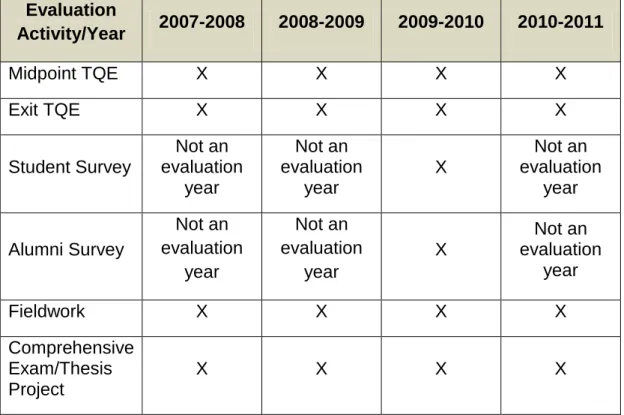
The following table outlines the evaluation process for the CSUN MPH Program. The information gleaned from these activities are used to address individual, student achievement (midpoint Total Quality Education (TQE), Fieldwork, Comprehensive Examinations/thesis projects) as well as assessment of the program objectives. Table 1.2.a1: Evaluation Activities for Planning Processes
Evaluation
Activity/Year 2007-2008 2008-2009 2009-2010 2010-2011
Midpoint TQE X X X X
Exit TQE X X X X
Student Survey
Not an evaluation
year
Not an evaluation
year
X
Not an evaluation
year
Alumni Survey
Not an evaluation
year
Not an evaluation
year
X
Not an evaluation
year
Fieldwork X X X X
Comprehensive Exam/Thesis Project
The MPH Program holds faculty meetings at least once a month. Committees meet on an as-needed basis. Additionally, the Department of Health Sciences as well as the Program Directors holds monthly meetings to discuss departmental issues pertaining to each program. Discussion of the MPH program, mission and course content occurs on a regular basis at the program meetings. Issues pertinent to the entire department occur at the other meetings. Discussions on program goals, program and department mission, and strategic planning can and does occur at all these levels.
The MPH Advisory Council had regular meetings on Mondays (pm) every other month until 2007. With changes of board members, we had one formal meeting during the spring of 2009, coordinated mainly through the efforts of the MPH Graduate
Coordinator, Dr. Vicki Ebin. MPHAC resumed meeting in September, 2010 and elected Diane Dobbins and Jeff Bailey as co-Chair of the Council. The main focus is on the program’s self study and preparation of a continuing education program. The major item at this September 2010 meeting included a lengthy discussion of skills and
competencies necessary to become a successful health educator (available onsite in the resource file). Meetings were also held in January 2011 and February 2011 (minutes will be available in the resource file).
The MPH Alumni Association was most active until 2007 with regular (once a month) board meetings on the last Thursday of the month & several social gatherings & joint alumni events every year. Following a period of several changes among the elected board members, they had two formal meetings during the spring of 2009, including the election of a new board for 2009-10. Also a social gathering was held in October, 2009. Peter Prampetch, 2009-10 alumni president has recently stepped down. The Alumni are currently in the process of electing a new governing board. They had a small meeting in March 2010 with the Alumni relations office. Rodney Mardirosian coordinated a meeting in April 2010 to elect board members for the 2010-11 periods and has been elected president. The MPH Alumni Association is assisting with the May 2011 scheduled Continuing Education workshop as well as participating in the preparation for the reaccreditation site visit. Many alumni serve as preceptors for current MPH students.
2011 CSUN MPH Program Self Study, 13
1.2.b Description of how the results of evaluation and planning are regularly used to enhance the quality of programs and activities.
A discussion of the future MPH professional needs and competencies of new MPH graduates was held at the September 2010 MPHAC meeting. The comments and suggestions from the participants were taken back to the MPH faculty and each faculty began a review of his/her course objectives and content.
The MPH Program commitment to Total Quality Education (TQE) is another mechanism used to evaluate and assess both students and the program. All MPH students are required to participate in this assessment process. Students have a mid-point TQE interview in which a panel of faculty members reviews the student’s work through the first 20 units of study. Student comment on the courses and suggest areas of change. The faculty panel suggests ways the student can improve their performance through the program. The results of these interviews are collated and discussed at MPH faculty meetings. Changes in the program or environmental settings are made whenever possible. For example, as a result of the 2010 student survey, Dr. Lawrence Chu, the Health Education Program Director, is working diligently to create additional computer laboratory open-usage times for the MPH students. During the Fall Semester 2010 and Spring Semester 2011 four hours per week of open lab time were given to MPH
students and others enrolled in the undergraduate biostatistics course, HSCI 390. Periodic student focus groups, surveys, MPHSA meetings, preceptor comments, and MPH Advisory Council input are used to improve the program. These issues are
discussion formally and informally among program faculty. Changes in the program are made within courses as well as to the administration of the program. For example, the MPH Admissions Committee is experimenting with a new admission tool for Fall 2011 applicants. Feedback from students and the MPHAC has been the impetus for work on creating an MPH handbook.
1.2.c. Identification of outcome measures that the program uses to monitor its effectiveness in meeting its mission, goals and objectives. Target levels should be defined and data regarding the program’s performance must be provided for each of the last three years.
Table 1.2.c1: Criterion 1.2.c Program Goals, Target levels, and Performance
Goal Target Level AY
2007-2008 AY 2008-2009 AY 2009-2010
GOAL 1
To ensure that MPH students develop a mastery of public health and health education knowledge and skills.
Objective 1.1
MPH faculty will meet annually to review course offerings and document which competencies are addressed in each course. Data Source:Annual Program Retreat
August 2007 August 2008 August 2009
Objective 1.2
At least 80% of MPH students will self-report mastery of technology skills required in the public health and health education field. Data Source: Midpoint TQE Not measured Not measured Met
Objective 1.3
All MPH core courses will incorporate oral
communication skills. Data Source:
MPH Core Course Syllabi
100% 100% 100%
Objective 1.4
All MPH core courses will incorporate written
communication skills. Data Source:
MPH Core Course Syllabi
2011 CSUN MPH Program Self Study, 15
Goal Target Level AY
2007-2008 AY 2008-2009 AY 2009-2010
GOAL 2
Ensure that MPH students are prepared to practice public health education with an understanding of the values and ethics that define the
profession.
Objective 2.1
All MPH core courses will incorporate health education values and ethics.
Data Source:
MPH Core Course Syllabi
100% 100% 100%
Objective 2.2
All MPH students will write a human subjects consent form in their research class.
Data Source:
MPH Core Course Syllabi
100% 100% 50%
Not met- only one class required the consent form
GOAL 3
Ensure that all MPH students are prepared to assume leadership roles in a wide variety of public health and health education settings.
Objective 3.1
All MPH students willcomplete a community-based 400 hour internship within pre-approved field training sites to better understand public health leadership and the role of the health
educator.
Data Source: student formal program
100% 100% 100%
Objective 3.2
All MPH students will complete a field training course to share, discuss and process their field training experiences.Data Source: student formal program
100% 100% 100%
Objective 3.3
All MPH students will be members of the MPH
Student Association, at least
Data not available
35 out of 60 (58%)
met
28 out of 60 (47%) Not met
Goal Target Level AY 2007-2008 AY 2008-2009 AY 2009-2010 50% actively.
Data Source: MPHSA records
GOAL 4
The MPH Program will train students to work with diverse
populations, particularly in California
Objective 4.1
All MPH students will address multicultural influences andconsiderations that may impact on the delivery of culturally competent public health and health education interventions in their program planning project (HSCI 531) and curriculum (HSCI 535) courses.
Data Source: course syllabi
Met Met Met
Objective 4.2
Eighty percent (80%) of MPH students will agree that the program prepared them to work with diverse
populations.
Data Source: Student Survey
Not Met Not a measurem
ent year
Met
Objective 4.3
Eighty percent (80%) of MPH alumni will agree that the program prepared them to work with diverse
populations.
Data Source: MPH Alumni Survey
Not a measurem
ent year
Not a measurem
ent year
Met
GOAL 5
MPH students will be actively involved in program evaluation activities and
decision-making.
Objective 5.1
At least one MPH student will be involved in the MPH Advisory Council and Health Education faculty meetings as representative of the MPH student body.
2011 CSUN MPH Program Self Study, 17
Goal Target Level AY
2007-2008
AY 2008-2009
AY 2009-2010 Data Source: meeting minutes
Objective 5.2
MPH students will have an opportunity to participate in MPH Program surveys to be conducted every two years. Data Source: MPH student survey
Not Met Not a measurem
ent year
Met
Objective 5.3
All MPH students will have the opportunity to review and comment on the accreditation self-study document at each accreditation cycle of the program.
Data Source: MPH email list
Not measured Not measured Not measured, Sent out for
comments AY
2010-2011
Objective 5.4
All MPH students will have the opportunity to meet with CEPH site visit teams to provide input during each evaluation process. Data Source: site visit agenda
Not applicable Not applicable Not applicable Site Visit AY 2010-2011
GOAL 6
Promote opportunities for MPH students to engage in funded or unfunded research.Objective 6.1
At least 80% full-time health education faculty will be engaged in an active research agenda whether research is funded or not. Data Source: faculty CV
4 of 6 faculty
(66%) Not met
3 of 4 faculty
(75%) Not met
4 of 5 faculty
(80%) met
Objective 6.2
All MPH core courses will incorporate research skills. Data Source: MPH core syllabi
Goal Target Level AY 2007-2008 AY 2008-2009 AY 2009-2010
Objective 6.3
All MPH students will report having research project experiences.
Data Source: student survey
Not met Not a measurabl
e year
Met
Objective 6.4
All MPH students enrolled in HSCI 592: Advanced
Biostatistics for the Health Sciences and in HSCI 694: Research Design in Health Sciences will complete a research project.
Data Source: course syllabi
Met HSCI 592 100% HSCI 694 100% Met HSCI 592 100% HSCI 694 100% Met HSCI 592 100% HSCI 694 100%
Objective 6.5
At least 2 MPH students per year will apply for The Minority Training Program in Cancer Control Research (MTPCCR) or RIMI Scholars. Data Source: program records of applicants 3 students in 2007 And one student in 2008 4 students in 2009 2 students in 2010
GOAL 7
The MPH Faculty and students will promote active involvement in serving the CSUN campus, Department of Health Sciences, MPH Program, and communities.
Objective 7.1
All full-time health education faculty will be involved in at least one community service activity per academic year. Data Source: faculty CV
Met 100% Met 100% Met 100%
Objective 7.2
All MPH students will report participating in a community service project through
coursework, MPHSA or other organization.
Data Source: student survey
Not measured
Not
measured Met 100%
2011 CSUN MPH Program Self Study, 19
Goal Target Level AY
2007-2008 AY 2008-2009 AY 2009-2010
GOAL 8
To conduct continuing education programs for health education professionals either alone or in
collaboration with other agencies, organizations or universities.
Objective 8.1
The MPH program and its constituencies will plan, implement, and evaluate at least one continuing
education program per year for CHES credit for health care and public health education professionals in the CSUN service area. Data Source: program minutes
1 program (Met) 1 program (Met) 2 programs (Met)
GOAL 9
Assure the MPH Program’s effectiveness in meeting its stated mission, goals, and objectives.
Objective 9.1
To conduct a survey of MPH Program alumni and field training supervisors every two years.
Data Source: alumni survey
Alumni not surveyed, preceptors individually Alumni not surveyed, preceptors individually Met
Objective 9.2
Conduct Total Quality Education (TQE) in-person interviews with 80% of students who have reached the 20 unit mark in their programs and at the time of their graduation (midpoint and Exit TQE).Data Source: midpoint and exit TQE 23 students in 2006 15 students in 2007 (met) 24 students (met) 7 students (Not met) Only 20 exit interviews from 2006-2009 (not met)
Objective 9.3
Conduct a yearly Program modification meeting with Health Education faculty. Data Source: meeting minutes
Goal Target Level AY 2007-2008
AY 2008-2009
AY 2009-2010
Objective 9.4
Convene and sustain an MPH Advisory Council made up of Program constituencies who can review, revise, and recommend changes needed in all aspects of the MPH Program.
Data Source: meeting minutes
Met Partially Met
Met
Objective 9.5
To conduct a periodic self-study of the Program consistent with CEPH’s re-accreditation cycle to share this self-study document with all constituencies of the MPH Program.
Data Source: program minutes
Not applicable
Not applicable
Met
1.2.d An analytical self-study document that provides a qualitative and
quantitative assessment of how the program achieves its mission, goals and objectives and meets all accreditation criteria, including a candid assessment of strengths and weaknesses in terms of the program’s performance against the accreditation criteria.
Qualitative Assessment: The CSUN MPH Program is one of the oldest Public Health programs outside of a School of Public Health, established in the early 1970s. It was designed to meet the needs of the public health workforce and serve the diverse
surrounding communities. This program is unique in that it specifically focuses on skills training rather than content issues, thus providing our communities with trained
graduates able to fit into any public health education arena. Individual faculty members have created strong working relationships with members of neighboring public health schools and programs. Within Los Angeles County, CSUN is the only program housed outside a School of Public Health. No other program serves the neighboring Ventura County. The faculty is committed to the students and community service. The updated mission, goals and objectives show the strength of the program’s commitment to improving the health of our communities.
2011 CSUN MPH Program Self Study, 21
Quantitative Assessment: The CSUN MPH Program has specific goals and objectives that are measurable. Given the success of our students in their field placement and culminating experiences, the program is meeting its goals and objectives. The overall Grade Point Averages (GPA) remain above the minimum of 3.0 and the majority of students are graduating within three years.
The strengths of this MPH program are in its ability to train health educators to fulfill the needs of multiple sites, particularly those with direct community interactions. The Total Quality Education (TQE) assessment process assists the faculty in making individual student recommendations for improvement as well as giving the program the
opportunity to make improvements in the actual program. The Program has a strong curriculum that addresses the current competencies of public health education as well as attempting to respond to the changing needs in the profession.
The weaknesses of this MPH Program relate to the structure of the institution and the current size of the core faculty. The program consistently tries to address the resource requirements but is constrained due to the California State University system. As stated in a later section, within the California State University (CSU) educational system, the smallest budgetary unit is the “Department”. In situations where the Master of Public Health is maintained within a Department of Health Sciences there is no line item budget allocation. Standard practice across the CSU is for the Department to generate internal budgetary processes that ensure adequate funding for all programs. The CSUN MPH Program is currently implementing a faculty search. Over the last year one faculty member permanently retired and another entered the Faculty Early Retirement Program (FERP). Our newest hire received an NIH Grant which could not be transferred to
CSUN, thus she made the decision to leave the university. She will remain as a part-time faculty member. The university has allowed us to conduct a faculty search for two positions.
1.2.e An analysis of the program’s responses to recommendations in the last accreditation report (if any).
Following the last site visit in the Spring Semester of 2005, the Program began a very intensive effort to design and implement a comprehensive plan that focused on
developing methodologies to ensure that regular review, monitoring and evaluation of all aspects of the Program were carried out in a regular and systemic way. The CSUN MPH Program met all criteria completely, “with commentary” or “partially met”. The
following is the program’s response to areas “partially met” and the recommendations
Resources adequate to meet mission: The Program has developed a program-level budget identifying program-specific resources that can be used for program planning (Criterion IV).
The CSUN MPH program has full access to all resources available to graduate programs at the university. The MPH Program addressed the unique issues of the California State University System in its 2008 Interim Report and follow-up report of 2009.
Within the California State University (CSU) educational system, the smallest budgetary unit is the “Department”. Standard practice across the CSU is for the Department to generate internal budgetary processes that ensure adequate funding for all programs. For example, part-time faculty needs of a program are covered by the Department budget. Travel, supplies and equipment are also allocated to programs within
Departments using processes that ensure program integrity and quality. Tenure track faculty appointments are made at the Department level and are funded centrally by the college and are not controlled by the Department budget. Individual Departments across the CSU manage the internal allocation and reporting of program resources in different format, but all are consistent in providing adequate resources to produce a quality Public Health program. Monetarily, the MPH is approximately 8% of the total FTES and receives $5500 of the Department’s operating expenses. In addition, the MPH faculty members were eligible for up to $1200 in travel related expenses.
The budget for the Health Sciences Department is developed as part of the total budget for the College of Health and Human Development (CHHD). The development of the department budget is the responsibility of the Department Chair, with input from Program Directors as to programmatic budgetary needs. The responsibility of the Department Program Directors (including the Health Education Director) is to build the course schedule and an annual equipment request list for the program. The department budget then becomes part of the total instructional budget of the College of Health and Human Development.
For example, dollar allocations follow the "normally" established procedures as follows: 1. Funds are allocated to the University.
2. The vice-provost allocates funds to the College.
2011 CSUN MPH Program Self Study, 23
The administrative analyst/specialist attends to the fiscal operation of the department. Because of the complexities of the organizational structure, it is not feasible to establish budgets for any one program within our department. Each Program Director makes specific requests for support equipment as is necessary to enhance the instructional responsibilities of a program. Because funds are allocated to a department, the fiscal needs of such departments may be ongoing, while the program may not require such funds over a protracted period of time. Hence, when funds are necessary, they are provided from the total department allocation.
Across the entire California State University System there are 6 MPH programs as well as one School of Public Health. The Chairs of the Department of Health Sciences meet on a regular basis to address issues impacting all the programs. All MPH Programs have the same issues of fiscal management. Our CSUN MPH Program has attempted to distinguish program-level resources to the best of it ability given the system it exists in.
Implemented tailored methods for assessing individual student’s attainment of defined programmatic competencies (Criterion V.D).
The CSUN MPH Program has worked diligently to address student assessment of competencies. I again refer to the Interim Report Submission outlining the process adopted by the program.
Assessment of student attainment is a five step process: 1. Intake/Baseline interview of new students
2. Coursework Assessment
3. Field Training/Preceptor Assessment 4. Culminating Experience
5. Total Quality Education (TQE)
Step 1: Intake/Baseline interview of new students. Every new student meets with the MPH Graduate Coordinator prior to beginning his/her coursework. This allows for
assessment of elective courses to fit individual needs and professional goals. A copy is given to the student as well as being placed in the student file for future advisor
reference (Attachment 1.2.e1).
Step 2: Coursework Assessment. Every course contains Student Learning Objectives stated in the syllabus. The coursework is designed to measure these objectives. Most graduate courses have final papers or projects as a means of student assessment. Those courses using a final exam will have written work assigned throughout the semester.
Step 3: Field Training/Preceptor Assessment. Prior to beginning the Field
Placement, each student must complete the Health Educator’s Self-Assessment Survey
Form (Attachment 1.2.e2). This form is used as a pre- and post-test of the student’s
progress over the course of the field placement. The initial (pre-) assessment also assists the student and preceptor in creating goals and objectives for the field
placement experience. Additionally, the faculty responsible for field placement reviews the individual’s self assessment and determines the need to focus on specific
competencies. Whenever the student identifies him/herself as scoring less than “average”, the designated faculty member will discuss where the skills are taught, whether or not the student has completed that course material, and if additional coursework is needed to improve that skillset.
The student, faculty member and preceptor meet at least once during the field placement and more frequently if warranted. This exit meeting is an opportunity to review the student’s objectives, how well they were accomplished, and discuss areas of improvement. This meeting also serves as additional information for program
assessment as every preceptor is asked about the preparation of the intern, skills addressed in the MPH Program, and future training needs of MPH graduates. These comments are discussed at the faculty retreats and then incorporated into class
material. Preceptors are sent bi-annual surveys. The MPH faculty has elicited individual preceptor comments during student exit interviews for the MPH Field Experience during the 2010 academic year.
Step 4: Culminating Experience. MPH students decide whether or not to do either a thesis/project or comprehensive examination as their culminating experience. The decision is made by the student with advisement of faculty members or the MPH Graduate Coordinator. There has been a trend toward taking the exam and very few students are opting for a thesis. This trend has been assisted by the fact that many of the MPH students want to finish within two years as completing a thesis takes longer to complete than the examination. A second factor is that the university has changed the manner in which a faculty workload is credited for supervising thesis projects. There are eight students sitting for the exam during the Fall 2010.
2011 CSUN MPH Program Self Study, 25
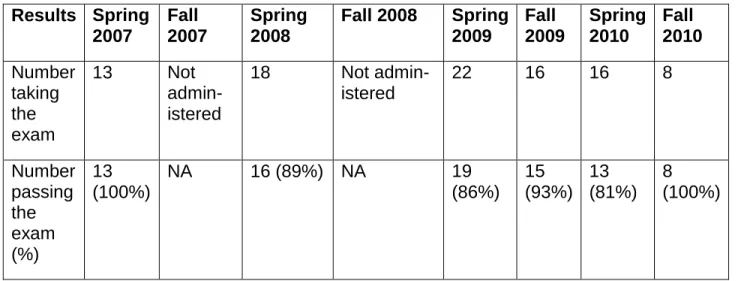
The following table illustrates the comprehensive examination pass rate for the past three years.
Table 1.2.e1: Comprehensive Examination Pass Rates Results Spring
2007
Fall 2007
Spring 2008
Fall 2008 Spring 2009 Fall 2009 Spring 2010 Fall 2010 Number taking the exam
13 Not admin-istered
18 Not admin-istered
22 16 16 8
Number passing the exam (%) 13 (100%)
NA 16 (89%) NA 19
(86%) 15 (93%) 13 (81%) 8 (100%)
Step 5: Total Quality Education (TQE). This assessment process has been a part of our program since 1999. Students meet with either two or three faculty members upon completion of eighteen units of coursework. The student completes a midpoint
assessment and the faculty members use another form to comment upon the student’s progress through the program. The student also completes an exit TQE form at the end of the program.
Employed creative efforts to recruit and retain a diverse faculty (Criterion VIII.C). The CSUN MPH Program has strong connections to neighboring universities with doctoral programs. Whenever a search is conducted we ask for assistance in
disseminating information regarding our faculty search. In addition to advertising the search at APHA, Chronicles of Higher Education and other electronic listings, all
program faculty send the announcement through various listservs. We continue to have a diverse part-time faculty pool as well as a multicultural group of internship community preceptors.
The MPH program conducted a nation-wide search for a new faculty member in 2008-2009. The announcement was placed in APHA and sent to members on the SOPHE listserv. We received final approval of another search to be conducted during the 2010-2011 academic year. Our Health Sciences Department and MPH Program are acutely aware of the need for diversity. We rely on the doctoral-granting universities to train future faculty members with the appropriate training in Public Health Education. We interview candidates according to their scores on our screening instruments. We offered the position to the person we thought was best qualified without regard to ethnicity as required by California law.
In order to creatively diversify our faculty, the MPH Program recruits part-time faculty and preceptors that will expand our students’ contact with diversity, cultural issues and a variety of authentic community experiences. Over the past year, the MPH program has expanded the part-time faculty with two excellent instructors, both graduates of our program. Both are trained in Public Health Education and bring personal diversity as well as a breadth of experience in a variety of community settings. Our preceptors are chosen for their skills in Public Health Education as well as the extensive exposure to diverse populations.
Developed a plan to conduct an analytical self-study that included all program constituencies in the process (Criterion X.B).
The CSUN MPH Program initiated the self-study process by meeting with all
constituency groups. Each constituency (student, community, preceptors, alumni) were informed of the self-study process and the important role they all play. The MPH student association (MPHSA) has elected its 2010-2011 Board of Officers. These students know that one of their tasks for the coming year is to assist in this process. The student association has designated a student member to attend all faculty meetings and give input. Additionally, the MPHSA has been told that they are requested to individually give input and make suggestions for improvement.
The MPH Alumni Association has also begun the process of participation in the self-study. A survey was sent out in the Spring Semester 2010 eliciting information about the MPH Program. This information will impact the curriculum and direction the current program will take in the future. This step in the self-study process is critical to us as is the information provided through the student survey.
The MPH Community Advisory Committee met on April 20, 2009 as the preliminary meeting in the self-study process. This meeting discussed the review process; current training and the future direction of public health. This committee has begun to review documents as the first step in the self-study. At the September 29, 2010 meeting
members continued the discussion of competencies needed by health educators as well as the mission, goals and objectives of the program.
The MPH Preceptors discuss their evaluation and proposed program improvements at each student exit interview. The comments and suggestions are discussed at the MPH Program meetings with changes then made in the program.
The MPH Program believes that it has addressed the concerns and recommendations of the 2005 MPH Accreditation and is constantly striving to improve.
2011 CSUN MPH Program Self Study, 27
1.2.f A description of the manner in which the self-study document was developed, including effective opportunities for input by important program
constituents, including institutional officers, administrative staff, teaching faculty, students, alumni and representatives of the public health community.
Student and alumni surveys were sent out via an online mechanism, StudentVoice
(Attachments 1.2.f1 and 1.2f2). During the Spring Semester 2010 faculty were given assignments to gather information and respond to specific sections of the Self-Study. A Self-Study Committee on the university campus was created:
Vicki Ebin, MPH Graduate Coordinator, MPH Program Lawrence Chu, Director, Health Education Program Brian Malec, Chair, Department of Health Sciences
Marilynn Filbeck, Associate Dean, College of Health and Human Development Diane Dobbins, co-Chair MPH Advisory Council
Meetings were conducted with teaching faculty, college administrators, current MPH students, alumni, and community members addressing their role and asking for input in the document. The first draft will be placed on the department website for review and commentary.
1.2.g Assessment of the extent to which this criterion is met.
The MPH Program believes this criterion is met. The program has taken great strides in improving the self-study process and addressing the recommendations made in the previous accreditation process. The program has a strong and active student
organization, alumni association and community council. These entities encourage the program to maintain what works well and suggest changes when appropriate.
A weakness may be seen in the inability to stay connected with all alumni. Many alumni change their contact information and fail to inform the program. The CSUN Alumni Office is working very diligently to improve its outreach and ability to connect with our alumni. We are exploring the increased use of social networking. We do have a listserv
2011 CSUN MPH Program Self Study, 29
1.3 Institutional Environment.
The program shall be an integral part of
an accredited institution of higher education.
1.3.a A brief description of the institution in which the program is located, along with the names of accrediting bodies (other than CEPH) to which the institution responds.
California State University, Northridge (CSUN) is part of the 23 campus California State University system. It is the only public university located in the San Fernando Valley and is one of the largest higher education institutions in California with an enrollment of over 35,198 students as of the Fall Semester 2009. CSUN is accredited by the Western Association of Schools and Colleges (WASC). Within the State of California, CSUN is accredited by the State Board of Education. The University is comprised of eight
colleges: Arts, Media, and Communication; Business and Economics; Michael D. Eisner College of Education; Engineering and Computer Science; Humanities; Science and Mathematics; Social and Behavioral Sciences; and Health and Human Development. CSUN offers 67 Bachelor’s degrees, 55 Master’s degrees, one professional doctorate, and 28 credentials given in the field of education. As of spring 2004, there were
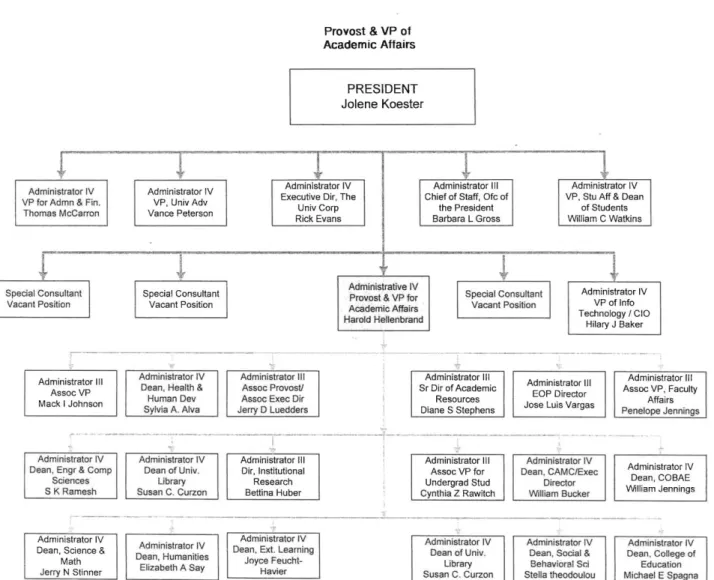
approximately 4000 faculty and staff at CSUN (CSUN Catalog, 2010-2012). Table 1.3.a1 provides the organizational chart of the University indicating key
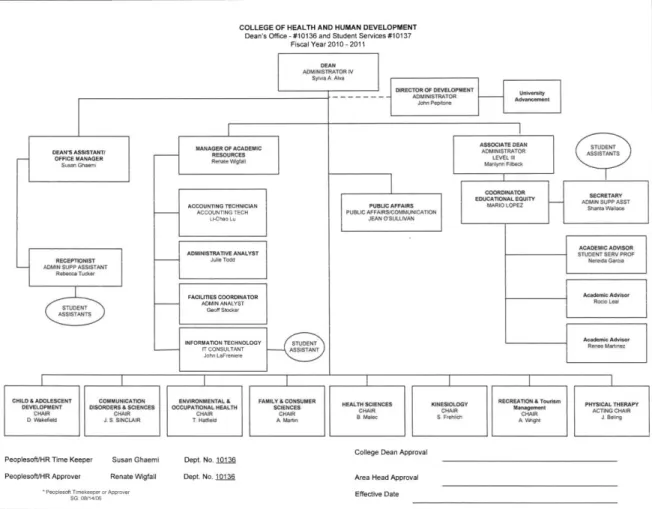
administrative positions within the University, the relationship of the College of Health and Human Development to the rest of the University, and the relationship of the Department of Health Sciences to the College and University. Table 1.3.a2 provides the organizational chart for the College of Health and Human Development and Table 1.3.a3 provides the organizational chart for the Department of Health Sciences including the key administrative positions within the Department.
The University has established policies, procedures and rules that govern all
administrative and organizational roles and responsibilities between the program and the University. This includes matters of budgeting and resource allocation, personnel recruitment, selection, and advancement, establishment of academic standards and policies, faculty governance, and curriculum matters.
As can be seen in Attachment 1.3.a1, the MPH Program is one of a number of accredited programs at CSUN and is administratively situated in the Department of Health Sciences (one of eight departments that make up the College of Health and Human Development). The program functions as a specific unit within the Department’s overall Health Education Option which includes an undergraduate program of Public Health Education and the Master of Public Health Program in Health Education.
The MPH Program is one of a number of distinct academic preparation areas within the Department of Health Sciences including Health Administration (undergraduate and graduate program), RN to BSN Nursing Program, Radiology Technology undergraduate program, and Health Education. There is also a Gerontology Interdisciplinary Minor program located within the Department. Administratively, each program area has a
Director who reports to the Department Chair (Dr. Brian Malec) who in turn reports to the Dean of the College of Health and Human Development. Since the last Self-Study, there have been several changes to the Department including the appointment of Dr. Brian Malec as Chair. During the first Health Sciences Department meeting of Spring 2011, the faculty members were informed that Nursing will become its own department as of Fall 2011. The Health Sciences Department will then consist of Health
Administration, Health Education and Radiology Technology. Table 1.3.a1: University Organizational Chart
2011 CSUN MPH Program Self Study, 31
1.3.a2 One or more organizational charts of the university indicating the program’s relationship to the other components of the institution, including reporting lines.
2011 CSUN MPH Program Self Study, 33
1.3.c A brief description of the university practices regarding:
1.3.c.1 lines of accountability, including access to higher-level university officials The ultimate authority rests with the President, Jolene Koester, and the Provost, Harry Hildebrand. Decisions on funding, courses offerings in the summer session, and
university policy are made by these officials. Academic issues related to faculty reside in the Faculty Senate. The MPH program is administratively located in the Department of Health Sciences. Other programs in the Department are: Health Administration
(undergraduate and graduate); Radiologic Technology (undergraduate); and Nursing (BSN). The Department is located within the College of Health and Human
Development (HHD). There are a total of eight departments within the HHD. The college is one of eight colleges that report to the Provost and Vice President for Academic Affairs.
Within the Department of Health Sciences, the MPH program is part of the Health Education Program. The Program has a Director and a Graduate Coordinator. The Program Director sits on the Department Chairs Program Directors Council. The Graduate Coordinator represents and is responsible for all aspects of the MPH
program. The Graduate Coordinator sits on the CSUN Graduate Coordinator’s Council. The Department Chair sits on the HHD Dean’s Council. Communication up and down the organization is efficient and takes multiple forms: face-to-face meetings, email, regular mail, retreats, standing and ad hoc committees and one-on-one conversation. The President of the University holds regular coffee hours with faculty all over the campus to ensure direct access to top administration.
1.3.c.2 prerogatives extended to academic units regarding names, titles and internal organization.
Department names are controlled at the university level and do not require system approval. Academic units have the prerogative to suggest and apply for name changes and necessary titles. Program Director titles are a local Department decision and do not require University approval. The internal organization of the Department and the MPH are part of our Governance Policies. These policies were internally developed and represent the will of the faculty on internal practices related to conducting the business of the Department and the Programs. The Department has developed these policies over the past two years and continues to be in development. The Governance Polices outlines, for example, the roles, responsibilities, and selection of Program Directors and Graduate Coordinators. During the Spring Semester 2009 the Department of Health Sciences approved acceptance of this governance policy. A copy is attached
1.3.c.3 budgeting and resource allocation, including budget negotiations, indirect cost recoveries, distribution of tuition and fees, and support for fund-raising. Budgeting and resource allocation are determined by the State of California, the
Chancellor’s Office for the California State University twenty-three campus system, the President and Provost of CSUN, and the Dean of HHD. The allocation is guided by the campus FTES target. The Department is the lowest organizational entity with a line-item budget. The MPH program is a subset within a Department and does not have and cannot have a separate line-item budget. The MPH program is not funded by tuition, but rather general state funds. The MPH program is supported in several ways. Faculty tenure track and part-time faculty salaries are allocated and managed at Department and College levels. Each Department is given line-item authority over an operating expense budget. The O&E expenditures and staff support are allocated to Programs based on full-time equivalent student FTES generation. Each faculty is allocated a base travel allocation and then can apply for additional funding when presenting research at professional meetings.
The College has a full-time development person available to support Departments and programs in fund raising. No specific to donations to the MPH have been received in the past few years. There is also grant writing support available on a project by project basis. The MPH program and the Department do not currently participate in indirect cost recovery from grants.
1.3.c.4 personnel recruitment, selection and advancement, including faculty and staff
New faculty lines are requested by Departments generally in the spring semester. The Dean negotiates with the Provost for centrally funded new positions. College funded new positions are also a possibility if funds are available. The MPH program was authorized to search for a tenure track faculty for AY-2009-2010. The new assistant professor began in Spring 2010. The MPH program has again been authorized to search for a new tenure track assistant or associate professor for AY-2010-2011. Department policy is to elect a three person Search Committee. Two members are from the program and one is an at-large member. One member of the Search Committee is the chair and another is the equity and diversity representative. The whole process is guided by the CSUN Search Manual
(http://www.csun.edu/facultyaffairs/policies/manuals/S&SFT2010-11Final.pdf ). The Search Committee is charged with the development of a recruitment plan that is approved by the CSUN Equity and Diversity Office. The Search Committee and
Department Chair give their summary and recommendation of the search to the Dean of HHD who is responsible for negotiating salary and other hiring terms. The Department is allocated sufficient recruitment funding for the search and on-campus expenses. Following the hire, the College allocates resources for the initial office setup and other necessary resources for the new faculty.
2011 CSUN MPH Program Self Study, 35
1.3.c.4 Academic standards and policies, including establishment and oversight of curricula
Every year the Department establishes a Curriculum Committee that is made up of one member from each of the four programs. All new curriculum proposals are vetted through the Department Committee. Successful proposals are then sent to the College of HHD’s Curriculum Committee and the Associate Dean of HHD. Upon approval from the College Curriculum Committee proposals are then reviewed by the Graduate Studies Committee at the University level
(http://www.csun.edu/grip/graduatestudies/gsc/ ). The process is governed by Faculty Senate policies. Current course content is reviewed yearly by program faculty.
1.3.d If a collaborative program, descriptions of all participating institutions and delineation of their relationships to the program.
Not applicable to the CSUN MPH Program
1.3.e If a collaborative program, a copy of the formal written agreement that
establishes the rights and obligations of the participating universities in regard to the program’s operation.
Not applicable to the CSUN MPH Program
1.3.f Assessment of the extent to which this criterion is met.
The MPH Program believes that this criterion is met. There are procedures and protocol from the university level down to the department and program levels. The MPH Program is fully integrated into the California State University of Northridge.
2011 CSUN MPH Program Self Study, 37
1.4 Organization and Administration.
The program shall provide an
organizational setting conducive to teaching and learning,
research and service. The organizational setting shall facilitate
interdisciplinary communication, cooperation and collaboration.
The organizational structure shall effectively support the work of
the program’s constituents.
1.4.a One or more organizational charts showing the administrative organization of the program, indicating relationships among its component offices or other administrative units and its relationship to higher-level departments, schools and divisions.
1.4.b Description of the roles and responsibilities of major units in the organizational chart.
The roles and responsibilities of administrators are determined by the university and their respective administrative unit. Within the Department of Health Sciences, the Department Chair oversees all programs and reports to the Dean of the College of Health and Human Development. The roles and responsibilities are outlined in
http://www.csun.edu/facultyaffairs/policies/manuals/SEC600_1011_FINAL.pdf . The Department has recently implemented its own governance protocol for the Department Chair and Program Director (Attachment 1.3.c1).
Department Chair
All programs have a Program Director who reports to the Department Chair who in turn reports to the Dean of the College of Health and Human Development. Programs are supported by Administrative staff that assists Program Directors with admissions processes and other related activities necessary to the effective functioning of these programs. Program Directors meet as a body with the Department Chair monthly to discuss budget and resource allocations, University, College and Departmental policy concerns and issues, and other concerns that relate to the functioning of the
Department and its various programs. The Chair is the direct link to the Dean of the College.
Director of the Health Education Program
The Director of the Health Education Program is responsible for two sets of duties; they include directing the undergraduate health education program and review the overall needs of resources for both the undergraduate and MPH programs. The Program Director relies upon his fellow faculty to make scheduling, curriculum, part-time faculty, and other recommendations to him. The Program Director assimilates all of the
information provided, reviews it for efficacy and makes all the final recommendations to the Chair of the Health Sciences Department. Dr. Ronald Fischbach held this position in the 2009-2010 academic year. Dr. Fischbach resigned this position during the summer of 2010. Currently Dr. Lawrence Chu is the Program Director.
Graduate Coordinator It is the responsibility of the MPH Graduate Coordinator to oversee the program, student progress, the Total Quality Education process, chair the admissions committee, oversee the culminating experience, and be responsible for all correspondence relating to academic issues of the graduate students. The CSUN student handbook is the guide for graduate student behavior and the MPH Graduate Coordinator follows that guide
(
http://www.csun.edu/graduatestudies/graduatestudies/documents/new-booklet2010.pdf). It is the responsibility of the MPH Graduate Coordinator to attend all informational meetings of the Office of Graduate Studies and to keep abreast of
2011 CSUN MPH Program Self Study, 39
changes in academic and university protocol. The Graduate Coordinator typically receives three units release time when resources are available. During the Spring Semester 2010 no release time was available for the Graduate Coordinator due to budget restrictions so the Health Education Program Director fulfilled his role as well as that of MPH Graduate Coordinator. Dr. Vicki Ebin was the MPH Graduate Coordinator from 2005-2009. During the Fall Semester 2009 Dr. Kathleen Young was the acting MPH Graduate Coordinator and Dr. Fischbach took on that position during Spring Semester 2010. Dr. Ebin has resumed the MPH Graduate Coordinator responsibility as of Fall Semester 2010.