• No results found

Particle Swarm Optimization Method for Optimal Reactive Power Procurement Considering Voltage Stability

N/A
N/A
Protected

Academic year: 2020

Share "Particle Swarm Optimization Method for Optimal Reactive Power Procurement Considering Voltage Stability"

Copied!
12
0
0

Loading.... (view fulltext now)

Full text

(1)

Particle Swarm Optimization Method for

Optimal Reactive Power Procurement

Considering Voltage Stability

B. Mozafari

;2;3

, T. Amraee

1;2;3

, A.M. Ranjbar

2;3

and M. Mirjafari

3

This paper presents and utilizes an Improved Particle Swarm Optimization algorithm (IPSO) for reactive power management in restructured power systems. Reactive power procurement is modeled as a Security Constraint Optimal Power Flow (SCOPF), which incorporates a voltage stability problem. This is a major concern in power system control and operation. The model attempts to minimize the cost of reactive power procurement and energy losses as a main objective, while the technical criteria and voltage stability margin, especially, are treated as soft constraints. From a mathematical point of view, the reactive power market can be expressed as a nonlinear non-convex optimization problem with multi-local minima. In most cases, the non-convexity results in a failure of the mathematical-based optimization algorithm to nd the global optimum. Thus, the PSO, a powerful heuristic searching algorithm, is developed and implemented to nd the global optimum of the reactive power market objective function. The feasibility of the methodology (IPSO) is tested over an IEEE30 bus system, while the obtained simulation results are compared with the gradient-based approach, using General Algebraic Modeling System (GAMS) software, the original PSO and another evolutionary programming called a Genetic Algorithm (GA). The results demonstrate that the IPSO can converge to better feasible solutions with less iteration and can be successfully used for reactive power scheduling in deregulation environments.

INTRODUCTION

Voltage stability constrained reactive power dispatch-ing in deregulated power networks is a dicult task facing an Independent System Operator (ISO) that is mandated to provide equitable ancillary services. In a vertically integrated power system, reactive power facilities are operated under a monopoly by the sys-tem operator to meet technical requirement, such as improving the voltage prole and reducing the loss

*. Corresponding Author, Science and Research Branch, Islamic Azad University, Tehran, I.R. Iran.

1. Science and Research Branch, Islamic Azad University, Tehran, I.R. Iran.

2. Department of Energy and Environment, Niroo Research Institute, Tehran, I.R. Iran.

3. Department of Electrical Engineering, Sharif University of Technology, Tehran, I.R. Iran.

of transmission lines or, even, increasing the voltage stability margin to avoid instability, due to load per-turbation or equipment failure. However, there is not a clear competition mechanism for providing reactive power in this structure. With the advent of restruc-turing, generation, transmission and distribution are separated into distinct entities in terms of ownership and management. Thus, the various competitive mar-ket structure models are designed and developed for the pricing of electricity and, also, associated ancillary services [1,2]. In these structures, new concerns are introduced into the power system operation to handle both technical and economical issues eciently. Op-timal reactive power procurement and voltage control are the most important issues in restructured power systems. Usually, the strategies for dealing with reactive power control are in accordance with electricity market strategies. In recent years, various approaches have been proposed for the optimal distribution of

(2)

re-active power among providers in power pool electricity markets. In one approach, active and reactive power markets are cleared together, at the same time. For example, Xie et al. [3] apply a mathematical method to minimize both active and reactive generation costs while, in [4,5], the reactive powers generated by static compensators are also treated as ancillary services and their associated costs are considered correspondingly. In the second approach, the reactive power market is executed independently of the energy market. In this perspective, a method is established that aims to dispatch ecient reactive power at a minimum cost, while real power transactions are assumed to be xed [6]. As a matter of fact, that part of the reactive power, which is used for improving various technical features of the power system, is inherently assumed as an ancillary service. This means that generators should provide some parts of the reactive power in a mandatory manner to satisfy grid code requirements.

Generally, an optimal reactive power procurement problem can be usually formulated as a nonlinear programming (NLP) problem. The nal purpose is to optimize the objective function, while satisfying sets of constraints. Usually, equality constraints are power ow equations and the inequality constraints are the limits on control variables, voltages, active/reactive power generation and line ows. The mathematically-based optimization algorithms are very ecient in handling linear convex problems. However, the studies, which have been performed on reactive power and voltage control optimization, show that the reactive power market is usually a non-convex NLP with more than one feasible region where the optimal solution might be found at any point within any such region. Hence, the mathematical algorithms are very sensitive to initial conditions or starting points [7]. The stochas-tic behavior implemented in the most population-based evolutionary algorithms makes them good candidates for obtaining the optimal solution. A survey regard-ing application of intelligent techniques for reactive power/voltage control in the power system is presented in [8]. Recently, Kennedy and Eberhart have developed a new powerful evolutionary computation technique, called the PSO, which comprises a very simple concept. This paradigm can be implemented in a few lines of computer code. It requires only primitive mathemat-ical operators and is computationally inexpensive in terms of both memory and speed requirements [9].

The PSO has also been applied to some optimiza-tion problems in the power systems. In [10,11], the PSO is implemented for well-known economic dispatch problems. Yoshida et al. [12] have presented a two-step procedure for handling voltage stability criteria in the reactive power optimization problem. In the rst stage, the PSO is used to minimize transmission

power losses, while, in the second stage, the maximum loading parameter of the system is evaluated using a CPFLOW method [13] for each best solution found by the PSO. The rst solution that satises the minimum requirements of the system operator is selected as the nal best solution. However, the PSO has not been im-plemented for power market scheduling, especially the reactive power market constrained by voltage stability criteria.

In this paper, the PSO is modied to solve the reactive power market, which incorporates the voltage stability criterion. This model conforms to the power pool electricity market. The objective function includes the costs associated with energy losses, as well as reac-tive power generation costs, while the voltage stability criterion is implemented into equality constraints. The feasibility of the proposed method is demonstrated and compared with the original PSO, the GA and results obtained from the GAMS software.

PSO APPROACH

Original Algorithm

The particle swarm optimization algorithm is a new evolutionary computation technique motivated by sim-ulation of the social behavior of a folk or a group of people [9]. Each individual refers to a particle and presents a candidate solution to the optimization problem. Two dierent versions of the PSO algorithm exist, which can be implemented and tested, namely, the gbest PSO and the lbest PSO [14]. In the gbest topology, all members move toward the best particle in the population, however, in the lbest topology, each swarm aims at the best particle in its surrounding neighborhood. In the original version, neighborhood size is constant and neighbors do not change during a run. The impact of randomly created neighborhood topologies on PSO performance has been investigated in [15]. A modied particle swarm optimizer is presented in [16], which reduces a number of setting parameters, such as maximum and minimum velocity (Vmax,Vmin), associated with the original algorithm. In

the following, the application of the PSO method for a general form of optimization problem is described. Let the optimization problem be written, as follows:

MinimizeF(X) s.t

G(X) = 0; H(X)<0; Xmin

X X

(3)

In this formulation, the vector, X, contains control variables. PSO can be applied to an optimization problem through the following steps.

Step 1

Using penalty factors, Equation 1 can be transformed into the form of the augmented objective function without any constraints. In such a case, the control variable limits, (Xmin X Xmax), dene the

feasi-ble solution region, and initial population is generated in such a way as to fulll these conditions. Moreover, a random velocity vector is assigned to each particle. These velocity vectors are generated according to the lower and upper bounds of control variables. LetXand V indicate the particle position and its corresponding velocity in ad-dimensional search region, respectively. Then, the ith particle can be represented as Xi =

(xi1;xi2;;xid) and its ight speed can be expressed

asVi= (vi1;vi2; ;vid). Step 2

The augmented objective function is used to evaluate the tness of each individual in the population. The obtained value for each particle is compared with the previous one, which is stored in the agent memory. If a decrease in value is noted (for the minimization problem), the new explored point is substituted with the prior position. This value suggests the self-experience of a particle and can be written in the form of Pbesti = (Pbesti1;Pbesti2;;Pbestid) for the ith

agent.

Step 3

In the lbest version, the initial generation is categorized into dierent groups where the particle's neighbors are specied. One methodology to determine neighbors is presented in [15]. Implementing the gbest version requires no additional operation. In this case, all individuals are considered to be a particle's neigh-bors.

Step 4

Referring to the evaluated tness value of each particle obtained in Step 2, the best agent in each group can be distinguished. This value is shown by Lbesth,

where h denotes the number of the group. In the gbest version, there is one neighborhood, which con-tains all population members and, hence, Lbesth is

replaced with Gbest, accordingly. The Lbesth or

Gbest store the best experience attained by

mem-bers of the hth neighborhood or the best experience achieved by all members of the population in every epoch.

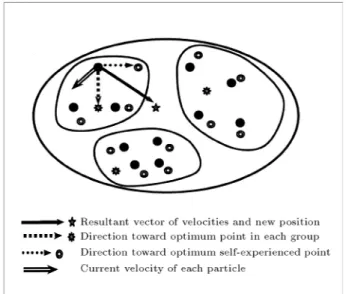
The modied velocity and position of each par-ticle can be calculated, using the current velocity, random weighted distance from the Pbest:i;h and

ran-dom weighted distance from theLbest:h(Gbest), by the

Figure1. Concept of particle's movement by PSO algorithm.

following formulas. The process is shown plainly in Figure 1.

Vi;h(t+1)=wV

(t)

i;h+c1rand1(:)(Pbesti;h X

(t)

i )

+c2:rand2(:)(Lbesth X

(t)

i;h); (2)

X(t+1)

i;h =Xi;h(t)+Vi;h(t+1); (3)

where:

i= 1;2;;m points to theith particle,

m the number of particles,

t a counter of iterations,

w an inertia weight,

c1;c2 the acceleration constants,

rand1(:);rand2(:) uniform random generator

function in range of [0,1]. Equations 2 and 3 are used for implementing the PSO lbest version. These equations are also applicable for the gbest version substituting h = 1 and Gbest

instead ofLbesth into Equation 2.

The acceleration constants, c1 and c2, represent

the weighting of the stochastic acceleration terms that pull each particle toward thePbestandLbestpositions.

Low values allow particles to roam far from the target regions before being tugged back. On the other hand, the high values result in abrupt movement towards, or, backwards, away from the target regions. Therefore, according to previous experiences, these factors are set to 2.0 during all simulations. The PSO algorithm is very sensitive to the value of inertia weight, w, presented in Equation 2. The w adjusts the PSO dynamic behavior during searching procedures, where w = 1 guaranties the PSO to converge by iterations. High values of w put particles to y over the local

(4)

minima, however, low values allow particles to intensify searching local areas. Generally, the w decreases linearly from about 0.9 to 0.4 during the run, according to the following equation:

w=wmax wmaxitermaxwmin iter;

whereWmaxis 0.9,Wminis 0.4 and itermaxis maximum

iteration number.

Improved Algorithm (IPSO)

PSO movement's instructions can be eectively applied to all members except for the best agent position, namely, Lbesth, where this position is identical to its

current position and its best previous experience. This causes the best agent moves only based on its weighted previous velocity. This becomes serious when w 1

tends to zero velocity after a number of iterations. Thus, the probability of local minima escaping may decrease in this situation. To solve this deciency, in this section, a method, which randomly selects the best position for each particle, is presented.

In Step 4 of the PSO original algorithm, particles that exist in neighborhood, h, move toward Lbesth,

which can be modied, as follows.

Let the initial population be divided into N neighborhoods, where h= 1;2;;N and allLbesth

are available at this stage. For each individual,Lbestis

assigned, where this value is selected among Lbesths,

based on one of the random selection procedures, such as the Roulette Wheel selection scheme. In this approach, all candidates are assigned weights based on their tness values and then a random selection is used to determine the social leaders. Accordingly, this provides a situation, in which particles in one neighborhood move toward other groups and increase overlap among the ock. The aim of this process is to maintain population diversity.

FORMULATION OF THE REACTIVE

POWER MARKET PROBLEM

In vertically integrated power systems, a single entity (provider) performs all of the basic functions of produc-tion, transportation and delivery. It is also responsible for developing the power system in each section. Trans-mission lines provide single path connecting generation sources to consumption areas. The static voltage security assessment is strictly dependent on power system network operation. From a reactive power point of view, in vertically integrated utilities, the system operator makes an eort to dispatch reactive power resources in order to maintain the security of the system under normal and, also, under various loading conditions. The reactive reserve can be determined

doing dierent (N 1) contingency analyses, according to the priority list. In such a system, the main objective is the fulllment of some technical requirements, such as improving the voltage prole, minimizing real power losses, increasing the available transmission capability of the network etc. [7,8]. At the same time, there is less attention paid to the reactive power revenue for each supplier.

However, in restructured power systems, nancial interests introduce new dimensions to an open market system, where the cost and contribution of dierent reactive power facilities should be evaluated more precisely than before. The methodology presented here considers the predened loadability limit or voltage stability margin as a soft constraint. Considering the voltage stability constraint in the reactive power market modeling provides independent system opera-tor with insurance against entering the power system into unstable conditions, which may happen due to load changes. In this paper, there is no intention of dealing with reactive power reserve procurement and, consequently, no contingency analysis will be carried out into the presented model and simulation. Thus, a voltage stability constrained reactive power market can be generally formulated, as follows.

Reactive Market Objective Function

Minimizef(Qg;Qvsm

g ;Qsh;X)

= Ng X

i=1Cgqi(Qgi) +

Ng X

i=1A

vsm

gqi :Cgqi(Qvsmgi )

+Nsh X

i=1Cshi(Qshi) + 0:5:MCP:

X

i;j(Gi;j

(V

2

i +Vj2 2ViVjcos(i j))); (4)

where:

i;j: index for buses,

Qg: generators VAr output at normal

condition, Qvsm

g : generators VAr output when

loads are increased,

Avsmgqi : the ratio between the cost of

reactive energy and reactive power reserve,

Ng: number of generators,

Qsh: static VAr compensators output,

Nsh: number of static compensators,

V: voltage at bus in per unit,

Gi;j=real(Yi;j): conductance of linei j,

(5)

Y admittance matrix of power system, X= [;V]: state vector,

MCP Market Clearing Price.

The objective function consists of the total payments of the reactive power procurement under normal and increasing load conditions and the payment associated with real power losses of transmission lines. In this model, the reactive power reserve necessary to protect the system against voltage instability is procured, simultaneously, with the reactive energy. In this structure, it is assumed that the slack generator pro-vides network losses at a MCP price, which has been previously settled in the electricity market. The cost of providing real power loss into the objective function of reactive power procurement is considered, since this term can inherently prevent the transportation of reactive power from long distance areas. The traveling of reactive power over long transmission lines can increase both active and reactive power losses. Since the dened objective function can minimize the cost of active and reactive power losses, ISO can assure the adequate local provision of reactive power. As a result, it seems to be a good objective for reactive power control in deregulated power sys-tems.

Constraints on the Power System and

Resources

1. Power ow equations under normal condition: P

gi P

di =

X

j ViYi;jVjcos(i;j+j j); (5)

Q

gi+Q

shi tan('

di):P

di

=X

j ViYi;jVjsin(i;j+j j); (6)

where: P

gi;P

di: denote generation and consumption of

active powers, '

di: denotes power angle of consumption

loads.

2. Power ow equations with xed predened voltage stability margin:

(1 +kgi:: N

g X

i=1P

gi):P

gi (1 +kdi::XN

i=1P

di):P

di

=X

j V vsm

i Yi;jVjvsmcos(i;j+ijvsm); (7)

Qvsmgi +Q

shi (1 +kdi::XN

i=1P

di):tan('

di):P

di

=X

j V vsm

i Yi;jVjvsmsin(i;j+ijvsm): (8)

In the above equations, the subscript \" is used

to represent the quantities of variables in the base-case, whilevsmis used to show the variables under load increasing conditions. In Equations 7 and 8, the percentage of load increasing is modeled by . The terms of :PN

g

i=1Pgi or :PN

i=1Pdi are

the total increase of power system generation and load, respectively. kgiis a distribution factor, which

denes the direction of generation increase for the ith generator and kdi indicates how much of the

load increase occurs at bus i. For a given load increase, the sum of distribution factor, kgi, as

well as kdi, is unity. This means that one has

P

kgi = 1 andP

kdi = 1. It should be mentioned

that numerous directions could be dened and considered for any load increase in the power system using these participation factors. In this paper, the amount of generation/consumption is increased, according to their base-case values. In other words, one can denekgi = P

g i P

P g i

andkdi = P di P

P di

; 3. Reactive power-generation limits:

Qmingi QgiQmaxgi ;

Qmingi Qvsmgi Qmaxgi ; (9)

Qminshi

QshiQ

max

shi : (10)

Qmaxgi and Qmingi are the maximum and minimum

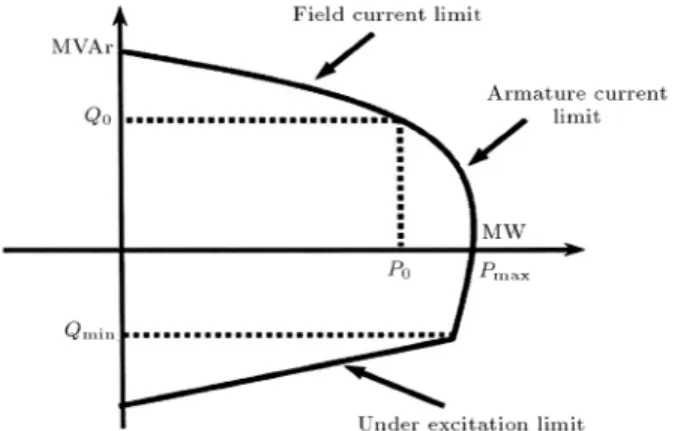
reactive power that a generator can provide. These values vary with a change in active power output of a generator. The capability curve of a generator is usually used to demonstrate the relation between its active and reactive power outputs. A typical capability curve of a generator is shown in Figure 2. It is restricted to the maximum stator winding heating limit, which depends on stator current and it is also restricted to the maximum eld winding heating limit or the end region heating limit of the rotor when the generator operates in an over or under excitation mode. The feasible operating conditions of a generator can be expressed as a function of its active and reactive operating current point, its terminal and internal setup voltages and its synchronous reactance [17]. However, this paper assumes that generators are allowed to propose their reactive power generation capability, with respect to their active power generation points;

(6)

Figure2. Typical capability curve of a generator.

4. Bus voltage limits: Vimin

ViV

max

i ;

Vimin

VivsmV

max

i : (11)

Vivsm= constant, ifi2generator bus.

The value of the voltage stability margin (:PN

g

i=1Pgi or :PN

i=1Pdi) should be

predeter-mined by ISO, who is legally responsible for the security and reliability of the power system. In this paper, there is no intention of calculating thevsm factor, however, a methodology has been presented for modeling voltage stability in the reactive power market. This method is called xed voltage stabil-ity margin formulation. Other useful strategies for handling the voltage stability problem are presented in [18,19].

Reactive Power Production Costs

1. Synchronous generators:

Active power generation decreases the reactive power capability of a generator, as shown in Fig-ure 2. The cost of reactive power production can be modeled using opportunity cost calculation [6]. An approximation for the cost of reactive power production corresponding to the rst term of Equation 4, is given in the following equation [5]: Cgqi(Qgi)=

h

Cgpi(Sgi) Cgpi

p

Sgi2 Qgi2

i

Kgi;

(12) whereCgpi(Pgi) =aPgi2+bPgi+c is active power

generation cost,Qgi is reactive power output ofith

generator,Sgi =

q

Pgi2 +Q2gi is apparent power of

ith generator andKgi is prot rate of active power,

usually between 0:050:1;

2. Static VAr compensators:

The second term in Equation 4 is the total produc-tion cost of static VAr compensators, which can be

expressed as the following equation, for the device installed at busj:

Cshj(Qshj) =rshjQshj; (13)

where rshj is the price of the reactive power per

MVAr, which depends on dierent factors, such as capital investment of the compensator, its period of lifetime and average utilization factor. For example, a SVC with an investment cost of $48,000/MVAr, a lifetime of 30 years and an average use of 2/3, has itsrcj as [4,5]:

rshj =30 22000

3652423

= 0:1225($MVAr): (14)

REACTIVE POWER MARKET SOLUTION

USING PSO

The following procedure can be used for obtaining the optimal solution to the proposed reactive power market.

Step 1

Initial populations of agents are generated randomly inside the searching space, specied by the upper and lower bands of control variables. In this problem, control variables consist of the output voltage of gen-erators and the reactive power outputs of static VAr compensators. Initial velocity values are also assigned to each particle. For each agent,Pbestis initialized with

the current position.

Step 2

For each individual, Equations 5 and 6 are evaluated. If the obtained values for state variables satisfy Con-ditions 9 and 11, then, go to Step 3, otherwise, assign a high value to the objective function and, then, go to Step 5.

Step 3

The control variables are xed and, then, Equations 7 and 8 are evaluated. if the obtained values for state variables satisfy Conditions 9 and 11, go to Step 4, otherwise, assign a high value to the objective function and, then, go to Step 5.

Step 4

Particles are divided into dierent groups. For each particle,Pbest andLbestare calculated for each

neigh-borhood. Finally, for each particle, Lbest is selected,

according to the method presented previously.

Step 5

New velocities are calculated using Equation 2.

Step 6

(7)

Step 7

If the iteration number reaches the maximum, then, stop and print the nal results, otherwise, go to Step 2.

SIMULATION AND RESULTS

In this section, the reactive power market is simulated using the IEEE 30-bus test system and the results obtained for optimal reactive power procurement are presented. The performance of the reactive power market is studied for two dierent cases. In the rst case, it is assumed that all generators, which have been committed for active power production, are obliged to provide a sucient reactive power reserve, according to the ISO requirement, however, they will be paid only for reactive energy production or absorption. In other words, allAvsmgqi are equal to zero. In the second

case, the cost associated with the reactive power reserve takes into account usingAvsmgqi neq0. In both cases, the

feasible solution of the market is achieved by means of dierent methodologies, such as: GA [20], PSO, IPSO and GAMS software. In these studies, the performance of the IPSO solver is compared with other methods to demonstrate its feasibility in the optimal reactive power procurement problem. The network conguration of the IEEE 30-bus test system and its transmission lines data are given in [21]. The characteristics of generating units are tabulated in Table 1.

The second column in Table 1 represents the reactive power output of generators when they are required to x their output voltage at the desired values indicated in column three. In this condition, the real power loss of the system is about 2.45 MW.

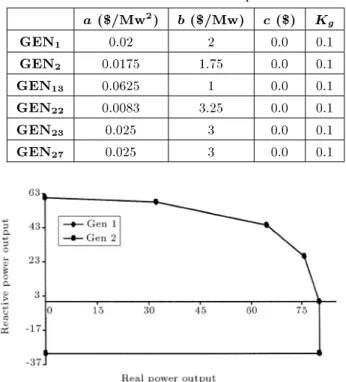
The reactive power costs of generating units are calculated by Equation 12, where the associated pa-rameters used in this formula are presented in Table 2. Figures 3 to 5 show the capability curves of each generator. It is assumed that these curves are submitted to the ISO from each generating unit. These curves demonstrate the maximum reactive power that each participant is willing to produce.

The additional energy necessary to provide active power losses is procured from the slack generator (G1),

Table 1. Generating unit characteristics. Pg

(MW)

Qg (MVAr)

VG

Pgmax (MW) GEN1 25.97 -12.37 1.00 80 GEN2 60.97 -13.36 1.00 80 GEN13 37 -0.05 1.00 50 GEN22 21.59 6.08 1.00 50 GEN23 19.2 -3.28 1.00 30 GEN27 26.91 -1.87 1.00 55

Table2. Coecient factors of Equation 12. a($/Mw2) b ($/Mw) c ($) Kg

GEN1 0.02 2 0.0 0.1

GEN2 0.0175 1.75 0.0 0.1 GEN13 0.0625 1 0.0 0.1 GEN22 0.0083 3.25 0.0 0.1

GEN23 0.025 3 0.0 0.1

GEN27 0.025 3 0.0 0.1

Figure3. Capability curves of generators 1 and 2.

Figure4. Capability curves of generators 13 and 22.

Figure5. Capability curves of generators 23 and 27. Table3. Static compensators operating costs.

C6 C19 C28 Cost($/MVAr) 0.1 0.15 0.07

(8)

based on the electricity market clearing price. In all simulations, MCP is assumed to be 9.5 $/MW to gure out the cost of loss. The reactive power prices of electronic-based static VAr compensators are given in Table 3. These compensators are installed at buses 6, 19 and 28, respectively. Fixed or switched capacitors/inductors cannot be entitled to provide reactive power as an ancillary service, since they are not equipped with regulator devices and, hence, their reactive power output varies drastically with any voltage changes.

The voltage stability margin can be improved by ecient reactive power procurement. This is shown on a typical P V curve of a power system in Figure 6, where consumption loads are xed. A feasible solution for reactive power dispatch may not exist if available reactive power support is not adequate to satisfy the voltage inequality constraints under heavy loading conditions. In this paper, it is assumed that the voltage stability margin, dened by the ISO, can be reached using available reactive support. This value

Figure6. Typical PV curve of a power system.

is assigned to be 0.1 per unit for the secure operation of the power system under normal operation.

Case 1

In this case, the optimum reactive energy is procured for the normal condition. Thus, allAvsmgqi are assigned

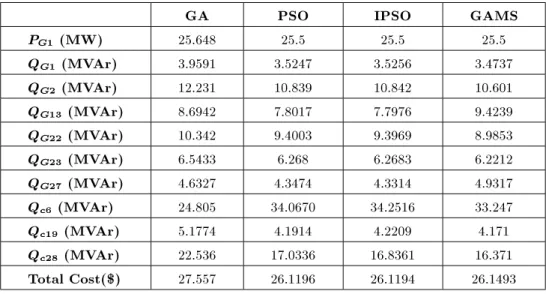
to zero and, then, the optimum point of the market is obtained, using GA, the original PSO algorithm, the proposed IPSO algorithm and GAMS software [22], which have been tabulated in Table 4.

The MINOS5 solver in GAMS software is used for the reactive market computation. The GAMS software has only been used to justify the correctness of the solutions obtained by means of the population-based algorithm. However, a comparison between evaluated costs of each method highlights the fact that population based algorithms may reach a better solution than a gradient-based method. In heuristic methods, the probability of escaping from local minima usually increases with an increase in population size.

To provide a rational comparison between the applied methods, similar population size is generated in each algorithm. The number of agents in IPSO and PSO is considered to be 24. This means that 24 new positions will be explored in every epoch. A genetic algorithm is initialized with 300 agents rst and, then, the best 24 individuals make a good population during the searching procedures. The results clearly show that the GA has a poor performance in nding the best solution among the alternatives considered. The IPSO present the best solution, in which the active power loss is 1.9705 (MW). This is about 19.6% less than before. Doing numerous simulations have indicated that the PSO algorithm has a good operation, moving the particles all over the search space. The results obtained from a 100 times execution of dierent heuristic

algo-Table4. Market simulation results.

GA PSO IPSO GAMS

PG1 (MW) 25.648 25.5 25.5 25.5

QG1 (MVAr) 3.9591 3.5247 3.5256 3.4737

QG2 (MVAr) 12.231 10.839 10.842 10.601

QG13(MVAr) 8.6942 7.8017 7.7976 9.4239

QG22(MVAr) 10.342 9.4003 9.3969 8.9853

QG23(MVAr) 6.5433 6.268 6.2683 6.2212

QG27(MVAr) 4.6327 4.3474 4.3314 4.9317

Qc6 (MVAr) 24.805 34.0670 34.2516 33.247

Qc19 (MVAr) 5.1774 4.1914 4.2209 4.171 Qc28 (MVAr) 22.536 17.0336 16.8361 16.371

(9)

rithms over the reactive power market are summarized in Table 5, which can provide useful information about the performance of each methodology. As Table 5 indicates, among the other methods, IPSO has a robust characteristic and better performance.

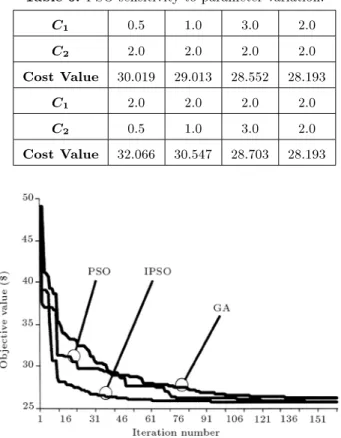
In Table 6, the PSO sensitivity to the variation of C1 and C2 is presented. As mentioned before,

selecting these factors can aect the performance of the optimization algorithm. From the results of this table, one can conclude that it is proper to setC1=C1= 2:0.

Figure 7 shows the typical convergence charac-teristics of GA, PSO and IPSO methodologies. It is clear from the gure that IPSO is converged to high quality solutions at the early iterations. The dynamic convergence curve of the PSO is similar to the IPSO and both of them can achieve a better solution, with low iteration, in respect to a genetic algorithm, where a decrease in the value of the objective function changes more slightly over iteration.

On the other hand, the convergence rate of the

Table5. Statistical results. The Best

Solution

TheWorst Solution

Mean Variance IPSO 26.1194 27.0780 26.2403 0.175366

PSO 26.1196 28.1932 26.3442 0.3098 GA 26.7032 28.2218 27.374 0.51109

Table6. PSO sensitivity to parameter variation.

C1 0.5 1.0 3.0 2.0

C2 2.0 2.0 2.0 2.0

Cost Value 30.019 29.013 28.552 28.193

C1 2.0 2.0 2.0 2.0

C2 0.5 1.0 3.0 2.0

Cost Value 32.066 30.547 28.703 28.193

Figure7. Dynamic behavior of GA, PSO and IPSO.

PSO depends on the factors w, C1 and C2. Since w

is usually chosen less than one, the velocity of the agents decays to zero. This situation deteriorates the potential of the PSO not to be trapped in local optima. Referring to Equations 2 and 3, one can easily nd out that particle position does not have any change when its associated velocity becomes zero. A typical variation of velocity for a particle is depicted in Figure 8. Figure 9 shows the same diagram for an improved particle swarm optimization algorithm. A comparison between these two gures reveals that IPSO can converge to global optima, even in the last iterations. It also shows that the value of a particle's velocity can only be used as a convergence criterion for the PSO algorithm.

The impact of population size generated in the searching space has been investigated and the obtained results are shown in Figure 10. This study indicates that the IPSO can achieve a better solution in earlier iterations, if the number of individuals increases. How-ever, trials with dierent population size can converge to near optimal value. Table 7 has also indicated the objective value obtained by setting dierent population sizes.

Figure8. Variation of particle velocity by iteration for PSO.

Figure9. Variation of particle velocity by iteration for IPSO.

(10)

Figure10. IPSO convergence characteristic for dierent population.

Table 7. Results obtained by dierent population size.

Iteration pop = 12 pop = 24 pop = 48

1 53.380 53.380 53.380

10 45.438 31.479 29.106

20 40.426 31.479 26.454

30 38.512 28.067 26.252

40 35.656 28.064 26.204

50 33.529 27.407 26.174

60 32.029 27.407 26.156

70 31.939 27.245 26.126

80 29.823 26.945 26.123

90 29.556 26.776 26.121

100 28.214 26.717 26.121

110 27.247 26.199 26.120

120 26.533 26.135 26.120

130 26.489 26.129 26.120

140 26.482 26.123 26.119

150 26.438 26.120 26.119

160 26.402 26.120 26.119

Case 2

This case deals with a situation in which reactive energy and the reactive power reserve are determined simultaneously for security operation of the power system. In this paper, it is assumed that generators are allowed to enter into the reactive power reserve market, and other types of reactive power generation

can only participate in the reactive energy market. As mentioned previously, it is intended to determine the ecient amount of reactive reserve needed to prevent voltage instability, happening due to perturbation in load values. Hence, it is assumed that all competitive suppliers could bid the cost of their reactive capacity proportional to the associated cost of reactive energy through the factors,Avsmgqi .

Assigning dierent values to the factors, Avsmgqi ,

can dene various strategies for the reactive power suppliers who take part in the reactive reserve market. One strategy can be dened by setting allAvsmgqi to the

same value. The results obtained for dierent values of Avsmgqi are presented in Table 8.

The simulation results in Table 8 show the impact of the reactive power costs on both reactive energy and reactive reserve dispatching. It also shows that static compensators have a good opportunity to provide the necessary reactive power when the prices of the reactive power reserve of the generators are extremely high. The results obtained for the two rst generators show that they have a large opportunity to make market power in the system.

The amount of reactive power of the rst genera-tor does not change with increasing reactive costs. The revenue of the second generator notably changes in the situation expressed byAvsmgq = 5:0, in comparison with

Avsmgq = 1:0. This is somehow true for the generator

G13. These signals can lead ISO to identify weak areas

with less reactive power capacity and to reinforce these parts of the network.

CONCLUSION

Reactive power management can be carried out for dierent purposes, such as minimizing power losses, improving voltage prole and, also, providing a suf-cient voltage stability margin. In this paper, rst, a model to handle both reactive energy and reactive reserve has been presented, in which reactive power can be eciently dispatched locally. Second, an improved version of the PSO has been presented, which increases the particle's endeavor to escape from the local minima. Then, the proposed method has been successfully implemented for the optimal procurement of reactive power in the open electricity market. In the proposed reactive market structure, the voltage stability constraint is implemented as a soft constraint to guarantee the security of the power system, due to some happenings in the power system, such as sudden load perturbation. Thus, reactive power management becomes a NLP problem with non-linearity in both the objective and its associated constraints. The simula-tion results carried out for the IEEE 30-bus system, demonstrate the excellent capability of the IPSO in obtaining the best solution, as well as convergence time,

(11)

Table8. Results of Case 2.

Avsmgq =0:5 Avsmgq =1:0 Avsmgq =5:0

MVAr REa RRb RE RR RE RR

QG1 3.387 3.685 3.263 3.556 3.070 3.40 QG2 8.046 12.42 6.499 10.86 2.533 6.968 QG13 5.546 6.909 4.412 5.773 1.525 2.894 QG22 6.115 10.213 4.314 8.408 -0.275 3.740 QG23 5.116 6.0124 4.348 5.238 1.856 2.757 QG27 2.697 3.936 1.834 3.064 -0.163 1.069

Qc6 40 - 40 - 39.98

-Qc19 5.140 - 6.1812 - 11.06

-Qc28 21.79 - 27.245 - 39.42

-Loss (MW) 1.995 2.028 2.173

Cost($) 27.45 28.355 31.491

a) RE: Reactive Energy; b) RR: Reactive Reserve in comparison with those obtained from the GA and the PSO algorithms. It is clear from the results that the proposed PSO method can avoid the shortcoming of premature convergence found in the GA method.

REFERENCES

1. Shahidehpour, M. and Alomoush, M., Restructured Electric Power System, 1st Ed., New York, Marcel Dekker (2001).

2. Hirst, E. and Kirby, B. \Creating competitive market for ancillary services",Oak Ridge National Laboratory, ORNL/Con448 (October 1997).

3. Xie, K. et al. \Decomposition model and interior point methods for optimal spot pricing of electricity in deregulation environments",IEEE Transaction on Power System,15(1), pp 39-50 (Feb. 2000).

4. Dai, Y., Ni, Y.X., Wen, F.S. and Han, Z.X. \Analysis of reactive power pricing under deregulation", Pro-ceeding of IEEE Power Engineering Society Summer Meeting Seattle, USA,4, pp 2162-2167 (2000). 5. Rider, M.J. and Pacuar, V.L. \Application of a

non-linear reactive power pricing model for competitive electric markets",IEE. Proc.-Gener. Transm. Distrib., 151(3), pp 407-414 (May 2004).

6. Lamont, J.W. and Fu, J. \Cost analysis of reactive power support",IEEE Transaction on Power System, 14(3), pp 890-898 (August 1999).

7. Pudjianto, D., Ahmed, S. and Strbac, G. \Allocation of VAr support using LP and NLP based optimal power ows", IEE. Proc.-Gener. Transm. Distrib., 149(4), pp 377-383 (July 2002).

8. Bansal, R.C., Bhatti, T.S. and Kothari, D.P. \Arti-cial intelligence techniques for reactive power/voltage control in power systems: A review", IEEE Interna-tional Journal of Power and Energy Systems, 23(2), pp 81-89 (2003).

9. Kennedy, J. and Eberhart, R. \Particle swarm opti-mization", inProc. IEEE Int. Conf. Neural Networks, 4, Perth, Australia, pp 1942-1948 (1995).

10. Park, J.B., Lee, K.S., Shin, J.R. and Lee, K.Y. \A particle swarm optimization for economic dispatch with non-smooth cost functions", IEEE Transaction on Power System,20(1), pp 34-42 (Feb. 2005). 11. Gaing, Z.L. \Particle swarm optimization in solving

the economic dispatch considering the generator con-straints",IEEE Transaction on Power System,18(3), pp 1187-1195 (Aug. 2003).

12. Yoshida, H. et al. \A particle swarm optimization for reactive power and voltage control considering voltage security assessment", IEEE Transaction on Power System,15(4), pp 1232-1239 (Feb. 2001).

13. Hsiao Dong Chiang et al. \CPFLOW: A practical tool for tracing power system steady state stationary behavior due to load and generation variations",IEEE Transaction on Power System,10(2), pp 623-633 (May 1995).

14. Eberhart, R.C. and Shi, Y. \Particle swarm opti-mization: Developments, applications and resources", Proceeding of the IEEE Congress on Evolutionary Computation (CEC 2001), Seoul, Korea, pp 81-86 (2001).

15. Kennedt, J. and Mendes, R. \Neighborhoods topolo-gies in fully-informed and best-of-neighborhood par-ticle swarms", Proceeding of the 2003 IEEE Inter-national Workshop on Soft Computing in Industrial Applications 2003 (SMCia/03), pp 45-50 (2003). 16. Shi, Y. and Eberhart, R.C. \A modied particle

swarm optimizer",Proceeding of the IEEE Congress on Evolutionary Computation (CEC 1998), Piscataway, NJ, pp 69-73 (1998).

17. Kundur, P., Power System Stability and Control, McGraw-Hill (1994).

(12)

18. Ca~nizares, C.A., Rosehart, W., Berizzi, A., and Bovo, C. \Comparison of voltage security constrained opti-mal power ow techniques", Proceedings of the 2001 IEEE-PES Summer Meeting, Vancouver, pp 1-6 (July 2001).

19. Rosehart, W., Ca~nizares, C. and Quintana, V. \Op-timal power ow incorporating voltage collapse con-straints",Proceedings of the 1999 IEEE-PES Summer Meeting, Edmonton, Alberta, pp 1-6 (July 1999).

20. Gen, M. and Cheng, R., Genetic Algorithms and Engineering Design, Wiley, USA (1994).

21. Power System Test Case Archive, available at: http://www.ee.washington.edu/research/pstca/. 22. GAMS Release 22.5 \A user's guide", GAMS

Development Corporation (1999); available at: http:/download.gams-software.com.

Figure

Figure 1. Concept of particle's movement by PSO algorithm.
Figure 2. Typical capability curve of a generator.
Table 2. Coecient factors of Equation 12.
Table 4. Market simulation results.
+4

References

Related documents

Approximately 15% of asthmatics and 34% of the patients Attacks of asthma precipitated by aspirin like drugs are with asthma and concomitant rhinosinusitis were unaware due to

When Neighborcare Health at West Seattle High School is closed, students and their families are encouraged to call a Neighborcare Health clinic for medical, dental and mental

For example, Extract 5 displays a continuing (chronology) positive (evaluation) initiative for the environment (categorization). Since CEO Statements are an overview

Title A novel drug delivery system of intraperitoneal chemotherapy for peritoneal carcinomatosis using gelatin microspheres incorporating cisplatin.. Author(s) Gunji, Shutaro;

In addition, Linde supplies tried-and-tested plants and process technologies for treating raw carbon dioxide from a wide range of industrial processes.. These include

Additional research should address lumbar flexion and extension AROM between a control group of non-runners and runners; the current study demonstrated a.. marginally

For example, [21] has offered a two-stage approach in which in the first phase, a new feature descriptor called maximum entropy feature descriptor (MEFD) is used

In order to test the ability of the mini-SEA to distinguish amnestic bvFTD patients from Alzheimer’s disease, the bvFTD group was divided in two subgroups