Sharif University of Technology
Scientia IranicaTransactions A: Civil Engineering www.scientiairanica.com
Developing fuzzy expert system for supplier and
subcontractor evaluation in construction industry
E. Shahvand, M.H. Sebt
and M.T. Banki
Department of Construction Engineering and Management, Amirkabir University of Technology, Tehran, Iran. Received 10 November 2014; received in revised form 4 August 2015; accepted 19 October 2015
KEYWORDS Fuzzy expert system; Supply chain management; Supplier; Subcontractor; Evaluation.
Abstract. Increasing competition in the global market to gain customer satisfaction and maximize protability has been a challenge in the last decade for many construction corporations. In recent years, Supply Chain Management (SCM) has been introduced as one of the most eective approaches in the construction industry literature; further, the rst step in SCM implementation is supplier evaluation and thus nding and resolving its weaknesses. In this regard, this research identied the criteria for evaluation of two types of suppliers in the construction industry (rst, material and equipment suppliers named suppliers, and second, service suppliers named subcontractors) and their fuzzy membership functions, distinctly, through literature review, questionnaire survey, and statistical analysis of expert judgment. Since most of them are linguistic parameters, fuzzy approach through Mamdani's inference mechanism has been utilized to develop a new methodology of fuzzy expert system. Thus, the developed expert system would evaluate and select the subcontractors and suppliers, distinctly, through three main criteria which are Quality, Cost, and Work relations history-timely delivery. The developed system was tested in three major companies and the results revealed signicant performance improvement of these construction companies.
© 2016 Sharif University of Technology. All rights reserved.
1. Introduction
Nowadays, strong competitive pressure forces many companies to make strategic changes. Construction companies purify their organization, decrease their organizational vertical hierarchy, concentrate on spe-cic activities, and provide their requirements with outsourcing. In the previous decades, companies have found that cooperation with the factories and service companies in the elds of collaboration, planning, and execution is vital. Therefore, companies can share technologies and planning information using the development of a vertical coalition of the organizations
*. Corresponding author. Tel.: +98 21 64543006; Fax: +98 21 64543037
E-mail addresses: [email protected] (E. Shahvand); [email protected] (M.H. Sebt); [email protected] (M.T. Banki)
within the supply chain [1]. Rapid changes in envi-ronment convinced organizations to establish highly exible, agile supply chains and prepare a fast response to evolutions. In this sequence, an eective supplier evaluation and selection is essential [2]. Gun et al. believe that at the present time, the purchase is considered as a strategic task instead of the technical one. This can be assigned to the appreciable inuence of suppliers on the success or failure of a rm. Hence, the process of purchasing should meet the following requirements: 1) Denition of criteria for supplier-selection; 2) Decision-making in supplier-supplier-selection; and 3) Evaluation of supplier performance [3]. Banki et al. presented that increasing the number of bidders would decrease the prices in tendering and purchase activities of construction rms [4]. Selecting suppliers and subcontractors depends just on tendering price and this would be risky and result in project failure; therefore,
it is essential to evaluate based on multiple criteria to achieve satisfaction of owners. Due to the uncertain nature of construction projects and subjective judg-ment of the decision-makers, fuzzy decision models are developed for construction contractor selection through utilization of multiple criteria [5,6].
The evaluation of the performance of suppliers in a supply chain is a process to analyze and manage their performance as well as to reduce costs and risk and to maintain continual improvement. The supplier evaluation system enables the organization to:
1. Control and evaluate the performance of suppliers;
2. Employ the same criteria and methodology for the evaluation;
3. Select suppliers in a systematic framework; in other words, to select robust suppliers for long-term cooperation and improve weak suppliers to achieve an acceptable level of performance.
The performance evaluation systems should have three main characteristics:
1. They should be systematic;
2. They have to be integrated with other systems in the organization;
3. They should be ecient and applicable.
In traditional models, performance evaluation system is only based on the eciency and produc-tion cost control. At the present time, due to the unpredictable changes in the work environment and managerial challenges, companies are involved in a competition which forces them to consider non-nancial factors [7]. Chien-Ho et al. developed a Subcontractor Performance Evaluation Model (SPEM) by employing Evolutionary Fuzzy Neural Inference Model (EFNIM) [8].
Construction companies have close relationships with two groups of suppliers, namely suppliers and subcontractors. The rst group supply materials, equipment, and machineries and the second group supply services. Therefore, evaluation of both suppliers seems essential. This study aims to develop a fuzzy expert system for evaluation and selection of suppliers based on the required criteria of the organization. First, the methodology is described; then, performance criteria are specied through literature review and expert judgment; next, the architecture of the system is represented; afterwards, fuzzy system membership functions and rules are described; and nally, the implementation results are presented.
1.1. Supply chain
Several denitions have been proposed in the literature. A system in which the raw suppliers, production
processes, distributors, and customers are regulated in one direction and information ow in the other, which are related to each other and are called the supply chain [9]. In some cases, it includes pecuniary ow [10]. Indeed, supply chains include all the activities related to material ow and transformation, from the raw ma-terial preparation phase to customer product delivery phase. In correlation with material ow, there are also two other types of ow: information ow and nancial resources ow or pecuniary ow [1]. Supply chain management is strategic; it provides the system-atic trade coordination between companies and makes use of any correlated trade process which leads to performance improvement of each and every company and their supply chain [11]. Nowadays, supply chain improvement through partnership is widely known as an eective tool.
1.2. Supplier performance evaluation criteria Supplier-selection decisions are very complicated be-cause of various factors that must be considered in the decision-making process. Many researchers pointed out that the numbers and types of criteria totally depend on the corporate policy, objectives, and strategies [4,5,8,12,13]. Hence, in this research, the performance criteria are dened by reviewing literature and obtaining expert's knowledge. According to the studies carried out by Neely et al.~[14,15], the favorable criteria should:
1. Be based on the organizational strategy;
2. Be simply understood;
3. Provide precise feedback;
4. Be based on the quantities which can be controlled by users;
5. Represent the business process - in other words, both client and supplier contribute to dene them;
6. Be related to the organizational goals;
7. Be compatible;
8. Be a part of the management loop;
9. Be clearly dened;
10. Have distinct eects;
11. Focus on the development;
12. Be valid within the time;
13. Provide fast feedback;
14. Provide one denite goal.
The problem of determination of the supplier-selection criteria has been the focus of a signicant amount of studies since 1960s [2,3,5-8,16-13,17,18]. Dickson presented 23 supplier-selection criteria, includ-ing [17,18]: (1) net price, (2) capability to provide all quality characteristics, (3) quality of maintenance
Table 1. Performance criteria as short term eect and capability criteria as long term eect on the achievement of the supply chain.
Capability factors Performance factors
Quality systems for operation with the place/quality
philosophy of the supplier Ability to meet delivery promise/delivery leadtime/consistent delivery Financial capability of the supplier Price
Technological capability/R&D capability Quality/reliability of the product Reputation for integrity/believability and
honesty/vendor's image Management sensitivity to requirementsof the buyer/attitude Management sensitivity to requirements
of the buyer/attitude After-sales support/the available technicalsupport Performance awards/performance history Positive attitudes towards complaints Bidding procedural compliance
Protability of suppliers
Breadth of product line/ability of a supplier to supply a number of items
Proximity of the supplier/geographic location Management and organization
Contribution to productivity Conict resolution
Production facilities and capacity Communication openness
Labor problems at the supplier's place Business volume/amount of past business services, (4) timely delivery, (5) geographical location, (6) nancial stability, (7) production facilities, (8) commercial experience, (9) technological capability, (10) managing and organizing, (11) possible future pur-chases of each vendor, (12) employing communication system, (13) operational controls, (14) position of the vendor in industry, (15) work relations history, (16) or-ganizational ethics, (17) job motivation, (18) complaint and warranty policies, (19) capabilities of product packaging, (20) rate of inuence on the contact, (21) possibility to satisfy the educational demands, (22) improvement of the procedures, and 23) performance history.
Garvin explained the performance criteria in de-tail. He suggested the most dominant factors including: quality, cost, timely delivery, services, and exibil-ity [19].
Sarkar et al. divided the criteria of performance
as short term eect and those of capability as long term eect on the achievement of the supply chain (Table 1) [16].
1.3. Fuzzy expert system
In recent years, expert systems or knowledge-based systems have been the focus of a signicant amount of studies. These studies declare that expert system processes knowledge while other software processes data and information [20]. Expert systems are one of the most practical elds of the articial intelligence that implicate a collection of the understandings and regulations in a special eld and ultimately simulate the abilities of experts in specic problem domains [21]. These are some powerful and exible tools which can solve many problems that could not be solved by traditional methods.
which uses fuzzy logic instead of Boolean logic in its knowledge-base and conclusions are made based on user inputs and fuzzy inference [22].
Further, some well-known methods such as partial completeness [23], optimized association rules [24], and CLIQUE [25] divided the qualitative attributes into many crisp partitions. Since there are no interactions between the partitions, this division does not seem favorable for linguistic and qualitative parameters; for example, if we tried to partition the range (70, 80) of the \COST" parameter for a supplier into two partitions, then the separable point would not be dierent between 75.01 and 74.99. Hence, interaction with any of the neighbor partitions can be promised. Moreover, we considered that the fuzzy association rules described by the natural language were well suited for thinking about human subjects. They enhance the exibility of users in making decisions or designing the fuzzy systems for agility evaluation. Thus, a fuzzy partition method has been employed to nd the fuzzy association rules [26]. Marsh et al. utilized the combination of fuzzy logic and expert system to evaluate contractors. Expert rules were used to capture the expert's reasoning and fuzzy logic and model both subjective and objective factors [12]. The characteristics of the developed fuzzy expert system are described in greater details in the next section. 2. Research methodology
The rst step in the evaluation of supplier performance is to select the evaluation approach and then the evaluation criteria which should be identied [27]. The proposed method and criteria should have the following features:
1. They should have a logical basis;
2. They should have adequate acceptance in the work environment;
3. The required information and tools should be handy;
4. They should provide the possibility for review and continuous improvement.
In the developed expert system, the authors covered all the above steps; thus, after modeling the fuzzy expert system for evaluation of the suppliers, the criteria were specied by investigating a vast area of literature after holding several justication sessions with many experts to persuade them to cooperate in this research. Some meeting sessions were organized by a group of 14 construction industry managers (con-struction experts) and 6 university professors (fuzzy logic experts); the average age and average experience of the construction experts were almost 47 and 19 years, respectively, and for the fuzzy logic experts 44 and 17
years, respectively. By gaining benet of one set of questionnaires and two sets of statistical analyses, the criteria were nalized and the membership functions were specied by the experts. Next, the fuzzy logic algorithms were developed by coding the rules using Mamdani's inference engine; after testing and conrm-ing the results by the experts, the expert system was developed and the preparation phase was completed.
After nal preparation of the fuzzy expert system, the validation and verication steps were performed in three major construction companies. These steps are mentioned in Section 4.
2.1. Supplier and subcontractor evaluation criteria
It is clear that eective and ecient application of eval-uation criteria in the organizations requires acceptance by the users. On the other hand, applying dierent criteria is inuential in the results. Furthermore, linguistic and fuzzy variables may have an apprecia-ble inuence on the decision-making process [7]. In this research, after collecting the criteria mentioned in the literature for supplier evaluation, the authors implemented two phases of criteria evaluation. In these phases, the chosen criteria were classied and ltered by the experts and the resulted criteria and their membership functions were analyzed through one set of questionnaires and two statistical analyses. At last, two nal groups of criteria with their membership functions were specied, distinctly, for evaluation of suppliers and subcontractors. The two evaluation phases are mentioned in the following sections.
2.1.1. Evaluation phase
In this phase, the whole collected criteria (over 82 criteria) were evaluated by 20 experts. There were two meeting sessions for achieving this goal. In the rst session, the research goals, plan, and collected criteria were presented to the experts; the authors wanted the experts to survey the criteria and prepare their preferred list with priorities for the next session. In the second session, the lists of experts were gathered and the rating was scaled and averaged; then, the compatibility of high-score criteria with construction industry was specied; thus, after improving compati-bility between criteria and the construction industry, 19 criteria were chosen as essential criteria for the construction industry to post-evaluate in the next phase. These chosen criteria were classied in four groups, including quality, price, timely delivery, and exibility.
2.1.2. Post-evaluation phase
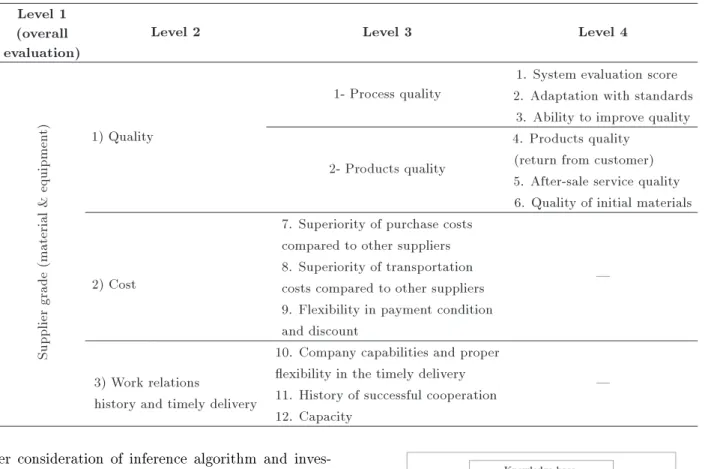
In this phase, 18 criteria were classied in two groups for evaluation and selection of suppliers and subcon-tractors, distinctly. Then, the evaluation algorithm of the developed fuzzy expert system was presented.
Table 2. Selected criteria for suppliers. Level 1
(overall evaluation)
Level 2 Level 3 Level 4
Supplier
grade
(material
&
equipmen
t) 1) Quality
1- Process quality
1. System evaluation score 2. Adaptation with standards
3. Ability to improve quality
2- Products quality
4. Products quality (return from customer) 5. After-sale service quality 6. Quality of initial materials
2) Cost
7. Superiority of purchase costs compared to other suppliers 8. Superiority of transportation costs compared to other suppliers 9. Flexibility in payment condition and discount
|
3) Work relations
history and timely delivery
10. Company capabilities and proper exibility in the timely delivery 11. History of successful cooperation 12. Capacity
|
After consideration of inference algorithm and inves-tigation within criteria, 12 criteria were selected as the nal essential criteria for each group of suppli-ers and subcontractors (including 5 common crite-ria), distinctly, which will be presented in the next section. For improvement in evaluation results, the experts suggested to merge exibility criterion into all other three criteria and further combine timely delivery with work relations history. Thus, the nal 12 criteria were classied in three groups of quality, cost, and timely delivery-work relations history, in which there were some exibility-related sub-criteria. The criteria for both groups are illustrated in Ta-bles 2 and 3.
After the agreement of experts with these 19 criteria, one questionnaire was circulated among them and the numbers in the range of values for each linguistic term in regard to the trapezoidal membership functions needed for the fuzzy inference engine were specied for each nal criterion by the experts; the values and membership functions were nalized after statistical analysis for utilization in the expert system, which will represented in the next sections.
2.2. System architecture
Appropriate system architecture would lead to facilita-tion of the development process. System architecture species system components and their interaction with each other [28]. As it is shown in Figure 1, the proposed system architecture includes three main and
Figure 1. System architecture which include three main and two subsidiary modules.
two subsidiary modules. The main modules are as follows:
Fuzzy inference engine: a module which analyzes and interprets the rules, membership functions, and data in the database and logically concludes a result. There are several fuzzy inference engines; in this research, Mamdani's inference engine, which is suitable for capturing expert knowledge, has been utilized. It allows us to describe the expertise in a more intuitive, more human-like manner. In the following paragraphs, the fuzzy logic operations and Mamdani's inference engine mechanism are represented:
Fuzzy logic operations:
Fuzzy union operation or fuzzy OR: A+B(x) = max (A(x); B(x)) :
Fuzzy intersection operation or fuzzy AND: A:B(x) = min (A(x); B(x)) :
Table 3. Selected criteria for subcontractors. Level 1
(overall evaluation)
Level 2 Level 3 Level 4
Supplier
grade
(service)
1) Quality 1- Process quality
1. Knowledge level and skills of the personnel 2. Certicates and standards of activity
3. Ability to improve quality 2- Service quality
4. Service quality 5. Relevant background 6. Quality of initial materials
2) Cost
7. The superiority of the service costs compared to other suppliers
8. Capabilities in minimizing waste of stu and optimizing machinery consumption 9. Flexibility in payment condition
|
3) Work relations
history and timely delivery
10. Subcontractor capabilities and proper exibility in the timely delivery
11. History of successful cooperation 12. Ethics
|
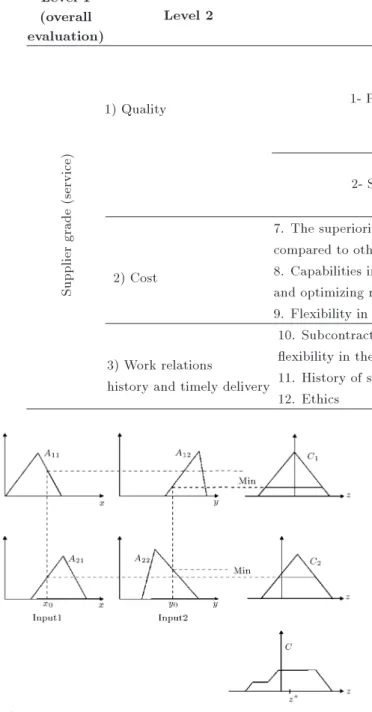
Figure 2. Mamdani inference mechanism.
Mamdani [30] uses the following mechanism (Fig-ure 2):
- Rule 1: If input1 is A11 and input2 is A12 THEN
output is C1;
- Rule 2: If input1 is A21 and input2 is A22 THEN
output is C2;
- Fact: Input1 is x0 and input2 is y0 consequence:
output is C.
The fuzzy implication is modeled by Mam-dani [30] as:
A AND B ! C = (A \ B) \ C:
The ring levels of the rules, denoted by I, i = 1; 2, are computed by:
1= A11(x0) \ A12(y0) = min fA11(x0); A12(y0)g ;
2= A21(x0) \ A22(y0) = min fA21(x0); A22(y0)g :
The individual rule outputs are computed by: C0
1(z) = 1\ C1(z) = min f1; C1(z)g ;
C0
2(z) = 2\ C2(z) = min f2; C2(z)g :
Then, the overall system output is computed by: C(z) = C1©(z) [ C2©(z) = maxnC1©(z); C2©(z)o:
User interface: Users of the proposed fuzzy expert system are decision-makers who input the real value of each linguistic variable into the system through a user interface. However, user interface displays the grade and scores of producers and also oers the required guidelines for making a contract.
Fuzzy rule base: This module includes two parts, namely data and rules, which provide a mecha-nism for sort fuzzy rules. These fuzzy rules are conditional statements which are represented as follow [29].
If x is Xi and y is Yi, THEN o is Oi., in
Yi are their linguistic quantities which have been
determined for a fuzzy function. Similarly, o and Oi are respectively the fuzzy output variables and
quantities [30].
In this fuzzy system, real values are employed for scoring suppliers. As a result, the system has two subsidiary modules. Firstly and foremost is a fuzzier in the input that converts real variable to fuzzy set. In this research, we used trape-zoidal membership functions which are based on the advices of experts and their reections on their knowledge. Secondly is a defuzzier in the output that converts the fuzzy set to a real value [31]. For defuzzing, we used Center Of Gravity (COG) method which nds the geometrical center of the output variable.
Z=Xz:
c(z)
=Xc(z)
: 3. The proposed fuzzy expert system
The fuzzy expert system employs linguistic charac-teristics for the evaluation of factors such as quality, cost, exibility, and work relations history. Then,
these factors are merged by fuzzy inference and after conducting an overall evaluation, they are assigned to one of the grades A, B, C, D, or E according to the obtained scores. By clicking on each block, the system asks a series of questions about that block from the user. The consulting process is very user-friendly. Users can select a crisp within the range of 0-10 for each characteristic. Afterwards, the fuzzyer converts the crisp variables into a fuzzy set which can be employed by fuzzy rule-base system and Mamdanis' inference engine for the evaluation of three criteria to determine the supplier grade. The fuzzyer performs the fuzzi-cation process using trapezoidal fuzzy membership functions (with low, medium, and high trapezoidal functions) available in the knowledge-based system. It should be noted that the above fuzzy functions have been determined separately for each characteristic, as mentioned in Section 2.1.2.
As shown in Table 4, the inference process is a combination of three stages (four levels) in this fuzzy expert system. After receiving input through level 4, the rst stage of fuzzy inference begins and transfers the results to the higher stage within two sections cent X and cent Y . Fuzzy inference engine uses cent X Table 4. Fuzzy inference stages for the evaluation of suppliers.
Level 1 (overall evaluation)
Stage 3 Level 2 Stage 2 Level 3 Stage 1 Level 4
Supplier
grade
Fuzzy
inference
1) Quality inferenceFuzzy 1- Process quality2- Products quality inferenceFuzzy
1. System evaluation score
2. Adaptation with standards 3. Ability to improve quality 4. Products quality (return from customer) 5. After-sale service quality
6. Quality of initial materials
2) Cost inferenceFuzzy
7. Superiority of purchase costs compared to other suppliers 8. Superiority of transportation costs compared to other suppliers 9. Flexibility in payment condition and discount
-
-3) Work relations history and timely delivery
Fuzzy inference
10. Company capabilities and proper exibility in the timely delivery 11. History of cooperation 12. Capacity
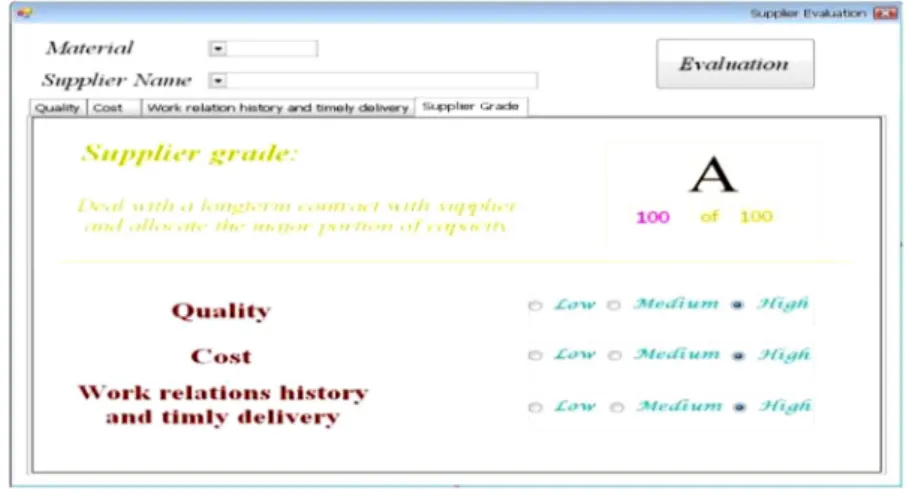
-Figure 3. Fuzzy expert system for evaluation and selection of suppliers. and cent Y to sort results of the previous level (within
low, medium, or high) and transfer these sorted results to the upper level for the next fuzzy inference stage. Finally, through exchange of two nal levels, the results of level 2 (within low, medium, or high) are sent to the inference engine and the nal result will be determined at level 1, within very low, low, medium, high, and very high (Table 4).
Since software development has a high level of importance in the design of expert systems, an attempt is made in the present study to develop user-friendly software.
At the end, after inputting the information on all criteria, the nal grade of the supplier as well as the required guidelines for making a contract with the supplier and the obtained scores by the company are displayed in the block. In addition, the condition of three main criteria is also displayed (Figure 3). The followings are some of the advantages of the proposed expert system:
1. The knowledge-base is reliable and easy to employ;
2. This system is cost-eective;
3. It can be utilized in dierent situations at the same time;
4. Reportage is easy by it;
5. It provides the possibility of analysis and inter-pretation of the results during the process and, accordingly, educates the experts.
3.1. Membership functions
A Membership Function (MF) is dened as a curve in which each input point is mapped by a membership value (or degree of membership) between 0 and 1; MFs play crucial role in the overall performance of fuzzy systems. The nature of problems determines shape of MFs; in this regard, triangular or trapezoidal shapes are simple to implement and fast for computation. In this research, the dened fuzzy MFs aim to utilize the
knowledge of the experts. Therefore, trapezoidal MFs are chosen based on the judgment of experts; they believe that trapezoidal shape could better represent their objectives by the selected criteria and simplify and facilitate the judgment process.
A trapezoidal membership function is formulated, as follows, with four parameters a, b, c, and d:
F(x : a; b; c; d) =
8 > > > > > > > > > < > > > > > > > > > :
0; if x < a
(x a)=(b a); if a x b 1; if b < x < c (d x)=(d c); if c x d
0; if d < x
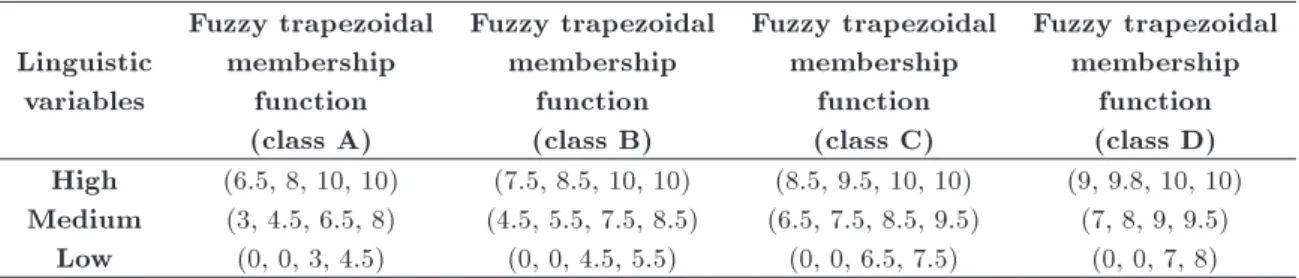
A questionnaire survey was made to specify a, b, c, and d parameters for each criterion of membership function. After averaging and statistical analysis, the nal results were classied and similar results were specied. Therefore, based on similarities, for facilitating the judgment process, experts decided to arrange trapezoidal input functions in four classes (Table 5); each criterion related function is shown in Table 6. Figures 4-8 illustrate the membership functions related to the variable; classes A, B, C, D; and output variables, respectively.
Table 5. Four classes of trapezoidal membership functions. Linguistic
variables
Fuzzy trapezoidal membership
function (class A)
Fuzzy trapezoidal membership
function (class B)
Fuzzy trapezoidal membership
function (class C)
Fuzzy trapezoidal membership
function (class D) High (6.5, 8, 10, 10) (7.5, 8.5, 10, 10) (8.5, 9.5, 10, 10) (9, 9.8, 10, 10) Medium (3, 4.5, 6.5, 8) (4.5, 5.5, 7.5, 8.5) (6.5, 7.5, 8.5, 9.5) (7, 8, 9, 9.5)
Low (0, 0, 3, 4.5) (0, 0, 4.5, 5.5) (0, 0, 6.5, 7.5) (0, 0, 7, 8) Table 6. Classication of the criteria for suppliers within four classes of trapezoidal membership functions.
Class Criteria
A History of cooperation, and ability to improve quality.
B
Capacity, system evaluation score, adaptation with standards, quality of initial materials, superiority of purchase costs compared to other suppliers, and
superiority of transportation costs compared to other suppliers.
C
Company capabilities and proper exibility in the timely delivery, exibility in payment condition and discount, and after-sale service quality.
D Products' quality (return from customer).
Figure 5. Input trapezoidal fuzzy MF (class B).
Figure 6. Input trapezoidal fuzzy MF (class C). 3.2. Description of fuzzy system rules
As stated before, the developed fuzzy expert system utilizes rules-data base and Mamdanis' inference engine for data inference. Since several parameters have been used for the evaluation of suppliers in this research,
Figure 7. Input trapezoidal fuzzy MF (class D).
Figure 8. Output trapezoidal fuzzy membership function. a great number of rules are ready to be red in the system. Further, all the mentioned rules are presented symmetrically.
In this system, by arranging and subdividing each general parameter in the duplex and triplex groups,
Table 7. 27 rules of inference in a triplex group. Rule's
number
Ability to improve quality
Adaptation with standards
System evaluation score
Process quality
1 High High Fine High
2 Hight High Medium High
3 High High Weak High
4 High Medium Fine High
5 High Medium Medium High
6 High Medium Weak Medium
7 High Low Fine High
8 High Low Medium Medium
9 High Low Weak Weak
10 Medium High Fine High
11 Medium High Medium High
12 Medium High Weak Medium
13 Medium Medium Fine High
14 Medium Medium Medium Medium
15 Medium Medium Weak Weak
16 Medium Low Fine Medium
17 Medium Low Medium Weak
18 Medium Low Weak Weak
19 Low High Fine High
20 Low High Medium Medium
21 Low High Weak Weak
22 Low Medium Fine Medium
23 Low Medium Medium Weak
24 Low Medium Weak Weak
25 Low Low Fine Weak
26 Low Low Medium Weak
27 Low Low Weak Weak
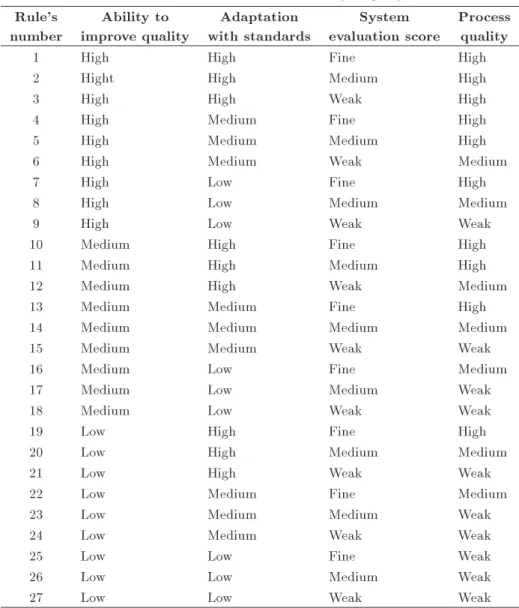
through combining them in the next levels and using fuzzy inference at each stage, the nal evaluation result of each supplier will be determined.
Thus, at each triplex group, the system receives three inputs (in the form of low or medium or high states). Accordingly, there are 27 rules as well as 3 inputs for result inference, which are presented for one triplex group shown in Table 7.
In a similar way, the other triplex criteria groups have 27 registered rules in the rule base. As it is cited in Tables 2 and 3, the system involves a duplex criteria group including 9 rules. These groups for suppliers are represented in Table 8.
Inference of the last stage resulted in supplier grade. The dierence between the inference of the three criteria of the group in the last stage and that of other groups lies in the division of the results into ve categories, i.e. very low, low, moderate, high, and very high (E, D, C, B, and A). In other words, after changing the name of parameter in Table 4, output of rows 1, 2,
4, and 10 became very high and that of rows 18, 24, 26, and 27 turned into very low. It should be noted that for the sake of better determination of supplier grade in the last stage, the score of each reasoning was represented in a round number within 1:100 which was computed from deuzication.
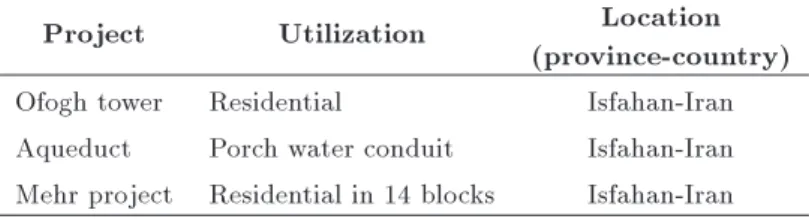
4. Implementation of fuzzy expert system The presented expert system has been tested and used in three construction companies for three years. The obtained results from a fuzzy expert system were com-pared with those from the AHP expert system (which was designed by the authors, before) and validation of the results was approved by the experts. As a sample, the authors represent the application of fuzzy expert system for the selection and evaluation of vendors and subcontractors in three projects of one of the construction companies. The projects are introduced in Table 9.
Table 8. Triplex and duplex criteria groups for suppliers. Inference
result
Three criteria groups and two criteria groups Supplier grade
1. Quality 2. Cost
3. Work relations history- timely delivery
Work relations history and timely delivery
1. Company capabilities and proper exibility in the timely delivery
2. History of cooperation 3. Capacity
Cost
1. Superiority of purchase costs compared to other suppliers
2. Superiority of transportation costs compared to other suppliers
3. Flexibility in payment condition and discount
Quality of products
1. Quality of products (return from customer) 2. After-sale service quality
3. Quality of initial materials
Process quality
1. System evaluation score 2. Adaptation with standards 3. Ability to improve quality
Quality 1. Process quality 2. Quality of products
Table 9. Three projects in which fuzzy expert system was utilized.
Project Utilization Location
(province-country) Ofogh tower Residential Isfahan-Iran Aqueduct Porch water conduit Isfahan-Iran Mehr project Residential in 14 blocks Isfahan-Iran In these companies, an overall review was
per-formed on the past processes of subcontractor selection and purchases. Besides, the current and previous strategies of the company in regard to evaluation and selection of suppliers were determined by utilizing the available documents and performing a number of interviews. There were three clear strategies in the evaluation process of the company:
1. The supplier who has oered the lower price is preferable;
2. It is advisable to avoid dealing with a single sup-plier, which increases the risk parameter in project accomplishment;
3. It is recommended not to work with too many suppliers, because the supply chain management may get out of control.
The developed fuzzy expert system covers all the above three strategies. In other words, it deals with cost strategy through selecting the cost as a primary parameter. In addition, it considers two other strategies by presenting some guidelines and approaches in relation to how to make a contract with an evaluated supplier. Utilization of the developed fuzzy expert system in each construction company resulted in collection of a classied archive of powerful suppliers in dierent elds. The above-mentioned
Table 10. Evaluation of steel framework subcontractors.
Producer Grade Score Recommendation
Supplier 1 A 85 Deal with a long term contract and allocate the major part of capacity Supplier 2 B 81 Deal with a short term contract and allocate the major part of capacity Supplier 3 B 68 Deal with a short term contract and allocate the major part of capacity
Table 11. Evaluation of steel framework subcontractors. Framework
contractor Grade Score Recommendation
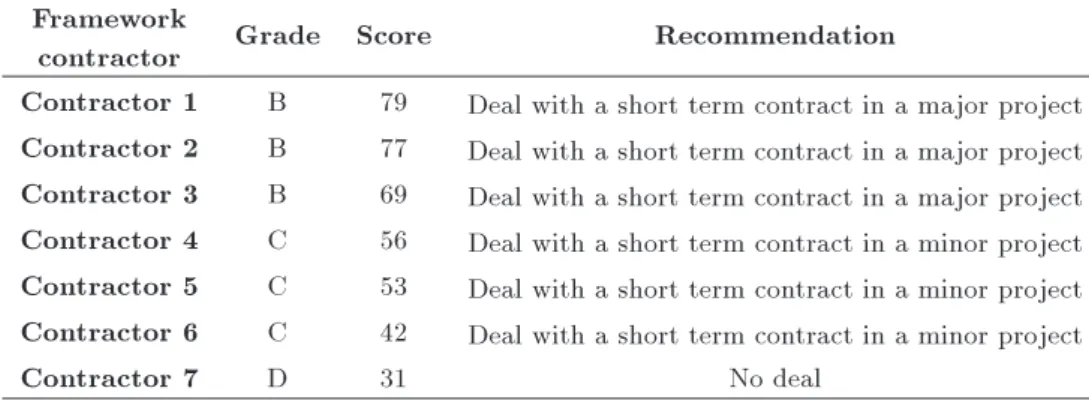
Contractor 1 B 79 Deal with a short term contract in a major project Contractor 2 B 77 Deal with a short term contract in a major project Contractor 3 B 69 Deal with a short term contract in a major project Contractor 4 C 56 Deal with a short term contract in a minor project Contractor 5 C 53 Deal with a short term contract in a minor project Contractor 6 C 42 Deal with a short term contract in a minor project
Contractor 7 D 31 No deal
archive includes a wide range of supplier information such as technical specications, capabilities, services or materials that they can provide, cost and product quality (service quality), and other specied criteria. As two examples, results of evaluation and selection of some steel framework producers and steel framework subcontractors (without mentioning their names) are presented in Tables 10 and 11.
5. Conclusion
In regard to the point that increases in the eciency and service quality of suppliers and subcontractors strongly aect the performance of clients, revenue, and satisfaction, civil companies have increasingly em-ployed SCM in recent years. Therefore, the evaluation and selection of the right supplier and subcontractor are crucial for construction projects. There are so many complaints in the literature on traditional supplier-selection based on the lowest tender price. Therefore, the rst step in supplier evaluation and selection would be specifying the evaluation criteria. In this research, the criteria were specied through 3 phases. First, the literature was reviewed and the related supplier evalu-ation and selection criteria were gathered, comprehen-sively; next, the criteria database was transferred to the experts for the pre-evaluation phase; and nally, two sets of 12 criteria were selected, independently, for construction suppliers and subcontractors.
In this research, after specifying the criteria, the authors prepared a multi criteria fuzzy framework by utilizing the judgment of experts for supplier and subcontractor selection. As the proposed performance criteria were linguistic, the fuzzy numbers, membership functions, and fuzzy calculations were utilized to attain
the results in a realistic manner. The membership functions which weighted the judgment process were specied through the judgment of experts. Therefore, the system user or client could utilize this facilitated judgment process through assigning his/her own score to each criterion for each supplier and attaining the supplier preferences and the end results.
The developed model was tested in three ma-jor construction companies for two years and the improvement results were satisfactory. Nevertheless, some challenges and improvement points exist for the identied system, due to the unique attributes of each construction project and in addition, the dierent interests and preferences of clients and stakeholders; the unique way of weighting the criteria could be inappropriate for all the circumstances. Therefore, the future research could work on a dynamic approach to involve the clients and main stakeholders in the weighing of criteria in each project, simultaneously. On the other hand, although Mamdani method is widely accepted for capturing expert knowledge, the Mamdani-type fuzzy inference entails a substantial computational burden, so, the future research could be concentrating on other inference mechanisms.
Acknowledgment
The authors deeply appreciate Dr. M.H. Fazel Zarandi and Engineer M. Hajimiri for their assistance to de-velop the fuzzy expert system.
References
1. Razmi, J. and Sifori, M. \Evaluation of the structural dierences between lean and agile production in the
supply chain", In First International Conference on the Supply Chain Management and Information System, Tehran (2007).
2. Luo, X., Wu, C., Rosenberg, D. and Barnes, D. \Sup-plier selection in agile supply chains: An information-processing model and an illustration", Journal of Purchasing & Supply Management, 15(4), pp. 249-262 (2009).
3. Bhutta, K.S. and Huq, F. \Supplier selection problem: A comparison of the total cost of ownership and analytic hierarchy process approaches", Supply Chain Management: An International Journal, 7(3), pp. 126-135 (2002).
4. Banki, M.T., Smaeeli, B. and Ravanshadnia, M. \The assessment of bidding strategy of Iranian construction rm", International Journal of Management Science and Engineering Management, 4, pp. 153-160 (2008).
5. Singh, D. and Tiong, R.L.K. \A fuzzy decision frame-work for contractor selection", Journal of Construction Engineering and Management, 131, pp. 62-70 (2005).
6. Morote, A.N. and Vila, F.R. \A fuzzy multi-criteria decision-making model for construction contractor pre-qualication", Automation in Construction, 25, pp. 8-19 (2012).
7. Salmanzadeh, S. and Javanrooh, S. \Evaluation the performance of suppliers in the supply chain of auto parts", In First National Conference on the Logistic and Supply Chain Management and Information Sys-tem, Tehran (2004).
8. Chien, H.K., Min, Y.C. and Tsung, K.W. \Evaluating sub-contractors performance using EFNIM", Automa-tion in ConstrucAutoma-tion, 16, pp. 525-530 (2007).
9. Stevens, J. \Integrating the supply chain", Interna-tional Journal of Physical Distribution and Materials Management, pp. 3-8 (1989).
10. Naim, M.M. \The book that changed the world", Manufacturing Engineer, pp. 13-16 (1997).
11. Mentzer, J.T., De Witt, W., Keebler, J.S., Min, S., Nix, N.W., Smith, C.D. and Zacharia, Z.G. \Dening supply chain management", Journal of Business Lo-gistics, 22(2) pp. 1-25 (2001).
12. Marsh, C. and Fayek, A.R. \Surety Assist: Fuzzy expert system to assist surety underwriters in evaluat-ing construction contractors for bondevaluat-ing", Journal of Construction Engineering and Management, 136(11), pp. 1219-1226 (2010).
13. Bevilacqua, M., Ciarapica, F.E. and Giacchetta, G. \A fuzzy-QFD approach to supplier-selection", Journal of Purchasing & Supply Management, 12, pp. 14-27 (2006).
14. Neely, A., Richards, H., Mills, J., Platts, K. and Bourne, M. \Designing performance measures: A structured approach", International Journal of Oper-ations & Production Management, 17(11), pp. 1131-1152 (1997).
15. Neely, A., Mills, J., Platts, K. and Richards, H.G. \Performance measurement system design: Developing and testing a process-based approach", International Journal of Operations & Production Management, 20(10), pp. 1119-1145 (2000).
16. Sarkar, A. and Mohapatra, P.K.J. \Evaluation of supplier capability and performance: A method for supply base reduction", Journal of Purchasing & Supply Management, 12(3), pp. 148-163 (2006).
17. Liu, J., Ding, F. and Lall, V. \Using data envelopment analysis to compare suppliers for supplier-selection and performance improvement", Supply Chain Man-agement: An International Journal, 5(3), pp. 143-150 (2000).
18. Vokurka, R.J., Choobineh, J. and Vadi, L. \A proto-type expert system for the evaluation and selection of potential suppliers", International Journal of Opera-tions & Production Management, 16(12), pp. 106-127 (1996).
19. Garvin, D. \Management, strategic planning", Cali-fornia Management Review, pp. 85-106 (1993).
20. Darlington, K., The Essence of the Expert System, prentice-hall, England (2000).
21. Shariati, A. and Fatemi Ghomi, M. \Design of an expert system and combination with analytic hierarchy process to evaluate and select the parts producer in the supply chain", In Fourth International Conference on Industrial Engineering, Tehran (2005).
22. Kandel, A.E. and Raton, B., Fuzzy Expert Systems, CRC Press (1992).
23. Srikant, R. and Agrawal, R. \Mining sequential patterns: Generalizations and performance improve-ments", in EDBT '96 Proceedings of the 5th Interna-tional Conference on Extending Database Technology: Advances in Database Technology, pp. 3-17 (1996).
24. Fukuda, T., Morimoto, Y., Morishita, S. and Tokuyama, T. \Data mining using two-dimensional optimized association rules: Scheme, algorithms, and visualization", in ACM SIGMOD International Con-ference on Management of Data, New York (1996).
25. Agrawal, R., Gehrke, J., Gunopul, D. and Raghavan, P. \Automatic subspace clustering of high dimensional data for data mining applications", in ACM SIGMOD International Conference on Management of Data, New York, pp. 94-105 (1998).
26. Jain, V., Benyoucef, L. and Deshmukh, S.G. \A new approach for evaluating agility in supply chains using fuzzy association rules mining", Engineering Applica-tions of Articial Intelligence, pp. 367-385 (2008).
27. Metaxiotis, K.S., Psarras, J.E. and Askounis, D.T. \GENESYS: an expert system for production schedul-ing", Industrial Management and Data Systems, pp. 309-317 (2002).
28. Nunamaker, J., Chen, M. and Purdin, D. \Systems development in information systems research", Journal of Management Information Systems, 7, pp. 89-106 (1990).
29. Matthews, C. \A formal specication for a fuzzy expert system", Information and software Technology, pp. 419-429 (2003).
30. Klir, G.J. and Floger, T.A., Fuzzy Set, Uncetainty and Information, Prentice-hall (1998).
31. Mohamadian, A. and Ghukasian, C.L. \Fuzzy expert system for the portfolio selection electronic business models", in Second International Conference on Man-agement, Tehran (2004).
Biographies
Ehsan Shahvand obtained his BSc degree in Civil Engineering from Sharif University of Technology in 2007 and his MSc degree in Construction Engineering and Management from Amirkabir University of Tech-nology, with honor, in 2009. He is currently pursu-ing his studies as a PhD Candidate in Construction Engineering and Management at Amirkabir University of Technology, Tehran, Iran. His research interests include strategic management, supply chain manage-ment, housing market analysis, economical analysis and nancial management.
Mohammad Hasan Sebt obtained his BSc de-gree from the Jackson Mississippi State University in Industrial Engineering and three MSc degrees from Jackson Mississippi State University and University of Kansas, Lawrence, in Computer Science, Busi-ness Administration, and Construction Engineering and Management till 1990. Then, he obtained his
PhD degree from University of Kansas, Lawrence, in Construction Engineering and Management in 1995. He has been a faculty member at The University of Kansas, USA, and Amirkabir University of Technology, Iran. He is Dean of the Management Department and Construction Engineering and Management Group at Amirkabir University of Technology. He has authored and coauthored many technical papers and books. His research interests include strategic management, project management, value engineering, and supply chain management.
Mohammad Taghi Banki obtained his BSc and MSc degrees from University of Tehran in Civil Engineering in 1968 and then, he obtained another MSc degree in Civil Engineering (Structural Engineering) from North Carolina State University, Raleigh, in 1973. Then, he obtained his PhD degree in Civil Engineering (Con-struction Management) from University of Missouri, Department of Civil Engineering, Columbia, USA, in 1980. He has been a faculty member at The Uni-versity of Calgary, Canada, and Amirkabir UniUni-versity of Technology, Iran. He was Minister of Planning and Budget Organization in 1982-1986 and Minister of Energy (responsible for water and electivity) in 1986-1988 in Islamic Republic of Iran and he has other vital executive experiences. He has authored and translated many books. His research interests include project management, construction methods and machineries, operational research, and economic analysis.