Sharif University of Technology
Scientia IranicaTransactions F: Nanotechnology www.scientiairanica.com
Second law analysis for radiative MHD slip ow of a
nanouid over a stretching sheet with non-uniform heat
source eect
A.K. Abdul Hakeem
a;, M. Govindaraju
a, B. Ganga
band M. Kayalvizhi
ca. Department of Mathematics, Sri Ramakrishna Mission Vidhyalaya College of Arts and Science, Coimbatore - 641 020, India. b. Department of Mathematics, Providence College for Women, Coonoor - 643 104, India.
c. Department of Science and Humanities, Sathyabama University, Chennai - 600 119, India. Received 23 April 2015; received in revised form 14 September 2015; accepted 16 January 2016
KEYWORDS Nanouid;
Entropy generation; MHD;
Thermal radiation; Non-uniform heat source/sink; Stretching sheet; Partial slip.
Abstract.The application of second law of thermodynamics to an electrically conducting incompressible nanouid slip ow over a stretching sheet is investigated in the presence of thermal radiation and non-uniform heat source/sink, both analytically and numerically. The governing dimensionless equations for this investigation are solved analytically by hypergeometric function and numerically by using Runge-Kutta-Gill method with shooting technique. The eects of magnetic parameter, nanosolid volume fraction parameter, slip parameter, and suction parameter on velocity prole are discussed for Ag nanoparticles. Further, in addition to these parameters, the eects of radiation parameter and non-uniform heat source/sink parameters on temperature prole and entropy generation number are also discussed. Finally, the results of these proles of Ag nanoparticles are compared with those of the Cu, Al2O3, and TiO2 nanoparticles. It is inferred that the eect of slip
and non-uniform heat source parameters decrease the entropy generation. The metallic nanoparticles create more entropy than the non-metallic nanoparticles.
© 2016 Sharif University of Technology. All rights reserved.
1. Introduction
Nanouid is a suspension of nanoparticles in a classical base uid. Thermal conductivity of the base uid can be substantially enhanced by addition of nano-size particles. Choi and Eastman [1] utilized a combi-nation of nanoparticles and base uid which resulted in nanouids. Experimental studies have displayed that with 1-5% volume of solid metallic or metallic oxide particles, the eective thermal conductivity of the resulting mixture can increase by 20% compared to that of the base uid [2-4]. The broad range of cur-rent and future applications involving nanouids has
*. Corresponding author. Tel.: +91 9442401998
E-mail address: [email protected] (A.K. Abdul Hakeem)
motivated the researchers to nd eective techniques for enhancing the heat transfer [5-8].
Magnetohydrodynamics is the science which deals with the motion of a highly conducting uid in the presence of a magnetic eld. The advantage of the hydromagnetic nanouid is that uid ow and heat transfer can be controlled by external magnetic eld, which makes it applicable in various elds, viz. aerospace, electronic packing, and thermal engineer-ing [9-11]. Hamad studied the natural convection ow of a nanouid over a linearly stretching sheet with the eect of magnetic eld [12]. Several studies have been reported in recent years on the eect of the magnetic eld on water based nanouid over a stretching surface [13,14]. The above mentioned studies have investigated the nanouid properties with no-slip condition over stretching sheet. When the uid is
particulate, such as emulsions, suspensions, foams, and polymer solutions, the no-slip condition is inadequate. In such cases, the suitable boundary condition is the partial slip [15,16]. Abdul Hakeem et al. [17] investigated the partial slip eect on the ow of a Newtonian uid over a stretching sheet. Recently, the slip eect on the Newtonian-type nanouid ow over a stretching sheet has been considered by Das [18] and Turkyilmazoglu [19]. Noghrehabad and Pourra-jab [20] and Ibrahim and Shankar [21] analyzed the slip eect on the non-Newtonian nanouid model over a stretching sheet. Very recently, Abdul Hakeem et al. [22] investigated the second-order slip eects on MHD nanouid ow over a stretching sheet in the presence of thermal radiation.
The second law of thermodynamics says that all the ow and heat transfer processes undergo ir-reversible changes. These changes are mostly caused by the energy losses during the processes. Although measures can be taken to reduce these irreversible eects, it is impossible to recover all the lost energy, which results in the increase of entropy. Due to this, the entropy generation rate is used as a standard metric to study the irreversibility eects. Aiboud and Saouli [23] demonstrated the application of the second law analysis of thermodynamics to viscoelastic MHD ow over a stretching surface. Since, extensive research has been made by scientists on the entropy generation in the ow and heat transfer systems [24-30]. The entropy generation, ow, and thermal boundary layer over an isothermal stretching sheet are theoretically analyzed in the presence of the slip boundary condition and internal heat generation/absorption [31]. The eect of hydrodynamic slip on entropy generation in a viscous ow over a vertical plate with convective boundary condition was observed by numerical technique, and shooting method [32]. Govindaraju et al. [33] investi-gated the entropy generation on the natural convection ow of nanouid over a stretching sheet in the presence of magnetic eld.
Another important aspect is that heat transfer processes play a vital role in all such theoretical studies. This is due to the fact that the rate of cooling signicantly inuences the quality of the nal product with the desired characteristics. Abel and Nandep-panavar [34] studied the MHD viscoelastic ow over a stretching sheet with non-uniform heat source/sink.
Thermal radiation eects may play a pivotal role in controlling heat transfer in polymer processing industry, where the quality of the nal product depends on the heat controlling factors. High temperature plasmas, nuclear reactors cooling, liquid metal uids, hydromagnetic accelerators, and power generation sys-tems are some important applications of radiative heat transfer from a vertical wall to conductive gray u-ids. Abdul et al. [35,36] reported the two-dimensional
oscillatory ow on free convective-radiation of an in-compressible viscous uid through a highly porous medium bounded by an innite vertical plate. Also, they analyzed the radiation eects on Walter's liquid B uid ow over a stretching sheet.
The main scope of the present work is to ana-lyze entropy generation of the hydromagnetic ow of an incompressible viscous nanouid over a stretching sheet with partial slip, thermal radiation, and non-uniform heat source/sink eects, both analytically and numerically. The governing dimensionless equations for this investigation are solved analytically using hyper-geometric function and numerically by Runge-Kutta-Gill method with shooting technique. The entropy generation is calculated using the entropy relation by substituting the velocity and temperature elds obtained from the momentum and energy equations. 2. Formulation of the problem
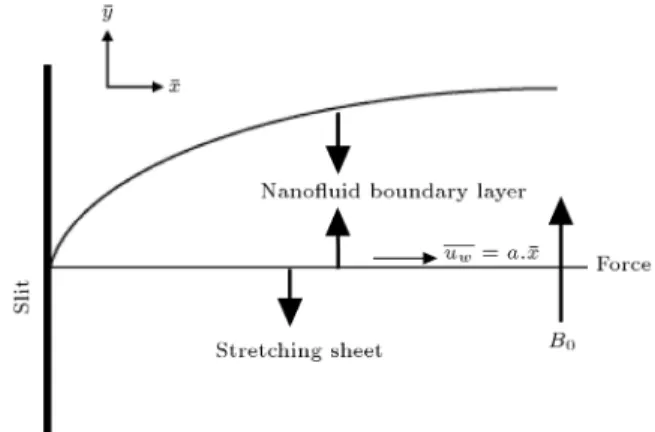
Consider a steady laminar two-dimensional radiative slip ow of an incompressible viscous nanouid over a stretching sheet in the presence of magnetic eld. The velocity of the stretching sheet is uw = ax. We
also consider inuence of a constant magnetic eld of strength B0, which is applied normally to the sheet
(see Figure 1). The temperature at the stretching surface takes the constant value Tw, while the ambient
value, attained as y, tends to innity and takes the constant value T1. It is further assumed that the
induced magnetic eld is negligible in comparison to the applied magnetic eld (as the magnetic Reynolds number is small). The uid is a water based nanouid containing dierent types of nanoparticles: copper (Cu), alumina (Al2O3), silver (Ag), and titanium oxide
(TiO2). It is assumed that the base uid water and the
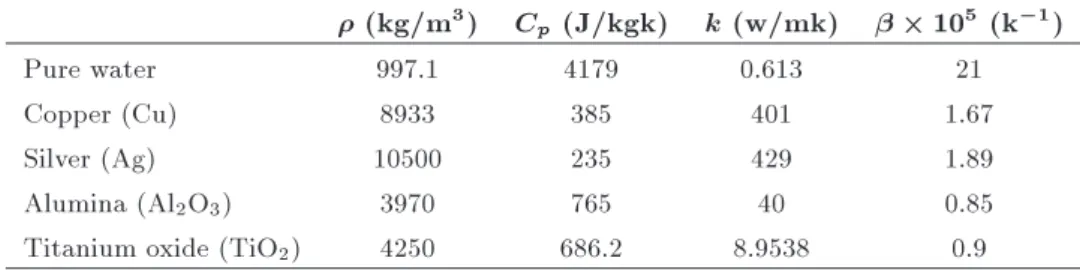
nanoparticles are in thermal equilibrium and no slip occurs between them. The thermo-physical properties of the nanouid are considered as in Table 1. Under the above assumptions, the boundary layer equations governing the ow and thermal elds can be written in
Table 1. Thermo-physical properties of water and nanoparticles [12]. (kg/m3) C
p (J/kgk) k (w/mk) 105 (k 1)
Pure water 997.1 4179 0.613 21
Copper (Cu) 8933 385 401 1.67
Silver (Ag) 10500 235 429 1.89
Alumina (Al2O3) 3970 765 40 0.85
Titanium oxide (TiO2) 4250 686.2 8.9538 0.9
dimensional form as [11,12,22]: @u
@x + @v
@y= 0; (1)
nf
u@u@x + v@u@y
= nf@ 2u
@y2 B02u; (2)
(cp)nf
u@T
@x + v @T @y
= knf@ 2T
@y2
@qr
@y + q000: (3) Here, x and y are the coordinates along and perpen-dicular to the sheet; u and v are velocity components in the x and y directions, respectively; T is the local temperature of the uid; is the electric conductivity; qr is the radiative heat ux; and q000 is the rate of
non-uniform heat generation/absorption coecient. The dimensionless form of q000 can be dened as [17,36]:
q000=knfuw(x)
xnf
[A(T
w T1)F0()+B(T T1)] ;
(4) where A and B are parameters of the space
and temperature-dependent internal heat genera-tion/absorption. The cases A > 0 and B > 0
correspond to internal heat generation, while A < 0
and B < 0 correspond to internal absorption. Using
Rosseland approximation for radiation (see [35,36]), we have:
qr= 4
3k nf
@T4
@y : (5)
Here, is the Stefan-Bolltzmann constant and k nf is
the absorption coecient of the nanouid. Further, we assume that the temperature dierence within the ow is such that T4 may be expanded in a Taylor series.
Hence, expanding T4 about T
1 and neglecting higher
order terms, we get: T4= 4T3
1T 3T14: (6)
Therefore, Eq. (3) is simplied to: u@T
@x + v @T
@y = knf
(cp)nf
@2T
@y2 +
16T3 1
3(cp)nfknf
@2T
@y2
+
knfuw(x)
x(cp)nfnf A (T
w T1)F0()
+ B(T T
1): (7)
The eective density of the nanouid, nf, the eective
dynamic viscosity of the nanouid, nf, the heat
capacitance of the nanouid, (Cp)nf, and the thermal
conductivity, knf, of the nanouid are given as:
nf = (1 )f + s;
nf = (1 )f 2:5
(Cp)nf = (1 )(Cp)f+ (Cp)s;
knf = kf
ks+ 2kf 2(kf ks)
ks+ 2kf+ (kf ks)
: (8)
Here, is the solid volume fraction.
The boundary conditions of Eqs. (1)-(3) are: u = ax + l@u@y; v = 0; T = Tw at y = 0;
u ! 0; T ! T1; as y ! 1; (9)
where f is the dynamic viscosity of the basic uid, f
and s are the densities of the base uid and
nanopar-ticles, respectively, (Cp)f and (Cp)s are the specic
heat parameters of the base uid and nanoparticles, respectively, kf and ks are the thermal conductivities
of the base uid and nanoparticles, respectively, and a is constant.
By introducing the following non-dimensional variables:
x = px
f=a; y =
y p
f=a;
u = pau
f; v =
v paf;
= TT T1
w T1; (10)
Eqs. (1) to (3) take the following non-dimensional form: @u
@x+ @v
@y = 0; (11)
u@u@x+ v@u@y = (1 + 1
s=f)
1 (1 )2:5
@2u
@y2
u@x@ + v@@y =
3Nr + 4 3Nr
1 Pr 1
(1 + (Cp)s=(Cp)f)
knf kf @2 @y2
+kknf
fP r
(1 )2:5(1 + s=f)
(1 + (Cp)s=(Cp)f)
[AF0() + B()] ; (13)
with the boundary conditions:
u = x + L@u@y; v = 0; = 1 at y = 0; u ! 0; ! 0; as y ! 1; (14) where Pr = f
f is the Prandtl number, Mn= B2
0 af is the
magnetic parameter, and Nr = knfknf 4T3
1 is the Radiation
parameter.
By introducing the stream function , which is dened as u = @ =@y and v = @ =@x, Systems (12) and (13) become:
@ @y @2 @x@y @ @x @2 @y2
=(1 + 1
s=f)
1 (1 )2:5
@2
@y2
Mn@ @y
; (15) @ @y @ @x @ @x @ @y =
3Nr + 4 3Nr
1 Pr 1
(1 + (Cp)s=(Cp)f)
knf kf @2 @y2
+kknf
fP r
(1 )2:5(1 + s=f)
(1 + (Cp)s=(Cp)f)
[AF0() + B()] ; (16)
with the boundary conditions: @
@y=x+L @2
@y2;
@
@x=0; =1 at y =0; @
@y ! 0; ! 0; as y ! 1: (17) Now, by using the simplied form of Lie-group trans-formations, viz. the scaling group G of transformations (see [12]), we get the similarity transformations as:
= y; = xF (); = (): (18)
3. Solution of ow eld
Now, using the similarity transformations in Eqs. (15) and (16), we get:
F+ (1 )2:5[1 + (s=f)](F F
F2
) MnF = 0; (19)
+
3Nr 3Nr + 4
Prkf[1 + (Cp)s=(Cp)f]
knf
S + X
1 e m
m
+ (1 )2:5
(1 + s=f)
3Nr 3Nr + 4
B = (1 )2:5
(1 + s=f)
3Nr 3Nr + 4
AXe m; (20)
with the boundary conditions becoming:
F (0)=S; F0(0)=1+LF00(0); (0)=1 at =0;
F0(1) = 0; (1) = 0 as ! 1: (21)
The exact solution to the dierential equation (Eq. (16)) satisfying the boundary condition (17) is obtained as (see [17]):
F () = S + X
1 e m m
; (22)
where m is the parameter associated with the nanopar-ticle volume fraction, the magnetic eld parameter, the uid density, and the nanoparticle density as follows: m= 0:3333L1 (0:4199(32 21))
L3+
p 2
3+ 434
1=3
+0:26453+p(23+444)1=3 L
; (23) where:
1=
f LS(1 )2:5f+LS(1 )2:5f LS(1 )2:5s
f ;
2= L(1 )
2:5( LM
f Sf+ Sf Ss)
f ;
3= 2 + 27LA2+ 18LA2 3SA2+ 9MSLA22
+ 3S2A2
2+ 2A32S3 27LA2 + 3SA2
9LMSA2
2 6A22S2 6A32S3
+ 3A2
2S22+ 6A32S32 2A32S33
+ 2A3
1S3 3A21S2 4A31S3+ 2A31S3
+ A2
1S2+ 2A31S3 2A31+ 0:667A31S3
4= 3A2( LMf Sf Sf+ Ss) f
(f SA2f+ A2Sf SA2s)2
2
f ;
A1=3L(1 ) 2:5
s
f ;
A2= L(1 )2:5 and X = Lm + 11 :
Thus, the non-dimensional velocity components are: u = xXe m; v = S + X1 e m
m
: (24) The dimensional velocity components are:
u = Xaxe mpa=fy;
v = S + X 1 e m p
a=fy
m
!!
pavf: (25)
The shear stress at the stretching sheet characterized by the skin friction coecient, Cf, is given by:
Cf = 2nf
f(uw(x))2
@u @y
y=0: (26)
Using Eqs. (10), (18), (22), (23) and (25), the skin friction can be written as:
Re1=2x Cf = (1 )2 2:5F00(0); (27)
where Rex= xuw(x)=f is the local Reynolds number
based on the stretching velocity uw(x). Re1=2x Cf is the
local skin friction coecient.
4. Analytical method for solution Introducing the new variable:
= Prkf[1 +(Cm2k p)s=(Cp)f]
nf
3Nr 3Nr+4
Xe m;
(28) and inserting Eq. (28) in Eq. (20), we obtain:
+ (1 a0 )+
3Nr 3Nr + 4
B m2 = A m2 3Nr 3Nr + 4
Xe m; (29)
and Eq. (20) is transformed into:
Pr m2
= 1; (0) = 0; (30)
where:
= knf
kf(1 + (C(Cpp))fs)
; a0= Pr
3Nr 3Nr + 4
S m + X m2 ; b0=
s
a2 0 4B
m2
3Nr 3Nr + 4
; = (1 )2:5
1 +s f
:
The solution of Eq. (29) in terms of with A = 0 is
written as:
() =e ma0+b02 c1M
" a0+ b0
2 ; b0+ 1; Pr
m2
3Nr 3Nr + 4
Xe m
#
+ c2e 2m; (31)
where: M
a0+ b0
2 ; b0+ 1; Pr m2
3Nr 3Nr + 4
Xe m;
is the Kummer's function (see [37]):
c1= 1 c2
Mha0+b0
2 ; b0+ 1; mPr2
3Nr 3Nr+4 Xi; and:
c2=
Pr 3Nr 3Nr+4
2 AX2
m41 a0+ 3Nr 3Nr+4
B m2
4 2a0+
3Nr 3Nr+4 B m2 : The Nusselt number, Nux, is dened as:
Nux=k xqw f(Tw T1);
where:
qw= knf +16T 3 1
3k nf
! @T @y
y=0;
is the local surface heat ux.
Rex1=2Nux=kknf f
3Nr + 4 3Nr
[ 0(0)];
where: 0(0) =c
1
(
ma0+ b2 0
M "
a0+ b0
2 ; b0+ 1; Pr
m2
3Nr 3Nr + 4
X
#)
+ c1
(
a0+ b0
2(1 + b0)
Pr m
3Nr 3Nr + 4
XM
a0+b0+2
2 ; b0+2; Pr m2
3Nr 3Nr + 4
X
)
2mc2: (32)
5. Numerical method for solution
The set of non-linear ordinary dierential equa-tions (19), (20) with boundary condiequa-tions (21) have been solved using Runge-Kutta-Gill method with shooting technique with an orderly guessing of F(0)
and (0). The procedure is repeated until we get
the results up to the desired degree of accuracy, vis. 10 8 with M
n, , S, L, A, B and Nr as prescribed
parameters. A code is C++ package and the numerical solutions are presented in tabular form.
6. Entropy generation analysis
The local volumetric rate of entropy generation in the presence of a magnetic eld and thermal radiation for nanouids can be expressed [38-40] as:
SG=kTnf2 1
"@T @x
2
+ 1 + 16T13
3k nfknf
! @T @y
2#
+Tnf
1
@u @y
2 +BT 02
1 u
2: (33)
The contributions of three sources of entropy genera-tion are considered in Eq. (33). The rst term indicates the entropy generation due to heat transfer across a nite temperature dierence, the second term the local entropy generation due to viscous dissipation, and the third term the local entropy generation due to the eect of the magnetic eld. A dimensionless number for entropy generation rates, NS, is dened as the
ratio of the local volumetric entropy generation rate (SG) to a characteristic entropy generation rate (SG)0.
For a prescribed boundary condition, the characteristic
entropy generation rate is: (SG)0=knf(T )
2
x2T2
1 ; (34)
therefore, the entropy generation number is: Ns=(SSG
G)0: (35)
Using Eqs. (31), (33), and (34), the entropy generation number is given by:
Ns=
3Nr+ 4
3Nr
02()Re
x+BrF002()Rex
+BrHa 2F02(); (36)
where Br is the Brinkman number; and and Ha are, respectively, the dimensionless temperature dierence and the Hartman number. These numbers are given by the following relationships:
Br=nfu2w
knfT; =
T
T1; Ha=B0x
r
nf: (37)
7. Results and discussion
In order to gain a clear insight into the physical problem, the results are discussed with the help of graphical illustrations for Ag-water. The eects of magnetic parameter, nanosolid volume fraction param-eter, slip paramparam-eter, and suction parameter on velocity prole are discussed for Ag nanoparticles. Further, in addition to these parameters, the eects of radiation parameter and non-uniform heat source/sink param-eters on temperature prole and entropy generation number are also discussed. The Prandtl number is xed on 6.2 for base uid water. For verication of the accuracy of the applied numerical scheme, a comparison of the results corresponding to the values of
0(0) (i.e., in the absence of S, M
n, Nr, A, , L, and
B) with the available published results of Wang [41]
is made and presented in Table 2. The results are found in excellent agreement. The values of local skin
Table 2. Comparison of results for the reduced Nusselt number 0(0). When = M
n= Nr = L = S = A=
B= 0.
Pr Present results Wang [41] Analytical Numerical
0.7 0.453916 0.453916 0.4539 2 0.911358 0.911358 0.9114 7 1.895400 1.895403 1.8954 20 3.353900 3.353904 3.3539
Table 3. Values of F00(0) for various parameters.
Parameters Values Cu Ag Al2O3 TiO2
Analytical Numerical Analytical Numerical Analytical Numerical Analytical Numerical Mn
0.0 0.547029 0.54702851 0.559587 0.55958739 0.499649 0.49964899 0.502710 0.50270989 0.5 0.580735 0.58073532 0.590605 0.59060545 0.545079 0.54507934 0.547301 0.54730165 1.0 0.606464 0.60646417 0.614623 0.61462290 0.577746 0.57774636 0.579500 0.57949966
0.0 0.593809 0.59380894 0.593809 0.59380894 0.593809 0.59380894 0.593809 0.59380894 0.05 0.602680 0.60268038 0.607441 0.60744081 0.586680 0.58668038 0.587623 0.58762331 0.1 0.606464 0.60646417 0.614623 0.61462290 0.577746 0.57774636 0.579500 0.57949966
L
0.6 0.817901 0.81790118 0.832594 0.83259404 0.766614 0.76661372 0.769727 0.76972651 0.8 0.695817 0.69581661 0.706502 0.70650234 0.658322 0.65832156 0.660606 0.66060576 1.0 0.606464 0.60646417 0.614623 0.61462290 0.577746 0.57774636 0.579500 0.57949966
S
0.2 0.567912 0.56791163 0.573774 0.57377352 0.547268 0.54726767 0.548529 0.54852912 0.4 0.593735 0.59373482 0.601159 0.60115900 0.567634 0.56763418 0.569227 0.56922673 0.6 0.618996 0.61899564 0.627843 0.62784312 0.587774 0.58777407 0.589683 0.58968303
Note: While studying the eect of individual parameters the following values are assumed: Pr = 6:2, Mn= 1:0, = 0:1, L = 1:0
and S = 0:5.
Figure 2. Eect of magnetic parameter on velocity and temperature distributions with Pr = 6:2, = 0:1, Nr = 0:3, L = 1:0, S = 0:5, A= 0:03, and B= 0:03.
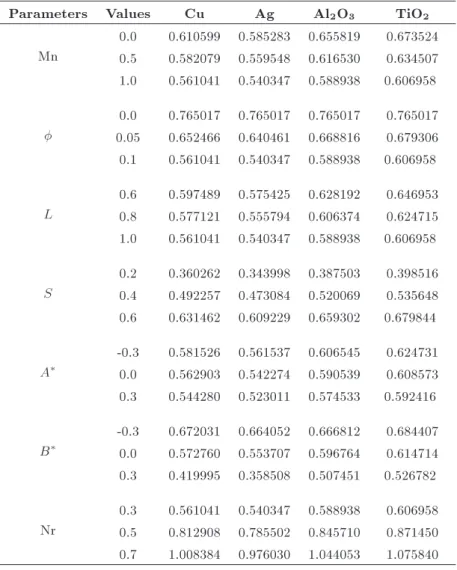
friction coecient and reduced Nusselt number are calculated and presented in Tables 3 and 4 for dierent nanoparticles like Cu, Ag, Al2O3, and TiO2.
Figure 2 exhibits the eect of magnetic parameter on velocity and temperature proles. With increasing values of magnetic parameter, nanouid velocity is found to decrease. Actually, rate of transport decreases with the increase in magnetic parameter, because the Lorentz force, which opposes the motion of uid, increases with an increase in magnetic parameter. It is also evident that the increasing values of magnetic parameter cause the nanouid to become warmer and therefore its temperature increases. It is obvious that
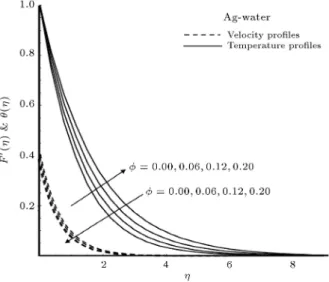
Figure 3. Eect of nanoparticles volume fraction parameter on velocity and temperature distributions with Pr = 6:2, Mn= 1:0, Nr = 0:3, L = 1:0, S = 0:5,
A= 0:03, and B= 0:03.
the presence of the magnetic eld leads to thickening of the thermal boundary layer and, at the same time, thermal conductivity of nanoparticle is higher; there-fore, there is an immediate heat distribution between the nanoparticles and the uid.
The eect of nanosolid volume fraction on the velocity and temperature proles is shown in Figure 3. It is noted that the increasing values of the nanosolid volume fraction parameter decrease the velocity prole. This is due to the fact that the presence of nano-solid-particles leads to the thinning of the boundary layer. The temperature of the nanouid increases with
Table 4. Values of 0(0) for various parameters.
Parameters Values Cu Ag Al2O3 TiO2
Mn
0.0 0.610599 0.585283 0.655819 0.673524 0.5 0.582079 0.559548 0.616530 0.634507 1.0 0.561041 0.540347 0.588938 0.606958
0.0 0.765017 0.765017 0.765017 0.765017 0.05 0.652466 0.640461 0.668816 0.679306 0.1 0.561041 0.540347 0.588938 0.606958
L
0.6 0.597489 0.575425 0.628192 0.646953 0.8 0.577121 0.555794 0.606374 0.624715 1.0 0.561041 0.540347 0.588938 0.606958
S
0.2 0.360262 0.343998 0.387503 0.398516 0.4 0.492257 0.473084 0.520069 0.535648 0.6 0.631462 0.609229 0.659302 0.679844
A
-0.3 0.581526 0.561537 0.606545 0.624731 0.0 0.562903 0.542274 0.590539 0.608573 0.3 0.544280 0.523011 0.574533 0.592416
B
-0.3 0.672031 0.664052 0.666812 0.684407 0.0 0.572760 0.553707 0.596764 0.614714 0.3 0.419995 0.358508 0.507451 0.526782
Nr
0.3 0.561041 0.540347 0.588938 0.606958 0.5 0.812908 0.785502 0.845710 0.871450 0.7 1.008384 0.976030 1.044053 1.075840
Note: While studying the eect of individual parameters the following values are assumed: Pr = 6:2, Mn= 1:0, = 0:1, Nr = 0:3, A= 0:03, B= 0:03,
L = 1:0, and S = 0:5.
increase in nanosolid volume fraction. This is because thermal conductivity of the nanoparticles in the base uid raises the temperature of the nanouid in the case of Ag-Water.
Figure 4 is plotted to show the eect of slip parameter on the velocity and temperature proles. It is evident that the velocity prole of the nanouid increases as the slip parameter decreases. When slip occurs, the ow velocity near the sheet will not be equal to the stretching velocity of the sheet. With the increase in slip parameter, such slip velocity increases and consequently nanouid velocity decreases, because under the slip condition, the pulling of the stretching sheet can only be partly transmitted to the nanouid. Further, this leads to decrease in the thickness of momentum boundary layer. As the slip parameter increases, the thermal boundary layer increases. This means that the partial slip parameter leads to thicken-ing of the thermal boundary layer.
Figure 4. Eect of the slip parameter on velocity and temperature distributions with Pr = 6:2, Mn= 1:0,
Figure 5. Eect of suction parameter on velocity and temperature distributions with Pr = 6:2, Mn= 1:0,
= 0:1, Nr = 0:3, L = 1:0, A= 0:03, and B= 0:03.
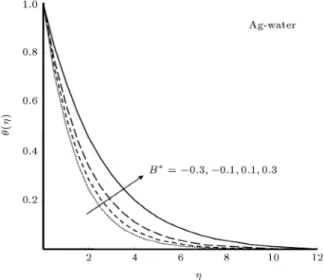
Figure 6. Eect of radiation parameter on temperature distributions with Pr = 6:2, Mn= 1:0, = 0:1, L = 1:0,
S = 0:5, A= 0:03, and B= 0:03.
The eect of suction parameter on velocity and temperature proles is demonstrated in Figure 5. The eect of suction parameter slows down the velocity of the nanouid. The boundary layer thickness decreases as suction parameter increases. As suction parameter increases, temperature decreases, which elucidates the fact that the eect of suction parameter reduces the temperature prole.
Figure 6 shows the eect of radiation parameter on the temperature prole. It is evident that the temperature decreases as the radiation parameter in-creases. This result qualitatively agrees with expecta-tions, since the eect of radiation is to decrease the rate of energy transport to the nanouid, thereby decreasing temperature of the nanouid.
Figures 7 and 8 present the eects of
space-Figure 7. Eect of non-uniform heat source/sink parameter (A) on temperature distribution with
Pr = 6:2, Mn= 1:0, = 0:1, Nr = 0:3, L = 1:0, S = 0:5,
and B= 0:03.
Figure 8. Eect of the non-uniform heat source/sink parameter (B) on temperature distribution with
Pr = 6:2, Mn= 1:0, = 0:1, Nr = 0:3, L = 1:0, S = 0:5,
and A= 0:03.
dependent and temperature-dependent heat source/ sink parameters A and B, respectively, on the
temperature prole of Ag-water. Figure 7 shows that temperature prole increases with the increasing values of A. This is because with an increase in
the value of A > 0 (heat source), the boundary
layer generates energy, which causes the temperature prole to increase; whereas in the case of A < 0
(ab-sorption), the boundary layer absorbs energy causing temperature of the nanouid to decrease. Figure 8 illustrates that the temperature prole increases with increase in the values of the temperature-dependent heat source/sink parameter B in the Ag-water. Thus,
Figure 9. Eect of magnetic parameter on entropy generation with Pr = 6:2, = 0:1, Nr = 0:3, L = 0:1, S = 0:5, A= 0:1, B= 0:1, Br 1= 1:0, Re
x= 1:0, and
Ha = 1:0.
temperature of the nanouid to increase; whereas when the energy is absorbed by decreasing values of B< 0,
the temperature signicantly drops near the boundary layer.
The inuence of the magnetic parameter on the entropy generation number is shown in Figure 9. It can be seen that the entropy generation increases with the increasing values of magnetic parameter. Entropy generation is intensied near the wall at which the magnetic parameter causes higher dissipation energy. Also, as the magnetic parameter increases, the entropy generation near the wall increases, while the entropy generation far from the wall is not aected seriously. The reason for this phenomenon is that increasing the magnetic parameter causes the resistant forces against the uid movement and then, heat transfer rate in the boundary layer increases.
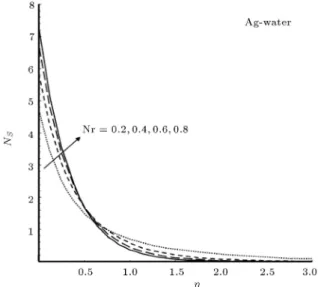
Figure 10 indicates the eect of the nanosolid volume fraction on the entropy generation number. It is evident that the entropy generation number decreases with the increase in the nanosolid volume fraction, due to the higher dissipation energy resulted from the sharper velocity gradient near the wall, and an opposite trend is observed far away from the wall. Figure 11 displays the eect of radiation parameter on entropy generation. The gure reveals that entropy consider-ably increases with the increasing values of radiation parameter. The increase in entropy generation is due to the increase in the emission rate of radiation near the wall and an opposite trend is observed away from the wall.
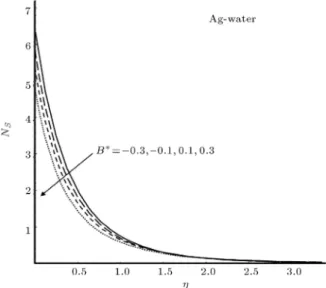
Figures 12 and 13 display the eect of non-uniform heat source/sink parameter on the entropy generation parameter. It can be seen that the entropy generation decreases in the case of heat source (i.e.,
Figure 10. Eect of nanoparticles volume fraction parameter on entropy generation with Pr = 6:2, Mn= 1:0,
Nr = 0:3, L = 0:1, S = 0:5, A= 0:1, B= 0:1,
Br 1= 1:0, Re
x= 1:0, and Ha = 1:0.
Figure 11. Eect of radiation parameter on entropy generation with Pr = 6:2, Mn= 1:0, = 0:1, L = 0:1,
S = 0:5, A= 0:1, B= 0:1, Br 1= 1:0, Re
x= 1:0, and
Ha = 1:0.
A > 0 and B > 0). It shows that heat source
dominates the entropy generation in nanouid, whereas in the case of heat sink (i.e. A < 0 and B < 0), it
produces more entropy in nanouid.
Figure 14 illustrates the eect of slip parameter on the entropy generation number. It is noticed that entropy generation increases as the slip parameter decreases. Figure 15 displays the eect of suction parameter on entropy generation. It is observed that suction parameter augments the entropy gener-ation; thus, suction parameter creates more entropy in nanouid.
Figure 16 demonstrates the inuence of dier-ent nanoparticles such as Copper (Cu), Silver (Ag),
Figure 12. Eect of non-uniform heat source/sink parameter (A) on entropy generation with Pr = 6:2,
Mn= 1:0, = 0:1, Nr = 0:3, L = 0:1, S = 0:5, B= 0:1,
Br 1= 1:0, Re
x= 1:0, and Ha = 1:0.
Figure 13. Eect of non-uniform heat source/sink parameter (B) on entropy generation with Pr = 6:2,
Mn= 1:0, = 0:1, Nr = 0:3, L = 0:1, S = 0:5, A= 0:1,
Br 1= 1:0, Re
x= 1:0, and Ha = 1:0.
Alumina (Al2O3), and Titanium Oxide (TiO2) on the
velocity, temperature, and entropy generation proles, respectively. Figure 16(a) exhibits the velocity dis-tribution for the nanoparticles Cu, Ag, Al2O3, and
TiO2. It can be seen that the velocity prole is
higher for TiO2-water and lower for Ag-water.
High-density nanoparticles have very low velocity. From Figure 16(b), it is noted that the temperature prole is higher for Ag-water and lower for TiO2-water. It is
clear that the Ag-water has high rate of heat transfer compared to other nanoparticles. This is due to the fact that the thermal conductivity of the Ag-water is very high compared to other nanoparticles. This
Figure 14. Eect of slip parameter on entropy generation with Pr = 6:2, Mn= 1:0, = 0:1, Nr = 0:3, S = 0:5,
A= 0:1, B= 0:1, Br 1= 1:0, Re
x= 1:0, and
Ha = 1:0.
Figure 15. Eect of suction parameter on entropy generation with Pr = 6:2, Mn= 1:0, = 0:1, Nr = 0:3,
L = 0:1, A= 0:1, B= 0:1, Br 1= 1:0, Re
x= 1:0, and
Ha = 1:0.
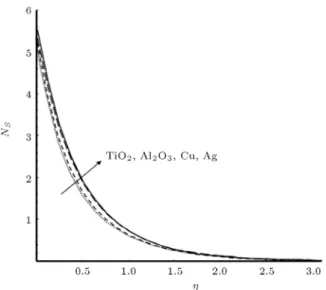
shows that thermal conductivity of the nanoparticles also aects the temperature of the nanoparticle. From Figure 16(c), it is clear that the entropy generation number is maximum for Ag-water and minimum for TiO2-water. The entropy generation number of Al2O3
-water is greater than that of Cu--water. The entropy generation is higher for the metallic nanouids and is lower for the non-metallic nanouids.
Figure 17 shows the eects of slip, magnetic, and nanosolid volume fraction parameters on local skin fric-tion coecient. It is clear that F00(0) values decrease
with slip parameter and increase with magnetic and nanoparticle volume fraction parameters. The values
Figure 16(a). Eect of dierent nanouids on velocity distribution with Pr = 6:2, Mn= 1:0, = 0:1, L = 1:0,
and S = 0:5.
Figure 16(b). Eect of dierent nanouids on temperature distribution with Pr = 6:2, Mn= 1:0,
= 0:1, Nr = 0:3, L = 1:0, S = 0:5, A= 0:03, and
B= 0:03.
of reduced Nusselt number are plotted in Figures 18(a) and 18(b). The reduced Nusselt number decreases with the increasing values of magnetic, slip, and nanoparti-cle volume fraction parameters (Figure 18(a)). It is observed from Figure 18(b) that 0(0) increases in
the case of heat source and decreases in heat sink case; also, it increases with the increasing values of radiation parameter.
8. Conclusion
The present study gives the analytical and numerical solutions for entropy generation analysis of hydromag-netic slip ow of an incompressible viscous nanouid (Cu-water, Ag-water, Al2O3-water, and TiO2-water)
over a stretching sheet in the presence of thermal
ra-Figure 16(c). Eect of dierent nanoparticles on entropy generation with Pr = 6:2, Mn= 1:0, = 0:1, Nr = 0:3,
L = 0:1, A= 0:1, B= 0:1, Br 1= 1:0, S = 0:5,
Rex= 1:0, and Ha = 1:0.
Figure 17. Eect of nanoparticles volume fraction, slip and magnetic parameters on local skin friction coecient with Pr = 6:2 and S = 0:5.
diation and investigates non-uniform heat source/sink. The partial dierential equations governing the prob-lem under consideration are transformed by Lie sym-metry group of transformations into a system of or-dinary dierential equations which are solved analyt-ically using hypergeometric functions and numeranalyt-ically by Runge-Kutta-Gill method with shooting technique which is used to compute the entropy generation number. The main conclusions derived from this study are as follows.
The velocity of the nanouid decreases with increase in magnetic parameter, nanosolid volume fraction parameter, slip parameter, and suction parameter;
Figure 18(a). Eect of nanoparticles volume fraction, slip and magnetic parameters on reduced Nusselt number with Pr = 6:2, Nr = 0:7, S = 0:5, A= 0:03, and
B= 0:03.
Figure 18(b). Eect of radiation and non-uniform heat source/sink parameters on reduced Nusselt number with Pr = 6:2, S = 0:5, Mn= 1; and = 0:05.
the increasing values of magnetic parameter, nanosolid volume fraction parameter, non-uniform heat source/sink parameters, and slip parameter. The temperature of the nanouid increases with the decreasing values of radiation parameter and suction parameter;
The increasing values of magnetic parameter, radia-tion parameter, and sucradia-tion parameter increase the generation of entropy in the nanouid ow eld. The entropy generation increases with decrease in slip parameter and non-uniform heat source parameter. The rising values of nanosolid volume fraction pa-rameter decrease the entropy generation near the wall, and an opposite trend is observed far away from the wall;
Ag-water uid considerably decreases velocity and increases temperature compared to other nanouids, viz. Cu, Al2O3, and TiO2. The entropy generation
is higher for metallic and lower for non-metallic nanoparticles in the base uid. The presence of metallic nanoparticles creates more entropy in the nanouid ow than the non-metallic nanoparticles. Nomenclature
A Space dependent internal heat
source/sink parameter
B Temperature dependent internal heat
source/sink parameter B0 Magnetic eld strength
Br Brinkman number Ha Hartmann number L Partial slip parameter M Kummer's function Mn Magnetic parameter
Nr Radiation parameter
Ns Entropy generation number
Pr Prandtl number Re1=2
x Cf Local skin friction coecient
Re 1=2
x Nux Reduced Nusselt number
SG Local volumetric entropy generation
rate
(SG)0 Characteristic entropy generation rate
T Local temperature of the uid
knf Thermal conductivity of the nanouid
kf Thermal conductivity of the base uid
ks Thermal conductivity of the
nanoparticles Electric conductivity
Dimensionless temperature dierence The solid volume fraction
nf The eective density of the nanouid
f Density of the pure uid
s Density of the nanoparticles
nf Eective dynamic viscosity of the
nanouid
f Dynamic viscosity of the basic uid
Space variable
nf Thermal diusivity of the nanouid
References
1. Choi, S.U.S. and Eastman, J.A. \Enhancing thermal conductivity of uids with nanoparticles", Mater. Sci., 231, pp. 99-105 (1995).
2. Eastman, J.A., Choi, U.S., Li, S., Soyez, G., Thomp-son, L.J. and DiMel, R.J. \Novel thermal properties of nanostructured materials", Mater. Sci. Forum., pp. 629-634 (1999).
3. Xuana, Y. and Roetzel, W. \Conceptions for heat transfer correlation of nanouids", Int. J. Heat Mass Transfer, 43, pp. 3701-3707 (2000).
4. Masuda, H., Ebata, A., Teramae, K. and Hishinuma, H. \Alteration of thermal conductivity and viscosity of liquid by dispersing ultra-ne particles (Dispersion of 7-A1203, SiO2 and TiO2 ultra-ne particles)", Netsu.
Bussei., 4, pp. 227-233(1993).
5. Kakac, S. and Pramuanjaroenkij, A. \Review of con-vective heat transfer enhancement with nanouids", Int. J. Heat Mass Transfer, 52, pp. 3187- 3196 (2009). 6. Nadeem, S., Haq, R.U. and Khan, Z.H. \Heat transfer analysis of water based nanouid over an exponentially stretching sheet", Alexandria Eng. J., 53, pp. 219-224 (2014).
7. Hatami, M. and Ganji, D.D. \Natural convection of sodiumalginate(SA) non-Newtonian nanouid ow between two vertical at plates by analytical and numerical methods", Case Stud. Therm. Eng., 2, pp. 14-22 (2014).
8. Abed, A.M., Sopian, K., Mohammedc, H.A., Alghoul, M.A., Ruslan, M.H., Sohif, M. and Al-Shamani, A.N. \Enhance heat transfer in the channel with V-shaped wavy lower plate using liquid nanouids", Case Stud. Therm. Eng., 5, pp. 13-23 (2015).
9. Rashidi, M.M., Rostami, B., Freidoonimehr, N. and Abbasbandey, S. \Free convective heat and mass transfer for MHD uid ow over a permeable vertical stretching sheet in the presence of the radiation and buoyancy eects", Ain Shams Engineering Journal, 5, pp. 901-912 (2014).
10. Rashidi, M.M. and Keimanesh, K. \Using dierential transform method and pad approximant for solving MHD ow in a laminar liquid lm from a horizontal stretching surface", Mathematical Problems in Engi-neering, Article ID 491319 (2010).
11. Rashidi, M.M., Vishnu Ganesh, N., Abdul Hakeem, A.K. and Ganga, B. \Buoyancy eect on MHD ow of nanouid over a stretching sheet in the presence of thermal radiation", J. Mol. Liq., 198, pp. 234-238 (2014).
12. Hamad, M.A.A. \Analytical solution of natural con-vection ow of a nanouid over a linearly stretching sheet in the presence of magnetic eld", Int. Comm. Heat Mass Transfer, 38, pp. 487-492 (2011).
13. Vishnu Ganesh, N., Ganga, B. and Abdul Hakeem, A.K. \Lie symmetry group analysis of magnetic eld eects on free convective ow of a nanouid over a semi-innite stretching sheet", J. Egyptian Math. Soc., 22, pp. 304-310 (2014).
14. Vishnu Ganesh, N., Abdul Hakeem, A.K.,
Jayap-rakash, R. and Ganga, B. \Analytical and numerical studies on hydromagnetic ow of water based metal nanouids over a stretching sheet with thermal radia-tion eect", J. Nanouids, 3, pp. 1-8 (2014).
15. Rashidi, M.M., Kavyani, N. and Abelman, S. \Inves-tigation of entropy generation in MHD and slip ow over a rotating porous disk with variable properties", Int. J. Heat Mass Transfer, 70, pp. 892-917 (2014). 16. Rashidi, M.M. and Erfani, E. \Analytical method for
solving steady MHD convective and slip ow due to a rotating disk with viscous dissipation and ohmic heating", Engineering Computations, 29(6), pp. 562-579 (2012).
17. Abdul Hakeem, A.K., Kalaivanan, R., Vishnu Ganesh, N. and Ganga, B. \Eect of partial slip on hydromag-netic ow over a porous stretching sheet with non-uniform heat source/sink, thermal radiation and wall mass transfer", Ain Shams Eng. J., 5, pp. 913-922 (2014).
18. Das, K. \Slip ow and convective heat transfer of nanouids over a permeable stretching surface", Com-put. Fluids, 64, pp. 34-42 (2012).
19. Turkyilmazoglu, M. \Exact analytical solutions for heat and mass transfer of MHD slip ow in nanou-ids"', Chem. Eng. Sci., 84, pp. 182-187 (2012). 20. Noghrehabad, A. and Pourrajab, R. \Eect of partial
slip boundary condi- tion on the ow and heat transfer of nanouids past stretching sheet prescribed constant wall temperature", Int. J. Therm. Sci., 54, pp. 253-261 (2012).
21. Ibrahim, W. and Shankar, B. \MHD boundary layer ow and heat transfer of a nanouid past a permeable stretching sheet with velocity, thermal and solutal slip boundary conditions", Comput. Fluids, 75, pp. 1-10 (2013).
22. Abdul Hakeem, A.K., Vishnu Ganesh, N. and Ganga, B. \Magnetic eld eect on second order slip ow of nanouid over a stretching/shrinking sheet with thermal radiation eect", J. Magn. Magn. Mater., 381, pp. 243-257 (2015).
23. Aboud, S. and Saouli, S. \Entropy analysis for vis-coelastic magnetohydro- dynamic ow over a stretch-ing surface"', Int. J. Non-linear Mech., 45, pp. 482-489 (2010).
24. Bejan, A., Entropy Generation Minimization, CRC Press, Boca Raton, New York (1996).
25. Sohel, M.R., Saidur, R., Hassan, N.H., Elias, M.M., Khaleduzzaman, S.S. and Mahbubul, I.M. \Analysis of entropy generation using nanouid ow through the circular micro channel and minichannel heat sink", Int. Comm. Heat Mass Transfer, 46, pp. 85-91 (2013). 26. Moghaddami, M., Shahidi, S. and Siavashi, M.
\En-tropy generation analysis of nanouid ow in turbulent and laminar regimes", J. Comput. Theor. Nanosci., 9, pp. 1586-1595 (2012).
27. Shahi, M., Mahmoudi, A.H. and Raouf, A.H. \Entropy generation due to natural convection cooling of a nanouid", Int. Comm. Heat Mass Transfer, 38, pp. 972-983 (2011).
28. Mahian, O., Mahmud, S. and Heris, S.Z. \Analysis of entropy generation between co-rotating cylinders using nanouids", Energy, 44, pp. 438-446 (2012).
29. Mahian, O., Pop, I., Sahin, A.Z., Oztop, H.F. and Wongwises, S. \Irreversibility analysis of a vertical annulus using TiO2/water nanouid with MHD ow
eects", Int. J. Heat Mass Transfer, 64, pp. 671-679 (2013).
30. Malvandi, A., Ganji, D.D., Hedayati, F. and Youse Rad, E. \An analytical study on entropy generation of nanouids over a at plate", Alexandria Eng. J., 52, pp. 595-604 (2013).
31. Noghrehabadi, A., Saarian, M.R., Pourrajab, R. and Ghalambaz, M. \Entropy analysis for nanouid ow over a stretching sheet in the presence of heat generation/absorption and partial slip", J. Mech. Sci. Technol., 27, pp. 927-937 (2013).
32. Butt, A.S., Munawar, S., Ali, A. and Mehmood, A. \Entropy generation in hydrodynamic slip ow over a vertical plate with convective boundary", J. Mech. Sci. Technol., 26, pp. 2977-2984 (2012).
33. Govindaraju, M., Vishnu Ganesh, N., Ganga, B. and Abdul Hakeem, A.K. \Entropy generation analysis of magneto hydrodynamic ow of a nanouid over a stretching sheet", J. Egyptian Math. Soc., 23, pp. 429-434 (2015).
34. Abel, M.S. and Nandeppanavar, M.M. \Heat transfer in a MHD viscoelastic boundary layer ow over a stretching with nonuniform heat source/sink", Com-mun. Nonlinear Sci. Numer. Simul., 14, pp. 2120-2131 (2009).
35. Abdul Hakeem, A.K. and Sathiyanathan, K. \An an-alytic solution of an oscillatory ow through a porous medium with radiation eect", Nonlinear Anal.: Hy-brid Syst., 3, pp. 288-295 (2009).
36. Abdul Hakeem, A.K., Vishnu Ganesh, N. and Ganga, B. \Eect of heat radiation in a Walter's liquid B uid over a stretching sheet with non-uniform heat source/sink and elastic deformation", J. King Saud University-Eng. Sci., 26, pp. 168-175 (2014).
37. Anjali Devi, S.P. and Ganga, B. \Viscous dissipation eects on nonlinear MHD ow in a porous medium over a stretching porous surface", Int. J. of Appl. Math. and Mech., 5, pp. 45-59 (2009).
38. Woods, L.C., Thermodynamics of Fluid Systems, Ox-ford University Press, OxOx-ford (1975).
39. Arpaci, V.S. \Radiative entropy production-lost heat into entropy", Int. J. Heat Mass Transfer, 30, pp. 2115-2123 (1987).
40. Paresh, V. and Archana, R. \Entropy regime for radia-tive MHD coquette ow inside a channel with naturally permeable base", Int. J. Energy and Technol., 5, pp. 1-9 (2013).
41. Wang, C.Y. \Free convection on a vertical stretching surface", J. Appl. Math. Mech. (ZAMM), 69, pp. 418-420 (1989).
Biographies
Abdul Kaoor Abdul Hakeem was born and brought up in the district of Coimbatore, Tamil Nadu, India. He obtained MPhil and PhD degrees in Math-ematics from Bharathiar University, Coimbatore. He is currently working as an Assistant Professor in the Department of Mathematics, Sri Ramakrishna Mission Vidhyalaya College of Arts and Science, Coimbatore, aliated to Bharathiar University. Besides teaching, he is actively engaged in the eld of uid mechanics, particularly in heat transfer in cavities, boundary layer ows, nanouid ow through porous media, and slip ow model.
Mathialagan Govindaraju works as an Assistant Professor in the Department of Mathematics, Sri Ra-makrishna Mission Vidhyalaya College of Arts and Science, Coimbatore Tamilnadu, India. He received his MPhil degree in Mathematics from Bharathiar University, Coimbatore. Nowadays, he is doing his research under the guidance of Dr. A. K. Abdul Hakeem.
Bhose Ganga was born and brought up in the district of Nilgiris, Tamil Nadu, India. She obtained MPhil and PhD degrees in Mathematics from Bharathiar University, Coimbatore. She is currently working as an Assistant Professor in the Department of Mathematics, Providence College for Women, Coonoor, aliated to Bharathiar University. Besides teaching, she is actively engaged in research in the eld of uid mechanics, particularly in boundary layer ows, nanouid ow through porous media, and slip ow model.
Marimuthu Kayalvizhi works as an Assistant Pro-fessor in Mathematics at Sathyabama University, Chennai, India. She obtained MPhil and PhD degrees in Mathematics from Bharathiar University, Coim-batore. Besides teaching, she is actively engaged in research in the eld of uid mechanics, particularly in heat mass transfer, boundary layer ows, and nanouid.