EFL Professional
Teaching Standards
DEVELOPED BY
NATALIE KUHLMAN & BOŽANA KNEŽEVIĆ
About These Guidelines
TESOL International Association developed these guidelines for postsecondary institutions, government agencies, ministries of education, and other entities charged with developing professional teaching standards in an EFL context. TESOL encourages teachers, administrators, policy makers and anyone else who needs these guidelines to use, adapt, and distribute them freely. As the authors point out,
In these guidelines for developing EFL standards, TESOL International Association uses its resources both human and material, accumulated knowledge, and experience in the field to create a new document, the sharing of which, and not exportation, is perceived as a positive result of globalization rather than of linguistic, cultural, academic, or educational imperialism. It is the result of TESOL International Association’s continuous work in the creation of teaching and learning standards.
For more information on TESOL International Association, please visit TESOL’s website at www.tesol.org or contact [email protected].
This work is licensed under a Creative Commons Attribution-NonCommercial 4.0 International License. To view a copy of this license, please visit http://creativecommons.org/licenses/by-nc/4.0/ or send a letter to Creative Commons, 444 Castro Street, Suite 900, Mountain View, California, 94041, USA.
www.tesol.org
TESOL International Association 1925 Ballenger Ave. Suite 550 Alexandria, VA 22314
Table of Contents
Part 1. Assumptions and Values to Guide the Creation
of Standards for Quality English as a Foreign Language (EFL) Teaching ... 2
Part 2. The Standards Package ... 4
The Theoretical Framework ... 4
Organizational Formats for Standards ... 4
Standards ... 7
Performance Indicators ... 7
Standards Use ... 8
Assessment and Evaluation ... 9
References and Glossary ... 11
The Standards Package ... 11
Part 3. Process for Standards Development ... 13
Decisions ... 13
Evaluating Existing Standards ... 14
Adapting Standards ... 15
Creating New Standards ... 15
Creating or Adapting Standards: The Step-by-Step Process ... 17
Summary of Steps ... 19
Part 4. Adapting Existing Standards in International Contexts ... 21
Albania ... 21
Ecuador ... 22
Egypt ... 24
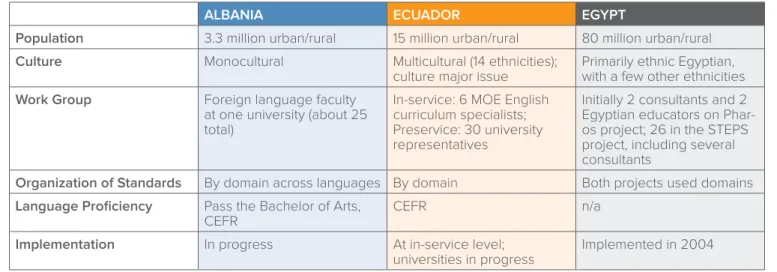
Summary for the Three Countries ... 25
Today’s societies thus place challenging demands on teachers, who are confronted with complexity in their practice. How do these demands align with competen-cies that teachers have or need to acquire or develop? One way to comply with the demands would be to define the competencies and develop standards that can make teacher evaluation a successful process. Evaluation of competencies, demonstrating that teachers are prepared for these challenges, is inconceivable without a clearly defined and agreed upon reference point: standards. In this section, we briefly address some assumptions (beliefs or ideas) about the nature of how one acquires knowledge (epistemology). Or, in other words, what it is we mean when we say that something (knowledge) exists, and what we mean when we say that we know something. We briefly discuss what knowledge, theoretical and practical, is needed for a teacher to be able to teach EFL, and how knowledge is creat-ed in a second or additional language.
EFL teaching is a multifaceted activity; it has several di-mensions, and it must rise to the challenge of its enhanced responsibilities. First and foremost, the responsibilities are educational but also social: to teach students to respect people of different cultural backgrounds, for example. It is the educational, social, and cultural milieu in which at least two languages and cultures meet—the language and culture of the students and of those who use the target language (English, in this case). EFL teaching is thus a com-plex endeavor.
It is, however, beyond this document to discuss how culture or cultural segments affect and shape teachers’ beliefs and, vice versa, how one’s teaching reflects those beliefs in different cultures. Additionally, it is beyond this document to discuss how basic epistemological or ontological beliefs about culture (be it foreign or domestic) change in the pro-cess of teaching and learning a language. But just passing on general information about the target culture and stereo-type models is no longer sufficient. The context in which a foreign language is taught and learned has changed. It is characterized by mobility, migration, and diversity. Multilingual and multicultural aspects of EFL should thus be integrated into teacher education programs and should be further fostered and promoted as a value in EFL and teacher education classrooms. Multilingualism, multicultur-alism, and diversity in the center of education present a challenge for EFL. They are changing the role (and identity) of the EFL teacher. As a result, education authorities need to provide quality training and integrated programs that offer knowledge (theoretical and practical), understanding, values, and subject specific and generic competences (intercultural being one of them). Another challenge and an identified need for a multilingual, multicultural, and informa-tion and communicainforma-tion technology-driven society is a shift from a monolingual to a multilingual paradigm (Canagarajah & Wurr, 2011).
Given all that, a new platform for teaching a foreign lan-guage in a multicultural, multilingual (a society/community
Assumptions and Values to Guide the
Creation of Standards for Quality English
as a Foreign Language (EFL) Teaching
01
The globalization of society and the dynamic role of education in it have given impetus to the
development of this document. The globalization of society and economy are manifested in
increasing mobility, introducing multicultural and multilingual diversity within national borders
and consequently within the student and teacher population.
dimension), and plurilingual (an individual dimension) so-ciety is needed. Multilingualism and multiculturalism need to be embedded in the concept of educational values, and this embedding will present a challenge for language education and for the creation of standards for quality EFL teaching.
TESOL International Association (TESOL) encourages respect for diversity, multilingualism, multiculturalism, and individual language rights. The association advocates for the profession and the rights of teachers—be they native or nonnative speakers (TESOL, 2006)—and teachers’ associa-tion to exist (TESOL, 2007).
TESOL fosters means and ends in education in general, and in English language teaching and learning in particular. However, beliefs must be evident in actions, verified by actions, and examined and evaluated from time to time. Evidence of need should be added to an assumption or a belief to convert it into knowledge.
As part of its mission to advance professional expertise in English language teaching and learning for speakers of other languages worldwide, TESOL International Asso-ciation has developed standards for various aspects of English language teaching. Starting with the ESL Standards for PreK–12 Students (1997) through the TESOL P–12 Pro-fessional Teaching Standards (2010), TESOL has devel-oped, published, and revised standards for students, teach-ers, and programs in various sectors including elementary and secondary education in the United States, teacher preparation, and adult education. The association has also published standards on the use of technology for English learners (TESOL, 2011) and English language teachers and best practices for workplace language programs. Through the development of these standards and related volumes, TESOL has leveraged the knowledge of the field to ad-vance educational outcomes for students and to adad-vance the expertise of English language teachers.
In these guidelines for developing EFL standards, TESOL utilizes its resources both human and material, accumulat-ed knowlaccumulat-edge, and experience in the field to create a new document, the sharing of which, and not exportation, is per-ceived as a positive result of globalization rather than of lin-guistic, cultural, academic, or educational imperialism. It is the result of TESOL International Association’s continuous work in the creation of teaching and learning standards.
How this document resonates depends on the needs of diverse contexts. And guidelines is the key word in under-standing and implementing it. The document suggests, does not mandate, parameters for adapting or creating standards that meet the needs of a global society but also takes into consideration local policies, ministries of edu-cation, universities, professional associations, and non-governmental agencies (NGOs). However, neat solutions are neither easily found nor are they within the scope of this document. In other words, this document will neither have the lure of the panacea to guarantee success, nor will it represent a pandemic threat to the local context and academic freedom (Phillipson, 2009).
In Part 2, these guidelines move to the Standards Package, which introduces the theoretical framework and organi-zational formats for standards, the performance indicators as well as the methods of assessment and evaluation, followed by the references and glossary. Part 3 provides the step-by-step process of creating standards, and Part 4 provides examples of the processes of EFL teaching stan-dards development in Albania, Ecuador, and Egypt. Part 5 provides a summary and conclusions.
References
Canagarajah, A. S., & Wurr, A. J. (2011). Multilingual com-munication and language acquisition: New research directions. The Reading Matrix, 11(1), 1–15.
Phillipson, R. (2009). English in higher education, panacea or pandemic? Angles of the English-Speaking World,9,
29–57.
TESOL International Association. (1997). ESL standards for pre-K–12 students. Alexandria, VA: Author.
TESOL International Association. (2006). Position statement against discrimination of nonnative speakers of English in the field of TESOL. Retrieved from http://www.tesol. org/docs/pdf/5889.pdf?sfvrsn=2
TESOL International Association. (2007). Position statement on the role of teacher’s associations in education policy and planning. Retrieved from http://www.tesol.org/docs/ pdf/10040.pdf?sfvrsn=2
TESOL International Association. (2010). TESOL P–12 pro-fessional teaching standards (2nd ed.). Alexandria, VA: Author.
TESOL International Association. (2011). TESOL technology standards. Alexandria, VA: Author.
1. The Theoretical or Conceptual Framework:1The
theoretical framework, goal, and/or mission statement, usually based on the research that the program, ministry of education (MOE), or national government accepts as the foundation for its teacher education programs (see Figure 1).
2. Organizational Formats for Standards: The domains or principles that will be used to organize the standards, the larger umbrella, including a supporting justification for each domain and/or principle.
3. Standards: The standard itself, either a specific or gen-eral statement that outlines an aspect of what the teach-er needs to know or be able to do within that domain or principle.
4. Performance Indicators (PIs): The standard, typically, is then broken down into PIs. Sometimes the PIs are broken down into even smaller elements.
5. Standards Use: The identification of the difference between a program based on standards and one that is based on a collection of courses, and deciding which to use.
6. Assessment and Evaluation: How it will be decided that standards have been met, often through the use of PIs to create rubrics, and the use of portfolios.
7. References and Glossary: A list of references that sup-port the standards, and a glossary so that all those who use the package have a common understanding of key concepts.
The Theoretical Framework
The theoretical (or conceptual) framework supports the goal. It provides the guiding structure for the standards, and represents the vision and direction of stakeholders. While it is usually stated at the beginning of a standards document, it is also infused throughout. Basing this frame-work on current research in the area and reading such studies recently done will better prepare those who will create or adapt the standards by providing the background knowledge needed to produce the standards and, possi-bly, ideas of how to approach the task. Examples of such literature reviews include the one done by TESOL when revising the TESOL P–12 Professional Teaching Standards
(2010) and another by Richards (2011). For the Standards for ESL/EFL Teachers of Adults (2008), background papers commissioned by TESOL are included that provide the the-oretical framework that ground and support the standards.
Organizational Formats for
Standards
In general, there are two approaches to standards develop-ment: a principles-based and a domains-based approach, the domains being the more common. Perhaps a simple way to explain the difference between a principles-based and a domains-based approach is to look at them as being abstract and concrete, respectively. They can also be seen as two sides of the same coin: A principles approach may be more conceptual, and a domains one more specific and practical. For example, the first Interstate Teacher Assess-ment and Support Consortium (InTASC) has as a principle:
The Standards Package
02
When all of the aspects of standards are put together, they form the core of a package that can
be used in the process of developing a standards-based teacher preparation program that will be
discussed in Part 3. The following forms the standards package core:
The teacher understands the central concepts, tools of inquiry, and structures of the discipline(s) he or she teach-es and can create learning experiencteach-es that make thteach-ese aspects of subject matter meaningful for students (Council of Chief State School Officers, 2011, p. 1).
This principle would be equivalent to the language domain in the TESOL P–12 Professional Teaching Standards
(TESOL, 2010).
The Principles Approach
Mahboob and Tilakaratna (2012) discuss principles as a theoretical framework for setting policy. Mahboob and Tilakaratna also present several principles that are needed for successful program implementation that should be used when constructing standards. These include collaboration, relevance, evidence (standards created based on sound research), alignment (with the policies and practices of a country, ministry, etc.), transparency (easily understood, without jargon), and empowerment (takes into consider-ation the outcomes expected from learning English, such as economics and education).
A different kind of principles-based approach is embodied in the work of a blue-ribbon panel formed by the National Council for Accreditation of Teacher Education (NCATE, 2010). For example, two of NCATE’s ten principles are “Clinical preparation is integrated throughout every facet of teacher education in a dynamic way,” and “Candidates learn in an interactive professional community” (p. 5). These principles would lead to standards on clinical practice and on professionalism and be part of the TESOL Instruction and Professionalism domains.
The Domains Approach
A domains approach focuses on general categories. The standards under each domain and the performance indica-tors (or elements) provide the specificity. Based on current research, TESOL (2010) identified five domains that are needed to prepare English teachers. The five domains are • Language (foundation domain)
• Culture (foundation domain) • Instruction (application domain) • Assessment (application domain)
• Professionalism (at the intersection of all the domains)
FIGURE 1. TESOL P–12 Teacher Education Program Standards (TESOL, 2010, p. 19).
FOUNDATIONS
APPLICATIONS
LANGUAGE CULTURE
INSTRUCTION
ASSESSMENT
PROFESSIONALISM
• Language as a system • Language acquisition and
development
• Culture as it affects student learning
• Planning for standards based ESL and content instruction • Implementing and managing
standards based ESL and content instruction
• Using resources and technology effec-tively in ESL and content instruction
• ESL research and history • Professional development,
partnerships and advocacy
• Issues of assessment for ELLs • Language proficiency assessment • Classroom-based assessment
There are a total of eleven standards within the five domains. These are visualized in Figure 1 as intersecting circles because each is dependent on the others.
The national teacher education accreditation agency in the United States, the Council for the Accreditation of Edu-cator Preparation (CAEP, formerly NCATE), identified four domains from which standards should be created: Content Knowledge, Pedagogical Knowledge, Learning Environ-ments, and Professional Knowledge. TESOL’s Language and Culture domains would fit under Content Knowledge, whereas Instruction and Assessment would fit under Pedagogical Knowledge, with Professionalism included in Professional Knowledge. Learning Environments might include standards from any of the five TESOL domains. The CAEP categories are just a different way of organizing the information.
TESOL’s Standards for ESL/EFL Teachers of Adults (2008) does not explicitly identify domains; however, its eight performance-based standards are grouped into two cat-egories that in essence serve as domains: Practices; and Knowledge, Abilities, and Dispositions. As illustrated in Fig-ure 2, student learning is the central concern for all teach-ers, and therefore occupies the center of these teaching
standards. Surrounding student learning in two concentric circles are the eight standards for ESL/EFL teachers of adults. Collectively, these eight standards represent the core of what professional teachers of ESL and EFL to adult learners should know and be able to do.
Although the Common European Framework of Reference for Languages: Learning, Teaching, Assessment (Council of Europe, 2001) does not include standards per se, they or-ganize the framework of reference essentially by domains. These include
1. Structure (how a teacher preparation program is organized)
2. Knowledge and Understanding (similar to TESOL’s Language and Culture domains, and CAEP’s Content Knowledge)
3. Strategies and Skills (similar to TESOL’s Instruction domain and CAEP’s Pedagogical Knowledge) 4. Values (included in TESOL’s Professionalism domain) Beginning in 2003, a group came together in the People’s Republic of China to create materials for language teachers, resulting in two sets of standards. This project was devel-oped collaboratively by with McGraw-Hill Education, TESOL, the National Foreign Language Teaching Association, scholars from the China Basic Foreign Language Educa-tion Research and Training Center, and staff of the Foreign Language Teaching and Research Press (Agor et al., 2005). They organized the standards under eight domains which, again, have similarities to the others already cited:
1. Knowing Students 2. Appreciating Attitudes
3. Planning, Delivering, and Reflecting on Instruction 4. Constructing Knowledge of Languages, Language
Learning and Critical Thinking 5. Exploring and Applying Culture 6. Assessing Teaching and Learning 7. Connecting Beyond the Classroom 8. Expanding Professional Horizons
Although these domains appear very different from those in the first two examples, they are different only in the way that they organize essentially the same information, as are the principles approach examples. The content of the actual standards will not vary dramatically.
FIGURE 2. Model of Standards for ESL/EFL Teachers of Adults (TESOL, 2008, p. viii).
Assessing
P
lan
nin
g
In
str
uc
tin
g
Language Prof ciency
L
ea
rn
in
g
I
de
nti
ty &
Co
ntex
t
C
ont
ent
Co
mm
itm
en
t &
P
ro
fe
ss
io
na
lis
m
Student
Learning
Standards
It is helpful to first explore what the term standards means and then to discuss what it means within the field of education. The term is used in a variety of ways, but one definition from Merriam-Webster (2013) seems appropriate: “Something established by authority, custom, or general consent as a model or example.” We use standards in our everyday life for things as simple as units of measure, such as meters, and as complicated as criteria for architectural design.
In the case of education, we need to know where we are going (the standard) in order to know how to get there (the curriculum), and when we have arrived at a benchmark (the assessment and evaluation). Standards thus serve as a point of reference and a way of ensuring consistency when needed, both in school and in life.
In a school context, standards are generally defined as benchmarks for accountability (O’Malley & Valdez Pierce, 1996) or goals that students (or teachers) will attain. Stan-dards call for consistency in what is expected from both students and teachers, and tests and other measurements are developed to determine if standards are being met. Darling-Hammond (1997) suggests that unless we move toward keeping more consistent goals rather than always making exceptions to the goals, our educational reforms “will surely evaporate in a very short time, long before good schooling spreads to the communities where it is cur-rently most notable by its absence” (p. 211). Standards are a way to provide the stability and consistency Darling-Ham-mond advocates. She also states a direct connection between standards for student learning and professional standards for teaching, stressing that both are necessary for genuine learning to occur. This document, however, will focus on standards development for the preparation of teachers only.
Types of Standards
There are several types of standards. Here we will define three types that are specific to teacher education: content, pedagogical, and performance standards (Seufert et al., 2005).
1. Content standards
Content knowledge is teacher candidates’ knowledge of the content they plan to teach and their ability to explain important principles and concepts that are delin-eated in professional standards. This might include, for example, linguistics, language acquisition and
devel-opment, and culture. Generally, there are two types of content standards:
a. Declarative knowledge consists of what candidates know, or knowledge of concepts and facts.
b. Procedural knowledge is what candidates know how to do.
2. Pedagogical standards
These standards focus on
a. how to teach, how students learn b. what is taught (the curriculum)
c. effective teaching strategies to impart the special-ized knowledge of a subject area (e.g., planning, instruction, analysis, and evaluation)
d. students’ diversity and on differing approaches to learning
e. how culture influences teaching and learning f. what teachers need to know about students’
precon-ceptions that must be engaged for effective learning g. teachers’ familiarity with standards-based instruction,
assessment, and learning
3. Performance standards
Performance standards describe how well or to what extent
a. standards are met
b. the criteria and evidence document that a standard has been met
c. standards demonstrate the level of performance expected to determine progress (this often includes scoring rubrics)
d. standards include exemplars of learners’ work to help teachers align instruction
e. instruction and assessment are at the appropriate level of difficulty
f. standards lead to assessments aligned with content standards
(adapted from Seufert et al., 2005, p. 6)
Performance Indicators
Depending on how specific the standards will be, the standards can be broken down into more detailed PIs, also sometimes called elements or components. PIs further explain the standard or the components needed to meet the standard. All standards can be made more specific,
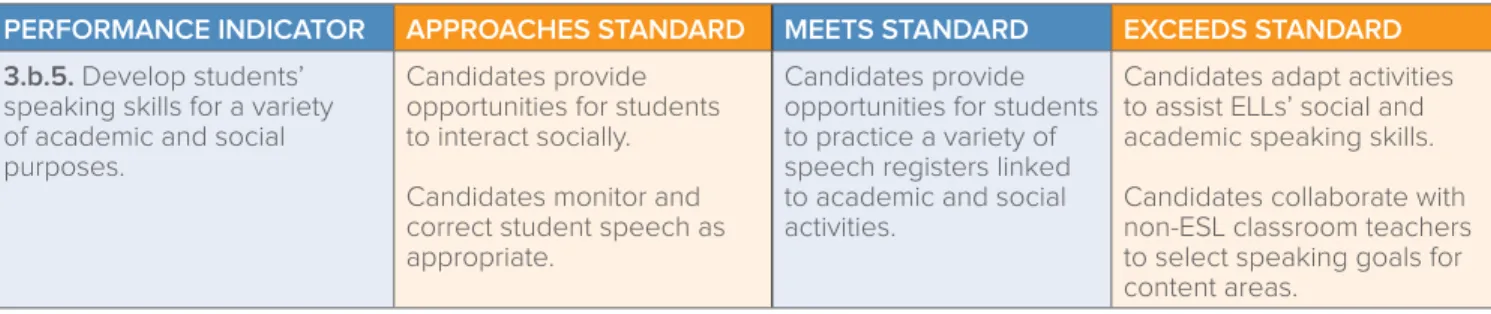
depending on needs, sometimes even having further specificity (e.g., a PI broken down further into subparts). For example, a standard on planning instruction may have PIs for the four language skills (listening, speaking, reading, and writing), and under each of them, there may be specific details. Table 1 shows a PI and rubric for Standard 3.b from the TESOL P–12 Professional Teaching Standards (TESOL, 2010) that focuses on speaking skills.
The language used in the PIs should be consistent and clearly differentiate the levels. Figure 3 provides examples of the words used in the TESOL P–12 Professional Teach-ing Standards (TESOL, 2010), which meet this
requirement.
The Standards for ESL/EFL Teachers of Adults (TESOL, 2008) provides a different example, with a list of perfor-mance indicators separated into categories accompanying each standard. These standards suggest a similar evalua-tion scale (i.e., approaches, meets, or exceeds standard), but do not include specific rubrics. See Figure 4 for an example from Standard 5, in which teachers “demonstrate proficiency in social, business/workplace, and academic English. Proficiency in speaking, listening, reading, and writing means that a teacher is functionally equivalent to a native speaker with some higher education” (p. 85).
Standards Use
To understand how standards fit into a teacher prepara-tion program, we need to distinguish between programs that are either based on standards or are just a group of courses.
A Course-Based Program
A course-based program is a collection of courses, that may or may not have an overall goal or theoretical frame-work. There may be no interaction among faculty (i.e., faculty teach within their respective specialties but do not necessarily see the linkages across courses). Some-times, faculty will protect what they teach (territoriality)
and may not even be aware if other courses overlap (Kuhlman, 2010). Assignments in these courses may have
PERFORMANCE INDICATOR APPROACHES STANDARD MEETS STANDARD EXCEEDS STANDARD
3.b.5. Develop students’ speaking skills for a variety of academic and social purposes.
Candidates provide opportunities for students to interact socially. Candidates monitor and correct student speech as appropriate.
Candidates provide opportunities for students to practice a variety of speech registers linked to academic and social activities.
Candidates adapt activities to assist ELLs’ social and academic speaking skills. Candidates collaborate with non-ESL classroom teachers to select speaking goals for content areas.
TABLE 1. Rubric for Standard 3.b, from TESOL P–12 Professional Teaching Standards (TESOL, 2010, p. 49).
FIGURE 3. Language for Three Levels of Performance (Staehr Fenner & Kuhlman, 2012, p. 38).
FIGURE 4. Standard 5: Language Proficiency Performance Indicators, from Standards for ESL/EFL Teachers of Adults (TESOL, 2008, p. 86).
APPROACHES MEETS EXCEEDS
Is aware Applies Analyzes Recognizes Demonstrates Adapts Identifies Uses Develops Minimal
discussion
Discusses fully Synthesizes Basic
understanding
Explains Designs
STANDARD 5: LANGUAGE PROFICIENCY PERFORMANCE INDICATORS
5:1 General Proficiency
• demonstrates proficiency in oral, written, and professional English
• demonstrates proficiency in social, academic, and professional English
5:2 Other Contexts
• demonstrates familiarity with more than one variety of English
• varies register according to context
5:3 Classroom Performance
• serves as an English language model for learners
5:4 Nonnative Advocate
no connection with assignments in other courses. Often, faculty across the program (and even department chairs), do not know why or when these courses were created, or even what happens within them. Whether the courses are research based, completely practical, or even relevant to current needs is not discussed. When more than one section of a course is taught by different instructors, one section may have no similarity to another section. There is no overall cohesion or plan. Faculty who are teaching in the course-based system are often totally autonomous. Prior to the onset of standards-based programs, the ma-jority of teacher preparation programs followed a course-based model of one sort or another.
A Standards-Based Program
In a standards-based program, the goal, the conceptual framework, the overall plan, and the standards themselves extend across courses and guide the development of in-dividual course content. Regular interaction among faculty teaching within the program is not only encouraged, but expected. It is assumed that courses build on one another and that content (and standards) in one course is refer-enced in another course. Common textbooks may be used, in which some chapters are covered in one course to help meet one standard, and other chapters are used in other courses to meet other standards. Standards themselves may occur initially in one course as a foundation for their application in another course; for example, an introducto-ry linguistics course provides the background needed to structure lessons in a methods course.
In a standards-based system, faculty still teach from their strengths. It is not expected that they will be programmed in terms of what they teach and how they teach. Some may use small-group discussion while others may require a great deal of fieldwork. In other words, they will maintain
their own individual way of teaching, but they will all reach the same goals: meeting standards and doing so within a common worldview or theoretical framework.
For example, in one university in Albania that wished to consider a standards-based approach for all of its foreign language teacher preparation programs, it was discovered that those who taught in the various language preparation programs (English, French, German, and Italian) had never talked to their counterparts across languages or shared within their own program. One of the major accomplish-ments of that project was that faculty from all four languag-es sat and discussed what they had in common for all of their courses (psychology, language, arts, etc.), where there were overlaps and redundancies, and how the courses fit together as a whole.
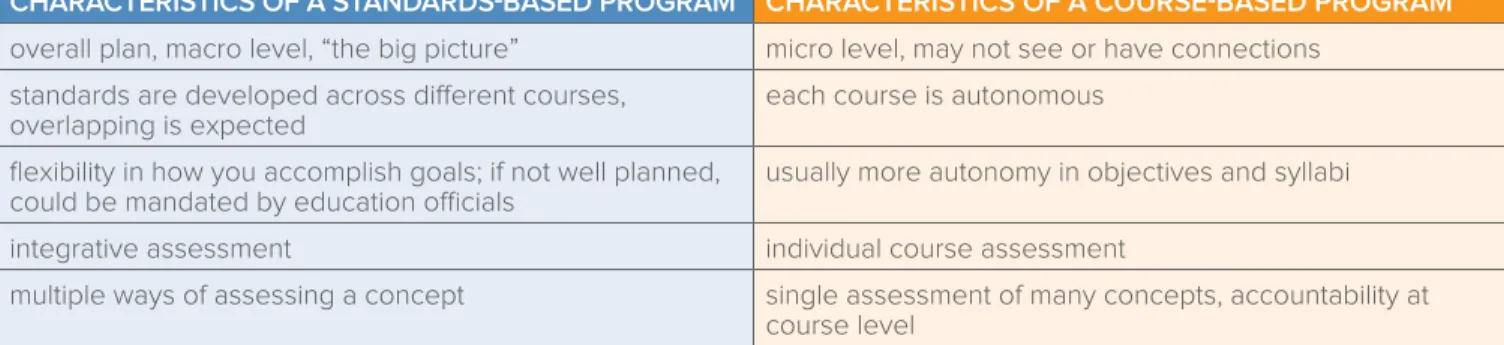
Table 2 summarizes some of the differences between a standards-based and a course-based program.
Assessment and Evaluation
As mentioned earlier, one needs to know where one is going (the standard) in order to know how to get there (the curriculum). However, how do we know when we have reached a benchmark or the goal? How do we know that teacher candidates have learned something?
It is critical when developing any standards that a well-artic-ulated assessment system is in place. Test scores are not sufficient; they only reflect what is known at one point in time—the product. In other words, they form a summative or overall evaluation. And because most tests are multiple choice in nature, they only require test takers to recognize the correct answer. They do not have to perform anything, which means those who administer the test do not know whether the students can practice what they have learned in the classroom.
CHARACTERISTICS OF A STANDARDS-BASED PROGRAM CHARACTERISTICS OF A COURSE-BASED PROGRAM
overall plan, macro level, “the big picture” micro level, may not see or have connections standards are developed across different courses,
overlapping is expected
each course is autonomous flexibility in how you accomplish goals; if not well planned,
could be mandated by education officials
usually more autonomy in objectives and syllabi integrative assessment individual course assessment
multiple ways of assessing a concept single assessment of many concepts, accountability at course level
A simple example will place the issue in focus. Would you prefer to go to a doctor who has only taken a series of multiple-choice tests about medicine, or to one who has been able to demonstrate his or her knowledge by actually performing in a medical situation? The same applies to a teaching situation. Would you go, or would you send your child, to someone who has taken multiple-choice exams to demonstrate that he or she has the knowledge to teach, or would you rather have teachers who have demonstrated in the classroom that they can teach?
The problem, of course, is that, in theory, the items in mul-tiple-choice tests are right or wrong. Because one or more people decide what to put on such tests, the only knowl-edge that is tested is what someone or some group has decided is important. Whether one person or a group of people prepare it, the test will likely reflect the preparers’ biases about what is important; in other words, tests are subjective.
Portfolios
For these reasons, in teacher preparation programs it is much better to determine the success of the teacher candidates by compiling key assignments, lesson plans, tests, and clinical experiences into a portfolio that provides a broad profile of the candidate. Teacher portfolios have a long history in education and provide both the breadth and depth of a teacher candidate’s accomplishments. Parts of a portfolio may include videos of candidates actually teaching in the classroom and projects that demonstrate an understanding of language development and a test of content knowledge, among other things (O’Malley & Valdez Pierce, 1996). For performance-based assessments such as are collected in portfolios, there are no right or wrong answers; there are degrees of competency, and in this case, they show whether candidates have met standards. However, portfolios should be specifically aligned to the standards used for the teacher preparation program.
Rubrics
A key to utilizing portfolios is establishing how they are evaluated. Rubrics provide a consistent way to determine the quality of the teacher candidate’s portfolio. Carefully constructed descriptions of what it means to “meet a stan-dard,” to “approach a stanstan-dard,” or to “exceed a standard” (Staehr Fenner & Kuhlman, 2012) can be used to deter-mine the readiness of the teacher candidate to become a licensed EFL teacher. Rubrics can also be used when portfolios are not part of the assessment and evaluation of
candidates, for example by determining individually if each PI of a standard has been met.
What are rubrics? The term rubric refers to a set of rules, guidelines, or benchmarks at different levels of perfor-mance. “The word rubric in the field of education refers to a scoring guide designed to provide constructive feedback to students by helping them think more clearly about the characteristics of quality work,” (Burke, 2011, p. 111). Numbers may be assigned to each level so that the measures can be quantified, although other ways of describing the levels might be used, such as grades of A, B, or C. Clear descrip-tions must be given for what the numbers (or grades) rep-resent if the rubrics are to be used consistently by various people (Burke, 2011; O’Malley & Valdez Pierce, 1996). Multiple-choice tests may function as a kind of rubric, depending on how they are constructed. Those multiple choice tests that use choices of always, sometimes, never
for an answer are a kind of rubric. The key is that there must be clear descriptions of what each element of the scale mean (in this case, always, sometimes, and never). Rubrics are most commonly used in performance-based assessment, which consists of any form of assessment in which the student constructs a response orally or in writing. (O’Malley & Valdez Pierce, 1996). Such assessment can be formal or informal, comprising an observation or an assigned task.
Any test that typically uses only right and wrong answers, such as multiple-choice norm-referenced tests used for achievement data, are not using rubrics. These tests typically focus on discrete skills. They may have breadth, but usually not depth. It would be difficult to use rubrics to score them.
Grades that have very specific criteria are a form of rubric. Without these criteria, students often will not have any idea on what their grades are based.
Types of rubrics. Rubrics can be holistic, analytic, or pri-mary trait, depending on what performance is to be rated (Del Vecchio & Guerrero, 1995). Holistic rubrics rate the overall performance with one score. Analytic rubrics sepa-rate out the key characteristics or break down the holistic score into key parts, such as breaking down an essay into introduction, body, and conclusion. Each part might form a category by itself. Primary trait rubrics rate the work based on one criterion, such as whether an essay is persuasive or not. Holistic rubrics are usually used as summative evalu-ation (at one point in time), whereas analytic and primary
trait rubrics are usually used as formative evaluations (used throughout the course or school year; Arter & McTighe, 2001).
The parts of the rubric. Good rubrics have several parts. First, a good rubric requires a task or assignment descrip-tion (i.e., what the students are supposed to do). Next, it needs a scale of some sort (e.g., levels of proficiency, grades). Then the dimensions of the assignment need to be determined (i.e., what knowledge and skills should be included). And, finally, the rubric needs a description of what is included in each level on the scale (Stevens & Levi, 2005).
Good rubrics are clearly written, consistent in format, detailed, clearly differentiate between levels, have limited criteria in each level (unless it’s a holistic rubric), and have consistent expectations.
The language used in rubrics can help to ensure that there are clear distinctions between levels. Table 1 provides examples of the language used in the TESOL P–12 Profes-sional Teaching Standards (2010).
Using rubrics is an excellent way to provide feedback to both the instructor and the student. A carefully developed rubric shows both the instructor and the teacher candidate how far the teacher candidate has traveled along a scale toward meeting the standards and becoming a new teach-er. Rubrics provide consistency and allow students to know how they are being assessed, and they provide teachers with specific, usable information to inform instruction. But no matter how carefully rubrics are constructed, it is import-ant to remember that all rubrics are subjective.
References and Glossary
References are helpful in showing educators what supports the standards, as in the case of the theoretical framework. The glossary provides an easy place to check the various concepts and terminology used in the standards.
The Standards Package
This section explained the components of the standards package: a theoretical framework, an organizational for-mat, the standards, performance indicators, a method for assessment and evaluation, and references and a glossary. The next section provides the step-by-step process need-ed to create the actual standards.
References
Agor, B., Gu, P., Hughes, J., Robbins, J., Zemach, D., & Zhang, W. (2005). A brief history of the CEFLS project. In T. Murphey & L. Chen (Eds.), Portfolio-based teacher development and appraisal with teacher performance standards: Teachers’ handbook (pp. 217–237). Alexan-dria, VA: TESOL International Association.
Arter, J., & McTighe, J. (2001). Scoring rubrics in the class-room: Using performance criteria for assessing and improving student performance. Thousand Oaks, CA: Corwin Press.
Burke, K. (Ed.). (2011). From standards to rubrics in 6 steps
(3rd ed.). Thousand Oaks, CA: Corwin Press.
Council of Chief State School Officers. (2011). InTASC model core teaching standards: A resource for state dialogue.
Retrieved from http://www.ccsso.org/Documents/2011/ InTASC_Model_Core_Teaching_Standards_2011.pdf Council of Europe. (2001). Common European framework
of reference for languages: Learning, teaching, assess-ment. Cambridge, United Kingdom: Cambridge Univer-sity Press.
Darling-Hammond, L. (1997). The right to learn: A blueprint for creating schools that work. San Francisco, CA: Jossey-Bass.
Del Vecchio, A., & Guerrero, M. (1995). Handbook of English language proficiency tests. Retrieved from http://www. ncela.gwu.edu/files/rcd/BE020503/Handbook_of_En-glish.pdf
Kuhlman, N. (2010). Developing foreign language teacher standards in Uruguay. GIST Education and Learning Research Journal, 4(1), 107–126.
Mahboob, A., & Tilakaratna, N. (2012). Toward a princi-ples-based approach for English language teaching policies and practices. [White paper]. Alexandria, VA: TESOL International Association.
National Council for Accreditation of Teacher Education. (2010, November). Transforming teacher education through clinical practice: A national strategy to prepare effective teachers. Retrieved from http://www.ncate.org/ LinkClick.aspx?fileticket=zzeiB1OoqPk%3D&tabid=715 O’Malley, J. M., & Valdez Pierce, L. (1996). Authentic
as-sessment for English language learners. New York, NY: Addison-Wesley.
Richards, J. (2011). Competence and performance in lan-guage teaching. Cambridge, United Kingdom: Cam-bridge University Press.
Seufert, P., Sherman, R., Amador, N., Condelli, L., Sil-ver-Pacuilla, H., Tetteyfio, S., Faller, B., Knight, L., & Ward, K. (2005). A process guide for establishing state adult education content standards. Washington, DC: Ameri-can Institutes for Research. Retrieved from http://www. adultedcontentstandards.ed.gov/ReferenceFiles/Guide/ Adult_Education_Process_Guide.pdf
Staehr Fenner, D., & Kuhlman, N. (2012). Preparing effective teachers of English language learners. Alexandria, VA: TESOL International Association.
Standards. (n.d.). Merriam-Webster’s online dictionary (11th ed.). Retrieved from http://www.merriam-webster.com/ dictionary/standard
Stevens, D., & Levi, A. (2005). Introduction to rubrics: An assessment tool to save grading time, convey effective feedback, and promote student learning. Sterling, VA: Stylus.
TESOL International Association. (2008). Standards for ESL/EFL teachers of adults. Alexandria, VA: Author. TESOL International Association. (2010). TESOL P-12
professional teaching standards (2nd ed.). Alexandria, VA: Author.
The group developing the standards should be guided by the needs of their particular context. They need not follow these guidelines in the order in which they are presented; they might even decide not to follow some of them. The decisions discussed at various points during the process may be made by the entire work group (or team) or by subgroups, but the process outlined in this section is for the work group as a whole.
In “A Process Guide for Establishing State Adult Education Content Standards,” Seufert and coauthors (2005) set out the following plan for creating content standards. This plan provides a good overview of the general process outlined in this section, although our process does not include all the of the “building blocks” listed below.
The foundation comprises a number of building blocks that will support a standards-based system, including (1) a vision to motivate the field to work toward a common goal, (2) a strategic plan that articulates the vision, (3) coherent and coordinat-ed policies and proccoordinat-edures that foster a systemic approach to continuous improvement through standards-based education, (4) financial resources that support the initiative, (5) staff to lead the initia-tive and to develop, review, align, and implement standards, and (6) a mechanism—to communicate to local programs the state’s expectations and policies for standards-based education. (p. 13)
The series of steps and decisions that follows is based on three strategic questions:
1. What is the basis for the standards, and what do you hope to achieve by developing them? In other words, what is the research base for the standards, what is their scope, and how will they be used?
2. How will the standards development project be executed? 3. What process(es) (internal and external) will be used to
prove validity?
Decisions
Decision: Goal and Theoretical Framework
Before standards can be created, some one or group must decide what the overall goal will be, including what makes a quality teacher and what research supports this goal. The theoretical framework, as defined in Part 2, supports the goal, identifies the quality teacher, provides the guiding structure for the standards, and represents the vision and direction of stakeholders.Decision: Domains or Principles Approach
As discussed in Part 2, a designated group will need to determine whether to take a conceptual approach to standards (principles) or a concrete and practical one (domains). Deciding which approach to use will help the group decide whether to adapt existing standards to current needs or create new ones.Process for Standards Development
03
This section provides step-by-step guidelines for either creating or adapting EFL teaching standards
to individual contexts. As we explain the process, we will pause at various points to discuss decisions
that the standards developers have to make before proceeding to the next step.
Decision: Use Existing Standards or
Create New Ones
Those developing the standards need to decide whether to create new standards or adapt existing standards to meet current needs.
If standards already exist that can be adapted to meet the stakeholders’ goals, and those standards were developed with an approach (domains or principles) that meets their needs, there is no point in starting from the beginning. The first step is to learn whether existing standards can be modified to meet the stakeholders’ needs: Are the exist-ing standards based on a sound theoretical framework? Do they take a domains or principles approach? Does this approach meet the stakeholders’ needs? Do they cover the content needed to prepare a quality teacher to teach in the stakeholders’ context?
In addition to the standards mentioned in these guidelines, existing standards can be found on the Internet by searching keywords such as educational organizations, national ac-creditation agencies, ministries of education, and program databases. Standards developers can also send surveys to TESOL affiliates to see which ones have EFL teaching standards.
The TESOL P–12 Professional Teaching Standards (2010), for example, is domains based and has been used in the United States as well as in other countries. The full set of standards can be found on the TESOL website, along with other standards developed by TESOL, including the Stan-dards for ESL/EFL Teachers of Adults (2008), which are ap-plicable to a broad variety of contexts. Australia and Israel also have such standards, and the European Union has the
Common European Framework of Reference for Languag-es: Learning, Teaching, Assessment (Council of Europe, 2001), which amounts to standards. Egypt and Mexico have also created teaching standards, and Albania, Uruguay, and Ecuador have adapted the TESOL standards (see Part 4). These existing standards or frameworks appear to have a great deal of content in common: They all include topics such as language structure, culture, and language acqui-sition and development. They also include methods of teaching including lesson planning, practice teaching, and assessing language growth, and most include professional-ism in some form.
Those making the decision whether to adapt existing stan-dards should also make sure that the conceptual frame-work of the existing standards meets stakeholders’ needs. They should also be aware that standards created in any
one country, such as the United States, Australia, or the United Kingdom, may emphasize the language and culture of those regions over others and may not meet the stake-holders’ needs; consequently, starting from the beginning may be necessary.
Guidelines for Evaluating
Existing Standards
The Common European Framework(CEFR; Council of Eu-rope, 2001) provides guidance that can be used to deter-mine if existing standards are appropriate. According to the CFR, the standards in question should be:
1. Open: capable of further extension and refinement 2. Dynamic: in continuous evolution in response to
experience using them
3. User friendly: presented in a form readily understand-able and usunderstand-able
4. Nondogmatic: not irrevocably and exclusively attached to any one of a number of linguistic theories or practices (adapted from Staehr Fenner & Kuhlman, 2012, p. 27) These four characteristics will help decision makers deter-mine whether existing standards can be adapted to meet stakeholders’ needs. In addition, the following questions should be considered:
1. What is the organizing format (e.g., domains, principles) and does it match the goals?
2. If there is to be an emphasis on clinical practice, does the existing set of standards have clearly stated clinical outcomes?
3. If the standards will be for existing teachers who wish to add EFL to their expertise, do the standards sufficiently emphasize the content knowledge needed to teach English?
4. Do the standards address issues of culture? Emphasis is a telling sign; if culture is embedded in a performance indicator (PI), rather than being a domain or principle of its own, then culture is not an important part of the stan-dards. If there is a principle that speaks to respect for the diversity of cultures in the world, and places an emphasis on such, then culture is important, as it should be. 5. How do the standards address the language proficiency
of the teachers? The TESOL standards have language proficiency only as a PI, but those standards were creat-ed primarily for U.S.-bascreat-ed teachers. In countries where
the primary language is not English, the proficiency of its teachers becomes critical. Many countries use the CEFR as their reference point to determine their teach-ers’ level of expertise, and their criteria can be modified into language proficiency standards. Others, such as the Pharos project in Egypt, discussed in Part 4, created their own language standards under a language domain (Snow, Omar, & Katz, 2004).
In summary, when determining if a set of existing standards are an appropriate starting place in the situation, it is nec-essary to determine how closely the standards model the kind of EFL teacher that is needed.
Adapting Standards
Many of the questions posed in making the decision to use existing standards will guide adapting existing standards to another context. In addition, whether the original standards were created for ESL or EFL teachers and how culture is treated need to be specifically addressed.
ESL to EFL
First, it is necessary to see to what extent the existing stan-dards are country-specific. This is particularly important if the standards were developed in English-medium coun-tries. Their focus would likely be on ESL, or what English is needed to survive in an English-medium country. Learning EFL may be intended simply as enrichment, opening em-ployment and economic opportunities, or providing access to the global media. In these cases, standards would have to be adapted from an ESL context to an EFL one. This would entail examining each standard and asking the ques-tion: does this apply to us? That question is the essential one in adaptation: what applies and what doesn’t, and how it can be changed so that it meets the current situation.
Culture
Culture is another area where adaptation of existing standards is often an issue, and it is central to EFL teach-ing (Meier, 2005). In a multicultural or pluricultural country, the standards would need to address teacher preparation both about indigenous cultures within the country that may affect learning English (English may be the third language learned in that case), and the culture of English medium populations; if the standards being considered were cre-ated for an audience that is monocultural, they would not address these issues. If a country is monocultural, then the
students and teachers will all come from more or less the same background, and the focus may just be on becoming knowledgeable about the culture of various English-me-dium contexts. Regardless, in addition, issues of cultural beliefs and how that may affect language learning need to be considered (Meier, 2005).
Other Suggestions
It will be necessary to go through the existing standards, word-by-word, to be sure they fit with the new context in which they will be used. While this can be tedious, it is necessary to make sure the adapted standards will be accepted by those who will use them. At some point these standards should be shared with other stakeholders, and they too should do a careful reading of the proposed stan-dards to see if they fit the context.
Creating New Standards
Decision: Desired Teacher Knowledge
and Ability
As with creating standards from existing ones, the first task that must be done is to decide on the goal and the theoretical framework that the teaching standards will rep-resent. As mentioned, a good way to start is by research-ing current studies on quality language teachresearch-ing (see for example, TESOL, 2010). Also, review existing standards from a variety of sources, which will provide ideas of what to include, even though they may not all be used as is, or may not be used at all. Another approach is to have a brainstorming session with various stakeholders and/or the work group about what qualities an EFL teacher should have (see Kuhlman, 2010).
Decision: Format or Approach
The next decision is whether the standards will be orga-nized around principles, domains, or something else, and what level of specificity they will have. If the standards are to be more general, which means that teachers will have more flexibility in their interpretation, there will be fewer PIs. If the desire is to have very specific guidelines or outcomes, then the model used by the People’s Repub-lic of China (PRC; Agor et al., 2005) could provide some guidance. In its program, the PRC organizes its format by beginning with domains and then breaking domains down to standards, PIs, and then elements.
Decision: Which English Will Be Used
Regardless of whether the work group will adapt existing standards or create new ones, they must decide early on what variety of English will be taught. This decision may affect the standards and will certainly affect how culture is taught. Although American and British English have probably had the most influence, and most countries lean toward one or the other, with the advent of English as an international language, new country-specific varieties are emerging. There is no “correct” version of English, and there is no universal English (McKay, 2012). Deciding which variety of English will be taught may be political as well. Whatever decision is made regarding the variety of English, it will affect the standards required for teachers.Decision: Language Proficiency
Standard and Evidence
This area of standards development is critical. Much has been written about native and nonnative English speakers as teachers and about Englishes in general (see Burns, 2005; Kachru & Nelson, 2001). TESOL has long supported nonnative English speakers in the field, and advocates against discrimination based on native language (TESOL, 2006). With English becoming the international language, many countries have evolved their own varieties of English, making the meaning of proficiency murkier. That said, and regardless of the variety of English used, teachers in many countries still have very low levels of English, so the ques-tion becomes: How much is enough?
In order to determine the language proficiency of their teachers, some countries may adopt the CEFR, because it has a thorough coverage of all aspects of English. Others may use any of several internationally developed language proficiency tests. The evidence gathered, hence, may differ from country to country. And what is considered proficient may vary as well.
Some will choose to create their own language standards to meet their specific needs. In some cases in which the goal is only to teach reading and writing, speaking and listening may not be part of teaching standards. In other situations, only speaking and listening may be required because students are only learning English for oral com-munication. For that matter, in some countries, the English teacher may not actually teach in English, but will teach in the country’s dominant language about English, instead relying on EFL textbooks. Ideally, of course, proficiency in all aspects of English will be required.
Evidence for the language proficiency standard may be established via standardized tests such as the TOEFL, the Cambridge Preliminary English Test (PET), the Cambridge Proficiency English Language Test (CPELT), the International English Language Testing System (IELTS), Pearson Test of English Academic (PTE Academic), and the Michigan Test of English Language Proficiency, among others. Some will merely take a written test, while others will be interviewed. Some may demonstrate their proficiency via a video of their teaching while others will have a portfolio. There are many options to demonstrate proficiency, depending on the standard determined.
Decision: Timeline
Usually, it is helpful if both short- and long-term timelines are made; otherwise, the program development may go on indefinitely. The easiest way to set up a long-term timeline is to work backward. Look at the end-point for approval of the standards, whether it is at the local or national level. If the standards will eventually be submitted to an accredi-tation agency (or other entity) for approval, determine the target date for submission. What other types of approval will be needed and by when (e.g., department, college, and university deadlines for curriculum proposals)? Going in reverse order will push the work group to meet internal (short-term) deadlines also.
Starting with short-term timelines can also work. Decide how long your team will take to create each draft, or each part of the draft (and be prepared to extend that time!). These deadlines will fill in the short-term timeline. That time estimate will include feedback on the various drafts from various constituents. Then, fill in how long a local entity will need for approval, and estimate the time needed for national approval. Seufert et al. (2005) have examples of timelines from various sources in their appendices.
Decision: Who Will Be Involved
One of the first considerations in determining who will be involved are the resources available to support the project. These resources will provide guidance as to the size of the team involved, the duration of the project, and other kinds of support available to help execute the project (e.g. adminis-trative support, financial resources to support meetings, etc.) In terms of project models, different models will work for different situations and institutions. Some examples of suc-cessful models include
• A large team comprising representative stakeholders, each contributing equally to the project.
• A large team making the content decisions, supported by a smaller group of writers to develop the text. • A small team executing initial drafts and soliciting
feed-back from different groups of stakeholders.
To determine who is on the team, project leaders can ask for volunteers or simply assign people. However, some of those who volunteer may have their own agendas, which may conflict with the project’s goals or cause such disrup-tion within the group as to make it dysfuncdisrup-tional. On the other hand if people are required to participate, those that do not really want to be involved may not complete their work, which holds the whole project back or forces others to make up the work.
Expertise. At the very least, the team must include people with expertise in each of the key EFL content areas (e.g. language, culture, instruction, assessment, and profession-alism), whether in the role of consultant or as core team members. It also needs to include opportunities for stake-holder input so that they take ownership of the product. These opportunities may be in the form of stakeholders serving as members of the development team or providing feedback during early stages of the project (e.g., comments on early drafts or participation in invitational working meet-ings). Those with strong expertise in writing also need to be included.
Compatibility. The compatibility of the team is also important. Team members need to be flexible, congenial, open-minded, and have enough trust in the whole team to feel comfortable challenging ideas that they may not agree with without hurting others’ feelings. They also need to be committed to making change.
Size. Obviously, the size of the team will depend on the needs of the project. A very small group of just two or three could mean that decisions would be made without stake-holder input. But when too many are involved, it is often difficult to come to consensus. Ideally, a large group would be chosen to elicit ideas, and smaller groups would write the initial draft or be responsible for individual domains or principles. Regardless of the size of the group, it is import-ant to ensure that all content/domain areas are covered and that all stakeholders (classroom teachers, current and past teacher candidates, administrators, ministry of educa-tion, etc.) have input.
Decision: Team Roles and Functionality
As with any cooperative group, each member needs to take on a role. If it is not predetermined, consideration should be given to who will lead the project (e.g., who will oversee its execution and how), content, writing, and opportunities for input by stakeholders. Regardless of the project model chosen, it should be clear who has the responsibility of lead-ing the project. Someone will need to organize meetlead-ings, set agendas, be responsible for communicating with others outside the work group, and ensure that the group remains on task. That person might assign the roles for others, but, as much as possible, the whole team needs to take responsibil-ity for the work to be done.Creating or Adapting Standards:
The Step-By-Step Process
Team Discussion
1. Discuss the project’s goals and why change is occurring. 2. Introduce standards and how they are created/adapted. 3. Review the expected tasks, timelines, and other
neces-sary details.
Team Practice: Write and Critique
After explaining what standards are and looking at and critiquing many examples of existing ones, have the team practice writing a few.1. Begin by having the whole team draft one standard (choose any related topic) using existing standards as a model, or start by adapting an existing standard to your context.
2. As a group, critique the standard. Does it meet the requirements described earlier? What type of standard is it (content, pedagogical, performance)?
3. Once everyone has agreed on the standard, break it down into two to three PIs. Use an existing standard as a model, or make up one.
4. After the group has discussed these PIs, design a rubric for each one. For this exercise, you might keep the rubric simple by using one similar to TESOL’s (e.g.,
approaches, meets, and exceeds). For consistency, use the language for three levels of performance (see Figure 3).
Break Into Subgroups
If creating or adapting standards using the domains approach, a subgroup may be formed for each domain. If using the principles approach, then a subgroup can be formed for each principle. Ideally, each subgroup will con-tain people with a range of expertise.
Subgroups can be formed in other ways, too. If teaching standards created for primary school will be different from the standards created for secondary school, and those will be different from the standards created for teachers of adults, then the subgroups may be formed by teach-ing level. In that case, each subgroup will create or adapt all standards for all the domains and/or principles. If the whole team is large enough, and different standards will be created by grade level, then within each group, subgroups can be formed for each domain or principle. If there are people on the team from both private and public schools and/or universities, it is useful to mix the subgroups so that all voices are heard. If the teaching standards will apply not just to English teachers, but to teachers of other languages, then those with expertise from all languages (linguistics, for example) should come together to work on a domain covering language.
Work Within Subgroups
Decide whether the individuals in each subgroup will work together to decide on content and write standards or whether, if there are sufficient numbers, pairs within the groups will work on individual standards. Set timelines and meet as a team regularly.
Critique Drafts
1. Come back together and share one standard from each group.
2. Create a checklist of what is strong and what needs work.
3. Trade the rest of the standards among subgroups (with their PIs and rubrics) and critique the standards until the whole group has seen all of the draft standards.
4. Return to subgroups and make revisions as necessary.
Stakeholder Critique
When all of the standards, PIs, and rubrics are written, and the writing team has shared and reached consensus, a new group needs to critique them. This group should rep-resent those who will be expected to meet the standards,
those who are practicing teachers, those who will teach the teachers, and any other relevant stakeholders. To facilitate this process, a plan should be developed for how feedback will be directly solicited and collected. The plan should include direct solicitation of important stakeholder groups and organizations, and the plan (and the time needed for it) should be included in the initial timeline. A survey form using a simple Likert scale, such as this is necessary/this is ok/ this isn’t necessary can be used to obtain feedback. Asking questions such as How important is this standard?, Is it clearly written, and Is it measurable? will usually obtain good results. Be sure to include a place for additional comments under each standard. Again, Seufert et al. (2005) have a variety of these types of feedback forms.
Subgroups Create the Assessment System
Having a system for assessing whether teacher candidates have met the standards is critical. A formal assessment plan is made in conjunction with the development of the stan-dards, not as an afterthought, and the plan clearly shows that candidates who finish the program have met the goals and are ready to teach EFL.What type of evidence will be required to show the meeting of the standards will also have to be decided. As mentioned in Part 2, a portfolio might be used and might include a variety of key assignments, including lesson or unit plans, a philosophy of teaching paper, a case study of student language growth, pre- and postevaluations of student learning, a clinical practice evaluation that may include an outside supervisor, and a self-evaluation by the candidate. A content knowledge test might also be used as part of the evidence.
Create or Modify the Teacher
Curriculum Coursework
Once the standards are complete, they need to be aligned to the existing teacher education program and changes should be made as needed, or if a new program is being created, the standards must inform what courses are devel-oped. Keep in mind that one course does not necessarily equal one standard. Standards may be partially met across courses in a standards-based program. For example, a standard on language development may have its founda-tion in a basic linguistics course along with a course on language acquisition. The application of this knowledge may occur in a methods course, and a determination whether the teaching is successful would be the focus of a language assessment course and clinical practice.
Pilot the Standards
Now that the standards have been created, and before full implementation, they need to be tried with a small group to see if they work, for example, with one group of teacher candidates at one university. If there is a 4-year preparation program, then the new program would not be fully imple-mented for 4 years, making it possible to make revisions and adjustments along the way as necessary. This process may include adjusting courses and revising the rubrics so that they are clear and easy to follow.
In some cases, existing programs will adopt the new courses and standards gradually, which allows for minor changes before the standards are completely implement-ed. Those candidates who have not yet completed the existing program will usually meet the old requirements as that program is phased out.
Questions that might be asked during the pilot include: 1. Are the standards fully covered in the curriculum? 2. Is there content in the coursework that is not included in
the standards and, if so, which needs to be modified? 3. Are the standards easy to assess as to whether teacher
candidates meet them?
4. Do teacher candidates understand the standards and how they will be assessed on them, and do the stan-dards support what EFL teachers need to know and be able to do?
Additional Revisions
After the standards are piloted, further revisions may need to be made, and courses may need to be adjusted.
Professional Development
Once standards have been created or adapted and approved for implementation in one or all EFL teacher preparation programs in the country, those who will be providing instruction for future teachers will need profes-sional development opportunities that introduce them to standards-based learning in general and the adopted standards, and to discuss how the new framework will be implemented. This professional development should include a discussion of revising courses, creating ways to show that standards are being met, and delineating what the instructors’ roles will be in making sure that all new EFL teachers meet them.
Full Implementation
Once everything is ready, the standards may be imple-mented slowly or all at once. Usually, teacher candidates already in progress would not be expected to meet the new standards, but it may be possible to require them to meet some of to the standards and gradually add more. New teacher candidates may begin their preparation program expecting to meet all of the standards. In a 4-year preparation program, full implementation would take 4 years.
Summary of Steps
Decisions
1. Decision: Goal and Theoretical Framework 2. Decision: Domains or Principles Approach
3. Decision: Use Existing Standards or Create New Ones
Evaluating Existing Standards Adapting Standards
Creating New Standards
1. Decision: Desired Teacher Knowledge and Ability 2. Decision: Format or Approach
3. Decision: Which English Will Be Used
4. Decision: Language Proficiency Standard and Evidence
5. Decision: Timeline
6. Decision: Who Will Be Involved 7. Decision: Team Roles and Functionality
Creating or Adapting Standards: The Step-By-Step Process
1. Team Discussion
2. Team Practice: Write and Critique 3. Break Into Subgroups
4. Work Within Subgroups 5. Critique Drafts
6. Stakeholder Critique
7. Subgroups Create the Assessment System
8. Create or Modify the Teacher Curriculum Coursework 9. Pilot the Standards
10. Additional Revisions 11. Professional Development 12. Full Implementation