185
Response of Barley Seedlings to Microwaves at 2.45 GHz
Cretescu Iuliana
*, Rodica Caprita, Velicevici Giancarla, Ropciuc Sorina,
Buzamat Genoveva
Banat’s University of Agricultural Sciences and Veterinary Medicine from Timisoara 300654-Timişoara, Calea Aradului 119, Romania
Abstract
The objective of the present study was to investigate the changes induced upon germination and growth rate, expressed by vigor index of barley seeds exposed to microwave (MW) treatment. As a microwave source was used a magnetron MWG20H, which emits radiation with a frequency of 2.45 GHz. In the experiment, barley seeds were exposed for 0s, 10s and 20s. The germination energy (GE) and germination (G), cotyledon length (CL), leaves length (LL) and roots length (RL) in cm were determined on the 3th, 7th and 14th day after irradiation in order to estimate the influence of microwave treatment on them. The hypothesis was that seeds exposed to MW will behave differently than those unexposed. It was observed that the best results in terms of GE, G and vigor index (SVI)were obtained in barley seeds for the treatment with output microwaves power of 400W for 20s.
Keywords: germination, genotype, growth, Hordeum vulgare L., microwave (MW)
1. Introduction
Cereals play such an integral part in global agriculture and diet. More than 50% of our food comes from three cereals: wheat, maize and rice [1]. An important step forward in the feeding of the world was the green revolution. Advances in plant breeding and the adoption of highly efficient production systems bring about of fourfold increase in grain yield during the second half of the twentieth century. But a continued, sustainable increase will be hard to realize without introducing modern cereals biotechnology and strong determination towards limitation of cereals grain losses during shipment and storage.
Barley (Hordeum vulgare L.) was one of the most important crop species in the World and had been subject to considerable genetic studies. It was a diploid (2n=2x=14), largely self-fertilizing species with a large genome [2].1
Oza et al. [3] used the microwave in the estimation of crop area, growth and phonological
* Corresponding author: Iuliana Cretescu, Tel: +40-256-277267, [email protected]
186
Сaragana arborescens Lam., Robinia
pseudoacacia L., Gleditsia triacanthos and
Laburnum anagyroides Med. [7], and influence on
the early stage development of lentil seeds (Lens
culinaris, Med.), [8]. The microwave radiation
used in the present study promoted grains germination, accelerated seedling development and growth, enhanced metabolic biosynthesis by increasing photosynthetic pigments. Literature in this field of study and the present study indicated that microwave radiation had a positive effect on some plants and had an adverse effect on others; thus we can suggest that microwave radiation effects may depend on: radiation frequency, exposure period and the environmental conditions [4, 9-12, 15].
The substitution of chemical methods of plant growth stimulation with physical ones can help avoid the pollution of food raw materials with toxic substances.
2. Materials and methods
The present experiment showed that germinating grains and growth rate of exposed barley seedling. The influence of microwave irradiation on seeds of barley has been investigated before. A MWG20H magnetron with a frequency of radiation of 2.45GHz and maximum output power of 800W according to supplier’s data has been used as microwave source. The maximum density of irradiation has been estimated at 40kW/m3. The experiment was conducted in the laboratories of the Faculty of Horticulture and Forestry, Timisoara. The biological material used in this study was a collection of 4 genotypes of Romanianwinter barley. The seeds were obtained from the Fundulea Agriculture Research Station. The seeds were initially treated with 1.5% sodium hypochlorite for 15 min. The residual chlorine was eliminated by thoroughly washing of the seeds with distilled water. The seeds for the experiment were distributed in two variants (V1-720W and V2–400W) with four time of exposure and 3 replicates each containing 25 seeds each. The seeds have been exposed to the microwave radiation for 0s (control-M), 10s, 20s, with two modifications of output powers of the magnetron– 400W and 720W, corresponding intensities– 20kW/m3 and 36kW/m3 respectively, have been applied. The seeds were then germinated on filter
paper in Petri dishes, in the growth chamber. The experiments have been performed under laboratory conditions. The natural light cycle was 9 h of light/14 h of darkness and the daily temperature was 21±2ºC, night temperature 15±2ºC.
During all the experimental period only distilled water was used to evaluate only the effects of microwave treatments. No other substances were added to distilled water and to seeds.
In order to estimate the influence of the microwave treatment on barley seeds, the following criteria were chosen:
The germination energy (GE) of seeds in %, determined on the 3th day after the start of the experiment–as a ratio of the number of germinated seeds to the total number of seeds for the corresponding variant;
The germination (G) of seeds in %, determined on the 7th day as a ratio of the number of germinated seeds to the total number of seeds; The germination capacity (%) was determined as percentage of germination (%)=SG Nr/ST Nr x100 where: Nr. SG–no. seeds germinated, Nr.ST-
no. seeds tested
length of stems (SL) and main roots (RL) in mm determined on the 3th, 7th and 14th day; Vigor index (SVI) was calculated as per equation by Abdul-Baki and Anderson (1997) [13];
Vigor Index=(Root length + Shoot length) x Germination percentage.
The obtained results were statistically processed using the monofactorial analysis of variance [14] and Principal Component Analysis (PCA) method.
3. Results and discussion
Table 1 showed the germination (G) and the germination energy (GE) for barley seeds when these was microwave irradiation with output powers of 400W (density of irradiation 20kW/m3) and 720W (density of irradiation 36 kW/m3), respectively and different times of exposure. Germination percentage of genotypes of barley
(Hordeum vulgare L.) is presented as an average
(±sx). The peculiarities of barley caryopsis germination are of particular importance for the success of crops, being influenced by a number of factors.
187 plant development, and is described by both characteristics–germination energy and germination. The treatments applying had determined decrease of germination percentage
proportional with increased of the time of exposure for output power 720W (density of irradiation 36 kW/m3.
Table 1. Results regarding germination percentage from 3, 7 days (GE and G)
Genotype Variant 3 days 7 days Time of exposure (s) Time of exposure (s)
10 20 10 20 Sistem 0W 100±0 100±0 100±0 100±0
400W 92±2.30 89.33±4.80 93,33±2.66 90.66±3.52 720W 96±2.30 89.33±3.52 96±2.30 92±4.0 Maresal 0W 100±0 100±0 100±0 100±0
400W 97.33±2.66 98.66±1.33 98.66±2.33 98.66±2.33 720W 98.66±1.33 90.66±2.66 100±0 97.33±2.30 Dana 0W 92±2.30 92±2.30 100±0 100±0
400W 96±2.30 100±0 97.33±1.33 100±0 720W 96±2.30 89.33±3.52 96±2.30 89.33±3.52 Cardinal 0W 88±4.61 88±4.61 100±0 100±0
400W 92±2.30 89.33±4.80 93.33±2.66 90.66±3.52 720W 96±2.30 89.33±3.52 96±2.30 92±4
For the coefficient of variation (Table 2) it was observed that for all genotypes germination percentage had a low variability (CV<10%). According to presented data in table 1 it could
observe both time of exposure and power of microwave had influence on germination percentage to all genotypes studied.
Table 2. Coefficient of variation for germination percentage from 3, 7 days (GE and G)
Genotype Variant 3 days CV(%) 7 days Time of exposure (s) Time of exposure (s)
10 20 10 20
Sistem 0W 0 0 0 0
720W 4.1 6.83 4.1 7.52 400W 4.34 9.31 4.93 6.73
Maresal 0W 0 0 0 0
720W 2.33 5.08 0 2.36
400W 4.73 2.33 2.33 2.33
Dana 0W 4.34 4.34 0 0
720W 4.16 6.83 4.16 6.83 400W 4.16 0 2.36 0
Cardinal 0W 9.09 9.09 0 0
720W 4.1 6.83 4.1 7.52 400W 4.34 9.31 4.93 6.73
It can be noticed that the highest results for GE
and G have been obtained after barley seeds were treated with the microwave output power 400 W. The obtained results were statistically interpreted using Principal Component Analysis (PCA) method.
188
Table 3. Correlation matrix (Pearson (n)) for all genotypes for germination percentage (G, GE)
Correlation matrix (Pearson (n))
Variables Sistem Maresal Dana Cardinal
Sistem 1 0.545 0.183 -0.046
Maresal 0.545 1 0.614 0.158
Dana 0.183 0.614 1 0.306
Cardinal -0.046 0.158 0.306 1
Figure 1. Biplot graphic of the principal components
for germination percentage at the studied barley
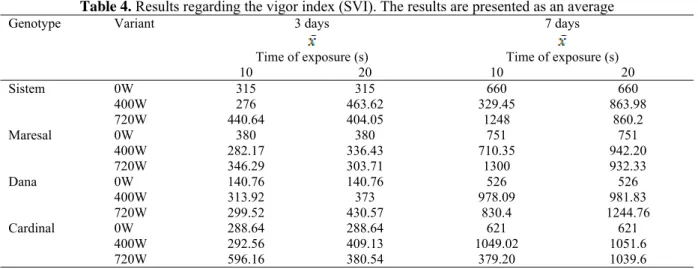
In Table 4 it is presented results regarding the vigor index (SVI). The results are presented as an average. For all 4 genotypes of output powers of the magnetron of 400W (density of irradiation 20kW/m3) we observed stimulation of the growth
(an increase inSVI) at 20s the timeofexposureto 10s the time of exposure. For 20s the time of exposure is a notice able growth stimulation compared with controls. At 720W the output
power of microwave radiation for Sistemand
Maresal genotypes observed a decrease in SVI during exposure to 20s than values obtained at
exposuretime of 10s. At3 days aftertreatment for
Dana genotype was observed an increase in SVI for output power of 720 W and 20s time of exposure. At Cardinalgenotypean increase inSVI for 20s timeofexposure at7 days after treatment was observed. At Dana and Cardinal genotypes the output power of microwave of 720W induces may delay growth stimulation.
Table 4. Results regarding the vigor index (SVI). The results are presented as an average
Genotype Variant 3 days 7 days
Time of exposure (s) Time of exposure (s)
10 20 10 20
Sistem 0W 315 315 660 660
400W 276 463.62 329.45 863.98
720W 440.64 404.05 1248 860.2
Maresal 0W 380 380 751 751
400W 282.17 336.43 710.35 942.20
720W 346.29 303.71 1300 932.33
Dana 0W 140.76 140.76 526 526
400W 313.92 373 978.09 981.83
720W 299.52 430.57 830.4 1244.76
Cardinal 0W 288.64 288.64 621 621
400W 292.56 409.13 1049.02 1051.6 720W 596.16 380.54 379.20 1039.6
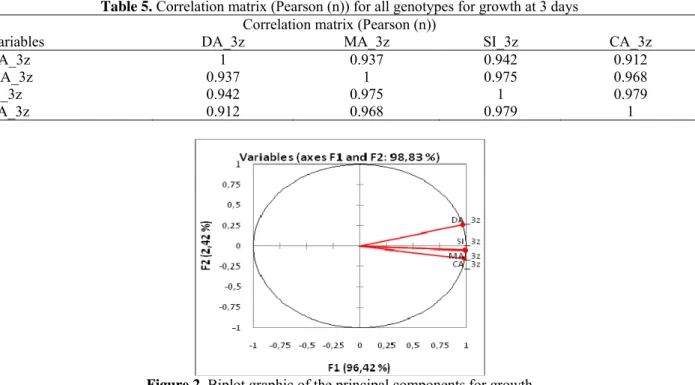
From Table 5 where it is presented correlation matrix (Pearson (n)) for growth at 3 days it can be
189 Cardinal-Maresal r=0.968***; Sistem-Dana, r=0.942***; Sistem-Maresal, r=0.975*** and
Maresal-Dana, r=0.937***). The data are placed in the a quadrant that the most tightly grouped.
Table 5. Correlation matrix (Pearson (n)) for all genotypes for growth at 3 days
Correlation matrix (Pearson (n))
Variables DA_3z MA_3z SI_3z CA_3z
DA_3z 1 0.937 0.942 0.912
MA_3z 0.937 1 0.975 0.968
SI_3z 0.942 0.975 1 0.979
CA_3z 0.912 0.968 0.979 1
Figure 2. Biplot graphic of the principal components for growth
at 3 days for the studied barley genotypes
From Table 6 where it is presented correlation matrix (Pearson (n)) for growth at 7 days it can be
observed a well correlate for Maresal and Dana genotypes (r=0.541**).
Table 6. Correlation matrix (Pearson (n)) for all genotypes for growth at 7 days
Correlation matrix (Pearson (n)):
Variables DA _7z MA_7z SI_7z CA_7z
DA _7z 1 0.541 0.164 0.267
MA_7z 0.541 1 0.166 0.016
SI_7z 0.164 0.166 1 -0.063
CA_7z 0.267 0.016 -0.063 1
Figure 3. Biplot graphic of the principal components for growth
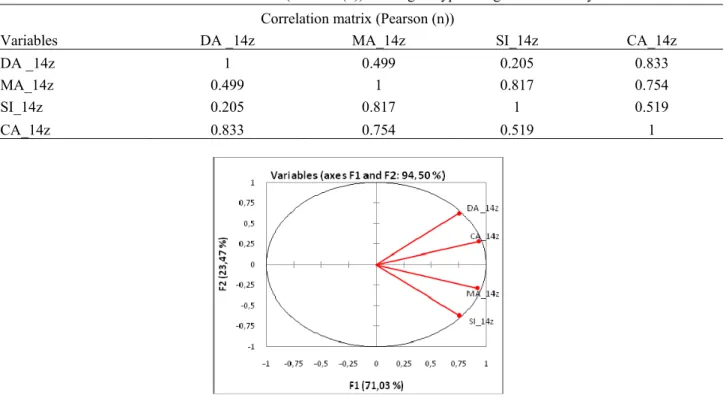
190 From Table 7 where it is presented correlation matrix (Pearson (n)) for growth at 14 days it can be observed a very well correlate for Sistem and
Maresal genotypes (r=0.817***); Cardinal-Dana (r=0.833***); Cardinal-Maresal (r=0.754***) and Sistem-Cardinal (r=0.519**).
Table 7. Correlation matrix (Pearson (n)) for all genotypes for growth at 14 days
Figure 4. Biplot graphic of the principal components for growth
at 14 days for the studied barley genotypes
4. Conclusions
The highest results for GE and G have been obtained after barley seeds were treated with the microwave output power 400 W. It has been obtained a very significant correlation for all genotypes to growth. The effect of the microwave radiation on the ultrastucture of cell organelles, enzymes activity, genetic changes and yield quality of different plants must be also investigated in order to prove the positive effect of microwave radiation on plants.
References
1. Morris, P. C., Palmer, G. H. and Bryce, J. H. Summary and conclusions, In: Cereal Biotechnology. P. C. Morris & J. H. Bryce, Ed. Woodhead Publishing Limited, Cambridge, England, 2000, pp. 237-242 2. Bennett, M. D. and Smith, J. B. Nuclear DNA amounts in angiosperms, Philosophical Transactions of the Royal Society of London B, 1976, 274 (933), 227– 274
3 Oza, S. R., Panigrahy, S., Parihar, J. S., Concurrent use of active and passive microwave remote sensing data for monitoring of rice crop, International Journal of Applied Earth Observation and Geoinformation, 2008, 10( 3), 296-304
4. Khalafallah, A. A., Samira M. Sallam,Response of maize seedlings to microwaves at 945 MHZ, Romanian J. Biophys., 2009, 19 (1), 49–62
5 Bhaskara Reddy, M. V., Kushalappa, A. C., Raghavan, G. S. V. and Stevenson, M. M. P., Eradication of seedborne Diaporthe phaseolorum in Soybean by microwave treatment. 66th Annual meeting of the Canadian Phytopathological Society, Toronto, 1995
6. Aladjadjian A., and Svetleva, D. Influence of Magnetron Irradiation on Common Bean (Phaseolus vulgaris L.) Seeds. Bulgarian Journal of Agricultural Science, 1997, 3, 741-747
7. Aladjadjiyan, A., Influence of microwave irradiation on some vitality indices and electroconductivity of perennial crops. Journal of Central European Agriculture, 2002c. 3(4), 271-2768. Aladjadjiyan, А., Effect of Microwave Irradiation on Seeds of Lentils (Lens Culinaris, Med.). Romanian Journal of Biophysics, 2010b, 20(3), 213-221
Correlation matrix (Pearson (n))
Variables DA _14z MA_14z SI_14z CA_14z
DA _14z 1 0.499 0.205 0.833
MA_14z 0.499 1 0.817 0.754
SI_14z 0.205 0.817 1 0.519
191
9. Aladjadjiyan, A., The effect of pre-sowing treatment by physical methods on seed germination in some ornamental tree species. Rastenievudni Nauki, 2003a, 30(2), 176-179
10. Aladjadjiyan, A., The effect of pre-sowing treatment by physical methods on seedlings length and fresh mass in some ornamental tree species. Rastenievudni Nauki,2003b, 30(3), 278 - 282
11. Aladjadjiyan, A., Use of physical factors as an alternative to chemical amelioration. Journal of Environmental Protection and Ecology (JEPE), 2003c, 4(1), 662-667
12. Aladjadjiyan, A., The Use of Physical Methods for Plant Growing Stimulation in Bulgaria. Journal of Central European Agriculture, 2007, 8(4), 369-380 13. Abdul-Baki, A. A., Anderson, J. D., Relationship between decarboxilation of glutamic acid and vigour in soybean seed, Crop Sci., 1973, 13, 222-226
14. Ciulca, S., Experimental methodology in agriculture and biology, Ed. Agroprint, Timisoara, 2006, pp.152-158