Blur Invariant Features for Exposing Region Duplication Forgery
Using ANMS and Local Phase Quantization
Diaa Mohammed Uliyan
Middle East University, Faculty of Information Technology, Amman, Jordan E-mail: [email protected]
Mohammad A. M. Abushariah
Computer Information Systems Department, King Abdullah II School of Information Technology The University of Jordan, Amman, Jordan
E-mail: [email protected] Ahmad M. Altamimi
Applied Science Private University, Faculty of Information Technology, Amman, Jordan E-mail: [email protected]
Keywords: copy-move forgery, image forgery detection, image forensics, local interest points, region duplication, segmented regions
Received: October 17, 2017
In digital image forensics, local interest points can be employed to faithfully detect region duplication forgery. Authentic images may be abused by copy-move forgery to fully contained duplicated regions such as objects.
Recent existing local interest point forgery detection methods fail to detect this type of forgery in the retouched regions by some geometric transformations. To solve this challenge, local interest points should be detected which cover all the regions with high primitives like corners and edges. These primitives represent the internal structure of any object in the image which makes them have a discriminating property under geometric transformations such as scale and rotation operation. They can be exposed based on Scale-Invariant Features Transform (SIFT) algorithm. Here, we provide an image forgery detection technique by using local interest points. First, the image is segmented based on fuzzy C means to divide the image into homogenous regions that have the same texture. Second, local interest points are exposed by extracting Adaptive non-maximal suppression (ANMS) from dividing blocks in the segmented image to detect such corners of objects. We also demonstrate that ANMS Keypoints can be effectively utilized to detect blurred and scaled forged regions. The ANMS features of the image are shown to exhibit the internal structure of copy moved region. We provide a new texture descriptor called local phase Quantization (LPQ) that is robust to image blurring and also to eliminate the false positives of duplicated regions. Experimental results show that our scheme has the ability to reveal region duplication forgeries under scaling, rotation and blur manipulation of JPEG images on MICC-F220 and CASIA v. 2 Image Datasets.
Povzetek: Predstavljena je izvirna metoda za odkrivanje ponarejenih področij v sliki.
1
Introduction
In the digital era, it is quite popular for expert users of image editing tools to manipulate images easily. Nowadays, we are facing the abuse of digital image tools, image forgery has begun to crumble the trustworthiness of visual images [12], that seeing is no longer believing. Image forgery has inspired researchers [20] to investigate and check the authenticity of digital images due to its effect to the judgment of the truth of suspected images in many sectors, such as digital newspapers, law evidence, medical documents, etc. Region duplication forgery is one of the most common image editing tools to abuse image. It is a simple operation that gives high visual impact to suspected images. Furthermore, it is known as Copy-move, cloning or region duplication. Copy-move forgery duplicates a region of an image and moves it to another
location within the same image. This type of forgery has a good effect which conveys misleading information in order to support an individual agenda.
image through some post-processing attacks. Such attacks include: blurring [43, 46], additive noise [38] and JPEG compression [19, 42] impacts are obtained after applying geometrical transformation operations. Hence, this type of forgery is a challenging problem that motivates us to investigate forged images against scale, rotation and blur attacks. As blurring could transform the features of any region in the image, further inspection of this attack should consider [43]. The blur transformation in the image features may also make the standard copy-move forgery detection methods struggle to detect the blurred duplicated regions. The proposed method starts a forensic job by collecting images that contain simple transformation attacks and blur attacks. The original images are collected from the Dataset MICC-F220 [4] and CASIA v2.0 [33]. Then, the proposed method is implemented to combine the Scale Invariant Feature with LPQ matching technique. We then compare the performance of the proposed method by F-scores with state-of-the-art methods: [4, 25, 39] and block-based methods: [3, 24].
The paper is organized into five sections. Section 2 highlights Related Works on copy-move forgery detection per some attacks included. Section 3 introduces the proposed method. In Section 4, it will discuss the experimental results and performance evaluation. In Section 5, the conclusion and future works are summrized.
2
Related works
The common flowchart of most copy-move forgery detection methods has six steps as shown in Figure 1. These steps are: 1) image preprocessing, 2) image division, 3) feature extraction, 4) building descriptor 5) matching and 6) show detection results. The first step is optional, which tries to improve the image content by defeating undesired noise. The most frequent preprocessing step is image color conversion be converting an RGB color image into grayscale image [32] by using the Eq. 1.
𝐺𝑟𝑎𝑦𝑠𝑐𝑎𝑙𝑒 = 0.228 𝑅 + 0.587 𝐺 + 0.114 𝐵 (1) Where R,G and B channels represent the Red, Green and Blue channels as pixel information in the image.
Rafsanjany et al. [17] converts the input RGB image to Gray scale and Lab color space. Then, they divided it into square blocks to extract features. Their method achieved
about 90% F-measure for JPEG images with size 512x512. Another color conversion is used such as YCbCr color system to give the luminance information Y or chrominance information Cb and Cr [26]. Shinfeng et al. [21] used YCbCr color system for image conversion and divide it into blocks, for each block, DCT coefficients are extracted to produce 64 bit feature vector. Later, they computed the probability of each block by identifying the period of the it’s histogram.
The main goal of the image conversion is to achieve the dimensionality reduction of the image features and extract the distinctive local interest points or visual features. This could help on performance the proposed copy-move forgery detection methods in the aspect of time complexity [13]. Similarly, Hue saturation Value (HSV) color space is used in method [31], which help to detect intense dark duplicated regions or bright regions with around 7.22 % false positive rate.
Based on the way of dividing the image on the second stage of copy-move forgery detection, these techniques are classified into three classes: block-based schemes [34], segmented regions-based schemes [41] and local keypoints based schemes [38]. In the block-based, the image is divided into a number of sub-blocks either square blocking or circle blocking. Similarly, segmented-based method tries to segment the image into different regions that fully covered the forged objects in the image based on color, texture and property palette properties. Conversely, the Keypoint based method detects local interest points to find primitive features in the image. The benefit of this stage is that can minimize the time complexity for matching step in order to search the similar feature vectors of building descriptor in an image compared to exhaustive search.
After image division, the feature extraction can help to choose the relevant data that exhibit the internal structure and its properties in the image. These features are saved into a feature vector. Finally, matching between two feature vectors is employed using the distance of the nearest neighbours from all points in the feature space to show forged regions.
Based on Copy-move forgery detection steps, common schemes focused on image division and feature extraction steps that exhibit invariant features against
geometric transformation and post-processing attacks. These schemes are introduced in details [37] as follows: I. Block-Based Methods divide the image into square or
circle blocks to extract features from these blocks as shown in Figure 2. The main advantage of this approach is that give high detection accuracy for the textured forged regions. But, it still gives high computational complexity due to exhaustive search between divided blocks in the image [34].
II. Segmented-Based MethodsSegment the input image into homogenous regions based on color or texture. This approach works well in the forged images that have duplicated objects [10].
III. Keypoint-Based Methodsdiscard block division step and use local interest point detectors to extract features. These features are distinctive to represent corners, edges or blobs in the image. Then, a robust texture descriptor is built to increase a reliability against geometric transformation attacks [37].
Different types of attacks have been considered in existing methods for detecting region duplication forgery. These methods are called Passive methods due to detecting image forgery without requiring explicit prior information. The main goal is to analyze the history of the image tampering blindly by examining pixel-level correlations [35].
In this article, popular feature extraction methods in copy-move forgery detection methods were covered for various geometric transformations and post-processing attacks. The robustness of detection methods depends on invariant features to possible attacks as pointed in [9]. Copy-move forgery detection methods based on type of features are classified into two classes: Frequency transform methods [16], Texture and intensity based methods [42].
A. Frequency Transform Methodsconvert the image pixel information into frequency domain to extract high frequency coefficients form the image. This approach is robust to JPEG compression and can detect duplicated regions with a large size 128 x 128 pixel. The limitations are the high computational complexity and struggle to detect duplicated regions with scale and rotation attacks. The frequency features are: Discrete cosine transform (DCT) [47], Fourier Transform (FT) [37], Discrete
wavelet transform (DWT) [27], Curvelet Transform (CT)[1] and Wiener Filter. The limitation of this approach is that features are sensitive to blur attack.
B. Texture And Intensity Based Methods extract features that exhibit image texture regions with the smoothness property. Various features have been used to detect textured duplicated regions in copy-move forgery detection methods for instance, Local binary Patterns (LBP), Histogram of Gradient (HOG), Zernike moments (Zm) [36] which is robust to rotation, log polar transform [28] that detects rotated duplicated regions, Principle component analysis (PCA) and Singular value decomposition (SVD) that reduce the size of feature vector to enhance the time complexity.
All of these methods that utilize frequency and texture features were employed in block-based methods and did not suppose that forged regions may be geometrically transformed. Another direction has been discovered to detect duplicated regions against scaling and rotations.
This can be done by keypoint-based approach for instance, Scale invariant transform features (SIFT), speed up robust features (SURF) [5] and Harris features. These features are slightly blur invariant. This motivates us to develop a blur invariant detection method to detect blurred forged duplicated regions in the suspected images.
Blurring is made effectively through image forgery process suing averaging of neighbor pixels in a square block [49]. The blur is commonly applied by Gaussian, defocus and motion blurs. In practice, the Gaussian blur filter is well known by users that do tampering in the image due to it’s simplicity. If the duplicated region is retouched by blur, then the main features of the blurred region are minimized and details cannot be seen.
Blurring on forged regions aims to manipulate region’s information and assists hiding retouch and blending artifacts. As a result, blurring allow the duplicated region to be consistent with its surrounding area. The scope of locating tampered regions attacked by blurring artifact is even smaller. Only few related papers have been discovered that deal with blur attack [5, 15, 49, 46, 23, 18].
Analysis was employed to achieve the dimensionality reduction of feature vectors, finally, they, used a kd tree to locate the duplicated regions. The weakeness of their method is that struggle to detect uniform duplicated regions and also gives high false positives. Another blur detection method is developed by Zhou et al. [49] for revealing blurred edges in the duplicated regions. Their method starts by preprocessing step to convert the image into binary one. Then, the method applied edge preserving–smoothing filters, followed by a mathematical morphology operation using the erosion filter to expose forged duplicated area with malicious blurred edges. The average accuracy rate about 89.26% in images with blurred edges manually attacked by the Gaussian noise filter. Zheng et al. [48] located tampered regions with blur attack via wavelet homomorphic filtering to represent pretty high frequency edges. Then, erosion operation was applied to expose blurred edges in forged reigon from normal regions which effectively reduced the false positive rates. Wang et al. [5] used non sub sampled contourlet transform (NCST) to examine manually blurred edges from duplicating regions. The detection of forged duplicated regions is done using support vector machine (SVM). In [46], blur artifacts were explored in forged regions by using combined blur and affine transform moments. The relative detection error was employed to estimate the stability of local invariant features deformed by Gaussian and motions blurs. The method achieved high accuracy rate with small feature vector. Guzin et al. [45] applied Object Removal operation from Uniform Background Forgery by adapting accelerated diffusion filter (AKAZE). The Local binary difference descriptor was built in AKAZE features which are scale invariant features. The size of feature vector is 486 bits. The performance of their method in terms of TPR is 85.74%, 71.35% and 76.73% against Gaussian blurring, rotation and JPG compression respectively.
The paper proposed a region duplication forgery detection scheme based on ANMS features and LPQ texture descriptor. In this paper, a part of the authentic image is copied and pasted to another area to mislead the semantic visual meaning of the image. While copy-move operation is applied, the duplicated region may be post-processed using rotation, scaling, blurring to create better forgery. The common pipeline of the proposed method is, first the input image is segmented-based on color features. Fuzzy C-means method is used to cluster and label the segments in the image. The centroid of each segment is
located in the image. We assume that forgery is made by for small regions. These regions can be detected by calculating the least frequent occurrence of labeled segments in the image. For each candidate segment, ANMS local interest points are extracted. ANMS features are scale invariant to represent the structure of segmented region. Second, each segment is split into 4 blocks, the size of the block is 4 x 4. The distribution of ANMS points the blocks of each segment contributes to detect duplicated regions against rotation. Third, blur invariant LPQ descriptor is built to the approximation of the ANMS points in each segment. Finally, the closest local keypoint search of features between two segments is employed by Generalized Nearest neighbor (G2NN) to improve the performance of our method in terms of True positive rate (TPR) and false positive rate (FPR).
3
Proposed method
In this section, we introduce in details the flowchart of the proposed method for exposing the copy-move forgery, with scaling and blurring of the cloned region. Our contribution is proposing a forensic keypoint-based method for blur and scale invariant copy-move forgery detection in digital images. A diagram representing the workflow of the proposed technique is shown in Figure 3.
3.1
Image preprocessing: color image
segmentation
membership criterion denotes that the sum of the membership value of a pixel to all clusters equals 1. The FCM clustering is an iterative optimization that minimizes the cost function which is described as follows:
𝐽 = ∑𝑛
𝑖=1 ∑𝑐𝑘=1𝜇𝑖𝑘𝑚|𝑝𝑖− 𝑣𝑘| 2 (2)
Where, an image I with n pixels to be partitioned into c clusters, pi represents the ith image pixels. 𝜇𝑖 is the fuzzy
membership value with fuzziness factor k >1. Here, the membership function 𝜇𝑖 with the centroid of Kth cluster Vk
is defined as follows: μik =
1
∑cl=1(|pi−vk|
|pi−vl|)
2 m−1⁄ (3)
vk=
∑ni=1μikm pi
∑ni=1μikm (4)
Here, vk denotes to the centroid of the kth cluster and |pi –
vk| refers to the Euclidean distance between two points: pi
and vk. By using the cluster information (c=5, maximum
number of iterations=10) and the pixel information pi from the forged image I with size 512 x 512, the homogeneous regions including copy-moved regions can be extracted as shown in Figure 4.
Consequently, each segment is split into 4 non overlapping blocks of 𝑏 x 𝑏 pixels, where 𝑏 = 4 as shown in Figure 4. We introduce below, the process of extracting features from these blocks to exhibit the internal structures of segments and achieve rotation invariance.
3.2
Adaptive Non Maxima Suppression
(ANMS) features
Keypoint-based methods are significantly helpful in detecting visual objects in the image. While the block-based shemes split the image into blocks, keypoint-block-based schemes identify and highlight only regions with high entropy, called the local interest points or keypoints. However, keypoints such as SIFT are robust against geometric transformations such as scaling. Hence, the major drawback is that keypoints may be insufficient or even none in the forged region of uniform texture. To avoid the drawback in SIFT based methods, we adopt the ANMS method which is an effective approach suggested by Brown, Szeliski, & Winder [6] to select uniformly distributed interest points for instance,
𝐾 = {𝐾1, 𝐾2, … , 𝐾 𝑚|𝐾 ∈ (𝜇𝐾𝑚, 𝑉𝐾𝑚)} in image and
provide the stability and good performance in scale and rotation through detection of duplicated regions. The principal of ANMS is to select 𝐾𝑚∈ 𝐾, Km is the
maximum neighborhood of region of interest with radius r pixels. K are generated from Harris corners can be described in Equation 5:
𝐸(𝜇, 𝑣)|(𝑥,𝑦)= ∑ 𝑤(𝑥, 𝑦)[𝐼(𝑥 + 𝑢, 𝑦 + 𝑣) − 𝐼(𝑥, 𝑦)]2 (5)
Where w(x,y) denotes a Gaussian kernel defined below and (u,v) is the minimal Euclidean distance.
𝑤(𝑥, 𝑦) = exp (−
1 2(𝑢
2+ 𝑣2)
𝜎2
⁄ ) (6) Where 𝜎 is the Standard Deviation. Then, Taylor series expansion is employed to the Equation of 𝐸(𝜇, 𝑣) to eliminate the weak interest points as follows:
𝐴 = 𝑤. 𝐼𝑥2, 𝐵 = 𝑤. 𝐼𝑦2,𝐶 = 𝑤. 𝐼𝑥 (7)
Here, . denotes the image convolution operator. Ix, Iy are
the horizontal and vertical directions in the image I. a corner response measure is defined as follows:
𝑍 = det(𝑉) − 𝛼 × 𝑡𝑟 2(𝑉),
where V= [𝐴 𝐶
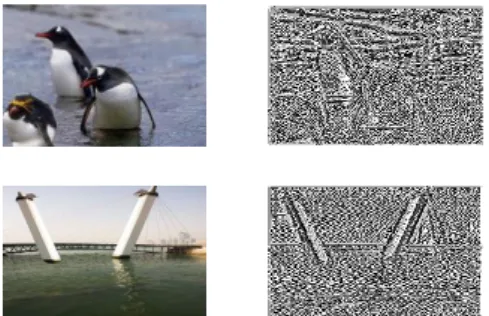
𝐶 𝐵] (8) 𝑉 is a matrix has two eigenvalues. 𝑡𝑟 is the trace of a matrix and 𝛼 = 0.06 in our method. Figure 5 shows the results obtained by the ANMS compared with the SIFT based method [22]. ANMS points are much better distributed in the image and represent the structure of windows object by local interest points such as corners. In Figure 5, two types of images are regarded: a)Arc - architecture content and b) Ani - animal content.
3.3
Local Phase Quantization (LPQ)
descriptor
Ojansivu et al. [30] proposed a blur invariant method to extract phase information in the Fourier transform domain and consider only the best energy of sampling low frequencies varying with blur changes. The blurring process in LPQ is applied by convolving the image with a Point Spread Function (PSF) which is defined as follows: g(x, y) = (f ∗ h)(x, y) + n(x, y) (9) Where, where g(x, y) denotes blurred image, f(x, y) represents the original image, h(x, y) is the PSF of blur and n(x, y) is the additive noise. Here * is the image convolution operator. In terms of frequency domain, the Equation 9 is converted to:
G(u, v) = (F ∗ H)(u, v) + N(u,v) (10) Where G(u,v), F(u,v) and H(u,v) dentote to the discrete Fourier transforms (DFT) of the blurred PSF image g(x,y), the original image f(x,y) and the PSF h(x,y), respectively. u,v are frequency coefficients in the blurred image. After
A B C
Figure 4: A) Original image, B) suspected image with duplicated regions and C) Segmented image using the FCM algorithm.
Arc-image content
Ani- image content
A) Forged image B) ANMS C) SIFT features
applying the Fourier transform, the image will have two parts: the real part 𝑅𝑒(𝑢, 𝑣) and imaginary part 𝐼𝑚(𝑢, 𝑣). Only real valued will be kept as follows:
𝐺(𝑢, 𝑣) = |𝑅𝑒{𝐹(𝑢, 𝑣)}| + |𝐼𝑚{𝐹(𝑢, 𝑣)} (11) Real valued parts are quantized based on scalar quantizer as follows:
𝑞𝑖= {1, 𝑖𝑓 𝑅𝑒𝑖
(𝑢, 𝑣) ≥ 0
0, 𝑜𝑡ℎ𝑒𝑟𝑤𝑖𝑠𝑒 } (12) Here 𝑞𝑖is the ith component of 𝑅𝑒(𝑢, 𝑣). The quantized
coefficients are integer values between 0-255.
Finally, LPQ descriptor, which is similar to Local binary pattern (LBP) [42] and is calculated as follows:
𝐿𝑃𝑄(𝑥, 𝑦) = ∑ 𝑞𝑖(𝑥, 𝑦) 2
𝑗−1
𝑗=8
𝑗=1 (13)
In Figure 6, an example of the computing LPQ for sample images from CASIA dataset and the duplicated regions are clearly recognized.
Figure 6: LPQ descriptor of sample images.
3.4
Forgery localization process
As discussed above, keypoints for each segmented region are extracted by ANMS. The LPC descriptor for each segment in the image was calculated to do matching between keypoints and discover the duplicated regions. The best matching between keypoints is founded by generalized nearest neighbor (G2NN) [4]. In G2NN, a ratio between closest keypoint 𝑑𝑖with the second nearest
neighbor 𝑑𝑖+1 is calculated as follows:
𝑑 = 𝑑𝑖
𝑑𝑖+1 ≤ 𝑇, 𝑇 ∈ [0,1] (14)
Where 𝑑 is Euclidean Distance, T is threshold value=0.89 in our experiments. x denotes the value on which the iterative procedure G2NN stops, then every keypoint related to a calculated distance in {𝑑1, 𝑑2, 𝑑3, 𝑑4. . . 𝑑𝑥} satisfies 1 ≤ 𝑥 < 𝑛, is regarded to be matched for keypoint. However, to search the similarity between two local keypoints, simply the proposed method evaluates the distance between two descriptors with respect to a global threshold T.
4
Experimental results
The performance of the blur invariant detection method was examined through a set of forged images were collected from two standard datasets, namely MICC-F220 and CASIA v2. Firstly, we introduce the experimental setup of our method and performance evaluation metric where used on detecting duplicated regions. These regions
have repetitive texture patterns which are required to make a convinced forgery via post-processing operation such as blurring and scaling. Then, the proposed method is evaluated with existing methods developed in [4], [10] and [39]. The details of the experiments are discussed below.
4.1 Evaluation metric
Our method is developed by MATLAB R2014a on Intel Core i5 processor, with 16 GB memory. The forged images under copy move forgery were collected from the first Dataset MICC-F220 which are produced by a well-known copy-move forgery detection method [4]. It consists of digital images from the Columbia photographic image repository [29] and their personal collection. MICC-F220 includes of 220 images with various sizes from 722 x 480 to 800 x 600 pixels. The size of the duplicated regions conceal about 1.2% of the whole image. The second Dataset (CASIA v2) has about 5123 forged images in JPEG Format with various quality factors. The image resolutions is varying from 240×160 to 900×600. A duplicated region on these images was copied and moved with considering the post-processing after copy move operation to finish the fake image generation; simple post-processing attacks comprising scaling, rotation, blurring, JPEG compression and additive noise. Here, A Gaussian blur filter is applied in duplicated pattern regions. The similarity threshold is set experimentally to T = 0.8 which give a high detection rate. The performance of the proposed detection scheme is evaluated via True Positive Rate (TPR) and False Positive
Rate (FPR). The evaluation metric is defined to include
others: True positive (TP), True negatives (TN), False positives (FP), False negatives (FN) and F-score calculated as follows:
F score= 2Tp
2Tp+FN+FP (15)
TPR=
No.of detected images as forged being forged
No.of forged images (16)
FPR=
No.of detected images as forged being original
No.of original images (17)
Where TP is the number of exposed forged images, FN is undetected forged images and FP is incorrectly detected original images.
4.2
Region duplication Forgery detection
without attacks
spend much time than Sift based method. The average detection time of the proposed method is about 13.8 seconds.
A B
C D
Figure 7: (A) Original image, (B) Forged image with Normal forgery, (C) Detection result of our method with TPR=96%, (D) Detection result of SFIT based
method with TPR=94% and FPR=7%.
4.3
Scale attacks
To examine the proposed method under scaling attack, Various scaling transformations with scaling Factors( SF=0.5,0.7,1,1.5) have been applied to images (A-D) in the dataset: MICC-F220, where Sx and Sy are scale factors applied to the x and y axis of the image part as shown in Figure 8.
A
Original image Forged image with Detection results
sx=0.5
B
Original image Forged image with Detection results Sy=0.7
C
Original image Forged image with Detection results Sy=1
D
Original image Forged image with Detection results
Sx=1.5
Figure 8: Detection of duplicated regions with horizontal and vertical scaling attacks.
Furthermore, the proposed method is examined to identify the optimal threshold T in the detection step to achieve the best detection rate for scaling attack. Table 1 shows that the value of 80% is identified as the best threshold value
where the best true positive rate (TPR) and false positive rate (FPR) results are achieved. The goal of our method is achieved the lowest FPR which means only a few percent of all images didn’t authenticate correctly; the TPR value is about 96% which means the majority of images in a dataset are authenticated correctly.
Threshold Value
Average TPR% Average FPR%
0.1 75% 20%
0.3 80% 36%
0.5 90% 10%
0.7 92% 12%
0.8 96% 7%
Table 1: Threshold estimation for images in MICC-F220 under scale attack with scaling Factors (SF=0.5, 0.7, 1, 1.5).
4.4
JPEG compression
Some experiments for JPEG compressions are addressed. The performance of our method is evaluated on a set of images compressed with various quality factors (QF=80, 70 and 50) as shown in Figure 9. The ROC curve in Figure 10 shows that the TPR and FPR of the proposed method are 90%, 4% respectively for JPEG quality factors up to 40.
A)Forged image B) Detection results with QF=50
C) Detection results with QF=70
D) Detection results with QF=80
Figure 9: The ability of our method to detect duplicated regions via various JPEG factors.
Figure 10: ROC curve in terms of TPR and FPR based on MICC-F220.
proposed method is still reliable and robust against JPEG compression even with a low quality factor such as Q=50.
4.5
Forgery with different block sizes
100 original images from CASIA v2 image are selected. For each original image and each duplicate region with a block size 32x32 pixels, 64x 64pixels and 96 x96 pixels, four forged images are created with the additive noise duplicated regions by SNRs (dB=10, 15,20,30). This results in 400 forged images in total. The detection performances of duplicated regions for each block size with additive noise are presented in Table 2. It shows the efficiency of the system in case of very high signal-to noise ratios.
4.6
Blurring Attack
Some experiments of detecting region duplication forgery under blur with their corresponding descriptors constructed by our method. Here, we use Gaussian blurs with radius varying from 0.5 to 2. The details are shown in Figure 11. Comparative study
As shown in Table 3, the proposed method is examined with a well known state of art methods such as keypoint-based methods: [4], [25], [39] and block-keypoint-based methods: [3], [24]. These methods focused on detecting region duplication forgery with different post-processing attacks for instance, scaling and blurring.
Table 3 shows that, the proposed scheme gives a TPR=97%, which is better than TPRs in the methods: [25] and [39] due to the robustness of ANMS features against scale and blur attacks compared with SURF features. [4] method gives high FPR due to the weakness
of SIFT method to detect local keypoints of duplicated regions when the textures of some forged regions are
almost in uniform, since the local extrema may not exist in such region. The FPR is about 3% which is less than FPR of [25] method due to G2NN clustering technique to find best matching. The proposed method extract local phase quantized coefficients from divided regions 4 x4 in the image. LPQ texture descriptor is insensitive to blurring manipulations which gives a high F-score=97% for detecting this type of forgery compared with [3] method and [24] method.
Methods TPR% FPR% Fscore% Features Block size Time(s)
Amerini et al. 2011 [4] 100 8 81.40 SIFT NA 4.94
Mishra et al. 2013 [25] 73.6 3.64 NA SURF and HAC 4 x4 2.58
Silva et al. 2015 [39] 94.08 1.70 NA SURF on HSV color features
Circle block with radii=4
18.81
Alkawaz et al. 2016 [3] 96.579 NA 75.166 DCT 4 x4 296.74
Mahmood et al. 2017 [24] 96.606 NA 96.05 Stationary wavelet transforms (SWT)
4 x4 NA
The proposed method 97 3 97.05 ANMS and LPQ 4 x4 13.80
Table 3: The overall performance of the proposed compared with the state of the art methods on MICC-F220.
SNR (dB)
Block size
32 x 32 64 x 64 96 x 96
TPR FPR TPR FPR TPR FPR
10 96% 6% 95% 6% 97% 3%
15 96% 8% 94% 8% 96% 8%
20 95% 8% 93% 8% 95% 15%
30 94% 10% 93% 10% 95% 15%
Table 2: The detection performance of region duplication forgery with different block size from images in CASIA v2.
Images:A and B
Blur radius=0.5
A
Blur radius =1.5
B
C D
LPQ Descriptor
Histograms of selected regions in LPQ descriptor
E
F
Figure 11: Illustrating region duplication forgery detection by local phase quantized coefficients from images on CASIA v2. (A) Image “window” has blurred duplicated region with (Gaussian blur radius = 0.5) which highlighted by the red rectangle. Image (B) has blurred duplicated region with (Gaussian blur radius = 1.5). (C) and (D) are LPQ image maps of (A) and (B) to extract a significant features of internal structure of foreground objects. (E) and (F) The histograms of selected regions in LPQ descriptor show the similarity of features between blurred region and Normal region.
0 0.005 0.01 0.015 0.02 0.025 0.03 0.035 0
20 40 60 80 100 120 140 160 180 200
0 0.005 0.01 0.015 0.02 0.025 0.03 0.035 0
20 40 60 80 100 120 140 160 180
0 0.005 0.01 0.015 0.02 0.025 0.030.035 0.04 0
50 100 150 200 250
0 0.005 0.01 0.015 0.02 0.025 0.03 0.035 0.04 0
5
Conclusion
In this paper, robust features such as local interest points play an important rule to expose copy move forgery on images. ANMS keypoints and LPQ texture descriptor have been proposed. The use of image preprocessing like color segmentation has reduced the FPR in the suspected image. Clustering segmented regions in the image based on fuzzy C means will increase the TPR of matching duplicated regions over ANMS keypoints. From the suspected forged images, the proposed method can find the duplicated regions, even if they are post-processed by some transformations like scaling or blurring. Future works will focus on image forgery with reflections and illumination changes.
Acknowledgment
The authors are grateful to the Middle East University, Amman, Jordan for the financial support granted to cover the publication fee of this research article.
References
[1] Al-Hammadi, M. H., G. Muhammad, M. Hussain and G. Bebis (2013). Curvelet transform and local texture based image forgery detection. International Symposium on Visual Computing, Springer, DOI: https://doi.org/10.1007/978-3-642-41939-3_49 [2] Al-Qershi, O. M. and B. E. Khoo (2013). Passive
detection of copy-move forgery in digital images: State-of-the-art. Forensic science international 231(1): 284-295,
DOI: https://doi.org/10.1016/j.forsciint.2013.05.027 [3] Alkawaz, M. H., G. Sulong, T. Saba and A. Rehman (2016). Detection of copy-move image forgery based on discrete cosine transform. Neural Computing and Applications: 1-10,
DOI: https://doi.org/10.1007/s00521-016-2663-3 [4] Amerini, I., L. Ballan, R. Caldelli, A. Del Bimbo and
G. Serra (2011). A sift-based forensic method for copy–move attack detection and transformation recovery. Information Forensics and Security, IEEE Transactions on 6(3): 1099-1110,
DOI: 10.1109/TIFS.2011.2129512
[5] Bo, X., W. Junwen, L. Guangjie and D. Yuewei (2010). Image copy-move forgery detection based on SURF. Multimedia Information Networking and Security (MINES), 2010 International Conference on, IEEE, DOI: 10.1109/MINES.2010.189
[6] Brown, M., R. Szeliski and S. Winder (2005). Multi-image matching using multi-scale oriented patches. Computer Vision and Pattern Recognition, 2005. CVPR 2005. IEEE Computer Society Conference on, IEEE, DOI: 10.1.1.124.3167
[7] Chen, M. and S. A. Ludwig (2017). Color Image Segmentation Using Fuzzy C-Regression Model. Advances in Fuzzy Systems 2017,
DOI: https://doi.org/10.1155/2017/4582948
[8] Cheng, H.-D., X. H. Jiang, Y. Sun and J. Wang (2001). Color image segmentation: advances and prospects. Pattern recognition 34(12): 2259-2281, DOI: https://doi.org/10.1016/S0031-3203(00)00149-7
[9] Christlein, V., C. Riess, J. Jordan and E. Angelopoulou (2012). An evaluation of popular copy-move forgery detection approaches. IEEE Transactions on Information Forensics and Security 7(6): 1841-1851, DOI: 10.1109/TIFS.2012.2218597 [10] Cozzolino, D., G. Poggi and L. Verdoliva (2015).
Efficient dense-field copy–move forgery detection. IEEE Transactions on Information Forensics and Security 10(11): 2284-2297,
DOI: 10.1109/TIFS.2015.2455334
[11] Dadkhah, S., M. Köppen, H. A. Jalab, S. Sadeghi, A. A. Manaf and D. M. Uliyan (2017). Electromagnetismlike Mechanism Descriptor with Fourier Transform for a Passive Copy-move Forgery Detection in Digital Image Forensics. ICPRAM, DOI: 10.5220/0006232206120619
[12] Farid, H. (2008). Digital image forensics. Scientific American 298(6): 66-71,
DOI: doi:10.1038/scientificamerican0608-66 [13] Gan, Y. and J. Zhong (2014). Image copy-move
tamper blind detection algorithm based on integrated feature vectors. Journal of Chemical and Pharmaceutical Research 6(6): 1584-1590, DOI: [14] Guo, J.-M., Y.-F. Liu and Z.-J. Wu (2013).
Duplication forgery detection using improved DAISY descriptor. Expert Systems with Applications 40(2): 707-714,
DOI: https://doi.org/10.1016/j.eswa.2012.08.002 [15] Hsiao, D.-Y. and S.-C. Pei (2005). Detecting digital
tampering by blur estimation. Systematic Approaches to Digital Forensic Engineering, 2005. First International Workshop on, IEEE,
DOI: 10.1109/SADFE.2005.8
[16] Huang, Y., W. Lu, W. Sun and D. Long (2011). Improved DCT-based detection of copy-move forgery in images. Forensic science international 206(1): 178-184,
DOI: https://doi.org/10.1016/j.forsciint.2010.08.001 [17] Kushol, R., M. S. Salekin, M. H. Kabir and A. A. Khan (2016). Copy-Move Forgery Detection Using Color Space and Moment Invariants-Based Features. Digital Image Computing: Techniques and Applications (DICTA), 2016 International Conference on, IEEE,
DOI: 10.1109/DICTA.2016.7797027
[18] Li, H. and J. Zheng (2012). Blind Detection of Digital Forgery Image Based on the Edge Width. Intelligent Science and Intelligent Data Engineering. Y. Zhang, Z.-H. Zhou, C. Zhang and Y. Li, Springer Berlin Heidelberg. 7202: 546-553,
DOI: 10.1007/978-3-642-31919-8_70
[19] Li, X.-h., Y.-q. Zhao, M. Liao, F. Shih and Y. Shi (2012). Passive detection of copy-paste forgery between JPEG images. Journal of Central South University 19(10): 2839-2851,
[20] Li, Y. (2012). Image copy-move forgery detection based on polar cosine transform and approximate nearest neighbor searching. Forensic science international 224(1-3): 59-67,
DOI: https://doi.org/10.1016/j.forsciint.2012.10.031 [21] Lin, S. D. and T. Wu (2011). An integrated technique for splicing and copy-move forgery image detection. Image and Signal Processing (CISP), 2011 4th International Congress on, IEEE,
DOI: 10.1109/CISP.2011.6100366
[22] Lowe, D. G. (1999). Object recognition from local scale-invariant features. Computer vision, 1999. The proceedings of the seventh IEEE international conference on, Ieee,
DOI: 10.1109/ICCV.1999.790410
[23] Mahdian, B. and S. Saic (2007). Detection of copy– move forgery using a method based on blur moment invariants. Forensic science international 171(2): 180-189,
DOI: https://doi.org/10.1016/j.forsciint.2006.11.002 [24] Mahmood, T., Z. Mehmood, M. Shah and Z. Khan (2017). An efficient forensic technique for exposing region duplication forgery in digital images. Applied Intelligence: 1-11,
DOI: https://doi.org/10.1007/s10489-017-1038-5 [25] Mishra, P., N. Mishra, S. Sharma and R. Patel
(2013). Region duplication forgery detection technique based on SURF and HAC. The Scientific World Journal 2013,
DOI: http://dx.doi.org/10.1155/2013/267691 [26] Muhammad, G., M. H. Al-Hammadi, M. Hussain, A.
M. Mirza and G. Bebis (2013). Copy move image forgery detection method using steerable pyramid transform and texture descriptor. EUROCON, 2013, IEEE, DOI: 10.1109/EUROCON.2013.6625188 [27] Muhammad, G., M. Hussain and G. Bebis (2012).
Passive copy move image forgery detection using undecimated dyadic wavelet transform. Digital Investigation 9(1): 49-57,
DOI: https://doi.org/10.1016/j.diin.2012.04.004 [28] Myrna, A., M. Venkateshmurthy and C. Patil (2007).
Detection of region duplication forgery in digital images using wavelets and log-polar mapping. Conference on Computational Intelligence and Multimedia Applications, 2007. International Conference on, IEEE,
DOI: 10.1109/ICCIMA.2007.271
[29] Ng, T.-T., S.-F. Chang, J. Hsu and M. Pepeljugoski (2005). Columbia photographic images and photorealistic computer graphics dataset. DOI: [30] Ojansivu, V. and J. Heikkilä (2008). Blur insensitive
texture classification using local phase quantization. International conference on image and signal
processing, Springer, DOI:
https://doi.org/10.1007/978-3-540-69905-7_27 [31] Panzade, P. P., C. S. Prakash and S. Maheshkar
(2016). Copy-move forgery detection by using HSV preprocessing and keypoint extraction. Parallel, Distributed and Grid Computing (PDGC), 2016 Fourth International Conference on, IEEE, DOI: 10.1109/PDGC.2016.7913156
[32] Peng, F., Y.-y. Nie and M. Long (2011). A complete passive blind image copy-move forensics scheme based on compound statistics features. Forensic science international 212(1): e21-e25, DOI: https://doi.org/10.1016/j.forsciint.2011.06.011 [33] Peng Gao, H. Z., Ruier Guo, Jingli Liu, Lihu Ma, Jin
Zhang and Qian He. (2009). CASIA Image Tempering Detection Evaluation Database (CAISA TIDE) V2.0. Retrieved 23, May 2016, from http://forensics.idealtest.org/casiav2/.
[34] Qazi, T., K. Hayat, S. U. Khan, S. A. Madani, I. A. Khan, J. Kołodziej, H. Li, W. Lin, K. C. Yow and C.-Z. Xu (2013). Survey on blind image forgery detection. IET Image Processing 7(7): 660-670, DOI: 10.1049/iet-ipr.2012.0388
[35] Redi, J. A., W. Taktak and J.-L. Dugelay (2011). Digital image forensics: a booklet for beginners. Multimedia Tools and Applications 51(1): 133-162, DOI:
[36] Ryu, S.-J., M.-J. Lee and H.-K. Lee (2010). Detection of copy-rotate-move forgery using Zernike moments. Information Hiding, Springer, DOI: https://doi.org/10.1007/978-3-642-16435-4_5 [37] Sadeghi, S., S. Dadkhah, H. A. Jalab, G. Mazzola and D. Uliyan (2017). State of the art in passive digital image forgery detection: copy-move image forgery. Pattern Analysis and Applications: 1-16, DOI: 10.1007/s10044-017-0678-8
[38] Sadeghi, S., H. A. Jalab, K. Wong, D. Uliyan and S. Dadkhah (2017). Keypoint based authentication and localization of copy-move forgery in digital image. Malaysian Journal of Computer Science 30(2): 117-133, DOI: https://doi.org/10.22452/mjcs.vol30no2.4 [39] Silva, E., T. Carvalho, A. Ferreira and A. Rocha
(2015). Going deeper into copy-move forgery detection: Exploring image telltales via multi-scale analysis and voting processes. Journal of Visual Communication and Image Representation 29: 16-32, DOI: https://doi.org/10.1016/j.jvcir.2015.01.016 [40] Uliyan, D. M., H. A. Jalab, A. W. Abdul Wahab and
S. Sadeghi (2016). Image Region Duplication Forgery Detection Based on Angular Radial Partitioning and Harris Key-Points. Symmetry 8(7): 62, DOI: https://doi.org/10.3390/sym8070062 [41] Uliyan, D. M., H. A. Jalab, A. Abuarqoub and M.
Abuhashim (2017). Segmented-Based Region Duplication Forgery Detection Using MOD Keypoints and Texture Descriptor. Proceedings of the International Conference on Future Networks and Distributed Systems, ACM,
DOI: 10.1145/3102304.3102310
[42] Uliyan, D. M., H. A. Jalab and A. W. A. Wahab (2015). Copy move image forgery detection using Hessian and center symmetric local binary pattern. Open Systems (ICOS), 2015 IEEE Confernece on, IEEE, DOI: 10.1109/ICOS.2015.7377269
DOI: https://doi.org/10.1016/j.eswa.2016.07.026 [44] Uliyan, D. M. H. (2016). Region Duplication
Forgery Detection Technique Based on Keypoint Matching, Fakulti Sains Komputer dan Teknologi Maklumat, Universiti Malaya.
[45] Ulutas, G. and G. Muzaffer (2016). A New Copy Move Forgery Detection Method Resistant to Object Removal with Uniform Background Forgery. Mathematical Problems in Engineering 2016, DOI: http://dx.doi.org/10.1155/2016/3215162 [46] Wang, T., J. Tang and B. Luo (2013). Blind detection
of region duplication forgery by merging blur and affine moment invariants. Image and Graphics (ICIG), 2013 Seventh International Conference on, Qingdao, China, IEEE,
DOI: 10.1109/ICIG.2013.61
[47] Zhao, J. and J. Guo (2013). Passive forensics for copy-move image forgery using a method based on DCT and SVD. Forensic science international 233(1): 158-166,
DOI: 10.1016/j.forsciint.2013.09.013
[48] Zheng, J. and M. Liu (2009). A digital forgery image detection algorithm based on wavelet homomorphic filtering. Digital Watermarking, Springer: 152-160, DOI: https://doi.org/10.1007/978-3-642-04438-0_13