Mitigating Malicious Attacks Using
Trust Based Secure-BEFORE Routing
Strategy in Mobile Ad Hoc Networks
Rutuja Shah, Sumathy Subramaniam and Dhinesh Babu Lekala Dasarathan
School of Information Technology and Engineering, VIT University, Vellore, IndiaMobile ad hoc Networks (MANET), being infrastruc-tureless and dynamic in nature, are predominantly sus-ceptible to attacks such as black hole, worm hole, cun- ning gray hole attack at source or destination. Various solutions have been put forth so far in literature in or-der to mitigate the effects of these attacks on the net-work performance and to improve the reliability of the network. However, these attacks are still prominently a serious threat in MANET. Hence, a trust based rout-ing strategy termed Secure-BEFORE routrout-ing (BEst FOrwarding Route Estimation) is proposed to ensure optimal route estimation in computing the trust value and hop counts using the dummy packets inside the network at 1-hop level. It is observed that the overall performance of the network is improved in provid-ing one-hop level security by maintainprovid-ing the packet equivalence ratio. Malicious and suspicious nodes are isolated and eliminated from the network, based on their behavior.
ACM CCS (2012) Classification: Security and privacy
→ Network security → Mobile and wireless security
Keywords: black hole attack, gray hole attack, worm hole attack, secure-BEFORE routing, SRNT (MANET)
1. Introduction
Mobile ad-hoc networks are more susceptible to more security breaches than the wired networks. Self configuring infrastructure and dynamic na-ture without any centralized controller to co-or-dinate packet transmission poses challenges in identifying and addressing the security issues. Mobility of the nodes in mobile ad hoc net-works leads to frequent changes in the topology of the network. Nodes joining and leaving the
network require monitoring and subsequently authenticating to ensure if they are genuine. Unauthentic participation of malicious or suspi-cious nodes attempts to reduce the performance of the network. Challenges faced due to packet drop attacks in mobile ad hoc networks are ad-dressed to an extent by a fellowship model as discussed by Balakrishnan and Varadharajan [1]. A one hop restricted route reply is used as a status reply when a genuine node forwards a packet. However, MANETs have come across serious security threats which tend to affect the end-to-end delay, buffer mechanism, response time and in general overall throughput of the network leading to performance degradation. Hence, it is difficult to manage such networks economically.
Ad hoc networks face the security threats due to certain attacks experienced by the nodes which are categorized under packet drop attacks such as worm hole, gray hole and black hole attacks. These attacks usually vary from each other depending upon the strategy of the attack, fre-quency of the attack and losses caused to the network due to the attack.
it through another route instead of forwarding it to the required destination. Such relayed pack-ets are then diverted to a group of malicious nodes which never delivers the packet to the intended destination node. Gray hole attacks are hard to handle since the malicious nodes of-ten change their behavior. Gray hole attack at source is a type of attack in which the malicious nodes drop all the packets originating from a particular source. Similarly, gray hole attack at destination is a type of attack in which the malicious nodes drop all the packets destined to a particular destination inside the network. Thus, in both cases the packet delivery ratio is affected, which leads to poor throughput of the network.
Various attacks (both external and internal) have been responsible for deterioration of the overall network performance of MANET. In or-der to mitigate their effects, there is a need for a strong optimum solution which could sentinel the mobile ad hoc network against such attacks periodically. This work attempts to address the node capturing attacks with secure before rout-ing strategy in buildrout-ing trust among the nodes in mobile ad hoc networks.
Section 2 provides a brief review of the litera-ture highlighting the background on the effects of various malicious attacks and different fense mechanisms. Section 3 elaborates the de-tailed system design proposed. Section 4 covers the implementation methodology and Section 5 highlights the simulation results with discus-sions. Section 6 gives the concluding remarks with Section 7 highlighting the future scope.
2. Background
Gupta and Pandey [2] have proposed a trust based routing algorithm considering the honest value of the participating nodes with Ad hoc On-Demand Distance Vector Routing (AODV) as the routing protocol. The honest value also known as trust value is used in addition to the hop count. Honest value is incremented during Route Request (RREQ) phase and decremented during Route Replay (RREP) phase, depending on the hop value and then the best path is ar-rived. As further enhancement, before forward-ing the data the node evaluates the routforward-ing path
according to trusted metrics using HAODV (hybrid-AODV).
Tamilselvan and Sankaranarayanan [3] have proposed a modified AODV routing ap-proach incorporating Collect Route Reply Table (CRRT), where a timer is set to collect the replies of all the requests sent for routing path setup after receiving the first request. The threshold value and the arrival time of first re-quest decides the validity of the route. Mech-anism to choose a reliable forwarding node based on randomized route reply message miti-gates the malicious nodes.
Tamilselvan and Sankaranarayanan [4], have also proposed an improvisation on their pre-vious work by using fidelity level, consider-ing the faithful performance of the node. The source sends route request (RREQ) to all the nodes in its neighborhood using Ad hoc On-De-mand Distance Vector Routing (AODV) proto-col. A timer t is set to collect the replies. Fi-delity level of responding node and each of its next hop levels are verified. If the fidelity levels are the same, then the node with less hop count is selected for route establishment, thus mini-mizing the possibility of collective black hole attack and eventually the packet drop attack. Performance in terms of better packet delivery ratio is achieved.
Sujatha et al. [5], discuss using genetic algo-rithm with soft computing technique which implements the law of selection and evolution. This method is used in high traffic networks to distinguish genuine and malicious connections, thereby reducing black hole attack. Li et al. [6] have presented a concept where the nodes are categorized according to their behavior. They have proposed a trust based scheme, which uses behavior metrics like packet delivery rate (PDR), packet modification rate (PMR) and packet misrouted rate (PMIR) to establish trust among the participating nodes.
Wahane et al. [7], have introduced slightly mod-ified AODV routing protocol using data routing information (DRI) table with cross-checking to mitigate the cooperative black hole attack. In order to identify multiple black hole nodes act-ing in co-operation, two bits of additional infor-mation are tracked from the nodes responding to RREQ of the source node. This approach has
the reputation system (RS) updated by the rep-utation table (RT). Velloso et al. [11], proposed a recommendation Exchange protocol (REP), that exchanges trust information only about the neighbors based on relationship maturity to im-prove the efficiency by mitigating the colluding attacks in the network.
Unlike hard security solutions that require de-ploying cryptographic algorithms which re-quire large computational power and band-width, soft security system basically determines the trust based on the nodes behavioral history without requiring more computational power. Such, trust based models are based on a partic-ular node’s behavior and the trust values keep changing periodically. Roy et al. [12] propose a dynamic trust management system (DTMS) that helps in distinguishing the authorized and malicious nodes in the network. Another ap-proach proposed in Buchegger and Le Boudec [13], include the CONFIDANT (Cooperation Of Nodes Fairness In Dynamic Ad hoc Net-works) protocol, which modifies the reputation system and maintains a path rater for secured communication.
Michiardi and Molva [14] used an alarm to sig-nal the neighbors about the malicious nodes. COllaborative REputation (CORE) is used for collaborative monitoring. It divides the reputa-tion of the node into 3 levels such as subjective reputation, (reputation which is calculated di-rectly using the direct interaction between the subject and its neighbor), indirect reputation, (which is a positive report by other nodes), and finally the functional reputation, (which is based upon the behavior monitored during a specific task carried out).
El Defrawy and Tsudik [15], have used an ALARM which gives secure correspondence and protection in both suspicious and un-friendly systems with sensible proficiency. ALARM is a protected and secured connection state based directing convention. Node secrecy and assurance are targets of security. Security implies hubs confirmation and uprightness of areas secure information sending an ALARM on utilizing the node's current positions.
The real concern in mobile ad hoc network is to build the steering security in the vicinity of noxious nodes, where the element topology of attempted to reduce the end-to-end delay and
improve network performance in terms of max-imum throughput. Bradley et al. [8] have come up with "WATCHERS", a behavioral approach on the basis of principle of packet flow conser-vation which detects and reacts to routers that drop or misroute packets. Here the number of packets incoming to the node, except the ones destined to it, and the number of packets for-warded by the node, except the ones generated by it, are validated periodically by all the neigh-bors of the suspicious router. Similarly, a mech-anism that detects bad routers which groups with its neighbors and those that alter packets are proposed to be addressed with suitable au-thentication mechanisms.
Balakrishnan and Varadharajan [1], combined the fellowship model with energy level model. Here the nodes have the obligation to follow the fellowship model in order to stay inside the network. The commitment to render network services inside the network is calculated using the energy levels of the participating nodes. It involves the parameters such as proportion of outgoing energy and the initial energy. Depend-ing upon the activeness of the node, usDepend-ing the energy level which is directly proportional to the possibility of the node being honest with a threshold, the nodes are isolated from the net-work if behaved maliciously. However, large computation of energy levels using complex mathematical computation at every node inside network leads to huge overhead.
In order to curb the gray hole and black hole attacks in MANET, various strategies were used by Yang et al. [9], which include comput-ing direct trust value (DTV) and indirect trust value (ITV) using some predefined threshold and related parameters. The Neighbor Recom-mendation Trust Model (NRTM) is used with indirect trust value to reduce co-operative black hole attacks. They have proposed a method to prevent gray hole and one kind of black hole attack based on watch dog mechanism using di-rect and indidi-rect trust values.
it through another route instead of forwarding it to the required destination. Such relayed pack-ets are then diverted to a group of malicious nodes which never delivers the packet to the intended destination node. Gray hole attacks are hard to handle since the malicious nodes of-ten change their behavior. Gray hole attack at source is a type of attack in which the malicious nodes drop all the packets originating from a particular source. Similarly, gray hole attack at destination is a type of attack in which the malicious nodes drop all the packets destined to a particular destination inside the network. Thus, in both cases the packet delivery ratio is affected, which leads to poor throughput of the network.
Various attacks (both external and internal) have been responsible for deterioration of the overall network performance of MANET. In or-der to mitigate their effects, there is a need for a strong optimum solution which could sentinel the mobile ad hoc network against such attacks periodically. This work attempts to address the node capturing attacks with secure before rout-ing strategy in buildrout-ing trust among the nodes in mobile ad hoc networks.
Section 2 provides a brief review of the litera-ture highlighting the background on the effects of various malicious attacks and different fense mechanisms. Section 3 elaborates the de-tailed system design proposed. Section 4 covers the implementation methodology and Section 5 highlights the simulation results with discus-sions. Section 6 gives the concluding remarks with Section 7 highlighting the future scope.
2. Background
Gupta and Pandey [2] have proposed a trust based routing algorithm considering the honest value of the participating nodes with Ad hoc On-Demand Distance Vector Routing (AODV) as the routing protocol. The honest value also known as trust value is used in addition to the hop count. Honest value is incremented during Route Request (RREQ) phase and decremented during Route Replay (RREP) phase, depending on the hop value and then the best path is ar-rived. As further enhancement, before forward-ing the data the node evaluates the routforward-ing path
according to trusted metrics using HAODV (hybrid-AODV).
Tamilselvan and Sankaranarayanan [3] have proposed a modified AODV routing ap-proach incorporating Collect Route Reply Table (CRRT), where a timer is set to collect the replies of all the requests sent for routing path setup after receiving the first request. The threshold value and the arrival time of first re-quest decides the validity of the route. Mech-anism to choose a reliable forwarding node based on randomized route reply message miti-gates the malicious nodes.
Tamilselvan and Sankaranarayanan [4], have also proposed an improvisation on their pre-vious work by using fidelity level, consider-ing the faithful performance of the node. The source sends route request (RREQ) to all the nodes in its neighborhood using Ad hoc On-De-mand Distance Vector Routing (AODV) proto-col. A timer t is set to collect the replies. Fi-delity level of responding node and each of its next hop levels are verified. If the fidelity levels are the same, then the node with less hop count is selected for route establishment, thus mini-mizing the possibility of collective black hole attack and eventually the packet drop attack. Performance in terms of better packet delivery ratio is achieved.
Sujatha et al. [5], discuss using genetic algo-rithm with soft computing technique which implements the law of selection and evolution. This method is used in high traffic networks to distinguish genuine and malicious connections, thereby reducing black hole attack. Li et al. [6] have presented a concept where the nodes are categorized according to their behavior. They have proposed a trust based scheme, which uses behavior metrics like packet delivery rate (PDR), packet modification rate (PMR) and packet misrouted rate (PMIR) to establish trust among the participating nodes.
Wahane et al. [7], have introduced slightly mod-ified AODV routing protocol using data routing information (DRI) table with cross-checking to mitigate the cooperative black hole attack. In order to identify multiple black hole nodes act-ing in co-operation, two bits of additional infor-mation are tracked from the nodes responding to RREQ of the source node. This approach has
the reputation system (RS) updated by the rep-utation table (RT). Velloso et al. [11], proposed a recommendation Exchange protocol (REP), that exchanges trust information only about the neighbors based on relationship maturity to im-prove the efficiency by mitigating the colluding attacks in the network.
Unlike hard security solutions that require de-ploying cryptographic algorithms which re-quire large computational power and band-width, soft security system basically determines the trust based on the nodes behavioral history without requiring more computational power. Such, trust based models are based on a partic-ular node’s behavior and the trust values keep changing periodically. Roy et al. [12] propose a dynamic trust management system (DTMS) that helps in distinguishing the authorized and malicious nodes in the network. Another ap-proach proposed in Buchegger and Le Boudec [13], include the CONFIDANT (Cooperation Of Nodes Fairness In Dynamic Ad hoc Net-works) protocol, which modifies the reputation system and maintains a path rater for secured communication.
Michiardi and Molva [14] used an alarm to sig-nal the neighbors about the malicious nodes. COllaborative REputation (CORE) is used for collaborative monitoring. It divides the reputa-tion of the node into 3 levels such as subjective reputation, (reputation which is calculated di-rectly using the direct interaction between the subject and its neighbor), indirect reputation, (which is a positive report by other nodes), and finally the functional reputation, (which is based upon the behavior monitored during a specific task carried out).
El Defrawy and Tsudik [15], have used an ALARM which gives secure correspondence and protection in both suspicious and un-friendly systems with sensible proficiency. ALARM is a protected and secured connection state based directing convention. Node secrecy and assurance are targets of security. Security implies hubs confirmation and uprightness of areas secure information sending an ALARM on utilizing the node's current positions.
The real concern in mobile ad hoc network is to build the steering security in the vicinity of noxious nodes, where the element topology of attempted to reduce the end-to-end delay and
improve network performance in terms of max-imum throughput. Bradley et al. [8] have come up with "WATCHERS", a behavioral approach on the basis of principle of packet flow conser-vation which detects and reacts to routers that drop or misroute packets. Here the number of packets incoming to the node, except the ones destined to it, and the number of packets for-warded by the node, except the ones generated by it, are validated periodically by all the neigh-bors of the suspicious router. Similarly, a mech-anism that detects bad routers which groups with its neighbors and those that alter packets are proposed to be addressed with suitable au-thentication mechanisms.
Balakrishnan and Varadharajan [1], combined the fellowship model with energy level model. Here the nodes have the obligation to follow the fellowship model in order to stay inside the network. The commitment to render network services inside the network is calculated using the energy levels of the participating nodes. It involves the parameters such as proportion of outgoing energy and the initial energy. Depend-ing upon the activeness of the node, usDepend-ing the energy level which is directly proportional to the possibility of the node being honest with a threshold, the nodes are isolated from the net-work if behaved maliciously. However, large computation of energy levels using complex mathematical computation at every node inside network leads to huge overhead.
In order to curb the gray hole and black hole attacks in MANET, various strategies were used by Yang et al. [9], which include comput-ing direct trust value (DTV) and indirect trust value (ITV) using some predefined threshold and related parameters. The Neighbor Recom-mendation Trust Model (NRTM) is used with indirect trust value to reduce co-operative black hole attacks. They have proposed a method to prevent gray hole and one kind of black hole attack based on watch dog mechanism using di-rect and indidi-rect trust values.
MANET permits nodes to join and leave the system any time. This elementary property has rendered it powerless against different security attacks. Bhalaji [16] discusses relationship en-hanced DSR protocol that identifies the mali-cious nodes and isolates them from snooping and forwarding active data.
Methods to address link level security threats are proposed to lessen the threats while rout-ing in mobile ad hoc networks, as put forth by Garg and Mahapatra [17]. A trust model that mitigates the selfish behaviour of the nodes in delay tolerant network is proposed by Chen et al. [18]. Their proposed approach achieves improved delivery ratio with lesser delay com-pared to Bayesian based trust model.
Various schemes are proposed in literature in order to identify and isolate the malicious nodes and various security threats with few theoreti-cal proposals and few through simulations. However, perfect solutions which can curb
var-Table 1. Comparative analysis of approaches used in MANETs against malicious attack.
Existing Techniques Description Base protocol Types of attacks addressed Gap identified
Gupta and Pandey value mechanismHonest and Trust AODV with trust based Black hole attack Insecure
Tamilselvan and
Sankaranarayanan route reply table)CRRT (collect AODV
Black hole & cooperative Black
hole attack
May lead to stale entries
Li et al.
SVM (support vector machine) categorizes nodes
based on behavior metrics like PMR,PDR,PMER
Any MANET
routing protol Black hole attack
Overhead to populate and maintain XML data
Wahane et al. using DRI (data routing Modified AODV
information) table AODV Black hole attack
Overhead to maintain large number of entries in table at
every node
Balakrishnan and
Varadharajan Fellowship model using energy levels of nodes routing protocol Packet drop attackAny MANET
Involves complex mathematical computations
Buchegger and Le Boudec
CONFIDANT (Cooperation Of Nodes Fairness In Dynamic Ad hoc Networks)
and maintains a path rater
AODV Co-operative black hole attack Insecure
Proposed Approach
with 1-hop security strategy using AODVSecure-BEFORE AODV
Black hole, Worm hole and Gray hole attacks at source as well as at destination
Insecure against node capture attack
ious attacks in MANETs are still a deficit. Solu-tions proposed by the few are impractical, pro-vide lesser throughput or do not have much impact on the overall network performance. Few have comparable and measurable impact on network performance, but at the cost of se-curity risk in the network. Many of the earlier researchers have come up with theoretical solu-tions with no practical implementasolu-tions or sup-plemented experiments to address this issue. Few solutions have either been expensive to deal with or involved large and complex com-putations pertaining to maintenance of re-sources of network setup. This has lead to the need for a solution to restrain the impact of more than one type of attacks by a single strate-gic framework with optimum or best possible results, which has eventually been the motiva-tion behind this paper. Table 1 shows a compar-ative analysis emphasized with the perspective in which the proposed approach is better than existing approaches.
3. Proposed System Design
A secure-BEFORE (BEst FOrwarding Rout-ing Estimation) methodology is proposed, that not only mitigates various malicious attacks in MANETs, but also improves the overall network performance utilizing the optimum resources. For establishing a communication between a source S and the destination D, a Secure Route Node table (SRN table) is maintained at the source node S with fields holding values of hop count, packet equivalence ratio, trust_value and Optimum Route flag (OR_flag). When RREQ message is sent, the intermediate nodes having route to that particular destination respond with a RREP message back to the source node. At source node S, multiple RREP packets may be received. Since the proposed methodology follows 1-hop level, node S considers the RREP of only those nodes which are just one hop away from the destination for further processing. Fur-ther, a dummy packet (a packet with no data) is sent via intermediate nodes which are just 1 hop away towards the destination and wait un-til a confirmation signal (CNF) is received at the source via intermediate nodes. The dummy packet is received at the destination only via genuine nodes because malicious node either drops or diverts the packets without forwarding them towards the destination. Thus, the destina-tion node sends CNF signal through the inter-mediate node whose dummy packet reaches the destination correctly.
On receiving the CNF signal, the table values for OR_flag and the trust values are modified. The OR_flag is set to 1 and the trust value of intermediate genuine node is increased by 1 in SRN table which is maintained at source node S. Subsequent packets are then sent from source node to the destination through genuine inter-mediate nodes as per the update in the table. At the end of a complete data transmission, the OR_flag is reset back to 0. The node structure table is updated accordingly. It maintains the hop-count, packet equivalence ratio, trust val-ues and optimum route flag. These valval-ues are updated accordingly during various phases of the proposed approach as discussed.
Nomenclature:
● to_node: next node towards destination;
● Hop_count: number of hops between the source and destination;
● Packet Equivalence Ratio (P.E.R): number of packets received by a particular node to the number of packets transmitted from the same node;
● Trust_value: based on node’s behavior and previous history (integer values are as-signed);
● Optimum Route flag (OR_flag): taking boolean values, i.e. 0 or 1;
● SRN (Secure Route Node) table: maintains hop-count, packet equivalence ratio, trust_ value and Optimum Route flag (OR_flag).
3.1. Module Description
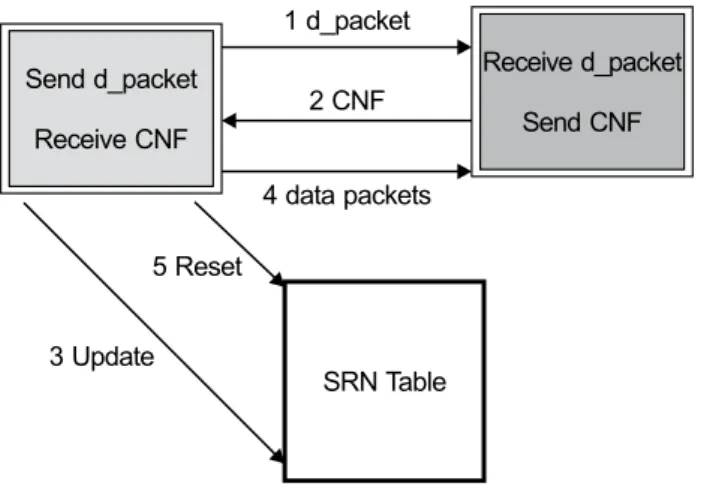
The module description of the proposed scheme is given in Figure 1, where d_packet is the dummy packet and CNF is confirmation signal. Various phases encountered by the nodes while establishing the path for data transmission in the network are as described below:
(i) Secure-BEFORE routing phase: A dummy packet is sent by source node towards the destination. The source waits until a CNF signal is received via intermediate nodes. Accordingly, the intermediate nodes and the source node modify the table values re-spectively once the CNF signal is received. (ii) Transmission phase: Once the table
modi-fications are carried out, actual data packet is sent to the destination through the inter-mediate nodes via which the CNF signal was received.
(iii) Updating phase: During the updating phase, after submission of consequent packets, Secure Route Node (SRN) table is updated.
MANET permits nodes to join and leave the system any time. This elementary property has rendered it powerless against different security attacks. Bhalaji [16] discusses relationship en-hanced DSR protocol that identifies the mali-cious nodes and isolates them from snooping and forwarding active data.
Methods to address link level security threats are proposed to lessen the threats while rout-ing in mobile ad hoc networks, as put forth by Garg and Mahapatra [17]. A trust model that mitigates the selfish behaviour of the nodes in delay tolerant network is proposed by Chen et al. [18]. Their proposed approach achieves improved delivery ratio with lesser delay com-pared to Bayesian based trust model.
Various schemes are proposed in literature in order to identify and isolate the malicious nodes and various security threats with few theoreti-cal proposals and few through simulations. However, perfect solutions which can curb
var-Table 1. Comparative analysis of approaches used in MANETs against malicious attack.
Existing Techniques Description Base protocol Types of attacks addressed Gap identified
Gupta and Pandey value mechanismHonest and Trust AODV with trust based Black hole attack Insecure
Tamilselvan and
Sankaranarayanan route reply table)CRRT (collect AODV
Black hole & cooperative Black
hole attack
May lead to stale entries
Li et al.
SVM (support vector machine) categorizes nodes
based on behavior metrics like PMR,PDR,PMER
Any MANET
routing protol Black hole attack
Overhead to populate and maintain XML data
Wahane et al. using DRI (data routing Modified AODV
information) table AODV Black hole attack
Overhead to maintain large number of entries in table at
every node
Balakrishnan and
Varadharajan Fellowship model using energy levels of nodes routing protocol Packet drop attackAny MANET
Involves complex mathematical computations
Buchegger and Le Boudec
CONFIDANT (Cooperation Of Nodes Fairness In Dynamic Ad hoc Networks)
and maintains a path rater
AODV Co-operative black hole attack Insecure
Proposed Approach
with 1-hop security strategy using AODVSecure-BEFORE AODV
Black hole, Worm hole and Gray hole attacks at source as well as at destination
Insecure against node capture attack
ious attacks in MANETs are still a deficit. Solu-tions proposed by the few are impractical, pro-vide lesser throughput or do not have much impact on the overall network performance. Few have comparable and measurable impact on network performance, but at the cost of se-curity risk in the network. Many of the earlier researchers have come up with theoretical solu-tions with no practical implementasolu-tions or sup-plemented experiments to address this issue. Few solutions have either been expensive to deal with or involved large and complex com-putations pertaining to maintenance of re-sources of network setup. This has lead to the need for a solution to restrain the impact of more than one type of attacks by a single strate-gic framework with optimum or best possible results, which has eventually been the motiva-tion behind this paper. Table 1 shows a compar-ative analysis emphasized with the perspective in which the proposed approach is better than existing approaches.
3. Proposed System Design
A secure-BEFORE (BEst FOrwarding Rout-ing Estimation) methodology is proposed, that not only mitigates various malicious attacks in MANETs, but also improves the overall network performance utilizing the optimum resources. For establishing a communication between a source S and the destination D, a Secure Route Node table (SRN table) is maintained at the source node S with fields holding values of hop count, packet equivalence ratio, trust_value and Optimum Route flag (OR_flag). When RREQ message is sent, the intermediate nodes having route to that particular destination respond with a RREP message back to the source node. At source node S, multiple RREP packets may be received. Since the proposed methodology follows 1-hop level, node S considers the RREP of only those nodes which are just one hop away from the destination for further processing. Fur-ther, a dummy packet (a packet with no data) is sent via intermediate nodes which are just 1 hop away towards the destination and wait un-til a confirmation signal (CNF) is received at the source via intermediate nodes. The dummy packet is received at the destination only via genuine nodes because malicious node either drops or diverts the packets without forwarding them towards the destination. Thus, the destina-tion node sends CNF signal through the inter-mediate node whose dummy packet reaches the destination correctly.
On receiving the CNF signal, the table values for OR_flag and the trust values are modified. The OR_flag is set to 1 and the trust value of intermediate genuine node is increased by 1 in SRN table which is maintained at source node S. Subsequent packets are then sent from source node to the destination through genuine inter-mediate nodes as per the update in the table. At the end of a complete data transmission, the OR_flag is reset back to 0. The node structure table is updated accordingly. It maintains the hop-count, packet equivalence ratio, trust val-ues and optimum route flag. These valval-ues are updated accordingly during various phases of the proposed approach as discussed.
Nomenclature:
● to_node: next node towards destination;
● Hop_count: number of hops between the source and destination;
● Packet Equivalence Ratio (P.E.R): number of packets received by a particular node to the number of packets transmitted from the same node;
● Trust_value: based on node’s behavior and previous history (integer values are as-signed);
● Optimum Route flag (OR_flag): taking boolean values, i.e. 0 or 1;
● SRN (Secure Route Node) table: maintains hop-count, packet equivalence ratio, trust_ value and Optimum Route flag (OR_flag).
3.1. Module Description
The module description of the proposed scheme is given in Figure 1, where d_packet is the dummy packet and CNF is confirmation signal. Various phases encountered by the nodes while establishing the path for data transmission in the network are as described below:
(i) Secure-BEFORE routing phase: A dummy packet is sent by source node towards the destination. The source waits until a CNF signal is received via intermediate nodes. Accordingly, the intermediate nodes and the source node modify the table values re-spectively once the CNF signal is received. (ii) Transmission phase: Once the table
modi-fications are carried out, actual data packet is sent to the destination through the inter-mediate nodes via which the CNF signal was received.
(iii) Updating phase: During the updating phase, after submission of consequent packets, Secure Route Node (SRN) table is updated.
Figure 1. Scenario description.
3.2. Justification Behind Using Dummy Packets to Detect Malicious Nodes
Handshake signals used to confirm the avail-ability of the intended nodes (control signals) at times do not help in obtaining a feasible se-cured route to forward data packets towards the destination. Moreover, they do not help in de-tecting the presence of malicious nodes in the network. Hence, the dummy packet is sent in as a preliminary handshaking signal which is treated as normal packet by all nodes in the net-work. Also, dummy packets do not carry any valid data while normal data packets carry valid data. Only the node that originates the dummy packet recognizes it. Dummy packet is dissem-inated in the network to observe the behavior of the nodes inside the network.
Trust_value component maintained in the SRN table is incremented only when the CNF sig-nal is sent back to the source from destination via genuine intermediate nodes. Such recorded update values in the SRN table ensure the opti-mum combination of trust value and the packet equivalence ratio which is further used to de-termine the next best-fit forwarding node for packet transmission. The motive of proposing a 1-hop security scheme aiming at the destina-tion node is that most attacks are targeted at the point just before the packet reaches the destina-tion as the volume of valuable informadestina-tion that could be sneaked or affected would be high. Hence, this proposed approach incorporates the authentication scheme just before the destina-tion, i.e. at the node closer to the destination just at 1-hop level only.
From the simulation results obtained with dif-ferent scenarios, considering the presence of malicious node and absence of malicious node, different time intervals, and the number of re-transmission attempts made, it is observed that the proposed 1-hop secure-BEFORE routing strategy outperforms the existing work in terms of better throughput and overall network per-formance.
It is observed that the nodes closer to the des-tination node or the desdes-tination node itself are targeted more by suspicious nodes aiming to deprive valuable content since the packets travel long distance consuming the network re-sources. When packets traverse from a source all the way and get dropped just nearer / closer to the destination before they reach the destina-tion, they lead to loss in more information and cause more impact on the performance of the network in terms of retransmissions.
The threshold value for trust is decided mutu-ally using agreement protocols among all the nodes in the network and the nodes with lesser trust value i.e. the value crossing minimum threshold, for a longer time is expelled out of the network. Results obtained after implement-ing the proposed 1-hop security against gray hole attack at source, destination and against packet drop attack, worm hole attack reveals a substantial improvement in throughput, packet delivery ratio and less end-to-end delay, thus improving the overall network performance. The trust values are updated periodically, thus improving the life of the network as a whole. Different scenarios with and without malicious nodes as described below are analyzed with the proposed approach.
Case i. Presence of one genuine node and one malicious node, both at one-hop level distance from destination is considered and secure-BE-FORE routing strategy is applied.
Case ii. Presence of one or more malicious nodes at one-hop level distance from desti-nation is considered. Packets will not be sent unless there is occurrence of a genuine node at one-hop distance and verification of the same is done using secure-BEFORE strategy.
Case iii. With presence of one or more genu-ine nodes at one-hop level distance from desti-nation, the node with better trust value is used to forward the packets. Also, if both genuine
nodes have same trust value, then either of the nodes based on the distance metric is chosen for further packet transmissions.
3.3. Sample Scenario Illustration
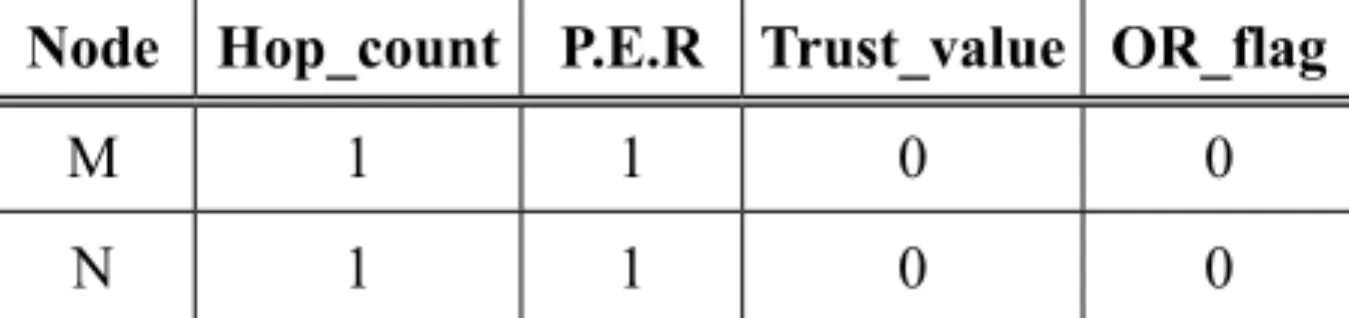
In order to implement one-hop level security using secure-BEFORE routing strategy, a sam-ple network scenario as shown in Figure 2 is considered to track the behavior of malicious nodes for illustration. It consists of source node S, destination node D, malicious node M and a normal node N. Source node S is 2 hops away from the destination node D and the interme-diate nodes M and N are just 1 hop away from the destination node D. Sample node structure followed at source node S is given in Table 2.
Figure 2. Basic network scenario.
Table 2. Node structure at source node (SRN table).
Node Hop_count P.E.R Trust_value OR_flag
M 1 1 0 0
N 1 1 0 0
Primarily, the network setup is done with few mobile nodes along with Application, Profile and Mobility Configuration set in the simula-tion environment. The settings are done with applications and profiles created to render FTP, Email and Database services inside the net-work. The initial trust_value for both nodes is assumed as 0 and P.E.R is set as 1. Normal nodes maintain good ratio of packet delivery. So, P.E.R values are mostly 1, since they for-ward all the packets tofor-wards destination, while the malicious nodes have poor packet delivery ratio since they tend to drop the packets to dis-rupt the network performance and hence P.E.R
is modified accordingly.
The route discovery phase begins by sending Route Request (RREQ) message from source node to next hop node in search of optimum route to destination node D. In mobile ad hoc networks route establishment relies on the par-ticipation of the neighbor nodes which act as forwarders until a path is established for the packets to reach the destination. The intermedi-ate nodes having a route to destination respond with Route Reply (RREP), towards source node and the rest simply forwards it to their next hop nodes. This process is repeated until a route to the destination node is established.
Upon the successful exchange of RREQ and RREP messages among the nodes forming the network, a dummy packet is sent by the source, to determine the genuine nodes with the one-hop level secure-BEFORE strategy us-ing AODV as base routus-ing protocol. Once the exchange of dummy packet and confirmation signal are performed, packet transmission is initiated successfully.
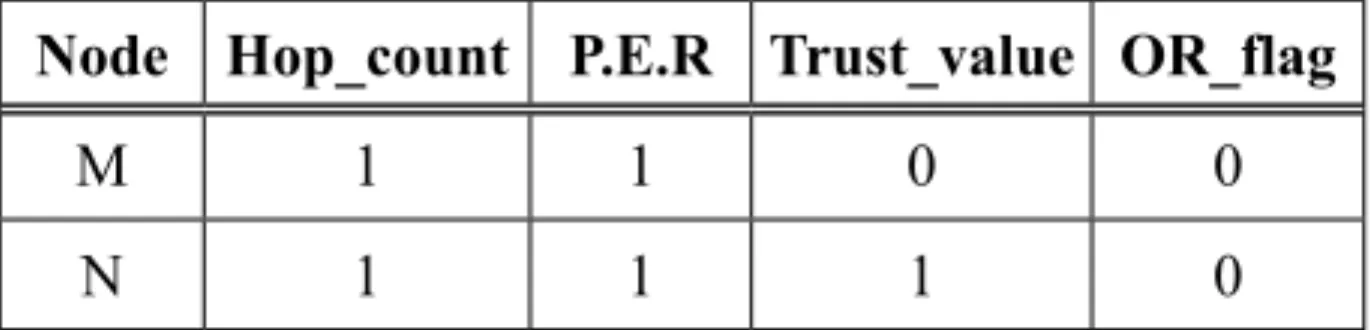
To achieve this, packet size is kept constant (0) in the node setting of source, intermediate and at the destination. Also, a packet discarder is used which drops every packet destined to it. This is done to ensure that the dummy packet reaches destination via the normal node and not through the packet discarder. The settings are as given: start time = 5.0 ms, end time = 300 ms, discard count = All. After CNF signal is re-ceived, node S updates the OR_flag by setting it to 1 and also increases the trust_value of node N by 1 as shown in Table 3.
Table 3. Modified node structure at source node (SRN table).
Node Hop_count P.E.R Trust_value OR_flag
M 1 1 0 0
N 1 1 1 1
Figure 1. Scenario description.
3.2. Justification Behind Using Dummy Packets to Detect Malicious Nodes
Handshake signals used to confirm the avail-ability of the intended nodes (control signals) at times do not help in obtaining a feasible se-cured route to forward data packets towards the destination. Moreover, they do not help in de-tecting the presence of malicious nodes in the network. Hence, the dummy packet is sent in as a preliminary handshaking signal which is treated as normal packet by all nodes in the net-work. Also, dummy packets do not carry any valid data while normal data packets carry valid data. Only the node that originates the dummy packet recognizes it. Dummy packet is dissem-inated in the network to observe the behavior of the nodes inside the network.
Trust_value component maintained in the SRN table is incremented only when the CNF sig-nal is sent back to the source from destination via genuine intermediate nodes. Such recorded update values in the SRN table ensure the opti-mum combination of trust value and the packet equivalence ratio which is further used to de-termine the next best-fit forwarding node for packet transmission. The motive of proposing a 1-hop security scheme aiming at the destina-tion node is that most attacks are targeted at the point just before the packet reaches the destina-tion as the volume of valuable informadestina-tion that could be sneaked or affected would be high. Hence, this proposed approach incorporates the authentication scheme just before the destina-tion, i.e. at the node closer to the destination just at 1-hop level only.
From the simulation results obtained with dif-ferent scenarios, considering the presence of malicious node and absence of malicious node, different time intervals, and the number of re-transmission attempts made, it is observed that the proposed 1-hop secure-BEFORE routing strategy outperforms the existing work in terms of better throughput and overall network per-formance.
It is observed that the nodes closer to the des-tination node or the desdes-tination node itself are targeted more by suspicious nodes aiming to deprive valuable content since the packets travel long distance consuming the network re-sources. When packets traverse from a source all the way and get dropped just nearer / closer to the destination before they reach the destina-tion, they lead to loss in more information and cause more impact on the performance of the network in terms of retransmissions.
The threshold value for trust is decided mutu-ally using agreement protocols among all the nodes in the network and the nodes with lesser trust value i.e. the value crossing minimum threshold, for a longer time is expelled out of the network. Results obtained after implement-ing the proposed 1-hop security against gray hole attack at source, destination and against packet drop attack, worm hole attack reveals a substantial improvement in throughput, packet delivery ratio and less end-to-end delay, thus improving the overall network performance. The trust values are updated periodically, thus improving the life of the network as a whole. Different scenarios with and without malicious nodes as described below are analyzed with the proposed approach.
Case i. Presence of one genuine node and one malicious node, both at one-hop level distance from destination is considered and secure-BE-FORE routing strategy is applied.
Case ii. Presence of one or more malicious nodes at one-hop level distance from desti-nation is considered. Packets will not be sent unless there is occurrence of a genuine node at one-hop distance and verification of the same is done using secure-BEFORE strategy.
Case iii. With presence of one or more genu-ine nodes at one-hop level distance from desti-nation, the node with better trust value is used to forward the packets. Also, if both genuine
nodes have same trust value, then either of the nodes based on the distance metric is chosen for further packet transmissions.
3.3. Sample Scenario Illustration
In order to implement one-hop level security using secure-BEFORE routing strategy, a sam-ple network scenario as shown in Figure 2 is considered to track the behavior of malicious nodes for illustration. It consists of source node S, destination node D, malicious node M and a normal node N. Source node S is 2 hops away from the destination node D and the interme-diate nodes M and N are just 1 hop away from the destination node D. Sample node structure followed at source node S is given in Table 2.
Figure 2. Basic network scenario.
Table 2. Node structure at source node (SRN table).
Node Hop_count P.E.R Trust_value OR_flag
M 1 1 0 0
N 1 1 0 0
Primarily, the network setup is done with few mobile nodes along with Application, Profile and Mobility Configuration set in the simula-tion environment. The settings are done with applications and profiles created to render FTP, Email and Database services inside the net-work. The initial trust_value for both nodes is assumed as 0 and P.E.R is set as 1. Normal nodes maintain good ratio of packet delivery. So, P.E.R values are mostly 1, since they for-ward all the packets tofor-wards destination, while the malicious nodes have poor packet delivery ratio since they tend to drop the packets to dis-rupt the network performance and hence P.E.R
is modified accordingly.
The route discovery phase begins by sending Route Request (RREQ) message from source node to next hop node in search of optimum route to destination node D. In mobile ad hoc networks route establishment relies on the par-ticipation of the neighbor nodes which act as forwarders until a path is established for the packets to reach the destination. The intermedi-ate nodes having a route to destination respond with Route Reply (RREP), towards source node and the rest simply forwards it to their next hop nodes. This process is repeated until a route to the destination node is established.
Upon the successful exchange of RREQ and RREP messages among the nodes forming the network, a dummy packet is sent by the source, to determine the genuine nodes with the one-hop level secure-BEFORE strategy us-ing AODV as base routus-ing protocol. Once the exchange of dummy packet and confirmation signal are performed, packet transmission is initiated successfully.
To achieve this, packet size is kept constant (0) in the node setting of source, intermediate and at the destination. Also, a packet discarder is used which drops every packet destined to it. This is done to ensure that the dummy packet reaches destination via the normal node and not through the packet discarder. The settings are as given: start time = 5.0 ms, end time = 300 ms, discard count = All. After CNF signal is re-ceived, node S updates the OR_flag by setting it to 1 and also increases the trust_value of node N by 1 as shown in Table 3.
Table 3. Modified node structure at source node (SRN table).
Node Hop_count P.E.R Trust_value OR_flag
M 1 1 0 0
N 1 1 1 1
route back on reverse path towards the source node S, as shown in Figure 3.
Figure 3. Network scenario with confirmation exchange.
Since the dummy packet forwarded via normal node reaches the destination, the destination node sends a CNF signal via same route to-wards the source node using reverse path. Thus, the source node confirms the best link to for-ward actual data packet and performs the data transmission subsequently via genuine nodes thus resetting the values in SRN table, as shown in Table 4.
Table 4. Updated node structure at source node (SRN table).
Node Hop_count P.E.R Trust_value OR_flag
M 1 1 0 0
N 1 1 1 0
Once the values are updated, the source node S sends actual data packets towards the destina-tion node D through the optimum path identi-fied as trusted path (node N in this case). Thus, subsequent data packet transmission is done and OR_flag is reset to 0 periodically. This is achieved in OPNET by setting packet inter-ar-rival time to exponential (0.03) and packet size as exponential (16000) for the nodes inside MANET in order to proceed with packet trans-mission and reception.
The network scenario is simulated in OPNET considering both the cases, such as with the presence of the malicious nodes using a packet discarder inside the network as well as the case where the malicious node is removed from the network where its trust value and packet
equiv-alence ratio are poor. The parameters used for the analysis are traffic sent, traffic received, number of retransmission attempts made, route discovery time, load and throughput.
Initial trust value of zero is assigned to all the nodes in the network. Trust values are updated based on the nodes experience during packet transmissions, as described. Based on the up-dated trust values, best 1-hop node is chosen for packet forwarding. The trust value of the node from which the confirmation is received is incremented. The trust value of the sus-pected node is checked to see if it is below the threshold. If so, the node is expelled from the network. Otherwise, packet transmission is set for the chosen route through the genuine nodes, as described in the flow diagram given in Figure 4.
Figure 4. Flowchart of Secure BEFORE routing scheme.
For optimum selection of the node to send the data packets, the proposed scheme can be math-ematically computed as given in (1),
j
via Node j j
1
SBSP P.E.R n trust on Node
i=
= ∗
∑
(1)where SBSPvia Nodej is Secure-BEFORE
Short-est Path via Nodej and P.E.Rj is the Packet
Equivalence Ratio for Nodej and ∑ (i = 1 to n)
is the summation of the trust values for Nodej
for recent n different sessions and Nodej is the
node for which trust values are computed to ob-tain Secure-BEFORE Shortest Path.
4. Implementation Methodology
To simulate and demonstrate the effects of ma-licious attacks in MANET and to understand its consequences through simulation study, there is a need to use a discrete event simulator. A very wide variety of simulation tools are available like NS-2, OPNET [19], Glomosim, QualNet, OMNet++ etc. OPNET is used in this simula-tion study which provides better results with accuracy and supports with a user friendly GUI interface on Windows platform. OPNET 17.5 (formerly known as Riverbed 17.5 modeler) is used with Windows platform (32/64 bit OS) us-ing Visual studio and C++ library.
4.1. Sample Scenario
A campus network scenario of 800 m × 800 m is created with 10 mobile nodes. IEEE 802.11 wireless network standard is used to deploy the application scenario. Application configuration is profoundly used to run the applications on mobile nodes in the network and configure the user profile. Profile configuration and mobility configuration settings such as start time, dura-tion, number of repetitions and the application profile are set as specified in Table 5. Perfor-mance of the network in the presence and ab-sence of malicious nodes is observed. Further, the behavior of the malicious nodes with and without the proposed defense mechanism is ob-served.
Table 5. Profile and mobility settings.
Profile Config.
Settings Value
Mobility Config.
Settings Value
Start time Uniform (5,10) Speed Uniform int (0,10)
Duration End of profile Pause time Constant (50)
No. of
repetitions Unlimited Start time Constant (10) Appln.
profiles (ordered)Serial Stop time simulationEnd of
Parameters such as the channel settings, routing protocol, network layer protocol used, physical characteristics, data rate, buffer size, duration of simulation etc. are set for the simulations as shown in Table 6.
Table 6. Parameter settings.
Parameter Value
Campus Network 800 m × 800 m
Simulation time 300 (s)
No. of nodes 10
Routing Protocol AODV
Networking protocol IP
Application FTP, Database and Email
Seed value 128
Kernel mode Optimized
Operation mode Serial (ordered)
Start time Uniform (100,110)
Duration End of simulation
Data rate 11 Mbps
Buffer size (bits) 1024000
4.2. Network Model (With and Without Malicious Nodes)
route back on reverse path towards the source node S, as shown in Figure 3.
Figure 3. Network scenario with confirmation exchange.
Since the dummy packet forwarded via normal node reaches the destination, the destination node sends a CNF signal via same route to-wards the source node using reverse path. Thus, the source node confirms the best link to for-ward actual data packet and performs the data transmission subsequently via genuine nodes thus resetting the values in SRN table, as shown in Table 4.
Table 4. Updated node structure at source node (SRN table).
Node Hop_count P.E.R Trust_value OR_flag
M 1 1 0 0
N 1 1 1 0
Once the values are updated, the source node S sends actual data packets towards the destina-tion node D through the optimum path identi-fied as trusted path (node N in this case). Thus, subsequent data packet transmission is done and OR_flag is reset to 0 periodically. This is achieved in OPNET by setting packet inter-ar-rival time to exponential (0.03) and packet size as exponential (16000) for the nodes inside MANET in order to proceed with packet trans-mission and reception.
The network scenario is simulated in OPNET considering both the cases, such as with the presence of the malicious nodes using a packet discarder inside the network as well as the case where the malicious node is removed from the network where its trust value and packet
equiv-alence ratio are poor. The parameters used for the analysis are traffic sent, traffic received, number of retransmission attempts made, route discovery time, load and throughput.
Initial trust value of zero is assigned to all the nodes in the network. Trust values are updated based on the nodes experience during packet transmissions, as described. Based on the up-dated trust values, best 1-hop node is chosen for packet forwarding. The trust value of the node from which the confirmation is received is incremented. The trust value of the sus-pected node is checked to see if it is below the threshold. If so, the node is expelled from the network. Otherwise, packet transmission is set for the chosen route through the genuine nodes, as described in the flow diagram given in Figure 4.
Figure 4. Flowchart of Secure BEFORE routing scheme.
For optimum selection of the node to send the data packets, the proposed scheme can be math-ematically computed as given in (1),
j
via Node j j
1
SBSP P.E.R n trust on Node
i=
= ∗
∑
(1)where SBSPvia Nodej is Secure-BEFORE
Short-est Path via Nodej and P.E.Rj is the Packet
Equivalence Ratio for Nodej and ∑ (i = 1 to n)
is the summation of the trust values for Nodej
for recent n different sessions and Nodej is the
node for which trust values are computed to ob-tain Secure-BEFORE Shortest Path.
4. Implementation Methodology
To simulate and demonstrate the effects of ma-licious attacks in MANET and to understand its consequences through simulation study, there is a need to use a discrete event simulator. A very wide variety of simulation tools are available like NS-2, OPNET [19], Glomosim, QualNet, OMNet++ etc. OPNET is used in this simula-tion study which provides better results with accuracy and supports with a user friendly GUI interface on Windows platform. OPNET 17.5 (formerly known as Riverbed 17.5 modeler) is used with Windows platform (32/64 bit OS) us-ing Visual studio and C++ library.
4.1. Sample Scenario
A campus network scenario of 800 m × 800 m is created with 10 mobile nodes. IEEE 802.11 wireless network standard is used to deploy the application scenario. Application configuration is profoundly used to run the applications on mobile nodes in the network and configure the user profile. Profile configuration and mobility configuration settings such as start time, dura-tion, number of repetitions and the application profile are set as specified in Table 5. Perfor-mance of the network in the presence and ab-sence of malicious nodes is observed. Further, the behavior of the malicious nodes with and without the proposed defense mechanism is ob-served.
Table 5. Profile and mobility settings.
Profile Config.
Settings Value
Mobility Config.
Settings Value
Start time Uniform (5,10) Speed Uniform int (0,10)
Duration End of profile Pause time Constant (50)
No. of
repetitions Unlimited Start time Constant (10) Appln.
profiles (ordered)Serial Stop time simulationEnd of
Parameters such as the channel settings, routing protocol, network layer protocol used, physical characteristics, data rate, buffer size, duration of simulation etc. are set for the simulations as shown in Table 6.
Table 6. Parameter settings.
Parameter Value
Campus Network 800 m × 800 m
Simulation time 300 (s)
No. of nodes 10
Routing Protocol AODV
Networking protocol IP
Application FTP, Database and Email
Seed value 128
Kernel mode Optimized
Operation mode Serial (ordered)
Start time Uniform (100,110)
Duration End of simulation
Data rate 11 Mbps
Buffer size (bits) 1024000
4.2. Network Model (With and Without Malicious Nodes)
maliciously inside the network. To achieve this, the packet interval size is increased to expo-nential (0.005) and packet size is kept as uni-form (190,220). Unlike the network with nor-mal nodes, it is observed that the frequency of packet drops is high in the network with mali-cious nodes.
Figures 5 and 6 show the comparative results in terms of packets sent, packets received and packets dropped with respect to a network with all normal behaving nodes and the network with malicious nodes. It is observed that the packet delivery ratio is high in the network with normal nodes and comparatively less in the net-work with malicious nodes.
Figure 5. Normal network model: Time (s) vs. Number of packets (bits/sec).
Figure 6. Malicious network model: Time (s) vs. Number of packets (bits/sec).
5. Simulation Results
and Discussions
The proposed approach is simulated in differ-ent phases of network scenarios using OPNET. The network scenario which includes the pres-ence of malicious nodes with no use of any defensive mechanism to curb it, is compared against the network scenario which involves malicious nodes which are curbed by making use of the proposed 1-hop security mechanism (Secure-BEFORE routing).
The parameters considered for evaluation are end-to-end delay, retransmission attempts, route discovery time, total number of packets dropped, network load and throughput gener-ated. Table 7 provides the simulation results ob-tained for various parameters of a network in-corporating normal nodes and malicious nodes.
Table 7. Simulation results.
Parameter (network with Values normal nodes)
Values (net-work with
ma-licious nodes) Delay (s) range 1 – 1.5 2 – 10
Throughput
(bits/sec) 44000500000 – 000 33000500000 – 000 Network load
(bits/sec) 400000 300000
Traffic sent
(bits/sec) 5000000 2500000 Traffic received
(bits/sec) 4000000 1500000 Number
of packets
dropped 100 650–850
Route discovery
time (s) 2 s 10 s
Retransmission
attempts (s) 0.35–0.45 0.18–0.35
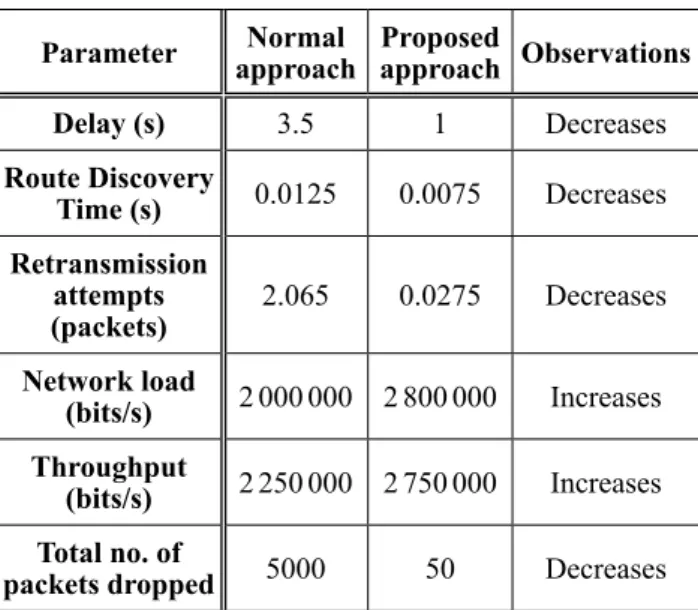
The simulation results obtained and the obser-vations made are given in Table 8 upon compar-ing the traditional approach with the proposed 1-hop Secure-BEFORE Routing approach.
Table 8. Comparison of statistical values.
Parameter approachNormal Proposed approach Observations
Delay (s) 3.5 1 Decreases
Route Discovery
Time (s) 0.0125 0.0075 Decreases Retransmission
attempts
(packets) 2.065 0.0275 Decreases Network load
(bits/s) 2000000 2800000 Increases Throughput
(bits/s) 2250000 2750000 Increases Total no. of
packets dropped 5000 50 Decreases
The normal approach has no defensive strategy to reduce the harm done by malicious nodes on network performance while the proposed ap-proach makes use of 1-hop security level termed as secure-BEFORE strategy to mitigate the harm done by malicious nodes. From the results obtained, it is observed that the performance of network in the presence of malicious nodes, when addressed using secure-BEFORE strat-egy, is much better than the network scenario with presence of malicious nodes without use of any defensive mechanism against malicious attacks. The delay and retransmission attempts are reduced by 71% and 98% respectively, since the packets are sent without much delay and eventually leading to lesser frequency in re-transmission attempts. Since lesser number of packets gets dropped, the time required to find new route to send packets i.e. the route discov-ery time and total number of packets dropped are also observed to have reduced considerably by 40% and 99% respectively.
The network is maintained to sustain the traf-fic flow and the packet delivery ratio. The throughput generated is more than normal network scenario and shows an increase of around 22% because the overall improvement of other network parameters also (in turn) helps to improve the network throughput. Thus, the 1-hop secure-BEFORE strategy on an over-all perspective proves to improve the network performance and provides a reliable network avoiding malicious attacks during the packet transmission.
Figures 7, 8, 9, 10 and 11 represent the impact on the network parameters chosen for analysis such as throughput, network load, traffic sent, traffic received and packet drop rate respec-tively. As observed from Figure 7, the through-put of the network without malicious nodes is high compared to the network with malicious nodes. With respect to network load in Figure 8, network without malicious nodes is able to sup-port more load as compared to the network with malicious nodes.
Figures 9 and 10 prove that the number of pack-ets sent and received is (relatively) higher in the network without malicious nodes than in the network with malicious nodes. The packet drop rate is less in the network without malicious nodes than in the network with malicious nodes as malicious nodes tend to drop the packets as given in Figure 11.
Figure 7. Time (s) vs Throughput (bits/sec).
maliciously inside the network. To achieve this, the packet interval size is increased to expo-nential (0.005) and packet size is kept as uni-form (190,220). Unlike the network with nor-mal nodes, it is observed that the frequency of packet drops is high in the network with mali-cious nodes.
Figures 5 and 6 show the comparative results in terms of packets sent, packets received and packets dropped with respect to a network with all normal behaving nodes and the network with malicious nodes. It is observed that the packet delivery ratio is high in the network with normal nodes and comparatively less in the net-work with malicious nodes.
Figure 5. Normal network model: Time (s) vs. Number of packets (bits/sec).
Figure 6. Malicious network model: Time (s) vs. Number of packets (bits/sec).
5. Simulation Results
and Discussions
The proposed approach is simulated in differ-ent phases of network scenarios using OPNET. The network scenario which includes the pres-ence of malicious nodes with no use of any defensive mechanism to curb it, is compared against the network scenario which involves malicious nodes which are curbed by making use of the proposed 1-hop security mechanism (Secure-BEFORE routing).
The parameters considered for evaluation are end-to-end delay, retransmission attempts, route discovery time, total number of packets dropped, network load and throughput gener-ated. Table 7 provides the simulation results ob-tained for various parameters of a network in-corporating normal nodes and malicious nodes.
Table 7. Simulation results.
Parameter (network with Values normal nodes)
Values (net-work with
ma-licious nodes) Delay (s) range 1 – 1.5 2 – 10
Throughput
(bits/sec) 44000500000 – 000 33000500000 – 000 Network load
(bits/sec) 400000 300000
Traffic sent
(bits/sec) 5000000 2500000 Traffic received
(bits/sec) 4000000 1500000 Number
of packets
dropped 100 650–850
Route discovery
time (s) 2 s 10 s
Retransmission
attempts (s) 0.35–0.45 0.18–0.35
The simulation results obtained and the obser-vations made are given in Table 8 upon compar-ing the traditional approach with the proposed 1-hop Secure-BEFORE Routing approach.
Table 8. Comparison of statistical values.
Parameter approachNormal Proposed approach Observations
Delay (s) 3.5 1 Decreases
Route Discovery
Time (s) 0.0125 0.0075 Decreases Retransmission
attempts
(packets) 2.065 0.0275 Decreases Network load
(bits/s) 2000000 2800000 Increases Throughput
(bits/s) 2250000 2750000 Increases Total no. of
packets dropped 5000 50 Decreases
The normal approach has no defensive strategy to reduce the harm done by malicious nodes on network performance while the proposed ap-proach makes use of 1-hop security level termed as secure-BEFORE strategy to mitigate the harm done by malicious nodes. From the results obtained, it is observed that the performance of network in the presence of malicious nodes, when addressed using secure-BEFORE strat-egy, is much better than the network scenario with presence of malicious nodes without use of any defensive mechanism against malicious attacks. The delay and retransmission attempts are reduced by 71% and 98% respectively, since the packets are sent without much delay and eventually leading to lesser frequency in re-transmission attempts. Since lesser number of packets gets dropped, the time required to find new route to send packets i.e. the route discov-ery time and total number of packets dropped are also observed to have reduced considerably by 40% and 99% respectively.
The network is maintained to sustain the traf-fic flow and the packet delivery ratio. The throughput generated is more than normal network scenario and shows an increase of around 22% because the overall improvement of other network parameters also (in turn) helps to improve the network throughput. Thus, the 1-hop secure-BEFORE strategy on an over-all perspective proves to improve the network performance and provides a reliable network avoiding malicious attacks during the packet transmission.
Figures 7, 8, 9, 10 and 11 represent the impact on the network parameters chosen for analysis such as throughput, network load, traffic sent, traffic received and packet drop rate respec-tively. As observed from Figure 7, the through-put of the network without malicious nodes is high compared to the network with malicious nodes. With respect to network load in Figure 8, network without malicious nodes is able to sup-port more load as compared to the network with malicious nodes.
Figures 9 and 10 prove that the number of pack-ets sent and received is (relatively) higher in the network without malicious nodes than in the network with malicious nodes. The packet drop rate is less in the network without malicious nodes than in the network with malicious nodes as malicious nodes tend to drop the packets as given in Figure 11.
Figure 7. Time (s) vs Throughput (bits/sec).
Figure 9. Time(s) vs. Traffic sent (bits/sec).
Figure 10. Time (s) vs.Traffic received (bits/sec).
Figure 11. Time (s) vs. Number of packets dropped.
Similarly, Figures 12, and 13 represent the route discovery time and the number of
re-transmission attempts respectively where trial2_tryagain_mail-scenario 1-DES-1 is the network scenario with normal nodes and Re-view-2-scenario1 malicious-DES-1 is the net-work scenario with malicious nodes.
Figure 12. Time (s) vs. Route discovery time (s).
Figure 13. Time (s) vs. Number of retransmission attempts.
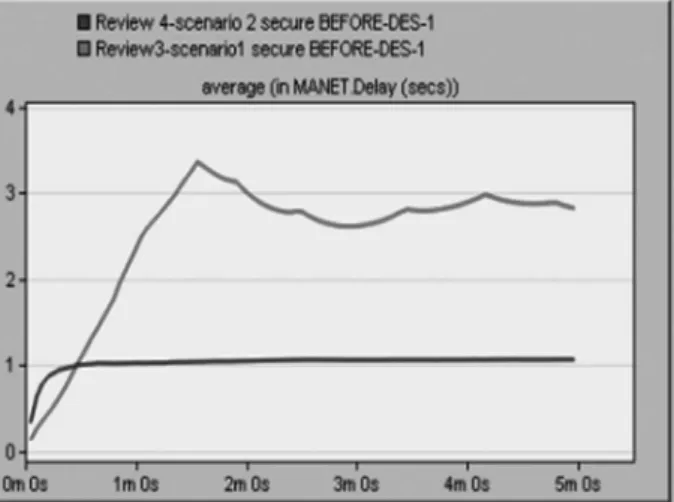
Review 3-scenario1 secure BEFORE-DES-1 is the network scenario with malicious nodes without any defense mechanism and Review 4-scenario 2 secure BEFORE-DES-1 is the network scenario with malicious nodes using the proposed secure-BEFORE routing strategy used as a defensive mechanism in the proposed approach. Figures 14, 15, 16 and 17 represent the network parameters such as packet delivery ratio, network load, number of retransmission attempts and route discovery time respectively. From Figure 14, it is observed that the packet
delivery ratio in the network with the proposed defensive mechanism is high, with good sup-port of network load as in Figure 15.
Figure 14. Traffic analysis time (s) vs. Traffic sent/received (bits/sec).
Figure 15. Time (s) vs. Network load (bits/sec).
Figure 16 shows that the number of retransmis-sion attempt is less with the proposed defense mechanism and the route discovery time is min-imal as given in Figure 17. Also, it is observed that the following parameters outperform the traditional approach in terms of throughput (Figure 18), which is high using the defensive mechanism with the proposed approach to alle-viate the malicious nodes. In addition, the num-ber of packets dropped and the delay incurred (as obtained and given in Figures 19 and 20) indicate that the drop rate is less and the delay incurred is minimal, too.
Figure 16. Time (s) vs. Number of retransmission attempts.
Figure 17. Time (s) vs. Route discovery time (s).
Figure 9. Time(s) vs. Traffic sent (bits/sec).
Figure 10. Time (s) vs.Traffic received (bits/sec).
Figure 11. Time (s) vs. Number of packets dropped.
Similarly, Figures 12, and 13 represent the route discovery time and the number of
re-transmission attempts respectively where trial2_tryagain_mail-scenario 1-DES-1 is the network scenario with normal nodes and Re-view-2-scenario1 malicious-DES-1 is the net-work scenario with malicious nodes.
Figure 12. Time (s) vs. Route discovery time (s).
Figure 13. Time (s) vs. Number of retransmission attempts.
Review 3-scenario1 secure BEFORE-DES-1 is the network scenario with malicious nodes without any defense mechanism and Review 4-scenario 2 secure BEFORE-DES-1 is the network scenario with malicious nodes using the proposed secure-BEFORE routing strategy used as a defensive mechanism in the proposed approach. Figures 14, 15, 16 and 17 represent the network parameters such as packet delivery ratio, network load, number of retransmission attempts and route discovery time respectively. From Figure 14, it is observed that the packet
delivery ratio in the network with the proposed defensive mechanism is high, with good sup-port of network load as in Figure 15.
Figure 14. Traffic analysis time (s) vs. Traffic sent/received (bits/sec).
Figure 15. Time (s) vs. Network load (bits/sec).
Figure 16 shows that the number of retransmis-sion attempt is less with the proposed defense mechanism and the route discovery time is min-imal as given in Figure 17. Also, it is observed that the following parameters outperform the traditional approach in terms of throughput (Figure 18), which is high using the defensive mechanism with the proposed approach to alle-viate the malicious nodes. In addition, the num-ber of packets dropped and the delay incurred (as obtained and given in Figures 19 and 20) indicate that the drop rate is less and the delay incurred is minimal, too.
Figure 16. Time (s) vs. Number of retransmission attempts.
Figure 17. Time (s) vs. Route discovery time (s).